

ISO 18538:2015
(Main)Traceability of molluscan products — Specifications on the information to be recorded in farmed molluscan distribution chains
General Information
- Abstract
ISO 18538:2015 specifies the information to be recorded in farmed molluscs supply chains (excluding cephalopods) in order to establish the traceability of products originating from farm-raised molluscs. It specifies how molluscan products traded are to be identified and the information to be generated and held on those products by each of the food businesses that physically trade them through the distribution chains. It is specific to the distribution for human consumption of molluscs and their products from farm through to retailers or caterers.
- Status
- Published
- Publication Date
- 03-Aug-2015
- Technical Committee
- ISO/TC 234 - Fisheries and aquaculture
- Drafting Committee
- ISO/TC 234 - Fisheries and aquaculture
- Current Stage
- 9093 - International Standard confirmed
- Start Date
- 10-Jun-2025
- Completion Date
- 29-Aug-2026
Buy Documents


ISO 18538:2015 - Traceability of molluscan products -- Specifications on the information to be recorded in farmed molluscan distribution chains

ISO 18538:2015 - Traceability of molluscan products — Specifications on the information to be recorded in farmed molluscan distribution chains/4/2015
Overview
ISO 18538:2015 - Traceability of molluscan products specifies the information to be recorded in farmed molluscs supply chains (excluding cephalopods) to establish product traceability from farm to retailer or caterer. The standard defines how molluscan products traded for human consumption are to be identified, what information each food business must generate and retain, and how trade units and logistic units should be managed. It is applicable to the full distribution chain for farmed mussels, oysters, scallops, clams, cockles and abalone (farm, hatchery, depuration, processing, transport, wholesale, retail, catering and feed production).
Key topics and technical requirements
- Unique identification of units: Trade units (TU) and logistic units (LU) must be labelled with unique identifiers (UTUI and ULUI). These can be globally unique (e.g., GS1 SGTIN, SSCC) or unique within an agreed scope.
- Information recording: Each business that physically trades or transforms units must generate and keep specified information tied to the unit IDs so products can be traced through the chain.
- Pragmatic traceability: The standard recognises mixing and grouping (grading, processing) are commercially necessary; it requires traceability from the point where unique identification is possible and recording of parent/child relationships between created and received units.
- Sector-specific processes: Requirements cover controlled relaying, depuration, shucking/processing, hatcheries/nurseries, broodstock and seed suppliers, farms, transport and storage, traders/wholesalers, retailers/caterers, and feed producers.
- Data formats and interoperability: ISO 18538 is designed for electronic data representation but supports paper systems; it references ISO 8601 for date/time formats and is compatible with GS1 identifiers and industry data standards.
Practical applications
- Support for food safety and recall management by enabling rapid identification of affected batches.
- Basis for audits and certification of traceability in aquaculture and molluscan processing.
- Improved supply chain transparency for buyers, regulators and consumers.
- Operational use by processors and logistics partners to maintain chain visibility during depuration, relaying and grading.
- Integration into digital traceability platforms, ERP systems and labeling/packaging workflows.
Who will use this standard
- Aquaculture farmers, hatcheries, broodstock and seed suppliers
- Processors, depuration facilities and shucking operations
- Transporters, cold-store operators, traders and wholesalers
- Retailers, caterers, regulators and certification bodies
- IT providers building traceability and supply‑chain solutions for molluscan products
Related standards
- ISO 8601 (date/time formats) - normatively referenced
- ISO 9000 (traceability concepts) - traceability definitions and principles
- GS1 system identifiers (GTIN, SGTIN, SSCC, GLN) - commonly used for global unique IDs in supply chains
Keywords: ISO 18538:2015, traceability of molluscan products, farmed molluscs, supply chain traceability, UTUI, ULUI, depuration, relaying, GS1.
Buy Documents
ISO 18538:2015 - Traceability of molluscan products -- Specifications on the information to be recorded in farmed molluscan distribution chains
ISO 18538:2015 - Traceability of molluscan products — Specifications on the information to be recorded in farmed molluscan distribution chains/4/2015
Get Certified
Connect with accredited certification bodies for this standard

BSI Group
BSI (British Standards Institution) is the business standards company that helps organizations make excellence a habit.

Bureau Veritas
Bureau Veritas is a world leader in laboratory testing, inspection and certification services.

DNV
DNV is an independent assurance and risk management provider.
Sponsored listings
Frequently Asked Questions
ISO 18538:2015 is a standard published by the International Organization for Standardization (ISO). Its full title is "Traceability of molluscan products — Specifications on the information to be recorded in farmed molluscan distribution chains". This standard covers: ISO 18538:2015 specifies the information to be recorded in farmed molluscs supply chains (excluding cephalopods) in order to establish the traceability of products originating from farm-raised molluscs. It specifies how molluscan products traded are to be identified and the information to be generated and held on those products by each of the food businesses that physically trade them through the distribution chains. It is specific to the distribution for human consumption of molluscs and their products from farm through to retailers or caterers.
ISO 18538:2015 specifies the information to be recorded in farmed molluscs supply chains (excluding cephalopods) in order to establish the traceability of products originating from farm-raised molluscs. It specifies how molluscan products traded are to be identified and the information to be generated and held on those products by each of the food businesses that physically trade them through the distribution chains. It is specific to the distribution for human consumption of molluscs and their products from farm through to retailers or caterers.
ISO 18538:2015 is classified under the following ICS (International Classification for Standards) categories: 67.120.30 - Fish and fishery products. The ICS classification helps identify the subject area and facilitates finding related standards.
ISO 18538:2015 is available in PDF format for immediate download after purchase. The document can be added to your cart and obtained through the secure checkout process. Digital delivery ensures instant access to the complete standard document.
Standards Content (Sample)
INTERNATIONAL ISO
STANDARD 18538
First edition
2015-08-01
Traceability of molluscan products —
Specifications on the information
to be recorded in farmed molluscan
distribution chains
Traçabilité des mollusques — Spécifications des informations à
enregistrer dans les chaines de distribution de mollusques en ferme
Reference number
©
ISO 2015
© ISO 2015, Published in Switzerland
All rights reserved. Unless otherwise specified, no part of this publication may be reproduced or utilized otherwise in any form
or by any means, electronic or mechanical, including photocopying, or posting on the internet or an intranet, without prior
written permission. Permission can be requested from either ISO at the address below or ISO’s member body in the country of
the requester.
ISO copyright office
Ch. de Blandonnet 8 • CP 401
CH-1214 Vernier, Geneva, Switzerland
Tel. +41 22 749 01 11
Fax +41 22 749 09 47
copyright@iso.org
www.iso.org
ii © ISO 2015 – All rights reserved
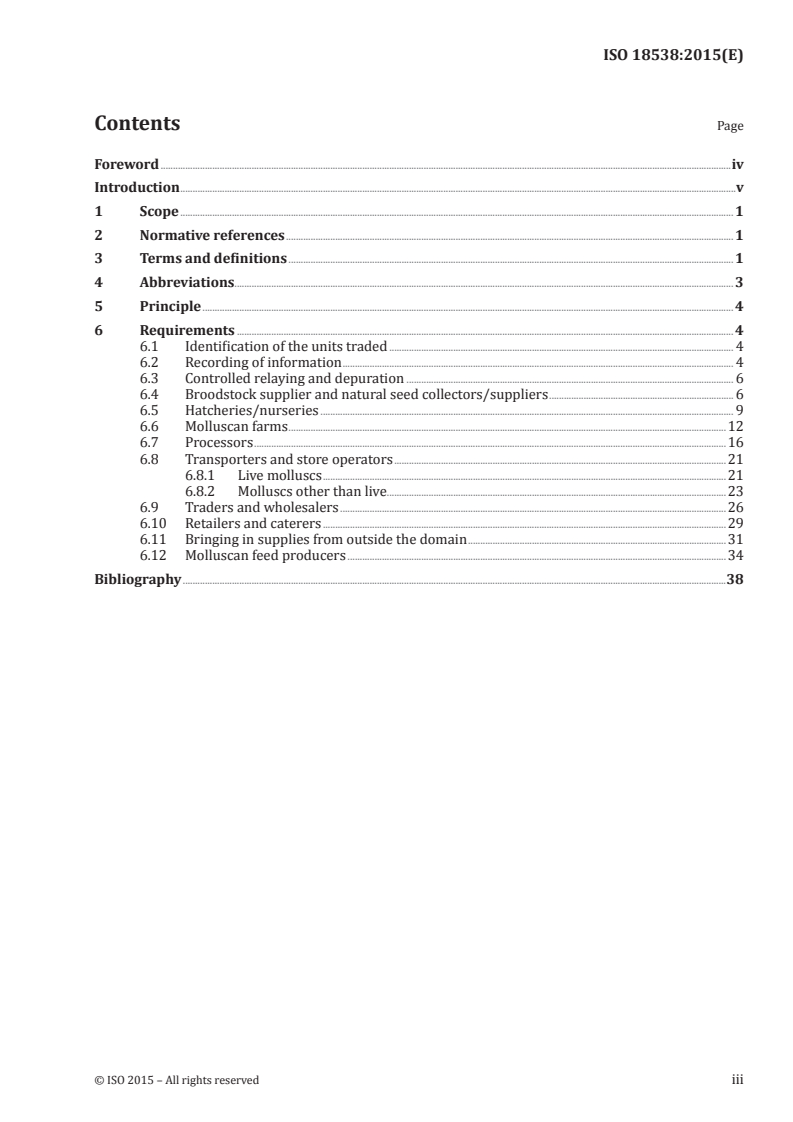
Contents Page
Foreword .iv
Introduction .v
1 Scope . 1
2 Normative references . 1
3 Terms and definitions . 1
4 Abbreviations. 3
5 Principle . 4
6 Requirements . 4
6.1 Identification of the units traded . 4
6.2 Recording of information . 4
6.3 Controlled relaying and depuration . 6
6.4 Broodstock supplier and natural seed collectors/suppliers . 6
6.5 Hatcheries/nurseries . 9
6.6 Molluscan farms .12
6.7 Processors .16
6.8 Transporters and store operators .21
6.8.1 Live molluscs .21
6.8.2 Molluscs other than live .23
6.9 Traders and wholesalers .26
6.10 Retailers and caterers .29
6.11 Bringing in supplies from outside the domain .31
6.12 Molluscan feed producers .34
Bibliography .38
Foreword
ISO (the International Organization for Standardization) and IEC (the International Electrotechnical
Commission) form the specialized system for worldwide standardization. National bodies that are
members of ISO or IEC participate in the development of International Standards through technical
committees established by the respective organization to deal with particular fields of technical
activity. ISO and IEC technical committees collaborate in fields of mutual interest. Other international
organizations, governmental and non-governmental, in liaison with ISO and IEC, also take part in the
work. In the field of information technology, ISO and IEC have established a joint technical committee,
ISO/IEC JTC 1.
The procedures used to develop this document and those intended for its further maintenance are
described in the ISO/IEC Directives, Part 1. In particular the different approval criteria needed for
the different types of document should be noted. This document was drafted in accordance with the
editorial rules of the ISO/IEC Directives, Part 2 (see www.iso.org/directives).
Attention is drawn to the possibility that some of the elements of this document may be the subject
of patent rights. ISO and IEC shall not be held responsible for identifying any or all such patent rights.
Details of any patent rights identified during the development of the document will be in the Introduction
and/or on the ISO list of patent declarations received (see www.iso.org/patents).
Any trade name used in this document is information given for the convenience of users and does not
constitute an endorsement.
For an explanation on the meaning of ISO specific terms and expressions related to conformity
assessment, as well as information about ISO’s adherence to the WTO principles in the Technical Barriers
to Trade (TBT) see the following URL: Foreword - Supplementary information
The committee responsible for this document is ISO/TC 234, Fisheries and aquaculture.
iv © ISO 2015 – All rights reserved
Introduction
There are increasing demands for detailed information on the nature and origin of food products.
Traceability is becoming a legal and commercial necessity.
The ISO definition of traceability concerns the ability to trace the history, application, and location
of that which is under consideration and for products, this can include the origin of food materials
and non-food parts; thereof, the processing history and the distribution and location of the product
after delivery. Traceability includes not only the principal requirement to be able to physically trace
products through the distribution chain from origin to destination and vice versa, but also to be able to
provide information on what they are made of and what has happened to them. These further aspects of
traceability are important in relation to food safety, quality, and labelling.
The scheme specified in this International Standard does not demand perfect traceability, i.e. that a
particular retail product should be traceable back to a hatchery and or farm and batch of origin.
Pragmatically, it is recognized that mixing of animals or materials is often commercially necessary
at a number of stages in the distribution chains, e.g. in grading at first sale prior to sale and in the
processing of raw materials into products. As a result, there will be occasions where whole chain
traceability of materials and products is neither possible nor commercially practical. These limitations
are to be recognized and taken into consideration when auditing against this International Standard
and are not to preclude compliance so as to disadvantage, otherwise compliant operators. Where such
mixing necessarily occurs, the food business shall generate a trade unit or units only from the point that
identification of units is possible. The requirement for traceability is that the business records the IDs
of created or received trade units that can be input into each subsequently created unit, thereafter and
vice versa. The particular product or products are then traceable through the supply chain (as far as is
practical) to generate information on the maximum number of stages of the chain as possible.
Given the variety of molluscan products and of their distribution chains that operate within and between
different countries and varying legal requirements, the information specifications cannot itemise all the
information that may possibly be required in every situation. This International Standard provides a
generic basis for traceability. Flexibility is allowed for businesses to record further information in their
own non-standardised files, but keyed to the same unit IDs.
The information remains in the ownership of the food business that generated it, but is available when
required by law for the purposes of traceability (in the event of a food safety problem) or by commercial
agreement between businesses. The structure, names, and content of the information is standardised so
that it can be readily communicated from business to business through the distribution chains ensuring
common understanding of terms and meanings.
Commercial arrangements for businesses to communicate information through the distribution chains
are to be encouraged, particularly for the information desired by the trade to be visible at the various
transaction points in the chains, but that is not the subject of this International Standard.
Though this International Standard is designed with electronic representation and communication of
data in mind, the specifications can be met by paper systems.
INTERNATIONAL STANDARD ISO 18538:2015(E)
Traceability of molluscan products — Specifications on
the information to be recorded in farmed molluscan
distribution chains
1 Scope
This International Standard specifies the information to be recorded in farmed molluscs supply chains
(excluding cephalopods) in order to establish the traceability of products originating from farm-raised
molluscs. It specifies how molluscan products traded are to be identified and the information to be
generated and held on those products by each of the food businesses that physically trade them through
the distribution chains. It is specific to the distribution for human consumption of molluscs and their
products from farm through to retailers or caterers.
The types of businesses identified in this International Standard for farmed molluscan distribution
chains are the following:
— farming;
a) broodstock suppliers/natural seed collectors;
b) hatcheries and nurseries;
c) molluscan farm;
d) harvesting;
— depuration and shucking etc.;
— processors;
— transporters and store operators;
— traders and wholesalers;
— retailers and caterers;
— logistics including materials brought from other domains;
— feed production.
Any given molluscan distribution chain can be made up of some or all of the above components, but not
necessarily in the sequence listed.
2 Normative references
The following documents, in whole or in part, are normatively referenced in this document and are
indispensable for its application. For dated references, only the edition cited applies. For undated
references, the latest edition of the referenced document (including any amendments) applies.
ISO 8601, Data elements and interchange formats — Information interchange — Representation of
dates and times
3 Terms and definitions
For the purposes of this document, the following terms and definitions apply.
3.1
traceability
ability to trace the history, application, or location of that which is under consideration
Note 1 to entry: When considering product, traceability can relate to:
— the origin of materials and parts,
— the processing history, and
— the distribution and location of the product after delivery.
[SOURCE: ISO 9000:2005, 3.5.4, modified]
3.2
unique logistic unit identifier
ULUI
any composition established for transport and/or storage that needs to be identified and managed
through the supply chain
3.3
unique trade unit identifier
UTUI
smallest unit which is guaranteed to retain its integrity as it moves from one link of the chain to the next
Note 1 to entry: It is the smallest unit that is kept whole and undivided with no change in content or
label/identification.
3.4
molluscan
invertebrate animal belonging to the phylum Mollusca
Note 1 to entry: A molluscan has a soft unsegmented body and is covered by a calcium carbonate shell of one
to eight parts or sections. In some species, the shell is lacking or reduced. Major cultured molluscs are mussels,
oysters, scallops, cockles, clams (bivalves), and abalone (gastropod).
3.5
molluscan products
products prepared out of molluscs or parts thereof
3.6
relaying
removal of bivalve molluscs from a microbiologically contaminated growing area to an acceptable
growing or holding area under the supervision of the agency having jurisdiction and holding them there
for the time necessary for the reduction of contamination to an acceptable level for human consumption
3.7
depuration
reduction of microorganisms to a level acceptable for direct consumption by the process of holding
live bivalve molluscs for a period of time under approved controlled conditions in natural or artificial
seawater suitable for the process which may be treated or untreated
3.8
heat shocking
process of subjecting bivalve molluscs in the shell to any form of heat treatment such as steam, hot
water, or dry heat for a short period to facilitate rapid removal of meat from the shell for the purpose of
shucking (3.9)
3.9
shucking
process of removing the meat from the shell
2 © ISO 2015 – All rights reserved
4 Abbreviations
In this International Standard, the following abbreviations apply:
ACC Aquaculture Certification Council
CAC Codex Alimentarius Commission
EPC Electronic Product Code, a unique number provided by GS1 used to identify instances of
trade items (individual trade units) particularly suited for representation in an RFID chip
FAO The Food and Agriculture Organization of the United Nations
FBO Food Business Operator, generic term for someone in the supply chain who processes,
sends or receives relevant trade units or logistic units
GAqP Good Aquaculture Practices
GLN Global Location Number, a 13-digit globally unique number provided by GS1 used to
identify parties and physical locations
GMP Good Manufacturing Practice
GS1 Global non-profit organization dedicated to the design and implementation of global
standards and solutions to improve the efficiency and visibility of supply and demand
chains globally and across sectors; previously EAN/UCC
GTIN Global Trade Item Number, an 8- to 14-digit globally unique number provided by GS1 used
to identify types of trade items (product types)
HACCP Hazard Analysis Critical Control Points
HS Harmonized Commodity Description and Coding System
LU Logistic Unit
OIE World Organization for Animal Health
RFID Radio-Frequency Identification, the use of an object (typically referred to as an RFID tag)
applied to or incorporated into a product for the purpose of identification and tracking
using radio waves
RFMO Regional Fisheries Management Organization
SGTIN Serialized Global Trade Item Number, a unique number provided by GS1 used to identify
instances of trade items (individual trade units) by extending the GTIN
SSCC Serial Shipping Container Code, an 18-digit globally unique number provided by GS1
used to identify logistics units
TU Trade Unit
UI Unique Identifier
ULUI Unique Logistic Unit Identifier
UTUI Unique Trade Unit Identifier
5 Principle
The fundamental principle of chain traceability is that trade units (TU) shall be identified by unique codes
(UI). This code may be globally unique in itself (for instance, the GS1 SGTIN or EPC numbers) or it could be
unique in that particular scope only which means that it should be no other TUs in that part of the chain
that can have the same number. If the scope (the product type, the company, the chain, the sector, the
country, or similar) is assigned a globally unique number, the combination of the globally unique scope
number and the locally unique TU number shall constitute a globally unique identifier for the TU.
NOTE 1 The UTUI term is introduced to indicate a TU identifier which is or can be made globally unique.
Trade units (TUs) can be grouped together to make logistic units (LUs) or LUs can be grouped together
to make higher level LUs. A fundamental principle of chain traceability is that logistic units shall be
identified by a unique code. This code shall be a national code which can be globally unique in itself
(similar to the GS1 SSCC code) or it could be unique in that particular scope only, which means that
there should be no other LUs in that part of the chain that may have the same number. If the scope (the
product type, the company, the chain, the sector, the country) is assigned a globally unique number, the
combination of the globally unique scope number and the locally unique LU number shall constitute a
globally unique identifier for the LU.
NOTE 2 The ULUI term is introduced to indicate a LU identifier which is or can be made globally unique.
The key to the operation of this traceability scheme is the labelling of each unit of goods traded, whether
of raw materials or finished products, with a unique ID. This shall be done by the food business that
creates each unit. Businesses that transform units such as processors who convert the units of raw
materials received into the products dispatched shall create new units and shall give them new IDs.
As indicated above, the simplest way of implementing UTUIs and ULUIs is to use the GS1 SGTIN/EPC
and SSCC codes. This practice is recommended, but is not mandatory. The central principle behind this
International Standard is that businesses which create TUs or LUs should assign unique numbers to them.
Each of the food businesses that create or physically trade in those units throughout the distribution
chains from catcher through to retailer or caterer shall generate and hold the information necessary for
traceability. The information is to be held on paper or electronically, keyed to the unit IDs.
6 Requirements
6.1 Identification of the units traded
Businesses that bring in supplies of farmed molluscan products from outside of the domain of the
specifications and trade them onwards shall identify each unit traded and record associated information
elements as indicated in Table 3 to Table 12.
6.2 Recording of information
To distinguish between the different categories of information, all information elements are classified
as either “shall”, “should”, or “may” with definition (see Table 1).
4 © ISO 2015 – All rights reserved
Table 1 — Classification of informative elements
Definition Explanation
“shall” This category contains recordings related to “shall” elements are data elements that are
identifiers and transformations that is necessary deemed necessary to record to ensure that
in order to trace the history, application, or traceability is possible. Data elements relating
location of an entity. This means the unique to product properties are not in this category
identity of trade and logistic units, as well as the even if these properties are essential for other
dependencies between the identifiers of inputs purposes like product documentation or food
and outputs in a process. safety.
“should” This category contains parameters that describe This includes parameters like “species”,
and provide supporting information on the units “production date”, etc. If certification according
being traced. Common parameters required by to this International Standard is to
law, commercial requirements, or good happen in the future, the “should” parameters
manufacturing practises are recorded, but only are to be considered.
where an established international format or
data list for the value exists.
“may” This category contains parameters that describe The “may” category is informative only and it is
and provide supporting information on the units included to enable use and uptake of the
being traced. It contains parameters that are not standard. If certification according to this
part of the “should” category, but that may still International Standard is to happen in the future,
be useful or relevant to record. It also contains the recording of “may” parameters are not to be
parameters that may be deemed important, but considered when evaluating adherence. The list
where no established international format or of “may” elements is not definitive or exclusive.
data list exists. It is by design extendible and the threshold for
including new elements in this category is low.
Businesses that physically trade in molluscan products shall generate and hold the required information
appropriate to the type of business for each of the units traded. The detailed information requirements
are tabulated in Table 2.
Table 2 — Information requirements to be recorded by the different businesses
Food business operator (FBO)
Data Create/
Table Receive Transform Dispatch
a
prefix produce
type
Brood stock suppliers/natural seed TU/LU TU/LU
3 MBR - -
collectors
Hatcheries/nurseries 4 MHA TU/LU Yes TU/LU TU/LU
Molluscan farms 5 MFF TU/LU Yes TU/LU TU/LU
Processors 6 MPR TU/LU Yes TU/LU TU/LU
Live molluscan transporters 7.1 MTR TU/LU Yes TU/LU TU/LU
Transporters and cold store TU/LU
operators for molluscs other than 7.2 MTS TU/LU No LU
live
Traders and wholesalers 8 MTW TU/LU No TU/LU TU/LU
Retailers and caterers 9 MRC TU/LU Yes TU/LU —
Bringing in materials from outside TU/LU TU/LU TU/LU
10 MOT —
the domain
Feed production 11 MFE TU/LU Yes TU/LU TU/LU
a
For the purpose of unique identification to establish an extendable framework for data element identification, each table
has been identified with a three letter alphanumeric code. This code plus three digits is used to give a unique number to each
data element.
The information specifications separately tabulate the information to be recorded by each of these
types of business. Some businesses may carry out the functions of more than one of the types listed,
for example, distribution businesses can act as wholesalers and as transporters in which case those
businesses shall record the relevant information requirements for each of the functions carried out.
NOTE 1 This International Standard is limited in scope to the distribution for human consumption of molluscs
and their products. The molluscs information specifications are substantially the same from processing onward.
Pragmatically, it is recognized that some supplies of molluscan products and supplies of ingredients,
etc. will come from outside of the domain and may lack the required IDs and information records.
To accommodate this, a business that brings in molluscs and materials from outside of the domain is
required to generate and hold the key information necessary for the traceability of the units brought in
and if they are to be traded on to label those units with the required IDs.
NOTE 2 These specifications are designed with electronic representation and communication of data in mind, but
this is not a requirement when using the International Standard. The specifications can also be met by paper systems.
Note that the specification is for data to be generated, recorded, and stored at the respective link. For
all links, except “Breeders”, relevant data shall be generated in a previous link in the supply chain and
passed along with the trade unit/logistic unit.
NOTE 3 In these tabulations, there is no repetition of the information originally recorded to describe the units
created and their history, although businesses receiving those units later in the distribution chain will often need
some of that information. The information is keyed to the unit IDs and can be supplied by commercial agreement
between the businesses without having to re-input the data.
6.3 Controlled relaying and depuration
Bivalve molluscs concentrate contaminants from the water column in which they grow. These
contaminants may then cause illness to humans when the bivalves are eaten. Depuration is effective in
removing many faecal contaminants from shellfish. Depuration means the reduction of microorganisms
sand and other contaminants to a level acceptable for direct consumption by the process of holding live
bivalve molluscs for a period of time under approved controlled conditions in natural or artificial sea water
suitable for the process which may be treated or untreated. Relay systems (natural or in containers) and
land-based depuration establishments are efficient methods of achieving microbiologically safe bivalve
molluscs that are harvested from approved areas. Each registered facility that depurates or relays
molluscs should follow their quality management program and appropriate documentation should be
maintained for the process. The details of traceability of depuration process are shown in Table 5.
6.4 Broodstock supplier and natural seed collectors/suppliers
For the purposes of this International Standard, broodstock suppliers are considered to be
establishments/self help groups/farmer groups/fisherman that produce/collect broodstocks that are
supplied to hatcheries for further maturation and production of spat. They may carry out basic operations
like collection and maintenance of broodstock under good management practices in a sustainable way.
Prior to dispatch, broodstock suppliers can carry out their own operations or get it done through
approved agencies/laboratories for absence of OIE-listed diseases, quality, grading, etc.
The trade units created by broodstock suppliers can range from a few hundred to several thousand
passed into the hands of the next food business, i.e. hatcheries.
For the purposes of this International Standard, natural seed collectors/suppliers are considered to be
establishments that produce/collect seeds from natural sources that are supplied to farms for further
maturation. They may carry out basic operations like collection and maintenance of natural seed in a
responsible way to ensure sustainability.
6 © ISO 2015 – All rights reserved
Table 3 — Detailed information for broodstock suppliers and natural seed collectors/suppliers
Categorization
Data element Description Examples
Shall Should May
BROODSTOCK SUPPLIERS AND NATURAL SEED COLLECTORS/SUPPLIERS
MBR101 Food Unique national identification Name, reg. no., and x
business number for the unit plus country prefix
ID country prefix or name and
address of the group/business
that operates maintenance of
broodstock (either indegenous
or exploited)
MBR102 Broodstock Unique national identification Women self-help group, x
supplier number for the Padanna, Kasargod,
establish group/unit/organization plus Kerala (bivalve spat
ment ID country prefix or name and suppliers)
address of the broodstock
supplier
MBR103 Broodstock Any quality certification Norms suggested by x
supplier available National Competent
GAqP Authority and aligned to
certificate codex GAqP
ion
MBR104 Natural Unique national identification Mahesh, Moothakunnam. x
seed number for the group/unit N.paravur
collector
MBR105 Location Specific location Njarakkal, Vypin, Kerala, x
India
MBR106 Area of RFMO or more specific location Vypin x
relaying
MBR150- (unassigned) Further information elements Certified wild x
that describe the breeder, broodstock bank
linked to broodstock supplier
ID
FOR EACH TRADE UNIT CREATED
Identity
MBR201 Unit ID UTUI ID can be created for a x
batch with national
prefix depending up on
the area and time of
collection
Description
MBR202 Species LAT- followed by Latin name LAT-Perna virdis x
or FAO- followed by FAO:MSV
FAO 3alpha code or TSN:3161003202
TSN- followed by
taxonomic serial number
(may be repeated if several
species)
MBR203 Area/ FAO area/RFMO area of the 51 x
country of broodstock if captured from
origin wild or country of origin for
broodstock from farmed stock
or more specific location
In case of broodstock collectors from wild, this requirement will be scored in the may column.
Table 3 (continued)
Categorization
Data element Description Examples
Shall Should May
MBR204 Health Type of checks and measured OIE-listed pathogens eg. x
quality results physical and Perkinsus marinus
checks microbiological or clinical signs (bivalve) oyster velar
disease
MBR205 GMO Use of GMO in production or No x
in feeding of broodstock
Yes/No
Production history
MBR206 Farm unit ID ID no. of broodstock producer M/S XYZ hatchery x
followed by unique
national identification
number
MBR207 Broodstock Record showing water Temperature 22 °C, x
maintain- temperature, salinity, salinity 28 ppt, water
ance record prophylaxis, water flow, and quality for aquaculture
other water quality parameters as per IS, ECO - PRO, OXY
of broodstock maintenance to –MORE, Detrodigest
be kept by broodstock supplier
MBR208 Feeding Live feed as per growth Telenet,12 pollock street, x
record requirement Cacutta, W.Bengal, India
Additional data
MBR250- (unassigned) Further information elements x
that describe the created trade
unit, linked to UTUI
FOR EACH LOGISTIC UNIT
CREATED
Identities
MBR301 Unit ID ULUI Unique national x
identification number or
GSI number for the
logistic unit
MBR302 Trade unit The IDs of the trade units Unique national x
IDs within the logistic unit identification number
or GSI number for the
trade unit
Additional data
MBR350- (unassigned) Further information elements x
that describe the created
logistic unit, linked to ULUI
FOR EACH UNIT DISPATCHED (either as a logistic unit or a separate trade unit)
Identity
MBR401 Unit ID ULUI (if dispatched as a logistic x
unit) or UTUI (if dispatched as
a separate trade unit)
In case of broodstock collectors from wild, this requirement will be scored in the may column.
8 © ISO 2015 – All rights reserved
Table 3 (continued)
Categorization
Data element Description Examples
Shall Should May
Destination
MBR402 Next food Unique national identification Unique national x
business ID number for the hatchery plus identification number/
country prefix and address GS1 and CMFRI, edible
oyster hatchery,
Narakkal, Cochin, Kerala
MBR403 Date and Date and time of transfer to 2010–09–25T12:15 x
time of next food business, ISO 8601
dispatch format
Additional data
MBR450- (unassigned) Further information elements x
that describe the dispatched
trade/logistic unit linked to
UTUI/ULUI
In case of broodstock collectors from wild, this requirement will be scored in the may column.
6.5 Hatcheries/nurseries
For the purposes of this International Standard, hatcheries/nurseries are considered to be businesses
that receive broodstock, maintain them, induce spawning, and produce spat and dispatch to other
hatcheries/molluscan farms for further rearing.
The hatcheries/nurseries may change the nature of molluscan products by carrying out operations such
as feeding, grading, treatments, etc. Hatcheries/nurseries create new trade units that can range from a
few thousands to several million spat passed into the hands of the next food business.
Table 4 — Detailed information for hatcheries including nurseries
Categorization
Data element Description Examples
Shall Should May
HATCHERY/NURSERY
MHA101 Hatchery/ Unique national identification Unique national x
nursery number for the hatchery plus identification number/
establish- country prefix or name and GS1 and National
ment ID address of the food business Competent Authority,
that operates hatchery edible oyster hatchery,
establishment Narakkal, Cochin, Kerala
MHA102 Hatchery/ Name(s) of quality or food Certification by National x
Nursery safety GAqP schemes by which Competent Authority
GAqP hatchery is certified FAO GAqP Hatchery
HACCP
FOR EACH UNIT RECEIVED
Identities
MHA201 Unit ID ULUI (if received as a logistic 400653005555555568 x
unit) or UTUI (if received as a
separate trade unit)
MHA202 Trade unit If received as a logistic unit, the 400653005555555570 x
IDs IDs of the trade units within 400653005555555571
the logistic unit 400653005555555572
a
The same unique ID for raw material/product will continue if there is no transformation.
Table 4 (continued)
Categorization
Data element Description Examples
Shall Should May
Source
MHA203 Previous Unique national identification 400653005555555571 x
food number for the broodstock M/S XYZ, edible oyster
business ID supplier plus country prefix or hatchery, Cochin, Kerala
name and address of the food
business that operates breed-
ing
company or transporter
MHA204 Date and ISO 8601 format/movement 2010–11–23T0.10:10 x
time of records
reception
Control checks (either on logistic or separate trade units)
MHA205 Tempera- Temperature (°C) in UTUI or 24 °C x
ture check ULUI received
MHA206 Survival Mortality of broodstock, spat 20 %, etc. x
record in %
MHA207 Quality Type of checks and measured Test results for OIE x
control results or indication if records listed diseases/paper
checks are available in electronic
form, on paper, or not available
Transformation information
MHA208 Related List of IDs of created trade Unique national ID/GS1 x
created units that may incorporate number
trade unit part of this
IDs
MHA209 Fractions Fraction of received trade unit UTUI-1 33 %, UTUI-2 x
that go into each created unit 33 %, UTUI-3 33 %,
Additional data
MHA250- (unassigned) Further information elements x
that describe the received
trade/logistic unit, linked to
UTUI/ULUI
FOR EACH NEW TRADE UNIT CREATED
Identity
MHA301 Unit ID ULUI (if dispatched as a logistic Unique national ID/GS1 x
unit) or UTUI (if dispatched as number
a separate trade unit)
Description
MHA302 Hatching Date of hatching Date of hatching in x
date ISO 8601 format,
yyyy-mm-dd
MHA303 Age Number of days after hatching Larvae three days old x
Production history
MHA304 Spat tank ID Spat rearing tank number of 20 x
the rearing unit/nursery unit
a
The same unique ID for raw material/product will continue if there is no transformation.
10 © ISO 2015 – All rights reserved
Table 4 (continued)
Categorization
Data element Description Examples
Shall Should May
MHA305 GAqP Records of disinfection of Paper/electronic x
records reservoirs, water filtration
units, rearing tanks, etc., or
indication if records are
available in electronic form,
on paper, or not available
MHA306 Disease Records of names and period Paper x
record of diseases or indication if
records are available in
electronic form, on paper, or
not available
MHA307 Treatment Medicine or chemical names Approved medication x
record and period of use or indication records, paper
if records are available in
electronic form, on paper, or
not available
MHA308 Larvae hatch Number of larvae that hatched 7-40 million eggs x
fecundity out from one female in the (M. edulis)
(LHF) production batch
MHA309 Density Record of stocking density of Nos./m x
record larvae in tanks
MHA310 Feeding Type of feed Micro algae culture x
record
MHA311 Hatchery Name of national/international National Competent x
certification GAqP scheme by which the Authority
scheme hatchery is certified
MHA312 Certifying Name and authorization of the National Competent x
body certifying body Authority or unique
identifier identification number of
the certifying body
Transformation information
MHA313 Trade unit List of IDs of received trade Unique identification x
ID of units that make up this created number of the
broodstock trade unit broodstock received
received
MHA314 Fractions Fraction (%) of the created UTUI 1 - 50 % x
unit that was made up by each UTUI 2 - 50 %
received trade unit
Additional data
MHA350- (unassigned) Further information elements x
that describe the created trade
unit, linked to UTUI
a
The same unique ID for raw material/product will continue if there is no transformation.
Table 4 (continued)
Categorization
Data element Description Examples
Shall Should May
FOR EACH LOGISTIC UNIT CREATED
Identities
a
MHA401 Unit ID ULUI 400653005555555568 x
MHA402 Trade unit The IDs of the trade units 400653005555555571 x
IDs within the logistic unit 400653005555555572
Additional data
MHA450- (Unassigned) Further information elements x
that describe the created
logistic unit linked to ULUI
FOR EACH UNIT DISPATCHED
Identity
a
MHA501 Unit ID UTUI x
Destination
MHA502 Next food Unique national identification M/S Kandekadu x
business ID number for the farm plus molluscan farm
country prefix or name and Chellanam, Kerala,
address of the food business to India
where the unit is dispatched
(transporter or bivalve farm
etc.)
MHA503 Date and Date and time of transfer to 2010–10–29T13:00 x
time of next food business, ISO 8601
dispatch format
Additional data
MBHA550- (unassigned) Further information elements x
that describe the dispatched
trade/logistic unit, linked to
UTUI/ULUI
a
The same unique ID for raw material/product will continue if there is no transformation.
6.6 Molluscan farms
For the purposes of this International Standard, molluscan farms are considered to be businesses that
receive molluscs/spat and keep them during the growing stage and dispatch the grown molluscan
spat/adults at required quantities to the processor/trader/retailer, etc.
The molluscan farms can change the nature of molluscan products by carrying out operations such as
feeding, grading, etc. Molluscan farms create new trade units that can range from a few tons to several
hundred tons passed into the hands of the next food business.
12 © ISO 2015 – All rights reserved
Table 5 — Detailed information for molluscan farms
Categorization
Data element Description Examples
Shall Should May
MOLLUSCAN FARMS
MFF101 Molluscan Unique national identification M/S Kandekadu x
farm ID number for the farm plus molluscan farm
country prefix or name and Chellanam, Kerala,
address of the food business India
that operates the molluscan
farm establishment
MFF102 Certification Name of molluscs aquaculture National Competent x
certification scheme by which Authority or any national
the molluscan farm is certified or international
certification/approval
scheme
MFF150- Unique Unique identification number M/S XYZ, INDOCERT, x
Identifica- or address of certifying agency Aluva Quality Council of
tion number and authorization India
of certifying
agency
FOR EACH UNIT RECEIVED
Identities
MFF201 Unit ID ULUI or UTUI of the seed 500653005555555568 x
(/spat) received from
farn/natural seed collector
MFF202 Trade unit If received as a ULUI, the IDs of 500653005555555568 x
IDs trade units within the logistic 500653005555555569
unit 500653005555555570
Source
MFF203 Previous Unique national identification Unique national x
food number for the identification number/
business ID hatchery/natural seed GSI and CMFRI, edible
collector plus country prefix oyster hatchery,
or name and address or GLN Narakkal, Cochin,
of previous food business from kerala ambrose
whom the unit was received natural seed collector
(hatchery/natural seed Nayarambalam, Kerala,
collector with location) India
MFF204 Date and Movement records 2010–10–28T15:05 x
time of
reception
Control checks (either on logistic or separate trade units)
MFF205 Temperature Temperature (°C) in the 20 °C x
check received unit
MFF206 Health Types of checks done on units Paper, OIE listed diseases x
checks/ received and prohibited
quality antibiotics, quality of
control the seed, and mortality
checks upon receipt
a
The same unique ID for raw material/product will continue if there is no transformation.
Table 5 (continued)
Categorization
Data element Description Examples
Shall Should May
Transformation information
MFF207 Related List of IDs of created trade 500653005555555568 x
created units that may incorporate 500653005555555569
trade unit part of this received trade unit. 500653005555555570
a
IDs
MFF208 Fractions Fraction (%) of the received UTUI-1 25 % x
spat trade unit that go into UTUI-2 75 %
each created unit
Additional data
MFF250- (unassigned) Further information elements x
that describe the received
trade/logistic unit, linked to
UTUI/ULUI
FOR EACH NEW TRADE UNIT CREATED BY MOLLUSCAN FARM
Identity
a
MFF301 Unit ID UTUI 500653005555555568 x
Description
MFF302 Location of Longitude and latitude or other National number x
molluscan appropriate specification
farm
MFV303 Depuration Unique national identification M/S Kandekadu x
(bivalves) number of the harvester molluscan farm
/depuration unit and tank Chellanam, Kerala, India
number Xyz (depuration tank
number)
MFF304 Count/kg Nos. 80/120,121/180 x
MFF305 Total Quantity in each batch traded 1 ton, 3 tons, x
quantity per etc.
batch
Production history
MFF306 Farm unit ID Internal number of R-3, etc x
pond/rafts/rakes/any other
suitable structures
MFF307 Temperature Temperature/time log (°C)/date and time x
record (manual/automatic)of the points
product holding area
(pond/raft /cage) for the
period between reception and
dispatch
MFF308 Density Stocked molluscan density in Desirable no. x
farm that went in to the create
...
INTERNATIONAL ISO
STANDARD 18538
First edition
2015-08-01
Traceability of molluscan products —
Specifications on the information
to be recorded in farmed molluscan
distribution chains
Traçabilité des mollusques — Spécifications des informations à
enregistrer dans les chaines de distribution de mollusques en ferme
Reference number
©
ISO 2015
© ISO 2015, Published in Switzerland
All rights reserved. Unless otherwise specified, no part of this publication may be reproduced or utilized otherwise in any form
or by any means, electronic or mechanical, including photocopying, or posting on the internet or an intranet, without prior
written permission. Permission can be requested from either ISO at the address below or ISO’s member body in the country of
the requester.
ISO copyright office
Ch. de Blandonnet 8 • CP 401
CH-1214 Vernier, Geneva, Switzerland
Tel. +41 22 749 01 11
Fax +41 22 749 09 47
copyright@iso.org
www.iso.org
ii © ISO 2015 – All rights reserved
Contents Page
Foreword .iv
Introduction .v
1 Scope . 1
2 Normative references . 1
3 Terms and definitions . 1
4 Abbreviations. 3
5 Principle . 4
6 Requirements . 4
6.1 Identification of the units traded . 4
6.2 Recording of information . 4
6.3 Controlled relaying and depuration . 6
6.4 Broodstock supplier and natural seed collectors/suppliers . 6
6.5 Hatcheries/nurseries . 9
6.6 Molluscan farms .12
6.7 Processors .16
6.8 Transporters and store operators .21
6.8.1 Live molluscs .21
6.8.2 Molluscs other than live .23
6.9 Traders and wholesalers .26
6.10 Retailers and caterers .29
6.11 Bringing in supplies from outside the domain .31
6.12 Molluscan feed producers .34
Bibliography .38
Foreword
ISO (the International Organization for Standardization) and IEC (the International Electrotechnical
Commission) form the specialized system for worldwide standardization. National bodies that are
members of ISO or IEC participate in the development of International Standards through technical
committees established by the respective organization to deal with particular fields of technical
activity. ISO and IEC technical committees collaborate in fields of mutual interest. Other international
organizations, governmental and non-governmental, in liaison with ISO and IEC, also take part in the
work. In the field of information technology, ISO and IEC have established a joint technical committee,
ISO/IEC JTC 1.
The procedures used to develop this document and those intended for its further maintenance are
described in the ISO/IEC Directives, Part 1. In particular the different approval criteria needed for
the different types of document should be noted. This document was drafted in accordance with the
editorial rules of the ISO/IEC Directives, Part 2 (see www.iso.org/directives).
Attention is drawn to the possibility that some of the elements of this document may be the subject
of patent rights. ISO and IEC shall not be held responsible for identifying any or all such patent rights.
Details of any patent rights identified during the development of the document will be in the Introduction
and/or on the ISO list of patent declarations received (see www.iso.org/patents).
Any trade name used in this document is information given for the convenience of users and does not
constitute an endorsement.
For an explanation on the meaning of ISO specific terms and expressions related to conformity
assessment, as well as information about ISO’s adherence to the WTO principles in the Technical Barriers
to Trade (TBT) see the following URL: Foreword - Supplementary information
The committee responsible for this document is ISO/TC 234, Fisheries and aquaculture.
iv © ISO 2015 – All rights reserved
Introduction
There are increasing demands for detailed information on the nature and origin of food products.
Traceability is becoming a legal and commercial necessity.
The ISO definition of traceability concerns the ability to trace the history, application, and location
of that which is under consideration and for products, this can include the origin of food materials
and non-food parts; thereof, the processing history and the distribution and location of the product
after delivery. Traceability includes not only the principal requirement to be able to physically trace
products through the distribution chain from origin to destination and vice versa, but also to be able to
provide information on what they are made of and what has happened to them. These further aspects of
traceability are important in relation to food safety, quality, and labelling.
The scheme specified in this International Standard does not demand perfect traceability, i.e. that a
particular retail product should be traceable back to a hatchery and or farm and batch of origin.
Pragmatically, it is recognized that mixing of animals or materials is often commercially necessary
at a number of stages in the distribution chains, e.g. in grading at first sale prior to sale and in the
processing of raw materials into products. As a result, there will be occasions where whole chain
traceability of materials and products is neither possible nor commercially practical. These limitations
are to be recognized and taken into consideration when auditing against this International Standard
and are not to preclude compliance so as to disadvantage, otherwise compliant operators. Where such
mixing necessarily occurs, the food business shall generate a trade unit or units only from the point that
identification of units is possible. The requirement for traceability is that the business records the IDs
of created or received trade units that can be input into each subsequently created unit, thereafter and
vice versa. The particular product or products are then traceable through the supply chain (as far as is
practical) to generate information on the maximum number of stages of the chain as possible.
Given the variety of molluscan products and of their distribution chains that operate within and between
different countries and varying legal requirements, the information specifications cannot itemise all the
information that may possibly be required in every situation. This International Standard provides a
generic basis for traceability. Flexibility is allowed for businesses to record further information in their
own non-standardised files, but keyed to the same unit IDs.
The information remains in the ownership of the food business that generated it, but is available when
required by law for the purposes of traceability (in the event of a food safety problem) or by commercial
agreement between businesses. The structure, names, and content of the information is standardised so
that it can be readily communicated from business to business through the distribution chains ensuring
common understanding of terms and meanings.
Commercial arrangements for businesses to communicate information through the distribution chains
are to be encouraged, particularly for the information desired by the trade to be visible at the various
transaction points in the chains, but that is not the subject of this International Standard.
Though this International Standard is designed with electronic representation and communication of
data in mind, the specifications can be met by paper systems.
INTERNATIONAL STANDARD ISO 18538:2015(E)
Traceability of molluscan products — Specifications on
the information to be recorded in farmed molluscan
distribution chains
1 Scope
This International Standard specifies the information to be recorded in farmed molluscs supply chains
(excluding cephalopods) in order to establish the traceability of products originating from farm-raised
molluscs. It specifies how molluscan products traded are to be identified and the information to be
generated and held on those products by each of the food businesses that physically trade them through
the distribution chains. It is specific to the distribution for human consumption of molluscs and their
products from farm through to retailers or caterers.
The types of businesses identified in this International Standard for farmed molluscan distribution
chains are the following:
— farming;
a) broodstock suppliers/natural seed collectors;
b) hatcheries and nurseries;
c) molluscan farm;
d) harvesting;
— depuration and shucking etc.;
— processors;
— transporters and store operators;
— traders and wholesalers;
— retailers and caterers;
— logistics including materials brought from other domains;
— feed production.
Any given molluscan distribution chain can be made up of some or all of the above components, but not
necessarily in the sequence listed.
2 Normative references
The following documents, in whole or in part, are normatively referenced in this document and are
indispensable for its application. For dated references, only the edition cited applies. For undated
references, the latest edition of the referenced document (including any amendments) applies.
ISO 8601, Data elements and interchange formats — Information interchange — Representation of
dates and times
3 Terms and definitions
For the purposes of this document, the following terms and definitions apply.
3.1
traceability
ability to trace the history, application, or location of that which is under consideration
Note 1 to entry: When considering product, traceability can relate to:
— the origin of materials and parts,
— the processing history, and
— the distribution and location of the product after delivery.
[SOURCE: ISO 9000:2005, 3.5.4, modified]
3.2
unique logistic unit identifier
ULUI
any composition established for transport and/or storage that needs to be identified and managed
through the supply chain
3.3
unique trade unit identifier
UTUI
smallest unit which is guaranteed to retain its integrity as it moves from one link of the chain to the next
Note 1 to entry: It is the smallest unit that is kept whole and undivided with no change in content or
label/identification.
3.4
molluscan
invertebrate animal belonging to the phylum Mollusca
Note 1 to entry: A molluscan has a soft unsegmented body and is covered by a calcium carbonate shell of one
to eight parts or sections. In some species, the shell is lacking or reduced. Major cultured molluscs are mussels,
oysters, scallops, cockles, clams (bivalves), and abalone (gastropod).
3.5
molluscan products
products prepared out of molluscs or parts thereof
3.6
relaying
removal of bivalve molluscs from a microbiologically contaminated growing area to an acceptable
growing or holding area under the supervision of the agency having jurisdiction and holding them there
for the time necessary for the reduction of contamination to an acceptable level for human consumption
3.7
depuration
reduction of microorganisms to a level acceptable for direct consumption by the process of holding
live bivalve molluscs for a period of time under approved controlled conditions in natural or artificial
seawater suitable for the process which may be treated or untreated
3.8
heat shocking
process of subjecting bivalve molluscs in the shell to any form of heat treatment such as steam, hot
water, or dry heat for a short period to facilitate rapid removal of meat from the shell for the purpose of
shucking (3.9)
3.9
shucking
process of removing the meat from the shell
2 © ISO 2015 – All rights reserved
4 Abbreviations
In this International Standard, the following abbreviations apply:
ACC Aquaculture Certification Council
CAC Codex Alimentarius Commission
EPC Electronic Product Code, a unique number provided by GS1 used to identify instances of
trade items (individual trade units) particularly suited for representation in an RFID chip
FAO The Food and Agriculture Organization of the United Nations
FBO Food Business Operator, generic term for someone in the supply chain who processes,
sends or receives relevant trade units or logistic units
GAqP Good Aquaculture Practices
GLN Global Location Number, a 13-digit globally unique number provided by GS1 used to
identify parties and physical locations
GMP Good Manufacturing Practice
GS1 Global non-profit organization dedicated to the design and implementation of global
standards and solutions to improve the efficiency and visibility of supply and demand
chains globally and across sectors; previously EAN/UCC
GTIN Global Trade Item Number, an 8- to 14-digit globally unique number provided by GS1 used
to identify types of trade items (product types)
HACCP Hazard Analysis Critical Control Points
HS Harmonized Commodity Description and Coding System
LU Logistic Unit
OIE World Organization for Animal Health
RFID Radio-Frequency Identification, the use of an object (typically referred to as an RFID tag)
applied to or incorporated into a product for the purpose of identification and tracking
using radio waves
RFMO Regional Fisheries Management Organization
SGTIN Serialized Global Trade Item Number, a unique number provided by GS1 used to identify
instances of trade items (individual trade units) by extending the GTIN
SSCC Serial Shipping Container Code, an 18-digit globally unique number provided by GS1
used to identify logistics units
TU Trade Unit
UI Unique Identifier
ULUI Unique Logistic Unit Identifier
UTUI Unique Trade Unit Identifier
5 Principle
The fundamental principle of chain traceability is that trade units (TU) shall be identified by unique codes
(UI). This code may be globally unique in itself (for instance, the GS1 SGTIN or EPC numbers) or it could be
unique in that particular scope only which means that it should be no other TUs in that part of the chain
that can have the same number. If the scope (the product type, the company, the chain, the sector, the
country, or similar) is assigned a globally unique number, the combination of the globally unique scope
number and the locally unique TU number shall constitute a globally unique identifier for the TU.
NOTE 1 The UTUI term is introduced to indicate a TU identifier which is or can be made globally unique.
Trade units (TUs) can be grouped together to make logistic units (LUs) or LUs can be grouped together
to make higher level LUs. A fundamental principle of chain traceability is that logistic units shall be
identified by a unique code. This code shall be a national code which can be globally unique in itself
(similar to the GS1 SSCC code) or it could be unique in that particular scope only, which means that
there should be no other LUs in that part of the chain that may have the same number. If the scope (the
product type, the company, the chain, the sector, the country) is assigned a globally unique number, the
combination of the globally unique scope number and the locally unique LU number shall constitute a
globally unique identifier for the LU.
NOTE 2 The ULUI term is introduced to indicate a LU identifier which is or can be made globally unique.
The key to the operation of this traceability scheme is the labelling of each unit of goods traded, whether
of raw materials or finished products, with a unique ID. This shall be done by the food business that
creates each unit. Businesses that transform units such as processors who convert the units of raw
materials received into the products dispatched shall create new units and shall give them new IDs.
As indicated above, the simplest way of implementing UTUIs and ULUIs is to use the GS1 SGTIN/EPC
and SSCC codes. This practice is recommended, but is not mandatory. The central principle behind this
International Standard is that businesses which create TUs or LUs should assign unique numbers to them.
Each of the food businesses that create or physically trade in those units throughout the distribution
chains from catcher through to retailer or caterer shall generate and hold the information necessary for
traceability. The information is to be held on paper or electronically, keyed to the unit IDs.
6 Requirements
6.1 Identification of the units traded
Businesses that bring in supplies of farmed molluscan products from outside of the domain of the
specifications and trade them onwards shall identify each unit traded and record associated information
elements as indicated in Table 3 to Table 12.
6.2 Recording of information
To distinguish between the different categories of information, all information elements are classified
as either “shall”, “should”, or “may” with definition (see Table 1).
4 © ISO 2015 – All rights reserved
Table 1 — Classification of informative elements
Definition Explanation
“shall” This category contains recordings related to “shall” elements are data elements that are
identifiers and transformations that is necessary deemed necessary to record to ensure that
in order to trace the history, application, or traceability is possible. Data elements relating
location of an entity. This means the unique to product properties are not in this category
identity of trade and logistic units, as well as the even if these properties are essential for other
dependencies between the identifiers of inputs purposes like product documentation or food
and outputs in a process. safety.
“should” This category contains parameters that describe This includes parameters like “species”,
and provide supporting information on the units “production date”, etc. If certification according
being traced. Common parameters required by to this International Standard is to
law, commercial requirements, or good happen in the future, the “should” parameters
manufacturing practises are recorded, but only are to be considered.
where an established international format or
data list for the value exists.
“may” This category contains parameters that describe The “may” category is informative only and it is
and provide supporting information on the units included to enable use and uptake of the
being traced. It contains parameters that are not standard. If certification according to this
part of the “should” category, but that may still International Standard is to happen in the future,
be useful or relevant to record. It also contains the recording of “may” parameters are not to be
parameters that may be deemed important, but considered when evaluating adherence. The list
where no established international format or of “may” elements is not definitive or exclusive.
data list exists. It is by design extendible and the threshold for
including new elements in this category is low.
Businesses that physically trade in molluscan products shall generate and hold the required information
appropriate to the type of business for each of the units traded. The detailed information requirements
are tabulated in Table 2.
Table 2 — Information requirements to be recorded by the different businesses
Food business operator (FBO)
Data Create/
Table Receive Transform Dispatch
a
prefix produce
type
Brood stock suppliers/natural seed TU/LU TU/LU
3 MBR - -
collectors
Hatcheries/nurseries 4 MHA TU/LU Yes TU/LU TU/LU
Molluscan farms 5 MFF TU/LU Yes TU/LU TU/LU
Processors 6 MPR TU/LU Yes TU/LU TU/LU
Live molluscan transporters 7.1 MTR TU/LU Yes TU/LU TU/LU
Transporters and cold store TU/LU
operators for molluscs other than 7.2 MTS TU/LU No LU
live
Traders and wholesalers 8 MTW TU/LU No TU/LU TU/LU
Retailers and caterers 9 MRC TU/LU Yes TU/LU —
Bringing in materials from outside TU/LU TU/LU TU/LU
10 MOT —
the domain
Feed production 11 MFE TU/LU Yes TU/LU TU/LU
a
For the purpose of unique identification to establish an extendable framework for data element identification, each table
has been identified with a three letter alphanumeric code. This code plus three digits is used to give a unique number to each
data element.
The information specifications separately tabulate the information to be recorded by each of these
types of business. Some businesses may carry out the functions of more than one of the types listed,
for example, distribution businesses can act as wholesalers and as transporters in which case those
businesses shall record the relevant information requirements for each of the functions carried out.
NOTE 1 This International Standard is limited in scope to the distribution for human consumption of molluscs
and their products. The molluscs information specifications are substantially the same from processing onward.
Pragmatically, it is recognized that some supplies of molluscan products and supplies of ingredients,
etc. will come from outside of the domain and may lack the required IDs and information records.
To accommodate this, a business that brings in molluscs and materials from outside of the domain is
required to generate and hold the key information necessary for the traceability of the units brought in
and if they are to be traded on to label those units with the required IDs.
NOTE 2 These specifications are designed with electronic representation and communication of data in mind, but
this is not a requirement when using the International Standard. The specifications can also be met by paper systems.
Note that the specification is for data to be generated, recorded, and stored at the respective link. For
all links, except “Breeders”, relevant data shall be generated in a previous link in the supply chain and
passed along with the trade unit/logistic unit.
NOTE 3 In these tabulations, there is no repetition of the information originally recorded to describe the units
created and their history, although businesses receiving those units later in the distribution chain will often need
some of that information. The information is keyed to the unit IDs and can be supplied by commercial agreement
between the businesses without having to re-input the data.
6.3 Controlled relaying and depuration
Bivalve molluscs concentrate contaminants from the water column in which they grow. These
contaminants may then cause illness to humans when the bivalves are eaten. Depuration is effective in
removing many faecal contaminants from shellfish. Depuration means the reduction of microorganisms
sand and other contaminants to a level acceptable for direct consumption by the process of holding live
bivalve molluscs for a period of time under approved controlled conditions in natural or artificial sea water
suitable for the process which may be treated or untreated. Relay systems (natural or in containers) and
land-based depuration establishments are efficient methods of achieving microbiologically safe bivalve
molluscs that are harvested from approved areas. Each registered facility that depurates or relays
molluscs should follow their quality management program and appropriate documentation should be
maintained for the process. The details of traceability of depuration process are shown in Table 5.
6.4 Broodstock supplier and natural seed collectors/suppliers
For the purposes of this International Standard, broodstock suppliers are considered to be
establishments/self help groups/farmer groups/fisherman that produce/collect broodstocks that are
supplied to hatcheries for further maturation and production of spat. They may carry out basic operations
like collection and maintenance of broodstock under good management practices in a sustainable way.
Prior to dispatch, broodstock suppliers can carry out their own operations or get it done through
approved agencies/laboratories for absence of OIE-listed diseases, quality, grading, etc.
The trade units created by broodstock suppliers can range from a few hundred to several thousand
passed into the hands of the next food business, i.e. hatcheries.
For the purposes of this International Standard, natural seed collectors/suppliers are considered to be
establishments that produce/collect seeds from natural sources that are supplied to farms for further
maturation. They may carry out basic operations like collection and maintenance of natural seed in a
responsible way to ensure sustainability.
6 © ISO 2015 – All rights reserved
Table 3 — Detailed information for broodstock suppliers and natural seed collectors/suppliers
Categorization
Data element Description Examples
Shall Should May
BROODSTOCK SUPPLIERS AND NATURAL SEED COLLECTORS/SUPPLIERS
MBR101 Food Unique national identification Name, reg. no., and x
business number for the unit plus country prefix
ID country prefix or name and
address of the group/business
that operates maintenance of
broodstock (either indegenous
or exploited)
MBR102 Broodstock Unique national identification Women self-help group, x
supplier number for the Padanna, Kasargod,
establish group/unit/organization plus Kerala (bivalve spat
ment ID country prefix or name and suppliers)
address of the broodstock
supplier
MBR103 Broodstock Any quality certification Norms suggested by x
supplier available National Competent
GAqP Authority and aligned to
certificate codex GAqP
ion
MBR104 Natural Unique national identification Mahesh, Moothakunnam. x
seed number for the group/unit N.paravur
collector
MBR105 Location Specific location Njarakkal, Vypin, Kerala, x
India
MBR106 Area of RFMO or more specific location Vypin x
relaying
MBR150- (unassigned) Further information elements Certified wild x
that describe the breeder, broodstock bank
linked to broodstock supplier
ID
FOR EACH TRADE UNIT CREATED
Identity
MBR201 Unit ID UTUI ID can be created for a x
batch with national
prefix depending up on
the area and time of
collection
Description
MBR202 Species LAT- followed by Latin name LAT-Perna virdis x
or FAO- followed by FAO:MSV
FAO 3alpha code or TSN:3161003202
TSN- followed by
taxonomic serial number
(may be repeated if several
species)
MBR203 Area/ FAO area/RFMO area of the 51 x
country of broodstock if captured from
origin wild or country of origin for
broodstock from farmed stock
or more specific location
In case of broodstock collectors from wild, this requirement will be scored in the may column.
Table 3 (continued)
Categorization
Data element Description Examples
Shall Should May
MBR204 Health Type of checks and measured OIE-listed pathogens eg. x
quality results physical and Perkinsus marinus
checks microbiological or clinical signs (bivalve) oyster velar
disease
MBR205 GMO Use of GMO in production or No x
in feeding of broodstock
Yes/No
Production history
MBR206 Farm unit ID ID no. of broodstock producer M/S XYZ hatchery x
followed by unique
national identification
number
MBR207 Broodstock Record showing water Temperature 22 °C, x
maintain- temperature, salinity, salinity 28 ppt, water
ance record prophylaxis, water flow, and quality for aquaculture
other water quality parameters as per IS, ECO - PRO, OXY
of broodstock maintenance to –MORE, Detrodigest
be kept by broodstock supplier
MBR208 Feeding Live feed as per growth Telenet,12 pollock street, x
record requirement Cacutta, W.Bengal, India
Additional data
MBR250- (unassigned) Further information elements x
that describe the created trade
unit, linked to UTUI
FOR EACH LOGISTIC UNIT
CREATED
Identities
MBR301 Unit ID ULUI Unique national x
identification number or
GSI number for the
logistic unit
MBR302 Trade unit The IDs of the trade units Unique national x
IDs within the logistic unit identification number
or GSI number for the
trade unit
Additional data
MBR350- (unassigned) Further information elements x
that describe the created
logistic unit, linked to ULUI
FOR EACH UNIT DISPATCHED (either as a logistic unit or a separate trade unit)
Identity
MBR401 Unit ID ULUI (if dispatched as a logistic x
unit) or UTUI (if dispatched as
a separate trade unit)
In case of broodstock collectors from wild, this requirement will be scored in the may column.
8 © ISO 2015 – All rights reserved
Table 3 (continued)
Categorization
Data element Description Examples
Shall Should May
Destination
MBR402 Next food Unique national identification Unique national x
business ID number for the hatchery plus identification number/
country prefix and address GS1 and CMFRI, edible
oyster hatchery,
Narakkal, Cochin, Kerala
MBR403 Date and Date and time of transfer to 2010–09–25T12:15 x
time of next food business, ISO 8601
dispatch format
Additional data
MBR450- (unassigned) Further information elements x
that describe the dispatched
trade/logistic unit linked to
UTUI/ULUI
In case of broodstock collectors from wild, this requirement will be scored in the may column.
6.5 Hatcheries/nurseries
For the purposes of this International Standard, hatcheries/nurseries are considered to be businesses
that receive broodstock, maintain them, induce spawning, and produce spat and dispatch to other
hatcheries/molluscan farms for further rearing.
The hatcheries/nurseries may change the nature of molluscan products by carrying out operations such
as feeding, grading, treatments, etc. Hatcheries/nurseries create new trade units that can range from a
few thousands to several million spat passed into the hands of the next food business.
Table 4 — Detailed information for hatcheries including nurseries
Categorization
Data element Description Examples
Shall Should May
HATCHERY/NURSERY
MHA101 Hatchery/ Unique national identification Unique national x
nursery number for the hatchery plus identification number/
establish- country prefix or name and GS1 and National
ment ID address of the food business Competent Authority,
that operates hatchery edible oyster hatchery,
establishment Narakkal, Cochin, Kerala
MHA102 Hatchery/ Name(s) of quality or food Certification by National x
Nursery safety GAqP schemes by which Competent Authority
GAqP hatchery is certified FAO GAqP Hatchery
HACCP
FOR EACH UNIT RECEIVED
Identities
MHA201 Unit ID ULUI (if received as a logistic 400653005555555568 x
unit) or UTUI (if received as a
separate trade unit)
MHA202 Trade unit If received as a logistic unit, the 400653005555555570 x
IDs IDs of the trade units within 400653005555555571
the logistic unit 400653005555555572
a
The same unique ID for raw material/product will continue if there is no transformation.
Table 4 (continued)
Categorization
Data element Description Examples
Shall Should May
Source
MHA203 Previous Unique national identification 400653005555555571 x
food number for the broodstock M/S XYZ, edible oyster
business ID supplier plus country prefix or hatchery, Cochin, Kerala
name and address of the food
business that operates breed-
ing
company or transporter
MHA204 Date and ISO 8601 format/movement 2010–11–23T0.10:10 x
time of records
reception
Control checks (either on logistic or separate trade units)
MHA205 Tempera- Temperature (°C) in UTUI or 24 °C x
ture check ULUI received
MHA206 Survival Mortality of broodstock, spat 20 %, etc. x
record in %
MHA207 Quality Type of checks and measured Test results for OIE x
control results or indication if records listed diseases/paper
checks are available in electronic
form, on paper, or not available
Transformation information
MHA208 Related List of IDs of created trade Unique national ID/GS1 x
created units that may incorporate number
trade unit part of this
IDs
MHA209 Fractions Fraction of received trade unit UTUI-1 33 %, UTUI-2 x
that go into each created unit 33 %, UTUI-3 33 %,
Additional data
MHA250- (unassigned) Further information elements x
that describe the received
trade/logistic unit, linked to
UTUI/ULUI
FOR EACH NEW TRADE UNIT CREATED
Identity
MHA301 Unit ID ULUI (if dispatched as a logistic Unique national ID/GS1 x
unit) or UTUI (if dispatched as number
a separate trade unit)
Description
MHA302 Hatching Date of hatching Date of hatching in x
date ISO 8601 format,
yyyy-mm-dd
MHA303 Age Number of days after hatching Larvae three days old x
Production history
MHA304 Spat tank ID Spat rearing tank number of 20 x
the rearing unit/nursery unit
a
The same unique ID for raw material/product will continue if there is no transformation.
10 © ISO 2015 – All rights reserved
Table 4 (continued)
Categorization
Data element Description Examples
Shall Should May
MHA305 GAqP Records of disinfection of Paper/electronic x
records reservoirs, water filtration
units, rearing tanks, etc., or
indication if records are
available in electronic form,
on paper, or not available
MHA306 Disease Records of names and period Paper x
record of diseases or indication if
records are available in
electronic form, on paper, or
not available
MHA307 Treatment Medicine or chemical names Approved medication x
record and period of use or indication records, paper
if records are available in
electronic form, on paper, or
not available
MHA308 Larvae hatch Number of larvae that hatched 7-40 million eggs x
fecundity out from one female in the (M. edulis)
(LHF) production batch
MHA309 Density Record of stocking density of Nos./m x
record larvae in tanks
MHA310 Feeding Type of feed Micro algae culture x
record
MHA311 Hatchery Name of national/international National Competent x
certification GAqP scheme by which the Authority
scheme hatchery is certified
MHA312 Certifying Name and authorization of the National Competent x
body certifying body Authority or unique
identifier identification number of
the certifying body
Transformation information
MHA313 Trade unit List of IDs of received trade Unique identification x
ID of units that make up this created number of the
broodstock trade unit broodstock received
received
MHA314 Fractions Fraction (%) of the created UTUI 1 - 50 % x
unit that was made up by each UTUI 2 - 50 %
received trade unit
Additional data
MHA350- (unassigned) Further information elements x
that describe the created trade
unit, linked to UTUI
a
The same unique ID for raw material/product will continue if there is no transformation.
Table 4 (continued)
Categorization
Data element Description Examples
Shall Should May
FOR EACH LOGISTIC UNIT CREATED
Identities
a
MHA401 Unit ID ULUI 400653005555555568 x
MHA402 Trade unit The IDs of the trade units 400653005555555571 x
IDs within the logistic unit 400653005555555572
Additional data
MHA450- (Unassigned) Further information elements x
that describe the created
logistic unit linked to ULUI
FOR EACH UNIT DISPATCHED
Identity
a
MHA501 Unit ID UTUI x
Destination
MHA502 Next food Unique national identification M/S Kandekadu x
business ID number for the farm plus molluscan farm
country prefix or name and Chellanam, Kerala,
address of the food business to India
where the unit is dispatched
(transporter or bivalve farm
etc.)
MHA503 Date and Date and time of transfer to 2010–10–29T13:00 x
time of next food business, ISO 8601
dispatch format
Additional data
MBHA550- (unassigned) Further information elements x
that describe the dispatched
trade/logistic unit, linked to
UTUI/ULUI
a
The same unique ID for raw material/product will continue if there is no transformation.
6.6 Molluscan farms
For the purposes of this International Standard, molluscan farms are considered to be businesses that
receive molluscs/spat and keep them during the growing stage and dispatch the grown molluscan
spat/adults at required quantities to the processor/trader/retailer, etc.
The molluscan farms can change the nature of molluscan products by carrying out operations such as
feeding, grading, etc. Molluscan farms create new trade units that can range from a few tons to several
hundred tons passed into the hands of the next food business.
12 © ISO 2015 – All rights reserved
Table 5 — Detailed information for molluscan farms
Categorization
Data element Description Examples
Shall Should May
MOLLUSCAN FARMS
MFF101 Molluscan Unique national identification M/S Kandekadu x
farm ID number for the farm plus molluscan farm
country prefix or name and Chellanam, Kerala,
address of the food business India
that operates the molluscan
farm establishment
MFF102 Certification Name of molluscs aquaculture National Competent x
certification scheme by which Authority or any national
the molluscan farm is certified or international
certification/approval
scheme
MFF150- Unique Unique identification number M/S XYZ, INDOCERT, x
Identifica- or address of certifying agency Aluva Quality Council of
tion number and authorization India
of certifying
agency
FOR EACH UNIT RECEIVED
Identities
MFF201 Unit ID ULUI or UTUI of the seed 500653005555555568 x
(/spat) received from
farn/natural seed collector
MFF202 Trade unit If received as a ULUI, the IDs of 500653005555555568 x
IDs trade units within the logistic 500653005555555569
unit 500653005555555570
Source
MFF203 Previous Unique national identification Unique national x
food number for the identification number/
business ID hatchery/natural seed GSI and CMFRI, edible
collector plus country prefix oyster hatchery,
or name and address or GLN Narakkal, Cochin,
of previous food business from kerala ambrose
whom the unit was received natural seed collector
(hatchery/natural seed Nayarambalam, Kerala,
collector with location) India
MFF204 Date and Movement records 2010–10–28T15:05 x
time of
reception
Control checks (either on logistic or separate trade units)
MFF205 Temperature Temperature (°C) in the 20 °C x
check received unit
MFF206 Health Types of checks done on units Paper, OIE listed diseases x
checks/ received and prohibited
quality antibiotics, quality of
control the seed, and mortality
checks upon receipt
a
The same unique ID for raw material/product will continue if there is no transformation.
Table 5 (continued)
Categorization
Data element Description Examples
Shall Should May
Transformation information
MFF207 Related List of IDs of created trade 500653005555555568 x
created units that may incorporate 500653005555555569
trade unit part of this received trade unit. 500653005555555570
a
IDs
MFF208 Fractions Fraction (%) of the received UTUI-1 25 % x
spat trade unit that go into UTUI-2 75 %
each created unit
Additional data
MFF250- (unassigned) Further information elements x
that describe the received
trade/logistic unit, linked to
UTUI/ULUI
FOR EACH NEW TRADE UNIT CREATED BY MOLLUSCAN FARM
Identity
a
MFF301 Unit ID UTUI 500653005555555568 x
Description
MFF302 Location of Longitude and latitude or other National number x
molluscan appropriate specification
farm
MFV303 Depuration Unique national identification M/S Kandekadu x
(bivalves) number of the harvester molluscan farm
/depuration unit and tank Chellanam, Kerala, India
number Xyz (depuration tank
number)
MFF304 Count/kg Nos. 80/120,121/180 x
MFF305 Total Quantity in each batch traded 1 ton, 3 tons, x
quantity per etc.
batch
Production history
MFF306 Farm unit ID Internal number of R-3, etc x
pond/rafts/rakes/any other
suitable structures
MFF307 Temperature Temperature/time log (°C)/date and time x
record (manual/automatic)of the points
product holding area
(pond/raft /cage) for the
period between reception and
dispatch
MFF308 Density Stocked molluscan density in Desirable no. x
farm that went in to the create
...