

ISO/TS 16099:2025
(Main)Water quality — Polymerase chain reaction (PCR) for the detection and quantification of microorganisms and viruses — General requirements, quality assurance and validation
General Information
- Abstract
This document specifies the general requirements for the in vitro amplification of nucleic acid sequences (DNA or RNA). This includes polymerase chain reaction (PCR)-based methods like quantitative PCR, qualitative PCR, reverse transcription-PCR and digital PCR. The minimum requirements laid down in this document are intended to ensure that comparable and reproducible results are obtained in different organizations. It covers quality assurance aspects to be considered when working with PCR-based methods in a laboratory as well as validation and verification. In addition to laboratory PCR-based methods, this document is also applicable to on-site PCR-based methods. This document is applicable to PCR-based methods used for the analysis of microorganisms and viruses in different water matrices, including but not limited to: — drinking water; — groundwater; — pool water; — process water; — surface water; — wastewater. This document is applicable to the detection and quantification of nucleic acids (DNA or RNA) of microorganisms by PCR-based methods in water such as bacteria, yeasts, fungi but also parasites such as Cryptosporidium, Giardia, amoebas and multicellular organisms. In addition, this document is applicable to the detection and quantification of nucleic acids from viruses in water by PCR-based methods. NOTE In the context of this document, viruses are considered to be microorganisms. Clauses in this document can also specifically apply to viruses and not to other types of microorganisms. In these clauses, viruses are mentioned separately.
- Status
- Published
- Publication Date
- 22-Jul-2025
- Technical Committee
- ISO/TC 147/SC 4 - Microbiological methods
- Drafting Committee
- ISO/TC 147/SC 4 - Microbiological methods
- Current Stage
- 6060 - International Standard published
- Start Date
- 23-Jul-2025
- Due Date
- 22-Apr-2025
- Completion Date
- 23-Jul-2025
Buy Documents
ISO/TS 16099:2025 - Water quality — Polymerase chain reaction (PCR) for the detection and quantification of microorganisms and viruses — General requirements, quality assurance and validation Released:23. 07. 2025
Overview - ISO/TS 16099:2025 (Water quality, PCR methods)
ISO/TS 16099:2025 specifies general requirements, quality assurance and validation for PCR-based in vitro amplification of nucleic acids (DNA/RNA) used to detect and quantify microorganisms and viruses in water. It covers a broad set of PCR methods - qualitative PCR, quantitative PCR (qPCR), reverse transcription‑PCR (RT‑PCR) and digital PCR (dPCR) - and is intended to ensure comparable, reproducible results across laboratories and on-site testing environments. The scope explicitly includes multiple water matrices such as drinking water, groundwater, pool water, process water, surface water and wastewater, and targets bacteria, yeasts, fungi, parasites (e.g., Cryptosporidium, Giardia, amoebas), multicellular organisms and viruses.
Key topics and technical requirements
- Principles and test material: definitions and guidance for PCR-based detection and quantification in water samples.
- Sampling, transport and storage: minimum expectations for preserving nucleic acid integrity prior to analysis.
- Sample preparation and concentration: approaches for preparing diverse water matrices and dealing with particulate/heavy‑metal contaminants.
- Nucleic acid extraction: requirements for extraction, removal/inactivation of extracellular nucleic acids, and assessment of nucleic acid quantity, quality and stability.
- PCR methodologies: requirements and distinctions for qualitative PCR, qPCR (quantification, standard curves, absolute/relative quantification) and digital PCR.
- Laboratory setup and workflow: recommended layout, clean areas, environmental monitoring and on-site PCR considerations to minimize contamination and ensure traceability.
- Equipment, reagents and consumables: specification of appropriate instruments (thermal cyclers, dPCR systems, spectrophotometers), master mixes, primers/probes, filters and controls.
- Controls and data analysis: negative/process controls, positive/internal/amplification controls, control charts, data analysis for qPCR and dPCR, and result evaluation.
- Validation and verification: minimum validation/verification practices to demonstrate method performance and comparability between organizations.
- Test reporting: essential components for clear, auditable reports.
Practical applications and users
ISO/TS 16099:2025 is relevant for:
- Water testing laboratories (public and private) performing molecular detection of pathogens.
- Public health and environmental surveillance programs (e.g., wastewater surveillance for viruses).
- Drinking water utilities and industrial process water monitoring.
- On-site testing providers and mobile PCR teams.
- Manufacturers of PCR kits, on-site PCR systems and laboratory consumables seeking alignment with quality and validation expectations.
Related standards
This technical specification complements broader laboratory quality and water‑quality standards and is intended to be used alongside organizational quality systems and relevant national regulations for water monitoring.
Keywords: ISO/TS 16099:2025, water quality, PCR, qPCR, dPCR, RT‑PCR, nucleic acid extraction, validation, quality assurance, waterborne pathogens.
Buy Documents
ISO/TS 16099:2025 - Water quality — Polymerase chain reaction (PCR) for the detection and quantification of microorganisms and viruses — General requirements, quality assurance and validation Released:23. 07. 2025
Get Certified
Connect with accredited certification bodies for this standard

CIS Institut d.o.o.
Personal Protective Equipment (PPE) certification body. Notified Body NB-2890 for EU Regulation 2016/425 PPE.

Kiwa BDA Testing
Building and construction product certification.
Kmetijski inštitut Slovenije
Agricultural Institute of Slovenia. Soil testing, plant health, agricultural product analysis.
Sponsored listings
Frequently Asked Questions
ISO/TS 16099:2025 is a technical specification published by the International Organization for Standardization (ISO). Its full title is "Water quality — Polymerase chain reaction (PCR) for the detection and quantification of microorganisms and viruses — General requirements, quality assurance and validation". This standard covers: This document specifies the general requirements for the in vitro amplification of nucleic acid sequences (DNA or RNA). This includes polymerase chain reaction (PCR)-based methods like quantitative PCR, qualitative PCR, reverse transcription-PCR and digital PCR. The minimum requirements laid down in this document are intended to ensure that comparable and reproducible results are obtained in different organizations. It covers quality assurance aspects to be considered when working with PCR-based methods in a laboratory as well as validation and verification. In addition to laboratory PCR-based methods, this document is also applicable to on-site PCR-based methods. This document is applicable to PCR-based methods used for the analysis of microorganisms and viruses in different water matrices, including but not limited to: — drinking water; — groundwater; — pool water; — process water; — surface water; — wastewater. This document is applicable to the detection and quantification of nucleic acids (DNA or RNA) of microorganisms by PCR-based methods in water such as bacteria, yeasts, fungi but also parasites such as Cryptosporidium, Giardia, amoebas and multicellular organisms. In addition, this document is applicable to the detection and quantification of nucleic acids from viruses in water by PCR-based methods. NOTE In the context of this document, viruses are considered to be microorganisms. Clauses in this document can also specifically apply to viruses and not to other types of microorganisms. In these clauses, viruses are mentioned separately.
This document specifies the general requirements for the in vitro amplification of nucleic acid sequences (DNA or RNA). This includes polymerase chain reaction (PCR)-based methods like quantitative PCR, qualitative PCR, reverse transcription-PCR and digital PCR. The minimum requirements laid down in this document are intended to ensure that comparable and reproducible results are obtained in different organizations. It covers quality assurance aspects to be considered when working with PCR-based methods in a laboratory as well as validation and verification. In addition to laboratory PCR-based methods, this document is also applicable to on-site PCR-based methods. This document is applicable to PCR-based methods used for the analysis of microorganisms and viruses in different water matrices, including but not limited to: — drinking water; — groundwater; — pool water; — process water; — surface water; — wastewater. This document is applicable to the detection and quantification of nucleic acids (DNA or RNA) of microorganisms by PCR-based methods in water such as bacteria, yeasts, fungi but also parasites such as Cryptosporidium, Giardia, amoebas and multicellular organisms. In addition, this document is applicable to the detection and quantification of nucleic acids from viruses in water by PCR-based methods. NOTE In the context of this document, viruses are considered to be microorganisms. Clauses in this document can also specifically apply to viruses and not to other types of microorganisms. In these clauses, viruses are mentioned separately.
ISO/TS 16099:2025 is classified under the following ICS (International Classification for Standards) categories: 13.060.70 - Examination of biological properties of water. The ICS classification helps identify the subject area and facilitates finding related standards.
ISO/TS 16099:2025 is available in PDF format for immediate download after purchase. The document can be added to your cart and obtained through the secure checkout process. Digital delivery ensures instant access to the complete standard document.
Standards Content (Sample)
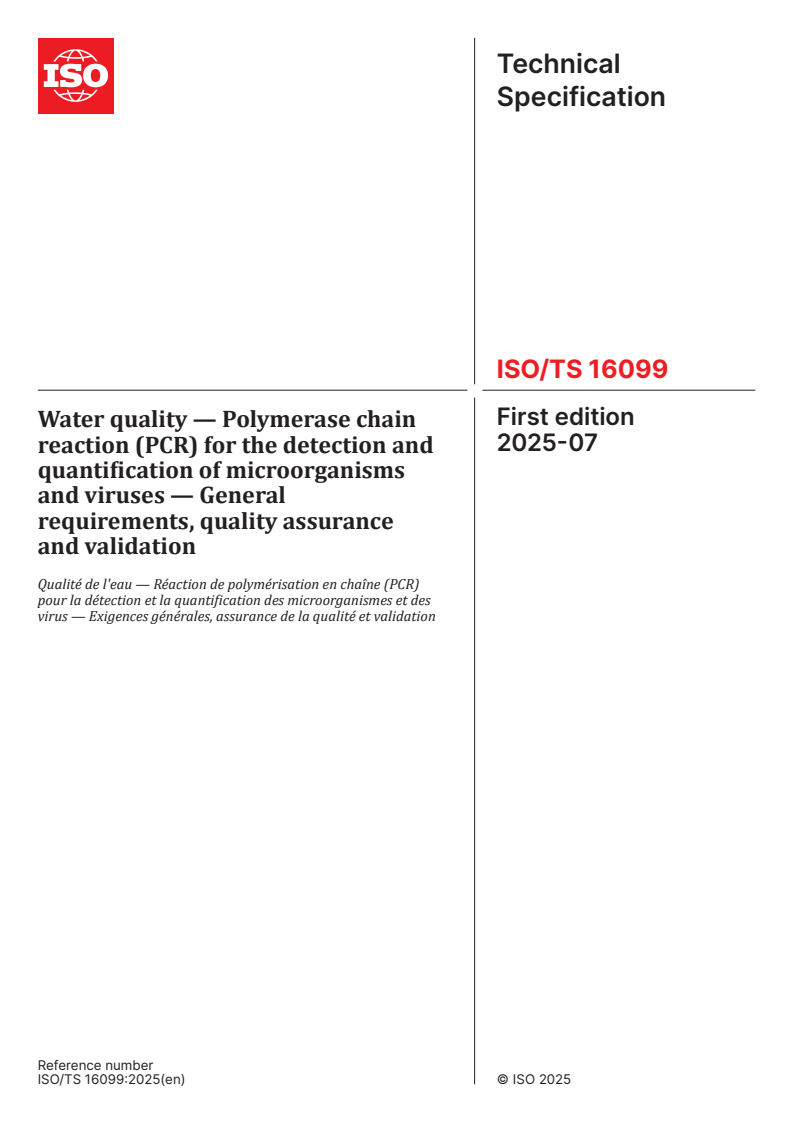
Technical
Specification
ISO/TS 16099
First edition
Water quality — Polymerase chain
2025-07
reaction (PCR) for the detection and
quantification of microorganisms
and viruses — General
requirements, quality assurance
and validation
Qualité de l'eau — Réaction de polymérisation en chaîne (PCR)
pour la détection et la quantification des microorganismes et des
virus — Exigences générales, assurance de la qualité et validation
Reference number
© ISO 2025
All rights reserved. Unless otherwise specified, or required in the context of its implementation, no part of this publication may
be reproduced or utilized otherwise in any form or by any means, electronic or mechanical, including photocopying, or posting on
the internet or an intranet, without prior written permission. Permission can be requested from either ISO at the address below
or ISO’s member body in the country of the requester.
ISO copyright office
CP 401 • Ch. de Blandonnet 8
CH-1214 Vernier, Geneva
Phone: +41 22 749 01 11
Email: copyright@iso.org
Website: www.iso.org
Published in Switzerland
ii
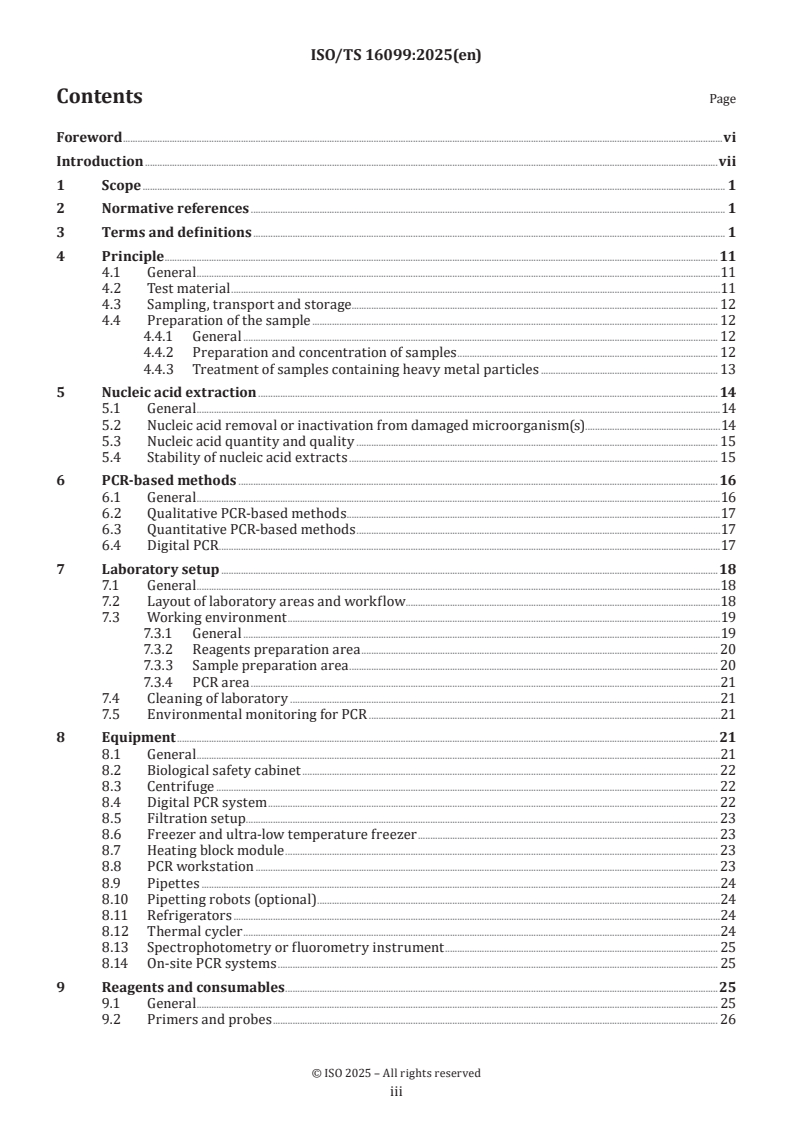
Contents Page
Foreword .vi
Introduction .vii
1 Scope . 1
2 Normative references . 1
3 Terms and definitions . 1
4 Principle .11
4.1 General .11
4.2 Test material .11
4.3 Sampling, transport and storage. 12
4.4 Preparation of the sample . 12
4.4.1 General . 12
4.4.2 Preparation and concentration of samples . 12
4.4.3 Treatment of samples containing heavy metal particles . 13
5 Nucleic acid extraction . 14
5.1 General .14
5.2 Nucleic acid removal or inactivation from damaged microorganism(s).14
5.3 Nucleic acid quantity and quality . 15
5.4 Stability of nucleic acid extracts . 15
6 PCR-based methods . 16
6.1 General .16
6.2 Qualitative PCR-based methods .17
6.3 Quantitative PCR-based methods .17
6.4 Digital PCR.17
7 Laboratory setup .18
7.1 General .18
7.2 Layout of laboratory areas and workflow .18
7.3 Working environment .19
7.3.1 General .19
7.3.2 Reagents preparation area . 20
7.3.3 Sample preparation area . 20
7.3.4 PCR area .21
7.4 Cleaning of laboratory .21
7.5 Environmental monitoring for PCR .21
8 Equipment .21
8.1 General .21
8.2 Biological safety cabinet . 22
8.3 Centrifuge . 22
8.4 Digital PCR system . 22
8.5 Filtration setup. 23
8.6 Freezer and ultra-low temperature freezer . 23
8.7 Heating block module . 23
8.8 PCR workstation . 23
8.9 Pipettes .24
8.10 Pipetting robots (optional) .24
8.11 Refrigerators .24
8.12 Thermal cycler .24
8.13 Spectrophotometry or fluorometry instrument . 25
8.14 On-site PCR systems . 25
9 Reagents and consumables .25
9.1 General . 25
9.2 Primers and probes . 26
iii
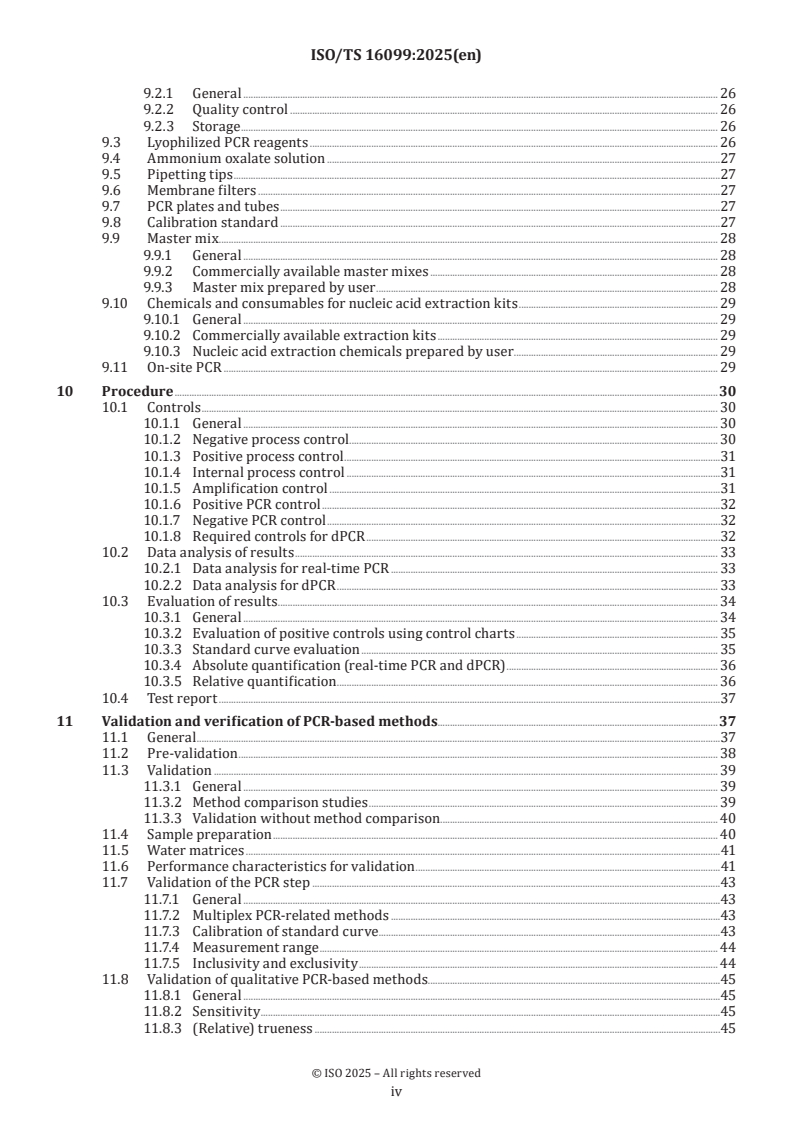
9.2.1 General . 26
9.2.2 Quality control . 26
9.2.3 Storage . 26
9.3 Lyophilized PCR reagents . 26
9.4 Ammonium oxalate solution .27
9.5 Pipetting tips .27
9.6 Membrane filters .27
9.7 PCR plates and tubes .27
9.8 Calibration standard .27
9.9 Master mix . 28
9.9.1 General . 28
9.9.2 Commercially available master mixes . 28
9.9.3 Master mix prepared by user . 28
9.10 Chemicals and consumables for nucleic acid extraction kits . 29
9.10.1 General . 29
9.10.2 Commercially available extraction kits . 29
9.10.3 Nucleic acid extraction chemicals prepared by user . 29
9.11 On-site PCR . 29
10 Procedure .30
10.1 Controls . 30
10.1.1 General . 30
10.1.2 Negative process control . 30
10.1.3 Positive process control .31
10.1.4 Internal process control .31
10.1.5 Amplification control .31
10.1.6 Positive PCR control .32
10.1.7 Negative PCR control .32
10.1.8 Required controls for dPCR .32
10.2 Data analysis of results . 33
10.2.1 Data analysis for real-time PCR . 33
10.2.2 Data analysis for dPCR . 33
10.3 Evaluation of results . . 34
10.3.1 General . 34
10.3.2 Evaluation of positive controls using control charts . 35
10.3.3 Standard curve evaluation . 35
10.3.4 Absolute quantification (real-time PCR and dPCR) . 36
10.3.5 Relative quantification . 36
10.4 Test report .37
11 Validation and verification of PCR-based methods.37
11.1 General .37
11.2 Pre-validation . 38
11.3 Validation . 39
11.3.1 General . 39
11.3.2 Method comparison studies . 39
11.3.3 Validation without method comparison. 40
11.4 Sample preparation . 40
11.5 Water matrices .41
11.6 Performance characteristics for validation .41
11.7 Validation of the PCR step .43
11.7.1 General .43
11.7.2 Multiplex PCR-related methods .43
11.7.3 Calibration of standard curve.43
11.7.4 Measurement range . 44
11.7.5 Inclusivity and exclusivity . 44
11.8 Validation of qualitative PCR-based methods.45
11.8.1 General .45
11.8.2 Sensitivity .45
11.8.3 (Relative) trueness .45
iv
11.8.4 (Relative) limit of detection . 46
11.9 Validation of quantitative PCR-based methods . 46
11.9.1 General . 46
11.9.2 (Relative) trueness . 46
11.9.3 (Relative) limit of quantification .47
11.9.4 (Relative) limit of detection .47
11.9.5 Linearity .47
11.9.6 Specificity and sensitivity . 48
11.9.7 Precision . 48
11.9.8 Robustness . . 48
11.10 Controls and validation . 49
11.11 Interlaboratory study . 49
11.12 Verification of PCR-based methods . 49
Annex A (informative) Example of an interpretation of qualitative PCR results for Escherichia
coli . .51
Annex B (informative) Example of an interpretation of quantitative PCR results for Legionella
pneumophila with an internal control .53
Annex C (informative) Example of an interpretation of dPCR results for SARS-CoV-2 .57
Annex D (informative) Verification of the calibration function of the quantitative PCR phase .60
Bibliography .68
v
Foreword
ISO (the International Organization for Standardization) is a worldwide federation of national standards
bodies (ISO member bodies). The work of preparing International Standards is normally carried out through
ISO technical committees. Each member body interested in a subject for which a technical committee
has been established has the right to be represented on that committee. International organizations,
governmental and non-governmental, in liaison with ISO, also take part in the work. ISO collaborates closely
with the International Electrotechnical Commission (IEC) on all matters of electrotechnical standardization.
The procedures used to develop this document and those intended for its further maintenance are described
in the ISO/IEC Directives, Part 1. In particular, the different approval criteria needed for the different types
of ISO document should be noted. This document was drafted in accordance with the editorial rules of the
ISO/IEC Directives, Part 2 (see www.iso.org/directives).
ISO draws attention to the possibility that the implementation of this document may involve the use of (a)
patent(s). ISO takes no position concerning the evidence, validity or applicability of any claimed patent
rights in respect thereof. As of the date of publication of this document, ISO had not received notice of (a)
patent(s) which may be required to implement this document. However, implementers are cautioned that
this may not represent the latest information, which may be obtained from the patent database available at
www.iso.org/patents. ISO shall not be held responsible for identifying any or all such patent rights.
Any trade name used in this document is information given for the convenience of users and does not
constitute an endorsement.
For an explanation of the voluntary nature of standards, the meaning of ISO specific terms and expressions
related to conformity assessment, as well as information about ISO's adherence to the World Trade
Organization (WTO) principles in the Technical Barriers to Trade (TBT), see www.iso.org/iso/foreword.html.
This document was prepared by Technical Committee ISO/TC 147, Water quality, Subcommittee SC 4,
Microbiological methods.
Any feedback or questions on this document should be directed to the user’s national standards body. A
complete listing of these bodies can be found at www.iso.org/members.html.
vi
Introduction
PCR-based methods are developed for the detection and/or quantification of, for example, pathogenic
bacteria, for rapid and reliable outcomes as an alternative to culture-based methods. For example, for the
screening on the presence of Legionella or faecal-related microorganisms in water, see References [26], [29],
[43], [49] and [56] for further information.
Performing nucleic acid quantification assays to a high standard of analytical quality can be challenging.
For example, it is well known that impure or degraded nucleic acid extracts can affect the accuracy of
quantification. Similarly, a poorly designed quantitative polymerase chain reaction (qPCR) assay with poor
amplification efficiency and poor primer specificity will impact the quantification accuracy of nucleic acid
targets.
In addition, aspects such as the water matrix and standard curves can have a significant influence on the
accuracy of quantitative measurements of nucleic acid targets. Therefore, it is important to improve the
reliability of data by setting general requirements for PCR-based methods.
vii
Technical Specification ISO/TS 16099:2025(en)
Water quality — Polymerase chain reaction (PCR) for the
detection and quantification of microorganisms and viruses
— General requirements, quality assurance and validation
1 Scope
This document specifies the general requirements for the in vitro amplification of nucleic acid sequences
(DNA or RNA). This includes polymerase chain reaction (PCR)-based methods like quantitative PCR,
qualitative PCR, reverse transcription-PCR and digital PCR.
The minimum requirements laid down in this document are intended to ensure that comparable and
reproducible results are obtained in different organizations. It covers quality assurance aspects to be
considered when working with PCR-based methods in a laboratory as well as validation and verification.
In addition to laboratory PCR-based methods, this document is also applicable to on-site PCR-based methods.
This document is applicable to PCR-based methods used for the analysis of microorganisms and viruses in
different water matrices, including but not limited to:
— drinking water;
— groundwater;
— pool water;
— process water;
— surface water;
— wastewater.
This document is applicable to the detection and quantification of nucleic acids (DNA or RNA) of
microorganisms by PCR-based methods in water such as bacteria, yeasts, fungi but also parasites such as
Cryptosporidium, Giardia, amoebas and multicellular organisms. In addition, this document is applicable to
the detection and quantification of nucleic acids from viruses in water by PCR-based methods.
NOTE In the context of this document, viruses are considered to be microorganisms. Clauses in this document can
also specifically apply to viruses and not to other types of microorganisms. In these clauses, viruses are mentioned
separately.
2 Normative references
The following documents are referred to in the text in such a way that some or all of their content constitutes
requirements of this document. For dated references, only the edition cited applies. For undated references,
the latest edition of the referenced document (including any amendments) applies.
ISO 19458, Water quality — Sampling for microbiological analysis
ISO 20836, Microbiology of the food chain — Polymerase chain reaction (PCR) for the detection of microorganisms
— Thermal performance testing of thermal cyclers
3 Terms and definitions
For the purposes of this document, the following terms and definitions apply.
ISO and IEC maintain terminology databases for use in standardization at the following addresses:
— ISO Online browsing platform: available at https:// www .iso .org/ obp
— IEC Electropedia: available at https:// www .electropedia .org/
3.1
5′-3′-exonuclease activity
ability of deoxyribonucleic acid (DNA) polymerase (3.18) to cleave nucleotides in the 5′-3′-direction
Note 1 to entry: When a fluorescent probe (3.50) is used for the detection of amplification, the 5’-3’-exonuclease
activity of DNA polymerase allows the probe to hydrolyse and emit fluorescence.
3.2
absolute quantification by digital polymerase chain reaction
absolute quantification by dPCR
procedure involving PCR amplification and target copy quantification which does not require a standard
curve to determine the concentration of a target nucleic acid (3.31) in a sample
[SOURCE: ISO 22174:2024, 3.7.9]
3.3
absolute quantification by real-time polymerase chain reaction
absolute quantification by real-time PCR
procedure involving PCR amplification to determine the concentration of a target nucleic acid (3.31) in a
sample by comparison with a standard curve, derived from standards containing a defined amount of target
[SOURCE: ISO 22174:2024, 3.6.4]
3.4
aliquot
portion of a quantity of liquids which has been divided into separate parts at the same time under identical
conditions
3.5
amplification control
nucleic acid (3.31) added in a defined amount or copy number which serves as a control for amplification
Note 1 to entry: This nucleic acid sequence (3.34) can be endogenous [naturally present in the tested matrix (3.25)] or
exogenous (naturally absent in the tested matrix).
Note 2 to entry: The amplification control can either be an internal or external control. With the internal amplification
control, the control is added to each polymerase chain reaction (PCR); this requires the use of a multiplex PCR (3.26).
The external amplification control is added to each aliquot of the extracted nucleic acid serving as a control for
amplification in a separate reaction.
Note 3 to entry: An exogenous internal amplification control can be homologous (amplified using the same primers
(3.47) as used for amplification of the target) or heterologous (amplified using different primers than those used for
amplification of the target). A homologous internal amplification control amplicon shall be distinguishable from the
microbial target amplicon (e.g. by size or by insertion of a different probe-binding sequence).
3.6
annealing
pairing of complementary single strands of nucleic acids (3.31) to form a double-stranded molecule
Note 1 to entry: Lowering the temperature of the PCR reaction allows primers (3.47) and probes (3.50) to pair with a
complementary single-stranded nucleic acid to form a double-stranded molecule.
[SOURCE: ISO 22174:2024, 3.4.13, modified — Note 1 to entry has been added.]
3.7
background fluorescence
background
intrinsic level of fluorescence resulting from the reagents, consumables and instruments used
[SOURCE: ISO 22174:2024, 3.4.7]
3.8
complementary DNA
cDNA
single-stranded deoxyribonucleic acid (DNA) (3.12), complementary to a given ribonucleic acid (RNA) (3.63)
and synthesised in the presence of reverse transcriptase to serve as a template for DNA amplification (3.17)
[SOURCE: ISO 20395:2019, 3.5]
3.9
cross-contamination
unintended transfer of nucleic acids (3.31) [deoxyribonucleic acid (DNA) (3.12) or ribonucleic acid (RNA) (3.63)]
EXAMPLE Cross-contamination can occur between samples during PCR preparation.
3.10
decontamination
procedure to remove or reduce nucleic acids (3.31) and/or nucleases from materials and surfaces
3.11
denaturation
process which results in the separation of the double-stranded nucleic acid (3.31) into single-stranded
nucleic acids
[SOURCE: ISO 22174:2024, 3.4.11]
3.12
deoxyribonucleic acid
DNA
polymer of deoxyribonucleotides occurring in a double-stranded (dsDNA) or single-stranded (ssDNA) form
[SOURCE: ISO 22174:2024, 3.1.6]
3.13
deoxyribonuclease
DNase
enzyme which degrades deoxyribonucleic acid (DNA) (3.12)
[SOURCE: ISO 22174:2024, 3.1.7]
3.14
deoxyribonucleoside triphosphate
dNTP
solution containing deoxyadenosine triphosphate (dATP), deoxycytidine triphosphate (dCTP),
deoxyguanosine triphosphate (dGTP), deoxythymidine triphosphate (dTTP) and/or deoxyuridine
triphosphate (dUTP)
[SOURCE: ISO 22174:2024, 3.4.2]
3.15
detection of polymerase chain reaction product
detection of PCR product
detection of amplicon
process which signals the presence of a PCR product
[SOURCE: ISO 22174:2024, 3.1.15, modified — “an amplicon” has been replaced by “a PCR product”.]
3.16
digital polymerase chain reaction
digital PCR
dPCR
procedure in which nucleic acid (3.31) templates are randomly and independently distributed across multiple
partitions (3.37) of nominally equivalent volume, such that some partitions contain template and others do
not, followed by PCR amplification of target sequences and detection of specific PCR products, providing a
count of the number of partitions with a positive and negative signal for the target template
Note 1 to entry: dPCR can also provide the qualitative results “detected” or “not detected”.
Note 2 to entry: In certain instances, whole cells or organisms can be partitioned and lysis is performed in the
individual partitions to allow amplification of target templates.
[SOURCE: ISO 22174:2024, 3.7.1, modified — “amplicons” has been replaced by “PCR products”.]
3.17
deoxyribonucleic acid amplification
DNA amplification
multiplication of nucleic acid (3.31) through polymerase chain reaction (PCR) resulting in the amplified
PCR product
Note 1 to entry: The filling-in of the single-stranded DNA (3.12) by DNA polymerase (3.18) to double-stranded DNA,
starting from the primer (3.47) binding site, is also called elongation.
3.18
deoxyribonucleic acid polymerase
DNA polymerase
thermostable enzyme which catalyses DNA (3.12) synthesis
Note 1 to entry: DNA polymerase can also cleave a hybridized nucleic acid (3.31) molecule using its 5′-3′-exonuclease
activity (3.1). It is dependent on the type of enzyme and can be present in, for example, Taq-, Tth- and Tfl-polymerase.
Note 2 to entry: DNA synthesis is catalysed by reading the existing DNA sequence, then adding nucleotides to the newly
forming strand of DNA that are complementary to the original strand. By using a forward and a reverse primer (3.47),
DNA polymerases will duplicate both strands of the original source DNA resulting in two identical DNA molecules.
[SOURCE: ISO 22174:2024, 3.4.1, modified — Note 2 to entry has been added.]
3.19
eluate
solution obtained through nucleic acid extraction (3.32) and purification (3.33) that contains the nucleic
acids (3.31) of a sample and that is to be used for PCR
3.20
hybridization
specific binding of complementary nucleic acid sequences (3.34) under suitable reaction conditions
[SOURCE: ISO 22174:2024, 3.4.12]
3.21
intercalating dye
double-stranded DNA binding dye that emits fluorescence when bound to double-stranded DNA, that gets
also inserted into double-stranded DNA during the process of PCR amplification, increasing the intensity of
the fluorescence with the increase of double-stranded DNA
3.22
internal process control
control used for the quality assessment of the entire protocol, which is therefore added to the investigated
sample material to undergo the same procedure as the naturally present microorganism or genetic material
Note 1 to entry: Due to its mode of action, an internal control shall be selected which assumingly is naturally absent in
the tested matrix (3.25).
Note 2 to entry: For optimal use of the internal process control, it is recommended to use a control that behaves the
same way in all parts of the PCR-based method, e.g. a virus as a control for a virus PCR-based method and, in case of
bacteria, those that exhibit similar extraction behaviour (e.g. gram-positive or gram-negative).
[SOURCE: ISO 22174:2024, 3.5.3, modified — “target microorganism” has been replaced by “naturally
present microorganism or genetic material” and Note 2 to entry has been added.]
3.23
limit of blank
LoB
highest number of partitions (3.37) appearing positive, with more than
95 % probability, when testing samples in the absence of the target nucleic acid sequence (3.34) of the target
organism (3.66), which determines the target sequence specific “false positive” limit
Note 1 to entry: The LoB should be determined, as a minimum, from replicates of the negative amplification control
(3.5) (amplification LoB) (e.g. water, elution buffer) and negative samples containing the matrix (3.25) (full method
LoB). The number of negative control replicates and negative samples should be justified by the user laboratory and
should be consistent with the validation tests performed by the developer.
[SOURCE: ISO 22174:2024, 3.7.7, modified — “pathogen” has been replaced by “target organism”.]
3.24
master mix
mixture of reagents needed for nucleic acid (3.31) amplification except for the target nucleic acid sequence (3.34)
Note 1 to entry: A reverse transcription (RT)-master mix is a type of master mix that contains a mixture of reagents
needed for reverse transcription, at least consisting of a reverse transcriptase (3.58), a primer (3.47), deoxynucleotide
triphosphates (dNTPs) (3.14), ribonuclease (3.61) inhibitor and polymerase chain reaction-grade water (PCR-grade
water) (3.39).
Note 2 to entry: A PCR-master mix is a type of master mix that contains a mixture of reagents needed for DNA
amplification (3.17), at least consisting of a deoxyribonucleic acid (DNA)polymerase (3.18), primers, dNTPs and PCR-
grade water.
[SOURCE: ISO 22174:2024, 3.4.4, modified — Notes 1 and 2 to entry have been added.]
3.25
matrix
all the components of the sample
[SOURCE: ISO 22174:2024, 3.1.5]
3.26
multiplex polymerase chain reaction
multiplex PCR
PCR allowing the detection of multiple targets simultaneously within a single reaction tube, where more
primer (3.47) pairs [and probes (3.50)] are used within one master mix (3.24)
[SOURCE: ISO 22174:2024, 3.1.20]
3.27
negative cluster
set of negative results from partitions (3.37) that contained the reaction mix, without the target sequence,
representing the negative partitions
[SOURCE: ISO 22174:2024, 3.7.3]
3.28
negative extraction control
extraction blank
control carried through all steps of the nucleic acid extraction (3.32) procedure in the absence of a sample
[SOURCE: ISO 22174:2024, 3.5.4, modified — “test” has been deleted.]
3.29
negative polymerase chain reaction control
negative PCR control
no-template control
NTC
PCR control made with water (or other PCR-inert substrate such as grinding or elution buffer) free of target
nucleic acid (3.31) and PCR inhibitors
[SOURCE: ISO 22174:2024, 3.5.8]
3.30
negative process control
target free sample which is run through all stages o
...