


ISO/FDIS 14993
(Main)Corrosion of metals and alloys — Accelerated testing involving cyclic exposure to salt mist, dry and wet conditions
Corrosion of metals and alloys — Accelerated testing involving cyclic exposure to salt mist, dry and wet conditions
This document specifies the apparatus and test procedure to be used in conducting accelerated corrosion tests for the comparative evaluation of metallic materials with or without permanent corrosion protection or temporary corrosion protection in salt-contaminated outdoor environments. The test involves cyclic exposure of the specimens to neutral salt mist, "dry" and "wet" conditions. The type of test specimen and the exposure period are not specified. The particular advantages of this test over common accelerated tests such as the neutral salt spray (NSS) test lie in its ability to better reproduce the corrosion that occurs in outdoor salt-contaminated environments. This document is applicable to — metals and their alloys, — metallic coatings (anodic and cathodic), — conversion coatings, — anodic oxide coatings, and — organic coatings on metallic materials. NOTE Methods of test for coatings to determine their resistance, in the presence of scribe marks through to the substrate, to various cyclic corrosion conditions which include the condensation of water on the test specimens during periods of humidity are given in ISO 11997-1.
Corrosion des métaux et alliages — Essais accélérés comprenant des expositions cycliques à des conditions de brouillard salin, de séchage et d'humidité
General Information
- Status
- Not Published
- Technical Committee
- ISO/TC 156 - Corrosion of metals and alloys
- Drafting Committee
- ISO/TC 156/WG 7 - Accelerated corrosion tests
- Current Stage
- 5020 - FDIS ballot initiated: 2 months. Proof sent to secretariat
- Start Date
- 22-Jan-2026
- Completion Date
- 22-Jan-2026
Relations
- Effective Date
- 29-Jun-2024
ISO/FDIS 14993:2026 – Accelerated Corrosion Testing of Metals and Alloys
Overview
ISO/FDIS 14993:2026, published by the International Organization for Standardization (ISO), specifies an accelerated corrosion test method that involves cyclic exposure of metallic materials to salt mist, dry, and wet conditions. This method is designed for the comparative evaluation of metals and alloys, including those with permanent or temporary corrosion protection, to simulate outdoor salt-contaminated environments more realistically than conventional neutral salt spray (NSS) tests.
The standard outlines the required apparatus, test solutions, procedures, and evaluation methods, enabling manufacturers and researchers to assess the durability and corrosion resistance of metallic materials and coatings under cyclic corrosive conditions.
Key Topics
Cyclic Exposure Test Method
The test simulates natural outdoor corrosion environments by subjecting specimens to repeated cycles of neutral salt mist, drying, and wet conditions. This approach promotes corrosion mechanisms more representative of real-world exposure compared to continuous spray tests.Scope of Application
Applies to:- Metals and their alloys
- Metallic coatings (anodic and cathodic)
- Conversion coatings
- Anodic oxide coatings
- Organic coatings on metallic substrates
Test Solution Preparation
A neutral sodium chloride solution is prepared at a concentration of 50 g/l ± 5 g/l. Key quality parameters include low conductivity, limited heavy metal impurities (copper, nickel, lead less than 0.005%), and minimal sodium iodide content, ensuring consistent corrosivity.Apparatus and Test Conditions
The standard specifies apparatus capable of generating salt mist and controlling humidity with drying intervals, including detailed requirements for component protection and specimen arrangement. Operating conditions, continuity, and test duration can be tailored but are not strictly defined, allowing flexibility for specific evaluation needs.Post-Test Specimen Treatment and Evaluation
Procedures for treating test specimens after exposure differ between organic-coated and non-organic-coated materials. The evaluation focuses on corrosion characteristics relevant to outdoor salt-contaminated atmospheres rather than ranking materials for long-term performance prediction.Safety Considerations
The standard includes warnings related to handling hazardous materials and operating test equipment safely, underlining the importance of compliance with health and safety regulations.
Practical Applications
Quality Control in Metal Manufacturing
This test method assists manufacturers in ensuring consistent corrosion resistance of metal products and coatings, especially for applications subjected to marine or salt-laden environments.Coating Performance Validation
By simulating cyclic salt contamination, drying, and wetting, ISO 14993 enables coating manufacturers to verify the durability of protective organic and inorganic coatings under aggressive outdoor conditions.Material Selection for Harsh Environments
Engineers and designers can use this accelerated testing method to compare different metallic materials and coatings, informing selections where exposure to salt spray, humidity, and weather fluctuations is expected.Research and Development
The standard serves as a reliable laboratory test framework for developing new corrosion-resistant alloys and coatings, helping to refine formulations and protective technologies.
Related Standards
ISO 11997-1
Addresses test methods for coatings with scribe marks under cyclic corrosion conditions, including condensation periods, providing complementary techniques for coating resistance evaluation.ISO 1514
Specifies standard panels for paint and varnish testing, ensuring test reproducibility across laboratories.ISO 2808
Details procedures for determining film thickness in coatings, relevant for preparing specimens for corrosion testing.ISO 4623-2:2016
Defines procedures for evaluating filiform corrosion resistance on aluminum substrates.ISO 8044
Provides vocabulary for corrosion and corrosion testing terms, supporting consistent communication and understanding.ISO 17872
Offers guidelines for introducing scribe marks on coated metallic panels pertinent to corrosion testing frameworks.
Keywords: ISO 14993, accelerated corrosion test, cyclic salt mist exposure, metals corrosion testing, alloy corrosion resistance, salt-contaminated environment, metallic coatings, organic coatings corrosion, salt spray alternative, cyclic corrosion test method, neutral salt spray, corrosion protection evaluation, test apparatus specifications, accelerated corrosion testing standards.
Buy Documents
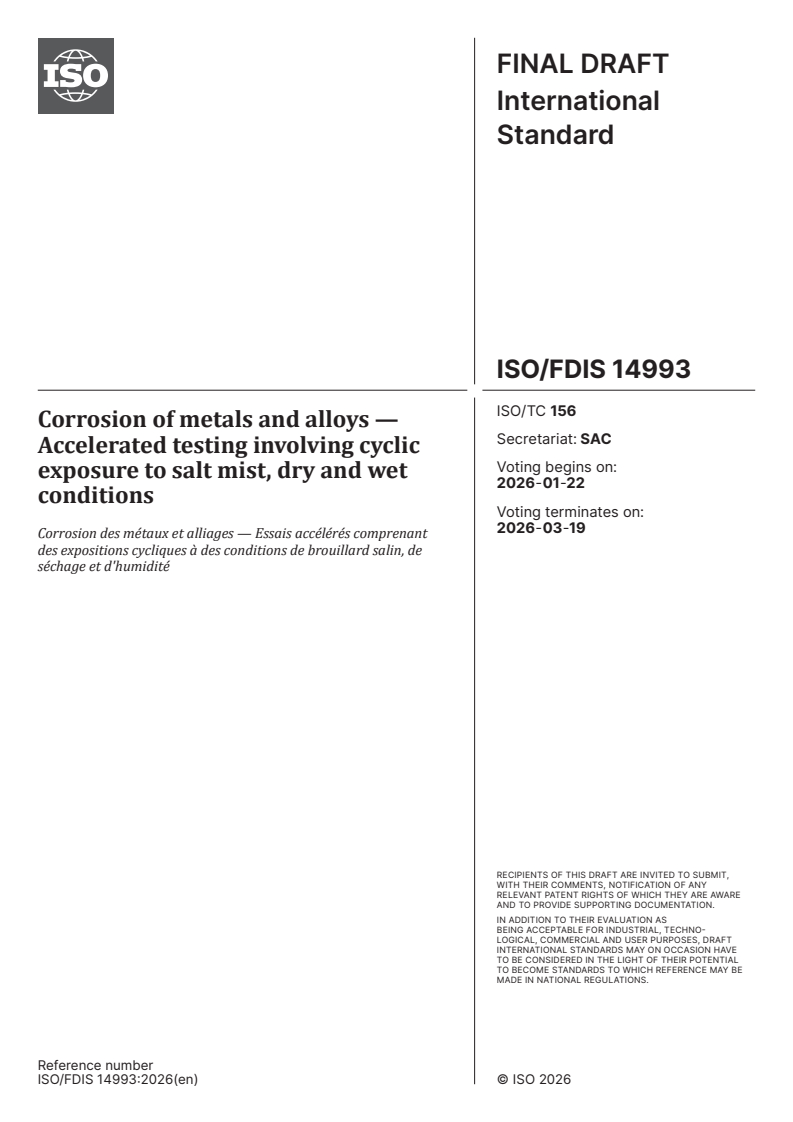
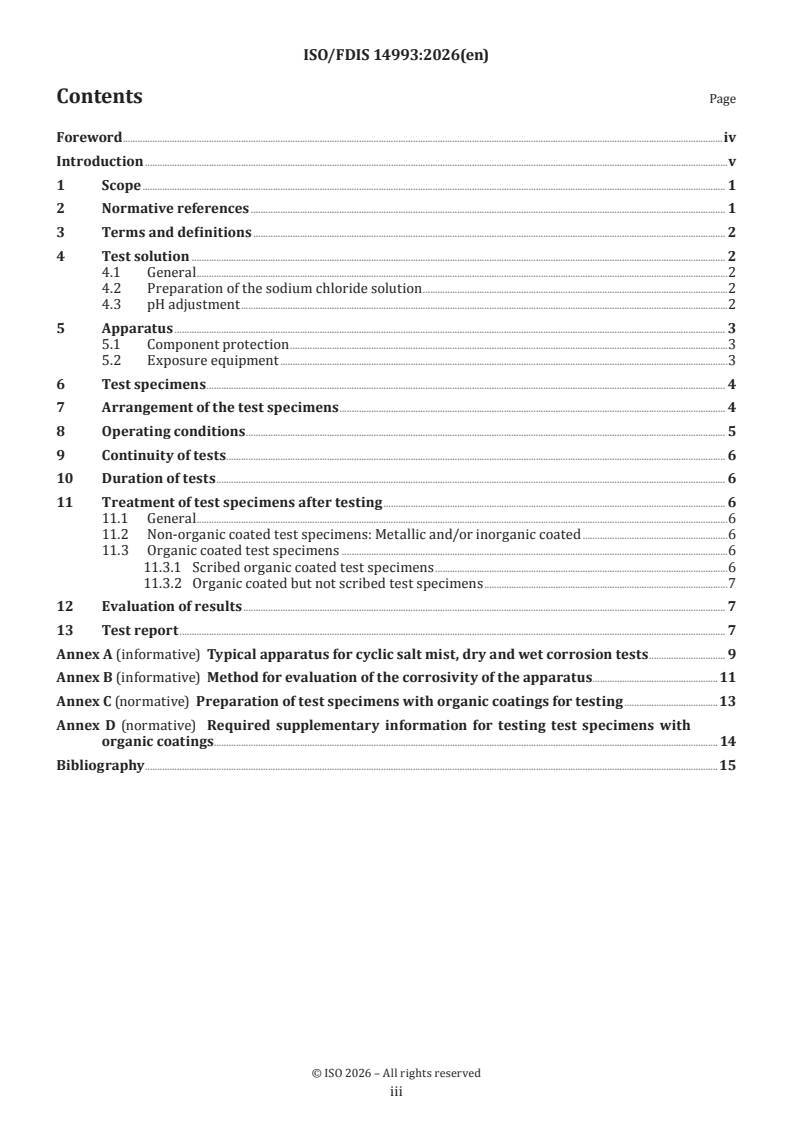

ISO/FDIS 14993 - Corrosion of metals and alloys — Accelerated testing involving cyclic exposure to salt mist, dry and wet conditions Released:8. 01. 2026
REDLINE ISO/FDIS 14993 - Corrosion of metals and alloys — Accelerated testing involving cyclic exposure to salt mist, dry and wet conditions Released:8. 01. 2026
ISO/FDIS 14993 - Corrosion des métaux et alliages — Essais accélérés comprenant des expositions cycliques à des conditions de brouillard salin, de séchage et d'humidité/14/2026
Get Certified
Connect with accredited certification bodies for this standard

Element Materials Technology
Materials testing and product certification.

Inštitut za kovinske materiale in tehnologije
Institute of Metals and Technology. Materials testing, metallurgical analysis, NDT.
Sponsored listings
Frequently Asked Questions
ISO/FDIS 14993 is a draft published by the International Organization for Standardization (ISO). Its full title is "Corrosion of metals and alloys — Accelerated testing involving cyclic exposure to salt mist, dry and wet conditions". This standard covers: This document specifies the apparatus and test procedure to be used in conducting accelerated corrosion tests for the comparative evaluation of metallic materials with or without permanent corrosion protection or temporary corrosion protection in salt-contaminated outdoor environments. The test involves cyclic exposure of the specimens to neutral salt mist, "dry" and "wet" conditions. The type of test specimen and the exposure period are not specified. The particular advantages of this test over common accelerated tests such as the neutral salt spray (NSS) test lie in its ability to better reproduce the corrosion that occurs in outdoor salt-contaminated environments. This document is applicable to — metals and their alloys, — metallic coatings (anodic and cathodic), — conversion coatings, — anodic oxide coatings, and — organic coatings on metallic materials. NOTE Methods of test for coatings to determine their resistance, in the presence of scribe marks through to the substrate, to various cyclic corrosion conditions which include the condensation of water on the test specimens during periods of humidity are given in ISO 11997-1.
This document specifies the apparatus and test procedure to be used in conducting accelerated corrosion tests for the comparative evaluation of metallic materials with or without permanent corrosion protection or temporary corrosion protection in salt-contaminated outdoor environments. The test involves cyclic exposure of the specimens to neutral salt mist, "dry" and "wet" conditions. The type of test specimen and the exposure period are not specified. The particular advantages of this test over common accelerated tests such as the neutral salt spray (NSS) test lie in its ability to better reproduce the corrosion that occurs in outdoor salt-contaminated environments. This document is applicable to — metals and their alloys, — metallic coatings (anodic and cathodic), — conversion coatings, — anodic oxide coatings, and — organic coatings on metallic materials. NOTE Methods of test for coatings to determine their resistance, in the presence of scribe marks through to the substrate, to various cyclic corrosion conditions which include the condensation of water on the test specimens during periods of humidity are given in ISO 11997-1.
ISO/FDIS 14993 is classified under the following ICS (International Classification for Standards) categories: 77.060 - Corrosion of metals. The ICS classification helps identify the subject area and facilitates finding related standards.
ISO/FDIS 14993 has the following relationships with other standards: It is inter standard links to ISO 14993:2018. Understanding these relationships helps ensure you are using the most current and applicable version of the standard.
ISO/FDIS 14993 is available in PDF format for immediate download after purchase. The document can be added to your cart and obtained through the secure checkout process. Digital delivery ensures instant access to the complete standard document.
Standards Content (Sample)
FINAL DRAFT
International
Standard
ISO/TC 156
Corrosion of metals and alloys —
Secretariat: SAC
Accelerated testing involving cyclic
Voting begins on:
exposure to salt mist, dry and wet
2026-01-22
conditions
Voting terminates on:
2026-03-19
Corrosion des métaux et alliages — Essais accélérés comprenant
des expositions cycliques à des conditions de brouillard salin, de
séchage et d'humidité
RECIPIENTS OF THIS DRAFT ARE INVITED TO SUBMIT,
WITH THEIR COMMENTS, NOTIFICATION OF ANY
RELEVANT PATENT RIGHTS OF WHICH THEY ARE AWARE
AND TO PROVIDE SUPPOR TING DOCUMENTATION.
IN ADDITION TO THEIR EVALUATION AS
BEING ACCEPTABLE FOR INDUSTRIAL, TECHNO
LOGICAL, COMMERCIAL AND USER PURPOSES, DRAFT
INTERNATIONAL STANDARDS MAY ON OCCASION HAVE
TO BE CONSIDERED IN THE LIGHT OF THEIR POTENTIAL
TO BECOME STAN DARDS TO WHICH REFERENCE MAY BE
MADE IN NATIONAL REGULATIONS.
Reference number
FINAL DRAFT
International
Standard
ISO/TC 156
Corrosion of metals and alloys —
Secretariat: SAC
Accelerated testing involving cyclic
Voting begins on:
exposure to salt mist, dry and wet
conditions
Voting terminates on:
Corrosion des métaux et alliages — Essais accélérés comprenant
des expositions cycliques à des conditions de brouillard salin, de
séchage et d'humidité
RECIPIENTS OF THIS DRAFT ARE INVITED TO SUBMIT,
WITH THEIR COMMENTS, NOTIFICATION OF ANY
RELEVANT PATENT RIGHTS OF WHICH THEY ARE AWARE
AND TO PROVIDE SUPPOR TING DOCUMENTATION.
© ISO 2026
IN ADDITION TO THEIR EVALUATION AS
All rights reserved. Unless otherwise specified, or required in the context of its implementation, no part of this publication may
BEING ACCEPTABLE FOR INDUSTRIAL, TECHNO
LOGICAL, COMMERCIAL AND USER PURPOSES, DRAFT
be reproduced or utilized otherwise in any form or by any means, electronic or mechanical, including photocopying, or posting on
INTERNATIONAL STANDARDS MAY ON OCCASION HAVE
the internet or an intranet, without prior written permission. Permission can be requested from either ISO at the address below
TO BE CONSIDERED IN THE LIGHT OF THEIR POTENTIAL
or ISO’s member body in the country of the requester.
TO BECOME STAN DARDS TO WHICH REFERENCE MAY BE
MADE IN NATIONAL REGULATIONS.
ISO copyright office
CP 401 • Ch. de Blandonnet 8
CH-1214 Vernier, Geneva
Phone: +41 22 749 01 11
Email: copyright@iso.org
Website: www.iso.org
Published in Switzerland Reference number
ii
Contents Page
Foreword .iv
Introduction .v
1 Scope . 1
2 Normative references . 1
3 Terms and definitions . 2
4 Test solution . 2
4.1 General .2
4.2 Preparation of the sodium chloride solution .2
4.3 pH adjustment .2
5 Apparatus . 3
5.1 Component protection .3
5.2 Exposure equipment .3
6 Test specimens . 4
7 Arrangement of the test specimens . 4
8 Operating conditions . 5
9 Continuity of tests. 6
10 Duration of tests . 6
11 Treatment of test specimens after testing . 6
11.1 General .6
11.2 Non-organic coated test specimens: Metallic and/or inorganic coated .6
11.3 Organic coated test specimens .6
11.3.1 Scribed organic coated test specimens .6
11.3.2 Organic coated but not scribed test specimens .7
12 Evaluation of results . 7
13 Test report . 7
Annex A (informative) Typical apparatus for cyclic salt mist, dry and wet corrosion tests . 9
Annex B (informative) Method for evaluation of the corrosivity of the apparatus .11
Annex C (normative) Preparation of test specimens with organic coatings for testing .13
Annex D (normative) Required supplementary information for testing test specimens with
organic coatings. 14
Bibliography .15
iii
Foreword
ISO (the International Organization for Standardization) is a worldwide federation of national standards
bodies (ISO member bodies). The work of preparing International Standards is normally carried out through
ISO technical committees. Each member body interested in a subject for which a technical committee
has been established has the right to be represented on that committee. International organizations,
governmental and non-governmental, in liaison with ISO, also take part in the work. ISO collaborates closely
with the International Electrotechnical Commission (IEC) on all matters of electrotechnical standardization.
The procedures used to develop this document and those intended for its further maintenance are described
in the ISO/IEC Directives, Part 1. In particular, the different approval criteria needed for the different types
of ISO documents should be noted. This document was drafted in accordance with the editorial rules of the
ISO/IEC Directives, Part 2 (see www.iso.org/directives).
ISO draws attention to the possibility that the implementation of this document may involve the use of (a)
patent(s). ISO takes no position concerning the evidence, validity or applicability of any claimed patent
rights in respect thereof. As of the date of publication of this document, ISO had not received notice of (a)
patent(s) which may be required to implement this document. However, implementers are cautioned that
this may not represent the latest information, which may be obtained from the patent database available at
www.iso.org/patents. ISO shall not be held responsible for identifying any or all such patent rights.
Any trade name used in this document is information given for the convenience of users and does not
constitute an endorsement.
For an explanation of the voluntary nature of standards, the meaning of ISO specific terms and expressions
related to conformity assessment, as well as information about ISO's adherence to the World Trade
Organization (WTO) principles in the Technical Barriers to Trade (TBT), see www.iso.org/iso/foreword.html.
This document was prepared by Technical Committee ISO/TC 156, Corrosion of metals and alloys.
This third edition cancels and replaces the second edition (ISO 14993:2018), which has been technically
revised.
The main changes are as follows:
— safety warnings have been added;
— apparatus has been revised to harmonize with ISO 16151.
Any feedback or questions on this document should be directed to the user’s national standards body. A
complete listing of these bodies can be found at www.iso.org/members.html.
iv
Introduction
Corrosion of metallic materials with or without corrosion protection is influenced by many environmental
factors, the importance of which can vary depending on the type of metallic material and the type of
environment. It is impossible, therefore, to design accelerated laboratory corrosion tests in such a way
that all environmental factors influencing resistance to corrosion are taken into account. Laboratory tests
are, therefore, designed to simulate the effects of the most important factors that enhance the corrosion
of metallic materials, however it is not possible to design a laboratory corrosion test in such a way that
complexity and variations of real, in-service conditions are fully represented.
The accelerated corrosion test method described in this document is designed to simulate and enhance the
environmental influence on a metallic material of exposure to an outdoor climate, where exposure to salt-
contaminated conditions occurs and can promote corrosion.
The test method involves cyclic exposure of test specimens to a mist of salt solution, to drying conditions
and to periods of high humidity. They are not intended to be used for comparative testing or as a means
of ranking different materials relative to each other with respect to corrosion resistance or as means of
predicting long-term corrosion resistance of the tested material (merely for testing the whole product). And
the results obtained do not permit far-reaching conclusions on the corrosion resistance of the tested metallic
material under the whole range of environmental conditions within which it can be used. Nevertheless, the
method gives a means of checking that comparative quality of a metallic material, with or without corrosion
protection, is maintained when exposed to salt-contaminated environments similar to those used in the
[15]
test .
This test method is based on Japanese Automobile Standards JASO M 609-91 and JASO M 610-92.
v
FINAL DRAFT International Standard ISO/FDIS 14993:2026(en)
Corrosion of metals and alloys — Accelerated testing
involving cyclic exposure to salt mist, dry and wet conditions
WARNING — This document can involve hazardous materials, operations and equipment. This
document does not purport to address all of the safety concerns, if any, associated with its use. It is
the responsibility of the user of this document to establish appropriate safety and health practices
and determine the applicability of regulatory limitations prior to use.
1 Scope
This document specifies the apparatus and test procedure to be used when conducting accelerated corrosion
tests for the comparative quality evaluation of metallic materials with or without permanent corrosion
protection or temporary corrosion protection in salt-contaminated outdoor environments. The test involves
cyclic exposure of the specimens to neutral salt mist, “dry” and “wet” conditions. The type of test specimen
and the exposure period are not specified.
The particular advantages of this test over common accelerated tests such as the neutral salt spray (NSS) test
lie in its ability to better reproduce the corrosion that occurs in outdoor salt-contaminated environments.
This document is applicable to:
— metals and their alloys;
— metallic coatings (anodic and cathodic);
— conversion coatings;
— anodic oxide coatings;
— organic coatings on metallic materials.
NOTE Methods of test for coatings to determine their resistance, in the presence of scribe marks through to the
substrate, to various cyclic corrosion conditions which include the condensation of water on the test specimens during
periods of humidity are given in ISO 11997-1.
2 Normative references
The following documents are referred to in the text in such a way that some or all of their content constitutes
requirements of this document. For dated references, only the edition cited applies. For undated references,
the latest edition of the referenced document (including any amendments) applies.
ISO 1514, Paints and varnishes — Standard panels for testing
ISO 2808, Paints and varnishes — Determination of film thickness
ISO 4623-2:2016, Paints and varnishes — Determination of resistance to filiform corrosion — Part 2: Aluminium
substrates
ISO 8044, Corrosion of metals and alloys — Vocabulary
ISO 17872, Paints and varnishes — Guidelines for the introduction of scribe marks through coatings on metallic
panels for corrosion testing
3 Terms and definitions
For the purposes of this document, the terms and definitions given in ISO 8044 and the following apply.
ISO and IEC maintain terminology databases for use in standardization at the following addresses:
— ISO Online browsing platform: available at https:// www .iso .org/ obp
— IEC Electropedia: available at https:// www .electropedia .org/
3.1
reference specimen
portion of the material with known test performance that is to be exposed with the intention to check the
reproducibility and repeatability of the test results for the test cabinet in use
3.2
test specimen
specific portion of the samples upon which the testing is to be performed
3.3
substitute specimen
specimen made of inert materials (such as plastic or glass) used for the substitute of a test specimen (3.2)
4 Test solution
4.1 General
Instructions for the preparation and use of a neutral sodium chloride solution are given in 4.2 and 4.3.
4.2 Preparation of the sodium chloride solution
Dissolve a sufficient mass of sodium chloride in distilled or deionized water with a conductivity no higher
than 20 μS/cm at 25 °C ± 2 °C to produce a concentration of 50 g/l ± 5 g/l. The sodium chloride concentration
of the sprayed solution collected shall be 50 g/l ± 5 g/l. The specific gravity range for a 50 g/l ± 5 g/l solution
is 1,029 to 1,036 at 25 °C.
The sodium chloride shall not contain a mass fraction of the heavy metals of copper (Cu), nickel (Ni) and lead
(Pb) in total more than 0,005 %. It shall not contain a mass fraction of sodium iodide more than 0,1 % and a
mass fraction of total impurities more than 0,5 %, calculated for dry salt.
NOTE Sodium chloride with anti-caking agents can act as corrosion inhibitors or accelerators. A useful sodium
chloride salt grade is a grade named Ph. Eur/USP or JIS, ACS.
4.3 pH adjustment
Adjust the pH of the salt solution so that the pH of the sprayed solution collected within the test cabinet is
6,5 to 7,2 at 25 °C ± 2 °C. Check the pH using electrometric measurement. Measurements of pH shall be done
using electrode suitable for measuring in weakly buffered sodium chloride solutions in deionized water.
Make any necessary corrections by adding hydrochloric acid, sodium hydroxide or sodium bicarbonate
solution of analytical grade.
®1)
WARNING — Hydrochloric acid (CAS Registry Number 7647-01-0) solution is toxic, corrosive,
irritating and very toxic to aquatic life. Refer to the safety data sheet for details. Handling of
hydrochloric acid solution shall be restricted to skilled personnel or conducted under their control.
Care shall be taken in the disposal of this solution. ®
1) CAS Registry Number is a trademark of the American Chemical Society (ACS). This information is given for the
convenience of users of this document and does not constitute an endorsement by ISO of the product named. Equivalent
products may be used if they can be shown to lead to the same results.
WARNING — Sodium hydroxide (CAS 1310-73-2) solution is toxic, corrosive and irritating. Refer to
the safety data sheet for details. Handling of sodium hydroxide solution shall be restricted to skilled
personnel or conducted under their control. Care shall be taken in the disposal of this solution.
NOTE Possible changes in pH can result from loss of carbon dioxide from the solution when it is sprayed.
Such changes can be avoided by reducing the carbon dioxide content of the solution by, for example, heating it to a
temperature greater than 35 °C before it is placed in the apparatus, or by making the solution from freshly boiled
water.
5 Apparatus
5.1 Component protection
All components in contact with the salt mist spray or the test solution shall be made of, or lined with,
materials which are resistant to corrosion by the test solution and which do not influence the corrosivity of
the sprayed test solution.
The supports for the test specimen shall be constructed such that different substrate types do not influence
each other. It shall also be constructed so that the supports themselves do not influence the test specimens.
5.2 Exposure equipment
5.2.1 Test cabinet, that meets the conditions of homogeneity and distribution of the spray. Due to the
limited capacity of test cabinets smaller than 0,4 m , the effect of the loading of the test cabinet on the
distribution of the spray and temperature shall be carefully considered. The solution shall not be sprayed
directly onto test specimens but rather spread throughout the test cabinet so that it falls naturally down on
them. The upper parts of the test cabinet shall be designed so that drops of sprayed solution formed on its
surface do not fall on the specimens being tested.
The size and shape of the test cabinet shall be such that during periods of exposure to salt mist spray, the
collection rate of solution in the test cabinet is within the limits specified in 8.2.
NOTE A schematic diagram of one possible design of test cabinet and associated apparatus for salt mist cyclic
corrosion testing is shown in Annex A.
5.2.2 Humidity and temperature control system, being capable of achieving the test condition
transition times listed in 8.1 when the test cabinet is filled with flat substitute specimens having a dimension
of 150 mm × 70 mm × 1 mm.
5.2.3 Spraying device, for spraying the salt solution during periods of exposure to salt mist spray
comprising a supply of air at controlled pressure, a reservoir containing the solution to be sprayed and one
or more atomizers.
The compressed air supplied to the atomizers shall be passed through a filter to remove all traces of oil or
solid matter and shall be at an overpressure of 70 kPa to 170 kPa. The pressure is typically 98 kPa ± 10 kPa
but can vary depending on the type of test cabinet and atomizer used.
5.2.4 Air saturator, consisting of a saturation tower containing hot water at a temperature higher than
that of the test cabinet. In order to prevent evaporation of water from the sprayed droplets, the air shall be
humidified before entering the atomizer, by passage through this tower.
During periods of exposure to the salt mist, the appropriate temperature depends on the pressure used and
on the type of atomizer nozzle and shall be adjusted so that the rate of collection of spray in the test cabinet
and the concentration of the collected spray are kept to within the specified limits (see 8.2). The level of
water shall be maintained automatically to ensure adequate humidification.
The atomizers shall be made of inert material, e.g. glass or plastic materials. Baffles may be used to prevent
direct impact of spray on the test specimens and the use of adjustable baffles is helpful in obtaining constant
distribution of spray within the test cabinet. The level of the salt solution in the supply tank shall be
maintained automatically to ensure constant spray delivery throughout the test.
5.2.5 Collecting devices, at least two, consisting of clean funnels with a collecting area of approximately
80 cm made of glass or other chemically inert material, with the stems inserted into graduated cylinders or
other similar containers. The purpose of the collecting devices is to confirm that the collection rate is within
specified limits (see 8.2). They shall be placed in the zone of the test cabinet where the test specimens are
placed, one close to the spray inlet and one remote from an inlet and in such a way that only spray, and not
the liquid falling from specimens or from parts of the test cabinet, is collected.
5.2.6 Air dryer, comprising a heating device and fan to supply dried air of the specified humidity during
“dry” periods (see Table 1).
5.2.7 Exhaust system, by which air is exhausted from the test cabinet. It shall not be influenced by the
back pressure of the atmosphere when the air is released at a point outside the building.
6 Test specimens
6.1 The number and type of test specimens, their
...
ISO/TC156 N7896
ISO/FDIS 14993:2025(en)
ISO/TC 156
Secretariat: SAC
Date: 2025-11-142026-01-07
Corrosion of metalmetals and alloys — Accelerated testing involving
cyclic exposure to salt mist, dry and wet conditions
Corrosion des métaux et alliages — Essais accélérés comprenant des expositions cycliques à des conditions de
brouillard salin, de séchage et d'humidité
FDIS stage
ISO #####-#:####(X/FDIS 14993:2026(en)
All rights reserved. Unless otherwise specified, or required in the context of its implementation, no part of this publication
may be reproduced or utilized otherwise in any form or by any means, electronic or mechanical, including photocopying,
or posting on the internet or an intranet, without prior written permission. Permission can be requested from either ISO
at the address below or ISO’s member body in the country of the requester.
ISO copyright office
CP 401 • Ch. de Blandonnet 8
CH-1214 Vernier, Geneva
Phone: + 41 22 749 01 11
EmailE-mail: copyright@iso.org
Website: www.iso.orgwww.iso.org
Published in Switzerland
ii © ISO #### 2026 – All rights reserved
ii
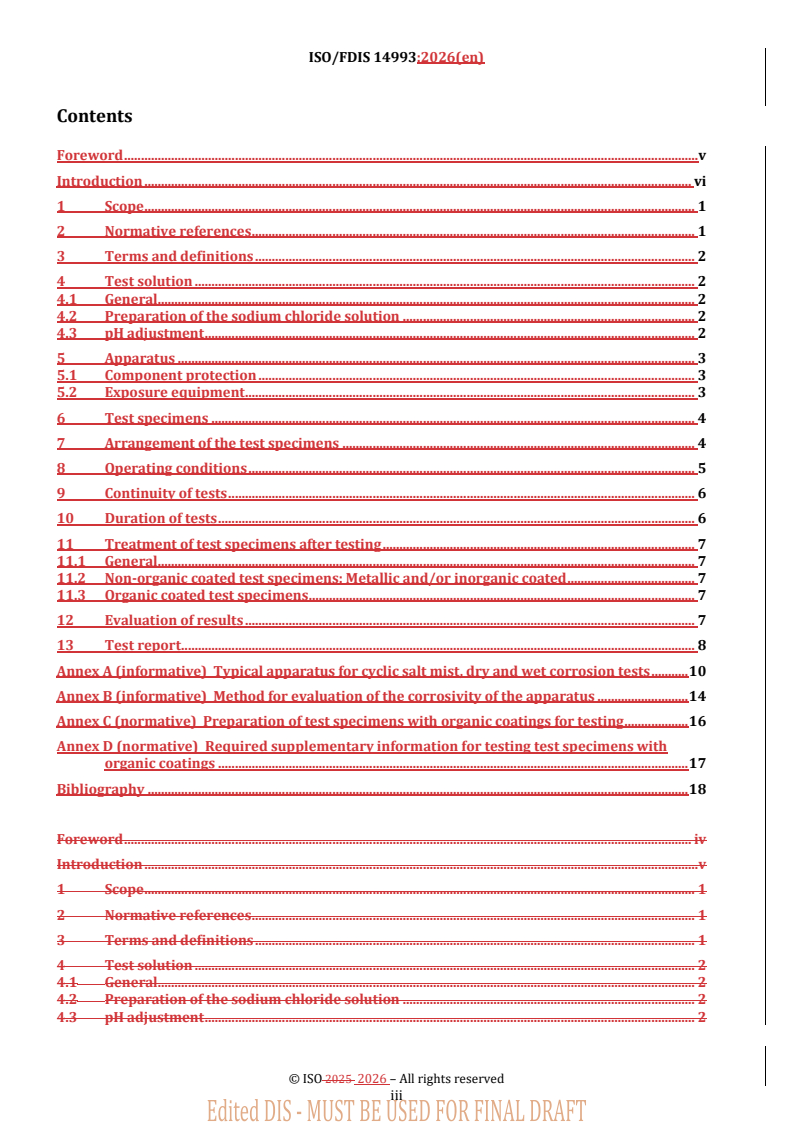
Contents
Foreword . v
Introduction . vi
1 Scope . 1
2 Normative references . 1
3 Terms and definitions . 2
4 Test solution . 2
4.1 General. 2
4.2 Preparation of the sodium chloride solution . 2
4.3 pH adjustment . 2
5 Apparatus . 3
5.1 Component protection . 3
5.2 Exposure equipment . 3
6 Test specimens . 4
7 Arrangement of the test specimens . 4
8 Operating conditions . 5
9 Continuity of tests . 6
10 Duration of tests . 6
11 Treatment of test specimens after testing . 7
11.1 General. 7
11.2 Non-organic coated test specimens: Metallic and/or inorganic coated . 7
11.3 Organic coated test specimens . 7
12 Evaluation of results . 7
13 Test report . 8
Annex A (informative) Typical apparatus for cyclic salt mist, dry and wet corrosion tests . 10
Annex B (informative) Method for evaluation of the corrosivity of the apparatus . 14
Annex C (normative) Preparation of test specimens with organic coatings for testing . 16
Annex D (normative) Required supplementary information for testing test specimens with
organic coatings . 17
Bibliography . 18
Foreword . iv
Introduction . v
1 Scope . 1
2 Normative references . 1
3 Terms and definitions . 1
4 Test solution . 2
4.1 General. 2
4.2 Preparation of the sodium chloride solution . 2
4.3 pH adjustment . 2
iii
ISO #####-#:####(X/FDIS 14993:2026(en)
5 Apparatus . 3
5.1 Component protection . 3
5.2 Exposure equipment . 3
6 Test specimens . 4
7 Arrangement of the test specimens . 4
8 Operating conditions . 5
9 Continuity of tests . 6
10 Duration of tests . 6
11 Treatment of test specimens after testing . 6
11.1 General. 6
11.2 Non-organic coated test specimens: metallic and/or inorganic coated. 6
11.3 Organic coated test specimens . 6
11.3.1 Scribed organic coated test specimens . 6
11.3.2 Organic coated but not scribed test specimens . 7
12 Evaluation of results . 7
13 Test report . 7
Annex A (informative) Typical apparatus for cyclic salt mist, dry and wet corrosion tests . 9
Annex B (informative) Method for evaluation of the corrosivity of the apparatus . 11
Annex C (normative) Preparation of test specimens with organic coatings for testing . 13
Annex D (normative) Required supplementary information for testing test specimens with
organic coatings . 14
Bibliography . 15
iv © ISO #### 2026 – All rights reserved
iv
Foreword
ISO (the International Organization for Standardization) is a worldwide federation of national standards
bodies (ISO member bodies). The work of preparing International Standards is normally carried out through
ISO technical committees. Each member body interested in a subject for which a technical committee has been
established has the right to be represented on that committee. International organizations, governmental and
non-governmental, in liaison with ISO, also take part in the work. ISO collaborates closely with the
International Electrotechnical Commission (IEC) on all matters of electrotechnical standardization.
The procedures used to develop this document and those intended for its further maintenance are described
in the ISO/IEC Directives, Part 1. In particular, the different approval criteria needed for the different types of
ISO documents should be noted. This document was drafted in accordance with the editorial rules of the
ISO/IEC Directives, Part 2 (see www.iso.org/directives).
ISO draws attention to the possibility that the implementation of this document may involve the use of (a)
patent(s). ISO takes no position concerning the evidence, validity or applicability of any claimed patent rights
in respect thereof. As of the date of publication of this document, ISO had not received notice of (a) patent(s)
which may be required to implement this document. However, implementers are cautioned that this may not
represent the latest information, which may be obtained from the patent database available at
www.iso.org/patents. ISO shall not be held responsible for identifying any or all such patent rights.
Any trade name used in this document is information given for the convenience of users and does not
constitute an endorsement.
For an explanation of the voluntary nature of standards, the meaning of ISO specific terms and expressions
related to conformity assessment, as well as information about ISO's adherence to the World Trade
Organization (WTO) principles in the Technical Barriers to Trade (TBT), see www.iso.org/iso/foreword.html.
This document was prepared by Technical Committee ISO/TC 156, Corrosion of metals and alloys.
This third edition cancels and replaces the second edition (ISO 14993:2018), which has been
editoriallytechnically revised.
The main changes are as follows:
— safety warnings have been added;
— apparatus has been revised to harmonize with ISO 16151.
Any feedback or questions on this document should be directed to the user’s national standards body. A
complete listing of these bodies can be found at www.iso.org/members.html.
v
ISO #####-#:####(X/FDIS 14993:2026(en)
Introduction
Corrosion of metallic materials with or without corrosion protection is influenced by many environmental
factors, the importance of which can vary depending on the type of metallic material and the type of
environment. It is impossible, therefore, to design accelerated laboratory corrosion tests in such a way that all
environmental factors influencing resistance to corrosion are taken into account. Laboratory tests are,
therefore, designed to simulate the effects of the most important factors that enhance the corrosion of metallic
materials, however it is not possible to design a laboratory corrosion test in such a way that complexity and
variations of real, in-service conditions are fully represented.
The accelerated corrosion test method described in this document is designed to simulate and enhance the
environmental influence on a metallic material of exposure to an outdoor climate, where exposure to salt-
contaminated conditions occurs and can promote corrosion.
The test method involves cyclic exposure of test specimens to a mist of salt solution, to drying conditions and
to periods of high humidity. They are not intended to be used for comparative testing or as a means of ranking
different materials relative to each other with respect to corrosion resistance or as means of predicting long-
term corrosion resistance of the tested material (merely for testing the whole product). And the results
obtained do not permit far-reaching conclusions on the corrosion resistance of the tested metallic material
under the whole range of environmental conditions within which it can be used. Nevertheless, the method
gives a means of checking that comparative quality of a metallic material, with or without corrosion protection,
[
is maintained when exposed to salt-contaminated environments similar to those used in the test Error!
]
Reference source not found. .
This test method is based on Japanese Automobile Standards JASO M 609-91 and JASO M 610-92.
vi © ISO #### 2026 – All rights reserved
vi
DRAFT International Standard ISO/DIS 14993:2025(en)
Corrosion of metals and alloys — Accelerated testing involving cyclic
exposure to salt mist, dry and wet conditions
WARNING — This document can involve hazardous materials, operations and equipment. This
document does not purport to address all of the safety concerns, if any, associated with its use. It is the
responsibility of the user of this document to establish appropriate safety and health practices and
determine the applicability of regulatory limitations prior to use.
1 Scope
This document specifies the apparatus and test procedure to be used inwhen conducting accelerated corrosion
tests for the comparative quality evaluation of metallic materials with or without permanent corrosion
protection or temporary corrosion protection in salt-contaminated outdoor environments. The test involves
cyclic exposure of the specimens to neutral salt mist, “dry” and “wet” conditions. The type of test specimen
and the exposure period are not specified.
The particular advantages of this test over common accelerated tests such as the neutral salt spray (NSS) test
lie in its ability to better reproduce the corrosion that occurs in outdoor salt-contaminated environments.
This document is applicable to:
— metals and their alloys;
— metallic coatings (anodic and cathodic);
— conversion coatings;
— anodic oxide coatings;
— organic coatings on metallic materials.
NOTE Methods of test for coatings to determine their resistance, in the presence of scribe marks through to the
substrate, to various cyclic corrosion conditions which include the condensation of water on the test specimens during
periods of humidity are given in ISO 11997-1.
2 Normative references
The following documents are referred to in the text in such a way that some or all of their content constitutes
requirements of this document. For dated references, only the edition cited applies. For undated references,
the latest edition of the referenced document (including any amendments) applies.
ISO 1514, Paints and varnishes — Standard panels for testing
ISO 2808, Paints and varnishes — Determination of film thickness
ISO 4623-2:2016, Paints and varnishes — Determination of resistance to filiform corrosion — Part 2: Aluminium
substrates
ISO 8044, Corrosion of metals and alloys — Vocabulary
ISO #####-#:####(X/FDIS 14993:2026(en)
ISO 17872, Paints and varnishes — Guidelines for the introduction of scribe marks through coatings on metallic
panels for corrosion testing
3 Terms and definitions
For the purposes of this document, the terms and definitions given in ISO 8044 and the following apply.
ISO and IEC maintain terminology databases for use in standardization at the following addresses:
— ISO Online browsing platform: available at https://www.iso.org/obp
— IEC Electropedia: available at https://www.electropedia.org/
3.1
reference specimen
portion of the material with known test performance that is to be exposed with the intention to check the
reproducibility and repeatability of the test results for the test cabinet in use
3.2
test specimen
specific portion of the samples upon which the testing is to be performed
3.3
substitute specimen
specimen made of inert materials (such as plastic or glass) used for the substitute of a test specimen (Error!
Reference source not found.)
4 Test solution
4.1 General
Instructions for the preparation and use of a neutral sodium chloride solution are given in 4.2 and 4.3.
4.2 Preparation of the sodium chloride solution
Dissolve a sufficient mass of sodium chloride in distilled or deionized water with a conductivity no higher than
20 μS/cm at 25 °C ± 2 °C to produce a concentration of 50 g/l ± 5 g/l. The sodium chloride concentration of
the sprayed solution collected shall be 50 g/l ± 5 g/l. The specific gravity range for a 50 g/l ± 5 g/l solution is
1,029 to 1,036 at 25 °C.
The sodium chloride shall not contain a mass fraction of the heavy metals of copper (Cu), nickel (Ni) and lead
(Pb) in total more than 0,005 %. It shall not contain a mass fraction of sodium iodide more than 0,1 % and a
mass fraction of total impurities more than 0,5 %, calculated for dry salt.
NOTE Sodium chloride with anti-caking agents can act as corrosion inhibitors or accelerators. A useful sodium
chloride salt grade is a grade named Ph. Eur/USP or JIS, ACS.
4.3 pH adjustment
Adjust the pH of the salt solution so that the pH of the sprayed solution collected within the test cabinet is 6,5
to 7,2 at 25 °C ± 2 °C. Check the pH using electrometric measurement. Measurements of pH shall be done using
electrode suitable for measuring in weakly buffered sodium chloride solutions in deionized water. Make any
necessary corrections by adding hydrochloric acid, sodium hydroxide or sodium bicarbonate solution of
analytical grade.
2 © ISO #### 2026 – All rights reserved
ISO/DISFDIS 14993:20252026(en)
®1)
WARNING — Hydrochloric acid (CAS Registry Number 7647-01-0) solution is toxic, corrosive,
irritating and very toxic to aquatic life. Refer to the safety data sheet for details. Handling of
hydrochloric acid solution shall be restricted to skilled personnel or conducted under their control.
Care shall be taken in the disposal of this solution.
WARNING — Sodium hydroxide (CAS 1310-73-2) solution is toxic, corrosive and irritating. Refer to the
safety data sheet for details. Handling of sodium hydroxide solution shall be restricted to skilled
personnel or conducted under their control. Care shall be taken in the disposal of this solution.
NOTE Possible changes in pH can result from loss of carbon dioxide from the solution when it is sprayed. Such
changes can be avoided by reducing the carbon dioxide content of the solution by, for example, heating it to a temperature
greater than 35 °C before it is placed in the apparatus, or by making the solution from freshly boiled water.
5 Apparatus
5.1 Component protection
All components in contact with the salt mist spray or the test solution shall be made of, or lined with, materials
which are resistant to corrosion by the test solution and which do not influence the corrosivity of the sprayed
test solution.
The supports for the test specimen shall be constructed such that different substrate types do not influence
each other. It shall also be constructed so that the supports themselves do not influence the test specimens.
5.2 Exposure equipment
5.2.1 Test cabinet, that meets the conditions of homogeneity and distribution of the spray. Due to the
limited capacity of test cabinets smaller than 0,4 m , the effect of the loading of the test cabinet on the
distribution of the spray and temperature shall be carefully considered. The solution shall not be
sprayed directly onto test specimens but rather spread throughout the test cabinet so that it falls
naturally down on them. The upper parts of the test cabinet shall be designed so that drops of sprayed
solution formed on its surface do not fall on the specimens being tested.
The size and shape of the test cabinet shall be such that during periods of exposure to salt mist spray, the
collection rate of solution in the test cabinet is within the limits specified in 8.2.
NOTE A schematic diagram of one possible design of test cabinet and associated apparatus for salt mist cyclic
corrosion testing is shown in Annex A.
5.2.2 Humidity and temperature control system, being capable of achieving the test condition transition
times listed in 8.1 when the test cabinet is filled with flat substitute specimens having a dimension of
150 mm × 70 mm × 1 mm.
5.2.3 Spraying device, for spraying the salt solution during periods of exposure to salt mist spray
comprising a supply of air at controlled pressure, a reservoir containing the solution to be sprayed and
one or more atomizers.
The compressed air supplied to the atomizers shall be passed through a filter to remove all traces of oil or
solid matter and shall be at an overpressure of 70 kPa to 170 kPa. The pressure is typically 98 kPa ± 10 kPa
but can vary depending on the type of test cabinet and atomizer used.
1) ®
CAS Registry Number is a trademark of the American Chemical Society (ACS). This information is given for the
convenience of users of this document and does not constitute an endorsement by ISO of the product named. Equivalent
products may be used if they can be shown to lead to the same results.
ISO #####-#:####(X/FDIS 14993:2026(en)
5.2.4 Air saturator, consisting of a saturation tower containing hot water at a temperature higher than that
of the test cabinet. In order to prevent evaporation of water from the sprayed droplets, the air shall be
humidified before entering the atomizer, by passage through this tower.
During periods of exposure to the salt mist, the appropriate temperature depends on the pressure used and
on the type of atomizer nozzle and shall be adjusted so that the rate of collection of spray in the test cabinet
and the concentration of the collected spray are kept to within the specified limits (see 8.2). The level of water
shall be maintained automatically to ensure adequate humidification.
The atomizers shall be made of inert material, e.g. glass or plastic materials. Baffles may be used to prevent
direct impact of spray on the test specimens and the use of adjustable baffles is helpful in obtaining constant
distribution of spray within the test cabinet. The level of the salt solution in the supply tank shall be maintained
automatically to ensure constant spray delivery throughout the test.
5.2.5 Collecting devices, at least two, consisting of clean funnels with a collecting area of approximately
80 cm made of glass or other chemically inert material, with the stems inserted into graduated
cylinders or other similar containers. The purpose of the collecting devices is to confirm that the
collection rate is within specified limits (see 8.2). They shall be placed in the zone of the test cabinet
where the test specimens are placed, one close to the spray inlet and one remote from an inlet and in
such a way that only spray, and not the liquid falling from specimens or from parts of the test cabinet,
is collected.
5.2.6 Air dryer, comprising a heating device and fan to supply dried air of the specified humidity during
“dry” periods (see 0).
5.2.7 Exhaust system, by which air is exhausted from the test cabinet. It shall not be influenced by the back
...
PROJET FINAL
Norme
internationale
ISO/TC 156
Corrosion des métaux et alliages —
Secrétariat: SAC
Essais accélérés comprenant
Début de vote:
des expositions cycliques à des
2026-01-22
conditions de brouillard salin, de
Vote clos le:
séchage et d'humidité
2026-03-19
Corrosion of metals and alloys — Accelerated testing involving
cyclic exposure to salt mist, dry and wet conditions
LES DESTINATAIRES DU PRÉSENT PROJET SONT
INVITÉS À PRÉSENTER, AVEC LEURS OBSERVATIONS,
NOTIFICATION DES DROITS DE PROPRIÉTÉ DONT ILS
AURAIENT ÉVENTUELLEMENT CONNAISSANCE ET À
FOURNIR UNE DOCUMENTATION EXPLICATIVE.
OUTRE LE FAIT D’ÊTRE EXAMINÉS POUR
ÉTABLIR S’ILS SONT ACCEPTABLES À DES FINS
INDUSTRIELLES, TECHNOLOGIQUES ET COM-MERCIALES,
AINSI QUE DU POINT DE VUE DES UTILISATEURS, LES
PROJETS DE NORMES
INTERNATIONALES DOIVENT PARFOIS ÊTRE CONSIDÉRÉS
DU POINT DE VUE DE LEUR POSSI BILITÉ DE DEVENIR DES
NORMES POUVANT
SERVIR DE RÉFÉRENCE DANS LA RÉGLEMENTATION
NATIONALE.
Numéro de référence
PROJET FINAL
Norme
internationale
ISO/TC 156
Corrosion des métaux et alliages —
Secrétariat: SAC
Essais accélérés comprenant
Début de vote:
des expositions cycliques à des
2026-01-22
conditions de brouillard salin, de
Vote clos le:
séchage et d'humidité
2026-03-19
Corrosion of metals and alloys — Accelerated testing involving
cyclic exposure to salt mist, dry and wet conditions
LES DESTINATAIRES DU PRÉSENT PROJET SONT
INVITÉS À PRÉSENTER, AVEC LEURS OBSERVATIONS,
NOTIFICATION DES DROITS DE PROPRIÉTÉ DONT ILS
AURAIENT ÉVENTUELLEMENT CONNAISSANCE ET À
FOURNIR UNE DOCUMENTATION EXPLICATIVE.
DOCUMENT PROTÉGÉ PAR COPYRIGHT
OUTRE LE FAIT D’ÊTRE EXAMINÉS POUR
ÉTABLIR S’ILS SONT ACCEPTABLES À DES FINS
© ISO 2026 INDUSTRIELLES, TECHNOLOGIQUES ET COM-MERCIALES,
AINSI QUE DU POINT DE VUE DES UTILISATEURS, LES
Tous droits réservés. Sauf prescription différente ou nécessité dans le contexte de sa mise en œuvre, aucune partie de cette
PROJETS DE NORMES
INTERNATIONALES DOIVENT PARFOIS ÊTRE CONSIDÉRÉS
publication ne peut être reproduite ni utilisée sous quelque forme que ce soit et par aucun procédé, électronique ou mécanique,
DU POINT DE VUE DE LEUR POSSI BILITÉ DE DEVENIR DES
y compris la photocopie, ou la diffusion sur l’internet ou sur un intranet, sans autorisation écrite préalable. Une autorisation peut
NORMES POUVANT
être demandée à l’ISO à l’adresse ci-après ou au comité membre de l’ISO dans le pays du demandeur.
SERVIR DE RÉFÉRENCE DANS LA RÉGLEMENTATION
NATIONALE.
ISO copyright office
Case postale 401 • Ch. de Blandonnet 8
CH-1214 Vernier, Genève
Tél.: +41 22 749 01 11
E-mail: copyright@iso.org
Web: www.iso.org
Publié en Suisse Numéro de référence
ii
Sommaire Page
Avant-propos .iv
Introduction .v
1 Domaine d’application . 1
2 Références normatives . 1
3 Termes et définitions . 2
4 Solution d’essai . 2
4.1 Généralités .2
4.2 Préparation de la solution de chlorure de sodium .2
4.3 Ajustement du pH .2
5 Appareillage . 3
5.1 Protection des pièces .3
5.2 Matériel d’exposition .3
6 Éprouvettes. 4
7 Disposition des éprouvettes d’essai . 5
8 Conditions de fonctionnement . 5
9 Continuité des essais . 6
10 Durée des essais . 7
11 Traitement des éprouvettes d’essai après l’essai . 7
11.1 Généralités .7
11.2 Éprouvettes d’essai ayant un revêtement non organique: Métallique et/ou inorganique .7
11.3 Éprouvettes d’essai ayant un revêtement organique .7
11.3.1 Éprouvettes d’essai ayant un revêtement organique entaillé .7
11.3.2 Éprouvettes d’essai ayant un revêtement organique non entaillé .7
12 Évaluation des résultats . 7
13 Rapport d’essai . 8
Annexe A (informative) Appareillage type pour les essais de corrosion cyclique en conditions
sèches, humides et de brouillard salin .10
Annexe B (informative) Méthode d’évaluation de la corrosivité de l’appareillage .12
Annexe C (normative) Préparation des éprouvettes d’essai avec revêtements organiques
pour les essais . 14
Annexe D (normative) Informations complémentaires exigées pour les essais des éprouvettes
d’essai avec revêtement organique .15
Bibliographie .16
iii
Avant-propos
L’ISO (Organisation internationale de normalisation) est une fédération mondiale d’organismes nationaux
de normalisation (comités membres de l’ISO). L’élaboration des Normes internationales est en général
confiée aux comités techniques de l’ISO. Chaque comité membre intéressé par une étude a le droit de faire
partie du comité technique créé à cet effet. Les organisations internationales, gouvernementales et non
gouvernementales, en liaison avec l’ISO participent également aux travaux. L’ISO collabore étroitement avec
la Commission électrotechnique internationale (IEC) en ce qui concerne la normalisation électrotechnique.
Les procédures utilisées pour élaborer le présent document et celles destinées à sa mise à jour sont
décrites dans les Directives ISO/IEC, Partie 1. Il convient, en particulier de prendre note des différents
critères d’approbation requis pour les différents types de documents ISO. Le présent document
a été rédigé conformément aux règles de rédaction données dans les Directives ISO/IEC, Partie 2
(voir www.iso.org/directives).
L’ISO attire l’attention sur le fait que la mise en application du présent document peut entraîner l’utilisation
d’un ou de plusieurs brevets. L’ISO ne prend pas position quant à la preuve, à la validité et à l’applicabilité de
tout droit de propriété revendiqué à cet égard. À la date de publication du présent document, l’ISO n’avait pas
reçu notification qu’un ou plusieurs brevets pouvaient être nécessaires à sa mise en application. Toutefois,
il y a lieu d’avertir les responsables de la mise en application du présent document que des informations
plus récentes sont susceptibles de figurer dans la base de données de brevets, disponible à l’adresse
www.iso.org/brevets. L’ISO ne saurait être tenue pour responsable de ne pas avoir identifié de tels droits de
brevet.
Les appellations commerciales éventuellement mentionnées dans le présent document sont données pour
information, par souci de commodité, à l’intention des utilisateurs et ne sauraient constituer un engagement.
Pour une explication de la nature volontaire des normes, la signification des termes et expressions
spécifiques de l’ISO liés à l’évaluation de la conformité, ou pour toute information au sujet de l’adhésion de
l’ISO aux principes de l’Organisation mondiale du commerce (OMC) concernant les obstacles techniques au
commerce (OTC), voir www.iso.org/iso/fr/avant-propos.html.
Le présent document a été élaboré par le comité technique ISO/TC 156, Corrosion des métaux et alliages.
Cette troisième édition annule et remplace la deuxième édition (ISO 14993:2018), qui a fait l’objet d’une
révision technique.
Les principales modifications sont les suivantes:
— des avertissements de sécurité ont été ajoutés;
— l’appareillage a été révisé afin de l’aligner sur l’ISO 16151.
Il convient que l’utilisateur adresse tout retour d’information ou toute question concernant le présent
document à l’organisme national de normalisation de son pays. Une liste exhaustive desdits organismes se
trouve à l’adresse www.iso.org/fr/members.html.
iv
Introduction
De nombreux facteurs environnementaux influent sur la corrosion des matériaux métalliques, qu’ils soient
ou non protégés contre la corrosion. L’importance de ces facteurs peut varier selon le type de matériau
métallique et le type d’environnement. Il est donc impossible de concevoir des essais de corrosion accélérée
en laboratoire prenant en compte tous les facteurs environnementaux influant sur la résistance à la
corrosion. Par conséquent, les essais en laboratoire sont conçus pour simuler les effets des facteurs les plus
importants favorisant la corrosion des matériaux métalliques. Cependant il n'est pas possible de concevoir
un essai de corrosion en laboratoire de manière à représenter pleinement la complexité et les variations des
conditions réelles d'utilisation.
La méthode d’essai de corrosion accélérée décrite dans le présent document est conçue pour simuler et
accentuer l’influence de l’environnement sur un matériau métallique exposé à l’extérieur à une contamination
saline qui peut favoriser la corrosion.
Cette méthode d’essai implique l’exposition cyclique d’éprouvettes à une solution de brouillard salin, à des
conditions de séchage et à des périodes de forte humidité. Elles ne sont pas destinées à être utilisées pour des
essais comparatifs ou comme moyen de classement de différents matériaux les uns par rapport aux autres
en termes de résistance à la corrosion, ni comme moyen de prédire la résistance à la corrosion à long terme
du matériau soumis à essai (uniquement pour soumettre le produit à essai dans son ensemble). Les résultats
obtenus ne permettent pas de tirer de conclusions significatives sur la résistance à la corrosion du matériau
métallique soumis à essai, sur tout l’éventail des conditions environnementales dans lesquelles il peut être
utilisé. Cependant, la méthode permet de vérifier que la qualité comparative d'un matériau métallique, avec
ou sans protection contre la corrosion, est maintenue lorsqu'il est exposé à des milieux contaminés par le sel
[15]
et similaires à ceux utilisés au cours de l’essai .
La méthode d’essai repose sur les normes automobiles japonaises JASO M 609-91 et JASO M 610-92.
v
PROJET FINAL Norme internationale ISO/FDIS 14993:2026(fr)
Corrosion des métaux et alliages — Essais accélérés
comprenant des expositions cycliques à des conditions de
brouillard salin, de séchage et d'humidité
AVERTISSEMENT — Le présent document peut impliquer la mise en œuvre de matériaux, d’opérations
et de matériels dangereux. Le présent document n’a pas pour but de traiter tous les problèmes de
sécurité qui sont, le cas échéant, liés à son utilisation. Il incombe à l’utilisateur du présent document
d’établir, avant de l’utiliser, des pratiques d’hygiène et de sécurité appropriées et de déterminer
l’applicabilité des restrictions réglementaires.
1 Domaine d’application
Le présent document spécifie l’appareillage et le mode opératoire d’essai à utiliser lors de la réalisation
d’essais de corrosion accélérée à des fins d’évaluation comparative de matériaux métalliques avec ou sans
protection contre la corrosion, qu’elle soit permanente ou temporaire, dans des environnements extérieurs
soumis à une contamination saline. L’essai implique une exposition cyclique des éprouvettes à une solution
de brouillard salin, dans des conditions “sèches“ et “humides“. Le type d’éprouvette et la période d’exposition
ne sont pas spécifiés.
Les avantages spécifiques de cet essai par rapport aux essais accélérés couramment utilisés, tels que l’essai
au brouillard salin neutre (NSS), résident dans sa meilleure capacité à reproduire la corrosion survenant
dans les milieux extérieurs contaminés par le sel.
Le présent document s’applique:
— aux métaux et à leurs alliages;
— aux revêtements métalliques (anodiques et cathodiques);
— aux couches de conversion;
— aux revêtements d’oxydes anodiques;
— aux revêtements organiques sur matériaux métalliques.
NOTE Les méthodes d’essai dédiées aux revêtements afin de déterminer leur résistance, en présence de rayures
réalisées jusqu’au substrat, à diverses conditions de corrosion cycliques incluant la condensation d’eau sur les
éprouvettes pendant les périodes d’humidité sont fournies dans l’ISO 11997-1.
2 Références normatives
Les documents suivants sont cités dans le texte de sorte qu’ils constituent, pour tout ou partie de leur
contenu, des exigences du présent document. Pour les références datées, seule l’édition citée s’applique. Pour
les références non datées, la dernière édition du document de référence s'applique (y compris les éventuels
amendements).
ISO 1514, Peintures et vernis — Panneaux normalisés pour essai
ISO 2808, Peintures et vernis — Détermination de l'épaisseur du feuil
ISO 4623-2:2016, Peintures et vernis — Détermination de la résistance à la corrosion filiforme — Partie 2:
Subjectiles en aluminium
ISO 8044, Corrosion des métaux et alliages — Vocabulaire
ISO 17872, Peintures et vernis — Lignes directrices pour la production de rayures au travers du revêtement de
panneaux métalliques en vue des essais de corrosion
3 Termes et définitions
Pour les besoins du présent document, les termes et les définitions de l’ISO 8044 ainsi que les suivants
s’appliquent.
L’ISO et l’IEC tiennent à jour des bases de données terminologiques destinées à être utilisées en normalisation,
consultables aux adresses suivantes:
— ISO Online browsing platform: disponible à l’adresse https:// www .iso .org/ obp
— IEC Electropedia: disponible à l’adresse https:// www .electropedia .org/
3.1
éprouvette de référence
partie du matériau dont les performances d'essai sont connues et qui doit être exposée dans le but de vérifier
la reproductibilité et la répétabilité des résultats d’essai pour la chambre d’essai utilisée
3.2
éprouvette d’essai
partie spécifique des échantillons sur laquelle doivent être effectués les essais
3.3
éprouvette de remplacement
éprouvette constituée de matériaux inertes (tels que le plastique ou le verre), utilisée en remplacement d’une
éprouvette d’essai (3.2)
4 Solution d’essai
4.1 Généralités
Les instructions pour la préparation et l’utilisation d’une solution neutre de chlorure de sodium sont données
en 4.2 et 4.3.
4.2 Préparation de la solution de chlorure de sodium
Dissoudre une masse suffisante de chlorure de sodium dans de l’eau distillée ou déionisée ayant une
conductivité inférieure ou égale à 20 µS/cm à 25 °C ± 2 °C pour obtenir une concentration de (50 ± 5) g/l.
La concentration de chlorure de sodium dans la solution pulvérisée recueillie doit être de (50 ± 5) g/l. La
densité relative d’une solution à (50 ± 5) g/l est comprise entre 1,029 et 1,036 à 25 °C.
Le chlorure de sodium ne doit pas contenir une fraction massique totale des métaux lourds de cuivre (Cu),
nickel (Ni) et plomb (Pb), supérieure à 0,005 %. Il ne doit pas contenir une fraction massique d’iodure de
sodium supérieure à 0,1 % ni une fraction massique d’impuretés totales supérieure à 0,5 %, pourcentages
calculés par rapport au sel sec.
NOTE Le chlorure de sodium associé à des agents anti-agglomérants peut agir comme inhibiteurs ou accélérateurs
de corrosion. Il est recommandé d’utiliser une qualité de sel de chlorure de sodium appelée Ph. Eur/USP ou JIS, ACS.
4.3 Ajustement du pH
Ajuster le pH de la solution saline de sorte que le pH de la solution pulvérisée recueillie dans la chambre
d’essai soit compris entre 6,5 et 7,2 à 25 °C ± 2 °C. Mesurer le pH à l’aide d’un pH-mètre. Les mesurages du
pH doivent être effectués à l’aide d’électrodes appropriées pour le mesurage dans des solutions de chlorure
de sodium faiblement tamponnées dans de l’eau déionisée. Effectuer les corrections nécessaires par ajout de
solution d’acide chlorhydrique, d’hydroxyde de sodium ou de bicarbonate de sodium de qualité analytique
reconnue.
®1))
AVERTISSEMENT — Une solution d’acide chlorhydrique (numéro de registre CAS 7647-01-0) est
toxique, corrosive, irritante et très toxique pour la vie aquatique. Se référer à la fiche de données
de sécurité pour plus de détails. La manipulation d’une solution d’acide chlorhydrique doit être
réservée au personnel qualifié ou effectuée sous son contrôle. Des précautions doivent être prises
lors de l’élimination de cette solution.
AVERTISSEMENT — Une solution d’hydroxyde de sodium (CAS 1310-73-2) est toxique, corrosive et
irritante. Se référer à la fiche de données de sécurité pour plus de détails. La manipulation d’une
solution d’hydroxyde de sodium doit être réservée au personnel qualifié ou effectuée sous son
contrôle. Des précautions doivent être prises lors de l’élimination de cette solution.
NOTE Le pH peut éventuellement varier à la suite d’une perte de dioxyde de carbone pendant la pulvérisation de
la solution. Ces variations peuvent être évitées par la réduction de la teneur en dioxyde de carbone de la solution, en
portant celle-ci par exemple à une température supérieure à 35 °C avant de la placer dans l’appareil, ou en préparant la
solution avec de l’eau fraîchement bouillie.
5 Appareillage
5.1 Protection des pièces
Le matériau ou le revêtement de toutes les pièces entrant en contact avec le brouillard salin ou la solution
d’essai doit résister à la corrosion de la solution d’essai et ne doit pas agir sur la corrosivité de la solution
d’essai pulvérisée.
Les supports des éprouvettes d’essai doivent être construits de sorte que des types de substrat différents
n’aient pas d’influence l’un sur l’autre. Ils doivent également être construits de sorte que les supports eux-
mêmes n’aient pas d’influence sur les éprouvettes d’essai.
5.2 Matériel d’exposition
5.2.1 Chambre d’essai, qui répond aux conditions d’homogénéité et de répartition de la pulvérisation. En
raison de la capacité limitée des chambres d’essai de moins de 0,4 m , l’effet du chargement de la chambre
d’essai sur la répartition du brouillard et la température doit être étudié attentivement. La solution ne doit
pas être pulvérisée directement sur les éprouvettes d’essai, mais plutôt dispersée dans la chambre d’essai de
sorte à retomber naturellement sur les éprouvettes. Les parties supérieures de la chambre d’essai doivent
être conçues de sorte que les gouttes de solution pulvérisée, formées à leur surface, ne puissent retomber
sur les éprouvettes soumises à essai.
Les dimensions et la forme de la chambre d’essai doivent être telles que, pendant les périodes d’exposition
au brouillard salin, la vitesse de récupération dans la chambre d’essai demeure dans les limites spécifiées
en 8.2.
NOTE Un schéma d’une conception possible de chambre d’essai et de l’appareillage associé pour les essais de
corrosion cyclique au brouillard salin est présenté à l’Annexe A.
5.2.2 Système de contrôle de l’humidité et de la température, capable d’atteindre les temps de
transition des conditions d’essai répertoriées en 8.1 lorsque la chambre d’essai est remplie d’éprouvettes de
remplacement plates d’une dimension de 150 mm × 70 mm × 1 mm. ®
1) Le CAS Registry Number est une marque commerciale de l’American Chemical Society (ACS). Cette information est
donnée à l’intention des utilisateurs du présent document et ne signifie nullement que l’ISO approuve l’emploi du produit
ainsi désigné. Des produits équivalents peuvent être utilisés s’il est démontré qu’ils aboutissent aux mêmes résultats.
5.2.3 Dispositif de pulvérisation, pour pulvériser la solution saline pendant les périodes d’exposition au
brouillard salin comprenant une alimentation en air à pression contrôlée, un réservoir contenant la solution
à pulvériser et un ou plusieurs pulvérisateurs.
L’alimentation des pulvérisateurs en air comprimé doit se faire à travers un filtre qui élimine toute trace
d’huile ou de matière solide et à une pression absolue de 70 kPa à 170 kPa. La pression est généralement
de (98 ± 10) kPa, mais peut varier selon le type de chambre d’essai et de pulvérisateur utilisé.
5.2.4 Saturateur d’air, constitué d’une tour de saturation contenant de l’eau chaude à une température
supérieure à celle de la chambre d’essai. Afin d’empêcher l’évaporation de l’eau des gouttelettes pulvérisées,
l’air doit être humidifié avant d’entrer dans le pulvérisateur, par passage au travers de la tour de saturation.
Pendant les périodes d’exposition au brouillard salin, la température appropriée dépend de la pression
utilisée et du type de buse du pulvérisateur et doit être ajustée de sorte que la vitesse de récupération de
la pulvérisation dans la chambre d’essai et la concentration de la pulvérisation recueillie soient maintenues
dans les limites spécifiées (voir 8.2). Le niveau d’eau doit être maintenu automatiquement pour assurer une
humidification adéquate.
Les pulvérisateurs doivent être en matériau inerte, par exemple en verre ou en matière plastique.
Des déflecteurs peuvent être prévus pour empêcher l’impact direct de la solution pulvérisée sur les
éprouvettes d’essai et l’utilisation de déflecteurs réglables peut être utile pour obtenir une répartition
uniforme de la pulvérisation dans la chambre d’essai. Le niveau de la solution saline dans le réservoir
d’alimentation doit être maintenu automatiquement pour assurer une distribution de pulvérisation
constante tout au long de l’essai.
5.2.5 Dispositifs collecteurs, au moins deux, constitués d’entonnoirs propres présentant une surface
de récupération d’environ 80 cm en verre ou autre matériau chimiquement inerte, les tiges étant insérées
dans des cylindres gradués ou d’autres contenants similaires. L’objectif des dispositifs collecteurs est de
confirmer que le taux de récupération est compris dans les limites spécifiées (voir 8.2). Ils doivent être
placés dans la zone de la chambre d’essai où les éprouvettes sont placées, l’un à proximité de l’entrée de
pulvérisation et l’autre à distance d’une entrée, de telle manière que seule la pulvérisation, et non le liquide
tombant des éprouvettes ou des parties de la chambre d’essai, soit recueillie.
5.2.6 Sécheur d’air, comprenant un dispositif de chauffage et un ventilateur pour fournir de l’air séché
comportant l’humidité spécifiée pendant les périodes “sèches” (voir Tableau 1).
5.2.7 Système d’échappement, par lequel l’air est évacué de la chambre d’essai. Il ne doit pas être
influencé par la contre-pression de l’atmosphère lorsque l’air est libéré en un point à l’extérieur du bâtiment.
6 Éprouvettes
6.1 Le nombre et le type des éprouvettes d’essai, leur forme et leurs dimensions doivent être choisis
conformément à la spécification du matériau ou du produit soumis à essai. À défaut d’une telle spécification,
ces paramètres doivent faire l’objet d’un accord entre les parties intéressées. Sauf spécification ou accord
contraire, les éprouvettes d’essai avec revêtement organique à soumettre à essai doivent être fabriquées en
acier poli conformément à l’ISO 1514, et de dimensions 150 mm × 100 mm × 1 mm environ. Les éprouvettes
d’essai avec revêtement organique doivent être préparées pour essai conformément à l’Annexe C. Les
informations complémentaires spécifiées à l’Annexe D doivent être fournies, le cas échéant, pour les essais
des éprouvettes d’essai avec revêtement organique.
6.2 Sauf spécif
...
Questions, Comments and Discussion
Ask us and Technical Secretary will try to provide an answer. You can facilitate discussion about the standard in here.
Loading comments...