

ISO 23974-3
(Main)Leather — Red hair sheep skins — Part 3: Guidelines for grading on the basis of mass and size
- Abstract
This draft standard prescribes guidelines for grading raw red hair skins on the basis of their mass and size.
- Status
- Not Published
- Technical Committee
- ISO/TC 120/SC 1 - Raw hides and skins, including pickled pelts
- Drafting Committee
- ISO/TC 120/SC 1/WG 1 - Sheep skins
- Current Stage
- 6000 - International Standard under publication - 60 Publication
- Start Date
- 20-Oct-2026
Buy Documents
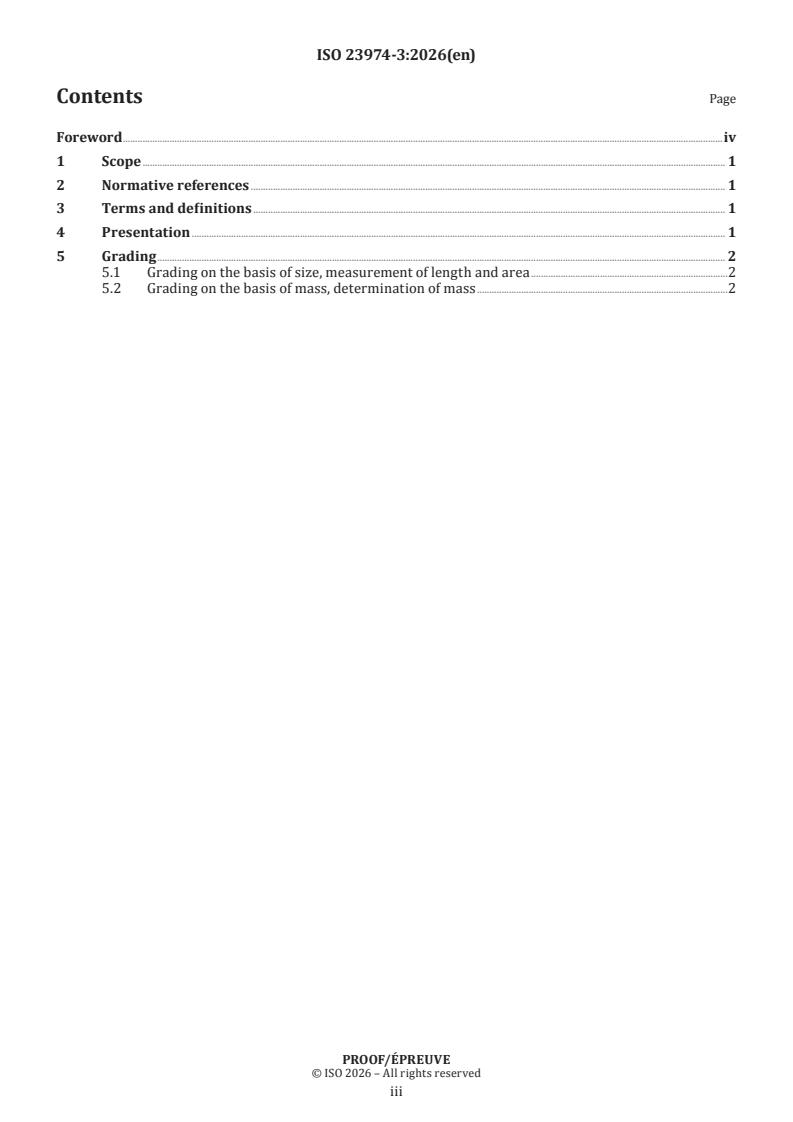
ISO/PRF 23974-3 - Leather — Red hair sheep skins — Part 3: Guidelines for grading on the basis of mass and size
REDLINE ISO/PRF 23974-3 - Leather — Red hair sheep skins — Part 3: Guidelines for grading on the basis of mass and size
ISO 23974-3 is an ISO document for grading raw red hair sheep skins by mass and size. It sets out how the skins are to be presented, how length, width and mass are measured, and how the results are grouped into grading categories for people who handle or check these skins.
What does ISO 23974-3 specify?
ISO 23974-3 specifies guidelines for grading raw red hair skins on the basis of mass and size. The document is organized into five clauses: scope, terms and definitions, presentation, grading, and grading methods for size and mass.
Clause 4 describes how the skins should be presented before grading. Clause 5 then splits grading into two paths - size in 5.1 and mass in 5.2 - so a user can grade by one basis or the other depending on the buying, sorting or packing practice being used.
What are the key requirements of ISO 23974-3?
ISO 23974-3 gives a simple, practical grading method: first prepare the skin in a defined way, then measure it, then place it in a category. That matters in practice because the same skin should be assessed the same way by different graders.
Presentation before grading
ISO 23974-3 says red hair sheep skins should be presented with the head cut straight behind the ears, the shanks cut off at right angles just above the knee and hock, and the tail cut no more than 40 mm from the butt. This standard presentation makes the measurements comparable and reduces grading disputes.
Measuring size
ISO 23974-3 measures length with the skin folded lengthwise along the backbone line and laid flat. Length is taken from the root of the tail to the widest point of the front part of the throat, and width is taken from the midpoint of the backbone line to the end of the belly, using a standard measuring tape and rounding to the nearest 1 cm.
The area is then calculated from the measured length and width and rounded to the nearest 10 cm. In practice, this means the grader needs only a tape measure and a consistent way of folding and laying out the skin.
Grading by size
ISO 23974-3 allows grading either by backbone-line length or by area, using Table 1. The table groups skins from extra small through extra-large, so the user can sort skins into size bands for commercial handling or lot comparison.
Determining mass
ISO 23974-3 treats the skin differently depending on its condition. Dry salted skins and wet salted skins are unfolded, shaken to remove surplus salt, brushed to remove remaining salt, and then weighed individually to the nearest 0.1 kg. Raw skins are made free from excess water and then weighed to the nearest 0.1 kg.
Grading by mass
ISO 23974-3 uses Table 2 to grade skins by mass, with separate mass bands for wet salted, dry salted and sun-dried skins. That separation matters because the same skin condition affects the mass reading, so users should not compare unlike forms without using the correct band.
What terms does ISO 23974-3 define?
- Dry salted skin - a skin dried in air after being treated with common salt so it can be preserved for a definite period.
- Raw skin - a skin after normal body heat has gone, trimmed, defatted and cleaned of dung and other material.
- Shanks - the part of the skin that covers the leg between the knee and the ankle.
- Sun-dried skin - a skin dried under the sun or in air for preservation.
- Wet salted skin - a skin treated with salt to reduce moisture content for preservation.
Who uses ISO 23974-3?
ISO 23974-3 is used by people who sort, grade, buy or process red hair sheep skins. It is relevant where skin lots need to be measured and classified in a consistent way, especially in leather handling, collection, trading and quality control.
What does the ISO 23974-3 document contain?
ISO 23974-3 contains a presentation clause, a size-grading method and a mass-grading method. The size method includes the measurement steps for length, width and area in 5.1.1, while the mass method in 5.2.1 sets out how to prepare different skin states before weighing.
The document also includes Table 1 for grading by length and area and Table 2 for grading by mass. These tables are the main working tools in the standard: they turn measured values into the grading categories used in practice.
Buy Documents
ISO/PRF 23974-3 - Leather — Red hair sheep skins — Part 3: Guidelines for grading on the basis of mass and size
REDLINE ISO/PRF 23974-3 - Leather — Red hair sheep skins — Part 3: Guidelines for grading on the basis of mass and size
Get Certified
Connect with accredited certification bodies for this standard

Control Union Certifications
Global certification for agriculture and sustainability.

Hohenstein Institut
Textile testing and certification.

Bureau Veritas Bangladesh
Bureau Veritas certification services in Bangladesh.
Sponsored listings
Frequently Asked Questions
ISO 23974-3 is a draft published by the International Organization for Standardization (ISO). Its full title is "Leather — Red hair sheep skins — Part 3: Guidelines for grading on the basis of mass and size". This standard covers: This draft standard prescribes guidelines for grading raw red hair skins on the basis of their mass and size.
This draft standard prescribes guidelines for grading raw red hair skins on the basis of their mass and size.
ISO 23974-3 is classified under the following ICS (International Classification for Standards) categories: 59.140.20 - Raw skins, hides and pelts. The ICS classification helps identify the subject area and facilitates finding related standards.
ISO 23974-3 is available in PDF format for immediate download after purchase. The document can be added to your cart and obtained through the secure checkout process. Digital delivery ensures instant access to the complete standard document.
Standards Content (Sample)
International
Standard
First edition
Leather — Red hair sheep skins —
Part 3:
Guidelines for grading on the basis
of mass and size
PROOF/ÉPREUVE
Reference number
© ISO 2026
All rights reserved. Unless otherwise specified, or required in the context of its implementation, no part of this publication may
be reproduced or utilized otherwise in any form or by any means, electronic or mechanical, including photocopying, or posting on
the internet or an intranet, without prior written permission. Permission can be requested from either ISO at the address below
or ISO’s member body in the country of the requester.
ISO copyright office
CP 401 • Ch. de Blandonnet 8
CH-1214 Vernier, Geneva
Phone: +41 22 749 01 11
Email: copyright@iso.org
Website: www.iso.org
Published in Switzerland
PROOF/ÉPREUVE
ii
Contents Page
Foreword .iv
1 Scope . 1
2 Normative references . 1
3 Terms and definitions . 1
4 Presentation . 1
5 Grading . 2
5.1 Grading on the basis of size, measurement of length and area .2
5.2 Grading on the basis of mass, determination of mass .2
PROOF/ÉPREUVE
iii
Foreword
ISO (the International Organization for Standardization) is a worldwide federation of national standards
bodies (ISO member bodies). The work of preparing International Standards is normally carried out through
ISO technical committees. Each member body interested in a subject for which a technical committee
has been established has the right to be represented on that committee. International organizations,
governmental and non-governmental, in liaison with ISO, also take part in the work. ISO collaborates closely
with the International Electrotechnical Commission (IEC) on all matters of electrotechnical standardization.
The procedures used to develop this document and those intended for its further maintenance are described
in the ISO/IEC Directives, Part 1. In particular, the different approval criteria needed for the different types
of ISO document should be noted. This document was drafted in accordance with the editorial rules of the
ISO/IEC Directives, Part 2 (see www.iso.org/directives).
ISO draws attention to the possibility that the implementation of this document may involve the use of (a)
patent(s). ISO takes no position concerning the evidence, validity or applicability of any claimed patent
rights in respect thereof. As of the date of publication of this document, ISO had not received notice of (a)
patent(s) which may be required to implement this document. However, implementers are cautioned that
this may not represent the latest information, which may be obtained from the patent database available at
www.iso.org/patents. ISO shall not be held responsible for identifying any or all such patent rights.
Any trade name used in this document is information given for the convenience of
...
Formatted: Spanish (Uruguay)
ISO/DISPRF 23974-3
Formatted: Spanish (Uruguay)
ISO/TC 120/SC 1
Secretariat: BIS
Date: 2026-05-1809-09
Leather — Red hair sheep skins —
Part 3:
Guidelines for grading on the basis of mass and size
DIS stage
PROOF
VVVVototototiiiinnnngggg b b b beeeeggggiiiinnnnssss on on on on:::: 2222000022225555----00009999----11118888
VVVVooootintintintingggg te te te termrmrmrmiiiinnnnaaaatetetetessss o o o onnnn:::: 2 2 2 2000022225555----11112222----11111111
ISO/DISPRF 23974-3:2026(en)
All rights reserved. Unless otherwise specified, or required in the context of its implementation, no part of this publication
may be reproduced or utilized otherwise in any form or by any means, electronic or mechanical, including photocopying,
or posting on the internet or an intranet, without prior written permission. Permission can be requested from either ISO
at the address below or ISO’s member body in the country of the requester.
ISO copyright office
CP 401 • Ch. de Blandonnet 8
CH-1214 Vernier, Geneva
Phone: + 41 22 749 01 11
Formatted: French (Switzerland)
E-mail: copyright@iso.org
Website: www.iso.org
Published in Switzerland
ii
ISO/DISPRF 23974-3:2026(en)
Contents
Foreword . iii
Scope . iii
Normative references . iii
Terms and definitions . iii
Presentation . iii
Grading . iii
Grading on the basis of size . iii
Grading on the basis of mass . iii
Foreword . iv
1 Scope . 1
2 Normative references . 1
3 Terms and definitions . 1
4 Presentation . 1
5 Grading . 2
5.1 Grading on the basis of size, measurement of length and area . 2
5.2 Grading on the basis of mass, determination of mass . 2
iii
ISO/DISPRF 23974-3:2026(en)
Foreword
ISO (the International Organization for Standardization) is a worldwide federation of national standards
bodies (ISO member bodies). The work of preparing International Standards is normally carried out through
ISO technical committees. Each member body interested in a subject for which a technical committee has been
established has the right to be represented on that committee. International organizations, governmental and
non-governmental, in liaison with ISO, also take part in the work. ISO collaborates closely with the
International Electrotechnical Commission (IEC) on all matters of electrotechnical standardization.
The procedures used to develop this document and those intended for its further maintenance are described
in the ISO/IEC Directives, Part 1. In particular, the different approval criteria needed for the different types of
ISO document should be noted. This document was drafted in accordance with the editorial rules of the
ISO/IEC Directives, Part 2 (see www.iso.org/directives).
ISO draws attention to the possibility that the implementation of this document may involve the use of (a)
patent(s). ISO takes no position concerning the evidence, validity or applicability of any claimed patent rights
in respect thereof. As of the date of publication of this document, ISO had not received notice of (a) patent(s)
which may be required to impl
...