

ISO/DIS 24607
(Main)Honey — Specifications
General Information
- Abstract
This standard applies to all honeys produced by honey bees (Apis ssp.) and covers all styles of honey presentations which are processed and ultimately intended for direct consumption. The honey which is packed for sale in bulk containers, which may be repacked into retail packs is included. This standard covers honey for industrial uses.
- Status
- Not Published
- Technical Committee
- ISO/TC 34/SC 19 - Bee products
- Drafting Committee
- ISO/TC 34/SC 19/WG 1 - Honey
- Current Stage
- 4099 - Full report circulated: DIS approved for registration as FDIS
- Start Date
- 15-May-2025
- Completion Date
- 29-Aug-2026
Buy Documents
ISO/FDIS 24607 - Honey — Specifications Released:10. 07. 2025
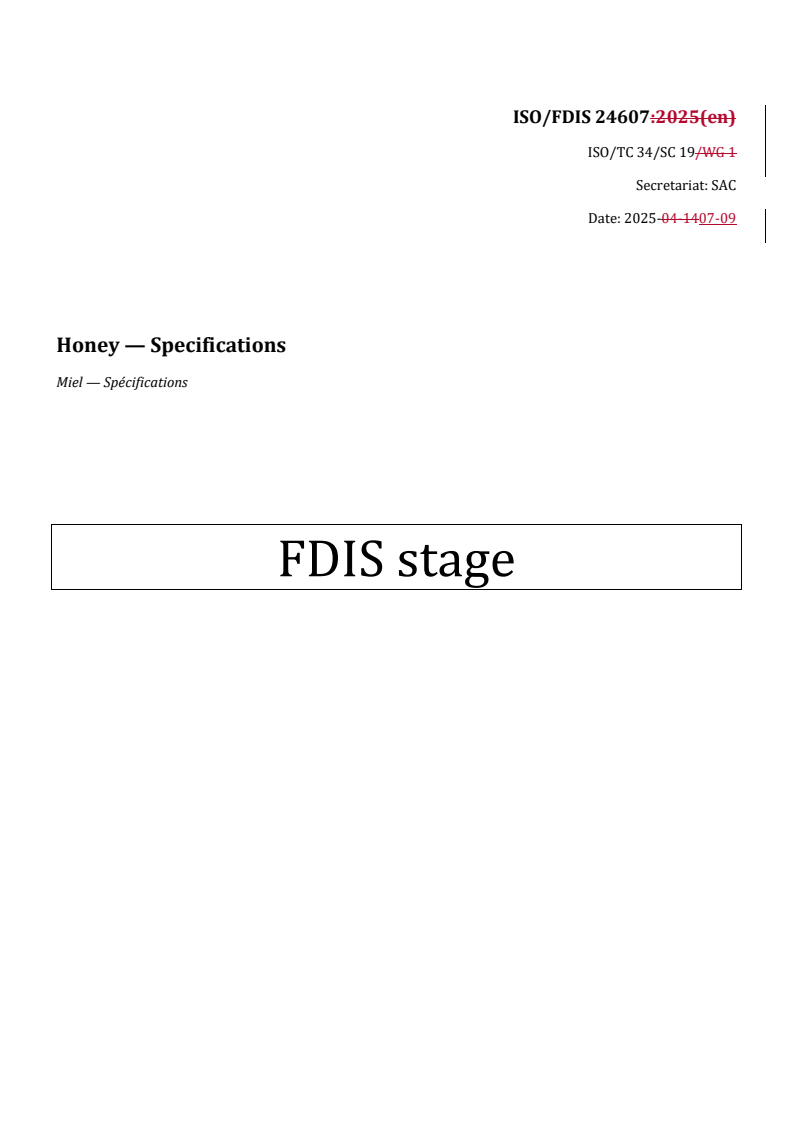
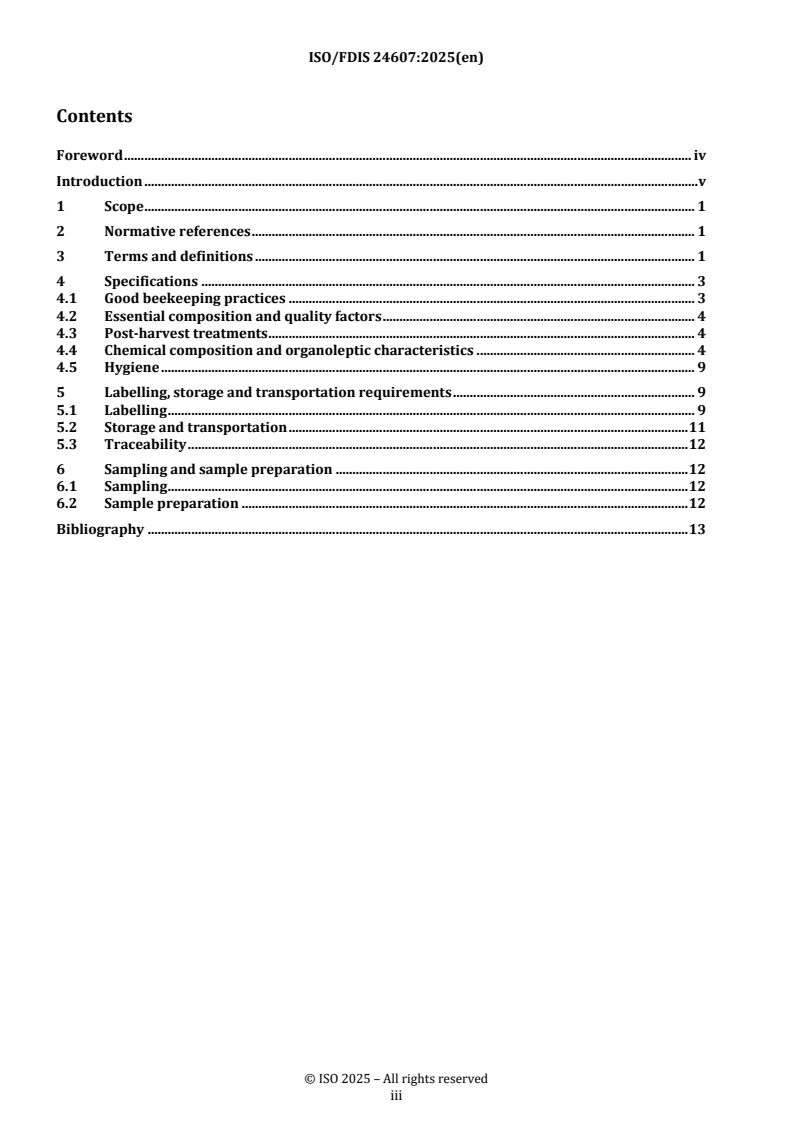
REDLINE ISO/FDIS 24607 - Honey — Specifications Released:10. 07. 2025
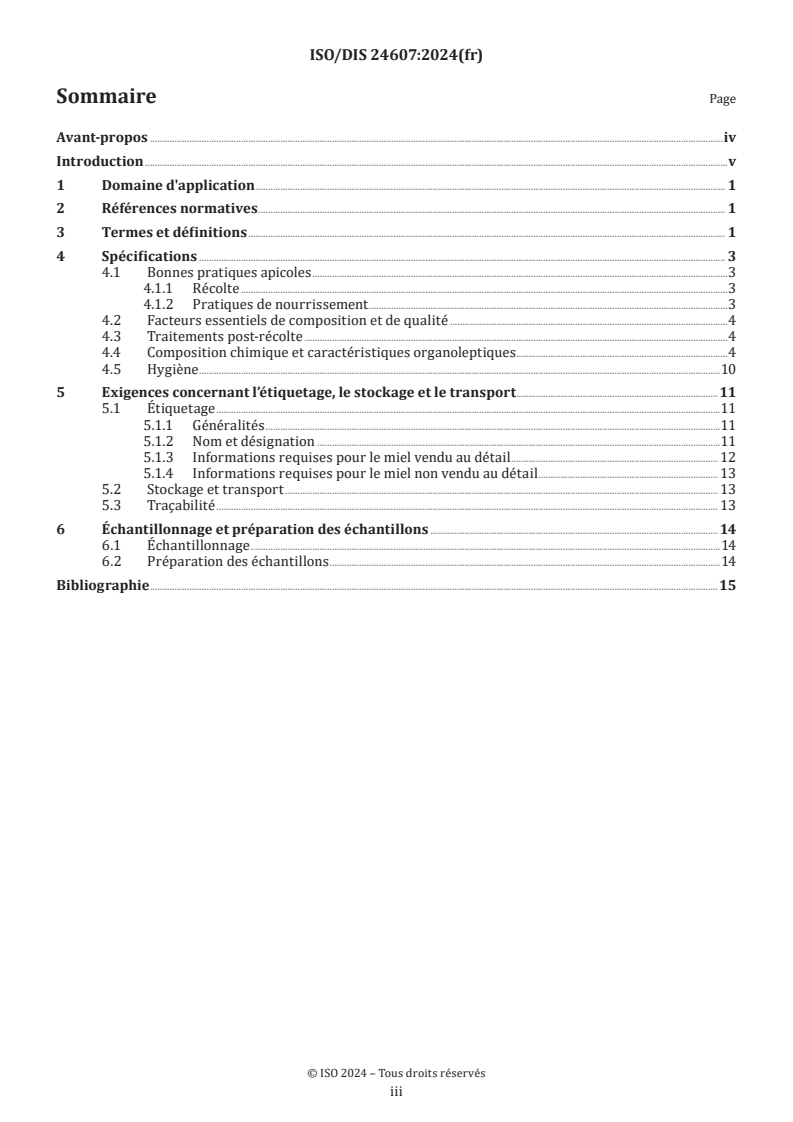
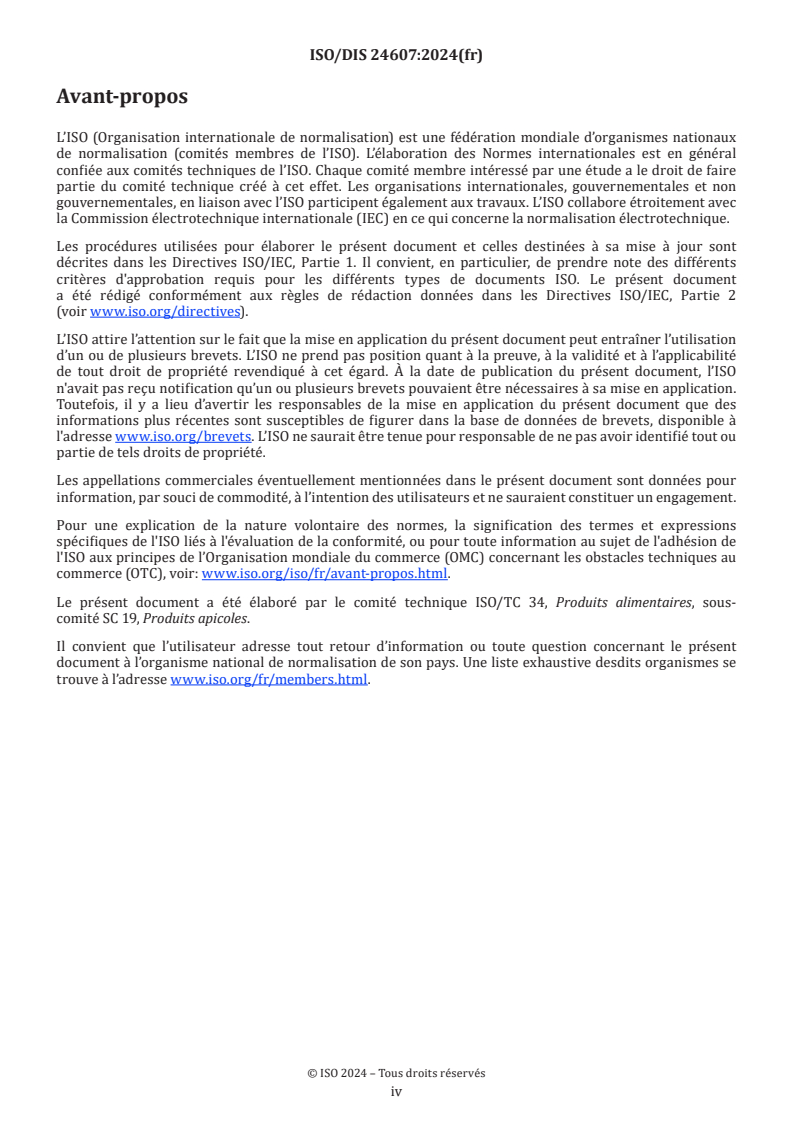
ISO/FDIS 24607 - Miel — Spécifications Released:5. 09. 2025
Overview
ISO/DIS 24607 - Honey - Specifications is an International Organization for Standardization draft that defines quality, composition, labelling, storage, transportation and sampling requirements for honey produced by honey bees (Apis ssp.). It applies to honeys intended for direct human consumption (table honey) as well as honey packed in bulk or for industrial use, and is based on established Codex references. Raw honey (unprocessed in-hive product) is not covered.
Key topics and technical requirements
- Scope and applicability
- Applies primarily to Apis mellifera; other Apis species are included if they meet the standard’s criteria.
- Covers retail-packed, bulk-packed and industrial-use honey.
- Good beekeeping practices
- Harvest guidance: honey should be harvested from combs with at least 80% capped-filled cells; recommended moisture at harvest is below 18%.
- Feeding restrictions: production hives must not be fed for the purpose of increasing honey yield; feeding with sugar/syrup during nectar flow prohibits harvesting that honey for sale.
- Composition and limits
- Moisture content: general limit ≤ 20% (thixotropic honeys, e.g. ling heather, ≤ 23%; mānuka ≤ 21%).
- Hydroxymethylfurfural (HMF): regional limits (e.g., up to 80 mg/kg for certain tropical/Mediterranean origins after processing/blending; generally ≤ 40 mg/kg for other regions).
- Fructose + glucose: general minimums (e.g., ≥ 60 g/100 g for many honeys; lower specific minima for honeydew or fir honeydew types).
- Filtered and ultrafiltered honey: filtered honey (particles <100 μm and reduced pollen) must be labelled and is treated as honey for indirect human consumption; ultrafiltered products (all pollen/protein removed) cannot be blended with regular honey.
- Post‑harvest treatments
- Permitted: straining, decantation, centrifugation, homogenization, blending, controlled heating for decrystallization if composition and organoleptic properties remain within limits.
- Prohibited or restricted: treatments that change authenticity (ion exchange, chemical/biochemical additives), intentional post-extraction moisture reduction, excessive heating or processing that alters aroma/flavour.
- Testing and traceability
- Botanical/geographical identification via melissopalynological, physicochemical, chemical and organoleptic analysis.
- Includes sampling, sample preparation and traceability requirements; references ISO/IEC 17025 and microbiological enumeration methods.
Applications and users
- Who uses it: beekeepers, packers, honey processors, food manufacturers using honey as an ingredient, quality managers, food safety labs, regulators, import/export authorities and retailers.
- Practical uses: setting procurement/specification limits, ensuring compliant processing and labelling, guiding post-harvest handling and storage, designing testing protocols for authenticity and quality, and supporting trade/compliance documentation.
Related standards
- ISO 4833-1 (microbiology), ISO/IEC 17025 (laboratory competence), ISO 22005 (traceability)
- Codex texts: CXS 12-1981, CXS 1-2018, CXS 346-2021
- Standardized methods referenced for colour and melissopalynology (AOAC, DIN, national methods)
Keywords: ISO/DIS 24607, honey specifications, honey standard, Apis, honey labelling, honey composition, HMF, moisture content, filtered honey, melissopalynological analysis, traceability.
Buy Documents
ISO/FDIS 24607 - Honey — Specifications Released:10. 07. 2025
REDLINE ISO/FDIS 24607 - Honey — Specifications Released:10. 07. 2025
ISO/FDIS 24607 - Miel — Spécifications Released:5. 09. 2025
Get Certified
Connect with accredited certification bodies for this standard

BSI Group
BSI (British Standards Institution) is the business standards company that helps organizations make excellence a habit.

Bureau Veritas
Bureau Veritas is a world leader in laboratory testing, inspection and certification services.

DNV
DNV is an independent assurance and risk management provider.
Sponsored listings
Frequently Asked Questions
ISO/DIS 24607 is a draft published by the International Organization for Standardization (ISO). Its full title is "Honey — Specifications". This standard covers: This standard applies to all honeys produced by honey bees (Apis ssp.) and covers all styles of honey presentations which are processed and ultimately intended for direct consumption. The honey which is packed for sale in bulk containers, which may be repacked into retail packs is included. This standard covers honey for industrial uses.
This standard applies to all honeys produced by honey bees (Apis ssp.) and covers all styles of honey presentations which are processed and ultimately intended for direct consumption. The honey which is packed for sale in bulk containers, which may be repacked into retail packs is included. This standard covers honey for industrial uses.
ISO/DIS 24607 is classified under the following ICS (International Classification for Standards) categories: 67.180.10 - Sugar and sugar products. The ICS classification helps identify the subject area and facilitates finding related standards.
ISO/DIS 24607 is available in PDF format for immediate download after purchase. The document can be added to your cart and obtained through the secure checkout process. Digital delivery ensures instant access to the complete standard document.
Standards Content (Sample)
FINAL DRAFT
International
Standard
ISO/FDIS 24607
ISO/TC 34/SC 19
Honey — Specifications
Secretariat: SAC
Miel — Spécifications
Voting begins on:
2025-07-24
Voting terminates on:
2025-09-18
RECIPIENTS OF THIS DRAFT ARE INVITED TO SUBMIT,
WITH THEIR COMMENTS, NOTIFICATION OF ANY
RELEVANT PATENT RIGHTS OF WHICH THEY ARE AWARE
AND TO PROVIDE SUPPOR TING DOCUMENTATION.
IN ADDITION TO THEIR EVALUATION AS
BEING ACCEPTABLE FOR INDUSTRIAL, TECHNO
LOGICAL, COMMERCIAL AND USER PURPOSES, DRAFT
INTERNATIONAL STANDARDS MAY ON OCCASION HAVE
TO BE CONSIDERED IN THE LIGHT OF THEIR POTENTIAL
TO BECOME STAN DARDS TO WHICH REFERENCE MAY BE
MADE IN NATIONAL REGULATIONS.
Reference number
ISO/FDIS 24607:2025(en) © ISO 2025
FINAL DRAFT
ISO/FDIS 24607:2025(en)
International
Standard
ISO/FDIS 24607
ISO/TC 34/SC 19
Honey — Specifications
Secretariat: SAC
Miel — Spécifications
Voting begins on:
Voting terminates on:
RECIPIENTS OF THIS DRAFT ARE INVITED TO SUBMIT,
WITH THEIR COMMENTS, NOTIFICATION OF ANY
RELEVANT PATENT RIGHTS OF WHICH THEY ARE AWARE
AND TO PROVIDE SUPPOR TING DOCUMENTATION.
© ISO 2025
IN ADDITION TO THEIR EVALUATION AS
All rights reserved. Unless otherwise specified, or required in the context of its implementation, no part of this publication may
BEING ACCEPTABLE FOR INDUSTRIAL, TECHNO
LOGICAL, COMMERCIAL AND USER PURPOSES, DRAFT
be reproduced or utilized otherwise in any form or by any means, electronic or mechanical, including photocopying, or posting on
INTERNATIONAL STANDARDS MAY ON OCCASION HAVE
the internet or an intranet, without prior written permission. Permission can be requested from either ISO at the address below
TO BE CONSIDERED IN THE LIGHT OF THEIR POTENTIAL
or ISO’s member body in the country of the requester.
TO BECOME STAN DARDS TO WHICH REFERENCE MAY BE
MADE IN NATIONAL REGULATIONS.
ISO copyright office
CP 401 • Ch. de Blandonnet 8
CH-1214 Vernier, Geneva
Phone: +41 22 749 01 11
Email: copyright@iso.org
Website: www.iso.org
Published in Switzerland Reference number
ISO/FDIS 24607:2025(en) © ISO 2025
ii
ISO/FDIS 24607:2025(en)
Contents Page
Foreword .iv
Introduction .v
1 Scope . 1
2 Normative references . 1
3 Terms and definitions . 1
4 Specifications . 3
4.1 Good beekeeping practices .3
4.1.1 Harvesting .3
4.1.2 Feeding practices .3
4.2 Essential composition and quality factors .3
4.3 Post-harvest treatments .4
4.4 Chemical composition and organoleptic characteristics .4
4.5 Hygiene .9
5 Labelling, storage and transportation requirements . 9
5.1 Labelling .9
5.1.1 General .9
5.1.2 Name and designation .10
5.1.3 Information required for retail-packed honey .11
5.1.4 Information required for non-retail packed honey . 12
5.2 Storage and transportation . 12
5.3 Traceability . 12
6 Sampling and sample preparation .12
6.1 Sampling . 12
6.2 Sample preparation . 13
Bibliography . 14
iii
ISO/FDIS 24607:2025(en)
Foreword
ISO (the International Organization for Standardization) is a worldwide federation of national standards
bodies (ISO member bodies). The work of preparing International Standards is normally carried out through
ISO technical committees. Each member body interested in a subject for which a technical committee
has been established has the right to be represented on that committee. International organizations,
governmental and non-governmental, in liaison with ISO, also take part in the work. ISO collaborates closely
with the International Electrotechnical Commission (IEC) on all matters of electrotechnical standardization.
The procedures used to develop this document and those intended for its further maintenance are described
in the ISO/IEC Directives, Part 1. In particular, the different approval criteria needed for the different types
of ISO document should be noted. This document was drafted in accordance with the editorial rules of the
ISO/IEC Directives, Part 2 (see www.iso.org/directives).
ISO draws attention to the possibility that the implementation of this document may involve the use of (a)
patent(s). ISO takes no position concerning the evidence, validity or applicability of any claimed patent
rights in respect thereof. As of the date of publication of this document, ISO had not received notice of (a)
patent(s) which may be required to implement this document. However, implementers are cautioned that
this may not represent the latest information, which may be obtained from the patent database available at
www.iso.org/patents. ISO shall not be held responsible for identifying any or all such patent rights.
Any trade name used in this document is information given for the convenience of users and does not
constitute an endorsement.
For an explanation of the voluntary nature of standards, the meaning of ISO specific terms and expressions
related to conformity assessment, as well as information about ISO’s adherence to the World Trade
Organization (WTO) principles in the Technical Barriers to Trade (TBT), see www.iso.org/iso/foreword.html.
This document was prepared by Technical Committee ISO/TC 34, Food products, Subcommittee SC 19, Bee
products.
Any feedback or questions on this document should be directed to the user’s national standards body. A
complete listing of these bodies can be found at www.iso.org/members.html.
iv
ISO/FDIS 24607:2025(en)
Introduction
Honey is a primary agricultural food product. It corresponds to the matured product inside the hive, which
has been extracted from the combs, from which all impurities and extraneous matter have been removed,
and which can be homogenized and heated in a controlled manner for decrystallization or recrystallization.
Honey consists essentially of different sugars, predominantly fructose and glucose, as well as other
substances (e.g. volatile compounds, organic acids, enzymes) and solid particles (e.g. pollen and honeydew
elements). The colour of honey varies from nearly colourless to varied shades of brown, yellow, red, green
and other colours, depending on the floral source. The consistency can be fluid, viscous or partly to entirely
crystallized. The flavour and aroma vary but are derived from the plant sources.
[1]
This document is based on CXS 12-1981 .
Raw honey is not included in the document.
v
FINAL DRAFT International Standard ISO/FDIS 24607:2025(en)
Honey — Specifications
1 Scope
This document specifies the quality requirements, and labelling, storage and transportation conditions
for honey.
This document is applicable to honey produced by Apis mellifera bees. It is also applicable to honey from
other bee species provided that it meets the criteria in this document, and is ultimately intended for either
direct human consumption or as a food ingredient for indirect human consumption.
This document does not apply to honey which is not intended for human consumption as food.
2 Normative references
The following documents are referred to in the text in such a way that some or all of their content constitutes
requirements of this document. For dated references, only the edition cited applies. For undated references,
the latest edition of the referenced document (including any amendments) applies.
ISO 4833-1, Microbiology of the food chain — Horizontal method for the enumeration of microorganisms —
Part 1: Colony count at 30 °C by the pour plate technique
ISO 7932, Microbiology of food and animal feeding stuffs — Horizontal method for the enumeration of
presumptive Bacillus cereus — Colony-count technique at 30 degrees C
ISO 15213-1, Microbiology of the food chain — Horizontal method for the detection and enumeration of
Clostridium spp. — Part 1: Enumeration of sulfite-reducing Clostridium spp. by colony-count technique
ISO 22005:2007, Traceability in the feed and food chain — General principles and basic requirements for system
design and implementation
ISO/IEC 17025, General requirements for the competence of testing and calibration laboratories
CXS 1-1985, General Standard for the Labelling of Prepackaged Foods
CXS 346-2021, General Standard for the Labelling of Non-Retail Containers of Foods
3 Terms and definitions
For the purposes of this document, the following terms and definitions apply.
ISO and IEC maintain terminology databases for use in standardization at the following addresses:
— ISO Online browsing platform: available at https:// www .iso .org/ obp
— IEC Electropedia: available at https:// www .electropedia .org/
3.1
honey
natural sweet substance produced by honey bees either as blossom honey (3.2) or honeydew honey (3.3),
which the bees collect, transform by combining with their own specific substances, deposit, dehydrate and
store in the honeycomb to ripen and mature by natural processes
ISO/FDIS 24607:2025(en)
3.2
blossom honey
nectar honey
honey (3.1) obtained wholly or mainly from the floral and extrafloral nectaries of plants
3.3
honeydew honey
honey (3.1) obtained wholly or mainly from the excretions of plant-sucking insects (Hemiptera) on the living
parts of plants or secretions of the living parts of plants
3.4
honey for direct human consumption
table honey
honey (3.1) directly used as food that meets certain criteria
Note 1 to entry: The criteria are given in Table 1.
Note 2 to entry: It may be also used as food ingredient.
Note 3 to entry: It can be sold in bulk or packed into retail packs.
3.5
honey for indirect human consumption
Baker’s honey
honey for indirect consumption
food ingredient defined as honey for direct human consumption (3.4) or as honey (3.1) that may have been
adversely altered inadvertently during harvesting and/or post-harvest practices (overheating, fermentation,
etc.), such that it no longer qualifies for direct consumption
3.6
comb honey
honey (3.1) stored by honey bees in the cells of freshly built broodless combs or in the combs developed by
the honey bees using the provisioned comb foundations made solely of beeswax, and sold in sealed, whole
combs or sections of such combs
3.7
chunk honey
comb honey (3.6) cut into chunks and suspended in a medium of extracted honey
3.8
filtered honey
honey (3.1) exposed to a process that removes particles (e.g. wax, propolis, air bubbles, other elements)
normally found in honey as well as a statistically significant portion of the pollen and honeydew elements of
less than 100 micrometres that are normally found in honey
Note 1 to entry: For thixotropic honey (3.10), processes to liquefy (heating and pressure) the honey can be used to
allow filtration.
Note 2 to entry: Strained honey is different from filtered honey. A synonym of strained honey is sieved honey and refers
to honey which has been strained in such a way that most of the particles of wax, propolis or other elements normally
present in honey have been removed and the original composition and distribution of pollen remains significantly
unchanged. For thixotropic honey, processes can be used to allow straining.
Note 3 to entry: Filtered honey can only be marketed as honey for indirect human consumption (3.5).
Note 4 to entry: For cases where microscopic analysis reveals an atypical concentration of pollen for the honey type or
total absence of pollen, it shall be labelled as filtered honey.
Note 5 to entry: The product resulting from a mixture of filtered honey with unfiltered honey shall be considered as
filtered honey regardless of the percentage of each of them.
ISO/FDIS 24607:2025(en)
3.9
ultrafiltered product derived from honey
product resulting from a process that removes all pollen and/or protein from honey
Note 1 to entry: Ultrafiltered honey product cannot be blended with honey (3.1), blossom honey (3.2), honeydew honey
(3.3), honey for direct human consumption (3.4), honey for indirect human consumption (3.5), comb honey (3.6), chunk
honey (3.7) or filtered honey (3.8).
3.10
thixotropic honey
gel-like honey (3.1) that is thick or viscous under static conditions but is able to flow when stirred or agitated
3.11
pressed honey
honey (3.1) obtained by pressing broodless comb, with or without the application of moderate heat (i.e. not
exceeding 45 °C)
3.12
foreign sugar
sugars from sources other than honey (3.1), not produced by bees, such as feeding syrup, candies and
tailored-made syrup for fraud
4 Specifications
4.1 Good beekeeping practices
4.1.1 Harvesting
In accordance with good beekeeping practice, honey should be harvested with less than 18 % moisture
content. Honey should be harvested from combs that have at least an average of 80 % capped-filled cells.
4.1.2 Feeding practices
4.1.2.1 Feeding production honey bee colonies (production hives) is a beekeeping practice to prevent the
starvation of the bees during periods without enough nectar flow to maintain a viable colony.
Feeding production hives may be done if, as far as possible, the harvested honey is always free from organic
or inorganic foreign matter to its natural composition.
The products used for the feeding should be natural (honey) or artificial (sugar feeding and protein
supplements in all forms but from sources found in bee products).
NOTE 1 Regarding protein supplements, there can be risks related to allergens and the presence of genetically
modified organisms (GMOs), e.g. soy proteins.
NOTE 2 From the standpoint of disease management of bees, it is dangerous to feed honey bees with honey of
unknown origin or contaminated.
4.1.2.2 Production hives shall not be fed with products for the purpose of increasing honey production or
to collect honey during an artificial feeding period (fraudulent practices).
4.1.2.3 If production hives are fed with sugar or syrup during the nectar flow, the honey produced shall
not be harvested for sale.
4.2 Essential composition and quality factors
All sugars included in the honey shall have been sourced by honey bees from plant nectar and honeydew and
living parts of plants.
ISO/FDIS 24607:2025(en)
Specific constituents (which characterize the botanical and geographical origin, or bioactivity) shall not be
added or removed from the honey.
The honey shall not show signs of yeast fermentation or effervescence.
To identify specific honey types, melissopalynological, physicochemical and chemical analysis, and
organoleptic characterization can be used to determine the honey’s botanical and geographical origin and
quality. Pollen is a natural component of honey, and a marker of origin (botanical and geographical).
[3]
For melissopalynological analysis, standardized methodologies are provided in References [2], DIN 10760
[4]
and UNI 11299 .
4.3 Post-harvest treatments
Post-harvest treatments shall not induce modifications that alter the product’s authenticity and natural
characteristics. Honey subject to these post-harvest treatments can still be considered to be a natural
product as found inside the hive.
Foreign objects may be removed by different techniques (e.g. by straining, decantation or centrifugation) but
such techniques shall not remove a significant part of the pollen, honeydew elements or other constituents
naturally found in honey. The honey may undergo homogenization, blending, directed crystallization
(creaming) and packaging provided that its physicochemical, chemical, biological and organoleptic
properties are maintained within the specified acceptable limits of this document (if mentioned) and do not
deviate substantially from the honey’s original state in the hive at harvest; otherwise, the honey’s quality is
impaired.
Honey shall not be heated or processed to such an extent that its essential composition deviates from the
criteria specified in Table 1 and, more specifically, that its aromas and flavours are changed and/or its
quality is impaired.
Chemical or biochemical treatments that influence the crystallization, colour, flavour, aroma or composition
of honey shall not be used.
Processing practices (such as ion exchange using resins) that remove contaminants, residues or heat-derived
degradation products, change the honey composition, or add additives, surrogates or supplemented honey
constituents shall not be used.
There shall not be intentional moisture reduction in any form after extraction.
4.4 Chemical composition and organoleptic characteristics
Honey shall conform to the requirements specified in Table 1.
Honey for indirect human consumption can conform to the chemical composition requirements specified in
Table 2.
[5] [6]
For evaluating the colour of honey, the standardized methods AOAC 960.44 and AOAC 985.25 or
[7]
DIN 10744 can be used.
ISO/FDIS 24607:2025(en)
Table 1 — Chemical composition requirements for honey for direct human consumption and honey
for indirect human consumption
Characteristic Honey type Requirement
a) Honey not listed below ≤ 20 %
Moisture content b) Thixotropic honey, e.g. Ling Heather (Calluna vulgaris) ≤ 23 %
(%, mass/mass)
c) Mānuka
≤ 21 %
(Leptospermum scoparium)
a) Honey of declared origin from regions with tropical
HMF (hydroxymethylfur-
climate (Köppen classification group A, Bwh and Bsh),
not more than 80 mg/kg
fural) content (determined
Mediterranean climate (Köppen classification Csa) and
after processing and/or
a
blends of this honey
blending)
b) Honey from other geographic regions, in general not more than 40 mg/kg
a) Honey not listed below ≥ 60 g/100 g
b) Honeydew honey, blends of honeydew honey with
Fructose and glucose ≥ 45 g/100 g
blossom honey
(sum of both)
c) Fir honeydew honey
≥ 35 g/100 g
(Abies cephalonica)
a) Honey not listed below ≤ 5 g/100 g
b) Alfalfa (Medicago sativa), Citrus spp., False Acacia
(Robinia pseudoacacia), French Honeysuckle
(Hedysarum sp.), Menzies Banksia (Banksia menziesii), ≤ 10 g/100 g
Sucrose content Red Gum (Eucalyptus camaldulensis), Leatherwood
(Eucryphia lucida, Eucryphia milliganii)
c) Lavender (Lavandula spp.), Borage (Borago officinalis),
Rosmary (Rosmarinus officinalis), Loquat (Eriobotrya ≤ 15 g/100 g
japonica)
a) Honey other than pressed honey ≤ 0,1 g/100 g
Water insoluble solids con-
a
tent
b) Pressed honey ≤ 0,5 g/100 g
Free acidity All honey ≤ 50 mEq of acid per kg
Honey not listed below ≥ 8 Schade units
Diastase acti
...
ISO/FDIS 24607:2025(en)
ISO/TC 34/SC 19/WG 1
Secretariat: SAC
Date: 2025-04-1407-09
Honey — Specifications
Miel — Spécifications
FDIS stage
ISO/FDIS 24607:2025(en)
All rights reserved. Unless otherwise specified, or required in the context of its implementation, no part of this publication
may be reproduced or utilized otherwise in any form or by any means, electronic or mechanical, including photocopying,
or posting on the internet or an intranet, without prior written permission. Permission can be requested from either ISO
at the address below or ISO’s member body in the country of the requester.
ISO copyright office
CP 401 • Ch. de Blandonnet 8
CH-1214 Vernier, Geneva
Phone: + 41 22 749 01 11
E-mail: copyright@iso.org
Website: www.iso.org
Published in Switzerland
ii
ISO/FDIS 24607:2025(en)
Contents
Foreword . iv
Introduction . v
1 Scope . 1
2 Normative references . 1
3 Terms and definitions . 1
4 Specifications . 3
4.1 Good beekeeping practices . 3
4.2 Essential composition and quality factors . 4
4.3 Post-harvest treatments . 4
4.4 Chemical composition and organoleptic characteristics . 4
4.5 Hygiene . 9
5 Labelling, storage and transportation requirements . 9
5.1 Labelling . 9
5.2 Storage and transportation . 11
5.3 Traceability . 12
6 Sampling and sample preparation . 12
6.1 Sampling . 12
6.2 Sample preparation . 12
Bibliography . 13
iii
ISO/FDIS 24607:2025(en)
Foreword
ISO (the International Organization for Standardization) is a worldwide federation of national standards
bodies (ISO member bodies). The work of preparing International Standards is normally carried out through
ISO technical committees. Each member body interested in a subject for which a technical committee has been
established has the right to be represented on that committee. International organizations, governmental and
non-governmental, in liaison with ISO, also take part in the work. ISO collaborates closely with the
International Electrotechnical Commission (IEC) on all matters of electrotechnical standardization.
The procedures used to develop this document and those intended for its further maintenance are described
in the ISO/IEC Directives, Part 1. In particular, the different approval criteria needed for the different types of
ISO document should be noted. This document was drafted in accordance with the editorial rules of the
ISO/IEC Directives, Part 2 (see www.iso.org/directives).
ISO draws attention to the possibility that the implementation of this document may involve the use of (a)
patent(s). ISO takes no position concerning the evidence, validity or applicability of any claimed patent rights
in respect thereof. As of the date of publication of this document, ISO had not received notice of (a) patent(s)
which may be required to implement this document. However, implementers are cautioned that this may not
represent the latest information, which may be obtained from the patent database available at
www.iso.org/patents. ISO shall not be held responsible for identifying any or all such patent rights.
Any trade name used in this document is information given for the convenience of users and does not
constitute an endorsement.
For an explanation of the voluntary nature of standards, the meaning of ISO specific terms and expressions
related to conformity assessment, as well as information about ISO’s adherence to the World Trade
Organization (WTO) principles in the Technical Barriers to Trade (TBT), see www.iso.org/iso/foreword.html.
This document was prepared by Technical Committee ISO/TC 34, Food products, Subcommittee SC 19, Bee
products.
Any feedback or questions on this document should be directed to the user’s national standards body. A
complete listing of these bodies can be found at www.iso.org/members.html.
iv
ISO/FDIS 24607:2025(en)
Introduction
Honey is a primary agricultural food product. It corresponds to the matured product inside the hive, which
has been extracted from the combs, from which all impurities and extraneous matter have been removed, and
which can be homogenized and heated in a controlled manner for decrystallization or recrystallization.
Honey consists essentially of different sugars, predominantly fructose and glucose, as well as other substances
(e.g. volatile compounds, organic acids, enzymes) and solid particles (e.g. pollen and honeydew elements). The
colour of honey varies from nearly colourless to varied shades of brown, yellow, red, green and other colours,
depending on the floral source. The consistency can be fluid, viscous or partly to entirely crystallized. The
flavour and aroma vary but are derived from the plant sources.
[1]
This document is based on CXS 12-1981 .
Raw honey is not included in the document.
v
ISO/FDIS 24607:2025(en)
Honey — Specifications
1 Scope
This document specifies the quality requirements, and labelling, storage and transportation conditions for
honey.
This document is applicable to honey produced by Apis mellifera bees. It is also applicable to honey from other
bee species provided that it meets the criteria in this document, and is ultimately intended for either direct
human consumption or as a food ingredient for indirect human consumption.
This document does not apply to honey which is not intended for human consumption as food.
2 Normative references
The following documents are referred to in the text in such a way that some or all of their content constitutes
requirements of this document. For dated references, only the edition cited applies. For undated references,
the latest edition of the referenced document (including any amendments) applies.
ISO 4833-1, Microbiology of the food chain — Horizontal method for the enumeration of microorganisms — Part
1: Colony count at 30 °C by the pour plate technique
ISO 7932, Microbiology of food and animal feeding stuffs — Horizontal method for the enumeration of
presumptive Bacillus cereus — Colony-count technique at 30 degrees C
ISO 15213-1, Microbiology of the food chain — Horizontal method for the detection and enumeration of
Clostridium spp. — Part 1: Enumeration of sulfite-reducing Clostridium spp. by colony-count technique
ISO/IEC 17025, General requirements for the competence of testing and calibration laboratories
ISO 22005:2007, Traceability in the feed and food chain — General principles and basic requirements for system
design and implementation
ISO/IEC 17025, General requirements for the competence of testing and calibration laboratories
CXS 1-2018-1985, General Standard for the Labelling of Prepackaged Foods
CXS 346-2021, General Standard for the Labelling of Non-Retail Containers of Foods
3 Terms and definitions
For the purposes of this document, the following terms and definitions apply.
ISO and IEC maintain terminology databases for use in standardization at the following addresses:
— ISO Online browsing platform: available at https://www.iso.org/obp
— IEC Electropedia: available at https://www.electropedia.org/
3.1
honey
natural sweet substance produced by honey bees either as blossom honey (3.2) or honeydew honey (3.3), which
the bees collect, transform by combining with their own specific substances, deposit, dehydrate and store in
the honeycomb to ripen and mature by natural processes
ISO/FDIS 24607:2025(en)
3.2
blossom honey
nectar honey
honey (3.1) obtained wholly or mainly from the floral and extrafloral nectaries of plants
3.3
honeydew honey
honey (3.1) obtained wholly or mainly from the excretions of plant-sucking insects (Hemiptera) on the living
parts of plants or secretions of the living parts of plants
3.4
honey for direct human consumption
table honey
honey (3.1) directly used as food that meets thecertain criteria in 4.5 Table 1
Note 1 to entry: The criteria are given in Table 1.
Note 2 to entry: It may be also used as food ingredient.
Note 2 3 to entry: It can be sold in bulk or packed into retail packs.
3.5
honey for indirect human consumption
Baker’s honey
honey for indirect consumption
food ingredient defined as table honey for direct human consumption (3.4) or as honey (3.1) that may have
been adversely altered inadvertently during harvesting and/or post-harvest practices (overheating,
fermentation, etc.), such that it no longer qualifies for direct consumption
3.6
comb honey
honey (3.1) stored by honey bees in the cells of freshly built broodless combs or in the combs developed by
the honey bees using the provisioned comb foundations made solely of beeswax, and sold in sealed, whole
combs or sections of such combs
3.7
chunk honey
comb honey (3.6) cut into chunks and suspended in a medium of extracted honey
3.8
filtered honey
honey (3.1) exposed to a process that removes particles (e.g. wax, propolis, air bubbles, other elements)
normally found in honey as well as a statistically significant portion of the pollen and honeydew elements of
less than 100 micrometers micrometres that are normally found in honey
Note 1 to entry: For thixotropic honey (3.10), processes to liquefy (heating and pressure) the honey can be used to allow
filtration.
Note 2 to entry: Strained honey is different from filtered honey. A synonym of strained honey is sieved honey and refers
to honey (3.1) which has been strained in such a way that most of the particles of wax, propolis or other elements
normally present in honey, have been removed and the original composition and distribution of pollen remains
significantly unchanged. For thixotropic honey, processes can be used to allow straining.
Note 3 to entry: Filtered honey can only be marketed as honey for indirect human consumption (3.5).
ISO/FDIS 24607:2025(en)
Note 4 to entry: In case of For cases where microscopic analysis reveals an atypical concentration of pollen for the honey
type or total absence of pollen, it has toshall be labelled as filtered honey.
Note 5 to entry: The product resulting from thea mixture of filtered honey with unfiltered honeyshoney shall be
considered as filtered honey regardless of the percentage of each of them.
3.9
ultrafiltered product derived from honey
product resulting from a process that removes all pollen and/or protein from honey
Note 1 to entry: Ultrafiltered honey product can notcannot be blended with honey (3.1), blossom honey (3.2), honeydew
honey (3.3), honey for direct human consumption (3.4), honey for indirect human consumption (3.5), comb honey (3.6),
chunk honey (3.7) or filtered honey (3.8).
3.10
thixotropic honey
gel-like honey (3.1) that areis thick or viscous under static conditions but is able to flow when stirred or
agitated
3.11
pressed honey
honey (3.1) obtained by pressing broodless comb (, with or without the application of moderate heat –(i.e. not
exceeding 45 °C)
3.12
foreign sugar
sugars from sources other than honey (3.1), not produced by bees (, such as feeding syrup, candies, and
tailored-made syrup for fraud)
4 Specifications
4.1 Good beekeeping practices
4.1.1 Harvesting
In accordance with good beekeeping practice, honey should be harvested with less than 18 % moisture
content. Honey should be harvested from combs that have at least an average of 80 % capped-filled cells.
4.1.2 Feeding practices
4.1.2.1 a) Feeding production honey bee colonies (production hives) is a beekeeping practice to prevent
the starvation of the bees during periods without enough nectar flow to maintain a viable colony.
Feeding production hives may be done if, as far as possible, the harvested honey is always free from organic
or inorganic foreign matter to its natural composition.
The products used for the feeding should be natural (honey) or artificial (sugar feeding and protein
supplements in all forms but from sources found in bee products).
NOTE 1 Regarding protein supplements, there can be risks related to allergens and the presence of genetically
modified organisms (GMOs), e.g. soy proteins.
NOTE 2 From the standpoint of disease management of bees, it is dangerous to feed honey bees with honey of
unknown origin or contaminated.
ISO/FDIS 24607:2025(en)
4.1.2.2 b) It is strictly prohibited to feed production hivesProduction hives shall not be fed with products
for the purpose of increasing honey production or to collect honey during an artificial feeding period
(fraudulent practices).
4.1.2.3 c) If production hives are fed with sugar or syrup during the nectar flow, the honey produced shall
not be harvested for sale.
4.2 Essential composition and quality factors
All sugars included in the honey shall have been sourced by honey bees from plant nectar and honeydew and
living parts of plants.
Specific constituents (which characterize the botanical and geographical origin, or bioactivity) shall not be
added or removed from the honey.
The honey shall not show signs of yeast fermentation or effervescence.
To identify specific honey types, melissopalynological, physicochemical and chemical analysis, and
organoleptic characterization can be used to determine the honey’s botanical and geographical origin and
quality. Pollen is a natural component of honey, and a marker of origin (botanical and geographical).
For melissopalynological analysis, standardized methodologies are provided in Reference [2], [3] and [4].
[3] [4]
References [2], DIN 10760 and UNI 11299 .
4.3 Post-harvest treatments
Post-harvest treatments shall not induce modifications that alter the product’s authenticity and natural
characteristics. Honey subject to these post-harvest treatments can still be considered to be a natural product
as found inside the hive.
Foreign objects may be removed by different techniques (e.g. by straining, decantation or centrifugation) but
such techniques shall not remove a significant part of the pollen, honeydew elements or other constituents
naturally found in honey. The honey may undergo homogenization, blending, directed crystallization
(creaming) and packaging provided that its physicochemical, chemical, biological and organoleptic properties
are maintained within the specified acceptable limits of this document (if mentioned) and do not deviate
substantially from the honey’s original state in the hive at harvest; otherwise, the honey’s quality is impaired.
Honey shall not be heated or processed to such an extent that its essential composition deviates from the
criteria specified in Table 1 Table 1 and, more specifically, that its aromas and flavours are changed and/or its
quality is impaired.
Chemical or biochemical treatments that influence the crystallization, colour, flavour, aroma or composition
of honey shall not be used.
Processing practices (such as ion exchange using resins) that remove contaminants, residues or heat-derived
degradation products, that change the honey composition, or that add additives, surrogates or supplemented
honey constituents shall not be used.
IntentionalThere shall not be intentional moisture reduction in any form after extraction is not allowed.
4.4 Chemical composition and organoleptic characteristics
Honey shall conform to the requirements specified in Table 1.
Honey for indirect human consumption can conform to the chemical composition requirements specified in
Table 2.
ISO/FDIS 24607:2025(en)
[5] [6]
For evaluating the colour of honey, the standardized methods AOAC 960.44 and AOAC 985.25 or
[7]
DIN 10744 can be used.
Table 1 — Chemical composition requirements for honey for direct human consumption and honey
for indirect human consumption
Honey
Characteristic Honey type requirementsRequire
ment
a) Honey not listed below
≤ 20 %
b) Thixotropic honey, e.g. Ling Heather (Calluna vulgaris)
Moisture content ≤ 23 %
(%, mass/mass)
c) Mānuka
(Leptospermum scoparium)
≤ 21 %
a) HoneysHoney of declared origin from regions with
tropical climate (Köppen classification group A, Bwh
and Bsh), Mediterranean climate (Köppen not more than
HMF
a
classification Csa) and blends of these honeys this 80 mg/kg
(hydroxymethylfurfural)
a
honey
content (determined after
processing and/or blending)
b) Honey from other geographic regions, in general not more than
40 mg/kg
a) Honey not listed below
≥ 60 g/100 g
b) Honeydew honey, blends of honeydew honey with
Fructose and glucose blossom honey ≥ 45 g/100 g
(sum of both)
c) Fir honeydew honey
(Abies cephalonica) ≥ 35 g/100 g
a) Honey not listed below
≤ 5 g/100 g
b) Alfalfa (Medicago sativa), Citrus spp., False Acacia
(Robinia pseudoacacia), French Honeysuckle
(Hedysarum sp.), Menzies Banksia (Banksia menziesii),
≤ 10 g/100 g
Red Gum (Eucalyptus camaldulensis), Leatherwood
Sucrose content
(Eucryphia lucida, Eucryphia milliganii)
c) Lavender (Lavandula spp.), Borage (Borago
officinalis), Rosmary (Rosmarinus officinalis), Loquat
≤ 15 g/100 g
(Eriobotrya japonica)
a) Honey other than pressed honey
≤ 0,1 g/100 g
Water insoluble solids
a
content b) Pressed honey
≤ 0,5 g/100 g
Free acidity All honey ≤ 50 mEq of acid per kg
Honey not listed below ≥ 8 Schade units
Honey with natural low diastase activity such as Tilia spp.,
Diastase activity
Erica spp., Pinus spp., Citrus spp., Robinia pseudoacacia,
(determined after
blossom honey from tropical zone and Mānuka honey ≥ 3 Schade units
processing and/or blending)
(HMF content not more than 15 mg/kg except for Mānuka
honey)
---------------
...
PROJET FINAL
Norme
internationale
ISO/FDIS 24607
ISO/TC 34/SC 19
Miel — Spécifications
Secrétariat: SAC
Honey — Specifications
Début de vote:
2025-09-19
Vote clos le:
2025-11-14
LES DESTINATAIRES DU PRÉSENT PROJET SONT
INVITÉS À PRÉSENTER, AVEC LEURS OBSERVATIONS,
NOTIFICATION DES DROITS DE PROPRIÉTÉ DONT ILS
AURAIENT ÉVENTUELLEMENT CONNAISSANCE ET À
FOURNIR UNE DOCUMENTATION EXPLICATIVE.
OUTRE LE FAIT D’ÊTRE EXAMINÉS POUR
ÉTABLIR S’ILS SONT ACCEPTABLES À DES FINS
INDUSTRIELLES, TECHNOLOGIQUES ET COM-MERCIALES,
AINSI QUE DU POINT DE VUE DES UTILISATEURS, LES
PROJETS DE NORMES
INTERNATIONALES DOIVENT PARFOIS ÊTRE CONSIDÉRÉS
DU POINT DE VUE DE LEUR POSSI BILITÉ DE DEVENIR DES
NORMES POUVANT
SERVIR DE RÉFÉRENCE DANS LA RÉGLEMENTATION
NATIONALE.
Numéro de référence
ISO/FDIS 24607:2025(fr) © ISO 2025
PROJET
ISO/FDIS 24607:2025(fr)
Norme
internationale
ISO/DIS 24607
ISO/TC 34/SC 19
Miel — Spécifications
Secrétariat: SAC
Honey — Specifications
Début de vote:
2024-06-24
ICS: 67.180.10
Vote clos le:
2024-09-16
CE DOCUMENT EST UN PROJET DIFFUSÉ
POUR OBSERVATIONS ET APPROBATION. IL
EST DONC SUSCEPTIBLE DE MODIFICATION
ET NE PEUT ÊTRE CITÉ COMME NORME
INTERNATIONALE AVANT SA PUBLICATION EN
TANT QUE TELLE.
OUTRE LE FAIT D’ÊTRE EXAMINÉS POUR
DOCUMENT PROTÉGÉ PAR COPYRIGHT
ÉTABLIR S’ILS SONT ACCEPTABLES À DES
FINS INDUSTRIELLES, TECHNOLOGIQUES ET
COMMERCIALES, AINSI QUE DU POINT DE VUE
© ISO 2025
DES UTILISATEURS, LES PROJETS DE NORMES
Tous droits réservés. Sauf prescription différente ou nécessité dans le contexte de sa mise en œuvre, aucune partie de cette INTERNATIONALES DOIVENT PARFOIS ÊTRE
CONSIDÉRÉS DU POINT DE VUE DE LEUR
publication ne peut être reproduite ni utilisée sous quelque forme que ce soit et par aucun procédé, électronique ou mécanique,
Ce document n’a pas été rédigé par le Secrétariat central de l’ISO.
POSSIBILITÉ DE DEVENIR DES NORMES
y compris la photocopie, ou la diffusion sur l’internet ou sur un intranet, sans autorisation écrite préalable. Une autorisation peut
POUVANT SERVIR DE RÉFÉRENCE DANS LA
être demandée à l’ISO à l’adresse ci-après ou au comité membre de l’ISO dans le pays du demandeur.
RÉGLEMENTATION NATIONALE.
ISO copyright office
LES DESTINATAIRES DU PRÉSENT PROJET
Case postale 401 • Ch. de Blandonnet 8
SONT INVITÉS À PRÉSENTER, AVEC LEURS
OBSERVATIONS, NOTIFICATION DES DROITS
CH-1214 Vernier, Genève
DE PROPRIÉTÉ DONT ILS AURAIENT
Tél.: +41 22 749 01 11
ÉVENTUELLEMENT CONNAISSANCE
E-mail: copyright@iso.org
ET À FOURNIR UNE DOCUMENTATION
Web: www.iso.org
EXPLICATIVE.
Publié en Suisse Numéro de référence
ii
Sommaire Page
Avant-propos .iv
Introduction .v
1 Domaine d'application . 1
2 Références normatives . 1
3 Termes et définitions . 1
4 Spécifications . 3
4.1 Bonnes pratiques apicoles .3
4.1.1 Récolte .3
4.1.2 Pratiques de nourrissement .3
4.2 Facteurs essentiels de composition et de qualité .4
4.3 Traitements post-récolte .4
4.4 Composition chimique et caractéristiques organoleptiques .4
4.5 Hygiène .10
5 Exigences concernant l’étiquetage, le stockage et le transport .11
5.1 Étiquetage .11
5.1.1 Généralités .11
5.1.2 Nom et désignation .11
5.1.3 Informations requises pour le miel vendu au détail . 12
5.1.4 Informations requises pour le miel non vendu au détail . 13
5.2 Stockage et transport . 13
5.3 Traçabilité . 13
6 Échantillonnage et préparation des échantillons . 14
6.1 Échantillonnage .14
6.2 Préparation des échantillons .14
Bibliographie .15
iii
Avant-propos
L’ISO (Organisation internationale de normalisation) est une fédération mondiale d’organismes nationaux
de normalisation (comités membres de l’ISO). L’élaboration des Normes internationales est en général
confiée aux comités techniques de l’ISO. Chaque comité membre intéressé par une étude a le droit de faire
partie du comité technique créé à cet effet. Les organisations internationales, gouvernementales et non
gouvernementales, en liaison avec l’ISO participent également aux travaux. L’ISO collabore étroitement avec
la Commission électrotechnique internationale (IEC) en ce qui concerne la normalisation électrotechnique.
Les procédures utilisées pour élaborer le présent document et celles destinées à sa mise à jour sont
décrites dans les Directives ISO/IEC, Partie 1. Il convient, en particulier, de prendre note des différents
critères d'approbation requis pour les différents types de documents ISO. Le présent document
a été rédigé conformément aux règles de rédaction données dans les Directives ISO/IEC, Partie 2
(voir www.iso.org/directives).
L’ISO attire l’attention sur le fait que la mise en application du présent document peut entraîner l’utilisation
d’un ou de plusieurs brevets. L’ISO ne prend pas position quant à la preuve, à la validité et à l’applicabilité
de tout droit de propriété revendiqué à cet égard. À la date de publication du présent document, l’ISO
n'avait pas reçu notification qu’un ou plusieurs brevets pouvaient être nécessaires à sa mise en application.
Toutefois, il y a lieu d’avertir les responsables de la mise en application du présent document que des
informations plus récentes sont susceptibles de figurer dans la base de données de brevets, disponible à
l'adresse www.iso.org/brevets. L’ISO ne saurait être tenue pour responsable de ne pas avoir identifié tout ou
partie de tels droits de propriété.
Les appellations commerciales éventuellement mentionnées dans le présent document sont données pour
information, par souci de commodité, à l’intention des utilisateurs et ne sauraient constituer un engagement.
Pour une explication de la nature volontaire des normes, la signification des termes et expressions
spécifiques de l'ISO liés à l'évaluation de la conformité, ou pour toute information au sujet de l'adhésion de
l'ISO aux principes de l’Organisation mondiale du commerce (OMC) concernant les obstacles techniques au
commerce (OTC), voir: www.iso.org/iso/fr/avant-propos.html.
Le présent document a été élaboré par le comité technique ISO/TC 34, Produits alimentaires, sous-
comité SC 19, Produits apicoles.
Il convient que l’utilisateur adresse tout retour d’information ou toute question concernant le présent
document à l’organisme national de normalisation de son pays. Une liste exhaustive desdits organismes se
trouve à l’adresse www.iso.org/fr/members.html.
iv
Introduction
Le miel est un produit agricole primaire. Il correspond au produit mature à l’intérieur de la ruche, qui a été
extrait des rayons, desquels toutes les impuretés et matières étrangères ont été éliminées, et qui peut être
homogénéisé et chauffé de manière contrôlée en vue de la décristallisation ou de la recristallisation.
Le miel consiste essentiellement en différents sucres mais surtout en fructose et en glucose, ainsi qu’en
d’autres substances (par exemple les composés volatils, les acides organiques et les enzymes) et particules
solides (par exemple le pollen et les composants du miellat). La couleur du miel peut aller d'une teinte
presque incolore à des teintes variées de marron, jaune, rouge, vert et autres couleurs, selon l’origine florale.
Le miel peut avoir une consistance fluide, visqueuse ou cristallisée (en partie ou en totalité). La saveur et
l’arôme varient mais dérivent de la plante dont provient le miel.
[1]
Le présent document repose sur la CXS 12-1981 .
Le miel brut n’est pas inclus dans le document.
v
PROJET Norme internationale ISO/DIS 24607:2024(fr)
Miel — Spécifications
1 Domaine d'application
Le présent document spécifie les exigences de qualité, ainsi que les conditions d’étiquetage, de stockage et de
transport du miel.
Le présent document est applicable au miel produit par les abeilles Apis mellifera. Il est également applicable
au miel produit par d’autres espèces d’abeilles à condition qu’il réponde aux critères spécifiés dans le
présent document. Enfin, il est destiné à être utilisé pour une consommation humaine directe ou à servir
d'ingrédient alimentaire en cas de consommation indirecte.
Le présent document ne s’applique pas au miel non destiné à la consommation humaine en tant que denrée
alimentaire.
2 Références normatives
Les documents suivants sont cités dans le texte de sorte qu’ils constituent, pour tout ou partie de leur
contenu, des exigences du présent document. Pour les références datées, seule l’édition citée s’applique. Pour
les références non datées, la dernière édition du document de référence s'applique (y compris les éventuels
amendements).
ISO 4833-1, Microbiologie de la chaîne alimentaire — Méthode horizontale pour le dénombrement des micro-
organismes — Partie 1: Comptage des colonies à 30 °C par la technique d'ensemencement en profondeur
ISO 7932, Microbiologie des aliments — Méthode horizontale pour le dénombrement de Bacillus cereus
présomptifs — Technique par comptage des colonies à 30 degrés C
ISO 15213-1, Microbiologie de la chaîne alimentaire — Méthode horizontale pour la recherche et le
dénombrement de Clostridium spp. — Partie 1: Dénombrement des bactéries Clostridium spp. sulfito-réductrices
par la technique de comptage des colonies
ISO 22005:2007, Traçabilité de la chaîne alimentaire — Principes généraux et exigences fondamentales
s'appliquant à la conception du système et à sa mise en oeuvre
ISO/IEC 17025, Exigences générales concernant la compétence des laboratoires d'étalonnages et d'essais
CXS 1-1985, Norme générale pour l'étiquetage des denrées alimentaires préemballées
CXS 346-2021, Norme générale pour l'étiquetage des récipients de denrées alimentaires non destinés à la vente
au détail
3 Termes et définitions
Pour les besoins du présent document, les termes et définitions suivants s’appliquent.
L’ISO et l’IEC tiennent à jour des bases de données terminologiques destinées à être utilisées en normalisation,
consultables aux adresses suivantes:
— ISO Online browsing platform: disponible à l’adresse https:// www .iso .org/ obp
— IEC Electropedia: disponible à l’adresse https:// www .electropedia .org/
3.1
miel
substance naturelle sucrée produite par les abeilles sous forme de miel de fleurs (3.2) ou miel de nectar (3.3),
que les abeilles butinent, transforment en les combinant avec leurs propres substances spécifiques, déposent,
déshydratent et emmagasinent dans les rayons de la ruche pour s’affiner et mûrir par des processus naturels
3.2
miel de fleurs
miel de nectar
miel (3.1) obtenu entièrement ou principalement à partir des nectaires floraux ou extrafloraux de plantes
3.3
miel de miellat
miel (3.1) obtenu entièrement ou principalement à partir d’excrétions d'insectes suceurs (Hemiptera) laissées
sur les parties vivantes de plantes ou de sécrétions de parties vivantes de plantes
3.4
miel destiné à une consommation humaine directe
miel de table
miel (3.1) directement utilisé en tant que denrée alimentaire qui répond à certains critères
Note 1 à l'article: Les critères sont indiqués dans le Tableau 1.
Note 2 à l'article: Il peut également être utilisé en tant qu’ingrédient alimentaire.
Note 3 à l'article: Il peut être vendu en vrac ou conditionné dans des emballages.
3.5
miel destiné à une consommation humaine indirecte
miel destiné à l’industrie «Baker’s honey»
miel destiné à une consommation indirecte
ingrédient alimentaire défini en tant que miel destiné à une consommation humaine directe (3.4) ou en tant que
miel (3.1) ayant pu être négativement altéré de façon délétère pendant les pratiques de récolte et/ou de post-
récolte (chauffage excessif, fermentation, etc.) de sorte qu’il n’est plus qualifié pour la consommation directe
3.6
miel en rayons
miel (3.1) emmagasiné par les abeilles dans les alvéoles de rayons fraîchement construits ou dans les rayons
développés par les abeilles à l’aide des cires gaufrées fournies réalisées uniquement en cire d’abeille, ne
contenant pas de couvain, et vendu en rayons operculés, entiers ou en section de rayons
3.7
miel avec morceaux de rayons
miel en rayons (3.6) découpé en morceaux et mis en suspension dans un milieu de miel extrait
3.8
miel filtré
miel (3.1) exposé à un procédé qui élimine les particules (par exemple la cire, la propolis, les bulles d’air ou
d’autres composants) naturellement présents dans le miel, mais également des quantités statistiquement
significatives de pollen et de composants du miellat de moins de 100 micromètres qui sont normalement
présents dans le miel
Note 1 à l'article: Pour le miel thixotrope (3.10), des procédés de liquéfaction (chauffage et pression) du miel peuvent
être utilisés pour permettre la filtration.
Note 2 à l'article: Le miel tamisé est différent du miel filtré. Un synonyme de miel tamisé est le miel passé au tamis
et désigne le miel obtenu par tamisage qui a pour résultat l’élimination de la majeure partie des particules de cire,
de propolis ou d’autres composants naturellement présents dans le miel, sans pour autant modifier la composition
et la distribution d’origine du pollen. Pour le miel thixotrope, des procédés peuvent être utilisés pour permettre le
tamisage.
Note 3 à l'article: Le miel filtré ne peut être vendu que sous l’appellation miel destiné à une consommation humaine
indirecte (3.5).
Note 4 à l'article: Dans les cas où l’analyse microscopique révèle une concentration atypique en pollen pour le type de
miel ou l’absence totale de pollen, il doit être étiqueté miel filtré.
Note 5 à l'article: Le produit résultant d’un mélange de miel filtré et de miel non filtré doit être considéré comme du
miel filtré, quel que soit le pourcentage de chacun d’eux.
3.9
produit ultrafiltré dérivé du miel
produit résultant d’un procédé d’élimination de la totalité du pollen et/ou des protéines du miel
Note 1 à l'article: Le miel ultrafiltré ne peut pas être mélangé avec le miel (3.1), le miel de fleurs (3.2), le miel de miellat
(3.3), le miel destiné à une consommation humaine directe (3.4), le miel destiné à une consommation humaine indirecte
(3.5), le miel en rayons (3.6), le miel avec morceaux (3.7) ou le miel filtré (3.8).
3.10
miel thixotrope
miel (3.1) gélifié qui est épais ou visqueux dans des conditions statiques mais qui peut être fluide lorsqu’il
est mélangé ou brassé
3.11
miel pressé
miel (3.1) obtenu par pressage du rayon ne contenant pas de couvain, avec ou sans application d’une chaleur
modérée (c’est-à-dire ne dépassant pas 45 °C)
3.12
sucre exogène
sucre d’origine différente du miel (3.1), non produit par les abeilles, notamment du sirop de nourrissement,
des friandises et du sirop personnalisé à des fins frauduleuses
4 Spécifications
4.1 Bonnes pratiques apicoles
4.1.1 Récolte
Conformément aux bonnes pratiques apicoles, il convient de récolter le miel ayant une teneur en eau
inférieure à 18 %. Il convient d’extraire le miel des rayons qui comptent, en moyenne, au moins 80 %
d’alvéoles pleines et operculées.
4.1.2 Pratiques de nourrissement
4.1.2.1 Le nourrissement des colonies d’abeilles (ruches en production) est une pratique apicole
permettant aux abeilles de ne pas mourir de faim pendant les périodes où le nectar n’est pas présent en
quantité suffisante pour maintenir une colonie viable.
Le nourrissement des ruches en production peut être effectué si, dans la mesure du possible, le miel récolté
est toujours exempt de matière étrangère organique ou inorganique de par sa composition naturelle.
Il convient que les produits utilisés pour le nourrissement soient naturels (miel) ou artificiels (compléments
riches en sucre et protéines sous toutes formes mais provenant de sources retrouvées dans les produits de
la ruche).
NOTE 1 En ce qui concerne les compléments riches en protéines, il peut exister des risques liés aux allergènes et à la
présence d’organismes génétiquement modifiés (OGM), par exemple les protéines de soja.
NOTE 2 Du point de vue de la gestion des maladies des abeilles, il est dangereux de nourrir les abeilles avec du miel
d’origine inconnue ou contaminé.
4.1.2.2 Les ruches en production ne doivent pas être nourries avec des produits dans le but d’augmenter
la production de miel ou le miel ne doit pas être récolté pendant une période de nourrissement artificiel
(pratiques frauduleuses).
4.1.2.3 Si les ruches en production sont nourries avec du sucre ou du sirop pendant la miellée, le miel
produit ne doit pas être récolté en vue d’être vendu.
4.2 Facteurs essentiels de composition et de qualité
Tous les sucres présents dans le miel doivent provenir du nectar et du miellat de plantes ainsi que des parties
vivantes de plantes, collectés par les abeilles.
Aucun constituant spécifique (qui caractérise l’origine botanique et géographique, ou la bioactivité) ne doit
être ajouté ou retiré du miel.
Le miel ne doit présenter aucun signe de fermentation de levure ou d’effervescence.
Pour identifier les différents types de miel, l’analyse mélissopalynologique, physico-chimique et chimique et
la caractérisation organoleptique peuvent être utilisées pour déterminer l’origine botanique et géographique
du miel, ainsi que sa qualité. Le pollen est un composant naturel du miel et un marqueur d’origine (botanique
et géographique).
Concernant l’analyse mélissopalynologique, des méthodes normalisées sont fournies dans les Références [2],
[3] [4]
la DIN 10760 et l’UNI 11299 .
4.3 Traitements post-récolte
Les traitements post-récolte ne doivent pas entraîner de modification susceptible de modifier l’authenticité
et les caractéristiques naturelles du produit. Le miel soumis à ces traitements post-récolte peut toujours
être considéré comme un produit naturel tel que présent dans la ruche.
Les matières étrangères peuvent être éliminées par différentes techniques (par exemple par tamisage,
décantation ou centrifugation) mais ces techniques ne doivent pas éliminer une partie significative
du pollen, des composants du miellat ou d’autres constituants naturellement présents dans le miel. Le
miel peut être soumis à une homogénéisation, à un mélange, à une cristallisation dirigée (miel crémeux)
et à un conditionnement à condition que ses propriétés physico-chimiques, chimiques, biologiques et
organoleptiques sont préservées dans les limites acceptables spécifiées dans le présent document (si
mentionnées) et ne diffèrent pas de l’état d’origine du miel dans la ruche au moment de la récolte; dans le cas
contraire, la qualité du miel est altérée.
Le miel ne doit pas être chauffé ou transformé à un point tel que sa composition essentielle diffère des
critères spécifiés dans le Tableau 1 et, plus particulièrement, que ses arômes et saveurs soient changés et/ou
que sa qualité s'en trouve altérée.
Aucun traitement chimique ou biochimique ne doit être utilisé pour influencer la cristallisation, la couleur,
la saveur, l’arôme ou la composition du miel.
Les pratiques de travail du miel (telles que l’échange d'ions utilisant des résines) qui éliminent les
contaminants, résidus ou produits de dégradation thermique, modifient la composition du miel ou ajoutent
des additifs, substituts ou compléments ne doivent pas être utilisées.
Il ne doit y avoir aucune réduction intentionnelle de la teneur en eau après extraction.
4.4 Composition chimique et caractéristiques organoleptiques
Le miel doit être conforme aux exigences spécifiées dans le Tableau 1.
Le miel destiné à une consommation humaine indirecte peut se conformer aux exigences relatives à la
composition chimique spécifiées dans le Tableau 2.
[5] [6]
Pour évaluer la couleur du miel, les méthodes normalisées AOAC 960.44 et AOAC 985.25 ou la
[7]
DIN 10744 peuvent être utilisées.
Tableau 1 — Exigences relatives à la composition chimique du miel destiné à une consommation
humaine directe et du miel destiné à une consommation humaine indirecte
Caractéristique Type de miel Exigence
a) Miel non répertorié ci-dessous ≤ 20 %
b) Miel thixotrope, par exemple miel de bruyère callune
Teneur en eau (%, m/m) ≤ 23 %
(Calluna vulgaris)
c) Miel de Manuka (Leptospermum scoparium) ≤ 21 %
a) Miel d’origine déclarée provenant de régions à climat
tropical (groupes A, BWh et BSh de la classification inférieure ou égale
Teneur en HMF (hydroxy-
de Köppen), à climat méditerranéen (groupe Csa de la à 80 mg/kg
méthylfurfural) (détermi-
a
classification de Köppen) et mélanges de ces miels
née après traitement et/ou
mélange)
b) Miel provenant d’autres régions géographiques, en inférieure ou égale
général à 40 mg/kg
a) Miel non répertorié ci-dessous ≥ 60 g/100 g
b) Miel de miellat, mélanges de miel de miellat et de miel
Fructose et glucose (somme ≥ 45 g/100 g
de fleurs
des deux)
c) Miel de miellat de sapin de Céphalonie (Abies
≥ 35 g/100 g
cephalonica)
a) Miel non répertorié ci-dessous ≤ 5 g/100 g
b) Miel de luzerne (Medicago sativa), agrumes, robinier
faux-acacia (Robinia pseudoacacia), chèvrefeuille des
jardins (Hedysarum sp.), Menzies Banksia (Banksia ≤ 10 g/100 g
Teneur en saccharose menziesii), gommier rouge (Eucalyptus camaldulensis),
«leatherwood» (Eucryphia lucida, Eucryphia milliganii)
c) Miel de lavande (Lavandula spp.), bourrache (Borago
officinalis), romarin (Rosmarinus officinalis), néflier du ≤ 15 g/100 g
Japon (Eriobotrya japonica)
a) Miel autre que le miel pressé ≤ 0,1 g/100 g
Teneur en solides non hydro-
a
solubles
b) Miel pressé ≤ 0,5 g/100 g
≤ 50 milliéquivalents
Acidité libre Tous les miels
d’acide par kilogramme
Miel non répertorié ci-dessous ≥ 8 unités Schade
Miel à faible indice diastasique tel que miel de tilleul, miel
Indice diastasique (déter-
de bruyère, miel de pin, miel d’agrumes, miel de robinier
miné après traitement et/ou
faux-acacia, miel de fleurs provenant de régions tropicales ≥ 3 unités Schade
mélange)
et miel de Manuka (teneur en HMF inférieure ou égale
à 15 mg/kg sauf pour le miel de Manuka)
a
L’origine (classification de Köppen) peut être vérifiée par des documents de traçabilité.
b
Pour certains miels à faible activité enzymatique, la teneur en proline peut être inférieure à 180 mg/kg.
TTaabblleeaauu 11 ((ssuuiitte)e)
Caractéristique Type de miel Exigence
a) Miel non répertorié en b) ou c), et mélanges de ces types
≤ 0,8 mS/cm
de miel
b) Miel de miellat et miel de châtaignier, miel d’épine du
Christ (Paliurus spinachristi) et mélanges de ces miels à ≥ 0,8 mS/cm
l’exc
...