


ISO 7176-23:2002
(Main)Wheelchairs — Part 23: Requirements and test methods for attendant-operated stair-climbing devices
Wheelchairs — Part 23: Requirements and test methods for attendant-operated stair-climbing devices
Fauteuils roulants — Partie 23: Exigences et méthodes d'essai pour les monte-escalier manipulés par une tierce personne
General Information
- Status
- Withdrawn
- Publication Date
- 24-Jul-2002
- Withdrawal Date
- 24-Jul-2002
- Technical Committee
- ISO/TC 173/SC 1 - Wheelchairs
- Drafting Committee
- ISO/TC 173/SC 1 - Wheelchairs
- Current Stage
- 9599 - Withdrawal of International Standard
- Start Date
- 01-Oct-2012
- Completion Date
- 12-Feb-2026
Relations
- Revised
ISO 7176-28:2012 - Wheelchairs — Part 28: Requirements and test methods for stair-climbing devices - Effective Date
- 18-Dec-2008

Get Certified
Connect with accredited certification bodies for this standard

BSI Group
BSI (British Standards Institution) is the business standards company that helps organizations make excellence a habit.

TÜV Rheinland
TÜV Rheinland is a leading international provider of technical services.

TÜV SÜD
TÜV SÜD is a trusted partner of choice for safety, security and sustainability solutions.
Sponsored listings
Frequently Asked Questions
ISO 7176-23:2002 is a standard published by the International Organization for Standardization (ISO). Its full title is "Wheelchairs — Part 23: Requirements and test methods for attendant-operated stair-climbing devices". This standard covers: Wheelchairs — Part 23: Requirements and test methods for attendant-operated stair-climbing devices
Wheelchairs — Part 23: Requirements and test methods for attendant-operated stair-climbing devices
ISO 7176-23:2002 is classified under the following ICS (International Classification for Standards) categories: 11.180.10 - Aids and adaptation for moving. The ICS classification helps identify the subject area and facilitates finding related standards.
ISO 7176-23:2002 has the following relationships with other standards: It is inter standard links to ISO 7176-28:2012. Understanding these relationships helps ensure you are using the most current and applicable version of the standard.
ISO 7176-23:2002 is available in PDF format for immediate download after purchase. The document can be added to your cart and obtained through the secure checkout process. Digital delivery ensures instant access to the complete standard document.
Standards Content (Sample)
INTERNATIONAL ISO
STANDARD 7176-23
First edition
2002-07-01
Wheelchairs —
Part 23:
Requirements and test methods for
attendant-operated stair-climbing devices
Fauteuils roulants —
Partie 23: Exigences et méthodes d'essai pour les monte-escalier
manipulés par une tierce personne
Reference number
©
ISO 2002
PDF disclaimer
This PDF file may contain embedded typefaces. In accordance with Adobe's licensing policy, this file may be printed or viewed but shall not
be edited unless the typefaces which are embedded are licensed to and installed on the computer performing the editing. In downloading this
file, parties accept therein the responsibility of not infringing Adobe's licensing policy. The ISO Central Secretariat accepts no liability in this
area.
Adobe is a trademark of Adobe Systems Incorporated.
Details of the software products used to create this PDF file can be found in the General Info relative to the file; the PDF-creation parameters
were optimized for printing. Every care has been taken to ensure that the file is suitable for use by ISO member bodies. In the unlikely event
that a problem relating to it is found, please inform the Central Secretariat at the address given below.
© ISO 2002
All rights reserved. Unless otherwise specified, no part of this publication may be reproduced or utilized in any form or by any means, electronic
or mechanical, including photocopying and microfilm, without permission in writing from either ISO at the address below or ISO's member body
in the country of the requester.
ISO copyright office
Case postale 56 • CH-1211 Geneva 20
Tel. + 41 22 749 01 11
Fax + 41 22 749 09 47
E-mail copyright@iso.ch
Web www.iso.ch
Printed in Switzerland
ii © ISO 2002 – All rights reserved
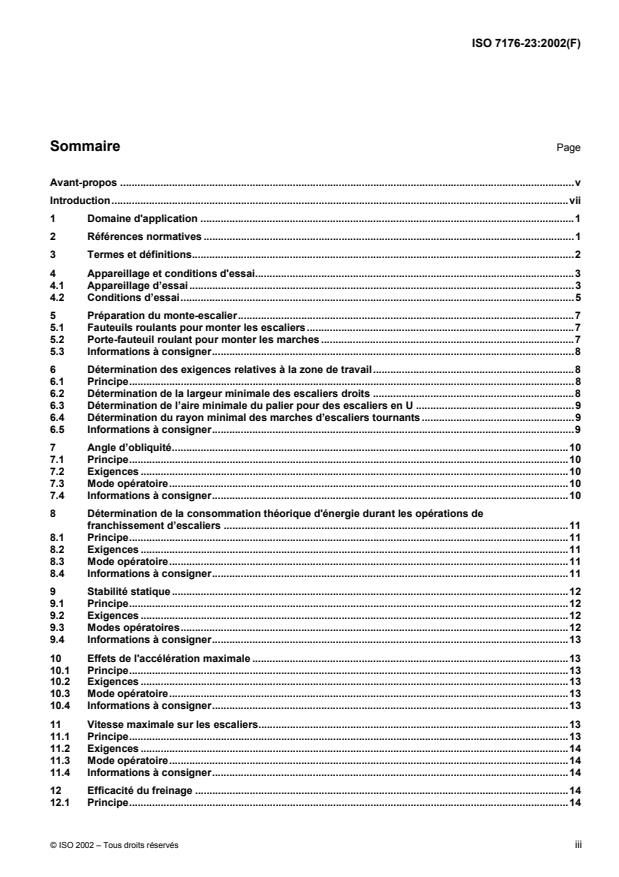
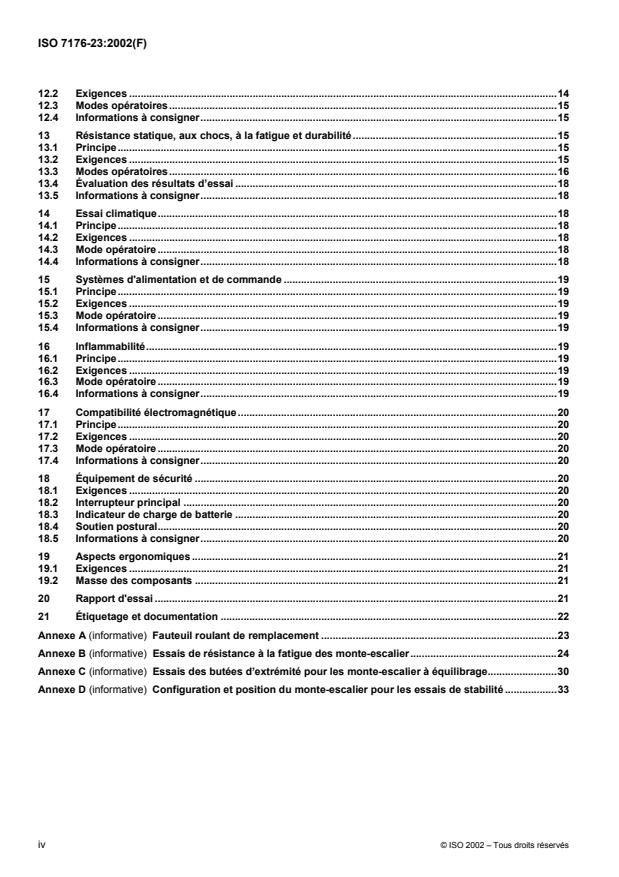
Contents Page
Foreword.v
Introduction.vii
1 Scope.1
2 Normative references.1
3 Terms and definitions .2
4 Test apparatus and conditions .3
4.1 Test apparatus.3
4.2 Test conditions.5
5 Preparation of the stair-climbing device.7
5.1 Stair-climbing wheelchairs.7
5.2 Stair-climbing wheelchair carriers.7
5.3 Recorded information.8
6 Determination of working area requirements.8
6.1 Principle.8
6.2 Determination of minimum stair width for straight stairs .8
6.3 Determination of minimum landing area for U-shaped stairs.9
6.4 Determination of minimum stair radius on winding stairs.9
6.5 Recorded information.9
7 Skew angle.10
7.1 Principle.10
7.2 Requirements.10
7.3 Test procedure.10
7.4 Recorded information.10
8 Determination of theoretical energy consumption during stair-climbing operation.11
8.1 Principle.11
8.2 Requirements.11
8.3 Test procedure.11
8.4 Recorded information.11
9 Static stability.12
9.1 Principle.12
9.2 Requirements.12
9.3 Test procedures.12
9.4 Recorded information.12
10 Effects of maximum acceleration .13
10.1 Principle.13
10.2 Requirements.13
10.3 Test procedure.13
10.4 Recorded information.13
11 Maximum speed on stairs.13
11.1 Principle.13
11.2 Requirements.13
11.3 Test procedure.13
11.4 Recorded information.14
12 Braking effectiveness.14
12.1 Principle.14
12.2 Requirements.14
12.3 Test procedures.14
12.4 Recorded information.15
13 Static, impact, fatigue strengths and durability .15
13.1 Principle.15
13.2 Requirements.15
13.3 Test procedures.16
13.4 Evaluation of test results .17
13.5 Recorded information.17
14 Climatic test.18
14.1 Principle.18
14.2 Requirements.18
14.3 Test procedure.18
14.4 Recorded information.18
15 Power and control systems .18
15.1 Principle.18
15.2 Requirements.18
15.3 Test procedure.18
15.4 Recorded information.19
16 Flammability.19
16.1 Principle.19
16.2 Requirements.19
16.3 Test procedure.19
16.4 Recorded information.19
17 Electromagnetic compatibility.19
17.1 Principle.19
17.2 Requirements.19
17.3 Test procedure.19
17.4 Recorded information.19
18 Safety equipment.19
18.1 Requirements.19
18.2 Mains switch.20
18.3 Battery charge indicator.20
18.4 Postural support.20
18.5 Records.20
19 Ergonomic aspects.20
19.1 Requirements.20
19.2 Component mass.20
20 Test report.20
21 Labelling and documentation.21
Annex A (informative) Surrogate wheelchair .23
Annex B (informative) Fatigue-strength tests for stair-climbing devices .24
Annex C (informative) Edge stop test for balancing stair-climbing devices.31
Annex D (informative) Configuration and position of the stair-climbing device for stability tests .34
iv © ISO 2002 – All rights reserved
Foreword
ISO (the International Organization for Standardization) is a worldwide federation of national standards bodies (ISO
member bodies). The work of preparing International Standards is normally carried out through ISO technical
committees. Each member body interested in a subject for which a technical committee has been established has
the right to be represented on that committee. International organizations, governmental and non-governmental, in
liaison with ISO, also take part in the work. ISO collaborates closely with the International Electrotechnical
Commission (IEC) on all matters of electrotechnical standardization.
International Standards are drafted in accordance with the rules given in the ISO/IEC Directives, Part 3.
Draft International Standards adopted by the technical committees are circulated to the member bodies for voting.
Publication as an International Standard requires approval by at least 75 % of the member bodies casting a vote.
Attention is drawn to the possibility that some of the elements of this part of ISO 7176 may be the subject of patent
rights. ISO shall not be held responsible for identifying any or all such patent rights.
International Standard ISO 7176-23 was prepared by Technical Committee ISO/TC 173, Technical systems and
aids for disabled or handicapped persons, Subcommittee SC 1, Wheelchairs.
ISO 7176 consists of the following parts, under the general title Wheelchairs:
— Part 1: Determination of static stability
— Part 2: Determination of dynamic stability of electric wheelchairs
— Part 3: Determination of efficiency of brakes
— Part 4: Energy consumption of electric wheelchairs and scooters for determination of theoretical distance
range
— Part 5: Determination of overall dimensions, mass and turning space
— Part 6: Determination of maximum speed, acceleration and deceleration of electric wheelchairs
— Part 7: Measurement of seating and wheel dimensions
— Part 8: Requirements and test methods for static, impact and fatigue strengths
— Part 9: Climatic tests for electric wheelchairs
— Part 10: Determination of obstacle-climbing ability of electric wheelchairs
— Part 11: Test dummies
— Part 13: Determination of coefficient of friction of test surfaces
— Part 14: Power and control systems for electric wheelchairs — Requirements and test methods
— Part 15: Requirements for information disclosure, documentation and labelling
— Part 16: Resistance to ignition of upholstered parts — Requirements and test methods
— Part 19: Wheeled mobility devices for use in motor vehicles
— Part 22: Set-up procedures
— Part 23: Requirements and test methods for attendant-operated stair-climbing devices
The following parts are also on the programme of work:
— Part 20: Determination of the performance of stand-up wheelchairs
— Part 21: Electromagnetic compatibility of electrically powered wheelchairs and motorized scooters —
Requirements and test methods
— Part 24: Requirements and test methods for user-operated stair-climbing devices
— Part 25: Requirements and test methods for batteries and their chargers for powered wheelchairs and
motorized scooters
— Part 26: Vocabulary
Annexes A to D of this part of ISO 7176 are for information only.
vi © ISO 2002 – All rights reserved
Introduction
The goal of this part of ISO 7176 is to create a common understanding, and to develop a means of qualifying and
quantifying the various conditions and environments encountered in stair-climbing operations, and stair-climbing
device performance. If the stair-climbing device can be used as a wheelchair, it shall also meet all ISO
requirements for wheelchairs. This will allow the users and manufacturers to evaluate and communicate the
pertinent safety and utility issues.
These tests are used to gather comparison information about factors relating to the performance of the stair-
climbing device whilst in stair-climbing mode on stairs and on level ground. They include identification of suitable
operating environments for each device and indications of various performance criteria in stair-climbing mode for
on-stair operations and on level ground.
NOTE 1 When ascending stairs, present known attendant-operated stair-climbing devices are driven backwards, which
means that the attendant goes backwards up the stairs with the occupant facing downstairs. Descending stairs is performed
forwards with the occupant facing downstairs.
NOTE 2 Elements of this part of ISO 7176 may be used as a basis for developing requirements and test methods for stair-
climbing devices not covered by this part of ISO 7176.
This part of ISO 7176 calls for the use of procedures that may be injurious to health if adequate precautions are not
taken. It refers only to technical suitability and does not absolve the manufacturer or test house from legal
obligations relating to health and safety at any stage.
NOTE 3 The attendant should be familiar with the operation of the stair-climbing device and not apply forces other than those
minimally necessary to operate the device.
Some stair-climbing devices may have adjustable components and/or alternative parts. Where there is an
obligation to ensure that all variations conform to this part of ISO 7176, it is for those commissioning the tests to
decide, which configurations should be tested.
It is anticipated that this part of ISO 7176 will continue to be developed and future revisions may include the results
of ongoing work in the following areas:
fatigue-strength test for joystick;
determination of static stability on winding stairs;
development of the fatigue-strength test for stair-climbing devices in informative annex B to a normative test
method;
development of the edge stop test in annex C to a normative test method;
development of the configuration and position of the stair-climbing device for stability tests in annex D to a
normative test method.
INTERNATIONAL STANDARD ISO 7176-23:2002(E)
Wheelchairs —
Part 23:
Requirements and test methods for attendant-operated stair-
climbing devices
1 Scope
This part of ISO 7176 specifies requirements and test methods for electrically propelled stair-climbing devices and
stair-climbing wheelchair carriers operated by an attendant. It also includes ergonomic, safety labelling and
disclosure requirements.
This part of ISO 7176 is applicable to stair-climbing devices for which the attendant walks directly behind the device
and where the device is driven backwards when ascending stairs.
NOTE This means that when ascending stairs the attendant walks backwards up the stairs, with the occupant facing
downstairs. Descending stairs is performed forwards with the occupant facing downstairs.
2 Normative references
The following normative documents contain provisions which, through reference in this text, constitute provisions of
this part of ISO 7176. For dated references, subsequent amendments to, or revisions of, any of these publications
do not apply. However, parties to agreements based on this part of ISO 7176 are encouraged to investigate the
possibility of applying the most recent editions of the normative documents indicated below. For undated
references, the latest edition of the normative document referred to applies. Members of ISO and IEC maintain
registers of currently valid International Standards.
ISO 3880-1, Building construction — Stairs — Part 1: Vocabulary.
ISO 6440, Wheelchairs — Nomenclature, terms and definitions.
ISO 7176-1, Wheelchairs — Part 1: Determination of static stability.
ISO 7176-3, Wheelchairs — Part 3: Determination of efficiency of brakes.
ISO 7176-4, Wheelchairs — Part 4: Energy consumption of electric wheelchairs and scooters for determination of
theoretical distance range.
ISO 7176-6, Wheelchairs — Part 6: Determination of maximum speed, acceleration and deceleration of electric
wheelchairs.
ISO 7176-8:1998, Wheelchairs — Part 8: Requirements and test methods for static, impact and fatigue strengths.
ISO 7176-9, Wheelchairs — Part 9: Climatic tests for electric wheelchairs.
ISO 7176-11, Wheelchairs — Part 11: Test dummies.
ISO 7176-13, Wheelchairs — Part 13: Determination of coefficient of friction of test surfaces.
ISO 7176-14, Wheelchairs — Part 14: Power and control systems for electric wheelchairs — Requirements and
test methods.
ISO 7176-15, Wheelchairs — Part 15: Requirements for information disclosure, documentation and labelling.
ISO 7176-16:1997, Wheelchairs — Part 16: Resistance to ignition of upholstered parts — Requirements and test
methods.
ISO 7176-19, Wheelchairs — Part 19: Wheeled mobility devices for use in motor vehicles.
ISO 7176-21, Wheelchairs — Part 21: Electromagnetic compatibility of electrically powered wheelchairs and
motorized scooters — Requirements and test methods.
ISO 7176-22, Wheelchairs — Part 22: Set-up procedures.
ISO 7193, Wheelchairs — Maximum overall dimensions.
3 Terms and definitions
For the purposes of this part of ISO 7176, the terms and definitions given in ISO 3880-1, ISO 6440, ISO 7176-15
and the following apply.
3.1
stair-climbing device
electrically propelled stair-climbing wheelchair or wheelchair carrier
3.2
attendant-operated stair-climbing wheelchair
wheelchair, operated by an attendant, intended by the manufacturer to be powered up and down on stairs with a
seated occupant
3.3
attendant-operated stair-climbing wheelchair carriers
portable device, operated by an attendant, intended by the manufacturer to be attached to a wheelchair in order to
power it up and down on stairs with a seated occupant
3.4
climbing
ascent or descent of stairs
3.5
winding stairs
stairs built in a curved construction
NOTE Normally the steps on winding stairs are wider on one side and narrower on the other side (see Figure 2).
3.6
attendant
person operating the stair-climbing device, not sitting on the device
3.7
occupant
person being transported by the stair-climbing device
3.8
U-shaped stairs
two flights of stairs at an angle of 180° to each other and connected by an intermediate landing
2 © ISO 2002 – All rights reserved
3.9
skew angle
angle of deviation between the pitch line of the stair and the axes of movement of the stair-climbing device
3.10
edge stop
device to stop forward movement of a balancing stair-climbing device when approaching the nosing of a downward
step
NOTE See annex C.
4 Test apparatus and conditions
4.1 Test apparatus
In addition to the test apparatus specified below, further test apparatus described in the normative references are
also required.
4.1.1 Standard test stairs with eight steps having a rise of 180 mm ± 5 mm and an overall pitch of 35° with a
+1°
tolerance of (see Figure 1). A riser shall close the front face of each step. All nosing shall fall within a region
contained between two imaginary parallel planes 10 mm apart and inclined at the overall pitch angle of the stairs.
The nosing shall be of a rigid material, smooth and rounded to a radius of 8 mm ± 1 mm. Each step shall be level
and shall have a coefficient of friction that complies with ISO 7176-13. The width of the stairs shall be at least
500 mm wider than the stair-climbing devices under test, including the attendant. A fixed barrier shall limit the stair
width on one side and sideways adjustable barriers on each step shall limit the stair width on the other side. The
height of the barriers shall be 1 800 mm ± 100 mm above the stairs. The test stairs shall be capable of being
connected to the landing platform (see 4.1.3). Provision for a handrail to be mounted if required shall be
incorporated on both sides.
4.1.2 Winding test stairs with eight steps having a rise of 180 mm ± 5 mm. The winding angle shall be
19° ± 0,5° per step. The stair nosing shall have a tangentiality to the central axis of the stair of 75 mm ± 20 mm.
The going/run of each step shall be 257 mm ± 10 mm at a point which is 760 mm ± 10 mm apart from the central
axis of the stair when measured parallel to the stair nosing. The inner radius of the stair shall be 310 mm ± 10 mm.
A riser shall close the front face of each step (see Figure 2).
The nosing shall be of a rigid material, smooth and rounded to a radius of 8 mm ± 1 mm. Each step shall be level
and shall have a coefficient of friction that complies with ISO 7176-13. The width of the stairs shall be at least
500 mm wider than the stair-climbing devices under test, including the attendant. Movable barriers shall limit the
stair width on each step on the outer side and a fixed barrier shall limit the stair width on the inner side. The height
of the barriers shall be 1 800 mm ± 100 mm above the stairs. The test stairs shall be capable of being connected to
the landing platform (see 4.1.3). Provision for a handrail to be mounted if required shall be incorporated on both
sides.
4.1.3 Landing platform with a height equal to the height of the top step in 4.1.1 and 4.1.2 with a tolerance of
± 5 mm. The top of the platform shall be covered with a material whose coefficient of friction complies with
ISO 7176-13. On one side the platform shall be capable of being rigidly connected to the test stairs. On the other
sides the platform shall be equipped with movable barriers with a height of 1 800 mm ± 100 mm.
Recommended area of the platform is 2 m ¥ 4 m.
NOTE If convenient, the test equipment in 4.1.1, 4.1.2 and 4.1.3 can be built in one piece.
Dimensions in millimetres
Figure 1 — Standard test stair with landing (see 4.1.1)
Dimensions in millimetres
Figure 2 — Winding test stair (see 4.1.2)
4 © ISO 2002 – All rights reserved
4.1.4 Rigid horizontal test plane of sufficient size to accommodate the stair-climbing device during testing,
such that the whole surface is contained between two imaginary parallel planes 5 mm apart. The surface of the
plane shall have a coefficient of friction as defined in ISO 7176-13.
NOTE The imaginary planes are intended to provide a measure of control on the flatness of the test plane.
4.1.5 Test wheelchair recommended by the manufacturer of the stair-climbing device. If the manufacturer
recommends several wheelchairs, priority shall be given to those conforming with ISO 7193. If no wheelchair is
recommended, a wheelchair that conforms with ISO 7193 shall be used, or a surrogate wheelchair in accordance
with specifications given in annex A.
4.1.6 Standard test dummy in accordance with ISO 7176-11, modified as follows:
Replace the lower leg portions of the 100 kg, 75 kg and 50 kg dummies with two footpieces with a shape that
permits ready attachment to the footrests and which have the following properties:
a) mass 3,5 kg ± 0,5 kg;
b) height of centre of gravity 20 mm ± 2 mm above footplate surface.
NOTE 1 Two steel blocks each having dimensions 75 mm ¥ 150 mm ¥ 40 mm are suitable as footpieces.
NOTE 2 A human test occupant with the same mass may be used instead of the test dummy.
4.1.7 Energy consumption instrumentation, a device capable of measuring the ampere-hours used by the
stair-climbing device which does not itself use more than 0,5 % of the ampere-hours used by the stair-climbing
device.
4.1.8 Device for measuring time with an accuracy of 0,1 s.
4.1.9 Lifting gear for lifting the standard test stairs relative to the horizontal for the purposes of the test specified
in 9.3.2.
4.1.10 Device for measuring linear dimensions up to 2 m with an accuracy of ± 1 mm.
4.1.11 Rectangular attendant-space gauge to simulate the space an attendant occupies when operating the
stair-climbing device (see Figure 3), with a horizontal length of 640 mm ± 10 mm and horizontal width of 560 mm
± 10 mm or the distance between the midpoint of the handgrips of the tested stair-climbing device plus 200 mm
± 10 mm, whichever is larger. Both rear corners shall be rounded with a radius of 200 mm ± 10 mm. It shall be
possible to attach the gauge to the midpoint of the handgrips of the tested stair-climbing device.
NOTE A frame made of wood or steel wire is suitable.
4.1.12 Rectangular foot-space gauge to simulate the area the feet of the occupant occupies when sitting on the
stair-climbing device or the test wheelchair (see Figure 4), with a horizontal length of 300 mm ± 10 mm and a
horizontal width of 300 mm ± 10 mm. Both front corners shall be rounded with a radius of 100 mm ± 10 mm. It shall
be possible to attach the gauge to the footrest of the stair-climbing device so that it is in line with it and in line with
the stair-climbing device.
NOTE A frame made of wood or steel wire is suitable.
4.2 Test conditions
4.2.1 The test equipment specified in 4.1.1 to 4.1.4 shall remain immobile during the test.
4.2.2 The ambient temperature shall be (20 ± 5) °C.
Dimensions in millimetres
Key
1 Datum point
2 Handgrips of stair-climbing device
Figure 3 — Attendant-space gauge
Dimensions in millimetres
Figure 4 — Foot-space gauge
6 © ISO 2002 – All rights reserved
5 Preparation of the stair-climbing device
5.1 Stair-climbing wheelchairs
5.1.1 Before each test, prepare the stair-climbing wheelchair as specified in 5.1.2 to 5.1.6 if not otherwise stated
in individual test procedure.
5.1.2 Equip and configure the stair-climbing wheelchair for stair-climbing operation in accordance with the
manufacturer’s instructions. For parts where there are no manufacturer’s recommendations, set the adjustable
parts of the stair-climbing device, where applicable, according to ISO 7176-22. For all other parts where there is a
range for adjustments, set them as near as possible to the mid-position.
5.1.3 Charge the batteries to not less than 75 % of their rated capacity.
5.1.4 Load the stair-climbing device with a test dummy constructed in accordance with ISO 7176-11. The mass
shall be equal to, or if there is no dummy of equal mass, the next size greater than, the maximum mass of occupant
recommended by the manufacturer as shown in Table 1.
Replacement footpieces for the lower leg portion of the test dummy are specified in 4.1.6. Position each footpiece
with the centre of gravity as close as possible to the centre of the footplate(s).
A human occupant may be used. In this case weights may be added on the seat of the stair-climbing wheelchair to
supplement the mass of a small occupant (sandbags or similar items are recommended). Shoes with a minimum
length of 300 mm shall be used. It is essential that appropriate precautions be taken to ensure the person’s safety.
Table 1
Maximum occupant mass Test dummy mass
kg kg
Up to 25 25
> 25 to 50 50
> 50 to 75 75
> 75 to 100 100
NOTE Work is in progress to develop test dummies for heavier user masses.
5.1.5 If the stair-climbing wheelchair has pneumatic tyres, inflate them to the pressure recommended by the
manufacturer of the stair-climbing wheelchair. If a pressure range is given, inflate to the highest pressure in the
range. If there is no recommendation for inflation pressure from the stair-climbing wheelchair manufacturer, inflate
the tyres to the maximum pressure recommended by the tyre manufacturer.
5.1.6 If the stair-climbing wheelchair has adjustable push handles (manœuvre device), adjust them as nearly as
possible to a height of 1 500 mm ± 20 mm.
5.2 Stair-climbing wheelchair carriers
5.2.1 Before each test, prepare the, stair-climbing wheelchair carrier as specified in 5.2.2 to 5.2.8 if not otherwise
stated in individual test procedure.
5.2.2 Charge the batteries to not less than 75 % of their rated capacity.
5.2.3 Select one standard wheelchair recommended by the manufacturer of the stair-climbing wheelchair carrier
as test wheelchair. The selected wheelchair shall conform with ISO 7193, if not otherwise stated by the
manufacturer of the stair-climbing wheelchair carrier.
5.2.4 Adjust the wheelchair in accordance to the instructions of the manufacturer of the stair-climbing wheelchair
carrier. If there are no instructions, adjust the wheelchair in accordance with the instructions from the manufacturer
of the wheelchair. For parts where there are no manufacturer’s recommendations, set the adjustable parts of the
wheelchair according to ISO 7176-22.
5.2.5 If the stair-climbing wheelchair carrier has pneumatic tyres, inflate them in accordance with 5.1.5.
5.2.6 If the stair-climbing wheelchair carrier has adjustable push handles (manœuvre device), adjust them as
nearly as possible to a height of 1 500 mm ± 20 mm.
5.2.7 Load the wheelchair in accordance with 5.1.4.
5.2.8 Secure the test wheelchair to the stair-climbing wheelchair carrier for stair-climbing operation in
accordance with the carrier manufacturer's instruction.
5.3 Recorded information
Record the following information:
a) the stair-climbing device used in the test;
b) wheelchair specified for the test, including its mass;
c) the position of any adjustable part;
d) the mass of the dummy.
6 Determination of working area requirements
6.1 Principle
6.1.1 Determination of minimum working area to operate the loaded stair-climbing device on stairs and landing,
including the space necessary to manœuvre the stair-climbing device by an attendant.
6.1.2 All tests in clause 6 shall be performed using the attendant-space gauge (see 4.1.11) and the foot-space
gauge (see 4.1.12). The stair-climbing device, the attendant-space gauge and the foot-space gauge shall not touch
the barriers (see 4.1.1 and 4.1.2) during the test procedure.
6.1.3 Before each test, check the adjustment of the stair-climbing device and position of the test dummy against
the instructions in clause 5 and correct if necessary.
NOTE When ascending stairs the stair-climbing device is driven backwards, which means that the attendant goes
backwards up the stairs.
6.2 Determination of minimum stair width for straight stairs
6.2.1 Set up the standard test stairs connected to the landing platform.
6.2.2 With the stair-climbing device standing horizontally in front of the test stairs following the manufacturer’s
instructions, drive the device up the stairs to the landing platform.
6.2.3 Position the stair-climbing device for descending the stairs following the manufacturer’s instructions. Drive
the stair-climbing device down the stairs so that the whole stair-climbing device is on the horizontal plane.
6.2.4 Measure to an accuracy of ± 20 mm the narrowest position of the two barriers which it is possible to
achieve without the stair-climbing device, the attendant-space gauge, the foot-space gauge or the test wheelchair
(if used) having any interference with the barriers during the test procedure.
8 © ISO 2002 – All rights reserved
EXAMPLE
An example of a practical method is as follows:
— Measure the maximum width of the test stair-climbing device.
— Set the adjustable barriers so that the distance between the barriers is a little wider than the width of the stair-climbing
device.
— Perform the test.
— Decrease/increase the width of the steps until the minimum stair width is determined.
6.3 Determination of minimum landing area for U-shaped stairs
6.3.1 Use the same test equipment as in 6.2.
6.3.2 Drive the stair-climbing device up the stairs onto the landing platform.
6.3.3 Turn the stair-climbing device 180°.
6.3.4 Measure to an accuracy of ± 20 mm the minimum length and width between the barriers which is possible
to achieve without the stair-climbing device, the attendant-space gauge, the foot-space gauge or test wheel chair (if
used) having any interference with the barriers during the test procedure.
6.4 Determination of minimum stair radius on winding stairs
6.4.1 The minimum stair radius is the distance on the winding test stairs, from the central axis of the stairs to the
maximum excursion of the stair-climbing device while performing the test cycle.
6.4.2 Set up the winding test stairs connected to the landing platform and set the adjustable barriers at maximum
distance from the centre point of the stairs.
6.4.3 With the stair-climbing device standing horizontally in front of the test stairs following the manufacturer’s
instructions, drive the device up the stairs to the landing platform. If there is no instruction from the manufacturer,
place the stair-climbing device as close as possible to the adjustable barrier without hitting the adjustable barrier
while ascending.
6.4.4 Position the stair-climbing device for descending the stairs following the manufacturer’s instructions. Drive
the device down the stairs so that the whole device is on the horizontal plane. The test cycle shall be performed
safely and without any interference with the barrier. If there is no manufacturer’s instruction, place the stair-climbing
device as close as possible to the adjustable barrier without hitting the adjustable barrier while descending.
6.4.5 Decrease the stair radius by moving the barrier closer to the centre point in steps, until the stair-climbing
device does not successfully complete the test cycle. Measure the stair radius to the barrier to an accuracy of
± 20 mm the minimum radius which is possible to achieve without the stair-climbing device, the attendant-space
gauge, the foot-space gauge, or the test wheelchair (if used) having any interference with the barriers or becoming
unsafe during the test procedure.
NOTE The space necessary for manœuvring of the device by an attendant shall be included in the measured area.
6.5 Recorded information
Record the measurements taken in 6.2, 6.3 and 6.4.
7 Skew angle
7.1 Principle
Stair-climbing devices often need to be operated under a skew angle. Testing is performed under such conditions.
All tests are performed with maximum speed if not otherwise specified by the manufacturer.
Before each test, check the adjustment of the stair-climbing device and position of the test dummy against the
instructions in clause 5 and correct if necessary.
7.2 Requirements
7.2.1 The stair-climbing device shall be able to climb the steps at maximum speed, whether ascending or
descending, at an approach skew angle of 9° from the edge of the step.
7.2.2 If the manufacturer claims that the stair-climbing device exceeds the above minimum requirements, the
stair-climbing device shall be able to ascend or descend steps at this higher approach skew angle.
7.3 Test procedure
7.3.1 The stair-climbing device shall be driven up and down the stairs at skew angles of 9°, and at a higher skew
angle if claimed by the manufacturer.
7.3.2 Set up the standard test stairs connected to the landing platform.
7.3.3 With the stair-climbing device standing horizontally in front of the test stairs and at a skew angle of 9°, drive
the device up to the first step. Drive up the remaiding steps to the landing. Repeat the test procedure driving down
the stairs.
Table 2 shall be used to assess the performance of the stair-climbing device.
Table 2
Definition Comments
Completed The test is completed according to the test procedure and requirements.
The test shall be completed in 3 min.
Not completed The test was impossible to complete. The reason why it was not
completed shall be recorded.
NOTE Difficulties are for example instability or that the attendant has to apply forces other than
minimally necessary to operate the stair-climbing device during the test procedure.
7.3.4 I
...
NORME ISO
INTERNATIONALE 7176-23
Première édition
2002-07-01
Fauteuils roulants —
Partie 23:
Exigences et méthodes d'essai pour les
monte-escalier manipulés par une tierce
personne
Wheelchairs —
Part 23: Requirements and test methods for attendant-operated
stair-climbing devices
Numéro de référence
©
ISO 2002
PDF – Exonération de responsabilité
Le présent fichier PDF peut contenir des polices de caractères intégrées. Conformément aux conditions de licence d'Adobe, ce fichier peut
être imprimé ou visualisé, mais ne doit pas être modifié à moins que l'ordinateur employé à cet effet ne bénéficie d'une licence autorisant
l'utilisation de ces polices et que celles-ci y soient installées. Lors du téléchargement de ce fichier, les parties concernées acceptent de fait la
responsabilité de ne pas enfreindre les conditions de licence d'Adobe. Le Secrétariat central de l'ISO décline toute responsabilité en la
matière.
Adobe est une marque déposée d'Adobe Systems Incorporated.
Les détails relatifs aux produits logiciels utilisés pour la création du présent fichier PDF sont disponibles dans la rubrique General Info du
fichier; les paramètres de création PDF ont été optimisés pour l'impression. Toutes les mesures ont été prises pour garantir l'exploitation de
ce fichier par les comités membres de l'ISO. Dans le cas peu probable où surviendrait un problème d'utilisation, veuillez en informer le
Secrétariat central à l'adresse donnée ci-dessous.
© ISO 2002
Droits de reproduction réservés. Sauf prescription différente, aucune partie de cette publication ne peut être reproduite ni utilisée sous quelque
forme que ce soit et par aucun procédé, électronique ou mécanique, y compris la photocopie et les microfilms, sans l'accord écrit de l’ISO à
l’adresse ci-après ou du comité membre de l’ISO dans le pays du demandeur.
ISO copyright office
Case postale 56 • CH-1211 Geneva 20
Tel. + 41 22 749 01 11
Fax. + 41 22 749 09 47
E-mail copyright@iso.ch
Web www.iso.ch
Imprimé en Suisse
ii © ISO 2002 – Tous droits réservés
Sommaire Page
Avant-propos .v
Introduction.vii
1 Domaine d'application.1
2 Références normatives.1
3 Termes et définitions.2
4 Appareillage et conditions d'essai.3
4.1 Appareillage d’essai.3
4.2 Conditions d’essai.5
5 Préparation du monte-escalier.7
5.1 Fauteuils roulants pour monter les escaliers.7
5.2 Porte-fauteuil roulant pour monter les marches .7
5.3 Informations à consigner.8
6 Détermination des exigences relatives à la zone de travail.8
6.1 Principe.8
6.2 Détermination de la largeur minimale des escaliers droits .8
6.3 Détermination de l’aire minimale du palier pour des escaliers en U .9
6.4 Détermination du rayon minimal des marches d’escaliers tournants .9
6.5 Informations à consigner.9
7 Angle d’obliquité.10
7.1 Principe.10
7.2 Exigences.10
7.3 Mode opératoire.10
7.4 Informations à consigner.10
8 Détermination de la consommation théorique d'énergie durant les opérations de
franchissement d’escaliers .11
8.1 Principe.11
8.2 Exigences.11
8.3 Mode opératoire.11
8.4 Informations à consigner.11
9 Stabilité statique.12
9.1 Principe.12
9.2 Exigences.12
9.3 Modes opératoires.12
9.4 Informations à consigner.13
10 Effets de l'accélération maximale .13
10.1 Principe.13
10.2 Exigences.13
10.3 Mode opératoire.13
10.4 Informations à consigner.13
11 Vitesse maximale sur les escaliers.13
11.1 Principe.13
11.2 Exigences.14
11.3 Mode opératoire.14
11.4 Informations à consigner.14
12 Efficacité du freinage .14
12.1 Principe.14
12.2 Exigences.14
12.3 Modes opératoires.15
12.4 Informations à consigner.15
13 Résistance statique, aux chocs, à la fatigue et durabilité.15
13.1 Principe.15
13.2 Exigences.15
13.3 Modes opératoires.16
13.4 Évaluation des résultats d’essai .18
13.5 Informations à consigner.18
14 Essai climatique.18
14.1 Principe.18
14.2 Exigences.18
14.3 Mode opératoire.18
14.4 Informations à consigner.18
15 Systèmes d'alimentation et de commande .19
15.1 Principe.19
15.2 Exigences.19
15.3 Mode opératoire.19
15.4 Informations à consigner.19
16 Inflammabilité.19
16.1 Principe.19
16.2 Exigences.19
16.3 Mode opératoire.19
16.4 Informations à consigner.19
17 Compatibilité électromagnétique.20
17.1 Principe.20
17.2 Exigences.20
17.3 Mode opératoire.20
17.4 Informations à consigner.20
18 Équipement de sécurité.20
18.1 Exigences.20
18.2 Interrupteur principal.20
18.3 Indicateur de charge de batterie .20
18.4 Soutien postural.20
18.5 Informations à consigner.20
19 Aspects ergonomiques.21
19.1 Exigences.21
19.2 Masse des composants .21
20 Rapport d'essai.21
21 Étiquetage et documentation.22
Annexe A (informative) Fauteuil roulant de remplacement .23
Annexe B (informative) Essais de résistance à la fatigue des monte-escalier.24
Annexe C (informative) Essais des butées d’extrémité pour les monte-escalier à équilibrage.30
Annexe D (informative) Configuration et position du monte-escalier pour les essais de stabilité .33
iv © ISO 2002 – Tous droits réservés
Avant-propos
L'ISO (Organisation internationale de normalisation) est une fédération mondiale d'organismes nationaux de
normalisation (comités membres de l'ISO). L'élaboration des Normes internationales est en général confiée aux
comités techniques de l'ISO. Chaque comité membre intéressé par une étude a le droit de faire partie du comité
technique créé à cet effet. Les organisations internationales, gouvernementales et non gouvernementales, en
liaison avec l'ISO participent également aux travaux. L'ISO collabore étroitement avec la Commission
électrotechnique internationale (CEI) en ce qui concerne la normalisation électrotechnique.
Les Normes internationales sont rédigées conformément aux règles données dans les Directives ISO/CEI, Partie 3.
Les projets de Normes internationales adoptés par les comités techniques sont soumis aux comités membres pour
vote. Leur publication comme Normes internationales requiert l'approbation de 75 % au moins des comités
membres votants.
L’attention est appelée sur le fait que certains des éléments de la présente partie de l’ISO 7176 peuvent faire
l’objet de droits de propriété intellectuelle ou de droits analogues. L’ISO ne saurait être tenue pour responsable de
ne pas avoir identifié de tels droits de propriété et averti de leur existence.
La Norme internationale ISO 7176-23 a été élaborée par le comité technique ISO/TC 173, Assistances et aides
techniques pour les invalides ou handicapés, sous-comité SC 1, Fauteuils roulants.
L'ISO 7176 comprend les parties suivantes, présentées sous le titre général Fauteuils roulants:
— Partie 1: Détermination de la stabilité statique
— Partie 2: Détermination de la stabilité dynamique des fauteuils roulants électriques
— Partie 3: Détermination de l'efficacité des freins
— Partie 4: Consommation d'énergie des fauteuils roulants et scooters électriques pour la détermination de la
distance théorique
— Partie 5: Détermination des dimensions hors tout, de la masse et de l'espace de giration
— Partie 6: Détermination de la vitesse, de l'accélération et du ralentissement maximaux des fauteuils roulants
électriques
— Partie 7: Mesurage des dimensions d'assise et des roues
— Partie 8: Exigences et méthodes d'essai pour la résistance statique, la résistance aux chocs et la résistance à
la fatigue
— Partie 9: Essais climatiques pour fauteuils roulants électriques
— Partie 10: Détermination de l'aptitude des fauteuils roulants électriques à gravir les obstacles
— Partie 11: Mannequins d'essai
— Partie 13: Détermination du coefficient de frottement des surfaces d'essai
— Partie 14: Systèmes d'alimentation et de commande des fauteuils roulants électriques — Exigences et
méthodes d'essai
— Partie 15: Exigences relatives à la diffusion des informations, à la documentation et à l'étiquetage
— Partie 16: Résistance à l'inflammation des parties rembourrées — Exigences et méthodes d'essai
— Partie 19: Dispositifs de mobilité montés sur roues et destinés à être utilisés dans des véhicules à moteur
— Partie 22: Modes opératoires de réglage
— Partie 23: Exigences et méthodes d'essai pour les monte-escalier manipulés par une tierce personne
Les parties suivantes sont également au programme de travail:
— Partie 20: Détermination de la performance des fauteuils roulants verticalisants
— Partie 21: Compatibilité électromagnétique des fauteuils roulants électriques et scooters motorisés —
Exigences et méthodes d'essai
— Partie 24: Exigences et méthodes d'essai pour les monte-escalier manipulés par l’utilisateur
— Partie 25: Batteries et leurs chargeurs pour les fauteuils roulants électriques et scooters motorisés —
Exigences et méthodes d'essai
— Partie 26: Vocabulaire
Les annexes A à D de la présente partie de l’ISO 7176 sont données uniquement à titre d’information.
vi © ISO 2002 – Tous droits réservés
Introduction
La présente partie de l’ISO 7176 a pour objectif de créer une compréhension commune et de développer un
moyen de qualifier et de quantifier les conditions et les environnements divers rencontrés en montant les escaliers,
ainsi que les performances des monte-escalier. Si le monte-escalier peut servir de fauteuil roulant, il doit également
satisfaire à toutes les exigences ISO concernant les fauteuils roulants. Cela permettra aux usagers et aux
fabricants d’évaluer et de communiquer les points pertinents en matière de sécurité et d’usage.
Ces essais sont utilisés pour réunir des informations comparatives sur les facteurs liés aux performances du
monte-escalier lorsqu’il est en mode de déplacement dans un escalier et sur un sol plan. Ils comportent
l’identification des environnements de fonctionnement appropriés à chaque monte-escalier et l’indication des divers
critères de performance en mode de montée et sur terrain plat.
NOTE 1 En montant les marches, les monte-escalier actuellement connus manipulés par une tierce personne sont
manœuvrés à reculons, ce qui signifie que la tierce personne monte les escaliers à reculons, l’occupant du fauteuil regardant
vers le bas. La descente des marches se fait vers l’avant, l’occupant du fauteuil regardant vers le bas.
NOTE 2 Certains éléments de la présente partie de l’ISO 7176 peuvent servir de base pour mettre au point des exigences et
des méthodes d’essai des monte-escalier non traitées dans la présente partie de l’ISO 7176.
La présente partie de l’ISO 7176 demande la mise en œuvre de modes opératoires susceptibles d’être dangereux
pour la santé si des précautions suffisantes ne sont pas prises. Elle se réfère à une aptitude technique à l’emploi et
ne libère pas le fabricant ou le laboratoire d’essai de ses obligations légales en matière de santé et de sécurité à
tous les stades.
NOTE 3 Il convient que la tierce personne soit familiarisée avec le fonctionnement du monte-escalier et n’exerce pas des
forces autres que celles requises au minimum pour manœuvrer le monte-escalier.
Certains monte-escalier peuvent comporter des composants réglables et/ou des pièces remplaçables. Lorsqu’il y a
obligation de s’assurer que toutes les variantes sont conformes à la présente partie de l’ISO 7176, il incombe aux
personnes demandant les essais de décider quelles configurations il convient de soumettre aux essais.
Il est prévu de poursuivre le développement de la présente partie de l’ISO 7176; de futures révisions pourront ainsi
intégrer les résultats des travaux en cours dans les domaines suivants:
essai de résistance à la fatigue de la manette;
détermination de la stabilité statique sur les escaliers tournants;
mise au point de l’essai de résistance à la fatigue des monte-escalier donné dans l’annexe B conformément à
une méthode d’essai normative;
mise au point de l’essai des butées d’extrémité donné dans l’annexe C conformément à une méthode d’essai
normative;
mise au point de la configuration et de la position du monte-escalier pour les essais de stabilité données dans
l’annexe D conformément à une méthode d’essai normative.
NORME INTERNATIONALE ISO 7176-23:2002(F)
Fauteuils roulants —
Partie 23:
Exigences et méthodes d'essai pour les monte-escalier manipulés
par une tierce personne
1 Domaine d'application
La présente partie de l’ISO 7176 spécifie des exigences et des méthodes d’essai applicables aux dispositifs
électriques pour franchir les marches et aux porte-fauteuil roulant pour franchir les marches manipulés par une
tierce personne. Elle comporte également des exigences d’ergonomie, d’étiquetage de sécurité et de
communication.
La présente partie de l’ISO 7176 est applicable aux monte-escalier pour lesquels la tierce personne marche juste
derrière et qui sont manœuvrés à reculons lors de la montée des marches.
NOTE Cela signifie que la tierce personne monte les marches à reculons, l’occupant du fauteuil regardant vers le bas. La
descente des marches se fait vers l’avant, l’occupant du fauteuil regardant vers le bas.
2 Références normatives
Les documents normatifs suivants contiennent des dispositions qui, par suite de la référence qui y est faite,
constituent des dispositions valables pour la présente partie de l'ISO 7176. Pour les références datées, les
amendements ultérieurs ou les révisions de ces publications ne s’appliquent pas. Toutefois, les parties prenantes
aux accords fondés sur la présente partie de l'ISO 7176 sont invitées à rechercher la possibilité d'appliquer les
éditions les plus récentes des documents normatifs indiqués ci-après. Pour les références non datées, la dernière
édition du document normatif en référence s’applique. Les membres de l'ISO et de la CEI possèdent le registre des
Normes internationales en vigueur.
ISO 3880-1, Construction immobilière — Escaliers — Vocabulaire.
ISO 6440, Fauteuils roulants — Nomenclature, termes et définitions.
ISO 7176-1, Fauteuils roulants — Partie 1: Détermination de la stabilité statique.
ISO 7176-3, Fauteuils roulants — Partie 3: Détermination de l’efficacité des freins.
ISO 7176-4, Fauteuils roulants — Partie 4: Consommation d'énergie des fauteuils roulants et scooters électriques
pour la détermination de la distance théorique.
ISO 7176-6, Fauteuils roulants — Partie 6: Détermination de la vitesse, de l'accélération et du ralentissement
maximaux des fauteuils roulants électriques.
ISO 7176-8:1998, Fauteuils roulants — Partie 8: Exigences et méthodes d'essai pour la résistance statique, la
résistance aux chocs et la résistance à la fatigue.
ISO 7176-9, Fauteuils roulants — Partie 9: Essais climatiques pour fauteuils roulants électriques.
ISO 7176-11, Fauteuils roulants — Partie 11: Mannequins d'essai.
ISO 7176-13, Fauteuils roulants — Partie 13: Détermination du coefficient de frottement des surfaces d'essai.
ISO 7176-14, Fauteuils roulants — Partie 14: Systèmes d'alimentation et de commande des fauteuils roulants
électriques — Exigences et méthodes d'essai.
ISO 7176-15, Fauteuils roulants — Partie 15: Exigences relatives à la diffusion des informations, à la
documentation et à l'étiquetage.
ISO 7176-16:1997, Fauteuils roulants — Partie 16: Résistance à l'inflammation des parties rembourrées —
Exigences et méthodes d'essai.
ISO 7176-19, Fauteuils roulants — Partie 19: Dispositifs de mobilité montés sur roues et destinés à être utilisés
dans des véhicules à moteur.
ISO 7176-21, Fauteuils roulants — Partie 21: Compatibilité électromagnétique des fauteuils roulants électriques et
scooters motorisés — Exigences et méthodes d'essai.
ISO 7176-22, Fauteuils roulants — Partie 22: Modes opératoires de réglage.
ISO 7193, Fauteuils roulants — Dimensions maximales hors tout.
3 Termes et définitions
Pour les besoins de la présente partie de l'ISO 7176, les termes et définitions donnés dans l’ISO 3880-1,
l’ISO 6440 et l’ISO 7176-15 s'appliquent, ainsi que les termes et définitions suivants.
3.1
monte-escalier
fauteuil roulant pour franchir les marches ou porte-fauteuil roulant à propulsion électrique
3.2
fauteuil roulant pour franchir les marches manipulé par une tierce personne
fauteuil roulant, manipulé par une tierce personne, prévu par le constructeur pour monter et descendre des
marches avec un occupant assis
3.3
porte-fauteuil roulant pour franchir les marches manipulé par une tierce personne
dispositif transportable, manipulé par une tierce personne, prévu par le constructeur pour être fixé à un fauteuil
roulant afin de monter et descendre les marches avec un occupant assis
3.4
franchissement
montée ou descente d’escaliers
3.5
escaliers tournants
escaliers construits en courbe
NOTE Les marches d’escaliers tournants sont normalement plus larges d’un côté que de l’autre (voir Figure 2).
3.6
tierce personne
personne manœuvrant le monte-escalier, sans être assise sur le dispositif
3.7
occupant
personne transportée par le monte-escalier
2 © ISO 2002 – Tous droits réservés
3.8
escalier en U
deux volées de marches faisant un angle de 180° et reliées par un palier intermédiaire
3.9
angle d’obliquité
angle entre la ligne de pente de l’escalier et les axes de déplacement du monte-escalier
3.10
butée d’extrémité
dispositif destiné à arrêter le mouvement vers l’avant d’un monte-escalier à équilibrage se rapprochant du nez
d’une marche en aval
NOTE Voir l’annexe C.
4 Appareillage et conditions d'essai
4.1 Appareillage d’essai
Outre l’appareillage d’essai mentionné ci-dessous, il est nécessaire d’utiliser celui décrit dans les références
normatives.
4.1.1 Escaliers d’essai normalisés, de huit marches d’une hauteur de 180 mm ± 5 mm et ayant une pente
+1∞
générale de 35°, avec une tolérance de (voir Figure 1). Une contremarche doit fermer le devant de chaque
marche. Tout nez de marche doit se situer dans la zone contenue entre deux plans parallèles imaginaires écartés
de 10 mm et inclinés à l’angle de pente générale des escaliers.
Le nez de marche doit être réalisé dans un matériau rigide, être lisse et arrondi à un rayon de 8 mm ± 1 mm.
Chaque marche doit être de niveau et avoir un coefficient de frottement conforme à l’ISO 7176-13. Les escaliers
doivent être plus larges d’au moins 500 mm que les monte-escalier soumis à essai, y compris la tierce personne.
Une rampe doit limiter la largeur de l’escalier sur un côté, une barrière réglable latéralement et placée sur chaque
marche devant la limiter de l’autre côté. La hauteur des barrières doit être de 1 800 mm ± 100 mm au-dessus des
escaliers. Les escaliers soumis à essai doivent pouvoir être reliés à la plate-forme du palier (voir 4.1.3). Il faut
pouvoir monter une main courante des deux côtés, si nécessaire.
4.1.2 Escaliers tournants d’essai, de huit marches d’une hauteur de 180 mm ± 5 mm, en faisant un angle de
19° ± 0,5° par marche. Le nez de la marche doit être tangent à l’axe central de la marche de 75 mm ± 20 mm. Le
giron de chaque marche doit être de 257 mm ± 10 mm en un point situé à 760 mm ± 10 mm de l’axe central de
l’escalier, lorsque le mesurage est effectué parallèlement au nez de la marche. L’escalier doit avoir un rayon
interne de 310 mm ± 10 mm. Une contremarche doit fermer le devant de chaque marche (voir Figure 2).
Le nez de marche doit être réalisé dans un matériau rigide, être lisse et arrondi à un rayon de 8 mm ± 1 mm.
Chaque marche doit être de niveau et avoir un coefficient de frottement conforme à l’ISO 7176-13. Les escaliers
doivent être plus larges d’au moins 500 mm que le monte-escalier soumis à essai, y compris la tierce personne.
Une barrière mobile doit limiter la largeur de l’escalier sur chaque marche côté extérieur, une rampe devant la
limiter côté intérieur. La hauteur des barrières doit être de 1 800 mm ± 100 mm au-dessus des escaliers. Les
escaliers soumis à essai doivent pouvoir être reliés à la plate-forme du palier (voir 4.1.3). Il faut pouvoir monter une
main courante des deux côtés, si nécessaire.
4.1.3 Plate-forme de palier, d’une hauteur égale à la hauteur de la dernière marche en 4.1.1 et 4.1.2 avec une
tolérance de ± 5 mm. Le haut de la plate-forme doit être recouvert d’un matériau dont le coefficient de frottement
est conforme à l’ISO 7176-13. D’un côté, la plate-forme doit pouvoir être fixée aux escaliers d’essai. Sur les autres
côtés, elle doit être munie de barrières mobiles d’une hauteur de 1 800 mm ± 100 mm.
La surface recommandée pour la plate-forme est de 2 m ¥ 4 m.
NOTE Si c’est plus pratique, les équipements d’essai de 4.1.1, 4.1.2 et 4.1.3 peuvent être d’une seule pièce.
Dimensions en millimètres
Figure 1 — Escalier d'essai normalisé avec palier (voir 4.1.1)
Dimensions en millimètres
Figure 2 — Escalier d'essai tournant (voir 4.1.2)
4 © ISO 2002 – Tous droits réservés
4.1.4 Plan d’essai horizontal rigide, de dimensions suffisantes pour recevoir le monte-escalier au cours des
essais de façon à contenir la totalité de la surface entre deux plans parallèles fictifs distants de 5 mm. La surface
du plan doit avoir le coefficient de frottement défini dans l’ISO 7176-13.
NOTE Les plans imaginaires sont destinés à fournir un moyen de contrôle de la planéité du plan d’essai.
4.1.5 Fauteuil roulant d’essai, recommandé par le fabricant du monte-escalier. Si le fabricant recommande
plusieurs fauteuils roulants, il faut donner la préférence à ceux conformes à l’ISO 7193. En l’absence de
recommandation, il faut utiliser un fauteuil roulant conforme à l’ISO 7193 ou un fauteuil roulant de remplacement
conformément aux spécifications de l’annexe A.
4.1.6 Mannequin d’essai normalisé, tel que spécifié dans l’ISO 7176-11, modifié comme décrit ci-dessous.
Remplacer les parties inférieures des jambes des mannequins de 100 kg, 75 kg et 50 kg par deux pieds d’essai
dont la forme permet une fixation aisée au repose-pied et qui présentent les caractéristiques suivantes:
a) masse: 3,5 kg ± 0,5 kg;
b) hauteur du centre de gravité: 20 mm ± 2 mm au-dessus de la surface du repose-pied.
NOTE 1 Deux blocs d’acier, de 75 mm ¥ 150 mm ¥ 40 mm chacun, conviennent pour servir de repose-pied.
NOTE 2 Il est permis de faire appel à un être humain de même poids pour servir d’occupant d’essai et remplacer le
mannequin d’essai.
4.1.7 Instrument de mesure de la consommation d’énergie, capable de mesurer la consommation du monte-
escalier en ampères-heures et ne consommant lui-même pas plus de 0,5 % de la consommation du monte-
escalier.
4.1.8 Chronomètre, permettant de mesurer le temps avec une exactitude de 0,1 s.
4.1.9 Mécanisme de levage, permettant de relever les escaliers d’essai normalisés par rapport à l’horizontale
pour permettre de réaliser l’essai décrit en 9.3.2.
4.1.10 Dispositif de mesure linéaire, permettant de mesurer des dimensions linéaires inférieures ou égales à
2 m, avec une exactitude de ± 1 mm.
4.1.11 Gabarit rectangulaire de la tierce personne, d’une longueur de 640 mm ± 10 mm et d’une largeur de
560 mm ± 10 mm à l’horizontale ou bien de dimensions égales à la distance entre les poignées du monte-escalier
soumis à essai plus 200 mm ± 10 mm, en prenant les dimensions les plus importantes. Les deux angles arrière
doivent avoir un rayon de 200 mm ± 10 mm. Ce gabarit doit pouvoir être fixé au centre des poignées du monte-
escalier soumis à essai et simuler l’espace qu’occupe une tierce personne lors de la manœuvre du monte-escalier
(voir Figure 3).
NOTE Un cadre en bois ou en fil d’acier convient.
4.1.12 Gabarit rectangulaire des pieds, destiné à simuler l’espace occupé par les pieds de l’occupant lorsqu’il
est assis sur le monte-escalier ou le fauteuil roulant d’essai (voir Figure 4). Le gabarit doit avoir une longueur de
300 mm ± 10 mm et une largeur de 300 mm ± 10 mm à l’horizontale. Les deux angles avant doivent avoir un rayon
de 100 mm ± 10 mm. Ce gabarit doit pouvoir être fixé au repose-pied du monte-escalier de façon à être aligné
avec eux et avec le monte-escalier.
NOTE Un cadre en bois ou en fil d’acier convient.
4.2 Conditions d’essai
4.2.1 L’équipement d’essai décrit de 4.1.1 à 4.1.4 ne doit pas pouvoir bouger pendant l’essai.
4.2.2 La température ambiante doit être de 20 °C ± 5 °C.
Dimensions en millimètres
Légende
1 Point de référence
2 Poignées du monte-escalier
Figure 3 — Gabarit de la tierce personne
Dimensions en millimètres
Figure 4 — Gabarit des pieds
6 © ISO 2002 – Tous droits réservés
5 Préparation du monte-escalier
5.1 Fauteuils roulants pour monter les escaliers
5.1.1 Sauf indication contraire dans le mode opératoire particulier, préparer, avant chaque essai, le fauteuil
roulant pour monter les escaliers comme spécifié en 5.1.2 à 5.1.6.
5.1.2 Équiper et configurer le fauteuil roulant pour monter les marches conformément aux instructions du
fabricant. Pour les pièces n’ayant pas fait l’objet de recommandations du fabricant, ajuster, le cas échéant, les
pièces réglables du monte-escalier conformément à l’ISO 7176-22. Pour toutes les autres pièces pour lesquelles il
existe une plage de réglages, les fixer aussi près que possible de la position médiane.
5.1.3 Charger les batteries à 75 % au minimum de leur capacité nominale.
5.1.4 Charger le monte-escalier avec un mannequin d’essai réalisé conformément à l’ISO 7176-11. La masse
doit être égale à la masse maximale de l’occupant recommandée par le fabricant et présentée dans le Tableau 1
(ou avoir la taille immédiatement supérieure, s’il n’existe pas de mannequin de masse égale).
Des pieds d’essai de remplacement pour la partie inférieure des jambes du mannequin d’essai sont spécifiés en
4.1.6. Positionner chaque forme en plaçant son centre de gravité aussi près que possible du centre du repose-
pied.
Il est permis de faire appel à un occupant humain. Dans ce cas, des poids peuvent être ajoutés sur le siège du
fauteuil roulant pour augmenter la masse d’un petit occupant (des sacs de sable ou des éléments analogues sont
recommandés). Il faut utiliser des chaussures ayant une longueur minimale de 300 mm. Il est indispensable de
prendre les précautions appropriées pour garantir la sécurité de la personne.
Tableau 1
Masse maximale de l’occupant Masse du mannequin d’essai
kg kg
inférieure ou égale à 25 25
> 25 à 50 50
> 50 à 75 75
> 75 à 100 100
NOTE Des travaux ont débuté pour mettre au point des mannequins d’essai correspondant à des utilisateurs plus lourds.
5.1.5 Si le fauteuil roulant pour monter les marches possède des pneumatiques, les gonfler à la pression d’air
recommandée par le fabricant du fauteuil. Si une plage de pression est spécifiée, choisir la pression recommandée
la plus élevée. En l'absence de recommandation du fabricant du fauteuil en ce qui concerne la pression de
gonflage, gonfler les pneumatiques à la pression maximale recommandée par le fabricant des pneumatiques.
5.1.6 Si le fauteuil roulant pour monter les marches est équipé de poignées réglables (dispositif de manœuvre),
les régler sur une hauteur de 1 500 mm ± 20 mm ou le plus près possible de cette valeur.
5.2 Porte-fauteuil roulant pour monter les marches
5.2.1 Sauf indication contraire dans le mode opératoire particulier, préparer, avant chaque essai, le porte-fauteuil
roulant pour monter les marches comme spécifié en 5.2.2 à 5.2.8.
5.2.2 Charger les batteries à 75 % au minimum de leur capacité nominale.
5.2.3 Choisir comme fauteuil d’essai un fauteuil roulant normalisé recommandé par le fabricant du porte-fauteuil
roulant. Sauf indication contraire du fabricant du porte-fauteuil roulant, le fauteuil choisi doit être conforme à
l’ISO 7193.
5.2.4 Régler le fauteuil roulant conformément aux instructions du fabricant du porte-fauteuil roulant. En l’absence
d’instructions, régler le fauteuil roulant conformément aux instructions de son fabricant. Pour les pièces n’ayant pas
fait l’objet de recommandations du fabricant, ajuster les pièces réglables conformément à l’ISO 7176-22.
5.2.5 Si le porte-fauteuil roulant possède des pneumatiques, les gonfler conformément à 5.1.5.
5.2.6 Si le porte-fauteuil roulant est équipé de poignées réglables (dispositif de manœuvre), les régler à une
hauteur de 1 500 mm ± 20 mm ou le plus près possible de cette valeur.
5.2.7 Charger le fauteuil roulant conformément à 5.1.4.
5.2.8 Pour le déplacer sur les escaliers, fixer le fauteuil d’essai conformément aux instructions données par le
fabricant du porte-fauteuil.
5.3 Informations à consigner
Consigner les informations suivantes:
a) le monte-escalier utilisé lors de l’essai;
b) le fauteuil roulant spécifié pour l’essai, y compris la masse;
c) la position de toute pièce réglable;
d) la masse du mannequin.
6 Détermination des exigences relatives à la zone de travail
6.1 Principe
6.1.1 Détermination de la zone de travail minimale pour manœuvrer le monte-escalier chargé sur les escaliers et
sur le palier, y compris l’espace nécessaire à sa manœuvre par une tierce personne.
6.1.2 Tous les essais mentionnés à l’article 6 doivent être réalisés en utilisant le gabarit de la tierce personne
(voir 4.1.11) et le gabarit des pieds (voir 4.1.12). Le monte-escalier, le gabarit de la tierce personne et le gabarit
des pieds ne doivent pas toucher les barrières (voir 4.1.1 et 4.1.2) au cours de l’essai.
6.1.3 Avant chaque essai, vérifier le réglage du monte-escalier et la position du mannequin d’essai par rapport
aux instructions de l’article 5 et les rectifier, si nécessaire.
NOTE À la montée, le monte-escalier est manœuvré à reculons, ce qui signifie que la tierce personne monte les marches
à reculons.
6.2 Détermination de la largeur minimale des escaliers droits
6.2.1 Régler les escaliers d’essai normalisés reliés à la plate-forme de palier.
6.2.2 Le monte-escalier étant placé horizontalement en face des escaliers d’essai selon les instructions du
fabricant, faire monter le monte-escalier jusqu’à la plate-forme de palier.
6.2.3 Positionner le monte-escalier pour la descente des escaliers selon les instructions du fabricant. Le faire
descendre les escaliers de façon à le placer entièrement sur le plan horizontal.
8 © ISO 2002 – Tous droits réservés
6.2.4 Mesurer, à ± 20 mm, l’écartement le plus faible des deux barrières qu’il est possible d’atteindre sans que le
monte-escalier, le gabarit de la tierce personne, le gabarit des pieds ou le fauteuil roulant d’essai (s’il est utilisé)
touchent les barrières au cours de l’essai.
EXEMPLE Une méthode pratique se présente, par exemple, comme suit:
— Mesurer d’abord la largeur maximale du monte-escalier d’essai.
— Ajuster les barrières réglables de manière que leur écartement soit un peu plus grand que la largeur du monte-escalier.
— Procéder à l’essai.
— Diminuer ou augmenter la largeur des marches jusqu’à ce que la largeur minimale de l’escalier soit déterminée.
6.3 Détermination de l’aire minimale du palier pour des escaliers en U
6.3.1 Utiliser le même équipement d’essai qu’en 6.2.
6.3.2 Faire monter le monte-escalier sur la plate-forme de palier.
6.3.3 Tourner le monte-escalier de 180°.
6.3.4 Mesurer, à ± 20 mm, la longueur minimale et la largeur minimale entre les barrières qu’il est possible
d’atteindre sans que le monte-escalier, le gabarit de la tierce personne, le gabarit des pieds ou le fauteuil roulant
d’essai (s’il est utilisé) touchent les barrières au cours de l’essai.
6.4 Détermination du rayon minimal des marches d’escaliers tournants
6.4.1 Le rayon minimal des marches d’escaliers tournants d’essai est la distance entre l’axe central des marches
et le déplacement maximal du monte-escalier lors de la réalisation du cycle d’essais.
6.4.2 Mettre en place les escaliers tournants d’essai reliés à la plate-forme de palier et ajuster les barrières
réglables à la distance maximale à partir du centre des escaliers.
6.4.3 Le monte-escalier se trouvant à l’horizontale face aux escaliers d’essai selon les instructions du fabricant,
faire monter le monte-escalier jusqu’à la plate-forme de palier. En l’absence d’instructions du fabricant, placer le
monte-escalier le plus près possible de la barrière réglable sans la toucher en montant.
6.4.4 Positionner le monte-escalier pour la descente des escaliers selon les instructions du fabricant. Faire
descendre le monte-escalier de manière à le placer entièrement sur le plan horizontal. Le cycl
...
МЕЖДУНАРОДНЫЙ ISO
СТАНДАРТ 7176-23
Первое издание
2002-07-01
Кресла-коляски.
Часть 23.
Требования и методы испытания
устройств для преодоления лестниц,
управляемых сопровождающим лицом
Wheelchairs—
Part 23: Requirements and test methods for attendant-operated stair-
climbing devices
Ответственность за подготовку русской версии несёт GOST R
(Российская Федерация) в соответствии со статьёй 18.1 Устава ISO
Ссылочный номер
©
ISO 2002
ДОКУМЕНТ ЗАЩИЩЕН АВТОРСКИМ ПРАВОМ
Все права сохраняются. Если не указано иное, никакую часть настоящей публикации нельзя копировать или использовать в какой-
либо форме или каким-либо электронным или механическим способом, включая фотокопии и микрофильмы, без предварительного
письменного согласия ISO, которое должно быть получено после запроса о разрешении, направленного по адресу, приведенному
ниже, или в комитет-член ISO в стране запрашивающей стороны.
ISO copyright office
Case postale 56 • CH-1211 Geneva 20
Tel. + 41 22 749 01 11
Fax + 41 22 749 09 47
E-mail copyright@iso.org
Web www.iso.org
Опубликовано в Швейцарии
ii © ISO 2002 – Все права сохраняются
Содержание Страница
Предисловие . v
Введение . vii
1 Область применения . 1
2 Нормативные ссылки . 1
3 Термины и определения . 2
4 Условия и оборудование для испытания . 3
4.1 Оборудование . 3
4.2 Условия испытания . 6
5 Подготовка устройства для преодоления лестниц . 8
5.1 Устройства для преодоления лестниц с креслом . 8
5.2 Устройство для преодоления лестниц - носитель кресла-коляски . 8
5.3 Регистрируемые данные . 9
6 Определение требований к рабочей области . 9
6.1 Основные положения . 9
6.2 Определение минимальной ширины ступени для прямой лестницы . 9
6.3 Определение минимальной площади лестничной площадки для U-образной лестницы . 10
6.4 Определение минимального радиуса ступени винтовой лестницы . 10
6.5 Регистрируемые данные . 11
7 Угол отклонения . 11
7.1 Основные положения . 11
7.2 Требования . 11
7.3 Процедура испытания . 11
7.4 Регистрируемые данные . 12
8 Определение теоретического расхода энергии во время преодоления лестниц . 12
8.1 Основные положения . 12
8.2 Требования . 12
8.3 Процедура испытания . 12
8.4 Регистрируемые данные . 13
9 Статическая устойчивость . 13
9.1 Основные положения . 13
9.2 Требования . 13
9.3 Процедуры испытания . 13
9.4 Регистрируемые данные . 14
10 Действия максимального ускорения . 14
10.1 Основные положения . 14
10.2 Требования . 14
10.3 Процесс испытания . 14
10.4 Регистрируемые данные . 14
11 Максимальная скорость на лестнице . 15
11.1 Основные положения . 15
11.2 Требования . 15
11.3 Процесс испытания . 15
11.4 Регистрируемые данные . 15
12 Эффективность торможения . 15
12.1 Основные положения . 15
12.2 Требования . 16
12.3 Процесс испытания . 16
12.4 Регистрируемые данные . 16
13 Ударная, статическая, усталостная прочность и износостойкость . 16
13.1 Основные положения . 16
13.2 Требования . 17
13.3 Процесс испытания . 17
13.4 Оценка результатов испытания . 19
13.5 Регистрируемые данные . 19
14 Климатические испытания . 19
14.1 Основные положения . 19
14.2 Требования . 19
14.3 Процесс испытания . 20
14.4 Регистрируемые данные . 20
15 Системы питания и управления . 20
15.1 Основные положения . 20
15.2 Требования . 20
15.3 Процесс испытания . 20
15.4 Регистрируемые данные . 20
16 Огнестойкость . 21
16.1 Основные положения . 21
16.2 Требования . 21
16.3 Процесс испытания . 21
16.4 Регистрируемые данные . 21
17 Электромагнитная совместимость . 21
17.1 Основные положения . 21
17.2 Требования . 21
17.3 Процесс испытания . 21
17.4 Регистрируемые данные . 21
18 Оборудование для обеспечения безопасности . 21
18.1 Требования . 21
18.2 Выключатель сети питания . 21
18.3 Индикатор зарядки аккумуляторной батареи . 22
18.4 Устройство для поддержки осанки . 22
18.5 Записи . 22
19 Аспекты эргономики . 22
19.1 Требования . 22
19.2 Масса составных частей . 22
20 Протокол испытания . 22
21 Маркировка и документация . 23
Приложение A (информативное) Устройства, заменяющие (суррогатные) кресло-коляску . 25
Приложение B (информативное) Испытания на усталостную прочность устройства для
преодоления лестниц . 26
Приложение C (информативное) Испытание бордюрного стопора балансирующего устройства
для преодоления лестниц . 33
Приложение D (информативное) Конфигурация и расположение устройства для преодоления
лестниц при испытаниях на устойчивость . 36
iv © ISO 2002 – Все права сохраняются
Предисловие
Международная организация по стандартизации (ISO) является всемирной федерацией национальных
организаций по стандартизации (комитетов-членов ISO). Разработка международных стандартов обычно
осуществляется техническими комитетами ISO. Каждый комитет-член, заинтересованный в деятельности,
для которой был создан технический комитет, имеет право быть представленным в этом комитете.
Международные правительственные и неправительственные организации, имеющие связи с ISO, также
принимают участие в работах. Что касается стандартизации в области электротехники, то ISO работает в
тесном сотрудничестве с Международной электротехнической комиссией (IEC).
Проекты международных стандартов разрабатываются в соответствии с правилами Директив ISO/IEC,
Часть 3.
Основная задача технических комитетов заключается в подготовке международных стандартов. Проекты
международных стандартов, принятые техническими комитетами, рассылаются комитетам-членам на
голосование. Их опубликование в качестве международного стандарта требует одобрения не менее 75 %
комитетов-членов, принимавших участие в голосовании.
Следует иметь в виду, что некоторые элементы настоящего международного стандарта могут быть
объектом патентных прав. ISO не может нести ответственность за идентификацию какого-либо одного или
всех патентных прав.
Международный стандарт ISO 7176-23 был подготовлен Техническим комитетом ISO/TC 173, Технические
устройства и приспособления для инвалидов, Подкомитетом SC 1, Кресла-коляски.
ISO 7176-23 состоит из следующих частей, под общей рубрикой Кресла- коляски:
— Часть 1. Определение статической устойчивости
— Часть 2. Определение динамической устойчивости кресел-колясок с электроприводом
— Часть 3. Определение эффективности действия тормозов
— Часть 4. Определение запаса хода кресел-колясок с электроприводом и скутеров путем измерения
расхода энергии
— Часть 5. Определение габаритных размеров, массы и площади для маневрирования
— Часть 6. Определение максимальной скорости, ускорения и торможения кресел-колясок с
электроприводом
— Часть 7. Определение размеров сиденья и колеса
— Часть 8. Требования и методы испытания на статическую, ударную и усталостную прочность
— Часть 9. Климатические испытания кресел-колясок с электроприводом
— Часть 10. Определение способности преодолевать препятствия кресел-колясок с электроприводом
— Часть 11. Испытательные манекены
— Часть 13. Определение коэффициента трения испытательной поверхности
— Часть 14. Электросистемы и системы управления кресел-колясок с электроприводом. Требования и
методы испытания
— Часть 15. Требования к документации и маркировке для обеспечения доступности информации
— Часть 16. Стойкость к возгоранию элементов кресла-коляски с мягкой обивкой. Требования и
методы испытания
— Часть 19. Мобильные колесные устройства для применения в качестве сиденья в автомобилях
— Часть 22. Правила установки
— Часть 23. Требования и методы испытания устройств для преодоления лестниц, управляемых
сопровождающим лицом
Следующие части находятся в стадии разработки:
— Часть 20. Определение характеристик кресел-колясок стоячего типа
— Часть 21. Требования и методы испытания электромагнитной совместимости кресла-коляски с
электроприводом и скутеров
— Часть 24. Требования и способы испытания для устройств, преодолевающих лестничные ступени
самостоятельно пользователем
— Часть 25. Требования и методы испытания аккумуляторов и зарядных устройств кресел-колясок с
электроприводом и скутеров
— Часть 26. Словарь
Приложения от А до D этой части ISO 7176 приведены только для информации.
vi © ISO 2002 – Все права сохраняются
Введение
Целью этой части ISO 7176 является, как формирование общего понимания проблемы, так и развитие
качественных и количественных оценок условий и требований к внешней среде, с которой приходиться
сталкиваться в процессе преодоления лестниц, а так же работа самого устройства для преодоления
лестниц. Если устройство для преодоления лестниц, может быть использовано в качестве кресла-коляски,
оно так же должно удовлетворять всем требованиям ISO для кресел-колясок. Это позволит пользователям
и производителям оценивать и сообщать о степени безопасности и эксплуатационных проблемах.
Эти испытания используются для сбора сравнительной информации о работе устройств для преодоления
лестниц, как в режиме преодоления лестниц, так и на ровной поверхности. Они включают в себя
определение пригодных к функционированию условий окружающей среды для каждого устройства и
формулирования критерия разных технических характеристик в режиме преодоления лестниц и при
движении по ровной поверхности.
ПРИМЕЧАНИЕ 1 Когда происходит подъем, известные в настоящее время устройства для преодоления лестниц с
сопровождающим перемещаются задним ходом, это означает, что сопровождающий поднимается вверх по лестнице
спиной с пациентом, обращенным лицом вниз лестницы. Спуск с лестницы происходит в прямом направлении с
пациентом обращенным лицом вниз лестницы.
ПРИМЕЧАНИЕ 2 Элементы этой части ISO 7176 могут послужить основой для дальнейшей разработки требований и
методов испытаний устройств для преодоления лестниц, не вошедших в эту часть ISO 7176.
Эта часть ISO 7176 призывает к необходимости применения адекватных мер предосторожности для
предотвращения нанесения вреда здоровью. Она обращает внимание только на техническую пригодность,
и не освобождает производителя или организацию, проводившую испытания от юридической
ответственности относительно здоровья или безопасности на любой стадии.
ПРИМЕЧАНИЕ 3 Сопровождающий должен быть знаком с работой устройства для преодоления лестниц, и не
прикладывать усилий, кроме усилий, минимально необходимых для его функционирования.
Некоторые устройства для преодоления лестниц могут иметь перестраиваемые и/или взаимозаменяемые
части. Там где существует уверенность, что все изменения соответствуют этой части ISO 7176, вопрос
какую конфигурацию использовать решают при подготовке испытания.
Ожидается, что эта часть ISO 7176 будет продолжать развиваться, и в будущем появятся результаты этого
развития в следующих областях:
испытания на усталостную прочность джойстика;
определение статической устойчивости на винтовой лестнице;
развитие испытания на усталостную прочность устройств для преодоления лестниц, изложенных в
справочном приложении B, до установления нормативного метода испытания;
развитие испытания бордюрного стопора, изложенного в справочном приложении C, до установления
нормативного метода испытания;
развитие требований по конфигурации и расположению устройства для преодоления лестниц при
испытаниях на устойчивость, изложенных в информативном приложении D, до установления
нормативного метода испытания.
МЕЖДУНАРОДНЫЙ СТАНДАРТ ISO 7176-23:2002(R)
Кресла-коляски.
Часть 23.
Требования и способы испытания устройств для преодоления
лестниц, управляемых сопровождающим лицом
1 Область применения
Настоящий стандарт устанавливает требования и методы испытания управляемых сопровождающим
лицом устройств для преодоления лестниц с электроприводом, оборудованным креслом, так и устройств,
перемещаемых пользователя в кресле-коляске. В настоящий стандарт также включены требования
эргономики, безопасности, маркировки и обеспечения доступности информации.
Настоящий стандарт распространяется на устройства для преодоления лестниц, когда сопровождающий
находится непосредственно за устройством и во время подъема устройство развернуто в сторону,
противоположную направлению подъема
ПРИМЕЧАНИЕ Это означает, что во время подъема сопровождающий идет задом, в то время как пациент развернут
лицом вниз лестницы.
2 Нормативные ссылки
Следующие нормативные документы содержат набор данных, которые через ссылки в тексте, и создают
основу этой части ISO 7176. Для датированных ссылок не рассматриваются более поздние исправления и
изменения. Однако любой участник, признающий международный стандарт, поощряется в исследовании
возможности применения самых современных изданий нормативных документов, приведенных ниже. Для
недатированных ссылок используются ссылки на самые последние издания нормативных документов.
Члены ISO и IEC поддерживают реестр действующих международных стандартов.
ISO 3880-1, Конструкция зданий. Лестницы. Часть 1. Словарь
ISO 6440, Кресла-коляски. Номенклатура, термины и определения
ISO 7176-1, Кресла-коляски. Часть 1. Определение статической устойчивости
ISO 7176-3, Кресла-коляски. Часть 3. Определение эффективности действия тормозов
ISO 7176-4, Кресла-коляски. Часть 4. Определение запаса хода кресел-колясок с электроприводом и
скутеров путем измерения расхода энергии
ISO 7176-6, Кресла-коляски. Часть 6. Определение максимальной скорости, ускорения и торможения
кресел-колясок с электроприводом
ISO 7176-8:1998, Кресла-коляски. Часть 8. Требования и методы испытаний на статическую, ударную и
усталостную прочность
ISO 7176-9, Кресла-коляски. Часть 9. Климатические испытания кресел-колясок с электроприводом
ISO 7176-11, Кресла-коляски. Часть 11. Испытательные манекены
ISO 7176-13, Кресла-коляски. Часть 13. Определение коэффициента трения испытательной
поверхности
ISO 7176-14, Кресла-коляски. Часть 14. Электросистемы и системы управления кресел-колясок с
электроприводом. Требования и методы испытаний
ISO 7176-15, Кресла-коляски. Часть 15. Требования к информационному описанию, документированию и
маркировке
ISO 7176-16:1997, Кресла-коляски. Часть 16. Стойкость к возгоранию обшитых материалами частей.
Требования и методы испытания
ISO 7176-19, Кресла-коляски. Часть 19. Переносные колесные устройства для применения в
автомобилях
ISO 7176-21, Кресла-коляски. Часть 21. Электромагнитная совместимость кресел-колясок с
электроприводом и скутеров
ISO 7176-22, Кресла-коляски. Часть 22. Процедуры настройки
ISO 7193, Кресла-коляски. Максимальные габариты
3 Термины и определения
В этой части ISO 7176 используются термины и определения, приведенные в ISO 3880-1, ISO 6440,
ISO 7176-15 в следующем понимании.
3.1
устройство для преодоления лестниц
stair-climbing device
устройство с электроприводом, предназначенное для подъема или спуска по лестнице отдельного человека
или человека вместе с креслом-коляской
3.2
устройство для преодоления лестниц, управляемое сопровождающим лицом
attendant-operated stair-climbing wheelchair
устройство для преодоления лестниц, управляемое сопровождающим лицом: Устройство, управляемое
сопровождающим лицом и предназначенное производителем специально для подъема и спуска по
лестнице сидящего в нем человека
3.3
устройство для преодоления лестниц – носитель кресла-коляски, управляемое сопровождающим
лицом
attendant-operated stair-climbing wheelchair carriers
управляемое сопровождающим лицом переносное устройство, которое крепится к креслу-коляске, и
предназначенное производителем специально для подъема и спуска по лестнице сидящего в кресле-
коляске человека
3.4
преодоление
climbing
подъем или спуск по лестнице
3.5
винтовая лестница
winding stairs
лестница, встроенная в криволинейную конструкцию
ПРИМЕЧАНИЕ Обычно ширина ступеней больше с одной стороны и меньше с другой (см. Рисунок.2).
2 © ISO 2002 – Все права сохраняются
3.6
сопровождающий
attendant
лицо, управляющее устройством для преодоления лестниц, и не сидящее на нем
3.7
пользователь
occupant
лицо, перемещаемое устройством для преодоления лестниц
3.8
U- образная лестница
U-shaped stairs
два лестничных пролета, расположенных под углом 180° и соединенных промежуточной площадкой
3.9
угол отклонения
skew angle
угол между линией наклона лестницы и направлением движения устройства для преодоления лестниц
3.10
бордюрный стопор
edge stop
устройство для остановки поступательного движения вперед устройства для преодоления лестниц, когда
происходит нарушение его равновесия
ПРИМЕЧАНИЕ см. Приложение С.
4 Условия и оборудование для испытания
4.1 Оборудование
Дополнительно к оборудованию, описанному ниже, также требуется оборудование, приведенное в
нормативных ссылках.
4.1.1 Стандартная испытательная лестница с восемью ступенями высотой 180 мм ± 5мм и общим
+1°
углом наклона 35° (см. Рисунок.1). Верхняя кромка должна прикрывать фронтальную поверхность
каждой ступени. Все предохранительные оковки ступеней должны располагаться внутри области,
расположенной между двумя воображаемыми плоскостями, отстоящими на 10 мм от наклонного луча угла
подъема лестницы.
Предохранительная оковка ступеней должна быть выполнена из твердого материала, гладкая и
закругленная с радиусом кривизны 8 мм ± 1мм. Каждая ступень должна иметь плоскую горизонтальную
поверхность с коэффициентом трения по ISO 7176-13. Ширина лестницы должна быть, по крайней мере, на
500 мм шире испытываемого устройства, включая сопровождающего. Фиксированный барьер должен
ограничивать ширину лестницы с одной стороны, и переносные ограждения для каждой ступени должны
ограничивать ширину лестницы с другой стороны. Высота ограждения должна быть на 1 800 мм ± 100 мм
больше высоты ступеней. Испытательная лестница должна иметь возможность стыковаться с лестничной
площадкой (см. 4.1.3). Если это необходимо, должна быть обеспечена возможность установки перил с двух
сторон.
4.1.2 Винтовая испытательная лестница с восемью ступенями высотой 180 мм ± 5 мм. Угол закрутки
должен быть 19° ± 0,5° на ступеньку. Предохранительная оковка на внутреннем радиусе лестницы
должна быть 75 мм ± 20 мм. Ширина ступени должна быть равной 257 мм ± 10 мм в точке, отстоящей на
760 мм ± 10 мм от центральной оси лестницы в плоскости этой ступени. Внутренний радиус лестницы
должен быть равен 310 мм ± 10 мм. Верхняя кромка должна прикрывать фронтальную поверхность каждой
ступени (см. Рисунок 2).
Предохранительная оковка ступеней должна быть выполнена из твердого материала, гладкая и
закругленная с радиусом кривизны 8 мм ± 1 мм. Каждая ступень должна иметь плоскую горизонтальную
поверхность с коэффициентом трения по ISO 7176-13. Ширина лестницы должна быть, по крайней мере, на
500 мм шире испытываемого устройства, включая сопровождающего. Переносные ограждения должны
ограничивать ширину лестницы на каждой ступени с наружной стороны и фиксированный барьер должны
ограничивать ширину лестницы с внутренней стороны. Высота ограждения должна быть на 1 800 мм ± 100 мм
выше ступеней. Испытательная лестница должна иметь возможность стыковаться с лестничной площадкой
(см. 4.1.3). Если это необходимо, должна быть обеспечена возможность установки перил с двух сторон.
4.1.3 Лестничная площадка высотой равной высоте верхней ступени по 4.1.1 и 4.1.2 с допуском ± 5 мм.
Верхняя поверхность площадки должна быть покрыта материалом с коэффициентом трения по ISO 7176-13. С
одной стороны площадка должна иметь возможность плотно стыковаться с испытательной лестницей. С
другой она должна быть оборудована переносными ограждениями высотой 1 800 мм ± 100 мм.
Рекомендуемые размеры площадки – 2 м × 4 м.
ПРИМЕЧАНИЕ Если это удобно, требования 4.1.1, 4.1.2 и 4.1.3 могут быть реализованы в едином устройстве.
4 © ISO 2002 – Все права сохраняются
Размеры в миллиметрах
Рисунок 1 – Стандартная испытательная лестница с площадкой (см. 4.1.1)
Размеры в миллиметрах
Рисунок 2 – Винтовая испытательная лестница (см. 4.1.2)
4.1.4 Гладкая горизонтальная плоскость для испытаний достаточного размера для размещения
устройства для преодоления лестниц при испытаниях, ее прогиб в процессе испытания не должен
превышать 5 мм. Поверхность этой плоскости должна иметь коэффициент трения по ISO 7176-13.
ПРИМЕЧАНИЕ Для контроля прогиба испытательной плоскости необходимо использовать две параллельные
воображаемые плоскости.
4.1.5 Испытываемое кресло-коляска рекомендованное производителем в качестве устройства для
преодоления лестниц. Если производитель рекомендует несколько кресел-колясок, приоритет должен быть
отдан тем из них, которые соответствуют ISO 7193. Если такие рекомендации отсутствуют, необходимо
использовать кресла-коляски, которые соответствуют ISO 7193, или кресла-коляски в соответствии с
техническими условиями, данными в Приложении А.
4.1.6 Стандартный испытательный манекен по ISO 7176-11 с учетом следующих изменений:
Ножную секцию манекенов массой 100 кг, 75 кг, и 50 кг следует заменить двумя болванками формой,
позволяющей закрепить их на подножке кресла-коляски и обладающими следующими свойствами:
a) масса 3,5 кг ± 0,5 кг;
b) центр массы тяжести расположен на высоте 20 мм ± 2 мм от подошвы.
ПРИМЕЧАНИЕ 1 В качестве таких ножных болванок можно использовать два стальных бруска размером 75 мм ×150 мм × 40 мм.
ПРИМЕЧАНИЕ 2 Вместо испытательного манекена можно использовать человека такой же массой.
4.1.7 Счетчик потребления электрической энергии, средство измерения энергии, ампер-часы,
потребляемой устройством для преодоления лестниц, и которое само потребляет не более 0,5 % А/ч
энергии, потребляемой устройством для преодоления лестниц.
4.1.8 Устройство для измерения времени с точностью 0,1 с.
4.1.9 Подъемный механизм для подъема стандартной испытательной лестницы относительно
горизонтальной поверхности для целей испытаний, определенных в 9.3.2.
4.1.10 Устройство для измерения линейных размеров до 2 м с точностью ± 1 мм.
4.1.11 Прямоугольный ограничитель пространства для сопровождающего лица для обозначения
местонахождения сопровождающего лица во время работы устройства для преодоления лестниц (см.
Рисунок. 3) длиной 640 мм ± 10 мм, шириной 560 мм ± 10 мм или 200 мм ± 10 мм от середины ручек
испытываемого устройства для преодоления лестниц, с выбором наибольшего. Радиус скругления тыльной
стороны ограничителя должен быть 200 мм ± 10 мм. Должна существовать возможность крепежа
ограничителя к ручкам испытываемого устройства для преодоления лестниц.
ПРИМЕЧАНИЕ Каркас может быть выполнен по желанию из дерева или стали.
4.1.12 Прямоугольный ограничитель пространства для ног человека для обозначения
местонахождения его ног, сидящего на устройстве для преодоления лестниц или в испытуемом кресле-
коляске (см. Рисунок 4) с горизонтальными размерами – длина 300 мм ± 10 мм, ширина 300 мм ± 10 мм.
Оба угла передней стороны должны быть скруглены радиусом 100 мм ± 10 мм. Должна существовать
возможность крепежа ограничителя к подножке испытуемого устройства для преодоления лестниц таким
образом, чтобы он находился на одной линии, как с подножкой, так и с самим устройством.
ПРИМЕЧАНИЕ Каркас может быть выполнен по желанию из дерева или стали.
4.2 Условия испытания
4.2.1 Требования к испытанию, определенные в 4.1.1 – 4.1.4 должны поддерживаться в течение всего
времени испытания.
6 © ISO 2002 – Все права сохраняются
4.2.2 Температура окружающей среды должна быть (20 ± 5) °С.
Размеры в миллиметрах
Обозначение
1 Базовая точка
2 Ручки устройства для преодоления лестниц
Рисунок 3 – Ограничитель пространства для сопровождающего лица
Размеры в миллиметрах
Рисунок 4 – Ограничитель пространства для ног пользователя
5 Подготовка устройства для преодоления лестниц
5.1 Устройства для преодоления лестниц с креслом
5.1.1 Перед каждым испытанием подготовьте устройство для преодоления лестниц, как определено в
5.1.2 – 5.1.6 если нет других требований в каждом конкретном случае.
5.1.2 Оборудуйте и сформируйте устройство для преодоления лестниц для работы в соответствии с
инструкцией производителя. Для частей, где нет рекомендаций производителя, настройте регулируемые
части устройства в соответствии с ISO 7176-22, где это возможно. Для всех других частей, настройте их в
области регулирования максимально близко к среднему значению.
5.1.3 Зарядите аккумуляторы не менее чем на 75 % от их номинального значения.
5.1.4 Снарядите устройство для преодоления лестниц испытательным манекеном, собранным в
соответствии с ISO 7176-11. Масса должна быть равна максимальной массе пациента, рекомендованного
производителем, как указано в Таблице 1.
Заменяющие нижние секции испытательного манекена определены в 4.1.6. Положение каждой болванки
должно быть выбрано так, чтобы их центр тяжести располагался в максимальной близости к центру
подножки.
Может быть использован и реальный пациент. В этом случае может добавляться вес на сиденье кресла-
коляски, дополняя слишком малую массу пациента (рекомендуются мешки с песком или похожие
приспособления). Должна использоваться обувь длиной не менее 300 мм. Необходимо убедиться, что
приняты все меры предосторожности для обеспечения личной безопасности.
Таблица 1
Максимальная масса
Масса испытательного манекена
пользователя
кг
кг
до 25 25
> 25 до 50 50
> 50 до 75 75
> 75 до 100 100
ПРИМЕЧАНИЕ Продолжается работа по созданию испытательных манекенов, соответствующих большей массе
пользователя.
5.1.5 Если устройство для преодоления лестниц имеет пневматические шины надуйте их до давления
рекомендованного его производителем. Если указана некая область давления, накачайте до самого
высокого значения диапазона. Если производитель устройства не указывает значение давления, накачайте
шины до максимального давления, рекомендованного производителем шин.
5.1.6 Если устройство для преодоления лестниц имеет регулируемые ручки, отрегулируйте их на высоту
1 500 мм ± 20 мм, насколько это возможно.
5.2 Устройство для преодоления лестниц - носитель кресла-коляски
5.2.1 Перед каждым испытанием подготовьте устройство, как определено в 5.2.2 – 5.2.8, если нет иных
требований для конкретной испытательной процедуры.
5.2.2 Зарядите аккумуляторную батарею не менее чем на 75 % от номинальной емкости.
8 © ISO 2002 – Все права сохраняются
5.2.3 Выберите какое-либо стандартное кресло-коляску, рекомендованное производителем для
использования с устройством, как испытательное. Выбранное кресло-коляска должно соответствовать
ISO 7193, если нет иных требований производителя устройства.
5.2.4 Настройте кресло-коляску в соответствии с инструкцией производителя устройства. Если таких
инструкций нет, настройте кресло-коляску в соответствии с инструкцией производителя кресла-коляски. Для
частей, относительно которых нет рекомендаций производителя, настройте регулируемые части кресла-
коляски в соответствии с ISO 7176-22.
5.2.5 Если устройство для преодоления лестниц имеет пневматические шины, накачайте их в
соответствии с 5.1.5.
5.2.6 Если устройство для преодоления лестниц имеет регулируемые ручки отрегулируйте их как можно
ближе к высоте 1 500 мм ± 20 мм.
5.2.7 Нагрузите кресло-коляску в соответствии с 5.1.4.
5.2.8 Прикрепите испытательное кресло-коляску к устройству для режима преодоления лестниц, в
соответствии с инструкцией производителя устройства.
5.3 Регистрируемые данные
Запишите следующую информацию:
a) устройство для преодоления лестниц, используемое в испытании;
b) точно опишите испытываемое кресло-коляску, включая его массу;
c) положение любой регулируемой части;
d) массу манекена.
6 Определение требований к рабочей области
6.1 Основные положения
6.1.1 Определение минимальной рабочей площади для работы с устройствами для преодоления лестниц
на лестницах и площадках, включая ручки для сопровождающего.
6.1.2 Все испытания по разделу 6 должны проводиться с использованием ограничителя пространства для
сопровождающего лица (см. 4.1.11) и ограничителя пространства для ног пользователя (см. 4.1.12).
Устройство для преодоления лестниц, ограничитель пространства для сопровождающего лица и
ограничитель пространства для ног пользователя не должны касаться барьеров (см. 4.1.1 и 4.1.2) в течение
процесса испытания.
6.1.3 Перед каждым испытанием проверьте регулировку устройства для преодоления лестниц и
положение испытательного манекена в соответствии с инструкцией раздела 5 и подкорректируйте их, если
это необходимо.
ПРИМЕЧАНИЕ Когда происходит подъем по лестнице, устройство для преодоления лестниц движется задним
ходом, это означает, что сопровождающий поднимается по лестнице тоже задом
6.2 Определение минимальной ширины ступени для прямой лестницы
6.2.1 Установите стандартную испытательную лестницу, соединенную с лестничной площадкой.
6.2.2 С устройством для преодоления лестниц, установленным горизонтально перед испытательной
лестницей, следую инструкциям производителя, поднимитесь по лестнице на лестничную площадку.
6.2.3 Расположите устройство для преодоления лестниц для спуска, следуя инструкциям производителя.
Спустите устройство для преодоления лестниц с лестницы так, чтобы оно полностью оказалось на
горизонтальной поверхности.
6.2.4 Измерьте с точностью ± 20 мм самое узкое расстояние между двумя барьерами, позволяющее
устройству для преодоления лестниц с ограничителем пространства для сопровождающего лица,
ограничителем пространства для ног пользователя или испытательным креслом-коляской (в случае его
использования) не входить в соприкосновение с барьером в процессе испытания.
ПРИМЕР
На практике приведенный метод выглядит следующим образом:
— Измерьте максимальную ширину устройства для преодоления лестниц.
— Отрегулируйте переносные барьеры так, чтобы расстояние между барьерами было немного шире, чем ширина
устройства для преодоления ступеней лестницы.
— Проведите испытание.
— Уменьшайте/увеличивайте ширину ступеней до тех пор пока не определите минимальную ширину ступеней.
6.3 Определение минимальной площади лестничной площадки для U-образной лестницы
6.3.1 Используйте те же самые требования к испытанию, что и в 6.2.
6.3.2 Поднимите устройство для преодоления лестниц на лестничную площадку.
6.3.3 Разверните устройство для преодоления лестниц на 180°.
6.3.4 Измерьте с точностью ± 20 мм самое узкое расстояние между двумя барьерами, позволяющее
устройству для преодоления лестниц с ограничителем пространства для сопровождающего лица,
ограничителем пространства для ног пользователя или испытательным креслом-коляской (в случае его
использования) не входить в соприкосновение с барьером в процессе испытания.
6.4 Определение минимального радиуса ступени винтовой лестницы
6.4.1 Минимальный радиус ступени есть расстояние от центральной оси винтовой испытательной
лестницы до максимального отклонения устройства для преодоления лестниц на протяжении всего цикла
проведения испытания.
6.4.2 Установите винтовую испытательную лестницу, соединенную с лестничной площадкой, и
установите переносной барьер на максимальном расстоянии от центральной точки лестницы.
6.4.3 С устройством для преодоления лестниц, установленным горизонтально перед испытательной
лестницей, следую инструкциям производителя, поднимитесь по лестнице на лестничную площадку. Если
нет инструкции производителя, поместите устройство для преодоления лестниц как можно ближе к барьеру
без соприкосновения с барьером во время подъема.
6.4.4 Расположите устройство для преодоления лестниц для спуска, следуя инструкциям производителя.
Спустите устройство для преодоления лестниц с лестницы так, чтобы оно полностью оказалось на
горизонтальной поверхности. Весь цикл испытаний должен проводиться с соблюдением мер безопасности,
и без какого либо взаимодействия с барьером. Если нет инструкции производителя, поместите устройство
для преодоления лестниц как можно ближе к барьеру без соприкосновения с барьером во время спуска.
6.4.5 Уменьшайте поэтапно радиус ступени, перемещая барьер ближе к центральной точке до тех пор
пока благополучно не завершите весь цикл испытаний. Измерьте радиус ступени до барьера с точностью
± 20 мм, как минимальный радиус, при котором устройство для преодоления лестниц с ограничителем
пространства для сопровождающего лица, ограничителем пространства для ног пользователя или
10 © ISO 2002 – Все права сохраняются
испытательным креслом-коляской (в случае его использования) не соприкасается с барьером, и не
нарушаются требования безопасности в процессе испытания.
ПРИМЕЧАНИЕ Пространство, необходимое для рукояток сопровождающего лица, должно быть включено в
измеряемую площадь.
6.5 Регистрируемые данные
Запишите измерения по 6.2, 6.3 и 6.4.
7 Угол отклонения
7.1 Основные положения
Чаще всего устройство для преодоления лестниц работает под некоторым углом отклонения. Испытания и
проводятся при таких условиях.
Все испытания производятся с максимальной скоростью, если нет других требований производителя.
Перед каждым испытанием проконтролируйте регулировки устройства для преодоления лестницы и
положение испытательного манекена, следуя инструкциям раздела 5, и при необ
...
Questions, Comments and Discussion
Ask us and Technical Secretary will try to provide an answer. You can facilitate discussion about the standard in here.
Loading comments...