

ISO/IEC FDIS 22237-5
(Main)Information technology — Data centre facilities and infrastructures — Part 5: Telecommunications cabling infrastructure
- Abstract
ISO/IEC TS 22237-5:2018 addresses the wide range of telecommunications cabling infrastructures within data centres based upon the criteria and classifications for "availability" within ISO/IEC TS 22237‑1. ISO/IEC TS 22237-5:2018 specifies requirements and recommendations for the following: a) information technology and network telecommunications cabling (e.g. SAN and LAN); b) general information technology cabling to support the operation of the data centre; c) telecommunications cabling to monitor and control, as appropriate, power distribution, environmental control and physical security of the data centre; d) other building automation cabling; e) pathways, spaces and enclosures for the telecommunications cabling infrastructures. Safety and electromagnetic compatibility (EMC) requirements are outside the scope of this document and are covered by other standards and regulations. However, information given in this document may be of assistance in meeting these standards and regulations.
- Status
- Not Published
- Technical Committee
- ISO/IEC JTC 1/SC 39 - Sustainability, IT and data centres
- Drafting Committee
- ISO/IEC JTC 1/SC 39/WG 3 - Sustainable facilities and infrastructures
- Current Stage
- 5020 - Proof sent to secretariat or FDIS ballot initiated: 8 weeks - 50 Approval
- Start Date
- 30-Sep-2026
- Due Date
- 30-Sep-2026
- Completion Date
- 30-Sep-2026
Buy Documents

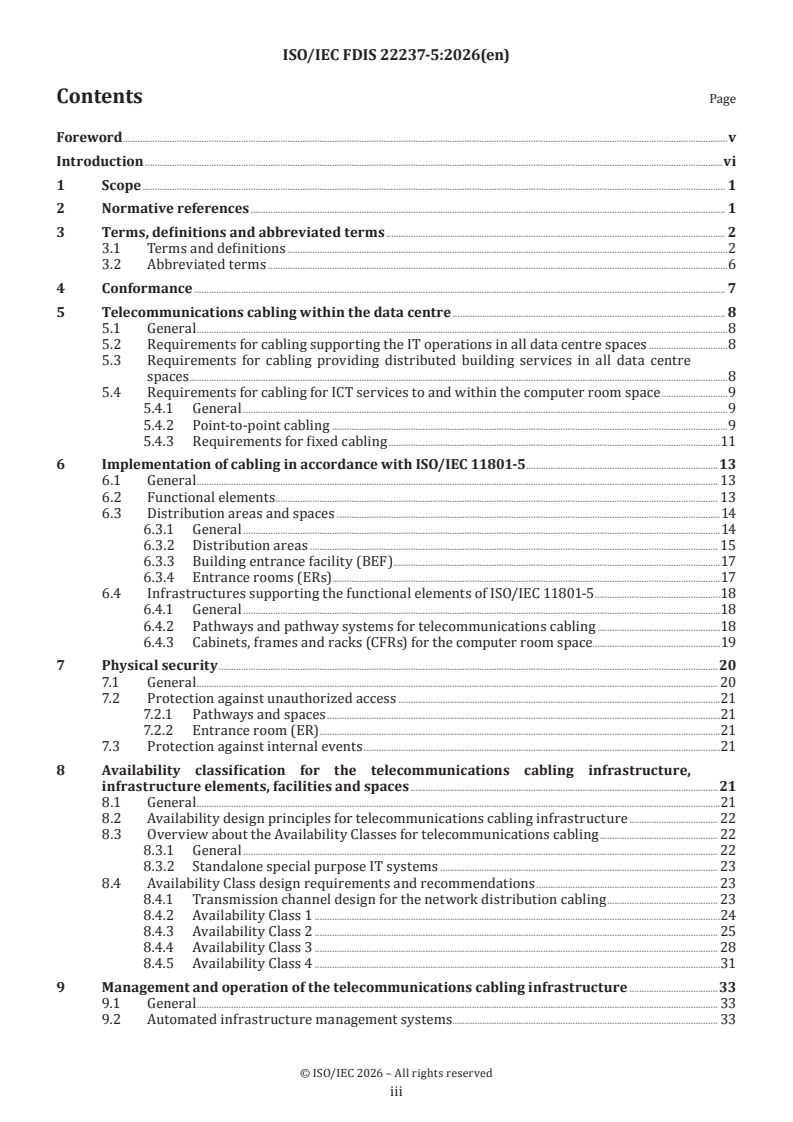

ISO/IEC FDIS 22237-5 - Information technology — Data centre facilities and infrastructures — Part 5: Telecommunications cabling infrastructure
REDLINE ISO/IEC FDIS 22237-5 - Information technology — Data centre facilities and infrastructures — Part 5: Telecommunications cabling infrastructure
ISO/IEC FDIS 22237-5 is an ISO/IEC document on telecommunications cabling infrastructure in data centres. It specifies design principles, requirements and recommendations for IT and network cabling, cabling for building services, and the pathways, spaces and enclosures that support them. It is intended for people planning, designing, installing, operating and maintaining data centre facilities and infrastructures.
What does ISO/IEC FDIS 22237-5 specify?
ISO/IEC FDIS 22237-5 applies to telecommunications cabling infrastructures used in data centres, based on the availability and physical security classifications in ISO/IEC 22237-1. It focuses on how cabling is designed and arranged, rather than on selecting active equipment or software.
The document covers:
- IT and network telecommunications cabling, such as SAN and LAN
- general IT cabling that supports data centre operation
- cabling for monitoring and control of power distribution, environmental control and physical security
- other building automation cabling
- pathways, pathway systems, spaces and enclosures for those cabling infrastructures
Safety and electromagnetic compatibility (EMC) are outside its scope and are handled by other standards and regulations.
The document is organized into clauses on scope, normative references, terms, conformance, cabling within the data centre, implementation in accordance with ISO/IEC 11801-5, physical security, availability classification, and management and operation. It then adds informative and normative annexes for design concepts, energy efficiency, summaries, examples and colocation-specific requirements.
| Annex | What it covers |
|---|---|
| A | Design concepts for network distribution cabling |
| B | Energy efficiency considerations for the telecommunications cabling infrastructure |
| C | Summary of requirements |
| D | Examples of telecommunications cabling infrastructures including active equipment |
| E | Availability description |
| F | Availability Classes for cabling infrastructures in colocation data centres |
| G | Integration of standalone IT systems in data centres |
What are the key requirements of ISO/IEC FDIS 22237-5?
ISO/IEC FDIS 22237-5 is built around the idea that cabling must match the required data centre availability class, while also staying maintainable, scalable and physically secure. In practice, the standard helps designers choose the right cabling architecture for the service level and the operating model of the data centre.
Cabling must fit the data centre functions and spaces
Clause 5 separates cabling for IT operations, distributed building services, and ICT services in the computer room space. This matters because the cabling for network traffic, building control and supporting services is not treated as one undifferentiated system.
Clause 6 links the cabling to ISO/IEC 11801-5 and identifies the functional elements used in data centres: ENI, MD, ID, ZD, LDP and EO. ENI, MD and EO are mandatory, while the others are optional. For a project team, this means the design has to decide which distributor areas are needed and where they sit in the building.
Clause 6.3 places those elements in defined spaces:
- ENI in the entrance room or telecommunications space
- MD in the main distribution area or space
- ID, ZD, LDP and EO in the computer room space
That placement affects room planning, floor layout and the routing of cables between spaces.
The cabling architecture must support the chosen availability class
Clause 8 says the cabling design is based on redundancy, maintainability, scalability or future-proofness, and simplicity. It also splits the infrastructure into telecommunications/campus supply cabling and data centre network distribution cabling. This helps buyers and designers separate external service entry from internal data movement.
The availability classes in Clause 8 range from Class 1 to Class 4. In practical terms:
- Class 1 uses single-path supply and distribution with no redundancy
- Class 2 keeps a single path but adds mandatory cross-connect arrangements and more structured management
- Class 3 introduces redundant paths
- Class 4 adds redundant paths and redundant distribution areas, giving the highest resilience described in the document
The standard also says that the class chosen for each cabling type and space must be met to achieve the overall data centre availability class.
Physical security and operations are part of cabling design
Clause 7 requires protection against unauthorized access and against internal events. This applies to pathways, spaces and the entrance room. For operators, that means access control, segregation and protection of cabling areas are part of the infrastructure design, not only the building security design.
Clause 9 adds management and operation requirements and points to automated infrastructure management systems. Automated infrastructure management (AIM) systems are recommended for real-time documentation and physical-layer management, and the standard recommends integrating them with data centre management tools. In practice, this supports moves, adds, changes and traceability.
Colocation data centres have additional rules
Annex F is normative and adds specific requirements for colocation data centres. It covers customer spaces, telecommunications supply cabling, meet-me-rooms (MMR), floor distribution areas (FDA) and colocation campus cabling. It also ties FDA active equipment to the power and environmental control requirements in ISO/IEC 22237-3 and ISO/IEC 22237-4.
A practical point in Annex F is that the telecommunications supply cabling in a colocation facility is chosen according to the business model and risk assessment, and an Availability Class 4 architecture is recommended to support any customer-space availability class.
What terms does ISO/IEC FDIS 22237-5 define?
- Application-specific cabling - Structured cabling arranged for one or a limited number of applications to provide a specific benefit compared with generic cabling.
- Generic cabling - A structured telecommunications cabling system that can support a wide range of standardized applications without prior knowledge of those applications.
- Fixed cabling - A cabling subsystem between closures, with either a peer-to-peer or hierarchical structure, that allows cross-connects or interconnects at those closures.
- Main distributor (MD) - The distributor that connects the main distribution cabling subsystem, network access cabling subsystem and other cabling subsystems with active equipment.
- Meet-me-room (MMR) - A colocation space that enables interconnection between customer spaces or between customer spaces and telecommunications providers.
- Pathway system - A cable management system or defined area or volume that protects or supports cabling so its performance is maintained.
- Standalone IT system - An IT system with a special purpose, such as a High Performance Computing Cluster (HPC) or AI Cluster.
Who uses ISO/IEC FDIS 22237-5?
ISO/IEC FDIS 22237-5 is used by owners, operators, facility managers, ICT managers, project managers and main contractors when planning, procuring, integrating, installing, operating or maintaining data centre cabling. It is also used by consultants, architects, building designers, builders, system and installation designers, auditors, test and commissioning agents, equipment suppliers, installers and maintainers.
It is relevant for enterprise data centres, co-location and co-hosting facilities, and network operator facilities. In practice, these users apply it to choose cabling architectures, define spaces and pathways, coordinate cabling with power and environmental systems, and document how the installation supports the required availability class.
What changed in ISO/IEC FDIS 22237-5 from the previous edition?
ISO/IEC FDIS 22237-5 cancels and replaces ISO/IEC TS 22237-5:2018. The main changes stated in the document are:
- the document structure has been completely revised
- the availability classes have been revised
- a new clause on physical security has been added
- Annex C summarizing requirements and recommendations has been added
- Annex D with examples including active equipment locations has been added
- Annex E with an availability description has been added
- Annex F with specific requirements for colocation data centres has been added
Which standards are used with ISO/IEC FDIS 22237-5?
ISO/IEC FDIS 22237-5 relies on these normative references and companion parts:
- ISO/IEC 11801-2 - provides generic cabling rules for office premises, used where office-type cabling concepts are relevant
- ISO/IEC 11801-5 - provides the generic cabling framework for data centres and is the main cabling basis for this document
- ISO/IEC 11801-6 - provides generic cabling for distributed building services
- ISO/IEC 14763-2 - supports planning and installation practices for customer premises cabling
- ISO/IEC 22237-1 - gives the general concepts and the availability and physical security classifications used throughout the series
- ISO/IEC 22237-2 - covers building construction for data centres
- ISO/IEC 22237-3 - covers power distribution, including the power supply to active equipment in colocation spaces
- ISO/IEC 22237-4 - covers environmental control, including the support of active equipment in FDA spaces
- ISO/IEC 22237-6 - covers security systems
- ISO/IEC 30129 - covers telecommunications bonding networks for buildings and other structures
- IEC 60332-1-2 - provides a fire test for vertical flame propagation of a single insulated wire or cable
What does the ISO/IEC FDIS 22237-5 document contain?
ISO/IEC FDIS 22237-5 contains the cabling architecture rules, the availability-class framework, and the physical security and management considerations needed for data centre telecommunications cabling. It uses tables and figures to show how supply and distribution cabling are arranged, how the availability classes differ, and how network distribution concepts such as EoR, MoR and ToR fit into the architecture.
Annex A provides example cabling concepts for Classes 1 to 4. Annex D gives worked examples that place cabling and active equipment in data centre layouts, including multi-floor and spine/leaf cases with out-of-band management. Annex C summarizes the requirements, while Annex E summarizes the availability classification in a compact table.
Annex B gives practical energy efficiency considerations, such as routing, containment, overhead distribution and the use of optical fibre. Annex F adds colocation-specific requirements for MMR, FDA and campus cabling, and Annex G explains how standalone IT systems can be integrated without changing the overall data centre availability class.
Relations
- Effective Date
- 23-Dec-2023
Buy Documents
ISO/IEC FDIS 22237-5 - Information technology — Data centre facilities and infrastructures — Part 5: Telecommunications cabling infrastructure
REDLINE ISO/IEC FDIS 22237-5 - Information technology — Data centre facilities and infrastructures — Part 5: Telecommunications cabling infrastructure
Get Certified
Connect with accredited certification bodies for this standard

BSI Group
BSI (British Standards Institution) is the business standards company that helps organizations make excellence a habit.

NYCE
Mexican standards and certification body.
Sponsored listings
Frequently Asked Questions
ISO/IEC FDIS 22237-5 is a draft published by the International Organization for Standardization (ISO). Its full title is "Information technology — Data centre facilities and infrastructures — Part 5: Telecommunications cabling infrastructure". This standard covers: ISO/IEC TS 22237-5:2018 addresses the wide range of telecommunications cabling infrastructures within data centres based upon the criteria and classifications for "availability" within ISO/IEC TS 22237‑1. ISO/IEC TS 22237-5:2018 specifies requirements and recommendations for the following: a) information technology and network telecommunications cabling (e.g. SAN and LAN); b) general information technology cabling to support the operation of the data centre; c) telecommunications cabling to monitor and control, as appropriate, power distribution, environmental control and physical security of the data centre; d) other building automation cabling; e) pathways, spaces and enclosures for the telecommunications cabling infrastructures. Safety and electromagnetic compatibility (EMC) requirements are outside the scope of this document and are covered by other standards and regulations. However, information given in this document may be of assistance in meeting these standards and regulations.
ISO/IEC TS 22237-5:2018 addresses the wide range of telecommunications cabling infrastructures within data centres based upon the criteria and classifications for "availability" within ISO/IEC TS 22237‑1. ISO/IEC TS 22237-5:2018 specifies requirements and recommendations for the following: a) information technology and network telecommunications cabling (e.g. SAN and LAN); b) general information technology cabling to support the operation of the data centre; c) telecommunications cabling to monitor and control, as appropriate, power distribution, environmental control and physical security of the data centre; d) other building automation cabling; e) pathways, spaces and enclosures for the telecommunications cabling infrastructures. Safety and electromagnetic compatibility (EMC) requirements are outside the scope of this document and are covered by other standards and regulations. However, information given in this document may be of assistance in meeting these standards and regulations.
ISO/IEC FDIS 22237-5 is classified under the following ICS (International Classification for Standards) categories: 35.020 - Information technology (IT) in general; 35.200 - Interface and interconnection equipment. The ICS classification helps identify the subject area and facilitates finding related standards.
ISO/IEC FDIS 22237-5 has the following relationships with other standards: It is inter standard links to ISO/IEC TS 22237-5:2018. Understanding these relationships helps ensure you are using the most current and applicable version of the standard.
ISO/IEC FDIS 22237-5 is available in PDF format for immediate download after purchase. The document can be added to your cart and obtained through the secure checkout process. Digital delivery ensures instant access to the complete standard document.
Standards Content (Sample)
Contents
- Introduction
- 1 Scope
- 2 Normative references
- 3 Terms, definitions and abbreviated terms
- 3.1 Terms and definitions
- 3.1.1 application-specific cabling
- 3.1.2 cabinet
- 3.1.3 central patching location
- 3.1.4 cross-connect
- 3.1.5 customer space
- 3.1.6 entrance room
- 3.1.7 equipment outlet
- 3.1.8 equipment distribution area
- 3.1.9 external network interface
- 3.1.10 fixed cabling
- 3.1.11 floor distributor
- 3.1.12 floor distribution area
- 3.1.13 frame
- 3.1.14 generic cabling
- 3.1.15 information technology equipment
- 3.1.16 interconnect
- 3.1.17 intermediate distributor
- 3.1.18 intermediate distribution area
- 3.1.19 IT load
- 3.1.20 jumper
- 3.1.21 local distribution point
- 3.1.22 main distributor
- 3.1.23 main distribution area
- 3.1.24 meet-me-room
- 3.1.25 pathway
- 3.1.26 pathway system
- 3.1.27 point-to-point connection
- 3.1.28 premises entrance facility
- 3.1.29 rack
- 3.1.30 standalone IT system
- 3.1.31 structured cabling
- 3.1.32 telecommunications provider
- 3.1.33 zone distributor
- 3.1.34 zone distribution area
- 3.1.35 zone patching location
- 3.2 Abbreviated terms
- 4 Conformance
- 5 Telecommunications cabling within the data centre
- 5.1 General
- 5.2 Requirements for cabling supporting the IT operations in all data centre spaces
- 5.3 Requirements for cabling providing distributed building services in all data centre
- 5.4 Requirements for cabling for ICT services to and within the computer room space
- 6.1 General
- 6.2 Functional elements
- 6.3 Distribution areas and spaces
- 7 Physical security
- 7.1 General
- 7.2 Protection against unauthorized access
- 7.3 Protection against internal events
- 8.1 General
- 8.2 Availability design principles for telecommunications cabling infrastructure
- 8.3 Overview about the Availability Classes for telecommunications cabling
- 8.4 Availability Class design requirements and recommendations
- 9 Management and operation of the telecommunications cabling infrastructure
- 9.1 General
- 9.2 Automated infrastructure management systems
- Annex A
- Annex B
- Annex C
- Annex D
- Annex E
- Annex F
- Annex G
- Bibliography
Introduction
The unrestricted access to internet-based information demanded by the information society has led to an exponential growth of both internet traffic and the volume of stored/retrieved data. Data centres are housing and supporting the information technology and network telecommunications equipment for data processing, data storage and data transport. They are required both by network operators (delivering those services to customer premises) and by enterprises within those customer premises. Data centres need to provide modular, scalable and flexible facilities and infrastructures to easily accommodate the rapidly changing requirements of the market. In addition, energy consumption of data centres has become critical, both from an environmental point of view (reduction of carbon footprint) and with respect to economic considerations (cost of energy) for the data centre operator. The implementation of data centres varies in terms of:
- purpose (enterprise, co-location, co-hosting or network operator facilities); - security level; - physical size; - accommodation (mobile, temporary and permanent constructions). NOTE Cloud services can be provided by all data centre types mentioned. The needs of data centres also vary in terms of availability of service, the provision of security and the objectives for energy efficiency. These needs and objectives influence the design of data centres in terms of building construction, power distribution, environmental control, telecommunications cabling and physical security. Effective management and operational information is required to monitor achievement of the defined needs and objectives.
The ISO/IEC 22237 series specifies requirements and recommendations to support the various parties involved in the design, planning, procurement, integration, installation, operation and maintenance of facilities and infrastructures within data centres. These parties include:
- owners, operators, facility managers, ICT managers, project managers, main contractors;
- consultants, architects, building designers and builders, system or installation designers, auditors, test and commissioning agents;
- suppliers of equipment;
- installers, maintainers.
The inter-relationship of the documents within the ISO/IEC 22237 series is shown in Figure 1.
ISO/IEC FDIS 22237-5:2026(en) Figure 1 — Schematic relationship between the ISO/IEC 22237 series of documents ISO/IEC 22237-2 ISO/IEC 22237-3, ISO/IEC 22237-4, this document and ISO/IEC 22237-6 specify requirements and recommendations for particular facilities and infrastructures to support the relevant classification for “availability”, “physical security” and “energy efficiency enablement” selected from ISO/IEC 22237−1. This document addresses the specific requirements for the telecommunications cabling infrastructure in data centres used for the purpose of IT networking and building services in accordance with the requirements of ISO/IEC 22237−1.
ISO/IEC TS 22237-7 addresses the operational and management information (in accordance with the requirements of ISO/IEC 22237-1.
ISO/IEC TS 22237-31 addresses resilience attributes, including dependability and fault tolerance metrics. This document is intended for use by and collaboration between architects, building designers, builders and system and installation designers.
The ISO/IEC 22237 series does not address the selection of information technology and network telecommunications equipment, software and associated configuration issues. Figure 2 shows the schematic and contextual relationships of ISO/IEC 22237-5 with other cabling and cabling installation related standards.
ISO/IEC FDIS 22237-5:2026(en) Figure 2 — Schematic relationship between ISO/IEC 22237-5 and other cabling design and installation standards The importance of the information technology and network telecommunications cabling infrastructure is similar to that of other infrastructures such as environmental control, power distribution and security systems. As with other utilities, interruptions to service can have a serious impact. Poor quality of service due to lack of planning, use of inappropriate components, incorrect installation, poor administration or inadequate support can threaten an organization's effectiveness.
FINAL DRAFT International Standard ISO/IEC FDIS 22237-5:2026(en) Information technology — Data centre facilities and infrastructures — Part 5:
Telecommunications cabling infrastructure
1 Scope
This document specifies design principles for information technology (IT) and network telecommunications cabling (e.g. storage area network and local area network) in accordance with ISO/IEC 11801-5, based upon the criteria and classifications for “availability” and “physical security” within ISO/IEC 22237-1. This document applies to the telecommunications cabling infrastructures used in data centres. It describes:
a) for design, the application of generic cabling standards in the ISO/IEC 11801 series; b) for installation specification, planning and practices and quality assurance, the application of ISO/IEC 14763-2 (and related standards).
In addition, this document specifies requirements and recommendations for the following:
- general IT cabling to support the IT operation of the data centre;
- telecommunications cabling to monitor and control, as appropriate, power distribution, environmental control and physical security of the data centre;
- other building automation cabling;
- pathways, pathway systems, spaces and enclosures for the telecommunications cabling infrastructures. Safety and electromagnetic compatibility (EMC) requirements are outside the scope of this document and are covered by other standards and regulations. However, information given in this document can be of assistance in meeting these standards and regulations.
2 Normative references
The following documents are referred to in the text in such a way that some or all of their content constitutes requirements of this document. For dated references, only the edition cited applies. For undated references, the latest edition of the referenced document (including any amendments) applies. ISO/IEC 11801-2, Information technology — Generic cabling for customer premises — Part 2: Office premises ISO/IEC 11801-5, Information technology — Generic cabling for customer premises — Part 5: Data centres ISO/IEC 11801-6, Information technology — Generic cabling for customer premises — Part 6: Distributed building services ISO/IEC 14763-2, Information technology — Implementation and operation of customer premises cabling — Part 2: Planning and installation ISO/IEC 22237-1, Information technology — Data centre facilities and infrastructures — Part 1: General concepts
ISO/IEC FDIS 22237-5:2026(en) ISO/IEC 22237-2, Information technology — Data centre facilities and infrastructures — Part 2: Building construction ISO/IEC 22237-3, Information technology — Data centre facilities and infrastructures — Part 3: Power distribution ISO/IEC 22237-4, Information technology — Data centre facilities and infrastructures — Part 4: Environmental control ISO/IEC 22237-6, Information technology — Data centre facilities and infrastructures — Part 6: Security systems ISO/IEC 30129, Information technology — Telecommunications bonding networks for buildings and other structures IEC 60332-1-2, Tests on electric and optical fibre cables under fire conditions - Part 1-2: Test for vertical flame propagation for a single insulated wire or cable
3 Terms, definitions and abbreviated terms
3.1 Terms and definitions
For the purposes of this document, the terms and definitions given in ISO/IEC 22237-1 and the following apply.
ISO and IEC maintain terminology databases for use in standardization at the following addresses:
- ISO Online browsing platform: available at https:// www .iso .org/ obp
- IEC Electropedia: available at https:// www .electropedia .org/
3.1.1 application-specific cabling
structured cabling with a configuration and performance which is considered to provide a specific benefit for a single or limited number of applications, as compared to generic cabling
3.1.2 cabinet
self-supporting and floor mounted enclosed construction for housing closures and information technology equipment
3.1.3 central patching location
passive cross-connect to connect different functional elements of a data centre Note 1 to entry: A central patching location can be located in both the main distribution area and the intermediate distribution area and is therefore a configuration either of a main distributor or an intermediate distributor according to the cabling of ISO/IEC 11801-5.
3.1.4 cross-connect
passive connection between cabling subsystems using a patch cord or jumper [SOURCE: ISO/IEC 11801-1:2017, 3.1.38]
3.1.5 customer space
part of a cabinet, a cabinet, a cage or a computer room in a colocation data centre that customers can rent to host their information technology equipment
ISO/IEC FDIS 22237-5:2026(en)
3.1.6 entrance room
space that houses the external telecommunications provider equipment and that provides the demarcation points for the external telecommunications services
3.1.7 equipment outlet
fixed connecting device for terminating the zone distribution cabling and providing the interface to the equipment cord [SOURCE: ISO/IEC 11801-5:2017, 3.1.3]
3.1.8 equipment distribution area
area served by local distribution point(s) (LDP) and equipment outlet(s) (EO) of cabling and accommodating the LDP(s), EO(s), servers, storage device and other networking equipment and their connections to the EO(s) Note 1 to entry: Cabling is according to ISO/IEC 11801-5.
3.1.9 external network interface
termination point providing demarcation of external telecommunications service provision [SOURCE: ISO/IEC 11801-1:2017, 3.1.44]
3.1.10 fixed cabling
cabling subsystem between closures which has either a peer-to-peer or hierarchical structure and which enables the installation of cross-connects or interconnects at those closures
3.1.11 floor distributor
distributor used to connect between the horizontal cable and other cabling subsystems or equipment
3.1.12 floor distribution area
area accommodating the floor distributor(s) of cabling and associated transmission equipment Note 1 to entry: Cabling is according to ISO/IEC 11801-2.
3.1.13 frame
open construction, typically self-supporting and floor-mounted, intended for housing closures and other telecommunications equipment [SOURCE: ISO/IEC 14763-2:2019, 3.1.15]
3.1.14 generic cabling
structured telecommunications cabling system, capable of supporting a wide range of standardized applications Note 1 to entry: Application-specific hardware is not a part of generic cabling. Note 2 to entry: Generic cabling can be installed without prior knowledge of the required applications. [SOURCE: ISO/IEC 11801-1:2017, 3.1.48, modified — Note 1 to entry and Note 2 to entry have been added.]
3.1.15 information technology equipment
IT equipment equipment designed for the purpose of:
ISO/IEC FDIS 22237-5:2026(en) a) receiving data from an external source (e.g. via network interface or via a keyboard); b) performing processing and storage functions on the received data (e.g. computation, data transformation or recording, filing, sorting, storage, transfer of data); c) providing a data output (either to other equipment or by the reproduction of data); d) data network transport;
3.1.16 interconnect
passive connection to a cabling subsystem not using a patch cord or jumper [SOURCE: ISO/IEC 11801-1:2017, 3.1.54]
3.1.17 intermediate distributor
distributor used to make connections between the main distribution cabling subsystem, intermediate distribution cabling subsystem, network access cabling subsystem and cabling subsystems specified in ISO/IEC 11801-1 and active equipment [SOURCE: ISO/IEC 11801-5:2017, 3.1.6]
3.1.18 intermediate distribution area
area accommodating the intermediate distributor(s) of cabling and associated IT equipment Note 1 to entry: Intermediate distributions areas (and intermediate distributors) are primarily used in larger data centres to enable data centre growth or to provide segmentation for specific applications. Note 2 to entry: Cabling is according to ISO/IEC 11801-5.
3.1.19 IT load
active equipment providing data transport services, data processing or data storage inside the data centre
3.1.20 jumper
cable, cable unit or cable element without connectors used for a cross-connections [SOURCE: ISO/IEC 11801-1:2017, 3.1.57]
3.1.21 local distribution point
connection point in the zone distribution cabling subsystem between a zone distributor and an equipment outlet [SOURCE: ISO/IEC 11801-5:2017, 3.1.7]
3.1.22 main distributor
distributor used to make connections between the main distribution cabling subsystem, network access cabling subsystem and cabling subsystems as specified in ISO/IEC 11801-1 and active equipment Note 1 to entry: A central patching location located in a main distribution area is a specific configuration of a main distributor according to the cabling of ISO/IEC 11801-5.
[SOURCE: ISO/IEC 11801-5:2017, 3.1.11, modified — Note 1 to entry has been added.]
ISO/IEC FDIS 22237-5:2026(en)
3.1.23 main distribution area
area accommodating the main distributor(s) of cabling and associated transmission equipment Note 1 to entry: A main distribution area can be in dedicated “main distributor space” or within the computer room of the data centre.
Note 2 to entry: Cabling is according to ISO/IEC 11801-5.
3.1.24 meet-me-room
space in a colocation data centre which enables the interconnection either between data centre customer spaces or between data centre customer spaces and telecommunications providers
3.1.25 pathway
<cable route, cable way> defined route for cables between termination points [SOURCE: ISO/IEC 14763-2:2019, 3.1.34]
3.1.26 pathway system
cable management system or other area or volume defined by markings or fittings used to either protect or support the cabling in order that its desired performance is maintained [SOURCE: ISO/IEC 14763-2:2019, 3.1.35]
3.1.27 point-to-point connection
direct connection of two pieces of IT equipment using a dedicated cable rather than a generic cabling system
3.1.28 premises entrance facility
facility that provides all necessary services, and which complies with all relevant regulations, for the entry of specific infrastructures or services into premises [SOURCE: ISO/IEC 22237-1:2021, 3.1.27]
3.1.29 rack
open construction, typically wall-mounted, for housing closures and other telecommunications equipment [SOURCE: ISO/IEC 14763-2:2019, 3.1.41]
3.1.30 standalone IT system
IT system with a special purpose Note 1 to entry: Examples are high performance computing clusters or AI clusters.
3.1.31 structured cabling
telecommunications cabling comprising fixed cables between points of distribution at which equipment or other fixed cables can be connected
3.1.32 telecommunications provider
either an access provider or a service provider Note 1 to entry: The term "service provider" is defined in ISO/IEC 14763-2:2019, 3.1.49.
ISO/IEC FDIS 22237-5:2026(en)
3.1.33 zone distributor
distributor used to make connections between the main distribution cabling subsystem, intermediate distribution cabling subsystem, zone distribution cabling subsystem, network access cabling subsystem, cabling subsystems specified in ISO/IEC 11801-1 and active equipment [SOURCE: ISO/IEC 11801-5:2017, 3.1.15]
3.1.34 zone distribution area
area accommodating the zone distributor(s) of cabling and associated transmission equipment Note 1 to entry: Cabling is according to ISO/IEC 11801-5.
3.1.35 zone patching location
passive cross-connect to connect different functional elements of a data centre zone Note 1 to entry: A zone patching location can be located in a zone distribution area and is therefore a specific configuration of a zone distributor according to the cabling of ISO/IEC 11801-5.
3.2 Abbreviated terms
For the purposes of this document the following abbreviated terms apply:
BEF building entrance facility BD building distributor CD campus distributor CFR cabinet/frame/rack CPL central patching location ENI external network interface ER entrance room EDA equipment distribution area EO equipment outlet EoR end of row EQP transmission equipment FDA floor distribution area FD floor distributor IDA intermediate distribution area ID intermediate distributor ICT information and communications technology IT information technology ITE information technology equipment LAN local area network
ISO/IEC FDIS 22237-5:2026(en) LDP local distribution point MDA main distribution area MD main distributor MMR meet-me-room MoR middle of row N/A not applicable NOC network operating centre SAN storage area network SO service outlet TE terminal equipment ToR top of rack ZDA zone distribution area ZD zone distributor ZPL zone patching location
4 Conformance
For a data centre to conform to this document:
a) Telecommunications cabling to support the IT operation of the data centre shall be in accordance with Clause 5, Clause 6 and ISO/IEC 11801-2.
b) Telecommunications cabling for either monitoring or control of power distribution, environmental control and physical security of the data centre shall be in accordance with Clause 5 and ISO/IEC 11801-6. c) Telecommunications cabling for information technology (IT) and network telecommunications to and within the computer room space of the data centre shall:
1) be in accordance with Clause 5; 2) be installed within an infrastructure, facilities and spaces meeting the requirements of Clause 6; 3) meet the physical security aspects of Clause 7 and ISO/IEC 22237-6; 4) have a design solution that meets the required Availability Class of Clause 8. d) The installation specification, quality assurance (including documentation) of the cabling shall be in accordance with ISO/IEC 14763-2 (subject to additional requirements of Clause 6 of this document). e) Installation planning and practices of the cabling shall be in accordance with ISO/IEC 14763-2. f) Telecommunications bonding networks for buildings and other structures shall be done in accordance with ISO/IEC 30129.
g) The designer of the telecommunications cabling for IT and network telecommunications to and within the computer room space of the data centre shall coordinate the cabling design with the data centre network administrators regarding the network architecture, topology, physical locations and specific interfaces required to be supported.
ISO/IEC FDIS 22237-5:2026(en)
5 Telecommunications cabling within the data centre
5.1 General
This clause defines the requirements and recommendations for the performance, design criteria and architectures for the different cabling types in a data centre. The telecommunications cabling within the data centre serves to support the following:
a) data centre IT and network telecommunications; b) monitoring and controlling of other data centre infrastructures; c) building management and automation.
The design and planning of cabling infrastructures should be undertaken at an early stage of the data centre design or refurbishment and should be integrated with the design and planning of:
- building construction;
- electrical power;
- environmental control systems;
- security systems;
- lighting systems;
- building management and automation systems.
...
Contents
- 19 Foreword
- 20 Introduction
- 21 1 Scope
- 22 2 Normative references
- 23 3 Terms, definitions and abbreviated terms
- 24 3.1 Terms and definitions
- 25 3.2 Abbreviated terms
- 26 4 Conformance
- 27 5 Telecommunications cabling within the data centre
- 28 5.1 General
- 29 5.2 Requirements for cabling supporting the IT operations in all data centre spaces
- 30 5.3 Requirements for cabling providing distributed building services in all data centre spaces 14 31 5.4 Requirements for cabling for ICT services to and within the computer room space
- 32 6 Implementation of cabling in accordance with ISO/IEC 11801-5
- 33 6.1 General
- 34 6.2 Functional elements
- 35 6.3 Distribution areas and spaces
- 36 6.4 Infrastructures supporting the functional elements of ISO/IEC 11801-5
- 37 7 Physical security
- 38 7.1 General
- 39 7.2 Protection against unauthorized access
- 40 7.3 Protection against internal events
- 41 8 Availability classification for the telecommunications cabling infrastructure, infrastructure 42 elements, facilities and spaces
- 43 8.1 General
- 44 8.2 Availability design principles for telecommunications cabling infrastructure
- 45 8.3 Overview about the Availability Classes for telecommunications cabling
- 46 8.4 Availability Class design requirements and recommendations
- 47 9 Management and operation of the telecommunications cabling infrastructure
- 48 9.1 General
- 49 9.2 Automated infrastructure management systems
- 50 Annex A (informative) Design concepts for network distribution cabling
- 51 Annex B (informative) Energy efficiency considerations for the telecommunications cabling 52 infrastructure
- 53 Annex C (informative) Summary of requirements
- 54 Annex D (informative) Examples of telecommunications cabling infrastructures including active 55 equipment
- 56 Annex E (informative) Availability description
- 57 Annex F (normative) Availability Classes for cabling infrastructures in colocation data centres11 58 Annex G (informative) Integration of standalone IT systems in data centres
- 59 Bibliography
- 61 15 Foreword
- 62 16 Introduction
- 63 17 1 Scope
18 2 Normative references ......................................................................................................................... 1 19 3 Terms, definitions and abbreviated terms .................................................................................. 2 20 3.1 Terms and definitions ......................................................................................................................... 2 21 3.2 Abbreviated terms ............................................................................................................................... 6 22 4 Conformance .......................................................................................................................................... 7 23 5 Telecommunications cabling within the data centre .............................................................. 8 24 5.1 General ..................................................................................................................................................... 8 25 5.2 Requirements for cabling supporting the IT operations in all data centre spaces ....... 8 26 5.3 Requirements for cabling providing distributed building services in all data centre 27 spaces ................................................................................................................................................. 8 28 5.4 Requirements for cabling for IT and network telecommunications to and within the 29 computer room space ................................................................................................................... 9 30 5.4.1 General ............................................................................................................................................... 9 31 5.4.2 Point-to-point cabling .................................................................................................................. 9 32 5.4.3 Requirements for fixed cabling .............................................................................................. 11 33 6 Implementation of cabling in accordance with ISO/IEC 11801-5 .................................... 12 34 6.1 General .................................................................................................................................................. 12 35 6.2 Functional elements ......................................................................................................................... 12 36 6.3 Distribution areas and spaces ...................................................................................................... 13 37 6.3.1 General ............................................................................................................................................ 13 38 6.3.2 Distribution areas ....................................................................................................................... 15 39 6.3.3 Building entrance facility ..........................................................................................................16 40 6.3.4 Entrance rooms ............................................................................................................................ 17 41 6.4 Infrastructures supporting the functional elements of ISO/IEC 11801-5 ..................... 18 42 6.4.1 General ............................................................................................................................................ 18 43 6.4.2 Pathways and pathway systems for telecommunications cabling ............................ 18 Formatted: Font: Not Bold, Not Expanded by / 44 6.4.3 Cabinets, frames and racks for the computer room space ........................................... 19 Condensed by 45 7 Physical Security ................................................................................................................................ 20 Formatted: Font: Not Bold, Not Expanded by / Condensed by 46 7.1 General ................................................................................................................................................... 20 47 7.2 Protection against unauthorized access ................................................................................... 20 Formatted: Font: Not Bold, Not Expanded by / 48 7.2.1 Pathways and spaces ................................................................................................................. 20 Condensed by 49 7.2.2 Entrance room .............................................................................................................................. 20 Formatted: Font: Not Bold, Not Expanded by / 50 7.3 Protection against internal events .............................................................................................. 21 Condensed by 51 8 Availability classification for the telecommunications cabling infrastructure, Formatted: Font: Not Bold, Not Expanded by / 52 infrastructure elements, facilities and spaces .................................................................. 21 Condensed by 53 8.1 General ................................................................................................................................................... 21 Formatted: Font: Not Bold, Not Expanded by / 54 8.2 Availability design principles for telecommunications cabling infrastructure .......... 21 Condensed by 55 8.3 Overview about the availability classes for telecommunications cabling .................... 22 Formatted: Font: Not Bold, Not Expanded by / 56 8.4 Availability Class design requirements and recommendations ....................................... 23 Condensed by 57 8.4.1 Transmission channel design for the network distribution cabling ........................ 23 58 8.4.2 Availability Class 1 ...................................................................................................................... 23 Formatted: Font: Not Bold, Not Expanded by / 59 8.4.3 Availability Class 2 ...................................................................................................................... 25 Condensed by 60 8.4.4 Availability Class 3 ...................................................................................................................... 27 61 8.4.5 Availability Class 4 ...................................................................................................................... 30 62 9 Management and operation of the telecommunications cabling infrastructure ........ 33 63 9.1 General ................................................................................................................................................... 33 Formatted: Font: Not Bold, Not Expanded by / 64 9.2 Automated infrastructure management systems .................................................................. 33 Condensed by 65 Annex A (informative) Design concepts for network distribution cabling.......................... 34 66 A.1 General ................................................................................................................................................... 34 Formatted: Font: Not Bold, Not Expanded by /
Condensed by 67 A.2 Class 1 cabling concept ..................................................................................................................... 34 Formatted: Font: Not Bold, Not Expanded by / 68 A.3 Class 2 cabling concepts .................................................................................................................. 35 Condensed by 69 A.3.1 General ............................................................................................................................................. 35 Formatted: Font: Not Bold, Not Expanded by /
Condensed by 70 A.3.2 End of row and middle of row concepts .............................................................................. 35 Formatted: Font: Not Bold, Not Expanded by / 71 A.3.3 Top of rack concept .................................................................................................................... 37 Condensed by 72 A.4 Class 3 cabling concepts .................................................................................................................. 38 Formatted: Font: Not Bold, Not Expanded by /
Condensed by 73 A.4.1 General ............................................................................................................................................. 38 Formatted: Font: Not Bold, Not Expanded by / 74 A.4.2 End of row and middle of row concepts .............................................................................. 38 Condensed by 75 A.4.3 Top of rack concept .................................................................................................................... 39 76 A.5 Class 4 cabling concepts .................................................................................................................. 40 77 A.5.1 General ............................................................................................................................................. 40 Formatted: Font: Not Bold, Not Expanded by /
Condensed by 78 A.5.2 End of row and middle of row concepts .............................................................................. 40 79 A.5.3 Top of rack concept .................................................................................................................... 41 80 Annex B (informative) Energy efficiency considerations for the telecommunications 81 cabling infrastructure ................................................................................................................ 43 82 Annex C (informative) Summary of requirements ....................................................................... 44 83 Annex D (informative) Examples of telecommunications cabling infrastructures 84 including active equipment ........................................................................................................ 1 85 D.1 General ...................................................................................................................................................... 1 Formatted: Font: Not Bold, Not Expanded by /
Condensed by 86 D.2 Example for Availability Class 3 ...................................................................................................... 1 87 D.3 Example for Availability Class 4 ...................................................................................................... 2 88 D.4 Example for Availability Class 3 implemented across multiple floors .............................. 2 89 D.5 Example for Availability Class 3 in spine/leaf architecture with out-of-band 90 management .................................................................................................................................... 3 91 Annex E (informative) Availability description ................................................................................ 4 92 Annex F (normative) Availability Classes for cabling infrastructures in colocation data 93 centres ................................................................................................................................................ 5 94 F.1 General ...................................................................................................................................................... 5 Formatted: Font: Not Bold, Not Expanded by /
Condensed by 95 F.2 Telecommunications cabling infrastructures in customer spaces ..................................... 5 96 F.2.1 Availability Classes ........................................................................................................................ 5 97 F.2.2 Requirements for spaces and distribution areas ................................................................ 5 98 F.2.3 Requirements for pathways and pathway systems ............................................................ 5 99 F.2.4 Requirements for cabinets, frames and racks ..................................................................... 5 100 F.3 Telecommunications supply cabling ............................................................................................. 5 101 F.3.1 Availability Classes ........................................................................................................................ 5 102 F.3.2 Spaces and distribution areas .................................................................................................... 5 103 F.3.2.1 Meet-Me-Room (MMR) ................................................................................................................. 5 104 F.3.2.2 Floor distribution area ................................................................................................................. 6 105 F.3.2.3 Requirements for spaces and distribution areas ................................................................ 6 106 F.3.3 Requirements for pathways and pathway systems ............................................................ 6 Formatted: Font: Not Bold, Not Expanded by /
Condensed by 107 F.3.4 Requirements for cabinets, frames and racks ..................................................................... 6 Formatted: Font: Not Bold, Not Expanded by / 108 F.4 Colocation campus cabling ................................................................................................................ 6 Condensed by 109 F.4.1 General ............................................................................................................................................... 6 Formatted: Font: Not Bold, Not Expanded by /
Condensed by 110 F.4.2 Requirements for spaces and distribution areas ................................................................ 6 Formatted: Font: Not Bold, Not Expanded by / 111 F.4.3 Requirements for pathways and pathway systems ........................................................... 6 Condensed by 112 F.4.4 Requirements for cabinets, frames and racks ..................................................................... 6 Formatted: Font: Not Bold, Not Expanded by /
Condensed by 113 F.5 Examples of telecommunications supply and campus cabling concepts .......................... 7 Formatted: Font: Not Bold, Not Expanded by / 114 F.5.1 Telecommunications supply cabling in a single building colocation data centre 7 Condensed by 115 F.5.2 Telecommunications supply and campus cabling in a multi-building/single floor Formatted: Font: Not Bold, Not Expanded by / 116 colocation facility ........................................................................................................................... 7 Condensed by 117 Bibliography ................................................................................................................................................... 9 Formatted: Font: Not Bold, Not Expanded by /
Condensed by 118
Formatted: Font: Not Bold, Not Expanded by /
Condensed by
Formatted: Font: Not Bold, Not Expanded by /
Condensed by
Formatted: Font: Not Bold, Not Expanded by /
Condensed by
Formatted: Font: Not Bold, Not Expanded by /
Condensed by
Formatted: Font: Not Bold, Not Expanded by /
Condensed by
Formatted: Font: Not Bold, Not Expanded by /
Condensed by
Formatted: Font: Not Bold, Not Expanded by /
Condensed by
Formatted: Font: English (United Kingdom), Not 119 Foreword
Expanded by / Condensed by 120 ISO (the International Organization for Standardization) and IEC (the International Electrotechnical Formatted: Default Paragraph Font
Commission) form the specialized system for worldwide standardization. National bodies that are members of ISO or IEC participate in the development of International Standards through technical committees established by the respective organization to deal with particular fields of technical activity. ISO and IEC technical committees collaborate in fields of mutual interest. Other international organizations, governmental and non-governmental, in liaison with ISO and IEC, also take part in the work.
121 The procedures used to develop this document and those intended for its further maintenance are Formatted: Default Paragraph Font described in the ISO/IEC Directives, Part 1. In particular, the different approval criteria needed for the different types of document should be noted. This document was drafted in accordance with the editorial rules of the ISO/IEC Directives, Part 2 (see www.iso.org/directives or www.iec.ch/members_experts/refdocs). www.iso.org/directives or www.iec.ch/members_experts/refdocs).
Formatted: Default Paragraph Font, Font: Not Bold 122 ISO and IEC draw attention to the possibility that the implementation of this document may involve the Formatted: Default Paragraph Font use of (a) patent(s). ISO and IEC take no position concerning the evidence, validity or applicability of any claimed patent rights in respect thereof. As of the date of publication of this document, ISO and IEC had not received notice of (a) patent(s) which may be required to implement this document. However, implementers are cautioned that this may not represent the latest information, which may be obtained from the patent database available at www.iso.org/patents and https://patents.iec.ch.www.iso.org/patents and https://patents.iec.ch. ISO and IEC shall not be held responsible for Formatted: Default Paragraph Font identifying any or all such patent rights.
123 Any trade name used in this document is information given for the convenience of users and does not constitute an endorsement.
Formatted: Default Paragraph Font 124 For an explanation of the voluntary nature of standards, the meaning of ISO specific terms and expressions related to conformity assessment, as well as information about ISO's adherence to the World Trade Organization (WTO) principles in the Technical Barriers to Trade (TBT) see www.iso.org/iso/foreword.htmlwww.iso.org/iso/foreword.html. In the IEC, see www.iec.ch/understanding- Formatted: Default Paragraph Font standards. www.iec.ch/understanding-standards.
Formatted: Font: Cambria, 11 pt 125 This document was prepared by Technical Committee ISO/IEC JTC 1, Information Technology, Formatted: Not Expanded by / Condensed by 126 technology, Subcommittee SC 39, Sustainability, IT and data centres.
Formatted: Not Expanded by / Condensed by 127 This first edition cancels and replaces ISO/IEC TS 22237-5:2018, which has been technically revised.
Formatted: Not Expanded by / Condensed by 128 technically revised.
129 The main changes are as follows:
Formatted: Not Expanded by / Condensed by 130— — the document structure has been completely revised; Formatted: Not Expanded by / Condensed by 131— — the availability classesAvailability Classes have been revised; Formatted: Not Expanded by / Condensed by 132— — a clause on physical security has been added (Clause 7);(Clause 7); Formatted: Not Expanded by / Condensed by 133— — Annex CAnnex C summarizing the requirements and recommendations of the document has been added; Formatted: Not Expanded by / Condensed by 134 — Annex DAnnex D with examples for cabling infrastructures including the location of active equipment Formatted: Not Expanded by / Condensed by has 135— been added; Formatted: Not Expanded by / Condensed by 136— — Annex EAnnex E with an availability description has been added; Formatted: Not Expanded by / Condensed by 137— — Annex FAnnex F with specific requirements for colocation data centres has been added.
Formatted: Not Expanded by / Condensed by 138 A list of all parts in the ISO/IEC 22237 series can be found on the ISO website.
vviiiiii 139 Any feedback or questions on this document should be directed to the user’s national standards body.
Formatted: Not Expanded by / Condensed by 140 A complete listing of these bodies can be found at www.iso.org/members.html.
...