

ISO 13085:2014
(Main)Petroleum and natural gas industries — Aluminium alloy pipe for use as tubing for wells
General Information
- Abstract
ISO 13085:2014 specifies the technical delivery condition, manufacturing process, material requirements, configuration and dimensions, and verification and inspection procedures for aluminium alloy pipes for use as tubing for wells in petroleum and natural gas industries.
- Status
- Published
- Publication Date
- 10-Mar-2014
- Technical Committee
- ISO/TC 67 - Materials, equipment and offshore structures for petroleum, petrochemical and natural gas industries
- Drafting Committee
- ISO/TC 67/WG 5 - Aluminium alloy pipes
- Current Stage
- 9093 - International Standard confirmed
- Start Date
- 20-Oct-2023
- Completion Date
- 29-Aug-2026
Buy Documents
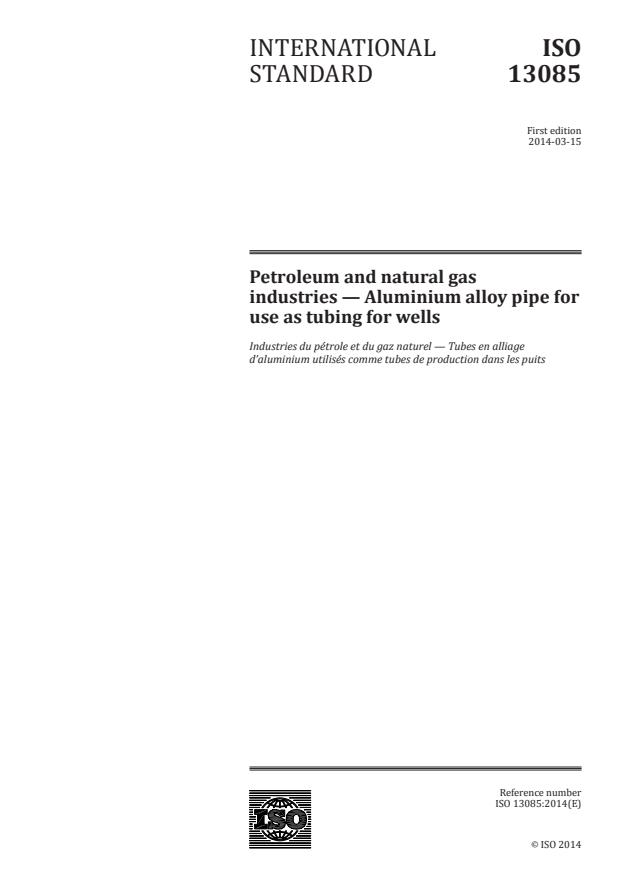
ISO 13085:2014 - Petroleum and natural gas industries — Aluminium alloy pipe for use as tubing for wells Released:3/11/2014
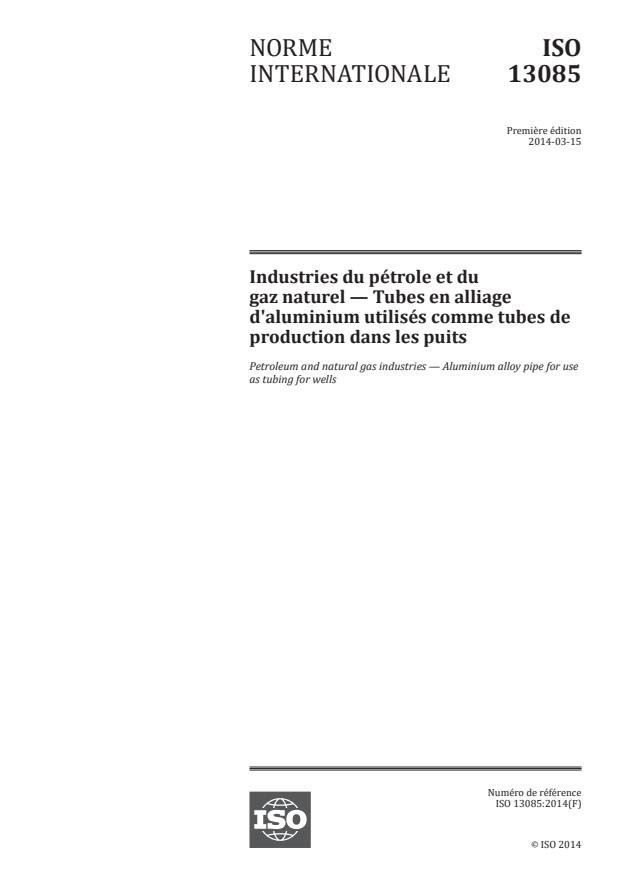
ISO 13085:2014 - Industries du pétrole et du gaz naturel — Tubes en alliage d'aluminium utilisés comme tubes de production dans les puits Released:9/18/2018
ISO 13085:2014 - Petroleum and natural gas industries — Aluminium alloy pipe for use as tubing for wells Released:11/11/2015
Overview
ISO 13085:2014 - Petroleum and natural gas industries - Aluminium alloy pipe for use as tubing for wells defines the technical delivery conditions, manufacturing processes, material requirements, configuration and dimensions, and verification and inspection procedures for aluminium alloy tubing used as downhole tubing in oil and gas wells. The standard is focused on seamless aluminium-alloy pipe intended for well tubing applications and sets out requirements that help ensure mechanical performance, corrosion resistance, traceability and consistent supply quality.
Key Topics
- Scope and purchaser information: Orders should reference ISO 13085 and specify quantity, delivery condition, outside diameter, wall thickness, material group, length, delivery date and inspection requirements.
- Manufacturing process: Tubing shall be produced by the seamless process and heat treated by solution treatment followed by artificial or natural aging. No cold working after final heat treatment except for normal straightening or threading.
- Material and mechanical requirements: Includes metallographic examination, chemical composition limits and tensile properties to verify alloy performance for downhole service.
- Configuration & dimensions: Covers pipe geometry, lengths, upset ends, wall thickness, straightness, ovality, eccentricity, drift requirements and optional internal coatings.
- Testing & inspection: Defines required test methods, measuring methods, hydrostatic and other verification tests, non-destructive inspection options, and purchaser inspection procedures (Annex A).
- Traceability & documentation: Mandates procedures for heat/lot identification, marking, certification, record retention and packaging/transport/storage.
- Corrosion testing: Includes guidance and annexed procedures for corrosion testing of aluminium alloys in well environments.
Applications and users
ISO 13085:2014 is applicable to aluminium alloy tubing used for:
- Production tubing and injection tubing in onshore and offshore oil & gas wells
- Lightweight downhole tubulars where aluminium alloys are selected for corrosion behavior or weight reduction
Primary users:
- Tubing manufacturers and pipe mills (quality & production teams)
- Oil & gas operators and procurement teams specifying tubing for wells
- Inspection and testing laboratories and third-party inspectors
- Standards and materials engineers responsible for well completion materials
Related Standards
Normative references and related documents commonly used with ISO 13085 include:
- ISO 6892 (tensile testing of metallic materials)
- ISO 11961 (steel drill pipe)
- ASTM G1, ASTM G44 (corrosion test practices)
- ASTM B917 (heat treatment of aluminium alloys)
- NACE TM0177 (sulfide stress cracking testing)
Using ISO 13085 helps ensure aluminium tubing meets consistent manufacturing, inspection and documentation practices for reliable well performance and regulatory compliance.
Relations
- Effective Date
- 12-Feb-2026
Buy Documents
ISO 13085:2014 - Petroleum and natural gas industries — Aluminium alloy pipe for use as tubing for wells Released:3/11/2014
ISO 13085:2014 - Industries du pétrole et du gaz naturel — Tubes en alliage d'aluminium utilisés comme tubes de production dans les puits Released:9/18/2018
ISO 13085:2014 - Petroleum and natural gas industries — Aluminium alloy pipe for use as tubing for wells Released:11/11/2015
Get Certified
Connect with accredited certification bodies for this standard

Element Materials Technology
Materials testing and product certification.

ABS Group Brazil
ABS Group certification services in Brazil.

ABS Quality Evaluations Inc.
American Bureau of Shipping quality certification.
Sponsored listings
Frequently Asked Questions
ISO 13085:2014 is a standard published by the International Organization for Standardization (ISO). Its full title is "Petroleum and natural gas industries — Aluminium alloy pipe for use as tubing for wells". This standard covers: ISO 13085:2014 specifies the technical delivery condition, manufacturing process, material requirements, configuration and dimensions, and verification and inspection procedures for aluminium alloy pipes for use as tubing for wells in petroleum and natural gas industries.
ISO 13085:2014 specifies the technical delivery condition, manufacturing process, material requirements, configuration and dimensions, and verification and inspection procedures for aluminium alloy pipes for use as tubing for wells in petroleum and natural gas industries.
ISO 13085:2014 is classified under the following ICS (International Classification for Standards) categories: 75.180.10 - Exploratory, drilling and extraction equipment; 77.150.10 - Aluminium products. The ICS classification helps identify the subject area and facilitates finding related standards.
ISO 13085:2014 has the following relationships with other standards: It is inter standard links to EN ISO 13085:2014. Understanding these relationships helps ensure you are using the most current and applicable version of the standard.
ISO 13085:2014 is available in PDF format for immediate download after purchase. The document can be added to your cart and obtained through the secure checkout process. Digital delivery ensures instant access to the complete standard document.
Standards Content (Sample)
INTERNATIONAL ISO
STANDARD 13085
First edition
2014-03-15
Petroleum and natural gas
industries — Aluminium alloy pipe for
use as tubing for wells
Industries du pétrole et du gaz naturel — Tubes en alliage
d’aluminium utilisés comme tubes de production dans les puits
Reference number
©
ISO 2014
© ISO 2014
All rights reserved. Unless otherwise specified, no part of this publication may be reproduced or utilized otherwise in any form
or by any means, electronic or mechanical, including photocopying, or posting on the internet or an intranet, without prior
written permission. Permission can be requested from either ISO at the address below or ISO’s member body in the country of
the requester.
ISO copyright office
Case postale 56 • CH-1211 Geneva 20
Tel. + 41 22 749 01 11
Fax + 41 22 749 09 47
E-mail copyright@iso.org
Web www.iso.org
Published in Switzerland
ii © ISO 2014 – All rights reserved
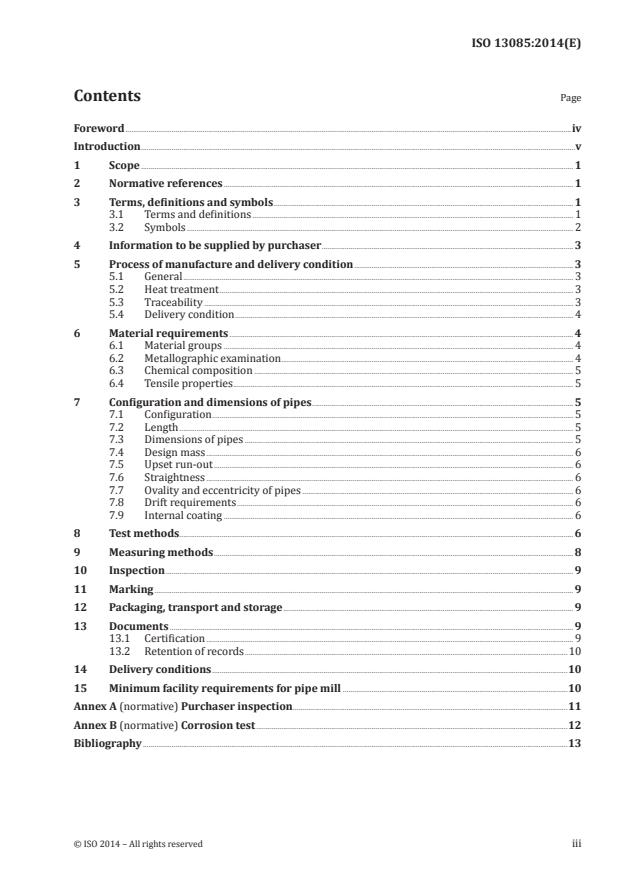
Contents Page
Foreword .iv
Introduction .v
1 Scope . 1
2 Normative references . 1
3 Terms, definitions and symbols . 1
3.1 Terms and definitions . 1
3.2 Symbols . 2
4 Information to be supplied by purchaser . 3
5 Process of manufacture and delivery condition . 3
5.1 General . 3
5.2 Heat treatment . 3
5.3 Traceability . 3
5.4 Delivery condition . 4
6 Material requirements . 4
6.1 Material groups . 4
6.2 Metallographic examination . 4
6.3 Chemical composition . 5
6.4 Tensile properties . 5
7 Configuration and dimensions of pipes . 5
7.1 Configuration . 5
7.2 Length . 5
7.3 Dimensions of pipes . 5
7.4 Design mass . 6
7.5 Upset run-out . 6
7.6 Straightness . 6
7.7 Ovality and eccentricity of pipes . 6
7.8 Drift requirements . 6
7.9 Internal coating . 6
8 Test methods . 6
9 Measuring methods . 8
10 Inspection . 9
11 Marking . 9
12 Packaging, transport and storage . 9
13 Documents . 9
13.1 Certification . 9
13.2 Retention of records .10
14 Delivery conditions .10
15 Minimum facility requirements for pipe mill .10
Annex A (normative) Purchaser inspection .11
Annex B (normative) Corrosion test .12
Bibliography .13
Foreword
ISO (the International Organization for Standardization) is a worldwide federation of national standards
bodies (ISO member bodies). The work of preparing International Standards is normally carried out
through ISO technical committees. Each member body interested in a subject for which a technical
committee has been established has the right to be represented on that committee. International
organizations, governmental and non-governmental, in liaison with ISO, also take part in the work.
ISO collaborates closely with the International Electrotechnical Commission (IEC) on all matters of
electrotechnical standardization.
The procedures used to develop this document and those intended for its further maintenance are
described in the ISO/IEC Directives, Part 1. In particular the different approval criteria needed for the
different types of ISO documents should be noted. This document was drafted in accordance with the
editorial rules of the ISO/IEC Directives, Part 2 (see www.iso.org/directives).
Attention is drawn to the possibility that some of the elements of this document may be the subject of
patent rights. ISO shall not be held responsible for identifying any or all such patent rights. Details of any
patent rights identified during the development of the document will be in the Introduction and/or on
the ISO list of patent declarations received (see www.iso.org/patents).
Any trade name used in this document is information given for the convenience of users and does not
constitute an endorsement.
For an explanation on the meaning of ISO specific terms and expressions related to conformity
assessment, as well as information about ISO’s adherence to the WTO principles in the Technical Barriers
to Trade (TBT) see the following URL: Foreword - Supplementary information.
The committee responsible for this document is ISO/TC 67, Materials, equipment and offshore structures
for petroleum, petrochemical and natural gas industries.
iv © ISO 2014 – All rights reserved
Introduction
Users of this International Standard should be aware that further or differing requirements may be
needed for individual applications. This International Standard is not intended to inhibit a manufacturer
from offering, or the purchaser from accepting, alternative equipment or engineering solutions for the
individual application. This may be particularly applicable where there is innovative or developing
technology. Where an alternative is offered, the manufacturer should identify any variations from this
International Standard and provide details.
This International Standard includes requirements of various natures. These are identified by the use
of certain verbal forms:
— “shall” is used to indicate that a provision is mandatory;
— “should” is used to indicate that a provision is not mandatory, but recommended as good practice;
— “may” is used to indicate that a provision is optional.
INTERNATIONAL STANDARD ISO 13085:2014(E)
Petroleum and natural gas industries — Aluminium alloy
pipe for use as tubing for wells
1 Scope
This International Standard specifies the technical delivery condition, manufacturing process, material
requirements, configuration and dimensions, and verification and inspection procedures for aluminium
alloy pipes for use as tubing for wells in petroleum and natural gas industries.
2 Normative references
The following documents, in whole or in part, are normatively referenced in this document and are
indispensable for its application. For dated references, only the edition cited applies. For undated
references, the latest edition of the referenced document (including any amendments) applies.
ISO 6892 (all parts), Metallic materials — Tensile testing
ISO 11961, Petroleum and natural gas industries — Steel drill pipe
ASTM G1, Standard practice for preparing, cleaning, and evaluating corrosion test specimens
ASTM G44, Standard practice for exposure of metals and alloys by alternate immersion in neutral 3.5%
sodium chloride solution
NACE/TM 0177, Laboratory testing of metals for resistance to sulfide stress cracking and stress corrosion
cracking in hydrogen sulfide (H2S) environments
3 Terms, definitions and symbols
3.1 Terms and definitions
For the purposes of this document, the following terms and definitions apply.
3.1.1
defect
imperfection of a size and/or population density greater than the acceptance criteria specified in this
International Standard
3.1.2
heat
metal produced by a single cycle of a batch melting process
3.1.3
imperfection
discontinuity or irregularity in the product wall or on the product surface that is detectable by inspection
methods outlined in this International Standard
Note 1 to entry: Imperfections are detected by methods outlined in this International Standard.
3.1.4
lot
those lengths of pipe with the same specified dimensions and grade which are heat treated as part
of a continuous operation (or batch) and which are of a single heat or from different heats that are
grouped according to a documented procedure which will ensure that the appropriate requirements of
this International Standard are met
Note 1 to entry: The documented procedure will ensure that the requirements of this International Standard are
met.
3.1.5
manufacturer
firm, company or corporation responsible for making and marking the product in accordance with the
requirements of this International Standard
Note 1 to entry: Marking by the manufacturer warrants that the product conforms to this International Standard,
and it is the manufacturer who is responsible for compliance with all of its applicable provisions.
3.1.6
pipe mill
firm, company or corporation that operates pipe-making facilities
3.1.7
seamless pipe
wrought tubular pipe product made without a welded seam, produced by a hot-forming process which
can be followed by cold sizing or cold finishing to produce the desired shape, dimensions and properties
3.1.8
tubing
pipe placed within a well and serving to produce well fluids or to inject fluids
3.2 Symbols
D pipe body outside diameter
D outside diameter of upset end
u
d pipe body inside diameter
L pipe length (the distance between the pipe ends)
p
f test factor
m mass of the specimen before the test
m mass of the specimen after the test
p standard hydrostatic test pressure
S surface area of the specimen
t wall thickness of pipe body
b test time
t wall thickness of upset end
u
V corrosion rate
k
Y specified minimum yield strength for the pipe body
min
2 © ISO 2014 – All rights reserved
4 Information to be supplied by purchaser
4.1 In placing orders for aluminium alloy tubing, the purchaser shall specify the following on the
purchase order:
a) reference to this International Standard (i.e. ISO 13085);
b) quantity;
c) tubing delivery condition (see 5.4);
d) outside diameter (see Table 3);
e) wall thickness (see Table 3);
f) material group (see Table 1);
g) length (see Table 2);
h) delivery date and shipping instruction;
i) inspection by purchaser (see Annex A).
4.2 The purchaser should also state on the purchase order requirements concerning the following
stipulations, which are optional with the purchaser:
a) pipe coatings (see 7.9);
b) non-destructive inspection (see 10.4);
c) leak-proof test (see 8.4);
d) aluminium alloy name (see Table 1).
5 Process of manufacture and delivery condition
5.1 General
Tubing furnished to this International Standard shall be made by the seamless process.
5.2 Heat treatment
Tubing shall be heat treated by solution heat treatment followed by artificial or natural aging. The
aluminium pipe shall not be subjected to cold working after the final heat treatment process, except for
that which is incidental to normal straightening or threading operations.
The temperature and time requirements for the solution and aging heat treatment cycles shall be
determined in accordance with the manufacturer’s documented practice. Actual furnace temperatures
and transfer timing shall be documented in order to verify that each heat treatment lot meets the
manufacturer’s documented requirements.
5.3 Traceability
The manufacturer shall establish and follow procedures for maintaining heat and/or lot identity until all
required heat and/or lot tests have been performed and conformance with specification requirements
has been verified.
5.4 Delivery condition
Aluminium alloy tubing shall be supplied as plain end pipe (with external or internal upsets but without
threads).
6 Material requirements
6.1 Material groups
Aluminium alloy tubing after heat treatment shall conform to the requirements specified in Table 1.
They are divided into four material groups:
a) Group I, without additional requirements for high strength or corrosion resistance;
b) Group II, with improved strength;
c) Group III, with high temperature mechanical properties;
d) Group IV, with improved corrosion resistance.
Table 1 — Material requirements for aluminium alloy tubing
Characteristic Unit Material group
I II Ill IV
Alloy name D16T 1953T1 AK4–1T1 1980T1
Yield strength, min MPa 325 480 340 350
(0,2 % offset method)
Tensile strength, min MPa 460 530 410 400
Elongation, min % 12 7 8 9
Operational temperature, max °C 160 120 220 160
Corrosion rate in 3,5 % sodium g/(m h) — — — 0,08
chloride solution, max
Corrosion in accordance with — No EC — —
NACE (method B) solution cracking
(NACE/TM 0177)
Mechanical testing shall be in accordance with ISO 6892.
The NACE test requirement shall be stated on the purchase agreement. The NACE test is for quality control
...
NORME ISO
INTERNATIONALE 13085
Première édition
2014-03-15
Industries du pétrole et du
gaz naturel — Tubes en alliage
d'aluminium utilisés comme tubes de
production dans les puits
Petroleum and natural gas industries — Aluminium alloy pipe for use
as tubing for wells
Numéro de référence
©
ISO 2014
DOCUMENT PROTÉGÉ PAR COPYRIGHT
© ISO 2014
Tous droits réservés. Sauf prescription différente ou nécessité dans le contexte de sa mise en œuvre, aucune partie de cette
publication ne peut être reproduite ni utilisée sous quelque forme que ce soit et par aucun procédé, électronique ou mécanique,
y compris la photocopie, ou la diffusion sur l’internet ou sur un intranet, sans autorisation écrite préalable. Une autorisation peut
être demandée à l’ISO à l’adresse ci-après ou au comité membre de l’ISO dans le pays du demandeur.
ISO copyright office
Case postale 401 • Ch. de Blandonnet 8
CH-1214 Vernier, Genève
Tél.: +41 22 749 01 11
Fax: +41 22 749 09 47
E-mail: copyright@iso.org
Web: www.iso.org
Publié en Suisse
ii © ISO 2014 – Tous droits réservés
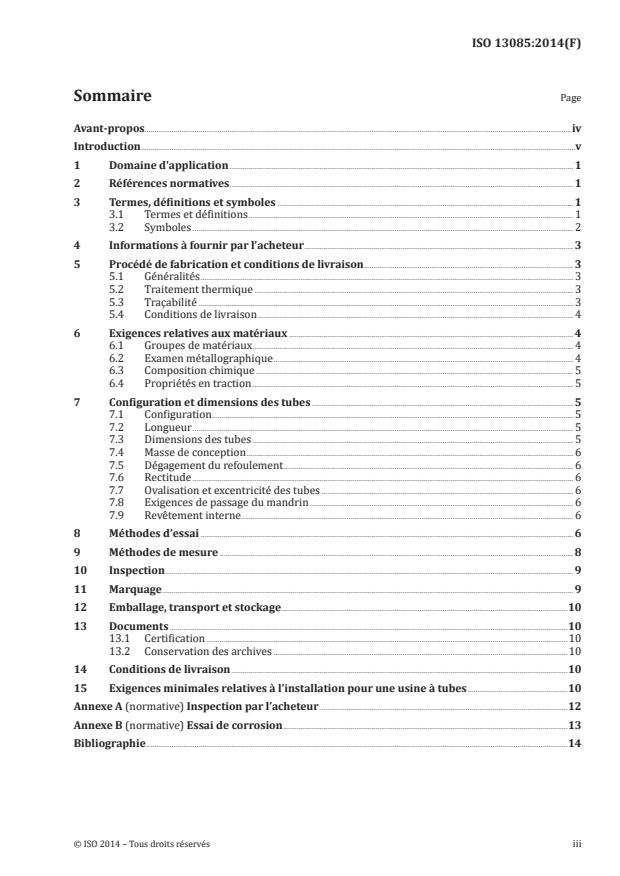
Sommaire Page
Avant-propos .iv
Introduction .v
1 Domaine d'application . 1
2 Références normatives . 1
3 Termes, définitions et symboles . 1
3.1 Termes et définitions . 1
3.2 Symboles . 2
4 Informations à fournir par l’acheteur . 3
5 Procédé de fabrication et conditions de livraison . 3
5.1 Généralités . 3
5.2 Traitement thermique . 3
5.3 Traçabilité . 3
5.4 Conditions de livraison . 4
6 Exigences relatives aux matériaux . 4
6.1 Groupes de matériaux . 4
6.2 Examen métallographique . 4
6.3 Composition chimique . 5
6.4 Propriétés en traction . 5
7 Configuration et dimensions des tubes . 5
7.1 Configuration . 5
7.2 Longueur . 5
7.3 Dimensions des tubes . 5
7.4 Masse de conception . 6
7.5 Dégagement du refoulement. 6
7.6 Rectitude . 6
7.7 Ovalisation et excentricité des tubes . 6
7.8 Exigences de passage du mandrin . 6
7.9 Revêtement interne. 6
8 Méthodes d’essai . 6
9 Méthodes de mesure . 8
10 Inspection . 9
11 Marquage . 9
12 Emballage, transport et stockage .10
13 Documents .10
13.1 Certification .10
13.2 Conservation des archives .10
14 Conditions de livraison .10
15 Exigences minimales relatives à l’installation pour une usine à tubes .10
Annexe A (normative) Inspection par l’acheteur .12
Annexe B (normative) Essai de corrosion .13
Bibliographie .14
Avant-propos
L'ISO (Organisation internationale de normalisation) est une fédération mondiale d'organismes
nationaux de normalisation (comités membres de l'ISO). L'élaboration des Normes internationales est
en général confiée aux comités techniques de l'ISO. Chaque comité membre intéressé par une étude
a le droit de faire partie du comité technique créé à cet effet. Les organisations internationales,
gouvernementales et non gouvernementales, en liaison avec l'ISO, participent également aux travaux.
L'ISO collabore étroitement avec la Commission électrotechnique internationale (IEC) en ce qui
concerne la normalisation électrotechnique.
Les procédures utilisées pour élaborer le présent document et celles destinées à sa mise à jour sont
décrites dans les Directives ISO/IEC, Partie 1. Il convient, en particulier, de prendre note des différents
critères d'approbation requis pour les différents types de documents ISO. Le présent document a été
rédigé conformément aux règles de rédaction données dans les Directives ISO/IEC, Partie 2 (voir www
.iso .org/directives).
L'attention est appelée sur le fait que certains des éléments du présent document peuvent faire l'objet de
droits de propriété intellectuelle ou de droits analogues. L'ISO ne saurait être tenue pour responsable
de ne pas avoir identifié de tels droits de propriété et averti de leur existence. Les détails concernant
les références aux droits de propriété intellectuelle ou autres droits analogues identifiés lors de
l'élaboration du document sont indiqués dans l'Introduction et/ou dans la liste des déclarations de
brevets reçues par l'ISO (voir www .iso .org/brevets).
Les appellations commerciales éventuellement mentionnées dans le présent document sont données
pour information, par souci de commodité, à l'intention des utilisateurs et ne sauraient constituer un
engagement.
Pour une explication de la signification des termes et expressions spécifiques de l'ISO liés à
l'évaluation de la conformité, ou pour toute information au sujet de l'adhésion de l'ISO aux principes
de l'OMC concernant les obstacles techniques au commerce (OTC), voir le lien suivant : Avant-propos -
Informations supplémentaires.
Le comité chargé de l'élaboration du présent document est l'ISO/TC 67, Matériels, équipements et
structures en mer pour les industries du pétrole, de la pétrochimie et du gaz naturel.
iv © ISO 2014 – Tous droits réservés
Introduction
Il convient que les utilisateurs de la présente Norme internationale soient informés que des exigences
supplémentaires ou différentes peuvent se révéler indispensables pour des applications individuelles. La
présente Norme internationale n’a pas pour objet d’empêcher un fabricant de proposer, ou un acheteur
d’accepter, des équipements alternatifs ou des solutions techniques alternatives pour une application
particulière. Cela peut être particulièrement applicable dans le cas de technologie innovante ou en
développement. Lorsqu’une alternative est proposée, il convient que le fabricant identifie les écarts par
rapport à la présente Norme internationale et fournisse des détails.
La présente Norme internationale comprend des exigences de différentes natures qui sont identifiées
par l'emploi de certaines formes verbales :
— « doit » ou « doivent » est utilisé pour indiquer qu'une disposition est obligatoire ;
— « il convient » est utilisé pour indiquer qu'une disposition n'est pas obligatoire, mais constitue une
bonne pratique recommandée ;
— « peut » ou « peuvent » est utilisé pour indiquer qu'une disposition est facultative.
NORME INTERNATIONALE ISO 13085:2014(F)
Industries du pétrole et du gaz naturel — Tubes en
alliage d'aluminium utilisés comme tubes de production
dans les puits
1 Domaine d'application
La présente Norme internationale définit les conditions techniques de livraison, le procédé de
fabrication, les exigences relatives aux matériaux, la configuration et les dimensions ainsi que les
modes opératoires de vérification et d’inspection pour les tubes en alliage d’aluminium destinés à une
utilisation comme tubes de production pour les puits dans les industries pétrolière et gazière.
2 Références normatives
Les documents ci-après, dans leur intégralité ou non, sont des références normatives indispensables à
l'application du présent document. Pour les références datées, seule l’édition citée s'applique. Pour les
références non datées, la dernière édition du document de référence s'applique (y compris les éventuels
amendements).
ISO 6892 (toutes les parties), Matériaux métalliques — Essai de traction
ISO 11961, Industries du pétrole et du gaz naturel — Tiges de forage en acier
ASTM G1, Standard practice for preparing, cleaning, and evaluating corrosion test specimens
ASTM G44, Standard practice for exposure of metals and alloys by alternate immersion in neutral 3.5%
sodium chloride solution
NACE/TM 0177, Laboratory testing of metals for resistance to sulfide stress cracking and stress corrosion
cracking in hydrogen sulfide (H2S) environments
3 Termes, définitions et symboles
3.1 Termes et définitions
Pour les besoins du présent document, les termes et définitions suivants s'appliquent.
3.1.1
défaut
imperfection d’une taille et/ou d’une densité de population supérieure aux critères d’acceptation
spécifiés dans la présente Norme internationale
3.1.2
coulée
métal produit au cours d’un seul cycle d’un procédé de fusion discontinue
3.1.3
imperfection
discontinuité ou irrégularité dans la paroi ou la surface d'un produit qui peut être détectée par des
méthodes de contrôle décrites dans la présente Norme internationale
Note 1 à l'article: à l’article : Les imperfections sont détectées par les méthodes décrites dans la présente
Norme internationale.
3.1.4
lot
longueurs de tube de dimensions et de qualité spécifiées identiques, qui sont soumises à un traitement
thermique dans le cadre d’une opération continue (ou discontinue), et qui proviennent d’une seule
coulée ou de différentes coulées regroupées conformément à une procédure documentée qui garantira
que les exigences appropriées de la présente Norme internationale sont satisfaites
Note 1 à l'article: à l’article : La procédure documentée garantira que les exigences appropriées de la
présente Norme internationale sont satisfaites.
3.1.5
fabricant
firme, compagnie ou société responsable de la fabrication et du marquage du produit conformément
aux exigences de la présente Norme internationale
Note 1 à l'article: à l’article : Le marquage du fabricant garantit que le produit est conforme à la présente
Norme internationale, la conformité à toutes les dispositions applicables de cette norme incombant au fabricant.
3.1.6
usine à tubes
firme, compagnie ou société qui exploite des installations de fabrication de tubes
3.1.7
tube sans soudure
produit tubulaire corroyé, fabriqué sans soudure par un procédé de formage à chaud, qui peut être suivi
d’un calibrage à froid ou d’une finition à froid afin d'obtenir la forme, les dimensions et les propriétés
souhaitées
3.1.8
tube de production
tube placé dans un puits et servant à produire les fluides du puits ou à injecter des fluides
3.2 Symboles
D diamètre extérieur du corps du tube
D diamètre extérieur de l’extrémité refoulée
u
d diamètre intérieur du corps du tube
L longueur du tube (distance entre les extrémités)
p
f facteur d’essai
m masse de l’éprouvette avant l’essai
m masse de l’éprouvette après l’essai
p pression d’essai hydrostatique normalisée
S aire de l’éprouvette
t épaisseur de paroi du corps du tube
b durée de l’essai
t épaisseur de la paroi de l’extrémité refoulée
u
V vitesse de corrosion
k
Y limite d'élasticité minimale spécifiée du corps du tube
min
2 © ISO 2014 – Tous droits réservés
4 Informations à fournir par l’acheteur
4.1 Lorsqu’il passe une commande de tubes en alliage d’aluminium, l’acheteur doit spécifier les points
suivants dans sa commande :
a) une référence à la présente Norme internationale, c’est-à-dire ISO 13085 ;
b) la quantité ;
c) l’état de livraison des tubes (voir 5.4) ;
d) le diamètre extérieur (voir Tableau 3) ;
e) l’épaisseur de paroi (voir Tableau 3) ;
f) le groupe de matériaux (voir Tableau 1) ;
g) la longueur (voir Tableau 2) ;
h) la date de livraison et les instructions d’expédition ;
i) l’inspection par l’acheteur (voir Annexe A).
4.2 Il convient que l’acheteur précise en outre, dans sa commande, les exigences relatives aux points
suivants qui sont au choix de l’acheteur :
a) les revêtements des tubes (voir 7.9) ;
b) les contrôles non destructifs (voir 10.4) ;
c) les essais d’étanchéité (voir 8.4) ;
d) le nom de l’alliage d’aluminium (voir Tableau 1).
5 Procédé de fabrication et conditions de livraison
5.1 Généralités
Les tubes fournis conformément à la présente Norme internationale doivent être fabriqués sans
soudure.
5.2 Traitement thermique
Les tubes doivent être soumis à un traitement thermique de mise en solution, suivi d’un processus de
vieillissement artificiel ou naturel. Le tube en aluminium ne doit pas être soumis à un écrouissage à
l’issue du procédé de traitement thermique final, à l’exception de l’écrouissage consécutif aux opérations
normales de redressement ou de filetage.
Les exigences de température et de durée, en ce qui concerne les cycles de traitement thermique de mise
en solution et de vieillissement, doivent être déterminées conformément aux spécifications écrites du
fabricant. Les températures et durées réelles de traitement thermique doivent être consignées de façon
à vérifier que chaque lot de traitement thermique satisfait aux exigences documentées du fabricant.
5.3 Traçabilité
Le fabricant doit établir et appliquer des modes opératoires garantissant l’identification de la coulée et/
ou du lot jusqu’à ce que tous les essais prescrits pour la coulée et/ou le lot aient été effectués et que la
conformité aux exigences de la spécification ait été démontrée.
5.4 Conditions de livraison
Les tubes en alliage d’aluminium doivent être fournis avec leurs extrémités lisses (avec des extrémités
refoulées extérieures ou intérieures, mais sans filetage).
6 Exigences relatives aux matériaux
6.1 Groupes de matériaux
Après le traitement thermique, les tubes en alliage d’aluminium doivent être conformes aux exigences
spécifiées dans le Tableau 1. Ils sont répartis selon quatre groupes de matériaux :
a) Groupe I, sans exigence supplémentaire de haute résistance ou de résistance à la corrosion ;
b) Groupe II, avec une résistance améliorée ;
c) Groupe III, avec des propriétés mécaniques à haute température ;
d) Groupe IV, avec une résistance à la corrosion améliorée.
Tableau 1 — Exigences relatives aux matériaux pour les tubes en alliage d’aluminium
Caractéristique Unité Groupe de matériaux
I II Ill IV
Nom de l’alliage D16T 1953T1 AK4–1T1 1980T1
Limite d’élasticité, min. MPa 325 480 340 350
(méthode de limite
conventionnelle à 0,2 %)
Résistance à la traction, min. MPa 460 530 410 400
Allongement, min. % 12 7 8 9
Température d’utilisation, max. °C 160 120 220 160
Vitesse de corrosion dans une g/(m h) — — — 0,08
solution de chlorure de sodium à
3,5 %, max.
Corrosion dans une solution — Aucune — —
NACE (méthode B) fissuration EC
(NACE/TM 0177)
Les essais mécaniques doivent être conformes à l’ISO 6892.
L'exigence d'un essai NACE doit être spécifiée dans la commande. L'essai NACE est réalisé à des fins de contrôle
de la qualité uniquement et ne qualifie pas le matériau pour une application en service corrosif. Il est de la
responsabilité de l’utilisateur du produit de s'assurer que celui-ci est adapté à l'application prévue.
NOTE 1 Il est permis d’utiliser un autre système d’alliage d’aluminium, tant qu’il y a accord de l’acheteur et que ce système
est conforme aux exigences de l’une des catégories des quatre groupes de matériaux.
NOTE 2 Les propriétés mécaniques des alliages données dans ce tableau se rapportent à
...
МЕЖДУНАРОДНЫЙ ISO
СТАНДАРТ 13085
Первое издание
2014-03-15
Нефтяная и газовая промышленность.
Трубы из алюминиевого сплава для
использования в качестве насосно-
компрессорных труб для скважин
Petroleum and natural gas industries — Aluminium alloy pipe for use as
tubing for wells
Ответственность за подготовку русской версии несёт GOST R
(Российская Федерация) в соответствии со статьёй 18.1 Устава ISO
Ссылочный номер
©
ISO 2014
ДОКУМЕНТ ЗАЩИЩЁН АВТОРСКИМ ПРАВОМ
© ISO 2014
Все права сохраняются. Если не указано иное, никакую часть настоящей публикации нельзя копировать или использовать в
какой-либо форме или каким-либо электронным или механическим способом, включая фотокопии и микрофильмы, без
предварительного письменного согласия ISO по адресу, указанному ниже, или членов ISO в стране регистрации пребывания.
ISO copyright office
Case postale 56 CH-1211 Geneva 20
Tel. + 41 22 749 01 11
Fax + 41 22 749 09 47
E-mail copyright@iso.org
Web www.iso.org
Опубликовано в Швейцарии
ii © ISO 2014 — Все права сохраняются
Содержание Страница
Предисловие . iv
Введение . v
1 Область применения . 1
2 Нормативные ссылки . 1
3 Термины, определения и обозначения . 1
3.1 Термины, определения . 1
3.2 Обозначения . 2
4 Информация, предоставляемая покупателем . 3
5 Процесс изготовления и условия поставки . 4
5.1 Общие положения . 4
5.2 Термообработка . 4
5.3 Прослеживаемость . 4
5.4 Условия поставки . 4
6 Требования к материалам . 4
6.1 Группы материалов . 4
6.2 Металлографический контроль . 5
6.3 Химический состав . 5
6.4 Характеристики при растяжении . 5
7 Конфигурация и размеры труб . 6
7.1 Конфигурация . 6
7.2 Длина . 6
7.3 Размеры труб . 6
7.4 Расчётная масса . 6
7.5 Выступ высадки . 7
7.6 Прямизна . 7
7.7 Овальность и эксцентриситет труб . 7
7.8 Требования по боковому отклонению . 7
7.9 Внутреннее покрытие . 7
8 Методы испытаний . 7
9 Методы измерений . 9
10 Проверка . 10
11 Маркировка . 10
12 Упаковка, транспортировка и хранение . 11
13 Документы . 11
13.1 Сертификаты . 11
13.2 Сохранение протоколов . 11
14 Условия поставки . 11
15 Минимальные требования к производственному оборудованию трубопрокатного
завода . 12
Приложение A (нормативное) Контроль покупателя . 13
Приложение B (нормативное) Испытания на коррозию . 14
Библиография . 15
Предисловие
Международная организация по стандартизации (ISO) является всемирной федерацией национальных
организаций по стандартизации (комитетов-членов ISO). Разработка международных стандартов
обычно осуществляется техническими комитетами ISO. Каждый комитет-член, заинтересованный в
деятельности, для которой был создан технический комитет, имеет право быть представленным в этом
комитете. Международные правительственные и неправительственные организации, имеющие связи с
ISO, также принимают участие в работах. ISO работает в тесном сотрудничестве с Международной
электротехнической комиссией (IEC) по всем вопросам стандартизации в области электротехники.
Процедуры, использованные для разработки данного документа и предназначенные для его
дальнейшей поддержки, описаны в Части 1 Директив ISO/IEC. В частности, должны быть указаны
различные критерии утверждения, необходимые для различных типов документов ISO. Данный
документ был разработан в соответствии с правилами редактирования Части 2 Директив ISO/IEC,
(см. www.iso.org/directives).
Необходимо обратить внимание на то, что некоторые элементы данного документа могут быть
объектом патентных прав. ISO не должна нести ответственность за идентификацию каких-либо или
всех таких патентных прав. Подробные сведения о каких-либо патентных правах, установленных при
разработке данного документа, будут содержаться во введении и/или перечне ISO полученных
патентных деклараций (см. www.iso.org/patents).
Любые торговые наименования, использованные в данном документе, предоставлены для удобства
пользователей и не являются подтверждением.
За разъяснениями значений специальных терминов и выражений ISO, относящихся к оценке
соответствия, а также об информации о следовании ISO принципам ВТО о технических барьерах в
торговле (ТБТ) см. по следующему URL: Foreword — Supplementary information.
Комитет, несущий ответственность за данный документ, — ISO/TC 67, Материалы, оборудование и
морские сооружения для нефтяной, нефтехимической и газовой промышленности.
iv © ISO 2014 — Все права сохраняются
Введение
Пользователи данного международного стандарта должны быть осведомлены, что для
индивидуальных или различных применений могут потребоваться дополнительные или отличающиеся
требования. Данный международный стандарт не предназначается для запрещения производителю
предлагать, или покупателю приобретать альтернативное оборудование или технические средства для
отдельных применений. Это может, в частности, относиться к инновационным или находящимся в
процессе разработки технологиям. В случае таких альтернативных решений производитель должен
указать любые отклонения от данного международного стандарта и предоставить подробные сведения.
Данный международный стандарт включает требования различного характера. Эти требования
устанавливаются путём использования определённых словесных формулировок:
— “должен (shall)” используется для указания, что условие является обязательным;
— “может быть (should)” используется для указания, что условие не является обязательным, но
рекомендуется в качестве хорошего метода;
— “может (may)” используется для указания, что условие является одним из возможных вариантов.
МЕЖДУНАРОДНЫЙ СТАНДАРТ ISO 13085:2014(R)
Нефтяная и газовая промышленность. Трубы из
алюминиевого сплава для использования в качестве
насосно-компрессорных труб для скважин
1 Область применения
Данный Международный стандарт устанавливает технические условия поставки, процесса
изготовления, требования к материалам, конфигурации и размерам, и процедуры проверки и контроля
труб из алюминиевого сплава, предназначенных для использования в качестве насосно-
компрессорных труб для скважин в нефтяной и газовой промышленности.
2 Нормативные ссылки
Следующие ссылочные документы, в целом или по частям, являются нормативными ссылками данного
документа и обязательны для применения. В случае датированных ссылок применяются только
цитированные издания. При недатированных ссылках используется последнее издание ссылочного
документа (включая все изменения).
ISO 6892 (все части), Материалы металлические. Испытания на растяжение
ISO 11961, Нефтяная и газовая промышленность. Трубы бурильные стальные
ASTM G1, Стандартные методы подготовки, очистки и оценки образцов для испытаний на
коррозию
ASTM G44, Стандартные методы испытаний металлов и сплавов путём переменного погружения
в нейтральный 3.5 % раствор хлорида натрия
NACE/TM 0177, Лабораторные испытания металлов на стойкость по отношению к
трещинообразованию при коррозии в средах с сульфидами под напряжением и на
трещинообразование при коррозии под напряжением в средах содержащих сероводород (H2S)
3 Термины, определения и обозначения
3.1 Термины, определения
Для целей настоящего документа применяются термины и определения, указанные ниже.
3.1.1
дефект
defect
дефект, имеющий размер и/или плотность размещения, выходящие за критические значения,
установленные в данном Международном стандарте
3.1.2
плавка
heat
металл, произведённый в течение одного цикла процесса плавки партии
3.1.3
несовершенство
imperfection
разрыв сплошности или нарушение регулярности строения стенки продукта или поверхности продукта,
которые поддаются обнаружению методами контроля, установленными в данном Международном
стандарте
ПРИМЕЧАНИЕ 1: Несовершенства детектируются методами, описанными в данном Международном стандарте.
3.1.4
партия
lot
такие отрезки трубы, которые имеют одинаковые установленные размеры и характеристики, которые
прошли термообработку в качестве части непрерывной операции (или партии) и которые получены из
одной плавки, или различных плавок, сгруппированных в соответствии с документально оформленной
процедурой, которая гарантирует, что соответствующие требования данного Международного
стандарта выполняются
ПРИЕЧАНИЕ 1: Документально оформленная процедура гарантирует, что требования данного Международного
стандарта выполняются.
3.1.5
изготовитель
manufacturer
фирма, компания или корпорация, несущие ответственность за изготовление и маркировку продукта в
соответствии с требованиями данного Международного стандарта
ПРИМЕЧАНИЕ 1: Маркировка изготовителем гарантирует, что продукт соответствует данному Международному
стандарту, и изготовитель является лицом, несущим ответственность за соответствие всем применяемым
условиям.
3.1.6
трубопрокатный завод
pipe mill
фирма, компания или корпорация, выполняющая работы на трубопрокатном оборудовании
3.1.7
бесшовная труба
seamless pipe
продукт в виде кованой полой трубы изготовленной без сварного шва, произведённый с помощью
процесса горячего формования, после которого может использоваться холодная калибровка или
холодная доводка для образования желательной формы, размеров и характеристик
3.1.8
трубы
tubing
труба, помещённая внутри скважины и предназначенная для создания флюидов скважин или введения
жидкостей
3.2 Обозначения
D наружный диаметр корпуса трубы
D наружный диаметр высаженного конца
u
d внутренний диаметр корпуса трубы
L длина трубы (расстояние между концами трубы)
p
2 © ISO 2014 — Все права сохраняются
f коэффициент испытаний
m1 масса образца перед испытаниями
m масса образца после испытания
P стандартное гидростатическое давления испытаний
S площадь поверхности образца
T толщина стенки корпуса трубы
B время испытаний
tu толщина стенки высаженного конца
V скорость коррозии
k
Ymin установленная минимальная величина предела текучести корпуса трубы
4 Информация, предоставляемая покупателем
4.1 При размещении заказов на насосно-компрессорные трубы для скважин из алюминиевого сплава
покупатель должен указать в заказе на закупку следующие данные:
a) ссылка на данный Международный стандарт (т.е. ISO 13085);
b) количество;
c) условия поставки насосно-компрессорных труб (с.м. 5.4);
d) наружный диаметр (см. Таблицу 3);
e) толщина стенки (см. Таблицу 3);
f) группа материала (см. Таблицу 1);
g) длина (см. Таблицу 2);
h) дата поставки и инструкция по транспортировке;
i) проверка покупателем (см. Приложение A).
4.2 Покупатель должен также установить в заказе на закупку требования, относящиеся к следующим
условиям, которые рассматриваются покупателем как необязательные:
a) покрытия труб (см. 7.9);
b) неразрушающий контроль (см. 10.4);
c) испытания на герметичность (см. 8.4);
d) наименование алюминиевого сплава (см. Таблицу 1).
5 Процесс изготовления и условия поставки
5.1 Общие положения
Насосно-компрессорные трубы, поставляемые в соответствии с данным Международным стандартом,
должны быть изготовлены по бесшовной технологии.
5.2 Термообработка
Насосно-компрессорные трубы должны быть подвергнуты термообработке с образованием твёрдого
раствора, после которой должно быть выполнено искусственное или естественное старение.
Алюминиевая труба не должна подвергаться холодной обработке после окончательного этапа
процесса горячей термообработки, за исключением относящейся к обычному выпрямлению или
операциям по нарезке резьбы.
Условия по температуре и времени для циклов обработки на твёрдый раствор и старение должны
быть определены в соответствии с документально оформленной практикой изготовителя. Фактические
значения температуры печи и время перемещения должны быть документированы с целью проверки,
что каждая партия термообработки соответствует документально оформленным требованиям
изготовителя.
5.3 Прослеживаемость
Изготовитель должен установить и выполнять процедуры поддержания воспроизводимости
термообработки и/или идентичности партии до полного выполнения необходимой термообработки
и/или испытаний партии и проверки соответствия требованиям технических условий.
5.4 Условия поставки
Насосно-компрессорные трубы из алюминиевого сплава должны поставляться в виде труб без резьбы
на концах (с наружной или внутренней высадкой без резьбы).
6 Требования к материалам
6.1 Группы материалов
Насосно-компрессорные трубы должны после термообработки соответствовать требованиям,
установленным в Таблице 1. Эти трубы подразделяются на четыре группы материалов:
a) Группа I, не имеющие дополнительных требований по высокой прочности или стойкости к
коррозии;
b) Группа II, имеющие повышенную прочность;
c) Группа III, имеющие определённые механические характеристики при высоких температурах;
d) Группа IV, имеющие повышенную стойкость к коррозии.
4 © ISO 2014 — Все права сохраняются
Таблица 1 — Требования к материалам насосно-компрессорных труб из алюминиевых сплавов
Характеристика Единицы Группа материалов
I II Ill IV
Наименование сплава D16T 1953T1 AK4–1T1 1980T1
Предел текучести, мин. (метод МПа 325 480 340 350
определения по остаточной
деформации 0,2 %)
Прочность на растяжение, мин. МПа 460 530 410 400
Удлинение, мин. % 12 7 8 9
Рабочая температура, макс. °C 160 120 220 160
Скорость коррозии в 3,5 % г/(мч) — — — 0,08
растворе хлорида натрия, макс.
Коррозия по NACE (метод B) — Нет EC — —
раствор растрескивания
(NACE/TM 0177)
Механические испытания должны соответствовать ISO 6892.
Требования испытаний по NACE должны быть установлены в соглашении о закупке. Испытания по
NACE предназначены только для целей контроля качества и не дают оценку материала с точки
зрения применения в конкретных кислотных средах. За обеспечение гарантии пригодности продукта
для предусматриваемого применения несёт ответственность потребитель продукта.
ПРИМЕЧАНИЕ 1 Допускается использование альтернативных систем алюминиевого сплава, если существует соглашение с
потребителем и он соответствует требованиям одной из четырёх категорий групп материалов.
ПРИМЕЧАНИЕ 2 Механические характеристики указанных в таблице сплавов соответствуют температуре испытаний
(20 ± 3) °C.
ПРИМЕЧАНИЕ 3 Максимальная рабочая температура соответствует температуре материала, при которой возникает
понижение предела текучести при минимальной температуре помещения не более чем на 30 % при времени воздействия
500 ч. См. ISO 20312 по вопросам снижения предела текучести материала при других рабочих температурах.
6.2 Металлографический контроль
Каждая выборка из партии термообработки должна подвергаться металлографическому контролю.
Макроструктура должна быть гомогенной, без трещин, пятен травления, расслоений, усадочных пор,
надрывов поверхности или пористости. Микроструктура не должна включать пористость или
эвтектическое плавление на границах зёрен
...