

ISO 4212:2023
(Main)Corrosion of metals and alloys — Method of oxalic acid etching test for intergranular corrosion of austenitic stainless steel
General Information
- Abstract
This document specifies a method to test for intergranular corrosion (IGC) in austenitic stainless steels using an oxalic acid etch. This method can evaluate non-sensitization of austenitic stainless steels by observing the structure of the etched surface with a microscope after performing electrolytic etching (hereinafter called “etching”) on austenitic stainless steel in an oxalic acid solution.
- Status
- Published
- Publication Date
- 07-Feb-2023
- Technical Committee
- ISO/TC 156 - Corrosion of metals and alloys
- Drafting Committee
- ISO/TC 156/WG 5 - Intergranular corrosion
- Current Stage
- 6060 - International Standard published
- Start Date
- 08-Feb-2023
- Due Date
- 27-Jan-2024
- Completion Date
- 08-Feb-2023
Overview
ISO 4212:2023 specifies an oxalic acid etching test for detecting intergranular corrosion (IGC) characteristics in austenitic stainless steels. The standard defines an electrolytic etching procedure and microscopic evaluation to determine whether a stainless steel specimen is non‑sensitized or suspected of sensitization. This method is a rapid, simple screening technique that complements ISO IGC tests (ISO 3651-1, ISO 3651-2, ISO 12732) and established practices such as ASTM A262-15 and JIS G0571.
Key Topics and Requirements
- Purpose: Screen for non‑sensitization or suspicion of sensitization by observing etched surface structure (does not by itself quantify sensitization).
- Test solution: Dissolve 100 g oxalic acid crystals in 900 ml deionized/distilled water (ISO 3696 Grade 3). For some Mo‑containing steels, ammonium peroxodisulfate (100 g/900 ml) may be used.
- Apparatus: DC power supply (example: 15 V, 20 A), variable resistor, ammeter, cathode (stainless beaker or plate), inert test vessel, holder and thermometer (±1 °C).
- Specimen preparation: Fine polishing (buffing with diamond suspension), isolation of non‑tested areas with insulating material; welded sections should include base metal, HAZ and weld metal where applicable.
- Etching conditions: Oxalic acid solution at 20–50 °C; etch as an anode for 90 s at 1 A/cm². For ammonium peroxodisulfate: 5–10 min at 1 A/cm².
- Microscopy: Examine entire etched surface; typical magnification 200×–500× for rolled, forged, cast products or weld zones.
- Etch classification:
- A (Step structure): orientation‑dependent step features.
- B (Dual structure): grooves at grain boundaries but no fully surrounded grains.
- C (Groove structure): one or more grains completely surrounded by grooves.
- Evaluation: A or B indicate no further ferric sulfate/65% HNO3/CuSO4/EPR testing required; C (grooved) indicates suspicion of sensitization and requires follow‑up testing (ISO 3651-1, ISO 3651-2, ISO 12732).
- Test report: Must reference ISO 4212:2023 and record steel grade, specimen details, sensitization heat treatment (if applied), solution and times, etching structure, solution temperature, deviations and anomalies, and test date.
Applications
- Rapid screening in corrosion laboratories and metal production QA/QC for austenitic stainless steel components.
- Weld and fabrication inspection to identify areas that may require further IGC testing.
- Material acceptance testing for manufacturers, fabricators, shipbuilding, chemical and power industry components where IGC risk is a concern.
- Metallurgists and corrosion engineers use it as a cost‑effective triage method before undertaking detailed IGC or electrochemical reactivation (EPR) tests.
Related Standards
- ISO 3651-1, ISO 3651-2 (detailed IGC corrosion tests)
- ISO 12732 (EPR double loop method)
- ASTM A262-15 Practice A (oxalic acid etch)
- JIS G0571:2003 (basis for ISO 4212)
Keywords: ISO 4212:2023, oxalic acid etching test, intergranular corrosion, austenitic stainless steel, sensitization, electrolytic etching, IGC screening, metallurgical inspection.
Get Certified
Connect with accredited certification bodies for this standard

Element Materials Technology
Materials testing and product certification.

Inštitut za kovinske materiale in tehnologije
Institute of Metals and Technology. Materials testing, metallurgical analysis, NDT.
Sponsored listings
Frequently Asked Questions
ISO 4212:2023 is a standard published by the International Organization for Standardization (ISO). Its full title is "Corrosion of metals and alloys — Method of oxalic acid etching test for intergranular corrosion of austenitic stainless steel". This standard covers: This document specifies a method to test for intergranular corrosion (IGC) in austenitic stainless steels using an oxalic acid etch. This method can evaluate non-sensitization of austenitic stainless steels by observing the structure of the etched surface with a microscope after performing electrolytic etching (hereinafter called “etching”) on austenitic stainless steel in an oxalic acid solution.
This document specifies a method to test for intergranular corrosion (IGC) in austenitic stainless steels using an oxalic acid etch. This method can evaluate non-sensitization of austenitic stainless steels by observing the structure of the etched surface with a microscope after performing electrolytic etching (hereinafter called “etching”) on austenitic stainless steel in an oxalic acid solution.
ISO 4212:2023 is classified under the following ICS (International Classification for Standards) categories: 77.060 - Corrosion of metals. The ICS classification helps identify the subject area and facilitates finding related standards.
ISO 4212:2023 is available in PDF format for immediate download after purchase. The document can be added to your cart and obtained through the secure checkout process. Digital delivery ensures instant access to the complete standard document.
Standards Content (Sample)
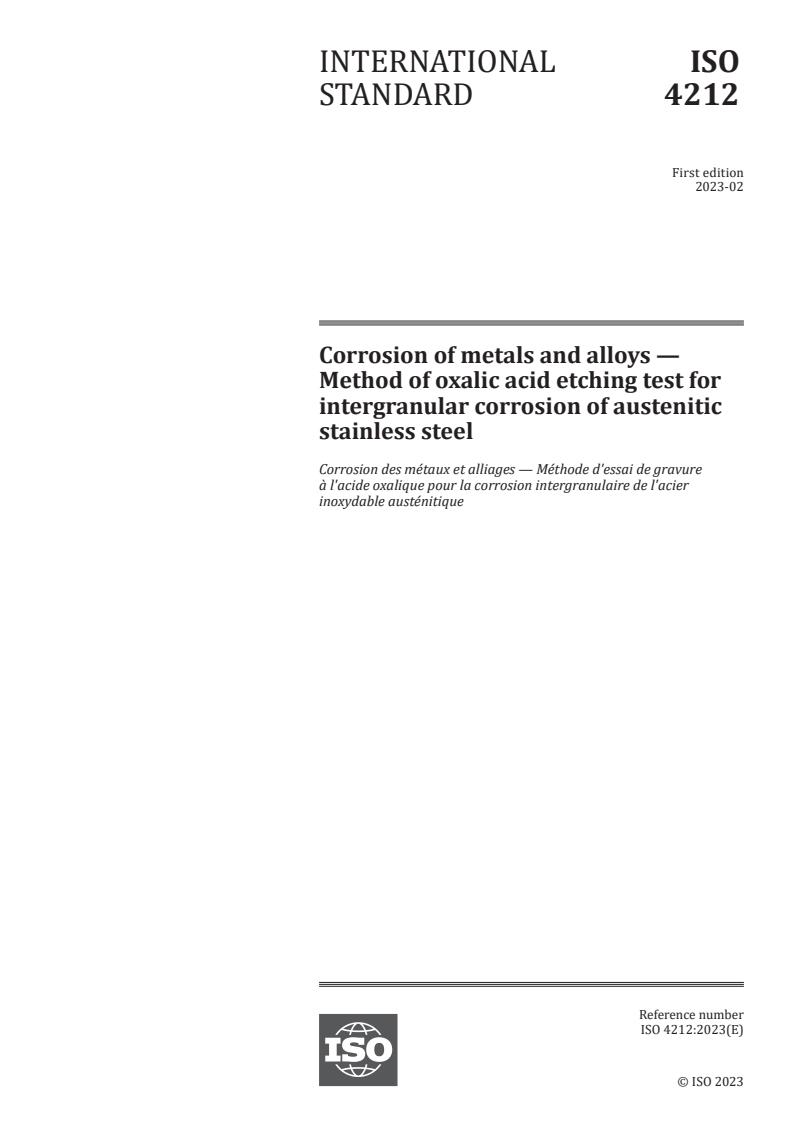
INTERNATIONAL ISO
STANDARD 4212
First edition
2023-02
Corrosion of metals and alloys —
Method of oxalic acid etching test for
intergranular corrosion of austenitic
stainless steel
Corrosion des métaux et alliages — Méthode d'essai de gravure
à l'acide oxalique pour la corrosion intergranulaire de l'acier
inoxydable austénitique
Reference number
© ISO 2023
All rights reserved. Unless otherwise specified, or required in the context of its implementation, no part of this publication may
be reproduced or utilized otherwise in any form or by any means, electronic or mechanical, including photocopying, or posting on
the internet or an intranet, without prior written permission. Permission can be requested from either ISO at the address below
or ISO’s member body in the country of the requester.
ISO copyright office
CP 401 • Ch. de Blandonnet 8
CH-1214 Vernier, Geneva
Phone: +41 22 749 01 11
Email: copyright@iso.org
Website: www.iso.org
Published in Switzerland
ii
Contents Page
Foreword .iv
Introduction .v
1 Scope . 1
2 Normative references . 1
3 Terms and definitions . 1
4 General principles . 2
5 Apparatus . 2
6 Sensitization heat treatment for test specimens. 2
7 Test specimens . 2
8 Test solution . 2
9 Test procedure .3
10 Evaluation of etching structure .4
11 Test report . 4
Bibliography . 6
iii
Foreword
ISO (the International Organization for Standardization) is a worldwide federation of national standards
bodies (ISO member bodies). The work of preparing International Standards is normally carried out
through ISO technical committees. Each member body interested in a subject for which a technical
committee has been established has the right to be represented on that committee. International
organizations, governmental and non-governmental, in liaison with ISO, also take part in the work.
ISO collaborates closely with the International Electrotechnical Commission (IEC) on all matters of
electrotechnical standardization.
The procedures used to develop this document and those intended for its further maintenance are
described in the ISO/IEC Directives, Part 1. In particular, the different approval criteria needed for the
different types of ISO documents should be noted. This document was drafted in accordance with the
editorial rules of the ISO/IEC Directives, Part 2 (see www.iso.org/directives).
Attention is drawn to the possibility that some of the elements of this document may be the subject of
patent rights. ISO shall not be held responsible for identifying any or all such patent rights. Details of
any patent rights identified during the development of the document will be in the Introduction and/or
on the ISO list of patent declarations received (see www.iso.org/patents).
Any trade name used in this document is information given for the convenience of users and does not
constitute an endorsement.
For an explanation of the voluntary nature of standards, the meaning of ISO specific terms and
expressions related to conformity assessment, as well as information about ISO's adherence to
the World Trade Organization (WTO) principles in the Technical Barriers to Trade (TBT), see
www.iso.org/iso/foreword.html.
This document was prepared by Technical Committee ISO/TC 156, Corrosion of metals and alloys.
Any feedback or questions on this document should be directed to the user’s national standards body. A
complete listing of these bodies can be found at www.iso.org/members.html.
iv
Introduction
Intergranular corrosion (IGC) is a form of localized corrosion which occurs along grain boundaries. IGC
of stainless steel is attributable to grain boundary segregation and precipitates. When the formation
of chromium-rich grain boundary carbides occurs, it leads to continuous chromium depletion adjacent
to the grain boundary, and IGC occurs in certain corrosive media. This process is usually known
as sensitization. Sensitization of stainless steel can be evaluated by ISO IGC tests for austenitic
stainless steels: such as ISO 3651-1, ISO 3651-2, and ISO 12732. On the other hand, oxalic etching
tests (JIS G0571:2003 and ASTM A262-15 Practice A) cannot evaluate sensitization, however, they
can evaluate non-sensitized condition of austenitic stainless steels and suspicions of sensitization by
observing the etched surface of the stainless steels. This is because it does not etch chromium depletion
adjacent to the chromium-rich grain boundary precipitates but chromium-rich grain boundary carbides
themselves. If sensitization is suspected, IGC tests, ferric sulfate-sulfuric acid test (see ISO 3651-2),
65 % nitric acid test (see ISO 3651-1), copper sulfate-sulfuric acid test (see ISO 3651-2) or EPR test
(ISO 12732) should be conducted to evaluate sensitization of austenitic stainless steels.
The main benefits of these oxalic acid etching tests are that they are simple, easy and rapid. This
document is based on JIS G0571:2003.
v
INTERNATIONAL STANDARD ISO 4212:2023(E)
Corrosion of metals and alloys — Method of oxalic acid
etching test for intergranular corrosion of austenitic
stainless steel
1 Scope
This document specifies a method to test for intergranular corrosion (IGC) in austenitic stainless steels
using an oxalic acid etch. This method can evaluate non-sensitization of austenitic stainless steels by
observing the structure of the etched surface with a microscope after performing electrolytic etching
(hereinafter called “etching”) on austenitic stainless steel in an oxalic acid solution.
2 Normative references
The following documents are referred to in the text in such a way that some or all of their content
constitutes requirements of this document. For dated references, only the edition cited applies. For
undated references, the latest edition of the referenced document
...