


ISO 13182
(Main)Classification for discrete polymer fibre for fibre-reinforced cementitious composites
Classification for discrete polymer fibre for fibre-reinforced cementitious composites
This project is proposed to develop a classification for discrete polymer fibre for fibre-reinforced cementitious composites.
Titre manque
General Information
- Status
- Not Published
- Current Stage
- 6000 - International Standard under publication
- Start Date
- 11-Dec-2025
- Completion Date
- 10-Jan-2026
Overview
ISO 13182:2025 - "Classification for discrete polymer fibre for fibre‑reinforced cementitious composites" establishes a unified classification system for discrete polymer fibres used in concrete and mortar (FRCC). The standard covers fibres with a nominal length of 80 mm or less and defines how to describe raw material, geometry, mechanical grades and tolerances so manufacturers, specifiers and testing laboratories can communicate fibre properties consistently.
Key topics and requirements
- Scope: Discrete polymer fibres mixed in concrete and mortar; nominal length ≤ 80 mm.
- Fibre types (raw materials): Standard symbols for common resins, e.g. Aramid (AR), Nylon (NY), Polyethylene (PE), Polypropylene (PP), Polyvinyl alcohol (PVA), Polyoxymethylene (POM).
- Geometric classification:
- Cross-sectional shape: Circular (C), Oval (O), Rectangular (R), Others (Z).
- Nominal diameter classes and how diameter is defined (circle with same cross‑sectional area).
- Longitudinal shape: Straight (S), Waved (W), Embossed (E), Split (SP), Others (Z).
- Length classes: Defined ranges (e.g., <20 mm, 20–50 mm, ≥50 mm).
- Bundling: Bundled (B) or not (N/A).
- Quality and performance classification:
- Tolerance classes for nominal diameter and length (±5 % to ±20 % ranges).
- Tensile strength grades (F1–F4) with defined ranges.
- Initial modulus of elasticity grades (E1–E4) with defined ranges.
- Test methods: Measurement and test methods for diameter, length, tensile strength and initial modulus are to be performed in accordance with ISO 23523.
- Notation: A standardized notation method (e.g., PVA‑Ca(II)‑Sa(II)‑F2‑E2) lists material, diameter class, cross‑section, tolerance classes, length, longitudinal shape, tensile and elasticity grades.
Applications and users
- Who uses ISO 13182:
- Fibre manufacturers and product developers
- Concrete and mortar producers specifying FRCC mixes
- Structural and materials engineers selecting fibres for performance-based designs
- Testing laboratories and certification bodies
- Standards committees and procurement teams
- Practical uses:
- Selecting polymer fibres for crack control, impact resistance, peeling prevention and secondary reinforcement in concrete and mortar
- Specifying consistent performance, geometry and tolerances for procurement and quality control
- Enabling clear labelling and communication across supply chains and international markets
Related standards
- ISO 23523 - Test methods for discrete polymer fibre for fibre‑reinforced cementitious composites (referenced for measurement and testing procedures).
Keywords: ISO 13182, discrete polymer fibre, fibre‑reinforced cementitious composites, FRCC, polymer fibres classification, fibre diameter, fibre length, tensile strength, modulus of elasticity, ISO 23523.
ISO/PRF 13182 - Classification for discrete polymer fibre for fibre-reinforced cementitious composites Released:12. 11. 2025
REDLINE ISO/PRF 13182 - Classification for discrete polymer fibre for fibre-reinforced cementitious composites Released:12. 11. 2025
Frequently Asked Questions
ISO 13182 is a draft published by the International Organization for Standardization (ISO). Its full title is "Classification for discrete polymer fibre for fibre-reinforced cementitious composites". This standard covers: This project is proposed to develop a classification for discrete polymer fibre for fibre-reinforced cementitious composites.
This project is proposed to develop a classification for discrete polymer fibre for fibre-reinforced cementitious composites.
ISO 13182 is classified under the following ICS (International Classification for Standards) categories: 83.120 - Reinforced plastics; 91.100.40 - Products in fibre-reinforced cement. The ICS classification helps identify the subject area and facilitates finding related standards.
ISO 13182 is available in PDF format for immediate download after purchase. The document can be added to your cart and obtained through the secure checkout process. Digital delivery ensures instant access to the complete standard document.
Standards Content (Sample)
International
Standard
First edition
Classification for discrete
polymer fibre for fibre-reinforced
cementitious composites
PROOF/ÉPREUVE
Reference number
© ISO 2025
All rights reserved. Unless otherwise specified, or required in the context of its implementation, no part of this publication may
be reproduced or utilized otherwise in any form or by any means, electronic or mechanical, including photocopying, or posting on
the internet or an intranet, without prior written permission. Permission can be requested from either ISO at the address below
or ISO’s member body in the country of the requester.
ISO copyright office
CP 401 • Ch. de Blandonnet 8
CH-1214 Vernier, Geneva
Phone: +41 22 749 01 11
Email: copyright@iso.org
Website: www.iso.org
Published in Switzerland
PROOF/ÉPREUVE
ii
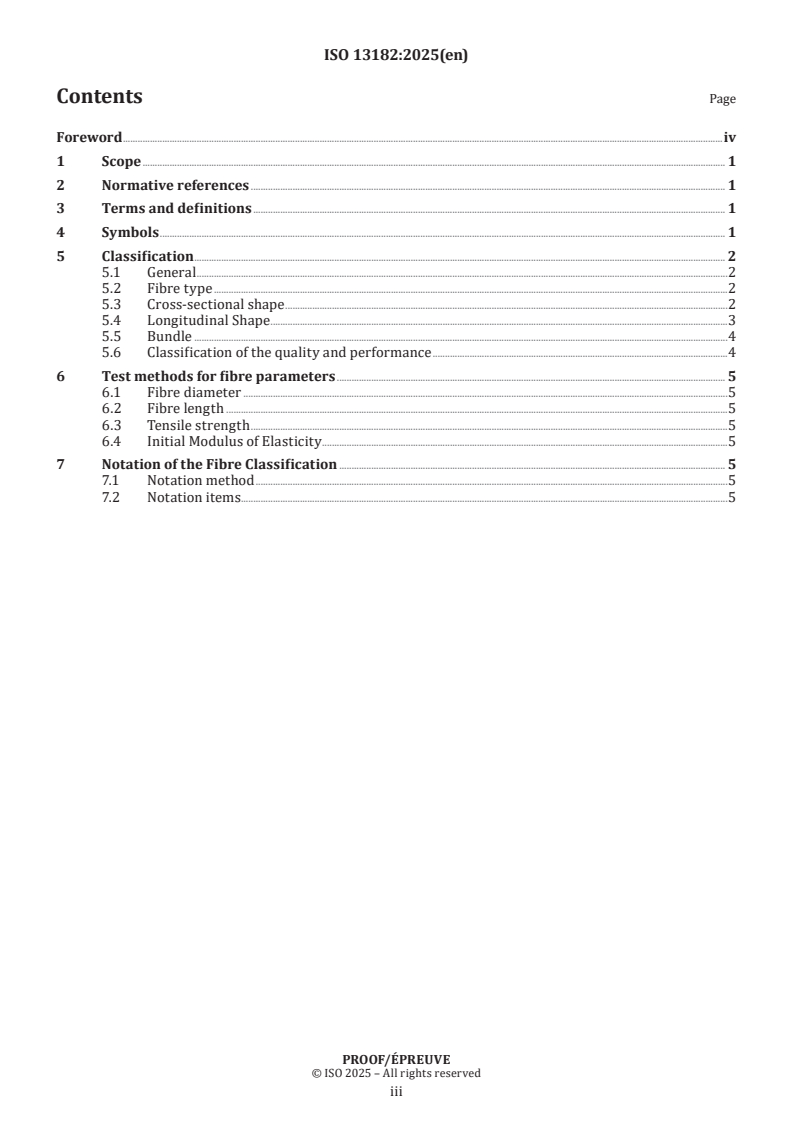
Contents Page
Foreword .iv
1 Scope . 1
2 Normative references . 1
3 Terms and definitions . 1
4 Symbols . 1
5 Classification . 2
5.1 General .2
5.2 Fibre type .2
5.3 Cross-sectional shape .2
5.4 Longitudinal Shape .3
5.5 Bundle .4
5.6 Classification of the quality and performance .4
6 Test methods for fibre parameters . 5
6.1 Fibre diameter .5
6.2 Fibre length .5
6.3 Tensile strength .5
6.4 Initial Modulus of Elasticity .5
7 Notation of the Fibre Classification . 5
7.1 Notation method .5
7.2 Notation items . .5
PROOF/ÉPREUVE
iii
Foreword
ISO (the International Organization for Standardization) is a worldwide federation of national standards
bodies (ISO member bodies). The work of preparing International Standards is normally carried out through
ISO technical committees. Each member body interested in a subject for which a technical committee
has been established has the right to be represented on that committee. International organizations,
governmental and non-governmental, in liaison with ISO, also take part in the work. ISO collaborates closely
with the International Electrotechnical Commission (IEC) on all matters of electrotechnical standardization.
The procedures used to develop this document and those intended for its further maintenance are described
in the ISO/IEC Directives, Part 1. In particular, the different approval criteria needed for the different types
of ISO document should be noted. This document was drafted in accordance with the editorial rules of the
ISO/IEC Directives, Part 2 (see www.iso.org/directives).
ISO draws attention to the possibility that the implementation of this document may involve the use of (a)
patent(s). ISO takes no position concerning the evidence, validity or applicability of any claimed patent
rights in respect thereof. As of the date of publication of this document, ISO had not received notice of (a)
patent(s) which may be required to implement this document. However, implementers are cautioned that
this may not represent the latest information, which may be obtained from the patent database available at
www.iso.org/patents. ISO shall not be held responsible for identifying any or all such patent rights.
Any trade name used in this document is information given for the convenience of users and does not
constitute an endorsement.
For an explanation of the voluntary nature of standards, the meaning of ISO specific terms and expressions
related to conformity assessment, as well as information about ISO's adherence to the World Trade
Organization (WTO) principles in the Technical Barriers to Trade (TBT), see www.iso.org/iso/foreword.html.
This document was prepared by Technical Committee ISO/TC 71, Concrete, reinforced concrete and pre-
stressed concrete, Subcommittee SC 6, Non-traditional reinforcing materials for concrete structures.
Any feedback or questions on this document should be directed to the user’s national standards body. A
complete listing of these bodies can be found at www.iso.org/members.html.
PROOF/ÉPREUVE
iv
International Standard ISO 13182:2025(en)
Classification for discrete polymer fibre for fibre-reinforced
cementitious composites
1 Scope
This docume
...
ISO/DISPRF 13182:2025(en)
ISO/TC 71/SC 6
Secretariat: JISC
Date: 2025-06-0411-12
Classification for discrete polymer fibre for fibre-reinforced
cementitious composites
PROOF
ISO/PRF 13182:2025(en)
All rights reserved. Unless otherwise specified, or required in the context of its implementation, no part of this publication
may be reproduced or utilized otherwise in any form or by any means, electronic or mechanical, including photocopying,
or posting on the internet or an intranet, without prior written permission. Permission can be requested from either ISO
at the address below or ISO'sISO’s member body in the country of the requester.
ISO Copyright Officecopyright office
CP 401 • Ch. de Blandonnet 8
CH-1214 Vernier, Geneva
Phone: + 41 22 749 01 11
Email: E-mail: copyright@iso.org
Website: www.iso.org
Published in Switzerland.
2 © ISO 2020 – All rights reserved
ii
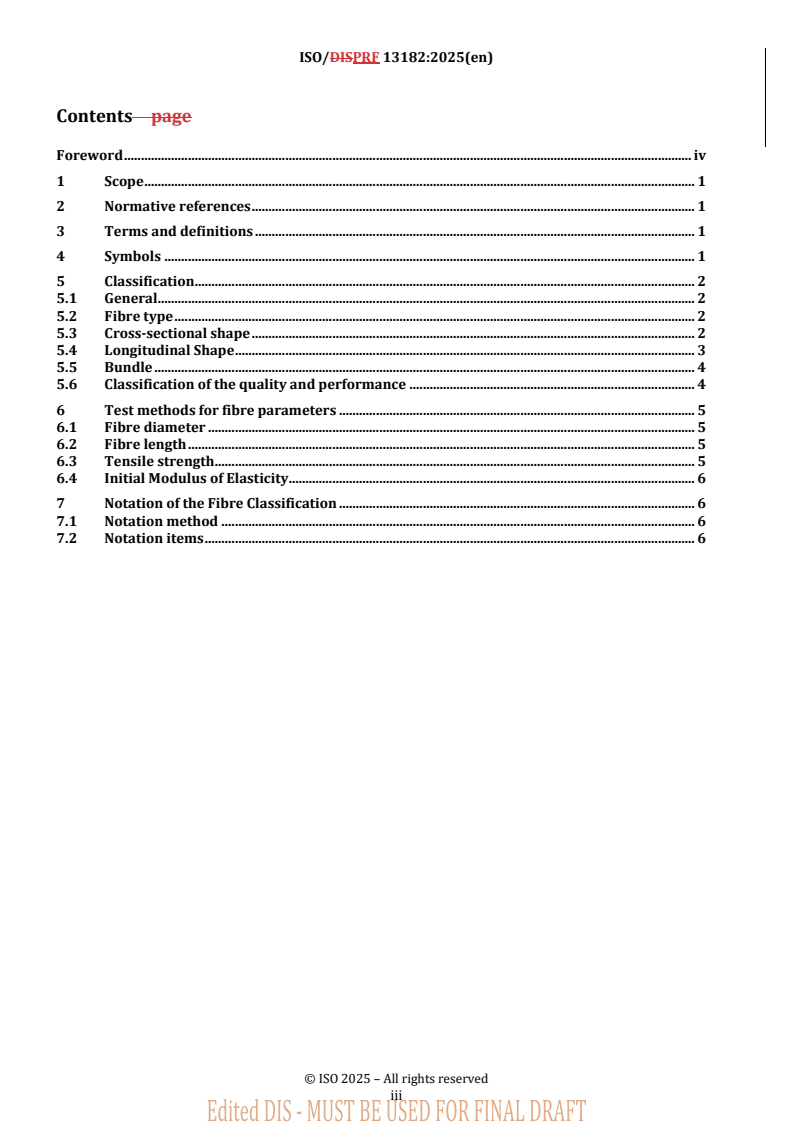
ISO/DISPRF 13182:2025(en)
Contents page
Foreword . iv
1 Scope . 1
2 Normative references . 1
3 Terms and definitions . 1
4 Symbols . 1
5 Classification. 2
5.1 General . 2
5.2 Fibre type . 2
5.3 Cross-sectional shape . 2
5.4 Longitudinal Shape . 3
5.5 Bundle . 4
5.6 Classification of the quality and performance . 4
6 Test methods for fibre parameters . 5
6.1 Fibre diameter . 5
6.2 Fibre length . 5
6.3 Tensile strength . 5
6.4 Initial Modulus of Elasticity . 6
7 Notation of the Fibre Classification . 6
7.1 Notation method . 6
7.2 Notation items . 6
iii
ISO/PRF 13182:2025(en)
Foreword
ISO (the International Organization for Standardization) is a worldwide federation of national standards
bodies (ISO member bodies). The work of preparing International Standards is normally carried out through
ISO technical committees. Each member body interested in a subject for which a technical committee has been
established has the right to be represented on that committee. International organizations, governmental and
non-governmental, in liaison with ISO, also take part in the work. ISO collaborates closely with the
International Electrotechnical Commission (IEC) on all matters of electrotechnical standardization.
The procedures used to develop this document and those intended for its further maintenance are described
in the ISO/IEC Directives, Part 1. In particular, the different approval criteria needed for the different types of
ISO document should be noted. This document was drafted in accordance with the editorial rules of the
ISO/IEC Directives, Part 2 (see www.iso.org/directives).
ISO draws attention to the possibility that the implementation of this document may involve the use of (a)
patent(s). ISO takes no position concerning the evidence, validity or applicability of any claimed patent rights
in respect thereof. As of the date of publication of this document, ISO [had/had not] received notice of (a)
patent(s) which may be required to implement this document. However, implementers are cautioned that this
may not represent the latest information, which may be obtained from the patent database available at
www.iso.org/patents. ISO shall not be held responsible for identifying any or all such patent rights.
Any trade name used in this document is information given for the convenience of users and does not
constitute an endorsement.
For an explanation of the voluntary nature of standards, the meaning of ISO specific terms and expressions
related to conformity assessment, as well as information about ISO's adherence to the World Trade
Organization (WTO) principles in the Technical Barriers to Trade (TBT), see www.iso.org/iso/foreword.html.
This document was prepared by Technical Committee ISO/TC 71, Concrete, reinforced concrete and pre-
stressed concrete, Subcommittee SC 6, Non-traditional reinforcing materials for concrete structures.
Any feedback or questions on this document should be directed to the user’s national standards body. A
complete listing of these bodies can be found at www.iso.org/members.html.
4 © ISO 2020 – All rights reserved
iv
DRAFT International Standard ISO/DIS 13182:2025(en)
Classification for discrete polymer fibre for fibre-reinforced
cementitious composites
1 Scope
This document specifies discrete polymer fibres with a nominal length of 80 mm or less mixed in concrete and
mortar. The quality and performance specified in this standard are the raw material resin of discrete polymer
fibres, nominal fibre diameter and its allowable range, nominal fibre length and its allowable range, fibre
cross-sectional shape, fibre longitudinal shape, grade of fibre strength, and grade of fibre elasticity.
There are a wide variety of discrete polymer fibres used to reinforce cement composites. Currently, in discrete
polymer fibres products distributed as industrial products, there are many types of raw material resins and
various shapes. In addition, the applications that have been used in practical fields are so wide, from structural
applications that require high mechanical reinforcement performance to crack control and peeling prevention
that are easier to use. Therefore, to select an app
...
Questions, Comments and Discussion
Ask us and Technical Secretary will try to provide an answer. You can facilitate discussion about the standard in here.
Loading comments...