


ISO/FDIS 13679
(Main)Petroleum and natural gas industries — Procedures for testing casing and tubing connections
Petroleum and natural gas industries — Procedures for testing casing and tubing connections
Industries du pétrole et du gaz naturel — Modes opératoires d'essai des connexions pour tubes de cuvelage et de production
General Information
- Status
- Withdrawn
- Technical Committee
- ISO/TC 67/SC 5 - Casing, tubing and drill pipe
- Current Stage
- 5098 - Project deleted
- Start Date
- 28-May-2018
- Completion Date
- 12-Feb-2026
Relations
- Effective Date
- 12-Feb-2026
- Effective Date
- 15-Apr-2008
Get Certified
Connect with accredited certification bodies for this standard

ABS Quality Evaluations Inc.
American Bureau of Shipping quality certification.

Element Materials Technology
Materials testing and product certification.

ABS Group Brazil
ABS Group certification services in Brazil.
Sponsored listings
Frequently Asked Questions
ISO/FDIS 13679 is a draft published by the International Organization for Standardization (ISO). Its full title is "Petroleum and natural gas industries — Procedures for testing casing and tubing connections". This standard covers: Petroleum and natural gas industries — Procedures for testing casing and tubing connections
Petroleum and natural gas industries — Procedures for testing casing and tubing connections
ISO/FDIS 13679 is classified under the following ICS (International Classification for Standards) categories: 75.180.10 - Exploratory, drilling and extraction equipment; 75.200 - Petroleum products and natural gas handling equipment. The ICS classification helps identify the subject area and facilitates finding related standards.
ISO/FDIS 13679 has the following relationships with other standards: It is inter standard links to FprEN ISO 13679, ISO 13679:2002. Understanding these relationships helps ensure you are using the most current and applicable version of the standard.
ISO/FDIS 13679 is available in PDF format for immediate download after purchase. The document can be added to your cart and obtained through the secure checkout process. Digital delivery ensures instant access to the complete standard document.
Standards Content (Sample)
FINAL
INTERNATIONAL ISO/FDIS
DRAFT
STANDARD 13679
ISO/TC 67/SC 5
Petroleum and natural gas industries —
Secretariat: JISC
Procedures for testing casing and tubing
Voting begins on:
connections
2011-09-15
Voting terminates on:
Industries du pétrole et du gaz naturel — Modes opératoires d'essai des
2011-11-15
connexions pour tubes de cuvelage et de production
Please see the administrative notes on page iii
RECIPIENTS OF THIS DRAFT ARE INVITED TO
SUBMIT, WITH THEIR COMMENTS, NOTIFICATION
OF ANY RELEVANT PATENT RIGHTS OF WHICH
THEY ARE AWARE AND TO PROVIDE SUPPORT-
ING DOCUMENTATION.
IN ADDITION TO THEIR EVALUATION AS
Reference number
BEING ACCEPTABLE FOR INDUSTRIAL, TECHNO-
LOGICAL, COMMERCIAL AND USER PURPOSES,
DRAFT INTERNATIONAL STANDARDS MAY ON
OCCASION HAVE TO BE CONSIDERED IN THE
LIGHT OF THEIR POTENTIAL TO BECOME STAN-
DARDS TO WHICH REFERENCE MAY BE MADE IN
©
ISO 2011
NATIONAL REGULATIONS.
Copyright notice
This ISO document is a Draft International Standard and is copyright-protected by ISO. Except as permitted
under the applicable laws of the user's country, neither this ISO draft nor any extract from it may be
reproduced, stored in a retrieval system or transmitted in any form or by any means, electronic,
photocopying, recording or otherwise, without prior written permission being secured.
Requests for permission to reproduce should be addressed to either ISO at the address below or ISO's
member body in the country of the requester.
ISO copyright office
Case postale 56 CH-1211 Geneva 20
Tel. + 41 22 749 01 11
Fax + 41 22 749 09 47
E-mail copyright@iso.org
Web www.iso.org
Reproduction may be subject to royalty payments or a licensing agreement.
Violators may be prosecuted.
ii © ISO 2011 – All rights reserved
ISO/CEN PARALLEL PROCESSING
This final draft has been developed within the International Organization for Standardization (ISO), and
processed under the ISO-lead mode of collaboration as defined in the Vienna Agreement. The final draft
was established on the basis of comments received during a parallel enquiry on the draft.
This final draft is hereby submitted to the ISO member bodies and to the CEN member bodies for a parallel
two-month approval vote in ISO and formal vote in CEN.
Positive votes shall not be accompanied by comments.
Negative votes shall be accompanied by the relevant technical reasons.
In accordance with the provisions of Council Resolution 15/1993, this document is circulated in the
English language only.
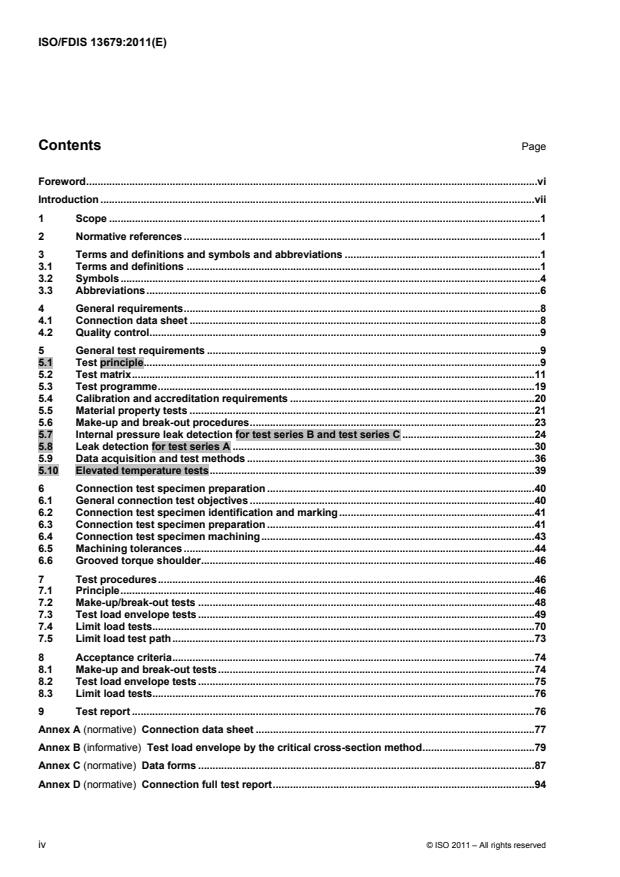
Contents Page
Forew ord .vi
Introduction .vii
1 Scope .1
2 Normative references .1
3 Terms and definitions and symbols and abbreviations .1
3.1 Terms and definitions .1
3.2 Symbols .4
3.3 Abbreviations .6
4 General requirements .8
4.1 Connection data sheet .8
4.2 Quality control .9
5 General test requirements .9
5.1 Test principle .9
5.2 Test matrix .11
5.3 Test programme .19
5.4 Calibration and accreditation requirements .20
5.5 Material property tests .21
5.6 Make-up and break-out procedures .23
5.7 Internal pressure leak detection for test series B and test series C .24
5.8 Leak detection for test series A .30
5.9 Data acquisition and test methods .36
5.10 Elevated temperature tests .39
6 Connection test specimen preparation .40
6.1 General connection test objectives .40
6.2 Connection test specimen identification and marking .41
6.3 Connection test specimen preparation .41
6.4 Connection test specimen machining .43
6.5 Machining tolerances .44
6.6 Grooved torque shoulder .46
7 Test procedures .46
7.1 Principle .46
7.2 Make-up/break-out tests .48
7.3 Test load envelope tests .49
7.4 Limit load tests .70
7.5 Limit load test path .73
8 Acceptance criteria .74
8.1 Make-up and break-out tests .74
8.2 Test load envelope tests .75
8.3 Limit load tests .76
9 Test report .76
Annex A (normative) Connection data sheet .77
Annex B (informative) Test load envelope by the critical cross-section method .79
Annex C (normative) Data forms .87
Annex D (normative) Connection full test report .94
iv © ISO 2011 – All rights reserved
Annex E (normative) Calculations for pipe body load envelope and examples of load schedules
for each test series . 98
Annex F (informative) Frame load range determination . 118
Annex G (informative) Connection product line qualification . 119
Annex H (informative) Special application testing . 126
Annex I (informative) Rationale for design basis. 132
Annex J (informative) Independent seal testing of connections with metal-to-metal and resilient
seals . 135
Annex K (informative) Summary of changes to ISO 13679:2002 as of April 2011 . 138
Bibliography . 143
Foreword
ISO (the International Organization for Standardization) is a worldwide federation of national standards bodies
(ISO member bodies). The work of preparing International Standards is normally carried out through ISO
technical committees. Each member body interested in a subject for which a technical committee has been
established has the right to be represented on that committee. International organizations, governmental and
non-governmental, in liaison with ISO, also take part in the work. ISO collaborates closely with the
International Electrotechnical Commission (IEC) on all matters of electrotechnical standardization.
International Standards are drafted in accordance with the rules given in the ISO/IEC Directives, Part 2.
The main task of technical committees is to prepare International Standards. Draft International Standards
adopted by the technical committees are circulated to the member bodies for voting. Publication as an
International Standard requires approval by at least 75 % of the member bodies casting a vote.
Attention is drawn to the possibility that some of the elements of this document may be the subject of patent
rights. ISO shall not be held responsible for identifying any or all such patent rights.
ISO 13679 was prepared by Technical Committee ISO/TC 67, Materials, equipment and offshore structures
for petroleum, petrochemical and natural gas industries, Subcommittee SC 5, Casing, tubing and drill pipe.
This second edition cancels and replaces the first edition (ISO 13679:2002). Refer to Annex K for a listing of
the parts of this document that have been technically revised.
vi © ISO 2011 – All rights reserved
Introduction
This International Standard is part of a process to provide reliable tubing and casing connections for the oil
and natural gas industry which are fit for purpose. It has been developed based on improvements to
API RP 5C5 and proprietary test procedures, with input from leading users, manufacturers and testing
consultants from around the world. This International Standard represents the knowledge of many years of
testing and qualification experiences.
The validation of connection test load envelope and failure limit loads is relevant to design of tubing and
casing for the oil and natural gas industries. Tubing and casing are subject to loads which include internal
pressure, external pressure, axial tension, axial compression, bending torsion, transverse forces and
temperature changes. The magnitude and combination of these loads result in various pipe body and
connection failure modes. Although pipe body test and limit loads are well understood in general, the same
cannot be stated for the connection. These failure modes and loads are generally different and often less than
that of the pipe. Consequently, experimental validation is required.
The validation of test and limit loads requires testing at the extremes of performance parameters to these
defined loads. Testing at the extremes of the performance parameters assures that the production population
that falls within these limits meets or exceeds the performance of the test population. Thread connection
performance parameters include dimensional tolerances, mechanical properties, surface treatment, make-up
torque and the type and amount of thread compound. For typical proprietary connections, worst-case
tolerances are known and defined in this International Standard. For other connections designs, analysis is
required to define worst-case tolerance combinations.
It is necessary that users of this International Standard be aware that further or differing requirements can be
needed for individual applications. This International Standard is not intended to inhibit a vendor from offering,
or a purchaser from accepting, alternate equipment or engineering solutions for the individual application. This
is particularly applicable when there is innovative or developing technology. Where an alternative is offered, it
is the responsibility of the vendor to identify any variations from this International Standard and provide details.
This International Standard consists of the following major parts. Based on manufacturer's supplied data
specified in Annex A and/or calculations in Annex B, tests are conducted in accordance with Clauses 4 to 8
and reported on the data forms given in Annex C. Annex D lists all the information that it is necessary to
provide in the full test report. Annex E provides methodology for calculating and examples of pipe body load
envelopes, the test load envelope and the test load points. Annex F gives an example of a load frame
calibration. Annex G gives considerations for possible connection product line qualifications. Annex H
provides guidelines for supplemental tests that can be used for special applications. Annex I gives the design
rationale for this International Standard. Annex J gives requirements for connections that contain both a metal-
to-metal seal and a resilient seal that are tested separately. Annex K is a summary of changes to
ISO 13679:2002.
For specific applications that are not evaluated by the tests herein, supplementary tests can be appropriate. It
is necessary that the user and manufacturer discuss well applications and limitations of the connection being
considered.
Representatives of users and/or other third party personnel are encouraged to monitor the tests. ISO 13679
covers the testing of connections for the most commonly encountered well conditions. Not all possible service
scenarios are included. For example, the presence of a corrosive fluid, which can influence the service
performance of a connection, is not considered.
This International Standard includes various provisions. These are identified by the use of certain verbal
forms:
SHALL is used to indicate requirements that strictly need to be followed in order to conform to this
International Standard and from which no deviation is permitted.
SHOULD is used to indicate that among several possibilities one is recommended as particularly suitable,
without mentioning or excluding others, or that a certain course of action is preferred but not necessarily
required, or that (in the negative form) a certain possibility or course of action is deprecated but not
prohibited.
MAY is used to indicate a course of action permissible within the limits of the document.
CAN is used to indicate statements of possibility and capability, whether material, physical or causal.
In addition, for Standard International (SI) units, the thousands separator is a space and the decimal separator
is a comma. For United States Customary (USC) units, the thousands separator is a comma and the decimal
separator is a period.
The “Highlighting in gray change-identification system” and the “Summary of changes” shown in informative
Annex K identify sections of this document where committee-agreed changes (additions, modifications, and/or
deletions) affecting the performance of the product(s) or the technical requirement(s) applicable to the
product(s) have been made from the previous edition of this International Standard. While efforts have been
made to ensure the accuracy and consistency of the application of the change-identification system, the user
of this International Standard is both encouraged to consider the totality of the technical content of this
International Standard rather than those changes identified, and is ultimately responsible for recognizing any
differences between this and previous editions of the International Standard.
ISO/CS expressly disclaims any liability or responsibility for loss or damage resulting from inappropriate use of
this International Standard based on inaccuracy of the “change-identification” system.
viii © ISO 2011 – All rights reserved
FINAL DRAFT INTERNATIONAL STANDARD ISO/FDIS 13679:2011(E)
Petroleum and natural gas industries — Procedures for testing
casing and tubing connections
1 Scope
This International Standard specifies tests to perform to determine the galling tendency, sealing performance
and structural integrity of casing and tubing connections. The words “casing” and “tubing” apply to the service
application and not to the diameter of the pipe.
2 Normative references
The following referenced documents are indispensable for the application of this document. For dated
references, only the edition cited applies. For undated references, the latest edition of the referenced
document (including any amendments) applies.
ISO 3183, Petroleum and natural gas industries — Steel pipe for pipeline transportation systems
ISO/TR 10400:2007, Petroleum and natural gas industries — Equations and calculations for the properties of
casing, tubing, drill pipe and line pipe used as casing or tubing
ISO 11960, Petroleum and natural gas industries — Steel pipes for use as casing or tubing for wells
ISO 13680, Petroleum and natural gas industries — Corrosion-resistant alloy seamless tubes for use as
casing, tubing and coupling stock — Technical delivery conditions
API TR 5C3, Technical report on equations and calculations for casing, tubing, and line pipe used as casing or
tubing; and performance properties tables for casing and tubing)
ANSI/API Spec 5L, Specification for Line Pipe
3 Terms and definitions and symbols and abbreviations
3.1 Terms and definitions
For the purposes of this document, the following terms, definitions, symbols and abbreviated terms apply.
3.1.1
100 % pipe body load envelope
diagram containing the extremes of pipe body performance based on actual properties
NOTE Pipe body performance is also known as VME yield. See ISO/TR 10400 (API TR 5C3) for collapse.
3.1.2
ambient temperature
actual current temperature of the test lab environment at the time of testing
3.1.3
axial-pressure load diagram
plot of axial load versus pressure showing pipe and/or connection test load envelope or limit load extremes
3.1.4
connection
one pin and its adjoining coupling side or integral box
3.1.5
connection leak
leak that occurs across a connection.
NOTE See 8.2 for pressure sealing acceptance criteria.
3.1.6
diametrical interference
outer diameter of the inner member minus the inner diameter of the outer member
3.1.7
failure load
load at which the pipe body or connection fails catastrophically as in an axial separation, a rupture, large
permanent deformation (e.g. buckling or collapse) or loss of sealing integrity
3.1.8
galling
form of surface damage resulting from cold welding of contacting material surfaces followed by tearing of the
metal during further sliding/rotation
NOTE There are several degrees of galling used for repair and reporting purposes as defined in 8.1.
3.1.9
interference
amount of geometric overlap of mating members created by the design and tolerances of the members
3.1.10
leak
leakage
passage of contained test medium outside of the containment space whether in the equipment or the
connection
3.1.11
light galling
galling that can be repaired by the use of abrasive paper
3.1.12
limit load
load combination extreme (axial load and/or pressure) that defines the failure conditions for the connection or
load combination resulting in large permanent deformation (such as buckling) prior to catastrophic failure
3.1.13
lot
lengths of pipe with the same specified dimensions and grade from the same heat of steel that are
heat-treated as part of a continuous operation (or batch)
3.1.14
material test coupon
cylinder of material from the tested pipe and/or coupling stock from which tensile test specimens are cut
3.1.15
metal-to-metal seal
seal or sealing system that relies on intimate and usually high contact stress of mating metal surfaces to
achieve a seal
NOTE The thread compound can affect, both beneficially and detrimentally, the performance of a metal seal.
2 © ISO 2011 – All rights reserved
3.1.16
moderate galling
galling that can be repaired by the use of fine files and abrasive paper
3.1.17
mother joint
length of pipe or coupling stock from which short lengths are cut for machining connection test specimens
3.1.18
multiple seal
sealing system having more than one independent barrier, with each barrier forming a seal
3.1.19
pipe string
pipe body and the connection
3.1.20
pup joint
short pipe length usually with threaded ends
3.1.21
resilient seal
seal or sealing system that relies on entrapment of a seal ring within a machined groove in the connection (e.g.
in the thread-form, on a seal area, etc.) to achieve a seal
3.1.22
seal
pressure barrier to prevent the passage of the test medium
3.1.23
seal ovality
maximum seal diameter minus the minimum seal diameter divided by the average seal diameter multiplied
by 100
NOTE Seal ovality shall be reported as a percentage.
3.1.24
severe galling
galling that cannot be repaired by the use of fine files and abrasive paper
3.1.25
single seal
one barrier or multiple barriers that cannot be physically differentiated in their function
3.1.26
specimen
two connections with a shared coupling or one integral connection
3.1.27
test load envelope
extremes of loads (axial load, pressure, bending) based on actual measured mechanical properties and
dimension of the specimen for a specific temperature to which the connection has been or will be tested in
accordance with this International Standard
3.1.28
thread lot
all products manufactured on a given machine during a continuous production cycle that is not interrupted by
a catastrophic tool failure or injurious machine malfunction (excluding worn tools or minor tool breakage), tool
holder change (except rough boring bar) or any other malfunction of either threading equipment or inspection
gauges
3.1.29
thread seal
seal or sealing system that relies on intimate fitting of the thread-form and usually entrapment of the thread
compound within the thread-form to achieve a seal
3.1.30
VME stress
equivalent stress based on the von Mises-Hencky minimum distortion energy criterion
3.2 Symbols
a
A cycles in test series A at ambient temperature using gas for internal pressure and liquid for external
pressure. For CAL I-E, either gas or liquid shall be used.
e
A cycles in test series A at 180 °C (356 °F) for CAL III and CAL IV using gas for internal pressure and
liquid for external pressure
a
B cycles in test series B, without bending, at ambient temperature with gas for CAL II through CAL IV;
with gas or water for CAL I-E; with water for CAL I
a
B cycles in test series B, with bending, at ambient temperature with gas for CAL II through CAL IV; with
b
gas or water for CAL I-E; with water for CAL I
e
B cycles in test series B, with bending, at 180 °C (356 °F) using gas for CAL III-Ambient A, CAL III, and
b
CAL IV; at 135 °C (275 °F) for CAL II using gas
C compressive axial force
D specified pipe outside diameter or measured average outside diameter of a specimen used for axial
load or pressure load
D inside diameter
i
D outside diameter
o
D effective dogleg severity, expressed in degrees per thirty metres
leg
d maximum pipe D
wall i
E error in load frame calibration
r
E error in load frame calibration, expressed in percent
rp
F failure
F total axial force, tension or compression (sum of applied loads: F , F , F )
a b i CEPL
F bending equivalent axial force
b
F test load envelope compression load at 0 pressure (uniaxial compression)
c
F capped-end pressure load acting on the connection
CEPL
F actual load frame axial force, tension or compression
f
F indicated load frame axial force, tension or compression
i
F 95 % of pipe body tension or compression yield load at 0 pressure (uniaxial load)
p
4 © ISO 2011 – All rights reserved
F TLE tension load at 0 pressure (uniaxial tension)
t
F specified minimum material yield strength
ymn
I moment of inertia
I maximum design interference between thread or seal members, resulting from pin and box diameter
max
specification and tolerances
I minimum design interference between thread or seal members, resulting from pin and box diameter
min
specification and tolerances
I range of design interference between thread or seal members, equal to I minus I
range max min
k , k geometric variable
i o
K minimum of (t /t) or 0,95
wall ac
p collapse rating for specified OD, specified wall thickness and specified specimen yield strength (see
c
ISO/TR 10400:2007,Clause 8)
P TLE pressure at 0 axial load (uniaxial internal pressure)
d
p internal pressure
i
p internal pressure with bending
ib
p high internal pressure
ih
p normalized internal test pressure
in
p low internal pressure
il
p external pressure
o
p external pressure with bending
ob
p normalized external test pressure
on
q actual leak rate to be reported
ac
q maximum connection leak rate that is acceptable during a test hold period
max
q observed leak rate
o
R radius of curvature of the pipe body at the axis of the pipe
t specified pipe wall thickness
t minimum measured wall thickness
ac
t average measured wall for the specimen used for axial load calculations
ave
T tension axial force
leak detection system efficiency
lds
stress
axial stress without bending
a
axial stress with bending
ab
axial stress due to bending
b
axial compressive yield strength if available or otherwise axial tensile yield strength
c
actual measured minimum yield strength of the specimen or the source mother tube
e
hoop (tangential) stress
h
hoop (tangential) stress at outside diameter
ho
radial (normal) stress
r
radial (normal) stress at outside diameter
ro
transverse tensile yield strength if available or otherwise axial tensile yield strength
t
defined transverse compressive yield strength if available or otherwise axial tensile yield strength
tc
von Mises equivalent stress
v
axial tensile yield strength
y
3.3 Abbreviations
A connection A end
B connection B end
AMYS actual minimum yield strength
CAL connection assessment level
CCS critical cross-section
CCW counter-clockwise direction around the test load envelope
cm /min cubic centimetres per minute
cm /s cubic centimetres per second
CW clockwise direction around the test load envelope
CEPL capped end pressure load (tension) at the designated pressure
CEYP capped end yield pressure
CRA corrosion-resistant alloy
EUE external upset end
FEA finite element analysis
FMU final make-up specimen condition
H high thread or seal interference range
H/H maximum specified amount of thread compound / maximum specified torque value in Figures 1 to 6;
and maximum thread interference / maximum seal interference
H/L maximum specified amount of thread compound / minimum specified torque value and in Figures 1
to 6; maximum thread interference / minimum seal interference
IJ integral joint
kN kiloNewton
6 © ISO 2011 – All rights reserved
kips 1 000 pound-force
ksi 1 000 pound-force per square inch
lb pound-force
L low thread or seal interference range
L/H minimum specified amount of thread compound / maximum specified torque value
LL limit load
LL1 limit load test path 1
LL2 limit load test path 2
LL3 limit load test path 3
LL4 limit load test path 4
LL5 limit load test path 5
LP load point
M/B make-up/break-out
MBG make-up/break-out galling test specimen condition
MC mechanical cycle
MPa megapascal
MT material test coupon
MTC metal seal threaded and coupled connection
MTM metal-to-metal seal
MU make-up
OCTG oil country tubular goods
PBVME pipe body von Mises envelope
PBY pipe body yield
PEL pressure end load
psi pound-force per square inch
psig pound-force per square inch gauge
PF-BS pin fast taper - box slow taper
PS-BF pin slow taper - box fast taper
PTFE polytetrafluoroethylene
r/min revolutions per minute
RS resilient seal
SMYS specified minimum yield strength
SRG seal ring groove
Std standard
TC thermal cycle
TLE test load envelope
TS-A test series A
TS-B test series B
TS-C test series C
TSC thread sealing connection
T&C threaded and coupled
VME von Mises equivalent stress
XH extreme maximum high thread or seal interference range
XL extreme minimum low thread or seal interference range
4 General requirements
4.1 Connection data sheet
Prior to beginning a test, the manufacturer shall provide a connection data sheet for the product stating its
intended connection assessment level, its geometry, and claimed performance properties in terms of tension,
compression, internal pressure, external pressure, bending, and torque (see Table A.1 for the connection data
sheet). The manufacturer shall provide a drawing, which is representative of the cross-sectional area of the
connection. The manufacturer shall also provide the following in graphical form (VME plot): 100 % pipe body
load envelope, 95 % pipe body load envelope (or as otherwise agreed to between user and manufacturer),
and claimed test load envelope and should quantify limit loads (see 7.4 and 7.5). The manufacturer's own
method of calculation should be used to derive the claimed test load envelope and to calculate the test loads.
Performance data or the method described in Annex B may be used.
Annex B has been provided as a means by which a manufacturer or user may estimate the test load envelope
using a connection performance model based on capacities of specific critical cross-sections in the connection.
The manufacturer should define as completely as possible the limit loads for each connection. A user may
also make an independent estimate of the limit loads. Limit loads shall be greater than the test load envelope.
It is critical that the combined load capacity described by the test load envelope be defined near and
throughout the conditions where the dominant load sensitivity of the connection can change from pressure to
axial force and/or bending or vice versa.
Since casing and tubing connection designs and the resultant performance can vary widely, no overall
requirement for the minimum number of values in a tabular data format can be mandated. However, it is
expected that approximately 10 combined load values of pressure and axial force per quadrant should be
sufficient to define the test and limit loads. If a connection design exhibits changes in load sensitivities, the
loads at which the changes in load sensitivity occur shall be provided.
In the calculation of both pipe body and connection load capacities, it is the intent of this International
Standard to test the specimens to as high a load or combination of loads as safely practical.
In the event that unanticipated events result in deviations to the detailed requirements and or procedures,
such deviations shall be clearly identified in the documentation and test report.
8 © ISO 2011 – All rights reserved
4.2 Quality control
All quality control procedures for the manufacturing of test specimens shall be documented and shall be
consistent with procedures used for connections manufactured for well service. The connection manufacturer
shall ensure that the connections manufactured for the purpose of these design verification tests are of the
same design and manufactured to the same dimensions and extremes of tolerances (see 6.5) as those
supplied for well service. The connection manufacturer shall issue a declaration of conformity (see
ISO/IEC Guide 22 for an example). The manufacturer shall provide the process control plan. This process
control plan shall include the product drawing number(s) and associated revision level(s) as well as the
procedure number and the associated revision levels for all applicable sub-tier documents (manufacturing,
gauge calibration, gauging procedure, surface treatment, thread compound [type and quantity, or other
amount indicators], make-up procedures, etc.). These procedures and any others determined necessary to
provide a consistent product for well service shall be used during manufacturing of all test specimens
(see A.4).
5 General test requirements
5.1 Test principle
5.1.1 Overview
Connection performance data are generated by testing. Passing the tests demonstrates conformance of the
connection to a specified level of assessment. Test failures can result in a revision of the connection design or
a revision of the test loads or limit loads. In the first case (connection redesign), the testing shall be repeated.
In the second case (test load revision), the individual test specimens shall be retested unless the tests
conform to the revised performance envelope.
Six test programmes, known as connection assessment levels (CAL), are presented. The increasingly
arduous test programs are developed to provide means to assess connection performance to satisfy the
variety of service requirements that have been driven by well design. These test programs increase in rigor by
increasing the number of test parameters and test specimens.
The test programmes do not include all possible service scenarios. For example, the presence of a corrosive
fluid that can influence the service performance of a connection is not considered and is beyond the scope of
this International Standard.
The user of this International Standard shall specify the connection assessment level required based on the
requirements for the particular service intended. Users of the connection should be familiar with the defined
connection test rigor, the performance limits and limit loads. The connection assessment levels (CAL) are
defined as follows:
a) Connection assessment level IV (5 specimens) — most testing rigor
CAL IV is the most rigorous test plan. CAL IV test matrix exposes the connection to cyclical test loads
including internal pressure, external pressure, tension, compression and bending at ambient and elevated
temperature. CAL IV test conditions subject the connection to extensive thermal cycling, with
approximately 83 h of cumulative exposure to gas loading conditions at an elevated temperature of
180 °C (356 °F). Limit load tests are performed to failure in three quadrants of the axial-pressure load
diagram.
b) Connection assessment level III (5 specimens) — significant testing rigor
CAL III is a rigorous test plan of significance. As with CAL IV, CAL III test matrix exposes the connection
to cyclical test loads including internal pressure, external pressure, tension, compression and bending at
ambient and elevated temperature. CAL III test conditions subject connections to less severe thermal
cycling levels than CAL IV. Elevated temperature requirements are maintained at 180 °C (356 °F);
however, cumulative exposure time is reduced to approximately 45 h. Limit loads tests are performed in
quadrant I on two separate specimens.
c) Connection assessment level III-Ambient A (5 specimens) — less significant testing rigor
CAL III-Ambient A is a less significant testing plan than CAL III. As with CAL III, CAL III-Ambient A test
matrix exposes the connection to cyclical test loads including internal pressure, external pressure, tension,
compression and bending at ambient and elevated temperature; however, external pressure testing is
conducted only at ambient temperature. Elevated temperature requirements are maintained at 180 °C
(356 °F); however, cumulative exposure time is reduced to approximately 34 h. Limit loads tests are
performed in quadrant I on two separate specimens.
d) Connection assessment level II (3 specimens) — moderate testing rigor
CAL II is a moderate rigor test plan. The CAL II test matrix exposes the connection to cyclical test loads
including internal pressure, tension, compression and bending at ambient and elevated temperature.
External pressure is evaluated only at ambient temperature and has a reduced number of cycles. Internal
pressure testing temperatures are limited to 135 °C (275 °F). Connection test samples are subjected to
elevated temperature testing conditions for approximately 16 h. A limit load test is performed in quadrant I
on one specimen.
e) Connection assessment level I-E (2 specimens) — less testing rigor
CAL I-E is a reduced rigor test plan that may utilize liquid or gas as an internal pressurization medium. All
testing is conducted at ambient temperature with one test specimen exposed to internal pressure testing
under tension and compression loading and bending. External pressure is evaluated at ambient
temperature and has a reduced number of cycles. Limit load test is performed in quadrant I on one
specimen.
f) Connection assessment level I (2 specimens) — least testing rigor
CAL I is the least rigorous test. CAL I exposes the connection to internal pressure testing performed with
liquid under tension and compression loading at ambient temperature. External pressure loading and
bending are not included. The limit load test is performed in quadrant I on one specimen.
5.1.2 Previous tests
Connections previously tested to prior versions of this International Standard shall retain the CAL test class to
which they were successfully tested. The test protocol used and the date of the test protocol used shall be
stated in the test report. See Annex D for reporting format.
Connection test data obtained from tests performed prior to the establishment of this International Standard
may also be used as part of a design verification process or application test sequence, provided that parties to
agreements based on this International Standard can agree such tests were substantially conducted to the
technical and documentation requirements of this International Standard and that they give comparable
results.
5.1.3 Abbreviated tests and deviations
Some of the tests herein, rather than the complete test programme, may be adequate to verify suitability for
specific applications when experience and related test data, for example on other sizes, are available.
Deviations to the tests specified herein are acceptable, provided
a) the planned deviations are clearly documented in advance;
b) there is clear agreement between the parties involved;
c) the deviations are clearly identified in the full test report.
A discussion of product line qualification and use of interpolation and extrapolation considerations is provided
in Annex G. More stringent acceptance requirements, sensitivity requirements and/or more extended
informative data may be agreed by the user and manufacturer.
10 © ISO 2011 – All rights reserved
5.2 Test matrix
Table 1 shows a matrix relating the connection assessment level to the relevant total number of test
specimens, their identification numbers and the relevant tests. Figures 1 to 6 are a summary of the each CAL
test programme and should be read and followed from the top down. When testing multiple specimens in
series, the applied test loads shall be determined using the lowest strength specimen.
Table 1 — Test matrix — Test series and specimen identification numbers
Series A Series B Series C
Internal test
4 quadrants 2 quadrants Thermal cycling
Bake and pressure
Connection
with with
elevated medium
Thermal/pressure and tension
assessment
mechanical mechanical
temperature
cycling
level
cycles cycles
tests (external is
(see 7.3.5)
liquid)
(see 7.3.3) (see 7.3.4)
Bending required
At ambient and
10 thermal with pressure/tension
at ambient and
IV elevated
elevated
5 mechanical cycles at ≤ 35 °C (95 °F)
temperature
temperatures
180 °C (356 °F) Gas
Total number of
Specimens Specimens
Specimens
specimens
1,2,3,4
1, 2, 3, 4 1, 2, 3, 4
Bending required
At ambient and
10 thermal with pressure/tension
at ambient and
III elevated
elevated
5 mechanical cycles at ≤ 35 °C (95 °F)
temperature
temperatures
180 °C (356 °F) Gas
Total number of
Specimen
Specimens Specimens
specimens
1,2,3,4 1, 2
Bending required
10 thermal with pressure/tension
At ambient at ambient and
III-Ambient A
temperature elevated
5 mechanical cycles at ≤ 35 °C (95 °F) 180 °C (356 °F) Gas
temperatures
Total number of
Specimen
Specimens Specimens
specimens — —
1,2,3,4 1, 2
Bending required
At ambient
at ambient and
temperature
II
elevated
Not applicable
(reduced cycles)
temperature
135 °C (275 °F) Gas
Total number of
Specimen Specimens
specimens
1 1, 4
I-E At ambient
Bending required
temperature
at ambient
Bake-out not
temperature
(reduced cycles) required
Not applicable Gas or liquid
ambient
Specimen Specimen
Total number of
specimens 2
1 1
Bending n
...
Questions, Comments and Discussion
Ask us and Technical Secretary will try to provide an answer. You can facilitate discussion about the standard in here.
Loading comments...