


ISO 13705:2001
(Main)Petroleum and natural gas industries - Fired heaters for general refinery service
Petroleum and natural gas industries - Fired heaters for general refinery service
Industries du pétrole et du gaz naturel — Réchauffeurs à brûleurs pour usage général dans les raffineries
General Information
Relations
Frequently Asked Questions
ISO 13705:2001 is a standard published by the International Organization for Standardization (ISO). Its full title is "Petroleum and natural gas industries - Fired heaters for general refinery service". This standard covers: Petroleum and natural gas industries - Fired heaters for general refinery service
Petroleum and natural gas industries - Fired heaters for general refinery service
ISO 13705:2001 is classified under the following ICS (International Classification for Standards) categories: 75.180.20 - Processing equipment. The ICS classification helps identify the subject area and facilitates finding related standards.
ISO 13705:2001 has the following relationships with other standards: It is inter standard links to ISO/R 64:1958, ISO 13705:2006. Understanding these relationships helps ensure you are using the most current and applicable version of the standard.
You can purchase ISO 13705:2001 directly from iTeh Standards. The document is available in PDF format and is delivered instantly after payment. Add the standard to your cart and complete the secure checkout process. iTeh Standards is an authorized distributor of ISO standards.
Standards Content (Sample)
INTERNATIONAL ISO
STANDARD 13705
First edition
2001-12-15
Petroleum and natural gas industries —
Fired heaters for general refinery service
Industries du pétrole et du gaz naturel — Réchauffeurs à brûleurs pour
usage général dans les raffineries
Reference number
©
ISO 2001
PDF disclaimer
This PDF file may contain embedded typefaces. In accordance with Adobe's licensing policy, this file may be printed or viewed but shall not
be edited unless the typefaces which are embedded are licensed to and installed on the computer performing the editing. In downloading this
file, parties accept therein the responsibility of not infringing Adobe's licensing policy. The ISO Central Secretariat accepts no liability in this
area.
Adobe is a trademark of Adobe Systems Incorporated.
Details of the software products used to create this PDF file can be found in the General Info relative to the file; the PDF-creation parameters
were optimized for printing. Every care has been taken to ensure that the file is suitable for use by ISO member bodies. In the unlikely event
that a problem relating to it is found, please inform the Central Secretariat at the address given below.
© ISO 2001
All rights reserved. Unless otherwise specified, no part of this publication may be reproduced or utilized in any form or by any means, electronic
or mechanical, including photocopying and microfilm, without permission in writing from either ISO at the address below or ISO's member body
in the country of the requester.
ISO copyright office
Case postale 56 • CH-1211 Geneva 20
Tel. + 41 22 749 01 11
Fax + 41 22 749 09 47
E-mail copyright@iso.ch
Web www.iso.ch
Printed in Switzerland
ii © ISO 2001 – All rights reserved
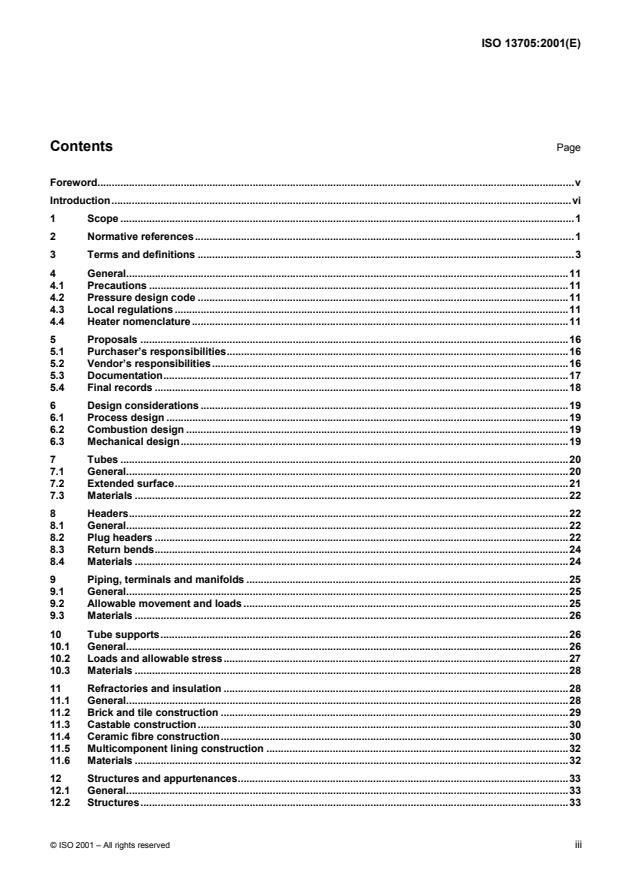
Contents Page
Foreword.v
Introduction.vi
1 Scope .1
2 Normative references.1
3 Terms and definitions .3
4 General.11
4.1 Precautions .11
4.2 Pressure design code .11
4.3 Local regulations .11
4.4 Heater nomenclature.11
5 Proposals .16
5.1 Purchaser’s responsibilities.16
5.2 Vendor’s responsibilities.16
5.3 Documentation.17
5.4 Final records .18
6 Design considerations .19
6.1 Process design .19
6.2 Combustion design .19
6.3 Mechanical design.19
7 Tubes .20
7.1 General.20
7.2 Extended surface.21
7.3 Materials .22
8 Headers.22
8.1 General.22
8.2 Plug headers .22
8.3 Return bends.24
8.4 Materials .24
9 Piping, terminals and manifolds .25
9.1 General.25
9.2 Allowable movement and loads .25
9.3 Materials .26
10 Tube supports.26
10.1 General.26
10.2 Loads and allowable stress.27
10.3 Materials .28
11 Refractories and insulation .28
11.1 General.28
11.2 Brick and tile construction .29
11.3 Castable construction.30
11.4 Ceramic fibre construction.30
11.5 Multicomponent lining construction .32
11.6 Materials .32
12 Structures and appurtenances.33
12.1 General.33
12.2 Structures.33
12.3 Header boxes, doors and ports.34
12.4 Ladders, platforms and stairways.34
12.5 Materials .35
13 Stacks, ducts and breeching.36
13.1 General.36
13.2 Design considerations .36
13.3 Design methods.38
13.4 Static design.38
13.5 Wind-induced vibration design .39
13.6 Materials .40
14 Burners and auxiliary equipment.40
14.1 Burners .40
14.2 Sootblowers .44
14.3 Fans and drivers .45
14.4 Dampers and damper controls.45
15 Instrument and auxiliary connections.46
15.1 Flue gas and air.46
15.2 Process fluid temperature .47
15.3 Auxiliary connections .47
15.4 Tube skin thermocouples .48
15.5 Access to connections.48
16 Shop fabrication and field erection.48
16.1 General.48
16.2 Structural steel fabrication .48
16.3 Coil fabrication.50
16.4 Painting and galvanizing.50
16.5 Refractories and insulation .51
16.6 Field erection.51
17 Inspection, examination and testing.52
17.1 General.52
17.2 Weld examination .52
17.3 Castings examination.53
17.4 Examination of other components.54
17.5 Testing .54
Annex A (informative) Equipment data sheets.56
Annex B (informative) Purchaser's checklist .85
Annex C (informative) Proposed shop assembly conditions .89
Annex D (normative) Stress curves for use in the design of tube support elements.91
Annex E (normative) Centrifugal fans for fired heater systems.107
Annex F (informative) Air preheat systems for fired process heaters.122
Annex G (informative) Measurement of thermal efficiency of fired process heaters .175
Annex H (informative) Stack design.222
Bibliography .232
iv © ISO 2001 – All rights reserved
Foreword
ISO (the International Organization for Standardization) is a worldwide federation of national standards bodies (ISO
member bodies). The work of preparing International Standards is normally carried out through ISO technical
committees. Each member body interested in a subject for which a technical committee has been established has
the right to be represented on that committee. International organizations, governmental and non-governmental, in
liaison with ISO, also take part in the work. ISO collaborates closely with the International Electrotechnical
Commission (IEC) on all matters of electrotechnical standardization.
International Standards are drafted in accordance with the rules given in the ISO/IEC Directives, Part 3.
Draft International Standards adopted by the technical committees are circulated to the member bodies for voting.
Publication as an International Standard requires approval by at least 75 % of the member bodies casting a vote.
Attention is drawn to the possibility that some of the elements of this International Standard may be the subject of
patent rights. ISO shall not be held responsible for identifying any or all such patent rights.
International Standard ISO 13705 was prepared by Technical Committee ISO/TC 67, Materials, equipment and
offshore structures for petroleum and natural gas industries, Subcommittee SC 6, Processing equipment and
systems.
Annexes D and E form a normative part of this International Standard. Annexes A, B, C, F, G and H are for
information only.
Introduction
This International Standard is based on API standard 560, second edition, September 1995.
Users of this International Standard should be aware that further or differing requirements may be needed for
individual applications. This International Standard is not intended to inhibit a vendor from offering, or the purchaser
from accepting, alternative equipment or engineering solutions for the individual application. This may be
particularly applicable where there is innovative or developing technology. Where an alternative is offered, the
vendor should identify any variations from this International Standard and provide details.
In International Standards, the SI system of units is used. Where practical in this International Standard, US
Customary units are included in brackets for information.
A bullet (zzzz) at the beginning of a clause or subclause indicates that either a decision is required or further
information is to be provided by the purchaser. This information should be indicated on data sheets (see examples
in annex A) or stated in the enquiry or purchase order. Decisions should be indicated on a check list (see example
in annex B).
vi © ISO 2001 – All rights reserved
INTERNATIONAL STANDARD ISO 13705:2001(E)
Petroleum and natural gas industries — Fired heaters for general
refinery service
1 Scope
This International Standard specifies requirements and gives recommendations for the design, materials,
fabrication, inspection, testing, preparation for shipment, and erection of fired heaters, air preheaters, fans and
burners for general refinery service.
2 Normative references
The following normative documents contain provisions which, through reference in this text, constitute provisions of
this International Standard. For dated references, subsequent amendments to, or revisions of, any of these
publications do not apply. However, parties to agreements based on this International Standard are encouraged to
investigate the possibility of applying the most recent editions of the normative documents indicated below. For
undated references, the latest edition of the normative document referred to applies. Members of ISO and IEC
maintain registers of currently valid International Standards.
ISO 8501-1, Preparation of steel substrates before application of paints and related products — Visual assessment
of surface cleanliness — Part 1: Rust grades and preparation grades of uncoated steel substrates and of steel
substrates after overall removal of previous coatings
ISO 13704, Petroleum and natural gas industries — Calculation of heater-tube thickness in petroleum refineries
1)
EN 10025 , Hot rolled products of non-alloy structural steels — Technical delivery conditions
2)
AFBMA Standard 9 , Load ratings and fatigue life for ball bearings
3)
AMCA 99-2404-78 , Drive arrangements for centrifugal fans
AMCA 201, Fans and systems
AMCA 210, Laboratory methods of testing fans for aerodynamic performance rating
4)
ASME B17.1 , Keys and keyseats
ASME B31.3, Process piping
ASME Boiler and pressure vessel code, Section VIII, Rules for construction of pressure vessels
5)
ASTM A 36 , Standard specification for carbon structural steel
1) European Committee for Standardization (CEN), Rue de Stassart 36, B-1050 Brussels, Belgium.
th
2) Anti-Friction Bearing Manufacturers Association, 1200 19 Street NW, Suite 300, Washington, DC 20036-2412, USA.
3) Air Movement and Control Assocation, 30 West University Drive, Arlington Heights, IL 60004, USA.
4) American Society of Mechanical Engineers, 3 Park Avenue, New York, NY 10017, USA.
5) American Society for Testing and Materials, 100 Barr Harbor Drive, West Conshohocken, PA 19428-2959, USA.
ASTM A 105, Standard specification for carbon steel forgings for piping applications
ASTM A 123, Standard specification for zinc (hot-dip galvanized) coatings on iron and steel products
ASTM A 143, Standard practice for safeguarding against embrittlement of hot-dip galvanized structural steel
products and procedure for detecting embrittlement
ASTM A 153, Standard specification for zinc coating (hot-dip) on iron and steel hardware
ASTM A 161, Standard specification for seamless low-carbon and carbon-molybdenum steel still tubes for refinery
service
ASTM A 181, Standard specification for carbon steel forgings, for general-purpose piping
ASTM A 182, Standard specification for forged or rolled alloy-steel pipe flanges, forged fittings, and valves and
parts for high-temperature service
ASTM A 192, Standard specification for seamless carbon steel boiler tubes for high-pressure service
ASTM A 193, Standard specification for alloy-steel and stainless steel bolting materials for high-temperature
service
ASTM A 194, Standard specification for carbon and alloy steel nuts for bolts for high-pressure or high-temperature
service, or both
ASTM A 209, Standard specification for seamless carbon-molybdenum alloy-steel boiler and superheater tubes
ASTM A 210, Standard specification for seamless medium-carbon steel boiler and superheater tubes
ASTM A 213, Standard specification for seamless ferritic and austenitic alloy-steel boiler, superheater and heat-
exchanger tubes
ASTM A 216, Standard specification for steel castings, carbon, suitable for fusion welding, for high-temperature
service
ASTM A 217, Standard specification for steel castings, martensitic stainless and alloy, for pressure-containing
parts, suitable for high-temperature service
ASTM A 234, Standard specification for piping fittings of wrought carbon steel and alloy steel for moderate and high
temperature service
ASTM A 240, Standard specification for heat-resisting chromium and chromium-nickel stainless steel plate, sheet,
and strip for pressure vessels
ASTM A 242, Standard specification for high-strength low-alloy structural steel
ASTM A 283, Standard specification for low and intermediate tensile strength carbon steel plates
ASTM A 297, Standard specification for steel castings, iron-chromium and iron-chromium-nickel, heat resistant, for
general application
ASTM A 307, Standard specification for carbon steel bolts and studs, 60 000 psi tensile strength
ASTM A 320, Standard specification for alloy steel bolting materials for low-temperature service
ASTM A 325, Standard specification for structural bolts, steel, heat treated, 120/105 ksi minimum tensile strength
ASTM A 351, Standard specification for castings, austenitic, austenitic-ferritic (duplex), for pressure-containing
parts
ASTM A 384, Standard practice for safeguarding against warpage and distortion during hot-dip galvanizing of steel
assemblies
2 © ISO 2001 – All rights reserved
ASTM A 385, Standard practice for providing high-quality zinc coatings (hot-dip)
ASTM A 387, Standard specification for pressure vessel plates, alloy steel, chromium-molybdenum
ASTM A 403, Standard specification for wrought austenitic stainless steel piping fittings
ASTM A 447, Standard specification for steel castings, chromium-nickel-iron alloy (25-12 class), for high-
temperature service
ASTM A 560, Standard specification for castings, chromium-nickel alloy
ASTM A 572, Standard specification for high-strength, low alloy columbium-vanadium structural steel
ASTM A 608, Standard specification for centrifugally cast iron-chromium-nickel high-alloy tubing for pressure
application at high temperatures
ASTM B 366, Standard specification for factory-made wrought nickel and nickel alloy fittings
ASTM B 407, Standard specification for nickel-iron-chromium alloy seamless pipe and tube
ASTM B 564, Standard specification for nickel alloy forgings
ASTM B 633, Standard specification for electrodeposited coatings of zinc on iron and steel
ASTM C 27, Standard classification of fireclay and high-alumina refractory brick
ASTM C 155, Standard classification of insulating firebrick
ASTM C 332, Standard specification for lightweight aggregates for insulating concrete
ASTM C 401, Standard classification of alumina and alumina-silicate castable refractories
ASTM C 612, Standard specification for mineral fiber block and board thermal insulation
6)
AWS D1.1, Structural welding code — Steel
AWS D14.6-96, Specification for welding of rotating elements of equipment
7)
MSS SP-55 , Quality standard for steel castings for valves, flanges and fittings, and other piping components —
Visual method
8)
NFPA 70 , National electrical code
3 Terms and definitions
For the purposes of this International Standard, the following terms and definitions apply.
NOTE Terms and definitions related to centrifugal fans are given in annex E.
3.1
air heater
air preheater
heat transfer apparatus through which combustion air is passed and heated by a medium of higher temperature,
such as the combustion products, steam or other fluid
6) American Welding Society, 550 NW Le Jeune Road, Miami, FL 33126, USA.
7) Manufacturers Standardization Society, 127 Park Street NE, Vienna, VA 22180, USA.
8) National Fire Protection Association, 1 Batterymarch Park, Quincy, MA 02269-9101, USA.
3.2
anchor
tieback
metallic or refractory device that holds the refractory or insulation in place
3.3
arch
flat or sloped portion of the heater radiant section opposite the floor
3.4
atomizer
device used to reduce liquid fuel to a fine mist
3.5
backup layer
refractory layer behind the hot face layer
3.6
balanced draught heater
heater which uses forced-draught fans to supply combustion air and uses induced fans to remove flue gases
3.7
breeching
heater section where flue gases are collected after the last convection coil for transmission to the stack or the outlet
ductwork
3.8
bridgewall
gravity wall
wall which separates two adjacent heater zones
3.9
bridgewall temperature
temperature of flue gas leaving the radiant section
3.10
burner
device which introduces fuel and air into a heater at the desired velocities, turbulence and concentration to
establish and maintain proper ignition and combustion
NOTE Burners are classified by the type of fuel fired, such as oil, gas, or a combination of gas and oil, which may be
designated as “dual fuel” or “combination”.
3.11
butterfly damper
single-blade damper which pivots about its centre
3.12
casing
metal plate used to enclose the fired heater
3.13
castable
insulating concrete poured or gunned in place to form a rigid refractory shape or structure
3.14
ceramic fibre
fibrous refractory insulation composed primarily of silica and alumina
NOTE Applicable forms include blanket, board, module, rigidized blanket, and vacuum-formed shapes.
4 © ISO 2001 – All rights reserved
3.15
convection section
portion of the heater in which the heat is transferred to the tubes primarily by convection
3.16
corbel
projection from the refractory surface generally used to prevent flue gas bypassing the tubes of the convection
section if they are on a staggered pitch
3.17
corrosion allowance
additional material thickness added to allow for material loss due to corrosion
3.18
corrosion rate
rate of reduction in the material thickness due to chemical attack from the process fluid or flue gas or both
NOTE Corrosion rate is expressed in millimetres per year (mils per year).
3.19
crossover
interconnecting piping between any two heater-coil sections
3.20
damper
device for introducing a variable resistance in order to regulate the flow of flue gas or air
3.21
direct air preheater
heat exchanger which transfers heat directly between the flue gas and the combustion air
NOTE A regenerative air preheater uses heated rotating elements and a recuperative design uses stationary tubes, plates,
or cast iron elements to separate the two heating media.
3.22
draught
negative pressure (vacuum) of the air and/or flue gas measured at any point in the heater
3.23
draught loss
pressure drop (including buoyancy effect) through duct conduits or across tubes and equipment in air and flue gas
systems
3.24
duct
conduit for air or flue gas flow
3.25
fuel efficiency
total heat absorbed divided by the total input of heat derived from the combustion of fuel only (lower heating value
basis)
NOTE This definition excludes sensible heat of the fuels and applies to the net amount of heat exported from the unit.
3.26
thermal efficiency
total heat absorbed divided by the total input of heat derived from the combustion of fuel (h ) plus sensible heats
L
from air, fuel and any atomizing medium
3.27
erosion
reduction in material thickness due to mechanical attack from a fluid
3.28
excess air
amount of air above the stoichiometric requirement for complete combustion
NOTE Excess air is expressed as a percentage.
3.29
extended surface
heat-transfer surface in the form of fins or studs attached to the heat-absorbing surface
3.30
extension ratio
ratio of total outside exposed surface to the outside surface of the bare tube
3.31
flue gas
gaseous product of combustion including excess air
3.32
forced-draught heater
heater for which combustion air is supplied by a fan or other mechanical means
3.33
fouling allowance
factor to allow for a layer of residue that increases pressure drop
NOTE 1 This residue is usually a build-up of coke or scale on the inner surface of a coil.
NOTE 2 The fouling allowance is used in calculating the fouled pressure drop.
3.34
fouling resistance
factor used to calculate the overall heat transfer coefficient
NOTE The inside fouling resistance is used to calculate the maximum metal temperature for design. The external fouling
resistance is used to compensate the loss of performance due to deposits on the external surface of the tubes or extended
surface.
3.35
header
return bend
cast or wrought fitting shaped in a 180° bend and used to connect two or more tubes
3.36
header box
internally insulated structural compartment, separated from the flue-gas stream, which is used to enclose a number
of headers or manifolds
NOTE Access is afforded by means of hinged doors or removable panels.
3.37
heat absorption
total heat absorbed by the coils, excluding any combustion-air preheat
6 © ISO 2001 – All rights reserved
3.38
average heat flux density
heat absorbed divided by the exposed heating surface of the coil section
NOTE Average flux density for an extended-surface tube is indicated on a bare surface basis with extension ratio noted.
3.39
maximum heat flux density
maximum local rate of heat transfer in the coil section
3.40
total heat release
heat liberated from the specified fuel, using the lower heating value of the fuel
3.41
volumetric heat release
heat released divided by the net volume of the radiant section, excluding the coils and refractory dividing walls
3.42
higher heating value
h
H
gross heating value
total heat obtained from the combustion of a specified fuel at 15 °C (60 °F)
3.43
lower heating value
h
L
net heating value
higher heating value minus the latent heat of vaporization of the water formed by combustion of hydrogen in the
fuel
3.44
hot face layer
refractory layer exposed to the highest temperatures in a multilayer or multicomponent lining
3.45
hot face temperature
temperature of the refractory surface in contact with the flue gas or heated combustion air
NOTE The hot face temperature is used to determine refractory or insulation thickness and heat transmitted.
3.46
indirect air preheater
fluid-to-air heat transfer device
NOTE The heat transfer can be accomplished by using a heat-transfer fluid, process stream or utility stream which has
been heated by the flue gas or other means. A heat pipe air preheater uses a vaporizing/condensing fluid to transfer heat
between the flue gas and air.
3.47
induced-draught heater
heater which uses a fan to remove flue gases and maintain a negative pressure in the heater to induce combustion
air without a forced-draught fan
3.48
jump over
interconnecting pipework within a heater coil section
3.49
louvre damper
damper consisting of several blades, each of which pivots about its centre and is linked to the other blades for
simultaneous operation
3.50
manifold
chamber for the collection and distribution of fluid to or from multiple parallel flow paths
3.51
metal fibre reinforcement
stainless steel needles added to castable for improved toughness and durability
3.52
monolithic lining
single-component lining system
3.53
mortar
refractory material preparation used for laying and bonding refractory bricks
3.54
multicomponent lining
refractory system consisting of two or more layers of different refractory types
NOTE Examples of refractory types are castable and ceramic fibre.
3.55
multilayer lining
refractory system consisting of two or more layers of the same refractory type
3.56
natural-draught heater
heater in which a stack effect induces the combustion air and removes the flue gases
3.57
normal heat release
design heat absorption of the heater divided by the calculated fuel efficiency
3.58
pass
stream
flow circuit consisting of one or more tubes in series
3.59
pilot
small burner that provides ignition energy to light the main burner
3.60
plenum
windbox
chamber surrounding the burners that is used to distribute air to the burners or reduce combustion noise
3.61
plug header
cast return bend provided with one or more openings for the purpose of inspection or mechanical tube cleaning
8 © ISO 2001 – All rights reserved
3.62
pressure design code
recognized pressure vessel standard specified or agreed by the purchaser
EXAMPLE ASME Boiler and Pressure Vessel Code, Section VIII.
3.63
pressure drop
difference between the inlet and the outlet static pressures between termination points, excluding the static
differential head
3.64
primary air
portion of the total combustion air that first mixes with the fuel
3.65
protective coating
corrosion-resistant material applied to a metal surface
EXAMPLE Coating on casing plates behind porous refractory materials to protect against sulfur in the flue gases.
3.66
radiant section
portion of the heater in which heat is transferred to the tubes primarily by radiation
3.67
radiation loss
setting loss
heat lost to the surroundings from the casing of the heater and the ducts and auxiliary equipment (when heat
recovery systems are used)
3.68
secondary air
air supplied to the fuel to supplement primary air
3.69
setting
heater casing, brickwork, refractory and insulation, including the tiebacks
3.70
shield section
shock section
tubes that shield the remaining convection-section tubes from direct radiation
3.71
sootblower
device used to remove soot or other deposits from heat-absorbing surfaces in the convection section
NOTE Steam is normally the medium used for soot blowing.
3.72
stack
vertical conduit used to discharge flue gas to the atmosphere
3.73
strake
spoiler
metal attachment to a stack which can prevent the formation of von Karman vortices that can cause wind-induced
vibration
3.74
structural design code
structural design standard specified or agreed by the purchaser
EXAMPLES ICBO Uniform Building Code, ASCE standards, AISC Specification for design, fabrication and erection of
structural steel for buildings.
3.75
target wall
re-radiating wall
vertical refractory firebrick wall which is exposed to direct flame impingement on one or both sides
3.76
temperature allowance
number of degrees Celsius (Fahrenheit) to be added to the process fluid temperature to account for flow
maldistribution and operating unknowns
NOTE The temperature allowance is added to the calculated maximum tube-metal temperature or the equivalent tube-metal
temperature to obtain the design metal temperature
3.77
terminal
flanged or welded connection to or from the coil providing for inlet and outlet of fluids
3.78
tube guide
device used with vertical tubes to restrict horizontal movement while allowing the tube to expand axially
3.79
tube retainer
device used to restrain horizontal radiant tubes from lifting off the intermediate tube supports during operation
3.80
tube support
tube sheet
device used to support tubes
3.81
vapour barrier
metallic foil placed between layers of refractory as a barrier to flue gas flow
10 © ISO 2001 – All rights reserved
4 General
4.1 Precautions
Care shall be excercised when using certain materials in the construction of fired heater components, in particular
those where a dust hazard may be experienced. Manufacturer’s recommendations and local and national safety
requirements shall be followed in all cases.
4.2 Pressure design code
z The pressure design code shall be specified or agreed by the purchaser. Pressure components shall comply with
the pressure design code and the supplemental requirements in this International Standard.
4.3 Local regulations
z The vendor shall comply with the applicable local rules and regulations specified by the purchaser.
4.4 Heater nomenclature
In a fired heater, heat liberated by the combustion of fuels is transferred to fluids contained in tubular coils within an
internally insulated enclosure. The type of heater is normally described by the structural configuration, radiant tube
coil configuration, and burner arrangement. Some examples of structural configurations are cylindrical, box, cabin
and multicell box. Examples of radiant tube coil configurations include vertical, horizontal, helical and arbor.
Examples of burner arrangements include upfired, downfired and wallfired. The wallfired arrangement can be
further classified as sidewall, endwall and multilevel.
Figure 1 illustrates some typical heater types.
Figure 2 illustrates typical burner arrangements.
Various combinations of Figures 1 and 2 can be used. For example, Figure 1 c) can employ burner arrangements
as in Figure 2 a), b) or c) Similarly, Figure 1 d) can employ burner arrangements as in Figure 2 a) or d).
Figure 3 shows typical components. Figures 4, 5 and 6 show typical combustion-air preheat systems.
a) Box heater with arbor coil b) Cylindrical heater with helical coil c) Cabin heater with horizontal
tube coil
d) Box heater with vertical tube coil e) Cylindrical heater with vertical coil f) Box heater with horizontal
tube coil
Figure 1 — Typical heater types
12 © ISO 2001 – All rights reserved
a) Upfired b) Endwall-fired
c) Sidewall-fired d) Sidewall-fired multi-level
Figure 2 — Typical burner arrangements (elevation view)
Key
1 Access door 7 Convection section 13 Header box 19 End tube sheet
2 Arch 8 Corbel 14 Radiant section 20 Pier
3 Breeching 9 Crossover 15 Shield section 21 Stack/duct
4 Bridgewall 10 Tubes 16 Observation door 22 Platform
5 Burner 11 Extended surface 17 Tube support 23 Process in
6 Casing 12 Return bend 18 Refractory lining 24 Process out
Figure 3 — Heater components
14 © ISO 2001 – All rights reserved
Key
1 Fired heater
2 Air
3 Air preheater
4 Induced-draught fan
5 Flue gas
6 Forced-draught fan
7 Separate stack (alternative)
Figure 4 — Air preheat system using regenerative, recuperative or heat pipe unit
Key
1 Flue gas
2 Induced-draught fan
3 Fired heater
4 Air
5 Air preheater
6 Forced-draught fan
7 Heat medium
Figure 5 — System using indirect closed system air preheater with mechanical circulation
Key
1 Fired heater
2 Air
3 Air preheater
4 Forced-draught fan
5 Process or utility stream
Figure 6 — External heat source for air preheating
5 Proposals
5.1 Purchaser’s responsibilities
5.1.1 The purchaser’s enquiry shall include data sheets, check list, and other applicable information outlined
herein. This information shall include any special requirements or exceptions to this International Standard.
5.1.2 The purchaser is responsible for the correct process specification to enable the vendor to prepare the fired
heater design. The purchaser should complete, as a minimum, those items on the data sheet that are designated
by an asterisk (*).
5.1.3 The purchase order shall state clearly the vendor’s scope of work and extent of supply.
z 5.1.4 The purchaser’s enquiry shall specify the number of copies of drawings, data sheets, specifications, data
reports, operating manuals, installation instructions, spare parts lists, and other data to be supplied by the vendor,
as required by 5.3 and 5.4.
5.2 Vendor’s responsibilities
The vendor’s proposal shall include:
a) for each heater, completed ISO data sheets for fired heater and associated equipment (see examples in
annex A);
b) an outline drawing showing firebox dimensions, burner layout and clearances, arrangement of tubes,
platforms, ducting, stack, breeching, air pre-heater and fans;
c) a full definition of the extent of shop assembly (format given in annex C may be used), including the number,
size and mass of prefabricated parts and the number of field welds;
16 © ISO 2001 – All rights reserved
d) a detailed description of any exceptions to the specified requirements;
z e) a completed noise data sheet if the data sheet is supplied by the purchaser;
f) curves for heaters in vaporizing
...
Questions, Comments and Discussion
Ask us and Technical Secretary will try to provide an answer. You can facilitate discussion about the standard in here.
Loading comments...