

ISO 10438-1:2007
(Main)Petroleum, petrochemical and natural gas industries — Lubrication, shaft-sealing and control-oil systems and auxiliaries — Part 1: General requirements
General Information
- Abstract
ISO 10438-1:2007 specifies general requirements for lubrication systems, oil-type shaft-sealing systems, dry-gas face-type shaft-sealing systems and control-oil systems for general- or special-purpose applications. General-purpose applications are limited to lubrication systems. These systems can serve equipment such as compressors, gears, pumps and drivers. ISO 10438-1:2007 is intended to be used in conjunction with ISO 10438-2, ISO 10438-3 or ISO 10438-4, as appropriate.
- Status
- Published
- Publication Date
- 02-Dec-2007
- Technical Committee
- ISO/TC 67/SC 6 - Processing equipment and systems
- Drafting Committee
- ISO/TC 67/SC 6 - Processing equipment and systems
- Current Stage
- 9093 - International Standard confirmed
- Start Date
- 16-Jun-2026
- Completion Date
- 29-Aug-2026
Buy Documents
ISO 10438-1:2007 - Petroleum, petrochemical and natural gas industries — Lubrication, shaft-sealing and control-oil systems and auxiliaries — Part 1: General requirements Released:12/3/2007


ISO 10438-1:2007 - Petroleum, petrochemical and natural gas industries — Lubrication, shaft-sealing and control-oil systems and auxiliaries — Part 1: General requirements Released:12/3/2007


ISO 10438-1:2007 - Industries du pétrole, de la pétrochimie et du gaz naturel — Systemes de lubrification, systemes d'étanchéité, systemes d'huile de régulation et leurs auxiliaires — Partie 1: Exigences générales Released:7/31/2009
Overview
ISO 10438-1:2007 - "Petroleum, petrochemical and natural gas industries - Lubrication, shaft‑sealing and control‑oil systems and auxiliaries - Part 1: General requirements" specifies the general requirements for lubrication systems, oil‑type shaft‑sealing systems, dry‑gas face‑type shaft‑sealing systems and control‑oil systems used in petroleum, petrochemical and natural gas applications. The standard applies to systems that serve equipment such as compressors, gears, pumps and drivers. ISO 10438-1:2007 is intended to be used together with ISO 10438‑2, ISO 10438‑3 or ISO 10438‑4, depending on the specific system type and application. The published package includes the main document and datasheets available in SI and USC units.
Key Topics
ISO 10438-1:2007 addresses core, high‑level requirements relevant across lubrication, shaft‑sealing and control‑oil systems, including:
- Scope and application limits - which system types and equipment are covered (general‑purpose lubrication limited to lubrication systems; special‑purpose systems included where applicable).
- System classifications - differentiating lubrication systems, oil‑type shaft seals, dry‑gas face seals and control‑oil systems.
- Interfaces and auxiliaries - requirements for supporting equipment and integration with compressors, pumps, gears and drivers.
- Documentation and datasheets - standardized datasheets (available in SI or USC units) for consistent specification and procurement.
- Use with Parts 2–4 - guidance to apply Part 1 together with the appropriate technical parts that give detailed requirements.
(Note: ISO 10438‑1 provides general requirements; detailed technical specifications are contained in the subsequent parts of the ISO 10438 series.)
Applications
ISO 10438-1:2007 is practical for:
- Preparing engineering specifications and procurement documents for lubrication and sealing systems in oil & gas facilities.
- Aligning multidisciplinary teams (rotating‑equipment, reliability, maintenance) on common system definitions and datasheet formats.
- Ensuring consistent system descriptions when integrating compressors, pumps, gears and drivers into process plants.
- Serving as the baseline standard when selecting the appropriate Part 2/3/4 for detailed design and testing requirements.
Who should use this standard
- Mechanical and rotating‑equipment engineers
- Procurement and specification writers
- Reliability, maintenance and operations teams in petroleum, petrochemical and natural gas plants
- OEMs and system integrators supplying lubrication, sealing or control‑oil systems
Related Standards
- ISO 10438‑2, ISO 10438‑3, ISO 10438‑4 - follow‑on parts providing detailed, system‑specific technical requirements to be used in conjunction with Part 1.
Keywords: ISO 10438-1:2007, lubrication systems, shaft sealing, control‑oil systems, petrochemical, natural gas, compressors, pumps, gears, ISO standard.
Relations
- Effective Date
- 25-Aug-2026
- Effective Date
- 25-Aug-2026
- Effective Date
- 25-Aug-2026
- Effective Date
- 25-Aug-2026
- Effective Date
- 25-Aug-2026
- Effective Date
- 25-Aug-2026
- Effective Date
- 25-Aug-2026
- Effective Date
- 25-Aug-2026
- Effective Date
- 25-Aug-2026
- Effective Date
- 25-Aug-2026
- Effective Date
- 25-Aug-2026
- Effective Date
- 03-Jun-2026
- Effective Date
- 12-Feb-2026
- Effective Date
- 15-Apr-2008
Buy Documents
ISO 10438-1:2007 - Petroleum, petrochemical and natural gas industries — Lubrication, shaft-sealing and control-oil systems and auxiliaries — Part 1: General requirements Released:12/3/2007
ISO 10438-1:2007 - Petroleum, petrochemical and natural gas industries — Lubrication, shaft-sealing and control-oil systems and auxiliaries — Part 1: General requirements Released:12/3/2007
ISO 10438-1:2007 - Industries du pétrole, de la pétrochimie et du gaz naturel — Systemes de lubrification, systemes d'étanchéité, systemes d'huile de régulation et leurs auxiliaires — Partie 1: Exigences générales Released:7/31/2009
Get Certified
Connect with accredited certification bodies for this standard

Element Materials Technology
Materials testing and product certification.

ABS Group Brazil
ABS Group certification services in Brazil.

ABS Quality Evaluations Inc.
American Bureau of Shipping quality certification.
Sponsored listings
Frequently Asked Questions
ISO 10438-1:2007 is a standard published by the International Organization for Standardization (ISO). Its full title is "Petroleum, petrochemical and natural gas industries — Lubrication, shaft-sealing and control-oil systems and auxiliaries — Part 1: General requirements". This standard covers: ISO 10438-1:2007 specifies general requirements for lubrication systems, oil-type shaft-sealing systems, dry-gas face-type shaft-sealing systems and control-oil systems for general- or special-purpose applications. General-purpose applications are limited to lubrication systems. These systems can serve equipment such as compressors, gears, pumps and drivers. ISO 10438-1:2007 is intended to be used in conjunction with ISO 10438-2, ISO 10438-3 or ISO 10438-4, as appropriate.
ISO 10438-1:2007 specifies general requirements for lubrication systems, oil-type shaft-sealing systems, dry-gas face-type shaft-sealing systems and control-oil systems for general- or special-purpose applications. General-purpose applications are limited to lubrication systems. These systems can serve equipment such as compressors, gears, pumps and drivers. ISO 10438-1:2007 is intended to be used in conjunction with ISO 10438-2, ISO 10438-3 or ISO 10438-4, as appropriate.
ISO 10438-1:2007 is classified under the following ICS (International Classification for Standards) categories: 75.180.20 - Processing equipment. The ICS classification helps identify the subject area and facilitates finding related standards.
ISO 10438-1:2007 has the following relationships with other standards: It is inter standard links to EN ISO 10438-2:2007, EN ISO 10439-1:2015, EN ISO 10438-3:2007, EN ISO 13709:2009, EN ISO 6368:2021, EN ISO 10439:2002, EN ISO 10439-2:2015, EN ISO 13691:2002, EN ISO 10437:2003, EN ISO 10439-4:2015, EN ISO 10442:2002, EN ISO 10438-4:2007, EN ISO 10438-1:2007, ISO 10438-1:2003. Understanding these relationships helps ensure you are using the most current and applicable version of the standard.
ISO 10438-1:2007 is available in PDF format for immediate download after purchase. The document can be added to your cart and obtained through the secure checkout process. Digital delivery ensures instant access to the complete standard document.
Standards Content (Sample)
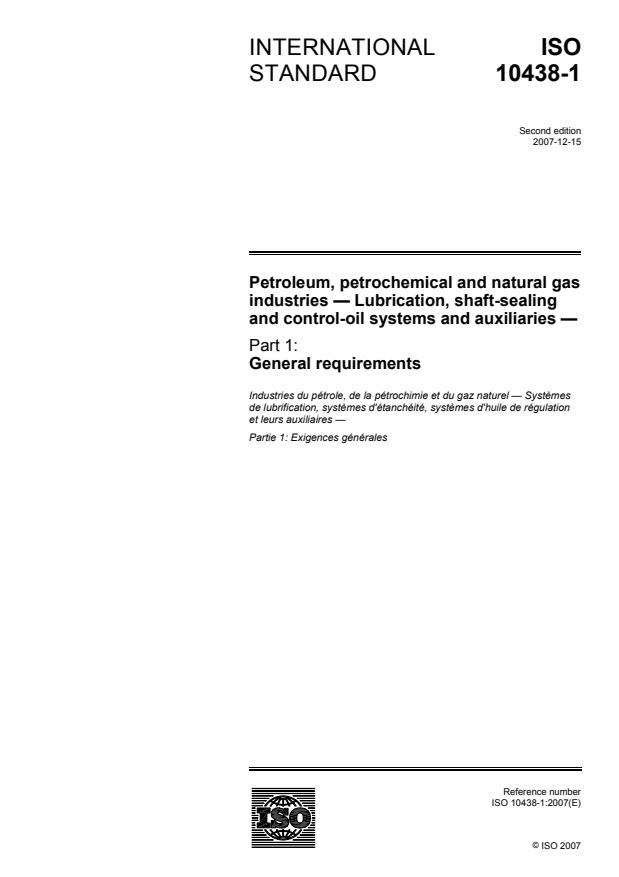
INTERNATIONAL ISO
STANDARD 10438-1
Second edition
2007-12-15
Petroleum, petrochemical and natural gas
industries — Lubrication, shaft-sealing
and control-oil systems and auxiliaries —
Part 1:
General requirements
Industries du pétrole, de la pétrochimie et du gaz naturel — Systèmes
de lubrification, systèmes d'étanchéité, systèmes d'huile de régulation
et leurs auxiliaires —
Partie 1: Exigences générales
Reference number
©
ISO 2007
PDF disclaimer
This PDF file may contain embedded typefaces. In accordance with Adobe's licensing policy, this file may be printed or viewed but
shall not be edited unless the typefaces which are embedded are licensed to and installed on the computer performing the editing. In
downloading this file, parties accept therein the responsibility of not infringing Adobe's licensing policy. The ISO Central Secretariat
accepts no liability in this area.
Adobe is a trademark of Adobe Systems Incorporated.
Details of the software products used to create this PDF file can be found in the General Info relative to the file; the PDF-creation
parameters were optimized for printing. Every care has been taken to ensure that the file is suitable for use by ISO member bodies. In
the unlikely event that a problem relating to it is found, please inform the Central Secretariat at the address given below.
© ISO 2007
All rights reserved. Unless otherwise specified, no part of this publication may be reproduced or utilized in any form or by any means,
electronic or mechanical, including photocopying and microfilm, without permission in writing from either ISO at the address below or
ISO's member body in the country of the requester.
ISO copyright office
Case postale 56 • CH-1211 Geneva 20
Tel. + 41 22 749 01 11
Fax + 41 22 749 09 47
E-mail copyright@iso.org
Web www.iso.org
Published in Switzerland
ii © ISO 2007 – All rights reserved
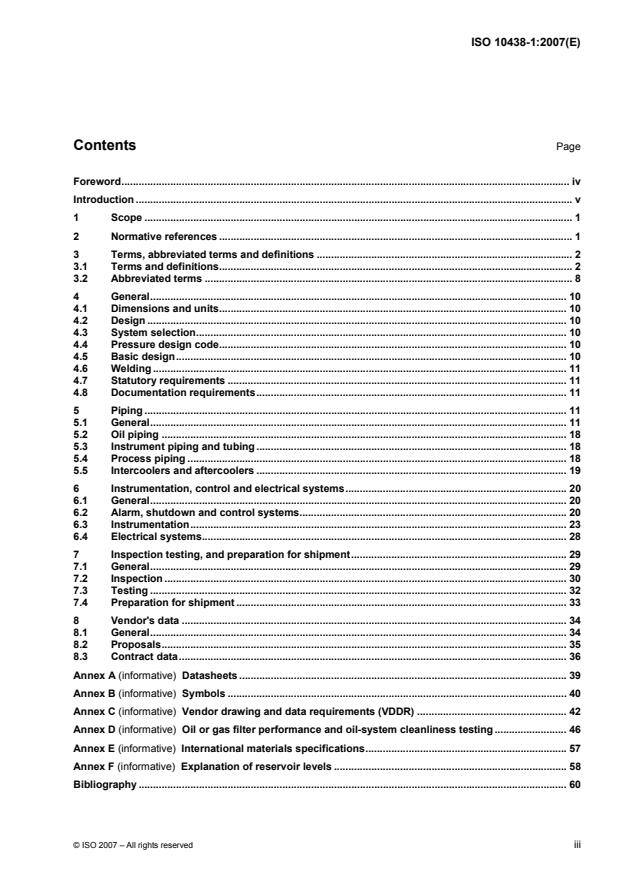
Contents Page
Foreword. iv
Introduction . v
1 Scope . 1
2 Normative references . 1
3 Terms, abbreviated terms and definitions . 2
3.1 Terms and definitions. 2
3.2 Abbreviated terms . 8
4 General. 10
4.1 Dimensions and units. 10
4.2 Design . 10
4.3 System selection. 10
4.4 Pressure design code. 10
4.5 Basic design. 10
4.6 Welding . 11
4.7 Statutory requirements . 11
4.8 Documentation requirements. 11
5 Piping . 11
5.1 General. 11
5.2 Oil piping . 18
5.3 Instrument piping and tubing . 18
5.4 Process piping . 18
5.5 Intercoolers and aftercoolers . 19
6 Instrumentation, control and electrical systems. 20
6.1 General. 20
6.2 Alarm, shutdown and control systems.20
6.3 Instrumentation. 23
6.4 Electrical systems. 28
7 Inspection testing, and preparation for shipment. 29
7.1 General. 29
7.2 Inspection . 30
7.3 Testing . 32
7.4 Preparation for shipment . 33
8 Vendor's data . 34
8.1 General. 34
8.2 Proposals. 35
8.3 Contract data. 36
Annex A (informative) Datasheets . 39
Annex B (informative) Symbols . 40
Annex C (informative) Vendor drawing and data requirements (VDDR) . 42
Annex D (informative) Oil or gas filter performance and oil-system cleanliness testing . 46
Annex E (informative) International materials specifications. 57
Annex F (informative) Explanation of reservoir levels . 58
Bibliography . 60
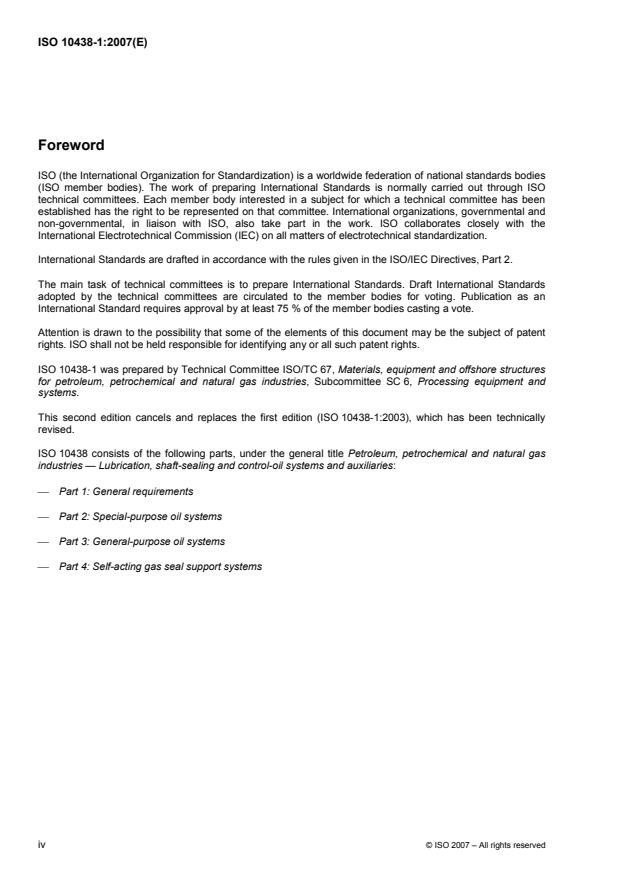
Foreword
ISO (the International Organization for Standardization) is a worldwide federation of national standards bodies
(ISO member bodies). The work of preparing International Standards is normally carried out through ISO
technical committees. Each member body interested in a subject for which a technical committee has been
established has the right to be represented on that committee. International organizations, governmental and
non-governmental, in liaison with ISO, also take part in the work. ISO collaborates closely with the
International Electrotechnical Commission (IEC) on all matters of electrotechnical standardization.
International Standards are drafted in accordance with the rules given in the ISO/IEC Directives, Part 2.
The main task of technical committees is to prepare International Standards. Draft International Standards
adopted by the technical committees are circulated to the member bodies for voting. Publication as an
International Standard requires approval by at least 75 % of the member bodies casting a vote.
Attention is drawn to the possibility that some of the elements of this document may be the subject of patent
rights. ISO shall not be held responsible for identifying any or all such patent rights.
ISO 10438-1 was prepared by Technical Committee ISO/TC 67, Materials, equipment and offshore structures
for petroleum, petrochemical and natural gas industries, Subcommittee SC 6, Processing equipment and
systems.
This second edition cancels and replaces the first edition (ISO 10438-1:2003), which has been technically
revised.
ISO 10438 consists of the following parts, under the general title Petroleum, petrochemical and natural gas
industries — Lubrication, shaft-sealing and control-oil systems and auxiliaries:
⎯ Part 1: General requirements
⎯ Part 2: Special-purpose oil systems
⎯ Part 3: General-purpose oil systems
⎯ Part 4: Self-acting gas seal support systems
iv © ISO 2007 – All rights reserved
Introduction
This part of ISO 10438 was developed jointly with API 614, 5th edition, together with the other three parts of
ISO 10438.
NOTE API 614 is equivalent to ISO 10438 (all parts).
Users of this part of ISO 10438 should be aware that further or differing requirements can be needed for
individual applications. This part of ISO 10438 is not intended to inhibit a vendor from offering, or the
purchaser from accepting, alternative equipment or engineering solutions for the individual application. This
can be particularly appropriate where there is innovative or developing technology. Where an alternative is
offered, the vendor should identify any variations from this part of ISO 10438 and provide details.
This part of ISO 10438 requires the purchaser to specify certain details and features.
A bullet (•) at the beginning of a clause or subclause indicates that either a decision is required or further
information is to be provided by the purchaser. This information should be indicated on the datasheet(s);
otherwise it should be stated in the quotation request or in the order.
In this International Standard, United States customary (USC) units are included in brackets for information.
INTERNATIONAL STANDARD ISO 10438-1:2007(E)
Petroleum, petrochemical and natural gas industries —
Lubrication, shaft-sealing and control-oil systems and
auxiliaries —
Part 1:
General requirements
1 Scope
This part of ISO 10438 specifies general requirements for lubrication systems, oil-type shaft-sealing systems,
dry-gas face-type shaft-sealing systems and control-oil systems for general- or special-purpose applications.
General-purpose applications are limited to lubrication systems. These systems can serve equipment such as
compressors, gears, pumps and drivers.
This part of ISO 10438 is intended to be used in conjunction with ISO 10438-2, ISO 10438-3 or ISO 10438-4,
as appropriate.
2 Normative references
The following referenced documents are indispensable for the application of this document. For dated
references, only the edition cited applies. For undated references, the latest edition of the referenced
document (including any amendments) applies.
ISO 7-1, Pipe threads where pressure-tight joints are made on the threads — Part 1: Dimensions, tolerances
and designation
ISO 10434, Bolted bonnet steel gate valves for the petroleum, petrochemical and allied industries
ISO 13706, Petroleum, petrochemical and natural gas industries — Air-cooled heat exchangers
ISO 15649, Petroleum and natural gas industries — Piping
ISO 15761, Steel gate, globe and check valves for sizes DN 100 and smaller, for the petroleum and natural
gas industries
ISO 16812, Petroleum, petrochemical and natural gas industries — Shell-and-tube heat exchangers
IEC 60079 (all parts), Electrical apparatus for explosive gas atmospheres
IEC 60529, Degrees of protection provided by enclosures (IP Code)
ANSI/API RP 551, Process Measurement Instrumentation
API RP 520 (all parts), Sizing, Selection, and Installation of Pressure-Relieving Devices in Refineries
API STD 526, Flanged Steel Pressure Relief Valves
API STD 611, General-Purpose Steam Turbines for Petroleum, Chemical and Gas Industry Services
API RP 686-96, Machinery Installation and Installation Design
ASME B1.1, Unified Inch Screw Threads (UN and UNR Thread Form)
ASME B16.5, Pipe Flanges and Flanged Fittings: NPS 1/2 through 24
ANSI/ASME B16.11, Forged Fittings, Socket-Welding and Threaded
ANSI/ASME Y14.2M, Line Conventions and Lettering
ASTM A193/A193M-07, Standard Specification for Alloy-Steel and Stainless Steel Bolting Materials for High
Temperature or High Pressure Service and Other Special Purpose Applications
ASTM A194/A194M-07, Standard Specification for Carbon and Alloy Steel Nuts for Bolts for High Pressure or
High Temperature Service, or Both
ASTM E94, Standard Guide for Radiographic Examination
ASTM E709, Standard Guide for Magnetic Particle Examination
ANSI/AWS D1.1/D1.1M, Structural Welding Code — Steel
ISA 18.1, Annunciator Sequences and Specifications
NEMA 250, Enclosures for Electrical Equipment (1 000 Volts Maximum)
TEMA, Standards of the Tubular Exchanger Manufacturers Association, 8th ed.
3 Terms, abbreviated terms and definitions
For the purposes of this document, the following terms, definitions and abbreviated terms apply.
3.1 Terms and definitions
3.1.1
alarm point
preset value of a parameter at which an alarm warns of a condition requiring corrective action
3.1.2
block-in time
period required after the driver is tripped to isolate a piece of equipment, such as a compressor, from its
system and to depressurize it
3.1.3
booster pump
oil pump that takes suction from the discharge of another pump to provide oil at a higher pressure
3.1.4
coast-down time
period required after the driver is tripped for the equipment to come to rest
3.1.5
components
machinery and hardware items, such as reservoirs, pumps, coolers, filters, valves, and instruments, that are
part of the system
2 © ISO 2007 – All rights reserved
3.1.6
console
total system whose components and controls are packaged as a single unit on a continuous or joined
baseplate
NOTE 1 With a console, the purchaser is required only to make external connections.
NOTE 2 Rundown tanks and seal-oil tanks that are separately mounted, as well as other items such as instrumentation
mounted on the equipment, are not part of the console.
3.1.7
continuous-flow transfer valve
valve that can simultaneously divert both inlet and outlet flows from one component to its installed spare
equipment without altering the continuity of full flow through the transfer valve to the equipment
3.1.8
control oil
oil required to operate such components as relays, servomotors and power pistons on the main equipment
3.1.9
cool-off time
period during which oil has to be circulated through the equipment to prevent heat damage after the driver is
tripped
3.1.10
device position
3.1.10.1
normally open
de-energized position of a device (e.g. automatically controlled electric switch or valve) remaining in an open
position during operation unless energized
NOTE During operation of the equipment, the positions of these devices are not necessarily the same as their
on-the-shelf positions.
3.1.10.2
normally closed
de-energized position of a device (e.g. automatically controlled electric switch or valve) remaining in a closed
position during operation unless energized
NOTE During operation of the equipment, the positions of these devices are not necessarily the same as their
on-the-shelf positions.
3.1.11
double seal
seal arrangement that utilizes two seal faces in an opposed configuration, whereby sealing gas is injected
between the seal faces
NOTE See tandem seal (3.1.49).
3.1.12
dry gas seal system
self-acting dry gas seal module and all other components necessary for operation of the self-acting dry gas
seal
3.1.13
equipment
main machinery served by the oil or gas system
3.1.14
fail safe
system or component that causes the equipment to revert to a permanently safe condition (shutdown and/or
depressurized) in the event of a component failure or failure of the energy supply to the system
3.1.15
gas-seal module
arrangement of piping, filters and instrumentation used to control and monitor the pressure or flow of seal,
buffer or separation gas to the equipment shaft end seals
3.1.16
gauge board
unenclosed bracket or plate used to support and display gauges, switches and other instruments
NOTE A gauge board is not a panel. A panel is an enclosure. Refer to 3.1.31 for the definition of a panel.
3.1.17
general-purpose
usually spared or in non-critical service
3.1.18
local
mounted on or near the equipment or console
3.1.19
mission time
duration of the mission
NOTE Mission time begins when the equipment or system is 100 % operational, i.e. equipment or system capability
has returned to engineered capability, and the equipment or system is ready for service. The mission time ends when the
equipment or system can no longer meet the defined mission objectives. To meet the business plan, it is necessary that
the actual mission time be equal to or greater than the planned mission time.
3.1.20
main oil pump
oil pump that is normally in operation
3.1.21
maximum allowable temperature
maximum continuous temperature for which the manufacturer has designed the equipment (or any part to
which the term is referred) when handling the specified fluid at the specified pressure
3.1.22
maximum allowable working pressure
maximum continuous pressure for which the manufacturer has designed the console or components when
handling the specified fluid at the maximum allowable temperature
3.1.23
maximum discharge pressure
〈centrifugal pump〉 maximum specified suction pressure plus the maximum differential pressure the pump with
the finished impeller is able to develop when operating at rated speed with fluid of the specified normal relative
density (specific gravity)
3.1.24
maximum sealing pressure
highest pressure expected at the seals during any specified static or operating conditions and during start-up
and shutdown
NOTE Considerations should include both relief valve settings and relief-valve accumulation pressure.
4 © ISO 2007 – All rights reserved
3.1.25
multiple-package
total oil supply system whose components are separated into individually packaged units
NOTE With this arrangement, the purchaser is required only to install the interconnections between the packages and
the external connections.
3.1.26
normal flow
total amount of fluid required by equipment components such as bearings, seals, couplings and steady-state
controls excluding transient flow for controls or fluid bypassed directly back to the reservoir
3.1.27
normal operating point
point at which normal operation is expected and optimum efficiency is desired
NOTE This point is usually the point at which the vendor certifies that the performance is within the tolerances stated
in the relevant standard.
3.1.28
observed
when the purchaser is notified of the timing of the inspection or test and the inspection or test is performed as
scheduled, whether or not the purchaser or his representative is present
3.1.29
owner
final recipient of the equipment, who may delegate another agent as the purchaser of the equipment
3.1.30
package
total system, or part of a system, whose components are mounted on a single baseplate
NOTE A package is complete in all respects, including controls and instrumentation.
3.1.31
panel
enclosure used to mount, display and protect gauges, switches and other instruments
NOTE Instruments in a panel may be open or enclosed by the panel. (See 3.1.16.)
3.1.32
pressure-limiting valve
PLV
automatic pressure-limiting device, which opens in proportion to the increase in pressure over the opening set
pressure and automatically closes when the upstream pressure is reduced below the set pressure, and which
is actuated by the static pressure upstream of the valve
NOTE 1 These devices are not necessarily tight shutoff when closed, i.e. they may have a small leakage flow when
closed. These devices are designed for liquid service only and are normally used for limiting the discharge pressure of
positive-displacement-type oil pumps and the downstream pressure of fail-open oil-pressure regulating valves when
necessary.
NOTE 2 PLVs require a flowing test system in order to test. Normally, these valves are, therefore, tested in the system
on which they are installed.
3.1.33
pressure safety valve
relief valve
PSV
automatic pressure-relieving device, which opens in proportion to the increase in pressure over the opening
set pressure, has a rapid full opening or pop action characteristic and is actuated by the static pressure
upstream of the valve
NOTE The device automatically closes when the upstream pressure is reduced below the set pressure. These
devices are considered to be tight shutoff when closed and are normally used in gas, vapour or liquid service.
3.1.34
purchaser
agency that issues the order and specification to the vendor
NOTE The purchaser can be the owner of the plant in which the equipment is installed or the owner's appointed
agent.
3.1.35
remote
located away from the equipment or the console, typically in a control house
3.1.36
seal buffer gas
clean gas supplied to the high-pressure side of a seal
NOTE 1 This term was originally used on oil seals and has been replaced with the term “seal gas supply” for clean gas
that also serves as the sealing gas for a dry gas seal.
NOTE 2 See ISO 10438-4:2007, Figures D.1 to D.4.
3.1.37
seal gas
dry, filtered gas supplied to the high-pressure side of a self-acting gas seal
NOTE See ISO 10438-4:2007, Figures D.1 to D.4.
3.1.38
seal gas leakage
gas that flows from the high-pressure side of the seal to the low-pressure side of the seal
3.1.39
secondary seal-gas supply
clean purge gas supplied to the area between the seals of a tandem self-acting gas seal having an
intermediate labyrinth
NOTE This gas is at a pressure lower than the process pressure.
3.1.40
self-contained regulator
regulating valve assembly that utilizes or internally senses the controlling pressure or temperature
3.1.41
separation gas
supply of inert gas or air fed into the region between the seal and the shaft bearing
3.1.42
settling-out pressure
maximum pressure the system can reach under static conditions
6 © ISO 2007 – All rights reserved
3.1.43
shaft-driven pump
oil pump driven by the shaft of one of the main machines served by the oil system
3.1.44
shutdown point
preset value of a parameter at which automatic or manual shutdown of the system is required
3.1.45
special-purpose application
application for which the equipment is designed for uninterrupted, continuous operation in critical service and
for which there is usually no spare equipment
3.1.46
standby pump
oil pump that is capable, either automatically or manually, of being immediately brought up to operating speed,
and that is capable of operating continuously
3.1.47
standby service
normally idle piece of equipment that is capable of immediate automatic or manual start-up and continuous
operation
3.1.48
stilling tube
pipe extending into the reservoir from the connection to below pump suction-loss level to prevent splashing
and provide free release of foam and gas
NOTE 1 A stilling tube is typically used for non-pressurized returns and has an open top or vent holes to equalize to
reservoir pressure.
NOTE 2 See ISO 10438-2:2007, Figure B.24.
3.1.49
tandem seal
seal arrangement which utilizes two seal faces oriented in the same direction, whereby the outboard seal face
acts as a backup seal to the inboard or primary seal face
NOTE 1 A special arrangement of this seal incorporates an intermediate labyrinth seal to allow an inert sealing gas to
be injected between the seal faces. In this arrangement, the backup or outboard seal face seals against the inert sealing
gas and is not exposed to the process gas.
NOTE 2 See double seal (3.1.11).
3.1.50
unit responsibility
responsibility for coordinating the technical aspects of the equipment and all auxiliary systems included in the
scope of the order
NOTE Responsibility for such factors as the power requirements, speed, rotation, general arrangement, couplings,
dynamics, noise, lubrication, sealing system, material test reports, instrumentation, piping and testing of components is
included.
3.1.51
vendor
supplier
agency that manufactures, sells and provides service support for the equipment
NOTE The vendor may be the manufacturer of the equipment or the manufacturer's agent and normally is
responsible for service support.
3.1.52
vent gas
seal gas leakage that is taken away by the vent system
3.1.53
vent system
arrangement of piping and valves used to take gas to a safe location
3.1.54
witnessed
inspection or test where the purchaser is notified of the timing of the inspection or test and a hold is placed on
the inspection or test until the purchaser or his representative is in attendance
3.2 Abbreviated terms
AS air supply
BWG Birmingham wire gauge
DN nominal diameter
DP differential pressure indicator
FAL flow alarm low
FC fail closed
FCV flow control valve
FE flow element
FG flow glass
FI flow indicator
FIC flow indicator controller
FL fail locked (when labelling a valve)
FO fail open (when labelling a valve)
FRO flow restriction orifice
FT flow transmitter
FY I/P (current to pneumatic) interposing relay
LC level controller
LG level gauge
LIC level indicator controller
LSH level switch high
LSHH level switch high high
LSL level switch low
8 © ISO 2007 – All rights reserved
LSLL level switch low low
LT level transmitter
LV level valve
LY level relay
NC normally closed
NDT non-destructive testing
NO normally open
NPS nominal pipe size
NPT national pipe thread (tapered)
P&ID process (piping) and instrument drawing
PCV pressure control valve
PDCV pressure differential control valve
PDI pressure differential indicator
PDS pressure differential switch
PDSH pressure differential switch high
PDSL pressure differential switch low
PDSLL pressure differential switch low low
PDT pressure differential transmitter
PI pressure indicator
PLV pressure-limiting valve
PN nominal pressure
PSH pressure switch high
PSHH pressure switch high high
PSL pressure switch low
PSLL pressure switch low low
PSV pressure safety (relief) valve
PT pressure transmitter
TC temperature controller
TCV temperature control valve
TI temperature indicator
TIC temperature indicator controller
TS temperature switch
TSH temperature switch high
TSL temperature switch low
UNC unified national coarse thread
VDDR vendor drawing and data requirements
4 General
4.1 Dimensions and units
z Drawings and maintenance dimensions shall be in SI units or United States customary (USC) units. Use of an
SI datasheet indicates that SI units shall be used. Use of an USC datasheet indicates that USC units shall be
used.
NOTE Dedicated datasheets for SI units and for USC units are provided in Annex A in each of the four parts of
ISO 10438.
4.2 Design
The term “design” shall apply solely to parameters or features of the equipment supplied by the manufacturer.
The term “design” should not be used in the purchaser's enquiry or specifications because it can create
confusion in understanding the order.
EXAMPLES Design power, design pressure, design temperature, design speed.
4.3 System selection
z 4.3.1 Annexes in ISO 10438-2, ISO 10438-3 and ISO 10438-4 provide schemas and diagrams of typical
complete lubrication, oil-type shaft-sealing, dry gas face-type shaft-sealing and control-oil systems. These
schematics and diagrams illustrate the general philosophy and requirements of this part of ISO 10438 and are
included to assist the purchaser in the selection of an appropriate system. Symbols shown on these
schematics and diagrams are identified in Annex B of this part of ISO 10438. The purchaser and the vendor
shall agree upon a mutually acceptable system before the order is released.
z 4.3.2 The purchaser shall define the scope of supply, the level of quality or the brand of components, the
system type, the general arrangement (including plan and elevation views of the console orientation), the
space available for the console, the service (special purpose or general purpose) and other requirements.
Annexes C and D of this part of ISO 10438 are intended to assist in this definition.
4.4 Pressure design code
z The pressure design code shall be specified or agreed by the purchaser. Pressure components shall comply
with the pressure design code and the supplementary requirements in this part of ISO 10438.
4.5 Basic design
4.5.1 Equipment shall be designed for installation in accordance with API 686.
z 4.5.2 The equipment, including all auxiliaries, shall be suitable for operation under the environmental
conditions specified. These conditions shall include whether the installation is indoors (heated or unheated) or
outdoors (with or without a roof), maximum and minimum temperatures, unusual humidity, and dusty or
corrosive conditions.
10 © ISO 2007 – All rights reserved
4.5.3 The equipment, including all auxiliaries, shall be suitable for operation, using the utility stream
conditions specified.
4.5.4 Spare and replacement parts shall meet all the criteria of the furnished system.
4.5.5 The vendor shall assume unit responsibility for all equipment and all auxiliary systems included in the
scope of the order.
4.5.6 Where drilled check valves are provided, they shall be labelled with stainless steel tags stamped
indicating that they are drilled and the size of the drilled hole.
NOTE Drilled check valves are sometimes utilized with shaft-driven pumps or atmospheric rundown tanks.
4.5.7 The purchaser and the vendor shall mutually determine the measures that shall be taken to comply
with any governmental codes, regulations, ordinances or rules that are applicable to the equipment.
It is recommended that this be done as early as possible and preferably in the inquiry stage.
4.6 Welding
4.6.1 Welding of piping and pressure-containing parts, as well as any dissimilar-metal welds and weld
repairs, shall be performed and inspected by operators and procedures qualified in accordance with the
pressure design code or the piping system design code as appropriate.
z 4.6.2 In addition to the requirements of 4.6.1 and the applicable piping code, the purchaser may specify that
additional radiography, magnetic particle inspection or liquid-penetrant inspection of specific welds on
equipment and/or piping is required.
NOTE 1 ISO 15649 already includes a level of NDT inspection for piping.
NOTE 2 ISO 10438-3 systems do not require radiography of piping (see ISO 10438-3:2007, 5.1.2).
4.6.3 All welding other than that covered by the pressure design code or the piping systems design code
such as welding on baseplates, non-pressure ducting, lagging and control panels shall be in accordance with
a structural welding standard such as AWS D1.1, unless otherwise specified.
4.7 Statutory requirements
The purchaser and the vendor shall mutually determine the measures to be taken to comply with any
governmental codes, regulations, ordinances or rules that are applicable to the equipment, its packaging and
any preservatives used.
4.8 Documentation requirements
The hierarchy of documents shall be specified.
NOTE Typical documents include company and industry specifications, meeting notes and modifications to these
documents.
5 Piping
5.1 General
5.1.1 Piping design and joint fabrication examination and inspection shall comply with ISO 15649.
NOTE 1 ISO 15649 includes ASME B31.3 as a normative reference, and for the purposes of this part of ISO 10438,
the provisions are identical. See also CEN/TR 14549.
NOTE 2 The alphanumeric designation of size used for reference purposes for components of a pipework system,
when using the DN system, comprises the letters DN followed by a dimensionless whole number that is indirectly related
to the nominal physical size in millimetres. The number following the letters DN does not represent a measurable value
and it is not appropriate that they be used for calculation purposes except where specified in the relevant standard.
NOTE 3 The alphanumeric designation relating to pressure used for reference purposes for components of a pipework
system, when using the PN system, comprises the letters PN followed by a convenient round, dimensionless number. For
further information, see ISO 7268.
NOTE 4 It is intended that all equipment of the same nominal size (DN) designated by the same PN number have the
same mating dimensions appropriate to the type of end connections.
The permissible working pressure depends upon the materials, design and working temperature and shall be
selected from the pressure/temperature rating tables in corresponding standards.
5.1.2 Auxiliary systems are defined as piping systems that are in the following services:
a) Group I, Auxiliary process fluids (see Table 1):
1) sealing fluid,
2) gland and flushing fluid,
3) recirculation fluid,
4) balance gas,
5) buffer gas,
6) fuel gas or oil,
7) drains and vents associated with group I systems,
8) starting gas,
9) separation gas,
10) solvents injection;
b) Group II, Steam and air (see Table 2):
1) sealing steam,
2) steam injection,
3) water injection,
4) starting air,
5) instrument and control air,
6) drains and vents associated with group II systems;
c) Group III, Cooling water (see Table 3):
1) cooling water,
2) liquid wash (water based),
3) drains and vents associated with group III systems;
12 © ISO 2007 – All rights reserved
d) Group IV, Lubricating, control and seal oil (see Table 4):
1) lubricating oil,
2) control oil,
3) seal oil (see 5.4 for seal oil contaminated with process fluid),
4) drains and vents associated with group IV systems.
Auxiliary systems shall comply with the requirements of Tables 1 through 6, except as modified in referencing
standards, including references to Tables 1 through 6 in ISO 10438-2, ISO 10438-3 and ISO 10438-4.
NOTE Casing connections are covered in the associated equipment standards.
Table 1 — Minimum requirements for piping materials — Auxiliary process fluid
Pipe Austenitic stainless steel, (e.g. ASTM A312 type 304 or 316 or the equivalent material designation
located in Annex E). Seamless, except Schedule 10S and 40S may be electric fusion welded.
Seamless carbon steel (e.g. ASTM A106-B, A53-B or the equivalent material designation located in
Annex E)
Pipe fitting Austenitic stainless steel, (e.g. ASTM A403 or the equivalent material designation located in
Annex E, type 304 or 316 stainless steel). Seamless, except Schedule 10S and 40S may be
electric fusion welded. Austenitic stainless steel, (e.g. ASTM A182 type 304 or 316 or the
equivalent material designation located in Annex E), class 3000. Seamless carbon steel (e.g.
ASTM A234 or the equivalent material designation located in Annex E). Carbon steel, (e.g.
ASTM A105 or the equivalent material designation located in Annex E), class 3000
Flange Austenitic stainless steel, (e.g. ASTM A182 type 304 or 316 or the equivalent code material
designation located in Annex E) weld neck or slip-on. Carbon steel (e.g. ASTM A105) or the
equivalent material designation located in Annex E, weld neck or slip-on
Tubing Stainless steel, (ASTM A269 type 304 or 316 or the equivalent material designation located in
Annex E)
Tube fittings Austenitic stainless steel type 304 or 316 (vendor's standard with purchaser's approval)
Gaskets For less than or equal to ANSI class 300: flat, non-asbestos type
For greater than or equal to ANSI class 600: spiral wound with non-asbestos filler, 304 or 316
windings and external centring ring
Flange bolting Refer to 5.1.28 and 5.1.29.
Valves Refer to 5.1.22, 5.1.23 and 5.1.24.
NOTE Threaded joints require seal welding; however, seal welding is not permitted on instruments or where disassembly is
required for maintenance.
Table 2 — Minimum requirements for piping materials — Steam and air
Pipe Seamless, carbon steel (e.g. ASTM A106-B, A53-B) or the equivalent material designation located
in Annex E
Pipe fitting Seamless, carbon steel (e.g. ASTM A234 or the equivalent material designation located in
Annex E)
Carbon steel (e.g. ASTM A105 class 3000 or the equivalent material designation located in
Annex E)
Flange Carbon steel (e.g. ASTM A105 or the equivalent material designation located in Annex E), weld
neck or slip-on
Tubing Stainless steel (e.g. ASTM A269 or the equivalent material designation located in Annex E),
type 304 or 316
Tube fittings Stainless steel type 304 or 316 (vendor's standard)
Gaskets For less than or equal to ANSI class 300: flat, non-asbestos type
For greater than or equal to ANSI class 600: spiral wound with non-asbestos filler, 304 or 316
windings and external centring ring
Flange bolting Refer to 5.1.28 and 5.1.29.
Valves Refer to 5.1.22, 5.1.23 and 5.1.24.
Table 3 — Minimum requirements for piping materials — Cooling water
Pipe Carbon steel (e.g. ASTM A106-B & A53-B or the equivalent material designation located in
Annex E), seamless
Pipe fitting Carbon steel (e.g. ASTM A234 or the equivalent material designation located in Annex E),
seamless
Carbon steel (e.g. ASTM A105 or the material designation located in Annex E), class 3000
Flange Carbon steel (e.g. ASTM A105 or the equivalent material designation located in Annex E), weld
neck or slip-on
Tubing Stainless steel (e.g. ASTM A269 or the equivalent material designation located in Annex E),
type 304 or 316
Tube fittings Stainless steel type 304 or 316 (vendor's standard)
Gaskets Flat, non-asbestos type
Flange bolting Refer to 5.1.28 and 5.1.29.
Valves Refer to 5.1.22, 5.1.23 and 5.1.24.
14 © ISO 2007 – All rights reserved
Table 4 — Minimum requirements for piping materials — Lubricating, control and seal oil
Pipe Stainless steel (e.g. ASTM A312 type 304 or 316 or the equivalent material designation located in
Annex E). Seamless, except Schedule 10S and 40S may be electric fusion welded.
Pipe fitting Stainless steel (e.g. ASTM A403 type 304 or 316 stainless steel or the equivalent material
designation located in Annex E). Seamless, except Schedule 10S and 40S may be electric fusion
welded.
Stainless steel (e.g. ASTM A182 type 304 or 316 stainless steel or the equivalent material
designation located in Annex E), class 3000. Socket weld fittings are prohibited.
Flange Stainless steel (e.g. ASTM A181 type 304 or 316 stainless steel or the equivalent material
designation located in Annex E), weld neck or slip-on. Socket weld flanges are prohibited.
Carbon steel (e.g. ASTM A105 or the equivalent material designation located in Annex E), slip-on
Tubing Stainless steel (e.g. ASTM A269 type 304 or 316 stainless steel or the equivalent material
designation located in Annex E)
Tube fittings Stainless steel type 304 or 316 (vendor's standard with purchasers approval)
Gaskets For less than or equal to ANSI class 300: flat, non-asbestos type
For greater than or equal to ANSI class 600: spiral wound with non-asbestos filler, 304 or 316
windings and external centring ring
Flange bolting Refer to 5.1.28 and 5.1.29.
Valves Refer to 5.1.22, 5.1.23 and 5.1.24.
NOTE Threaded joints require seal welding; however, seal welding is not permitted on instruments or where disassembly is
required for maintenance.
Table 5 — Minimum pipe wall thicknesses
Nominal pipe size minimum
Materials
DN in Schedule
Carbon steel DN 40 (u11/2) 80
Carbon steel DN 50 to 200 (2 to 8) 40
Carbon steel DN 200 (W8) 20
Stainless steel DN 25 (u1) 80S
Stainless steel DN 40 to 75 (11/2 to 3) 40S
Stainless steel DN 100 (W4) 10S
Table 6 — Minimum tubing wall thicknesses
a
Nominal tubing size Minimum wall thickness
mm in mm in
b
6 (1/4) 1,0 0.035
b
10 (3/8) 1,0 0.035
12 (1/2) 1,5 0.065
20 (3/4) 2,0 0.095
25 (1) 2,6 0.109
a
The tubing size is the outside diameter.
b
The sizes 6 mm (1/4 in) and 10 mm (3/8 in) are permitted for instrument and control air
only.
5.1.3 Piping systems shall include piping, isolating valves, control valves, relief valves, pressure reducers,
orifices, temperature gauges and thermowells, pressure gauges, sight flow indicators and related vents and
drains.
z 5.1.4 The vendor shall furnish all piping systems, including mounted appurtenances, located within the
confines of the main unit's base area, any oil console base area or any auxiliary base area. The piping shall
terminate with flanged connections at the edge of the base. When soleplates are specified for the equipment
train, the extent of the piping system at the equipment train shall be defined by the purchaser. The purchaser
shall furnish only interconnecting piping between equipment groupings and off-base facilities.
5.1.5 The design of piping systems shall achieve the following:
a) proper support and protection to prevent damage from vibration or from shipment, operation and
maintenance;
b) proper flexibility and normal accessibility for operation, maintenance and thor
...
INTERNATIONAL ISO
STANDARD 10438-1
Second edition
2007-12-15
Petroleum, petrochemical and natural gas
industries — Lubrication, shaft-sealing
and control-oil systems and auxiliaries —
Part 1:
General requirements
Industries du pétrole, de la pétrochimie et du gaz naturel — Systèmes
de lubrification, systèmes d'étanchéité, systèmes d'huile de régulation
et leurs auxiliaires —
Partie 1: Exigences générales
Reference number
©
ISO 2007
PDF disclaimer
PDF files may contain embedded typefaces. In accordance with Adobe's licensing policy, such files may be printed or viewed but shall
not be edited unless the typefaces which are embedded are licensed to and installed on the computer performing the editing. In
downloading a PDF file, parties accept therein the responsibility of not infringing Adobe's licensing policy. The ISO Central Secretariat
accepts no liability in this area.
Adobe is a trademark of Adobe Systems Incorporated.
Details of the software products used to create the PDF file(s) constituting this document can be found in the General Info relative to
the file(s); the PDF-creation parameters were optimized for printing. Every care has been taken to ensure that the files are suitable for
use by ISO member bodies. In the unlikely event that a problem relating to them is found, please inform the Central Secretariat at the
address given below.
This CD-ROM contains
1) the publication ISO 10438-1:2007 (including the datasheets) in portable document format (PDF),
which can be viewed using Adobe® Acrobat® Reader, and
2) a separate folder (electronic inserts) containing the datasheets (in either SI or USC units).
Adobe and Acrobat are trademarks of Adobe Systems Incorporated.
This second edition cancels and replaces the first edition (ISO 10438-1:2003), which has been technically
revised.
© ISO 2007
All rights reserved. Unless otherwise specified, no part of this CD-ROM may be reproduced, stored in a retrieval system or transmitted in
any form or by an
...
NORME ISO
INTERNATIONALE 10438-1
Deuxième édition
2007-12-15
Industries du pétrole, de la pétrochimie et
du gaz naturel — Systèmes de
lubrification, systèmes d'étanchéité,
systèmes d'huile de régulation et leurs
auxiliaires —
Partie 1:
Exigences générales
Petroleum, petrochemical and natural gas industries — Lubrication,
shaft-sealing and control-oil systems and auxiliaries —
Part 1: General requirements
Numéro de référence
©
ISO 2007
PDF – Exonération de responsabilité
Les fichiers PDF peuvent contenir des polices de caractères intégrées. Conformément aux conditions de licence d'Adobe, ils peuvent
être imprimés ou visualisés, mais ne doivent pas être modifiés à moins que l'ordinateur employé à cet effet ne bénéficie d'une licence
autorisant l'utilisation de ces polices et que celles-ci y soient installées. Lors du téléchargement de fichiers PDF, les parties
concernées acceptent de fait la responsabilité de ne pas enfreindre les conditions de licence d'Adobe. Le Secrétariat central de l'ISO
décline toute responsabilité en la matière.
Adobe est une marque déposée d'Adobe Systems Incorporated.
Les détails relatifs aux produits logiciels utilisés pour la création du ou des fichiers PDF qui constituent cette publication sont
disponibles dans la rubrique General Info des fichiers; les paramètres de création PDF ont été optimisés pour l'impression. Toutes les
mesures ont été prises pour garantir l'exploitation de ces fichiers par les comités membres de l'ISO. Dans le cas peu probable où
surviendrait un problème d'utilisation, veuillez en informer le Secrétariat central à l'adresse donnée ci-dessous.
Le présent CD-ROM contient:
1) la publication ISO 10438-1:2007 au format PDF (portable document format), qui peut être visualisée
en utilisant Adobe® Acrobat® Reader;
2) un fichier séparé (encart électronique) contenant les feuilles de données en anglais (en unités SI ou
USC).
Adobe et Acrobat sont des marques déposées de Adobe Systems Incorporated.
Cette deuxième édition annule et remplace la première édition (ISO 10438-1:2003), qui a fait l'objet d'une
révision technique.
DOCUMENT PROTÉGÉ PAR COPYRIGHT
© ISO 2007
Tous droits réservés. Sauf exigence particulière d'installation et sauf stipulation contraire, aucune partie de ce CD-ROM ne peut être
reproduite, enregistrée dans un système d'extraction ou transmise, sous quelque forme q
...