

ISO 21028-1:2016
(Main)Cryogenic vessels — Toughness requirements for materials at cryogenic temperature — Part 1: Temperatures below -80 degrees C
General Information
- Abstract
ISO 21028-1:2016 specifies the toughness requirements of metallic materials for use at a temperature below -80 °C to ensure their suitability for cryogenic vessels. ISO 21028-1:2016 is not applicable to unalloyed steels and cast materials.
- Status
- Withdrawn
- Publication Date
- 19-Sep-2016
- Technical Committee
- ISO/TC 220 - Cryogenic vessels
- Drafting Committee
- ISO/TC 220/WG 1 - Design and construction
- Current Stage
- 9599 - Withdrawal of International Standard
- Start Date
- 23-Sep-2026
- Completion Date
- 26-Sep-2026
Buy Documents
ISO 21028-1:2016 - Cryogenic vessels -- Toughness requirements for materials at cryogenic temperature

ISO 21028-1:2016 - Cryogenic vessels — Toughness requirements for materials at cryogenic temperature — Part 1: Temperatures below -80 degrees C/20/2016
ISO 21028-1:2016 - Récipients cryogéniques -- Exigences de ténacité pour les matériaux à température cryogénique
ISO 21028-1:2016 - Récipients cryogéniques — Exigences de ténacité pour les matériaux à température cryogénique — Partie 1: Températures inférieures à -80 degrés C/20/2016
Overview
ISO 21028-1:2016 - "Cryogenic vessels - Toughness requirements for materials at cryogenic temperature - Part 1: Temperatures below −80 °C" specifies toughness criteria and test requirements for metallic materials intended for service below −80 °C. It defines when impact testing is required, minimum acceptance levels for steels, specimen size and location, and acceptance/retest rules. Unalloyed steels and cast materials are excluded.
Key topics and requirements
- Scope: Applies to metallic materials for cryogenic vessels at temperatures < −80 °C; excludes unalloyed steels and cast materials.
- Toughness verification: Material producers or vessel manufacturers must guarantee toughness or verify it by impact testing per the standard.
- Steels - minimum values:
- Ferritic steels: 34 J/cm² (corresponds to 27 J for full-size specimen)
- Austenitic steels: 40 J/cm² (corresponds to 32 J for full-size specimen)
- Minimum lateral expansion: 0.38 mm
- Lower-temperature service (colder than −196 °C):
- Base metal, HAZ and weld metal must be tested.
- Testing at −196 °C is acceptable provided either:
- 48 J/cm² minimum, or
- 40 J/cm² if welding procedure tests show similar values at the lower temperature, or
- 0.53 mm lateral expansion.
- Aluminium and copper alloys: Generally have sufficient low‑temperature toughness; impact testing is not required (references: ISO 6361 series, EN standards).
- Specimen and test rules:
- Standard test cross-section 10 × 10 mm V‑notched (reduced sections allowed for thickness 5–10 mm per ISO 148‑1).
- No impact testing on plates < 5 mm thickness.
- Orientation: specimens taken transverse to rolling and parallel to rolling direction (notch perpendicular to plate surface).
- Weld and HAZ test piece locations:
- e ≤ 10 mm: 3 from weld centre + 3 from HAZ (6 total)
- 10 < e ≤ 20 mm: 3 weld + 3 HAZ (6 total)
- e > 20 mm: two sets of 3 from upper and lower surfaces (12 total)
- Acceptance criteria:
- Minimums are averages of three specimens; single value may be as low as 70% of specified value.
- Failed initial series may require a second series of three; combined acceptance rules apply (average of six ≥ min; max two values below min).
Applications and users
- Who uses it: Designers, material suppliers, vessel manufacturers, welding engineers, QA/QC inspectors, and regulatory bodies involved in cryogenic storage and transport (LNG, industrial gases, laboratory cryostats).
- Why use it: To ensure materials and welded joints maintain adequate toughness at cryogenic temperatures, reduce brittle fracture risk, and comply with product or regulatory standards for cryogenic vessels.
Related standards
- ISO 148-1 (Charpy impact test method)
- ISO 6361 series (wrought aluminium)
- EN 10028‑4 / EN 10028‑7 (steel for pressure purposes)
- EN 1652 / EN 1653 / EN 1981 / EN 12163 (copper/copper alloys)
- ASME BPVC Section II (materials)
Keywords: ISO 21028-1:2016, cryogenic vessels, toughness requirements, impact test, weld testing, minimum working temperature, cryogenic materials.
Relations
- Effective Date
- 25-Aug-2026
- Effective Date
- 25-Aug-2026
- Referred By
EN ISO 24490:2025 - Cryogenic vessels - Centrifugal pumps for cryogenic service (ISO 24490:2025) - Effective Date
- 13-Feb-2026
- Effective Date
- 12-Feb-2026
- Effective Date
- 18-Jun-2022
- Effective Date
- 06-Jul-2013
Buy Documents
ISO 21028-1:2016 - Cryogenic vessels -- Toughness requirements for materials at cryogenic temperature
ISO 21028-1:2016 - Cryogenic vessels — Toughness requirements for materials at cryogenic temperature — Part 1: Temperatures below -80 degrees C/20/2016
ISO 21028-1:2016 - Récipients cryogéniques -- Exigences de ténacité pour les matériaux à température cryogénique
ISO 21028-1:2016 - Récipients cryogéniques — Exigences de ténacité pour les matériaux à température cryogénique — Partie 1: Températures inférieures à -80 degrés C/20/2016
Get Certified
Connect with accredited certification bodies for this standard

Institut za varilstvo d.o.o. (Welding Institute)
Slovenia's leading welding institute since 1952. ISO 3834, EN 1090, pressure equipment certification, NDT personnel, welder qualification. Only IIW Au
Sponsored listings
Frequently Asked Questions
ISO 21028-1:2016 is a standard published by the International Organization for Standardization (ISO). Its full title is "Cryogenic vessels — Toughness requirements for materials at cryogenic temperature — Part 1: Temperatures below -80 degrees C". This standard covers: ISO 21028-1:2016 specifies the toughness requirements of metallic materials for use at a temperature below -80 °C to ensure their suitability for cryogenic vessels. ISO 21028-1:2016 is not applicable to unalloyed steels and cast materials.
ISO 21028-1:2016 specifies the toughness requirements of metallic materials for use at a temperature below -80 °C to ensure their suitability for cryogenic vessels. ISO 21028-1:2016 is not applicable to unalloyed steels and cast materials.
ISO 21028-1:2016 is classified under the following ICS (International Classification for Standards) categories: 23.020.40 - Cryogenic vessels. The ICS classification helps identify the subject area and facilitates finding related standards.
ISO 21028-1:2016 has the following relationships with other standards: It is inter standard links to EN ISO 21012:2018, EN ISO 21012:2024, EN ISO 24490:2025, EN ISO 21028-1:2016, ISO 21028-1:2026, ISO 21028-1:2004. Understanding these relationships helps ensure you are using the most current and applicable version of the standard.
ISO 21028-1:2016 is available in PDF format for immediate download after purchase. The document can be added to your cart and obtained through the secure checkout process. Digital delivery ensures instant access to the complete standard document.
Standards Content (Sample)
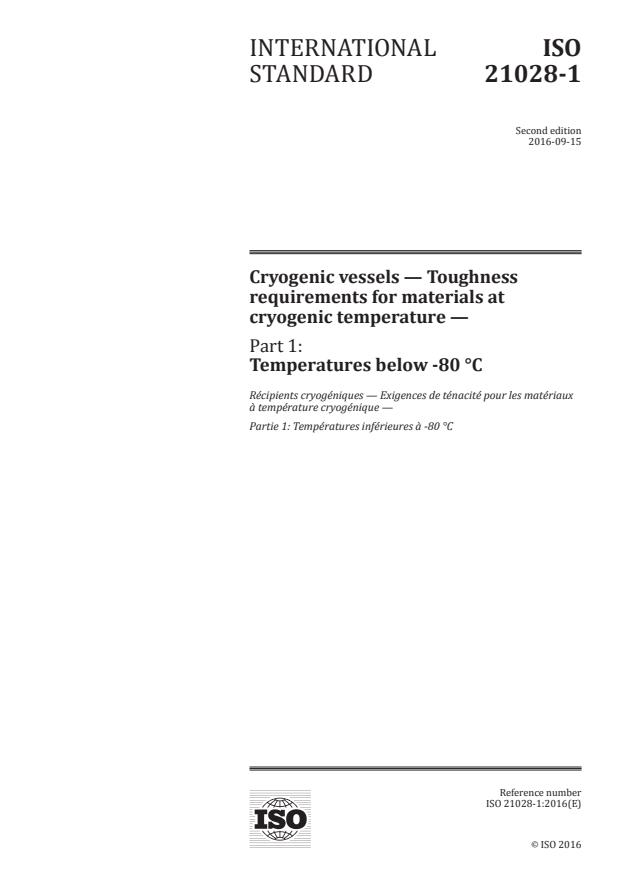
INTERNATIONAL ISO
STANDARD 21028-1
Second edition
2016-09-15
Cryogenic vessels — Toughness
requirements for materials at
cryogenic temperature —
Part 1:
Temperatures below -80 °C
Récipients cryogéniques — Exigences de ténacité pour les matériaux
à température cryogénique —
Partie 1: Températures inférieures à -80 °C
Reference number
©
ISO 2016
© ISO 2016, Published in Switzerland
All rights reserved. Unless otherwise specified, no part of this publication may be reproduced or utilized otherwise in any form
or by any means, electronic or mechanical, including photocopying, or posting on the internet or an intranet, without prior
written permission. Permission can be requested from either ISO at the address below or ISO’s member body in the country of
the requester.
ISO copyright office
Ch. de Blandonnet 8 • CP 401
CH-1214 Vernier, Geneva, Switzerland
Tel. +41 22 749 01 11
Fax +41 22 749 09 47
copyright@iso.org
www.iso.org
ii © ISO 2016 – All rights reserved
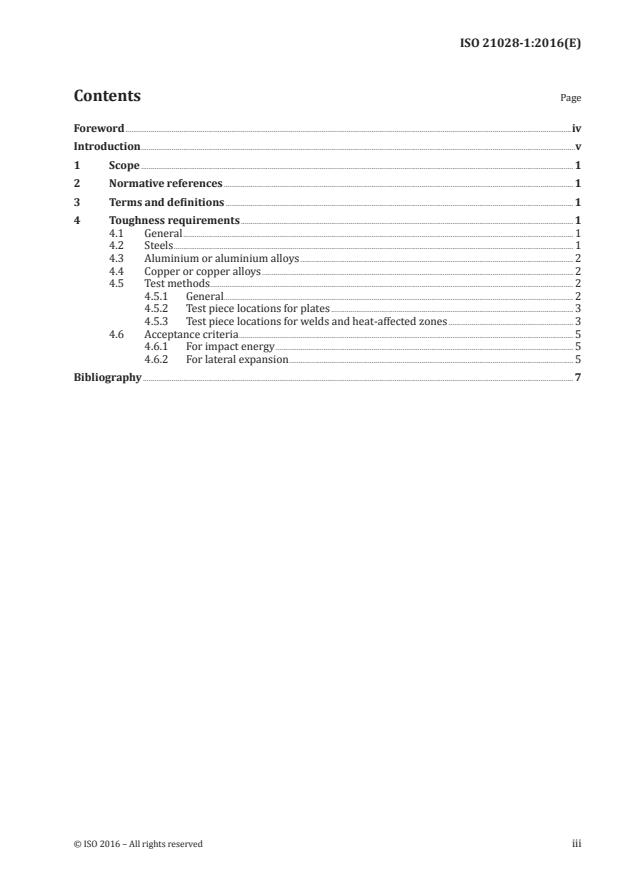
Contents Page
Foreword .iv
Introduction .v
1 Scope . 1
2 Normative references . 1
3 Terms and definitions . 1
4 Toughness requirements . 1
4.1 General . 1
4.2 Steels . 1
4.3 Aluminium or aluminium alloys . 2
4.4 Copper or copper alloys . 2
4.5 Test methods . 2
4.5.1 General. 2
4.5.2 Test piece locations for plates . 3
4.5.3 Test piece locations for welds and heat-affected zones . 3
4.6 Acceptance criteria . 5
4.6.1 For impact energy . 5
4.6.2 For lateral expansion . 5
Bibliography . 7
Foreword
ISO (the International Organization for Standardization) is a worldwide federation of national standards
bodies (ISO member bodies). The work of preparing International Standards is normally carried out
through ISO technical committees. Each member body interested in a subject for which a technical
committee has been established has the right to be represented on that committee. International
organizations, governmental and non-governmental, in liaison with ISO, also take part in the work.
ISO collaborates closely with the International Electrotechnical Commission (IEC) on all matters of
electrotechnical standardization.
The procedures used to develop this document and those intended for its further maintenance are
described in the ISO/IEC Directives, Part 1. In particular the different approval criteria needed for the
different types of ISO documents should be noted. This document was drafted in accordance with the
editorial rules of the ISO/IEC Directives, Part 2 (see www.iso.org/directives).
Attention is drawn to the possibility that some of the elements of this document may be the subject of
patent rights. ISO shall not be held responsible for identifying any or all such patent rights. Details of
any patent rights identified during the development of the document will be in the Introduction and/or
on the ISO list of patent declarations received (see www.iso.org/patents).
Any trade name used in this document is information given for the convenience of users and does not
constitute an endorsement.
For an explanation on the meaning of ISO specific terms and expressions related to conformity assessment,
as well as information about ISO’s adherence to the World Trade Organization (WTO) principles in the
Technical Barriers to Trade (TBT) see the following URL: www.iso.org/iso/foreword.html.
The committee responsible for this document is ISO/TC 220, Cryogenic vessels.
This second edition cancels and replaces the first edition (ISO 21028-1:2004), which has been
technically revised.
ISO 21028 consists of the following parts, under the general title Cryogenic vessels — Toughness
requirements for materials at cryogenic temperature:
— Part 1: Temperatures below -80 °C
— Part 2: Temperatures between -80 °C and -20 °C
iv © ISO 2016 – All rights reserved
Introduction
The use of materials at low temperatures entails special problems which are to be addressed.
Consideration is to be given, in particular, to changes in mechanical characteristics, expansion and
contraction phenomena and the thermal conduction of the various materials. Austenitic stainless steel
can transform from the austenitic to the martensitic phase when cooled down, leading to dimensional
change that needs to be considered during design.
However, the most important property to be considered is material toughness at low temperatures.
INTERNATIONAL STANDARD ISO 21028-1:2016(E)
Cryogenic vessels — Toughness requirements for materials
at cryogenic temperature —
Part 1:
Temperatures below -80 °C
1 Scope
This part of ISO 21028 specifies the toughness requirements of metallic materials for use at a
temperature below -80 °C to ensure their suitability for cryogenic vessels.
This part of ISO 21028 is not applicable to unalloyed steels and cast materials.
2 Normative references
The following documents are referred to in the text in such a way that some or all of their content
constitutes requirements of this document. For dated references, only the edition cited applies. For
undated references, the latest edition of the referenced document (including any amendments) applies.
There are no normative references in this document.
3 Terms and definitions
For the purposes of this document, the following terms and definitions apply.
3.1
minimum working temperature
lowest temperature likely to be reached by the vessel or by one of the vessel components during
operation
4 Toughness requirements
4.1 General
The toughness of the materials used shall be either guaranteed by the material produce
...
INTERNATIONAL ISO
STANDARD 21028-1
Second edition
2016-09-15
Cryogenic vessels — Toughness
requirements for materials at
cryogenic temperature —
Part 1:
Temperatures below -80 °C
Récipients cryogéniques — Exigences de ténacité pour les matériaux
à température cryogénique —
Partie 1: Températures inférieures à -80 °C
Reference number
©
ISO 2016
© ISO 2016, Published in Switzerland
All rights reserved. Unless otherwise specified, no part of this publication may be reproduced or utilized otherwise in any form
or by any means, electronic or mechanical, including photocopying, or posting on the internet or an intranet, without prior
written permission. Permission can be requested from either ISO at the address below or ISO’s member body in the country of
the requester.
ISO copyright office
Ch. de Blandonnet 8 • CP 401
CH-1214 Vernier, Geneva, Switzerland
Tel. +41 22 749 01 11
Fax +41 22 749 09 47
copyright@iso.org
www.iso.org
ii © ISO 2016 – All rights reserved
Contents Page
Foreword .iv
Introduction .v
1 Scope . 1
2 Normative references . 1
3 Terms and definitions . 1
4 Toughness requirements . 1
4.1 General . 1
4.2 Steels . 1
4.3 Aluminium or aluminium alloys . 2
4.4 Copper or copper alloys . 2
4.5 Test methods . 2
4.5.1 General. 2
4.5.2 Test piece locations for plates . 3
4.5.3 Test piece locations for welds and heat-affected zones . 3
4.6 Acceptance criteria . 5
4.6.1 For impact energy . 5
4.6.2 For lateral expansion . 5
Bibliography . 7
Foreword
ISO (the International Organization for Standardization) is a worldwide federation of national standards
bodies (ISO member bodies). The work of preparing International Standards is normally carried out
through ISO technical committees. Each member body interested in a subject for which a technical
committee has been established has the right to be represented on that committee. International
organizations, governmental and non-governmental, in liaison with ISO, also take part in the work.
ISO collaborates closely with the International Electrotechnical Commission (IEC) on all matters of
electrotechnical standardization.
The procedures used to develop this document and those intended for its further maintenance are
described in the ISO/IEC Directives, Part 1. In particular the different approval criteria needed for the
different types of ISO documents should be noted. This document was drafted in accordance with the
editorial rules of the ISO/IEC Directives, Part 2 (see www.iso.org/directives).
Attention is drawn to the possibility that some of the elements of this document may be the subject of
patent rights. ISO shall not be held responsible for identifying any or all such patent rights. Details of
any patent rights identified during the development of the document will be in the Introduction and/or
on the ISO list of patent declarations received (see www.iso.org/patents).
Any trade name used in this document is information given for the convenience of users and does not
constitute an endorsement.
For an explanation on the meaning of ISO specific terms and expressions related to conformity assessment,
as well as information about ISO’s adherence to the World Trade Organization (WTO) principles in the
Technical Barriers to Trade (TBT) see the following URL: www.iso.org/iso/foreword.html.
The committee responsible for this document is ISO/TC 220, Cryogenic vessels.
This second edition cancels and replaces the first edition (ISO 21028-1:2004), which has been
technically revised.
ISO 21028 consists of the following parts, under the general title Cryogenic vessels — Toughness
requirements for materials at cryogenic temperature:
— Part 1: Temperatures below -80 °C
— Part 2: Temperatures between -80 °C and -20 °C
iv © ISO 2016 – All rights reserved
Introduction
The use of materials at low temperatures entails special problems which are to be addressed.
Consideration is to be given, in particular, to changes in mechanical characteristics, expansion and
contraction phenomena and the thermal conduction of the various materials. Austenitic stainless steel
can transform from the austenitic to the martensitic phase when cooled down, leading to dimensional
change that needs to be considered during design.
However, the most important property to be considered is material toughness at low temperatures.
INTERNATIONAL STANDARD ISO 21028-1:2016(E)
Cryogenic vessels — Toughness requirements for materials
at cryogenic temperature —
Part 1:
Temperatures below -80 °C
1 Scope
This part of ISO 21028 specifies the toughness requirements of metallic materials for use at a
temperature below -80 °C to ensure their suitability for cryogenic vessels.
This part of ISO 21028 is not applicable to unalloyed steels and cast materials.
2 Normative references
The following documents are referred to in the text in such a way that some or all of their content
constitutes requirements of this document. For dated references, only the edition cited applies. For
undated references, the latest edition of the referenced document (including any amendments) applies.
There are no normative references in this document.
3 Terms and definitions
For the purposes of this document, the following terms and definitions apply.
3.1
minimum working temperature
lowest temperature likely to be reached by the vessel or by one of the vessel components during
operation
4 Toughness requirements
4.1 General
The toughness of the materials used shall be either guaranteed by the material produce
...
NORME ISO
INTERNATIONALE 21028-1
Deuxième édition
2016-09-15
Récipients cryogéniques — Exigences
de ténacité pour les matériaux à
température cryogénique —
Partie 1:
Températures inférieures à -80 °C
Cryogenic vessels — Toughness requirements for materials at
cryogenic temperature —
Part 1: Temperatures below -80 degrees C
Numéro de référence
©
ISO 2016
DOCUMENT PROTÉGÉ PAR COPYRIGHT
© ISO 2016, Publié en Suisse
Droits de reproduction réservés. Sauf indication contraire, aucune partie de cette publication ne peut être reproduite ni utilisée
sous quelque forme que ce soit et par aucun procédé, électronique ou mécanique, y compris la photocopie, l’affichage sur
l’internet ou sur un Intranet, sans autorisation écrite préalable. Les demandes d’autorisation peuvent être adressées à l’ISO à
l’adresse ci-après ou au comité membre de l’ISO dans le pays du demandeur.
ISO copyright office
Ch. de Blandonnet 8 • CP 401
CH-1214 Vernier, Geneva, Switzerland
Tel. +41 22 749 01 11
Fax +41 22 749 09 47
copyright@iso.org
www.iso.org
ii © ISO 2016 – Tous droits réservés
Sommaire Page
Avant-propos .iv
Introduction .v
1 Domaine d’application . 1
2 Références normatives . 1
3 Termes et définitions . 1
4 Exigences de ténacité . 1
4.1 Généralités . 1
4.2 Aciers . 2
4.3 Aluminium ou alliages d’aluminium . 2
4.4 Cuivre ou alliages de cuivre . 3
4.5 Méthodes d’essai . 3
4.5.1 Généralités . 3
4.5.2 Position des éprouvettes pour les tôles . 3
4.5.3 Emplacement des éprouvettes pour les soudures et les zones
affectées thermiquement . 3
4.6 Critères d’acceptation . 5
4.6.1 Pour l’énergie de rupture en flexion par choc . 5
4.6.2 Pour l’expansion latérale . 6
Bibliographie . 7
Avant-propos
L’ISO (Organisation internationale de normalisation) est une fédération mondiale d’organismes
nationaux de normalisation (comités membres de l’ISO). L’élaboration des Normes internationales est
en général confiée aux comités techniques de l’ISO. Chaque comité membre intéressé par une étude
a le droit de faire partie du comité technique créé à cet effet. Les organisations internationales,
gouvernementales et non gouvernementales, en liaison avec l’ISO, participent également aux travaux.
L’ISO collabore étroitement avec la Commission électrotechnique internationale (IEC) en ce qui
concerne la normalisation électrotechnique.
Les procédures utilisées pour élaborer le présent document et celles destinées à sa mise à jour sont
décrites dans les Directives ISO/IEC, Partie 1. Il convient, en particulier, de prendre note des différents
critères d’approbation requis pour les différents types de documents ISO. Le présent document a été
rédigé conformément aux règles de rédaction données dans les Directives ISO/IEC, Partie 2 (voir www.
iso.org/directives).
L’attention est appelée sur le fait que certains des éléments du présent document peuvent faire l’objet de
droits de propriété intellectuelle ou de droits analogues. L’ISO ne saurait être tenue pour responsable
de ne pas avoir identifié de tels droits de propriété et averti de leur existence. Les détails concernant
les références aux droits de propriété intellectuelle ou autres droits analogues identifiés lors de
l’élaboration du document sont indiqués dans l’Introduction et/ou dans la liste des déclarations de
brevets reçues par l’ISO (voir www.iso.org/brevets).
Les appellations commerciales éventuellement mentionnées dans le présent document sont données
pour information, par souci de commodité, à l’intention des utilisateurs et ne sauraient constituer un
engagement.
Pour une explication de la signification des termes et expressions spécifiques de l’ISO liés à l’évaluation
de la conformité, ou pour toute information au sujet de l’adhésion de l’ISO aux principes de l’Organisation
mondiale du commerce (OMC) concernant les obstacles techniques au commerce (OTC), voir le lien
suivant: www.iso.org/iso/fr/foreword.html.
Le comité chargé de l’élaboration du présent document est l’ISO/TC 220, Récipients cryogéniques.
Cette deuxième édition annule et remplace la première édition (ISO 21028-1:2004), qui a fait l’objet
d’une révision technique.
L’ISO 21028 comprend les parties suivantes, présentées sous le titre général Récipients cryogéniques —
Exigences de ténacité pour les matériaux à température cryogénique:
— Partie 1: Températures inférieures à −80 °C
— Partie 2: Températures comprises entre −80 °C et −20 °C
iv © ISO 2016 – Tous droits réservés
Introduction
L’utilisation de matériaux à basse température crée des problèmes spécifiques qui doivent être pris
en compte. Il faut, en particulier, tenir compte de modifications des caractéristiques mécaniques, de
phénomènes de dilatation et de contraction et de la conduction thermique des divers matériaux.
Lorsqu’il est refroidi, l’acier austénitique inoxydable peut passer de la phase austénitique à la phase
martensitique, ce qui entraîne des modifications dimensionnelles dont il faut tenir compte au stade de
la conception.
Toutefois, la principale propriété à prendre en considération est la ténacité des matériaux à basse
température.
NORME INTERNATIONALE ISO 21028-1:2016(F)
Récipients cryogéniques — Exigences de ténacité pour les
matériaux à température cryogénique —
Partie 1:
Températures inférieures à -80 °C
1 Domaine d’application
La présente partie de l’ISO 21028 spécifie les exigences de ténacité des matériaux métalliques utilisables
à une température inférieure à −80 °C, pour assurer leur aptitude à l’emploi pour les récipients
cryogéniques.
La présente partie de l’ISO 21028 ne s’applique pas aux aciers non alliés ni aux matériaux moulés.
2 Références normatives
Les documents suivants cités dans le texte constituent, pour tout ou partie de leur contenu, des
exigences du présent document. Pour les références datées, seule l’édition citée s’applique. Pour les
références non datées, la dernière édition du document de référence s’applique (y compris les éventuels
amendements).
Le présent document ne contient aucune référence normative.
3 Termes et définitions
Pour les besoins du présent document, les termes et définitions suivants s’appliquent.
3.1
température minimale de service
température la plus basse susceptible d’être atteinte par le récipient ou par l’un des éléments constitutifs
de ce récipient en cours d’exploitation
4 Exigences de ténacité
4.1 Généralités
La ténacité des matériaux utilisés doit être soit garantie par le producteur de matériaux soit vérifiée en
effectuant un essai de flexion par choc sur le produit en respectant les exigences suivantes.
La ténacité des matériaux utilisés doit être garantie par le producteur de matériaux ou le fabricant de
récipients cryogéniques en effectuant un essai de flexion par choc sur chaque coulée (lot) du matériau
conformément aux exigences suivantes.
De plus, un essai de flexion par choc doit être réalisé sur les récipients soudés au cours de la phase de
qualification du mode opératoire de soudage et des essais de so
...
NORME ISO
INTERNATIONALE 21028-1
Deuxième édition
2016-09-15
Récipients cryogéniques — Exigences
de ténacité pour les matériaux à
température cryogénique —
Partie 1:
Températures inférieures à -80 °C
Cryogenic vessels — Toughness requirements for materials at
cryogenic temperature —
Part 1: Temperatures below -80 degrees C
Numéro de référence
©
ISO 2016
DOCUMENT PROTÉGÉ PAR COPYRIGHT
© ISO 2016, Publié en Suisse
Droits de reproduction réservés. Sauf indication contraire, aucune partie de cette publication ne peut être reproduite ni utilisée
sous quelque forme que ce soit et par aucun procédé, électronique ou mécanique, y compris la photocopie, l’affichage sur
l’internet ou sur un Intranet, sans autorisation écrite préalable. Les demandes d’autorisation peuvent être adressées à l’ISO à
l’adresse ci-après ou au comité membre de l’ISO dans le pays du demandeur.
ISO copyright office
Ch. de Blandonnet 8 • CP 401
CH-1214 Vernier, Geneva, Switzerland
Tel. +41 22 749 01 11
Fax +41 22 749 09 47
copyright@iso.org
www.iso.org
ii © ISO 2016 – Tous droits réservés
Sommaire Page
Avant-propos .iv
Introduction .v
1 Domaine d’application . 1
2 Références normatives . 1
3 Termes et définitions . 1
4 Exigences de ténacité . 1
4.1 Généralités . 1
4.2 Aciers . 2
4.3 Aluminium ou alliages d’aluminium . 2
4.4 Cuivre ou alliages de cuivre . 3
4.5 Méthodes d’essai . 3
4.5.1 Généralités . 3
4.5.2 Position des éprouvettes pour les tôles . 3
4.5.3 Emplacement des éprouvettes pour les soudures et les zones
affectées thermiquement . 3
4.6 Critères d’acceptation . 5
4.6.1 Pour l’énergie de rupture en flexion par choc . 5
4.6.2 Pour l’expansion latérale . 6
Bibliographie . 7
Avant-propos
L’ISO (Organisation internationale de normalisation) est une fédération mondiale d’organismes
nationaux de normalisation (comités membres de l’ISO). L’élaboration des Normes internationales est
en général confiée aux comités techniques de l’ISO. Chaque comité membre intéressé par une étude
a le droit de faire partie du comité technique créé à cet effet. Les organisations internationales,
gouvernementales et non gouvernementales, en liaison avec l’ISO, participent également aux travaux.
L’ISO collabore étroitement avec la Commission électrotechnique internationale (IEC) en ce qui
concerne la normalisation électrotechnique.
Les procédures utilisées pour élaborer le présent document et celles destinées à sa mise à jour sont
décrites dans les Directives ISO/IEC, Partie 1. Il convient, en particulier, de prendre note des différents
critères d’approbation requis pour les différents types de documents ISO. Le présent document a été
rédigé conformément aux règles de rédaction données dans les Directives ISO/IEC, Partie 2 (voir www.
iso.org/directives).
L’attention est appelée sur le fait que certains des éléments du présent document peuvent faire l’objet de
droits de propriété intellectuelle ou de droits analogues. L’ISO ne saurait être tenue pour responsable
de ne pas avoir identifié de tels droits de propriété et averti de leur existence. Les détails concernant
les références aux droits de propriété intellectuelle ou autres droits analogues identifiés lors de
l’élaboration du document sont indiqués dans l’Introduction et/ou dans la liste des déclarations de
brevets reçues par l’ISO (voir www.iso.org/brevets).
Les appellations commerciales éventuellement mentionnées dans le présent document sont données
pour information, par souci de commodité, à l’intention des utilisateurs et ne sauraient constituer un
engagement.
Pour une explication de la signification des termes et expressions spécifiques de l’ISO liés à l’évaluation
de la conformité, ou pour toute information au sujet de l’adhésion de l’ISO aux principes de l’Organisation
mondiale du commerce (OMC) concernant les obstacles techniques au commerce (OTC), voir le lien
suivant: www.iso.org/iso/fr/foreword.html.
Le comité chargé de l’élaboration du présent document est l’ISO/TC 220, Récipients cryogéniques.
Cette deuxième édition annule et remplace la première édition (ISO 21028-1:2004), qui a fait l’objet
d’une révision technique.
L’ISO 21028 comprend les parties suivantes, présentées sous le titre général Récipients cryogéniques —
Exigences de ténacité pour les matériaux à température cryogénique:
— Partie 1: Températures inférieures à −80 °C
— Partie 2: Températures comprises entre −80 °C et −20 °C
iv © ISO 2016 – Tous droits réservés
Introduction
L’utilisation de matériaux à basse température crée des problèmes spécifiques qui doivent être pris
en compte. Il faut, en particulier, tenir compte de modifications des caractéristiques mécaniques, de
phénomènes de dilatation et de contraction et de la conduction thermique des divers matériaux.
Lorsqu’il est refroidi, l’acier austénitique inoxydable peut passer de la phase austénitique à la phase
martensitique, ce qui entraîne des modifications dimensionnelles dont il faut tenir compte au stade de
la conception.
Toutefois, la principale propriété à prendre en considération est la ténacité des matériaux à basse
température.
NORME INTERNATIONALE ISO 21028-1:2016(F)
Récipients cryogéniques — Exigences de ténacité pour les
matériaux à température cryogénique —
Partie 1:
Températures inférieures à -80 °C
1 Domaine d’application
La présente partie de l’ISO 21028 spécifie les exigences de ténacité des matériaux métalliques utilisables
à une température inférieure à −80 °C, pour assurer leur aptitude à l’emploi pour les récipients
cryogéniques.
La présente partie de l’ISO 21028 ne s’applique pas aux aciers non alliés ni aux matériaux moulés.
2 Références normatives
Les documents suivants cités dans le texte constituent, pour tout ou partie de leur contenu, des
exigences du présent document. Pour les références datées, seule l’édition citée s’applique. Pour les
références non datées, la dernière édition du document de référence s’applique (y compris les éventuels
amendements).
Le présent document ne contient aucune référence normative.
3 Termes et définitions
Pour les besoins du présent document, les termes et définitions suivants s’appliquent.
3.1
température minimale de service
température la plus basse susceptible d’être atteinte par le récipient ou par l’un des éléments constitutifs
de ce récipient en cours d’exploitation
4 Exigences de ténacité
4.1 Généralités
La ténacité des matériaux utilisés doit être soit garantie par le producteur de matériaux soit vérifiée en
effectuant un essai de flexion par choc sur le produit en respectant les exigences suivantes.
La ténacité des matériaux utilisés doit être garantie par le producteur de matériaux ou le fabricant de
récipients cryogéniques en effectuant un essai de flexion par choc sur chaque coulée (lot) du matériau
conformément aux exigences suivantes.
De plus, un essai de flexion par choc doit être réalisé sur les récipients soudés au cours de la phase de
qualification du mode opératoire de soudage et des essais de so
...