

ISO 21013-2:2025
(Main)Cryogenic vessels — Pressure-relief accessories for cryogenic service — Part 2: Non-reclosable pressure-relief devices
General Information
- Abstract
This document specifies the requirements for the design, manufacture and testing of non‑reclosable pressure-relief devices for cryogenic service, i.e. for operation with cryogenic fluids in addition to operation at temperatures from ambient to cryogenic. This document is restricted to bursting‑disc and buckling‑pin devices not exceeding a nominal diameter size (DN) of 200 that are designed to relieve single‑phase vapours or gases. A bursting‑disc or buckling‑pin assembly can be specified, constructed and tested such that it is suitable for use with more than one gas or with mixtures of gases. NOTE This document does not provide methods for determining the capacity of bursting‑disc or buckling‑pin devices for a particular cryogenic vessel. Such methods are provided in ISO 21013-3.
- Status
- Published
- Publication Date
- 17-Apr-2025
- Technical Committee
- ISO/TC 220 - Cryogenic vessels
- Drafting Committee
- ISO/TC 220 - Cryogenic vessels
- Current Stage
- 6060 - International Standard published
- Start Date
- 18-Apr-2025
- Due Date
- 13-Jun-2025
- Completion Date
- 18-Apr-2025

Overview
ISO 21013-2:2025 defines international requirements for the design, manufacture, and testing of non-reclosable pressure-relief devices intended for cryogenic vessels. This standard specifically addresses bursting-disc and buckling-pin devices used in cryogenic service, operating with cryogenic fluids and under temperatures ranging from ambient to cryogenic levels. The devices covered have a nominal diameter (DN) up to 200 and are designed to safely relieve single-phase vapors or gases by preventing overpressure in cryogenic systems without the capability of resealing after activation.
This document is critical for manufacturers, engineers, and safety professionals involved in designing and maintaining pressure-relief accessories within cryogenic applications.
Key Topics
Scope and Application
The standard focuses on non-reclosable pressure-relief devices such as bursting discs and buckling pins to ensure safety when relieving gases or vapors in cryogenic vessels.Design Requirements
- Rated minimum and maximum temperatures are established based on the coldest fluid and typically a max of +65 °C unless otherwise specified.
- Coincident temperatures are specified for normal and fire conditions to assure device reliability under different environmental scenarios.
- Design considerations are given to prevent blockage from sublimating fluids (e.g., CO2) and to control insert materials to avoid failure due to cold flow.
Materials and Compatibility
- Materials must be compatible with cryogenic fluids and oxygen service per ISO 21010, ensuring safety and corrosion resistance.
- Metallic materials must meet toughness requirements at cryogenic temperatures as described in ISO 21028-1 & ISO 21028-2.
- Non-metallic materials must withstand mechanical stress, weathering, and be appropriate for cryogenic use.
- Corrosion resistance is emphasized due to low temperatures and high humidity in cryogenic environments.
Testing and Certification
- Type approval involves passing mechanical and pressure tests outlined in ISO 4126-2, including burst pressure and operational reliability.
- Production testing ensures leak tightness using methods like helium mass spectrometry or pneumatic submergence tests.
- Visual inspection confirms device assembly and compliance to prevent substitution or improper installation.
Marking and Traceability
Devices must be clearly marked for identification, including burst pressure and size, to aid in maintenance and verification.
Applications
ISO 21013-2:2025 is essential for industries dealing with cryogenic storage and transportation, including:
- Liquefied Gas Storage: For safely relieving pressure in liquid nitrogen, oxygen, argon, and other industrial gases stored at low temperatures.
- Transport Tanks and Vessels: Ensuring safe overpressure relief in cryogenic tankers and portable containers during transport.
- Petrochemical and Chemical Plants: Where cryogenic fluids are used or produced, reliable safety accessories prevent overpressure incidents.
- Medical and Research Facilities: Handling cryogenic gases such as liquid helium in MRI machines or laboratory equipment requires certified pressure relief devices.
Adopting this standard enhances safety protocols, equipment reliability, and regulatory compliance across sectors handling cryogenic fluids.
Related Standards
- ISO 21013-1: Specifies general requirements for pressure-relief accessories on cryogenic vessels, complementing the non-reclosable devices covered in Part 2.
- ISO 21013-3: Provides methods for determining capacity and sizing of bursting-disc and buckling-pin devices for cryogenic vessels.
- ISO 4126-2: Defines general safety requirements for bursting disc safety devices, used as a normative reference in ISO 21013-2.
- ISO 21010: Focuses on gas/material compatibility specifically for cryogenic vessels, ensuring materials used in pressure-relief devices are appropriate.
- ISO 21028-1 & ISO 21028-2: Define toughness requirements for materials at cryogenic temperatures, critical for selecting materials of pressure-relief devices.
- ISO 23208: Covers cleanliness requirements essential for cryogenic service to prevent contamination and malfunction.
Conclusion
ISO 21013-2:2025 plays a pivotal role in ensuring the safe design and reliable performance of non-reclosable pressure-relief devices in cryogenic systems. By observing stringent material, design, and testing criteria, this standard safeguards critical infrastructure from overpressure hazards in environments dealing with extremely low temperatures and volatile gases. Implementation of this standard benefits manufacturers and end-users by enhancing operational safety and compliance in cryogenic industries worldwide.
Relations
- Effective Date
- 18-Jun-2022
- Effective Date
- 18-Jun-2022
Get Certified
Connect with accredited certification bodies for this standard

Institut za varilstvo d.o.o. (Welding Institute)
Slovenia's leading welding institute since 1952. ISO 3834, EN 1090, pressure equipment certification, NDT personnel, welder qualification. Only IIW Au
Sponsored listings
Frequently Asked Questions
ISO 21013-2:2025 is a standard published by the International Organization for Standardization (ISO). Its full title is "Cryogenic vessels — Pressure-relief accessories for cryogenic service — Part 2: Non-reclosable pressure-relief devices". This standard covers: This document specifies the requirements for the design, manufacture and testing of non‑reclosable pressure-relief devices for cryogenic service, i.e. for operation with cryogenic fluids in addition to operation at temperatures from ambient to cryogenic. This document is restricted to bursting‑disc and buckling‑pin devices not exceeding a nominal diameter size (DN) of 200 that are designed to relieve single‑phase vapours or gases. A bursting‑disc or buckling‑pin assembly can be specified, constructed and tested such that it is suitable for use with more than one gas or with mixtures of gases. NOTE This document does not provide methods for determining the capacity of bursting‑disc or buckling‑pin devices for a particular cryogenic vessel. Such methods are provided in ISO 21013-3.
This document specifies the requirements for the design, manufacture and testing of non‑reclosable pressure-relief devices for cryogenic service, i.e. for operation with cryogenic fluids in addition to operation at temperatures from ambient to cryogenic. This document is restricted to bursting‑disc and buckling‑pin devices not exceeding a nominal diameter size (DN) of 200 that are designed to relieve single‑phase vapours or gases. A bursting‑disc or buckling‑pin assembly can be specified, constructed and tested such that it is suitable for use with more than one gas or with mixtures of gases. NOTE This document does not provide methods for determining the capacity of bursting‑disc or buckling‑pin devices for a particular cryogenic vessel. Such methods are provided in ISO 21013-3.
ISO 21013-2:2025 is classified under the following ICS (International Classification for Standards) categories: 23.020.40 - Cryogenic vessels. The ICS classification helps identify the subject area and facilitates finding related standards.
ISO 21013-2:2025 has the following relationships with other standards: It is inter standard links to ISO 21013-2:2007/Amd 1:2018, ISO 21013-2:2007. Understanding these relationships helps ensure you are using the most current and applicable version of the standard.
ISO 21013-2:2025 is available in PDF format for immediate download after purchase. The document can be added to your cart and obtained through the secure checkout process. Digital delivery ensures instant access to the complete standard document.
Standards Content (Sample)
International
Standard
ISO 21013-2
Second edition
Cryogenic vessels — Pressure-relief
2025-04
accessories for cryogenic service —
Part 2:
Non-reclosable pressure-relief
devices
Récipients cryogéniques — Dispositifs de sécurité pour le service
cryogénique —
Partie 2: Dispositifs de sécurité non refermables
Reference number
© ISO 2025
All rights reserved. Unless otherwise specified, or required in the context of its implementation, no part of this publication may
be reproduced or utilized otherwise in any form or by any means, electronic or mechanical, including photocopying, or posting on
the internet or an intranet, without prior written permission. Permission can be requested from either ISO at the address below
or ISO’s member body in the country of the requester.
ISO copyright office
CP 401 • Ch. de Blandonnet 8
CH-1214 Vernier, Geneva
Phone: +41 22 749 01 11
Email: copyright@iso.org
Website: www.iso.org
Published in Switzerland
ii
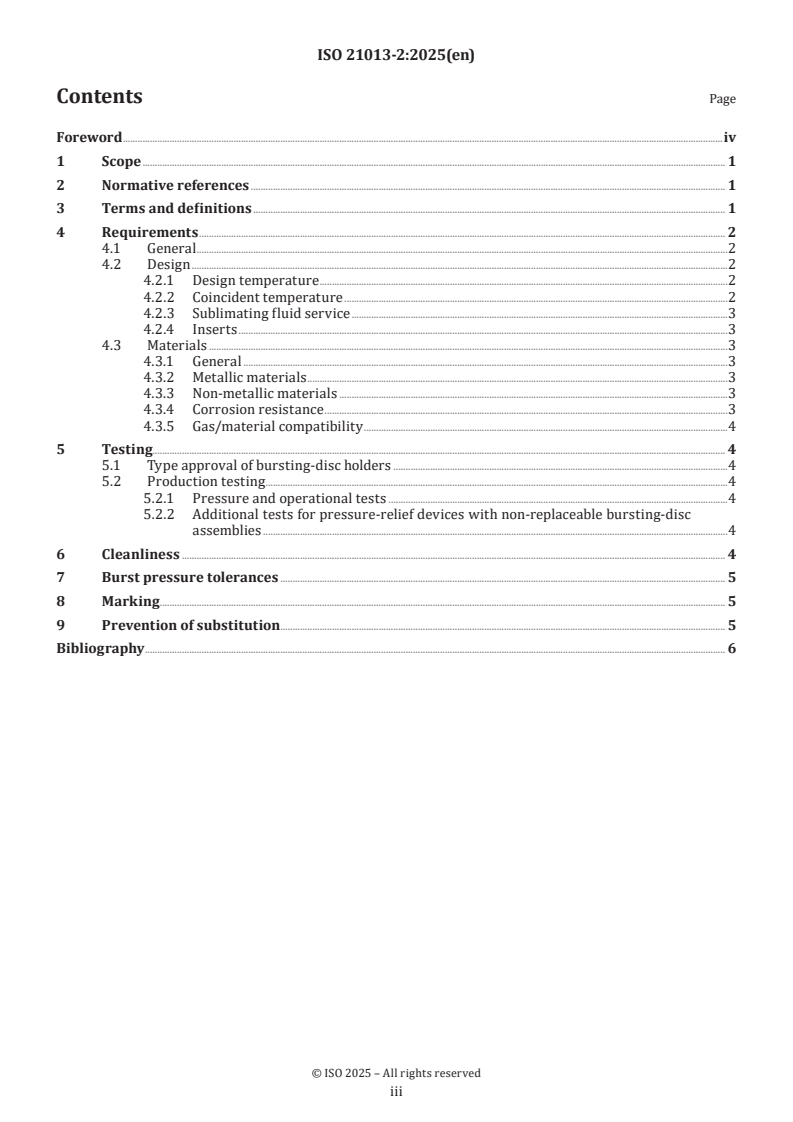
Contents Page
Foreword .iv
1 Scope . 1
2 Normative references . 1
3 Terms and definitions . 1
4 Requirements . 2
4.1 General .2
4.2 Design .2
4.2.1 Design temperature .2
4.2.2 Coincident temperature .2
4.2.3 Sublimating fluid service .3
4.2.4 Inserts .3
4.3 Materials .3
4.3.1 General .3
4.3.2 Metallic materials .3
4.3.3 Non-metallic materials .3
4.3.4 Corrosion resistance .3
4.3.5 Gas/material compatibility .4
5 Testing. 4
5.1 Type approval of bursting-disc holders .4
5.2 Production testing .4
5.2.1 Pressure and operational tests .4
5.2.2 Additional tests for pressure-relief devices with non-replaceable bursting-disc
assemblies .4
6 Cleanliness . 4
7 Burst pressure tolerances . 5
8 Marking . . 5
9 Prevention of substitution . 5
Bibliography . 6
iii
Foreword
ISO (the International Organization for Standardization) is a worldwide federation of national standards
bodies (ISO member bodies). The work of preparing International Standards is normally carried out through
ISO technical committees. Each member body interested in a subject for which a technical committee
has been established has the right to be represented on that committee. International organizations,
governmental and non-governmental, in liaison with ISO, also take part in the work. ISO collaborates closely
with the International Electrotechnical Commission (IEC) on all matters of electrotechnical standardization.
The procedures used to develop this document and those intended for its further maintenance are described
in the ISO/IEC Directives, Part 1. In particular, the different approval criteria needed for the different types
of ISO documents should be noted. This document was drafted in accordance with the editorial rules of the
ISO/IEC Directives, Part 2 (see www.iso.org/directives).
ISO draws attention to the possibility that the implementation of this document may involve the use of (a)
patent(s). ISO takes no position concerning the evidence, validity or applicability of any claimed patent
rights in respect thereof. As of the date of publication of this document, ISO had not received notice of (a)
patent(s) which may be required to implement this document. However, implementers are cautioned that
this may not represent the latest information, which may be obtained from the patent database available at
www.iso.org/patents. ISO shall not be held responsible for identifying any or all such patent rights.
Any trade name used in this document is information given for the convenience of users and does not
constitute an endorsement.
For an explanation of the voluntary nature of standards, the meaning of ISO specific terms and expressions
related to conformity assessment, as well as information about ISO’s adherence to the World Trade
Organization (WTO) principles in the Technical Barriers to Trade (TBT), see www.iso.org/iso/foreword.html.
This document was prepared by Technical Committee ISO/TC 220, Cryogenic vessels.
This second edition cancels and replaces the first edition (ISO 21013-2:2007), which has been technically
revised. It also incorporates the Amendment ISO 21013-2:2007/Amd. 1:2018.
The main changes are as follows:
— deletion of 4.3.5.3 because acetylene is not stored in cryogenic liquid state.
A list of all parts in the ISO 21013 series can be found on the ISO website.
Any feedback or questions on this document should be directed to the user’s national standards body. A
complete listing of these bodies can be found at www.iso.org/members.html.
iv
International Standard ISO 21013-2:2025(en)
Cryogenic vessels — Pressure-relief accessories for cryogenic
service —
Part 2:
Non-reclosable pressure-relief devices
1 Scope
This document specifies the requirements for the design, manufacture and testing of non-reclosable
pressure-relief devices for cryogenic service, i.e. for operation with cryogenic fluids in addition to operation
at temperatures from ambient to cryogenic.
This document is restricted to bursting-disc and buckling-pin devices not exceeding a nominal diameter
size (DN) of 200 that are designed to relieve single-phase vapours or gases. A bursting-disc or buckling-pin
assembly can be specified, constructed and tested such that it is suitable for use with more than one gas or
with mixtures of gases.
NOTE This document does not provide methods for determining the capacity of bursting-disc or buckling-pin
devices for a particular cryogenic vessel. Such methods are provided in ISO 21013-3.
2 Normative references
The following documents are referred to in the text in such a way that some or all of their content constitutes
requirements of this document. For dated references, only the edition cited applies. For undated references,
the latest edition of the referenced document (including any amendments) applies.
ISO 4126-2, Safety devices for protection against excessive pressure — Part 2: Bursting disc safety devices
ISO 21010, Cryogenic vessels — Gas/material compatibility
ISO 21028-1, Cryogenic vessels — Toughness requirements for materials at cryogenic temperature — Part 1:
Temperatures below -80 °C
ISO 21028-2, Cryogenic vessels — Toughness requirements for materials at cryogenic temperature — Part 2:
Temperatures between ‒80 °C and ‒20 °C
ISO 23208, Cryogenic vesse
...