


ISO 9652-4:2000
(Main)Masonry — Part 4: Test methods
Masonry — Part 4: Test methods
Maçonneries — Partie 4: Méthodes d'essai
General Information
- Status
- Withdrawn
- Publication Date
- 27-Sep-2000
- Withdrawal Date
- 27-Sep-2000
- Technical Committee
- ISO/TC 179/SC 3 - Test methods
- Drafting Committee
- ISO/TC 179/SC 3 - Test methods
- Current Stage
- 9599 - Withdrawal of International Standard
- Start Date
- 31-Oct-2018
- Completion Date
- 12-Feb-2026
Get Certified
Connect with accredited certification bodies for this standard

ICC Evaluation Service
Building products evaluation and certification.

QAI Laboratories
Building and construction product testing and certification.

Aboma Certification B.V.
Specialized in construction, metal, and transport sectors.
Sponsored listings
Frequently Asked Questions
ISO 9652-4:2000 is a standard published by the International Organization for Standardization (ISO). Its full title is "Masonry — Part 4: Test methods". This standard covers: Masonry — Part 4: Test methods
Masonry — Part 4: Test methods
ISO 9652-4:2000 is classified under the following ICS (International Classification for Standards) categories: 91.080.30 - Masonry. The ICS classification helps identify the subject area and facilitates finding related standards.
ISO 9652-4:2000 is available in PDF format for immediate download after purchase. The document can be added to your cart and obtained through the secure checkout process. Digital delivery ensures instant access to the complete standard document.
Standards Content (Sample)
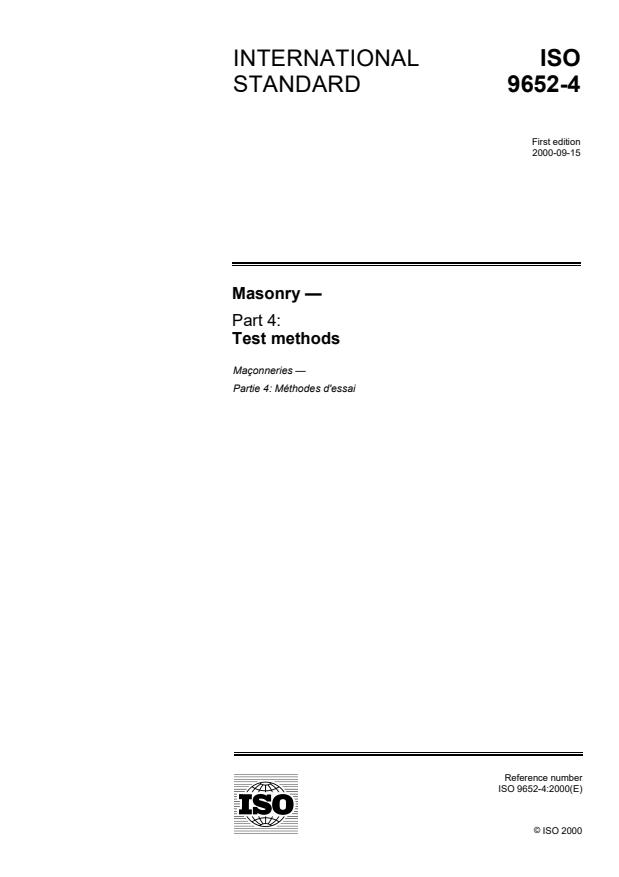
INTERNATIONAL ISO
STANDARD 9652-4
First edition
2000-09-15
Masonry —
Part 4:
Test methods
Maçonneries —
Partie 4: Méthodes d'essai
Reference number
©
ISO 2000
PDF disclaimer
This PDF file may contain embedded typefaces. In accordance with Adobe's licensing policy, this file may be printed or viewed but shall not
be edited unless the typefaces which are embedded are licensed to and installed on the computer performing the editing. In downloading this
file, parties accept therein the responsibility of not infringing Adobe's licensing policy. The ISO Central Secretariat accepts no liability in this
area.
Adobe is a trademark of Adobe Systems Incorporated.
Details of the software products used to create this PDF file can be found in the General Info relative to the file; the PDF-creation parameters
were optimized for printing. Every care has been taken to ensure that the file is suitable for use by ISO member bodies. In the unlikely event
that a problem relating to it is found, please inform the Central Secretariat at the address given below.
All rights reserved. Unless otherwise specified, no part of this publication may be reproduced or utilized in any form or by any means, electronic
or mechanical, including photocopying and microfilm, without permission in writing from either ISO at the address below or ISO's member body
in the country of the requester.
ISO copyright office
Case postale 56 � CH-1211 Geneva 20
Tel. + 41 22 749 01 11
Fax + 41 22 749 09 47
E-mail copyright@iso.ch
Web www.iso.ch
Printed in Switzerland
ii © ISO 2000 – All rights reserved
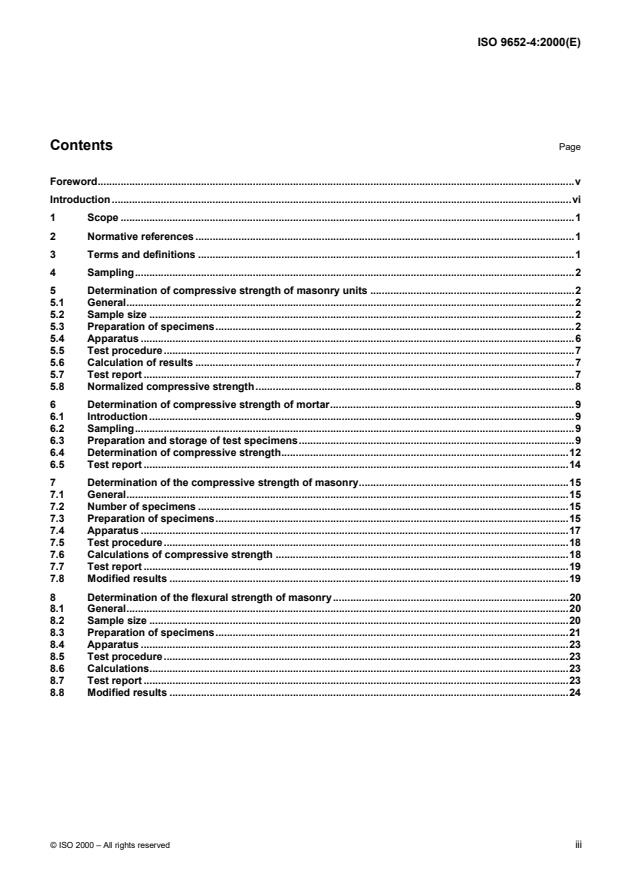
Contents Page
Foreword.v
Introduction.vi
1 Scope .1
2 Normative references .1
3 Terms and definitions .1
4 Sampling.2
5 Determination of compressive strength of masonry units .2
5.1 General.2
5.2 Sample size .2
5.3 Preparation of specimens.2
5.4 Apparatus .6
5.5 Test procedure.7
5.6 Calculation of results .7
5.7 Test report .7
5.8 Normalized compressive strength.8
6 Determination of compressive strength of mortar.9
6.1 Introduction.9
6.2 Sampling.9
6.3 Preparation and storage of test specimens.9
6.4 Determination of compressive strength.12
6.5 Test report .14
7 Determination of the compressive strength of masonry.15
7.1 General.15
7.2 Number of specimens .15
7.3 Preparation of specimens.15
7.4 Apparatus .17
7.5 Test procedure.18
7.6 Calculations of compressive strength .18
7.7 Test report .19
7.8 Modified results .19
8 Determination of the flexural strength of masonry.20
8.1 General.20
8.2 Sample size .20
8.3 Preparation of specimens.21
8.4 Apparatus .23
8.5 Test procedure.23
8.6 Calculations.23
8.7 Test report .23
8.8 Modified results .24
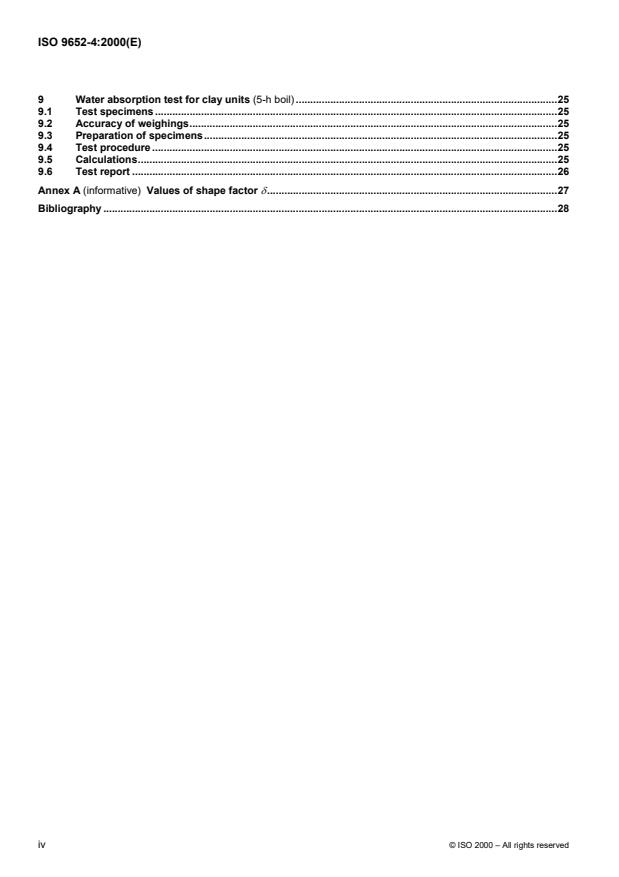
9 Water absorption test for clay units (5-h boil) .25
9.1 Test specimens .25
9.2 Accuracy of weighings.25
9.3 Preparation of specimens.25
9.4 Test procedure .25
9.5 Calculations.25
9.6 Test report .26
Annex A (informative) Values of shape factor �.27
Bibliography .28
iv © ISO 2000 – All rights reserved
Foreword
ISO (the International Organization for Standardization) is a worldwide federation of national standards bodies (ISO
member bodies). The work of preparing International Standards is normally carried out through ISO technical
committees. Each member body interested in a subject for which a technical committee has been established has
the right to be represented on that committee. International organizations, governmental and non-governmental, in
liaison with ISO, also take part in the work. ISO collaborates closely with the International Electrotechnical
Commission (IEC) on all matters of electrotechnical standardization.
International Standards are drafted in accordance with the rules given in the ISO/IEC Directives, Part 3.
Draft International Standards adopted by the technical committees are circulated to the member bodies for voting.
Publication as an International Standard requires approval by at least 75 % of the member bodies casting a vote.
Attention is drawn to the possibility that some of the elements of this part of ISO 9652 may be the subject of patent
rights. ISO shall not be held responsible for identifying any or all such patent rights.
International Standard ISO 9652-4 was prepared by Technical Committee ISO/TC 179, Masonry, Subcommittee
SC 3, Test methods.
ISO 9652 consists of the following parts, under the general title Masonry:
� Part 1: Unreinforced masonry design by calculation
� Part 2: Unreinforced masonry design by simple rules
� Part 3: Code of practice for design of reinforced masonry
� Part 4: Test methods
� Part 5: Vocabulary
Annex A forms a normative part of this part of ISO 9652.
Introduction
ISO/TC 179 is responsible for the International Standards for design of masonry, either by calculation (see
ISO 9652-1) or by simple rules (see ISO 9652-2). The test methods given in this part of ISO 9652 are standard
reference test methods. They are used to determine the properties of masonry units, mortars and masonry
elements needed in the design of structures.
Test methods in national standards for determining the resistance of masonry units and elements to loads show
considerable differences. This no doubt reflects both the history of the derivation of the test and the purpose to
which the results are put, but the effect is that design methods are different in different countries. Researchers into
masonry problems may use test methods, which differ again.
National standards are appropriate for use in a particular country, as are research methods for specific
investigations. However, parallel tests following the methods given in this part of ISO 9652 are necessary in order
to establish a relationship between them and in order that a precise comparison of test results using different test
methods may be obtained with confidence.
The results from the reference test methods in this part of ISO 9652 are intended to provide a basic common datum
against which data obtained by different test methods may be strictly compared. More attention has been paid to
precision and repeatability than to the provision of test methods of universal applicability.
Even if all laboratories do not have the equipment to carry out these standard reference tests, there will usually be
a national, often governmental, laboratory that has.
vi © ISO 2000 – All rights reserved
INTERNATIONAL STANDARD ISO 9652-4:2000(E)
Masonry —
Part 4:
Test methods
1 Scope
This part of ISO 9652 specifies reference methods for testing
a) the compressive strength of masonry units;
b) the compressive strength of masonry;
c) the flexural strength of masonry;
d) the water absorption of clay units; and
e) the compressive strength of mortar.
It is applicable to masonry built with units of fired clay, calcium silicate, concrete (including autoclaved aerated
concrete), natural stone or manufactured stone.
NOTE The methods may be suitable for testing other walling materials, but they have not been examined as reference
testsinthisrespect.
2 Normative references
The following normative documents contain provisions which, through reference in this text, constitute provisions of
this part of ISO 9652. For dated references, subsequent amendments to, or revisions of, any of these publications
do not apply. However, parties to agreements based on this part of ISO 9652 are encouraged to investigate the
possibility of applying the most recent editions of the normative documents indicated below. For undated
references, the latest edition of the normative document referred to applies. Members of ISO and IEC maintain
registers of currently valid International Standards.
ISO 2591-1, Test sieving — Part 1: Methods using test sieves of woven wire cloth and perforated metal plate.
ISO 4287, Geometrical Product Specifications (GPS) — Surface texture: Profile method — Terms, definitions and
surface texture parameters.
ISO 6507-1, Metallic materials — Vickers hardness test — Part 1: Test method.
ISO 9652-5, Masonry — Vocabulary.
3 Terms and definitions
For the purposes of this part of ISO 9652, the terms and definitions given in ISO 9652-5 apply.
4 Sampling
The method of sampling and the number of specimens shall be stated in the test report and shall be chosen so that
the sample is representative of the batch to be tested. If the testing laboratory does not carry out the sampling, this
shall be stated in the test report.
5 Determination of compressive strength of masonry units
5.1 General
The load at which a masonry unit fails in a compression test machine divided by the loaded area is defined as the
crushing strength of that single unit. The compressive strength is defined as the arithmetical mean of the crushing
strengths of a sample. The standard reference test requires a sample of 10 specimens, but provision is made for a
smaller sample of 6 to be used when the coefficient of variation is known to be low. It is the best guide to the
strength of the consignment from which the sample was taken and may be used in conjunction with information
about the composition of the mortar used in construction to estimate the strength of the resulting masonry wall.
The test procedure uses a standard method of preparation to ensure that the surfaces are essentially plane and
parallel so that the load is evenly distributed over the tested area. Specimens are tested wet but factors are
provided to enable the results to be modified to give an approximate value for an air-dried specimen and to
transform the result by means of a shape factor correction to bring different sized units to assumed equivalence.
In the test report there is provision for "Remarks" under which exceptional features (e.g. badly cracked, chipped or
misshapen specimens) should be recorded.
5.2 Sample size
Sampling shall be carried out in accordance with clause 4. The number of specimens shall be at least 10. If the
coefficient of variation is known to be not greater than 15 %, the number of specimens may be reduced to 6.
5.3 Preparation of specimens
5.3.1 Test specimens
Use test specimens sampled in accordance with clause 4. Concrete masonry units other than autoclaved ones
shall be stored for the required number of days before testing. This shall be recorded in the test report (see 5.7).
For certain forms of construction, it will be necessary to test the units in more than one orientation.
Units used in the normal manner are understood to be laid with their bed faces horizontal, as shown in Figure 1.
5.3.2 Dimensions of units
5.3.2.1 General
In order to meet the requirements of d) and e) of the test report (see 5.7), make a sketch and description of the unit
using the following procedures (see Figure 2).
2 © ISO 2000 – All rights reserved
a) Group I Units which are solid or withuuuu 25 % by volume of formed vertical holes that may or may not
pass right through the unit, or units withuuuu 25 % by volume of frogs in the bed faces
b) Group II Units with���� 25 % and ���� 60 % by volume of formed vertical holes
which may or may not pass through the units
c) Group III Units with���� 50 % by volume of formed horizontal holes,
which may or may not pass through the units
Figure 1 — Units in normal aspect
l = length
t=width
Figure 2 — Example of dimensions
5.3.2.2 Gross area of the loaded surface
This subclause applies to all types of masonry unit, including those to be used with a divided joint (face-shell
bedded), that is, the gap between the twin strips of mortar is included in the overall area (see 5.5.1).
Make three measurements of the dimensions of the gross plan area to the nearest 1 mm at the top, middle and
bottom of the unit. Multiply the means of these three measurements of length and width together to calculate the
gross area.
5.3.2.3 Determination of the proportion and size of voids
Measure the dimensions of the voids directly if they are large enough. Calculate and record the total cross-
sectional area of voids and express it as a percentage of the gross area. Otherwise proceed as follows.
a) Make three measurements of the height of the unit to the nearest 1 mm at the middle and two ends. Use the
mean to multiply by the gross area to obtain the gross volume that is recorded to the nearest 1 000 mm .
b) Place the unit on a thin sheet of foam rubber with the holes in a vertical position. Using a measuring cylinder
filled with fine dry sand, fill the holes and record the volume of sand used, to the nearest 1 000 mm .
c) Express the volume of sand as a percentage of the gross unit volume.
5.3.2.4 Net area
If the voids were measured directly, subtract the cross-sectional area of voids from the gross area to obtain the net
area. To find the average net area of units with voids too small to be measured directly, subtract the volume of the
voids from the gross volume and divide by the mean height.
5.3.3 Bed face preparation
5.3.3.1 General
Prepare each specimen so that the bed faces are plane to a tolerance of 0,1 mm per 100 mm of gauge length and
the top surface lies between two parallel planes not greater than 1 mm apart in 500 mm and parallel to the bottom
surface. If the unit already meets these requirements, then test it directly. Otherwise use grinding or, as an
alternative, capping with mortar as described in 5.3.3.2. Fill frogs and allow the mortar to cure before grinding.
4 © ISO 2000 – All rights reserved
5.3.3.2 Capping procedure
5.3.3.2.1 General
Immerse the specimens in water for 18 h and then allow them to drain for approximately 10 min. Wipe off the
surplus water.
Use a capping mortar consisting of one part by volume of clean, well-graded sand with a maximum grain size of
2 mm, mixed with one part by volume of cement. The compressive strength of the mortar at the time of the test,
determined as described in clause 6, shall be not less than 30 N/mm .
Treat each of the two bed faces in turn as described below, using mortar of the same composition made with the
same constituents
5.3.3.2.2 Units without holes or with holes unfilled
NOTE Ground plate glass or machined steel plates are the most suitable materials. The flatness tolerance can be checked
by measuring deviations from straightness along a line parallel to, and close to, each specimen edge; along each diagonal and
along each centreline, using a straight edge raised by pads of equal thickness at each end of the specimen and an appropriate
gauge at the centre. The deviation from flatness may be obtained be relating the deviations from straightness at the centre point
of the plate and at other points where the lines described intersect.
5.3.3.2.2.1 Bed each specimen in the mortar on a smooth rigid plate, at least 25 mm longer and wider than the
specimen, and plane to within 0,05 mm, using the following procedure.
a) Support the plate firmly with the machined face uppermost and level it in two directions at right angles, using a
spirit level. Coat the plate with a film of mould-release oil or a sheet of thin paper to prevent mortar adhering.
b) Spread a uniform layer of mortar about 5 mm thick on the plate. Press one bed face of the specimen firmly into
it. Check that the vertical axis of the specimen is perpendicular to the plane of the plate using a square or
vertical level to check each vertical face. When bedding hollow blocks, it will be found an advantage to shape
the mortar layer so that it is a little thicker in the middle than at the edges so that air is not trapped under the
block when it is pressed into the mortar.
c) Ensure the mortar bed is at least 3 mm thick over the whole area and that any cavity normally filled when the
units are laid in the wall is completely filled with mortar. Do not fill other cavities.
d) Trim off surplus mortar flush with the sides of the specimen. Cover it with a cloth, kept damp. Allow the bedded
specimen to remain undisturbed for at least 16 h and then carefully remove it from the plate without damaging
the mortar.
e) Examine the mortar bed for defects such as lack of compaction, cracking and lack of adhesion to the
specimen. Replace such defective specimens.
5.3.3.2.2.2 Bed the second bed face using the same process.
5.3.3.2.3 Units with frogs intended to be filled
Treat each of the two bed faces in turn as described below.
a) Fill the frog with capping mortar and strike off level.
b) At the time that the top frog is filled, bed the base of the unit in a similar mortar mix as described in 5.3.3.2.1.
For bricks with two frogs, fill the lower frog before inverting the brick onto the mortar bed. Store under damp
sacking, polyethylene or similar material until the mortar has hardened.
5.3.3.2.4 Units to be face-shell bedded
5.3.3.2.4.1 Bed each specimen in the mortar on a smooth rigid plate (see Note in 5.3.3.2.4.2) at least 25 mm
longer and wider than the specimen, and plane to within 0,05 mm, using the following procedure.
a) Support and coat the plate as described in 5.3.3.2.2.
b) Lay two parallel strips of mortar about 5 mm thick on the plate such that each strip is about 25 mm longer than
the length of the unit and about 10 mm wider than the face shell.
c) Press one bed face of the unit into the mortar such that the thickness of the mortar over the face-shells is at
least 3 mm. Check that the vertical axis of the specimen is perpendicular to the plane of the plate using a
square or vertical level to check each vertical face.
d) Trim off any surplus mortar and store the specimen in accordance with 5.3.3.2.2.
e) Examine in accordance with 5.3.3.2.2.
5.3.3.2.4.2 Bed the second face using the same process.
NOTE The distance between the strips should be approximately equal to the distances between the face-shelIs less
10 mm.
5.3.3.3 Storage of specimens
After the second capping layer has hardened sufficiently (3 to 7 days), immerse the specimens in water or cure
them under sacks kept damp throughout the curing period or in a conditioning chamber at greater than 90 %
relative humidity.
5.3.4 Conditioning of specimens before testing
Immerse the specimens in water for at least 24 h. Remove and allow to drain without drying out before testing
(normally about 15 min).
5.4 Apparatus
Test the specimens in an appropriate machine regularly calibrated to ensure that it complies with the requirements
given in Table 1.
Table 1 — Requirements for testing machines (for masonry units)
Maximum permissible Maximum permissible mean error Maximum permissible error of
repeatability of forces as a of forces as a percentage of zero force as percentage of
percentage of indicated force indicated force maximum force of range
1,0
� 1,0 � 0,2
The testing machine shall have adequate capacity to crush all the test specimens, but the scale used shall be such
that the ultimate load on the specimen exceeds one-fifth of the full-scale reading.
The machine shall be provided with a load pacer or equivalent means to enable the load to be applied at the rate
givenin5.5.2.
6 © ISO 2000 – All rights reserved
The testing machine shall be equipped with two steel bearing platens of adequate stiffness (see Note). The testing
faces, where case-hardened, shall have a Vickers hardness of at least HV 600 when tested in accordance with
ISO 6507-1. When the platens are through-hardened, the steel shall have a tensile strength of not less than
1 000 N/mm .
NOTE Grade 36 CrNiMo6 as specified in ISO 683-1 is known to be suitable.
Both the stiffness of the platens and the manner of load transfer shall be such that the deformation of the platen
surface at ultimate load shall be less than 0,1 mm measured over 250 mm, assuming a uniformly distributed load.
One platen of the machine shall be able to align freely with the specimen as contact is made but the platens shall
be restrained by friction or other means from tilting with respect to one another during loading. The other
compression platen shall be a plane non-tilting block. The bearing faces of both platens shall be larger than the
size of the loaded face of the largest unit to be tested. Where auxiliary platens are used, they shall be properly
located and of sufficient hardness, stiffness and planeness to ensure uniformity of load. The bearing surfaces of the
platens shall not depart from a plane by more than 0,05 mm.
To meet this requirement, the platens, when new, should be somewhat more accurate and should be refaced when
they approach this limit.
The surface texture shall not be greater than Ra 3,2 (see ISO 4287). Auxiliary platens shall meet these
requirements on both faces.
5.5 Test procedure
5.5.1 Placing specimens in the testing machine
Wipe the bearing surfaces of the testing machine clean and remove any loose grit from the bed faces of the
specimen. Align the specimen carefully with the centre of the ball-seated platen so that a uniform seating is
obtained. Do not use any packing material except for units intended to be face-shell bedded, which have been
prepared by grinding. Then use four stiff steel strips, the same width as the face-shells and 50 mm longer,
positioned two at the top and two at the bottom, overlapping equally at each end.
5.5.2 Loading
Apply load to the specimen without shock and increase it continuously. Initially, use any convenient rate of loading,
but when about half the expected maximum load has been applied, adjust the rate so that loading will be
completed in a further time of between 0,5 min and 2 min. Record the maximum load.
NOTE With some specimens the recorded load may fluctuate before maximum load is reached. This will be indicated by a
reduction in load as the specimen yields, followed by an increase to a new maximum as loading is continued. This temporary
reduction may occur several times before the specimen finally fails.
5.6 Calculation of results
Calculate the crushing strength of each specimen by dividing the failure load by its gross loaded area (see 5.3.2)
and express it to the nearest 0,1 N/mm .
Calculate the average value and record it as the compressive strength of the units, to the nearest 0,1 N/mm .
Calculate the standard deviation of the sample and the coefficient of variation.
5.7 Test report
The test report shall contain the following information:
a) the number and date of this part of ISO 9652;
b) the date of production of the unit in the case of concrete units other than autoclaved concrete units, including
aerated;
c) the date of testing;
d) a description of the masonry unit, including the type, dimensions, cross section, proportion of voids, minimum
thickness of solid material in the webs and shells, pattern of voids and such other information as is necessary
to identify the unit clearly;
e) a sketch of the masonry unit showing its height and the extent of the loaded area and the orientation of
loading;
f) the name of the organization that carried out the sampling and the method used;
g) the number of specimens in the sample;
h) whether specimens were capped or ground;
i) for each specimen, the dimensions in millimetres, including the height of the specimen after surface
preparation, if any, the failure load in newtons, and the crushing strength in newtons per square millimetre;
j) the compressive strength of the sample in newtons per square millimetre to the nearest 0,1 N/mm ;
k) the standard deviation;
l) the coefficient of variation;
m) remarks.
An addendum may be added to the test report (see 5.8).
5.8 Normalized compressive strength
5.8.1 General
For design purposes, modify the compressive strength obtained from the test report to the air-dried strength of an
equivalent 100 mm � 100 mm unit, (h � t)i.e. f , by factors as given in 5.8.2 and 5.8.3.
b
5.8.2 Conversion to equivalent results for air-dried specimens
To convert to a nominal value for the air-dried condition, multiply the compressive strength for fired clay units by 1,1
and for all other units by 1,2.
5.8.3 Shape factor
To allow for the height and width of the masonry unit as tested, multiply the strength of the units by a factor � given
in annex A. Alternatively, a statistically rigorous value may be obtained by experiment when the details of the
calculation shall be recorded.
5.8.4 Calculation of normalized compressive strength
ff���
bc
where
f is the normalized compressive strength of the masonry unit;
b
8 © ISO 2000 – All rights reserved
f is the compressive strength of the sample (see 5.7);
c
ω is a moisture factor for converting to the normal value for the air-dried condition:
ω = 1,1 for fired-clay units,
ω=1,2 forall otherunits;
� is a shape factor given in annex A for converting to the normal value of units with a vertical cross section
of 100 mm � 100 mm.
The modified results are an addendum to the test report.
6 Determination of compressive strength of mortar
6.1 Introduction
This clause specifies methods for determining the compressive strength of mortars. It is not intended to be used for
mortars consisting of lime and sand only. These methods are not suitable for specimens of set mortar cut from
masonry. The air content and bulk density may be determined in accordance with standard methods if requested
and then should be recorded in the test report.
6.2 Sampling
Obtain samples by taking uniformly distributed increments (preferably from material in motion, provided this can be
carried out in safety), and mixing them thoroughly to form a combined sample. The number of increments and size
of bulk sample necessary depend on the quantity of the material and its variability. The bulk sample may be further
reduced by taking sufficient scoops from random positions throughout the mixed material.
Mix the batch well before filling the moulds. Because batch variations in the mortar are likely to be much greater
than testing variations, when testing a single sample of mortar from site, prepare specimens from three separate
batches (see 6.3.3).
6.3 Preparation and storage of test specimens
6.3.1 Dimensions of specimens
Use either prisms 160 mm � 40 mm � 40 mm or cubes of side 70,7 mm. A minimum of three prisms or six cubes
are required. When prisms are used, break them in half to provide six test pieces.
6.3.2 Apparatus
6.3.2.1 Steel moulds
Each mould consists of a rigid base plate, two end plates and four side plates, at least 10 mm thick, rigidly clamped
together. Each mould thus has three compartments. The surface of each internal face shall be at least HV 400
Vickers hardness value in accordance with the requirements of ISO 6507-1.
A typical mould is shown in Figure 3.
Figure 3 — Typical mould for forming mortar prism specimens 160 mm���� 40 mm���� 40 mm
The assembled moulds shall comply with the following requirements:
a) Dimensions
1) Prisms: the depth and internal width of each compartment, each based on the average of six
measurements symmetrically placed along the axis of the compartment, shall be 40 mm + 0,1 mm; the
length of each compartment shall be 160 mm + 0,4 mm.
2) Cubes: the depth of the mould and the distance between either pair of opposite internal faces, each based
on the average of four symmetrically placed measurements, shall be 70,7 mm + 0,15 mm.
b) Flatness
The surface of each internal face shall lie between two parallel planes 0,03 mm apart. The joints between the
sections of the mould and between the bottom surface of the mould and the top surface of the base plate shall
lie between two parallel planes 0,06 mm apart.
c) Squareness
The surface of each internal face shall lie between two parallel planes 0,05 mm apart which are perpendicular
to the bottom surface of the mould and also to the adjacent internal faces.
d) Parallelism
The top surface of the mould shall lie between two parallel planes 1,0 mm apart and parallel to the bottom
surface.
10 © ISO 2000 – All rights reserved
e) Surface texture
The surface texture of each internal surface shall be not greater than Ra 3,2 (see ISO 4287).
While the cleaned mould is being assembled ready for use, seal the joints between all the sections of the mould to
prevent the escape of water (using, for example, grease). Remove excess sealant from the assembled mould and
coat the internal faces with mould oil to prevent adhesion of the mortar.
6.3.3 Preparation of test specimens
Sample the mortar in accordance with 6.2. Prepare three prisms or cubes for testing at each of two ages, 7 days
and 28 days being preferred. If specimens are required to determine the age at which masonry is to be tested (see
7.3.2) make sufficient for that purpose. Make the specimens as soon as practicable after mixing, but not later than
1 h after the addition of water to the mix, except in the case of retarded mixes.
Fill the mould to about half height with mortar and compact by ramming in a uniform manner with neither
segregation nor excessive laitance. Use a 12 mm square compacting bar having a mass of 50 g for prisms or
25 mm square and a mass of 1,8 kg for cubes. The number of strokes of the compacting bar to compact the
specimen will vary according to the consistence of the mortar but in no case give fewer than 25 strokes. Overfill the
mould with more mortar and compact this layer as before. Strike off the surface plane and level with the top of the
mould using a palette knife or trowel having a straight edge long enough to span the mould.
Place the mould in a humidity chamber or plastic bag, seal and store it at a temperature of 20 °C � 3 °C, protecting
it from drying for one to three days, depending on the early strength of the mortar. Then demould the specimens
without damage, mark them for later identification and transfer them immediately to the appropriate surroundings
for subsequent curing.
6.3.4 Storage of test specimens
6.3.4.1 General
Two types of curing are permitted:
a) under water for mortars that derive their strength mainly from hydration of cement (see 6.3.4.2); and
b) moist air curing, without carbonation, for other mortars (see 6.3.4.3).
6.3.4.2 Curing under water
Immerse the specimens in lime-saturated water at room temperature and keep them there until 2 min before
testing. Support the specimens so as to allow the water free access to all parts of each face.
Fill the containers in which the specimens are to be cured to a sufficient depth to submerge the specimens and
maintain at this level by topping up as required. At least once a month, empty and clean out the container and
renew the water. Do not immerse specimens made from mortars of different types in the same water; however,
specimens made from mortars of different classes of the same type may be immersed together.
6.3.4.3 Moist air curing
Store the specimens over water in a closed airtight container having a volume not greater than 0,015 m at room
temperature. Immerse specimens in water at 20 °C+3 °C for 4 h to 6 h immediately before testing.
6.4 Determination of compressive strength
6.4.1 Apparatus
6.4.1.1 Prisms
6.4.1.1.1 Testing machine
Use a machine of sufficient capacity and sensitivity for the test and capable of applying the load at the rate
specified in 6.4.2.4. The machine shall be regularly calibrated to ensure that it complies with the requirements in
Table 1. The upper machine platen shall be able to align freely as contact is made with the specimen but the
platens shall be restrained from tilting with respect to one another during loading.
6.4.1.1.2 Bearing plates
Use two bearing plates made of tungsten carbide or of steel of surface hardness at least HV 600 Vickers hardness
value in accordance with the requirements of ISO 6507-1. The plates shall be 40,0 mm long, 40,0 � 0,1 mm wide
and 10 mm thick. The dimensional tolerance for the width shall be based on the average of four symmetrically
placed measurements. The flatness tolerance for the contact faces shall be 0,01 mm.
6.4.1.1.3 Compression jig
Use a compression jig to locate the bearing plates. A suitable jig is shown in Figure 4. The base plate of the jig
shall be of hardened and tempered tool steel and the faces shall have a flatness tolerance of 0,01 mm. A device to
provide positive centring on the lower platen of the testing machine shall be provided. The hardened and tempered
steel pillars shall be symmetrically placed about the centering device so that the gap in one direction is the nominal
width of the prism plus 0,3 mm and in the other direction is the nominal width of the prism plus 0,8 mm. The top
face of the base plate shall be marked with an arrow in the direction of the greater distance between the pillars to
indicate the direction of the long axis of the bearing plates.
6.4.1.2 Cubes
6.4.1.2.1 Testing machine
Use a testing machine as described in 6.4.1.1, equipped with two rigid steel bearing platens at least as large as the
nominal size of the specimen to which the load is applied. The surface shall have a Vickers hardness value of at
least HV 600 in accordance with the requirements of ISO 6507-1. The flatness tolerance for the area to be in
contact with the specimen and the surface texture requirements are as given respectively in 6.3.2.1 b) and e).
6.4.2 Test procedure
6.4.2.1 General
Test the specimen immediately on removing from the curing water in which it has been stored and while still in a
wet condition. Remove any loose grit or other material from the sides of the specimen as-cast. Wipe the bearing
surfaces of the testing machine and, for prisms, the bearing plates and jig, with a clean cloth and place the
specimen in the machine in such a manner that the load is applied to the opposite sides of the specimen as-cast,
that is not to the top and bottom.
12 © ISO 2000 – All rights reserved
Dimensions in millimetres
a) Hardened and tempered tool steel base plate
b) Hardened and tempered tool steel bearing plates
c) Hardened and tempered steel pillars
Key
1 Four holes, � 10 mm reamed
2 Centring hole (e.g. � 5 mm and 6 mm deep)
a
Arrows marked to indicate long axis of bearing plates
b
Slight taper
c
Press fit
Figure 4 — Compression jig for 160 mm���� 40 mm���� 40 mm mortar specimens
6.4.2.2 Prisms
Arrange the prisms so that the cast end is 16 mm from the nearer edges of the platens or bearing plates. Discard
any specimens that do not provide a cube of solid material between the top and bottom platens or bearing plates.
Carefully align the specimen so that the load will be applied to the whole width of the faces in contact with the
platens. When using the bearing plates and jig, place one bearing plate on the upper surface of the jig with its long
axis parallel to the indicating arrow, ensuring that it makes close contact over the whole surface. Place the
specimen in the jig, between the pillars, with its long axis perpendicular to the arrow and place the other bearing
plate on top of the specimen parallel to the lower bearing plate. Carefully centre the compression jig assembly on
the lower platen of the test machine.
6.4.2.3 Cubes
Carefully centre the cube on the lower platen. Do not use any packing other than auxiliary steel platens between
the faces of the specimen and the steel platen of the testing machine.
6.4.2.4 Loading
Apply the load without shock and, according to the likely strength of the mortar, increase it continuously at a rate
2 2
within the range 0,03 N/(mm �s) to 0,1 N/(mm �s) until failure occurs.
Record the maximum load applied, in newtons, during the test.
6.4.3 Calculations
For prisms, calculate the strength as the maximum load divided by the cross-sectional area of the test piece in
contact with the platen or bearing plate. For cubes, calculate the strength as the maximum load divided by the
cross-sectional area of the cube.
2 2
Record the strength to the nearest 0,05 N/mm for individual results and to the nearest 0,1 N/mm for the
compressive strength, that is the mean strength of the test pieces.
6.5 Test report
The test report shall contain the following information:
a) the number and date of this part of ISO 9652;
b) the origin of the mortar sample;
c) the number and type of specimens;
d) the date of moulding;
e) the date of demoulding;
f) the date of testing;
g) a description of the mortar including type, intended mortar class, composition (i.e. mix ratio with, where
possible, precise identification of the individual constituents including the make of cement), source of the sand
and any additions and admixtures;
h) sieve analysis of the sand using the method given in ISO 2591-1;
2 2
i) individual and mean values for the mortar strength to the nearest 0,05 N/mm and 0,1 N/mm respectively;
j) if requested, individual and mean values for the bulk density of the mortar, air content calculated from the bulk
density of the mortar and the specific gravity of the constituent materials or measured by a standard method;
k) remarks.
14 © ISO 2000 – All rights reserved
7 Determination of the compressive strength of masonry
7.1 General
The compressive strength of masonry may either be derived from the strength of storey height masonry walls or
from the strength of small masonry specimens tested to destruction.
The value
...
Questions, Comments and Discussion
Ask us and Technical Secretary will try to provide an answer. You can facilitate discussion about the standard in here.
Loading comments...