


ISO 3258:1976
(Main)Air distribution and air diffusion — Vocabulary
Air distribution and air diffusion — Vocabulary
Defines the elements and accessories used in the techniques of air distribution and diffusion. In addition to terms used in the three official ISO languages (English, French and Russian) the equivalent terms and their definitions in the German language are included.
Distribution et diffusion de l'air — Vocabulaire
General Information
- Status
- Withdrawn
- Publication Date
- 30-Apr-1976
- Withdrawal Date
- 30-Apr-1976
- Technical Committee
- ISO/TC 144 - Air distribution and air diffusion -- STAND-BY
- Drafting Committee
- ISO/TC 144 - Air distribution and air diffusion -- STAND-BY
- Current Stage
- 9599 - Withdrawal of International Standard
- Start Date
- 12-Aug-2009
- Completion Date
- 12-Feb-2026

Get Certified
Connect with accredited certification bodies for this standard

ICC Evaluation Service
Building products evaluation and certification.

QAI Laboratories
Building and construction product testing and certification.

Aboma Certification B.V.
Specialized in construction, metal, and transport sectors.
Sponsored listings
Frequently Asked Questions
ISO 3258:1976 is a standard published by the International Organization for Standardization (ISO). Its full title is "Air distribution and air diffusion — Vocabulary". This standard covers: Defines the elements and accessories used in the techniques of air distribution and diffusion. In addition to terms used in the three official ISO languages (English, French and Russian) the equivalent terms and their definitions in the German language are included.
Defines the elements and accessories used in the techniques of air distribution and diffusion. In addition to terms used in the three official ISO languages (English, French and Russian) the equivalent terms and their definitions in the German language are included.
ISO 3258:1976 is classified under the following ICS (International Classification for Standards) categories: 01.040.91 - Construction materials and building (Vocabularies); 91.140.30 - Ventilation and air-conditioning systems. The ICS classification helps identify the subject area and facilitates finding related standards.
ISO 3258:1976 is available in PDF format for immediate download after purchase. The document can be added to your cart and obtained through the secure checkout process. Digital delivery ensures instant access to the complete standard document.
Standards Content (Sample)
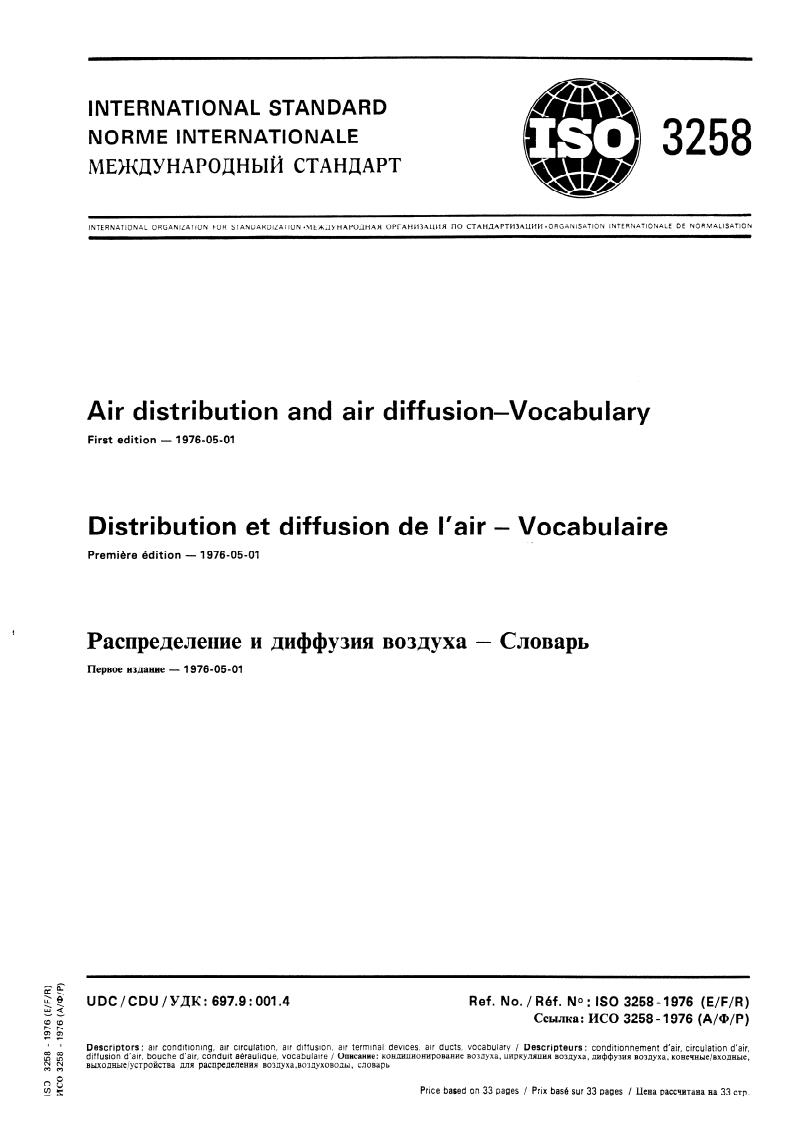
INTERNATIONAL STANDARD
NORME INTERNATIONALE
MEXflYHAPOflHbIti CTAHJJAPT
INTERNATIONAL ORGANIZATION FOR STANDARDIZATION .VE*X~YHAPO3.HAR OPi-AtiII3ALlIl~ I’lO CTAH;rlAPTI13AUMM .ORGANISATION INTERNATIONALE DE NORMALISATION
Air distribution and air diffusion-Vocabulary
First edition - 1976-05-01
Distribution et diffusion de I’air - Vocabulaire
Premihre Edition - 1976-05-01
PampegeneHMe M JJFI@*~~I~II Bo3ayxa - Cnosapb
Kiepsoe asname - 1976-05-01
UDC/CDU/YpcrC: 697.9:001.4 Ref. No. / RBf. No: ISO 3258 - 1976 (E/F/R)
Cc~ma: MC0 3258 - 1976 (A/Qi/P)
Descriptors : air conditioning, air circulation, air diffusion, air terminal devices, air ducts, vocabuiary / Descripteurs :
conditionnement d’air, circulation d’air,
diffusion d’air, bauche d’air, conduit akauiique, vocabulaire / OnwaHHe: Kowu!.iI.U3oHEipoBaßHe BO3iIyXa, UHPK~J?JUIH~I BO3A)‘Xa, J.U!i449’3HR BO3AyXa, KOHe¶HbJe/BXOAHble,
BhXXOAH.bIe/yCTpOiiCTBa ZUM pi’iCn~J?eJIeHEH B03~Xa,B03qVXOBOiW, CJlOBapb
Price based on 33 pages / Prix bas6 sur 33 pages / Ueaa paccrurlarra aa 33 CTp.
FOREWORD
ISO (the International Organization for Standardization) is a worldwide federation of
national Standards institutes (ISO Member Bodies). The work of developing International
Standards is carried out through ISO Technical Committees. Every Member Body inter-
ested in a subject for which a Technical Committee has been set up has the right to be repre-
sented on that Committee. International organizations, governmental and non-governmental,
in liaison with ISO, also take part in the work.
Draft International Standards adopted by the Technical Committees are circulated to the
Member Bodies for approval before their acceptance as International Standards by the ISO
Council.
International Standard ISO 3258 was drawn up by Technical Committee ISOjTC 144,
Air distribution and air diffusion, and circulated to the Member Bodies in March 1974.
It has been approved by the Member Bodies of the following countries:
Belgium Germany Spain
Bulgaria Hungary Sweden
Chile New Zealand Switzerland
Czechoslovakia Romania Thailand
France South Africa, Rep. of United Kingdom
No Member Body expressed disapproval of the document.
AVANT-PROPOS
L’ISO (Organisation Internationale de Normalisation) est une federation mondiale d’orga-
nismes nationaux de normalisation (Comites Membres ISO). L’elaboration des Normes
Internationales est confiee aux Comites Techniques ISO. Chaque Comite Membre interesse
par une etude a Ie droit de faire Partie du Comite Technique correspondant. Les organi-
sations internationales, gouvernementales et non gouvernementales, en liaison avec l’IS0,
participent egalement aux travaux.
Les Projets de Normes Internationales adoptes par les Comites Techniques sont soumis
aux Comites Membres pour approbation, avant leur acceptation comme Normes Tnter-
nationales par le Conseil de 1’ISO.
La Norme Internationale ISO 3258 a etc etablie par le Comite Technique ISO/TC 144,
Distribution et d(ffusion d’air, et soumise aux Comites Membres en mars 1974.
Elle a et6 approuvee par les Comites Membres des pays suivants:
Afrique du Sud, Rep. d’ Espagne Royaume-Uni
Allemagne France Suede
Belgique Hongrie Suisse
Bulgarie Nouvelle-Zelande Tchecoslovaquie
Chili Roumanie Thailande
Aucun Comite Membre n’a desapprouve le document.
BBEa[EHHE
klco (MeXAyHapOAHaSI OpraHH3aUWf I-IO CTaHAapTH3aIJHH) RBJT5IeTCII BCeMHpHOii @eAe-
paIJHe$i HaIJHOHaJIbHbIX OpraHOB IT0 CTaHAapTH3aLWi (KOMklTeTOB-WeHOB MCO). Pa3pa-
6oma MeXAyHapOAHbIX CTaHAapTOB OCy~eCTBJUieTC5I TeXHHYecKFfMEI KOMHTeTaMkf MC0 .
KaXAbIti KOMEITeT-YJIeH, 3aHHTepeCOBaHHbIti B AeSITeJIbHOCTH KaKoro-mi6o TeXHwmKOro
KOMHTeTa, EIMeeT IIpaBO YYaCTBOBaTb B er0 pa6oTax. flpaBHTeJlbCTBeHHbIe H HeIlpaBEiTeJIb-
CTBeHHbIe MeXAyHapOAHbIe OpraHIl3aIUifH, COTpyAHMYalOIIJkle C klco, TaKXe IIpMHMMalOT
ysacTHe B pa6oTax.
npOeKTb1 MeXAyHapOAHbIX CTaHAapTOB, IIpHHfiTbIe TeXHLIYeCKmm KoMmeTam, IIepeA MX
YTBepXAeHHeM COBeTOM MC0 B KaYeCTBe MeXAyHapOAHbIX CTaHAapTOB paCCbIJIaIOTCfl
Ha OAO6peHHe BCeM ]ECOMHTeTaM-YJIeHaM.
MeXAyHapOAHbIti CTaHAapT HC0 3258 IIOArOTOBJleH TexHmecKaM KOMEITeTOM MCO/
TK 144, Boz/l)rwwe &&!iy3uo?t?me cucme,wd, m HanpaBneH B MapTe 1974 roAa BceM
KOMHTeTaM-WeHaM.
CTaHAapT 6bxn oAO6peH KOMUTeTaMB-WIeHaMM CneAyIo~HX CTpaH :
IGenbrm HoBan 3enaHAm YHJIH
Eionrapm PyMbIHHII IIIBeiQapm
BeHrpmi COeAHHeHHOe KOpOneBCTBO ~BeIJHR
repMaHml TaHnaHA
PicrIaHmr Yexocnosaxm DKHO-A@PHK. Pecn .
HR OAHH K’OMHTeT-WEH He OTKJ-IOHHJI AOKyMeHT.
0 International Organkation for Standardization, 1976 l
0 Organisation Internationale de Normalisation, 1976 l
MexAyHapoaHarr Opramxwa no Crawap-rwaww,
0 1976 l
Printed in Switzerland / hnprimk en Suisse / khpraHo B aseiiuapm
. . .
This page intentionally left blank .-
INTERNATIONAL STANDARD
ISO 3258 - 1976 (E/F/R)
NORME INTERNATIONALE
MC0 3258 - 1976 (A/@/P)
MEX~YHAPOJ@IbIt!i CTAHAAPT
Air distribution and air Distribution et difhsion Pacnpeflenemie EI ~~si44ysm
diffusion-Vocabulary de 1’ai.r - Vocabulaire Bo3JJyxa - CJIOBapb
OBJET ET DOMAINE IIPEP[MET M OWIACTb
SCOPE AND FIELD OF
I-IPkIMEHEHWI
APPLICATION D’APPLICATION
La presente Norme Internationale definit HacToflnu& h!kXAyHapOAHbIti CTaHAapT
This International Standard defines the
les elements et les accessoires utilises dans BKJIIOSaeT B ce6rr OIIpeAeJIeHEUI 3JIeMeHTOB
elements and accessories used in the tech-
H AeTlUi& ZipMaTypbI, HCIIOJIb3yeMbIX B
niques of air distribution and diffusion. les techniques de la distribution et de Ia
diffusion de l’air.
TeXHHKe pacnpeAeneHwr H J@@y3HM.
En distribution comme en diffusion, l’air B o6nacw pacnpeneneww EI AH@@~~FM
In air distribution as in air diffusion, any
gaseous fluid may, in a general manner, peut, d’une maniere generale, designer ’ - «B03)Q'X)~MOXeT 0603HaYaTb nm6oe ra30-
o6pa3Hoe BeLqeCTBO.
be designated air. tout fluide gazeux.
- En Supplement des termes utilises dans IIPHMEYAHHE - B AOIIOJIFieHHe K TePMHHaM
NOTE - In addition to terms used in the three NOTE
Ha TpeX OC@~HZiJIbHbIX I3bIKaX klco (ZiHrl-IHiiCKOM,
official ISO languages (English, French and Russian), les trois langues officielles de I’ISO (anglais, francais
et russe), la prksente Norme Internationale donne @pa~y3CKOM EI PJ’CCKOM), HaCTOSIIIJHii MeXAyHa-
this International Standard gives the equivalent
POAHbIkjr CTaHJJapT IIPHBOAHT 3KBHBaJIeHTHbIe Tep-
terms and their definitions in the German language; les termes equivalents et leur definition en langue
these have been included at the request of ISO allemande; ces termes ont et& inclus a la demande MHHM H HX OIIpe~eJIeH&UI Ha HeMeIJKOM II3bIKe; 3TEi
du Comite Technique ISO 144 et sont publies sous TepMHHbI 6brmi BKJ-IIO¶WIbI fl0 npocb6e TexHase-
Technical Committee 144 and are published under
the responsibility of the Member Body for Germany la responsabilite du Comite Membre de 1’Allemagne CKOTO RoMrirera HC0 144 H OITy6JTHKOBaHfd
(DIN). Toutefois, seuls les termes et definitions llOA OTBeTCTBeHHOCTb KOWlHTeTa-WIeHa repMaHH&i
(DIN). However, only the terms and definitions
given in the official languages tan be considered as donnes dans les langues officielles sont a considerer (DHH). HeCMOTpfl Ha 3T0, TOJIbKO TePMHHbI Ei
comme termes et definitions ISO. OIlpeAtSIeHIUI, AaHHbIe Ha O&UUGiJIbHbIX I13bIKaX,
ISO terms and definitions.
AOJIWI paCCMaTp&iBaTbCR KaK TepMEiHbI Ei OKIpe-
nenemin IICO.
ISQ 3258 - 1976
HC0 3258 - 1976
a GENERAL
g$e i$ir:
1. The transpmatial of a spedied aisn Io 1. iiastri kmsfert dkm debit d ‘air
flow to or from the treated space or spaces, genera%ly by determme vers ou en provenance d’un (ou des) espaee(s)
a traiter, en general a B’aide de conduits.
means of duets.
Along the ducts, devices for the purpose of treating the air ke long des condui~s peuverrt 6tre inseres des appareils
(for example cleaning, heating, cooling, humidifying or destines A traiter l’air (par exemple a le purifier, k le
de-humidifying, etc.) and known as air treatment devices chaufTer, a le refroidir, a l’humidif-ierT ou A Be deshumidifier,
may be inserted; these devices are the Object sf separate etc.), connus sous le nom d’appareils de traitement de
studies and will not be considered in the present document. I’air; ces appareils font l’objet d’etudes particulieres et
ne seront pas traites dans le present document,
.,2 diffusion of air ; air diffusion: The distributiun of’ tk PL2 ~i~~s~~~ de I’ai~ o ‘Distribution de B’air dans un espace
air in a space, called the treated space? by means ofdevi~es~ appele espaee k traiter, k I’aide d’appareils appeles
called air terminal devices Q, in a manner to satisfy certain bouches d’air Q 5 CE vue de satisfaire k certaines conditions
spkifiees (telles q,~e
speeified conditions such as air Change rate, pressure: taux d e renouvellemen t d ‘air,
eleanliness, temperature, humidity, air velocity and noise Pression, pure& bsmperature humidite, vitesse de l’air
Level, in a determined zone within this space which is et niveau acoustique? da-ns une zone determinee de cet
called the uccupied ZOE espace que %‘on appelle zone c;B’oeoccup;a%Pon.
kes bouches d%r fonTxnt les
Air terminal devi ces ferm the common bo Undaries frontik-es communes de
space and fhc a ir distribu tion System. I’espace k traiter Lt du circuit
between the treated de distsibution de Yak.
NOTE - For normal applications in human cor-nfort: envi~onmcn~ NOTE - Pour des applications normales d’anabiance confortable
the occupied zone is geornetrically limited at OJ 5 m frorn all room pour 19hornnx, la Lene d’occupatiorn s’ktend gf5om&riquement jus-
surfaces with a height of 1?80 m above the f!oor. For other environ- qu’k O,I 5 m de taute mrface de la pikce et jusqu% une hauteur
mental conditions the boundaries of the occupied zone m.ust be de 1,80 m au-dessus du plancher. Pou~ d’autres conditions d.envi-
ronnement, Ies fror*Gmzs de ‘ta zone d’occupation doivent Zetre
specified.
sp&fi6es.
ILL1 alinaen%a%ion: Ecoulement dc d’air Ck I’eMx-6e de
P.2.f supply: The air flow entering the treated Spate.
l’espacs ii traiter,
1.22 exhaus&-: The air ~TOW leaving the treated space.
12.2 ~~~~~~~~~~: lhxdeme~~r de l’air k la sortie de
l’espace 2 traker,
Exhaust may be accompliskd in one cipr more of the L’evacuatioi~ peut eke rkali;Ze de Yune ou de p8usieurs
following ways : des manieres suivantes :
a) extsac%: Exhaust in which the air is discharged ex~~~~~i~~: Fxhxatio~r teHTe qze I’air s’&kq3pe
a)
vers
atmosphere. Yatx3vi;pkke.
‘gp) rollief: Exhaust in which air is allowed to escape
reue 1 ‘air puisse
CPe
from the treated space should the pressure in the s’khapper de l’espace a traiter SH La Pression s’y eleve
space rise above a specified level. au-dessus d’~e Valeur determinee,
c) recirculation: Exhaust in which the air is returned c) qxk: Ikvacuation tefle que l’air soit ramene dans
to the air treatment System. le svsteme de traitement de l’air,
d) transfer : Exhaust in which air Passes from the d) t~armskrmt : Jkacraation teile que I ‘air passe de l’espace
treated space to another treated space. A traiter dans uos autre espace a traiter.
l> See 3.1.1. a> Voir 3.1.1.
ISO 3258 - 1976 (E/F/R)
MC0 3258 - 1976 (A/QI/P)
1 OMI(HE CBE~EHIUI 1 ALLGEMEINES
1 .l pacnpeaeneuue Bo3ayxa : Ilepeaasa 0npeneJrenaor0
1.1 Luftverteilung: Transport einer bestimmten Luft-
KOJIWIeCTBa BO3AyXa B (MJIH E13) KaKoro-mf60 IIpOCTpaH- menge zu oder von einem behandelten Raum oder
CTBa TJIaBHbIM o6pa3oM IIpI4 I-IOMOIIJEf B03AyXOBOAOB. behandelten Räumen, im allgemeinen durch Kanäle.
BEMERKUNG - Der Begriff Kanäle umfasst in diesem Doku-
ment alle Arten von lufttechnischen Leitungen, Rohre und Kanäle.
BAOJI~ 3TFlX B03AyXOBOAOB MOryT 6bm BMOHTEipOBaHbI
Innerhalb des Luftverteilungssystems können Luft-
yCTpOfiCTBa, IIpeAHa3HaseHHbIe AJUI o6pa6oTKn BO3AyXa
behandlungselemente eingefügt werden (z.B. Filter, Luft-
(HanpmMep, fi~rcr er0 OYHCTKM, narpesa, OxJIaiicAennX,
erhitzer, Luftkühler, Befeuchter, Entfeuchter, usw.).
yBJIa2KHeHWI EIJIH 06e3BoxMBaHkIFI M T. A.), EI3BeCTHbIe
Diese werden in anderen Dokumenten erfasst.
IIOA Ha3BaHMeM «yCTpOfiCTBa AJISI o6pa6oTKM BO3AyXaN.
3TkI yCTpOi’iCTBa COCTaBJISUOT IIpeAMeT CIIeIJI!faJIbHOrO
OTAeJIbHOrO H3yYeHWI EI He paCCMaTpEfBaIOTC5I B AaHHOM
AOKyMeHTe.
1.2 ~a41+ysaa (pacupowpaueuue) uo3flyxa : PacnpeAe- 1.2 Luftströmung im Raum: Einblasen von Luft in einen
JIeHIiZe BO3AyXa B IIpOCTpaHCTBe, Ha3bIBaeMOM o6pa6a- Raum, den sogenannten (( behandelten Raum )), mit Hilfe
TbIBaeMbIM, IIpH IIOMOIIJH aIIIIapaTOB, Ha3bIBaeMbIX OT-
von Luftdurchlässen l), wobei gewisse vorgegebene Bedin-
AyIIIM[HaMH ‘), C I&?JIblO yA0 BJIeTBOpeHWf HeKOTOpbIM Tpe-
gungen, wie Luftwechsel, Druck, Reinheit, Temperatur,
6oBaHHRM, TaKHM, KaK KO3@~~I@leHT IIpOBeTpMBaHHII,
Feuchtigkeit, Luftgeschwindigkeit und Schallpegel in
AaBJIeHEIII, YETCTOTa, TeMIIepaTypa, BJTaxHOCTb, CKOpOCTb
einem abgegrenzten Bereich des Raumes, der sogenannten
BO3AyXa Ei aKyCTEIWZCK&i ypOBeHb B OIlpeAeJIeHHOii 30He (( Aufenthaltszone J), erfüllt werden müssen.
3TOrO IIpOCTpaHCTBa, Ha3bIBaeMOii O~~yl-.Ui~HOHHOii 30HOii.
OTAymuHbI o6pa3yIoT o6nwe rpaHsubI MeXAy o6pa6a- Luftdurchlässe bilden den Übergang zwischen dem
TyBaeMbIM IIpOCTpaHCTBOM M BOSAyIIIHOfi CIlCTeMOii paC-
behandelten Raum und dem Luftverteilungssystem.
npefieneunrr .
I-IPMMEYAHHE -rIpI4 HOpMaJIbHOii 0Kpy~ammeil: cpeae, non- BEMERKUNG - Für normale Anwendungsfälle im menschlichen
xonsfmeijr Ju-IR YenoBeKa, OKKyIIa~HOHHa~ 30Ha reoMeTpmecKH npo- Kornfortbereich ist die Aufenthaltszone durch einen Abstand von
CTMpaeTC~OT~,~~M~OBCe~~OBepXHOCT~~OMe~eH~~~~OBbICOTbI 0,15 m von sämtlichen Raumwänden und durch eine Höhe bis
1,80 M HaA ypOBHeM IIOJIa. npH ApyrHX yCnOBH5IX OKpylKaI-O4eii 1,80 m über Boden begrenzt. Bei besonderen Anwendungsfällen
CpeJJbI rpaHHIJb1 OKKyIIaIJHOHHOii 30HbI AOJIlKHbI 6bITb TOYHO müssen die Grenzen der Aufenthaltszone spezifiziert angegeben
OrOBOpeHbI. werden.
1.2.1 nonasa: IYIoToK Bo3ayxa Ha sxoAe B o6pa6a’rbr- 1.2.1 Zuluft: Luftstrom, der dem (( behandelten Raum 1)
BaeMOe IlpOCTpaHCTBO.
zugeführt wird.
1.2.2 Bbl6pOC: nOTOK BO3AyXa ,Ia BbIXOAe kI3 o6pa6aTbr-
1.2.2 Abluft: Luftstrom, der aus dem (( behandelten
BaeMOrO IIpOCTpaHCTBa. Raum 1) abgeführt wird.
BbI6poc BO3AyXa IIpOlWZXOAEiT OAHEIM E13 CneAyIO~aX
Das Abführen der Abluft kann durch eine oder mehrere
crIoco6oB :
der unten angegebenen Möglichkeiten erfolgen.
a) 3wrpaKqaefi: BbI6poc HeIIOCpeACTBeHHO B aTMO-
a) Fortluft: Abluft, die in die Atmosphäre geführt
wird
c@PY*
b) m6bITowrbIM AaB.nemekc Bbr6poc Bo3ayxa ~3 06-
b) Uberdruckentlüftung: Entlüftung, bei der die Abluft
pa6aTbIBaeMOrO IIpOCTpaHCTBa, IIpOl4CXOJ.J5IIIJHfi IIpM
nur dann von dem N behandelten Raum 1) ausströmen
yCJIOBHM, YTO AaBJ-IeHHe IIpeBOCXOAHT OIIpeAeJEHHyIO kann, wenn der Druck im Raum über einem bestimmten
BeJDiYHHy . Wert liegt
c) pe:4upKynHuuefi : Bos~yx BO3BparuaeTC% B CMCTeMy c) Umluft: Abluft, die ganz oder teilweise zu dem
o6pa6oTKn Bo3Ayxa. Zuluftsystem zurückgeführt wird
d) nepegaseii : Bo3~yx nepex0Aa-r 143 oAuoro o6pa6a- d) uberströmentlüftung : Entlüftung, bei der die Abluft
TbIBaeMOrO IIpOCTpaHCTBa B ApyrOe. von dem (( behandelten Raum 1) in einen anderen Raum
überströmt
') CM. 3.1.1. l) Siehe 3.1 .l.
ISO 3258 - 1976
PICO 3258- 1976
2 COM~ONENTS OF AIR. DISTW E .DlhSTRIBUTPON
TEMS
Dans les reseaux de distribution d’air, on distingue trois
In air distribution systems there are three main categories
of components : categories principales d’elements :
a) Sments de distribution: Elements de l’installation
a) elements of distribution : Components of the
installation intended to ensure a correct distribution destines a assurer une distribution torrecte de l’air
of the air (for example: ducts, dampers, etc.). (par exemple : conduites, registres, etc.).
b) high velocity/pressure equipment : Components of b) matkriel 5~ grande vitesse et a haute Pression:
an installation normally inserted into or added to the I%ments d’une installation normalement inseres dans
les conduits ou adjoints a leur extremite, dans lesquels
ends of ducts where the average air velocity is greater
than 12 m/s, or components capable of functioning up la vitesse debitante de l’air depasse 12 m/s, ou elements
to a gauge pressure of 1,5 kPa (15 mbar). prevus pour fonctionner a une Pression effective
atteignant 1,5 kPa (15 mbar).
c) accessories of distribution: Components of perma- c) accessoires de distribution: -Elements d’une ins-
nent installation ensuring the fitting and fixing in tallation terminee permettant d’assurer le montage, la
place of the elements of distribution and their main- mise en place et l’entretien des elements de distribution
tenance (for example : fixing collars, sealing joints, (par exemple : colliers de Rxation, Joints d’etancheite,
portes de Visite, etc.).
inspection covers, etc.).
2.1 PR‘ZNCIPAL ELEMENTS OF DISTRIBUTION 2. $ NTS DE, DISTRIBUTION
The following expressions are generally intended to Les expressions suivantes sont generalement employees
designate elements of distribution and, where applicable, pour designer des elenaents de distribution. Tous les
all terms in this clause are selected with reference to the termes utilises dans le present chapitre sont choisis en se
direction of the air flow within the duct. referant, l& OU c’est possibie, au sens d’ecoulement de
l’air dans le conduit.
2.1.1 air duct: In a general way, the envelope sf the 2,8.1 conduit atkaulique: D’une facon generale, l’en-
space in which the air is carried. veloppe de l’espace dans lequel l’air est transfere.
Ces conduits peuvent etre constitues de divers materiaux.
These ducts tan be made of various materials.
The assembly of the ducts of an installation and of the L’ensennble des conduits d’une installation et des autres
other elements of distribution, inserted into these ducts, eiements de distribution ins&& dans ces conduits constitue
constitutes the distribution network (or ductwork System). le r6seau de distrabution.
It is usual to give different names (trunks, stub ducts, 11 est d”usage de donner des noms differents (collecteurs,
spurs) to certain Parts of the distribution network; derivations, piquages) a certaines Parties du reseau de
correspondingly precise definitions are difficult to estab- distribution. 11 est dificile d’etablir des definitions precises
lish; the scheme in figure 1 summarizes and explains the correspondantes. Ie Schema de Ia figure 1 resume et
usual nomenclature. explique les denominations usuelles.
2.1.2 sections of ducting: Troncons qui son t utilises,
Sections which are used in 2.1,2 troaqons de esnduit:
practice to facilitate manufacture, stocking, transport dans la pratique, pour faciliter l’execution, le stockage, le
and installation, etc., and which are joined at the time of transport et la mise en place, etc., et qui sont raccordes
installation to form ducts. These sections are of various lors de l’installation pour constituer les conduites. Ces
types and the main subdivisions are as follows: troncons sont de types divers; on peut les subdiviser
principale.ment comme suit :
ISO 3258 - 1976
WVR)
MC0 3258 - 1976
(AIWP)
2 3JIEMEHTbI CLICTEM PACIIPE&EJIEHI?W 2 BAUTEILE DES LUFTVERTEILUNGSSYSTEMS
B03AYXA
Pa3JIHFIaH>TC5I TPEI OCHOBHbIe KaTWOpHH 3JIeMeHTOB : In Luftverteilungssystemen gibt es drei Hauptgruppen
von Bauteilen :
a) 3JIeMWITbI paCIIpe~&IeHiiSl: 3JleMeHTbI YCTaHOBKH, a) Bauelemente der Luftverteilung: Bauteile der An-
npeaHa3HaueHHbre ans o6ecneseHwr npaBanbHor0 pac- lage, die eine planmässige Verteilung der Luft sicher-
IIpeAUTeHEUI BO3AyXa (HNIpHMep : B03AYXOBOAb1, 38- stellen (z.B. Kanäle, Klappen usw.).
CJTOHKH H T. A.).
b) Hochgeschwindigkeit+ bzw. Hochdruck-Bauelemente :
b) 06OpyAOBaHHe AJ-IR BbICOKIiX CKOpOCTeii H AaBJ’IeHHii:
Bauteile der Anlage, die normalerweise innerhalb oder
%tZMeHTbI, BCTpOeHHbIe B Tpy6OIIpOBOAbI MJIM IIPH-
am Ende der Kanäle, in denen die durchschnittliche
Luftgeschwindigkeit grösser als 12 m/s ist, eingesetzt
werden oder Bauteile, die bis zu einem effektiven
Druck von 1,5 kPa (15 mbar) arbeiten können.
HHEI B 1,5 Kna (15 M6ap).
c) Zuberhörteile der Luftverteilung: Bauteile, die zur
C) apMaTypa pWIpe~t!JIIiTWIbHbIX YCTPOfiCTB : nOCTO-
IfHHO J’CTaHOBJIeHHbIe 3JIeMeHTb1, II03BOJUIK)Ul[lle o6ec- Montage der Anlage verwendet werden, um die Bau-
elemente der Luftverteilung zu verbinden, aufzuhängen
IIeYEITb MOHTZUK, YCTaHOBKY El TeXHk-iYeCKOe o6cnymkIsa-
und die Wartung zu ermöglichen (z.B. Verbindungs-
HkIe 3neMeHToB pacnpeAeneHHx (HanpHMep : Kpenex-
flansche, Dichtungen, Inspektionstüren usw.).
HbIe XOMYTbI, JUIJIOTHTWIbHbIe COeJUIHeHZUI > KPbIIlIKH
CMOTPOBbIX OKOH M T. fl.).
2.1 OCHOBHbIE WIEMEHTbI PACIIPEP[EJIEHWI
2.1 BAUELEMENTE DER LUF’I’VERTEILUNG
06brwro yno’rpe6nRro’rcX CJIe~y~~~e TePMHHbI AJIJI 060-
Nachfolgend werden die üblichen Begriffe aus dem Gebiet
3HaYeHkIlI 3JIeMeHTOB pWIIpeAeJIeHkI5I. Bce TePMHHbI, HC-
der Luftverteilung definiert. Wo immer es möglich ist
IIOJIb3yeMbIe B AaHHOii IYIaBe, BbI6paHbI C yKa3aHkfeM, rAe sind die Ausdrücke so gewählt, dass sie mit der Strom-
DTO B03MOxH0, Ha HN-IpaBJIeHIE TVIeHkT(I BO3JIyXa B richtung der Luft in den Kanälen übereinstimmten.
Tpy6onpoBQJ&?.
2.1.1 B03AYIIIHbIii ICaH2U-I: B OCHOBHOM IIJ’Tb, 3aKpbITOe
2.1.1 Luftkanäle: Ein Luftkanal kann ganz allgemein
IIpOCTpaHCTBO, B KOTOPOM ~I!fpKJUIIIpyeT B03AYX. als die Umhüllung des Raumes betrachtet werden, in
dem die Luft gefördert wird.
TaKne KaHZiJIbI MOTYT 6bITb El3I-OTOBJIeHbI El3 pa3JIkNHbIX
Dieser Luftkanal kann aus verschiedenartigem Material
MaTepaaJIoB.
hergestellt sein.
COBOKYIIHOCTb B03AYXOBOAOB YCTaHOBKEI EI APYrMX 3JIe-
Die Gesamtheit der Luftkanäle und anderen eingefügten
MeHTOB paCIIpeAeJIeHliW, BMOHTHPOBaHHbIX B 3TkI B03AYXO-
Bauelemente der Luftverteilung der Anlage bilden zusam-
BOAbI, COCTilBJIIIeT CkICTeMY pllCIIpe~WIeHI!W.
men das Verteilungssystem (das Kanal- oder Rohrnetz).
Pa3JIEIYHbIM 3JIeMeHTaM pUIpeAWIHTWIbHOii CHCTeMbI
Es ist üblich, für gewisse Teile des Verteilungssystems
AaIoTC5l pa3JIWIHbIe Ha3BaHIltI (KOJIJIeKTOpbI, OTBeTBJIe-
verschiedene Bezeichnungen (Hauptkanäle, Sammel-
HWI, OTBOAbI). OYeHb TPJQHO AaTb TOYHbIe COOTBeT-
kanäle, Stichkanäle) zu benutzen. Entsprechende genaue
CTBylO~EIe OIIpeJ.&eJIeHlUI. CXeMa Ha PEICyHKe 1 IIOKa3bI-
Definitionen sind schwer festzulegen. Im Bild 1 sind die
Bae’r M o6%xCH%eT o6brYHo ynoTpe6nxeMbIe Ha3BaHkIII.
üblichen Bezeichnungen aufgeführt.
2.1.2 CeK~HH BO3JQ’XOBOAa : OTpe3KEI BO3AyXOBOAa, HC- 2.1.2 Kanalstücke, Rohrstücke : Um die Herstellung,
Lagerung, den Transport, die Montage usw, zu erleich-
IIOJIb3yeMbIe Ha IIpaKTkIKe AJUI o6nerYenng EI3I-‘OTOBJIe-
TpaHCIIOpTEIpOBKEI IJ YCTaHOBKEl tern, werden in der Praxis Luftkanäle als Kanal- bzw.
HH%, CKJIaAkfpOBaHWI,
EI T. A., KOTOPbIe BO BpeMSI C6OpKH CTbIKYIOTCSI, o6pasyx Rohrstücke gefertigt, die bei der Montage zusammen-
B03AYXOBOAbI. 3TH OTpe3Kki 6bIsamT Pa3JIkIYHbIX THIIOB, gesetzt werden. Diese Teile sind von verschiedener Art.
Die wichtigsten Untergruppen sind :
EX MO~HO IIOApa3AWII!fTb CJEAyIOlIIElM o6pa3oM :
ISO 3258 - 1974 (E/F/R)
rdco 3258 ” 1946 (ApD/P)
fg.&*ns af p$$l>&ica~ 1) &J&
.l ~~~~~e~~s ~~~i~es~ ‘~~~~n~o~~s ae eonduit cylin-
2*1.2.I straight sections:
vYTO r k (constant cross-section ahg d the considerei2 drii;jjue Q (sectiorr droite constante le loarg de l’&ment
ssctim rs generallg:
element) I the shape of this siraight consid~re) : 4 a fcmxe de cette se~~Oun droite est g&uSrale-
mene circulaire ou rectangulaire.
circular OP rectangular.
‘OTE ~ The werd “ pipe ” is sometimes used in order to designate NOTE ~ On utilise parfois en langue anglaise 1 ‘expression 0 pipe 0
pour designer un troncon de conduit cylindrique de section circulaire.
section of a cylindrical circular duct.
2,i.2.2 sgecial sectioms: Sections of ductwork incorpor- 2.122 singularitks: Troncons de conduit assurant l’une
ou plusieurs des modikations suivantes relatives a:
ating one or several of the following changes relative to:
--
l ‘orientation du eonduit ;
the orientation of the ducting;
1a forme de la section droite du conduit;
- the shape of the straight section of the ducting ;
- the area of the cross-section of the fow within the --- l’aire de Ia section de Passage de l’ecoulement dans
I
duct. ie conduit.
The special sections incIude notably : On trouve ni>tanmxnt pamii ces singular;tes I
--
bends (or elbows) which effect a change in direction; -- des coudes qui assurent un changement de direction;
---
transformation pieces 54hicF: efTect along the duct - des pieces dt: transformation qui assurent les
changements continus d’aire e-tjou de forme de Ia
continuous changes of area and,kr the ferm of the
section de passage du conduit : il est d’usage de les
cross-section of the duct; it 2s us-ual to call them
9’ when one establishe~; 3 reduction lin ths appeler :c co uvergents jj ~‘31 y a Gduction de I’aire de
‘6 convergents
area of this cross-section in the dllrection 0-f flow, and cette section dans Ze sens de l’ecoulement, et (C diver-
gents 3 s’iE 4 s, au coMfaire augmentation de cette aire.
“ divergent.5 ” when there is: to thc ~ontrary. an increase
S’il se p-~d~~ii: hxilemerat !e lang du conduit une
uf this area. A point where a discontinuous kariatim
varjafi(-j j-) d&Qy:-j$~;&$
of the area of Ihe cross-sx”tion occurs akmg thi: ducz is de l’aire de la section de passage
& qlge;;i-&q]y~& ()ll (--ji-k, sQivaj--Je 15
called 9 according to the case, an bU abrupt enlarge- c~L;~ ^u’il s’agit d’un
cc clargissement brusque jJ ou d’-un (C retrecissement
ment ” or an “ abrupt contraction ” ;
brusque j;;
_-_- -.-
the bifurcations to divide the delivery fxom Oase les bifurcations uti1Bsees pour repartir le debit d’un
duct into Wo 0r several ohhsr-s: or ccmverseiy t;J unite coradttit dans deux C‘iLi i~tl-srisfeurs autres, ou inversement,
pour reunir dans unk
the deliverv from two er several ducts into one duct conduit le debit de deux ou
Y “I pieces, cross-pieces? etc.). ylusieurs autres (IX%, pijwes en Y, croi.x, etc.).
(” T ” piec& Li
---- Apart frorn rigid sections sf ducting there arc nexi5ie
.w m-E PKKE ------ Cu~re ies tronp~-~ de conduits rigides, iI existe des tron-
sections. notably flexible skeves. which tan either reduce the propa- qnis -i%xi!+3~
iZOt2iixrixxt drts mandieltes souples, qizi peuvent soit
gation of \ 4 b ra t ions andior of noise along the iength 06’ ducting. attenuer Ta propayation des vibrations et,lou du bruit le long du
or esse the assembly of a part of the instalfation eonduit, seit faciliter ie montage d’une Partie de l’installation.
ZU3 WSW equalizers: Connponents intended to even out 2.1 .s ~~~~~~~isa~e d%caule~~~ennt 1 EXments destines a
the velocity in a Cross-section and/or to decrease the relative unikxmiser %a vitesse dans une section droite et/ou a
inagnitudc of fluctuations characteristic of the Wow and/or 1 kpXT~.~;Cc;
dimfnues rekative des Auctuations des
to reduce the magnitude of a possible swirl of the air flow, grandeurs caracteristiques de l’ecoulement et,/ou k reduire
I’importance d’une &~entuelle giration de l’ecoulement
de l’ak
Fiow equalizers include: L.es reguPar*isat.eurs de l’ecoulement comprennent:
- turning vanes inserted in special sections to &mease -’ des alkes dire&rices inserees dans Jes singularites
pour reduire des fluctuations de Y~coulement ;
fhxtuations of the Aow;
l) The word “ cylindrical ” does not imply a circular section. Ta has l) Le naot f( cylindriqu, 0 0 n’implique pas obligatoirement que la sec-
tion droite soit circulaire, 11 s’agit seulement de la definition
only a geometrical definition. geome-
trique d’une surface cylindrique.
ISO 3258 - 1976 (E/F/R)
MC0 3258 - 1976 (A/@/P)
2.1.2.1 IIpSIMbIe cew.piu : OTpe3KH IJHJIHH~pWIeCKOrO 2.1.2.1 gerade Kanal- bzw. Rohrstücke: Teile von luft-
l) (rrocTomHoe nonepesaoe ceqeHue no technischen Leitungen mit konstantem gleichförmigem
Tpy6OIIpOBOga
Bd AJIEIHe paCCMZiTpIlBaeMOr0 JFELCTKll) : @OpMa 3TOI’O Querschnitt ‘1 und geraden parallelen Begrenzungslinien
nonepe~Horoce~eHm06b1~~0 Kpyrnarr HJIII npxMoyronb- entlang des Kanalstückes. Die Form des Querschnitts ist
normalerweise rund oder rechteckig.
HPHMEYAHHE - B aHrJI&iCKOM 5I3bIKe HHOraa HCIIOJIb3yeTCJI
BEMERKUNG - Das Wor t ,,Pipe” wird in der englischen Sprache
BbxpaXeHne «Tpy6a» ~n51 0603nanennfi oTpe3Ka qHnaH~pHYecKor0 bisweilen verwendet, um ein Rohrstück zu bezeichnen.
Tpy6OIIpOBOfia KpjWIOrO CeYeHHII.
2.1.2.2 CHeI1(HaJIbHbIe CeICI(IiH: OTpe3KkI Tpy6onpoBoAa, 2.1.2.2 Formstücke: Kanal- bzw. Rohrstücke, die eine
o6ecneYmsa~r.ume OAHO HJIH HeCKOJ-IbKO I43MeHeHEIii B CO- oder mehrere der nachfolgenden Änderungen der luft-
OTBeTCTBEIFl C : technischen Leitung ermöglichen :
- die Richtung;
- noJIo~eHneM Tpy6onpoBo~a;
- die Form;
- @OPMOEi nonepesaoro ceYennx BO3AyXOBOaa;
- den Querschnitt.
- nJromaabm npoxoanoro ceYemx ITOTOKa Bo3)Jyxa
B Tpy6OIIpOBOne.
Die Formstücke sind :
CpeaH 3THX OCO6eHHOCTei% Heo6xoAHMo OTMeTMTb :
- Bogen oder Krümmer, die eine Änderung der
(KOJEHO), o6ecneYnsaIomnii kI3MeHeHkIe Ha-
IIp2iBlIeHW.I JJBEDKeHH5l BO3JlYXa ;
Richtung des Luftkanals bewirken ;
npeo6pasyIomne 3JIeMeHTb1, o6ecnesnsammne He-
- Übergangsstücke, die im Kanal- oder Rohrnetz eine
IIpepbIBHOe Ei3MeHeHEIe IIJIOru,a~Ei EI/EiJIEI @OpMbI IIpO-
kontinuierliche Veränderung des Querschnitts und/oder
o6bIYHo Ha31610
XoAHoro ce=reHn% Tpy6onpoBoga: HX
der Form des Querschnitts bewirken. Es ist üblich, diese
em3 ImoIuagb
BaM)T « co6npamrune » (cxonrrmnec@, als Reduzierstücke zu bezeichnen, wenn eine Verrin-
3TOrO CeYeHkISI J’MeHbLIIaeTCSI B HNIpaBJIeHIJH IIOTOKa.,
gerung des Strömungsquerschnitts, in der Strömungs-
. _
richtung gesehen, bewirkt wird, und als Erwei-
terungsstücke, wenn umgekehrt eine Vergrösserung
des Querschnitts erfolgt. Wenn der Kanalquerschnitt
durch Übergangsstücke nicht kontinuierlich, sondern
ki)JeT 0 «pe3KOM paCI.WfpeHEfFi)~ LIJIEI 0 GPe3KOM CJQKe-
sprunghaft verändert wird, spricht man von (( plötzlicher
HEIHD;
Erweiterung 1) oder (( sprunghafter Verengung 11;
HCIIOJIb3yeMbIe TOTO, yTo6bI
pa3BeTBJIeHEUI,
- Abzweigstücke, die einen Luftstrom von einem
PaCIIpeAWIElTb IIOTOK B ABZl EUIkI HeCKOJIbKO TP’Y60-
Luftkanal in zwei oder mehreren Abzweigungen auf-
teilen oder umgekehrt, Luftströme von zwei oder
mehreren Luftkanälen zusammenführen (T-Stücke,
-Y-Stücke, X-Stücke usw.).
HPMMEYAHHE - KpoMe OTpe3KOB 2KeCTKHX TpJ6OIIpOBOHOB > BEMERKUNG - Neben den starren Luftkanälen gibt es auch
CJ’IIleCTByeT eIIJe OTpe3KH rn6Knx Tpy6OIIpOBOAOB, a EIMeHHO rM6- flexible Kanäle, vor allem flexible Schläuche, die zur Verminderung
KEle MJ@TM, KOTOpbIe MOIJ’T YMeHbIIIHTb paCl-IpOCTpaHeHHe BEibpEi-
der Übertragung von Schwingungen entlang dem Kanalnetz
IJEiH H/HJIH IIIyMa B Tpy6OnpOBOne MJIEI 06Jrer!urrb MOHTZUK YaCT-fi und/oder Schall dienen oder das Anschliessen anderer Teile der
YC’TaHOBKkI .
Anlage erleichtern.
2.1.3 BbIPaBHHBaTeJIEi IIOTOKa : %IeMeHTbI, IIpe~Ha3Ha-
2.1.3 Strömungsausgleicher: Bauelemente, die dazu die-
YeHHbIe AJIR IIpPi~aHEIII enmHoo6pa3m IIpO@IJIEO CKO-
nen, die Geschwindigkeit in einem Querschnitt zu ver-
POCTEI B AilHHOM CeYeHEIEf EI/WIH AJUI YMeHbIIIeHEW 3Hil-
gleichmässigen und/oder die relative Grösse der Geschwin-
YeHMx Kone6aHnM XapaKTepFICTEfYeCKaX BeJIEPIMH IIOTOKa
digkeitsschwankungen des Luftstroms zu vermindern
Fl/EIJIH AJIS COKpN.I@HEUI BWIMYEfH B03MOlKHOI’O Bpa~eHEUI
und/oder eventuell vorhandenen Drall zu beseitigen.
IIOTOKa BO3AyXa.
BbIpaBHHBaTeJIH IIOTOKa COCTOIIT M3: Dazu gehören :
- HZUIpaBJUilOIIJHX xeno6oB, BMOHTEIPOBaHHbIX B Cl-Ie-
- Leitschaufeln, die in Formstücken eingebaut wer-
IJEIaJIbHbIe YYaCTKM AJI5I YMeHbLIIeHkI5f Kone6aHHti
den, um die Turbulenzen abzubauen;
IIOTOKa. ;
l) CJIOBO «um’rnnApnYecKnfi)) ne 06fl3aTemHo 0603naYaeT Kpyr- l) Im englischen und französischen Sprachgebrauch bezeichnet das
JIbIit IIpRMOii YYaCTOK, pe9b HAeT TOJ-IbKO 0 reOMeTpH!ieCKOM
Wort ,,zylindrisch” nicht nur Körper mit kreisrundem, sondern
OIIpeJJeJIeHHH I.WIHHJJpWIeCKOi% I-IOBepXHOCTH. auch solche mit beliebig geformtem, aber gleichem Querschnitt über
die Länge.
HS0 3258 - 1976 (E/Fpt)
CO 3258 - 1946 (A/tD/P)
- straightening elements in cross or honeycomb form _- des c%ments redresseurs en forme de crofx ou de
inserted to eliminate a possible swirl sf the air flow; nid d’abeille? ins&% en vue d’eliminer une giration
hentuelle de %‘ecoulement de P’air;
--
-- des plaques perforees, des grillages ou d’autres
perforated plates. screens or other devices inserted
,
dispositifs ins&% en vue d’unlformiser le pro
to even out the velocity Profile by increasing the
pressure loss. vitesse par accroissement de %a perte de Charge,
XI.4 dampers and valves: Components inserted into air 2.1.4 registres et clapets: I%ments ins&% dans les
ducts or used with air terminal devices (see 3.2.n> per- conduits aerauliques ou utilises conjointement avec des
mitting modification sf air resistance of the System and bouches d’air (voir 3.2.1), permettant de modifier la
consequently changing the air flow rate (dampers) or resistance du reseau et, par consequentT de faire varier le
shutting off the air flow completely (valves): or controlling debit d’air (registres) ou d’obturer completement l’ecou-
Bement de l’air (clapets), ou de commander Be debit d’air
the air flow rate and in addition providing shut-off of the
air flow (control valves). et, de plus, d’obturer completement Ncoulement de
I’air (clapets de commande),
Different types are : On distingue Ees types suivants:
- Single leaf dampers, with central mounting (figure 2) ; - registres k pa~i~~~~~ piwtant autour d’un axe central
(figure 2) ;
- registres & orrgane n~sb&z unitq(oe, montes deportes
- Single Beaf dampers, the flap being mounted a.t one
end (figure 3); (axe & une extremite) (figure 3);
- Single Beaf dampers, regulating branch flows (fig- - registres a srgane msbik unique, contr6lant les
.
ure 4); ecoulements da ns une d .erivatio n (figure
4)
, 9
- butterfly dampers, with two flaps in “ V ” arrange- - registres en V, cornportant deux palettes montees
ment (figure 5); en V (figure 5);
- multiple leaf dampers, having a number of shutters - registres & organes mobiles multiples, comportant
of opposed blade or parallel leaf type (figure 6); un certain nsmbre de lames (ou volets) a mouvement
contrarotatif ou parallele (figure 6) ;
- iris dampers (sectorized dampers) (figure 7); - registres du type iris, eomportant des volets en
forme de secteur (figure 7);
- hit and miss dampers, having two or more slotted - registres h glissi6res, comportant deux glissieres (ou
slides in parallel arrangement and adjustable against plus) & fentes disposees paraMement et reglables l’une
each other (figure 8); par rapport A. I’autre (figure et);
- slide dampers, the sliding part of which is perpen- - registres a csulisse, dont la Partie coulissante est
dicular to the direction of the air fow (figure 9). perpendiculaire a la direction de l’&cou$ement de P’air
(figure 9) D
2.P.5 fire valves l): Elements inserted between two fire 2.1.5
clagets coupe43.x Elhents dIspos& sur un reseau
Separation compartments of an air distribution System de distribution Graulique entre deux comyartiments
and intended to prevent the propagation of fire and/or qu’ils separent en cas d’incendie, destines a empecher la
smoke. They are kept open by mechanical restraint, the propagation du feu et/ou de Pa fumee. 11s sont maintenus
eRect of which ceases under determined conditions, when ouverts par une contrainte mecanique dont 19efI’et cesse
the valve @loses itself automatically. dans des conditions d&termmees: le registre se ferme alors
automatiquement.
2.B.6 Sound attennators: Components inserted into the 2.1.6 att~n~ate~rs aceustiques: Elements inskrks dans iie
air distribution System and intended to reduce airborne
rkseau de distribution d’air, destinks & rkduire Ie bruit
noise propagated along the ducts. propage par voie aerienne le long des conduits.
Q Commonly called “ fire dampers ‘t
ISO 3258 - 1976 (E/F/R)
IWO 3258 - 1976 (A/@/P)
- BbIIlpIIMJI5GOIQHX 3JIeMeHTOB B g>OpMe KpeCTa HJIH - Gleichrichter, kreuz- oder wabenförmig, eingesetzt,
IIYeJIEIHHbIX COT y IIpenHa3HaYeHHbIX JJJIri IIpeaOTBpa- um die eventuell vorhandene Drall- oder Querströmung
~eHkI5I B03MO~HOrO BpaI.lJeHFUI IIOTOKa BO3AyXa ; zu beseitigen ;
- l-Iep~OpMpOBaHHbIX IIJIaCTIIHOK, CeTOK Ei P(pyrHX - Lochbleche (Drahtsiebe) oder andere Einrichtungen,
3JEMeHTOB, IIpeAHa3HaYeHHbIX AJISI BbIpaBHHBaHEW IIpO-
die dazu dienen, das Geschwindigkeitsprofil durch
i&UI5I CKOpOCTH IIyTeM yBeJIWIeHEUI IIOTepb Harpy3KM. Druckabfall auszugleichen.
2.1.4 3aCJIOHlCM Ei KJIalTaHbI: %eMeHTbI, BCTpOeHHbIe 2.1.4 Drossel- und Absperrelemente: Bauelemente, die
B B03AyXOBOAbI MJIEI MCIIOJIb3yeMbIe B COeAEIHeHHEi C OT- im Kanal- oder Rohrnetz eingesetzt werden oder an
AyIIDiHaMkI (CM. 3.2.1), IIO3BOJI5IlO~Ele M3MeH%Tb COIIpO-
Luftdurchlässen angebaut sind (siehe 3.2.1), um durch
THBJIeHHe CeTH H, CJIeAOBaTeJIbHO, M3MeHRTb paCXOA
Änderung des Luftwiderstandes im Verteilungssystem
BO3AyXa (3aCJIOHKH), EIJUl IIOJIHOCTbIO IIepeKpbIBaTb B03- eine Veränderung des Luftstroms zu erzielen (Drossel-
AyLIIHbIti IIOTOK (KJIaIIaHbI) MJIll KOHTpOJIHpOBaTb paCXOA element) oder durch völliges Absperren den Durchfluss zu
BO3AyXa H TaK3Ke IlepeKpbIBaTb er0 (peryJIHpyH>IQHe KJIa- verhindern (Absperrelement), oder solche, die sowohl den
IIaHbI).
Luftstrom regeln als auch den Luftstrom absperren
können (Drosselklappe mit Absperrmöglichkeit).
Pa3nnYamTcx cnenyrowne TnnbI :
Übliche Bauformen :
- 3acfioHKu c sagsElrxcrcoii, BpamaIorue&i BoKpyr uen-
- Drosselklappe, mit zentrischer Lagerung der Klappe
TpaJIbHO% OCH (pMC. 2);
(Bild 2);
- 3aCJIOHKEI C OfiHEIM IIOp(BWKHbIM OpraHOM, 3aKpen-
- Drosselklappe, mit einseitiger Lagerung der Klappe
JIeHHbIM Ha OAHOM KOHIJe (pHC. 3);
(Bild 3);
KOHTOJTEi-
- 3aCJIOHKH C OAHHM IIOflBIWCHbIM OpTaHOM,
- Abzweigklappe, zur Durchflussregelung bei einen
pyKU.IQie IIOTOKM B OTBeTBJIeHEiZI (pHC. 4); Abzweigkanal (Bild 4) ;
- 3aCJIoHKM B @opnae v, cocTo5IIIJme Ei3 JJBYX nona-
- Schmetterlingsklappe, mit zwei V-förmig angeordne-
CTe& CMOHTHpOBaHHbIX B Q>opMe v (pEIC. 5);
ten Klappen (Bild 5);
- 3aCJIOHKEi C MHO2ICeCTBOM IIO~BIWHbIX OpraHOB, CO-
AepxaLIJHX HeCKOJIbKO JIOIlaCTefi EIJIkI 3aABIDKeK, ABI+
2KeHHe KOTOpbIX IfpOTHBOBpa~aTeJIbHOe IUIH IIapaJI-
- Jalousieklappe, mit mehreren Klappen, die parallel
nenbrroe (p~c. 6);
oder gegenläufig arbeiten (Bild 6);
- 3aCJIOHKII TmIa «paAyru», cofiepxaulue 3aABEDKKkT
B @OpMe CeKTOpa (pEIC. 7);
- Irisblende (Sektorenblende) (Bild 7) ;
- 3aCJIOHNi C HalIpaBJISIIOI.IJZIMEI, COAepJKaIIJHMH ABe
- Schlitzschieber, mit zwei oder mehreren parallel
(uJn4 6onbrue) HanpaBnaWuae c pa3pe3aMM9 pacnono- zueinander angeordneten geschlitzten Schiebern die
xeHHbIMu napaJuIenbH0 I4 perynapyeMbrMM no oTHO-
gegeneinander verschiebbar sind (Bild 8) ;
LLIeHEIK) Apyr K Apyry (pHC. 8) ;
- cKoJIb35iIuyHe~ 3aCJIoHm, IIOfiBSDKHa5l YaCTb KOTO-
- Absperrschieber, mit einem senkrecht zur Luft-
pbIX ll~pl-.IeHA~KyJI~pHa HaIIpaBJIeHEiEO BO3AyLIIHOrO
strömungsrichtung angeordneten Schieber (Bild 9).
IIOTOKa (pMC. 9).
2.1.5 OrHe3aqHTHbIe W-IalIaHbI : %eMeHTbI, paCIIOJlO-
2.1.5 Feuerschutzklappen: Bauelemente, die in Luft-
XeHHbIe B CHCTeMe paCIIpeAeJIeHWI BO3AyXa MexAy
kanälen zwischen zwei Brandabschnitten eingebaut
KOTOpble OHM pa3AeJIflEOT B CJIyVae
AByMII OTCeKaMI4,
werden, um das Ausbreiten von Feuer und/oder Rauch zu
IIOxapa, IIpeAHa3HaYeHHbIe fiJI5I IIpeAOTBpa~eHIUI paC-
verhindern. Sie werden mechanisch offen gehalten. Bei
IIpOCTpaHeHEUI OrH% H/EIJIM: AbIMa. OHH yAeplKHBaEOTC5I
bestimmten Einwirkungen löst sich die mechanische
IIOCTOSIHHO B OTKpbITOM IIOJIOlKeHHH IIpH IIOMOIIJH MeXa-
Halterung aus, und die Klappe schliesst von selbst.
HkIYeCKOrO @!IKCaTOpa, AeiiCTBMe KOTOpOrO IIpeKpa-
UaeTcx IIpEi Ol-IpeAeJIeHHbIX yCJIOBWIX; B ATOM cnyqae
3aCJIOHKa 3aKpbIBaeTCSI aBTOMaTDYeCKII.
2.1.6 aKyCTIiYeCECEie aTTeHEOaTOpb1: %EMeHTbI, BCTpOeH-
2.1.6 Schalldämpfer: Bauelemente, die im Luftver-
HbIe B CeTb BO3AyIIIHOrO paCIIpeAeJleHFf5I M ITpeAHa3-
teilungssystem eingebaut werden, um den sich im Kanal
HaYeHHbIe AJI5I yMeHbLIIeHMII paCIIpOCTpaHeHM5I LLIyMa
fortpflanzenden Luftschall zu vermindern.
BAOJIb BO3AyXOBOAOB.
ISO 3258 - 1976 (E/F/R)
HC0 3258 - 1976 (A/@/P)
2,1.7 dispsitifs ~~~ta~~~~~~t~ h H’air du r&wwo liispoi;rtX~
2.1.7 means for air sealing sf the network: Means taken
prevus soit pour assurer 3’6tanchM 21. l’air, seit pour
either to ensure a tight air sealing sf sections of the air
riduire ‘l’importance des fuites des troncons du reseau
distribution system or to minimize their leakage.
de distribution de l’air.
NOTE ~ Diverses techniques peuvent Etre utikxks selon Ie sype de
NOTE - Various techniques may be used, according to the type
joint employk en vue d’atteindre ce but : soudure, masticage, joints
of joint used, to achieve this objective: welds, mastic Seals, prefabri-
cated joints, etc. prkfabriquks, etc.
2.1.8 treatments for acoustic and thermal insulation: 2.1.8 revetements pour isolation acoustique et thermique :
Rev&ements des parois internes ou externes des conduits:
Treatments of the internal or external walls of the ducts so
destines 2 6viter la transmission de I’energie acoustique
as to avoid the transmission of acoustic energy along the
length and through the duct and also of thermal energy le long et au travers du conduit, et aussi de I’energie
thermique 5 travers les parois.
across the Walls.
2,%,9 kran pare-vapeur: RevZtenzent &~~he A la vapeur
23.9 vapour barrier : A vapour-tight coating laid on the
” wall of the thermal insulation used on d’eau dispose sur la paroi extkrieure ((c chaude 11) d’un
exterior, “ warm
dispositif d’isolation thermique utiJLis& sur un reseau dans
ductwork through which air a.t sub-ambient temperature
flows. lequel circule E’air & des temperatures inf&ieures & %a
temperature ambiante exterieure.
Le r61e de l’@cran pare-vapeur est d’empecher la pin&-
Its purpose is to avoid migratiorr of water vapour into, and
tration de la vapeur d’eau et Ha condensation de I’eau dans
condensation of water mithin, the thermal insulation, with
consequent loss of heat insulating value. A vapour barrier I’isolant thermique, ce qui entrainerait un accroissement
de la conductivite thermiaue. 11 peut aussi Ztre nkcessaire
may also be necessary to prevent corrosion of the metallic
pour evites la corrosiorr cie Ia gaine m6tallique due & la
sheath by condensation upon the duct walls.
condensation sur les parois du conduit.
2.1.10 means of reducing Vibration: Means intended to 2.1.10 dispositifs antivibratiles: Dispositifs destines &
accroitre ‘la frequence propre des parois des conduits
increase the natura1 frequency of the duct Walls in Order
pour rkduire les effets eventuels des vibrations.
to minimize the possible effects of Vibration.
2.LPE cadres raitissenrs ou cornleres
2.1.11 frame stiffeners or stifaening corners: Frames or
Cadres ou cornieres assurant Ie raidissement des parois
corners ensuring the stiffness of the utalls of the rectangular
ducts in Order to reduce the risk of Vibration due to the des conduits rectanguiaires’ de maniere ;i reduire Pss
risques des vibrations resultant de la vitesse de I’air et/ou &
velocity of the air and/or to reinforte the duct against the
renforcer Be conduit contre ies effets de la Pression de l’air,
pressure of the air.
2.2 h!lAT&tHEL ii GRANDE VITESSE ET’ A HAUTE PRES-
.2 HIGH VELOCITY/PRES§URE EQUIPMENT
SB[ON
mat&?kl & grande vitesse et a haute pression: Mat&-ie1
high velocity/pressure equipment : Equipment for air
utilise en distribution d’air pour realiser l’une ou
...
Questions, Comments and Discussion
Ask us and Technical Secretary will try to provide an answer. You can facilitate discussion about the standard in here.
Loading comments...