

ISO 16294:2025
(Main)Basic chemical products — Basic chemicals resulting from chemical recycling — General principles
General Information
- Abstract
This document specifies general requirements for basic chemicals and raw materials of basic chemicals resulting from chemical recycling of organic materials. This document does not provide specific requirements for materials covered by other ISO technical committees.
- Status
- Published
- Publication Date
- 18-Aug-2025
- Technical Committee
- ISO/TC 47 - Chemistry
- Drafting Committee
- ISO/TC 47 - Chemistry
- Current Stage
- 6060 - International Standard published
- Start Date
- 19-Aug-2025
- Due Date
- 08-Nov-2025
- Completion Date
- 19-Aug-2025
Overview
ISO 16294:2025 - Basic chemical products - Basic chemicals resulting from chemical recycling - General principles - sets out general requirements and guidance for basic chemicals and raw materials produced by chemical recycling of organic materials (CR‑BCRM). It explains core principles to support safe, transparent and consistent use of recycled feedstock in the chemical industry and to facilitate market uptake as part of a circular economy. This document provides high‑level requirements (not product‑specific limits) and does not replace technical standards developed by other ISO technical committees.
Key topics and requirements
- Definitions and scope: introduces terms such as chemical recycling, basic chemical (BC), raw material of basic chemicals (RM), BCRM and CR‑BCRM to standardize language across stakeholders.
- Evaluation items: CR‑BCRM shall be assessed on quality, resource efficiency, energy consumption, air and water emissions, process difficulty, and safety, health and equitable working conditions.
- Quality assurance: analytical methods, specifications, quality management and QA for CR‑BCRM should match those for virgin BCRM. Suppliers are required to provide a safety data sheet (SDS) in accordance with ISO 11014, and to document process control, shipping inspection, packaging and labelling.
- Labels and declarations: CR‑BCRM and products using CR‑BCRM may be self‑declared (with explanatory text, symbols or diagrams) or subject to third‑party conformity assessment. ISO 14021 (self‑declared environmental claims) and ISO 14024 (Type I environmental labelling) are referenced for environmental labelling approaches.
- Transparency and communication: the standard emphasizes sharing relevant information between suppliers and purchasers (e.g., CO2 emissions and residues) while not requiring disclosure of proprietary manufacturing know‑how.
Applications and users
Practical uses:
- Procurement and sustainable sourcing policies for chemical manufacturers and brand owners evaluating recycled feedstock.
- Quality management and conformity workflows in chemical and recycling companies integrating CR‑BCRM into production.
- Product designers and formulators seeking verified recycled inputs for polymers, solvents, monomers and intermediates.
- Regulators, industry associations and sustainability teams developing circular‑economy roadmaps and reporting frameworks.
Primary users:
- Chemical producers, recyclers and feedstock suppliers
- Purchasing officers and sustainability procurement specialists
- Quality assurance laboratories and compliance teams
- Environmental and occupational health managers
Related standards
- ISO 11014 - Safety data sheet content
- ISO 15270 - Plastics recycling guidelines
- ISO 20400 - Sustainable procurement
- ISO 22095 - Chain of custody terminology and models
- ISO 26000 - Guidance on social responsibility
- ISO 14021 / ISO 14024 - Environmental labelling and declarations
Keywords: ISO 16294:2025, chemical recycling, CR‑BCRM, basic chemicals, recycled feedstock, circular economy, quality assurance, safety data sheet, environmental labelling.
Get Certified
Connect with accredited certification bodies for this standard

ECOCERT
Organic and sustainability certification.

Eurofins Food Testing Global
Global leader in food, environment, and pharmaceutical product testing.

Intertek Bangladesh
Intertek certification and testing services in Bangladesh.
Sponsored listings
Frequently Asked Questions
ISO 16294:2025 is a standard published by the International Organization for Standardization (ISO). Its full title is "Basic chemical products — Basic chemicals resulting from chemical recycling — General principles". This standard covers: This document specifies general requirements for basic chemicals and raw materials of basic chemicals resulting from chemical recycling of organic materials. This document does not provide specific requirements for materials covered by other ISO technical committees.
This document specifies general requirements for basic chemicals and raw materials of basic chemicals resulting from chemical recycling of organic materials. This document does not provide specific requirements for materials covered by other ISO technical committees.
ISO 16294:2025 is classified under the following ICS (International Classification for Standards) categories: 71.080.01 - Organic chemicals in general. The ICS classification helps identify the subject area and facilitates finding related standards.
ISO 16294:2025 is available in PDF format for immediate download after purchase. The document can be added to your cart and obtained through the secure checkout process. Digital delivery ensures instant access to the complete standard document.
Standards Content (Sample)
International
Standard
ISO 16294
First edition
Basic chemical products — Basic
2025-08
chemicals resulting from chemical
recycling — General principles
Produits chimiques de base — Substances chimiques de base
résultant d'un recyclage chimique — Principes généraux
Reference number
© ISO 2025
All rights reserved. Unless otherwise specified, or required in the context of its implementation, no part of this publication may
be reproduced or utilized otherwise in any form or by any means, electronic or mechanical, including photocopying, or posting on
the internet or an intranet, without prior written permission. Permission can be requested from either ISO at the address below
or ISO’s member body in the country of the requester.
ISO copyright office
CP 401 • Ch. de Blandonnet 8
CH-1214 Vernier, Geneva
Phone: +41 22 749 01 11
Email: copyright@iso.org
Website: www.iso.org
Published in Switzerland
ii
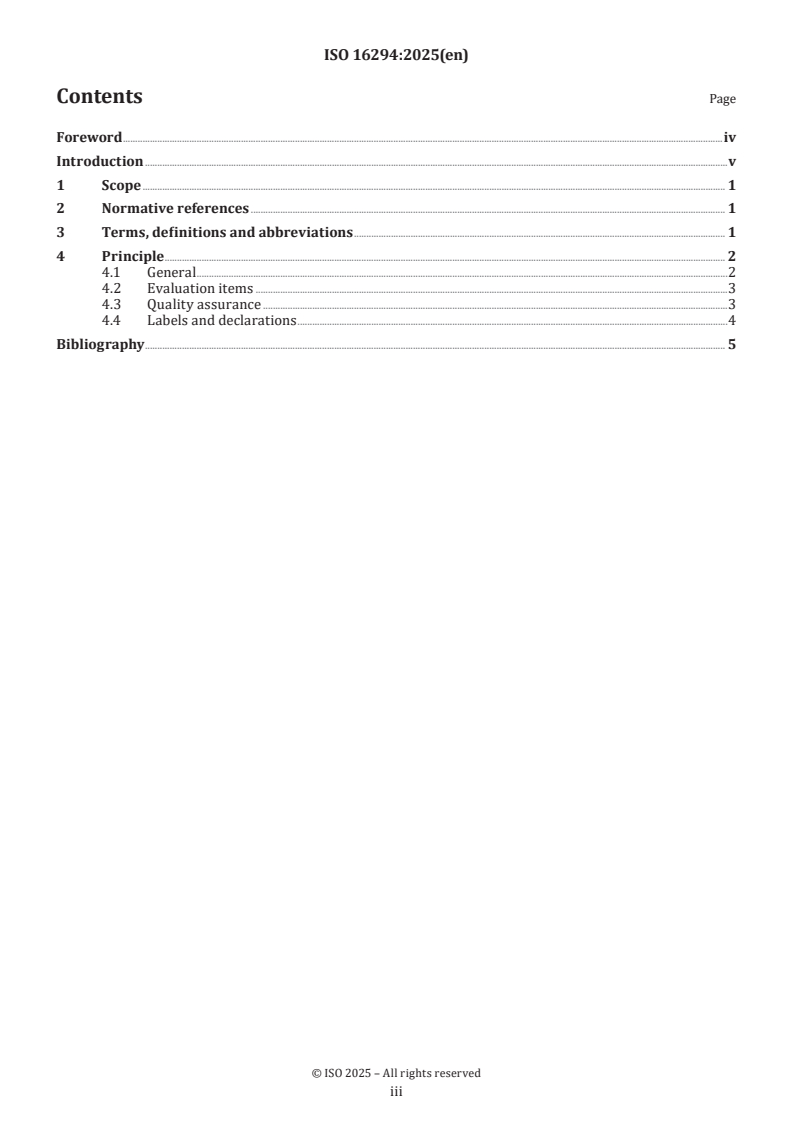
Contents Page
Foreword .iv
Introduction .v
1 Scope . 1
2 Normative references . 1
3 Terms, definitions and abbreviations . 1
4 Principle . 2
4.1 General .2
4.2 Evaluation items .3
4.3 Quality assurance .3
4.4 Labels and declarations .4
Bibliography . 5
iii
Foreword
ISO (the International Organization for Standardization) is a worldwide federation of national standards
bodies (ISO member bodies). The work of preparing International Standards is normally carried out through
ISO technical committees. Each member body interested in a subject for which a technical committee
has been established has the right to be represented on that committee. International organizations,
governmental and non-governmental, in liaison with ISO, also take part in the work. ISO collaborates closely
with the International Electrotechnical Commission (IEC) on all matters of electrotechnical standardization.
The procedures used to develop this document and those intended for its further maintenance are described
in the ISO/IEC Directives, Part 1. In particular, the different approval criteria needed for the different types
of ISO document should be noted. This document was drafted in accordance with the editorial rules of the
ISO/IEC Directives, Part 2 (see www.iso.org/directives).
ISO draws attention to the possibility that the implementation of this document may involve the use of (a)
patent(s). ISO takes no position concerning the evidence, validity or applicability of any claimed patent
rights in respect thereof. As of the date of publication of this document, ISO had not received notice of (a)
patent(s) which may be required to implement this document. However, implementers are cautioned that
this may not represent the latest information, which may be obtained from the patent database available at
www.iso.org/patents. ISO shall not be held responsible for identifying any or all such patent rights.
Any trade name used in this document is information given for the convenience of users and does not
constitute an endorsement.
For an explanation of the voluntary nature of standards, the meaning of ISO specific terms and expressions
related to conformity assessment, as well as information about ISO's adherence to the World Trade
Organization (WTO) principles in the Technical Barriers to Trade (TBT), see www.iso.org/iso/foreword.html.
This document was prepared by Technical Committee ISO/TC 47, Chemistry.
Any feedback or questions on this document should be directed to the user’s national standards body. A
complete listing of these bodies can be found at www.iso.org/members.html.
iv
Introduction
The purpose of this document is to provide general requirements for basic chemicals produced by chemical
recycling, to help all stakeholder understand basic chemicals produced by chemical recycling properly and
to support the use of basic chemicals produced by chemical recycling. Chemical products are essential to
support various industries and our daily life. At the end of their life, these products can be valuable resources
which should be recaptured and are indispensable for sustainable economic growth.
Chemical recycling is an important solution to achieve a circular economy. New chemical products (the
recovered materials) can be produced by recovering resources through chemical recycling. The recovered
resources can be used as replacements for virgin materials, which are manufactured by conventional fossil
feedstock, such as coal or oil. Chemical recycling can contribute to resource circulation in circular economy
(see Figure 1).
Basic chemical(s) or raw material(s) of basic chemicals (BCRM), which are produced by chemical recycling
of organic material(s) (CR-BCRM) has been recognized as a challenge by purchasers of CR-BCRM. Given the
innovative and recent character of chemical recycling technologies, general principles are needed on quality
assurance, distribution of information such as CO emissions and the amount of residues generated by these
1)
processes, etc. CR-BCRM should be selected from the perspective of not only the price they offer, but also
effective use of resources, contribution to the environment, or the workplace environment they put value on
such as employment status or wage system.
To smooth the transition from virgin to recycled material, methods such as the mass balance method have
also been proposed. In light of the above, it is important to facilitate communication between purc
...