


ISO 13408-1:2008
(Main)Aseptic processing of health care products — Part 1: General requirements
Aseptic processing of health care products — Part 1: General requirements
ISO 13408-1:2008 specifies the general requirements for, and offers guidance on, processes, programmes and procedures for development, validation and routine control of the manufacturing process for aseptically-processed health care products. ISO 13408-1:2008 includes requirements and guidance relative to the overall topic of aseptic processing. Specific requirements and guidance on various specialized processes and methods related to filtration, lyophilization, clean-in place (CIP) technologies, sterilization in place (SIP) and isolator systems are given in other parts of ISO 13408.
Traitement aseptique des produits de santé — Partie 1: Exigences générales
L'ISO 13408-1:2008 spécifie des exigences générales et propose des directives en matière de méthodes, de programmes et de modes opératoires pour le développement, la validation et le contrôle de produits de santé soumis à un traitement aseptique. L'ISO 13408-1:2008 comprend des exigences et des directives relatives au domaine général du traitement aseptique. Des exigences et des directives spécifiques sur les divers procédés et méthodes spécialisés de filtration, de lyophilisation, de nettoyage in situ, de stérilisation in situ et de systèmes isolateurs sont indiquées dans les différentes parties de l'ISO 13408.
General Information
- Status
- Withdrawn
- Publication Date
- 09-Jun-2008
- Technical Committee
- ISO/TC 198 - Sterilization of health care products
- Drafting Committee
- ISO/TC 198/WG 9 - Aseptic processing
- Current Stage
- 9599 - Withdrawal of International Standard
- Start Date
- 15-Aug-2023
- Completion Date
- 12-Feb-2026
Relations
- Consolidated By
ISO 340:2013 - Conveyor belts — Laboratory scale flammability characteristics — Requirements and test method - Effective Date
- 06-Jun-2022
- Effective Date
- 26-Nov-2021
- Effective Date
- 23-Apr-2020
- Effective Date
- 15-Apr-2008


Get Certified
Connect with accredited certification bodies for this standard

BSI Group
BSI (British Standards Institution) is the business standards company that helps organizations make excellence a habit.

TÜV Rheinland
TÜV Rheinland is a leading international provider of technical services.

TÜV SÜD
TÜV SÜD is a trusted partner of choice for safety, security and sustainability solutions.
Sponsored listings
Frequently Asked Questions
ISO 13408-1:2008 is a standard published by the International Organization for Standardization (ISO). Its full title is "Aseptic processing of health care products — Part 1: General requirements". This standard covers: ISO 13408-1:2008 specifies the general requirements for, and offers guidance on, processes, programmes and procedures for development, validation and routine control of the manufacturing process for aseptically-processed health care products. ISO 13408-1:2008 includes requirements and guidance relative to the overall topic of aseptic processing. Specific requirements and guidance on various specialized processes and methods related to filtration, lyophilization, clean-in place (CIP) technologies, sterilization in place (SIP) and isolator systems are given in other parts of ISO 13408.
ISO 13408-1:2008 specifies the general requirements for, and offers guidance on, processes, programmes and procedures for development, validation and routine control of the manufacturing process for aseptically-processed health care products. ISO 13408-1:2008 includes requirements and guidance relative to the overall topic of aseptic processing. Specific requirements and guidance on various specialized processes and methods related to filtration, lyophilization, clean-in place (CIP) technologies, sterilization in place (SIP) and isolator systems are given in other parts of ISO 13408.
ISO 13408-1:2008 is classified under the following ICS (International Classification for Standards) categories: 11.080.01 - Sterilization and disinfection in general. The ICS classification helps identify the subject area and facilitates finding related standards.
ISO 13408-1:2008 has the following relationships with other standards: It is inter standard links to ISO 340:2013, ISO 13408-1:2008/Amd 1:2013, ISO 13408-1:2023, ISO 13408-1:1998. Understanding these relationships helps ensure you are using the most current and applicable version of the standard.
ISO 13408-1:2008 is available in PDF format for immediate download after purchase. The document can be added to your cart and obtained through the secure checkout process. Digital delivery ensures instant access to the complete standard document.
Standards Content (Sample)
INTERNATIONAL ISO
STANDARD 13408-1
Second edition
2008-06-15
Aseptic processing of health care
products —
Part 1:
General requirements
Traitement aseptique des produits de santé —
Partie 1: Exigences générales
Reference number
©
ISO 2008
PDF disclaimer
This PDF file may contain embedded typefaces. In accordance with Adobe's licensing policy, this file may be printed or viewed but
shall not be edited unless the typefaces which are embedded are licensed to and installed on the computer performing the editing. In
downloading this file, parties accept therein the responsibility of not infringing Adobe's licensing policy. The ISO Central Secretariat
accepts no liability in this area.
Adobe is a trademark of Adobe Systems Incorporated.
Details of the software products used to create this PDF file can be found in the General Info relative to the file; the PDF-creation
parameters were optimized for printing. Every care has been taken to ensure that the file is suitable for use by ISO member bodies. In
the unlikely event that a problem relating to it is found, please inform the Central Secretariat at the address given below.
© ISO 2008
All rights reserved. Unless otherwise specified, no part of this publication may be reproduced or utilized in any form or by any means,
electronic or mechanical, including photocopying and microfilm, without permission in writing from either ISO at the address below or
ISO's member body in the country of the requester.
ISO copyright office
Case postale 56 • CH-1211 Geneva 20
Tel. + 41 22 749 01 11
Fax + 41 22 749 09 47
E-mail copyright@iso.org
Web www.iso.org
Published in Switzerland
ii © ISO 2008 – All rights reserved
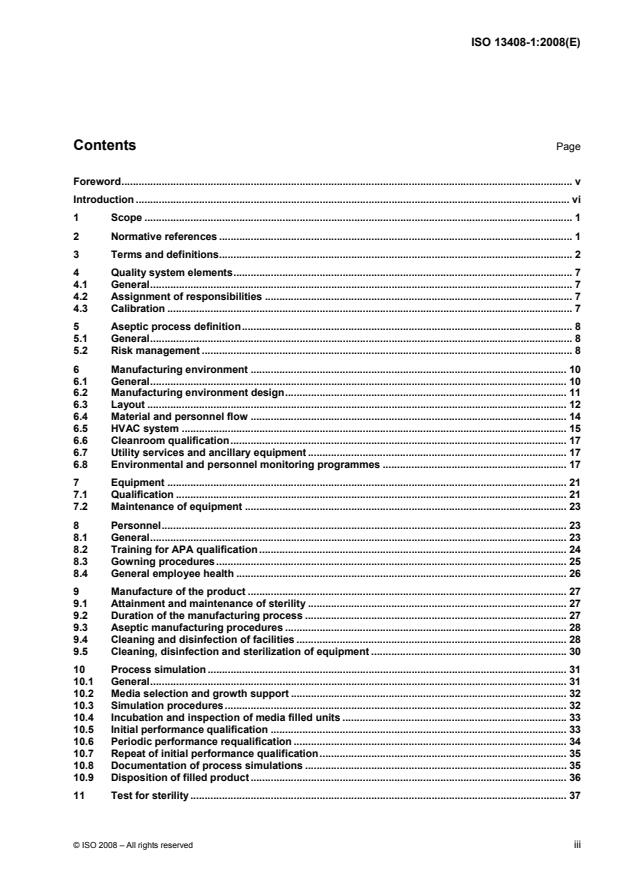
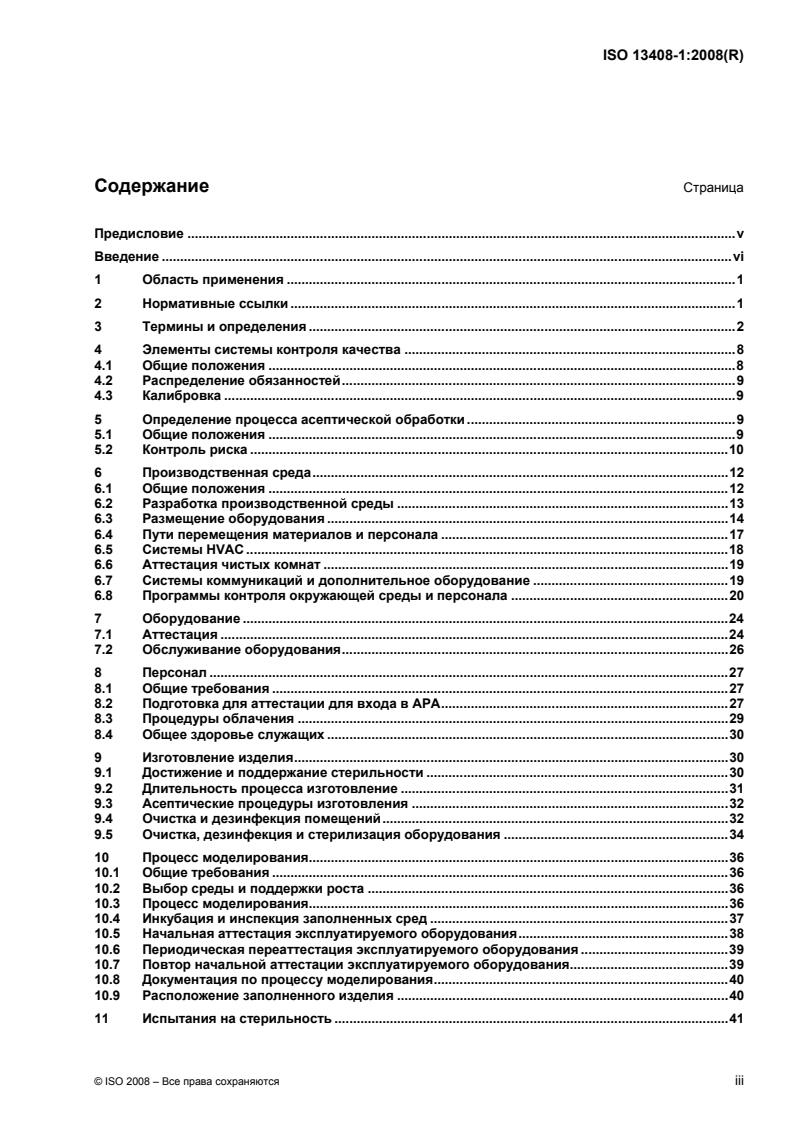
Contents Page
Foreword. v
Introduction . vi
1 Scope . 1
2 Normative references . 1
3 Terms and definitions. 2
4 Quality system elements. 7
4.1 General. 7
4.2 Assignment of responsibilities . 7
4.3 Calibration . 7
5 Aseptic process definition. 8
5.1 General. 8
5.2 Risk management . 8
6 Manufacturing environment . 10
6.1 General. 10
6.2 Manufacturing environment design. 11
6.3 Layout . 12
6.4 Material and personnel flow . 14
6.5 HVAC system . 15
6.6 Cleanroom qualification. 17
6.7 Utility services and ancillary equipment . 17
6.8 Environmental and personnel monitoring programmes . 17
7 Equipment . 21
7.1 Qualification . 21
7.2 Maintenance of equipment . 23
8 Personnel. 23
8.1 General. 23
8.2 Training for APA qualification . 24
8.3 Gowning procedures. 25
8.4 General employee health . 26
9 Manufacture of the product . 27
9.1 Attainment and maintenance of sterility . 27
9.2 Duration of the manufacturing process .27
9.3 Aseptic manufacturing procedures . 28
9.4 Cleaning and disinfection of facilities . 28
9.5 Cleaning, disinfection and sterilization of equipment . 30
10 Process simulation. 31
10.1 General. 31
10.2 Media selection and growth support . 32
10.3 Simulation procedures. 32
10.4 Incubation and inspection of media filled units . 33
10.5 Initial performance qualification . 33
10.6 Periodic performance requalification . 34
10.7 Repeat of initial performance qualification. 35
10.8 Documentation of process simulations . 35
10.9 Disposition of filled product . 36
11 Test for sterility. 37
11.1 General . 37
11.2 Investigation of positive units from tests for sterility . 37
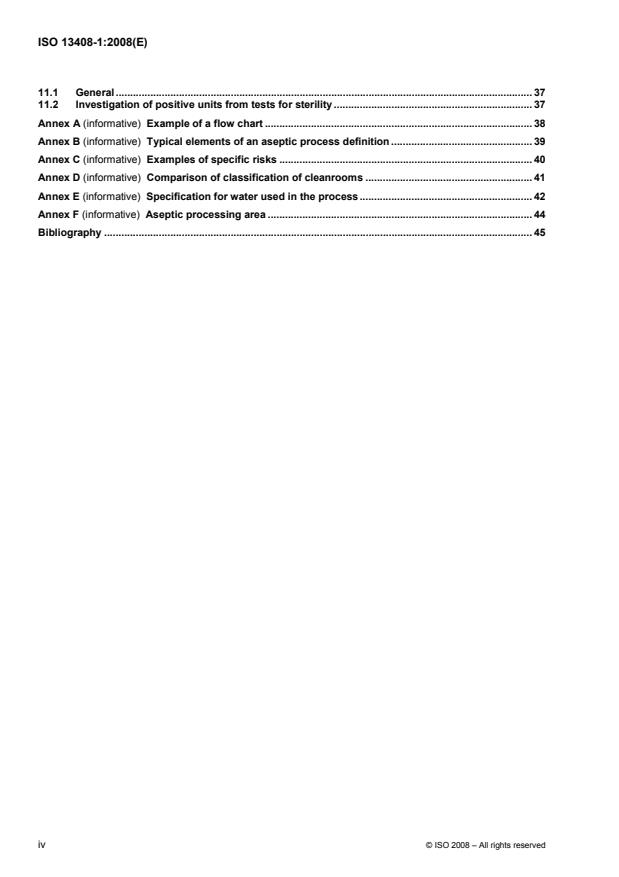
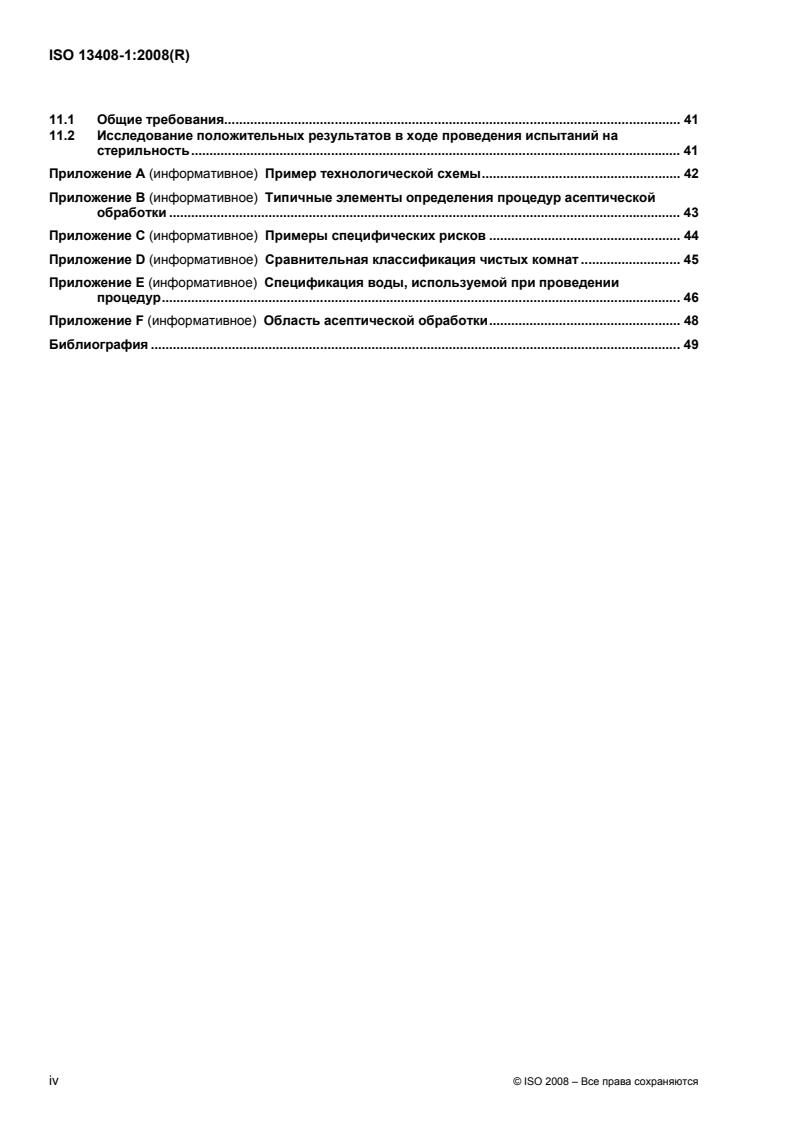
Annex A (informative) Example of a flow chart . 38
Annex B (informative) Typical elements of an aseptic process definition . 39
Annex C (informative) Examples of specific risks . 40
Annex D (informative) Comparison of classification of cleanrooms . 41
Annex E (informative) Specification for water used in the process. 42
Annex F (informative) Aseptic processing area . 44
Bibliography . 45
iv © ISO 2008 – All rights reserved
Foreword
ISO (the International Organization for Standardization) is a worldwide federation of national standards bodies
(ISO member bodies). The work of preparing International Standards is normally carried out through ISO
technical committees. Each member body interested in a subject for which a technical committee has been
established has the right to be represented on that committee. International organizations, governmental and
non-governmental, in liaison with ISO, also take part in the work. ISO collaborates closely with the
International Electrotechnical Commission (IEC) on all matters of electrotechnical standardization.
International Standards are drafted in accordance with the rules given in the ISO/IEC Directives, Part 2.
The main task of technical committees is to prepare International Standards. Draft International Standards
adopted by the technical committees are circulated to the member bodies for voting. Publication as an
International Standard requires approval by at least 75 % of the member bodies casting a vote.
Attention is drawn to the possibility that some of the elements of this document may be the subject of patent
rights. ISO shall not be held responsible for identifying any or all such patent rights.
ISO 13408-1 was prepared by Technical Committee ISO/TC 198, Sterilization of health care products.
This second edition cancels and replaces the first edition (ISO 13408-1:1998), which has been technically
revised. Any normative and informative clauses on subjects which have meanwhile been addressed in Part 2 to
Part 6 of ISO 13408 have been removed from this part.
ISO 13408 consists of the following parts, under the general title Aseptic processing of health care products:
⎯ Part 1: General requirements
⎯ Part 2: Filtration
⎯ Part 3: Lyophilization
⎯ Part 4: Clean-in-place technologies
⎯ Part 5: Sterilization in place
⎯ Part 6: Isolator systems
Introduction
Health care products that are labelled “sterile” are prepared using appropriate and validated methods under
stringent control as part of a quality management system. For pharmaceuticals and medical devices there
might be various requirements including compliance with ISO standards, GMP regulations and
pharmacopoeial requirements.
Wherever possible, healthcare products intended to be sterile should be sterilized in their final sealed
container (terminal sterilization). ISO/TC 198 has prepared standards for terminal sterilization of health care
products by irradiation (series ISO 11137), by moist heat (ISO 17665-1), by dry heat (ISO 20857, in
preparation) and by ethylene oxide (ISO 11135-1).
When a health care product is intended to be sterile and cannot be terminally sterilized, aseptic processing
provides an alternative. Presterilization of product, product parts and/or components and all equipment
coming into direct contact with the aseptically-processed product is required. Aseptic processing intends to
maintain the sterility of the pre-sterilized components and products during assembling. The resulting product is
required to be sterile in its final container. Aseptic processing can also be used to prevent contamination of
biological product or biological systems (e.g. tissues, vaccines).
While terminal sterilization involves the control of a well-defined process of known lethality delivered to the
product and a sterility assurance level (SAL) can be extrapolated from sterilization data, this is not applicable
to aseptic processing.
Examples of applications in which aseptic processing are used include:
⎯ aseptic handling and filling of solutions, suspensions, semisolids and powders;
⎯ aseptic handling, transfer and packaging of solid products including solid medical devices;
⎯ aseptic handling, transfer and packaging of combination products;
⎯ aseptic handling of tissues or biological production systems.
Sterilization procedures which render components and/or parts sterile as a prerequisite for further aseptic
processing can be treated as separate procedures. They have to be evaluated and validated separately and it
is important that their risk of failure is minimal. The aseptic process definition encompasses all production
steps following the sterilization of product and components until the final container or package is sealed. To
keep the aseptic process definition clear and workable, this part of ISO 13408 is focused on the risks to the
maintenance of sterility.
It is important to control all possible sources of contamination in order to maintain the sterility of each and
every component. To achieve this, a risk-based aseptic process definition is established encompassing each
product and applied in a comprehensive way considering product, package design, environment and
manufacturing process designs. The product is processed in a controlled environment where microbial and
particulate levels are maintained at defined minimal levels and where human intervention is minimized.
Validated systems, adequately trained personnel, controlled environments and well-documented systematic
processes are applied to assure a sterile finished product.
The aseptic process is divided into unit operations (e.g. sterilization of product or components including sterile
filtration, assembly of components, handling and storage of sterilized product) and it is necessary that
potential sources of contamination from materials, components, product, personnel, facility, equipment and
utilities such as water systems be considered and minimized. Only if all risks of contamination have been
recognised, wherever possible minimized, eliminated or controlled and finally have been evaluated as
vi © ISO 2008 – All rights reserved
acceptable, can the controls on the aseptic process be considered to be acceptable. Appropriate validation of
the specified elements of the aseptic process is needed, of which process simulation studies are an essential.
This revision of ISO 13408-1:1998 is intended to adopt this International Standard to the actual state of
technology in the field.
INTERNATIONAL STANDARD ISO 13408-1:2008(E)
Aseptic processing of health care products —
Part 1:
General requirements
1 Scope
1.1 This part of ISO 13408 specifies the general requirements for, and offers guidance on, processes,
programmes and procedures for development, validation and routine control of the manufacturing process for
aseptically-processed health care products.
1.2 This part of ISO 13408 includes requirements and guidance relative to the overall topic of aseptic
processing. Specific requirements and guidance on various specialized processes and methods related to
filtration, lyophilization, clean-in place (CIP) technologies, sterilization in place (SIP) and isolator systems are
given in other parts of ISO 13408.
NOTE This part of ISO 13408 does not supersede or replace national regulatory requirements, such as Good
Manufacturing Practices (GMPs) and/or pharmacopoeial requirements that pertain in particular national or regional
jurisdictions.
2 Normative references
The following referenced documents are indispensable for the application of this document. For dated
references, only the edition cited applies. For undated references, the latest edition of the referenced
document (including any amendments) applies.
ISO 9001, Quality management systems — Requirements
ISO 11135-1, Sterilization of health care products — Ethylene oxide — Part 1: Requirements for development,
validation and routine control of a sterilization process for medical devices
ISO 11137-1, Sterilization of health care products — Radiation — Part 1: Requirements for development,
validation and routine control of a sterilization process for medical devices
ISO 11137-2, Sterilization of health care products — Radiation — Part 2: Establishing the sterilization dose
ISO 13408-2, Aseptic processing of health care products — Part 2: Filtration
ISO 13408-3, Aseptic processing of health care products — Part 3: Lyophilization
ISO 13408-4, Aseptic processing of health care products — Part 4: Clean-in-place technologies
ISO 13408-5, Aseptic processing of health care products — Part 5: Sterilization in place
ISO 13408-6, Aseptic processing of health care products — Part 6: Isolator systems
ISO 13485, Medical devices — Quality management systems — Requirements for regulatory purposes
ISO 14160, Sterilization of single-use medical devices incorporating materials of animal origin — Validation
and routine control of sterilization by liquid chemical sterilants
ISO 14644-1:1999, Cleanrooms and associated controlled environments — Part 1: Classification of air
cleanliness
ISO 14644-2, Cleanrooms and associated controlled environments — Part 2: Specifications for testing and
monitoring to prove continued compliance with ISO 14644-1
ISO 14644-3, Cleanrooms and associated controlled environments — Part 3: Test methods
ISO 14644-4, Cleanrooms and associated controlled environments — Part 4: Design, construction and start-
up
ISO 14644-5, Cleanrooms and associated controlled environments — Part 5: Operations
ISO 14644-7, Cleanrooms and associated controlled environments — Part 7: Separative devices (clean air
hoods, gloveboxes, isolators and mini-environments)
ISO 14698-1, Cleanrooms and associated controlled environments — Biocontamination control — Part 1:
General principles and methods
ISO 14698-2, Cleanrooms and associated controlled environments — Biocontamination control — Part 2:
Evaluation and interpretation of biocontamination data
ISO 14937, Sterilization of health care products — General requirements for characterization of a sterilizing
agent and the development, validation and routine control of a sterilization process for medical devices
ISO 14971, Medical devices — Application of risk management to medical devices
ISO 17665-1, Sterilization of health care products — Moist heat — Part 1: Requirements for the development,
validation and routine control of a sterilization process for medical devices
1)
ISO 20857 , Sterilization of health care products — Dry heat — Requirements for the development, validation
and routine control of a sterilization process for medical devices
2)
ICH Guidance for Industry — Q9 Quality Risk Management
3 Terms and definitions
For the purposes of this document, the following terms and definitions apply:
3.1
action level
established microbial or particulate monitoring results requiring immediate follow-up and corrective action
3.2
airlock
room with interlocked doors designed to maintain pressure control between adjacent rooms of different
cleanliness class
3.3
alert level
established microbial or particulate monitoring results giving early warning of potential drift from normal
operating conditions which are not necessarily grounds for definitive corrective action but which could require
follow-up investigation
1) To be published.
2) Available at: http://www.ich.org
2 © ISO 2008 – All rights reserved
3.4
aseptic processing
handling of sterile product, containers and/or devices in a controlled environment, in which the air supply,
materials, equipment and personnel are regulated to maintain sterility
NOTE This includes sterilization by membrane filtration which cannot be separated from the subsequent aseptic
process.
3.5
aseptic processing area
APA
facilities for aseptic processing (3.4), consisting of several zones
3.6
bioburden
population of viable microorganisms on or in product and/or sterile barrier system
[ISO/TS 11139:2006, definition 2.2]
NOTE For the purposes of aseptic processing, the bioburden of concern is that on or in the product including all
factors affecting it such as raw material, intermediates, other components and equipment.
3.7
bio-decontamination
removal of microbiological contamination or its reduction to an acceptable level
[ISO 13408-6:2005, definition 3.1]
3.8
cleaning
removal of contamination from an item to the extent necessary for further processing or for intended use
[ISO/TS 11139:2006, definition 2.7]
3.9
combination product
product comprised of drug/device, biologic/device, drug/biologic or drug/device/biologic, that are physically,
chemically, or otherwise combined or mixed and produced as a single entity
3.10
correction
action to eliminate a detected nonconformity
NOTE A correction can be made in conjunction with a corrective action.
[ISO 9000:2005; definition 3.6.6]
3.11
corrective action
action to eliminate the cause of a detected nonconformity or other undesirable situation
[ISO 9000:2005, definition 3.6.5]
NOTE 1 There can be more than one cause for a nonconformity.
NOTE 2 Corrective action is taken to prevent recurrence whereas preventive action (3.29) is taken to prevent
occurrence.
NOTE 3 There is a distinction between correction and corrective action.
NOTE 4 Corrective actions might be subject to change control.
3.12
critical processing zone
location within the aseptic processing area in which product and critical surfaces are exposed to the
environment
3.13
critical surface
surface that may come into contact with or directly affect a product or its containers or closures
3.14
depyrogentation
validated process designed to remove or deactivate endotoxins
3.15
design qualification
verification that the proposed specification for the facility, equipment or system is suitable for the intended use
[ISO/TS 11139:2006, definition 2.12]
3.16
direct support zone
protective area directly surrounding a critical processing zone
3.17
disinfectant
chemical agent that is able to reduce the number of viable microorganisms
3.18
disinfection
removal, destruction or de-activation of microorganisms on objects or surfaces
[ISO 14644-5:2004;definition 3.1.4]
3.19
endotoxin
lipopolysaccharide component of the cell wall of Gram-negative bacteria which is heat stable and elicits a
variety of inflammatory responses in animals and humans
3.20
environmental isolates
microorganisms present in and/or isolated from processing or manufacturing environments
3.21
gowning procedure
defined steps to reduce the risk of contamination while putting on the protective garments needed to enter the
APA (3.5)
3.22
health care product
medical device(s), including in vitro diagnostic medical device(s), or medicinal product(s), including
biopharmaceutical(s)
[ISO/TS 11139:2006, definition 2.20]
3.23
high efficiency particulate air filter
HEPA filter
retentive matrix having a minimum particle-collection efficiency of 99,97 % (that is, a maximum particle
penetration of 0,03 % for 0,3 µm particles)
4 © ISO 2008 – All rights reserved
3.24
indirect support zone
location within the aseptic processing area which protects the direct support zone
NOTE The required grade of cleanliness of the indirect support zone depends on the aseptic processing activities
performed in the indirect processing zone.
3.25
installation qualification
IQ
process of obtaining and documenting evidence that equipment has been provided and installed in
accordance with its specification
[ISO/TS 11139:2006, definition 2.22]
3.26
isolator
enclosure capable of preventing ingress of contaminants by means of physical interior/exterior separation, and
capable of being subject to reproducible interior bio-decontamination
NOTE An isolator can range in size from a small box to a large room.
3.27
operational qualification
OQ
process of obtaining and documenting evidence that installed equipment operates within predetermined limits
when used in accordance with its operational procedures
[ISO/TS 11139:2006, definition 2.27]
3.28
performance qualification
PQ
process of obtaining and documenting evidence that the equipment, as installed and operated in accordance
with operational procedures, consistently performs in accordance with predetermined criteria and thereby
yields product meeting its specification
[ISO/TS 11139:2006, definition 2.30]
3.29
preventive action
action to eliminate the cause of a potential nonconformity or other undesirable potential situation
[ISO 9000:2005, definition 3.6.4]
NOTE 1 There can be more than one cause for a potential nonconformity.
NOTE 2 Preventive action is taken to prevent occurrence whereas corrective action (3.11) is taken to prevent
recurrence.
3.30
qualification
documented process used by the health care product manufacturer to assure the reliability and capability of
equipment and/or processes before approval for use in manufacturing
NOTE Qualification of equipment and/or processes generally includes installation qualification (3.25), operational
qualification (3.27) and performance qualification (3.28).
3.31
risk control
process in which decisions are made and measures implemented by which risks are reduced to, or
maintained within, specified levels
[ISO 14971:2007, definition 2.19]
3.32
separative device
equipment utilizing constructional and dynamic means to create assured levels of separation between the
inside and outside of a defined volume
NOTE Some industry-specific examples of separative devices are clean air hoods, containment enclosures,
gloveboxes, isolators and mini-environments.
[ISO 14644-7:2004, definition 3.17]
3.33
shift
scheduled period of work or production staffed by a single defined group of workers
NOTE This is usually not more than 12 h in length.
3.34
sterile
free from viable microorganisms
[ISO/TS 11139:2006, definition 2.43]
NOTE In practice, no such absolute statement regarding the absence of microorganisms can be proven,
see sterilization (3.35).
3.35
sterilization
validated process used to render a product free from viable microorganisms
[ISO/TS 11139:2006, definition 2.47]
3.36
terminal sterilization
process whereby product is sterilized within its sterile barrier system
[ISO/TS 11139:2006, definition 2.52]
3.37
ultra low penetration air filter
ULPA filter
matrix with minimum 0,3 µm particle retaining efficiency of 99,999 %
3.38
unidirectional airflow
air stream which has a defined direction
3.39
unit operation
defined chemical or physical step in a manufacturing process
NOTE See example of a flowchart in Annex A.
6 © ISO 2008 – All rights reserved
3.40
validation
documented procedure for obtaining, recording and interpreting the results required to establish that a process
will consistently yield product complying with predetermined specifications
[ISO/TS 11139:2006, definition 2.55]
3.41
worst case
set of conditions that represent the greatest challenge to product integrity and safety which will be accepted
during routine production
4 Quality system elements
4.1 General
4.1.1 A quality management system, appropriate to the nature of the operations, shall be implemented to
assure control over all activities affecting aseptic processing. Unless a superseding national, regional, or
International Good Manufacturing Practice (e.g. the World Health Organization GMPs) is employed, the
quality management system shall be in conformance with the requirements of ISO 9001 and/or ISO 13485.
NOTE Guidance on selecting a suitable model is given in ISO 9004 and ISO/TR 14969.
4.1.2 Documented procedures for each phase of the development, validation, routine monitoring and
control of the aseptic process shall be prepared and implemented.
4.1.3 Documents required by this part of ISO 13408 shall be reviewed and approved by designated
personnel.
4.1.4 Records of development, validation, routine control and monitoring shall be maintained to provide
evidence of conformity to the requirements of this part of ISO 13408.
4.2 Assignment of responsibilities
4.2.1 The responsibilities and authority for implementing, performing and monitoring the procedures
described in this part of ISO 13408 shall be assigned to qualified personnel as specified in ISO 13485.
4.2.2 Management shall be responsible for ensuring that there is an adequate number of qualified
employees to perform required work and that supervision is provided. Management shall periodically review
the performance of the quality management system to assess any areas needing improvement.
4.2.3 If the requirements of this part of ISO 13408 are undertaken by separate organizations with
independent quality management systems, the responsibilities and authority of each party shall be specified.
4.3 Calibration
4.3.1 A documented procedure shall be specified for the calibration of all measuring instruments or
measuring systems.
4.3.2 The accuracy and tolerance of all measuring instruments shall be adequate for the process to be
measured.
5 Aseptic process definition
5.1 General
5.1.1 Aseptic processing is an activity composed of many unit operations that need to be effectively
combined to maintain sterility.
The purpose of the aseptic process definition is to obtain a comprehensive understanding of the integration of
the different elements required. Typical elements are given in Annex B.
5.1.2 A justification for the use of aseptic processing shall be documented.
NOTE The preferred option is terminal sterilization in the final container.
5.1.3 Based on the aseptic processing definition an assessment of aseptic processing risks shall be
conducted. Methods and procedures to control these risks shall be described and implemented (see 5.2).
Residual risks shall be justified.
5.1.4 The aseptic process definition shall be reviewed after stated intervals or whenever a change occurred
that might impact the product or following a significant event (e.g. batch non-sterility).
5.1.5 The aseptic process definition shall consider the complete process and give a rationale describing
how each element involved in processing contributes to the attainment and maintenance of a sterile product.
NOTE For requirements for aseptically manufactured medical devices to be designated “sterile”, see also ISO 15223
and national or regional requirements given in, for example, EN 556-2 or ANSI/AAMI ST67:2003.
5.2 Risk management
5.2.1 General
5.2.1.1 A risk management process shall be carried out, applying ISO 14971 and/or ICH Q9.
Risks associated with the aseptic process shall be identified, assessed and controlled in order to establish
acceptance criteria for all elements of the aseptic process definition.
Compliance with the requirements as defined in Clause 6 et seq. and/or regulatory documents can be used to
demonstrate acceptability of the implemented risk control.
NOTE While this part of ISO 13408 is primarily concerned with microbiological contamination issues, there are other
contamination risks that are relevant (e.g. endotoxin, particulate and chemical contamination).
5.2.1.2 The risk management strategy shall take into account the nature of the product and its intended
clinical use. Microbiological risk management should follow the following four stages:
a) identification of contamination risks;
b) assessment of contamination risks;
c) monitoring and detection of contamination;
d) prevention of contamination.
The measures taken to control the risks shall be proportionate to perceived risks.
Specific risks shall be taken into account and the aseptic process shall be designed with due consideration of
all identified factors (see Table C.1 for guidance).
8 © ISO 2008 – All rights reserved
5.2.2 Identification of microbiological contamination risks
Each unit operation shall be assessed for risks that might compromise the quality of the product. Factors to be
considered shall include:
a) origins of contamination:
1) contamination sources;
b) routes of contamination:
1) inappropriate aseptic technique;
2) ability of microorganisms to cross a segregation barrier;
3) microorganisms being transported across a processing zone;
c) proliferation of contamination:
1) conditions conducive to microbial proliferation;
d) contamination detection and removal:
1) detection of microbial contamination;
2) adequate microbial removal.
NOTE Examples of high risk procedures include handling by personnel, of sterile product or equipment and exposure
of product or critical surfaces to the environment. The extent of the risk depends on the level of segregation between
personnel and the item and the degree of control over the microbiological quality of the environment.
5.2.3 Assessment of contamination risks
Any identified contamination risks shall be assessed regarding the potential effect on product quality. This
assessment should include the evaluation of relevant process or monitoring data. Measures to minimize risks
shall be prioritized based on the risk assessment.
NOTE Established procedures such as Failure Mode and Effect Analysis (FMEA) or Hazard Analysis of Critical
Control Points (HACCP) can be applied in order to identify risks.
5.2.4 Monitoring and detection of contamination
5.2.4.1 There shall be procedures for monitoring aseptic processing.
5.2.4.2 The procedures for monitoring the process shall not be limited to the isolation and identification of
microbial contamination. Monitoring of processes shall also include particulates and endotoxins where
relevant claims are made. Other contamination risks not specifically associated with aseptic processing are
not addressed in this part of ISO 13408.
NOTE Particle monitoring allows real-time detection of potential process deviations.
5.2.4.3 Monitoring of the bioburden and endotoxin load of starting materials shall be conducted as
relevant for the product with regard to the nature of the material and its potential for microbiological
contamination. Alert and action levels shall be set with regard to the risk of microbial proliferation and with due
consideration of the control methods applied in the process.
5.2.4.4 The aseptic process shall be monitored in order to allow comprehensive management of
microbiological quality. Monitoring shall address:
a) microbiological quality of the product at defined stages during the manufacturing process (see 6.8);
b) microbiological quality of the manufacturing environment including air and surfaces of rooms (see 6.8.3.1),
equipment surfaces (see 6.8.3.1) and tools (see 6.8.1.7);
c) microbiological status of the gloves and gowns of personnel at defined intervals (see 6.8).
NOTE 1 Observation of activities is also useful for the purposes of identification of potential sources for the introduction
of contaminants.
NOTE 2 Monitoring of bioburden against established limits is a requirement in certain jurisdictions.
5.2.4.5 The rationale of the monitoring methods employed shall be documented.
NOTE Pharmacopoeial procedures such as “Microbiological examination of non-sterile products: Microbial
enumeration tests” shown in the Ph.Eur., JP and USP might be applicable.
5.2.4.6 The applicability of the monitoring methods and the reliability of the results obtained using those
methods with respect to recognition of risks shall be assessed.
NOTE In general, the available microbiological monitoring methods are not sufficiently sensitive to detect all microbial
contaminants.
5.2.4.7 Data gathered from monitoring shall be evaluated so that appropriate action can be taken. The
response to a monitoring result should be correlated to the identified risk as determined in the risk
management process.
5.2.5 Prevention of contamination
5.2.5.1 Once risks have been identified corrective and preventive action shall be applied to minimize or
eliminate these risks.
NOTE Such measures can include design changes, additional training or procedural modifications.
5.2.5.2 Appropriate measurements shall be undertaken to demonstrate the effectiveness of the
preventive measures.
6 Manufacturing environment
6.1 General
6.1.1 The manufacturing environment shall be designed and built in accordance with ISO 14644-4.
6.1.2 The objective(s) of the control programme for the manufacturing environment shall be defined.
NOTE Aseptic processing is aimed at preventing product contamination. Where highly potent or cytotoxic health care
products are to be processed, protection of personnel and the environment is considered an ancillary element of aseptic
processing design.
6.1.3 The control programme for the manufacturing environment shall address:
a) APA layout and design including:
1) physical attributes of the rooms;
2) segregation for all cleanliness zones;
10 © ISO 2008 – All rights reserved
b) APA heating, venting and air conditioning (HVAC) system including:
1) airflow velocities, number of air changes per hour and differential pressures;
2) airflow pattern for critical processing (and direct support zones where required);
3) temperature and relative humidity;
c) appropriate monitoring parameters and set control levels for particulates and microorganisms;
d) introduction and exhaust of utilities;
e) introduction and removal of materials, components, product and waste;
f) cleaning and disinfection procedures;
g) provisions and procedures including gowning practices for entering and leaving of personnel;
h) access for service and maintenance;
i) behaviour and activities of personnel in the APA;
j) provisions for corrective measures within the APA;
k) personnel flow;
l) pest control.
6.2 Manufacturing environment design
6.2.1 General
6.2.1.1 The APA shall be designed and constructed in accordance with ISO 14644-1, ISO 14644-4 and
ISO 14644-7.
6.2.1.2 The facility design shall be compatible with processes or product types processed therein.
6.2.1.3 A design review shall be carried out and recorded for each APA. It shall demonstrate that the
design is in compliance with the aseptic process definition or equivalent. Records of design reviews shall be
retained (see 4.1.4).
6.2.1.4 Before significant modifications to a facility are implemented, a design review including risk
assessment shall be undertaken.
6.2.2 Construction features
6.2.2.1 Ceilings, walls, wall systems and floors shall be designed and constructed in a way that facilitates
cleaning and disinfection and minimizes the shedding or accumulation of particles or microorganisms.
Materials shall be chosen which are resistant to the repeated application of cleaning agents and to the
disinfectants used. The edges of the floors of cleanrooms shall be covered and sealed at the junction to the
walls.
6.2.2.2 Ceilings shall be sealed to prevent ingress of particles from the space above. Filters, filter frames
and housings, diffusers, lamps or any other penetration points shall be sealed and fitted flush with the ceiling.
False ceilings and wall elements shall be sealed to prevent contamination from the surrounding areas.
6.2.2.3 Windows shall be integrated into the walls of the cleanroom to allow observation of the aseptic
operations from the outside of the cleanroom in order to minimize the need for access to the clean zones for
any reason other than direct participation in the aseptic operations. Where glass is inserted in walls and doors
it shall be non-opening with flush mounting on surfaces in the APA.
6.2.2.4 Where communication systems are provided in the APA they shall be designed to facilitate
cleaning.
6.2.2.5 Where barriers are used to guide airflow, the material used shall be durable and resistant to the
cleaning agents and disinfectants used.
6.2.2.6 The design of the APA shall be such as to minimize horizontal surfaces and to allow for the
adequate cleaning and disinfection of ceilings, floors, walls and other surfaces.
6.2.2.7 Pipes, ducts and other utilities shall be installed so that they do not create recesses, unsealed
openings or surfaces which are difficult to clean.
Pipes, tubing and cables shall be routed in external service areas or ducts wherever possible. Power take-off
points, switchboards, taps and connections shall be designed and installed to facilitate regular cleaning and to
avoid the build-up of contamination in or behind blanking covers. Where protective housings or covers cannot
be avoided (for example in switchboards of equipment), these shall be sealed in a way to prevent
contamination of APA and shall only be opened when the APA is not is use.
6.2.2.8 Sinks and open drains shall not be located in critical processing zones (see 6.3.2) and direct
support zones (see 6.3.3). Where drains are fitted to process equipment, appropriate backflow prevention
shall be used. In other areas, sinks and drains shall be suitable for disinfection. and air breaks shall be fitted
between the machine or sink and the drains to prevent back contamination. Floor drains in indirect support
zones (see 6.3.4) shall be suitable for disinfection, fitted with traps or water seals and sealed when not in use.
6.3 Layout
6.3.1 General
6.3.1.1 Aseptic manufacture of sterile products shall be carried out in an APA. Operations involving
component preparation, product preparation and filling shall be carried out in separate areas within the APA.
NOTE Segregation (or separation) within the APA is achieved by the sweeping action of the air (airflows), pressure
differential
...
NORME ISO
INTERNATIONALE 13408-1
Deuxième édition
2008-06-15
Traitement aseptique des produits
de santé —
Partie 1:
Exigences générales
Aseptic processing of health care products —
Part 1: General requirements
Numéro de référence
©
ISO 2008
PDF – Exonération de responsabilité
Le présent fichier PDF peut contenir des polices de caractères intégrées. Conformément aux conditions de licence d'Adobe, ce fichier
peut être imprimé ou visualisé, mais ne doit pas être modifié à moins que l'ordinateur employé à cet effet ne bénéficie d'une licence
autorisant l'utilisation de ces polices et que celles-ci y soient installées. Lors du téléchargement de ce fichier, les parties concernées
acceptent de fait la responsabilité de ne pas enfreindre les conditions de licence d'Adobe. Le Secrétariat central de l'ISO décline toute
responsabilité en la matière.
Adobe est une marque déposée d'Adobe Systems Incorporated.
Les détails relatifs aux produits logiciels utilisés pour la création du présent fichier PDF sont disponibles dans la rubrique General Info
du fichier; les paramètres de création PDF ont été optimisés pour l'impression. Toutes les mesures ont été prises pour garantir
l'exploitation de ce fichier par les comités membres de l'ISO. Dans le cas peu probable où surviendrait un problème d'utilisation,
veuillez en informer le Secrétariat central à l'adresse donnée ci-dessous.
DOCUMENT PROTÉGÉ PAR COPYRIGHT
© ISO 2008
Droits de reproduction réservés. Sauf prescription différente, aucune partie de cette publication ne peut être reproduite ni utilisée sous
quelque forme que ce soit et par aucun procédé, électronique ou mécanique, y compris la photocopie et les microfilms, sans l'accord écrit
de l'ISO à l'adresse ci-après ou du comité membre de l'ISO dans le pays du demandeur.
ISO copyright office
Case postale 56 • CH-1211 Geneva 20
Tel. + 41 22 749 01 11
Fax + 41 22 749 09 47
E-mail copyright@iso.org
Web www.iso.org
Publié en Suisse
ii © ISO 2008 – Tous droits réservés
Sommaire Page
Avant-propos. v
Introduction . vi
1 Domaine d'application. 1
2 Références normatives . 1
3 Termes et définitions. 2
4 Éléments du système qualité . 7
4.1 Généralités . 7
4.2 Attribution des responsabilités. 8
4.3 Étalonnage. 8
5 Définition d'un traitement aseptique. 8
5.1 Généralités . 8
5.2 Gestion des risques. 9
6 Environnement de fabrication . 11
6.1 Généralités . 11
6.2 Conception de l’environnement de fabrication . 12
6.3 Plan. 13
6.4 Flux de personnes et de matériaux. 15
6.5 Système de ventilation contrôlée. 16
6.6 Qualification de la chambre stérile . 18
6.7 Installations et équipements . 18
6.8 Programmes de surveillance environnementale et du personnel. 19
7 Équipement . 22
7.1 Qualification . 22
7.2 Maintenance de l’équipement. 24
8 Personnel. 25
8.1 Généralités . 25
8.2 Formation à la qualification APA . 26
8.3 Modes opératoires relatifs à l’habillage . 27
8.4 État de santé général du personnel . 29
9 Fabrication du produit. 29
9.1 Stérilisation et maintien de la stérilité . 29
9.2 Durée du procédé de fabrication. 30
9.3 Modes opératoires relatifs à la fabrication aseptique. 30
9.4 Nettoyage et désinfection des installations.30
9.5 Nettoyage, désinfection et stérilisation de l’équipement . 32
10 Simulation de procédé . 34
10.1 Généralités . 34
10.2 Sélection et soutien de la culture du milieu. 34
10.3 Modes opératoires relatifs à la simulation. 35
10.4 Incubation et inspection des unités utilisées dans les essais de remplissage simulés. 36
10.5 Qualification opérationnelle initiale. 37
10.6 Requalification opérationnelle périodique.37
10.7 Répétition de la qualification opérationnelle initiale. 38
10.8 Documentation des simulations de procédé . 38
10.9 Mise au rebut du produit rempli . 39
11 Essai de stérilité. 40
11.1 Généralités. 40
11.2 Enquête sur les unités positives à partir des études de stérilité. 40
Annexe A (informative) Exemple de logigramme. 41
Annexe B (informative) Éléments types de la définition d’un procédé aseptique. 42
Annexe C (informative) Exemples de risques spécifiques. 43
Annexe D (informative) Comparaison de la classification des chambres stériles . 44
Annexe E (informative) Spécifications relatives à l’eau utilisée dans le procédé . 45
Annexe F (informative) Zone de traitement aseptique. 47
Bibliographie . 48
iv © ISO 2008 – Tous droits réservés
Avant-propos
L'ISO (Organisation internationale de normalisation) est une fédération mondiale d'organismes nationaux de
normalisation (comités membres de l'ISO). L'élaboration des Normes internationales est en général confiée
aux comités techniques de l'ISO. Chaque comité membre intéressé par une étude a le droit de faire partie du
comité technique créé à cet effet. Les organisations internationales, gouvernementales et non
gouvernementales, en liaison avec l'ISO participent également aux travaux. L'ISO collabore étroitement avec
la Commission électrotechnique internationale (CEI) en ce qui concerne la normalisation électrotechnique.
Les Normes internationales sont rédigées conformément aux règles données dans les Directives ISO/CEI,
Partie 2.
La tâche principale des comités techniques est d'élaborer les Normes internationales. Les projets de Normes
internationales adoptés par les comités techniques sont soumis aux comités membres pour vote. Leur
publication comme Normes internationales requiert l'approbation de 75 % au moins des comités membres
votants.
L'attention est appelée sur le fait que certains des éléments du présent document peuvent faire l'objet de
droits de propriété intellectuelle ou de droits analogues. L'ISO ne saurait être tenue pour responsable de ne
pas avoir identifié de tels droits de propriété et averti de leur existence.
L'ISO 13408-1 a été élaborée par le comité technique ISO/TC 198, Stérilisation des produits de santé.
Cette deuxième édition annule et remplace la première édition (ISO 13408-1:1998), qui a fait l'objet d'une
révision technique.
L'ISO 13408 comprend les parties suivantes, présentées sous le titre général Traitement aseptique des
produits de santé:
⎯ Partie 1: Exigences générales
⎯ Partie 2: Filtration
⎯ Partie 3: Lyophilisation
⎯ Partie 4: Technologies de nettoyage sur place
⎯ Partie 5: Stérilisation sur place
⎯ Partie 6: Systèmes isolateurs
Introduction
Les produits de santé étiquetés «stérile» sont préparés suivant des méthodes appropriées et validées dans le
cadre de contrôles stricts faisant partie du système de management de la qualité. Les dispositifs
pharmaceutiques et médicaux peuvent être soumis à différentes exigences, notamment la conformité aux
normes ISO, à la réglementation BPF (bonnes pratiques de fabrication) et aux exigences pharmaceutiques.
Dans la mesure du possible, il convient que les produits de santé destinés à être stériles soient stérilisés dans
leur conditionnement (stérilisation terminale). L’ISO/TC 198 a élaboré des normes relatives à la stérilisation
terminale des produits de santé par irradiation (série ISO 11137), par chaleur humide (ISO 17665-1), par
chaleur sèche (en cours d’élaboration) et par oxyde d'éthylène (ISO 11135-1).
Lorsqu'un produit de santé est destiné à être stérile, mais qu’il ne peut subir de stérilisation terminale, le
traitement aseptique peut constituer une autre solution. La stérilisation préliminaire du produit, des parties
et/ou des composants du produit ainsi que de tous les équipements entrant directement en contact avec le
produit traité de façon aseptique est requise. Le traitement aseptique doit préserver la stérilité des
composants et des produits préalablement stérilisés au moment de l’assemblage. Il est impératif que le
produit en bout de ligne soit stérile dans son conditionnement final. Il est également possible de passer par un
traitement aseptique pour empêcher la contamination d’un produit ou de systèmes biologiques (par exemple
les tissus, les vaccins).
En revanche, la stérilisation terminale implique le contrôle d’un procédé bien défini de létalité connue, associé
au produit, et un niveau d'assurance de la stérilité (NAS) qui puissent être extrapolés à partir des données de
stérilisation. Cela ne s’applique pas au traitement aseptique.
Voici quelques exemples d’applications utilisant un traitement aseptique:
⎯ la manipulation et le remplissage aseptiques des solutions, des suspensions, des semi-solides et des
poudres;
⎯ la manipulation, le transfert et l'emballage aseptiques des produits solides y compris des dispositifs
médicaux solides;
⎯ la manipulation, le transfert et l'emballage aseptiques de combinaisons de produits;
⎯ la manipulation aseptique des systèmes de production biologique ou des tissus.
Les modes opératoires relatifs à la stérilisation, permettant de stériliser des composants et/ou des pièces qui
constituent une exigence préalable à un traitement aseptique ultérieur, peuvent être traités comme des modes
opératoires distincts. Ils doivent être évalués et validés un par un et il est important de réduire le plus possible
tout risque de dysfonctionnement. La définition du procédé aseptique englobe toutes les étapes de production
suivant la stérilisation du produit et des composants jusqu’au scellement du conditionnement final. Pour que la
définition du procédé aseptique ne perde pas en clarté au fil du temps, la présente Norme internationale se
concentre sur les risques liés au maintien de la stérilité.
Il est essentiel de contrôler toutes les sources possibles de contamination afin de maintenir la stérilité de
chaque composant. Pour ce faire, une définition d’un procédé aseptique fondée sur les risques est établie.
Elle englobe chaque produit et est appliquée d’une manière globale en prenant en compte le produit, la
conception de l’emballage, l’environnement et les différents procédés de fabrication. Le produit est traité dans
un environnement contrôlé, dans lequel les charges microbiennes et particulaires sont maintenues à des
niveaux définis et où l'intervention humaine est limitée au maximum. Des systèmes validés, du personnel
formé de façon adéquate, un environnement contrôlé et des modes opératoires systématiques bien
documentés sont mis en œuvre pour garantir un produit fini stérile.
vi © ISO 2008 – Tous droits réservés
Le procédé aseptique est divisé en opérations simples (par exemple stérilisation du produit ou des
composants comprenant la filtration stérile, l'assemblage des composants, la manipulation et le stockage du
produit stérilisé). Il est nécessaire d’identifier et de réduire le plus possible les sources potentielles de
contamination, qu’elles viennent des matériaux, des composants, du produit, du personnel, de l’installation, de
l’équipement et des équipements auxiliaires tels que les systèmes d’alimentation en eau. Ce n’est qu’une fois
que tous les risques de contamination ont été identifiés et, dans la mesure du possible, réduits le plus
possible, éliminés ou contrôlés et, enfin, qu’ils ont été évalués comme acceptables, que les contrôles du
traitement aseptique peuvent être considérés comme acceptable. Une validation appropriée des éléments
spécifiés du procédé aseptique est nécessaire, pour laquelle il est essentiel d’avoir procédé à des études sur
des simulations.
La révision de l’ISO 13408-1:1998 est censée adopter la présente Norme internationale dans l’état actuel de
la technologie dans ce domaine.
NORME INTERNATIONALE ISO 13408-1:2008(F)
Traitement aseptique des produits de santé —
Partie 1:
Exigences générales
1 Domaine d'application
1.1 La présente partie de l’ISO 13408 spécifie des exigences générales et propose des directives en
matière de méthodes, de programmes et de modes opératoires pour le développement, la validation et le
contrôle de produits de santé soumis à un traitement aseptique.
1.2 La présente partie de l'ISO 13408 comprend des exigences et des directives relatives au domaine
général du traitement aseptique. Des exigences et des directives spécifiques sur les divers procédés et
méthodes spécialisés de filtration, de lyophilisation, de nettoyage in situ, de stérilisation in situ et de systèmes
isolateurs sont indiquées dans les différentes parties de l’ISO 13408.
NOTE La présente partie de l’ISO 13408 n'est pas destinée à remplacer ou à annuler des exigences réglementaires
nationales, telles que les «bonnes pratiques de fabrication» (BPF) et/ou les exigences pharmaceutiques, qui relèvent des
juridictions nationales ou régionales particulières.
2 Références normatives
Les documents de référence suivants sont indispensables pour l'application du présent document. Pour les
références datées, seule l'édition citée s'applique. Pour les références non datées, la dernière édition du
document de référence s’applique (y compris les éventuels amendements).
ISO 9001, Systèmes de management de la qualité — Exigences
ISO 11135-1, Stérilisation des produits de santé — Oxyde d'éthylène — Partie 1: Exigences de
développement, de validation et de contrôle de routine d'un processus de stérilisation pour des dispositifs
médicaux
ISO 11137-1, Stérilisation des produits de santé — Irradiation — Partie 1: Exigences relatives à la mise au
point, à la validation et au contrôle de routine d'un procédé de stérilisation pour les dispositifs médicaux
ISO 11137-2, Stérilisation des produits de santé — Irradiation — Partie 2: Établissement de la dose
stérilisante
ISO 13408-2, Traitement aseptique des produits de santé — Partie 2: Filtration
ISO 13408-3, Traitement aseptique des produits de santé — Partie 3: Lyophilisation
ISO 13408-4, Traitement aseptique des produits de santé — Partie 4: Technologies de nettoyage sur place
ISO 13408-5, Traitement aseptique des produits de santé — Partie 5: Stérilisation sur place
ISO 13408-6, Traitement aseptique des produits de santé — Partie 6: Systèmes isolateurs
ISO 13485, Dispositifs médicaux — Systèmes de management de la qualité — Exigences à des fins
réglementaires
ISO 14160, Stérilisation des dispositifs médicaux non réutilisables contenant des matière d'origine animale —
Validation et contrôle de routine de la stérilisation par agents stérilisants chimiques liquides
ISO 14644-1:1999, Salles propres et environnement maîtrisés apparentés — Partie 1: Classification de la
propreté de l'air
ISO 14644-2, Salles propres et environnements maîtrisés apparentés — Partie 2: Spécifications pour les
essais et la surveillance en vue de démontrer le maintien de la conformité avec l'ISO 14644-1
ISO 14644-3, Salles propres et environnements maîtrisés apparentés — Partie 3: Méthodes d'essai
ISO 14644-4, Salles propres et environnement maîtrisés apparentés — Partie 4: Conception, construction et
mise en fonctionnement
ISO 14644-5, Salles propres et environnements maîtrisés apparentés — Partie 5: Exploitation
ISO 14644-7, Salles propres et environnements maîtrisés apparentés — Partie 7: Dispositifs séparatifs
(postes à air propre, boîtes à gants, isolateurs et mini-environnements)
ISO 14698-1, Salles propres et environnements maîtrisés apparentés — Maîtrise de la biocontamination —
Partie 1: Principes généraux et méthodes
ISO 14698-2, Salles propres et environnements maîtrisés apparentés — Maîtrise de la biocontamination —
Partie 2: Évaluation et interprétation des données de biocontamination
ISO 14971, Dispositifs médicaux — Application de la gestion des risques aux dispositifs médicaux
ISO 14937, Stérilisation des produits de santé — Exigences générales pour la caractérisation d'un agent
stérilisant et pour le développement, la validation et la vérification de routine d'un processus de stérilisation
pour dispositifs médicaux
ISO 17665-1, Stérilisation des produits de santé — Chaleur humide — Partie 1: Exigences pour le
développement, la validation et le contrôle de routine d'un procédé de stérilisation des dispositifs médicaux
1)
ISO 20857 , Stérilisation des produits de santé — Chaleur sèche — Exigences pour l'élaboration, la
validation et le contrôle de routine d'un processus industriel de stérilisation pour dispositifs médicaux
2)
ICH Guidance for Industry — Q9 Quality Risk Management
3 Termes et définitions
Pour les besoins du présent document, les termes et définitions suivants s'appliquent.
3.1
niveau d’action
résultats de la surveillance microbienne ou particulaire définis, qui exigent une réaction ou une mesure
correctrice immédiate
1) À publier.
2) Disponible sur: http://www.ich.org
2 © ISO 2008 – Tous droits réservés
3.2
sas
pièce équipée de portes asservies conçue pour maintenir le contrôle de la pression entre des pièces
adjacentes d’une classe de propreté différente
3.3
niveau d’alerte
résultats de la surveillance microbienne ou particulaire définis, qui donnent, suffisamment tôt, les signaux d'un
éventuel écart par rapport aux conditions normales d'exploitation, sans qu’ils constituent nécessairement un
motif pour prendre des mesures correctrices définitives, mais peuvent exiger une enquête de suivi
3.4
traitement aseptique
manipulation de produit, de récipients et/ou de dispositifs stériles dans un environnement contrôlé et dans
lequel l'alimentation en air, les matériaux, l'équipement et le personnel sont définis afin de maintenir la stérilité
NOTE Cela comprend la stérilisation par une filtration sur membrane qui ne peut pas être dissociée du procédé
aseptique qui lui fait suite.
3.5
zone de traitement aseptique
APA
installations destinées au traitement aseptique (3.4) composé de plusieurs zones
3.6
charge biologique
population de micro-organismes viables sur ou dans un produit et/ou un système de barrière stérile
[ISO/TS 11139:2006, définition 2.2]
NOTE Pour les besoins du traitement aseptique, la charge biologique étudiée est celle présente sur ou dans un
produit, comprenant tous les facteurs qui l’affectent, tels que la matière première ou les autres composants et
équipements intermédiaires
3.7
biodécontamination
élimination de la contamination microbiologique ou sa réduction à un niveau acceptable
[ISO 13408-6:2005, définition 3.1]
3.8
nettoyage
élimination de la contamination d’un article dans une proportion suffisante en vue du traitement ultérieur ou de
son aptitude à l'emploi
[ISO/TS 11139:2006, définition 2.7]
3.9
combinaison de produits
produit composé d'un médicament/dispositif, élément biologique/dispositif, médicament/élément biologique ou
encore médicament/dispositif/élément biologique qui sont associés ou mélangés physiquement, chimiquement
ou par un autre biais, puis produits sous la forme d'une seule entité
3.10
correction
action visant à éliminer une non-conformité détectée
NOTE Une correction peut être menée conjointement avec une action corrective (3.11).
[ISO 9000:2005, définition 3.6.6]
3.11
action corrective
action visant à éliminer la cause d’une non-conformité ou d’une autre situation indésirable détectée
NOTE 1 Il peut y avoir plusieurs causes à une non-conformité.
NOTE 2 Une action corrective est entreprise pour empêcher la réapparition, alors qu'une action préventive (3.29) est
entreprise pour empêcher l’occurrence.
NOTE 3 Il convient de distinguer action curative, ou correction (3.10), et action corrective.
[ISO 9000:2005, définition 3.6.5]
NOTE 4 Les actions correctives peuvent être soumises à un contrôle des modifications.
3.12
zone critique de traitement
point de la zone de traitement aseptique dans laquelle le produit et les surfaces critiques sont exposés à
l'environnement
3.13
surface critique
surface susceptible d'entrer en contact avec ou d'affecter directement un produit, ses récipients ou ses
fermetures
3.14
dépyrogénation
procédé validé destiné à éliminer ou à désactiver les endotoxines
3.15
qualification de la conception
vérification visant à confirmer que la spécification proposée pour l'installation, l'équipement ou le système est
adaptée à l'usage prévu
[ISO/TS 11139:2006, définition 2.12]
3.16
zone d’appoint direct
zone de protection entourant directement une zone de traitement critique
3.17
désinfectant
agent chimique capable de réduire le nombre de micro-organismes viables
3.18
désinfection
élimination, destruction ou inactivation de micro-organismes sur des objets ou des surfaces
[ISO 14644-5:2004;définition 3.1.4]
3.19
endotoxine
lipopolysaccharide de la paroi cellulaire d’une bactérie Gram-négative qui se caractérise par sa stabilité à la
chaleur et qui provoque diverses réactions inflammatoires chez l'Homme et chez les animaux
4 © ISO 2008 – Tous droits réservés
3.20
souche environnementale
micro-organismes présents dans les environnements de traitement ou de fabrication ou qui en sont absents
3.21
mode opératoire relatif à l'habillage
étapes définies visant à réduire le risque de contamination tout en portant les vêtements de protection
nécessaires pour entrer dans l’APA (3.5)
3.22
produit de santé
dispositifs médicaux, notamment les dispositifs médicaux de diagnostic in vitro, ou les produits médicinaux,
notamment les produits biopharmaceutiques
[ISO/TS 11139:2006, définition 2.20]
3.23
filtre particulaire à haut pouvoir d'arrêt
filtre HEPA
matrice ayant un rendement/un pouvoir d'arrêt minimal de 99,97 % (soit un passant maximal de 0,03 % de
particules de 0,3 µm de diamètre)
3.24
zone d’appoint indirect
emplacement de la zone de traitement aseptique qui protège la zone d’appoint direct
NOTE Le niveau requis de propreté de la zone d’appoint indirect est fonction des activités de traitement aseptique
réalisées dans la zone de traitement indirect.
3.25
qualification de l’installation
QI
processus d’obtention de preuves documentées selon lesquelles les équipements ont été fournis et installés
conformément à leurs spécifications
[ISO/TS 11139:2006, définition 2.22]
3.26
isolateur
espace clos empêchant l’infiltration de contaminants à l'aide d'une séparation intérieure/extérieure physique,
et qui peut également subir une biodécontamination intérieure reproductible
NOTE Au niveau de la taille, un isolateur peut varier d'une petite boîte à une grande pièce.
3.27
qualification opérationnelle
QO
processus d’obtention de preuves documentées selon lesquelles l’équipement installé fonctionne dans les
limites prédéterminées, dans la mesure où il est utilisé conformément à son mode opératoire
[ISO/TS 11139:2006, définition 2.27]
3.28
qualification de performance
QP
processus d’obtention de preuves documentées selon lesquelles l’équipement, installé et utilisé
conformément à son mode opératoire, fonctionne de façon constante conformément aux critères
prédéterminés et qu’il donne, par conséquent, un produit conforme à ses spécifications
[ISO/TS 11139:2006, définition 2.30]
3.29
action préventive
action visant à éliminer la cause d’une non-conformité potentielle ou d’une autre situation potentielle
indésirable
NOTE 1 Il peut y avoir plusieurs causes à une non-conformité potentielle.
NOTE 2 Une action préventive est entreprise pour empêcher l’occurrence, alors qu'une action corrective (3.11) est
entreprise pour empêcher la réapparition.
[ISO 9000:2005, définition 3.6.4]
3.30
qualification
mode opératoire documenté appliqué par le fabricant des produits de santé pour assurer la fiabilité et
l'aptitude de l'équipement et/ou des procédés, avant approbation pour leur usage en fabrication
NOTE La qualification de l'équipement et/ou des procédés inclut généralement la qualification de l'installation
(3.25), la qualification opérationnelle (3.27) et la qualification de la performance (3.28).
3.31
maîtrise du risque
processus au cours duquel les décisions sont prises et les mesures visant à réduire les risques ou à les
maintenir dans les limites spécifiées sont mises en place
[ISO 14971:2007, définition 2.19]
3.32
dispositif séparatif
équipement utilisant des moyens structurels et dynamiques pour créer des niveaux assurés de séparation
entre l'intérieur et l'extérieur d'un volume défini
NOTE Des exemples de dispositifs séparatifs spécifiques à l'industrie sont les postes à air propre, les enceintes de
confinement, les boîtes à gants, les isolateurs et les minienvironnements.
[ISO 14644-7:2004, définition 3.17]
3.33
équipe
période programmée de travail ou de production effectuée par un seul groupe défini de travailleurs
NOTE Elle est en général inférieure à 12 h.
3.34
stérile
exempt de micro-organismes viables
[ISO/TS 11139:2006, définition 2.43]
NOTE En pratique, aucune formulation absolue de ce type ne peut être démontrée quant à l’absence de micro-
organismes, voir stérilisation (3.35).
3.35
stérilisation
procédé validé utilisé pour obtenir un produit qui soit exempt de micro-organismes viables
NOTE Adapté de l’ISO/TS 11139:2006, définition 2.47.
6 © ISO 2008 – Tous droits réservés
3.36
stérilisation terminale
procédé par lequel un produit est stérilisé à l’intérieur de son système de barrière stérile
[ISO/TS 11139:2006, définition 2.52]
3.37
filtre à air à très faible pénétration
filtre ULPA
matrice ayant un rendement/un pouvoir d'arrêt minimal de 99,999 % pour les particules de 0,3 µm de
diamètre
3.38
flux d'air unidirectionnel
flux d'air avec une direction définie
3.39
opération de base
étape chimique ou physique définie dans un processus de fabrication
NOTE L’Annexe A présente un exemple de logigramme.
3.40
validation
mode opératoire écrit utilisé pour obtenir, enregistrer et interpréter les résultats nécessaires pour établir qu’un
procédé fourni de façon constante est un produit conforme aux spécifications prédéterminées
[ISO/TS 11139:2006, définition 2.55]
3.41
cas le plus contraignant
ensemble de conditions les plus éprouvantes au regard de l'intégrité et de la sécurité du produit, considérées
comme acceptables pour une production de routine
4 Éléments du système qualité
4.1 Généralités
4.1.1 Un système de management de la qualité, adapté à la nature des opérations, doit être mis en place
pour assurer le contrôle de l'ensemble des activités affectant le traitement aseptique. En l’absence de
«bonnes pratiques de fabrication» prévalant à l’échelon national, régional ou international (par exemple les
«bonnes pratiques de fabrication» définies par l'Organisation mondiale de la santé), le système de
management de la qualité doit être conforme aux exigences de l'ISO 9001 et/ou de l'ISO 13485.
NOTE L'ISO 9004 et l'ISO/TR 14969 présentent les lignes directrices pour la sélection d'un modèle approprié.
4.1.2 Des protocoles écrits doivent être élaborés et appliqués pour chaque phase de mise au point, de
validation, de surveillance et de contrôle périodique du traitement aseptique.
4.1.3 Les documents exigés par la présente partie de l’ISO 13408 doivent être passés en revue et
approuvés par le personnel désigné.
4.1.4 Des enregistrements de données de mise au point, de validation, de contrôle et de surveillance de
routine doivent être conservés afin de fournir la preuve de la conformité aux exigences de la présente partie
de l'ISO 13408.
4.2 Attribution des responsabilités
4.2.1 Les responsabilités et l’autorité associées à la mise en œuvre, à la réalisation et à la surveillance des
modes opératoires décrits dans la présente partie de l’ISO 13408 doivent être attribués à un personnel
qualifié tel que spécifié dans l'ISO 13485.
4.2.2 La direction de l'entreprise doit s'assurer que le nombre d'employés qualifiés pour réaliser un travail
est suffisant et que leur supervision est assurée. La direction de l'entreprise doit revoir périodiquement les
performances du système de management de la qualité afin de pouvoir évaluer les points à améliorer.
4.2.3 Au cas où les exigences définies dans la présente partie de l’ISO 13408 sont prises en charge par un
organisme distinct doté d’un système de management de la qualité qui lui est propre, les responsabilités et les
autorités de chaque partie doivent être précisées.
4.3 Étalonnage
4.3.1 Un mode opératoire documenté doit être spécifié pour l'étalonnage de tous les instruments ou
systèmes de mesure.
4.3.2 L'exactitude et la tolérance de tous les instruments de mesure doivent être adaptées au procédé à
mesurer.
5 Définition d'un traitement aseptique
5.1 Généralités
5.1.1 Le traitement aseptique est une activité qui se décompose en nombreuses opérations de base qui
doivent être combinées efficacement afin de maintenir la stérilité.
La définition du traitement aseptique vise à donner une compréhension globale de la manière dont les
différents éléments requis s’intègrent. Les éléments types sont donnés dans l'Annexe B.
5.1.2 La justification de l'utilisation du traitement aseptique doit être documentée.
NOTE Il est préférable de procéder à la stérilisation terminale dans le récipient final.
5.1.3 En se fondant sur la définition du traitement aseptique, une évaluation des risques liés au traitement
aseptique doit être conduite. Les méthodes et les modes opératoires permettant de contrôler ces risques
doivent être décrits et mis en œuvre (voir 5.2). Les risques résiduels doivent être justifiés.
5.1.4 La définition du procédé aseptique doit être révisée à intervalles définis, à la suite d'un événement
significatif (par exemple non-stérilité d'un lot) ou chaque fois qu'un changement susceptible d’impacter le
produit survient.
5.1.5 La définition du procédé aseptique doit prendre en compte le procédé dans son ensemble et décrire
la manière dont chaque élément impliqué dans le traitement contribue à atteindre et à maintenir en état un
produit stérile.
NOTE Pour les exigences relatives aux dispositifs médicaux fabriqués de façon aseptique à concevoir «stériles», voir
également l’ISO 15223 ainsi que les exigences nationales ou régionales données, par exemple l’EN 556-2 ou
l’ANSI/AAMI ST67:2003.
8 © ISO 2008 – Tous droits réservés
5.2 Gestion des risques
5.2.1 Généralités
5.2.1.1 Un procédé de gestion des risques doit être mis en place, appliquant l’ISO 14971 et/ou l’ICH Q9.
Les risques associés au procédé aseptique doivent être identifiés, évalués et contrôlés afin de définir les
critères d’acceptation pour tous les éléments de la définition du procédé aseptique.
La conformité avec les exigences, telles que définies dans l’Article 6 et suivants de la présente partie de
l’ISO 13408 et/ou dans des documents réglementaires, peut être utilisée pour démontrer la capacité de
l’organisme à maîtriser des risques.
NOTE Alors que la présente partie de l’ISO 13408 concerne essentiellement les questions de contamination
microbiologique, il existe d’autres risques de contamination à prendre en compte (par exemple l’endotoxine, la
contamination particulaire et chimique).
5.2.1.2 La stratégie de gestion des risques doit prendre en compte la nature du produit et l’usage clinique
pour lequel il est prévu. Il convient que la gestion des risques microbiologiques suive les quatre étapes
suivantes:
a) identification des risques de contamination;
b) évaluation des risques de contamination;
c) surveillance et détection de la contamination;
d) prévention de la contamination.
Les mesures prises pour contrôler les risques doivent être proportionnelles aux risques perçus.
Les risques spécifiques doivent être pris en compte et le procédé aseptique doit être conçu en tenant compte
de tous les facteurs identifiés (voir Tableau C.1).
5.2.2 Identification des risques de contamination microbiologique
Les risques susceptibles de nuire à la qualité du produit doivent être évalués pour chaque opération de base.
Les facteurs à prendre en compte comprennent:
a) les origines de la contamination:
1) sources de contamination;
b) les voies de contamination:
1) techniques aseptiques inappropriées;
2) capacité des micro-organismes à traverser une barrière de séparation;
3) micro-organismes transportés à travers une zone de traitement;
c) la prolifération de la contamination:
1) conditions propices à la prolifération microbienne;
d) la détection et l’élimination de la contamination:
1) détection de la contamination microbienne;
2) élimination microbienne appropriée.
NOTE Les exemples de modes opératoires à haut risque comprennent la manutention par le personnel de produits
ou d'équipements stériles et l’exposition du produit ou des surfaces critiques à l’environnement. L’étendue du risque
dépend du niveau de séparation entre le personnel et l’article, et du degré de contrôle de la qualité microbiologique de
l’environnement.
5.2.3 Évaluation des risques de contamination
Tous les risques de contamination identifiés doivent être évalués au regard de l’effet potentiel sur la qualité du
produit. Il convient que cette évaluation inclue l’estimation du procédé correspondant ou des données de
surveillance. Les mesures visant à réduire le plus possible les risques doivent être classées par ordre de
priorité, en fonction de l’évaluation des risques.
NOTE L’identification des risques peut passer par des modes opératoires établis tels que l’analyse des modes de
pannes et de leurs répercussions ou l’analyse du risque et des points de contrôle critiques.
5.2.4 Surveillance et détection de la contamination
5.2.4.1 Des modes opératoires doivent permettre la surveillance du traitement aseptique.
5.2.4.2 Les modes opératoires relatifs à la surveillance du processus ne doivent pas se limiter à
l’isolation et à l’identification de la contamination microbienne. La surveillance des processus doit également
comprendre les particules et les endotoxines chaque fois que se pose le problème. Les autres risques de
contamination qui ne sont pas associés de manière spécifique au traitement aseptique ne sont pas couverts
par la présente partie de l’ISO 13408.
NOTE La surveillance particulaire permet la détection en temps réel des écarts potentiels par rapport aux procédés.
5.2.4.3 La surveillance de la charge biologique et de la charge endotoxine des matériaux de départ doit
être conduite, selon le cas, pour le produit eu égard à la nature du matériau et de son potentiel en termes de
contamination microbiologique. Des niveaux d’action et d’alerte doivent être définis au regard du risque de
prolifération microbienne et en tenant compte des méthodes de contrôle appliquées dans le cadre du procédé.
5.2.4.4 Le procédé aseptique doit être surveillé afin de permettre une gestion globale de la qualité
microbiologique. La surveillance doit couvrir:
a) la qualité microbiologique du produit à des stades déterminés au cours du processus de fabrication
(voir 6.8);
b) la qualité microbiologique de l’environnement de fabrication comprenant l’air et les surfaces des
chambres (voir 6.8.3.1), les surfaces des équipements (voir 6.8.3.1), ainsi que les outils (voir 6.8.1.7);
c) le statut microbiologique des gants et des vêtements du personnel à des intervalles définis (voir 6.8).
NOTE 1 L’observation des activités est également utile pour identifier les sources susceptibles d’introduire des
contaminants.
NOTE 2 La surveillance de la charge biologique par rapport aux limites établies est une exigence dans certaines
juridictions.
5.2.4.5 Le justificatif des méthodes de surveillance employées doit être documenté.
NOTE Les modes opératoires de pharmacopée tels qu'«Examen microbiologique des produits non stériles: Essais
de dénombrement microbien» tels que décrits dans le Ph.Eur./JP/USP peuvent s’appliquer.
5.2.4.6 L’applicabilité des méthodes de surveillance et la fiabilité des résultats obtenus à l’aide de ces
méthodes relatives à la reconnaissance des risques doivent être évaluées.
NOTE En général, les méthodes de surveillance microbiologiques existantes ne sont pas suffisamment sensibles
pour détecter tous les contaminants microbiens.
10 © ISO 2008 – Tous droits réservés
5.2.4.7 Les données recueillies grâce à la surveillance doivent être évaluées de sorte que des mesures
appropriées puissent être prises. Il convient de corréler le résultat de la surveillance avec le risque identifié, tel
que déterminé dans le procédé de gestion des risques.
5.2.5 Prévention de la contamination
5.2.5.1 Une fois que les risques ont été identifiés, les actions correctives et préventives doivent être
menées de manière à réduire le plus possible ou à éliminer ces risques.
NOTE Ces mesures peuvent comprendre des changements de conception, une formation supplémentaire ou des
modifications du mode opératoire.
5.2.5.2 Les mesures appropriées doivent être entreprises afin de démontrer l’efficacité des mesures
préventives.
6 Environnement de fabrication
6.1 Généralités
6.1.1 L’environnement de production doit être conçu et construit conformément à l’ISO 14644-4.
6.1.2 Les objectifs du programme de contrôle pour l’environnement de fabrication doivent être définis.
NOTE Le traitement aseptique est destiné à empêcher la contamination des produits. Lorsque des produits de santé
cytotoxiques ou extrêmement actifs doivent être traités, la protection du personnel et de l’environnement est considérée
comme un élément associé de la conception du traitement aseptique.
6.1.3 Le programme de contrôle de l’environnement de fabrication doit couvrir:
a) la conception et les plans de l’APA, notamment
1) les attributs physiques des chambres,
2) la séparation des zones de propreté;
b) le chauffage, la ventilation et la climatisation de l’APA, notamment
1) les vitesses de flux d’air, le nombre de renouvellements de l’air par heure et les pressions
différentielles,
2) pour les traitements critiques le schéma selon le
...
МЕЖДУНАРОДНЫЙ ISO
13408-1
СТАНДАРТ
Второе издание
2008-06-15
Асептическая обработка
изделий медицинского назначения.
Часть 1.
Общие требования
Aseptic processing of health care products —
Part 1: General requirements
Ответственность за подготовку русской версии несёт GOST R
(Российская Федерация) в соответствии со статьёй 18.1 Устава ISO
Ссылочный номер
©
ISO 2008
Отказ от ответственности при работе в PDF
Настоящий файл PDF может содержать интегрированные шрифты. В соответствии с условиями лицензирования, принятыми
фирмой Adobe, этот файл можно распечатать или смотреть на экране, но его нельзя изменить, пока не будет получена
лицензия на интегрированные шрифты и они не будут установлены на компьютере, на котором ведется редактирование. В
случае загрузки настоящего файла заинтересованные стороны принимают на себя ответственность за соблюдение
лицензионных условий фирмы Adobe. Центральный секретариат ISO не несет никакой ответственности в этом отношении.
Adobe - торговый знак фирмы Adobe Systems Incorporated.
Подробности, относящиеся к программным продуктам, использованные для создания настоящего файла PDF, можно найти в
рубрике General Info файла; параметры создания PDF были оптимизированы для печати. Были приняты во внимание все
меры предосторожности с тем, чтобы обеспечить пригодность настоящего файла для использования комитетами-членами
ISO. В редких случаях возникновения проблемы, связанной со сказанным выше, просьба проинформировать Центральный
секретариат по адресу, приведенному ниже.
ДОКУМЕНТ ЗАЩИЩЕН АВТОРСКИМ ПРАВОМ
Все права сохраняются. Если не указано иное, никакую часть настоящей публикации нельзя копировать или использовать в
какой-либо форме или каким-либо электронным или механическим способом, включая фотокопии и микрофильмы, без
предварительного письменного согласия ISO по адресу ниже или представительства ISO в соответствующей стране.
Бюро авторского права ISO
Почтовый ящик 56 • CH-1211 Женева 20
Тел. + 41 22 749 01 11
Факс + 41 22 749 09 47
E-mail copyright@iso.org
Web www.iso.org
Опубликовано в Швейцарии
ii © ISO 2008 – Все права сохраняются
Содержание Страница
Предисловие .v
Введение .vi
1 Область применения .1
2 Нормативные ссылки .1
3 Термины и определения .2
4 Элементы системы контроля качества .8
4.1 Общие положения .8
4.2 Распределение обязанностей.9
4.3 Калибровка .9
5 Определение процесса асептической обработки .9
5.1 Общие положения .9
5.2 Контроль риска .10
6 Производственная среда.12
6.1 Общие положения .12
6.2 Разработка производственной среды .13
6.3 Размещение оборудования .14
6.4 Пути перемещения материалов и персонала .17
6.5 Системы HVAC .18
6.6 Аттестация чистых комнат .19
6.7 Системы коммуникаций и дополнительное оборудование .19
6.8 Программы контроля окружающей среды и персонала .20
7 Оборудование .24
7.1 Аттестация .24
7.2 Обслуживание оборудования.26
8 Персонал .27
8.1 Общие требования .27
8.2 Подготовка для аттестации для входа в АРА.27
8.3 Процедуры облачения .29
8.4 Общее здоровье служащих .30
9 Изготовление изделия.30
9.1 Достижение и поддержание стерильности .30
9.2 Длительность процесса изготовление .31
9.3 Асептические процедуры изготовления .32
9.4 Очистка и дезинфекция помещений.32
9.5 Очистка, дезинфекция и стерилизация оборудования .34
10 Процесс моделирования.36
10.1 Общие требования .36
10.2 Выбор среды и поддержки роста .36
10.3 Процесс моделирования.36
10.4 Инкубация и инспекция заполненных сред .37
10.5 Начальная аттестация эксплуатируемого оборудования.38
10.6 Периодическая переаттестация эксплуатируемого оборудования .39
10.7 Повтор начальной аттестации эксплуатируемого оборудования.39
10.8 Документация по процессу моделирования.40
10.9 Расположение заполненного изделия .40
11 Испытания на стерильность .41
11.1 Общие требования. 41
11.2 Исследование положительных результатов в ходе проведения испытаний на
стерильность. 41
Приложение A (информативное) Пример технологической схемы. 42
Приложение B (информативное) Типичные элементы определения процедур асептической
обработки . 43
Приложение C (информативное) Примеры специфических рисков . 44
Приложение D (информативное) Сравнительная классификация чистых комнат . 45
Приложение E (информативное) Спецификация воды, используемой при проведении
процедур. 46
Приложение F (информативное) Область асептической обработки. 48
Библиография . 49
iv © ISO 2008 – Все права сохраняются
Предисловие
Международная организация по стандартизации (ISO) является всемирной федерацией национальных
организаций по стандартизации (комитетов-членов ISO). Разработка международных стандартов
обычно осуществляется техническими комитетами ISO. Каждый комитет-член, заинтересованный в
деятельности, для которой был создан технический комитет, имеет право быть представленным в этом
комитете. Международные правительственные и неправительственные организации, имеющие связи с
ISO, также принимают участие в работах. Что касается стандартизации в области электротехники, то
ISO работает в тесном сотрудничестве с Международной электротехнической комиссией (IEC).
Проекты международных стандартов разрабатываются в соответствии с правилами Директив ISO/IEC,
Часть 2.
Основная задача технических комитетов заключается в подготовке международных стандартов.
Проекты международных стандартов, принятые техническими комитетами, рассылаются комитетам-
членам на голосование. Их опубликование в качестве международных стандартов требует одобрения
не менее 75 % комитетов-членов, принимающих участие в голосовании.
Следует иметь в виду, что некоторые элементы настоящего международного стандарта могут быть
объектом патентных прав. ISO не может нести ответственность за идентификацию какого-либо одного
или всех патентных прав.
ISO 13408-1 был подготовлен техническим комитетом ISO/TC 198, Стерилизация изделий
медицинского назначения.
Второе издание отменяет и заменяет первое издание (ISO 13408-1:1998), которое было технически
пересмотрено. Все нормативные и информативные разделы по вопросам, на которые ссылались
Части ISO 13408 со 2 по 6, были удалены из этих частей.
ISO 13408 состоит из следующих частей под общим заголовком Асептическая обработка изделий
медицинского назначения:
⎯ Часть 1. Общие требования
⎯ Часть 2. Фильтрация
⎯ Часть 3. Лиофилизация
⎯ Часть 4. Методики очистки на месте
⎯ Часть 5. Стерилизация на месте
⎯ Часть 6. Системы изоляторов
Введение
Медицинские изделия, маркируемые “Стерильно”, приготавливаются с использованием определенных
методов и под строгим контролем как часть системы контроля качества. Для фармацевтических и
медицинских препаратов могут быть различные требования, в том числе соответствие стандартам ISO,
нормативам GMP и требованиям фармакопеи.
Если это возможно, медицинские приборы, подлежащие стерилизации, должны стерилизоваться в их
окончательной упаковке (стерилизация в конечной упаковке). ISO/TC 198 подготовил ряд стандартов
для стерилизации медицинских приборов в конечной упаковке облучением (серия ISO 11137),
влажным теплом (ISO 17665-1), сухим жаром (ISO 20857, в рассмотрении) и этилен оксидом
(ISO 11135-1).
Если медицинский прибор, подлежащий стерилизации, не может быть подвергнут стерилизации в
конечной упаковке, проводится альтернативная процедура. Требуется предварительная стерилизация
изделия, его частей и/или компонентов и всего оборудования, вступающего в контакт с асептически
обработанными изделиями. Асептическая обработка предназначена для сохранения стерильности
предварительно стерилизованных компонентов и изделий во время сборки. В результате готовое
изделие помещается в окончательную упаковку в стерильном виде. Асептическая обработка также
может предотвратить заражение биологических изделий или систем (например, ткани, вакцины).
Хотя стерилизация в конечной упаковке включает в себя контроль за четко определенным процессом
стерилизации с известным уровнем смертности, обеспечиваемым для продукта, и уровнем
обеспечения стерильности (sterility assurance level, SAL), который может быть экстраполирован из
данных стерилизации, это не может быть применимо к процессам асептической обработки.
Примеры областей применения асептической обработки:
⎯ асептическая обработка и заполнение растворов, порошков и полутвердых веществ;
⎯ асептическая обработка, перенос и упаковка твердых изделий, включая твердые металлические
устройства;
⎯ асептическая обработка, перенос и упаковка комбинированных устройств;
⎯ асептическая обработка тканей или систем биологического производства.
Процедуры стерилизации, которым требуются стерильные компоненты и/или части для проведения
дальнейших процедур, могут считаться самостоятельными процедурами. Они должны
контролироваться и проверяться отдельно и важно, чтобы риск ошибки был минимален. Оценка
асептической обработки охватывает все этапы, следующие за стерилизацией изделия и его
компонентов, вплоть до запечатывания окончательной упаковки. Для сохранения оценки асептической
обработки четкой и действенной, данная часть стандарта ISO 13408 уделяет большое внимание
рискам по поддержанию стерильности.
Важно контролировать все возможные источники заражения для сохранения стерильности всех и
каждого компонентов. Для достижения этой цели определение процесса асептической обработки,
основанное на рисках, устанавливает охват всех изделий и применяется в виде комплексного
рассмотрения изделия, конструкции упаковки, окружающей среды и схемы процесса разработки.
Изделие обрабатывается в контролируемых условиях, где микробиологический уровень и уровень
твердых частиц поддерживаются на определенном минимальном уровне и человеческих фактор
сведен к минимуму. Системы контроля, специально обученный персонал, контролируемые условия и
хорошо документируемый систематический процесс приводят к уверенности в стерильности конечного
продукта.
vi © ISO 2008 – Все права сохраняются
Асептическая обработка разделяется на типовые операции (например, стерилизация изделия или
компонентов, включая стерилизационную фильтрацию, сбор компонентов, обработка и хранение
стерильного продукта), поэтому необходимо, чтобы потенциальные источники заражения от
материалов, компонентов, изделий, персонала, оборудования и коммунальных объектов, таких как
система водоснабжения, были приняты во внимание и минимизированы. Только если все возможности
загрязнений опознаны, по возможности, сведены к минимуму, устранены или контролируемы, и, в
итоге, признаны приемлемыми, контроль за асептической обработкой может быть признан
приемлемым. Необходима соответствующая валидация асептической обработки специфических
элементов, для которой важны исследования моделирования процесса
Пересмотр данной части ISO 13408-1:1998 предназначен для подтверждения актуальности
методологического уровня международного стандарта в данной области
МЕЖДУНАРОДНЫЙ СТАНДАРТ ISO 13408-1:2008(R)
Асептическая обработка медицинских изделий.
Часть 1.
Общие требования
1 Область применения
1.1 Данная часть ISO 13408 определяет общие требования и предлагает руководство по процессам,
программам и процедурам разработки, проверки и регулярного контроля процесса изготовления
асептически производимых изделий медицинского назначения.
1.2 Данная часть ISO 13408 содержит требования и руководства по общим вопросам асептической
обработки. Конкретные требования и рекомендации по различным специализированным процессам и
методам, связанным с фильтрацией, лиофилизацией, технологиями очистки на месте (clean-in place,
CIP), стерилизацией на месте (sterilization in place, SIP) и системам изоляторов приведены в других
частях ISO 13408.
ПРИМЕЧАНИЕ Данная часть ISO 13408 не отменяет и не заменяет национальные нормативные требования,
такие как, надлежащая производственная практика (Good Manufacturing Practices, GMP) и/или требования
фармакопеи, которые относятся к национальным или региональным юрисдикциям.
2 Нормативные ссылки
Ссылка на следующий документ обязательна при использовании данного документа. Для жестких
ссылок применяются только указанное по тексту издание. Для плавающих ссылок необходимо
использовать самое последнее издание нормативного ссылочного документа (включая любые
изменения).
ISO 9001, Системы менеджмента качества. Требования
ISO 11135-1, Стерилизация изделий медицинского назначения. Этилен оксид. Часть 1. Требования к
разработке, валидации и текущему контролю за процессом стерилизации медицинских изделий
ISO 11137-1, Стерилизация изделий медицинского назначения. Радиация. Часть 1. Требования к
разработке, валидации и текущему контролю за процессом стерилизации медицинских изделий
ISO 11137-2, Стерилизация изделий медицинского назначения. Радиация. Часть 2. Выбор
стерилизационной дозы
ISO 13408-2, Асептическая обработка изделий медицинского назначения. Часть 2. Фильтрация
ISO 13408-3, Асептическая обработка изделий медицинского назначения. Часть 3. Лиофиоизация
ISO 13408-4, Асептическая обработка изделий медицинского назначения. Часть 4. Технология
очистки на месте
ISO 13408-5, Асептическая обработка изделий медицинского назначения. Часть 5. Стерилизация на
месте
ISO 13408-6, Асептическая обработка изделий медицинского назначения. Часть 6. Системы
изоляторов
ISO 13485, Медицинские изделия. Системы менеджмента качества. Требования к
регламентирующим назначениям
ISO 14160, Стерилизация одноразовых медицинских изделий, содержащих материалы животного
происхождения. Валидация и текущий контроль стерилизации с помощью жидких стерилизующих
средств
ISO 14644-1:1999, Чистые помещения и связанные с ними контролируемые среды. Часть 1.
Классификация чистоты воздуха
ISO 14644-2, Чистые помещения и связанные с ними контролируемые среды. Часть 2. Требования к
контролю и мониторингу для подтверждения постоянного соответствия ISO 14644-1
ISO 14644-3, Чистые помещения и связанные с ними контролируемые среды. Часть 3. Методы
испытаний
ISO 14644-4, Чистые помещения и связанные с ними контролируемые среды. Часть 4. Разработка,
конструирование и запуск
ISO 14644-5, Чистые помещения и связанные с ними контролируемые среды. Часть 5. Операции
ISO 14644-7, Чистые помещения и связанные с ними контролируемые среды. Часть 7. Отдельные
устройства (вытяжки чистого воздуха, перчаточная камера, изоляторы и мини-среды)
ISO 14698-1, Чистые помещения и связанные с ними контролируемые среды. Контроль
биозагрязнения. Часть 1. Основные принципы и методы
ISO 14698-2, Чистые помещения и связанные с ними контролируемые среды. Контроль
биозагрязнения. Часть 2. Оценка и интерпретация данных о биозагрязнении
ISO 14937, Стерилизация изделий медицинского назначения. Общие требования для определения
характеристик стерилизующего вещества и для разработки, валидации и текущего контроля
процессов стерилизации медицинских изделий
ISO 14971, Изделия медицинские. Применение менеджмента рисков к медицинским изделиям
ISO 17665-1, Стерилизация изделий медицинского назначения. Влажный жар. Требования к
разработке, валидации и текущему контролю процесса стерилизации медицинских приборов
1)
ISO 20857 , Стерилизация изделий медицинского назначения. Сухой жар. Требования к разработке,
валидации и текущему контролю процесса стерилизации медицинских приборов
2)
ICH Руководство для производителей. Q9 Менеджмент риска качества
3 Термины и определения
В рамках данного документа приняты следующие термины и определения:
1) Публикуется
2) Доступен на http://www.ich.org
2 © ISO 2008 – Все права сохраняются
3.1
уровень активности
action level
утвержденные результаты микробиологического контроля или контроля уровня частиц, требующие
немедленных действий по исследованию и корректировке
3.2
шлюз
airlock
комната с взаимосвязанными дверьми, предназначенная для поддержания контроля давления между
двумя комнатами с разным классом чистоты
3.3
уровень готовности
alert level
утвержденные результаты микробиологического контроля или контроля уровня частиц, дающие раннее
предупреждение о потенциальном отклонении от нормальных рабочих условий, при котором нет
оснований для действий по корректировке, но при котором может понадобится дополнительное
исследование
3.4
асептическая обработка
aseptic processing
обработка стерильного изделия, контейнеров и/или устройств в контролируемой среде, в которой
подаваемый воздух, материалы, оборудование и персонал регулируются для поддержания
стерильности
ПРМЕЧАНИЕ Данное определение включает в себя мембранную фильтрацию, которая не может быть отделена
от соответствующей асептической обработки.
3.5
область асептической обработки
aseptic processing area
APA
помещения для асептической обработки (3.4), состоящие из нескольких зон
3.6
бионагрузка
bioburden
популяция жизнеспособных микроорганизмов на или в изделии и/или защитной системе стерилизации
[ISO/TS 11139:2006, определение 2.2]
ПРИМЕЧАНИЕ В рамках процессов асептической обработки рассматриваемая бионагрузка это то, что находится
на или в продукте, включая все влияющие факторы, такие как исходный материал, промежуточные состояния,
другие компоненты и оборудование.
3.7
био-обеззараживание
bio-decontamination
удаление микробиологического загрязнения или сведение его к приемлемому уровню
[ISO 13408-6:2005, определение 3.1]
3.8
очистка
cleaning
удаление загрязнения с элемента до уровня, необходимого для дальнейшей обработки или
использования
[ISO/TS 11139:2006, определение 2.7]
3.9
составное изделие
combination product
изделие, состоящее из лекарства/устройства, биологического элемента/устройства,
лекарства/биологического элемента/устройства, физически, химически или каким-либо иным способом
составленное или смешенное и производимое как единое целое
3.10
корректировка
correction
действие, направленное на устранение установленных несоответствий
ПРИМЕЧАНИЕ Корректировка может проводиться совместно с корректирующими действиями.
[ISO 9000:2005; определение 3.6.6]
3.11
корректирующие действия
сorrective action
действия направленные на устранение причин установленных несоответствий или иных
нежелательных ситуаций.
[ISO 9000:2005, определение 3.6.5]
ПРИМЕЧАНИЕ 1 Причин несоответствий может быть более одной.
ПРМЕЧАНИЕ 2 Корректирующее действие направлено на предотвращение повторных сбоев, в то время как
профилактические действия (3.29) направлены на предотвращение возникновения сбоев в системе.
ПРИМЕЧАНИЕ 3 Существует различие между корректировкой и корректирующими действиями.
ПРИМЕЧАНИЕ 4 Корректирующие действия могут быть объектом контроля изменений.
3.12
зона критической обработки
critical processing zone
зона в области асептической обработки, в которой изделие и критические поверхности подвергаются
воздействию окружающей среды
3.13
критические поверхности
critical surface
поверхности, которые могут вступать в контакт или непосредственно воздействовать на изделие или
его упаковки или покрытия
3.14
апирогенизация
depyrogentation
валидированный процесс, направленный на уничтожение или деактивацию эндотоксинов
4 © ISO 2008 – Все права сохраняются
3.15
аттестация разработки
design qualification
проверка, что предлагаемая спецификация объекта, оборудования или системы приемлема для
использования
[ISO/TS 11139:2006, определение 2.12]
3.16
зона прямой поддержки
direct support zone
защитная зона, окружающая критическую зону обработки
3.17
дезинфицирующее средство
disinfectant
химический агент, способный уменьшить количество жизнеспособных микроорганизмов
3.18
дезинфекция
disinfection
удаление, разрушение или деактивация микроорганизмов на объектах или поверхностях
[ISO 14644-5:2004; определение 3.1.4]
3.19
эндотоксины
endotoxin
липополисахариды, содержащиеся в клеточной стенке грамотрицательных бактерий, которые
являются устойчивыми к тепло стабильными и вызывают различные воспалительные реакции у
человека и животных
3.20
изоляты окружающей среды
environmental isolates
микроорганизмы, присутствующие в и/или изолированные от окружающей среды при обработке или
производстве
3.21
процедура облачения
gowning procedure
определенные меры по снижению риска заражения при одевании защитной одежды, требуемой для
нахождения в АРА (3.5)
3.22
изделие медицинского назначения
health care product
медицинское(ие) устройство(а), включая устройство(а) для in vitro диагностики, или медицинский(ие)
продукт(ы), включая биофармацевтическое(ие).
[ISO/TS 11139:2006, определение 2.20]
3.23
воздушный фильтр высокой степени эффективности
high efficiency particulate air filter
НЕРА фильтр
удерживающая матрица с минимальной эффективностью сбора частиц 99,97% (т.е. максимальное
пропускание 0,03% для частиц размером 0,3 мкм)
3.24
зона непрямой поддержки
indirect support zone
зона внутри области асептической обработки, защищающая зону прямой поддержки
ПРИМЕЧАНИЕ Требуемый уровень чистоты зоны непрямой поддержки зависит от активности асептической
обработки в зоне непрямой обработки.
3.25
аттестация ввода в эксплуатацию
installation qualification
IQ
процесс признания и подтверждения документацией того, что оборудование оснащено и установлено в
соответствии с его спецификацией
[ISO/TS 11139:2006, определение 2.22]
3.26
изолятор
isolator
купол, способный предотвратить попадание загрязняющих веществ при помощи внутренних/внешних
физических отделений, и могущий быть предметом для проведения внутренней биологической
дезактивации
ПРИМЕЧАНИЕ Изоляторы по размерам может варьироваться от маленькой коробочки до большой комнаты.
3.27
аттестация эксплуатации
operational qualification
OQ
процесс признания и подтверждения документацией того, что установленное оборудование
функционирует в пределах предопределенных уровней при использовании в соответствии с
техническими инструкциями
[ISO/TS 11139:2006, определение 2.27]
3.28
аттестация эксплуатируемого оборудования
performance qualification
PQ
процесс признания и подтверждения документацией того, что оборудование, установленное и
работающее в соответствии с техническими инструкциями, соответственно выполнено в соответствии
с предопределенными критериями и, таким образом, получаемая продукция удовлетворяет своей
спецификации
[ISO/TS 11139:2006, определение 2.30]
3.29
профилактические действия
preventive action
действия, направленные на устранение причин потенциальных несоответствий или иных
нежелательных ситуаций
[ISO 9000:2005, определение 3.6.4]
ПРИМЕЧАНИЕ 1 Причин несоответствий может быть более одной.
ПРИМЕЧАНИЕ 2 Профилактические действия направлены на предотвращение возникновения сбоев, в то время
как корректирующие действия (3.11) направлены на предотвращение повторных сбоев в системе.
6 © ISO 2008 – Все права сохраняются
3.30
аттестация
qualification
документально оформленные процессы, используемые производителями изделий медицинского
назначения для обеспечения надежности и производительности оборудования и/или процесса до
утверждения для использования при производстве
ПРИМЕЧАНИЕ Аттестация оборудования и/или процесса обычно включает аттестацию ввода в
эксплуатацию (3.25), аттестацию эксплуатации (3.27) и аттестацию эксплуатируемого оборудования (3.28).
3.31
контроль рисков
risk control
процесс, при котором принятые решения и меры влияют на снижение уровня риска до, или сохранения
в установленном пределе
[ISO 14971:2007, определение 2.19]
3.32
разделительное устройство
separative device
оборудование, использующее конструктивные или динамические средства для достижения
определенного уровня разделения внутренней и внешней поверхностей определенного объема
ПРИМЕЧАНИЕ Некоторые производственный примеры разделительных устройств: вытяжки воздушной очистки,
изоляционные тамбуры, перчаточные камеры, изоляторы и мини-среды.
[ISO 14644-7:2004, определение 3.17]
3.33
смена
shift
определенный период работы или производства, выполняемый одной группой рабочих
ПРИМЕЧАНИЕ Обычно не более 12 ч.
3.34
стерильность
sterility
отсутствие жизнеспособных микроорганизмов
[ISO/TS 11139:2006, определение 2.43]
ПРИМЕЧАНИЕ На практике нет таких доказанных утверждений о полном отсутствии микроорганизмов, см.
стерилизация (3.35).
3.35
стерилизация
sterilization
валидированный процесс, используемый для достижения отсутствия жизнеспособных
микроорганизмов на изделии
[ISO/TS 11139:2006, определение 2.47]
3.36
стерилизация в конечной упаковке
terminal sterilization
процесс, при котором изделие стерилизуется в его защитной системе стерилизации
[ISO/TS 11139:2006, определение 2.52]
3.37
воздушный фильтр ультранизкой степени пропускания
ultra low penetration air filter
ULPA фильтр
матрица, сохраняющая эффективность 99,999% при размерах частиц 0,3 мкм
3.38
направленный поток воздуха
unidirectional airflow
поток воздуха, имеющий определенное направление
3.39
единичная операция
unit operation
определенный химический или физический шаг в процессе производства
ПРИМЕЧАНИЕ См. пример технологической схемы в Приложении A.
3.40
валидация
validation
документально оформленный процесс получения, регистрации и интерпретации результатов,
необходимых для установления того, что в результате процесса будет выпускаться продукция,
соответствующая заданным характеристикам
[ISO/TS 11139:2006, определение 2.55]
3.41
худший случай
worst case
набор условий, представляющих наибольшее сомнение в чистоте и безопасности изделия,
полученного в результате стандартной процедуры
4 Элементы системы контроля качества
4.1 Общие положения
4.1.1 Должна быть предусмотрена система контроля качества, соответствующая характеру операций,
для обеспечения контроля над всей деятельностью, затрагивающей асептическую обработку. Если не
применяется национальный, региональный или международный документ по надлежащей
производственной практике (например, GMP всемирной организации здравоохранения), система
контроля качества должна соответствовать требованиям ISO 9001 и/или ISO 13485.
ПРИМЕЧАНИЕ Руководство по выбору подходящей модели дано в ISO 9004 и ISO/TR 14969.
4.1.2 Должно быть разработано и осуществляться документирование процедур каждой фазы
разработки, проверки, постоянного мониторинга и контроля асептической обработки.
4.1.3 Документы, требуемые этой частью ISO 13408, должны быть рассмотрены и утверждены
уполномоченным персоналом.
4.1.4 Отчеты о разработке, проверки, постоянном мониторинге и контроле должны сохраняться для
предоставления свидетельств соответствия требованиям данной части ISO 13408.
8 © ISO 2008 – Все права сохраняются
4.2 Распределение обязанностей
4.2.1 Обязанности и полномочия для осуществления, исполнения и мониторинга процедур,
описанных в данной части ISO 13408 должны быть у квалифицированного персонала, как определено
в ISO 13485.
4.2.2 Администрация несет ответственность за предоставление необходимого для проведения
требуемых работ количества сотрудников и за проведение контроля. Руководство должно
периодически проводить обзор эффективности системы контроля качества для достижения
необходимых улучшений в каких-либо областях.
4.2.3 Если действия, попадающие под требования данной части ISO 13408, осуществляются
разными организациями с независимыми системами контроля качества, то должны быть определены
обязанности и полномочия каждого участника.
4.3 Калибровка
4.3.1 Должны быть определены документируемые процедуры для калибровки всех измерительных
инструментов или измерительных систем.
4.3.2 Точность и допустимые отклонения всех измерительных инструментов должна быть
достаточной для процесса измерения.
5 Определение процесса асептической обработки
5.1 Общие положения
5.1.1 Асептическая обработка – деятельность, состоящая из множества единичных операций,
которые должны эффективно сочетаться для сохранения стерильности.
Цель определения процесса асептической обработки состоит в получении полного представления о
необходимом объединении различных элементов. Типичные элементы представлены в Приложении B.
5.1.2 Обоснования проведения асептической обработки должны быть документально подтверждены.
ПРИМЕЧАНИЕ Предпочтительной является стерилизация в конечной упаковке.
5.1.3 Исходя из определения процесса асептической обработки должна проводится оценка рисков
асептической обработки. Методы и процедуры управления этими рисками должны быть описаны и
выполнены (см. 5.2). Остаточный риск должен быть оправданным.
5.1.4 Определение процесса асептической обработки должно быть пересмотрено после некоторого
интервала или если произошли изменения, которые могли повлиять на изделие или вызвать
существенное событие (например, партия не стерильна).
5.1.5 При определении процесса асептической обработки рассматривается весь процесс и дается
обоснованное описание того, как каждый элемент, участвующий в обработке, способствует
достижению и поддержанию стерильности изделия.
ПРИМЕЧАНИЕ Для получения требований к асептически изготавливаемым изделиям медицинского
назначения, которые будут маркироваться “Стерильно”, см. стандарт ISO 15223 и национальные или
региональные требования, данные, например, в EN 556-2 или ANSI/AAMI ST67:2003.
5.2 Контроль риска
5.2.1 Общие положения
5.2.1.1 Процесс контроля рисков должен осуществляться согласно ISO 14971 и/или ICH Q9.
Риски, связанные с асептической обработкой должны выявляться, оцениваться и контролироваться
для установления критериев приемлемости для всех элементов процесса асептической обработки.
Соблюдение требований, в соответствии с Разделом 6 и следующими и/или нормативными
документами, могут быть использованы для демонстрации приемлемости этого метода контроля риска.
ПРИМЕЧАНИЕ Хотя данная часть ISO 13408 в первую очередь касается вопросов микробиологического
загрязнения, есть другие риски загрязнения, попадающие в рамки настоящего стандарта (например, эндотоксины,
твердые частицы и химическое загрязнение).
5.2.1.2 В стратегии управления рисками должны приниматься во внимание тип изделия и его
клиническое применение. Контроль микробиологических рисков должен следовать согласно
следующим четырем этапам:
a) выявление рисков загрязнения;
b) оценка рисков загрязнения
c) мониторинг и обнаружение загрязнения;
d) предотвращение загрязнения.
Меры, принимаемые для контроля рисков, должны быть соразмерны рискам.
Конкретные риски должны быть учтены и асептическая обработка должны быть разработана с учетом
всех выявленных факторов (см. Таблицу C.1 для руководства).
5.2.2 Определение риска микробиологического заражения
Каждая единичная операция должна оценивать риски, которые могут нанести ущерб качеству изделия.
Факторы, которые необходимо рассмотреть, включают в себя:
a) происхождение загрязнения:
1) источники загрязнения;
b) пути загрязнения:
1) несоответствие метода асептической обработки;
2) способность микроорганизмов пересечь барьер сегрегации;
3) микроорганизмы, перенесенные через зону обработки;
c) распространение загрязнения:
1) благоприятные условия для распространения микробов;
10 © ISO 2008 – Все права сохраняются
d) обнаружение и удаление загрязнения:
1) обнаружение микробного загрязнения;
2) соответствующее удаление микробов.
ПРИМЕЧАНИЕ К примерам рисков высокой степени относятся процедуры, выполняемые персоналом,
обработка стерильных изделий или инструментов и воздействия на изделие или критические поверхности
окружающей среды. Степень риска зависит от уровня разделения между персоналом и изделием, и степени
контроля над микробиологическим качеством окружающей среды.
5.2.3 Оценка риска загрязнения
Любые выявленные риски загрязнения должны быть оценены по отношению к потенциальному
воздействию на качество изделия. Эта оценка должна включать оценку соответствующих процессов
или данных мониторинга. Меры по минимизации рисков должны быть основаны на оценке рисков.
ПРИМЕЧАНИЕ В целях выявления рисков могут быть применены установленные процедуры, такие как анализ
видов и последствий потенциальных отказов (Failure Mode and Effect Analysis, FMEA) или анализ рисков и
критические точки контроля (Hazard Analysis of Critical Control Points, HACCP).
5.2.4 Контроль и обнаружение заражения
5.2.4.1 Должен существовать порядок контроля асептической обработки.
5.2.4.2 Процедуры контроля за процессом не должны быть ограничены условиями изоляции и
идентификации микробного загрязнения. Мониторинг процесса должен также включать частицы и
эндотоксины, в тех случаях, где созданы соответствующие условия. Другие риски загрязнений, не
связанные непосредственно с асептической обработки, не рассматриваются в данной части стандарта
ISO 13408.
ПРИМЕЧАНИЕ Мониторинг частиц позволяет в реальном времени обнаруживать возможные отклонения в
обработке.
5.2.4.3 Контроль за бионагрузкой и эндотоксинами исходных материалов осуществляется как
относящийся к изделию с учетом типа данного материала и его потенциала для микробиологического
загрязнения. Уровни оповещения и действия уровней должны быть установлены в связи с опасностью
распространения микробов и с учетом контроля методов, применяемых в этом процессе.
5.2.4.4 Процесс асептической обработки должен контролироваться в целях обеспечения
комплексного управления микробиологическим качеством. Должны контролироваться:
e) микробиологическое качество изделия на определенных этапах производственного процесса
(см. 6.8);
f) микробиологическое качество производственной среды, включая воздух и поверхности помещения
(см. 6.8.3.1), оборудования (см. 6.8.3.1), инструментов (см. 6.8.1.7);
g) микробиологическое состояние перчаток и халатов персонала через определенные промежутки
времени (см. 6.8).
ПРИМЕЧАНИЕ 1 Наблюдение за активностью также является полезным в целях определения потенциальных
источников возможного загрязнения.
ПРИМЕЧАНИЕ 2 Контроль бионагрузки по отношению к установленным пределам лимитов требуется в
некоторых юрисдикциях.
5.2.4.5 Обоснование методов контроля должно быть документально оформлено.
ПРИМЕЧАНИЕ Также могут быть применимы фармакопические процедуры, такие как "Испытание
микробиологической чистоты нестерильных лекарственных средств (определение общего числа жизнеспособных
аэробных микроорганизмов", используемые в Ph.Eur., JP и USP.
5.2.4.6 Должна оцениваться применимость методов контроля и надежность результатов, полученных
с помощью этих методов.
ПРИМЕЧАНИЕ В целом, имеющиеся методы микробиологического контроля не достаточно чувствительны для
обнаружения всех видов микробного загрязнения.
5.2.4.7 Данные, полученные в результате мониторинга должны оцениваться для принятия
соответствующих мер. Результаты мониторинга должны быть сопоставлены с выявленными рисками в
соответствии с процессом управления рисками.
5.2.5 Предупреждение заражения
5.2.5.1 Как только риски правильно идентифицированы, должны быть проведены
профилактические действия для минимизации или исключения этих рисков.
ПРИМЕЧАНИЕ Такие меры могут включать в себя изменение в конструкции, дополнительные испытания или
изменения процедур.
5.2.5.2 Должны быть проведены соответствующие измерения для установления эффективности
профилактических действий.
6 Производственная среда
6.1 Общие положения
6.1.1 Производственная среда должна быть спроектирована и построена в соответствии с
ISO 14644-4.
6.1.2 Должны быть определены объекты программы контроля производственной среды.
ПРИМЕЧАНИЕ Асептическая обработка направлена на предотвращение загрязнения продукта. Защита
персонала и окружающей среды рассматривается как вспомогательный элемент асептической обработки в тех
случаях, когда обрабатывается сильнодействующее или цитотоксическое изделие медицинского назначения.
6.1.3 Программа контроля производственной среды должна охватывать:
a) Проектирование и оформление АРА, в том числе:
1) физические параметры комнат;
2) разделение зон по чистоте;
b) Системы отопления, вентиляции и кондиционирования воздуха (heating, venting and air conditioning,
HVAC) АРА, включая:
1) скорость воздушного потока, количество смен воздуха в час и дифференциальное давление;
2) распределение воздушного потока в зоне критической обработки (и зоне прямой поддержки,
если это необходимо);
3) температура и относительная влажность воздуха;
c) надлежащие параметры контроля и набор контрольных уровней частиц и микроорганизмов;
d) введение и выведение вспомогательных веществ;
12 © ISO 2008 – Все права сохраняются
e) внесение и удаление материалов, компонентов, изделий и отходов;
f) процедуры очистки и дезинфекции;
g) положения и процедуры, включая методы одевания для входа и выхода персонала;
h) доступ для обслуживания и ремонта;
i) поведения и деятельности персонала в АРА;
j) положения по способам корректировки в пределах APA;
k) пути перемещения персонала;
l) борьбу с вредителями.
6.2 Разработка производственной среды
6.2.1 Общие положения
6.2.1.1 АРА должна быть спроектирована и построена в соответствии с ISO 14644-1, ISO 14644-4 и
ISO 14644-7.
6.2.1.2 Дизайн АРА должен быть совместим с процессами или видами изделий, обрабатываемыми
в АРА.
6.2.1.3 Для каждой АРА должен проводится и записываться обзор проектов. Он должен показать,
что дизайн соответствует или эквивалентен процессу асептической обработки. Должны сохраняться
отчеты по обзорам проектов (см. 4.1.4).
6.2.1.4 Перед выполнением значительных изменений в АРА, должен проводиться обзор
конструкции, включая оценку рисков.
6.2.2 Особенности конструкции
6.2.2.1 Потолки, стены, системы перегородок и полы должны быть спроектированы и изготовлены
таким образом, чтобы облегчить очистку и дезинфекцию помещения, а
...
Questions, Comments and Discussion
Ask us and Technical Secretary will try to provide an answer. You can facilitate discussion about the standard in here.
Loading comments...