

ISO/TS 21343:2025
(Main)Oil and gas industries including lower carbon energy — Fuel ammonia —Requirements and guidance for boilers for power generation
General Information
- Abstract
This document specifies requirements and guidance for manufacturers of ammonia-fired boilers regarding functional tests performed at the time of design and on-site acceptance tests, in order to meet the required environmental performance. This document stipulates the test methods, the measurement items, the evaluation methods and the test reports for each test. This document is applicable to: a) land boilers used for power generation with an electrical output of 100 MWe or more; b) equipment that uses NH3 of any mixing ratio as fuel; c) boilers with burners for combustion of fuel. This document does not apply to heat recovery steam generators for gas turbines, fluidized bed boiler, stokers, black liquor recovery boiler and process heat transfer equipment (used in petroleum refining).
- Status
- Published
- Publication Date
- 13-Jan-2025
- Current Stage
- 6060 - International Standard published
- Start Date
- 14-Jan-2025
- Due Date
- 15-Aug-2026
- Completion Date
- 14-Jan-2025
Overview
ISO/TS 21343:2025 - "Oil and gas industries including lower carbon energy - Fuel ammonia - Requirements and guidance for boilers for power generation" provides standardized requirements and guidance for ammonia-fired boilers used in large land-based power generation (electrical output ≥ 100 MWe). The technical specification defines how manufacturers should plan and execute functional tests (at combustion test facilities during design) and acceptance tests (on-site prior to commercial operation) to verify environmental performance, particularly greenhouse gas (GHG) and other combustion emissions.
Key Topics
- Scope and applicability: Applies to boilers with burners using NH3 (any mixing ratio) as fuel; excludes heat recovery steam generators for gas turbines, fluidized bed boilers, stokers, black liquor recovery boilers and certain process heat equipment.
- Functional tests: Requirements for design-stage testing at dedicated combustion test facilities to validate burner and combustion chamber performance before fabrication.
- Acceptance tests: On-site verification at the purchaser’s installation to confirm emissions and performance under real operating conditions.
- Test methods and measurement items: Stipulates measurement items, measurement interval/steady-state definitions, fuel specifications, test conditions (holding time, load points), evaluation methods and reporting requirements.
- Combustion emissions measurement: Guidance on representative sampling points, spatial averaging, and measurement equipment for NOx and other flue gas components.
- Test reporting: Structured requirements for functional and acceptance test reports, including sample formats and fuel property documentation (see Annexes A–D).
- Ancillary equipment considerations: Includes performance expectations for downstream equipment (e.g., denitrification/SCR, air preheaters).
Applications
ISO/TS 21343:2025 is practical for:
- Boiler manufacturers and vendors designing and testing ammonia-capable boilers.
- Utilities and independent power producers (IPPs) planning conversion to or commissioning of ammonia-fuelled boilers.
- Engineering, procurement and construction (EPC) firms verifying supplier test results and acceptance criteria.
- Environmental compliance officers and regulators evaluating emissions measurement and validation practices.
- Test laboratories and combustion test facilities implementing standardized functional and acceptance test protocols.
Using this specification helps ensure consistent verification of environmental performance when deploying fuel ammonia in power generation, supporting safe, measurable decarbonization steps.
Related Standards (if applicable)
- ISO/TC 67 publications on oil and gas industry practices and terminology.
- National/regional emissions standards and permitting guidance for NOx and GHG controls (refer to local regulators).
Get Certified
Connect with accredited certification bodies for this standard

DNV
DNV is an independent assurance and risk management provider.

Lloyd's Register
Lloyd's Register is a global professional services organisation specialising in engineering and technology.
DNV Energy Systems
Energy and renewable energy certification.
Sponsored listings
Frequently Asked Questions
ISO/TS 21343:2025 is a technical specification published by the International Organization for Standardization (ISO). Its full title is "Oil and gas industries including lower carbon energy — Fuel ammonia —Requirements and guidance for boilers for power generation". This standard covers: This document specifies requirements and guidance for manufacturers of ammonia-fired boilers regarding functional tests performed at the time of design and on-site acceptance tests, in order to meet the required environmental performance. This document stipulates the test methods, the measurement items, the evaluation methods and the test reports for each test. This document is applicable to: a) land boilers used for power generation with an electrical output of 100 MWe or more; b) equipment that uses NH3 of any mixing ratio as fuel; c) boilers with burners for combustion of fuel. This document does not apply to heat recovery steam generators for gas turbines, fluidized bed boiler, stokers, black liquor recovery boiler and process heat transfer equipment (used in petroleum refining).
This document specifies requirements and guidance for manufacturers of ammonia-fired boilers regarding functional tests performed at the time of design and on-site acceptance tests, in order to meet the required environmental performance. This document stipulates the test methods, the measurement items, the evaluation methods and the test reports for each test. This document is applicable to: a) land boilers used for power generation with an electrical output of 100 MWe or more; b) equipment that uses NH3 of any mixing ratio as fuel; c) boilers with burners for combustion of fuel. This document does not apply to heat recovery steam generators for gas turbines, fluidized bed boiler, stokers, black liquor recovery boiler and process heat transfer equipment (used in petroleum refining).
ISO/TS 21343:2025 is classified under the following ICS (International Classification for Standards) categories: 27.060.20 - Gas fuel burners; 29.160.20 - Generators; 75.160.30 - Gaseous fuels. The ICS classification helps identify the subject area and facilitates finding related standards.
ISO/TS 21343:2025 is available in PDF format for immediate download after purchase. The document can be added to your cart and obtained through the secure checkout process. Digital delivery ensures instant access to the complete standard document.
Standards Content (Sample)
Technical
Specification
ISO/TS 21343
First edition
Oil and gas industries including
2025-01
lower carbon energy — Fuel
ammonia —Requirements and
guidance for boilers for power
generation
Industries du pétrole et du gaz, y compris les énergies à faible
teneur en carbone — Ammoniac combustible — Exigences et
recommandations applicables aux chaudières pour la production
d'électricité
Reference number
© ISO 2025
All rights reserved. Unless otherwise specified, or required in the context of its implementation, no part of this publication may
be reproduced or utilized otherwise in any form or by any means, electronic or mechanical, including photocopying, or posting on
the internet or an intranet, without prior written permission. Permission can be requested from either ISO at the address below
or ISO’s member body in the country of the requester.
ISO copyright office
CP 401 • Ch. de Blandonnet 8
CH-1214 Vernier, Geneva
Phone: +41 22 749 01 11
Email: copyright@iso.org
Website: www.iso.org
Published in Switzerland
ii
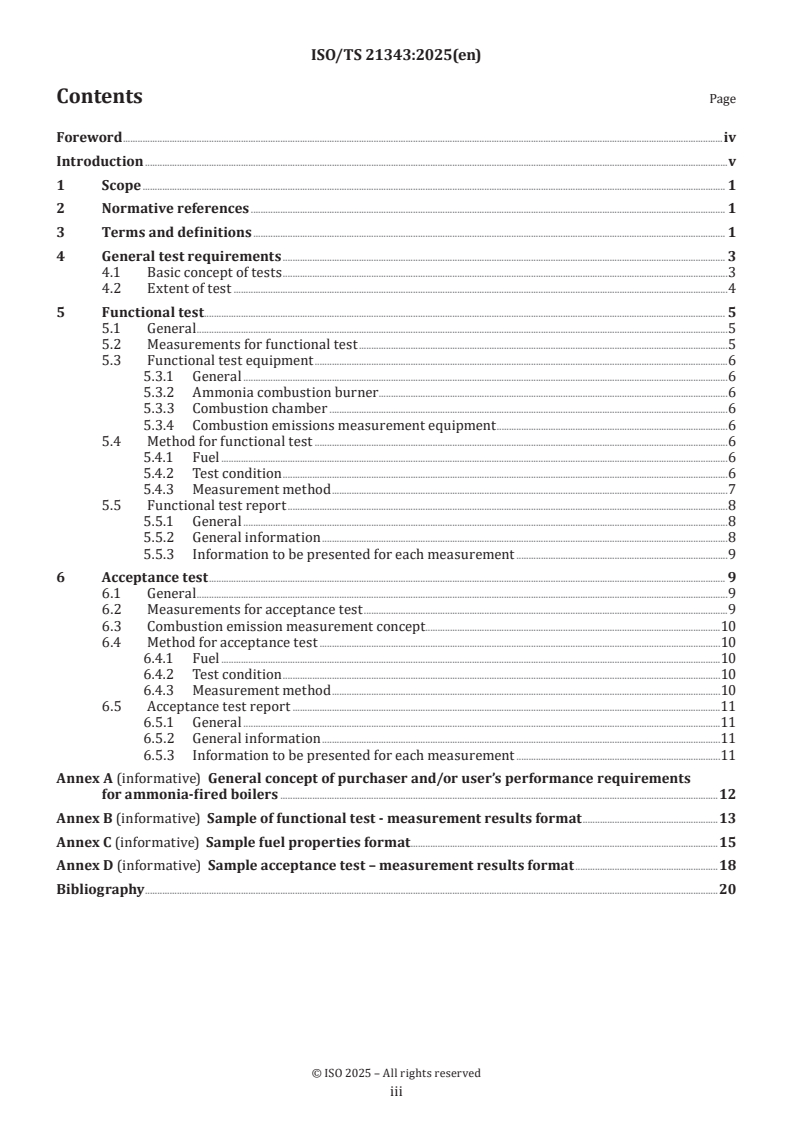
Contents Page
Foreword .iv
Introduction .v
1 Scope . 1
2 Normative references . 1
3 Terms and definitions . 1
4 General test requirements . 3
4.1 Basic concept of tests .3
4.2 Extent of test .4
5 Functional test . 5
5.1 General .5
5.2 Measurements for functional test .5
5.3 Functional test equipment .6
5.3.1 General .6
5.3.2 Ammonia combustion burner . .6
5.3.3 Combustion chamber .6
5.3.4 Combustion emissions measurement equipment .6
5.4 Method for functional test .6
5.4.1 Fuel .6
5.4.2 Test condition .6
5.4.3 Measurement method .7
5.5 Functional test report .8
5.5.1 General .8
5.5.2 General information .8
5.5.3 Information to be presented for each measurement .9
6 Acceptance test . 9
6.1 General .9
6.2 Measurements for acceptance test .9
6.3 Combustion emission measurement concept.10
6.4 Method for acceptance test .10
6.4.1 Fuel .10
6.4.2 Test condition .10
6.4.3 Measurement method .10
6.5 Acceptance test report .11
6.5.1 General .11
6.5.2 General information .11
6.5.3 Information to be presented for each measurement .11
Annex A (informative) General concept of purchaser and/or user’s performance requirements
for ammonia-fired boilers .12
Annex B (informative) Sample of functional test - measurement results format .13
Annex C (informative) Sample fuel properties format .15
Annex D (informative) Sample acceptance test – measurement results format .18
Bibliography .20
iii
Foreword
ISO (the International Organization for Standardization) is a worldwide federation of national standards
bodies (ISO member bodies). The work of preparing International Standards is normally carried out through
ISO technical committees. Each member body interested in a subject for which a technical committee
has been established has the right to be represented on that committee. International organizations,
governmental and non-governmental, in liaison with ISO, also take part in the work. ISO collaborates closely
with the International Electrotechnical Commission (IEC) on all matters of electrotechnical standardization.
The procedures used to develop this document and those intended for its further maintenance are described
in the ISO/IEC Directives, Part 1. In particular, the different approval criteria needed for the different types
of ISO document should be noted. This document was drafted in accordance with the editorial rules of the
ISO/IEC Directives, Part 2 (see www.iso.org/directives).
ISO draws attention to the possibility that the implementation of this document may involve the use of (a)
patent(s). ISO takes no position concerning the evidence, validity or applicability of any claimed patent
rights in respect thereof. As of the date of publication of this document, ISO had not received notice of (a)
patent(s) which may be required to implement this document. However, implementers are cautioned that
this may not represent the latest information, which may be obtained from the patent database available at
www.iso.org/patents. ISO shall not be held responsible for identifying any or all such patent rights.
Any trade name used in this document is information given for the convenience of users and does not
constitute an endorsement.
For an explanation of the voluntary nature of standards, the meaning of ISO specific terms and expressions
related to conformity assessment, as well as information about ISO's adherence to the World Trade
Organization (WTO) principles in the Technical Barriers to Trade (TBT), see www.iso.org/iso/foreword.html.
This document was prepared by Technical Committee ISO/TC 67, Oil and gas industries including lower
carbon energy.
Any feedback or questions on this document should be directed to the user’s national standards body. A
complete listing of these bodies can be found at www.iso.org/members.html.
iv
Introduction
Ammonia can be used as a carbon-free fuel with the potential to contribute to the transition to a carbon-
neutral society. The greatest advantage of ammonia is that it does not produce CO during combustion.
In addition, the technology for safely liquefying, transporting and storing ammonia has already been
implemented in the society as existing ammonia infrastructure; and further development is underway
from the perspective of unprecedented large-scale transporting and storing. Appropriate use of these
technologies can lead to rapid decarbonization.
There are many potential applications of fuel ammonia, such as boilers for power utility or industrial boilers,
gas turbines, marine engines, industrial furnaces, both for new boilers and modified existing facilities.
However, from the perspective of achieving carbon net zero, it is necessary to accelerate the application
of fuel ammonia to boilers that generate particularly high amounts of CO and other potential greenhouse
gases (GHG).
In order to contribute to CO and other potential GHG reduction at an early stage by using fuel ammonia in
power generation boilers, there's an urgent need to provide requirements and guidance for manufacturers
of ammonia-fired boilers. Demonstration projects of ammonia-fired boilers are progressing successfully;
and commercialization is sooner than originally expected. Therefore, it is necessary to establish standards
to validate the certainty of design, engineering and manufacturing in terms of envisioned improvement in
environmental performance of the electric utility power boilers. This document aims to standardize the
functional tests and acceptance tests to be performed in order to accomplish such validation.
v
Technical Specification ISO/TS 21343:2025(en)
Oil and gas industries including lower carbon energy — Fuel
ammonia —Requirements and guidance for boilers for power
generation
1 Scope
This document specifies requirements and guidance for manufacturers of ammonia-fired boilers regarding
functional tests performed at the time of design and on-site acceptance tests, in order to meet the required
environmental performance.
This document stipulates the test methods, the measurement items, the evaluation methods and the test
reports for each test.
This document is applicable to:
a) land boilers used for power generation with an electrical output of 100 MWe or more;
b) equipment that uses NH of any mixing ratio as fuel;
c) boilers with burners for combustion of fuel.
This document does not apply to heat recovery steam generators for gas turbines, fluidized bed boiler,
stokers, black liquor recovery boiler and process heat transfer equipment (used in petroleum refining).
2 Normative references
There are no normative references in this document.
3 Terms and definitions
For the purposes of this document, the following terms and definitions apply.
ISO and IEC maintain terminology databases for use in standardization at the following addresses:
— ISO Online browsing platform: available at https:// www .iso .org/ obp
— IEC Electropedia: available at https:// www .electropedia .org/
3.1
acceptance test
test performed at the actual ammonia-fired boiler (3.4), prior to the commercial operation date
3.2
fuel ammonia
NH utilized as a fuel for boilers (3.4)
Note 1 to entry: Ammonia is used differently as “NH “, because NH is an expression of a substance with a molecular
3 3
formula and ammonia is defined as a fuel that includes the concept of purity of NH .
3.3
ancillary equipment
series of equipment installed at the downstream of the boiler (3.4)
EXAMPLE Denitrification equipment, air preheater, dust removal equipment and desulfurization equipment.
3.4
boiler
equipment generating steam by firing fuels
3.5
burner
device or group of devices for the introduction of fuel and air into a combustion chamber (3.7)
3.6
combustion air temperature
temperature of the air introduced into burners (3.5) to combust fuels
3.7
combustion chamber
part of the boiler (3.4) equipped with burners (3.5) where fuels are combusted
3.8
excess air ratio
ratio of the actual combustion air quantity to the theoretically required air quantity to combust fuels
completely
3.9
functional test
test performed using the combustion test facility, prior to the fabrication of the electric utility power boilers
3.10
holding time
period required for the establishment of a steady-state operation, before the start of the functional test (3.9)
or the acceptance test (3.1)
Note 1 to entry: This excludes transient time.
Note 2 to entry: See Figure 3.
3.11
land boiler
stationary boiler (3.4) installed on land
3.12
manufacturer
supplier or vendor of the ammonia-fired boiler according to the contract with the purchaser and/or user (3.17)
3.14
measurement interval time
period between measurements during steady-state operations under the same load condition
Note 1 to entry: See Figure 3.
3.15
multi-stage combustion air port
additional air port installed above or around burners (3.5)
3.16
nominal rated heat input
numerical value obtained by multiplying the fuel heating value by the maximum fuel flow rate
Note 1 to entry: This value represents the capacity of the combustion test facility.
3.17
purchaser and/or user
individual or organization that buys, owns, operates, or any combination of functions with respect to the
electric utility power boiler (3.4) including the ammonia-fired boiler and makes the contract with the
manufacturer (3.12)
3.18
representative point
predetermined point considered to represent the spatial average value (3.20) of the gas concentration and
where the measurement will be conducted
3.19
selective catalytic reduction
SCR
denitrification equipment to reduce NOx in the flue gas
3.20
spatial average value
arithmetic mean value obtained from multiple measuring points in the cross section
3.21
steady-state time
period covering all measurement(s), including interval(s) between multiple measurements, and any
additional time the equipment is continuously operated for observation purposes under the same load
condition
Note 1 to entry: See Figure 3.
4 General test requirements
4.1 Basic concept of tests
The tests of ammonia-fired boilers shall be carried out in accordance with Clause 5 (functional test) and
Clause 6 (acceptance test). Figure 1 indicates an entire typical process, its main activities including
functional test and acceptance test, and the correlations between activities.
Functional tests are performed by the manufacturer at smaller-scale test facilities with the aim of achieving
such design that fulfils the purchaser and/or user’s environmental performance requirements specifically
in terms of levels of emissions of GHG and other flue gas emissions that are recognized as environmental
pollutants. The purpose of functional tests is to verify the validity of the design in order to proceed to
detailed design to reduce the risk of an acceptance test failure. The concept of the purchaser and/or user's
performance requirements is shown in Annex A.
Acceptance tests are conducted at the purchaser and/or user’s installation site with the aim of confirming
the levels of emissions of GHG and other flue gas emissions that are recognized as environmental pollutants
as agreed between the purchaser and/or user and the manufacturer. The procedure of acceptance tests shall
be agreed upon in writing between the concerned parties.
NOTE The order is an example.
Figure 1 — Entire typical process, its main activities including functional test and acceptance test,
and the correlations between activities
4.2 Extent of test
The concept of an ammonia-fired boiler is illustrated in Figure 2, which shows ammonia as a fuel, a
combustion chamber, a flue gas measurement point and downstream flue gas treatment facilities. The tests
shall be conducted on ammonia-fired boilers, both for new power plants and modified existing facilities.
Key
1 NH as fuel of any mixing ratio 6 ancillary equipment
2 burner 7 selective catalytic reduction (example)
3 fan 8 heat exchanger (example)
4 combustion chamber (at functional test) or boiler 9 precipitator (example)
(at acceptance test)
5 flue gas composition measurement position
NOTE Ancillary equipment varies among test facilities.
Figure 2 — Conceptual diagram of test facilities
5 Functional test
5.1 General
If a valid test report that demonstrates the required performance of the purchaser and/or user exists, that
shall be acceptable and included in the functional test report. Otherwise a functional test shall be carried
out in accordance with the specification.
A functional test shall be performed by the manufacturer prior to fabrication of the electric utility power
boilers with the test equipment (see Figure 2) and test methods described in 5.3. The test results shall be
reported to the purchaser and/or user in accordance with the functional test report as described in 5.5.
The manufacturer may also outsource the tests as necessary.
5.2 Measurements for functional test
The concentration of the following combustion emissions shall be measured in the functional tests.
Regarding the required performance of combustion emissions for electric utility power boilers as agreed
with the purchaser and/or user, it shall be verified whether the values corrected for electric utility power
boilers based on the measurement results from the functional tests satisfy the required performance, and
that information shall be reported in the functional test report. In addition to GHG and other environmental
pollutants, levels of poisonous substances such as HCN should be measured:
— NOx;
— NH ;
— N O;
— unburned fuel.
5.3 Functional test equipment
5.3.1 General
The test facility for functional test of ammonia-fired boilers shall be equipped with the following facilities
(ancillary equipment varies among test facilities):
— a combustion chamber with a nominal rated heat input of at least 0,5 MWth equipped with a-burner able
to fire ammonia as either a single fuel or in mixtures, or both;
— a combustion emissions measurement equipment installed between the combustion chamber outlet
and the inlet of the ancillary equipment, with a measurement installation at a well-mixed location; the
measurement equipment may be permanent or temporary, on-site or off-site.
5.3.2 Ammonia combustion burner
The system shall be capable of burning fuel ammonia alone, or fuels other than fuel ammonia simultaneously
or alternately. The burner structure shall be equivalent to that of electric utility facilities. The test facility
shall be capable of evaluating the purchase
...