

ISO/FDIS 41012
(Main)Facility management — Guidance on strategic sourcing and the development of agreements
- Abstract
ISO 41012:2017 provides guidance on sourcing and development of agreements in facility management (FM). It highlights: · essential elements in FM sourcing processes; · FM roles and responsibilities in sourcing processes; · development processes and structures of typical agreement models. ISO 41012:2017 is applicable to: · strategic processes related to service and support functions for the core business; · development of FM strategies; · development of facility service provision agreements covering both public and private service demand and internal and external production/delivery options; · development of FM information systems; · FM education and research; · organization development and business re-engineering processes in major types of working environments (e.g. industrial, commercial, administration, military, healthcare, accommodation).
- Status
- Not Published
- Technical Committee
- ISO/TC 267 - Facility management
- Drafting Committee
- ISO/TC 267/WG 4 - Strategy and policy
- Current Stage
- 5020 - Proof sent to secretariat or FDIS ballot initiated: 8 weeks - 50 Approval
- Start Date
- 19-Oct-2026
- Due Date
- 19-Oct-2026
- Completion Date
- 19-Oct-2026
Buy Documents
ISO/FDIS 41012 - Facility management — Guidance on strategic sourcing and the development of agreements
REDLINE ISO/FDIS 41012 - Facility management — Guidance on strategic sourcing and the development of agreements
ISO/FDIS 41012 - Facility management — Recommandations relatives au processus d'approvisionnement stratégique et d'élaboration des accords
ISO/FDIS 41012 is an ISO draft standard for facility management (FM) guidance on strategic sourcing and the development of agreements. It helps a demand organization decide how FM services should be delivered, how to turn needs into service requirements, and how to structure internal or external agreements and service level agreements (SLAs).
What does ISO/FDIS 41012 specify?
ISO/FDIS 41012 gives guidance on sourcing and agreement development in FM. It covers sourcing strategy, roles and responsibilities, and typical agreement models, and it is written as guidance rather than a fixed one-size-fits-all method.
The document applies to strategic processes for service and support functions that enable the core business, development of FM sourcing strategies, facility service provision agreements for public and private demand, internal and external delivery options, FM information systems, FM education and research, and organization development or business re-engineering in industrial, commercial, administration, military, healthcare and accommodation environments.
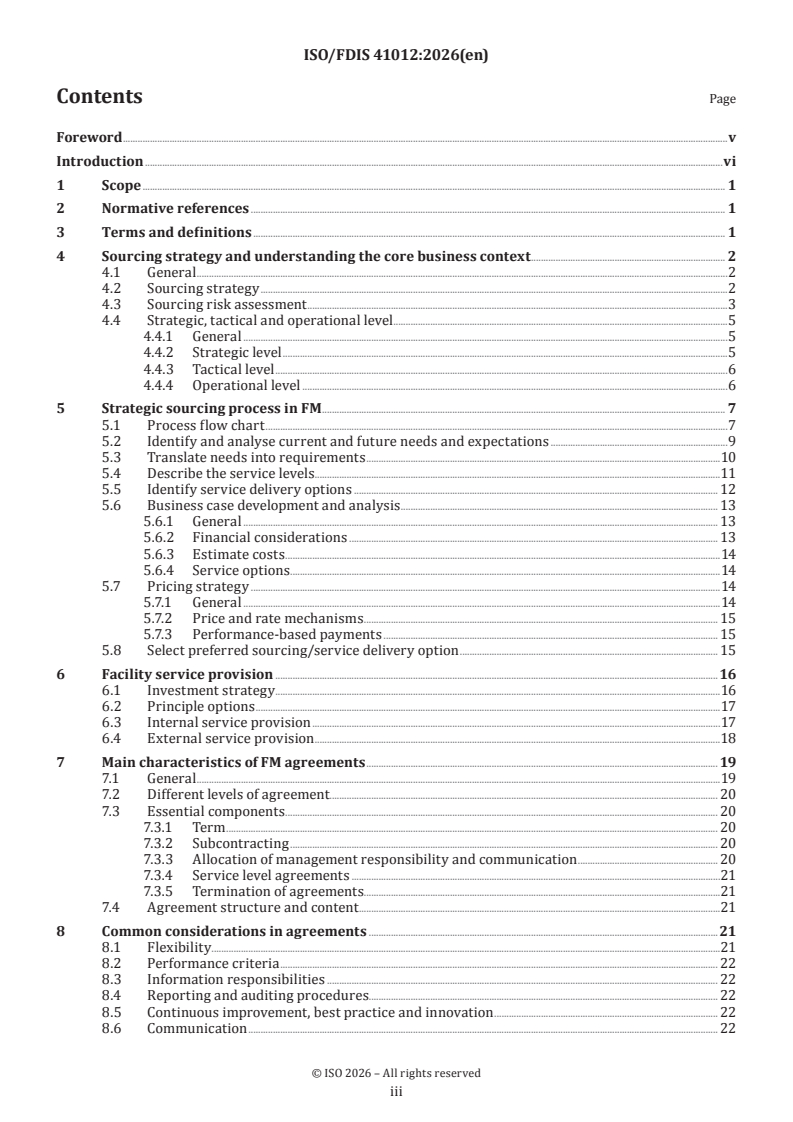
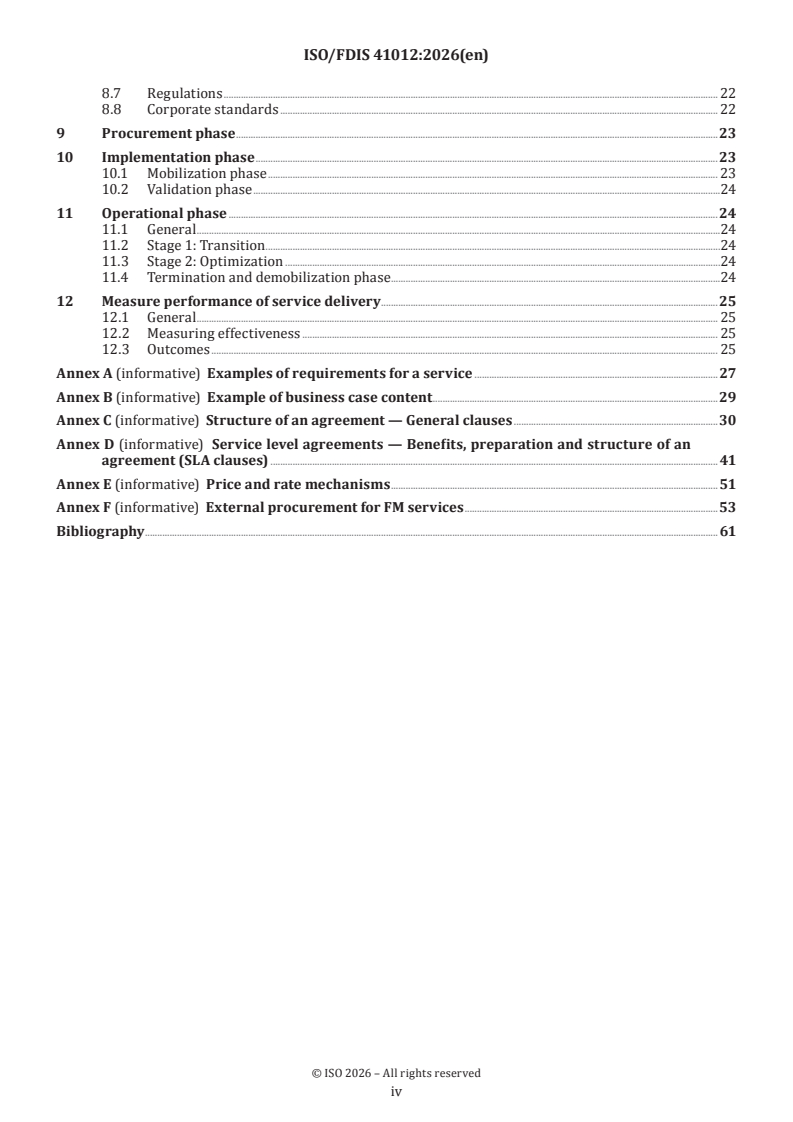
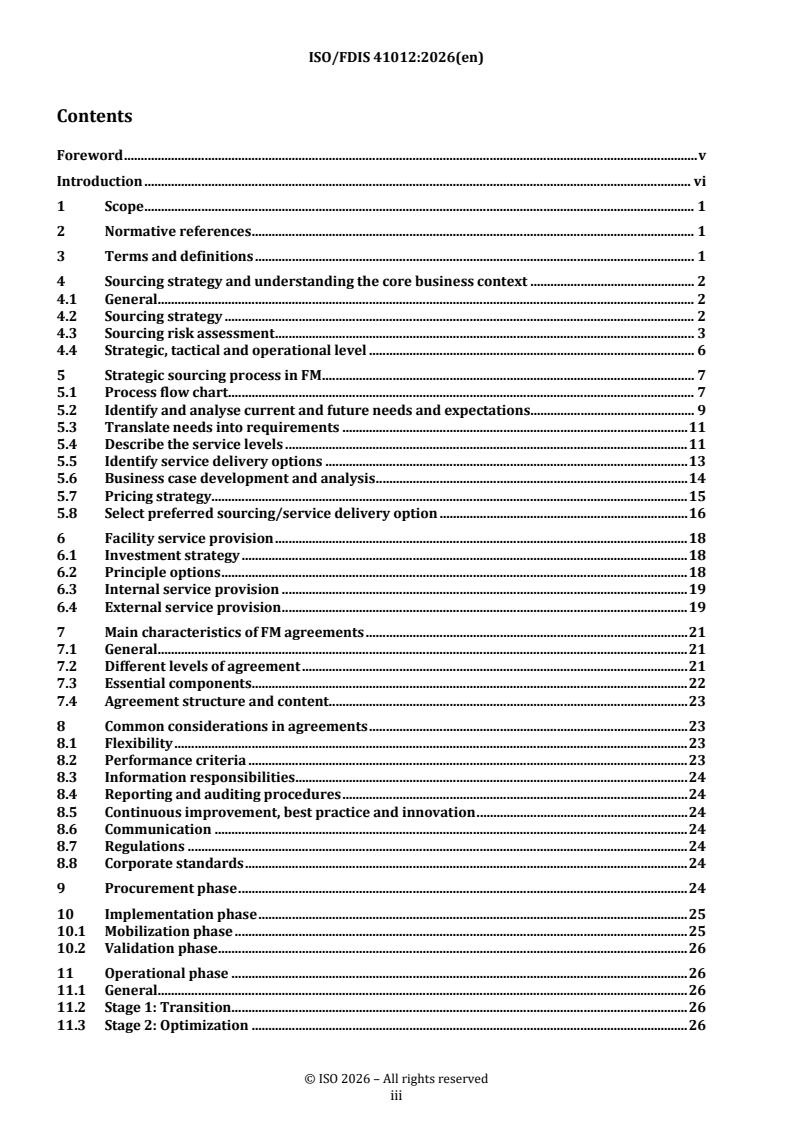
The document is organized into Clauses 1 to 12, starting with scope, references and terms, then moving through sourcing strategy, the FM sourcing process, service provision, agreement structure, common contract considerations, procurement, implementation, operational phases and performance measurement. Annexes A to F provide worked examples and structured guidance.
| Annex | What it covers |
|---|---|
| A | Examples of requirements for a service |
| B | Example of business case content |
| C | Structure of an agreement - General clauses |
| D | Service level agreements - benefits, preparation and structure |
| E | Price and rate mechanisms |
| F | External procurement for FM services |
What are the key requirements of ISO/FDIS 41012?
ISO/FDIS 41012 guides the reader through a complete FM sourcing cycle, from understanding the core business to measuring service performance. In practice, the document is about making sourcing decisions traceable, measurable and aligned with the organization’s needs.
Start with the core business context
Clause 4 says the FM organization should understand the core business before choosing a sourcing approach. That means collecting information on mission, strategy, service criticality, sites, portfolio, culture, risk, sustainability, legal obligations, current service model and stakeholder expectations.
This matters because FM sourcing is not only about cost. The document makes the organization test how FM choices affect continuity, security, service dependencies and the future shape of the business.
Turn needs into measurable requirements
Clause 5 says needs should be translated into requirements before service levels are set. The document expects requirements to be expressed clearly, with measurable performance indicators where possible, and to take account of interdependencies between FM activities.
This matters because vague service descriptions are hard to procure or manage. The document pushes the reader toward requirements that can be checked, compared and managed over time.
Set service levels and KPIs
Clause 5.4 says service levels should be practical, achievable and linked to the resources needed to deliver them. It also points to qualitative and quantitative performance measures, including response times, completion rates, preventive maintenance compliance, cleanliness, sustainability performance, space use, energy conservation and total cost of ownership.
In practice, this means the agreement should not only say what service is wanted, but also how success will be measured. Annex D supports this by showing how an SLA can be built around output or input specifications.
Choose the service delivery model
Clause 5.5 and Clause 6 describe the main delivery options: in-house services, separately externally contracted services, or bundled external services. The standard also says the organization should check capability, market availability, business continuity, security needs and strategic considerations before deciding.
This matters because the right model is not always the cheapest or most outsourced one. The document supports a make-or-buy decision based on business fit, risk and capacity.
Build the business case and pricing approach
Clause 5.6 and Clause 5.7 require analysis of financial considerations and pricing strategy. Annex B gives business case content, and Annex E describes fixed price, target price, pass-through costs and unit rate mechanisms.
In practice, this helps the organization match the pricing model to the way the service is actually used and measured. It also makes cost, risk sharing and financial transparency part of the sourcing decision.
Structure the agreement and manage change
Clause 7 and Clause 8 guide the agreement structure. The agreement should cover strategic, tactical and operational responsibilities, term, subcontracting, management responsibility, communication, flexibility, performance criteria, information responsibilities, reporting, auditing, continuous improvement, regulations and corporate standards.
This matters because FM agreements often fail when responsibilities are unclear or change is unmanaged. Annex C and Annex D provide example clause structures that can be adapted to the situation.
Control procurement, implementation and operations
Clause 9 covers procurement, including bid documentation, evaluation, probity, confidentiality, conflicts of interest and transparent assessment. Clause 10 covers mobilization and validation. Clause 11 covers transition, optimization, termination and demobilization.
In practice, the document treats handover and exit as planned phases, not afterthoughts. That is important for data transfer, continuity, performance start-up and closing out obligations cleanly.
Measure performance during service delivery
Clause 12 says performance should be monitored using appropriate measurement methods, including statistical or mathematical sampling where suitable. It also expects measurement against SLAs and KPIs, and validation through benchmarking where appropriate.
This matters because the agreement is meant to be managed, not just filed away. The standard links performance data to corrective action, improvement and, where needed, changes to the agreement.
What terms does ISO/FDIS 41012 define?
ISO/FDIS 41012 uses terms from ISO 41011 and adds a small number of key definitions for sourcing and risk.
- Strategic sourcing - the process a demand organization uses to decide the nature of FM service delivery.
- Risk - the effect of uncertainty, including positive or negative deviation from what is expected.
- Demand organization (DO) - the organization that needs the FM service and sets the requirements for delivery.
- Facility management organization (FMO) - the FM function or organization that plans, coordinates or delivers the service.
- Service level agreement (SLA) - the agreement that sets the required scope, quality and performance expectations for a service.
- Key performance indicator (KPI) - the measurable performance level used to track whether the agreed service is being achieved.
- Facility management (FM) - the field covered by the document, focused on organizing service and support functions for the core business.
Who uses ISO/FDIS 41012?
ISO/FDIS 41012 is intended for FM professionals, procurement teams, finance teams and senior management who need to source, contract and manage FM services. It is also relevant to service providers, whether internal or external, because it defines how service expectations, responsibilities and performance measures should be set.
The document is useful in both public and private sectors and in organizations with industrial, commercial, administration, military, healthcare or accommodation environments. Typical tasks include strategy development, service specification, SLA drafting, bid evaluation, contract mobilization, performance monitoring and agreement closure.
What changed in ISO/FDIS 41012 from the previous edition?
ISO/FDIS 41012 states that the second edition cancels and replaces ISO/DIS 41012:2017 and that it has been technically revised.
The changes listed in the document are:
- the sections were restructured to improve navigation, including the sourcing process figure
- major changes were made across Clauses 4 to 7
- a new Clause 9 was added for the procurement phase
- new Annex E was added on price and rate mechanisms
- new Annex F was added on external procurement for FM services
- alignment was strengthened with ISO 41001, ISO/TR 41030, ISO 31000, the ISO 55000 series, ISO 55001 and ISO 55002
Which standards are used with ISO/FDIS 41012?
ISO/FDIS 41012 has one normative reference and several related standards cited in notes and the bibliography.
| Standard | Contribution to ISO/FDIS 41012 |
|---|---|
| ISO 41011 | Vocabulary for FM terms and definitions |
| ISO 41001 | FM management systems context |
| ISO 41002 | Guidance on development of the FM organization |
| ISO 41014 | Guidance on FM strategy development |
| ISO/TR 41016 | Overview of available technologies in FM |
| ISO/TR 41030 | State of the industry for performance management in FM organizations |
| ISO 31000 | Risk management principles and guidance |
| ISO 55000 series, ISO 55001, ISO 55002 | Asset management vocabulary, requirements and guidance |
| ISO 37500 | Outsourcing principles that may apply to FM sourcing |
| EN 15221-3 | Guidance on quality in FM |
| EN 15221-7 | Guidelines for performance benchmarking in FM |
What does the ISO/FDIS 41012 document contain?
ISO/FDIS 41012 contains a staged model for strategic sourcing in FM, shown through figures and clause-by-clause guidance. It includes examples and checklists rather than fixed numerical requirements.
Annex A gives example translations from needs into service requirements and specifications. Annex B gives business case elements. Annex C and Annex D provide clause structures for general agreement terms and SLAs. Annex E explains pricing and rate mechanisms, and Annex F lays out the procurement sequence from preparation through award and execution.
The body of the document also contains process steps for identifying needs, defining service levels, choosing service delivery options, drafting agreements, mobilizing service, validating information, managing the operational phase, and measuring service delivery performance.
Relations
- Effective Date
- 12-Feb-2026
- Effective Date
- 22-Apr-2023
- Effective Date
- 15-Apr-2023
Buy Documents
ISO/FDIS 41012 - Facility management — Guidance on strategic sourcing and the development of agreements
REDLINE ISO/FDIS 41012 - Facility management — Guidance on strategic sourcing and the development of agreements
ISO/FDIS 41012 - Facility management — Recommandations relatives au processus d'approvisionnement stratégique et d'élaboration des accords
Get Certified
Connect with accredited certification bodies for this standard

Great Wall Tianjin Quality Assurance Center
Established 1993, first batch to receive national accreditation with IAF recognition.

Hong Kong Quality Assurance Agency (HKQAA)
Hong Kong's leading certification body.

Innovative Quality Certifications Pvt. Ltd. (IQCPL)
Known for integrity, providing ethical & impartial Assessment & Certification. CMMI Institute Partner.
Sponsored listings
Frequently Asked Questions
ISO/FDIS 41012 is a draft published by the International Organization for Standardization (ISO). Its full title is "Facility management — Guidance on strategic sourcing and the development of agreements". This standard covers: ISO 41012:2017 provides guidance on sourcing and development of agreements in facility management (FM). It highlights: · essential elements in FM sourcing processes; · FM roles and responsibilities in sourcing processes; · development processes and structures of typical agreement models. ISO 41012:2017 is applicable to: · strategic processes related to service and support functions for the core business; · development of FM strategies; · development of facility service provision agreements covering both public and private service demand and internal and external production/delivery options; · development of FM information systems; · FM education and research; · organization development and business re-engineering processes in major types of working environments (e.g. industrial, commercial, administration, military, healthcare, accommodation).
ISO 41012:2017 provides guidance on sourcing and development of agreements in facility management (FM). It highlights: · essential elements in FM sourcing processes; · FM roles and responsibilities in sourcing processes; · development processes and structures of typical agreement models. ISO 41012:2017 is applicable to: · strategic processes related to service and support functions for the core business; · development of FM strategies; · development of facility service provision agreements covering both public and private service demand and internal and external production/delivery options; · development of FM information systems; · FM education and research; · organization development and business re-engineering processes in major types of working environments (e.g. industrial, commercial, administration, military, healthcare, accommodation).
ISO/FDIS 41012 is classified under the following ICS (International Classification for Standards) categories: 03.080.10 - Maintenance services. Facilities management. The ICS classification helps identify the subject area and facilitates finding related standards.
ISO/FDIS 41012 has the following relationships with other standards: It is inter standard links to FprEN ISO 41012, ISO/IEC 24711:2021, ISO 41012:2017. Understanding these relationships helps ensure you are using the most current and applicable version of the standard.
ISO/FDIS 41012 is available in PDF format for immediate download after purchase. The document can be added to your cart and obtained through the secure checkout process. Digital delivery ensures instant access to the complete standard document.
Standards Content (Sample)
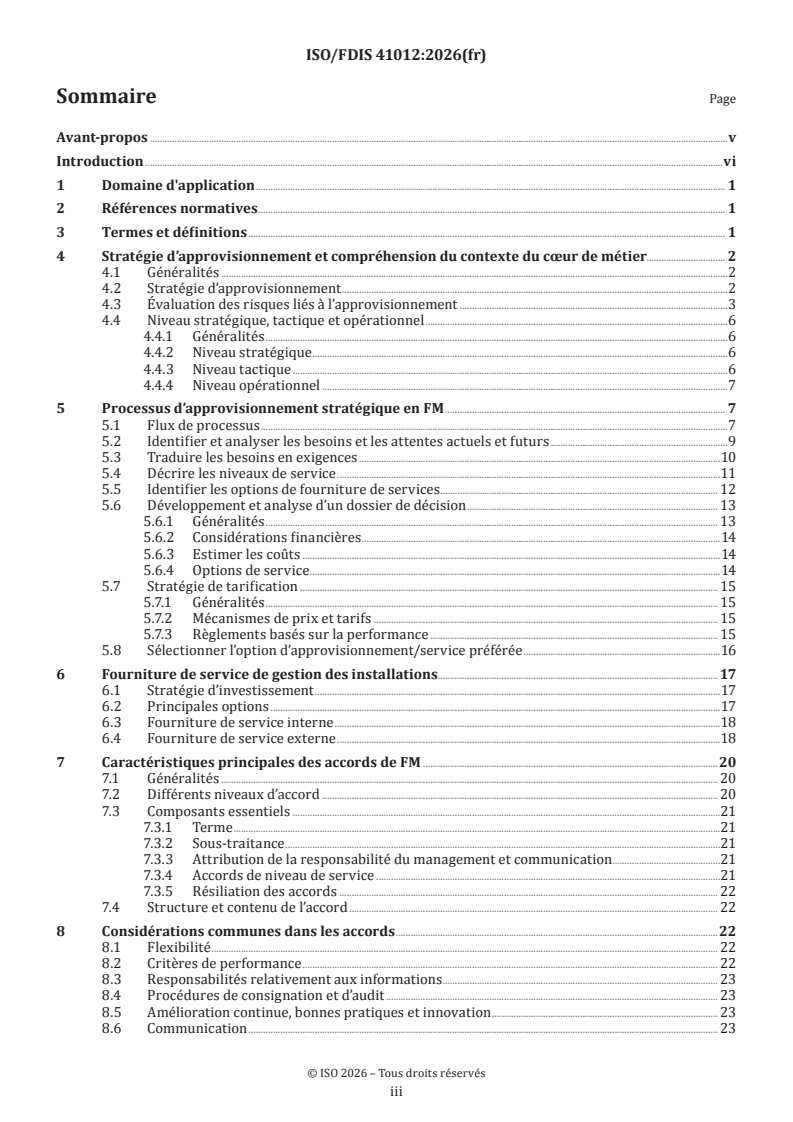
Contents
- Introduction
- 1 Scope
- 2 Normative references
- 3 Terms and definitions
- 3.1 strategic sourcing
- 3.2 risk
- 4 Sourcing strategy and understanding the core business context
- 4.1 General
- 4.2 Sourcing strategy
- 4.3 Sourcing risk assessment
- 4.4 Strategic, tactical and operational level
- 5 Strategic sourcing process in FM
- 5.1 Process flow chart
- 5.2 Identify and analyse current and future needs and expectations
- 5.3 Translate needs into requirements
- 5.4 Describe the service levels
- 5.5 Identify service delivery options
- 5.6 Business case development and analysis
- 5.7 Pricing strategy
- 5.8 Select preferred sourcing/service delivery option
- 6 Facility service provision
- 6.1 Investment strategy
- 6.2 Principle options
- 6.3 Internal service provision
- 6.4 External service provision
- 7 Main characteristics of FM agreements
- 7.1 General
- 7.2 Different levels of agreement
- 7.3 Essential components
- 7.4 Agreement structure and content
- 8 Common considerations in agreements
- 8.1 Flexibility
- 8.2 Performance criteria
- 8.3 Information responsibilities
- 8.4 Reporting and auditing procedures
- 8.5 Continuous improvement, best practice and innovation
- 8.6 Communication
- 8.7 Regulations
- 8.8 Corporate standards
- 9 Procurement phase
- 10 Implementation phase
- 10.1 Mobilization phase
- 10.2 Validation phase
- 11 Operational phase
- 11.1 General
- 11.2 Stage 1: Transition
- 11.3 Stage 2: Optimization
- 11.4 Termination and demobilization phase
- 12 Measure performance of service delivery
- 12.1 General
- 12.2 Measuring effectiveness
- 12.3 Outcomes
- Annex A
- Annex B
- Annex C
- Annex D
- Annex E
- Annex F
- Bibliography
Introduction
The International Standards on facility management (FM) developed by ISO/TC 267 describe the characteristics of facility management and are intended for use in both the private and public sectors. NOTE The terms “facility management” and “facilities management” can be used interchangeably. International cooperation in the preparation of these International Standards has identified common practices that can be applied across a wide variety of market sectors, organizational types, process activities and geographies, and their implementation will help to:
- improve quality, productivity and financial performance;
- enhance sustainability and reduce negative environmental impact;
- develop functional and motivating work environments;
- maintain regulatory compliance and provide safe workplaces;
- optimize life cycle performance and costs;
- improve resilience and relevance;
- project an organization’s identity and image more successfully. FM and related goods and services support the achievement of core organizational activities and objectives. The purpose of this document is to enable organizations to identify and select the most appropriate resources for the design, sourcing and delivery of FM.
This document provides guidance on the overall strategic sourcing process and on how to prepare and implement adequate internal or external FM agreements. Figure 1 provides an overview of the logical sequence of this document.
ISO/FDIS 41012:2026(en) Figure 1 — Logical sequence of this document This document also provides guidance on:
- types of agreements;
- development, structure and contents of agreements;
- clarification of definitions, where appropriate.
This document promotes a methodology from a strategic level to an operational level, with examples and check lists. The application of this sourcing approach is intended to contribute significantly to adding value
ISO/FDIS 41012:2026(en) and optimizing costs of operations for FM professionals and procurement, finance and senior management teams.
Annexes A and B give examples of requirements for typical services and a business case. Annexes C and D provide general and specific clauses and structured checklists for typical agreements. These annexes facilitate the selection of important clauses and preferences in the development of agreements, which allow for differences in origin, purpose and jurisdictions/national rules and regulations, and are based on a generic platform.
This document covers general demand organization requirements. The FM organization should apply this document within its own context. Not all information in this document can be applicable to every FM process or agreement.
In this document, references to “agreement”, “service” or “service provider” are specific to FM and facility services agreement, facility service or facility service provider (internal or external). Any reference to a single service can also include multiple services.
FINAL DRAFT International Standard ISO/FDIS 41012:2026(en) Facility management — Guidance on strategic sourcing and the development of agreements
1 Scope
This document gives guidance on sourcing and the development of agreements in facility management (FM). It highlights:
- different sourcing strategies and considerations to determine the best outcome for the demand organization;
- essential elements in FM sourcing processes;
- FM roles and responsibilities in sourcing processes;
- development processes and structures of typical agreement models. This document is applicable to:
- strategic processes related to service and support functions for the core business;
- development of FM sourcing strategies;
- development of facility service provision agreements covering both public and private service demand and internal and external production/delivery options;
- development of FM information systems;
- FM education and research;
- organizational development and business re-engineering processes in major types of working environments (e.g. industrial, commercial, administration, military, healthcare, accommodation).
2 Normative references
The following documents are referred to in the text in such a way that some or all of their content constitutes requirements of this document. For dated references, only the edition cited applies. For undated references, the latest edition of the referenced document (including any amendments) applies. ISO 41011, Facility management — Vocabulary
3 Terms and definitions
For the purposes of this document, the terms and definitions given in ISO 41011 and the following apply. ISO and IEC maintain terminology databases for use in standardization at the following addresses:
- ISO Online browsing platform: available at https:// www .iso .org/ obp
- IEC Electropedia: available at https:// www .electropedia .org/
3.1 strategic sourcing
process undertaken by a demand organization to come to a strategic decision about the nature of facility management (FM) service delivery
ISO/FDIS 41012:2026(en)
3.2 risk
effect of uncertainty Note 1 to entry: An effect is a deviation from the expected – positive or negative. [SOURCE: ISO 41011:2024, 3.7.18, modified — “on objectives” in the definition and Notes 2, 3 and 4 to entry deleted.]
4 Sourcing strategy and understanding the core business context
4.1 General
This step of the strategic sourcing process is shown in Figure 2. It is the first step of the strategic sourcing process given in Figure 3.
Figure 2 — Sourcing strategy and core business context
4.2 Sourcing strategy
To achieve its core business objectives a demand organization should ensure the structures, the delivery of FM and support services are aligned with the business strategy. The demand organization should employ an effective sourcing process to achieve that objective.
Criteria that can have an impact on sourcing strategy include, but are not limited to:
- the competitive environment;
- value drivers (including cost/benefit analysis);
- the need for resource flexibility;
- business risks;
- reliability of supply chain / risk of over-reliance on single suppliers;
- operational characteristics;
- operational interdependencies;
- availability of in-house FM expertise;
- the availability and capability of various supply options;
- corporate policies;
- statutory obligations and legal requirements
- organizational culture and management style;
- reporting requirements and management information systems;
- demand organization objectives on a strategic and operational level;
- innovation;
- corporate and real estate strategy;
ISO/FDIS 41012:2026(en) - FM strategy; As most organizations live in an environment of dynamic change, these sourcing processes should be reviewed regularly and should be, at all times, closely linked to the organization’s overall business strategy. The adequate FM competence should be available within the demand organization to support the sourcing process through internal and/or external sources. These competences should include, but are not limited to:
- understanding the core business;
- analytic skills;
- management skills;
- communication skills;
- appropriate knowledge of FM;
- procurement skills;
- understanding statutory obligations and legal requirements;
- environmental, social and cultural awareness.
To achieve an optimum outcome through each state of the process, the demand organization should engage the appropriately competent expertise to ensure exposure to the broadest potential opportunities are made available also in the procurement phase of the process.
4.3 Sourcing risk assessment
Risk analysis is a process that is used to understand the nature, sources and causes of risk. A careful evaluation will ensure foreseeable risks are identified, quantified and, where possible, eliminated. It is also used to study impacts and consequences. The level of detail and complexity applied to the review will depend upon the potential impact.
Incorporating risk assessment and management into strategic sourcing and the development of agreements enables the demand organization and delivery organization(s) to incorporate and address potential threats and opportunities in a structured manner. In addition to identifying risks, the probability, impact and consequence should be assessed so that they can be incorporated into strategic planning, decision-making and the overall strategic sourcing and agreement process.
The demand organization should consider potential risks during development of the sourcing strategy and modify as appropriate on the basis of improved knowledge during the procurement phase of the process, eventual supplier selection and negotiation and through ongoing governance. The level of detail and complexity applied to the risk assessment will depend upon risk complexity, probability, impact and potential consequence.
A key objective is to ensure that risk is allocated and apportioned to the organization best able to manage or mitigate each risk to a level acceptable to the demand organization. Areas to consider during the risk assessment should be comprehensive enough to meet the needs of the demand organization and the service or activity being sourced. The assessment may include, but is not limited to, the following threats and opportunities:
- political:
- prevailing current and expected political climate to services being sourced;
- other political and regulatory events that can impact ability to deliver;
- economic:
- economic climate;
ISO/FDIS 41012:2026(en) - inflation and potential impact to an agreement; - market:
- supplier power and concentration;
- purchasing power;
- market practices;
- general competencies of suppliers for services being procured within the market;
- technology:
- availability and maturity of technology to support delivery of service over the life of an agreement;
- ownership of technology by a supplier or demand organization;
- legal:
- jurisdictional/national legal requirements;
- maturity of contracting arrangements;
- local familiarity with sourcing contract types, strategies and relationships. More specific threats and opportunities for the demand organization to consider can include:
- demand organization expertise;
- compliance;
- business continuity;
- intellectual property;
- reputation;
- health and safety:
- ethics;
- brand of demand organization and potential suppliers;
- operations;
- mutual dependency (share of demand organization spend and share of supplier revenue);
- transition from a change in delivery from internal to third party or between third parties;
- events associated with the service or activity being sourced:
- portfolio data and/or assets;
- quality of information on service to be sourced;
- local service provider competencies;
- safety or compliance implications for specific service;
- impact of service on other demand organization operations.
NOTE For specific risk management information, see ISO 31000 and ISO 41014:2020, 4.4.
ISO/FDIS 41012:2026(en) The demand organization should consider the potential threats and opportunities prior to implementing an agreement. All foreseeable events should be considered to ensure the following (among other considerations):
- the impacts of needs are fully defined;
- needs and constraints are translated into requirement and specifications/service level, for example:
- data on the property portfolio and/or built environment;
- information on initial and long-term cost implications;
- competences in the demand organization;
- competences by the service provider;
- resources;
- health, safety and environment;
- security;
- funding;
- information technology (IT) system, hardware and communication technology/integration;
- due diligence;
- coordinated design, construction and commissioning;
- coordinated disaster recovery planning (natural and business-related);
- business continuity planning and management;
- corporate governance.
Throughout a strategic sourcing process, choices and decisions are made that can trigger threats or opportunities. A risk-based approach to FM means that the assessment should be repeated throughout the process of strategic sourcing as well as FM services at specific milestones, at a level appropriate for the relevant milestone.
4.4 Strategic, tactical and operational level
4.4.1 General
In order to succeed and deliver required results, FM should be in close synchronization with the mission, vision, objectives and domains of the core business. It is the role of FM to provide strategic guidance to a core business in relation to FM aspects, interpreting needs and demands, translating them into explicit service and deliverables requirements. FM acts on the main three levels:
- strategic;
- tactical;
- operational.
4.4.2 Strategic level
At the strategic level, the aim is to achieve the strategic objectives of the organization in the long term by means of:
- establishing the FM strategy and sourcing strategy in accordance with the organization’s strategy;
- policymaking, elaborating guidelines for space, built environments, processes and services;
ISO/FDIS 41012:2026(en) - initiating risk analysis and mitigation and providing the direction to adapt to changes in the organization; - establishing performance management policy and outcomes; - assessing the impact of facility on the primary activities, external environment and community; - maintaining relations with authorities and other stakeholders; - approving business plans and budgets; - providing advisory services to the demand organization; - making procurement decisions, including establishing the re-procurement criteria.
4.4.3 Tactical level
At the tactical level, the aim is to implement the strategic objectives in the organization in the medium term, for example, through:
- administration;
- reporting (setting up and performing);
- recording (status and events);
- implementing and monitoring guidelines for strategies;
- developing business plans and budgets;
- translating strategic FM objectives into operational level requirements;
- establishing the service level agreements (SLAs);
- establishing the key performance indicators (KPIs);
- managing projects, processes and agreements;
- managing the FM teams;
- managing the services team;
- optimizing the use of resources;
- adapting to and reporting on changes and statuses;
- communicating with internal or external service providers on a tactical level.
4.4.4 Operational level
At the operational level, the aim is to create the required environment to the end users on a day-to-day basis, for example, through:
- delivering services in accordance with the SLA;
- monitoring and checking the service delivery processes;
- monitoring the service providers;
- receiving requests for service (e.g. via a help desk or service line);
- collecting data for performance evaluations, feedback and demands from end users;
- reporting to tactical level;
- communicating with internal or external service providers on an operational level.
ISO/FDIS 41012:2026(en)
5 Strategic sourcing process in FM
5.1 Process flow chart
The strategic sourcing process consists of a number of steps described in Clauses 5 to 10, as illustrated in Figure 3.
The decision-making is often a result of each stage or step and those decisions inform subsequent stages or steps.
ISO/FDIS 41012:2026(en) Figure 3 — Strategic sourcing process overview
ISO/FDIS 41012:2026(en)
5.2 Identify and analyse current and future needs and expectations
This step of the strategic sourcing process is shown in Figure 4. Figure 4 — Identify and analyse current and future needs The first step in the identification of needs is to understand the current conditions and establish a baseline. The demand organization should have a good understanding of the current organizational structure and capabilities, current service delivery models, existing service contracts and current performance measures. The following additional elements of existing core business information are important in most sourcing processes. As managing service supply can cover a very broad range of needs and demands of totally different natures, FM related sourcing should acquire as a minimum the following information from the demand organization:
- primary activities and core business, mission, vision, strategy and corporate values;
- key objectives of business/activities;
- identification of service criticality and dependencies between services;
- geographical locations and areas of operation, building portfolio and space;
- strategic directions of the organization short/long term and its influence on, for example, building portfolio, technical infrastructure, work force and competence;
- organizational culture, structure, governance and principles of decision-making (local, regional, global);
- current and possible future (intended) corporate image and trademark;
- range and nature of core products/services and distribution (local, regional, global);
- strategic considerations related to sustainable environmental issues and social responsibilities;
- security, resilience and other risk concerns with decisive influence on strategic choices;
- customers, demand organizations and other stakeholders with decisive influence on strategic choices;
- management of information for planning and controlling services;
- setting up the demand organization’s FM service catalogue;
- existing basis and arrangements for service provision and scope of services;
- the interface between the primary activities and support services;
- the “as is” situation: users’ expectations and satisfaction of present range and quality of services provision;
- applicable statutory obligations and legal requirements.
The organizational needs should be clearly articulated and the ultimate objectives documented before commencement of any FM sourcing activity.
It is also important to understand the critical opportunities and risks and to identify the consequences current and future strategic decisions will have on the service and facility support demand of the core business of the demand organization.
The FM organization should have information on:
- top management’s impressions of the present FM organization’s performance, service levels and qualities;
ISO/FDIS 41012:2026(en) - the strategic planning time frame of the demand organization/business unit; - changes in core strategies which, within their planning horizon, are expected to cause notable impact on:
- stakeholders’ expectations;
- geographic representation;
- building portfolio/tenancies;
- sites and locations;
- workspace/workplace;
- products and distribution;
- technical infrastructures and other infrastructure-built environments;
- human resources (HR) and corporate culture and identity;
- security and operational risk issues;
- sustainability and environmental issues;
- social responsibilities;
- the most likely serious challenges and what impact they can have on the needs and demand of service and support;
- business objectives, main drivers and constraints;
- core and non-core business;
- sustainability aspects;
- scope of services;
- innovation requirements;
- special service requirements and hazardous operations, where applicable;
- transitional arrangements;
- current service delivery model.
5.3 Translate needs into requirements
This step of the strategic sourcing process is shown in Figure 5. Figure 5 — Translate needs into requirements After an understanding of the needs of the core business is established, the scope of the facility service or services to be provided needs to be defined. The translation of a need to a requirement is to identify satisfaction criteria and corresponding service and/or goods. See Annex A for examples of how to translate needs into requirements.
...
Contents
- Introduction
- 1 Scope
- 2 Normative references
- 3 Terms and definitions
- 3.1 strategic sourcing
- 3.2 Risk
- 3.2 risk
- 4 Sourcing strategy and understanding the core business context
- 4.1 General
- 5 Strategic sourcing process in FM
- 5.1 Process flow chart
- 5.2 Identify and analyse current and future needs and expectations
- 5.3 Translate needs into requirements
- 5.4 Describe the service levels
- 5.5 Identify service delivery options
- 5.6 Business case development and analysis
- 5.7 Pricing strategy
- 5.8 Select preferred sourcing/service delivery option
- 6 Facility service provision
- 6.1 Investment strategy
- 6.2 Principle options
- 6.3 Internal service provision
- 6.4 External service provision
- 7 Main characteristics of FM agreements
- 7.1 General
- 7.2 Different levels of agreement
- 7.3 Essential components
- 7.4 Agreement structure and content
- 8 Common considerations in agreements
- 8.1 Flexibility
- 8.2 Performance criteria
- 8.3 Information responsibilities
- 8.4 Reporting and auditing procedures
- 8.5 Continuous improvement, best practice and innovation
- 8.6 Communication
- 8.7 Regulations
- 8.8 Corporate standards
- 9 Procurement phase
- 10 Implementation phase
- 10.1 Mobilization phase
- 10.2 Validation phase
- 11 Operational phase
- 11.1 General
- 11.2 Stage 1: Transition
- 11.3 Stage 2: Optimization
- 11.4 Termination and demobilization phase
- 12 Measure performance of service delivery
- 12.1 General
- 12.2 Measuring effectiveness
- 12.3 Outcomes
- Annex A
- Annex B
- Annex C
- Annex D
- Annex E
- Annex F
- Bibliography
Introduction
The International Standards on facility management (FM) developed by ISO/TC 267 describe the characteristics of facility management and are intended for use in both the private and public sectors. NOTE The terms “facility management” and “facilities management” can be used interchangeably. International cooperation in the preparation of these International Standards has identified common practices that can be applied across a wide variety of market sectors, organizational types, process activities and geographies, and their implementation will help to:
- improve quality, productivity and financial performance;
- enhance sustainability and reduce negative environmental impact;
- develop functional and motivating work environments;
- maintain regulatory compliance and provide safe workplaces;
- optimize life cycle performance and costs;
- improve resilience and relevance;
- project an organization’s identity and image more successfully. FM and related goods and services support the achievement of core organizational activities and objectives. The purpose of this document is to enable organizations to identify and select the most appropriate resources for the design, sourcing and delivery of FM.
This document provides guidance on the overall strategic sourcing process and on how to prepare and implement adequate internal or external FM agreements. Figure 1 provides an overview of the logical sequence of this document.
ISO/FDIS 41012:2026(en)
Figure 1 — Logical sequence of this document This document also provides guidance on:
- types of agreements;
- development, structure and contents of agreements;
- clarification of definitions, where appropriate.
This document promotes a methodology from a strategic level to an operational level, with examples and check lists. The application of this sourcing approach is intended to contribute significantly to adding value
ISO/FDIS 41012:2026(en) and optimizing costs of operations for FM professionals and procurement, finance and senior management teams.
Annexes A and B give examples of requirements for typical services and a business case. Annexes C and D provide general and specific clauses and structured checklists for typical agreements. These annexes facilitate the selection of important clauses and preferences in the development of agreements, which allow for differences in origin, purpose and jurisdictions/national rules and regulations, and are based on a generic platform.
This document covers general demand organization requirements. The FM organization should apply this document within its own context. Not all information in this document can be applicable to every FM process or agreement.
In this document, references to “agreement”, “service” or “service provider” are specific to FM and facility services agreement, facility service or facility service provider (internal or external). Any reference to a single service can also include multiple services.
Facility management — Guidance on strategic sourcing and the development of agreements
1 Scope
This document gives guidance on sourcing and the development of agreements in facility management (FM). It highlights:
- different sourcing strategies and considerations to determine the best outcome for the demand organization;
- essential elements in FM sourcing processes;
- FM roles and responsibilities in sourcing processes;
- development processes and structures of typical agreement models. This document is applicable to:
- strategic processes related to service and support functions for the core business;
- development of FM sourcing strategies;
- development of facility service provision agreements covering both public and private service demand and internal and external production/delivery options;
- development of FM information systems;
- FM education and research;
- organizational development and business re-engineering processes in major types of working environments (e.g. industrial, commercial, administration, military, healthcare, accommodation).
2 Normative references
The following documents are referred to in the text in such a way that some or all of their content constitutes requirements of this document. For dated references, only the edition cited applies. For undated references, the latest edition of the referenced document (including any amendments) applies. ISO 41011, Facility management — Vocabulary
3 Terms and definitions
For the purposes of this document, the terms and definitions given in ISO 41011 and the following apply. ISO and IEC maintain terminology databases for use in standardization at the following addresses:
- ISO Online browsing platform: available at https://www.iso.org/obp
- IEC Electropedia: available at https://www.electropedia.org/
ISO/FDIS 41012:2026(en)
3.1 strategic sourcing
process undertaken by a demand organization (DO) to come to a strategic decision about the nature of facility management (FM) service delivery
3.2 Risk
3.2 risk
effect of uncertainty NOTE Note 1: to entry: An effect is a deviation from the expected – positive or negative. - ISO 31000:2018 – Risk management: available at [SOURCE: ISO 41011:2024, 3.7.18, modified — “on objectives” in the definition and Notes 2, 3 and 4 to entry deleted.]
4 Sourcing strategy and understanding the core business context
4.1 General
This step of the strategic sourcing process is shown in Figure 2Figure 2.a below and. It is the first step of the strategic sourcing process as showedgiven in Figure 3Figure 2. .
Figure 2.a — — Sourcing strategy and core business context
4.14.2 Sourcing strategy
To achieve its core business objectives a demand organization should ensure the structures, the delivery of FM and support services are aligned with the business strategy. The demand organization should employ an effective sourcing process to achieve that objective.
Criteria that can have an impact on sourcing strategy include, but are not limited to:
- the competitive environment;
- value drivers (including cost/benefit analysis);
- the need for resource flexibility;
- business risks;
- reliability of supply chain / risk of over-reliance on single suppliers;
- operational characteristics;
- operational interdependencies;
- availability of in-house FM expertise;
- the availability and capability of various supply options;
- corporate policies;
ISO/FDIS 41012:2026(en) - statutory obligations and legal requirements - organizational culture and management style; - reporting requirements and management information systems; - demand organization (DO) objectives on a strategic and operational level; - innovation; - corporate and real estate strategy; - FM strategy; As most organizations live in an environment of dynamic change, these sourcing processes should be reviewed regularly and should be, at all times, closely linked to the organization’s overall business strategy. The adequate FM competence should be available within the demand organization to support the sourcing process through internal and/or external sources. These competences should include, but are not limited to:
- understanding the core business;
- analytic skills;
- management skills;
- communication skills;
- appropriate knowledge of FM;
- procurement skills;
- understanding statutory obligations and legal requirements;
- environmental, social and cultural awareness.
To achieve an optimum outcome through each state of the process, the demand organization should engage the appropriately competent expertise to ensure exposure to the broadest potential opportunities are made available also in the procurement phase of the process.
4.24.3 Sourcing risk assessment
Risk analysis is a process that is used to understand the nature, sources and causes of risk. A careful evaluation will ensure foreseeable risks are identified, quantified and, where possible, eliminated. It is also used to study impacts and consequences. The level of detail and complexity applied to the review will depend upon the potential impact.
Incorporating risk assessment and management into strategic sourcing and the development of agreements enables the demand organization and delivery organization(s) to incorporate and address potential threats and opportunities in a structured manner. In addition to identifying risks, the probability, impact and consequence should be assessed so that they can be incorporated into strategic planning, decision-making and the overall strategic sourcing and agreement process.
The demand organization should consider potential risks during development of the sourcing strategy and modify as appropriate on the basis of improved knowledge during the procurement phase of the process, eventual supplier selection and negotiation and through ongoing governance. The level of detail and
ISO/FDIS 41012:2026(en) complexity applied to the risk assessment will depend upon risk complexity, probability, impact and potential consequence.
A key objective is to ensure that risk is allocated and apportioned to the organization best able to manage or mitigate each risk to a level acceptable to the demand organization. Areas to consider during the risk assessment should be comprehensive enough to meet the needs of the demand organization and the service or activity being sourced. The assessment may include, but is not limited to, the following threats and opportunities:
- political:
- prevailing current and expected political climate to services being sourced;
- other political and regulatory events that can impact ability to deliver;
- economic:
- economic climate;
- inflation and potential impact to an agreement;
- market:
- supplier power and concentration;
- purchasing power;
- market practices;
- general competencies of suppliers for services being procured within the market;
- technology:
- availability and maturity of technology to support delivery of service over the life of an agreement;
- ownership of technology by a supplier or demand organization;
- legal:
- jurisdictional/national legal requirements;
- maturity of contracting arrangements;
- local familiarity with sourcing contract types, strategies and relationships. More specific threats and opportunities for the demand organization to consider can include:
- demand organization expertise;
- compliance;
- business continuity;
- intellectual property;
ISO/FDIS 41012:2026(en) - reputation; - health and safety:
- ethics;
- brand of demand organization and potential suppliers;
- operations;
- mutual dependency (share of demand organization spend and share of supplier revenue);
- transition from a change in delivery from internal to third party or between third parties;
- events associated with the service or activity being sourced:
- portfolio data and/or assets;
- quality of information on service to be sourced;
- local service provider competencies;
- safety or compliance implications for specific service;
- impact of service on other demand organization operations.
NOTE For specific risk management information, see ISO 31000 and ISO 41014:2020, 4.4. The demand organization should consider the potential threats and opportunities prior to implementing an agreement. All foreseeable events should be considered to ensure the following (among other considerations):
- the impacts of needs are fully defined;
- needs and constraints are translated into requirement and specifications/service level, for example:
- data on the property portfolio and/or built environment;
- information on initial and long-term cost implications;
- competences in the demand organization;
- competences by the service provider;
- resources;
- health, safety and environment;
- security;
- funding;
- information technology (IT) system, hardware and communication technology/integration;
- due diligence;
- coordinated design, construction and commissioning;
ISO/FDIS 41012:2026(en) - coordinated disaster recovery planning (natural and business-related); - business continuity planning and management; - corporate governance.
Throughout a strategic sourcing process, choices and decisions are made that can trigger threats or opportunities. A risk-based approach to FM means that the assessment should be repeated throughout the process of strategic sourcing as well as FM services at specific milestones, at a level appropriate for the relevant milestone.
4.34.4 Strategic, tactical and operational level
4.3.14.4.1 General In order to succeed and deliver required results, FM should be in close synchronization with the mission, vision, objectives and domains of the core business. It is the role of FM to provide strategic guidance to a core business in relation to FM aspects, interpreting needs and demands, translating them into explicit service and deliverables requirements. FM acts on the main three levels:
- strategic;
- tactical;
- operational.
4.3.24.4.2 Strategic level At the strategic level, the aim is to achieve the strategic objectives of the organization in the long term by means of:
- establishing the FM strategy and sourcing strategy in accordance with the organization’s strategy;
- policy-makingpolicymaking, elaborating guidelines for space, built environments, processes and services;
- initiating risk analysis and mitigation and providing the direction to adapt to changes in the organization;
- establishing performance management policy and outcomes;
- assessing the impact of facility on the primary activities, external environment and community;
- maintaining relations with authorities and other stakeholders;
- approving business plans and budgets;
- providing advisory services to the demand organization;
- making procurement decisions, including establishing the re-procurement criteria. 4.3.34.4.3 Tactical level At the tactical level, the aim is to implement the strategic objectives in the organization in the medium term, e.g.for example, through:
- administration;
ISO/FDIS 41012:2026(en) - reporting (setting up and performing); - recording (status and events); - implementing and monitoring guidelines for strategies; - developing business plans and budgets; - translating strategic FM objectives into operational level requirements; - establishing the service level agreements (SLAs); - establishing the key performance indicators (KPIs); - managing projects, processes and agreements; - managing the FM teams; - managing the services team; - optimizing the use of resources; - adapting to and reporting on changes and statuses; - communicating with internal or external service providers on a tactical level. 4.3.44.4.4 Operational level At the operational level, the aim is to create the required environment to the end users on a day-to-day basis, e.g.for example, through:
- delivering services in accordance with the SLA;
- monitoring and checking the service delivery processes;
- monitoring the service providers;
- receiving requests for service (e.g. via a help desk or service line);
- collecting data for performance evaluations, feedback and demands from end users;
- reporting to tactical level;
- communicating with internal or external service providers on an operational level.
5 Strategic sourcing process in FM
5.1 Process flow chart
The strategic sourcing process consists of a number of steps described in Clauses 5 to 10, as illustrated in Figure 3Figure 2..
The decision-making is often a result of each stage or step and those decisions inform subsequent stages or steps.
ISO/FDIS 41012:2026(en)
Figure 2 3 — Strategic sourcing process overview
ISO/FDIS 41012:2026(en)
5.2 Identify and analyse current and future needs and expectations
This step of the strategic sourcing process is shown in Figure 4Figure 2.b..
STEP 2 of 10 Identify & analyse current & future needs Figure 2.b —
Figure 4 — Identify and analyse current and future needs The first step in the identification of needs is to understand the current conditions and establish a baseline. The demand organization should have a good understanding of the current organizational structure and capabilities, current service delivery models, existing service contracts and current performance measures. The following additional elements of existing core business information are important in most sourcing processes. As managing service supply can cover a very broad range of needs and demands of totally different natures, FM related sourcing should acquire as a minimum the following information from the demand organization:
- primary activities and core business, mission, vision, strategy and corporate values;
- key objectives of business/activities;
- identification of service criticality and dependencies between services;
- geographical locations and areas of operation, building portfolio and space;
- strategic directions of the organization short/long term and its influence on, for example, building portfolio, technical infrastructure, work force and competence;
- organizational culture, structure, governance and principles of decision-making (local, regional, global);
- current and possible future (intended) corporate image and trademark;
- range and nature of core products/services and distribution (local, regional, global);
- strategic considerations related to sustainable environmental issues and social responsibilities;
- security, resilience and other risk concerns with decisive influence on strategic choices;
- customers, demand organizations and other stakeholders with decisive influence on strategic choices;
- management of information for planning and controlling services;
- setting up the demand organization’s FM service catalogue;
- existing basis and arrangements for service provision and scope of services;
- the interface between the primary activities and support services;
- the “as is” situation: users’ expectations and satisfaction of present range and quality of services provision;
ISO/FDIS 41012:2026(en) - applicable statutory obligations and legal requirements.
The organizational needs should be clearly articulated and the ultimate objectives documented before commencement of any FM sourcing activity.
It is also important to understand the critical opportunities and risks and to identify the consequences current and future strategic decisions will have on the service and facility support demand of the core business of the demand organization.
The FM organization should have information on:
- top management’s impressions of the present FM organization’s performance, service levels and qualities;
- the strategic planning time frame of the demand organization/business unit;
- changes in core strategies which, within their planning horizon, are expected to cause notable impact on:
- stakeholders’ expectations;
- geographic representation;
- building portfolio/tenancies;
- sites and locations;
- workspace/workplace;
- products and distribution;
- technical infrastructures and other infrastructure-built environments;
- human resources (HR) and corporate culture and identity;
- security and operational risk issues;
- sustainability and environmental issues;
- social responsibilities;
- the most likely serious challenges and what impact they can have on the needs and demand of service and support;
- business objectives, main drivers and constraints;
- core and non-core business;
- sustainability aspects;
- scope of services;
- innovation requirements;
- special service requirements and hazardous operations, where applicable;
- transitional arrangements;
ISO/FDIS 41012:2026(en) - current service delivery model.
5.3 Translate needs into requirements
This step of the strategic sourcing process is shown in Figure 5Figure 2c.. STEP 3 of 10 Translate needs into requirements
...
Contents
- Introduction
- 1 Domaine d'application
- 2 Références normatives
- 3 Termes et définitions
- 3.1 approvisionnement stratégique
- 3.2 risque
- 4 Stratégie d’approvisionnement et compréhension du contexte du cœur de métier
- 4.1 Généralités
- 4.2 Stratégie d’approvisionnement
- 4.3 Évaluation des risques liés à l’approvisionnement
- 4.4 Niveau stratégique, tactique et opérationnel
- 5 Processus d’approvisionnement stratégique en FM
- 5.1 Flux de processus
- 5.2 Identifier et analyser les besoins et les attentes actuels et futurs
- 5.3 Traduire les besoins en exigences
- 5.4 Décrire les niveaux de service
- 5.5 Identifier les options de fourniture de services
- 5.6 Développement et analyse d’un dossier de décision
- 5.7 Stratégie de tarification
- 5.8 Sélectionner l’option d’approvisionnement/service préférée
- 6 Fourniture de service de gestion des installations
- 6.1 Stratégie d’investissement
- 6.2 Principales options
- 6.3 Fourniture de service interne
- 6.4 Fourniture de service externe
- 7 Caractéristiques principales des accords de FM
- 7.1 Généralités
- 7.2 Différents niveaux d’accord
- 7.3 Composants essentiels
- 7.4 Structure et contenu de l’accord
- 8 Considérations communes dans les accords
- 8.1 Flexibilité
- 8.2 Critères de performance
- 8.3 Responsabilités relativement aux informations
- 8.4 Procédures de consignation et d’audit
- 8.5 Amélioration continue, bonnes pratiques et innovation
- 8.6 Communication
- 8.7 Règlements
- 8.8 Normes internes
- 9 Phase d’achat
- 10 Phase de mise en œuvre
- 10.1 Phase de mobilisation
- 10.2 Phase de validation
- 11 Phase opérationnelle
- 11.1 Généralités
- 11.2 Étape 1: Transition
- 11.3 Étape 2: Optimisation
- 11.4 Résiliation et phase de démobilisation
- 12 Mesurer la performance de la prestation de services
- 12.1 Généralités
- 12.2 Mesure de l’efficacité
- 12.3 Résultats
- Annexe A
- Annexe B
- Annexe C
- Annexe D
- Annexe E
- Annexe F
- Bibliographie
Introduction
Les Normes internationales sur le facility management (FM) élaborées par l’ISO/TC 267 décrivent les caractéristiques du facility management et sont destinées à être utilisées aussi bien dans le secteur privé que dans le secteur public.
NOTE Les termes, “facility management” et “facilities management”, peuvent être utilisés l’un pour l’autre. Une coopération internationale dans la préparation de ces Normes internationales a identifié des pratiques communes pouvant être appliquées à une grande variété de secteurs marchands, de types d’organismes, d’activités de processus et de lieux géographiques, et leur mise en œuvre contribuera à:
- améliorer la qualité, la productivité et les performances financières;
- améliorer la durabilité et réduire l’impact environnemental négatif;
- développer des environnements de travail fonctionnels et motivants;
- entretenir la conformité réglementaire et offrir des lieux de travail sécurisés;
- optimiser la performance et les coûts du cycle de vie;
- améliorer la résilience et la pertinence;
- projeter l’identité et l’image de l’organisme plus efficacement. Le FM et les biens et services associés viennent appuyer les activités et les objectifs clés de l’organisme. L’objet du présent document est de permettre aux organismes d’identifier et de sélectionner les ressources les plus appropriées concernant la conception, l’approvisionnement et la fourniture de FM. Le présent document donne des recommandations relatives au processus général d’approvisionnement stratégique et sur la manière de préparer et de mettre en œuvre des accords de FM internes ou externes adéquats. La Figure 1 ci-dessous donne un aperçu de la séquence logique du présent document.
ISO/FDIS 41012:2026(fr) Figure 1 — Séquence logique du présent document Le présent document donne également des recommandations concernant:
- les types d’accords;
- l’élaboration, la structure et le contenu des accords;
- la clarification des définitions, le cas échéant.
Le présent document promeut une méthodologie allant du niveau stratégique au niveau opérationnel, au moyen d’exemples et de listes de contrôle. L’application de cette approche d’approvisionnement vise à
ISO/FDIS 41012:2026(fr) contribuer de manière significative à ajouter de la valeur et à optimiser les coûts d’exploitation pour les professionnels du FM et les équipes des achats, des finances et de cadres dirigeants. Les Annexes A et B donnent des exemples d’exigences relatives aux services typiques et un exemple de dossier de décision. Les Annexes C et D proposent des clauses générales et spécifiques et des listes de contrôle structurées d’accords typiques. Ces annexes facilitent la sélection de clauses importantes et de préférences dans l’élaboration des accords, qui permettent d’exposer les différences d’origine, d’objectif et de règles/juridictions et règlements nationaux, et sont basées sur une plateforme générale. Le présent document couvre les exigences générales de l'organisme demandeur. Il convient que l'organisme de FM applique le présent document dans son propre contexte. Toutes les informations données par le présent document ne peuvent pas s’appliquer à tous les processus de FM ni à tous les accords. Dans le présent document, les références aux termes “accord”, “service” ou “fournisseur de services” sont spécifiques au FM et désignent un accord de services de gestion des installations, un service de gestion des installations ou un fournisseur de services de gestion des installations (interne ou externe). Toute référence à un service unique peut également inclure plusieurs services.
PROJET FINAL Norme internationale ISO/FDIS 41012:2026(fr) Facility management — Recommandations relatives au processus d'approvisionnement stratégique et d'élaboration des accords
1 Domaine d'application
Le présent document donne des recommandations relatives au processus d’approvisionnement et d’élaboration des accords en facility management (FM). Il souligne:
- les différentes stratégies d’approvisionnement et considérations pour déterminer la stratégie la plus adaptée pour l’organisme demandeur;
- les éléments essentiels des processus d’approvisionnement de FM;
- les rôles et responsabilités relatives au FM dans les processus d’approvisionnement;
- les processus d’élaboration et les structures des modèles d’accords courants. Le présent document est applicable:
- aux processus stratégiques associés aux fonctions de service et de support du cœur de métier;
- au développement de stratégies d’approvisionnement de FM;
- à l’élaboration d’accords de fourniture de service de gestion des installations qui couvrent la demande aussi bien publique que privée et les options de production et fourniture internes et externes;
- au développement de systèmes d’information de FM;
- à l’éducation et la recherche en FM;
- au développement des organismes et à la réorganisation des processus dans les principaux types d’environnements de travail (par exemple industrie, commerce, administration, secteur militaire, santé, logement).
2 Références normatives
Les documents suivants sont cités dans le texte de sorte qu’ils constituent, pour tout ou partie de leur contenu, des exigences du présent document. Pour les références datées, seule l’édition citée s’applique. Pour les références non datées, la dernière édition du document de référence s'applique (y compris les éventuels amendements).
ISO 41011, Facility management — Vocabulaire
3 Termes et définitions
Pour les besoins du présent document, les termes et les définitions de l'ISO 41011 ainsi que les suivants s'appliquent.
L'ISO et l'IEC tiennent à jour des bases de données terminologiques destinées à être utilisées en normalisation, consultables aux adresses suivantes:
- ISO Online browsing platform: disponible à l'adresse https:// www .iso .org/ obp
ISO/FDIS 41012:2026(fr) - IEC Electropedia: disponible à l'adresse https:// www .electropedia .org/
3.1 approvisionnement stratégique
Processus entrepris par l’organisme demandeur pour parvenir à une décision stratégique concernant la nature de la prestation de services de facility management (FM)
3.2 risque
effet de l'incertitude Note 1 à l'article: Un effet est un écart, positif ou négatif, par rapport à une attente. [SOURCE: ISO 41011:2024, 3.7.18, modifié — suppression de “sur les objectifs” dans la définition et des Notes 2, 3 et 4 à l'article.]
4 Stratégie d’approvisionnement et compréhension du contexte du cœur de métier
4.1 Généralités
Cette étape du processus d’approvisionnement stratégique est représentée à la Figure 2. Il s'agit de la première étape du processus d'approvisionnement stratégique indiqué à la Figure 3. Figure 2 — Stratégie d’approvisionnement et contexte du cœur de métier
4.2 Stratégie d’approvisionnement
Pour atteindre les objectifs de son cœur de métier, il convient que l'organisme demandeur s'assure que les structures, la fourniture du FM et les services de support sont alignés sur la stratégie professionnelle. Il convient que l'organisme demandeur emploie un processus d'approvisionnement efficace pour atteindre cet objectif.
Les critères pouvant avoir un impact sur la stratégie d’approvisionnement comprennent entre autres:
- l’environnement concurrentiel;
- les inducteurs de valeur (y compris l’analyse des coûts/bénéfices);
- le besoin de flexibilité des ressources;
- les risques métier;
- la fiabilité de la chaîne d’approvisionnement/le risque de trop se fier à des fournisseurs uniques;
- les caractéristiques opérationnelles;
- les interdépendances opérationnelles;
- la disponibilité d’une expertise de FM interne;
- la disponibilité et les capacités des diverses options d’approvisionnement;
- les politiques d’entreprise;
- les obligations légales et les exigences légales;
- la culture de l’organisme et le style de management;
ISO/FDIS 41012:2026(fr) - les exigences de consignation et relatives aux systèmes d’informations de management; - les objectifs de l'organisme demandeur au niveau stratégique et opérationnel; - l’innovation; - la stratégie d’entreprise et immobilière; - la stratégie de FM; La plupart des organismes existent dans un environnement de changements dynamiques; il convient donc que ces processus soient revus régulièrement et soient à tout moment étroitement associés à la stratégie professionnelle générale de l’organisme.
Il convient que les compétences de FM adéquates soient disponibles au sein de l’organisme demandeur pour soutenir le processus d’approvisionnement par l’intermédiaire de sources internes et/ou externes. Il convient que ces compétences incluent, entre autres:
- la compréhension du cœur de métier;
- des compétences analytiques;
- des compétences de management;
- des compétences de communication;
- une connaissance appropriée du FM;
- des compétences d’achat;
- la compréhension des obligations légales et exigences légales;
- une conscience environnementale, sociale et culturelle.
Pour obtenir un résultat optimal à chaque étape du processus, il convient que l’organisme demandeur fasse appel à l’expertise compétente appropriée pour s’assurer que les opportunités potentielles les plus larges sont également disponibles dans la phase d’achat du processus.
4.3 Évaluation des risques liés à l’approvisionnement
L’analyse des risques est un processus utilisé pour comprendre la nature, les sources et les causes des risques. Une évaluation soigneusement menée permet de garantir que les risques prévisibles soient identifiés, quantifiés et, si possible, éliminés. Elle sert également à étudier les impacts et les conséquences. Le niveau de détail et la complexité appliqués à l’analyse dépendent de l’impact potentiel. L’intégration de l’évaluation et du management du risque dans l’approvisionnement stratégique et l’élaboration d’accords permet à l’organisme demandeur et à l’organisme ou aux organismes de prestation d’intégrer et de traiter les menaces et opportunités potentielles de manière structurée. Outre l’identification des risques, il convient que la probabilité, l’impact et les conséquences soient évalués de sorte qu’ils puissent être intégrés dans la planification stratégique, la prise de décision et le processus global d’approvisionnement et d’accord stratégiques.
Il convient que l’organisme demandeur tienne compte des risques pendant l’élaboration de la stratégie d’approvisionnement et les modifie, suivant le cas, sur la base de connaissances améliorées pendant la phase d’achat du processus, la sélection et la négociation éventuelles des fournisseurs et par le biais d’une gouvernance continue. Le niveau de détail et de complexité appliqué à l’appréciation du risque dépendra de la complexité, de la probabilité, de l’impact et des conséquences potentielles du risque. Un objectif clé est de s’assurer que le risque est alloué et réparti entre l’organisme le mieux à même de gérer ou d’atténuer chaque risque à un niveau acceptable pour l’organisme demandeur.
ISO/FDIS 41012:2026(fr) Il convient que les domaines à prendre en compte au cours de l’appréciation du risque soient suffisamment complets pour répondre aux besoins de l’organisme demandeur et du service ou de l’activité sous-traité. L'évaluation peut inclure, sans toutefois s'y limiter, les menaces et opportunités suivantes:
- la politique:
- le climat politique actuel et attendu envers les services sous-traités;
- d'autres événements politiques et réglementaires susceptibles pouvant avoir un impact sur la capacité à délivrer;
- économique:
- le climat économique;
- l’inflation et l’impact potentiel sur l’accord;
- marché:
- la puissance et la concentration des fournisseurs;
- le pouvoir d’achat;
- les pratiques du marché;
- les compétences générales des fournisseurs pour les services achetés sur le marché;
- technologie:
- la disponibilité et la maturité de la technologie pour soutenir la prestation du service pendant toute la durée de l’accord;
- la propriété de la technologie par un fournisseur ou un organisme demandeur;
- juridique:
- les exigences légales nationales/juridictionnelles;
- la maturité des accords contractuels;
- la connaissance locale des types de contrats, de stratégies et de relations d’approvisionnement. Les menaces et opportunités plus spécifiques à prendre en compte par l'organisme demandeur peuvent inclure:
- l’expertise de l’organisme demandeur;
- la conformité;
- la continuité des activités;
- les droits de propriété intellectuelle;
- la réputation;
- la santé et la sécurité:
- l’éthique;
- la marque de l’organisme demandeur et des fournisseurs potentiels;
- les opérations;
- la dépendance mutuelle (part des dépenses de l’organisme demandeur et part des revenus des fournisseurs);
ISO/FDIS 41012:2026(fr) - le risque de transition lié à un changement de livraison d’interne à un tiers ou entre des tiers; - les événements associés au service ou à l’activité sous-traitée:
- les données du portefeuille et/ou les actifs; - la qualité des informations sur le service à approvisionner; - les compétences des fournisseurs de services locaux; - les implications en matière de sécurité ou de conformité pour un service spécifique; - l’impact du service sur les autres opérations de l’organisme demandeur. NOTE Pour des informations spécifiques sur le management du risque, se reporter à l’ISO 31000 et l’ISO 41014:2020, 4.4.
Il convient que l'organisme demandeur tienne compte des menaces et opportunités potentielles avant de mettre en œuvre un accord. Il convient de tenir compte de tous les événements prévisibles afin d’assurer (entre autres considérations) que:
- les impacts des besoins sont pleinement définis;
- les besoins et contraintes se traduisent en exigences et spécifications/niveau de service, par exemple:
- des données relatives au portefeuille de propriétés et/ou aux actifs;
- des informations sur les implications initiales et à long terme des coûts;
- des compétences dans l’organisme demandeur;
- des compétences de la part du fournisseur de services;
- des ressources;
- la santé, la sécurité et la protection de l’environnement;
- la sécurité;
- un financement;
- un système informatique, un matériel et une technologie/une intégration de communication suffisants;
- une diligence raisonnable;
- une conception, une construction et une mise en service coordonnées;
- une planification coordonnée de récupération en cas de sinistre (naturel ou associé au métier);
- une planification et un management de la continuité d’activité;
- une gouvernance d’entreprise.
Tout au long d'un processus d'approvisionnement stratégique, des choix et des décisions sont pris qui peuvent déclencher des menaces ou des opportunités. Une approche de FM fondée sur les risques signifie qu'il convient de répéter l'analyse tout au long du processus d'approvisionnement stratégique ainsi que des services de FM à des étapes spécifiques, à un niveau approprié pour l'étape pertinente.
ISO/FDIS 41012:2026(fr)
4.4 Niveau stratégique, tactique et opérationnel
4.4.1 Généralités
Pour pouvoir réussir à produire les résultats demandés, il convient que le FM soit étroitement synchronisé avec la mission, la vision, les objectifs et les domaines du cœur de métier. Le rôle du FM est de fournir des recommandations stratégiques relatives à une activité principale en ce qui concerne les aspects liés au FM, d’interpréter les besoins et les demandes, et de les traduire en exigences explicites en matière de services et de livrables. Le FM agit sur les trois niveaux principaux:
- stratégique;
- tactique;
- opérationnel.
4.4.2 Niveau stratégique
Au niveau stratégique, le but est d’atteindre les objectifs stratégiques de l’organisme à long terme au moyen des actions suivantes:
- établissement de la stratégie de FM et de la stratégie d’approvisionnement conformément à la stratégie de l’organisme;
- élaboration des politiques, des lignes directrices pour l’espace, les environnements bâtis, les processus et les services;
- initiation d’analyse et d’atténuation des risques et information de la direction afin qu’elle s’adapte aux changements dans l’organisme;
- établissement de la politique de management de la performance et des résultats;
- évaluation de l’impact des installations sur les activités principales, l’environnement externe et la communauté;
- entretien de relations avec les autorités et les autres parties prenantes;
- l’approbation de plans d’action et de budgets;
- fourniture de services de conseils à l’organisme demandeur;
- prise de décisions d’achat, dont l’établissement des critères de réapprovisionnement.
4.4.3 Niveau tactique
Au niveau tactique, le but est de mettre en œuvre les objectifs stratégiques au sein de l’organisme à moyen terme, par exemple par l’intermédiaire des aspects suivants:
- administration;
- consignation dans des rapports (définition et réalisation);
- consignation dans des enregistrements (statut et événements);
- mise en œuvre et surveillance de lignes directrices pour les stratégies;
- développement de plans d’action et de budgets;
- traduction des objectifs stratégiques de FM en exigences de niveau opérationnel;
- établissement des accords de niveau de service (ANS);
- établissement des indicateurs clés de performance (ICP);
ISO/FDIS 41012:2026(fr) - gestion des projets, des processus et des accords; - gestion des équipes de FM; - gestion des équipes de services; - optimisation de l’utilisation des ressources; - adaptation aux changements et statuts et consignation dans des rapports; - communication avec les fournisseurs de services internes et externes à un niveau tactique.
4.4.4 Niveau opérationnel
Au niveau opérationnel, le but est de créer l’environnement requis pour les utilisateurs finaux au quotidien, par exemple au moyen des aspects suivants:
- fourniture de services conformément à l’ANS;
- surveillance et contrôle des processus de fourniture de services;
- surveillance des fournisseurs de services;
- réception de demandes de services (par exemple via une assistance physique ou téléphonique);
- collecte de données pour les évaluations de performance, les retours et les demandes des utilisateurs finaux;
- consignation au niveau tactique;
- communication avec les fournisseurs de services internes et externes à un niveau opérationnel.
5 Processus d’approvisionnement stratégique en FM
5.1 Flux de processus
Le processus d’approvisionnement stratégique comprend les étapes décrites dans les Articles 5 à 10, comme représenté à la Figure 3.
La prise de décision est souvent le résultat de chaque phase ou étape et ces décisions renseignent les phases ou étapes suivantes.
ISO/FDIS 41012:2026(fr) Figure 3 — Aperçu du processus d’approvisionnement stratégique
ISO/FDIS 41012:2026(fr)
5.2 Identifier et analyser les besoins et les attentes actuels et futurs
Cette étape du processus d’approvisionnement stratégique est représentée à la Figure 4. Figure 4 — Identifier et analyser les besoins actuels et futurs La première étape de l’identification des besoins consiste à comprendre les conditions courantes et à établir les fondations. Il convient que l’organisme demandeur comprenne bien la structure et les capacités de l’organisme, les modèles de fourniture de services existants, les contrats de service existants et les mesures de performance existantes. Les éléments supplémentaires qui suivent d’informations sur le cœur de métier sont importants dans la plupart des processus d’approvisionnement. La fourniture de services de gestion pouvant couvrir une large gamme de besoins et de demandes de natures totalement différentes, il convient que l’approvisionnement en FM obtienne au minimum les informations suivantes de la part de l’organisme demandeur:
...