


ISO 11111:1995
(Main)Safety requirements for textile machinery
Safety requirements for textile machinery
Intended for use by any person, concerned with the safety of textile machinery, for example textile machinery designers, manufacturers, users, system integrators and safety experts. Applicable to all textile machinery, plant and related equipment intended to be used in the textile industry for processing and finishing. Not applicable to machinery, plant and related equipment used for the manufacture of continous filaments, household and industrial textile goods, making-up of garments and machinery for laundering and drycleaning.
Exigences de sécurité pour le matériel textile
La présente Norme internationale est destinée à l'usage de toute personne concernée par la sécurité du matériel textile par exemple, dessinateurs, fabricants, utilisateurs, fournisseurs d'une ligne intégrée, experts en sécurité. 1.1 La présente Norme internationale est applicable à toutes les machines et installations ainsi qu'au matériel associé destinés à être utilisés dans l'industrie textile pour-- l'ouverture, le nettoyage, le mélange, le cardage, la préparation après cardage, la filature et autres traitements des fibres (brins et fils) ainsi que d'autres machines servant à fabriquer des fils ou des nontissés (y compris les feutres); le bobinage, le doublage, le retordage, la texturation, etc. des fils et le traitement préliminaire des fils avant le tissage ou le tricotage; -- le tissage, le tricotage, la fabrication de dentelle et autre utilisation similaire des fils, etc., pour fabriquer de l'étoffe; -- la fabrication de galon, corde, brin, cordage, ficelle, filet, etc., à l'exception de la reprise des bobines des machines de toronnage et de câblage; -- les traitements incluant la préparation, le blanchiment, la teinture, l'impression et le finissage des fibres, des fils, des tissus, des galons, des cordes, etc., et l'assemblage final avant expédition; -- la teinture en pièce de produits finis; -- le finissage sur métier à tricoter à mailles jetées, y compris la bonneterie autre que l'assemb 1786lage du produit fini, par exemple la couture; -- la fabrication de tapis, par tissage, touffetage et autres procédés. 1.2 La présente Norme internationale ne s'applique pas aux machines, installations et matériel associé utilisés pour -- la fabrication de fibres synthétiques en fil continu y compris le premier mode d'enroulement textile formé, par exemple: bobine de fil continu, balle de fibre synthétique; -- la confection de vêtements, de produits textiles industriels et ménagers, et le poinçonnage et le pressa
General Information
- Status
- Withdrawn
- Publication Date
- 27-Sep-1995
- Withdrawal Date
- 27-Sep-1995
- Technical Committee
- ISO/TC 72/SC 8 - Safety requirements for textile machinery
- Drafting Committee
- ISO/TC 72/SC 8/WG 1 - Safety requirements for textile machinery
- Current Stage
- 9599 - Withdrawal of International Standard
- Start Date
- 21-Feb-2005
- Completion Date
- 12-Feb-2026
Relations
- Effective Date
- 12-Feb-2026
- Effective Date
- 06-Jun-2022
- Effective Date
- 06-Jun-2022
- Effective Date
- 15-Apr-2008
- Effective Date
- 15-Apr-2008
- Revised
ISO 11111-7:2005 - Textile machinery — Safety requirements — Part 7: Dyeing and finishing machinery - Effective Date
- 15-Apr-2008
- Effective Date
- 15-Apr-2008
- Effective Date
- 15-Apr-2008
- Revised
ISO 11111-6:2005 - Textile machinery — Safety requirements — Part 6: Fabric manufacturing machinery - Effective Date
- 15-Apr-2008
- Effective Date
- 15-Apr-2008
Get Certified
Connect with accredited certification bodies for this standard

Control Union Certifications
Global certification for agriculture and sustainability.

Bureau Veritas Bangladesh
Bureau Veritas certification services in Bangladesh.

ECOCERT France
Leader in organic and sustainability certification worldwide.
Sponsored listings
Frequently Asked Questions
ISO 11111:1995 is a standard published by the International Organization for Standardization (ISO). Its full title is "Safety requirements for textile machinery". This standard covers: Intended for use by any person, concerned with the safety of textile machinery, for example textile machinery designers, manufacturers, users, system integrators and safety experts. Applicable to all textile machinery, plant and related equipment intended to be used in the textile industry for processing and finishing. Not applicable to machinery, plant and related equipment used for the manufacture of continous filaments, household and industrial textile goods, making-up of garments and machinery for laundering and drycleaning.
Intended for use by any person, concerned with the safety of textile machinery, for example textile machinery designers, manufacturers, users, system integrators and safety experts. Applicable to all textile machinery, plant and related equipment intended to be used in the textile industry for processing and finishing. Not applicable to machinery, plant and related equipment used for the manufacture of continous filaments, household and industrial textile goods, making-up of garments and machinery for laundering and drycleaning.
ISO 11111:1995 is classified under the following ICS (International Classification for Standards) categories: 59.120.01 - Textile machinery in general. The ICS classification helps identify the subject area and facilitates finding related standards.
ISO 11111:1995 has the following relationships with other standards: It is inter standard links to EN ISO 11111:1995, ISO 4126-1:1991, ISO 10451:2002, ISO 11111-2:2005, ISO 11111-5:2005, ISO 11111-7:2005, ISO 11111-4:2005, ISO 11111-3:2005, ISO 11111-6:2005, ISO 11111-1:2005. Understanding these relationships helps ensure you are using the most current and applicable version of the standard.
ISO 11111:1995 is available in PDF format for immediate download after purchase. The document can be added to your cart and obtained through the secure checkout process. Digital delivery ensures instant access to the complete standard document.
Standards Content (Sample)
INTERNATIONAL
IS0
STANDARD
First edition
1995-09-I 5
Safety requirements for textile machinery
Exigences de &writ6 pour le matkiel textile
Reference number
ISO 11111 :I 995(E)
IS0 11111:1995(E)
Page
Contents
.............................................................................................. I
Scope
.................................................................... 2
Normative references
Definitions .
Stopping time .
3.1
.................................... ............................... 4
3.2 Access time .
Crawl speed .
3.3
................................................................ 4
Reduced running speed
3.4
........ 4
Fence guard .
3.5
..................................... ................................. 4
Lap (wrap) .
3.6
...... 4
Normal operation .
3.7
Special operation .
3.8
............................. 4
Complex installation .
3.9
Automatic machinery and equipment . 5
3.10
....................................... ......................................... 5
4 List of hazards
5 Summary of frequently occurring safety requirements and/or
........................... ........................... 6
measures for textile machines
5.1 Safety requirements for the different phases of “life” of a
.......................................................................................... 6
machine
5.2 Electrical equipment .
General safety requirements .
52.1
Special safety requirements for control systems and devices . 7
5.2.2
Starting and stopping . 8
5.2.3
0 IS0 1995
All rights reserved. Unless otherwise specified, no part of this publication may be
reproduced or utilized in any form or by any means, electronrc or mechanrcai, including
photocopying and microfilm, without permission in writing from the publisher.
International Organization for Standardization
Case postale 56 l CH-1211 Geneve 20 0 Switzerland
Printed in Switzerland
II
IS0 11111:1995(E)
@ IS0
Protection against hazards . . . . . . . . . . . . . . . . . . . . . . . . . . . . . . . . . . . . . . . . . . . . . . . . . . . . . . . . . . . .
. 9
Mechanical origin . . . . . . . . . . . . . . .~. 9
5.3.1
5.3.1.1 Design . . . . . . . . . . . . . . . . . . . . . . . . . . . . . . . . . . . . . . . . . . . . . . . . . . . . . . . . . . . . . . . . . . . . . . . . . . . . . . . . . . . . . . . . . . . . 9
5.3.1.2 Guards and safety devices . . . . . . . . . . . . . . . . . . . . . . . . . . . . . . . . . . . . . . . . . . . . . . . . . . . . . . . . . . . . IO
5.3.2 Other origin . . . . . . . . . . . . . . . . . . . . . . . . . . . . . . . . . . . . . . . . . . . . . . . . . . . . . . . . . . . . . . . . . . . . . . . . . . . . . . . . . . . . II
5.3.2.1 Electric shock . . . . . . . . . . . . . . . . . . . . . . . . . . . . . . . . . . . . . . . . . . . . . . . . . . . . . . . . . . . . . . . . . . . . . . . . . . . . . . . . . 11
5.3.2.2 Static electricity . . . . . . . . . . . . . . . . . . . . . . . . . . . . . . . . . . . . . . . . . . . . . . . . . . . . . . . . . . . . . . . . . . . . . . . . . . . . . II
Fluid power systems and components . . . . . . . . . . .*. 11
5.3.2.3
Extreme temperatures . . . . . . . . . . . . . . . . . . . . . . . . . . . . . . . . . . . . . . . . . . . . . . . . . . . . . . . . . . . . . . . . . . 11
5.3.2.4
. . . . . . . . . . . . . . . . . . . . . . . . . . . . . . . . . . . . . . . . . . . . . . . . . . . . . . . . . . . . . . . . . . . . . . . . . . . . . . . . . . II
5.3.2.4.1 Hot surfaces
5.3.2.4.2 Hot processing materials: liquor or steam . . . . . . . . . . . . . . . . . . . . . . . . . . . . . . . . . . . 12
5.3.2.5 Noise reduction . . . . . . . . . . . . . . . . . . . . . . . . . . . . . . . . . . . . . . . . . . . . . . . . . . . . . . . . . . . . . . . . . . . . . . . . . . . . . 12
5.3.2.6 Lasers . . . . . . . . . . . . . . . . . . . . . . . . . . . . . . . . . . . . . . . . . . . . . . . . . . . . . . . . . . . . . . . . . . . . . . . . . . . . . . . . . . . . . . . . . . . . . 12
5.3.2.7 Ionizing radiation . . . . . . . . . . . . . . . . . . . . . . . . . . . . . . . . . . . . . . . . . . . . . . . . . . . . . . . . . . . . . . . . . . . . . . . . . . . . 12
5.3.2.8 Materials and substances . . . . . . . . . . . . . . . . . . . . . . . . . . . . . . . . . . . . . . . . . . . . . . . . . . . . . . . . . . . . . 12
5.3.2.9 Fire * . . . . . . . . . . . . . . . . . . . . . . . . . . . . . . . . . . . . . . . . . . . . . . . . . . . . . . . . . . . . . . . . . . . . . . . . . . . . . . . . . . . . . . . . . . . . . . . . . 13
5.3.2.10 Explosion . . . . . . . . . . . . . . . . . . . . . . . . . . . . . . . . . . . . . . . . . . . . . . . . . . . . . . . . . . . . . . . . . . . . . . . . . . . . . . . . . . . . . . . . 13
5.3.2.‘?1 Ergonomics . . . . . . . . . . . . . . . . . . . . . . . . . . . . . . . . . . . . . . . . . . . . . . . . . . . . . . . . . . . . . . . . . . . . . . . . . . . . . . . . . . . . 14
Devices for special operation . . . . . . . . . . . . . . . . . . . . . . . . . . . . . . . . . . . . . . . . . . . . . . . . . . . . . . . . 14
5.4
. . . . . . . . . . . . . . . . . . . . . . 15
5.5 Access to operating position and servicing points
5.6 Measures for the escape and rescue of trapped persons . . . . . . . . . . 15
5.7 Residual risk . . . . . . . . . . . . . . . . . . . . . . . . . . . . . . . . . . . . . . . . . . . . . . . . . . . . . . . . . . . . . . . . . . . . . . . . . . . . . . . . . . . 15
6 Significant hazards and corresponding safety requirements
and/or measures for certain machine elements and their
combinations . . . . . . . . . . . . . . . . . . . . . . . . . . . . . . . . . . . . . . . . . . . . . . . . . . . . . . . . . . . . . . . . . . . . . . . . . . . . . . . . . . 16
61 . Drive and transmission enclosures . . . . . . . . . . . . . . . . . . . . . . . . . . . . . . . . . . . . . . . . . . . . . . 16
6.2 Particularly dangerous machine elements . . . . . . . . . . . . . . . . . . . . . . . . . . . . . . . . . . . 16
6.3 Machine elements which normally do not require safeguarding 17
6.4 Rollers . . . . . . . . . . . . . . . . . . . . . . . . . . . . . . . . . . . . . . . . . . . . . . . . . . . . . . . . . . . . . . . . . . . . . . . . . . . . . . . . . . . . . . . . . . . .
6.5 Rotating shafts . . . . . . . . . . . . . . . . . . . . . . . . . . . . . . . . . . . . . . . . . . . . . . . . . . . . . . . . . . . . . . . . . . . . . . . . . . . . . .
66 . Wheels . . . . . . . . . . . . . . . . . . . . . . . . . . . . . . . . . . . . . . . . . . . . . . . . . . . . . . . . . . . . . . . . . . . . . . . . . . . . . . . . . . . . . . . . . . .
6.6.1 Running wheels
. . . . . . . . . . . . . . . . . . . . . . . . . . . . . . . . . . . . . . . . . . . . . . . . . . . . . . . . . . . . . . . . . . . . . . . . . . . . . 25
6.6.2 Handwheels . . . . . . . . . . . . . . . . . . . . . . . . . . . . . . . . . . . . . . . . . . . . . . . . . . . . . . . . . . . . . . . . . . . . . . . . . . . . . . . . . . .
6.7 Doors and lids
. . . . . . . . . . . . . . . . . . . . . . . . . . . . . . . . . . . . . . . . . . . . . . . . . . . . . . . . . . . . . . . . . . . . . . . . . . . . . . . . 26
6.7.1 Opening and closing
. .-.--.-.-.-. 26
. . .
III
@ IS0
IS0 I II 11:1995(E)
Locking and unlocking . . . . . . . . . . . . . . . . . . . . . . . . . . . . . . . . . . . . . . . . . . . . . . . . . . . . . . . . . . . . . . . . . . .
6.7.2
. . . . . . . . . . . . . . . . . . . . . . . . . . . . 28
Entry into machines, vessels or items of plant
6.7.3
Observation windows . . . . . . . . . . . . . . . . . . . . . . . . . . . . . . . . . . . . . . . . . . . . . . . m . . . . . . . . . . . . . . . . . . .
6.8
. . . . . . . . . . . . . . . . . . . . . . . . . . . . . . . . . . . . . . . . . . . . . . . . . 29
Conveyors . . . . . . . . . . . . . . . . . . . . . . . . . . . . . . . . . . . . .
6.9
6.10
.......... 30
Cutting devices .
6.11
6.12 Work platforms and walkways on machines, work areas
. . . . . . . . . . . . . . . . . . . . . . . . . . . . . . . . . . . . . . . . . . . . . . . . . . . . . . . . . . . . . .
adjacent to tanks and pits
6.13 Radiators or burners for the direct heat treatment of yarn and
. . . . .~.~.
fa brie . . . . . . . . . . . . . . . . . . . . . . . . . . . . .
heating of liquors . . . . . . . . . . . . . . . . . . . . . . . . . . . . . . . . . . . . . . . . . . . .
6.14 Devices for steam
. . . . s . . . . . . . . . . . . . . . 33
6.15 Liquor preparatory machinery incorporating stirrers
....................................................................... ........ 35
6.16 Dancing rollers
. . . . . . . . . . . . . . . . . . . . . . . . . . . . . . . . . . . . . . . . . . . . . . . . . . . . . . . . . . . . . . . . . . . . . . . . . . .
6.17 Bate hers . . . . . . . . . . . . . .
..........................................................................................
6.18 Mangles
......................................................... ....... 42
6.19 Pilers and plaiters .
. . . . . . . . . . . . . . . . . . . . . . . . . . . . . . . . . . . . . . . . . . . .
6.20 Automatic machines and equipment
Automatic guards . . . . . . . . . . . . . . . . . . . . . . . . . . . . . . . . . . . . . . . . . . . . . . . . .*.
6.2&I
. . . . . . . . . . . . . . . . 43
Mobile machines, handling devices, operational parts
6.20.2
Mobile machines and handling devices which could leave their
6.20.3
............................... 44
defined path . .
Floor-mounted and overhead rails (tracks) . . . . .I.
6.20.4
.n.*.
6.20.5 Overhead transport of process material
..................................................................... 45
6.21 Complex installations
...................................... 46
6.22 Safeguarding multi-sourced installations
7 Significant hazards and corresponding safety requirements
and/or measures for all spinning preparatory and spinning
machines . . . . . . . . . . . . . . . . . . . . . . . . . . . . . . . . . . . . . . . . . . . . . . . . . . . . . . . . . . . . . . . . . . . . . . . . . . . . . . . . . . . . . . . .
......... 47
Opening, cleaning, blending .
7.1
7.1.1 Automated blending bale openers .
7.1.2 Teasers, willows .
Moving bin emptiers . 50
7.1.3
. . . . . . . . . . . . . . . . . . . . .*. 52
7.1.4 Bunker emptiers
. . . . . . . . . . . . . . . . . . . . . . . . . . .=. 52
7.2 Wool scouring (wool washing)
7.3 Baling . . . . . . . . . . . . . . . . . . . . . . . . . . . . . . . . . . . . . . . . . . . . . . . . . . . . . . . . . . . . . . . . . . . . . .“.
iv
@ IS0 IS0 II 111:1995(E)
7.4 Carding . . 55
Flat cards
7.4.1 . 56
7.4.2 Roller and clearer cards . 57
7.4.3 Tape condensers . 58
7.5 Tow cutting and stretch breaking . 59
7.6 Spinning preparation subsequent to carding
. . . . . . . . . . . . . . . . . . . . . . . . . . . . . . . 60
7.6.1 Draw frames for short fibres . . . . . . . . . . . . . . . . . . . . . . . . . . . . . . . . . . . . . . . . . . . . . . . . . . . . . . . .
7.6.2 Gill boxes, including “intersecting” and “chain-gill” types . . . . . . . . .
7.6.3 Backwashers . . . . . . . . . . . . . . . . . . . . . . . . . . . . . . . . . . . . . . . . . . . . . . . . . . . . . . . . . . . . . . . . . . . . . . . . . . . . . . . . .
7.6.4 Sliver and ribbon lap machines, lap formers
. . . . . . . . . . . . . . . . . . . . . . . . . . . . . . . . 63
7.6.5 Cotton combers . . . . . . . . . . . . . . . . . . . . . . . . . . . . . . . . . . . . . . . . . . . . . . . . . . . . . . . . . . . . . . . . . . . . . . . . . . . . .
Rectilinear combs . . . . . . . . . . . . . . . . . . . . . . . . . . . . . . . . . . . . . . . . . . . . . . . . . . . . . . . . . . . . . . . . . . . . . . . . . .
7.6.6 63
7.6.7 Speedframes . . . . . . . . . . . . . . . . . . . . . . . . . . . . . . . . . . . . . . . . . . . . . . . . . . . . . . . . . . . . . . . . . . . . . . . . . . . . . . . . .
High draft finishers . . . . . . . . . . . . . . . . . . . . . . . . . . . . . . . . . . . . . . . . . . . . . . . . . . . . . . . . . . . . . . . . . . . . . . . .
7.6.8 64
Automatic sliver can-doffing units
7.6.9 . 65
7.7 Spinning .
Ring spinning machines
7.7.1 . 67
7.7.2 Open-end spinning machines . . . . . . . . . . . . . . . . . . . . . . . . . . . . .*. 67
7.7.3 Gill spinning machines . . . . . . . . . . . . . . . . . . . . . . . . . . . . . . . . . . . . . . . . . . . . . . . . . . . . . . . . . . . . . . . . . . . 68
8 Significant hazards and corresponding safety requirements
and/or measures for all machines for nonwovens . . . . . . . . . . . . . . . . . . . . . .
8.1 Opening, cleaning, blending . . . . . . . . . . . . . . . . . . . . . . . . . . . . . . . . . . . . . . . . . . . . . . . . . . . . . . . . . .
. . . . . . . . . . . . . . . . . . . . . . . . . . . . . . . . . . . . . . . . . . . . . . . . . . . . . . . . . . . . . . . . . . . . . . . . . . . . . . . . . . . . . . . . . . .
82 . Carding 69
Needle punching .
83 . 69
.........................................................................................
84 . Batching 71
85 . Cylinder drying .
Significant hazards and corresponding safety requirements
and/or measures for all yarn processing, cordage and rope-
manufacturing machines . . . . . . . . . . . . . . . . . . . . . . . . . . . . . . . . . . . . . . . . . . . . . . . . . . . . . . . . . . . . . .
Doubling, twisting, texturing .
91 . 72
......................................................................
92 . Reeling and winding 73
93 . Ball winding .
94 . Cordage and rope manufacturing . . . . . . . . . . . . . . . . . . . . . . . . . . . . . . . . . . . . . . . . . . . . . . . . .
V
@ IS0
IS0 II 111:1995(E)
Safety requirements and/or measures for certain machine
9.4.1
elements common to several cordage and rope-manufacturing
........................................................................................
machines 76
..............................................................................
9.4.1.1 Bobbin spindles 76
.............................................................................................. 77
9.4.1.2 Flyers
9.4.1.3 Capstans . 77
9.4.2 Goods machines or spreaders, breakers . 78
9.4.3 Draw frames and finishers . 78
9.4.4 Stranding machines . 79
Laying (closing) machines . 79
9.4.5
Combined stranding and closing machines . 80
9.4.6
Strand-plaited rope-making machines .
9.4.7 80
...........................................................................................
95 . Braiding 81
IO Significant hazards and corresponding safety requirements
and/or measures for all machinery preparatory to weaving and
..................................................................................
warp knitting 83
10.1 Warping and beaming . 83
10.2 Sizing . 87
10.2.1 Cylinder dryers for sizing lines . 88
10.2.2 Size baths . 88
10.3 Size preparation . 91
10.4 Storage of warp and cloth beams .
11 Significant hazards and corresponding safety requirements
and/or measures for all fabric manufacturing machinery . 93
11.1 Weaving .
11.1.1 Requirements for all weaving machines
...................................... 93
11.1.2 Shuttle weaving machines
............................................................ 96
Rapier weaving machines
11.1.3 . 97
11.1.4 Pile wire weaving machines (Wilton, epingle, velvet) . 98
Gripper weaving machines
11.1.5 . 98
III.6 Face-to-face weaving machines (pile, heavy fabric or carpet) . 99
Water-jet weaving machines
11.1.7 .
11.1.8 Narrow fabric weaving machines
.................................................
11.1.8.1 Shuttle type .
11.1.8.2 Needle type .
11.1.9 Jacquard machines
........................................................................ 102
vi
@ IS0 IS0 11111:1995(E)
11.2 Knitting (circular, flat and warp knitting) . 103
11.2.1 Circular knitting machines . 104
11.2.2 Flat knitting machines . . . . . . . . . . . . . . . . . . . . . . . . . . . . . . . . . . . . . . . . . . . . . . . . . . . . . . . . . . . . . . . . . . .
11.2.3 Warp knitting and Raschel knitting machines
. . . . . . . . . . . . . . . . . . . . . . . . . . . . . . 105
11.3 Tufting . . . . . . . . . . . . . . . . . . . . . . . . . . . . . . . . . . . . . . . . . . . . . . . . . . . . . . . . . . . . . . . . . . . . . . . . . . . . . . . . . . . . . . . . . . . .
Significant hazards and corresponding safety requirements
and/or measures for all dyeing and finishing machinery .
12.1 Preparation . 108
12.1.1 Brushing machines . 108
12.1.2 Cropping machines, shearing machines . 109
12.1.3 Slitting machines . . . . . . . . . . . . . . . . . . . . . . . . . . . . . . . . . . . . . . . . . . . . . . . . . . . . . . . . . . . . . .*. 110
12.1.4 Singeing machines . 111
12.1.5 Desizing (scouring) machines . III
Discontinuous bleaching plants (open kiers) . . . . . . . . . . . . . . . . . . . . . . . . . . . . . . . . 112
12.1.6
Bleaching pits . . . . . . . . . . . . . . . . . . . . . . . . . . . . . . . . . . . . . . . . . . . . . . . . . . . . . . . . . . . . . . . . . . . . . . . . . . . . . . . . 113
12.1.7
12.1.8 Continuous bleaching plants . . . . . . . . . . . . . . . . . . . . . . . . . . . . . . . . . . . . . . . . . . . . . . . . . . . . . . . . . 113
12.1.9 Washers . . .*. 114
.....................................................................................
12.1.10 Autoclaves 115
....................................................
12.1.11 Continuous steamers for fabric 116
12.1.12 J-boxes . 117
12.1.13 Mercerizing equipment . 118
12.1.14 Crabbing machines . 118
12.1.15 Milling machines . 119
12.2 Dyeing . 119
12.2.1 Atmospheric dyeing machines/apparatus .
12.2.2 High temperature dyeing machines/apparatus . 121
12.2.3 Liquor preparation plants for dyeing processes . 122
12.2.4 Jigs . 123
12.2.5 Winches . 124
12.2.6 Jet dyeing machines . 124
12.2.7 Padding mangles . 124
12.2.8 Continuous dyeing machines . 125
12.2.9 Package dyeing machines .
12.2.10 Beam dyeing machines .
VII
@ IS0
IS0 11111:1995(E)
Hank dyeing machines . .
12.2.11
........... ................................................................................
12.3 Printing
Flat screen printing machines . . . . . . . . . . . . . . . . . . . . . . . . . . . . . . . . . . . . . . . . . . . . . . . . . . . . . . .
12.3.1
Rotary screen printing machines .
12.3.2
............................................................
12.3.3 Transfer printing machines
. . . . . . . . . . . . . . . . . . . . . . . . . . . . . . . . . . . . . . . . . . . . . . . . . . . . . . . . . . . . . . . .
12.3.4 Roller printing machines
.......................................................
12.3.5 Liquor preparation equipment
................................................................
12.4 Fixation, wetting, drying
. . . . . . . . . . . . . . . . . . . . . . . . . . . . . . . . . . . . . . . . . . . . . . . . . . . . . . . . . . . . . . . . . . . . . . . . . . .
12.4.1 Steam chambers
. . . . . . . . . . . . . . . . . . . . . . . . . . . . . . . . . . . . . . . . . . . . . . . . . . . . . . . . . . . . . . . . . . . . . . . . 130
12.4.2 Wringing machines
............................................................................
12.4.3 Stenters, tenters
................................................................................ 131
12.4.4 Dryers, bakers
...............................................................................
12.45 Cylinder dryers
. . . . . . . . . . . . . . . . . . . . . . . . . . . . . . . . . . . . . . . . . . . . . . . . . . . . . . . . . . . . . . . . . . . 132
12.4.6 High frequency dryers
. . . . . . . . . . . . . . . . . . . . . . . . . . . . . . . . . . . . . . . . . . . . . . . . . . . . . . . . . . . . . . . . . . . . . . . . . . . . . . . . . . . . . . . . . 132
12.5 Finishing
. . . . . . . . . . . . . . . . . . . . . . . . . . . . . . . . . . . . . . . . . . . . . . . . . . . . . . . . . . . . . . . . . . . . . . . . . . . . . . . . . . . . . . . 133
12.51 Calenders
. . . . . . . . . . . . . . . . . . . . . . . . . . . . . . . . . . . . . . . . . . . . . . . 134
12.5.2 Calenders for tubular knitted fabric
. . . . . . . . . . . . . . . . . . . . . . . . . . . . . . . . . . . . . . . . . . . . . . . . . 134
12.5.3 Coating and laminating machines
. . . . . . . . . . . . . . . . . . . . . . . . . . . . . . . . . . . . . . . . . . . . . . . . . . . . . . . . . . . . . . . . . . . . . . . . . . . 135
12.5.4 Raising machines
................................ 136
12.5.5 Cropping machines and shearing machines
12.5.6 Shrinking machines .
12.5.7 Flocking plants .
Decatizing machines . 137
12.5.8
............................................................................... 137
12.5.9 Rotary presses
........................................................................ 138
12.5.10 Polishing machines
. . . . . . . . . . . . . . . . . . . . . . . . . . . . . . . . . . . . . . . . . . . . . . . . . . . . . . . . . . . . . . . . . 138
12.6 Making-up/presentation
...................................................................... 139
12.6.1 Inspection machines
........................................................................... 139
12.6.2 Folding machines
13 Verification of safety requirements and/or measures . . . . . . . . . . . . . . . . . .
14 Information concerning machine use .a.
14.1 Instruction handbook . . .-.
14.2 Marking . . . . . . . . . . . . . . . . . . . . . . . . . . . . . . . . . . . . . . . . . . . . . . . . . . . . . . . . . . . . . . . . . . . . . . . . . . . . . . . . . . . . . . . . . .
. . .
VIII
@ IS0
IS0 II II 1:1995(E)
Annexes
Specifications . . . . . . . . . . . . . . . . . . .*.
Surface temperatures
. . . . . . . . . . . . . . . . . . . . . . . . . . . . . . . . . . . . . . . . . . . . . . . . . . . . . . . . . . . . . . . . . . .
Verification . . . . . . . . . . . . . . . . . . . . . . . . . . . . . . . . . . . . . . . . . . . . . . . . . . . . . . . . . . . . . . . . . . . . . . . . . . . . . . . . . . . . .
Hazards
. . . . . . . . . . . . . . . . . . . . . . . . . . . . . . . . . . . . . . . . . . . . . . . . . . . . . . . . . . . . . . . . . . . . . . . . . . . . . . . . . . . . . . . . . . .
ix
Q IS0
IS0 11111:1995(E)
Foreword
IS0 (the International Organization for Standardization) is a worldwide
federation of national standards bodies (IS0 member bodies). The work
of preparing International Standards is normally carried out through IS0
technical committees. Each member body interested in a subject for
which a technical committee has been established has the right to be
represented on that committee. International organizations, governmental
and non-governmental, in liaison with ISO, also take part in the work. IS0
collaborates closely with the International Electrotechnicai Commission
(I EC) on all matters of electrotechnical standardization.
Draft International Standards adopted by the technical committees are
circuiated to the member bodies for voting. Publication as an International
Standard requires approval by at least 75 % of the member bodies casting
a vote.
International Standard IS0 11111 was prepared by Technical Committee
ISO/TC 72, Textile machinery and allied machinery and accessories.
Annexes A, B and C form an integral part of this international Standard.
Annex D is for information only.
0 IS0
IS0 11111:1995(E)
This International Standard was prepared simultaneously by lSO/TC 72 and
CEN/TC 214 and adopted under the Vienna Agreement in order to obtain
identical standards on safety requirements for textile machinery.
This International Standard deals with the hazards generated by machines
used in the textile industry. The great number and variety of such ma-
chines render impractical the preparation of individual standards.
Clause 5 contains a summary of frequently occurring safety requirements
and/or measures for textile machines which apply whenever referred to in
later clauses.
Clause 6 describes significant hazards and corresponding safety require-
ments and/or measures for certain prevalent component items (e.g. rol-
lers).
Clauses 7 to 12 contain significant hazards and corresponding safety re-
quirements and/or measures for all types of textile machines. As far as
possible these are treated by way of references to clauses 5 and 6 and
other cross-references, thus reducing considerably the volume of this In-
ternational Standard by avoiding many repetitions.
The examples given in clauses 6 to 12 are proven solutions, representing
the state of the art with respect to safety at the time of standard prep-
aration. To enable further technical progress, other solutions are also al-
lowed, provided they attain at least the same safety level.
xi
This page intentionally left blank
INTERNATIONAL STANDARD 0 IS0 IS0 11111:1995(E)
Safety requirements for textile machinery
1 Scope
This International Standard is intended for use by any person concerned with the safety of textile machinery, for
example, textile machinery designers, manufacturers, users, systems integrators, safety experts.
1.1 This International Standard is applicable to all machinery plant and related equipment intended to be used in
the textile industry for the following:
- the opening, cleaning, blending, carding, preparation subsequent to carding, spinning and other processing of
fibres (staple and filament) and other materials to form yarn or nonwoven material (including felts);
- the winding, doubling, twisting, texturing, etc. of yarns and the processing of yarns preparatory to weaving and
knitting;
- the weaving, knitting, lace-making and similar utilization of yarn, etc., to form fabric;
- the formation of braid, cord, strand, rope, twine, net, etc., except take-up reels of stranding and laying ma-
chinery;
- processes including the preparation, bleaching, dyeing, printing and finishing of fibre, yarn, fabric, braid, cord,
etc., and final assembly for despatch;
- the piece dyeing of made-up goods;
- finishing of warp and weft knitting, including hosiery, other than assembly of the finished product (e.g. sewing);
- carpet manufacture, by weaving, tufting and other processes.
This International Standard is not applicable to machinery, plant and related equipment used for:
1.2
- the manufacture of continuous filament man-made fibres up to and including the formation of the first textile
package (e.g. continuous filament cheese, staple fibre bale);
- the formation and making up of garments, household and industrial textile goods, and the die punching and
pressing of nonwoven fabric;
- the laundering and drycleaning of made-up textil e goods;
(e.g. cardwire servicing);
- machines used for servicing of textile machines
- certain cutting devices in 6.11.
IS0 11111:1995(E) 0 IS0
1.3 This International Standard applies to the generality of textile machinery, particularly all the machinery plant
and equipment which is used during the processes listed in 1 .I, and including equipment to enable automated
operation of the machines and processes in either free-standing or complex installations, but excluding transpor-
tation between the interfaces of the machines.
1.4 This International Standard does not give specific technical advice about:
the phases of “life” of the machine other than use;
electric shock;
fluid power systems and components;
noise;
laser;
ionizing radiation;
.
fire
I
gas;
explosion;
ergonomics;
isolation of energy sources;
intervention during normal operation;
pressure-sensitive safety devices;
and it does not cover the hazards and technical measures dealing with the containment of pressure in 6.7.2,
12.1 .lO, 12.1 .I 1, 12.2.2, 12.2.6, 12.2.8, 12.2.9, 12.2.10 and 12.2.1 I, for high temperature dyeing machines.
1.5 This International Standard applies primarily to machines which are manufactured after the date of publi-
cation of this International Standard.
1.6 The guidance contained in this International Standard is based on the presumption that the designer has
completed a risk analysis of the machine under consideration. This will enable him to identify and fulfil the signif-
icant requirements for his machine as stipulated by this International Standard.
In that very limited number of applications where the requirements seem excessive, deviation from those re-
quirements should be fully justified by detailed risk assessment, comparison with this International Standard and
design evaluation. All this information should be recorded in the technical construction file and kept available for
external assessment.
2 Normative references
The following standards contain provisions which, through reference in this text, constitute provisions of this In-
ternational Standard. At the time of publication, the editions indicated were valid. All standards are subject to re-
vision, and parties to agreements based on this International Standard are encouraged to investigate the possibility
of applying the most recent editions of the standards indicated below0 Members of IEC and lS0 maintain registers
of currently valid International Standards.
IS0 11111:1995(E)
0 IS0
IS0 5232: 1988, Graphical symbols for textile machinery.
IS0 9902: 1993, Textile machinery acoustics - Determination of sound pressure levels and sound power levels
emitted by textile machines - Engineering and survey methods.
- Recommended practice for the design of low-noise machinery and equipment
IS0 11688-l :I 995, Acoustics
- Part 1: Planning.
Recommended practice for the design of low-noise workplaces - Part 7: Noise
IS0 11690-I : ---I), Acoustics -
control strategies.
IS0 11690-2: -J), Acoustics - Recommended practice for the design of low-noise workplaces - Part 2: Noise
control measures.
I EC 519-l :I 984, Safety in electroheat installations - Part 7: General requirements.
IEC 519-9:1987, Safety in electroheat installations - Part 9: Particular requirements for high-frequency dielectric
heating ins talla tions.
Basic concepts, general principles for design - Part 1: Basic terminology,
EN 292-l :I 991, Safety of machinery -
methodology.
Basic concepts, general principles for design - Part 2: Technical principles
EN 292-2:1991, Safety of machinery -
and spcifications.
EN 294: 1992, Safety of machinery - Safety distances to prevent danger zones from being reached by the upper
limbs.
Minimum gaps to avoid crushing of the parts of the human body.
EN 349: 1993, Safety of machinery -
EN 418:1992, Safety of machinery - Emergency stop equipment; Functional aspects, principles for design.
EN 563:1994, Safety of machinery - Temperatures of touchable surfaces; Ergonomics data to establish tem-
perature limit values for hot surfaces.
EN 574:-l’, Safety of machinery - Two-hand control devices.
EN 626-l :I 994, Safety of machinery - Part 7: Reduction of risk to health from hazardous substances emitted by
machinery - Principles and specifications for machinery manufacturers.
EN 811:-‘jl Safety of machinery - Safety distances to prevent danger zones being reached by the lower limbs.
Safety of machinery -
EN 953:-l’, General requirements for the design and construction of guards (fixed, mov-
able).
EN 954-l :-‘I, Safety of machinery - Safety related parts of control systems - Part I: General principles for de-
sign.
Safety requirements for fluid power systems and components - Hydraulics.
EN 982:-l),
Safety requirements for fluid power systems and components - Pneumatics.
EN 983:-l’,
EN 999:-l’, Safety of machinery - Hand/arm speed - Approach speed of parts of the body for the position of
safety devices.
EN 1037.-“1 Safety of machinery - Isolation and energy dissipation - Prevention of unexpected start-up.
1) To be published.
0 IS0
IS0 11111:1995(E)
Safety of machinery - Risk assessment.
EN 1050:-“,
Interlocking devices with and without guard locking - General principles and
EN 1088:-", Safety of machinery -
provisions for design.
Part 7: Explosion prevention and protection.
EN 1127-I:--1', Safety of machinery - Fire and explosions -
Safety of machinery - Electra-sensitive protective devices - Part 7: General requirements and
EN 50100-I:-",
tests.
Safety of machinery - Electra-sensitive protective devices - Part 2: Particular requirements for
EN 50100-2:-l),
equipment using active opto-electronic protective devices.
Electrical equipment of machines - Part 1: General requirements.
EN 60204-I :I 992, Safety of machinery -
EN 60447: 1993, Man-machine interface (MM/) - Actuating principles. [I EC 447: 19931
Indication, marking and actuation - Part 1: Requirements for visual,
EN 61310-l:-", Safety of machinery -
auditory and tactile signals.
3 Definitions
For the purposes of this international Standard, the definitions given in EN 292-l and EN 953, and the following
definitions apply.
Where values are applicable to terms defined in this clause, these values are indicated in annex A.
NOTE 1
3.1 stopping time: Time taken by a machine or machine part to reach a stand-still after the signal to stop has
been given.
access time: Time required to reach a dangerous part from first exposure to that part.
32 .
3.3 crawli speed: Linear or tangential speed of machine elements or process material which is substantially be-
low the normal speed. It occurs during special operations, is measured at the danger point and is characterized
by a speed limit and a maximum stopping distance (see annex A).
3.4 reduced running speed: Linear or tangential speed of machine elements or process material which is sub-
stantially below the normal speed. It occurs during special operations, is measured at the danger point and is
characterized by a maximum stopping distance (see annex A).
3.5 fence guard: Fixed guard to provide a barrier at a distance which prevents access to a danger zone. It can
be either fixed directly to the machine or free-standing and fixed to the floor. Access to the space between the
fence guard and the machine is controlled by interlocked doors (see annex A).
36 . lap (wrap): Undesired wrapping of the process material around a rotating part of the machine.
3.7 normal operation: Entire sequence of the production process, including start-up, incidental cleaning and
elimination of routine process faults (e.g. feeding and removal of process material, start-up, threading up, process
surveillance, quality tests, removal of fibre fly, mending of broken ends).
3.8 special operation: Every procedure and action not included in normal operation, such as setting, tuning,
major cleaning, elimination of substantial process faults and maintenance (e.g. removal of blockages, laps except
on spinning, twisting and texturizing machines, resewing broken cloth, elimination of rope loops).
3.9 complex installation: Combination of textile machines and service equipment, arranged to work as one in-
tegrated production unit, subject to overall control either from a central system or from distributed, communicating
systems.
0 IS0
IS0 11111:1995(E)
3.10 automatic machinery and equipment: Machinery and equipment for which systems are employed to
govern their operation without further intervention from the operator once the start control has been activated.
Such machines may be either free-standing or included in a complex installation. Automatic control can apply to
the operational sequence of a machine and its integrated equipment located in a permanent place, and equipment
which is mobile, including handling devices (e.g. piecing devices, knotters).
4 List of hazards
The significant hazards for selected machine elements are listed in clause 6, and for individual textile machines in
clauses 7 to 12, together with the corresponding safety requirements and/or measures.
Annex D gives a survey and description of typical hazards in the field of textile machinery.
0 IS0
IS0 11111:1995(E) -
5 Summary of frequently occurring safety requirements and/or measures for textile
machines
This clause contains a summary of frequently occurring safety requirements and/or measures for textile machines,
mainly in the form of references to fundamental safety standards. These safety requirements and/or measures
apply whenever reference is made to them in clauses 6 to 12.
5.1 Safety requirements for the different phases of “life” of a machine
The safety requirements given in this International Standard apply to the use of the machine. For the other phases
of “life” of a machine, such as
a) transport and commissioning
- assembly, installation
- adjustment
b) decommissioning, dismantling and, as far as safety is concerned, disposal,
safety measures should be selected according to EN 292-l :I 991, clause 5, and information for use should be given
according to EN 292-2:1991, 5.5.1 a), b) and f).
5.2 Electrical equipment
5.2.1 General safety requirements
The safety requirements of EN 60204-I :I 992, option I, shall apply, as detailed in table 1.
- Safety requirements for electrical equipment of machines
Table 1
Safety requirements concerning See EN 60204,1:1992, clause
Electric shock 6, 7, 8, 15 and 18
I I
Overcurrent, over-speed and overload 7 and 8
I I
Environmental influences 4, 13 and 16
I I
Electromagnetic compatibility 4, 8 and 9
I I
Restart after voltage drop or supply interruption 7.5
I I
Accessibility, layout and identification of control equipment 10, 13 and 18
I
1 Ergonomics for manual operation 10 and 13
I
14 and 15
Cabling and wiring
I
Accessories and lighting 17
I I
Documentation and instruction handbook 19
I I
Testing 20
I
0 IS0
...
NORME ISO
INTERNATIONALE
Premiere Edition
1995-09-15
Exigences de sbcurith pour Ie matbiel
textile
Safe ty requiremen ts for textile machinery
Num&-o de rkfkrence
ISO 1 1 1 1 1 :1995(F)
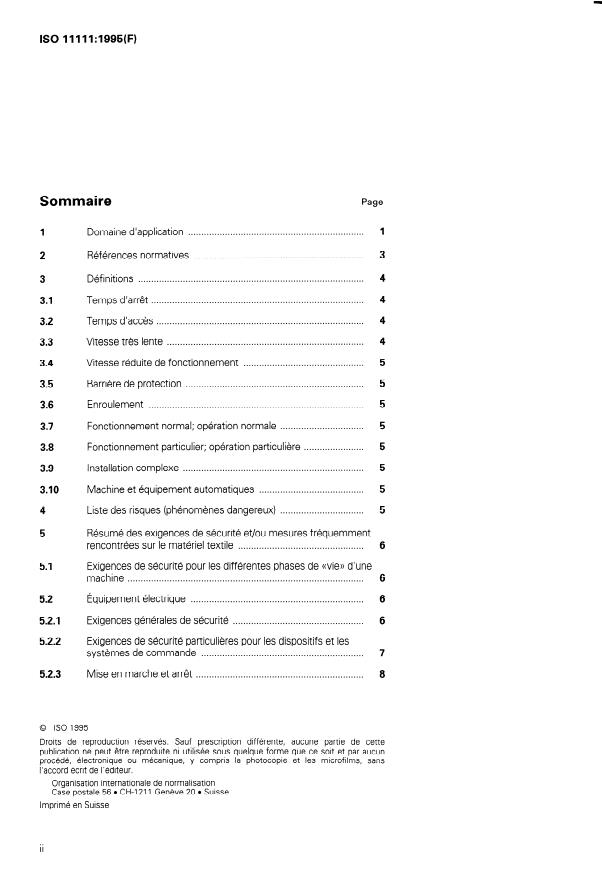
Sommaire Page
................................................................... 1
1 Domaine d ’application
References normatives . 3
...................................................................................... 4
3 Definitions
................................................................................. 4
3.1 Temps d ’arret
............................................................................... 4
3.2 Temps d ’acces
3.3 Vitesse tres lente . 4
..............................................
34 . Vitesse reduite de fonctionnement 5
. Barriere de protection . 5
Enroulement . 5
36 .
Fonctionnement normal; Operation normale . 5
3.7
Fonctionnement particulier; Operation particuliere . 5
3.8
..................................................................... 5
3.9 Installation complexe
Machine et equipement automatiques . 5
3.10
Liste des risques (phenomenes dangereux) . 5
5 Resume des exigences de securite et/ou mesures frequemment
rencontrees sur Ie materiel textile . 6
Exigences de securite pour les differentes phases de wie)) d ’une
5.1
machine . 6
Equipement electrique .
5.2 6
Exigences generales de securite . 6
5.2.1
Exigences de securite particulieres pour les dispositifs et les
5.2.2
..............................................................
systemes de commande 7
5.2.3 Mise en marche et arret . 8
0 ISO 1995
Droits de reproduction reserves. Sauf prescription differente, aucune Partie de cette
publication ne peut etre reproduite ni utilisee sous quelque forme que ce soit et par aucun
procede, electronique ou mecanique, y compris Ia photocopie et les microfilms, sans
l ’accord ecrit de I ’editeur.
Organisation internationale de normalisation
Case postale 56 l CH-l 211 Geneve 20 l Suisse
Imprime en Suisse
ii
Q ISO
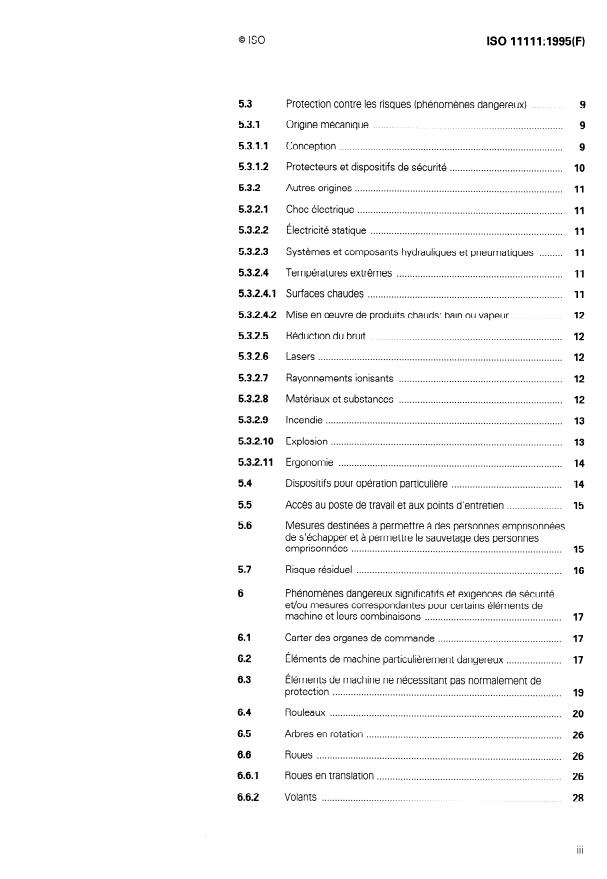
............ 9
53 . Protection contre les risques (phenomenes dangereux)
........................................................................
5.3.1 Origine mecanique 9
5.3.1.1 Conception . 9
5.3.1.2 Protecteurs et dispositifs de securite . 10
5.3.2 Autres origines . 11
5.3.2.1 Choc electrique . 11
......................................................................... 11
5.3.2.2 Electricite statique
......... 11
5.3.2.3 Systemes et composants hydrauliques et pneumatiques
............................................................... 11
5.3.2.4 Temperatures extremes
5.3.2.4.1 Surfaces chaudes .
................... 12
5.3.2.4.2 Mise en oeuvre de produits chauds: bain ou vapeur
5.3.2.5 Reduction du bruit .
5.3.2.6 . 12
Lasers
Rayonnements ionisants . 12
5.3.2.7
Materiaux et substances . 12
5.3.2.8
5.3.2.9 Incendie .
........................................................................................ 13
5.3.2.10 Explosion
5.3.2.11 Ergonomie .
. . . . . . . . . . . . . . . . . . . . . . . . . . . . . . . . . . . . . . . . . . 14
54 . Dispositifs pour Operation particuliere
5.5 Ac& au poste de travail et aux Points d ’entretien . . . . . . . . . . . . . . . . . . . . .
5.6 Mesures destinees a permettre a des personnes emprisonnees
de s ’echapper et a permettre Ie sauvetage des personnes
emprisonnees . . . . . . . . . . . . . . . . . . . . . . . . . . . . . . . . . . . . . . . . . . . . . . . . . . . . . . . . . . . . . . . . .*.
Risque residuel . . . . . . . . . . . . . . . . . . . . . . . . . . . . . . . . . . . . . . . . . . . . . . . . . . . . . . . . . . . . . . . . . . . . . . . . . . . . . . 16
5.7
6 Phenomenes dangereux significatifs et exigences de securite
et/ou mesures correspondantes pour certains elements de
. . . . . . . . . . . . . . . . . . . . . . . . . . . . . . . . . . . . . . . . . . . . . . . . . . . . 17
machine et leurs combinaisons
61 . Carter des organes de commande . . . . . . . . . . . . . . . . . . . . . . . . . . . . . . . . . . . . . . . . . . . . . . .
62 . lkments de machine particulierement dangereux . . . . . . . . . . . . . . . . . . . . . 17
Elements de machine ne necessitant pas normalement de
63 .
. . . . . .*. 19
protection
64 . Rouleaux . . . . . . . . . . . . . . . . . . . . . . . . . . . . . . . . . . . . . . . . . . . . . . . . . . . . . . . . . . . . . . . . . . . . . . . . . . . . . . . . . . . . . . . .
65 . Arbres en rotation . . . . . . . . . . . . . . . . . . . . . . . . . . . . . . . . . . . . . . . . . . . . . . . . . . . . . . . . . . . . . . . . . . . . . . . . . . 26
66 . Roues . . . . . . . . . . . . . . . . . . . . . . . . . . . . . . . . . . . . . . . . . . . . . . . . . . . . . . . . . . . . . . . . . . . . . . . . . . . . . . . . . . . . . . . . . . . . .
6.6.1 Roues en translation . . . . . . . . . . . . . . . . . . . . . . . . . . . . . . . . . . . . . . . . . . . . . . . . . . . . . . . . . . . . . . . . . . . . . .
6.6.2 Volants . . . . . . . . . . . . . . . . . . . . . . . . . . . . . . . . . . . . . . . . . . . . . . . . . . . . . . . . . . . . . . . . . . . . . . . . . . . . . . . . . . . . . . . . . . . 28
. . .
Ill
@ ISO
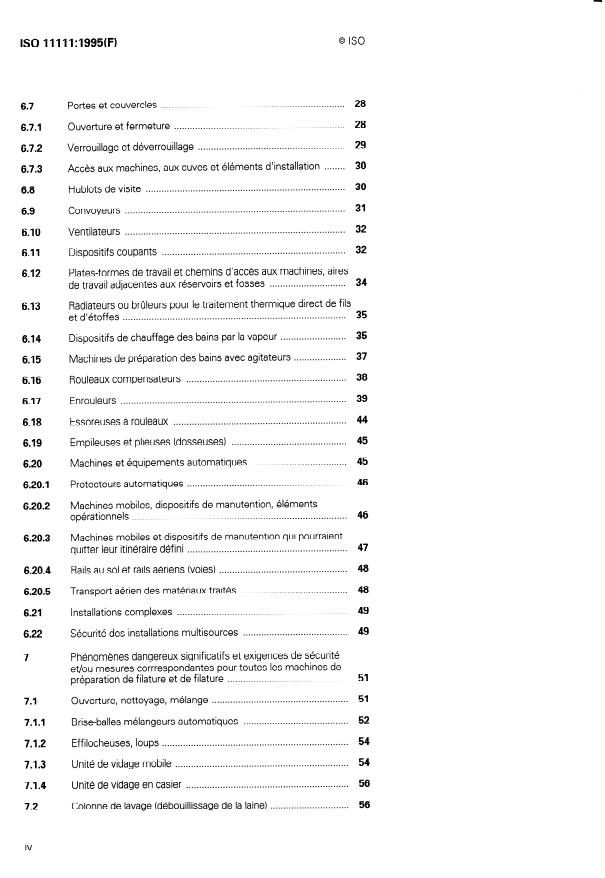
. . . . . . . . . . . . . . . . . . . . . . . . . . . . . . . . . . . . . . . . . . . . . . . . . . . . . . . . . . . . . . . . . . . . . . 28
67 . Portes et couvercles
. . . . . . . . .*. 28
6.7.1 Ouverture et fermeture
. . . . . . . . . . . . . . . . . . .~.~~.~~.~~.~~.~. 29
6.7.2 Verrouillage et deverrouillage
6.7.3 Ac& aux machines, aux cuves et elements d ’installation . . . . . . . .
. . . . . . . . . . . . . . . . . . . . . . . . . . . . . . . . . . . . . . . . . . . . . . . . . . . . . . . . . . . . . . . . . . . . . . . . . . . . 30
6.8 Hublots de Visite
Convoyeurs . . . . . . . . . . . . . . . . . . . . . . . . . . . . . . . . . . . . . . . . . . . . . . . . . . . . . . . . . . . . . . . . . . . . . . . . . . . . . . . . . . . .
6.9
Ventilateurs . . . . . “.
6.10
Dispositifs coupants . .*.,.
6.11
6.12 Plates-formes de travail et chemins d ’acces aux machines, aires
. . . . . . . . . . . . . . . . . . . . . . . . . . . . . 34
de travail adjacentes aux reservoirs et fosses
Radiateurs ou bruleurs pour Ie traitement thermique direct de fils
6.13
. . . . . . . . . . . . . . . . . . . . . . . . . . . . . . . . . . . . . . . . . . . . . . . . . . . . . . . . . . . . . . . . . . . . . . . . . . . . . . . . . . . . . 35
et d ’etoffes
6.14 Dispositifs de chauffage des bains par Ia vapeur . . . . . . . . . . . . . . . . . . . . . . . . .
6.15 Machines de preparation des bains avec agitateurs . . . . . . . . . . . . . . . . . . . .
. . . . . . . . . . . . . . . . . . . . . . . . . . . . . . . . . . . . . . . . . . . . . . . . . . . . . . . . . . . . . 38
6.16 Rouleaux compensateurs
. . . . . . . . . . . . . . . . . . . . . . . . . . . . . . . . . . . . . . . . . . . . . . . . . . . . . . . . . . . . . . . . . . . . . . . . . . . . . . . . . . . . . . 39
6.17 Enrouleurs
. . . . . . . . . . . . . . . . . . . . . . . . .*. 44
6.18 Essoreuses a rouleaux
. . . . . . . . . . . . . . . . . . . . . . . . . . . . . . . . . . . . . . . . . . . . 45
6.19 Empileuses et plieuses (dosseuses)
. . . . . . . . . . . . . . . . . . . . . . . . . . . . . . . . . . . . 45
Machines et equipements automatiques
6.20
Protecteurs automatiques . . . . . . . . . . . . . . . . . . . . . . . . . . . . . . . . . . . . . . . . . . . . . . . . . . . . . . . . . . . . .
6.20.1
Machines mobiles, dispositifs de manutention, elements
6.20.2
. . . . . . . . . . . . . . . . . . . . . . . . . . . . . . . . . . . . . . . . . . . . . . . . . . . . . . . . . . . . . . . . . . . . . . . . . . . . . . . . . . 46
operationnels
6.20.3 Machines mobiles et dispositifs de manutention qui pourraient
quitter leur itineraire defini . . . . . . . . . . . . . . . . . . . . . . . . . . . . . . . . . . . . . . . . . . . . . . . . . . . . . . . . . . . . . 47
. . . . . . . . . . . . . . . . . . . . . . . . . . . . . . . . . . . . . . . . . . . . . . . . . 48
6.20.4 Rails au sol et rails aeriens (voies)
. . . . . . . . . . . . . . . . . . . . . . . . . . . . . . . . . . . . . . . . . 48
6.20.5 Transport aerien des materiaux traites
. . . . . . . . . . . . . . . . . . . . . . . . . . . . . . . . . . . . . . . . . . . . . . . . . . . . . . . . . . . . . . . . . 49
6.21 Installations complexes
Securite des installations multisources . . . . . . . . . . . . . . . . . . . . . . . . . . . . . . . . . . . . . . . . 49
6.22
7 Phenomenes dangereux significatifs et exigences de securite
et/ou mesures corrrespondantes pour toutes les machines de
preparation de filature et de filature . . . . . . . . . . . . . . . . . . . . . . . . . . . . . . . . . . . . . . . . . . . . . .
. . . . . . . . . . . . . . . . . . . . . . . . . .*. 51
7.1 Ouverture, nettoyage, melange
7.1.1 Brise-balles melangeurs automatiques . . . . . . . . . . . . . . . . . . . . . . . . . . . . . . . . . . . . . . . . 52
7.1.2 Effilocheuses, loups . . . . . . . . . . . . . . . . . . . . . . . . . . . . . . . . . . . . . . . . . . . . . . . . . . . . . . . . . . . . . . . . . . . . . . . 54
. . . . . . . . . . . . . . . . . . . . . . . . . . . . . . . . . . . . . . . . . . . . . . . . . . . . . . . . . . . . . . . . . . 54
7.1.3 Unite de vidage mobile
7.1.4 Unite de vidage en casier . . . . . . . . . . . . . . . . . . . . . . . . . . . . . . . . . . . . . . . . . . . . . . . . . . . . . . . . . . . . . . 56
7.2 Colonne de lavage (debouillissage de Ia laine) . . . . . . . . . . . . . . . . . . . . . . . . . . . . . . 56
iv
@ ISO ISO 11111:1995(F)
7.3 Presses pour mise en balle . . . . . . . . . . . . . . . . . . . . . . . . . . . . . . . . . . . . . . . . . . . . . . . . . . . . . . . . . . .
7.4 Cardage . . . . . . . . . . . . . . . . . . . . . . . . . . . . . . . . . . . . . . . . . . . . . . . . . . . . . . . . . . . . . . . . . . . . . . . . . . . . . . . . . . . . . . . . . .
7.4.1 Cardes a chapeaux . . . . . . . . . . . . . . . . . . . . . . . . . . . . . . . . . . . . . . . . . . . . . . . . . . . . . . . . . . . . . . . . . . . . . . . .
7.4.2 Cardes a travailleurs . . . . . . . . . . . . . . . . . . . . . . . . . . . . . . . . . . . . . . . . . . . . . . . . . . . . . . . . . . . . . . . . . . . . . .
7.4.3 Appareils diviseurs de Voile a lanieres . . . . . . . . . . . . . . . . . . . . . . . . . . . . . . . . . . . . . . . . . .
7.5 Coupe et craquage par etirage de cable . . . . . . . . . . . . . . . . . . . . . . . . . . . . . . . . . . . . . . 63
7.6 Machines de preparation de filature apres cardage . . . . . . . . . . . . . . . . . . . . 64
7.6.1 Bancs d ’etirage pour fibres courtes . . . . . . . . . . . . . . . . . . . . . . . . . . . . . . . . . . . . . . . . . . . . . 66
7.6.2 Etireuses a barrettes (y compris les etireuses a barrettes a
champ simple ((gill)) et a double champ croise ((intersecting))) . . 66
. . . . . . . . . . . . . . . . . . . . . . . . . . . . . . . . . . . . . . . . . . . . . . . . . . . . . . . . . . . . . . . . . . . . . . . . . . . . . . . . . . . . . . . 67
7.6.3 Lisseuses
7.6.4 Reunisseuses de rubans, etireuses a surface gauehe,
. . . . . . . . . . . . . . . . . . . . . . . . . . . . . . . . . . . . . . . . . . . . . 67
enrouleuses doubleuses de rubans
. . . . . . . . . . . . . . . . . . . . . . . . . . . . . . . . . . . . . . . . . . . . . . . . . . . . . . . . . . . . . . . . . . . . . . . . . . 68
7.6.5 Peigneuses coton
7.6.6 Peigneuses rectilignes . . . . . . . . . . . . . . . . . . . . . . . . . . . . . . . . . . . . . . . . . . . . . . . . . . . . . . . . . . . . . . . . . .
7.6.7 Bancs a broches . . . . . . . . . . . . . . . . . . . . . . . . . . . . . . . . . . . . . . . . . . . . . . . . . . . . . . . . . . . . . . . . . . . . . . . . . . . .
7.6.8 Finisseurs-frotteurs a grand etirage . . . . . . . . . . . . . . . . . . . . . . . . . . . . . . . . . . . . . . . . . . . . . .
7.6.9 Unites de changement automatique de pots de filature . . . . . . . . . . . . . 70
7.7 . . . . . . . . . . . . . . . . . . . . . . . . . . . . . . . . . . . . . . . . . . . . . . . . . . . . . . . . . . . . . . . . . . . . . . . . . . . . . . . . . . . . . . . . . . . 71
Filature
Machines a filer a anneaux . . . . . . . . . . . . . . . . . . . . . . . . . . . . . . . . . . . . . . . . . . . . . . . . . . . . . . . . . . . 72
7.7.1
. . . . . . . . . . . . . . . . . . . . . . . . 72
7.7.2 Machines de filature a fibres liberees (open-end)
. . . . . . . . . . . . . . . . . . . . . . . 73
7.7.3 Machines de filature a barrettes (continus a gills)
Phenomenes dangereux significatifs et exigences de securite
et/ou mesures correspondantes pour toutes les machines de
production de nontisses . . . . . . . . . . . . . . . . . . . . . . . . . . . . . . . . . . . . . . . . . . . . . . . . . . . . . . . . . . . . . . . . 74
. . . . . . . . . . . . . . . . . . . . . . . . . . . . . . . . . . . . . . . . . . . . . . . . . . . 74
81 . Ouverture, nettoyage, melange
. . . . . . . . . . . . . . . . . . . . . . . . . . . . . . . . . . . . . . . . . . . . . . . . . . . . . . . . . . . . . . . . . . . . . . . . . . . . . . . . . . . . . . . . . . 74
82 . Cardage
83 . Aiguilletage . . . . . . . . . . . . . . . . . . . . . . . . . . . . . . . . . . . . . . . . . . . . . . . . . . . . . . . . . . . . . . . . . . . . . . . . . . . . . . . . . . . . 75
84 . Enroulage . . . . . . . . . . . . . . . . . . . . . . . . . . . . . . . . . . . . . . . . . . . . . . . . . . . . . . . . . . . . . . . . . . . . . . . . . . . . . . . . . . . . . . . 76
. Cylindres secheurs . . . . . . . . . . . . . . . . . . . . . . . . . . . . . . . . . . . . . . . . . . . . . . . . . . . . . . . . . . . . . . . . . . . . . . . . 76
9 Phenomenes dangereux significatifs et exigences de securite
et/ou mesures correspondantes pour toutes les operations de
transformation de fils et les machines de production de
cordages et d ’articles de corderie . . . . . . . . . . . . . . . . . . . . . . . . . . . . . . . . . . . . . . . . . . . . . . . . 77
. Doublage-assemblage, retordage, texturation . . . . . . . . . . . . . . . . . . . . . . . . . . . . . 77
Devidage et bobinage . . . . . . . . . . . . . . . . . . . . . . . . . . . . . . . . . . . . . . . . . . . . . . . . . . . . . . . . . . . . . . . . .~ 78
92 .
. . . . . . . . . . . . . . . . . . . . . . . . . . . . . . . . . . . . . . . . . . . . . . . . . . . . . . . . . . . . . . . . . . . . . . . . . . . . . . . . . . . . . . . . .
93 . Pelotage 79
V
@ ISO
........................ 80
94 . Fabrication de cordages et d ’articles de corderie
9.4.1 Exigences de securite et/ou mesures applicables a certains
elements de machine communs a plusieurs machines de
.........................
production de cordages et d ’articles de corderie 81
9.4.1.1 Supports de bobines .
9.4.1.2 Ailettes . 82
9.4.1.3 Cabestans .
9.4.2 Machines d ’etirage directionnel ou etaleurs . 83
9.4.3 . 83
Bancs d ’etirage et finisseurs
9.4.4 Machines de toronnage . 84
. . . . . . . . . . . . . . . . . . . . . . . . . . . . . . . . . . . . . . . . . . . . . . . . . . . . . . . . . . . . . . . . . . . . . 85
9.4.5 Machines de cablage
............................... 85
9.4.6 Machines combinees de toronnage-cablage
........
9.4.7 Machines de cablage avec dispositif de toronnage integre 86
95 . Tressage . 86
Phenomenes dangereux significatifs et exigences de securite
et/ou mesures correspondantes pour les machines de
preparation au tissage et tricotage a mailles jetees . 88
............................................................ 88
10.1 Ourdissage et ensouplage
. . . . . . . . . . . . . . . . . . . . . . . . . . . . . . . . . . . . . . . . . . . . . . . . . . . . . . . . . . . . . . . . . . . . . . . . . . . . . . . . . . . . . . . . 92
10.2 Encollage
.................................
10.2.1 Cylindres secheurs pour lignes d ’encollage 93
...........................................................................
10.2.2 Bains d ’encollage 93
10.3 Preparation d ’encollage . 96
10.4 Stockage d ’ensouples d ’ourdissage et d ’etoffes . 97
Phenomenes dangereux significatifs et exigences de securite
et/ou mesures correspondantes pour toutes les machines de
production d ’etoffes .
11.1 Tissage . 98
11.1.1 Exigences pour I ’ensemble des machines a tisser . 98
11.1.2 Machines a tisser a navette(s) . 102
11.1.3 Machines a tisser a lance(s) . 103
11.1.4 Machines a tisser a verges (Wilton, epingle, Velours) . 103
Machines a tisser a pinces .
11.1.5 104
Machines a tisser double nappe (eponge, etoffe lourde ou tapis) IO4
11.1.6
Machines a tisser a jet d ’eau .
11.1.7 105
Machines a tisser les rubans
11.1.8 . 105
Type a navettes .
11.1.8.1 105
Type a aiguilles .
11.1.8.2 106
vi
0 ISO ISO 11111:1995(F)
11.1.9 Machines Jacquard . . . . . . . . . . . . . . . . . . . . . . . . . . . . . . . . . . . . . . . . . . . . . . . . . . . . . . . . . . . . . . . . . . . . . . . 108
. . . . . . . . . . . . . . . . . . . . . . 109
11.2 Tricotage (circulaire, rectiligne et a mailles jetees)
. . . . . . . . . . . . . . . . . . . . . . . . . . . . . . . . . . . . . . . . . . . . . . . . . . . . . . 110
11.2.1 Machines a tricoter circulaires
. . . . . . . . . . . . . . . . . . . . . . . . . . . . . . . . . . .~. 110
11.2.2 Machines a tricoter rectilignes
11.2.3 Machines a tricoter a mailles jetees et machines a tricoter
Ill
Rasche1 . . . . . . . . . . . . . . . . . . . . . . . . . . . . . . . . . . . . . . . . . . . . . . . . . . . . . . . . . . . . . . . . . . . . . . . . . . . . . . . . . . . . . . . . . .
11.3 Touffetage . . . . . . . . . . . . . . . . . . . . . . . . . . . . . . . . . . . . . . . . . . . . . . . . . . . . . . . . . . . . . . . . . . . . . . . . . . . . . . . . . . . . . 111
12 Phenomenes dangereux significatifs et exigences de securite
et/ou mesures correspondantes pour toutes les machines de
. . . . . . . . . . . . . . . . . . . . . . . . . . . . . . . . . . . . . . . . . . . . . . . . . . . . . . . . . . . . . . . . . . 114
teinture et de finissage
12.1 Preparation . . . . . . . . . . . . . . . . . . . . . . . . . . . . . . . . . . . . . . . . . . . . . . . . . . . . . . . . . . . . . . . . . . . . . . . . . . . . . . . . . . . . .
12.1.1 Brosseuses . . . . . . . . . . . . . . . . . . . . . . . . . . . . . . . . . . . . . . . . . . . . . . . . . . . . . . . . . . . . . . . . . . . . . . . . . . . . . . . . . . . .
12.1.2 Raseuses, tondeuses . . . . . . . . . . . .*.
12.1.3 Machines a couper longitudinalement . . . . . . . . . . . . . . . . . . . . . . . . . . . . . . . . . . . . . . . . .
12.1.4 Flambeuses . . . . . . . .*. 117
12.1.5 Machines a desencoller . . . . . . . . . . . . . . . . . . . . . . . . . . . . . . . . . . . . . . . . . . . . . . . . . . . . . . . . . . . . . . . . 117
Installations de blanchiment en discontinu (cuves ouvertes) . . . . . . 118
12.1.6
. . . . . . . . . . . . . . . . . . . . . . . . . . . . . . . . . . . . . . . . . . . . . . . . . . . . . . . . . . . . . . . . . 119
12.1.7 Fosses de blanchiment
. . . . . . . . . . . . . . . . . . . . . . . . . . . . . . . . . . . . . . . 119
12.1.8 Installations de blanchiment en continu
12.1.9 Laveuses . . . . . . . . . . . . . . . . . . . . . . . . . . . . . . . . . . . . . . . . . . . . . . . . . . . . . . . . . . . . . . . . . . . . . . . . . . . . . . . . . . . . . . . .
12.1.10 Autoclaves . . . . . . . . . . . . . . . . . . . . . . . . . . . . . . . . . . . . . . . . . . . . . . . . . . . . . . . . . . . . . . . . . . . . . . . . . . . . . . . . . . . . .
................... 121
12.1.11 Equipements de vaporisage en continu pour etoffe
12.1.12 Cuves en J . 123
12.1.13 Equipements de mercerisage . 123
12.1.14 Machines de debouillissage . 124
12.1.15 Machines a fouler . . . . . . . . . . . . . . . . . . . . . . . . . . . . . . . . . . . . . . . . . . . . . . . . . . . . . . . . . . . . . . . . . . . . . . . . . . 124
12.2 Teinture . . . . . . . . . . . . . . . . . . . . . . . . . . . . . . . . . . . . . . . . . . . . . . . . . . . . . . . . . . . . . . . . . . . . . . . . . . . . . . . . . . . . . . . . . . 125
Machines/appareils de teinture a cuves ouvertes . . . . . . . . . . . . . . . . . . . . . . . 125
12.2.1
12.2.2 Machines/appareils de teinture a haute temperature . . . . . . . . . . . . . . . . .
. . . . . . . . . . . . . . . . . . . . . . . . 128
12.2.3 iquipements de preparation du bain de teinture
12.2.4 J iggers . . . . . . . . . . . . . . . . . . . . . . . . . . . . . . . . . . . . . . . . . . . . . . . . . . . . . . . . . . . . . . . . . . . . . . . . . . . . . . . . . . . . . . . . . . . . 128
12.2.5 Bacs a tournettes . . . . . . . . . . . . . . . . . . . . . . . . . . . . . . . . . . . . . . . . . . . . . . . . . . . . . . . . . . . . . . . . . . . . . . . . . . 129
12.2.6 Machines de teinture a tuyeres . . . . . . . . . . . . . . . . . . . . . . . . . . . . . . . . . . . . . . . . . . . . . . . . . . . . 129
12.2.7 Foulards de teinture . . . . . . . . . . . . . . . . . . . . . . . . . . . . . . . . . . . . . . . . . . . . . . . . . . . . . . . . . . . . . . . . . . . . . . 130
12.2.8 Machines de teinture en continu . . . . . . . . . . . . . . . . . . . . . . . . . . . . . . . . . . . . . . . . . . . . . . . . . . 131
vii
Machines de teinture pour bobines . 131
12.2.9
Machines de teinture pour ensouples . 131
12.2.10
Machines de teinture pour echeveaux . 132
12.2.11
..................................................................................... 132
12.3 Impression
Machines d ’impression a cadre plat . 132
12.3.1
......................................... 133
12.3.2 Machines d ’impression a cadre rotatif
Machines d ’impression par transfert . 134
12.3.3
............................................... 134
12.3.4 Machines d ’impression au rouleau
............................................ 134
12.35 iquipements de preparation du bain
........................................................ 135
12.4 Fixage, humectage, sechage
............................................................... 135
12.4.1 Chambres de vaporisage
............................. 136
12.4.2 Machines a essorer par rouleaux (foulardage)
12.4.3 Rames et rames secheuses .
Sechairs, fours . 137
12.4.4
Sechairs a cylindres . 137
12.4.5
12.4.6 Sechairs par haute frequence . 137
Finissage . 138
12.5
........................................................................................ 139
12.5.1 Calandres
Calandres pour tricots circulaires . 139
12.5.2
Machines a enduire, contrecoller et a laminer . 140
12.5.3
....................................................................................... 141
12.5.4 Laineuses
.................................................................... 142
12.5.5 Raseuses, tondeuses
12.5.6 Machines a retrait .
12.5.7 Machines de flocage . 143
Machines a decatir (decatisseuses) . 143
12.5.8
Presses a cuvettes . 143
12.5.9
12.5.10 Machines de polissage . IQQ
...................................................... 145
12.6 Presentation/conditionnement
......................................................................... 145
12.6.1 Machines de Visite
Machines a dosser (dosseuses) . 145
12.6.2
13 Verification des exigences et/ou mesures de securite . 146
.......................
14 Information concernant I’utilisation des machines 146
14.1 Notice d ’instructions .
....................................................................................... 146
14.2 Marquage
. . .
VIII
@ ISO
Annexes
Qualif ications . .*.
Temperatures de surface
. . . . . . . . . . . . . . . . . . . . . . . . . . . . . . . . . . . . . . . . . . . . . . . . . . . . . . .-.
V&if ications . . . . . . . . . . . . . . . . . . . . . . . . . . . . . . . . . . . . . . . . . . . . . . . . . . . . . . . . . . . . . . . . . . . . . . . . . . . . . . . . . . .
Phbnomenes dangereux
. . . . . . . . . . . . . . . . . .*.
ix
0 ISO
Avant-propos
L ’ISO (Organisation internationale de normalisation) est une federation
mondiale d ’organismes nationaux de normalisation (comites membres de
I’ISO). L ’elaboration des Normes internationales est en general confiee aux
comites techniques de I’ISO. Chaque comite membre interesse par une
etude a Ie droit de faire Partie du comite technique cr& a cet effet. Les
organisations internationales, gouvernementales et non gouvernemen-
tales, en liaison avec I’ISO participent egalement aux travaux. L ’ISO colla-
bore etroitement avec Ia Commission electrotechnique internationale (GEI)
en ce qui concerne Ia normalisation electrotechnique.
Les projets de Normes internationales adoptes par Pes comites techniques
sont soumis aux comites membres pour vote. Leur publication comme
Normes internationales requiert I’approbation de 75 % au moins des co-
mites membres votants.
La Norme internationale ISO 1 l’l 11 a etc elaboree par Ie comite technique
lSO/TC 72, Mat&iel pour I’industrie textile et mat&ie/ connexe.
Les annexes A, B et C font Partie integrante de Ia presente Norme inter-
nationale. L ’annexe D est donnee uniquement a titre d ’information.
X
0 ISO
ISO 1111 ’1:1995(F)
Introduction
La presente Norme internationale a etc preparee simultanement par
l ’lSO/TC 72 et par Ie CEN/TC 214 et adoptee dans Ie cadre de I ’accord de
Vienne en vue d ’obtenir une norme identique sur les exigences de secu-
rite pour Ie materiel textile.
La presente Norme internationale traite des phenomenes dangereux en-
gendres par I ’ensemble des machines utilisees dans I ’industrie textile. Le
grand nombre et Ia gamme variee de ces machines ne permettent pas de
preparer des normes individuelles.
L ’article 5 contient un resume des exigences de securite et/ou mesures
pour Ie materiel textile qui s ’appliquent a chaque fois qu ’on y fait reference
dans les articles suivants.
L ’article 6 decrit les phenomenes dangereux significatifs ainsi que les
exigences de securite et/ou mesures correspondantes pour certains ele-
ments largement repandus (par exemple les rouleaux).
Les articles 7 a 12 decrivent les phenomenes dangereux significatifs ainsi
que les exigences de securite et/ou mesures correspondantes pour les
types de machines textiles. Autant que possible, les references aux arti-
cles 5 et 6 et autres references transversales sont utilisees afin de reduire
considerablement Ie volume de Ia presente Norme internationale et eviter
de nombreuses repetitions.
Les exemples donnes dans les articles 6 a 12 sont des solutions verifiees,
representant I ’etat de I ’art dans Ie domaine de Ia securite au moment de
Ia preparation de Ia norme. Pour permettre Ie progres technique, d ’autres
solutions sont egalement admises dans Ia mesure ou elles garantissent
au moins Ie meme niveau de securite.
xi
This page intentionally left blank
NORME INTERNATIONALE 0 ISO
Exigences de securith pour Ie materiel textile
1 Domaine d ’application
La presente Norme internationale est destinee a I’usage de toute personne concernee par Ia securite du materiel
textile par exemple, dessinateurs, fabricants, utilisateurs, fournisseurs d ’une ligne integree, experts en securite.
1.1 La presente Norme internationale est applicable a toutes les machines et installations ainsi qu ’au materiel
associe destines a etre utilises dans I’industrie textile pour
- I’ouverture, Ie nettoyage, Ie melange, Ie cardage, Ia preparation apres cardage, Ia filature et autres traitements
des fibres (brins et fils) ainsi que d ’autres machines servant a fabriquer des fils ou des nontisses (y compris les
feutres);
- Ie bobinage, Ie doublage, Ie retordage, Ia texturation, etc. des fils et Ie traitement preliminaire des fils avant Ie
tissage ou Ie tricotage;
- Ie tissage, Ie tricotage, Ia fabrication de dentelle et autre utilisation similaire des fils, etc., pour fabriquer de
I’etoffe;
- Ia fabrication de galon, Corde, brin, cordage, ficelle, filet, etc., a I’exception de Ia reprise des bobines des ma-
chines de toronnage et de cablage;
- les traitements incluant Ia preparation, Ie blanchiment, Ia teinture, I’impression et Ie finissage des fibres, des
fils, des tissus, des galons, des Cordes, etc., et I’assemblage final avant expedition;
- Ia teinture en piece de produits finis;
- Ie finissage sur metier a tricoter a mailles jetees, y compris Ia bonneterie autre que I’assemblage du produit fini,
par exemple Ia couture;
- Ia fabrication de tapis, par tissage, touffetage et autres procedes.
1.2 La presente Norme internationale ne s ’applique pas aux machines, installations et materiel associe utilises
pour
- Ia fabrication de fibres synthetiques en fil continu y compris Ie Premier mode d ’enroulement textile forme, par
exemple: bobine de fil continu, balle de fibre synthetique;
- Ia confection de vetements, de produits textiles industriels et menagers, et Ie poinconnage et Ie pressage de
nontisses;
- Ia blanchisserie et Ie nettoyage a sec de produits textiles finis;
0 ISO
- les machines utilisees pour Ia revision des machines textiles, par exemple revision des garnitures de carde;
- certains dispositifs de coupe en 6.11.
1.3 La presente Norme internationale s ’applique a I’ensemble des machines textiles, en particulier a toutes les
machines d ’usine et equipement utilises lors des processus repertories en 1 .l, y compris a I’equipement per-
mettant Ie fonctionnement automatise des machines et des processus dans des installations autonomes ou
complexes, mais excluant Ie transport entre les interfaces des machines.
1.4 La presente Norme internationale ne contient aucun tonseil technique particulier sur
- les phases de wie)) de Ia machine autre que I’utilisation;
- les chocs electriques;
- les systemes hydrauliques et pneumatiques et leurs composants;
- Ie bruit;
- Ie laser;
- les rayonnements ionisants;
- I’incendie;
- Ie gaz;
- I’explosion;
- l’ergonomie;
- I’isolation des sources d ’energie;
- I’intervention Pendant I’utilisation normale;
- les dispositifs de securite sensibles a Ia Pression;
et ne couvre pas les phenomenes dangereux et les mesures techniques relatives a Ia maitrise de Ia Pression en
6.7.2, 12.1 .lO, 12.1 .ll, 12.2.2, 12.2.6, 12.2.8, 12.2.9, 12.2.10 et 12.2.11, pour les machines de teinture a haute
temperature.
1.5 La presente Norme internationale s ’applique avant tout aux machines fabriquees apres Ia date de publication
de Ia presente Norme internationale.
1.6 Les conseils contenus dans Ia presente Norme internationale sont bases sur Ia presomption que Ie dessi-
nateur a complete I’analyse des risques de Ia machine consideree.
Cela lui permettra d ’identifier et de satisfaire aux exigences significatives de cette machine comme cela est stipule
presente Norme internationale.
dans Ia
Pour un nombre tres limite d ’applications, quand les exigences paraissent excessives, il convient de realiser un
ecart par rapport a ces exigences, ecat-t pleinement justifie par une appreciation detaillee du risque en comparaison
avec Ia presente Norme internationale et de l’evaluation a Ia conception. II convient de noter toutes ces infor-
mations dans Ie dossier technique de construction et de les conserver a disposition pour toute appreciation par
une personne exterieure.
0 ISO ISO 11111:1995(F)
2 Rbfbrences normatives
Les normes suivantes contiennent des dispositions qui, par Suite de Ia reference qui en est faite, constituent des
dispositions valables pour Ia presente Norme internationale. Au moment de Ia publication, les editions indiquees
etaient en vigueur. Toute norme est sujette a revision et les Parties prenantes des accords fondes sur Ia presente
Norme internationale sont invitees a rechercher Ia possibilite d ’appliquer les editions les plus recentes des normes
indiqubes ci-aprks. Les membres de Ia CEI et de I ’ISO possedent Ie registre des Normes internationales en vigueur
a un moment donne.
ISO 5232: 1988, Symboles graphiques pour machines textiles.
ISO 9902:1993, Acoustique du materiel pour I ’industrie textile - Determination des niveaux de Pression acousti-
que et des niveaux de puissance acoustique emis par /es machines textiles - Methodes d ’expertise et de
con trole.
ISO 11688-1 :1995, Acoustique - Pratique recommandee pour Ia conception de machines et d ’equipements a
Partie I : Planifica tion.
bruit reduit -
Pra tique recommandee pour Ia conception de lieux de tra vail a faible niveau de
ISO 11690-l :-- ‘), Acoustique -
bruit - Partie 1: Strategies de lutte contre Ie bruit.
ISO 11690-2: --J), Acoustique - Pratique recommandee pour Ia conception de lieux de travail a faible niveau de
bruit - Partie 2: Mesures de lutte contre le bruit.
CE I 5 19-1: 1984, Securite dans /es installa tions electro thermiques - Premiere Partie: ßegles generales.
CE I 5 19-9: 1987, Securite dans /es installa tions electro thermiques - Partie 9: ßegles particulieres pour /es instal-
iations de chauffage dielectrique a haute frequence.
EN 292-1 :1991, Securite des machines - Notions fondamentales, principes generaux de conception - Partie 1:
Terminologie de base, me thodologie.
EN 292-2:1991, Securite des machines - Notions fondamentales, principes generaux de conception - Partie 2:
Principes et specifica tions techniques.
EN 294:1992, Securite des machines - Distances de securite pour empecher l ’atteinte des zones dangereuses
par /es membres superieurs.
EN 349:1993, Securite des machines - tkartements minimaux pour prevenir /es risques d ’ecrasement de Parties
du Corps humain.
EN 418: 1992, Securite des machines - Equipement d ’arret d ’urgence, aspects fonctionnels - Principes de
conception.
EN 563: 1994, Securite des machines - Temperatures des surfaces tangibles; Donnees ergonomiques pour Ia
fixation de temperatures limites des surfaces chaudes.
EN 574:- “, Securite des machines - Dispositif de commande bimanuelle.
EN 626-1: 1994, Securite des machines - ßeduction des risques pour Ia sante resultant de I ’emission des sub-
stances dangereuses a partir des machines - Partie 1: Principes et specifica tions a / ‘in ten tion des cons tructeurs.
.
EN 811 . ---- ‘jy Securite des machines - Distances de securite pour empecher I ’atteinte des zones dangereuses par
/es membres inferieurs.
1) A publier.
0 ISO
Skurite des machines - Prescriptions g&Grales pour /a conception et Ia construction des protec-
EN 953:~ “,
teurs (fixes, mobiles).
S&urite des machines - Partie des systemes de commande relatifs a la skuritk - Partie 7:
EN 954-1 :-‘jl
Principes g&&aux de conception.
Exigences g&Grales de securite relatives aux systemes et composan ts
EN 982:- “, Skcurite des machines -
- Transmissions hydrauliques.
EN 983:- “, S&urite des machines - Exigences g&Grales de skcurite relatives aux systemes et composan ts
- Transmissions pneumatiques.
S&urit& des machines - Vitesse mainlbras - Vitesse d ’approche des Parties du Corps pour Ie po-
EN 999:- “,
sitionnemen t des dispositifs de skuritk.
EN 1037:- “, Skuritk des machines - Consignation - Prkvention de Ia mise en marche intempestive.
S&uritk des machines - Apprkiation du risque.
EN 1050:- “,
S&urit& des machines - Dispositif de verrouillage et d ’interverrouillage - Principes g&Graux et
EN 1088:- ‘),
spkifica tions pour Ia concep tion.
Skcurite des machines - Incendies et explosions - Partie 1: Protections contre /es incendies et
EN 1127-l :-‘),
/es explosions.
EN 50100-l :-‘), Skcuritk des machines - Dispositifs de protection electro-sensibles - Partie 7: ßkgles g&Wales
et essais.
Skcurite des machines - Dispositifs de protection electro-sensibles - Partie 2: ß&gles particu-
EN 50100-2:- “,
k-es pour /es kquipements utilisant des dispositifs de protection photoelectriques.
EN 60204-111992, Skcuritk des machines - Equipement blectrique des machines - Partie 1: ßkgles g6n&ales.
Principes de mancwvre. [GEI 447: 19931
EN 60447:1993, Interface homme-machine (IHM) -
EN 6131 O-l :-‘), S&urite des machines - Principes d ’indica tion de marquage et de commande - Partie 7: Si-
gnaux visuels, audibles et tactiles.
3 Dkfinitions
Pour Pes besoins de Ia presente Norme internationale, les definitions donnees dans I’EN 292-1 et I’EN 953, et les
definitions suivantes s ’appliquent.
Lorsque des valeurs sont applicables a des termes dkfinis dans cet article, celles-ci sont indiqukes dans
NOTE 1
I ’annexe A.
3.1 temps d ’arret: Temps que met une machine ou un element de machine a s ’immobiliser apres que Ie Signal
d ’arret ait etc donne.
3.2 temps d ’acck Temps necessaire pour atteindre un element dangereux des Ia Premiere exposition a cet
element.
3.3 vitesse trhs lente: Vitesse lineaire ou tangentielle d ’un element de machine ou materiau en cours de procede
qui est considerablement reduite par rapport a Ia vitesse normale. Elle apparait au cours d ’operations speciales,
est mesuree au Point dangereux et caracterisee par une vitesse limite et une distance d ’arret maximum (voir an-
nexe A).
0 ISO ISO 11111:1995(F)
3.4 vitesse reduite de fonctionnement: Vitesse Iineaire ou tangentielle d ’un element de machine ou materiau
en cours de procede qui est considerablement reduite par rapport a Ia vitesse normale. Elle apparait au cours
d ’operations speciales, est mesuree au Point dangereux et caracterisee par une distance d ’arret maximum (voir
annexe A).
3.5 barrikre de protection: Protecteur fixe servant de barriet-e de maintien a distance qui emp&he I’accb a une
zone dangereuse. Cette protection peut etre fixee directement a Ia machine, ou etre independante et fixee au sol.
L ’acces a l’espace entre Ia barriere de protection et Ia machine est controle par des portes verrouillees (voir
annexe A).
36 . enroulement: Enroulement genant des materiaux traites situe autour de Ia Partie rotative d ’une machine.
3.7 fonctionnement normal; Operation normale: La sequence complete du processus de production y compris
Ia mise en marche, Ie nettoyage occasionnel et l’elimination des defaillances de routine au cours du processus de
fabrication, tels que I’alimentation et I’evacuation du produit traite, Ia mise en marche, I’enfilage, Ia surveillance
du processus, les controles de qualite, I’elimination des fibres residuelles, Ie nouage des bouts casses.
3.8 fonctionnement particulier; Operation particuli&e: Toutes les procedures et toutes les actions qui ne
s ’integrent pas dans Ie fonctionnement normal: tel que mise au Point, reglage, nettoyage important, elimination
des defaillances majeures dans Ie processus de fabrication et I’entretien, par exemple I’elimination des blocages,
des enroulements, a I’exception des machines a filer, a retordre et a texturer, Ie rentraillage
...
Questions, Comments and Discussion
Ask us and Technical Secretary will try to provide an answer. You can facilitate discussion about the standard in here.
Loading comments...