


EN ISO 11111:1995
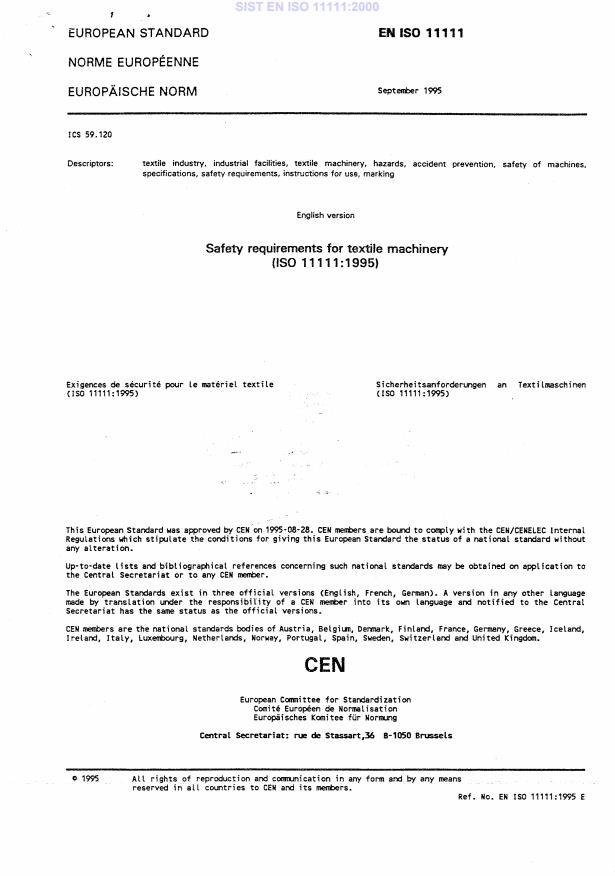
(Main)Safety requirements for textile machinery (ISO 11111:1995)
Safety requirements for textile machinery (ISO 11111:1995)
This International Standard is intended for use by any person concerned with the safety of textile machinery, for example, textile machinery designers, manufacturers, users, systems integrators, safety experts. 1.1 This International Standard is applicable to all machinery plant and related equipment intended to be used in the textile industry for the following: - the opening, cleaning, blending, carding, preparation subsequent to carding, spinning and other processing of fibres (staple and filament) and other materials to form yarn or nonwoven material (including felts); - the winding, doubling, twisting, texturing, etc. of yarns and the processing of yarns preparatory to weaving and knitting; - the weaving, knitting, lace-making and similar utilization of yarn, etc. to form fabric; - the formation of braid, cord, strand, rope, twine, net, etc., except take-up reels of stranding and laying machinery; - processes including the preparation, bleaching, dyeing, printing and finishing of fibre, yarn, fabric, braid, cord, etc., and final assembly for despatch; - the piece dyeing of made-up goods; - finishing of warp and weft knitting, including hosiery, other than assembly of the finished product (e.g. sewing); - carpet manufacture, by weaving, tufting and other processes. 1.2 This International Standard is not applicable to machinery, plant and related equipment used for: - the manufacture of continuous filament man-made fibres up to and including the formation of the first textile package (e.g. continuous filament cheese, staple fibre bale); - the formation and making up of garments, household and industrial textile goods, and the die punching and pressing of nonwoven fabric; - the laundering and drycleaning of made-up textile goods; - machines used for servicing of textile machines (e.g. cardwire servicing); - certain cutting devices in 6.11.
Sicherheitsanforderungen an Textilmaschinen (ISO 11111:1995)
Diese Internationale Norm ist für jede bestimmt, der sich mit Sicherheit von Textilmaschinen befaßt, wie zum Beispiel Maschinenkonstrukteure, Maschinenhersteller, Maschinenbetreiber, Anlagenplaner, Sicherheitsfachleute.
Exigences de sécurité pour le matériel textile (ISO 11111:1995)
Varnostne zahteve za tekstilne stroje (ISO 11111: 1995)
General Information
- Status
- Withdrawn
- Publication Date
- 14-Sep-1995
- Withdrawal Date
- 14-Feb-2005
- Technical Committee
- CEN/TC 214 - Textile machinery and allied machinery
- Drafting Committee
- CEN/TC 214/WG 1 - Safety requirements for textile machinery
- Current Stage
- 9960 - Withdrawal effective - Withdrawal
- Start Date
- 15-Feb-2005
- Completion Date
- 15-Feb-2005
- Directive
- 89/392/EEC - Machinery - Safety of machinery: general essential health and safety requirements
- Directive
- 98/37/EC - Machinery
Relations
- Effective Date
- 22-Dec-2008
- Effective Date
- 22-Dec-2008
- Effective Date
- 22-Dec-2008
- Effective Date
- 22-Dec-2008
- Effective Date
- 22-Dec-2008
- Effective Date
- 22-Dec-2008
- Effective Date
- 22-Dec-2008
- Effective Date
- 09-Feb-2026
- Effective Date
- 09-Feb-2026
- Effective Date
- 28-Jan-2026
- Effective Date
- 28-Jan-2026

Get Certified
Connect with accredited certification bodies for this standard

Control Union Certifications
Global certification for agriculture and sustainability.

Bureau Veritas Bangladesh
Bureau Veritas certification services in Bangladesh.

ECOCERT France
Leader in organic and sustainability certification worldwide.
Sponsored listings
Frequently Asked Questions
EN ISO 11111:1995 is a standard published by the European Committee for Standardization (CEN). Its full title is "Safety requirements for textile machinery (ISO 11111:1995)". This standard covers: This International Standard is intended for use by any person concerned with the safety of textile machinery, for example, textile machinery designers, manufacturers, users, systems integrators, safety experts. 1.1 This International Standard is applicable to all machinery plant and related equipment intended to be used in the textile industry for the following: - the opening, cleaning, blending, carding, preparation subsequent to carding, spinning and other processing of fibres (staple and filament) and other materials to form yarn or nonwoven material (including felts); - the winding, doubling, twisting, texturing, etc. of yarns and the processing of yarns preparatory to weaving and knitting; - the weaving, knitting, lace-making and similar utilization of yarn, etc. to form fabric; - the formation of braid, cord, strand, rope, twine, net, etc., except take-up reels of stranding and laying machinery; - processes including the preparation, bleaching, dyeing, printing and finishing of fibre, yarn, fabric, braid, cord, etc., and final assembly for despatch; - the piece dyeing of made-up goods; - finishing of warp and weft knitting, including hosiery, other than assembly of the finished product (e.g. sewing); - carpet manufacture, by weaving, tufting and other processes. 1.2 This International Standard is not applicable to machinery, plant and related equipment used for: - the manufacture of continuous filament man-made fibres up to and including the formation of the first textile package (e.g. continuous filament cheese, staple fibre bale); - the formation and making up of garments, household and industrial textile goods, and the die punching and pressing of nonwoven fabric; - the laundering and drycleaning of made-up textile goods; - machines used for servicing of textile machines (e.g. cardwire servicing); - certain cutting devices in 6.11.
This International Standard is intended for use by any person concerned with the safety of textile machinery, for example, textile machinery designers, manufacturers, users, systems integrators, safety experts. 1.1 This International Standard is applicable to all machinery plant and related equipment intended to be used in the textile industry for the following: - the opening, cleaning, blending, carding, preparation subsequent to carding, spinning and other processing of fibres (staple and filament) and other materials to form yarn or nonwoven material (including felts); - the winding, doubling, twisting, texturing, etc. of yarns and the processing of yarns preparatory to weaving and knitting; - the weaving, knitting, lace-making and similar utilization of yarn, etc. to form fabric; - the formation of braid, cord, strand, rope, twine, net, etc., except take-up reels of stranding and laying machinery; - processes including the preparation, bleaching, dyeing, printing and finishing of fibre, yarn, fabric, braid, cord, etc., and final assembly for despatch; - the piece dyeing of made-up goods; - finishing of warp and weft knitting, including hosiery, other than assembly of the finished product (e.g. sewing); - carpet manufacture, by weaving, tufting and other processes. 1.2 This International Standard is not applicable to machinery, plant and related equipment used for: - the manufacture of continuous filament man-made fibres up to and including the formation of the first textile package (e.g. continuous filament cheese, staple fibre bale); - the formation and making up of garments, household and industrial textile goods, and the die punching and pressing of nonwoven fabric; - the laundering and drycleaning of made-up textile goods; - machines used for servicing of textile machines (e.g. cardwire servicing); - certain cutting devices in 6.11.
EN ISO 11111:1995 is classified under the following ICS (International Classification for Standards) categories: 59.120.01 - Textile machinery in general. The ICS classification helps identify the subject area and facilitates finding related standards.
EN ISO 11111:1995 has the following relationships with other standards: It is inter standard links to EN ISO 11111-5:2005, EN ISO 11111-6:2005, EN ISO 11111-1:2005, EN ISO 11111-4:2005, EN ISO 11111-7:2005, EN ISO 11111-2:2005, EN ISO 11111-3:2005, EN 61010-1:1993/A2:1995, EN 61010-1:2001, EN ISO 9902-1:2001, EN ISO 13631:2002. Understanding these relationships helps ensure you are using the most current and applicable version of the standard.
EN ISO 11111:1995 is associated with the following European legislation: EU Directives/Regulations: 89/392/EEC, 98/37/EC; Standardization Mandates: M/BC/CEN/88/13. When a standard is cited in the Official Journal of the European Union, products manufactured in conformity with it benefit from a presumption of conformity with the essential requirements of the corresponding EU directive or regulation.
EN ISO 11111:1995 is available in PDF format for immediate download after purchase. The document can be added to your cart and obtained through the secure checkout process. Digital delivery ensures instant access to the complete standard document.
Standards Content (Sample)
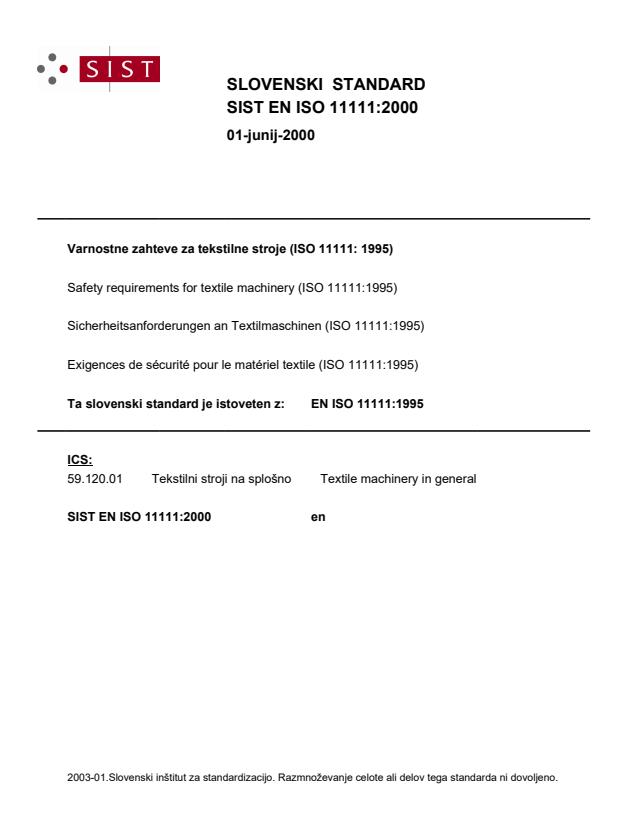
SLOVENSKI STANDARD
01-junij-2000
Varnostne zahteve za tekstilne stroje (ISO 11111: 1995)
Safety requirements for textile machinery (ISO 11111:1995)
Sicherheitsanforderungen an Textilmaschinen (ISO 11111:1995)
Exigences de sécurité pour le matériel textile (ISO 11111:1995)
Ta slovenski standard je istoveten z: EN ISO 11111:1995
ICS:
59.120.01 Tekstilni stroji na splošno Textile machinery in general
2003-01.Slovenski inštitut za standardizacijo. Razmnoževanje celote ali delov tega standarda ni dovoljeno.
INTERNATIONAL
IS0
STANDARD
First edition
1995-09-I 5
Safety requirements for textile machinery
Exigences de &writ6 pour le matkiel textile
Reference number
ISO 11111 :I 995(E)
IS0 11111:1995(E)
Page
Contents
.............................................................................................. I
Scope
.................................................................... 2
Normative references
Definitions .
Stopping time .
3.1
.................................... ............................... 4
3.2 Access time .
Crawl speed .
3.3
................................................................ 4
Reduced running speed
3.4
........ 4
Fence guard .
3.5
..................................... ................................. 4
Lap (wrap) .
3.6
...... 4
Normal operation .
3.7
Special operation .
3.8
............................. 4
Complex installation .
3.9
Automatic machinery and equipment . 5
3.10
....................................... ......................................... 5
4 List of hazards
5 Summary of frequently occurring safety requirements and/or
........................... ........................... 6
measures for textile machines
5.1 Safety requirements for the different phases of “life” of a
.......................................................................................... 6
machine
5.2 Electrical equipment .
General safety requirements .
52.1
Special safety requirements for control systems and devices . 7
5.2.2
Starting and stopping . 8
5.2.3
0 IS0 1995
All rights reserved. Unless otherwise specified, no part of this publication may be
reproduced or utilized in any form or by any means, electronrc or mechanrcai, including
photocopying and microfilm, without permission in writing from the publisher.
International Organization for Standardization
Case postale 56 l CH-1211 Geneve 20 0 Switzerland
Printed in Switzerland
II
IS0 11111:1995(E)
@ IS0
Protection against hazards . . . . . . . . . . . . . . . . . . . . . . . . . . . . . . . . . . . . . . . . . . . . . . . . . . . . . . . . . . . .
. 9
Mechanical origin . . . . . . . . . . . . . . .~. 9
5.3.1
5.3.1.1 Design . . . . . . . . . . . . . . . . . . . . . . . . . . . . . . . . . . . . . . . . . . . . . . . . . . . . . . . . . . . . . . . . . . . . . . . . . . . . . . . . . . . . . . . . . . . . 9
5.3.1.2 Guards and safety devices . . . . . . . . . . . . . . . . . . . . . . . . . . . . . . . . . . . . . . . . . . . . . . . . . . . . . . . . . . . . IO
5.3.2 Other origin . . . . . . . . . . . . . . . . . . . . . . . . . . . . . . . . . . . . . . . . . . . . . . . . . . . . . . . . . . . . . . . . . . . . . . . . . . . . . . . . . . . . II
5.3.2.1 Electric shock . . . . . . . . . . . . . . . . . . . . . . . . . . . . . . . . . . . . . . . . . . . . . . . . . . . . . . . . . . . . . . . . . . . . . . . . . . . . . . . . . 11
5.3.2.2 Static electricity . . . . . . . . . . . . . . . . . . . . . . . . . . . . . . . . . . . . . . . . . . . . . . . . . . . . . . . . . . . . . . . . . . . . . . . . . . . . . II
Fluid power systems and components . . . . . . . . . . .*. 11
5.3.2.3
Extreme temperatures . . . . . . . . . . . . . . . . . . . . . . . . . . . . . . . . . . . . . . . . . . . . . . . . . . . . . . . . . . . . . . . . . . 11
5.3.2.4
. . . . . . . . . . . . . . . . . . . . . . . . . . . . . . . . . . . . . . . . . . . . . . . . . . . . . . . . . . . . . . . . . . . . . . . . . . . . . . . . . . II
5.3.2.4.1 Hot surfaces
5.3.2.4.2 Hot processing materials: liquor or steam . . . . . . . . . . . . . . . . . . . . . . . . . . . . . . . . . . . 12
5.3.2.5 Noise reduction . . . . . . . . . . . . . . . . . . . . . . . . . . . . . . . . . . . . . . . . . . . . . . . . . . . . . . . . . . . . . . . . . . . . . . . . . . . . . 12
5.3.2.6 Lasers . . . . . . . . . . . . . . . . . . . . . . . . . . . . . . . . . . . . . . . . . . . . . . . . . . . . . . . . . . . . . . . . . . . . . . . . . . . . . . . . . . . . . . . . . . . . . 12
5.3.2.7 Ionizing radiation . . . . . . . . . . . . . . . . . . . . . . . . . . . . . . . . . . . . . . . . . . . . . . . . . . . . . . . . . . . . . . . . . . . . . . . . . . . . 12
5.3.2.8 Materials and substances . . . . . . . . . . . . . . . . . . . . . . . . . . . . . . . . . . . . . . . . . . . . . . . . . . . . . . . . . . . . . 12
5.3.2.9 Fire * . . . . . . . . . . . . . . . . . . . . . . . . . . . . . . . . . . . . . . . . . . . . . . . . . . . . . . . . . . . . . . . . . . . . . . . . . . . . . . . . . . . . . . . . . . . . . . . . . 13
5.3.2.10 Explosion . . . . . . . . . . . . . . . . . . . . . . . . . . . . . . . . . . . . . . . . . . . . . . . . . . . . . . . . . . . . . . . . . . . . . . . . . . . . . . . . . . . . . . . . 13
5.3.2.‘?1 Ergonomics . . . . . . . . . . . . . . . . . . . . . . . . . . . . . . . . . . . . . . . . . . . . . . . . . . . . . . . . . . . . . . . . . . . . . . . . . . . . . . . . . . . . 14
Devices for special operation . . . . . . . . . . . . . . . . . . . . . . . . . . . . . . . . . . . . . . . . . . . . . . . . . . . . . . . . 14
5.4
. . . . . . . . . . . . . . . . . . . . . . 15
5.5 Access to operating position and servicing points
5.6 Measures for the escape and rescue of trapped persons . . . . . . . . . . 15
5.7 Residual risk . . . . . . . . . . . . . . . . . . . . . . . . . . . . . . . . . . . . . . . . . . . . . . . . . . . . . . . . . . . . . . . . . . . . . . . . . . . . . . . . . . . 15
6 Significant hazards and corresponding safety requirements
and/or measures for certain machine elements and their
combinations . . . . . . . . . . . . . . . . . . . . . . . . . . . . . . . . . . . . . . . . . . . . . . . . . . . . . . . . . . . . . . . . . . . . . . . . . . . . . . . . . . 16
61 . Drive and transmission enclosures . . . . . . . . . . . . . . . . . . . . . . . . . . . . . . . . . . . . . . . . . . . . . . 16
6.2 Particularly dangerous machine elements . . . . . . . . . . . . . . . . . . . . . . . . . . . . . . . . . . . 16
6.3 Machine elements which normally do not require safeguarding 17
6.4 Rollers . . . . . . . . . . . . . . . . . . . . . . . . . . . . . . . . . . . . . . . . . . . . . . . . . . . . . . . . . . . . . . . . . . . . . . . . . . . . . . . . . . . . . . . . . . . .
6.5 Rotating shafts . . . . . . . . . . . . . . . . . . . . . . . . . . . . . . . . . . . . . . . . . . . . . . . . . . . . . . . . . . . . . . . . . . . . . . . . . . . . . .
66 . Wheels . . . . . . . . . . . . . . . . . . . . . . . . . . . . . . . . . . . . . . . . . . . . . . . . . . . . . . . . . . . . . . . . . . . . . . . . . . . . . . . . . . . . . . . . . . .
6.6.1 Running wheels
. . . . . . . . . . . . . . . . . . . . . . . . . . . . . . . . . . . . . . . . . . . . . . . . . . . . . . . . . . . . . . . . . . . . . . . . . . . . . 25
6.6.2 Handwheels . . . . . . . . . . . . . . . . . . . . . . . . . . . . . . . . . . . . . . . . . . . . . . . . . . . . . . . . . . . . . . . . . . . . . . . . . . . . . . . . . . .
6.7 Doors and lids
. . . . . . . . . . . . . . . . . . . . . . . . . . . . . . . . . . . . . . . . . . . . . . . . . . . . . . . . . . . . . . . . . . . . . . . . . . . . . . . . 26
6.7.1 Opening and closing
. .-.--.-.-.-. 26
. . .
III
@ IS0
IS0 I II 11:1995(E)
Locking and unlocking . . . . . . . . . . . . . . . . . . . . . . . . . . . . . . . . . . . . . . . . . . . . . . . . . . . . . . . . . . . . . . . . . . .
6.7.2
. . . . . . . . . . . . . . . . . . . . . . . . . . . . 28
Entry into machines, vessels or items of plant
6.7.3
Observation windows . . . . . . . . . . . . . . . . . . . . . . . . . . . . . . . . . . . . . . . . . . . . . . . m . . . . . . . . . . . . . . . . . . .
6.8
. . . . . . . . . . . . . . . . . . . . . . . . . . . . . . . . . . . . . . . . . . . . . . . . . 29
Conveyors . . . . . . . . . . . . . . . . . . . . . . . . . . . . . . . . . . . . .
6.9
6.10
.......... 30
Cutting devices .
6.11
6.12 Work platforms and walkways on machines, work areas
. . . . . . . . . . . . . . . . . . . . . . . . . . . . . . . . . . . . . . . . . . . . . . . . . . . . . . . . . . . . . .
adjacent to tanks and pits
6.13 Radiators or burners for the direct heat treatment of yarn and
. . . . .~.~.
fa brie . . . . . . . . . . . . . . . . . . . . . . . . . . . . .
heating of liquors . . . . . . . . . . . . . . . . . . . . . . . . . . . . . . . . . . . . . . . . . . . .
6.14 Devices for steam
. . . . s . . . . . . . . . . . . . . . 33
6.15 Liquor preparatory machinery incorporating stirrers
....................................................................... ........ 35
6.16 Dancing rollers
. . . . . . . . . . . . . . . . . . . . . . . . . . . . . . . . . . . . . . . . . . . . . . . . . . . . . . . . . . . . . . . . . . . . . . . . . . .
6.17 Bate hers . . . . . . . . . . . . . .
..........................................................................................
6.18 Mangles
......................................................... ....... 42
6.19 Pilers and plaiters .
. . . . . . . . . . . . . . . . . . . . . . . . . . . . . . . . . . . . . . . . . . . .
6.20 Automatic machines and equipment
Automatic guards . . . . . . . . . . . . . . . . . . . . . . . . . . . . . . . . . . . . . . . . . . . . . . . . .*.
6.2&I
. . . . . . . . . . . . . . . . 43
Mobile machines, handling devices, operational parts
6.20.2
Mobile machines and handling devices which could leave their
6.20.3
............................... 44
defined path . .
Floor-mounted and overhead rails (tracks) . . . . .I.
6.20.4
.n.*.
6.20.5 Overhead transport of process material
..................................................................... 45
6.21 Complex installations
...................................... 46
6.22 Safeguarding multi-sourced installations
7 Significant hazards and corresponding safety requirements
and/or measures for all spinning preparatory and spinning
machines . . . . . . . . . . . . . . . . . . . . . . . . . . . . . . . . . . . . . . . . . . . . . . . . . . . . . . . . . . . . . . . . . . . . . . . . . . . . . . . . . . . . . . . .
......... 47
Opening, cleaning, blending .
7.1
7.1.1 Automated blending bale openers .
7.1.2 Teasers, willows .
Moving bin emptiers . 50
7.1.3
. . . . . . . . . . . . . . . . . . . . .*. 52
7.1.4 Bunker emptiers
. . . . . . . . . . . . . . . . . . . . . . . . . . .=. 52
7.2 Wool scouring (wool washing)
7.3 Baling . . . . . . . . . . . . . . . . . . . . . . . . . . . . . . . . . . . . . . . . . . . . . . . . . . . . . . . . . . . . . . . . . . . . . .“.
iv
@ IS0 IS0 II 111:1995(E)
7.4 Carding . . 55
Flat cards
7.4.1 . 56
7.4.2 Roller and clearer cards . 57
7.4.3 Tape condensers . 58
7.5 Tow cutting and stretch breaking . 59
7.6 Spinning preparation subsequent to carding
. . . . . . . . . . . . . . . . . . . . . . . . . . . . . . . 60
7.6.1 Draw frames for short fibres . . . . . . . . . . . . . . . . . . . . . . . . . . . . . . . . . . . . . . . . . . . . . . . . . . . . . . . .
7.6.2 Gill boxes, including “intersecting” and “chain-gill” types . . . . . . . . .
7.6.3 Backwashers . . . . . . . . . . . . . . . . . . . . . . . . . . . . . . . . . . . . . . . . . . . . . . . . . . . . . . . . . . . . . . . . . . . . . . . . . . . . . . . . .
7.6.4 Sliver and ribbon lap machines, lap formers
. . . . . . . . . . . . . . . . . . . . . . . . . . . . . . . . 63
7.6.5 Cotton combers . . . . . . . . . . . . . . . . . . . . . . . . . . . . . . . . . . . . . . . . . . . . . . . . . . . . . . . . . . . . . . . . . . . . . . . . . . . . .
Rectilinear combs . . . . . . . . . . . . . . . . . . . . . . . . . . . . . . . . . . . . . . . . . . . . . . . . . . . . . . . . . . . . . . . . . . . . . . . . . .
7.6.6 63
7.6.7 Speedframes . . . . . . . . . . . . . . . . . . . . . . . . . . . . . . . . . . . . . . . . . . . . . . . . . . . . . . . . . . . . . . . . . . . . . . . . . . . . . . . . .
High draft finishers . . . . . . . . . . . . . . . . . . . . . . . . . . . . . . . . . . . . . . . . . . . . . . . . . . . . . . . . . . . . . . . . . . . . . . . .
7.6.8 64
Automatic sliver can-doffing units
7.6.9 . 65
7.7 Spinning .
Ring spinning machines
7.7.1 . 67
7.7.2 Open-end spinning machines . . . . . . . . . . . . . . . . . . . . . . . . . . . . .*. 67
7.7.3 Gill spinning machines . . . . . . . . . . . . . . . . . . . . . . . . . . . . . . . . . . . . . . . . . . . . . . . . . . . . . . . . . . . . . . . . . . . 68
8 Significant hazards and corresponding safety requirements
and/or measures for all machines for nonwovens . . . . . . . . . . . . . . . . . . . . . .
8.1 Opening, cleaning, blending . . . . . . . . . . . . . . . . . . . . . . . . . . . . . . . . . . . . . . . . . . . . . . . . . . . . . . . . . .
. . . . . . . . . . . . . . . . . . . . . . . . . . . . . . . . . . . . . . . . . . . . . . . . . . . . . . . . . . . . . . . . . . . . . . . . . . . . . . . . . . . . . . . . . . .
82 . Carding 69
Needle punching .
83 . 69
.........................................................................................
84 . Batching 71
85 . Cylinder drying .
Significant hazards and corresponding safety requirements
and/or measures for all yarn processing, cordage and rope-
manufacturing machines . . . . . . . . . . . . . . . . . . . . . . . . . . . . . . . . . . . . . . . . . . . . . . . . . . . . . . . . . . . . . .
Doubling, twisting, texturing .
91 . 72
......................................................................
92 . Reeling and winding 73
93 . Ball winding .
94 . Cordage and rope manufacturing . . . . . . . . . . . . . . . . . . . . . . . . . . . . . . . . . . . . . . . . . . . . . . . . .
V
@ IS0
IS0 II 111:1995(E)
Safety requirements and/or measures for certain machine
9.4.1
elements common to several cordage and rope-manufacturing
........................................................................................
machines 76
..............................................................................
9.4.1.1 Bobbin spindles 76
.............................................................................................. 77
9.4.1.2 Flyers
9.4.1.3 Capstans . 77
9.4.2 Goods machines or spreaders, breakers . 78
9.4.3 Draw frames and finishers . 78
9.4.4 Stranding machines . 79
Laying (closing) machines . 79
9.4.5
Combined stranding and closing machines . 80
9.4.6
Strand-plaited rope-making machines .
9.4.7 80
...........................................................................................
95 . Braiding 81
IO Significant hazards and corresponding safety requirements
and/or measures for all machinery preparatory to weaving and
..................................................................................
warp knitting 83
10.1 Warping and beaming . 83
10.2 Sizing . 87
10.2.1 Cylinder dryers for sizing lines . 88
10.2.2 Size baths . 88
10.3 Size preparation . 91
10.4 Storage of warp and cloth beams .
11 Significant hazards and corresponding safety requirements
and/or measures for all fabric manufacturing machinery . 93
11.1 Weaving .
11.1.1 Requirements for all weaving machines
...................................... 93
11.1.2 Shuttle weaving machines
............................................................ 96
Rapier weaving machines
11.1.3 . 97
11.1.4 Pile wire weaving machines (Wilton, epingle, velvet) . 98
Gripper weaving machines
11.1.5 . 98
III.6 Face-to-face weaving machines (pile, heavy fabric or carpet) . 99
Water-jet weaving machines
11.1.7 .
11.1.8 Narrow fabric weaving machines
.................................................
11.1.8.1 Shuttle type .
11.1.8.2 Needle type .
11.1.9 Jacquard machines
........................................................................ 102
vi
@ IS0 IS0 11111:1995(E)
11.2 Knitting (circular, flat and warp knitting) . 103
11.2.1 Circular knitting machines . 104
11.2.2 Flat knitting machines . . . . . . . . . . . . . . . . . . . . . . . . . . . . . . . . . . . . . . . . . . . . . . . . . . . . . . . . . . . . . . . . . . .
11.2.3 Warp knitting and Raschel knitting machines
. . . . . . . . . . . . . . . . . . . . . . . . . . . . . . 105
11.3 Tufting . . . . . . . . . . . . . . . . . . . . . . . . . . . . . . . . . . . . . . . . . . . . . . . . . . . . . . . . . . . . . . . . . . . . . . . . . . . . . . . . . . . . . . . . . . . .
Significant hazards and corresponding safety requirements
and/or measures for all dyeing and finishing machinery .
12.1 Preparation . 108
12.1.1 Brushing machines . 108
12.1.2 Cropping machines, shearing machines . 109
12.1.3 Slitting machines . . . . . . . . . . . . . . . . . . . . . . . . . . . . . . . . . . . . . . . . . . . . . . . . . . . . . . . . . . . . . .*. 110
12.1.4 Singeing machines . 111
12.1.5 Desizing (scouring) machines . III
Discontinuous bleaching plants (open kiers) . . . . . . . . . . . . . . . . . . . . . . . . . . . . . . . . 112
12.1.6
Bleaching pits . . . . . . . . . . . . . . . . . . . . . . . . . . . . . . . . . . . . . . . . . . . . . . . . . . . . . . . . . . . . . . . . . . . . . . . . . . . . . . . . 113
12.1.7
12.1.8 Continuous bleaching plants . . . . . . . . . . . . . . . . . . . . . . . . . . . . . . . . . . . . . . . . . . . . . . . . . . . . . . . . . 113
12.1.9 Washers . . .*. 114
.....................................................................................
12.1.10 Autoclaves 115
....................................................
12.1.11 Continuous steamers for fabric 116
12.1.12 J-boxes . 117
12.1.13 Mercerizing equipment . 118
12.1.14 Crabbing machines . 118
12.1.15 Milling machines . 119
12.2 Dyeing . 119
12.2.1 Atmospheric dyeing machines/apparatus .
12.2.2 High temperature dyeing machines/apparatus . 121
12.2.3 Liquor preparation plants for dyeing processes . 122
12.2.4 Jigs . 123
12.2.5 Winches . 124
12.2.6 Jet dyeing machines . 124
12.2.7 Padding mangles . 124
12.2.8 Continuous dyeing machines . 125
12.2.9 Package dyeing machines .
12.2.10 Beam dyeing machines .
VII
@ IS0
IS0 11111:1995(E)
Hank dyeing machines . .
12.2.11
........... ................................................................................
12.3 Printing
Flat screen printing machines . . . . . . . . . . . . . . . . . . . . . . . . . . . . . . . . . . . . . . . . . . . . . . . . . . . . . . .
12.3.1
Rotary screen printing machines .
12.3.2
............................................................
12.3.3 Transfer printing machines
. . . . . . . . . . . . . . . . . . . . . . . . . . . . . . . . . . . . . . . . . . . . . . . . . . . . . . . . . . . . . . . .
12.3.4 Roller printing machines
.......................................................
12.3.5 Liquor preparation equipment
................................................................
12.4 Fixation, wetting, drying
. . . . . . . . . . . . . . . . . . . . . . . . . . . . . . . . . . . . . . . . . . . . . . . . . . . . . . . . . . . . . . . . . . . . . . . . . . .
12.4.1 Steam chambers
. . . . . . . . . . . . . . . . . . . . . . . . . . . . . . . . . . . . . . . . . . . . . . . . . . . . . . . . . . . . . . . . . . . . . . . . 130
12.4.2 Wringing machines
............................................................................
12.4.3 Stenters, tenters
................................................................................ 131
12.4.4 Dryers, bakers
...............................................................................
12.45 Cylinder dryers
. . . . . . . . . . . . . . . . . . . . . . . . . . . . . . . . . . . . . . . . . . . . . . . . . . . . . . . . . . . . . . . . . . . 132
12.4.6 High frequency dryers
. . . . . . . . . . . . . . . . . . . . . . . . . . . . . . . . . . . . . . . . . . . . . . . . . . . . . . . . . . . . . . . . . . . . . . . . . . . . . . . . . . . . . . . . . 132
12.5 Finishing
. . . . . . . . . . . . . . . . . . . . . . . . . . . . . . . . . . . . . . . . . . . . . . . . . . . . . . . . . . . . . . . . . . . . . . . . . . . . . . . . . . . . . . . 133
12.51 Calenders
. . . . . . . . . . . . . . . . . . . . . . . . . . . . . . . . . . . . . . . . . . . . . . . 134
12.5.2 Calenders for tubular knitted fabric
. . . . . . . . . . . . . . . . . . . . . . . . . . . . . . . . . . . . . . . . . . . . . . . . . 134
12.5.3 Coating and laminating machines
. . . . . . . . . . . . . . . . . . . . . . . . . . . . . . . . . . . . . . . . . . . . . . . . . . . . . . . . . . . . . . . . . . . . . . . . . . . 135
12.5.4 Raising machines
................................ 136
12.5.5 Cropping machines and shearing machines
12.5.6 Shrinking machines .
12.5.7 Flocking plants .
Decatizing machines . 137
12.5.8
............................................................................... 137
12.5.9 Rotary presses
........................................................................ 138
12.5.10 Polishing machines
. . . . . . . . . . . . . . . . . . . . . . . . . . . . . . . . . . . . . . . . . . . . . . . . . . . . . . . . . . . . . . . . . 138
12.6 Making-up/presentation
...................................................................... 139
12.6.1 Inspection machines
........................................................................... 139
12.6.2 Folding machines
13 Verification of safety requirements and/or measures . . . . . . . . . . . . . . . . . .
14 Information concerning machine use .a.
14.1 Instruction handbook . . .-.
14.2 Marking . . . . . . . . . . . . . . . . . . . . . . . . . . . . . . . . . . . . . . . . . . . . . . . . . . . . . . . . . . . . . . . . . . . . . . . . . . . . . . . . . . . . . . . . . .
. . .
VIII
@ IS0
IS0 II II 1:1995(E)
Annexes
Specifications . . . . . . . . . . . . . . . . . . .*.
Surface temperatures
. . . . . . . . . . . . . . . . . . . . . . . . . . . . . . . . . . . . . . . . . . . . . . . . . . . . . . . . . . . . . . . . . . .
Verification . . . . . . . . . . . . . . . . . . . . . . . . . . . . . . . . . . . . . . . . . . . . . . . . . . . . . . . . . . . . . . . . . . . . . . . . . . . . . . . . . . . . .
Hazards
. . . . . . . . . . . . . . . . . . . . . . . . . . . . . . . . . . . . . . . . . . . . . . . . . . . . . . . . . . . . . . . . . . . . . . . . . . . . . . . . . . . . . . . . . . .
ix
Q IS0
IS0 11111:1995(E)
Foreword
IS0 (the International Organization for Standardization) is a worldwide
federation of national standards bodies (IS0 member bodies). The work
of preparing International Standards is normally carried out through IS0
technical committees. Each member body interested in a subject for
which a technical committee has been established has the right to be
represented on that committee. International organizations, governmental
and non-governmental, in liaison with ISO, also take part in the work. IS0
collaborates closely with the International Electrotechnicai Commission
(I EC) on all matters of electrotechnical standardization.
Draft International Standards adopted by the technical committees are
circuiated to the member bodies for voting. Publication as an International
Standard requires approval by at least 75 % of the member bodies casting
a vote.
International Standard IS0 11111 was prepared by Technical Committee
ISO/TC 72, Textile machinery and allied machinery and accessories.
Annexes A, B and C form an integral part of this international Standard.
Annex D is for information only.
0 IS0
IS0 11111:1995(E)
This International Standard was prepared simultaneously by lSO/TC 72 and
CEN/TC 214 and adopted under the Vienna Agreement in order to obtain
identical standards on safety requirements for textile machinery.
This International Standard deals with the hazards generated by machines
used in the textile industry. The great number and variety of such ma-
chines render impractical the preparation of individual standards.
Clause 5 contains a summary of frequently occurring safety requirements
and/or measures for textile machines which apply whenever referred to in
later clauses.
Clause 6 describes significant hazards and corresponding safety require-
ments and/or measures for certain prevalent component items (e.g. rol-
lers).
Clauses 7 to 12 contain significant hazards and corresponding safety re-
quirements and/or measures for all types of textile machines. As far as
possible these are treated by way of references to clauses 5 and 6 and
other cross-references, thus reducing considerably the volume of this In-
ternational Standard by avoiding many repetitions.
The examples given in clauses 6 to 12 are proven solutions, representing
the state of the art with respect to safety at the time of standard prep-
aration. To enable further technical progress, other solutions are also al-
lowed, provided they attain at least the same safety level.
xi
This page intentionally left blank
INTERNATIONAL STANDARD 0 IS0 IS0 11111:1995(E)
Safety requirements for textile machinery
1 Scope
This International Standard is intended for use by any person concerned with the safety of textile machinery, for
example, textile machinery designers, manufacturers, users, systems integrators, safety experts.
1.1 This International Standard is applicable to all machinery plant and related equipment intended to be used in
the textile industry for the following:
- the opening, cleaning, blending, carding, preparation subsequent to carding, spinning and other processing of
fibres (staple and filament) and other materials to form yarn or nonwoven material (including felts);
- the winding, doubling, twisting, texturing, etc. of yarns and the processing of yarns preparatory to weaving and
knitting;
- the weaving, knitting, lace-making and similar utilization of yarn, etc., to form fabric;
- the formation of braid, cord, strand, rope, twine, net, etc., except take-up reels of stranding and laying ma-
chinery;
- processes including the preparation, bleaching, dyeing, printing and finishing of fibre, yarn, fabric, braid, cord,
etc., and final assembly for despatch;
- the piece dyeing of made-up goods;
- finishing of warp and weft knitting, including hosiery, other than assembly of the finished product (e.g. sewing);
- carpet manufacture, by weaving, tufting and other processes.
This International Standard is not applicable to machinery, plant and related equipment used for:
1.2
- the manufacture of continuous filament man-made fibres up to and including the formation of the first textile
package (e.g. continuous filament cheese, staple fibre bale);
- the formation and making up of garments, household and industrial textile goods, and the die punching and
pressing of nonwoven fabric;
- the laundering and drycleaning of made-up textil e goods;
(e.g. cardwire servicing);
- machines used for servicing of textile machines
- certain cutting devices in 6.11.
IS0 11111:1995(E) 0 IS0
1.3 This International Standard applies to the generality of textile machinery, particularly all the machinery plant
and equipment which is used during the processes listed in 1 .I, and including equipment to enable automated
operation of the machines and processes in either free-standing or complex installations, but excluding transpor-
tation between the interfaces of the machines.
1.4 This International Standard does not give specific technical advice about:
the phases of “life” of the machine other than use;
electric shock;
fluid power systems and components;
noise;
laser;
ionizing radiation;
.
fire
I
gas;
explosion;
ergonomics;
isolation of energy sources;
intervention during normal operation;
pressure-sensitive safety devices;
and it does not cover the hazards and technical measures dealing with the containment of pressure in 6.7.2,
12.1 .lO, 12.1 .I 1, 12.2.2, 12.2.6, 12.2.8, 12.2.9, 12.2.10 and 12.2.1 I, for high temperature dyeing machines.
1.5 This International Standard applies primarily to machines which are manufactured after the date of publi-
cation of this International Standard.
1.6 The guidance contained in this International Standard is based on the presumption that the designer has
completed a risk analysis of the machine under consideration. This will enable him to identify and fulfil the signif-
icant requirements for his machine as stipulated by this International Standard.
In that very limited number of applications where the requirements seem excessive, deviation from those re-
quirements should be fully justified by detailed risk assessment, comparison with this International Standard and
design evaluation. All this information should be recorded in the technical construction file and kept available for
external assessment.
2 Normative references
The following standards contain provisions which, through reference in this text, constitute provisions of this In-
ternational Standard. At the time of publication, the editions indicated were valid. All standards are subject to re-
vision, and parties to agreements based on this International Standard are encouraged to investigate the possibility
of applying the most recent editions of the standards indicated below0 Members of IEC and lS0 maintain registers
of currently valid International Standards.
IS0 11111:1995(E)
0 IS0
IS0 5232: 1988, Graphical symbols for textile machinery.
IS0 9902: 1993, Textile machinery acoustics - Determination of sound pressure levels and sound power levels
emitted by textile machines - Engineering and survey methods.
- Recommended practice for the design of low-noise machinery and equipment
IS0 11688-l :I 995, Acoustics
- Part 1: Planning.
Recommended practice for the design of low-noise workplaces - Part 7: Noise
IS0 11690-I : ---I), Acoustics -
control strategies.
IS0 11690-2: -J), Acoustics - Recommended practice for the design of low-noise workplaces - Part 2: Noise
control measures.
I EC 519-l :I 984, Safety in electroheat installations - Part 7: General requirements.
IEC 519-9:1987, Safety in electroheat installations - Part 9: Particular requirements for high-frequency dielectric
heating ins talla tions.
Basic concepts, general principles for design - Part 1: Basic terminology,
EN 292-l :I 991, Safety of machinery -
methodology.
Basic concepts, general principles for design - Part 2: Technical principles
EN 292-2:1991, Safety of machinery -
and spcifications.
EN 294: 1992, Safety of machinery - Safety distances to prevent danger zones from being reached by the upper
limbs.
Minimum gaps to avoid crushing of the parts of the human body.
EN 349: 1993, Safety of machinery -
EN 418:1992, Safety of machinery - Emergency stop equipment; Functional aspects, principles for design.
EN 563:1994, Safety of machinery - Temperatures of touchable surfaces; Ergonomics data to establish tem-
perature limit values for hot surfaces.
EN 574:-l’, Safety of machinery - Two-hand control devices.
EN 626-l :I 994, Safety of machinery - Part 7: Reduction of risk to health from hazardous substances emitted by
machinery - Principles and specifications for machinery manufacturers.
EN 811:-‘jl Safety of machinery - Safety distances to prevent danger zones being reached by the lower limbs.
Safety of machinery -
EN 953:-l’, General requirements for the design and construction of guards (fixed, mov-
able).
EN 954-l :-‘I, Safety of machinery - Safety related parts of control systems - Part I: General principles for de-
sign.
Safety requirements for fluid power systems and components - Hydraulics.
EN 982:-l),
Safety requirements for fluid power systems and components - Pneumatics.
EN 983:-l’,
EN 999:-l’, Safety of machinery - Hand/arm speed - Approach speed of parts of the body for the position of
safety devices.
EN 1037.-“1 Safety of machinery - Isolation and energy dissipation - Prevention of unexpected start-up.
1) To be published.
0 IS0
IS0 11111:1995(E)
Safety of machinery - Risk assessment.
EN 1050:-“,
Interlocking devices with and without guard locking - General principles and
EN 1088:-", Safety of machinery -
provisions for design.
Part 7: Explosion prevention and protection.
EN 1127-I:--1', Safety of machinery - Fire and explosions -
Safety of machinery - Electra-sensitive protective devices - Part 7: General requirements and
EN 50100-I:-",
tests.
Safety of machinery - Electra-sensitive protective devices - Part 2: Particular requirements for
EN 50100-2:-l),
equipment using active opto-electronic protective devices.
Electrical equipment of machines - Part 1: General requirements.
EN 60204-I :I 992, Safety of machinery -
EN 60447: 1993, Man-machine interface (MM/) - Actuating principles. [I EC 447: 19931
Indication, marking and actuation - Part 1: Requirements for visual,
EN 61310-l:-", Safety of machinery -
auditory and tactile signals.
3 Definitions
For the purposes of this international Standard, the definitions given in EN 292-l and EN 953, and the following
definitions apply.
Where values are applicable to terms defined in this clause, these values are indicated in annex A.
NOTE 1
3.1 stopping time: Time taken by a machine or machine part to reach a stand-still after the signal to stop has
been given.
access time: Time required to reach a dangerous part from first exposure to that part.
32 .
3.3 crawli speed: Linear or tangential speed of machine elements or process material which is substantially be-
low the normal speed. It occurs during special operations, is measured at the danger point and is characterized
by a speed limit and a maximum stopping distance (see annex A).
3.4 reduced running speed: Linear or tangential speed of machine elements or process material which is sub-
stantially below the normal speed. It occurs during special operations, is measured at the danger point and is
characterized by a maximum stopping distance (see annex A).
3.5 fence guard: Fixed guard to provide a barrier at a distance which prevents access to a danger zone. It can
be either fixed directly to the machine or free-standing and fixed to the floor. Access to the space between the
fence guard and the machine is controlled by interlocked doors (see annex A).
36 . lap (wrap): Undesired wrapping of the process material around a rotating part of the machine.
3.7 normal operation: Entire sequence of the production process, including start-up, incidental cleaning and
elimination of routine process faults (e.g. feeding and removal of process material, start-up, threading up, process
surveillance, quality tests, removal of fibre fly, mending of broken ends).
3.8 special operation: Every procedure and action not included in normal operation, such as setting, tuning,
major cleaning, elimination of substantial process faults and maintenance (e.g. removal of blockages, laps except
on spinning, twisting and texturizing machines, resewing broken cloth, elimination of rope loops).
3.9 complex installation: Combination of textile machines and service equipment, arranged to work as one in-
tegrated production unit, subject to overall control either from a central system or from distributed, communicating
systems.
0 IS0
IS0 11111:1995(E)
3.10 automatic machinery and equipment: Machinery and equipment for which systems are employed to
govern their operation without further intervention from the operator once the start control has been activated.
Such machines may be either free-standing or included in a complex installation. Automatic control can apply to
the operational sequence of a machine and its integrated equipment located in a permanent place, and equipment
which is mobile, including handling devices (e.g. piecing devices, knotters).
4 List of hazards
The significant hazards for selected machine elements are listed in clause 6, and for individual textile machines in
clauses 7 to 12, together with the corresponding safety requirements and/or measures.
Annex D gives a survey and description of typical hazards in the field of textile machinery.
0 IS0
IS0 11111:1995(E) -
5 Summary of frequently occurring safety requirements and/or measures for textile
machines
This clause contains a summary of frequently occurring safety requirements and/or measures for textile machines,
mainly in the form of references to fundamental safety standards. These safety requirements and/or measures
apply whenever reference is made to them in clauses 6 to 12.
5.1 Safety requirements for the different phases of “life” of a mach
...
Questions, Comments and Discussion
Ask us and Technical Secretary will try to provide an answer. You can facilitate discussion about the standard in here.
Loading comments...