

ISO 5527:2015
(Main)Cereals — Vocabulary
General Information
- Abstract
ISO 5527:2015 defines terms relating to cereals.
- Status
- Published
- Publication Date
- 29-Jan-2015
- Technical Committee
- ISO/TC 34/SC 4 - Cereals and pulses
- Drafting Committee
- ISO/TC 34/SC 4/WG 3 - Nomenclature and vocabulary
- Current Stage
- 9092 - International Standard to be revised
- Start Date
- 28-Apr-2025
- Completion Date
- 29-Aug-2026
Overview
ISO 5527:2015 - "Cereals - Vocabulary" is an international vocabulary standard that defines terms related to cereals and cereal products. This third edition (2015) replaces ISO 5527:1995 and organizes standardized definitions to support clear, consistent communication across the cereal value chain. The terms are available in the ISO Online Browsing Platform (OBP) in multiple languages (English, French, German, Spanish; PDF also contains Chinese). Only the official ISO languages (English and French) are normative.
Key topics
ISO 5527:2015 groups terms and definitions under six technical areas:
- General terms (e.g., blight - “fungus disease of cereals”; consignment; bread-making cereals)
- Physiology (terms describing growth and biological processes)
- Morphology (grain and plant structure terms such as bran, pericarp damage, vitreous grain)
- Technology of cereals (milling and processing language)
- Cereal products (rice, maize, barley sub-terms like malting barley, waxy rice/corn, pop corn)
- Test and sampling methods (references to sieves and sampling descriptors)
Examples of defined items drawn from the standard: sprouted grain (visible radicle or plumule), hidden infestation (insects inside grains not apparent on first inspection), heat damaged grain, weevily grain, and commodity-specific entries for barley, corn/maize, and rice.
Practical applications
ISO 5527:2015 is designed to be used by professionals who need unambiguous cereal terminology:
- Grain traders and contract writers - for precise specification of consignments and quality attributes
- Millers and food processors - to standardize process/product descriptions (bran, head rice, milling fractions)
- Quality control and testing laboratories - to align sampling and defect terminology with test methods
- Storage and logistics managers - for inventory classification (bulk store, packed unit, impurities)
- Regulators and standards bodies - to harmonize labeling, safety and inspection criteria
- Plant breeders, agronomists and researchers - for consistent use of physiological and morphological terms
Using a common vocabulary reduces disputes in trade, improves clarity in technical reports and lab results, and supports regulatory compliance.
Related standards and resources
- ISO Online Browsing Platform (OBP) - free browsing of terms
- Cross-references within the standard: ISO 5526 (list of principal cereal species) and ISO 5223 (sieve test apertures)
- Note: only the English and French entries are normative ISO terms; other language equivalents are informational.
Keywords: ISO 5527:2015, cereals vocabulary, cereal terminology, grain definitions, cereal standards, cereal testing, milling terms, grain storage, rice maize barley vocabulary.
Relations
- Effective Date
- 12-Feb-2026
- Consolidates
ISO 8362-3:2001 - Injection containers and accessories — Part 3: Aluminium caps for injection vials - Effective Date
- 06-Jun-2022
- Effective Date
- 12-May-2008
- Effective Date
- 15-Apr-2008
Get Certified
Connect with accredited certification bodies for this standard

BSI Group
BSI (British Standards Institution) is the business standards company that helps organizations make excellence a habit.

Bureau Veritas
Bureau Veritas is a world leader in laboratory testing, inspection and certification services.

DNV
DNV is an independent assurance and risk management provider.
Sponsored listings
Frequently Asked Questions
ISO 5527:2015 is a standard published by the International Organization for Standardization (ISO). Its full title is "Cereals — Vocabulary". This standard covers: ISO 5527:2015 defines terms relating to cereals.
ISO 5527:2015 defines terms relating to cereals.
ISO 5527:2015 is classified under the following ICS (International Classification for Standards) categories: 01.040.67 - Food technology (Vocabularies); 67.060 - Cereals, pulses and derived products. The ICS classification helps identify the subject area and facilitates finding related standards.
ISO 5527:2015 has the following relationships with other standards: It is inter standard links to EN ISO 5527:2015, ISO 8362-3:2001, SIST ISO 5527:1997, ISO 5527:1995. Understanding these relationships helps ensure you are using the most current and applicable version of the standard.
ISO 5527:2015 is available in PDF format for immediate download after purchase. The document can be added to your cart and obtained through the secure checkout process. Digital delivery ensures instant access to the complete standard document.
Standards Content (Sample)
INTERNATIONAL ISO
STANDARD 5527
NORME
Third edition
Troisième édition
INTERNATIONALE 2015-02-01
Cereals — Vocabulary
Céréales — Vocabulaire
Getreide — Vokabular
Reference number
Numéro de référence
©
ISO 2015
DOCUMENT PROTÉGÉ PAR COPYRIGHT
© ISO 2015
All rights reserved. Unless otherwise specified, no part of this publication may be reproduced or utilized otherwise in any form
or by any means, electronic or mechanical, including photocopying, or posting on the internet or an intranet, without prior
written permission. Permission can be requested from either ISO at the address below or ISO’s member body in the country of
the requester.
Droits de reproduction réservés. Sauf indication contraire, aucune partie de cette publication ne peut être reproduite ni utilisée
sous quelque forme que ce soit et par aucun procédé, électronique ou mécanique, y compris la photocopie, l’affichage sur
l’internet ou sur un Intranet, sans autorisation écrite préalable. Les demandes d’autorisation peuvent être adressées à l’ISO à
l’adresse ci-après ou au comité membre de l’ISO dans le pays du demandeur.
ISO copyright office
Case postale 56 • CH-1211 Geneva 20
Tel. + 41 22 749 01 11
Fax + 41 22 749 09 47
E-mail copyright@iso.org
Web www.iso.org
Published in Switzerland/Publié en Suisse
iiii © ISO 2015 – All rig© ISO 2015 – All rights rhts reserveserved/Ted/Tous drous droits roits réservéservésés
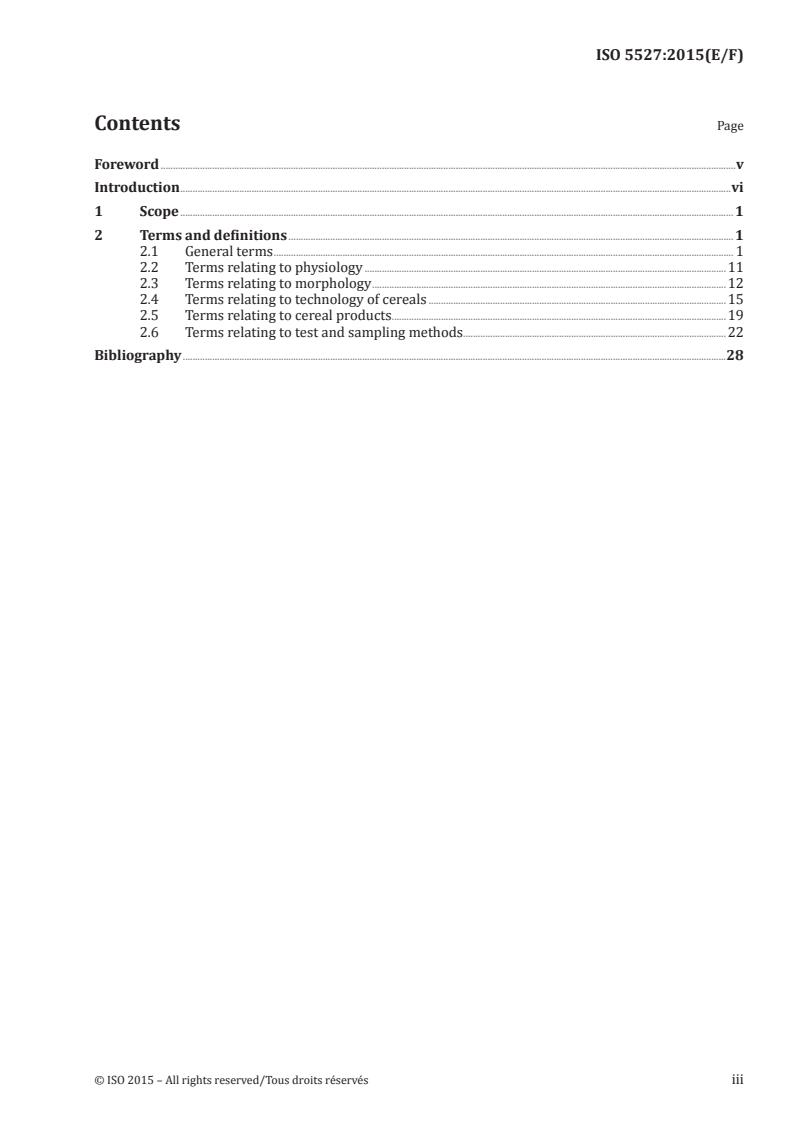
Contents Page
Foreword .v
Introduction .vi
1 Scope . 1
2 Terms and definitions . 1
2.1 General terms . 1
2.2 Terms relating to physiology .11
2.3 Terms relating to morphology .12
2.4 Terms relating to technology of cereals .15
2.5 Terms relating to cereal products .19
2.6 Terms relating to test and sampling methods.22
Bibliography .28
Foreword
ISO (the International Organization for Standardization) is a worldwide federation of national standards
bodies (ISO member bodies). The work of preparing International Standards is normally carried out
through ISO technical committees. Each member body interested in a subject for which a technical
committee has been established has the right to be represented on that committee. International
organizations, governmental and non-governmental, in liaison with ISO, also take part in the work.
ISO collaborates closely with the International Electrotechnical Commission (IEC) on all matters of
electrotechnical standardization.
The procedures used to develop this document and those intended for its further maintenance are
described in the ISO/IEC Directives, Part 1. In particular the different approval criteria needed for the
different types of ISO documents should be noted. This document was drafted in accordance with the
editorial rules of the ISO/IEC Directives, Part 2, www.iso.org/directives.
Attention is drawn to the possibility that some of the elements of this document may be the subject of
patent rights. ISO shall not be held responsible for identifying any or all such patent rights. Details of any
patent rights identified during the development of the document will be in the Introduction and/or on
the ISO list of patent declarations received, www.iso.org/patents.
Any trade name used in this document is information given for the convenience of users and does not
constitute an endorsement.
The committee responsible for this document is ISO/TC 34, Food Products, Subcommittee SC 4, Cereals
and pulses.
This third edition cancels and replaces the second edition (ISO 5527:1995), which has been technically
revised.
iv © ISO 2015 – All rights reserved/Tous droits réservés
Introduction
In this edition of ISO 5527, the terms and definitions have been stored in the Online Browsing Platform
(OBP) (http://www.iso.org/obp), where they can be browsed free of charge by members of the public
(but not downloaded) in the following languages: English, French, German and Spanish.
The PDF version of ISO 5527 also contains the terms and definitions in Chinese.
INTERNATIONAL STANDARD ISO 5527:2015(E/F)
Cereals — Vocabulary
1 Scope
This International Standard defines terms relating to cereals.
NOTE 1 In addition to terms used in English and French, two of the three official ISO languages, this document
gives the equivalent terms in Spanish, German and Chinese; these are published under the responsibility of the
member bodies for Argentina (IRAM), Germany (DIN) and China (SAC) and are given for information only. Only
the terms and definitions given in the official languages can be considered as ISO terms and definitions.
The terms are given under the following subheadings:
2.1 General terms
2.2 Terms relating to physiology
2.3 Terms relating to morphology
2.4 Terms relating to technology of cereals
2.5 Terms relating to cereal products
2.6 Terms relating to test and sampling methods
[6]
NOTE 2 See ISO 5526 for a list of principal cereal species with their botanic names and common names.
2 Terms and definitions
2.1 General terms
2.1.1
blight
fungus disease of cereals
2.1.2
bread-making cereals
cereals that are suitable for making bread and other products
EXAMPLE Wheat, rye, triticale.
2.1.3
bulk store
large store in which grain is stored unpackaged in large quantities
2.1.4
bunted grain
grains filled with a fetid smelling dust comprising the spores of bunts
2.1.5
cereals
grains of plants, usually cultivated, belonging to the Poaceae family
[6]
Note 1 to entry: A list of these plants is given in ISO 5526.
2.1.6
consignment
physical quantity of grain on offer, dispatched or received at one time, and covered by a particular
contract or shipping document
Note 1 to entry: A consignment may be composed of one or more lots.
2.1.7
cultivar
variety
unique and uniform member of a species of plant (except for hybrid species) that retains its characteristics
from generation to generation through its natural mode of reproduction
2.1.8
damaged grain
whole kernel which is distinctly discoloured or damaged by water, insects, heat or any other causes
2.1.9
ear cockle
nematode seed gall having a blackish brown colouration and containing a mass of small dried-up
nematode worms of the species Anguina tritici, which become active when immersed in water
Note 1 to entry: This term does not apply to batches of grain containing seeds of corn or purple cockle (Lychnis
githago Scop. or Agrostemma githago L.).
2.1.10
ergot
sclerotium of the fungus Claviceps purpurea which may infect wheat but mostly rye
Note 1 to entry: Sclerotia develop in the ear instead of a seed. Sclerotia contain more than 40 poisonous ergot
alcaloids.
2.1.11
extraneous matter
fraction consisting of inorganic extraneous matter and organic extraneous matter
2.1.12
foreign grain
seeds, other than cereals, present in the sample or in the lot under consideration
2.1.13
fracture
surface presented by the endosperm of a broken grain, which can be either mealy, semi-vitreous or
vitreous in appearance
2.1.14
fusarium-contaminated grain
grain of which the pericarp is contaminated by mycelia of Fusarium spp
Note 1 to entry: Such grain has a slightly scalded, shrivelled appearance and shows diffuse spots, with badly
delimitated contours, of pink and/or white colouration.
2.1.15
grains attacked by pests
grains which show damage owing to attack by rodents, insects, mites or other pests
2.1.16
harmful seed
toxic seed
seeds which, if present in quantities above a certain limit, may have a toxic, harmful, damaging or
dangerous effect on health, organoleptic properties or technological performance
2 © ISO 2015 – All rights reserved/Tous droits réservés
2.1.17
heat damaged grain
resulting from the effect of heat, grain with a chestnut to black colouration, and of which a section of the
endosperm is yellowish-grey or brownish black
2.1.18
hidden infestation
those insects which are present within individual grains because either they are at juvenile stages and
have developed from eggs laid inside the grains or they have entered the interior of individual grains
through cracks or other damage, usually to feed
Note 1 to entry: Hidden infestation is not normally apparent upon first examination of the sample.
2.1.19
impurities
damaged grains and all organic and inorganic materials other than cereals grains
Note 1 to entry: The impurities comprise four main categories as follows: damaged grains; other cereals;
extraneous matter; harmful and/or toxic seeds, bunted grains and ergot.
2.1.20
impurity of animal origin
matter of animal origin (eggs, larvae, nymphs or adults of insects and their fragments, rodent hairs and
their fragments, mites and their fragments) separated from the product under specified conditions
2.1.21
infestation
pest species
live insect and mite species which, during some stage(s) of their life cycle, are capable of causing damage
to the grain
2.1.22
initial observed infestation
those free-living insects that are immediately apparent to the eye when the sample is first examined
2.1.23
mealy fracture
fracture surface of endosperm that is completely loose in texture and starchy in appearance
2.1.24
moth
species of the order Lepidoptera (Heterocera), which are less brightly coloured than butterflies and fly
mainly at night
Note 1 to entry: Butterflies (Rhophalocera) and moths (Heterocera) belong to the same order Lepidoptera, but
butterflies are not encountered in grain storage.
2.1.25
mouldy grains
grains with moulds visible to the naked eye on 50 % of the surface and/or inside the kernel
2.1.26
packed unit
quantity of grain or milled product packed in a bag or a retail pack
2.1.27
pericarp damage
primary type of damage that causes kernel to be non-whole, consisting of cracks, cuts, abrasions, and
chips or pieces of missing endosperm
2.1.28
bran
milling fraction obtained from removal of outer layer of cereals
2.1.29
seed grain
grain intended for sowing
2.1.30
semi-vitreous fracture
fracture surface of endosperm that is partly mealy and partly vitreous in appearance
2.1.31
shrivelled grain
shrunken grains
grains which are poorly filled, light and thin, whose build-up of reserves has been halted due to
physiological or pathological factors
2.1.32
small grains
sound grains of small size which pass through a sieve of a particular aperture size
2.1.33
spring cereals
varieties (cultivars) of cereals which are planted in the spring and which flower in the same spring
2.1.34
sprouted grain
grains in which the radicle or plumule is clearly visible to the naked eye
Note 1 to entry: Sprouted grains of cereals (soft wheat, durum wheat, rye and triticale) are not always taken into
account as such, but according to the α-amylase activity which results from their presence and which is expressed
as the falling number.
2.1.35
stress crack
tiny fissure inside a kernel starting near the centre and extending outward through the vitreous
endosperm but which does not extend all the way outward to the pericarp
2.1.36
total damaged kernels
kernels and pieces of grain kernels that are badly ground damaged, weather damaged, damaged by
fungi, insect bored, frost damaged, germ damaged, sprout damaged, or otherwise materially damaged
2.1.37
vitreous fracture
fracture surface of endosperm that is completely compact and translucent in appearance
2.1.38
vitreous grain
whole sound grain having a natural translucent appearance
Note 1 to entry: These are not considered to be impurities.
2.1.39
waxy cereals
cereal with starch composed almost entirely of amylopectine
4 © ISO 2015 – All rights reserved/Tous droits réservés
2.1.40
weevily grain
grain attacked by grain weevil (Sytophilus granarius)
Note 1 to entry: The weevil lays eggs in stored grain, the larvae feed inside the grain.
2.1.41
winter cereals
varieties (cultivars) of cereals which are planted in the autumn and which flower in the next spring
Note 1 to entry: Flowering occurs only if plants are subjected to certain natural and artificial conditions of
vernalization usually involving cold treatment, which occurs naturally if planted before winter frost.
2.1.42
barley
fruit of the cereal crop Hordeum vulgare belonging to the Poaceae family
2.1.42.1
feed barley
barley whose grains are used for feeding animals
2.1.42.2
highland barley
hulless barley
naked barley
mutant caryopsis of cultivated barley belonging to the Poaceae family which easily separates from the
glume
2.1.42.3
malting barley
barley having certain characteristics (physical, chemical, germinative and others) which enable it to be
converted to malt
2.1.43
foxtail millet
millet in husk
caryopsis of cultivated cereal crop that belongs to the Poaceae family
Note 1 to entry: The husk of the caryopsis can be red, orange, yellow, white, purple or black in colour; its fruit is
oval, yellow in colour, and may be non-glutinous or glutinous.
2.1.44
corn
maize
fruit cereal crop, usually cultivated, belonging to the Poaceae family, often tooth-shaped, triangular and
almost rounded, usually yellow or white in colour
2.1.44.1
baby corn
form of corn for human consumption whose young ears are harvested when silks become visible
2.1.44.2
dent corn
form of corn whose mature kernel has the shape of a horse’s tooth with a depression in the crown
2.1.44.3
field corn
corn whose mature grains — the common commodity corn, mostly flint and dent types — are mainly
used for animal feed either directly or as part of a pre-processed feed
2.1.44.4
flint corn
form of corn whose mature kernel has a smooth, vitreuos, appearance and a rather round shape
2.1.44.5
flour corn
kind of corn whose kernels are composed largely of soft starch instead of vitreous starch
2.1.44.6
genetically modified corn
GMO
maize obtained by using recombinant DNA technology, able to transfer specific genes from one organism
(e.g. animals, plants, microorganisms) to another, in order to give it one or several new characteristics
2.1.44.7
maize hardness
amount of vitreous endosperm in the kernel relative to the amount of floury endosperm present in the
maize kernel
2.1.44.8
pop corn
form of corn whose mature kernels have the ability to pop during rapid cooking because of the build-up
of internal pressure during rapid heating
2.1.44.9
sweet corn
form of corn whose kernels have so much sugar and so little starch that they are wrinkled and translucent
when dried
2.1.44.10
waxy corn
glutinous corn
type of corn which contains less than 5 % mass fraction amylose on dry matter, the rest being amylopectin
2.1.45
rice
fruits of Oryza sativa or Oryza glaberrima, of the family Poaceae
2.1.45.1
abdominal white rice
white belly
head rice with the opaque portion at the ventral surface or the same side of the embryo
2.1.45.2
aromatic rice
fragrant rice
scented rice
rice varieties containing a natural aromatic odour different to other rice varieties which especially
appears after cooking
2.1.45.3
brown rice
cargo rice
hulled rice
husked rice
loonzain rice
paddy from which the husk only has been removed
Note 1 to entry: The processes of husking and handling may result in some loss of bran.
Note 2 to entry: For convenience and classification purposes, this entry is identical to that of 2.5.3.1.
6 © ISO 2015 – All rights reserved/Tous droits réservés
2.1.45.4
chalky kernel
head rice (except waxy rice) whose whole surface has an opaque and floury appearance
2.1.45.5
chip
[5]
part of kernel which passes through a test sieve complying with ISO 5223, and having round apertures
of diameter 1,4 mm
2.1.45.6
damaged kernel
head rice showing evident deterioration due to moisture, pests, disease or other causes.
2.1.45.7
extra well-milled rice
husked rice obtained by milling in such a way that all of the husk and almost all of the embryo have been
removed
2.1.45.8
genetically modified rice
rice obtained by using recombinant DNA technology, able to transfer specific genes from one organism
(e.g. animals, plants, microorganisms) to another, in order to give it one or several new characteristics
2.1.45.9
glutinous rice
waxy rice
type of rice whose kernels have a white and opaque appearance
Note 1 to entry: The starch of waxy rice consists almost entirely of amylopectin. After cooking, the kernels tend
to stick together.
2.1.45.10
grain chalkiness
head rice whose a part of the endosperm is not translucent (except waxy rice)
2.1.45.11
head rice
whole kernel or portion of kernel with a length greater than or equal to three-quarters of the average
length of the test sample kernels
2.1.45.12
hull
husk
envelope, flowering glumes and glumes, which encloses the whole kernel
2.1.45.13
immature rice kernel
head rice which is unripe and badly developed
2.1.45.14
large broken kernel
part of kernel with a length less than three-quarters but greater than one-half of the average length of
the test sample kernels
2.1.45.15
long-grain glutinous rice
fruits of long-grain and glutinous paddy rice, which generally is oval or long and thin in shape and whose
kernels have a white and opaque appearance
Note 1 to entry: The starch of waxy rice consists almost entirely of amylopectin. The kernels have a tendency to
stick together after cooking.
2.1.45.16
long-grain non-glutinous rice
fruit of non-glutinous paddy rice, generally is oval or long and thin in shape, and has relative low
stickiness and high expansibility
2.1.45.17
medium broken kernel
part of kernel with a length less than or equal to one-half but greater than one-quarter of the average
length of the test sample kernels
2.1.45.18
medium to short-grain non-glutinous rice
fruit of medium to short-grain non-glutinous paddy rice, which kernel generally is oval or round type in
shape
2.1.45.19
milled rice
white rice
husked rice from which almost all of the bran and embryo have been removed by milling
2.1.45.20
non-glutinous rice
non-waxy rice
type of rice having a translucent endosperm whose starch contains amylopectin and amylose
Note 1 to entry: The more amylose non-glutinous rice contains, the more sticky it is after cooking.
2.1.45.21
paddy rice
rough rice
fruits of cultivated paddy rice, including its husk and caryopsis, as harvested
2.1.45.22
parboiled rice
husked or milled rice processed from paddy or husked rice that has been soaked in water and subjected
to a heat treatment so that the starch is fully gelatinized followed by a drying process
2.1.45.23
partly gelatinized kernel
parboiled rice which is not fully gelatinized and shows an endosperm white and opaque areas
2.1.45.24
peck
pecky kernel
head rice or broken kernel of parboiled rice of which more than one quarter of the surface is dark
brown or black in colour due to the parboiling process or rice which has brown/black colouration due
to bacterial or fungal diseases
2.1.45.25
red kernel
head rice having red bran
2.1.45.26
red streaked rice
head rice or broken kernel rice with red streaks of length greater than or equal to half of the kernel
length
8 © ISO 2015 – All rights reserved/Tous droits réservés
2.1.45.27
short-grain glutinous rice
fruits of short-grain and glutinous paddy, which generally is oval in shape, varieties of rice whose kernels
have a white and opaque appearance
Note 1 to entry: The starch of waxy rice consists almost entirely of amylopectin. The kernels have a tendency to
stick together after cooking.
2.1.45.28
small broken kernel
part of kernel with a length less than a quarter of the average length of the test sample kernels
2.45.29
well milled rice
husked rice with most of the husk and the embryo removed by milling
2.1.45.30
white back rice
husked rice whose dorsal surface located on the opposite side of the embryo is partially chalky
2.1.45.31
white core rice
husked rice partially chalky at the centre part of the endosperm
2.1.45.32
whole kernels
grains without any broken part or piece of grains having a length greater than or equal to nine-tenths of
the average length of test sample kernels
Note 1 to entry: Average length: arithmetic mean of the test sample kernels that are not immature or malformed
and without any broken parts.
2.1.46
wheat
straw cereal crop sown in winter or spring
Note 1 to entry: The mature plant is characterized by a spike and grain is a naked caryopsis more or less red or
white and ovoid.
2.1.46.1
alternative wheat
late autumn wheat, en GB
winter wheat, en GB
wheat sown equally well during the autumn or winter
2.1.46.2
blending wheat
wheat with special characteristics, mixed in small quantities to others to produce flour better suited for
its intended purpose
2.1.46.3
bread wheat
bread-making wheat
common wheat which has the appropriate physical, chemical, rheological and other properties for a
bread product (such as leavened bread)
2.1.46.4
wheat broken grains
grains in which part of the endosperm is exposed, or grains without germ
2.1.46.5
durum wheat shrivelled grains
shrivelled (shrunken), light, thin whole grains, in which accumulation of nutritive elements is finished
owing to physiological and pathological influences, and which pass through a specific sieve for each
species of grain
2.1.46.6
feed wheat
wheat whose grains are used for feeding animals
2.1.46.7
genetically modified wheat
wheat obtained by using recombinant DNA technology, able to transfer specific genes from one organism
(e.g. animals, plants, microorganisms) to another, in order to give it one or several new characteristics
2.1.46.8
hard wheat
wheat with kernels having a high hardness criterion
2.1.46.9
medium hard wheat
wheat with medium gluten content, and a medium hard texture
2.1.46.10
mottled grains
sick grains
sick wheats
grains which show, at places other than on the germ itself, colourations between brown and brownish-
black, including in the crease
Note 1 to entry: Sick wheat is not considered to be an impurity except for durum wheat.
2.1.46.11
non-wholly-vitreous grain
partly vitreous grain
grain which is partially vitreous
Note 1 to entry: This expression is used to indicate a defect affecting durum wheat.
2.1.46.12
smutty grains
grains coloured on the outside by the presence of spores of smuts (Ustilago spp.)
Note 1 to entry: Smutty grains should not be confused with grains simply soiled with earth or dust. This distinction
can only be made by microscope.
Note 2 to entry: Spores are often clustered in the hairs of wheat brush.
2.1.46.13
bunted grains
grains coloured on the outside by the presence of brown-black spores of bunt (Tilletia spp.)
Note 1 to entry: Both Tilletia foetida and Tilletia caries can cause common (stinking) bunt, which is sometimes
characterized by a fishy odour.
Note 2 to entry: Spores are often clustered in the brush hairs of wheat.
2.1.46.14
soft wheat
wheat with low gluten content, and a soft, floury endosperm ratio of not less than 70 % mass fraction; in
general, it is suitable for cake, biscuit, and low-volume breads
10 © ISO 2015 – All rights reserved/Tous droits réservés
2.2 Terms relating to physiology
2.2.1
dormancy
natural state of suspended growth and metabolism of a viable seed which does not germinate when
placed under normal or optimal conditions of light, temperature and moisture
2.2.2
enzyme
biocatalyst and protein substance produced by living cells which catalyses a biochemical reaction in
living organism
2.2.3
germ
shoot
sprout
resulting plantule when a dormant seed undergoes the process of germination
Note 1 to entry: The radicle and the plumule are visible at this stage.
Note 2 to entry: See also 2.3.1.17.
2.2.4
germination
physiological activity which precedes plant growth
Note 1 to entry: All the events which occur when the seed passes from dormancy to active growth of a new
plantlet.
Note 2 to entry: The visible end result of this activity, the protrusion of the radicle and plumule, is referred to as
“sprouting”.
Note 3 to entry: The terms “germination” and “sprouting” are not synonyms.
2.2.5
germinative capacity
ability of a grain to germinate, or number of grains that can potentially germinate (e.g. once the seed has
move out of dormancy), under experimentally defined conditions which do not include any limitation of
duration of germination
Note 1 to entry: Germinative capacity is expressed as the percentage of grains germinating.
2.2.6
germinative force
germinative energy
ability of a grain to germinate, or number of grains that do germinate, under experimentally defined
conditions at a given time
Note 1 to entry: Germinative force is expressed as the percentage of grains germinating at a given time.
2.2.7
grain brightness
“lustrous” external appearance of grain which has not been discoloured or damaged by adverse weather
conditions, by pests or by unsuitable conditions of storage
2.2.8
maturity
state of a grain when physiologically fully developed and stable after the maturation period
2.2.9
physiological maturity
stage when a cereal kernel has maximum accumulation of dry mass, i.e. when a black layer becomes
visible at the base of the kernel
Note 1 to entry: This matter is not visible for all maize kernels. It is generally absent for other straw cereals.
2.2.10
respiration
oxidative process occurring within living cells by which the chemical energy of organic molecules is
released in a series of metabolic steps involving the consumption of oxygen and the liberation of carbon
dioxide and water
2.3 Terms relating to morphology
2.3.1 General terms
2.3.1.1
aleurone grains
protein bodies
granules present in the cells of the aleurone layer, composed principally of globulin-type proteins, and
containing phytin and mineral constituents
2.3.1.2
aleurone layer
proteinaceous layer
outermost, highly differentiated, proteinaceous layer(s) of the endosperm
2.3.1.3
amylopectin
polysaccharide constituent of starch, the macromolecules of which have glucose units linked in a
branched structure
2.3.1.4
amylose
polysaccharide constituent of starch, the macromolecules of which have glucose units linked in a
predominantly linear structure
2.3.1.5
awn
bristle-like extension of the glume or lemma of certain cereals
2.3.1.6
beard
brush
brush of grain
tuft of very short hairs at the non-germ end of the caryopsis of certain cereals
2.3.1.7
birefringence
maltose cross
characteristic of cereal starch observed through a microscope under polarized light
2.3.1.8
cotyledon
first leaf of the embryo as a seed sprouts
12 © ISO 2015 – All rights reserved/Tous droits réservés
2.3.1.9
crease
longitudinal depression of variable depth and width or ventral furrow, situated on the ventral side (the
side opposite the embryo of the grain) of certain cereal grains
Note 1 to entry: It is absent in the case of many cereals, but in wheat it may reach two-thirds of the thickness of
the grain.
2.3.1.10
cross cells
cross-cell layer
outer of the two cellular layers which together comprise the endocarp, the longer side of which is
perpendicular to the main axis of the grain
2.3.1.11
cuticle
pellicule covering the epidermis
2.3.1.12
embryo
living organism, which develops from a seed
2.3.1.13
endosperm
tissue containing reserve substances in cereal grains
Note 1 to entry: “Endosperm” is a botanical term, the technological term “kernel” is close to “endosperm”, but not
synonymous, and it means that part of the starchy grain obtained after removing the envelopes.
2.3.1.14
epicarp
exocarp, the outer layer of skin on a seed
2.3.1.15
epidermis
outermost cellular layer, generally covered by a cuticle
2.3.1.16
flowering glume
part of the plant comprising the lemma and the palea which wraps directly every flower of Poaceae
Note 1 to entry: Lemma is the lower of the two bracts enclosing the flower of Poaceae. Palea is the upper of the two
bracts enclosing the flower of Poaceae.
2.3.1.17
germ
that part of the grain which develops into a young plant
Note 1 to entry: The embryo and the scutellum are parts of the germ.
Note 2 to entry: See also 2.2.3.
2.3.1.18
glume
bract which covers and protects a spikelet
2.3.1.19
hull
pericarp
thin covering which encloses the whole kernel, glume, and grain husks
2.3.1.20
husk
leaf-like sheaths which enclose the ear
2.3.1.21
hyaline layer
refractive zone between the testa and the aleurone layer
2.3.1.22
lemma
lower glume of the Poaceae flower
Note 1 to entry: The lower of the two bracts enclosing the flower in the spikelet of grasses.
2.3.1.23
longitudinal cells
epidermal cells having their longer sides parallel to the main axis of the grain
2.3.1.24
palea
upper bract that with the lemma encloses the flower in the spikelet of grasses
2.3.1.25
pigment
any colouring matter in the cells and tissues of plants
2.3.1.26
scutellum
complex tissue in the shape of a shield which separates the embryo from the endosperm
2.3.1.27
seed-coat
testa
true seed-coat layer(s) of the caryopsis, fused between the pericarp and the nucellar epidermis (hyaline
layer)
Note 1 to entry: The seed coat is cuticularized and may contain a pigmented layer.
2.3.1.28
spike
pistillate or female inflorescence originated from the axillary bud apices
2.3.1.29
straw
dry stems and leaves of cereal crop, left after the grains have been removed by threshing, usually used
as low quality feed-component
2.3.1.30
tassel
branched staminate or male inflorescence arises from the shoot apical meristem and located at the tip
of the main stem
2.3.2 Terms specific to corn
2.3.2.1
black layer
hilar layer
layer of dense cells situated at the tip cap of the corn kernel on its cob which is laid down by the mature
kernel and appear as a dark brown spot
14 © ISO 2015 – All rights reserved/Tous droits réservés
2.3.2.2
cob
term indicating the organ formed by an axis carrying the grains of corn
2.3.2.3
silk
elongated style originated from ovary and protruded over the tip of a young ear corn at anthesis
2.4 Terms relating to technology of cereals
2.4.1 General terms
2.4.1.1
aeration of grain
operation consisting of introducing air into a mass of grain using a flow rate which is adequate to achieve
or maintain levels of temperature and humidity required for satisfactory storage
2.4.1.2
bin
compartment of a silo, large container or an enclosed space intended for storing grain in bulk
2.4.1.3
bolting
sieving
sifting
separation of particles according to their size, by means of a sieve having apertures of known size
Note 1 to entry: The term “bolting” was formerly used predominantly to describe the separation of flour from the
products of grinding, and is still used in the United Kingdom and in France.
2.4.1.4
dockage
waste material which is removed from grains as it is being processed before milling
2.4.1.5
gelatinization
loss of the native crystalline organization of a starch granule when it is heated above a particular
temperature in an aqueous medium
2.4.1.6
grading
operation consisting of identifying then separating batches of cereals according to their appearance and
physical condition or according to one of their special (chemical, technological) characteristics
2.4.1.7
grain drying
operation which consists of reducing the moisture content of a mass of grain by various processes (hot-
air drying, ventilation, dehumidification, etc.)
2.4.1.8
grain silo
individual storage unit consisting of one or more bins with an installation for handling grain
2.4.1.9
lot
identified quantity of material from which a sample can be taken and analysed to determine one (or
several) characteristic(s)
2.4.1.10
pearling
process of removing husk or outer seed coat by abrasion
2.4.1.11
plansifter
sifting machine consisting of a number of superimposed sieves gyrating together in a horizontal plane,
for sustained grading of all milling product
2.4.1.12
preliminary cleaning
pre-cleaning
brief cleaning before storage, during which coarse impurities and dust are removed by dry mechanical
methods (sifting and ventilation)
2.4.1.13
retrogradation
crystallization of gelatinized starch and water mixture during cooling
2.4.1.14
screenings
losses on cleaning, composed mainly of small-sized and broken grains
2.4.1.15
sieve
device for the purpose of sieving, consisting of a medium mounted in a frame
[4]
Note 1 to entry: For test sieves, see ISO 2395.
2.4.1.16
sieve-cleaning brush
self-propelling brush underneath the sieve of a plansifter and of a purifier which frees the sieve apertures
of obstructing particles
2.4.1.17
spontaneous heating
abnormal rise in temperature produced naturally in a grain mass as a result of bad storage conditions
2.4.2 Terms specific to wheat
2.4.2.1
bran
outer layers or seed coat of the wheat grain
Note 1 to entry: This term can also be used for rice.
2.4.2.2
bran brush
bran duster
bran finisher
machine for removing particles of endosperm, not detached by the breaking process, from the bran
coats
2.4.2.3
break flour
flour produced by the break rolls as the grain passes through the break system of the milling process
2.4.2.4
break middling
mixture of particles of pure endosperm and endosperm with adhering bran (composite particles
produced by break rolls as the grain passes through the break system of the milling process)
16 © ISO 2015 – All rights reserved/Tous droits réservés
2.4.2.5
break system
stage in the milling process where the grain is broken open and treated on successive rolls to separate
the endosperm from the bran coat
2.4.2.6
breaking
fragmentation, principally by shearing by means of fluted rollers, during the first part of the milling
process
2.4.2.7
brushing
operation of mechanically cleaning a surface (of grain, grain covering or sieve) by means of a brush
2.4.2.8
centrifugal
reel
bolting device with a cylindrical or prismatic rotor covered with a sieving cloth of known aperture size
2.4.2.9
flour enrichment
further addition of a substance that is already present in the flour but not in sufficient amounts to meet
the nutritional requirements, usually refers to vitamins, minerals or amino acids
2.4.2.10
flour yield
amount of flour obtained by a particular mill and milling method
Note 1 to entry: Flour yield is expressed as a percentage.
2.4.2.11
germinal brush
grain brush
machine used principally at the end of cleaning to remove impurities adhering to the surface of grain
2.4.2.12
grain separator
wheat cleaning machine that removes both larger and finer foreign material
2.4.2.13
granulation
coarseness or fineness of the flour
Note 1 to entry: In baking, pasta or biscuit technology, the particle size and size distribution pertain to the flour
end-use value.
2.4.2.14
gravity table
wheat cleaning machine that removes foreign material of similar size and shape as the wheat on the base
of density
2.4.2.15
grinding mill
device used to carry out fragmenting operations
Note 1 to entry: The grinding mills most commonly used in flour milling are roller mills, although hammer mills,
pin mills, etc., are also used.
2.4.2.16
middlings
particles of the outer layers or seed coat of the wheat grain, extracted from the bread flour system which
have yet to be ground into flour
2.4.2.17
milling
process to remove the hull and parts or all of the bran from cereals; grinding grain into flour
2.4.2.18
milling yield
amount of utilizable milled products produced in the course of milling
2.4.2.19
reduction system
section of the wheat milling process that grinds purified granular endosperm particles into flour by
utilizing a succession of grinding and sifting passages
2.4.2.20
roller mill
machine generally comprising two pairs of rollers arranged symmetrically, used for grinding cereals
and reducing them to flour and milling by-products
Note 1 to entry: Each pair of rollers is independent, and the surfaces of the rollers can be either fluted to separate
the endosperm from the bran (breaking), or smooth to reduce the endosperm fragments to flour (reduction).
2.4.2.21
second clear
part of flour obtained at the end of the milling process mainly composed of protein layer and little pieces
of bran and germ and flour
2.4.2.22
semolina
product milled, usually from durum wheat, to coarse but uniform granulation, to make pasta products
2.4.2.23
shorts
mixture of small pieces of bran and fibrous material remaining after the flour has been extracted from
the wheat
2.4.2.24
sizing
section of the wheat milling process that removes small parts of bran and germ attached to endosperm
particles; this is achieved by light grinding, sifting, and purification
2.4.2.25
tail end
final stages of the milling process where the last particles of flour are extracted
2.4.2.26
yellow pigment content
essential quality factor of raw materials for the production of pasta, defined as the content of extractable
carotenoids of the endosperm
Note 1 to entry: Yellow pigment content is expressed as milligrams of β-carotene per 100 g of dry matter.
2.4.3 Terms relating specifically to rice
2.4.3.1
coefficient of water absorption
ratio of the mass of rice after cooking to the mass of the same rice before cooking
2.4.3.2
dehusk
removing the husk from seeds
18 © ISO 2015 – All rights reserved/Tous droits réservés
2.4.3.3
elastic recovery
tendency of grain of cooked rice to return to its initial form, once the stress to which it has been subjected
is released
Note 1 to entry: Elastic recovery is expressed as a percentage.
2.4.3.4
firmness
resistance to extrusion of cooked rice
2.4.3.5
gelatinization
hydration process conferring the jelly-like state typical of the coagulated colloids, which are named
“gels”, on kernels
2.4.3.6
gelatinization temperature
temperature at which about 90 % of the starch granules have swelled irreversibly
2.4.3.7
gelatinization time
time necessary for 90 % of the kernels to pass from their natural state to the gel state
2.4.3.8
milling
removing almost all of the bran and embryo from husked rice using a machine
2.4.3.9
paddy table
grain cleaning machine that removes foreign material that has different density
2.4.3.10
swelling
thickness of grains of rice after cooking
Note 1 to entry: Swelling is expressed in millimetres.
Note 2 to entry: Swelling is the increase in volume of the rice during cooking. It can be measured as the increase
in thickness of the grain by determining the thickness of the rice before and after cooking. Measurements of
thickness after various cooking times give a curve indicating the course of swelling.
2.5 Terms relating to cereal products
2.5.1 General terms
2.5.1.1
bakery
place where the manufacture of baked products (including bread) is carried out and where such products
may be sold
2.5.1.2
composite flour
flour made by blending wheat flour with other cereals flour (varying amounts)
2.5.1.3
dry gluten
residue obtained from wet gluten dried according to specified conditions
2.5.1.4
flour
finely milled wheat endosperm with a particle size of less than 250 µm
2.5.1.5
flour improver
substance added to flour to facilitate the manufacture of specific baked products
2.5.1.6
gluten
visco-elastic proteinaceous material formed when flour and water are mixed into a dough, and which
may be isolated by washing which eliminates the starchy endosperm particles and cell walls as well as
the soluble proteins
Note 1 to entry: In some countries, the term “gluten” stands for “wheat gluten” and glutens from other cereals are
called maize gluten, rice gluten, etc.
2.5.1.7
ready-to-eat cereals
flaked, puffed, shredded, crushed, or granular products made from wheat, maize or rice, although oats
and barley are also used; may be enriched with vitamins, minerals, sugar, syrup, honey, etc.
2.5.1.8
softening of gluten
weakening of gluten
reduction in the firmness of gluten
2.5.1.9
wet gluten
visco-elastic substance, composed principally of two protein fractions (gliadin and glutenin) in a
hydrated form
2.5.2 Terms relating specifically to wheat
2.5.2.1
bleaching of flour
destruction of flour pigments by the addition of substances having a specific oxidizing action
2.5.2.2
bulgur
food product resulting from a three-stage treatment of wheat (mainly Triticum durum) consisting of a
pre-cooking stage followed by drying and coarse crushing and, finally, partial decortication
2.5.2.3
wheat flour
main final product of wheat milling cleared of the husk and of the germ
2.5.2.4
wholemeal
whole grain flour (whole grain grist) for example made of wheat, from which nothing has been removed
(gran, seed) and nothing has been added and which, therefore, includes nearly all or all components of
the wheat in its natural proportions
20 © ISO 2015 – All rights reserved/Tous droits réservés
2.5.3 Terms relating specifically to rice
2.5.3.1
brown
...