

ISO 24037:2026
(Main)Ships and marine technology — Requirements and guidance for training, qualification and competency of submersible system crew and other key personnel
- Abstract
This document provides requirements and guidance on common competence requirements and qualifications for crewed submersible operations to enable operators to develop their own competence schemes. It is applicable to any crewed submersible system (CSS) or craft. Conventional and nuclear powered naval submarines, and diving bells are not addressed in this document.
- Status
- Published
- Publication Date
- 24-Jun-2026
- Technical Committee
- ISO/TC 8/SC 13 - Marine technology
- Drafting Committee
- ISO/TC 8/SC 13 - Marine technology
- Current Stage
- 6060 - International Standard published
- Start Date
- 25-Jun-2026
- Due Date
- 16-Nov-2026
- Completion Date
- 25-Jun-2026

ISO 24037:2026 is an International Standard from ISO for the training, qualification and competency of crewed submersible system (CSS) crew and other key personnel. It gives common requirements and guidance for crewed submersible operations so operators can build their own competence schemes for pilots, maintenance staff, passenger safety, operations and training roles. The standard applies to any CSS or craft, but not to conventional and nuclear powered naval submarines or diving bells.
What does ISO 24037:2026 specify?
ISO 24037:2026 specifies the competence basis for crewed submersible operations and the way operators can structure training, assessment and qualification around it. It is organized as scope, terms and definitions, training/qualification/certification, key roles, a system for training management, general IMO provisions, competence frameworks, and an operational organization structure.
It matters in practice because CSS companies often combine several functions in small teams, so the document gives a common framework for assigning responsibilities and proving that people are ready for safety-critical tasks.
| Annex | What it covers |
|---|---|
| Annex A | CSS competence frameworks for the main roles, including pilot, maintenance manager and technician, passenger safety officer, operations manager, LARS supervisor and operator, designated person ashore, training manager and trainer, and HSEP manager |
| Annex B | An example CSS organizational structure showing key positions, hierarchy, direction, control and coordination |
What are the key requirements of ISO 24037:2026?
ISO 24037:2026 treats competence as a managed process: define the task, train for it, assess it, certify it, and keep it current. The standard is built for operators who need a repeatable way to show that crew and shore-based personnel can operate a CSS safely in normal and emergency conditions.
Training, qualification and certification
- Clause 4 places responsibility for training with the CSS company and describes a pathway from training to testing, examination and certification of competence. In practice, this means the company must not leave competence to chance - it needs a documented way to show who is trained, qualified and current.
- Clause 4 also links competence to ongoing development, performance appraisal and record keeping. That matters because competence can fade if people are not active in role, so the operator needs records that show experience, training and reassessment.
- Clause 4 notes that simulator training and other modern training aids can support learning, including virtual reality training aids where suitable. In practice, the quality of the simulation matters, so the operator should use training tools that match the real system closely enough to be meaningful.
Role-based competence
- Clause 5 defines the key roles that need competence control: pilots, engineering and maintenance manager, maintenance technician, passenger safety officer (PSO), operations manager, launch and recovery system supervisor and operator, designated person ashore (DPA), training manager and trainer, and health, safety and environmental protection (HSEP) manager. This matters because an operator can map real duties to named people instead of using a generic job list.
- Clause 5.2 makes the pilot responsible for safe operation of the vehicle, including navigation, propulsion, buoyancy, communications and launch and recovery-related functions where fitted. A pilot must know standard and emergency procedures and be trained within the vessel’s safe operating envelope, so the operator must train to the actual craft and its modes of operation.
- Clause 5.3 and 5.4 require maintenance leadership and technical staff who can keep the CSS in a safe-to-operate condition and work to the manufacturer’s specifications. In practice, this turns maintenance into a competence-managed function, not just a repair activity.
- Clause 5.5 assigns passenger protection and life support awareness to the PSO, or to the rescue chamber operator (RCO) in rescue submersibles. This means someone other than the pilot must be ready to brief passengers and manage emergency safety inside the occupied compartment.
- Clause 5.6 to 5.10 cover the operational chain, launch and recovery, shore control, training delivery and HSEP support. These clauses matter because they show that safe CSS operation depends on the crew, the shore side and the training system working together.
System for training management
- Clause 6 sets out the system for training management (STM) as four connected stages: analysis, design, delivery and assurance. This gives operators a practical structure for turning role requirements into training plans, then checking that the plans actually work.
- Clause 6.2 requires a training needs analysis (TNA) that identifies the tasks for each role and the gaps in an individual’s skills. In practice, the operator should start from the job tasks, not from a generic course syllabus.
- Clause 6.4 and 6.5 require safety content in training and a way to recover currency after a lapse, including crossover training where people move between different submersible systems. That matters because CSS crews often transfer between craft with different details even when the basic role is similar.
- Clause 6.7 and 6.8 require assessment, verification and audit. In practice, that means competence should be checked independently and the whole training system should be open to review by external authorities or auditors.
IMO provisions and operating topics
- Clause 7 links CSS personnel qualifications to STCW or a nationally authorized equivalent for seagoing work. This matters because CSS personnel still need marine qualifications beyond submersible-specific training.
- Clause 7.3 sets the main training themes: life support, buoyancy and stability, navigation, communications, power and electrical arrangements, emergency planning, personnel responsibilities, and practical supervised training. These themes show what operators need to cover when they build courses and drills for their own craft.
Competence frameworks and organization structure
- Clause 8 points to Annex A for role-by-role competence frameworks, and Clause 9 points to Annex B for an example organizational structure. In practice, these annexes turn the general requirements into role-specific guidance that can be used in company training files and organization charts.
What terms does ISO 24037:2026 define?
- crewed submersible system (CSS) - A vessel and supporting ancillary equipment used to carry personnel, passengers or both underwater, while submerging, surfacing and remaining afloat with the crewed compartment normally near one atmosphere.
- system for training management (STM) - The company system used to analyze training needs, design training, deliver it and verify that it is effective and current.
- launch and recovery system (LARS) - The system that supports launch, recovery and other handling operations of a submersible.
- passenger safety officer (PSO) - The crew member responsible for passenger safety and well-being in the occupied compartment, where appropriate.
- designated person ashore (DPA) - The shore-based person who provides a controlling mind for CSS operations and links the company with the operating team.
- health, safety and environmental protection (HSEP) manager - The person who provides health, safety and environmental protection guidance and supports risk management for CSS operations.
- submersible mobilisation vessel (MOSHIP) - The surface vessel onto which a submersible is embarked for transport, launch and recovery.
- person under training - A person being trained for a role who is not yet qualified and cannot take direct responsibility for that role until assessed as competent.
Who uses ISO 24037:2026?
ISO 24037:2026 is used by CSS operators who need a structured way to train, qualify and keep their personnel current. It is also relevant to the people who fill safety-critical and support roles in the operation.
Typical users include pilots, maintenance managers and technicians, PSOs or RCOs, operations managers, LARS supervisors and operators, DPA staff, training managers and trainers, and HSEP managers. The standard also supports marine educational facilities, industry-sponsored training providers, national authorities and external auditors who review competence records, training systems and role coverage.
Which standards are used with ISO 24037:2026?
ISO 24037:2026 refers to several external documents and uses them as context for competence, safety and marine practice.
- IMO MSC/Circular.981 - Used as a benchmark for passenger submersible craft training and operation where more detailed international guidance is needed.
- STCW - Provides the seagoing qualification base and the Chapter VI safety certificates used in the role frameworks.
- IMO MSC-MEPC.7/Circ.6 - Gives guidance for qualification, training and experience of the DPA role under the ISM Code.
- COLREGs - Supports navigation and collision-avoidance training.
- ISO 9001 - Supports the training management, train-the-trainer approach, verification and auditing of competence systems.
- ISO 45001 - Supports safety management, safety content in training and the broader STM approach.
- ISO 14001 - Supports environmental protection policy for HSEP management.
- ISO 5411 - Provides related submersible vocabulary used in the document’s terminology.
What does the ISO 24037:2026 document contain?
ISO 24037:2026 contains the role descriptions, training principles and competence frameworks needed to build a CSS competence scheme. Annex A gives the role tables for the main functions and shows the kinds of prerequisites, specialist training, assessment and verification used for each role.
The document also includes a worked example of a CSS organizational structure in Annex B, showing how direction, control and coordination can be arranged. In the main clauses, it covers training management, competence assessment, currency, safety content, and the marine qualifications that support CSS operations.
Get Certified
Connect with accredited certification bodies for this standard

DNV
DNV is an independent assurance and risk management provider.

BSI Group
BSI (British Standards Institution) is the business standards company that helps organizations make excellence a habit.

Bureau Veritas
Bureau Veritas is a world leader in laboratory testing, inspection and certification services.
Sponsored listings
Frequently Asked Questions
ISO 24037:2026 is a standard published by the International Organization for Standardization (ISO). Its full title is "Ships and marine technology — Requirements and guidance for training, qualification and competency of submersible system crew and other key personnel". This standard covers: This document provides requirements and guidance on common competence requirements and qualifications for crewed submersible operations to enable operators to develop their own competence schemes. It is applicable to any crewed submersible system (CSS) or craft. Conventional and nuclear powered naval submarines, and diving bells are not addressed in this document.
This document provides requirements and guidance on common competence requirements and qualifications for crewed submersible operations to enable operators to develop their own competence schemes. It is applicable to any crewed submersible system (CSS) or craft. Conventional and nuclear powered naval submarines, and diving bells are not addressed in this document.
ISO 24037:2026 is classified under the following ICS (International Classification for Standards) categories: 03.100.30 - Management of human resources; 47.080 - Small craft. The ICS classification helps identify the subject area and facilitates finding related standards.
ISO 24037:2026 is available in PDF format for immediate download after purchase. The document can be added to your cart and obtained through the secure checkout process. Digital delivery ensures instant access to the complete standard document.
Standards Content (Sample)
International
Standard
ISO 24037
First edition
Ships and marine technology —
2026-06
Requirements and guidance
for training, qualification and
competency of submersible system
crew and other key personnel
Reference number
© ISO 2026
All rights reserved. Unless otherwise specified, or required in the context of its implementation, no part of this publication may
be reproduced or utilized otherwise in any form or by any means, electronic or mechanical, including photocopying, or posting on
the internet or an intranet, without prior written permission. Permission can be requested from either ISO at the address below
or ISO’s member body in the country of the requester.
ISO copyright office
CP 401 • Ch. de Blandonnet 8
CH-1214 Vernier, Geneva
Phone: +41 22 749 01 11
Email: copyright@iso.org
Website: www.iso.org
Published in Switzerland
ii
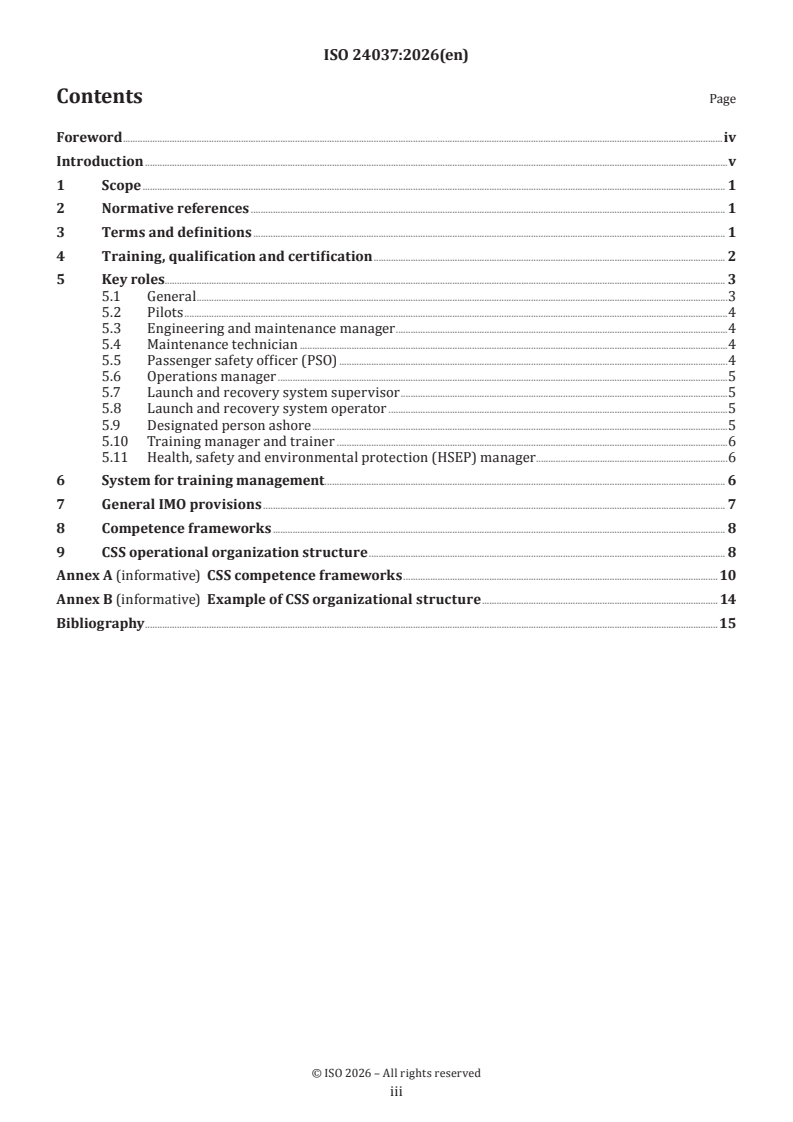
Contents Page
Foreword .iv
Introduction .v
1 Scope . 1
2 Normative references . 1
3 Terms and definitions . 1
4 Training, qualification and certification . 2
5 Key roles. 3
5.1 General .3
5.2 Pilots .4
5.3 Engineering and maintenance manager .4
5.4 Maintenance technician .4
5.5 Passenger safety officer (PSO) .4
5.6 Operations manager .5
5.7 Launch and recovery system supervisor .5
5.8 Launch and recovery system operator .5
5.9 Designated person ashore .5
5.10 Training manager and trainer .6
5.11 Health, safety and environmental protection (HSEP) manager .6
6 System for training management. 6
7 General IMO provisions . 7
8 Competence frameworks . 8
9 CSS operational organization structure . 8
Annex A (informative) CSS competence frameworks . 10
Annex B (informative) Example of CSS organizational structure . 14
Bibliography .15
iii
Foreword
ISO (the International Organization for Standardization) is a worldwide federation of national standards
bodies (ISO member bodies). The work of preparing International Standards is normally carried out through
ISO technical committees. Each member body interested in a subject for which a technical committee
has been established has the right to be represented on that committee. International organizations,
governmental and non-governmental, in liaison with ISO, also take part in the work. ISO collaborates closely
with the International Electrotechnical Commission (IEC) on all matters of electrotechnical standardization.
The procedures used to develop this document and those intended for its further maintenance are described
in the ISO/IEC Directives, Part 1. In particular, the different approval criteria needed for the different types
of ISO document should be noted. This document was drafted in accordance with the editorial rules of the
ISO/IEC Directives, Part 2 (see www.iso.org/directives).
ISO draws attention to the possibility that the implementation of this document may involve the use of (a)
patent(s). ISO takes no position concerning the evidence, validity or applicability of any claimed patent
rights in respect thereof. As of the date of publication of this document, ISO had not received notice of (a)
patent(s) which may be required to implement this document. However, implementers are cautioned that
this may not represent the latest information, which may be obtained from the patent database available at
www.iso.org/patents. ISO shall not be held responsible for identifying any or all such patent rights.
Any trade name used in this document is information given for the convenience of users and does not
constitute an endorsement.
For an explanation of the voluntary nature of standards, the meaning of ISO specific terms and expressions
related to conformity assessment, as well as information about ISO's adherence to the World Trade
Organization (WTO) principles in the Technical Barriers to Trade (TBT), see www.iso.org/iso/foreword.html.
This document was prepared by Technical Committee ISO/TC 8, Ships and marine technology, Subcommittee
SC 13, Marine technology.
Any feedback or questions on this document should be directed to the user’s national standards body. A
complete listing of these bodies can be found at www.iso.org/members.html.
iv
Introduction
The growing number of crewed submersible systems (CSS) in use around the world are operated by
personnel filling the key roles of piloting, atmosphere control, power management, passenger safety,
submersible system maintenance, operational management and other essential positions. These CSS vary
in complexity, capability and function; however, the common attribute is that they are all relatively small
and designed to be operated independently underwater by a single member or small numbers of crew. Given
the wide variety of design, task and operating circumstances of such crafts, the specific qualifications and
skill training requirements for each submersible will reflect its specific needs. However, the fundamental
principles of these qualification and training requirements are likely to be common and it is the aim of this
document to describe these to provide guidance to submersible operators.
There is some industry guidance available from recognized bodies concerning the operation of CSS,
however there is no industry standard for competency levels that are comparable to other marine sector
professionals such as dynamic positioning operators. Therefore, there is a need to provide an operating
safety benchmark for personnel designated as crew members, maintenance engineers or CSS operational
management, all of whom are required to be adequately trained and qualified to be competent to operate
such systems and to respond to all reasonably foreseeable emergencies. For each system, specific training
should be configured to the submersible’s operational requirements. This will usually be done in-house by
the CSS operators. However, there are fundamental theoretical and practical competency requirements
for personnel engaged or planning to engage in this professional area, which can be reasonably acquired
through training methodologies in specialist marine educational facilities or industry sponsored training
programmes. These programmes should cover the minimum required skill levels, which must be considered
in submersible operator training solutions.
The aim of this document is to provide guidance and requirements on common competence requirements
and qualifications for crewed submersible operations to enable operators to develop their own competence
schemes, thereby enabling an industry-wide commonality.
The objectives of this document are to:
a) provide confidence that all personnel appointed to safety-critical and other key positions can carry out
their jobs in an effective manner;
b) develop a standard that can be used and recognized across the industry to create a competent workforce;
c) outline a baseline competence framework;
d) reduce operating risk and improve safety;
e) support an effective assessment procedure;
f) specify minimum criteria for qualifications;
g) recommend minimum levels of experience required for achievement of competence;
h) develop industry accepted procedures, criteria and recording systems for competence management.
v
International Standard ISO 24037:2026(en)
Ships and marine technology — Requirements and guidance
for training, qualification and competency of submersible
system crew and other key personnel
1 Scope
This document provides requirements and guidance on common competence requirements and
qualifications for crewed submersible operations to enable operators to develop their own competence
schemes. It is applicable to any crewed submersible system (CSS) or craft. Conventional and nuclear powered
naval submarines, and diving bells are not addressed in this document.
2 Normative references
There are no normative references in this document.
3 Terms and definitions
For the purposes of this document, the following terms and definitions apply.
ISO and IEC maintain terminology databases for use in standardization at the following addresses:
— ISO Online browsing platform: available at https:// www .iso .org/ obp
— IEC Electropedia: available at https:// www .electropedia .org/
3.1
breathing gas supply system
equipment providing breathing gas to the crewed compartment(s) while the submersible is surfaced or
submerged
3.2
launch and recovery system
LARS
system supporting launch, recovery and other handling operations of a submersible
[SOURCE: ISO 5411:2024, 3.8.5, modified — note 1 to entry has been deleted.]
3.3
launch and recovery procedure
procedures by which the submersible is normally launched and recovered using the launch and recovery
equipment
3.4
life support system
equipment and systems required to maintain a crewed submersible system (3.5) in a habitable condition in all
anticipated operating conditions
3.5
crewed submersible system
CSS
vessel and supporting ancillary equipment that is used to carry personnel, passengers (3.6) or both, while
operating underwater, submerging, surfacing and remaining afloat with the internal pressure of the crewed
compartment normally maintained at or near one atmosphere
3.6
passenger
every person other than the pilot (3.8) and crew within a transport submersible, who has no formal role in
the operation of the submersible
3.7
passenger submersible
passenger-carrying submersible, which primarily operates underwater and relies on surface support
[SOURCE: ISO 5411:2024, 3.1.6]
3.8
pilot
person appointed and qualified to command a submersible
[SOURCE: ISO 5411:2024, 3.11.1]
3.9
atmosphere control system
equipment that maintains the habitability of the internal pressure module’s conditions including the onboard
breathing gas supplies, gas mixing and carbon dioxide (CO2) scrubbing systems
3.10
power management control
operation of the vessel power generation, supply and reserve power control system
3.11
scrubbers
equipment used to remove certain molecules from the atmospheres inside submersible vessels, usually
related to the removal by absorption of carbon dioxide (CO2)
3.12
underwater telephone
UWT
device which is designed to establish a real-time audio communication link between a crewed submersible
and a support ship (or other craft) through water
3.13
occupied compartment
compartment inside the submersible’s pressure hull in which people are carried, generally maintained at a
pressure of one atmosphere but possibly not applicable for rescue submersibles
3.14
person under training
any personnel undergoing training to fill a role as a competent operator, who is unqualified in that role
and who therefore cannot be given direct responsibility for the fulfilment of that role until they have been
assessed and declared as competent to do so
3.15
submersible mobilisation vessel
MOSHIP
surface vessel onto which a submersible has been mobilised or embarked and from which it is transported
to a selected operating area and launched and recovered
4 Training, qualification and certification
4.1 While some national authorities have implemented regulatory requirements on the training and
certification for the crew or operational staff for CSS operations, there are no specific internationally
[1]
recognized regulations. MSC/Circular.981 of the International Maritime Organization (IMO) Marine Safety
Committee has been used as a benchmark in the absence of more detailed guidance.
4.2 For personnel employed or seeking to be employed in the crewed submersibles industry, the career
pathway is a familiar process common to most marine professional roles. Most people undergo a period of
training gained either through an apprenticeship or on-the-job training with an existing CSS operator, or
specialized training by a commercial or naval training provider, imbuing individuals with relevant necessary
skills and a degree of competency. Ideally, this training is consolidated by testing and examination to enable
an individual to be considered qualified in their role. The process is expected to culminate in a certification
of competence procedure that conveys professional certified status on the individual in their specialization.
[2]
This aligns with IMO Guidelines.
4.3 From this initial level of competency, companies should seek to develop and improve the professional
skill levels of their personnel through a coherent personal development process. This should include
ongoing assessment by line managers and professionally challenging personal objectives being applied
during operational activity. Assessment processes and criteria should be described in company training
management policy. By implementing a career skill development process, CSS companies can facilitate
their employees' progress in achieving this goal through a structured and accredited appraisal process as
part of a company system for training management (STM) (6.1). This is also expected to satisfy the quality,
effectiveness, efficiency and operating safety expectations of national and international regulatory and
industry stakeholders.
4.4 Performance appraisal and competence assessment and verification are the main elements of
the process whereby skills are assessed and personnel can develop their career in a systematic manner.
Training needs are identified and opportunities for future roles are facilitated when an appraisal system
and competence scheme operate in an integrated manner.
4.5 An individual’s competence records are maintained to ensure that training, skill base development,
experience and knowledge acquisition gained by individuals can be used to demonstrate their competence
and be assessed against relevant specialist criteria. CSS operators should adopt a suitable and credible
human resource (HR) management process to record competence for their personnel. These HR management
processes should enable trained personnel to transfer the details of their personal professional record to
other industry domains, national authorities and employers.
NOTE Legal requirements can apply.
4.6 Individual company certification schemes that conform to an industry standard adopted by all
stakeholders have mutual benefit for all by improving the overall ability of the trained cohort within the
industry. Adoption of such schemes can facilitate a more rapid transition for incoming personnel when
required to meet demanding project timelines and can minimize induction and crossover training costs.
4.7 Training received in submersible simulators and other modern training equipment (including virtual
reality training aids) can offer considerable benefits to the training outcome. This is highly dependent on the
quality and accuracy of the simulator and the fidelity of the simulation software programming. Nevertheless,
simulation is widely and successfully used in the aviation industry, among others, and could therefore be
applied to CSS operations.
5 Key roles
5.1 General
There are a number of roles that require personnel to be trained to a specified competence level to ensure
the safe operation of the system. It is often the case that one person fulfils several functions or roles, but
this depends on the complexity, size and nature of the CSS operations. CSS operating companies must make
a judgement on the workforce level required to deliver the training, qualification and assurance appropriate
for their operations.
5.2 Pilots
5.2.1 Normally the submersible’s qualified pilot is the vessel’s Master. If two or more pilots are in the crew,
the lead or senior pilot may be the vessel’s Master. They shall be trained to operate the submersible in all
conditions within the vessel’s designed safe operating envelope (see Table A.1). This includes being able to
use all the equipment and systems in the vessel in its primary and reversionary modes and having a complete
knowledge of standard and emergency operating procedures. Pilots are responsible for the safe operation
of the vehicle including its navigation, propulsion and buoyancy systems and for manoeuvring the vehicle in
the water. This also includes operating the vessel’s communications e.g. underwater telephone (UWT) and
any vessel-fitted launch and recovery systems. Pilots are required to achieve an agreed level of competency
before being certified to operate the submersible as a qualified pilot. Until this has been achieved, they are
considered to be a person under training.
5.2.2 The second pilot on a larger CSS is also known as the co-pilot and is not required to be fully qualified.
They shall be qualified in the co-pilot or "Pilot 2" role. The requirements of this role are dependent on the
type of the submersible and its specific operating procedures, as determined by the CSS company.
5.2.3 The pilot or pilots manage the vessel’s power systems. They shall be able to operate the power
management control system in all its modes of operation including the emergency fallback options. They shall
be capable of fault finding and, where feasible, have an appropriate ability to carry out repairs to maintain
the submersible’s power supply requirements while it is operating in the water. They shall understand how
to manage and operate the onboard power supplies including the engagement of the reserve and emergency
power supply options.
5.2.4 Pilots may be responsible for operating the atmosphere control system in all its modes of operation
including the emergency fallback options. They shall be capable of an adequate level of fault finding and
have an appropriate ability to effect repairs to maintain the submersible’s atmosphere during its in-water
operation. They shall understand how to manage and operate the onboard breathing gas supply system, any
gas mixing requirements and CO scrubbers, absorption or removal systems.
5.3 Engineering and maintenance manager
All CSS require some form of planned maintenance management. It is necessary for the system’s engineering
needs to be factored into the operating programme or schedule. To ensure that these requirements are
adequately met, an individual should be assigned to manage all engineering aspects of the submersible
operation. The assigned individual should have the necessary qualified technical ability and managerial
experience to fulfil this role, i.e. training in the specific submersible vessel's technical specifications and the
CSS operator’s maintenance system (see Table A.2). The assigned individuals shall be capable of managing
the work of technical engineers subordinate to them and allocating maintenance tasks accordingly and in
compliance with the vessel manufacturer’s specifications. They hold overall responsibility for ensuring that
the CSS are kept in a state that ensures the submersible’s “safe to operate” status. This role can be fulfilled
by any suitably qualified member of the crew, including the pilot.
5.4 Maintenance technician
All maintenance and engineering needs of the submersible shall be carried out by a suitably qualified and
experienced engineering technician(s). They shall be capable of carrying out all maintenance tasks and
of completing the engineering tasks specified in their areas of responsibility. They shall be responsible
for ensuring that the equipment and systems they are maintaining are kept in a state that ensures the
submersible is safe to operate. They shall be provided with the training necessary to ensure that they have
sufficient technical knowledge of the specific vessel or vessels for which they are responsible, to enable them
to carry out their tasks safely and effectively.
5.5 Passenger safety officer (PSO)
The safety of passengers and the crew in a submersible should be the highest priority for any CSS operator.
While the safety of passengers falls directly under the overall responsibility of the vessel’s Master, a member
of the crew shall be assigned to be continuously responsible for the safety and well-being of passengers in
the occupied compartment of the submersible, where appropriate. This enables the Master/pilot to focus on
their primary task of the safe and effective operation of the submersible. For rescue submersibles, this role is
described as a rescue chamber operator (RCO) and include being responsible for doing this in a normobaric
or hyperbaric environment. The PSO or RCO shall know the standard and emergency operating procedures
...