

ISO 14817-3:2017
(Main)Intelligent transport systems — ITS data dictionaries — Part 3: Object identifier assignments for ITS data concepts
General Information
- Abstract
ISO 14817-3:2017 specifies how to assign an object identifier to a data concept under the "its" arc of the international object identifier tree.
- Status
- Published
- Publication Date
- 20-Aug-2017
- Technical Committee
- ISO/TC 204 - Intelligent transport systems
- Drafting Committee
- ISO/TC 204/WG 1 - Architecture
- Current Stage
- 9060 - Close of review
- Completion Date
- 03-Mar-2028
Buy Documents

ISO 14817-3:2017 - Intelligent transport systems -- ITS data dictionaries

ISO 14817-3:2017 - Intelligent transport systems — ITS data dictionaries — Part 3: Object identifier assignments for ITS data concepts/21/2017
Overview
ISO 14817-3:2017 - "Intelligent transport systems - ITS data dictionaries - Part 3: Object identifier assignments for ITS data concepts" specifies how to assign an object identifier (OID) to an ITS data concept under the "its" arc of the international OID tree. The standard defines the naming tree, conformance prerequisites, management and registration practices, and formally supplies an ASN.1 module (Annex A) and guidance (Annex B). Its purpose is to maximize interoperability, enable efficient encoding, and reduce duplication across ITS data dictionaries via the Central ITS Data Concept Registry (CIDCR).
Key topics and technical requirements
- OID placement: Recommends assigning values under the its (28) arc of the joint-iso-itu-t(2) root for consistency and encoding benefits (including efficient use of RELATIVE OID).
- ASN.1 OBJECT IDENTIFIER: Assigned values must be valid ASN.1 OBJECT IDENTIFIERs and conform to ISO/IEC 9834-1 and ISO/IEC 8824-1 rules.
- CIDCR registration: Before an arc/OID can be standardized under the “its” arc, the data concept must be entered in the CIDCR and reach quality level “recorded” (or higher).
- Conformance checks: Verify contextual name, parent object class, unambiguous definition, correct context/module reference, and data type conformity per ISO 14817-1.
- ITS naming tree structure: Defines major arcs (e.g., its-misc arc 0) and sub-arcs such as member-body arcs (using ISO 3166-1 three‑digit country codes).
- Management topics: Processes for registering data concepts, versioning, and obtaining a dictionary document arc are covered.
- Deliverables: Normative ASN.1 module (Annex A) and FAQs on subtle data variations (Annex B).
Applications and who uses it
- ITS architects and system integrators standardize OIDs for messages, data elements, value domains and aggregates to enable consistent cross-system exchange.
- Application developers and equipment providers use assigned OIDs for encoding, protocol design, and implementation to ensure interoperability.
- Standards bodies and national member bodies register country-specific data concepts under member-body arcs (e.g., ISO 3166 three-digit codes).
- CIDCR managers and registry maintainers administer arcs, versioning and ensure data concepts meet conformance requirements.
Benefits / Practical value
- Promotes harmonization and reuse of ITS data concepts across domains.
- Reduces duplication and inconsistent definitions.
- Enables efficient encodings (RELATIVE OID) and easier discovery of related data concepts via the CIDCR.
Related standards
- ISO 14817-1 (meta-attributes and rules for ITS data concepts)
- ISO 14813 series (ITS system architecture)
- ISO/IEC 9834-1 and ISO/IEC 8824-1 (OID and ASN.1 rules)
- ISO 3166-1 (country code assignment for member-body arcs)
Keywords: ISO 14817-3:2017, ITS data dictionaries, object identifier, OID, CIDCR, ITS naming tree, ASN.1, interoperability.
Buy Documents
ISO 14817-3:2017 - Intelligent transport systems -- ITS data dictionaries
ISO 14817-3:2017 - Intelligent transport systems — ITS data dictionaries — Part 3: Object identifier assignments for ITS data concepts/21/2017
Get Certified
Connect with accredited certification bodies for this standard

BSI Group
BSI (British Standards Institution) is the business standards company that helps organizations make excellence a habit.

Great Wall Tianjin Quality Assurance Center
Established 1993, first batch to receive national accreditation with IAF recognition.
Hong Kong Quality Assurance Agency (HKQAA)
Hong Kong's leading certification body.
Sponsored listings
Frequently Asked Questions
ISO 14817-3:2017 is a standard published by the International Organization for Standardization (ISO). Its full title is "Intelligent transport systems — ITS data dictionaries — Part 3: Object identifier assignments for ITS data concepts". This standard covers: ISO 14817-3:2017 specifies how to assign an object identifier to a data concept under the "its" arc of the international object identifier tree.
ISO 14817-3:2017 specifies how to assign an object identifier to a data concept under the "its" arc of the international object identifier tree.
ISO 14817-3:2017 is classified under the following ICS (International Classification for Standards) categories: 03.220.01 - Transport in general; 35.240.60 - IT applications in transport. The ICS classification helps identify the subject area and facilitates finding related standards.
ISO 14817-3:2017 is available in PDF format for immediate download after purchase. The document can be added to your cart and obtained through the secure checkout process. Digital delivery ensures instant access to the complete standard document.
Standards Content (Sample)
INTERNATIONAL ISO
STANDARD 14817-3
First edition
2017-08
Intelligent transport systems — ITS
data dictionaries —
Part 3:
Object identifier assignments for ITS
data concepts
Systèmes intelligents de transport — Dictionnaires de données des
ITS —
Partie 3: Affectation didentifiants d’objets pour les concepts liés aux
données des ITS
Reference number
©
ISO 2017
© ISO 2017, Published in Switzerland
All rights reserved. Unless otherwise specified, no part of this publication may be reproduced or utilized otherwise in any form
or by any means, electronic or mechanical, including photocopying, or posting on the internet or an intranet, without prior
written permission. Permission can be requested from either ISO at the address below or ISO’s member body in the country of
the requester.
ISO copyright office
Ch. de Blandonnet 8 • CP 401
CH-1214 Vernier, Geneva, Switzerland
Tel. +41 22 749 01 11
Fax +41 22 749 09 47
copyright@iso.org
www.iso.org
ii © ISO 2017 – All rights reserved
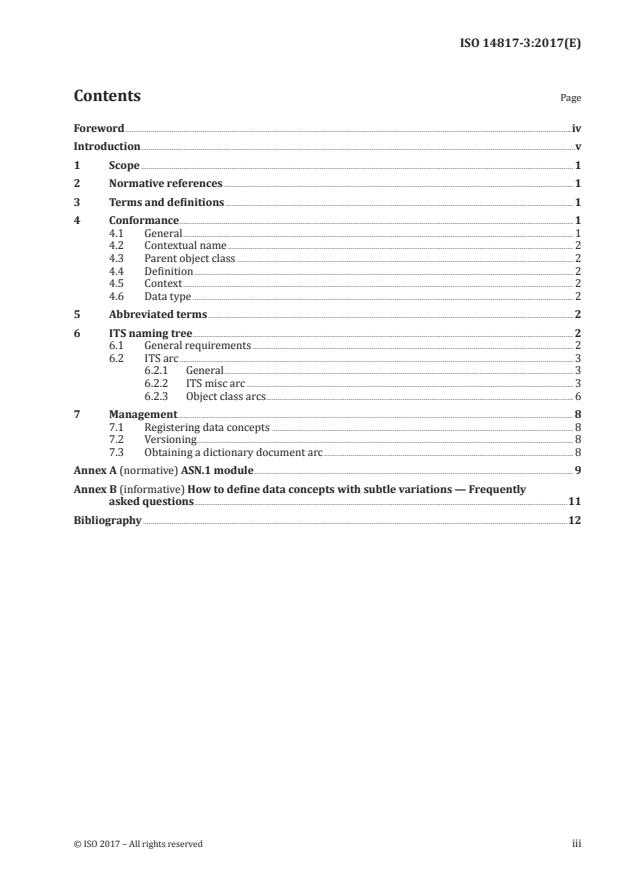
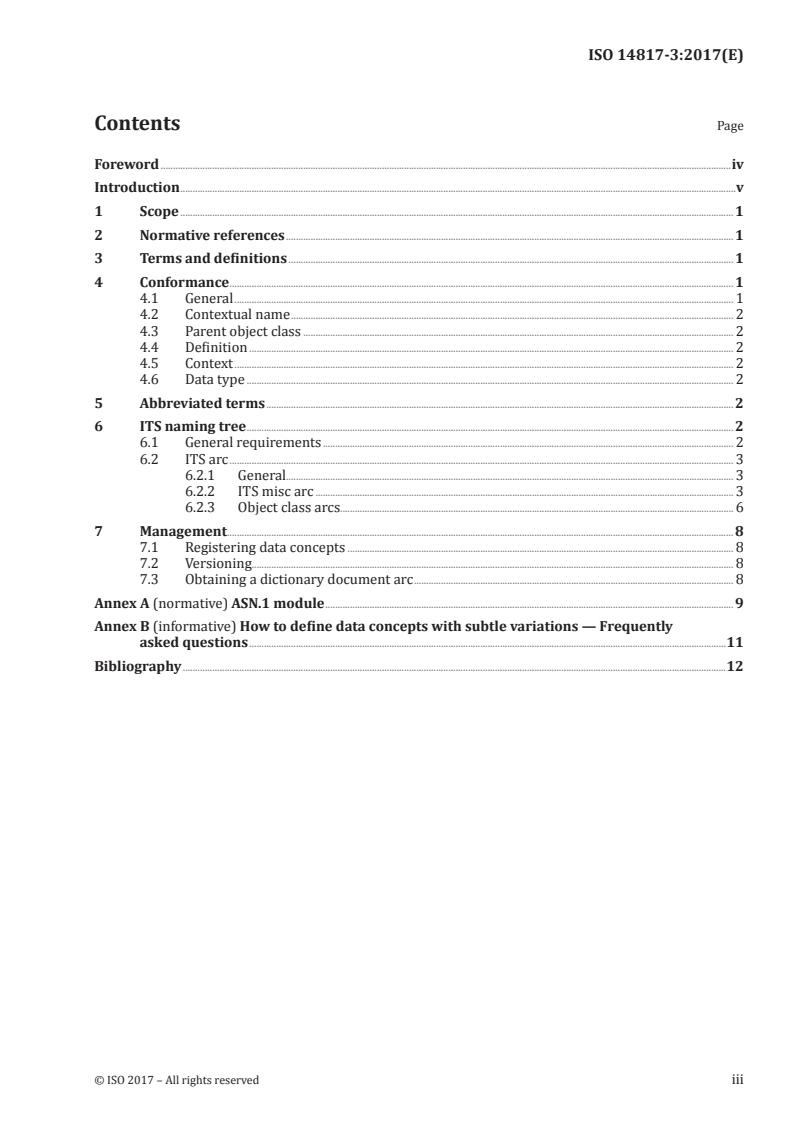
Contents Page
Foreword .iv
Introduction .v
1 Scope . 1
2 Normative references . 1
3 Terms and definitions . 1
4 Conformance . 1
4.1 General . 1
4.2 Contextual name . 2
4.3 Parent object class . 2
4.4 Definition . 2
4.5 Context . 2
4.6 Data type . 2
5 Abbreviated terms . 2
6 ITS naming tree . 2
6.1 General requirements . 2
6.2 ITS arc . 3
6.2.1 General. 3
6.2.2 ITS misc arc . 3
6.2.3 Object class arcs. 6
7 Management . 8
7.1 Registering data concepts . 8
7.2 Versioning. 8
7.3 Obtaining a dictionary document arc . 8
Annex A (normative) ASN.1 module . 9
Annex B (informative) How to define data concepts with subtle variations — Frequently
asked questions .11
Bibliography .12
Foreword
ISO (the International Organization for Standardization) is a worldwide federation of national standards
bodies (ISO member bodies). The work of preparing International Standards is normally carried out
through ISO technical committees. Each member body interested in a subject for which a technical
committee has been established has the right to be represented on that committee. International
organizations, governmental and non-governmental, in liaison with ISO, also take part in the work.
ISO collaborates closely with the International Electrotechnical Commission (IEC) on all matters of
electrotechnical standardization.
The procedures used to develop this document and those intended for its further maintenance are
described in the ISO/IEC Directives, Part 1. In particular the different approval criteria needed for the
different types of ISO documents should be noted. This document was drafted in accordance with the
editorial rules of the ISO/IEC Directives, Part 2 (see www. iso. org/d irectives).
Attention is drawn to the possibility that some of the elements of this document may be the subject of
patent rights. ISO shall not be held responsible for identifying any or all such patent rights. Details of
any patent rights identified during the development of the document will be in the Introduction and/or
on the ISO list of patent declarations received (see www. iso. org/p atents).
Any trade name used in this document is information given for the convenience of users and does not
constitute an endorsement.
For an explanation on the voluntary nature of standards, the meaning of ISO specific terms and
expressions related to conformity assessment, as well as information about ISO’s adherence to the
World Trade Organization (WTO) principles in the Technical Barriers to Trade (TBT) see the following
URL: w w w . i s o. org/i so/f oreword. html.
This document was prepared by Technical Committee ISO/TC 204, Intelligent transport systems.
A list of all parts in the ISO 14817 series can be found on the ISO website.
iv © ISO 2017 – All rights reserved
Introduction
Background
This document has been developed by ISO/TC 204 in order to provide a framework for the
documentation and registration of data that passes through system interfaces within the Intelligent
Transport Systems (ITS) domain. It is designed to maximize interoperability and facilitate information
re-use across system interfaces.
Vision statement
This International Standard envisions a harmonized approach to ITS data and interfaces to promote
maximum interoperability of data within the ITS sector by the creation and maintenance of the
Central ITS Data Concept Registry (CIDCR), which are supported by interface and application-specific
ITS data dictionaries, created and maintained in a common and interoperable form, and to ensure
the minimization of duplication by clear rules for data concept definition and data concept registry
management.
Mission statement
The mission is to develop tools that will promote a holistic, integrated approach involving vehicle
technology, infrastructure, and the road user to increase transport safety and efficiency. Specifically,
this standard defines the principles and concepts, scope, field of application, rules and procedures, and
definition and concept of operation for the CIDCR and ITS functional data dictionaries. Furthermore,
this standard also makes provision for the migration of data concepts from ITS functional data
dictionaries to the CIDCR to maximize interoperability and minimize proliferation of similar (but
inconsistently defined) data concept entries.
This International Standard defines the framework, formats, and procedures used to define information
and information exchanges within the ITS sector. The standard is designed to be used by the ITS
community at large, but should be of special interest to application developers, equipment providers,
and data concept registry managers.
ISO 14817-1 specifies a set of meta-attributes for ITS data concepts, as well as associated conventions
and schemes that enable the description, standardization and management of all exchanged ITS
data. Through consistent use of these common structures and associated conventions and schemes,
interchange of data and information among the various ITS functional subsystems via their specific
application systems can be maximized. This International Standard also supports re-use of data
elements and other data concepts across various ITS functional subsystems and their specific
application systems.
The formats and processes defined within this International Standard are consistent with
implementation(s) of the ISO ITS System Architecture defined in the ISO 14813 Standardization
deliverables, particularly ISO 14813-2 and ISO 14813-2. This does not preclude the application of
data concept registries using alternative international, regional or national system architecture
methodologies or techniques, indeed, common formats and processes will ease migration and
interoperability between such approaches.
The ITS data concepts that populate the CIDCR or data dictionary may originate from a Computer-
Aided Software Engineering (CASE) tool implementation of the ISO 14813 ITS Reference Architecture,
from International Standards for ITS, from national implementations for ITS, or from the submission
by relevant users. Data dictionary entries are not limited to those generated by object-oriented
methodologies.
Document overview
This clause provides an overview of this document. Clause 1 identifies the scope of this document.
Clause 2 specifies the conformance tests that a data concept must pass to be assigned an arc under the
“common-data” arc. Clause 3 identifies references required for proper implementation of this document.
Clause 4 defines terms used and Clause 5 lists the abbreviations. Clause 6 declares the structure of
the centralized ITS naming tree and Clause 7 identifies management structure for adding new arcs
underneath the centralized ITS naming tree.
Annex A contains the formal ASN.1 module defining all arcs defined in this document.
Annex B is informational and provides answers to frequently asked questions.
vi © ISO 2017 – All rights reserved
INTERNATIONAL STANDARD ISO 14817-3:2017(E)
Intelligent transport systems — ITS data dictionaries —
Part 3:
Object identifier assignments for ITS data concepts
1 Scope
This document specifies how to assign an object identifier to a data concept under the “its” arc of the
international object identifier tree.
2 Normative references
The following documents are referred to in the text in such a way that some or all of their content
constitutes requirements of this document. For dated references, only the edition cited applies. For
undated references, the latest edition of the referenced document (including any amendments) applies.
ISO 3166-1, Codes for the representation of names of countries and their subdivision — Part 1: Country codes
ISO/IEC 8824-1, Information technology — Abstract Syntax Notation One (ASN.1) — Specification of basic
notation
ISO/IEC 9834-1, Information technology — Procedures for the operation of object identifier registration
authorities: General procedures and top arcs of the international object identifier tree — Part 1
ISO 14813-1, Intelligent transport systems — Reference model architecture(s) for the ITS sector — Part 1:
ITS service domains, service groups and services
ISO 14817-1, Intelligent transport systems — ITS central data dictionaries — Part 1: Requirements for ITS
data definitions
3 Terms and definitions
For the purposes of this document, the terms and definitions given in ISO 14817-1 apply.
ISO and IEC maintain terminological databases for use in standardization at the following addresses:
— IEC Electropedia: available at http:// www .electropedia .org/
— ISO Online browsing platform: available at http:// www .iso .org/ obp
4 Conformance
4.1 General
Prior to standardizing an arc assignment to any data concept under the joint “its” arc, the developer
of the data concept shall enter the data concept into the CIDCR so that it reaches the quality level of
“recorded” or higher. In addition, it is recommended that the following conditions be met:
NOTE ISO 14817-2 defines the “recorded” level as “Indicates that the data concept has syntactically valid
entries for all mandatory meta-attributes and passes all defined automated checks for the data concept type”.
4.2 Contextual name
Verify that the name is descriptive of the data concept being defined.
4.3 Parent object class
Verify that the parent object class properly identifies the object class that the data concept describes
when this meta-attribute is required.
4.4 Definition
Verify that the definition unambiguously describes the data concept meaning.
4.5 Context
Verify that the context properly references the correct module or dictionary document.
4.6 Data type
Verify that the data type conforms to the rules of ISO 14817-1:2015, 7.4.1.
5 Abbreviated terms
ASN.1 Abstract Syntax Notation One
CEN European Committee for Standardization
CIDCR Central ITS Data Concept Registry
IEC International Electrotechnical Commission
ISO International Organization for Standardization
ITS Intelligent Transport System(s)
ITU-T International Telecommunications Union – Telecommunications Sector
JTC Joint technical committee
OID Object identifier
SC Sub-committee
6 ITS naming tree
6.1 General requirements
The value assigned to the object identifier meta-attribute of any data concept shall be an ASN.1 OBJECT
IDENTIFIER that conforms to the rules of ISO/IEC 9834-1. It is recommended that the assigned value
be a node underneath the “its (28)” arc of
...
INTERNATIONAL ISO
STANDARD 14817-3
First edition
2017-08
Intelligent transport systems — ITS
data dictionaries —
Part 3:
Object identifier assignments for ITS
data concepts
Systèmes intelligents de transport — Dictionnaires de données des
ITS —
Partie 3: Affectation didentifiants d’objets pour les concepts liés aux
données des ITS
Reference number
©
ISO 2017
© ISO 2017, Published in Switzerland
All rights reserved. Unless otherwise specified, no part of this publication may be reproduced or utilized otherwise in any form
or by any means, electronic or mechanical, including photocopying, or posting on the internet or an intranet, without prior
written permission. Permission can be requested from either ISO at the address below or ISO’s member body in the country of
the requester.
ISO copyright office
Ch. de Blandonnet 8 • CP 401
CH-1214 Vernier, Geneva, Switzerland
Tel. +41 22 749 01 11
Fax +41 22 749 09 47
copyright@iso.org
www.iso.org
ii © ISO 2017 – All rights reserved
Contents Page
Foreword .iv
Introduction .v
1 Scope . 1
2 Normative references . 1
3 Terms and definitions . 1
4 Conformance . 1
4.1 General . 1
4.2 Contextual name . 2
4.3 Parent object class . 2
4.4 Definition . 2
4.5 Context . 2
4.6 Data type . 2
5 Abbreviated terms . 2
6 ITS naming tree . 2
6.1 General requirements . 2
6.2 ITS arc . 3
6.2.1 General. 3
6.2.2 ITS misc arc . 3
6.2.3 Object class arcs. 6
7 Management . 8
7.1 Registering data concepts . 8
7.2 Versioning. 8
7.3 Obtaining a dictionary document arc . 8
Annex A (normative) ASN.1 module . 9
Annex B (informative) How to define data concepts with subtle variations — Frequently
asked questions .11
Bibliography .12
Foreword
ISO (the International Organization for Standardization) is a worldwide federation of national standards
bodies (ISO member bodies). The work of preparing International Standards is normally carried out
through ISO technical committees. Each member body interested in a subject for which a technical
committee has been established has the right to be represented on that committee. International
organizations, governmental and non-governmental, in liaison with ISO, also take part in the work.
ISO collaborates closely with the International Electrotechnical Commission (IEC) on all matters of
electrotechnical standardization.
The procedures used to develop this document and those intended for its further maintenance are
described in the ISO/IEC Directives, Part 1. In particular the different approval criteria needed for the
different types of ISO documents should be noted. This document was drafted in accordance with the
editorial rules of the ISO/IEC Directives, Part 2 (see www. iso. org/d irectives).
Attention is drawn to the possibility that some of the elements of this document may be the subject of
patent rights. ISO shall not be held responsible for identifying any or all such patent rights. Details of
any patent rights identified during the development of the document will be in the Introduction and/or
on the ISO list of patent declarations received (see www. iso. org/p atents).
Any trade name used in this document is information given for the convenience of users and does not
constitute an endorsement.
For an explanation on the voluntary nature of standards, the meaning of ISO specific terms and
expressions related to conformity assessment, as well as information about ISO’s adherence to the
World Trade Organization (WTO) principles in the Technical Barriers to Trade (TBT) see the following
URL: w w w . i s o. org/i so/f oreword. html.
This document was prepared by Technical Committee ISO/TC 204, Intelligent transport systems.
A list of all parts in the ISO 14817 series can be found on the ISO website.
iv © ISO 2017 – All rights reserved
Introduction
Background
This document has been developed by ISO/TC 204 in order to provide a framework for the
documentation and registration of data that passes through system interfaces within the Intelligent
Transport Systems (ITS) domain. It is designed to maximize interoperability and facilitate information
re-use across system interfaces.
Vision statement
This International Standard envisions a harmonized approach to ITS data and interfaces to promote
maximum interoperability of data within the ITS sector by the creation and maintenance of the
Central ITS Data Concept Registry (CIDCR), which are supported by interface and application-specific
ITS data dictionaries, created and maintained in a common and interoperable form, and to ensure
the minimization of duplication by clear rules for data concept definition and data concept registry
management.
Mission statement
The mission is to develop tools that will promote a holistic, integrated approach involving vehicle
technology, infrastructure, and the road user to increase transport safety and efficiency. Specifically,
this standard defines the principles and concepts, scope, field of application, rules and procedures, and
definition and concept of operation for the CIDCR and ITS functional data dictionaries. Furthermore,
this standard also makes provision for the migration of data concepts from ITS functional data
dictionaries to the CIDCR to maximize interoperability and minimize proliferation of similar (but
inconsistently defined) data concept entries.
This International Standard defines the framework, formats, and procedures used to define information
and information exchanges within the ITS sector. The standard is designed to be used by the ITS
community at large, but should be of special interest to application developers, equipment providers,
and data concept registry managers.
ISO 14817-1 specifies a set of meta-attributes for ITS data concepts, as well as associated conventions
and schemes that enable the description, standardization and management of all exchanged ITS
data. Through consistent use of these common structures and associated conventions and schemes,
interchange of data and information among the various ITS functional subsystems via their specific
application systems can be maximized. This International Standard also supports re-use of data
elements and other data concepts across various ITS functional subsystems and their specific
application systems.
The formats and processes defined within this International Standard are consistent with
implementation(s) of the ISO ITS System Architecture defined in the ISO 14813 Standardization
deliverables, particularly ISO 14813-2 and ISO 14813-2. This does not preclude the application of
data concept registries using alternative international, regional or national system architecture
methodologies or techniques, indeed, common formats and processes will ease migration and
interoperability between such approaches.
The ITS data concepts that populate the CIDCR or data dictionary may originate from a Computer-
Aided Software Engineering (CASE) tool implementation of the ISO 14813 ITS Reference Architecture,
from International Standards for ITS, from national implementations for ITS, or from the submission
by relevant users. Data dictionary entries are not limited to those generated by object-oriented
methodologies.
Document overview
This clause provides an overview of this document. Clause 1 identifies the scope of this document.
Clause 2 specifies the conformance tests that a data concept must pass to be assigned an arc under the
“common-data” arc. Clause 3 identifies references required for proper implementation of this document.
Clause 4 defines terms used and Clause 5 lists the abbreviations. Clause 6 declares the structure of
the centralized ITS naming tree and Clause 7 identifies management structure for adding new arcs
underneath the centralized ITS naming tree.
Annex A contains the formal ASN.1 module defining all arcs defined in this document.
Annex B is informational and provides answers to frequently asked questions.
vi © ISO 2017 – All rights reserved
INTERNATIONAL STANDARD ISO 14817-3:2017(E)
Intelligent transport systems — ITS data dictionaries —
Part 3:
Object identifier assignments for ITS data concepts
1 Scope
This document specifies how to assign an object identifier to a data concept under the “its” arc of the
international object identifier tree.
2 Normative references
The following documents are referred to in the text in such a way that some or all of their content
constitutes requirements of this document. For dated references, only the edition cited applies. For
undated references, the latest edition of the referenced document (including any amendments) applies.
ISO 3166-1, Codes for the representation of names of countries and their subdivision — Part 1: Country codes
ISO/IEC 8824-1, Information technology — Abstract Syntax Notation One (ASN.1) — Specification of basic
notation
ISO/IEC 9834-1, Information technology — Procedures for the operation of object identifier registration
authorities: General procedures and top arcs of the international object identifier tree — Part 1
ISO 14813-1, Intelligent transport systems — Reference model architecture(s) for the ITS sector — Part 1:
ITS service domains, service groups and services
ISO 14817-1, Intelligent transport systems — ITS central data dictionaries — Part 1: Requirements for ITS
data definitions
3 Terms and definitions
For the purposes of this document, the terms and definitions given in ISO 14817-1 apply.
ISO and IEC maintain terminological databases for use in standardization at the following addresses:
— IEC Electropedia: available at http:// www .electropedia .org/
— ISO Online browsing platform: available at http:// www .iso .org/ obp
4 Conformance
4.1 General
Prior to standardizing an arc assignment to any data concept under the joint “its” arc, the developer
of the data concept shall enter the data concept into the CIDCR so that it reaches the quality level of
“recorded” or higher. In addition, it is recommended that the following conditions be met:
NOTE ISO 14817-2 defines the “recorded” level as “Indicates that the data concept has syntactically valid
entries for all mandatory meta-attributes and passes all defined automated checks for the data concept type”.
4.2 Contextual name
Verify that the name is descriptive of the data concept being defined.
4.3 Parent object class
Verify that the parent object class properly identifies the object class that the data concept describes
when this meta-attribute is required.
4.4 Definition
Verify that the definition unambiguously describes the data concept meaning.
4.5 Context
Verify that the context properly references the correct module or dictionary document.
4.6 Data type
Verify that the data type conforms to the rules of ISO 14817-1:2015, 7.4.1.
5 Abbreviated terms
ASN.1 Abstract Syntax Notation One
CEN European Committee for Standardization
CIDCR Central ITS Data Concept Registry
IEC International Electrotechnical Commission
ISO International Organization for Standardization
ITS Intelligent Transport System(s)
ITU-T International Telecommunications Union – Telecommunications Sector
JTC Joint technical committee
OID Object identifier
SC Sub-committee
6 ITS naming tree
6.1 General requirements
The value assigned to the object identifier meta-attribute of any data concept shall be an ASN.1 OBJECT
IDENTIFIER that conforms to the rules of ISO/IEC 9834-1. It is recommended that the assigned value
be a node underneath the “its (28)” arc of
...