

ISO 23225:2025
(Main)Corrosion control engineering life cycle in nuclear power plants — General requirements
General Information
- Abstract
This standard specifies the general requirements of the corrosion control engineering life cycle in nuclear power plants. This standard applies to of various activities management of the corrosion control engineering life cycle in nuclear power plants.
- Status
- Published
- Publication Date
- 08-Jul-2025
- Technical Committee
- ISO/TC 156/SC 1 - Corrosion control engineering life cycle
- Drafting Committee
- ISO/TC 156/SC 1 - Corrosion control engineering life cycle
- Current Stage
- 6060 - International Standard published
- Start Date
- 09-Jul-2025
- Due Date
- 17-Aug-2025
- Completion Date
- 09-Jul-2025
Overview
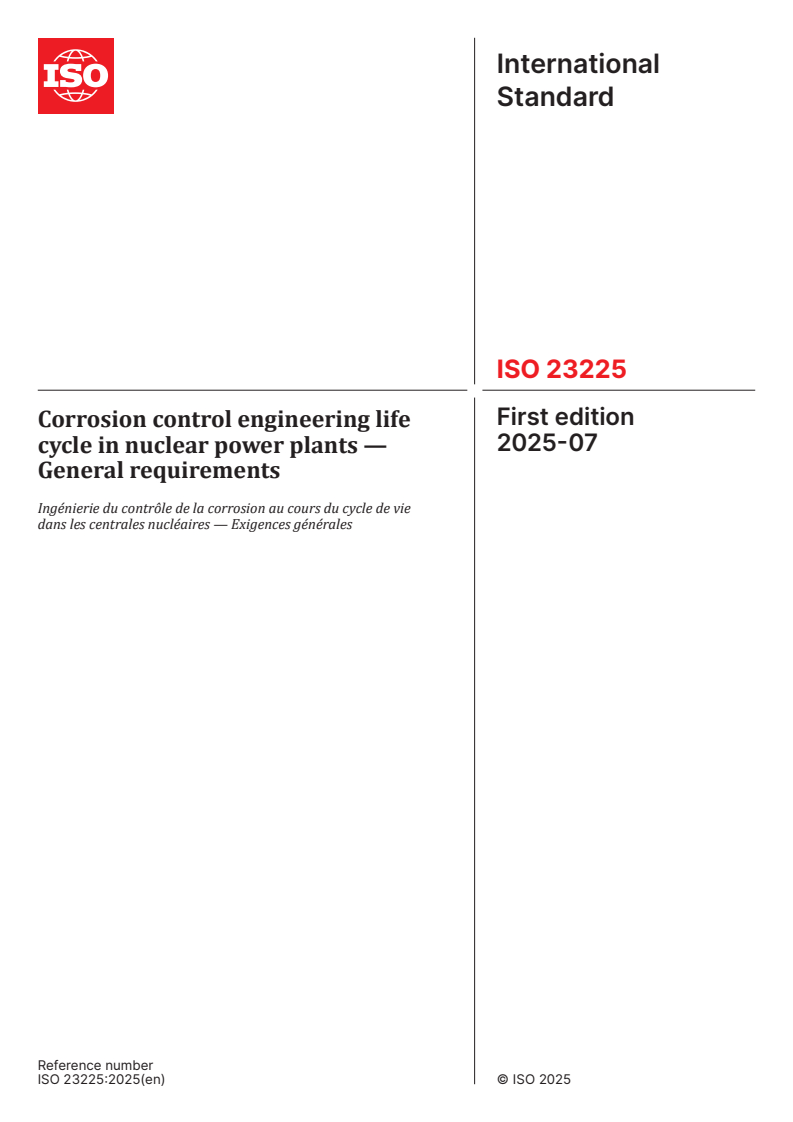
ISO 23225:2025 - "Corrosion control engineering life cycle in nuclear power plants - General requirements" is the first-edition ISO standard that defines a holistic framework for corrosion control across the entire life cycle of nuclear power plants. Published in 2025 by ISO/TC 156 (Corrosion of metals and alloys, SC 1), the standard sets out general requirements to identify corrosion sources, select materials and technologies, and manage design, construction, operation, inspection, maintenance, life extension and decommissioning activities with safety, cost-effectiveness and environmental protection in mind.
Key topics and technical requirements
The standard organizes corrosion control engineering around the full lifecycle and specifies requirements for each major element:
- Corrosion source identification: direct (e.g., water chemistries, steam, seawater), indirect (e.g., temperature, radiation, stress), environmental (e.g., stray currents, galvanic contacts) and corrosion-generated sources.
- Materials: selection and validation of metallic, non‑metallic and composite materials (e.g., stainless steels, nickel alloys, coatings) based on corrosion resistance, mechanical and irradiation properties.
- Technologies: environmental conditioning (pH control, oxygen removal), protective layers (coatings, linings, galvanizing) and electrochemical protection (cathodic/anodic systems).
- Design: structural and localized corrosion-strength considerations, accessibility for inspection/maintenance, and allowance for service-life margins.
- Lifecycle processes: development, manufacturing, transport/storage, construction/installation, commissioning/acceptance, operation, testing/inspection, maintenance/repair, life extension and scrapping.
- Management systems: documentation, records, resource management, verification and comprehensive assessment procedures.
- Principles and objectives: holistic, systematic, coordinated and optimized corrosion control to protect public safety, national security and the environment while achieving long-term operation and economic efficiency.
Note: ISO 23225:2025 contains no normative references and recognizes reactor-type differences (schematics in Annex A) and both normal and accident conditions.
Applications and who uses it
ISO 23225 is intended for organizations and professionals involved in nuclear power plant lifecycle management, including:
- Corrosion engineers and materials scientists
- Nuclear design and structural engineers
- Plant operators, maintenance and reliability teams
- Procurement, quality assurance and regulatory compliance staff
- Constructors, fabricators and equipment suppliers
- Safety assessors and decommissioning planners
Practical uses include creating corrosion management plans, specifying materials and coatings, defining inspection regimes, validating mitigation technologies, and supporting regulatory safety cases.
Related standards
ISO 23225 complements broader nuclear and corrosion standards and is aligned with ISO/TC 156 workstreams. For full implementation, users typically reference applicable nuclear design codes, regulatory requirements and industry best practices available from ISO and national standards bodies.
For purchase and official text, obtain ISO 23225:2025 from ISO or your national standards body.
Relations
- Effective Date
- 06-Jun-2022
Get Certified
Connect with accredited certification bodies for this standard

DNV
DNV is an independent assurance and risk management provider.

Lloyd's Register
Lloyd's Register is a global professional services organisation specialising in engineering and technology.
DNV Energy Systems
Energy and renewable energy certification.
Sponsored listings
Frequently Asked Questions
ISO 23225:2025 is a standard published by the International Organization for Standardization (ISO). Its full title is "Corrosion control engineering life cycle in nuclear power plants — General requirements". This standard covers: This standard specifies the general requirements of the corrosion control engineering life cycle in nuclear power plants. This standard applies to of various activities management of the corrosion control engineering life cycle in nuclear power plants.
This standard specifies the general requirements of the corrosion control engineering life cycle in nuclear power plants. This standard applies to of various activities management of the corrosion control engineering life cycle in nuclear power plants.
ISO 23225:2025 is classified under the following ICS (International Classification for Standards) categories: 27.120.20 - Nuclear power plants. Safety; 77.060 - Corrosion of metals. The ICS classification helps identify the subject area and facilitates finding related standards.
ISO 23225:2025 has the following relationships with other standards: It is inter standard links to ISO 1133-1:2022. Understanding these relationships helps ensure you are using the most current and applicable version of the standard.
ISO 23225:2025 is available in PDF format for immediate download after purchase. The document can be added to your cart and obtained through the secure checkout process. Digital delivery ensures instant access to the complete standard document.
Standards Content (Sample)
International
Standard
ISO 23225
First edition
Corrosion control engineering life
2025-07
cycle in nuclear power plants —
General requirements
Ingénierie du contrôle de la corrosion au cours du cycle de vie
dans les centrales nucléaires — Exigences générales
Reference number
© ISO 2025
All rights reserved. Unless otherwise specified, or required in the context of its implementation, no part of this publication may
be reproduced or utilized otherwise in any form or by any means, electronic or mechanical, including photocopying, or posting on
the internet or an intranet, without prior written permission. Permission can be requested from either ISO at the address below
or ISO’s member body in the country of the requester.
ISO copyright office
CP 401 • Ch. de Blandonnet 8
CH-1214 Vernier, Geneva
Phone: +41 22 749 01 11
Email: copyright@iso.org
Website: www.iso.org
Published in Switzerland
ii
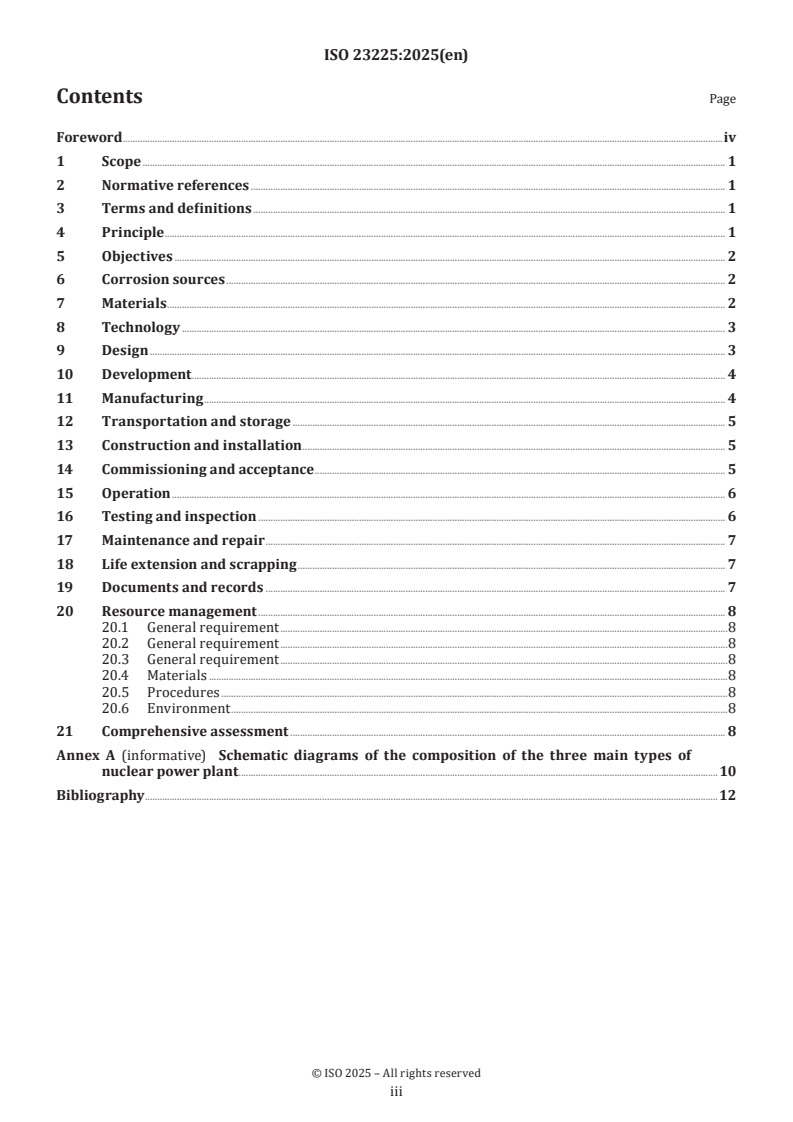
Contents Page
Foreword .iv
1 Scope . 1
2 Normative references . 1
3 Terms and definitions . 1
4 Principle . 1
5 Objectives . 2
6 Corrosion sources . 2
7 Materials . 2
8 Technology . 3
9 Design . 3
10 Development . 4
11 Manufacturing . 4
12 Transportation and storage . 5
13 Construction and installation . 5
14 Commissioning and acceptance . 5
15 Operation . 6
16 Testing and inspection . 6
17 Maintenance and repair . 7
18 Life extension and scrapping . 7
19 Documents and records . 7
20 Resource management . 8
20.1 General requirement .8
20.2 General requirement .8
20.3 General requirement .8
20.4 Materials .8
20.5 Procedures .8
20.6 Environment .8
21 Comprehensive assessment . 8
Annex A (informative) Schematic diagrams of the composition of the three main types of
nuclear power plant . 10
Bibliography .12
iii
Foreword
ISO (the International Organization for Standardization) is a worldwide federation of national standards
bodies (ISO member bodies). The work of preparing International Standards is normally carried out through
ISO technical committees. Each member body interested in a subject for which a technical committee
has been established has the right to be represented on that committee. International organizations,
governmental and non-governmental, in liaison with ISO, also take part in the work. ISO collaborates closely
with the International Electrotechnical Commission (IEC) on all matters of electrotechnical standardization.
The procedures used to develop this document and those intended for its further maintenance are described
in the ISO/IEC Directives, Part 1. In particular, the different approval criteria needed for the different types
of ISO document should be noted. This document was drafted in accordance with the editorial rules of the
ISO/IEC Directives, Part 2 (see www.iso.org/directives).
ISO draws attention to the possibility that the implementation of this document may involve the use of (a)
patent(s). ISO takes no position concerning the evidence, validity or applicability of any claimed patent
rights in respect thereof. As of the date of publication of this document, ISO had not received notice of (a)
patent(s) which may be required to implement this document. However, implementers are cautioned that
this may not represent the latest information, which may be obtained from the patent database available at
www.iso.org/patents. ISO shall not be held responsible for identifying any or all such patent rights.
Any trade name used in this document is information given for the convenience of users and does not
constitute an endorsement.
For an explanation of the voluntary nature of standards, the meaning of ISO specific terms and expressions
related to conformity assessment, as well as information about ISO's adherence to the World Trade
Organization (WTO) principles in the Technical Barriers to Trade (TBT), see www.iso.org/iso/foreword.html.
This document was prepared by Technical Committee ISO/TC 156, Corrosion of metals and alloys,
Subcommittee SC 1, Corrosion control engineering life cycle.
Any feedback or questions on this document should be directed to the user’s national standards body. A
complete listing of these bodies can be found at www.iso.org/members.html.
iv
International Standard ISO 23225:2025(en)
Corrosion control engineering life cycle in nuclear power
plants — General requirements
1 Scope
This document specifies the general requirements of corrosion control engineering life cycle in nuclear
power plants.
This document applies to the corrosion control engineering in nuclear power plants.
2 Normative references
There are no normative references in this document.
3 Terms and definitions
For the purposes of this document, the following terms and definitions apply.
ISO and IEC maintain terminology databases for use in standardization at the following addresses:
— ISO Online browsing platform: available at https:// www .iso .org/ obp
— IEC Electropedia: available at https:// www .electropedia .org/
3.1
corrosion control engineering life cycle in nuclear power plants
entire process of identification of the corrosion sources in nuclear power plants to control of corrosion
behaviour
Note 1 to entry: The entire process refers to the systematic engineering of selecting corrosion control materials and
technologies, as well as the design, construction, inspection, assessment and maintenance.
3.2
direct corrosion source
various factors that cause corrosion in direct contact with materials, such as environmental mediums and
acid solutions, alkali solutions and salt solutions
3.3
indirect corrosion source
various factors that cause corrosion without direct contact with materials, such as environmental conditions
and mediums working conditions
4 Principle
This document defines the corrosion control activities conducted throughout the entire engineering life cycle
in nuclear power plants. It identifies all related elements including the objectives, corrosion sources, materials,
technology, development, design, manufacturing, transportation and storage, construction and installation,
commissioning and acceptance, operation, testing and inspection, maintenance and repair, life extension and
scrapping, documents and records, resource management and comprehensive assessment. The requirements
of those elements are specified in accordance with holistic, systematic, coordinated and optimized principles.
The purpose of the requirements is to achieve the objectives (see Clause 5) under the premise of ensuring
public health, lives and property safety, national security and ecological environment safety.
5 Objectives
The corrosion control activities specified in this document aim at controlling corrosion effectively during
the entire engineering life cycle in nuclear power plants, and achieving the optimum benefits of safety, cost-
effectiveness, long-term operation and environmental protection.
6 Corrosion sources
6.1 The corrosion sources of nuclear power plants are classified as follows:
— direct corrosion sources, such as light water, heavy water, liquid metal, helium, boric acid solution, steam,
seawater, fresh water, soil, acid solution, alkali solution and salt solution, waste liquid, atmosphere,
dissolved hydrogen, dissolved oxygen and humidity;
— indirect corrosion sources, such as pressure, temperature, flow rate, radiation, stress field,
microorganisms and their metabolites and other working conditions;
— environmental corrosion sources, such as stray current interference and dissimilar metal contact
resulting in galvanic corrosion current interference;
— corrosion sources generated during corrosion.
6.2 Systematic, comprehensive and accurate investigation and identification should be carried out on the
corrosion sources involved at all stages.
6.3 When identifying corrosion sources, the differences between different reactor types of nuclear power
plant should be taken into account (see Appendix A). This process should cover the normal operating and
accident conditions of equipment and facilities in nuclear power plants.
6.4 Check and recognition of corrosion sources in nuclear power plants should be carried out through the
appropriate procedures.
7 Materials
7.1 Corrosion control materials may include the following:
— metallic materials, such as zirconium alloys, nickel-based alloys, stainless steel, carbon steel, low-alloy
steel, cast iron, copper alloys, titanium alloys and aluminium alloys;
— non-metallic materials, such as rubber, glass fibre reinforced plastics, plastics and coatings;
— composite materials, such as steel-plastic composites.
7.2 Select materials that can resist the corrosion sources identified in Clause 6 to ensure they are
compatible with processes such as design, manufacturing and operation.
7.3 The selection of materials should take into account:
— corrosion resistance, physical properties (such as heat resistance and electrical conductivity), mechanical
properties (such as strength, hardness and plasticity) and processing performance (such as machining,
casting and welding) of the materials;
— the scientific nature, technicality, economy and green environmental protection of the materials;
— materials performance in similar project;
— materials used in irradiation areas have good anti-irradiation and decontamination properties, and
materials in contact with the reactor coolant should be limited elements that can easily lead to increased
radioactive activation.
7.4 Check and validation of the selected materials should be carried out through the appropriate
procedures.
8 Technology
8.1 Select corrosion control technologies that can resist the corrosion sources identified in Clause 6.
8.2 To control corrosion in nuclear power plants, the following may be applied:
— technologies to improve the environmental conditions, such as the addition of corrosion inhibitors and
alkalizers, pH regulation, demineralization, oxygen removal and dehumidification;
— technologies for cover layers providing corrosion protection, such as coating, rubber lining and other
non-metallic covering layer, hot dip galvanizing, thermal spray zinc, thermal spray aluminium and other
metal covering layer, as well as passivation layer, phosphate layer and other surface transformation film;
— technologies for electrochemical protection, such as sacrificial anode protection, impressed current
cathodic protection, and anode protection.
8.3 The selection of corrosion control technologies should take into account the following factors:
— corrosion control technologies should meet the safety design requirements of nuclear power plants;
— corrosion control technologies should be scientific, technical, economic and environmental;
— corrosion control technologies should have successful performance or implementation cases.
8.4 Check and demonstration of the selected corrosion control technology should be carried out through
the appropriate procedures.
9 Design
9.1 Once the corrosion sources
...