


ISO/FDIS 15928-6
(Main)Houses — Description of performance — Part 6: Sustainable development contributions
Houses — Description of performance — Part 6: Sustainable development contributions
Constructions d'habitation — Description des performances — Partie 6: Contributions au développement durable
General Information
- Status
- Withdrawn
- Technical Committee
- ISO/TC 59/SC 15 - Framework for the description of housing performance
- Drafting Committee
- ISO/TC 59/SC 15/WG 6 - Sustainable construction
- Current Stage
- 5098 - Project deleted
- Start Date
- 22-Aug-2022
- Completion Date
- 12-Feb-2026
ISO/FDIS 15928-6 - Houses -- Description of performance


REDLINE ISO/FDIS 15928-6 - Houses — Description of performance — Part 6: Sustainable development contributions Released:9/28/2021
Get Certified
Connect with accredited certification bodies for this standard

BSI Group
BSI (British Standards Institution) is the business standards company that helps organizations make excellence a habit.

Bureau Veritas
Bureau Veritas is a world leader in laboratory testing, inspection and certification services.

DNV
DNV is an independent assurance and risk management provider.
Sponsored listings
Frequently Asked Questions
ISO/FDIS 15928-6 is a draft published by the International Organization for Standardization (ISO). Its full title is "Houses — Description of performance — Part 6: Sustainable development contributions". This standard covers: Houses — Description of performance — Part 6: Sustainable development contributions
Houses — Description of performance — Part 6: Sustainable development contributions
ISO/FDIS 15928-6 is classified under the following ICS (International Classification for Standards) categories: 13.020.20 - Environmental economics. Sustainability; 91.040.01 - Buildings in general; 91.080.01 - Structures of buildings in general. The ICS classification helps identify the subject area and facilitates finding related standards.
ISO/FDIS 15928-6 is available in PDF format for immediate download after purchase. The document can be added to your cart and obtained through the secure checkout process. Digital delivery ensures instant access to the complete standard document.
Standards Content (Sample)
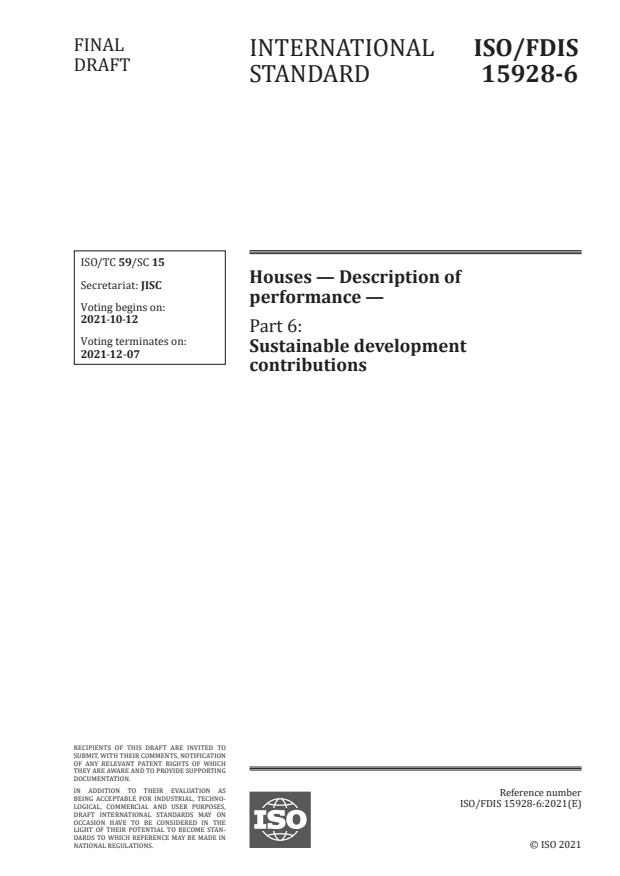
FINAL
INTERNATIONAL ISO/FDIS
DRAFT
STANDARD 15928-6
ISO/TC 59/SC 15
Houses — Description of
Secretariat: JISC
performance —
Voting begins on:
2021-10-12
Part 6:
Voting terminates on:
Sustainable development
2021-12-07
contributions
RECIPIENTS OF THIS DRAFT ARE INVITED TO
SUBMIT, WITH THEIR COMMENTS, NOTIFICATION
OF ANY RELEVANT PATENT RIGHTS OF WHICH
THEY ARE AWARE AND TO PROVIDE SUPPOR TING
DOCUMENTATION.
IN ADDITION TO THEIR EVALUATION AS
Reference number
BEING ACCEPTABLE FOR INDUSTRIAL, TECHNO-
LOGICAL, COMMERCIAL AND USER PURPOSES,
DRAFT INTERNATIONAL STANDARDS MAY ON
OCCASION HAVE TO BE CONSIDERED IN THE
LIGHT OF THEIR POTENTIAL TO BECOME STAN-
DARDS TO WHICH REFERENCE MAY BE MADE IN
NATIONAL REGULATIONS. © ISO 2021
© ISO 2021
All rights reserved. Unless otherwise specified, or required in the context of its implementation, no part of this publication may
be reproduced or utilized otherwise in any form or by any means, electronic or mechanical, including photocopying, or posting on
the internet or an intranet, without prior written permission. Permission can be requested from either ISO at the address below
or ISO’s member body in the country of the requester.
ISO copyright office
CP 401 • Ch. de Blandonnet 8
CH-1214 Vernier, Geneva
Phone: +41 22 749 01 11
Email: copyright@iso.org
Website: www.iso.org
Published in Switzerland
ii
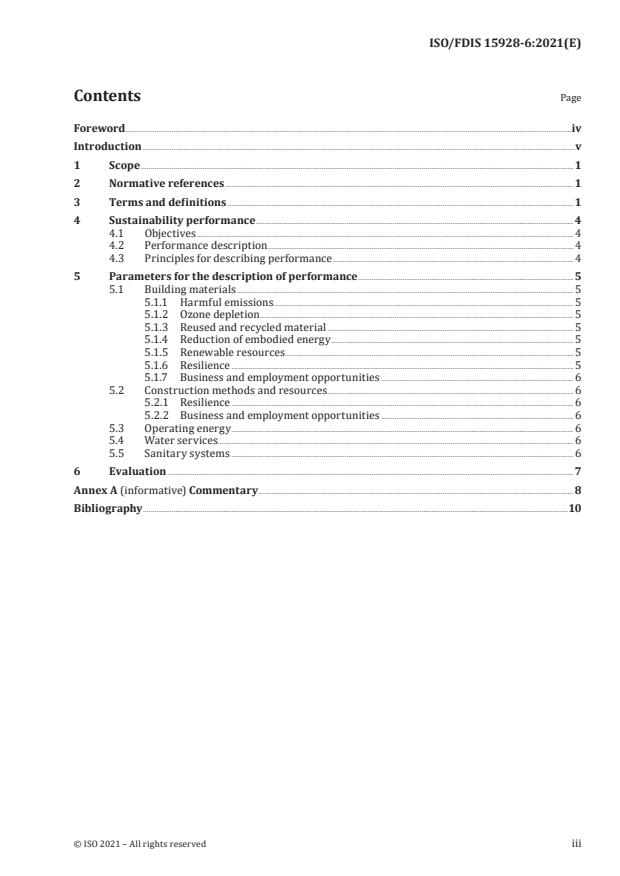
Contents Page
Foreword .iv
Introduction .v
1 Scope . 1
2 Normative references . 1
3 Terms and definitions . 1
4 Sustainability performance . 4
4.1 Objectives . 4
4.2 Performance description . 4
4.3 Principles for describing performance . 4
5 Parameters for the description of performance . 5
5.1 Building materials . 5
5.1.1 Harmful emissions . . . 5
5.1.2 Ozone depletion . 5
5.1.3 Reused and recycled material . 5
5.1.4 Reduction of embodied energy . 5
5.1.5 Renewable resources . . 5
5.1.6 Resilience . 5
5.1.7 Business and employment opportunities . 6
5.2 Construction methods and resources . 6
5.2.1 Resilience . 6
5.2.2 Business and employment opportunities . 6
5.3 Operating energy . 6
5.4 Water services. 6
5.5 Sanitary systems . 6
6 Evaluation . 7
Annex A (informative) Commentary . 8
Bibliography .10
iii
Foreword
ISO (the International Organization for Standardization) is a worldwide federation of national standards
bodies (ISO member bodies). The work of preparing International Standards is normally carried out
through ISO technical committees. Each member body interested in a subject for which a technical
committee has been established has the right to be represented on that committee. International
organizations, governmental and non-governmental, in liaison with ISO, also take part in the work.
ISO collaborates closely with the International Electrotechnical Commission (IEC) on all matters of
electrotechnical standardization.
The procedures used to develop this document and those intended for its further maintenance are
described in the ISO/IEC Directives, Part 1. In particular, the different approval criteria needed for the
different types of ISO documents should be noted. This document was drafted in accordance with the
editorial rules of the ISO/IEC Directives, Part 2 (see www.iso.org/directives).
Attention is drawn to the possibility that some of the elements of this document may be the subject of
patent rights. ISO shall not be held responsible for identifying any or all such patent rights. Details of
any patent rights identified during the development of the document will be in the Introduction and/or
on the ISO list of patent declarations received (see www.iso.org/patents).
Any trade name used in this document is information given for the convenience of users and does not
constitute an endorsement.
For an explanation of the voluntary nature of standards, the meaning of ISO specific terms and
expressions related to conformity assessment, as well as information about ISO's adherence to
the World Trade Organization (WTO) principles in the Technical Barriers to Trade (TBT), see
www.iso.org/iso/foreword.html.
This document was prepared by Technical Committee ISO/TC 59, Buildings and civil engineering works,
Subcommittee SC 15, Framework for the description of housing performance.
A list of all parts in the ISO 15928 series can be found on the ISO website.
Any feedback or questions on this document should be directed to the user’s national standards body. A
complete listing of these bodies can be found at www.iso.org/members.html.
iv
Introduction
The ISO 15928 series applies the framework for specifying the performance of buildings established in
ISO 19208 to buildings occupied for residential purposes that can be separated or linked horizontally,
but not linked vertically, and which have their own access and do not share any common space. This
document covers the house as constructed including permanent services and finishings. It does not
cover:
a) the use of the land for houses;
b) the design and operation of the environment within which houses are located;
c) household waste for the use stage;
d) moveable contents within homes.
Each part of the ISO 15928 series addresses a different attribute of a house and its parts, the objective of
which is to identify the methods that are used to describe the performance for that attribute. Each part
as such identifies objectives, provides performance descriptions, establishes parameter descriptions,
and outlines evaluation processes for an attribute of a home and its parts.
These documents, which do not specify levels of performance, are intended to assist anyone
concerned with specifying performance of attributes and aspects of houses or parts thereof, including
purchasers, regulators, international and national committee members and specifiers, to describe their
requirements in standardized performance terms. This in turn enables manufacturers/suppliers to
respond by describing the performance of their products in a similar manner.
The performance concept has historically been used to address fitness for intended use of various
attributes of a building either as a whole or as a part thereof. This concept has in recent years been
expanded to address the relevant aspects of building design and the potential impact of choices made
regarding, amongst other things, building materials, construction methods and resources, operating
energy, water services and sanitary systems on economic conditions, the environment, a society or
the quality of life. Accordingly, ISO 19208 includes considerations of the contributions to sustainable
development in the framework for specifying the performance of buildings.
ISO 15392 establishes general principles for the contribution of buildings, civil engineering works
and other types of construction works to sustainable development. It is based on the concept of
sustainable development as it applies to the life cycle of construction works, from inception to the end-
of-life. ISO 15392 does not provide performance levels (benchmarks) that can serve as the basis for
sustainability claims. ISO 21929-1 establishes a core set of indicators to take into account in the use and
development of sustainability indicators for assessing the sustainability performance of new or existing
buildings, related to their design, construction, operation, maintenance, refurbishment and end of life.
ISO 21931-1 provides a general framework for improving the quality and comparability of methods for
assessing the environmental performance of buildings and their related external works.
The purpose of this document is, drawing on the principles of ISO 15392, ISO 21929-1 and ISO 21931-
1 for sustainability, to develop a standardized framework for describing performance of houses in a
manner that is consistent with the provisions of ISO 19208.
In this document, only a limited set of building attributes are considered: building materials,
construction methods and equipment and people, operating energy, water services and sanitary
systems. The limited set of environmental issues being considered are emissions to air, use of non-
renewable resources, and freshwater consumption.
Sustainability and sustainable development can be approached from a number of viewpoints.
Accordingly, some of the performance descriptions are not always applicable or appropriate to all users.
The guidance provided in ISO Guide 82 was considered for the development of this document. This
document contributes to several of the UN Sustainable Development Goals, including SDG 8 (Promote
sustained, inclusive and sustainable economic growth, full and productive employment and decent
v
work for all), SDG 9 (Build resilient infrastructure, promote inclusive and sustainable industrialization
and foster innovation), SDG 12 (Ensure sustainable consumption and production patterns) and SDG 13
(Take urgent action to combat climate change and its impacts).
Annex A provides commentary on the framework provided in this document.
NOTE 1 Impacts arise from changes or existing conditions and can be either adverse, neutral, or beneficial.
NOTE 2 As it relates to SDG 12, reducing our environmental impact, promoting the use of renewable sources
of energy and encouraging responsible purchasing decisions related to houses can contribute to sustainable
consumption and production. Sustainability is highly relevant when it comes to construction.
NOTE 3 As it relates to SDG 13, taking action to combat climate change and its impacts through appropriate
building design and choice of building products plays an essential role in the climate agenda, helping to influence
climate change, quantify greenhouse gas emissions and promote good practice in environmental management.
vi
FINAL DRAFT INTERNATIONAL STANDARD ISO/FDIS 15928-6:2021(E)
Houses — Description of performance —
Part 6:
Sustainable development contributions
1 Scope
This document sets out a framework for describing the potential impact of choices on sustainable
development made regarding building materials, construction methods and equipment and people,
operating energy, water services and sanitary systems for a house. It outlines a performance-based
decision-making approach to assessing such impacts.
This document is intended for use in the evaluation of houses that can be separated from, or linked
horizontally, to another house(s). Where houses are linked, and some sharing of services occurs,
performance can be assessed both for individual houses, as well as a group of houses that are linked
together.
2 Normative references
The following documents are referred to in the text in such a way that some or all of their content
constitutes requirements of this document. For dated references, only the edition cited applies. For
undated references, the latest edition of the referenced document (including any amendments) applies.
ISO 15928-5, Houses — Description of performance — Part 5: Operating energy
3 Terms and definitions
For the purposes of this document, the following terms and definitions apply.
ISO and IEC maintain terminology databases for use in standardization at the following addresses:
— ISO Online browsing platform: available at https:// www .iso .org/ obp
— IEC Electropedia: available at https:// www .electropedia .org/
3.1
attribute
characteristic assessed in terms of whether it does or does not meet a given performance (3.10)
[SOURCE: ISO 6707-1:2020, 3.7.1.4 — EXAMPLE has been deleted.]
3.2
competent person
person who has demonstrated his/her ability to apply knowledge and skills to make a determination
regarding the performance (3.10) of building attributes (3.1) in relation to the required performance
[SOURCE: ISO 19208:2016, 3.5]
3.3
component
product (3.12) manufactured as a distinct unit to serve a specific function or functions
[SOURCE: ISO 19208:2016, 3.6]
3.4
embodied energy
total of all the energy consumed in the processes associated with the production of materials (3.8) and
products (3.12)
[SOURCE: ISO 6707-3:2017, 3.7.6]
3.5
house
building occupied for residential purposes and designed as one unit (dwelling) with its own access
Note 1 to entry: The house can be a separate building or linked horizontally with another house but not linked
vertically.
[SOURCE: ISO 15928-5:2013, 3.1, modified — The original notes 1 to 4 to entry have been removed; a
new note to entry has been added.]
3.6
impact
change that may be beneficial or adverse
[SOURCE: IS
...
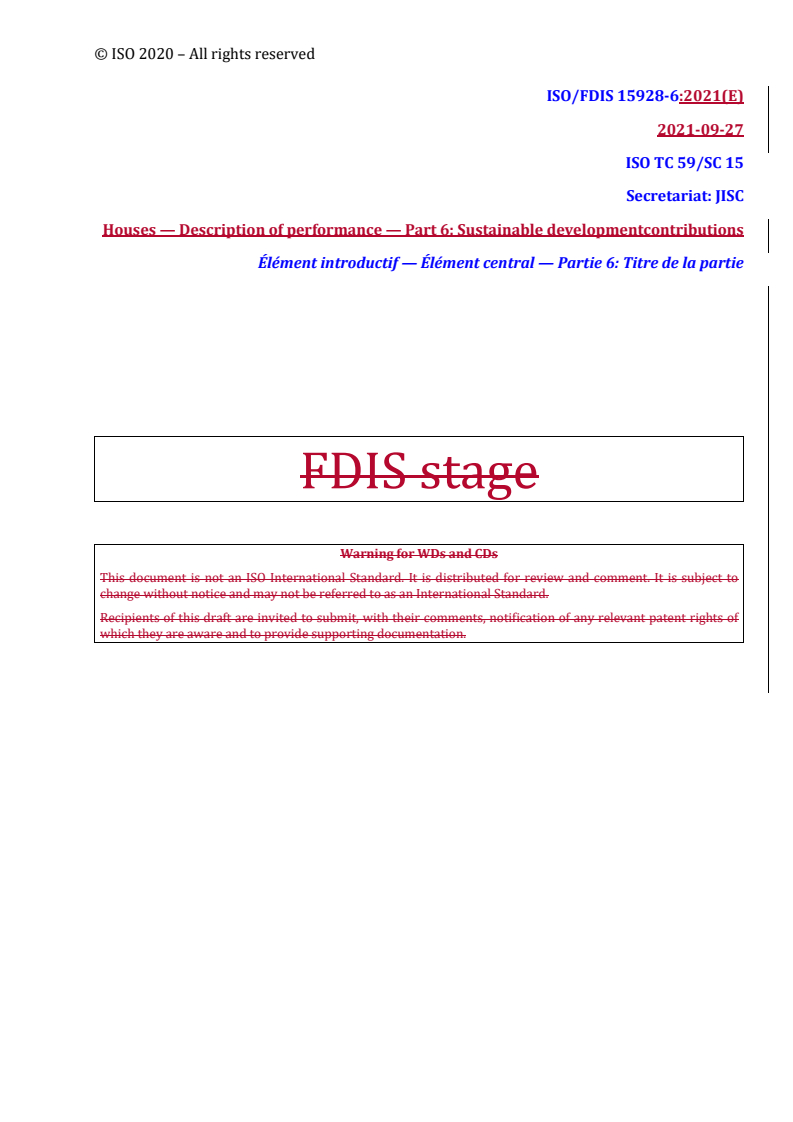
2021-09-27
ISO TC 59/SC 15
Secretariat: JISC
Houses — Description of performance — Part 6: Sustainable developmentcontributions
Élément introductif — Élément central — Partie 6: Titre de la partie
FDIS stage
Warning for WDs and CDs
This document is not an ISO International Standard. It is distributed for review and comment. It is subject to
change without notice and may not be referred to as an International Standard.
Recipients of this draft are invited to submit, with their comments, notification of any relevant patent rights of
which they are aware and to provide supporting documentation.
ISO/FDIS 15928-76:2021(E)
All rights reserved. Unless otherwise specified, or required in the context of its implementation, no part
of this publication may be reproduced or utilized otherwise in any form or by any means, electronic or
mechanical, including photocopying, or posting on the internet or an intranet, without prior written
permission. Permission can be requested from either ISO at the address below or ISO’s member body
in the country of the requester.
ISO copyright office
CP 401 • Ch. de Blandonnet 8
CH-1214 Vernier, Geneva
Phone: +41 22 749 01 11
Fax: +41 22 749 09 47
Email: copyright@iso.org
Website: www.iso.orgwww.iso.org
Published in Switzerland
iv © ISO 2021 – All rights reserved
ISO/FDIS 15928-76:2021(E)
Contents
Foreword . v
Introduction .vi
1 Scope . 1
2 Normative references . 1
3 Terms and definitions . 1
4 Sustainability performance . 4
4.1 Objectives . 4
4.2 Performance description . 4
4.3 Principles for describing performance . 5
5 Parameters for the description of performance . 5
5.1 Building materials . 5
5.1.1 Harmful emissions . 5
5.1.2 Ozone depletion . 5
5.1.3 Reused and recycled material . 5
5.1.4 Reduction of embodied energy . 6
5.1.5 Renewable resources . 6
5.1.6 Resilience . 6
5.1.7 Business and employment opportunities . 6
5.2 Construction methods and resources . 7
5.2.1 Resilience . 7
5.2.2 Business and employment opportunities . 7
5.3 Operating energy . 7
5.4 Water services . 7
5.5 Sanitary systems . 7
6 Evaluation . 7
Annex A (informative) Commentary . 9
Bibliography . 12
Foreword .iv
Introduction . v
1 Scope . 1
2 Normative references . 1
3 Terms and definitions . 1
4 Sustainability performance . 4
4.1 Objectives . 4
4.2 Performance description . 4
4.3 Principles for describing sustainability performance . 5
5 Parameters for the description of performance . 5
5.1 Building materials . 5
reserved
ISO/FDIS 15928-76:2021(E)
5.2 Construction methods and resources . 6
5.3 Operating energy . 6
5.4 Water services . 6
5.5 Sanitary systems . 7
6 Evaluation . 7
Annex A (informative) Commentary . 8
Bibliography .10
vi © ISO 2021 – All rights reserved
ISO/FDIS 15928-76:2021(E)
Foreword
ISO (the International Organization for Standardization) is a worldwide federation of national standards
bodies (ISO member bodies). The work of preparing International Standards is normally carried out
through ISO technical committees. Each member body interested in a subject for which a technical
committee has been established has the right to be represented on that committee. International
organizations, governmental and non-governmental, in liaison with ISO, also take part in the work. ISO
collaborates closely with the International Electrotechnical Commission (IEC) on all matters of
electrotechnical standardization.
The procedures used to develop this document and those intended for its further maintenance are
described in the ISO/IEC Directives, Part 1. In particular, the different approval criteria needed for the
different types of ISO documents should be noted. This document was drafted in accordance with the
editorial rules of the ISO/IEC Directives, Part 2 (see www.iso.org/directives).
Attention is drawn to the possibility that some of the elements of this document may be the subject of
patent rights. ISO shall not be held responsible for identifying any or all such patent rights. Details of any
patent rights identified during the development of the document will be in the Introduction and/or on
the ISO list of patent declarations received (see www.iso.org/patents).
Any trade name used in this document is information given for the convenience of users and does not
constitute an endorsement.
For an explanation of the voluntary nature of standards, the meaning of ISO specific terms and
expressions related to conformity assessment, as well as information about ISO's adherence to the World
Trade Organization (WTO) principles in the Technical Barriers to Trade (TBT)), see
www.iso.org/iso/foreword.htmlthe following URL: .
This document was prepared by Technical Committee ISO/TC 59, Buildings and civil engineering works,
Subcommittee SC 15, Framework for the description of housing performance.
A list of all parts in the ISO 15928 series can be found on the ISO website.
Any feedback or questions on this document should be directed to the user’s national standards body. A
complete listing of these bodies can be found at www.iso.org/members.html.
reserved
ISO/FDIS 15928-76:2021(E)
Introduction
The ISO 15928 series applies the framework for specifying the performance of buildings established in
ISO 19208 to buildings occupied for residential purposes that can be separated or linked horizontally,
but not linked vertically, and which have their own access and do not share any common space. This
document covers the house as constructed including permanent services and finishings. It does not cover:
a) the use of the land for houses;
b) the design and operation of the environment within which houses are located;
c) household waste for the use stage;
d) moveable contents within homes.
Each part of the ISO 15928 series addresses a different attribute of a house and its parts, the objective of
which is to identify the methods that are used to describe the performance for that attribute. Each part
as such identifies objectives, provides performance descriptions, establishes parameter descriptions, and
outlines evaluation processes for an attribute of a home and its parts.
These documents, which do not specify levels of performance, are intended to assist anyone concerned
with specifying performance of attributes and aspects of houses or parts thereof, including purchasers,
regulators, international and national committee members and specifiers, to describe their requirements
in standardized performance terms. This in turn enables manufacturers/suppliers to respond by
describing the performance of their products in a similar manner.
The performance concept has historically been used to address fitness for intended use of various
attributes of a building either as a whole or as a part thereof. This concept has in recent years been
expanded to address the relevant aspects of building design and the potential impact of choices made
regarding, amongst other things, building materials, construction methods and resources, operating
energy, water services and sanitary systems on economic conditions, the environment, a society or the
quality of life. Accordingly, ISO 19208 includes considerations of the contributions to sustainable
development in the framework for specifying the performance of buildings.
ISO 15392 establishes general principles for the contribution of buildings, civil engineering works and
other types of construction works to sustainable development. It is based on the concept of sustainable
development as it applies to the life cycle of construction works, from inception to the end-of-life.
ISO 15392 does not provide performance levels (benchmarks) that can serve as the basis for
sustainability claims. ISO 21929-1 establishes a core set of indicators to take into account in the use and
development of sustainability indicators for assessing the sustainability performance of new or existing
buildings, related to their design, construction, operation, maintenance, refurbishment and end of life.
ISO 21931-1 provides a general framework for improving the quality and comparability of methods for
assessing the environmental performance of buildings and their related external works.
The purpose of this document is, drawing on the principles of ISO 15392, ISO 21929-1 and ISO 21931-1
for sustainability, to develop a standardized framework for describing performance of houses in a
manner that is consistent with the provisions of ISO 19208.
In this document, only a limited set of building attributes are considered: building materials, construction
methods and equipment and people, operating energy, water services and sanitary systems. The limited
set of environmental issues being considered are emissions to air, use of non-renewable resources, and
freshwater consumption.
viii © ISO 2021 – All rights reserved
ISO/FDIS 15928-76:2021(E)
Sustainability and sustainable development can be approached from a number of viewpoints.
Accordingly, some of the performance descriptions are not always applicable or appropriate to all users.
The guidance provided in ISO Guide 82 was considered for the development of this document. This
document contributes to several of the UN Sustainable Development Goals, including SDG 8 (Promote
sustained, inclusive and sustainable economic growth, full and productive employment and decent work
for all), SDG 9 (Build resilient infrastructure, promote inclusive and sustainable industrialization and
foster innovation), SDG 12 (Ensure sustainable consumption and production patterns) and SDG 13 (Take
urgent action to combat climate change and its impacts).
Annex A provides commentary on the framework provided in this document.
NOTE 1 Impacts arise from changes or existing conditions and can be either adverse, neutral, or beneficial.
NOTE 2 As it relates to SDG 12, reducing our environmental impact, promoting the use of renewable sources of
energy and encouraging responsible purchasing decisions related to houses can contribute to sustainable
consumption and production. Sustainability is highly relevant when it comes to construction.
NOTE 3 As it relates to SDG 13, taking action to combat climate change and its impacts through appropriate
building design and choice of building products plays an essential role in the climate agenda, helping to influence
climate change, quantify greenhouse gas emissions and promote good practice in environmental management.
reserved
FINAL DRAFT INTERNATIONAL STANDARD ISO/FDIS 15928-6:2021(E)
Houses — Description of performance — Part 6: Sustainable
development contributions
1 Scope
This document sets out a framework for describing the potential impact of choices on sustainable
development made regarding building materials, construction methods and equipment and people,
operating energy, water services and sanitary systems for a house. It outlines a performance-based
decision-making approach to assessing such impacts.
This document is intended for use in the evaluation of houses that can be separated from, or linked
horizontally, to another house(s). Where houses are linked, and some sharing of services occurs,
performance can be assessed both for individual houses, as well as a group of houses that are linked
together.
2 Normative references
The following documents are referred to in the text in such a way that some or all of their content
constitutes requirements of this document. For dated references, only the edition cited applies. For
undated references, the latest edition of the referenced document (including any amendments) applies.
ISO 15928-5, Houses — Description of performance — Part 5: Operating energy
3 Terms and definitions
For the purposes of this document, the following terms and definitions apply.
ISO and IEC maintain terminology databases for use in standardization at the following addresses:
— IEC Electropedia: available at — ISO Online browsing platform: available at
https://www.iso.org/obp
— IEC Electropedia: available at https://www.electropedia.org/
3.1
attribute
characteristic assessed in terms of whether it does or does not meet a given performance (3.10)
[SOURCE: ISO 6707-1:2020, 3.7.1.4 – Example— EXAMPLE has been deleted].]
3.2
competent person
person who has demonstrated his/her ability to apply knowledge and skills to make a determination
) in relation to the required performance
regarding the performance (3.10) of building attributes (3.111
[SOURCE: ISO 19208:2016, 3.5]
3.3
component
ISO/FDIS 15928-76:2021(E)
product (3.12) manufactured as a distinct unit to se
...
Questions, Comments and Discussion
Ask us and Technical Secretary will try to provide an answer. You can facilitate discussion about the standard in here.
Loading comments...