

ISO 16121-3:2011
(Main)Road vehicles — Ergonomic requirements for the driver's workplace in line-service buses — Part 3: Information devices and controls
General Information
- Abstract
ISO 16121-3:2011 specifies requirements for the location of information devices and controls. ISO 16121-3:2011 applies to the driver's workplace in low-floor buses designed for the carriage of passengers, comprising more than eight seats in addition to the driver's seat, and having a maximum weight exceeding five metric tonnes and a maximum width exceeding 2,30 m.
- Status
- Published
- Publication Date
- 27-Jul-2011
- Technical Committee
- ISO/TC 22/SC 39 - Ergonomics
- Drafting Committee
- ISO/TC 22/SC 39 - Ergonomics
- Current Stage
- 9060 - Close of review
- Completion Date
- 02-Dec-2029
Overview
ISO 16121-3:2011 - "Road vehicles - Ergonomic requirements for the driver's workplace in line-service buses - Part 3: Information devices and controls" specifies ergonomic requirements for the location and arrangement of information devices and controls in the driver’s workplace of low‑floor, line‑service buses. The standard applies to buses with more than eight passenger seats (in addition to the driver), a maximum weight > 5 metric tonnes and a width > 2.30 m. It builds on ergonomic research and defines practical layout rules to reduce driver workload and improve safety.
Key topics and requirements
- Zone-based layout (A–F): Devices and controls are allocated to Zones A–F relative to the steering wheel and driver seating (e.g., Zone A beneath the steering wheel for indicator lamps and central displays; Zones B/C to the left/right for frequently used controls; Zone F for infrequently used roof-mounted equipment).
- Hand reach and anthropometry: Hand reach defined by 750 mm hemispheres from shoulder points; design considers driver statures from 1.55 m to 2.0 m (including ~30 mm shoes).
- Information prioritization: Displays and indicators must present relevant, unambiguous information with ranked priorities (safety, origin, addressee). Distinction between early warning (visual, no immediate action) and alert (immediate action) is required.
- Visual coding and symbols: Use large, clear symbols (ISO 2575) and color coding - red for alerts, yellow for early warnings; fault messages should differentiate urgency.
- Recommended control locations: Common driving controls (speed indicator, indicators, headlamp controls, wipers, horn) should follow ISO 4040 locations for consistency.
- Adjustable dashboard guidance: If dashboard and steering wheel are adjustable, adjustments should be simultaneous; controls must remain accessible without upper‑body forward bending; avoid operating devices “through the steering wheel”; provide adequate legroom and eliminate pinch/jamming hazards.
- Ergonomic principles: Minimize driver distraction, ensure unobstructed forward/side visibility, and design for convenient ticketing/payment operation where fitted.
Applications and who uses it
- Bus manufacturers and interior designers - to layout driver consoles and instrument clusters.
- Ergonomics and human factors engineers - to validate driver reach, visibility, and control prioritization.
- Transit system integrators and equipment suppliers - for ticketing, monitoring, video and HVAC control placement.
- Fleet operators and regulators - to evaluate compliance, driver safety and usability during procurement or retrofits.
Related standards
- ISO 16121-1: General description, basic requirements (Part 1)
- ISO 16121-2: Visibility (Part 2)
- ISO 16121-4: Cabin environment (Part 4)
- ISO 4040: Location of hand controls, indicators and tell‑tales
- ISO 2575: Symbols for controls, indicators and tell‑tales
Keywords: ISO 16121-3:2011, ergonomic requirements, driver's workplace, line-service buses, information devices and controls, low-floor buses, control layout, Zones A–F, ISO 4040, ISO 2575.
Relations
- Effective Date
- 06-Jun-2022
- Effective Date
- 19-Feb-2011
Get Certified
Connect with accredited certification bodies for this standard

TÜV Rheinland
TÜV Rheinland is a leading international provider of technical services.

TÜV SÜD
TÜV SÜD is a trusted partner of choice for safety, security and sustainability solutions.

DEKRA Certification Inc.
DEKRA US certification services.
Sponsored listings
Frequently Asked Questions
ISO 16121-3:2011 is a standard published by the International Organization for Standardization (ISO). Its full title is "Road vehicles — Ergonomic requirements for the driver's workplace in line-service buses — Part 3: Information devices and controls". This standard covers: ISO 16121-3:2011 specifies requirements for the location of information devices and controls. ISO 16121-3:2011 applies to the driver's workplace in low-floor buses designed for the carriage of passengers, comprising more than eight seats in addition to the driver's seat, and having a maximum weight exceeding five metric tonnes and a maximum width exceeding 2,30 m.
ISO 16121-3:2011 specifies requirements for the location of information devices and controls. ISO 16121-3:2011 applies to the driver's workplace in low-floor buses designed for the carriage of passengers, comprising more than eight seats in addition to the driver's seat, and having a maximum weight exceeding five metric tonnes and a maximum width exceeding 2,30 m.
ISO 16121-3:2011 is classified under the following ICS (International Classification for Standards) categories: 13.180 - Ergonomics; 43.080.20 - Buses. The ICS classification helps identify the subject area and facilitates finding related standards.
ISO 16121-3:2011 has the following relationships with other standards: It is inter standard links to ISO 5840-3:2021, ISO 16121-3:2005. Understanding these relationships helps ensure you are using the most current and applicable version of the standard.
ISO 16121-3:2011 is available in PDF format for immediate download after purchase. The document can be added to your cart and obtained through the secure checkout process. Digital delivery ensures instant access to the complete standard document.
Standards Content (Sample)
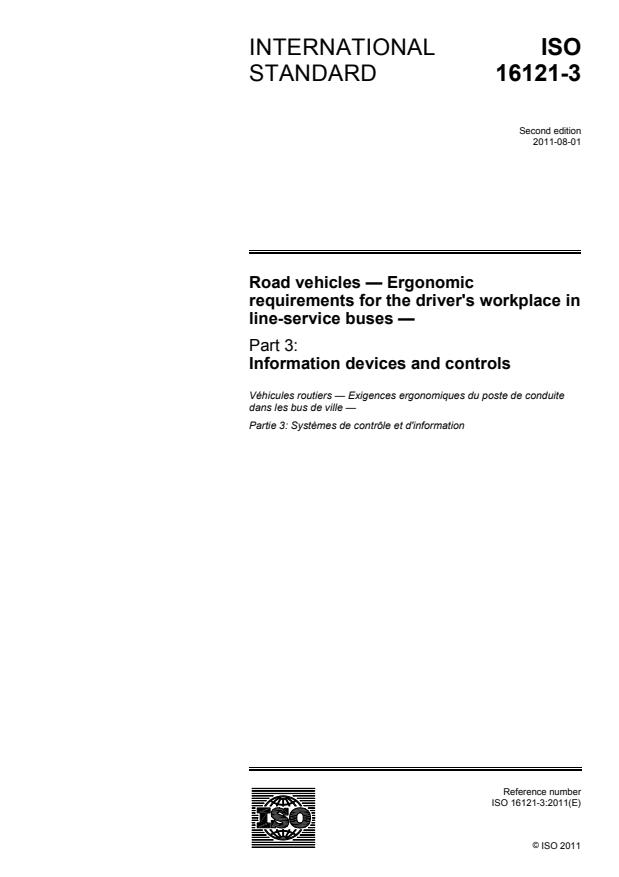
INTERNATIONAL ISO
STANDARD 16121-3
Second edition
2011-08-01
Road vehicles — Ergonomic
requirements for the driver's workplace in
line-service buses —
Part 3:
Information devices and controls
Véhicules routiers — Exigences ergonomiques du poste de conduite
dans les bus de ville —
Partie 3: Systèmes de contrôle et d'information
Reference number
©
ISO 2011
© ISO 2011
All rights reserved. Unless otherwise specified, no part of this publication may be reproduced or utilized in any form or by any means,
electronic or mechanical, including photocopying and microfilm, without permission in writing from either ISO at the address below or
ISO's member body in the country of the requester.
ISO copyright office
Case postale 56 • CH-1211 Geneva 20
Tel. + 41 22 749 01 11
Fax + 41 22 749 09 47
E-mail copyright@iso.org
Web www.iso.org
Published in Switzerland
ii © ISO 2011 – All rights reserved
Contents Page
Foreword .iv
Introduction.v
1 Scope.1
2 Normative references.1
3 Terms, definitions and abbreviated terms.1
3.1 Terms and definitions .1
3.2 Abbreviated terms .3
4 Checking and information devices.5
4.1 Basic ergonomic principles .5
4.2 ISO 4040 compatible location .5
4.3 Zone A.6
4.4 Zone B.6
4.5 Zone B (where available).6
4.6 Zone C.6
4.7 Zone C (where available).7
4.8 Zone D.7
4.9 Zone E.7
4.10 Zone F.7
5 Adjustable dashboard.8
Bibliography.9
Foreword
ISO (the International Organization for Standardization) is a worldwide federation of national standards bodies
(ISO member bodies). The work of preparing International Standards is normally carried out through ISO
technical committees. Each member body interested in a subject for which a technical committee has been
established has the right to be represented on that committee. International organizations, governmental and
non-governmental, in liaison with ISO, also take part in the work. ISO collaborates closely with the
International Electrotechnical Commission (IEC) on all matters of electrotechnical standardization.
International Standards are drafted in accordance with the rules given in the ISO/IEC Directives, Part 2.
The main task of technical committees is to prepare International Standards. Draft International Standards
adopted by the technical committees are circulated to the member bodies for voting. Publication as an
International Standard requires approval by at least 75 % of the member bodies casting a vote.
Attention is drawn to the possibility that some of the elements of this document may be the subject of patent
rights. ISO shall not be held responsible for identifying any or all such patent rights.
ISO 16121-3 was prepared by Technical Committee ISO/TC 22, Road vehicles, Subcommittee SC 13,
Ergonomics applicable to road vehicles.
This second edition cancels and replaces the first edition (ISO 16121-3:2005), which has been editorially
revised.
ISO 16121 consists of the following parts, under the general title Road vehicles — Ergonomic requirements
for the driver's workplace in line-service buses:
⎯ Part 1: General description, basic requirements
⎯ Part 2: Visibility
⎯ Part 3: Information devices and controls
⎯ Part 4: Cabin environment
iv © ISO 2011 – All rights reserved
Introduction
Poor ergonomics in the driver's workplace in buses designed to provide scheduled urban and interurban
services increase the already high physical and mental strains on the drivers.
It is the aim of this part of ISO 16121 to supply the designer of line-service buses with information about how
to develop an overall ergonomic concept for the driver's workplace. The recommended requirements on the
driver's workplace for line-service buses made in this part of ISO 16121 are based on the scientific
conclusions of the research project “Driver's workplace in the line-service bus”. This was conducted in
[1]
Germany and summarized in the recommendation VDV 234 . Further comprehensive ergonomic studies
related to the design of an enhanced driver workplace conducted in the United States, Canada, the
[2][3][4][5][6]
Netherlands, Sweden and the United Kingdom have been considered and found to provide
recommendations covering similar areas.
This part of ISO 16121 sets out to consider the practical implications for all ranges of drivers, but particularly
those with statures from 1,55 m (small female) to 2,0 m (large male). These statures include shoes (∼30 mm).
It is also essential that the designer refers to the specifications and requirements of all parts of ISO 16121
(1 to 4) before completing the design of a driver's workplace.
It should be noted that where there is also national legislation covering any of the subjects contained herein,
then both should be complied with. However, if a contradiction between the two should arise in any specific
area, then the legislation shall prevail for that specific point only.
INTERNATIONAL STANDARD ISO 16121-3:2011(E)
Road vehicles — Ergonomic requirements for the driver's
workplace in line-service buses —
Part 3:
Information devices and controls
1 Scope
This part of ISO 16121 specifies requirements for the location of information devices and controls.
It applies to the driver's workplace in low-floor buses designed for the carriage of passengers, comprising
more than eight seats in addition to the driver's seat, and having a maximum weight exceeding five metric
tonnes and a maximum width exceeding 2,30 m.
2 Normative references
The following referenced documents are indispensable for the application of this document. For dated
references, only the edition cited applies. For undated references, the latest edition of the referenced
document (including any amendments) applies.
ISO 16121-1, Road vehicles — Ergonomic requirements for the driver's workplace in line-service buses —
Part 1: General description, basic requirements
ISO 2575, Road vehicles — Symbols for controls, indicators and tell-tales
ISO 4040, Road vehicles — Location of hand controls, indicators and tell-tales in motor vehicles
3 Terms, definitions and abbreviated terms
3.1 Terms and definitions
For the purposes of this document, the following terms and definitions apply.
3.1.1
low-floor
vehicle in which at least 35 % of the area available for standing passengers (or of its forward section in the
case of an articulated vehicle) forms a single area without steps, reached through at least one service door by
a single step from the ground
3.1.2
early warning
visual signal, no immediate action required
3.1.3
alert
visual signal alarm, immediate action required
3.1.4
Zone A
zone on the dashboard beneath the steering wheel, bounded by a horizontal tangent to the top of the steering
column at its uppermost position, a vertical line projected from the left- and right-hand extremities of the wheel
rim and the top of the dashboard (see Figure 1)
3.1.5
Zone B
zone to the left of the steering wheel limited to the right by outer diameter of steering wheel, limited to t
...