

ISO 11133
(Main)Microbiology of the food chain, animal feed and water — Preparation, production, storage and performance testing of culture media and reagents
- Status
- Not Published
- Technical Committee
- ISO/TC 34/SC 9 - Microbiology
- Current Stage
- 6000 - International Standard under publication - 60 Publication
- Start Date
- 20-Oct-2026
Buy Documents
ISO/FDIS 11133 - Microbiology of the food chain, animal feed and water — Preparation, production, storage and performance testing of culture media and reagents
REDLINE ISO/FDIS 11133 - Microbiology of the food chain, animal feed and water — Preparation, production, storage and performance testing of culture media and reagents
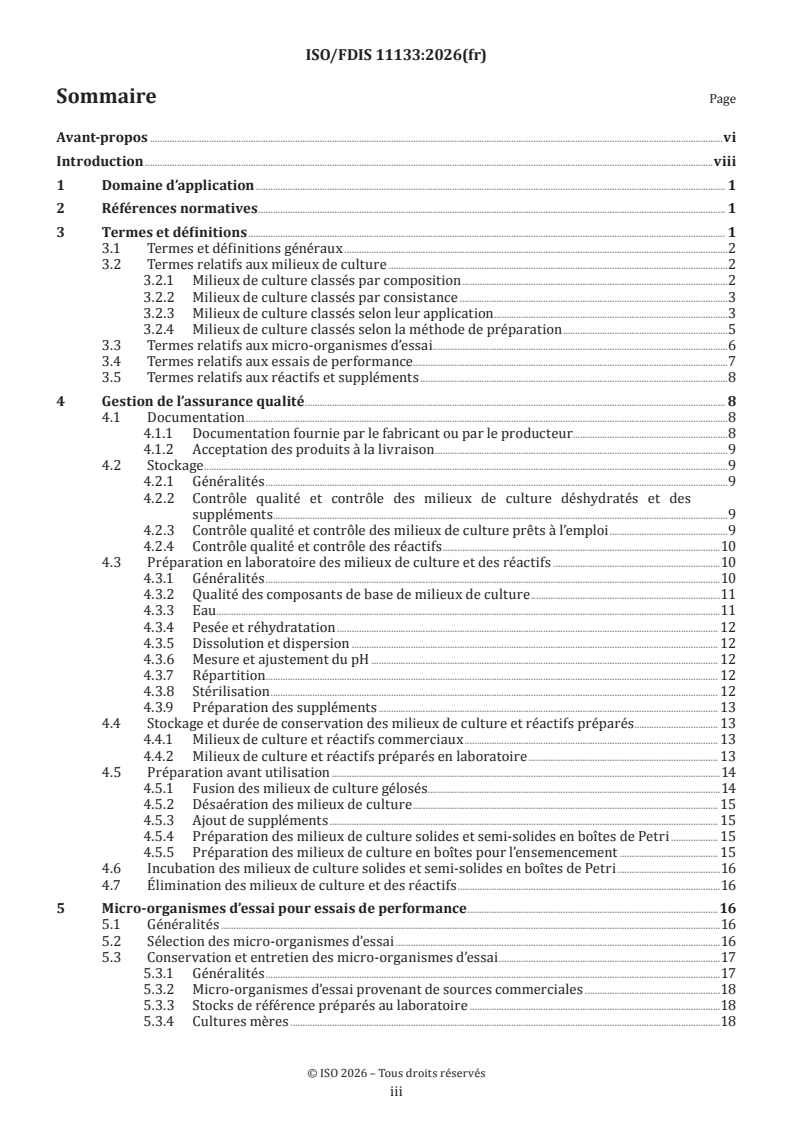
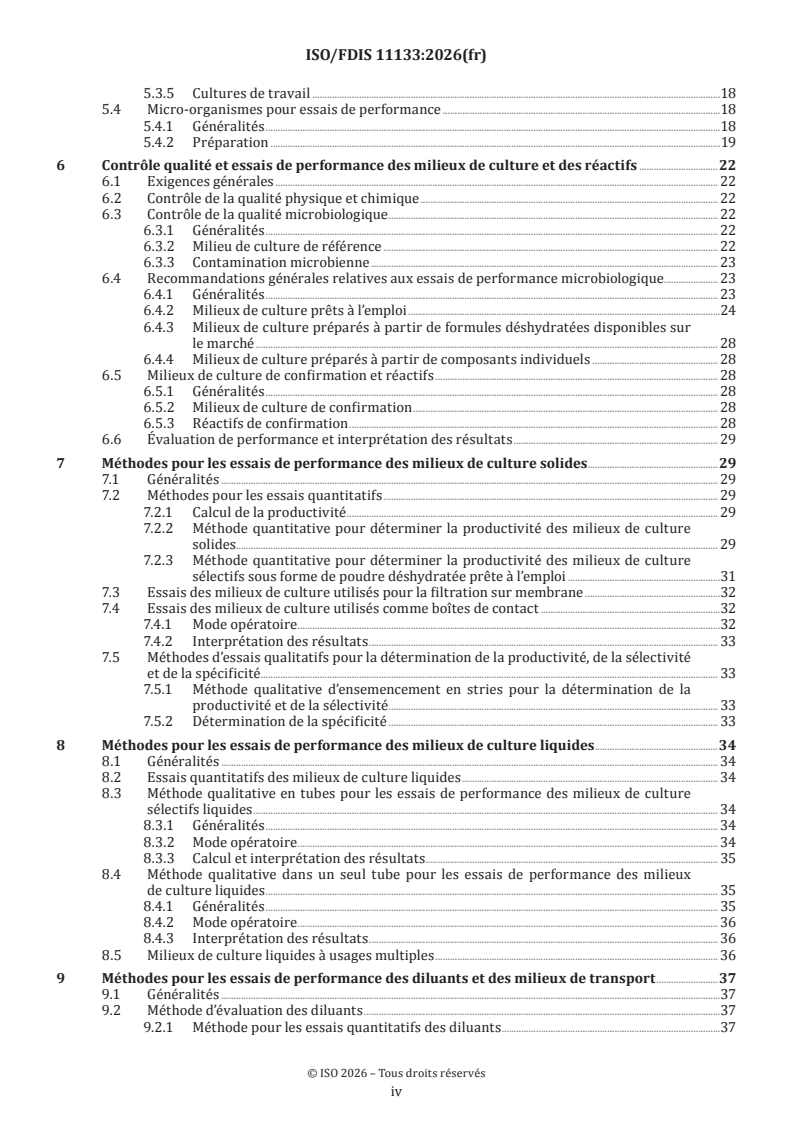
ISO/FDIS 11133 - Microbiologie de la chaîne alimentaire, des aliments pour animaux et de l’eau — Préparation, production, stockage et essais de performance des milieux de culture et des réactifs
ISO 11133 is an ISO standard for the preparation, production, storage and performance testing of culture media and reagents used in microbiological analysis of the food chain, animal feed and water. It is written for laboratories, manufacturers and other users that need to control media quality and prove that a medium, diluent or transport medium performs as intended.
The document tells users how to prepare and store culture media and reagents, how to select and maintain test microorganisms, and how to verify performance with defined criteria. In practice, it is a working standard for batch control, internal quality control and method-specific media verification.
What does ISO 11133 specify?
ISO 11133 specifies requirements for quality assurance of culture media and reagents for microbiological analysis of samples from the food chain and all kinds of water. It applies to all categories and formats of culture media and reagents, including media prepared in-house and proprietary media when their performance criteria are set elsewhere or in the manufacturer’s certificates.
The document is organized around the full media lifecycle: quality assurance management, test microorganisms, quality control and performance testing, methods for solid media, liquid media, diluents and transport media, and documentation of results. The annexes supply the detailed media lists, procedures, examples and criteria that support those clauses.
| Annex | What it covers |
|---|---|
| A | Harmonized designations for culture medium components and reagents |
| B | Preparation of reference stock and working culture |
| C | Flowcharts for performance testing methods |
| D | Example control card for recording test results |
| E | Test microorganisms and performance criteria for culture media and reagents |
| F | Reference culture media |
| G | Use of control charts for quantitative testing of solid media |
| H | Troubleshooting when quality assurance results are unsatisfactory |
| I | Quantitative testing of liquid culture media |
| J | Guidance for defining performance criteria in other microbiological standards |
| K | Preparation of standardized test suspensions and ultra-low freezing |
| L | pH measurement of culture media |
| M | Evaluation protocol for non-selective pre-enrichment culture medium, especially BPW |
What are the key requirements of ISO 11133?
Quality assurance and media control
ISO 11133 requires documented quality assurance for storage, preparation, shelf life, use, incubation and disposal of culture media and reagents. Clause 4 is the core operational part of the standard, and it matters because media quality depends on the ingredients, the preparation steps, contamination control and storage conditions.
Before use, each batch should be assessed against the intended application, whether qualitative or quantitative. If a medium or supplement is too labile to test in advance, the document allows parallel performance testing alongside sample work, which is important for routine laboratories that use short-lived media.
Physical, chemical and microbiological checks
ISO 11133 requires physical and chemical checks such as visual inspection, fill volume or thickness, appearance, colour, homogeneity, gel consistency, moisture content and pH. The pH measurement approach is expanded in Annex L, because pH affects selectivity, productivity and specificity.
Clause 6 also requires microbiological quality control and states that a batch is satisfactory only when both physical-chemical and microbiological criteria are met. If the performance is not satisfactory, Annex H provides troubleshooting guidance, which helps users decide whether the issue is with ingredients, preparation, storage or the test itself.
Test microorganisms and inoculum preparation
ISO 11133 requires the use of defined test microorganisms or control strains for performance testing, and Clause 5 says new or revised microbiological standards shall specify these strains and the acceptance criteria. The document prefers stable strains from reference culture collections, ideally originating from the food chain or water, and it distinguishes robust positive strains, weakly positive strains, negative strains and inhibited strains.
The standard also controls how cultures are preserved, maintained and turned into working cultures and standardized inocula. This matters in practice because poor inoculum control can make a good medium look bad, or a bad medium look acceptable.
Performance testing of solid and liquid media
ISO 11133 gives separate method families for solid media, liquid media, diluents and transport media. For solid media, Clause 7 covers quantitative productivity testing and qualitative testing for productivity, selectivity and specificity. For liquid media, Clause 8 covers quantitative and qualitative tube methods, including selective liquid media and multipurpose media such as BPW.
For media used with membrane filtration, ISO 11133 directs users to ISO 7704 so the whole system, not just the agar, is assessed. For contact plates, Clause 7 includes a dedicated procedure. In practice, users select the test method that matches the medium’s function, rather than applying one universal test to every product.
Special cases: diluents, transport media and BPW
Clause 9 covers diluents and transport media. Diluents are tested quantitatively, liquid transport media are tested quantitatively, and solid transport media are tested qualitatively. That distinction matters because the expected function is not growth promotion but preservation, recovery or controlled dilution without unwanted change.
Annex M adds a dedicated protocol for buffered peptone water (BPW), the standard’s main example of a non-selective pre-enrichment medium. It is aimed at evaluating recovery of stressed microorganisms, especially Salmonella spp., and is useful for comparative studies and product development.
Documentation and traceability
ISO 11133 requires documentation of test results and traceability of routine performance testing. Clause 10 states that the manufacturer or supplier should provide batch-specific growth characteristics on request, and it recommends control sheets for recording results.
This is important for audits, internal reviews and batch release because it creates a record of what was tested, with what microorganisms, and whether the batch met the criteria.
What terms does ISO 11133 define?
- Quality control - Part of quality management focused on fulfilling quality requirements.
- Batch of culture medium - A homogeneous, fully traceable unit of medium produced in one defined production period and given one batch number.
- Test microorganism - A microorganism generally used to test the performance of culture media.
- Reference strain - A microorganism obtained directly from a reference culture collection and defined at least to species level.
- Working culture - A subculture taken from a reference stock, stock culture or reference material for use in testing.
- Target microorganism - The microorganism or group of microorganisms that the medium is intended to detect, enumerate or confirm.
- Productivity - The measure of how well a culture medium recovers a target microorganism under defined conditions.
- Specificity - Demonstration that non-target microorganisms do not show the same visual characteristics as the target microorganism under defined conditions.
Who uses ISO 11133?
ISO 11133 is used by end-users, commercial bodies, non-commercial bodies and laboratories that prepare their own media. It is also relevant to manufacturers and producers of culture media and reagents, especially when they need to define batch acceptance criteria and release procedures.
The standard is used in microbiology laboratories working on food chain samples, animal feed and water. It is also relevant to quality managers, technical managers and buyers who need to specify whether a medium is for isolation, enumeration, confirmation, enrichment, dilution or transport.
What changed in ISO 11133 from the previous edition?
The foreword states that this second edition cancels and replaces ISO 11133:2014 and incorporates Amendments 1 and 2 to that edition. It is described as technically revised.
The changes listed in the foreword include:
- exclusion of culture media now covered in other International Standards
- amalgamation of Annexes E, F and K for media and reagents not yet detailed in specific standards
- performance tests for liquid transport media with neutralizers
- a new Annex F on reference culture media
- Annex G made informative with new content
- a new Annex K on standardized test suspensions and ultra-low freezing
- a new Annex L on pH measurement
- a new Annex M on BPW evaluation
- performance testing for contact plates
- distinguishable target microorganisms
- other amendments and improvements from the technical committees
Which standards are used with ISO 11133?
ISO 11133 cites four normative references that support its procedures:
- ISO 6887 (all parts) - preparation of test samples, initial suspension and decimal dilutions
- ISO 7218 - general requirements and guidance for microbiological examinations
- ISO 7704 - performance testing of membrane filters used for direct enumeration by culture methods
- ISO 8199 - general requirements and guidance for microbiological examinations by culture
The standard is also linked throughout to many method standards that use its media criteria and test organisms, including food and water methods for Salmonella, coliforms, E. coli, enterococci, Bacillus cereus, Campylobacter, yeasts and moulds, sulfite-reducing anaerobes and Legionella. Annex J uses those links to show how new and revised microbiological standards should define media performance criteria and control strains.
What does the ISO 11133 document contain?
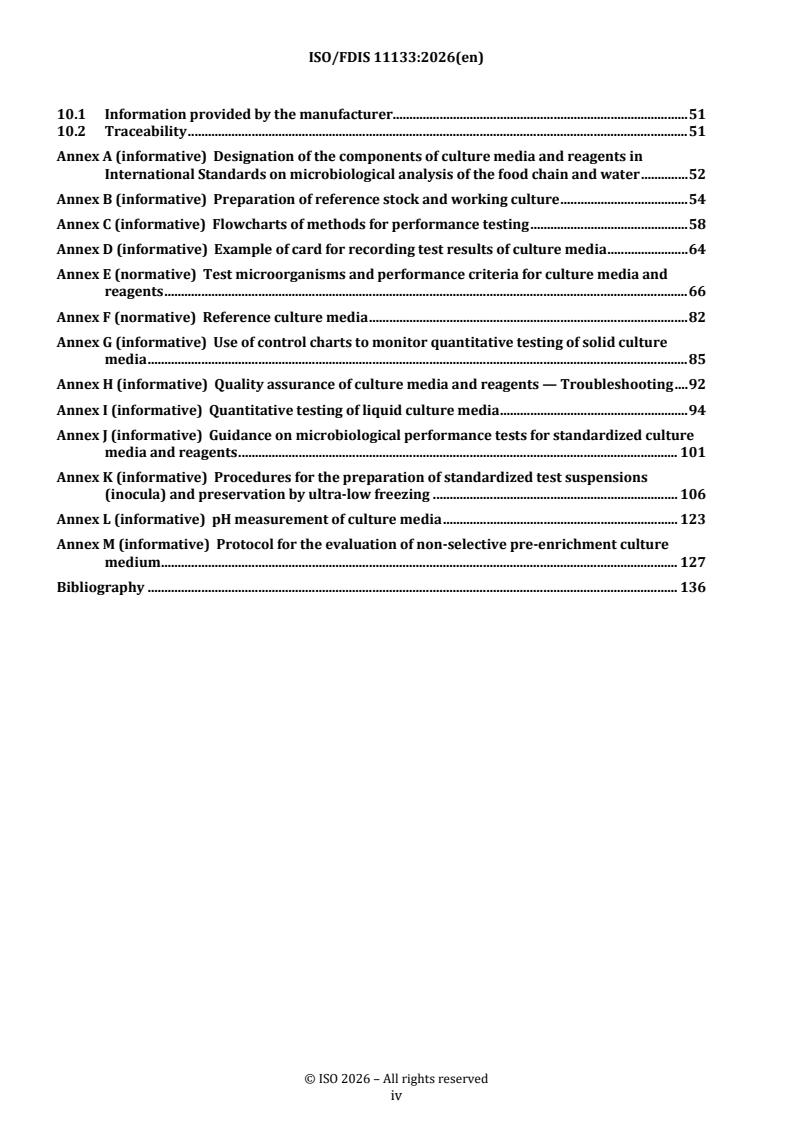
ISO 11133 contains practical procedures, flowcharts, control examples and annexed criteria that support media preparation and verification. Annex C gives method flowcharts, Annex D gives a sample recording card, and Annex E lists the test microorganisms, culture conditions and expected reactions used for performance testing.
The document also contains reference media formulations and preparation details in Annex F, control-chart guidance in Annex G, a troubleshooting framework in Annex H, and a dedicated pH measurement protocol in Annex L. Annex K provides procedures for making standardized test suspensions and preserving them by ultra-low freezing, while Annex M gives a worked protocol for evaluating BPW, including growth-curve and lag-phase analysis.
Relations
- Effective Date
- 12-Feb-2026
- Effective Date
- 20-Aug-2022
- Effective Date
- 10-Jul-2021
- Effective Date
- 18-Apr-2021
- Effective Date
- 23-Apr-2020
Buy Documents
ISO/FDIS 11133 - Microbiology of the food chain, animal feed and water — Preparation, production, storage and performance testing of culture media and reagents
REDLINE ISO/FDIS 11133 - Microbiology of the food chain, animal feed and water — Preparation, production, storage and performance testing of culture media and reagents
ISO/FDIS 11133 - Microbiologie de la chaîne alimentaire, des aliments pour animaux et de l’eau — Préparation, production, stockage et essais de performance des milieux de culture et des réactifs
Frequently Asked Questions
ISO 11133 is a draft published by the International Organization for Standardization (ISO). Its full title is "Microbiology of the food chain, animal feed and water — Preparation, production, storage and performance testing of culture media and reagents". This standard covers: Microbiology of the food chain, animal feed and water — Preparation, production, storage and performance testing of culture media and reagents
Microbiology of the food chain, animal feed and water — Preparation, production, storage and performance testing of culture media and reagents
ISO 11133 is classified under the following ICS (International Classification for Standards) categories: 07.100.20 - Microbiology of water; 07.100.30 - Food microbiology. The ICS classification helps identify the subject area and facilitates finding related standards.
ISO 11133 has the following relationships with other standards: It is inter standard links to FprEN ISO 11133, ISO/IEC 23643:2020, ISO 11133:2014/Amd 1:2018, ISO 11133:2014/Amd 2:2020, ISO 11133:2014. Understanding these relationships helps ensure you are using the most current and applicable version of the standard.
ISO 11133 is available in PDF format for immediate download after purchase. The document can be added to your cart and obtained through the secure checkout process. Digital delivery ensures instant access to the complete standard document.
Standards Content (Sample)
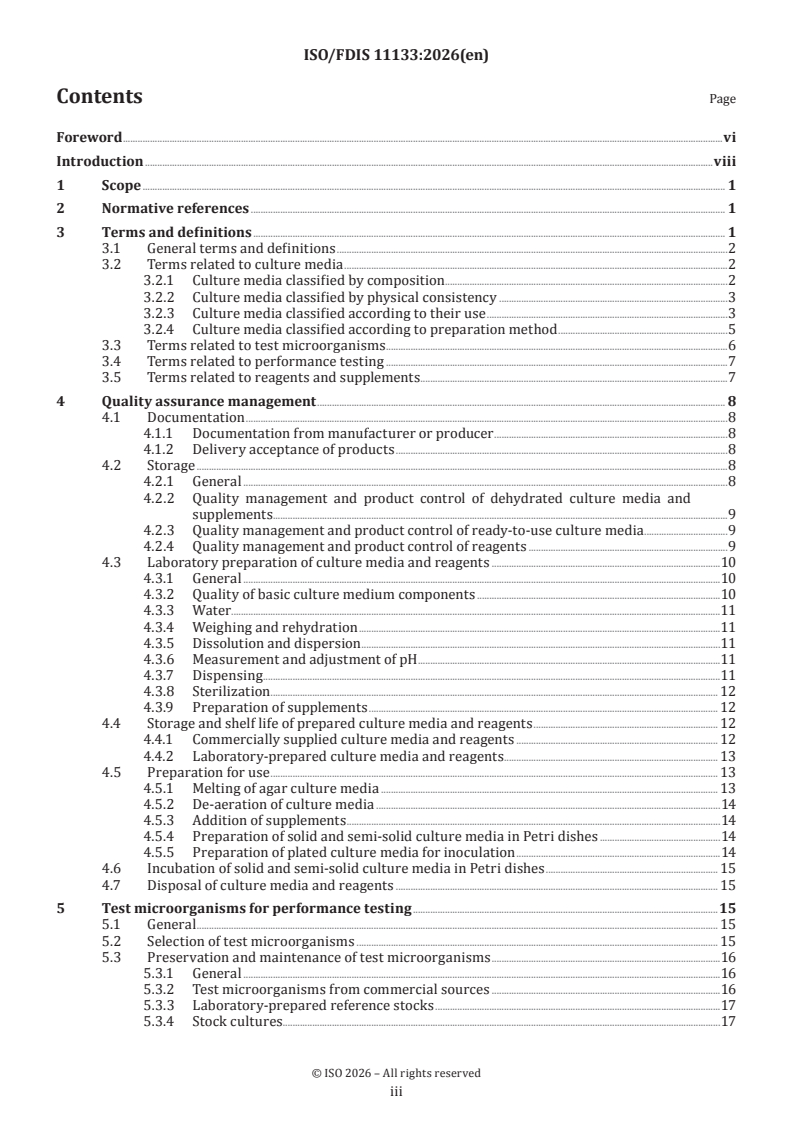
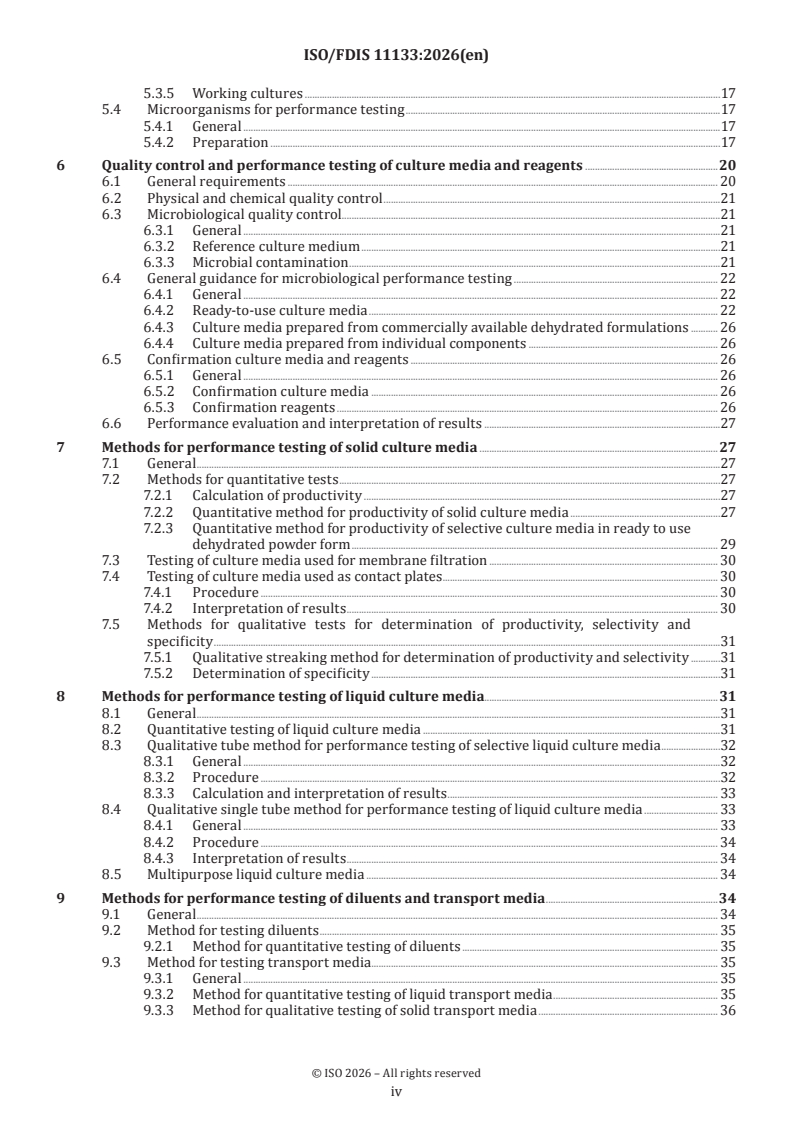
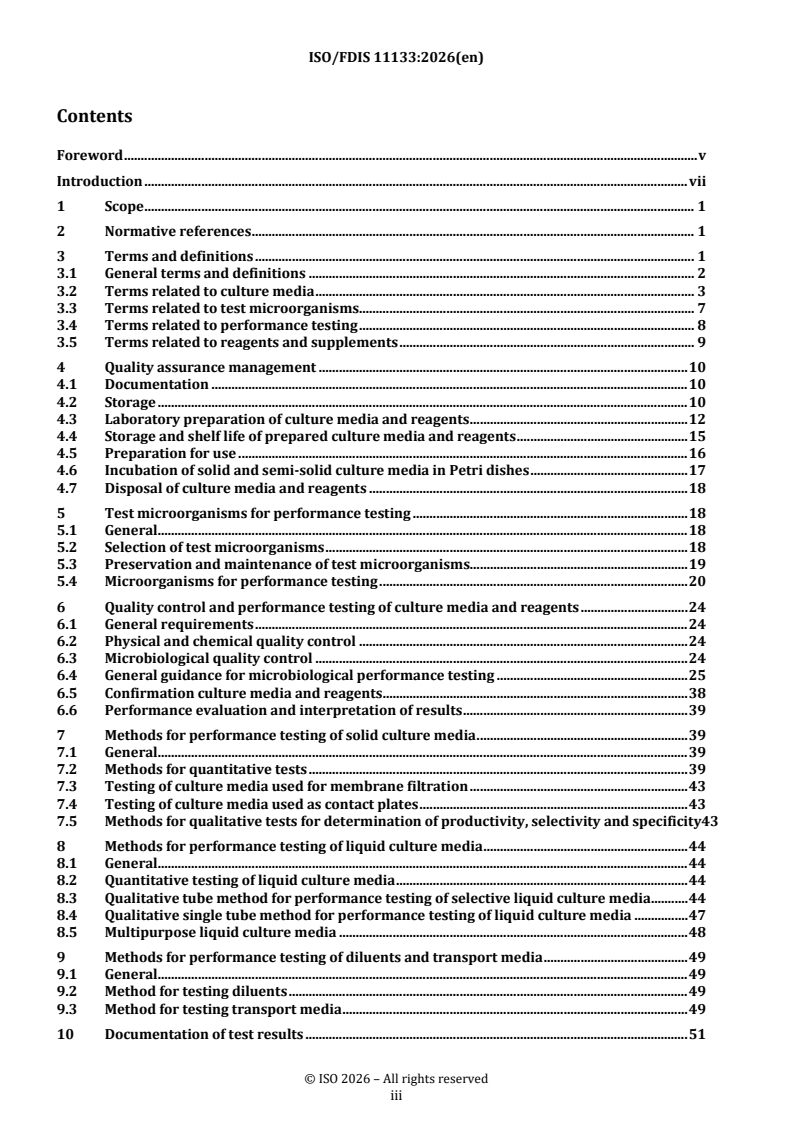
Contents
- Introduction
- 1 Scope
- 2 Normative references
- 3 Terms and definitions
- 3.1 General terms and definitions
- 3.1.1 quality control
- 3.1.2 culture medium
- 3.1.3 batch of culture medium
- 3.1.4 user laboratory preparation
- 3.2 Terms related to culture media
- 3.2.1.1 culture media with defined non-proprietary formula
- 3.2.1.2 widely available ingredients
- 3.2.2.1 liquid culture medium
- 3.2.2.2 solid culture medium
- 3.2.3.1 transport medium
- 3.2.3.2 diluent
- 3.2.3.3 pre-enrichment culture medium
- 3.2.3.4 enrichment culture medium
- 3.2.3.5 isolation culture medium
- 3.2.3.6 differential culture medium
- 3.2.3.7 enumeration culture medium
- 3.2.3.8 confirmation culture medium
- 3.2.3.9 culture medium containing neutralizers
- 3.2.3.10 multipurpose culture medium
- 3.2.3.11 reference culture medium
- 3.2.4.1 finished culture medium
- 3.2.4.2 ready-to-use culture medium
- 3.2.4.3 culture medium prepared from commercially dehydrated formulations
- 3.2.4.4 culture medium prepared from individual components
- 3.3 Terms related to test microorganisms
- 3.3.1 test microorganism
- 3.3.2 reference strain
- 3.3.3 reference stock
- 3.3.4 stock culture
- 3.3.5 working culture
- 3.3.6 reference count
- 3.3.7 reference material
- 3.3.8 certified reference material
- 3.3.9 passage
- 3.4 Terms related to performance testing
- 3.4.1 performance
- 3.4.2 target microorganism
- 3.4.3 non-target microorganism
- 3.4.4 productivity
- 3.4.5 selectivity
- 3.4.6 specificity
- 3.5 Terms related to reagents and supplements
- 3.5.1 reagent
- 3.5.2 batch of reagent
- 3.5.3 confirmation reagent
- 3.5.4 supplement
- 4 Quality assurance management
- 4.1 Documentation
- 4.2 Storage
- 4.3 Laboratory preparation of culture media and reagents
- 4.4 Storage and shelf life of prepared culture media and reagents
- 4.5 Preparation for use
- 4.6 Incubation of solid and semi-solid culture media in Petri dishes
- 4.7 Disposal of culture media and reagents
- 5 Test microorganisms for performance testing
- 5.1 General
- 5.2 Selection of test microorganisms
- 5.3 Preservation and maintenance of test microorganisms
- 5.4 Microorganisms for performance testing
- 6 Quality control and performance testing of culture media and reagents
- 6.1 General requirements
- 6.2 Physical and chemical quality control
- 6.3 Microbiological quality control
- 6.4 General guidance for microbiological performance testing
- 6.5 Confirmation culture media and reagents
- 6.6 Performance evaluation and interpretation of results
- 7 Methods for performance testing of solid culture media
- 7.1 General
- 7.2 Methods for quantitative tests
- 7.3 Testing of culture media used for membrane filtration
- 7.4 Testing of culture media used as contact plates
- 7.5 Methods for qualitative tests for determination of productivity, selectivity and
- 8 Methods for performance testing of liquid culture media
- 8.1 General
- 8.2 Quantitative testing of liquid culture media
Introduction
In laboratories carrying out microbiological examinations, the main objectives are to maintain, resuscitate, grow, detect and/or enumerate a wide variety of microorganisms. Culture media are used in all traditional microbiological culture techniques and also for many alternative techniques. Many formulae of culture media are commercially available and many more, designed for specific growth purposes, are described in the literature.
Many tests and procedures depend upon culture media being capable of providing consistent and reproducible results. The requirements for culture media can be specific to both the sample and the microorganisms to be detected. Culture media meeting established performance criteria are therefore a pre-requisite for any reliable microbiological work. Sufficient testing should be carried out to demonstrate:
a) the acceptability of each batch of culture medium; b) that the culture medium is “fit for purpose”; c) that the culture medium can produce consistent results.
These three criteria are an essential part of internal quality control procedures and, with appropriate documentation, will permit effective monitoring of culture media and contribute to the production of both accurate and reliable data. For reliable microbiological analysis, it is essential to use culture media of proven quality. For all culture media described in International Standard methods, it is essential to define the minimum acceptance criteria required to ensure their reliability. It is recommended that in the determination of the performance characteristics of a culture medium tests are carried out that are in accordance with this document (see Table 1).
Table 1 — Culture media and reagents type in relation to criteria and section of this document Criteria and section of this document Culture media and reagents type Productivity Selectivity Specificity Solid non-selective culture media Quantitative 7.2.2 Solid selective culture media for Quantitative 7.2.2 Qualitative 7.5.1 Qualitative 7.5.2 enumeration Solid selective culture media for Qualitative 7.5.1 Qualitative 7.5.1 Qualitative 7.5.2 isolation Solid non-selective culture media Qualitative 7.5.1 for isolation Solid reference culture media Quantitative 7.2.2 Selective culture media in ready- Quantitative 7.2.3 Qualitative 7.5.1 Qualitative 7.5.2 to-use dehydrated powder form Liquid non-selective enrichment Qualitative 8.4.2.1 culture media Liquid selective enrichment cul- Qualitative 8.3 Qualitative 8.3 ture media Liquid selective culture media for Qualitative 8.4.2.2 Qualitative 8.4.2.2 confirmation Liquid selective culture media for Quantitative Annex I Qualitative 8.3 enumeration Diluents Quantitative 9.2 Liquid transport media Quantitative 9.3.2 Solid transport media Qualitative 9.3.3 Contact plates Quantitative 7.4 The widespread adoption of minimum performance criteria for culture media will lead to products with more consistent quality and thus reduce the extent of testing necessary in the user’s laboratory.
ISO/FDIS 11133:2026(en) In addition, the acceptance criteria measured by the methods defined in this document can be used by all microbiological laboratories to evaluate the productive and selective properties of a culture medium. This includes culture media not described in International Standards, including proprietary culture media, or other methods.
Since 2014, all new and revised International Standards now specify the performance testing of culture media and reagents including the specification of test microorganisms in the International Standard itself. When specific International Standards are revised and new International Standards developed, they will include a paragraph for performance testing of the culture media used in the standard, and will refer to this document for detailed methods (or detailed protocols). To ensure performance testing is to the latest requirements, the ISO webpage enables a rapid cross-check between this document and the International Standards published. Refer to the link: https://committee.iso.org/sites/tc34sc9/home/general-standards/ content-left-area/culture-media/iso-11133-on-culture-media.html, where the spreadsheet link shown will be updated at least annually.
FINAL DRAFT International Standard ISO/FDIS 11133:2026(en) Microbiology of the food chain, animal feed and water — Preparation, production, storage and performance testing of culture media and reagents
1 Scope
This document relates to quality assurance of culture media and reagents, and specifies requirements for the preparation, production and storage of culture media and reagents intended for the microbiological analysis of samples from the food chain as well as all kinds of water. This document is applicable to all categories of culture media and reagents prepared and produced for use in laboratories performing microbiological analyses.
This document also sets criteria and describes methods for the performance testing of culture media and reagents.
This document is applicable to end-users, commercial bodies, non-commercial bodies and laboratories preparing their own media.
This document is applicable to all formats of culture media and reagents. The principles covered in this document can be equally applied to the preparation, production, storage and performance testing of culture media and reagents (used in the intended analysis as described above) that are not captured in International Standards; this includes proprietary culture media, or other methods for which the criteria for the performance of those culture media and reagents are described within those other methods or in the manufacturers’ certificates.
2 Normative references
The following documents are referred to in the text in such a way that some or all of their content constitutes requirements of this document. For dated references, only the edition cited applies. For undated references, the latest edition of the referenced document (including any amendments) applies. ISO 6887 (all parts), Microbiology of the food chain — Preparation of test samples, initial suspension and decimal dilutions for microbiological examination ISO 7218, Microbiology of the food chain — General requirements and guidance for microbiological examinations ISO 7704, Water quality — Requirements for the performance testing of membrane filters used for direct enumeration of microorganisms by culture methods ISO 8199, Water quality — General requirements and guidance for microbiological examinations by culture
3 Terms and definitions
For the purposes of this document, the following terms and definitions apply. ISO and IEC maintain terminology databases for use in standardization at the following addresses:
- ISO Online browsing platform: available at https:// www .iso .org/ obp
- IEC Electropedia: available at https:// www .electropedia .org/
ISO/FDIS 11133:2026(en)
3.1 General terms and definitions
3.1.1 quality control
part of quality management focused on fulfilling quality requirements [SOURCE: ISO 9000:2026, 3.2.8]
3.1.2 culture medium
formulation of substances, in liquid, semi-solid or solid form, which contain natural and/or synthetic constituents intended to support the multiplication (with or without inhibition of certain microorganisms), identification or preservation of viability of microorganisms Note 1 to entry: Some culture media also contain one or more chromogenic/fluorogenic substrates. Chromogenic substrates facilitate the identification of microorganisms by means of defined colour and morphological characteristics. Fluorogenic substrates require visualization using a UV lamp. The biochemical reaction products, which are necessary for the efficiency of chromogenic/fluorogenic culture media, are normally the result of the enzymatic activity of certain microorganisms, which in turn depends greatly on the precise maintenance of specific conditions (e.g. temperature, pH value, concentrations of substrate).
3.1.3 batch of culture medium
lot of culture medium homogeneous and fully traceable unit of a culture medium referring to a defined amount of bulk, semifinished product or end product, which is consistent in type and quality and which has been produced within one defined production period, having been assigned the same batch (or lot) number Note 1 to entry: This applies to the unit produced, whether from individual components or from commercial blend.
3.1.4 user laboratory preparation
culture medium prepared in-house from basic individual components or from a commercial batch of dehydrated culture medium that requires treatment and rehydration before use, according to the manufacturer's instructions, resulting in one of two types of media: a finished culture medium; or a semifinished culture medium
3.2 Terms related to culture media
3.2.1 Culture media classified by composition
3.2.1.1 culture media with defined non-proprietary formula
culture media with a known formulation that do not contain any proprietary ingredient or formulation, and includes a description of all natural and/or synthetic constituents, concentration (including active component from biological origin when appropriate) and preparation protocol Note 1 to entry: Chemical substances may be defined by Chemical Abstracts Service (CAS) numbers. Note 2 to entry: Harmonized designations for natural or chemically undefined components are specified in Annex A.
3.2.1.2 widely available ingredients
natural and/or synthetic constituents publicly available to be sourced from several countries, suppliers or origins with non-restrictive terms of use Note 1 to entry: Availability should be assessed, not exclusively, considering ingredient conditions associated to price, toxicity, quality, animal welfare, export quotas or bans, ethical practices, regulatory compliance, and logistics.
ISO/FDIS 11133:2026(en)
3.2.2 Culture media classified by physical consistency
3.2.2.1 liquid culture medium
culture medium consisting of an aqueous solution of one or more constituents, such as buffered peptone water Note 1 to entry: In some cases, solid particles are added to the liquid culture medium, such as cooked meat medium. Note 2 to entry: Liquid culture media in tubes, flasks or bottles are commonly called “broths”. Note 3 to entry: In some cases, a liquid culture medium is created by adding a culture medium in ready-to-use powder form to a water sample.
3.2.2.2 solid culture medium
semi-solid culture medium liquid culture medium containing solidifying substances (e.g. agar-agar, gelatin) in different concentrations Note 1 to entry: Due to the worldwide use of culture media solidified with agar-agar, the shortened term “agar” is often used synonymously for solid culture media and therefore in connection with nouns, e.g. “plate count agar”. Note 2 to entry: Solid culture media poured into Petri dishes are commonly called “plates”. Solid culture media poured into tubes or small bottles that are kept in slanted positions while the culture media are solidifying are often called “slants” or “slopes”. If the culture medium is dispensed to fill the bottom of the container, this forms a “butt”.
3.2.3 Culture media classified according to their use
3.2.3.1 transport medium
culture medium designed to preserve and maintain the viability of microorganisms whilst minimizing numerical change in the time period between sample collection and laboratory processing of the sample EXAMPLE Stuart or Amies transport medium.
3.2.3.2 diluent
suspension culture medium designed to separate microorganisms from a solid test product into a liquid phase and/or to reduce their concentration by dilution without multiplication or inhibition during the time of contact EXAMPLE Peptone salt solution.
3.2.3.3 pre-enrichment culture medium
resuscitation culture medium culture medium enabling stressed and damaged microorganisms to repair and recover their capacity for normal growth without necessarily promoting their multiplication EXAMPLE Buffered peptone water.
3.2.3.4 enrichment culture medium
generally liquid culture medium which, due to its composition, provides particularly favourable conditions for multiplication of microorganisms EXAMPLE Nutrient broth, tryptone soya broth.
ISO/FDIS 11133:2026(en) 3.2.3.4.1 selective enrichment culture medium enrichment culture medium that allows the multiplication of specific microorganisms whilst partially or totally inhibiting the growth of other microorganisms EXAMPLE Rappaport-Vassiliadis soya peptone medium (RVS), Half Fraser broth. 3.2.3.4.2 non-selective enrichment culture medium enrichment culture medium that allows the growth of a wide variety of microorganisms EXAMPLE Heart infusion broth.
3.2.3.5 isolation culture medium
solid or semi-solid culture medium that allows the growth of microorganisms with the formation of distinct colonies EXAMPLE Yeast extract agar.
3.2.3.5.1 selective culture medium isolation culture medium that allows growth of specific target microorganisms, while inhibiting, totally or partially, other microorganisms EXAMPLE 1 Modified charcoal cefoperazone deoxycholate agar (mCCD agar), modified semi-solid Rappaport- Vassiliadis (MSRV) agar.
EXAMPLE 2 Agar Listeria according to Ottaviani and Agosti, modified lauryl sulfate tryptose broth (LST + MUG), chromogenic coliform agar (CCA), MUG/EC medium (4-methylumbelliferyl-β-D glucuronide /EC medium). Note 1 to entry: Some selective chromogenic/fluorogenic culture media also contain chromogenic/fluorogenic selective compounds which inhibit, totally or partially, accompanying flora occurring in test materials and thus support the targeted detection of microorganisms 3.2.3.5.2 non-selective culture medium isolation culture medium that is not intended to selectively inhibit microorganisms EXAMPLE Nutrient agar.
3.2.3.6 differential culture medium
culture medium that permits the testing of one or more physiological/biochemical characteristics of the microorganisms for their identification EXAMPLE Tryptone bile X-glucuronide (TBX) agar, Xylose lysine deoxycholate (XLD) agar, blood agar. Note 1 to entry: Differential culture media that can be used as isolation culture media are referred to as isolation/ differential culture media, e.g. Xylose lysine deoxycholate (XLD) agar.
3.2.3.7 enumeration culture medium
selective or non-selective culture medium for quantitative methods EXAMPLE Baird-Parker agar, Yeast extract agar
3.2.3.8 confirmation culture medium
culture medium that contributes to the identification or characterization of the microorganism following a preliminary resuscitation and/or enrichment and/or isolation step EXAMPLE Triple sugar iron (TSI) agar.
ISO/FDIS 11133:2026(en)
3.2.3.9 culture medium containing neutralizers
transport medium, diluent, or culture medium containing neutralizing ingredients to inactivate detergents/ disinfectants or other biocidal agents EXAMPLE Non-selective contact plate with added neutralizers.
3.2.3.10 multipurpose culture medium
culture medium assigned to several categories EXAMPLE Blood agar is a resuscitation culture medium according to enrichment culture medium (3.2.3.4), an isolation culture medium (3.2.3.5) and a differential culture medium (3.2.3.6) used for detection of haemolysis. Buffered peptone water is a diluent (3.2.3.2), a pre-enrichment culture medium (3.2.3.3) and a resuscitation culture medium.
3.2.3.11 reference culture medium
culture medium (3.1.2), usually non-selective, for determination of the reference count (3.3.6) Note 1 to entry: The reference culture medium is usually a non-selective culture medium, which is different to the culture medium under test and has been demonstrated to be suitable for use in the performance testing. EXAMPLE Tryptone soya agar (TSA); Sabouraud dextrose agar (SDA)
3.2.4 Culture media classified according to preparation method
3.2.4.1 finished culture medium
culture medium in a form that is ready for inoculation
3.2.4.2 ready-to-use culture medium
liquid, solid or semi-solid culture medium that is supplied in plates, bottles, tubes or other containers, in ready-to-use form; or ready-to-use after addition of a water sample 3.2.4.2.1 ready-to-use culture medium after remelting culture medium to be remelted, for instance for use in the pour-plate technique or to be poured into Petri dishes 3.2.4.2.2 ready-to-use culture medium after remelting and/or supplementing culture medium to be remelted, supplemented, or be remelted and supplemented, and dispensed before use (incomplete ready-to-use culture medium) EXAMPLE Tryptose sulphite cycloserine (TSC) agar, Baird-Parker or Rabbit Plasma Fibrinogen (RPF) agar, Fraser/Half Fraser broth.
3.2.4.2.3 ready-to-use culture medium in dehydrated powder form culture medium in powder form, to become a liquid growth medium after addition of a water sample
3.2.4.3 culture medium prepared from commercially dehydrated formulations
culture medium in dry form which requires rehydration and processing before use, resulting in one of two kinds of culture media:
- a complete culture medium; - an incomplete culture medium to which supplements are added before use EXAMPLE Powders, compacted granules, lyophilized products.
ISO/FDIS 11133:2026(en)
3.2.4.4 culture medium prepared from individual components
culture medium produced by a microbiology laboratory entirely from its individual ingredients
3.3 Terms related to test microorganisms
3.3.1 test microorganism
control strain microorganism generally used for performance testing of culture media Note 1 to entry: Test microorganisms and control strains are chosen to produce either a known positive test result or a known negative test result
3.3.2 reference strain
microorganism obtained directly from a reference culture collection and defined to at least the species level Note 1 to entry: A reference culture collection is a culture collection which is a member of the World Federation of [84] [66] Culture Collections (WFCC) or the European Culture Collections’ Organization (ECCO) . Note 2 to entry: A reference strain is catalogued and described according to its characteristics and preferably originating from the food chain or water as applicable.
3.3.3 reference stock
set of separate identical cultures obtained by a single subculture from the reference strain either in the laboratory or from a supplier
3.3.4 stock culture
primary subculture from a reference stock
3.3.5 working culture
subculture from a reference stock or stock culture or a reference material, certified or not
3.3.6 reference count
inoculum level total count of colonies on a reference culture medium (3.2.3.11)
3.3.7 reference material
RM microbiological material containing a quantity of revivable microorganisms, sufficiently homogenous and stable with respect to the quantity of revivable microorganisms, which has been established to be fit for its intended use in a measurement process Note 1 to entry: See ISO 33400.
Note 2 to entry: For in-house prepared quality control reference materials (QRMs), often so-called “in-house reference materials” or “internal RM”, see ISO/TR 33402.
3.3.8 certified reference material
CRM microbiological reference material (3.3.7) characterized by a metrologically valid procedure for the quantity of revivable microorganisms Note 1 to entry: See ISO 33400.
ISO/FDIS 11133:2026(en) Note 2 to entry: Metrologically valid procedures for the production and certification of RMs are given in, among others, ISO 17034, ISO 33401 and ISO 33405.
...
Contents
- Introduction
- 1 Scope
- 2 Normative references
- 3 Terms and definitions
- 3.1 General terms and definitions
- 3.1.2 culture medium
- 3.1.3 batch of culture medium
- 3.2 Terms related to culture media
- 3.2.1.1 3.2.1.1 Culture
- 3.2.1.2 Widelywidely available ingredients
- 3.2.1.3 chromogenic culture medium
- 3.2.3.6 differential culture medium
- 3.2.3.9 culture medium containing neutralizers
- 3.2.4.3 culture medium prepared from commercially dehydrated formulations
- 3.3 Terms related to test microorganisms
- 3.4 Terms related to performance testing
- 3.5 Terms related to reagents and supplements
- 3.5.3 3.5.3
- 4 Quality assurance management
- 4.1 Documentation
- 4.2 Storage
- 4.3 Laboratory preparation of culture media and reagents
- 4.4 Storage and shelf life of prepared culture media and reagents
- 4.5 Preparation for use
- 4.6 Incubation of solid and semi-solid culture media in Petri dishes
- 4.7 Disposal of culture media and reagents
- 5 Test microorganisms for performance testing
- 5.1 General
- 5.2 Selection of test microorganisms
- 5.3 Preservation and maintenance of test microorganisms
- 5.4 Microorganisms for performance testing
- 6 Quality control and performance testing of culture media and reagents
- 6.1 General requirements
- 6.2 Physical and chemical quality control
- 6.3 Microbiological quality control
- 6.4 General guidance for microbiological performance testing
- 6.5 Confirmation culture media and reagents
- 6.6 Performance evaluation and interpretation of results
- 7 Methods for performance testing of solid culture media
- 7.1 General
- 7.2 Methods for quantitative tests
- 7.3 Testing of culture media used for membrane filtration
- 7.4 Testing of culture media used as contact plates
- 7.5 Methods for qualitative tests for determination of productivity, selectivity and
- 8 Methods for performance testing of liquid culture media
- 8.1 General
- 8.2 Quantitative testing of liquid culture media
- 8.3 Qualitative tube method for performance testing of selective liquid culture media
- 8.4 Qualitative single tube method for performance testing of liquid culture media
- 8.5 Multipurpose liquid culture media
- 9 Methods for performance testing of diluents and transport media
- 9.1 General
- 9.2 Method for testing diluents
- 9.3 Method for testing transport media
- 10 Documentation of test results
- 10.1 Information provided by the manufacturer
- 10.2 Traceability
- Annex A
- Annex B
- Annex C
- Annex D
- Annex E
- Annex F
- Annex G
- 1.40 + 3 s
- 1.20 + 1 s
- 1.00 centre line
- 0.80 0.60
- 0.40 0.20
- 0.00 0 5 10 15 20 25 30 35 40 45 50 55 X
- Annex H
- Annex I
- Annex J
- Annex K
- 10.2.1 K.4 Preparation of standardized test suspensions (inocula)
- Annex L
- Annex M
- Bibliography
Introduction
In laboratories carrying out microbiological examinations, the main objectives are to maintain, resuscitate, grow, detect and/or enumerate a wide variety of microorganisms. Culture media are used in all traditional microbiological culture techniques and also for many alternative techniques. Many formulae of culture media are commercially available and many more, designed for specific growth purposes, are described in the literature.
Many tests and procedures depend upon culture media being capable of providing consistent and reproducible results. The requirements for culture media can be specific to both the sample and the microorganisms to be detected. Culture media meeting established performance criteria are therefore a prerequisite for any reliable microbiological work. Sufficient testing should be carried out to demonstrate:
a) a) the acceptability of each batch of culture medium; b) b) that the culture medium is “fit for purpose”; c) c) that the culture medium can produce consistent results.
These three criteria are an essential part of internal quality control procedures and, with appropriate documentation, will permit effective monitoring of culture media and contribute to the production of both accurate and reliable data. For reliable microbiological analysis, it is essential to use culture media of proven quality. For all culture media described in International Standard methods, it is essential to define the minimum acceptance criteria required to ensure their reliability. It is recommended that in the determination of the performance characteristics of a culture medium tests are carried out that are in accordance with this document (see Table 1.).
Table 1 — Culture media and reagents type in relation to criteria and section of this document Criteria and section of this document Culture media and reagents type Productivity Selectivity Specificity Solid non-selective culture Quantitative 7.2.2 media Solid selective culture media for Quantitative 7.2.2 Qualitative 7.5.1 Qualitative 7.5.2 enumeration Solid selective culture media for Qualitative 7.5.1 Qualitative 7.5.1 Qualitative 7.5.2 isolation Solid non-selective culture Qualitative 7.5.1 media for isolation Solid reference culture media Quantitative 7.2.2 Selective culture media in ready- Quantitative 7.2.3 Qualitative 7.5.1 Qualitative 7.5.2 to-use dehydrated powder form Liquid non-selective enrichment Qualitative 8.4.2.1 culture media Liquid selective enrichment Qualitative 8.3 Qualitative 8.3 culture media Liquid selective culture media Qualitative 8.4.2.2 Qualitative 8.4.2.2 for confirmation Liquid selective culture media Quantitative Annex I Qualitative 8.3 for enumeration
ISO/FDIS 11133:2026(en) Criteria and section of this document Culture media and reagents type Productivity Selectivity Specificity Diluents Quantitative 9.2 Liquid transport media Quantitative 9.3.2 Solid transport media Qualitative 9.3.3 Contact plates Quantitative 7.4 The widespread adoption of minimum performance criteria for culture media will lead to products with more consistent quality and thus reduce the extent of testing necessary in the user’s laboratory. In addition, the acceptance criteria measured by the methods defined in this document can be used by all microbiological laboratories to evaluate the productive and selective properties of a culture medium. This includes culture media not described in International Standards, including proprietary culture media, or other methods.
Since 2014, all new and revised International Standards now specify the performance testing of culture media and reagents including the specification of test microorganisms in the International Standard itself. When specific International Standards are revised and new International Standards developed, they will include a paragraph for performance testing of the culture media used in the standard, and will refer to this document for detailed methods (or detailed protocols). To ensure performance testing is to the latest requirements, the ISO webpage enables a rapid cross-check between this document and the International Standards published. Refer to the link: https://committee.iso.org/sites/tc34sc9/home/general-standards/content-leftarea/culture-media/iso-11133-on-culture-media.html, where the spreadsheet link shown will be updated at least annually.
ISO/FDIS 11133:2026(en) Microbiology of the food chain, animal feed and water — Preparation, production, storage and performance testing of culture media and reagents
1 Scope
This document relates to quality assurance of culture media and reagents, and specifies requirements for the preparation, production and storage of culture media and reagents intended for the microbiological analysis of samples from the food chain as well as all kinds of water.
This document is applicable to all categories of culture media and reagents prepared and produced for use in laboratories performing microbiological analyses.
This document also sets criteria and describes methods for the performance testing of culture media and reagents.
This document is applicable to end-users, commercial bodies, non-commercial bodies and laboratories preparing their own media.
This document is applicable to all formats of culture media and reagents. The principles covered in this document can be equally applied to the preparation, production, storage and performance testing of culture media and reagents (used in the intended analysis as described above) that are not captured in International Standards; this includes proprietary culture media, or other methods for which the criteria for the performance of those culture media and reagents are described within those other methods or in the manufacturers’ certificates.
2 Normative references
The following documents are referred to in the text in such a way that some or all of their content constitutes requirements of this document. For dated references, only the edition cited applies. For undated references, the latest edition of the referenced document (including any amendments) applies. ISO 6887 (all parts), Microbiology of the food chain — Preparation of test samples, initial suspension and decimal dilutions for microbiological examination ISO 7218, Microbiology of the food chain — General requirements and guidance for microbiological examinations ISO 7704, Water quality — Requirements for the performance testing of membrane filters used for direct enumeration of microorganisms by culture methods ISO 8199, Water quality — General requirements and guidance for microbiological examinations by culture
3 Terms and definitions
For the purposes of this document, the following terms and definitions apply. ISO and IEC maintain terminology databases for use in standardization at the following addresses:
ISO/FDIS 11133:2026(en) - — ISO Online browsing platform: available at https://www.iso.org/obp - — IEC Electropedia: available at https://www.electropedia.org/
3.1 General terms and definitions
3.1.1 3.1.1 quality control part of quality management focused on fulfilling quality requirements [SOURCE: ISO 9000:[18],:2026, 3.3.13].
3.1.2.8]
3.1.2 culture medium
formulation of substances, in liquid, semi-solid or solid form, which contain natural and/or synthetic constituents intended to support the multiplication (with or without inhibition of certain microorganisms), identification or preservation of viability of microorganisms 3.1.3Note 1 to entry: Some culture media also contain one or more chromogenic/fluorogenic substrates. Chromogenic substrates facilitate the identification of microorganisms by means of defined colour and morphological characteristics. Fluorogenic substrates require visualization using a UV lamp. The biochemical reaction products, which are necessary for the efficiency of chromogenic/fluorogenic culture media, are normally the result of the enzymatic activity of certain microorganisms, which in turn depends greatly on the precise maintenance of specific conditions (e.g. temperature, pH value, concentrations of substrate).
3.1.3 batch of culture medium
lot of culture medium homogeneous and fully traceable unit of a culture medium referring to a defined amount of bulk, semi- finished product or end product, which is consistent in type and quality and which has been produced within one defined production period, having been assigned the same batch (or lot) number Note 1 to entry: This applies to the unit produced, whether from individual components or from commercial blend. 3.1.4 3.1.4 user laboratory preparation culture medium prepared in-house from basic individual components or from a commercial batch of dehydrated culture medium that requires treatment and rehydration before use, according to the manufacturer's instructions, resulting in one of two types of media: a finished culture medium; or a semifinished culture medium - a finished culture medium (3.2.4.1); or - a semi-finished culture medium (3.2.4.3)
ISO/FDIS 11133:2026(en)
3.2 Terms related to culture media
3.2.1 Culture media classified by composition
3.2.1.1 3.2.1.1 Culture
culture media with defined non-proprietary formula culture media with a known formulation that do not contain any proprietary ingredient or formulation, and includes a description of all natural and/or synthetic constituents, concentration (including active component from biological origin when appropriate) and preparation protocol Note 1 to entry: Chemical substances may be defined by Chemical Abstracts Service (CAS) numbers. Note 2 to entry: Harmonized designations for natural or chemically undefined components are specified in Annex AAnnex A..
3.2.1.13.2.1.2
3.2.1.2 Widelywidely available ingredients
natural and/or synthetic constituents publicly available to be sourced from several countries, suppliers or origins with non-restrictive terms of use.
Note 1 to entry: Availability should be assessed, not exclusively, considering ingredient conditions associated to price, toxicity, quality, animal welfare, export quotas or bans, ethical practices, regulatory compliance, and logistics.
3.2.1.3 chromogenic culture medium
fluorogenic culture medium culture medium containing one or more chromogenic/fluorogenic substrates Note 1 to entry: Chromogenic culture media facilitate the identification of microorganisms by means of defined colour and morphological characteristics (culture medium typical growth). Fluorogenic culture media require visualization using a UV lamp. The biochemical reaction products, which are necessary for the efficiency of chromogenic/fluorogenic culture media, are normally the result of the enzymatic activity of certain microorganisms, which in turn depends greatly on the precise maintenance of specific conditions (e.g. temperature, pH value, concentrations of substrate). EXAMPLE TBX agar, Colilert 18
3.2.2 Culture media classified by physical consistency
3.2.2.1 3.2.2.1 liquid culture medium culture medium consisting of an aqueous solution of one or more constituents, such as buffered peptone water Note 1 to entry: In some cases, solid particles are added to the liquid culture medium, such as cooked meat medium. Note 2 to entry: Liquid culture media in tubes, flasks or bottles are commonly called “broths”. Note 3 to entry: In some cases, a liquid culture medium is created by adding a culture medium in ready-to-use powder form to a water sample.
ISO/FDIS 11133:2026(en) 3.2.2.2 3.2.2.2 solid culture medium semi-solid culture medium liquid culture medium containing solidifying substances (e.g. agar-agar, gelatin) in different concentrations Note 1 to entry: Due to the worldwide use of culture media solidified with agar-agar, the shortened term “agar” is often used synonymously for solid culture media and therefore in connection with nouns, e.g. “plate count agar”. Note 2 to entry: Solid culture media poured into Petri dishes are commonly called “plates”. Solid culture media poured into tubes or small bottles that are kept in slanted positions while the culture media are solidifying are often called “slants” or “slopes”. If the culture medium is dispensed to fill the bottom of the container, this forms a “butt”.
3.2.3 Culture media classified according to their use
3.2.3.1 3.2.3.1 transport medium culture medium designed to preserve and maintain the viability of microorganisms whilst minimizing numerical change in the time period between sample collection and laboratory processing of the sample EXAMPLE Stuart or Amies transport medium.
3.2.3.2 3.2.3.2 diluent suspension culture medium designed to separate microorganisms from a solid test product into a liquid phase and/or to reduce their concentration by dilution without multiplication or inhibition during the time of contact EXAMPLE Peptone salt solution.
3.2.3.3 3.2.3.3 pre-enrichment culture medium resuscitation culture medium culture medium enabling stressed and damaged microorganisms to repair and recover their capacity for normal growth without necessarily promoting their multiplication EXAMPLE Buffered peptone water.
3.2.3.4 3.2.3.4 enrichment culture medium generally liquid culture medium which, due to its composition, provides particularly favourable conditions for multiplication of microorganisms EXAMPLE Nutrient broth, tryptone soya broth.
3.2.3.4.1 3.2.3.4.1 selective enrichment culture medium enrichment culture medium that allows the multiplication of specific microorganisms whilst partially or totally inhibiting the growth of other microorganisms EXAMPLE Rappaport-Vassiliadis soya peptone medium (RVS), Half Fraser broth. 3.2.3.4.2 3.2.3.4.2 non-selective enrichment culture medium enrichment culture medium that allows the growth of a wide variety of microorganisms EXAMPLE Heart infusion broth.
ISO/FDIS 11133:2026(en) 3.2.3.5 3.2.3.5 isolation culture medium solid or semi-solid culture medium that allows the growth of microorganisms with the formation of distinct colonies EXAMPLE Yeast extract agar.
3.2.3.5.1
3.2.3.5.1 selective culture medium isolation culture medium that allows growth of specific target microorganisms, while inhibiting, totally or partially, other microorganisms EXAMPLE 1 Modified charcoal cefoperazone deoxycholate agar (mCCD agar), modified semi-solid Rappaport- Vassiliadis (MSRV) agar.
3.2.3.5.2 non-selective culture medium isolation culture medium that is not intended to selectively inhibit microorganisms EXAMPLE Nutrient agar.
3.2.3.5.3 chromogenic selective culture medium fluorogenic selective culture medium chromogenic/fluorogenic culture medium that also contains selective compounds which inhibit, totally or partially, accompanying flora occurring in test materials and thus support the targeted detection of microorganisms EXAMPLE Agar Listeria according to Ottaviani and Agosti, modified lauryl sulfate tryptose broth (LST + MUG), chromogenic coliform agar (CCA), MUG/EC medium (4-methylumbelliferyl-β-D glucuronide /EC medium). 3.2.3.6 Note 1 to entry: Some selective chromogenic/fluorogenic culture media also contain chromogenic/fluorogenic selective compounds which inhibit, totally or partially, accompanying flora occurring in test materials and thus support the targeted detection of microorganisms 3.2.3.5.2 non-selective culture medium isolation culture medium that is not intended to selectively inhibit microorganisms EXAMPLE Nutrient agar.
3.2.3.6 differential culture medium
culture medium that permits the testing of one or more physiological/biochemical characteristics of the microorganisms for their identification EXAMPLE Tryptone bile X-glucuronide (TBX) agar, Xylose lysine deoxycholate (XLD) agar, blood agar. Note 1 to entry: Differential culture media that can be used as isolation culture media are referred to as isolation/differential culture media, e.g. Xylose lysine deoxycholate (XLD) agar.
ISO/FDIS 11133:2026(en) 3.2.3.63.2.3.7 3.2.3.7 enumeration culture medium selective or non-selective culture medium for quantitative methods EXAMPLE Baird-Parker agar, Yeast extract agar 3.2.3.73.2.3.8 3.2.3.8 confirmation culture medium culture medium that contributes to the identification or characterization of the microorganism following a preliminary resuscitation and/or enrichment and/or isolation step EXAMPLE Triple sugar iron (TSI) agar.
3.2.3.83.2.3.9
3.2.3.9 culture medium containing neutralizers
transport medium, diluent, or culture medium containing neutralizing ingredients to inactivate detergents/disinfectants or other biocidal agents EXAMPLE non Non-selective contact plate with added neutralizers. 3.2.3.93.2.3.10 3.2.3.10 multipurpose culture medium culture medium assigned to several categories EXAMPLE Blood agar is a resuscitation culture medium according to enrichment culture medium (3.2.3.43.2.3.4,), an isolation culture medium (3.2.3.5according to 3.2.3.5) and a differential culture medium (3.2.3.6according to 3.2.3.6) used for detection of haemolysis. Buffered peptone water is a diluent (3.2.3.2according to 3.2.3.2, a resuscitation culture medium according to 3.2.3.3, and a ), a pre-enrichment culture medium (3.2.3.3according to 3.2.3.3) and a resuscitation culture medium.
3.2.3.103.2.3.11 3.2.3.11 reference culture medium culture medium (3.1.2(3.1.2),), usually non-selective, for determination of the reference count (3.3.6(3.3.6)) Note 1 to entry: The reference culture medium is usually a non-selective culture medium (3.2.3.5.2),, which is different to the culture medium under test and has been demonstrated to be suitable for use in the performance testing. EXAMPLE Tryptone soya agar (TSA); Sabouraud dextrose agar (SDA)
3.2.4 Culture media classified according to preparation method
3.2.4.1 3.2.4.1 finished culture medium culture medium in a form that is ready for inoculation 3.2.4.2 3.2.4.2 ready-to-use culture medium liquid, solid or semi-solid culture medium that is supplied in plates, bottles, tubes or other containers, in readyto-use form; or ready-to-use after addition of a water sample 3.2.4.2.1 3.2.4.2.1 ready-to-use culture medium after remelting culture medium to be remelted, for instance for use in the pour-plate technique or to be poured into Petri dishes
ISO/FDIS 11133:2026(en) 3.2.4.2.2 3.2.4.2.2 ready-to-use culture medium after remelting and/or supplementing culture medium to be remelted, supplemented, or be remelted and supplemented, and dispensed before use (incomplete ready-to-use culture medium) EXAMPLE Tryptose sulphite cycloserine (TSC) agar, Baird-Parker or Rabbit Plasma Fibrinogen (RPF) agar, Fraser/Half Fraser broth.
3.2.4.2.3 3.2.4.2.3 ready-to-use culture medium in dehydrated powder form culture medium in powder form, to become a liquid growth medium after addition of a water sample 3.2.4.3
3.2.4.3 culture medium prepared from commercially dehydrated formulations
culture medium in dry form which requires rehydration and processing before use, resulting in one of two kinds of culture media:
- — a complete culture medium; - — an incomplete culture medium to which supplements are added before use EXAMPLE Powders, compacted granules, lyophilized products.
3.2.4.4 3.2.4.4 culture medium prepared from individual components culture medium produced by a microbiology laboratory entirely from its individual ingredients
...
Contents
- Introduction
- 1 Domaine d’application
- 2 Références normatives
- 3 Termes et définitions
- 3.1 Termes et définitions généraux
- 3.1.1 maîtrise de la qualité
- 3.1.2 milieu de culture
- 3.1.3 lot de milieu de culture
- 3.1.4 préparation par le laboratoire utilisateur
- 3.2 Termes relatifs aux milieux de culture
- 3.2.1.1 milieux de culture avec formule définie non propriétaire
- 3.2.1.2 ingrédients largement disponibles
- 3.2.2.1 milieu de culture liquide
- 3.2.2.2 milieu de culture solide
- 3.2.3.1 milieu de transport
- 3.2.3.2 diluant
- 3.2.3.3 milieu de culture de pré-enrichissement
- 3.2.3.4 milieu de culture d’enrichissement
- 3.2.3.5 milieu de culture d’isolement
- 3.2.3.6 milieu de culture différentiel
- 3.2.3.7 milieu de culture de dénombrement
- 3.2.3.8 milieu de culture de confirmation
- 3.2.3.9 milieu de culture contenant des neutralisants
- 3.2.3.10 milieu de culture à usages multiples
- 3.2.3.11 milieu de culture de référence
- 3.2.4.1 milieu de culture fini
- 3.2.4.2 milieu de culture prêt à l’emploi
- 3.2.4.4 milieu de culture préparé à partir de composants individuels
- 3.3 Termes relatifs aux micro-organismes d’essai
- 3.3.1 micro-organisme d’essai
- 3.3.2 souche de référence
- 3.3.3 stock de référence
- 3.3.4 culture mère
- 3.3.5 culture de travail
- 3.3.6 nombre de référence
- 3.3.7 matériau de référence
- 3.3.8 matériau de référence certifié
- 3.3.9 passage
- 3.4 Termes relatifs aux essais de performance
- 3.4.1 performance
- 3.4.2 micro-organisme cible
- 3.4.3 micro-organisme non cible
- 3.4.4 productivité
- 3.4.5 sélectivité
- 3.4.6 spécificité
- 3.5 Termes relatifs aux réactifs et suppléments
- 3.5.1 réactif
- 3.5.2 lot de réactif
- 3.5.3 réactif de confirmation
- 3.5.4 supplément
- 4 Gestion de l’assurance qualité
- 4.1 Documentation
- 4.2 Stockage
- 4.3 Préparation en laboratoire des milieux de culture et des réactifs
- 4.4 Stockage et durée de conservation des milieux de culture et réactifs préparés
- 4.5 Préparation avant utilisation
- 4.6 Incubation des milieux de culture solides et semi-solides en boîtes de Petri
- 4.7 Élimination des milieux de culture et des réactifs
- 5 Micro-organismes d’essai pour essais de performance
- 5.1 Généralités
- 5.2 Sélection des micro-organismes d’essai
- 5.3 Conservation et entretien des micro-organismes d’essai
- 5.4 Micro-organismes pour essais de performance
- 6 Contrôle qualité et essais de performance des milieux de culture et des réactifs
- 6.1 Exigences générales
- 6.2 Contrôle de la qualité physique et chimique
- 6.3 Contrôle de la qualité microbiologique
- 6.4 Recommandations générales relatives aux essais de performance microbiologique
- 6.5 Milieux de culture de confirmation et réactifs
- 6.6 Évaluation de performance et interprétation des résultats
- 7 Méthodes pour les essais de performance des milieux de culture solides
- 7.1 Généralités
- 7.2 Méthodes pour les essais quantitatifs
- 7.3 Essais des milieux de culture utilisés pour la filtration sur membrane
- 7.4 Essais des milieux de culture utilisés comme boîtes de contact
- 7.5 Méthodes d’essais qualitatifs pour la détermination de la productivité, de la sélectivité
- 8 Méthodes pour les essais de performance des milieux de culture liquides
- 8.1 Généralités
- 8.2 Essais quantitatifs des milieux de culture liquides
- 8.3 Méthode qualitative en tubes pour les essais de performance des milieux de culture
Introduction
Dans les laboratoires pratiquant des examens microbiologiques, les principaux objectifs sont la conservation, la revivification, la croissance, la recherche et/ou le dénombrement d’une grande variété de micro-organismes. Les milieux de culture sont utilisés dans toutes les méthodes de culture microbiologique traditionnelles comme dans de nombreuses autres méthodes alternatives. Il existe de nombreuses formules de milieux de culture disponibles sur le marché et un plus grand nombre encore, destinées à des utilisations spécifiques, sont décrites dans la littérature.
De nombreux essais et modes opératoires dépendent de l’aptitude des milieux de culture à donner des résultats homogènes et reproductibles. Les exigences relatives aux milieux de culture peuvent être spécifiques à la fois à l’échantillon et aux micro-organismes à rechercher. Des milieux de culture satisfaisant à des critères de performance établis constituent donc un préalable à toute analyse microbiologique fiable. Il convient d’effectuer un nombre suffisant d’essais afin de démontrer que:
a) chaque lot de milieu de culture est acceptable; b) le milieu de culture répond aux besoins; c) le milieu de culture peut donner des résultats homogènes.
Ces trois critères constituent une part essentielle des procédures internes de contrôle qualité et, avec la documentation appropriée, permettent une surveillance efficace des milieux de culture, contribuant ainsi à l’obtention de données exactes et fiables. Pour une analyse microbiologique fiable, il est essentiel d’utiliser des milieux de culture de qualité reconnue. Pour tous les milieux de culture décrits dans les méthodes des Normes internationales, il est indispensable de définir les critères d’acceptation minimaux requis pour garantir leur fiabilité. Il est recommandé, pour la détermination des caractéristiques de performance d’un milieu de culture, de procéder à des essais conformes au présent document (voir le Tableau 1). Tableau 1 — Types de milieux de culture et de réactifs en fonction des critères et de la section du présent document Critères et section du présent document Type de milieux de culture et de réactifs Productivité Sélectivité Spécificité Milieux de culture non sélectifs solides Quantitative 7.2.2 Milieux de culture sélectifs solides pour Quantitative 7.2.2 Qualitative 7.5.1 Qualitative 7.5.2 le dénombrement Milieux de culture sélectifs solides pour Qualitative 7.5.1 Qualitative 7.5.1 Qualitative 7.5.2 l’isolement Milieux de culture non sélectifs solides pour Qualitative 7.5.1 l’isolement Milieux de culture solides de référence Quantitative 7.2.2 Milieux de culture sélectifs sous forme Quantitative 7.2.3 Qualitative 7.5.1 Qualitative 7.5.2 de poudre déshydratée prête à l’emploi Milieux de culture d’enrichissement non sé- Qualitative 8.4.2.1 lectifs liquides Milieux de culture d’enrichissement sélectifs Qualitative 8.3 Qualitative 8.3 liquides Milieux de culture de confirmation sélectifs Qualitative 8.4.2.2 Qualitative 8.4.2.2 liquides Milieux de culture sélectifs liquides pour Quantitative Annexe I Qualitative 8.3 dénombrement Diluants Quantitative 9.2 Milieux de transport liquides Quantitative 9.3.2 Milieux de transport solides Qualitative 9.3.3 Boîtes de contact Quantitative 7.4
ISO/FDIS 11133:2026(fr) L’adoption généralisée de critères de performance minimaux pour les milieux de culture conduit à des produits de qualité plus homogène, et réduit le nombre d’essais dans le laboratoire utilisateur. En outre, les critères d’acceptation mesurés selon des méthodes définies dans le présent document peuvent être utilisés par tous les laboratoires de microbiologie pour évaluer le caractère productif et sélectif d’un milieu de culture. Cela inclut les milieux de culture non décrits dans les Normes internationales, y compris les milieux de culture propriétaires, ou d’autres méthodes.
Depuis 2014, toutes les nouvelles Normes internationales et Normes internationales révisées spécifient désormais les essais de performance des milieux de culture et des réactifs, y compris les micro-organismes d’essai dans la Norme internationale à proprement parler. Lorsque des Normes internationales spécifiques sont révisées et que de nouvelles Normes internationales sont élaborées, elles comprennent un alinéa sur les essais de performance des milieux de culture utilisés dans la norme et se réfèrent au présent document pour les méthodes détaillées (ou les protocoles détaillés). Pour s’assurer que les essais de performance sont conformes aux exigences les plus récentes, la page Web de l’ISO permet une vérification croisée rapide entre le présent document et les Normes internationales publiées. Consulter l’adresse: https://committee.iso.org/ sites/tc34sc9/home/general-standards/content-left-area/culture-media/iso-11133-on-culture-media.html, où le lien vers le tableur est mis à jour au moins une fois par an.
PROJET FINAL Norme internationale ISO/FDIS 11133:2026(fr) Microbiologie de la chaîne alimentaire, des aliments pour animaux et de l’eau — Préparation, production, stockage et essais de performance des milieux de culture et des réactifs
1 Domaine d’application
Le présent document définit les termes relatifs à l’assurance qualité des milieux de culture et des réactifs et spécifie les exigences relatives à la préparation, à la production et au stockage des milieux de culture et réactifs destinés à être appliqués pour l’analyse microbiologique d’échantillons provenant de la chaîne alimentaire et de tous les types d’eau.
Le présent document est applicable à toutes les catégories de milieux de culture et de réactifs préparés et produits pour être utilisés dans les laboratoires qui réalisent des analyses microbiologiques. Le présent document définit également des critères et décrit des méthodes pour les essais de performance des milieux de culture et des réactifs.
Il s’applique aux utilisateurs finaux, aux organismes commerciaux, aux organismes non commerciaux et aux laboratoires qui préparent leurs propres milieux.
Le présent document s’applique à tous les formats de milieux de culture et de réactifs. Les principes couverts par le présent document peuvent également être appliqués à la préparation, à la production, au stockage et aux essais de performance des milieux de culture et des réactifs (utilisés dans l’analyse prévue, telle que décrite ci-dessus) qui ne sont pas pris en compte dans les Normes internationales. Cela inclut les milieux de culture propriétaires ou d’autres méthodes pour lesquels les critères de performance de ces milieux de culture et réactifs sont décrits dans ces autres méthodes ou dans les certificats des fabricants.
2 Références normatives
Les documents suivants sont cités dans le texte de sorte qu’ils constituent, pour tout ou partie de leur contenu, des exigences du présent document. Pour les références datées, seule l’édition citée s’applique. Pour les références non datées, la dernière édition du document de référence s’applique (y compris les éventuels amendements).
ISO 6887 (toutes les parties), Microbiologie de la chaîne alimentaire — Préparation des échantillons, de la suspension mère et des dilutions décimales en vue de l’examen microbiologique ISO 7218, Microbiologie de la chaîne alimentaire — Exigences générales et recommandations pour les examens microbiologiques ISO 7704, Qualité de l'eau — Exigences relatives aux essais de performance des membranes filtrantes utilisées pour le dénombrement direct des micro-organismes par des méthodes de culture ISO 8199, Qualité de l’eau — Exigences et lignes directrices générales pour les examens microbiologiques sur milieu de culture
3 Termes et définitions
Pour les besoins du présent document, les termes et définitions suivants s’appliquent.
ISO/FDIS 11133:2026(fr) L’ISO et l’IEC tiennent à jour des bases de données terminologiques destinées à être utilisées en normalisation, consultables aux adresses suivantes:
- ISO Online browsing platform: disponible à l’adresse https:// www .iso .org/ obp
- IEC Electropedia: disponible à l’adresse https:// www .electropedia .org/
3.1 Termes et définitions généraux
3.1.1 maîtrise de la qualité
partie du management de la qualité axée sur la satisfaction des exigences pour la qualité [SOURCE: ISO 9000:2026, 3.2.8]
3.1.2 milieu de culture
mélange de substances, sous forme liquide, semi-solide ou solide, qui contient des constituants naturels et/ ou synthétiques permettant la croissance des micro-organismes (avec ou sans inhibition de certains d’entre eux), leur identification ou leur conservation Note 1 à l'article: Certains milieux de culture contiennent également un ou plusieurs substrats chromogènes/ fluorogènes. Les substrats chromogènes facilitent l’identification des micro-organismes au moyen de couleurs et de caractéristiques morphologiques définies. Les substrats fluorogènes nécessitent d’être interprétés à l’aide d’une lampe UV. Les produits issus de réactions biochimiques nécessaires à l’efficacité des milieux de culture chromogènes/ fluorogènes sont normalement le résultat de l’activité enzymatique de certains micro-organismes, laquelle dépend grandement du maintien précis de conditions spécifiques (par exemple, température, valeur de pH, concentrations du substrat).
3.1.3 lot de milieu de culture
unité de milieu de culture homogène et conforme aux exigences de traçabilité, correspondant à une quantité définie de produits en vrac, de produits semi-finis ou finis, de type et de qualité homogènes, qui a été produite au cours d’une période définie et identifiée sous un même numéro de lot Note 1 à l'article: Cela s’applique à l’unité produite, que ce soit à partir de composants individuels ou d’un mélange commercial.
3.1.4 préparation par le laboratoire utilisateur
milieu de culture préparé en interne à partir de composants individuels de base ou à partir d’un lot commercial de milieu de culture déshydraté qui nécessite un traitement et une réhydratation avant utilisation, conformément aux instructions du fabricant, pour obtenir l’un des deux types de milieu: un milieu de culture fini ou un milieu de culture semi-fini
3.2 Termes relatifs aux milieux de culture
3.2.1 Milieux de culture classés par composition
3.2.1.1 milieux de culture avec formule définie non propriétaire
milieux de culture dont la formulation est connue et qui ne contiennent aucun ingrédient ou formulation propriétaire, et qui comprennent une description de tous les constituants naturels et/ou synthétiques, la concentration (y compris le composant actif d’origine biologique, le cas échéant) et le protocole de préparation Note 1 à l'article: Les substances chimiques peuvent être définies par les numéros de registre du Chemical Abstracts Service (CAS).
Note 2 à l'article: Les désignations harmonisées pour les composants naturels ou chimiquement non définis sont spécifiées à l’Annexe A.
ISO/FDIS 11133:2026(fr)
3.2.1.2 ingrédients largement disponibles
constituants naturels et/ou synthétiques accessibles au public provenant de plusieurs pays, fournisseurs ou origines avec des conditions d’utilisation non restrictives Note 1 à l'article: Il convient d’évaluer la disponibilité, de manière non exclusive, en tenant compte des conditions d’ingrédients associées au prix, à la toxicité, à la qualité, au bien-être animal, aux quotas ou interdictions d’exportation, aux pratiques éthiques, à la conformité réglementaire et à la logistique.
3.2.2 Milieux de culture classés par consistance
3.2.2.1 milieu de culture liquide
milieu de culture consistant en une solution aqueuse d’un ou de plusieurs constituants, tel que l’eau peptonée tamponnée Note 1 à l'article: Dans certains cas, des particules solides sont ajoutées au milieu de culture liquide, tel que le milieu de viande cuite.
Note 2 à l'article: Les milieux de culture liquides répartis dans des tubes, des fioles ou des flacons sont couramment appelés “bouillons”.
Note 3 à l'article: Dans certains cas, un milieu de culture liquide est créé en ajoutant un milieu de culture sous forme de poudre prête à l’emploi à un échantillon d’eau.
3.2.2.2 milieu de culture solide
milieu de culture semi-solide milieu de culture liquide contenant des produits gélifiants (par exemple, agar-agar, gélatine) à différentes concentrations Note 1 à l'article: Étant donné que les milieux de culture gélosés par de l’agar-agar sont utilisés dans le monde entier, le terme “gélose” est souvent utilisé comme synonyme de milieu de culture solide et donc en association avec d’autres termes, par exemple, “gélose pour dénombrement”.
Note 2 à l'article: Les milieux de culture solides contenus dans des boîtes de Petri sont couramment appelés “milieux gélosés”. Les milieux de culture contenus dans des tubes ou des petits flacons maintenus en position inclinée pendant la solidification sont fréquemment appelés “géloses inclinées” ou “géloses en pente”. Si le milieu de culture est réparti pour remplir le fond du récipient, cela forme un “culot”.
3.2.3 Milieux de culture classés selon leur application
3.2.3.1 milieu de transport
milieu de culture destiné à préserver et à maintenir la viabilité des micro-organismes en réduisant le plus possible le changement numérique pendant la période qui sépare le prélèvement de l’échantillon du traitement de celui-ci en laboratoire EXEMPLE Milieu de transport Stuart ou Amies.
3.2.3.2 diluant
suspension milieu de culture destiné à disperser les micro-organismes d’une matrice solide dans une phase liquide et/ ou à réduire leur concentration par dilution, sans multiplication ou inhibition pendant le temps de contact EXEMPLE Solution peptone-sel.
ISO/FDIS 11133:2026(fr)
3.2.3.3 milieu de culture de pré-enrichissement
milieu de culture de revivification milieu de culture permettant aux micro-organismes ayant subi un stress ou ayant été altérés de se régénérer et de retrouver leur aptitude de croissance normale, sans nécessairement favoriser leur multiplication EXEMPLE Eau peptonée tamponnée.
3.2.3.4 milieu de culture d’enrichissement
milieu de culture se présentant en général sous une forme liquide qui, de par sa composition, crée des conditions particulièrement favorables à la multiplication des micro-organismes EXEMPLE Bouillon nutritif, bouillon tryptone-soja.
3.2.3.4.1 milieu de culture d’enrichissement sélectif milieu de culture d’enrichissement qui permet la multiplication de micro-organismes cibles spécifiques tout en empêchant partiellement ou totalement la croissance d’autres micro-organismes non cibles EXEMPLE Milieu Rappaport-Vassiliadis au soja (RVS), bouillon demi-Fraser. 3.2.3.4.2 milieu de culture d’enrichissement non sélectif milieu de culture d’enrichissement qui permet la croissance d’une grande variété de micro-organismes EXEMPLE Bouillon à l’infusion de cœur.
3.2.3.5 milieu de culture d’isolement
milieu de culture solide ou semi-solide qui permet la croissance de micro-organismes avec la formation de colonies distinctes EXEMPLE Gélose à l’extrait de levure.
3.2.3.5.1 milieu de culture sélectif milieu de culture d’isolement qui permet la croissance de micro-organismes cibles spécifiques, tout en inhibant, totalement ou partiellement, celle d’autres micro-organismes EXEMPLE 1 Gélose modifiée à la céfopérazone, au charbon et au désoxycholate (gélose mCCD), gélose semi-solide de Rappaport-Vassiliadis modifiée (MSRV).
EXEMPLE 2 Gélose Listeria selon Ottaviani et Agosti, bouillon de tryptose au sulfate de lauryle modifié (LST + MUG), gélose chromogène pour bactéries coliformes (CCA), milieu MUG/EC (milieu 4-méthylumbelliféryl-β-D glucuronide/EC).
Note 1 à l'article: Certains milieux de culture chromogène/fluorogène sélectifs contiennent également des composés sélectifs chromogènes/fluorogènes permettant l’inhibition totale ou partielle de la flore annexe présente dans les matériaux analysés et qui contribue ainsi à la recherche ciblée de micro-organismes. 3.2.3.5.2 milieu de culture non sélectif milieu de culture d’isolement qui n’est pas destiné à l’inhibition sélective de micro-organismes EXEMPLE Gélose nutritive.
3.2.3.6 milieu de culture différentiel
milieu de culture qui permet de rechercher une ou plusieurs caractéristiques physiologiques/biochimiques des micro-organismes en vue de leur identification EXEMPLE Gélose tryptone bile X glucuronide (TBX), gélose xylose-lysine-désoxycholate (XLD), gélose au sang.
ISO/FDIS 11133:2026(fr) Note 1 à l'article: Les milieux de culture de différenciation qui peuvent être utilisés comme des milieux de culture d’isolement sont désignés sous le nom de milieux de culture d’isolement/de différenciation (par exemple, gélose xylose lysine désoxycholate (XLD)).
3.2.3.7 milieu de culture de dénombrement
milieu de culture sélectif ou non sélectif pour les méthodes quantitatives EXEMPLE Gélose Baird-Parker, gélose à l’extrait de levure.
3.2.3.8 milieu de culture de confirmation
milieu de culture contribuant à l’identification ou à la caractérisation du micro-organisme après une étape préliminaire de revivification et/ou d’enrichissement et/ou d’isolement EXEMPLE Gélose au citrate de fer et aux trois sucres (TSI).
3.2.3.9 milieu de culture contenant des neutralisants
milieu de transport, diluent ou milieu de culture contenant des ingrédients neutralisants pour inactiver des détergents/désinfectants ou d’autres agents biocides EXEMPLE Boîte de contact non sélective avec ajout de neutralisants.
3.2.3.10 milieu de culture à usages multiples
milieu de culture se rapportant à plusieurs catégories EXEMPLE La gélose au sang est un milieu de culture de revivification selon le milieu de culture d’enrichissement (3.2.3.4), le milieu de culture d’isolement (3.2.3.5) et le milieu de culture de différenciation (3.2.3.6) utilisés pour la recherche de l’hémolyse. L’eau peptonée tamponnée est un diluant (3.2.3.2), un milieu de culture de pré-enrichissement (3.2.3.3) et un milieu de culture de revivification.
3.2.3.11 milieu de culture de référence
milieu de culture (3.1.2), en général non sélectif, utilisé pour la détermination du nombre de référence (3.3.6) Note 1 à l'article: Le milieu de culture de référence est généralement un milieu de culture non sélectif, qui est différent du milieu de culture soumis à l’essai et dont l’aptitude à être utilisé dans les essais de performance a été démontrée. EXEMPLE Gélose tryptone soja (GTS), milieu Sabouraud dextrosé gélosé (SDA).
3.2.4 Milieux de culture classés selon la méthode de préparation
3.2.4.1 milieu de culture fini
milieu de culture sous forme de produit prêt à être ensemencé
3.2.4.2 milieu de culture prêt à l’emploi
milieu de culture liquide, solide ou semi-solide fourni dans des boîtes, flacons, tubes ou autres récipients sous forme de produit prêt à l’emploi, ou utilisable immédiatement après l’ajout d’un échantillon d’eau 3.2.4.2.1 milieu de culture utilisable immédiatement après avoir été régénéré milieu de culture à régénérer, par exemple destiné à être utilisé dans le cadre d’une technique d’ensemencement en profondeur ou à être coulé dans des boîtes de Petri
ISO/FDIS 11133:2026(fr) 3.2.4.2.2 milieu de culture utilisable immédiatement après avoir été régénéré et/ou supplémenté milieu de culture à régénérer, à supplémenter, ou à régénérer et supplémenter, et à répartir avant utilisation (milieu de culture prêt à l’emploi incomplet) EXEMPLE Gélose tryptose sulfite cyclosérine (TSC), gélose Baird-Parker ou gélose au plasma de lapin et au fibrinogène (RPF), bouillon Fraser/demi-Fraser.
...