

ISO 16521:2024
(Main)Design of concrete-filled steel tubular (CFST) hybrid structures
General Information
- Abstract
This document provides guidelines for the design, construction, and inspection of concrete-filled steel tubular (CFST) hybrid structures. These structures can be used as main structural components like columns, girders, piers, or arches in buildings, bridges, especially in high-rise structures, long-span spatial structures, and large-scale bridges. CFST hybrid structures can employ CFST members with a circular cross-section as their chords, and they can also use square or rectangular CFST chords.
- Status
- Published
- Publication Date
- 19-Sep-2024
- Technical Committee
- ISO/TC 71 - Concrete, reinforced concrete and pre-stressed concrete
- Drafting Committee
- ISO/TC 71 - Concrete, reinforced concrete and pre-stressed concrete
- Current Stage
- 6060 - International Standard published
- Start Date
- 20-Sep-2024
- Due Date
- 05-Sep-2025
- Completion Date
- 20-Sep-2024

Overview
ISO 16521:2024 - Design of concrete-filled steel tubular (CFST) hybrid structures provides authoritative guidelines for the design, construction and inspection of CFST hybrid structures. The standard applies where CFST members are used as main structural components - such as columns, girders, piers or arches - particularly in high‑rise buildings, long‑span spatial structures, and large‑scale bridges. CFST chords may be circular, square or rectangular sections.
Key topics and technical requirements
The standard is organized to support full life‑cycle delivery of CFST hybrid structures. Major technical topics include:
- Materials (Clause 5): requirements and specifications for concrete, steel tubes, reinforcement, welding consumables, fasteners and protective coatings; storage of materials.
- Design and construction procedure (Clause 6): overall workflow from concept through inspection.
- Limit states and design formats (Clauses 7–8): ultimate and serviceability limit state frameworks, design working life, and selection of construction methods.
- Actions (Loads) (Clause 9): treatment of dead, live, snow, wind, seismic, thermal and other actions; load combinations and partial factors.
- Analysis (Clause 10): structural analysis objectives, methods, construction‑stage analysis, and material stress–strain relationships for concrete and steel.
- Ultimate limit states (Clauses 11–12): detailed resistance models for trussed and concrete‑encased CFST hybrids - axial compression, bending, combined compression/bending, shear, slenderness and long‑term effects.
- Serviceability (Clause 13): calculation of deflections, cracking, and other serviceability criteria.
- Inspection and construction detailing: welding, reinforcement detailing, and inspection guidance are integrated through the document.
Practical applications and users
ISO 16521:2024 is intended for professionals involved in the planning, design, fabrication, erection and inspection of CFST hybrid structures, including:
- Structural and bridge engineers
- Design offices and architects specifying composite/hybrid systems
- Fabricators, contractors and erectors of tubular steel and concrete elements
- Inspection bodies, certification agencies and code authorities
- Researchers and manufacturers developing CFST products and connection details
Practically, the standard supports safe, consistent design and construction practices for CFST systems used in buildings and bridges where hybrid tubular members are preferred.
Related references and implementation
The standard includes normative references (Clause 2) and defined terms/symbols (Clauses 3–4) to ensure consistent application. For project‑level use, consult ISO 16521:2024 alongside national building codes and local seismic/bridge design regulations.
Keywords: ISO 16521:2024, CFST, concrete‑filled steel tubular, hybrid structures, design guidelines, seismic design, ultimate limit state, serviceability, structural analysis, bridge design.
Get Certified
Connect with accredited certification bodies for this standard

DIBt (Deutsches Institut für Bautechnik)
German Institute for Building Technology.
DIN CERTCO
DIN Group product certification.

Aboma Certification B.V.
Specialized in construction, metal, and transport sectors.
Sponsored listings
Frequently Asked Questions
ISO 16521:2024 is a standard published by the International Organization for Standardization (ISO). Its full title is "Design of concrete-filled steel tubular (CFST) hybrid structures". This standard covers: This document provides guidelines for the design, construction, and inspection of concrete-filled steel tubular (CFST) hybrid structures. These structures can be used as main structural components like columns, girders, piers, or arches in buildings, bridges, especially in high-rise structures, long-span spatial structures, and large-scale bridges. CFST hybrid structures can employ CFST members with a circular cross-section as their chords, and they can also use square or rectangular CFST chords.
This document provides guidelines for the design, construction, and inspection of concrete-filled steel tubular (CFST) hybrid structures. These structures can be used as main structural components like columns, girders, piers, or arches in buildings, bridges, especially in high-rise structures, long-span spatial structures, and large-scale bridges. CFST hybrid structures can employ CFST members with a circular cross-section as their chords, and they can also use square or rectangular CFST chords.
ISO 16521:2024 is classified under the following ICS (International Classification for Standards) categories: 91.080.99 - Other structures. The ICS classification helps identify the subject area and facilitates finding related standards.
ISO 16521:2024 is available in PDF format for immediate download after purchase. The document can be added to your cart and obtained through the secure checkout process. Digital delivery ensures instant access to the complete standard document.
Standards Content (Sample)
International
Standard
ISO 16521
First edition
Design of concrete-filled steel
2024-09
tubular (CFST) hybrid structures
Conception de structures hybrides en tubes d'acier remplis de
béton (CFST)
Reference number
© ISO 2024
All rights reserved. Unless otherwise specified, or required in the context of its implementation, no part of this publication may
be reproduced or utilized otherwise in any form or by any means, electronic or mechanical, including photocopying, or posting on
the internet or an intranet, without prior written permission. Permission can be requested from either ISO at the address below
or ISO’s member body in the country of the requester.
ISO copyright office
CP 401 • Ch. de Blandonnet 8
CH-1214 Vernier, Geneva
Phone: +41 22 749 01 11
Email: copyright@iso.org
Website: www.iso.org
Published in Switzerland
ii
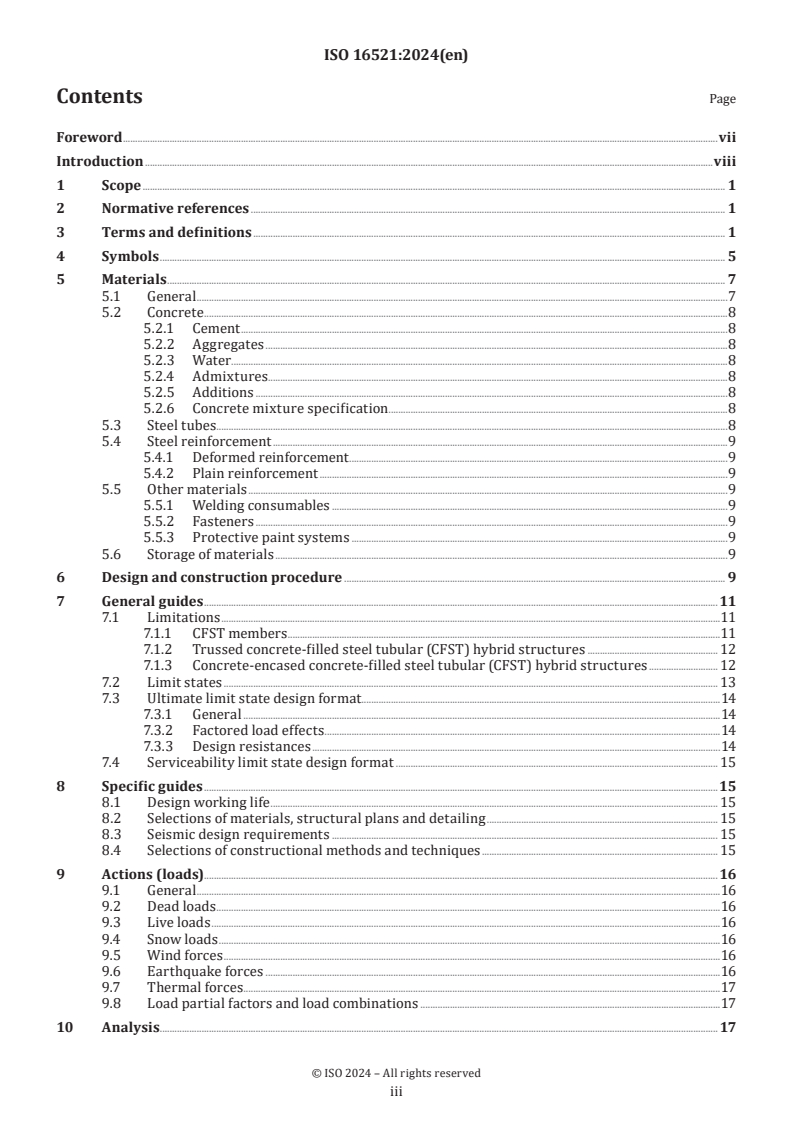
Contents Page
Foreword .vii
Introduction .viii
1 Scope . 1
2 Normative references . 1
3 Terms and definitions . 1
4 Symbols . 5
5 Materials . 7
5.1 General .7
5.2 Concrete .8
5.2.1 Cement .8
5.2.2 Aggregates .8
5.2.3 Water .8
5.2.4 Admixtures.8
5.2.5 Additions .8
5.2.6 Concrete mixture specification .8
5.3 Steel tubes . .8
5.4 Steel reinforcement .9
5.4.1 Deformed reinforcement .9
5.4.2 Plain reinforcement .9
5.5 Other materials .9
5.5.1 Welding consumables .9
5.5.2 Fasteners .9
5.5.3 Protective paint systems .9
5.6 Storage of materials .9
6 Design and construction procedure . 9
7 General guides .11
7.1 Limitations .11
7.1.1 CFST members .11
7.1.2 Trussed concrete-filled steel tubular (CFST) hybrid structures . 12
7.1.3 Concrete-encased concrete-filled steel tubular (CFST) hybrid structures . 12
7.2 Limit states . 13
7.3 Ultimate limit state design format . .14
7.3.1 General .14
7.3.2 Factored load effects .14
7.3.3 Design resistances .14
7.4 Serviceability limit state design format . 15
8 Specific guides .15
8.1 Design working life . 15
8.2 Selections of materials, structural plans and detailing . 15
8.3 Seismic design requirements . 15
8.4 Selections of constructional methods and techniques . 15
9 Actions (loads). 16
9.1 General .16
9.2 Dead loads .16
9.3 Live loads .16
9.4 Snow loads .16
9.5 Wind forces .16
9.6 Earthquake forces .16
9.7 Thermal forces .17
9.8 Load partial factors and load combinations .17
10 Analysis . . 17
iii
10.1 General .17
10.1.1 Structural analysis purpose .17
10.1.2 Structural analysis methods.17
10.1.3 Structural analysis requirements .17
10.1.4 Loading cases .18
10.1.5 Construction stage analysis .18
10.2 Stress-strain relationships for materials .18
10.2.1 General .18
10.2.2 Concrete .19
10.2.3 Steel . 26
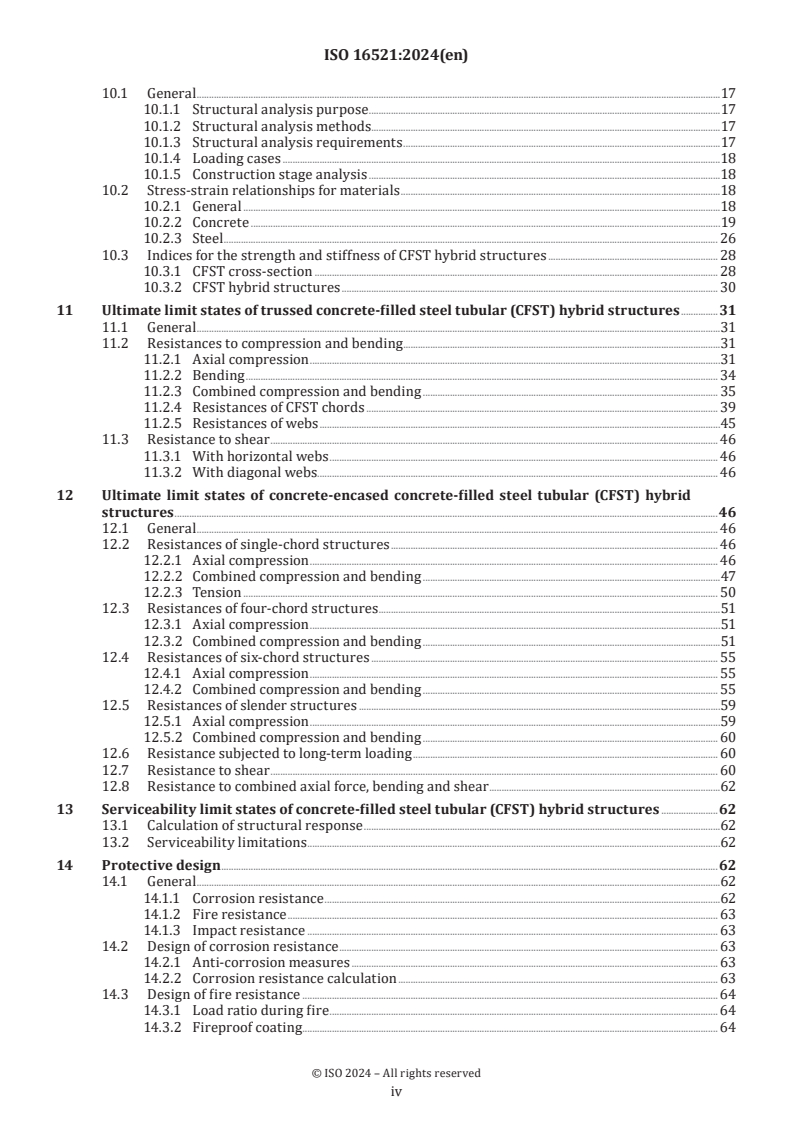
10.3 Indices for the strength and stiffness of CFST hybrid structures . 28
10.3.1 CFST cross-section . 28
10.3.2 CFST hybrid structures . 30
11 Ultimate limit states of trussed concrete-filled steel tubular (CFST) hybrid structures .31
11.1 General .31
11.2 Resistances to compression and bending .31
11.2.1 Axial compression .31
11.2.2 Bending . 34
11.2.3 Combined compression and bending . 35
11.2.4 Resistances of CFST chords . 39
11.2.5 Resistances of webs .45
11.3 Resistance to shear . 46
11.3.1 With horizontal webs . 46
11.3.2 With diagonal webs. 46
12 Ultimate limit states of concrete-encased concrete-filled steel tubular (CFST) hybrid
structures .46
12.1 General . 46
12.2 Resistances of single-chord structures . 46
12.2.1 Axial compression . 46
12.2.2 Combined compression and bending .47
12.2.3 Tension . 50
12.3 Resistances of four-chord structures .51
12.3.1 Axial compression .51
12.3.2 Combined compression and bending .51
12.4 Resistances of six-chord structures . 55
12.4.1 Axial compression . 55
12.4.2 Combined compression and bending . 55
12.5 Resistances of slender structures .59
12.5.1 Axial compression .59
12.5.2 Combined compression and bending . 60
12.6 Resistance subjected to long-term loading . 60
12.7 Resistance to shear . 60
12.8 Resistance to combined axial force, bending and shear .62
13 Serviceability limit states of concrete-filled steel tubular (CFST) hybrid structures .62
13.1 Calculation of structural response .62
13.2 Serviceability limitations . .62
14 Protective design .62
14.1 General .62
14.1.1 Corrosion resistance .62
14.1.2 Fire resistance . 63
14.1.3 Impact resistance . 63
14.2 Design of corrosion resistance . 63
14.2.1 Anti-corrosion measures . 63
14.2.2 Corrosion resistance calculation . 63
14.3 Design of fire resistance . 64
14.3.1 Load ratio during fire . 64
14.3.2 Fireproof coating . 64
iv
14.3.3 Fire resistance ratings . 65
14.3.4 Detailing requirements . 65
14.4 Design of impact resistance . 66
14.4.1 Bending resistance under impact. 66
14.4.2 Dynamic increase factor for circular CFST chords under impact . 66
14.4.3 Deformation of circular CFST chords under impact .67
15 Connections . 67
15.1 General .67
15.2 Joints of trussed concrete-filled steel tubular (CFST) hybrid structures .67
15.2.1 General requirements .67
15.2.2 Typical forms of joints . 68
15.2.3 Welding requirements . 69
15.2.4 Detailing requirements of webs . 69
15.2.5 Inserted plate connections .70
15.2.6 Gusset plate connections .70
15.2.7 Intersecting welded plane K-joints and N-joints .71
15.2.8 Plane T-joints, Y-joints and X-joints .74
15.2.9 Multiplanar joints .74
15.3 Joints of concrete-encased concrete-filled steel tubular (CFST) hybrid structures .74
15.3.1 Steel beam-to-column ring plate joints .74
15.3.2 Reinforced concrete beam-to-column joints . 75
15.3.3 Detailing requirements of beam-to-column joints .76
15.3.4 Connections between steel tubes . 77
15.4 Column bases and supporting connections . 78
15.4.1 Column bases and supporting connections of trussed CFST hybrid structures . 78
15.4.2 Column bases of concrete-encased CFST hybrid structures . 82
15.5 Fatigue design of joints . 83
15.5.1 General requirements . 83
15.5.2 Design methods . 83
15.5.3 Hot spot stress ranges under constant amplitude fatigue . 84
15.5.4 Hot spot stress ranges under variable amplitude fatigue . 84
15.5.5 Detailing requirements . 85
16 Construction and acceptance .86
16.1 General . 86
16.2 Fabrication and erection of steel tubes . 86
16.2.1 General . 86
16.2.2 Documents . 86
16.2.3 Fabrication . 86
16.2.4 Surface protection. 87
16.2.5 Transportation and erection . 87
16.3 Construction of core concrete. 87
16.3.1 General . 87
16.3.2 General requirements . 87
16.3.3 Mixture design . 88
16.3.4 Requirements of self-compacting concrete . 88
16.3.5 Use of cement plaster . 88
16.3.6 Placement preparation . 88
16.3.7 Placement methods . 88
16.3.8 Placement process . 88
16.3.9 Treatment of post-placement holes on steel tubes . 88
16.3.10 Requirements of limiting values of core concrete void in steel tubes . 88
16.4 Construction of concrete encasement . 90
16.4.1 General . 90
16.4.2 Construction preparation . 90
16.4.3 Workability of concrete . 90
16.4.4 Construction order . 90
16.5 Inspection and acceptance . . . 90
16.5.1 General . 90
v
16.5.2 Steel structures .91
16.5.3 Core concrete .91
16.5.4 Concrete encasement .91
16.5.5 Documents and records .91
Annex A (informative) Long-term load coefficients for concrete-encased circular CFST hybrid
structures .92
Annex B (informative) Fire resistance ratings of single-chord concrete-encased circular CFST
hybrid structures .96
Bibliography .97
vi
Foreword
ISO (the International Organization for Standardization) is a worldwide federation of national standards
bodies (ISO member bodies). The work of preparing International Standards is normally carried out through
ISO technical committees. Each member body interested in a subject for which a technical committee
has been established has the right to be represented on that committee. International organizations,
governmental and non-governmental, in liaison with ISO, also take part in the work. ISO collaborates closely
with the International Electrotechnical Commission (IEC) on all matters of electrotechnical standardization.
The procedures used to develop this document and those intended for its further maintenance are described
in the ISO/IEC Directives, Part 1. In particular, the different approval criteria needed for the different types
of ISO document should be noted. This document was drafted in accordance with the editorial rules of the
ISO/IEC Directives, Part 2 (see www.iso.org/directives).
ISO draws attention to the possibility that the implementation of this document may involve the use of (a)
patent(s). ISO takes no position concerning the evidence, validity or applicability of any claimed patent
rights in respect thereof. As of the date of publication of this document, ISO had not received notice of (a)
patent(s) which may be required to implement this document. However, implementers are cautioned that
this may not represent the latest information, which may be obtained from the patent database available at
www.iso.org/patents. ISO shall not be held responsible for identifying any or all such patent rights.
Any trade name used in this document is information given for the convenience of users and does not
constitute an endorsement.
For an explanation of the voluntary nature of standards, the meaning of ISO specific terms and expressions
related to conformity assessment, as well as information about ISO's adherence to the World Trade
Organization (WTO) principles in the Technical Barriers to Trade (TBT), see www.iso.org/iso/foreword.html.
This document was prepared by Technical Committee ISO/TC 71, Concrete, reinforced concrete and
prestressed concrete.
Any feedback or questions on this document should be directed to the user’s national standards body. A
complete listing of these bodies can be found at www.iso.org/members.html.
vii
Introduction
Concrete-filled steel tubular (CFST) hybrid structures employ CFST members as their main members,
and construct with steel or reinforced concrete members or components to act compositely. They consist
of trussed CFST hybrid structures, concrete-encased CFST hybrid structures, etc. The economic and
environmental benefits of CFST hybrid structures have made them one of the desirable structural types
for constructions in relatively tough and harsh conditions, such as mountainous areas, earthquake-prone
regions, corrosive environments, and less-developed regions. They can also be used in conventional
structures, such as multi-storey residential buildings and relatively short-span bridges.
viii
International Standard ISO 16521:2024(en)
Design of concrete-filled steel tubular (CFST) hybrid
structures
1 Scope
This document provides guidelines for the design, construction, and inspection of concrete-filled steel
tubular (CFST) hybrid structures. These structures can be used as main structural components like
columns, girders, piers, or arches in buildings, bridges, especially in high-rise structures, long-span spatial
structures, and large-scale bridges.
CFST hybrid structures can employ CFST members with a circular cross-section as their chords, and they
can also use square or rectangular CFST chords.
2 Normative references
The following documents are referred to in the text in such a way that some or all of their content constitutes
the requirements of this document. For dated references, only the edition cited applies. For undated
references, the latest edition of the referenced document (including any amendments) applies.
ISO 19338, Performance and assessment requirements for design standards on structural concrete
3 Terms and definitions
For the purposes of this document, the following terms and definitions apply.
ISO and IEC maintain terminology databases for use in standardization at the following addresses:
— ISO Online browsing platform: available at https:// www .iso .org/ obp
— IEC Electropedia: available at https:// www .electropedia .org/
3.1
concrete-filled steel tubular hybrid structure
CFST hybrid structure
structure in which concrete-filled steel tubular (CFST) members serve as its main members, and are in
contact with and act compositely with steel or reinforced concrete members or components, including
trussed CFST hybrid structure, concrete-encased CFST hybrid structure, etc.
Note 1 to entry: CFST hybrid structures more frequently employ circular CFST members due to the higher confinement
effect provided by circular hollow steel tubes to the core concrete; square or rectangular CFST members can also be
used when design or construction conditions require. CFST members require full composite effects between steel
tubes and the core concrete. Steel tubular members using infilled concrete to only enhance their stiffness are beyond
the scope of this document.
3.2
trussed concrete-filled steel tubular (CFST) hybrid structure
trussed CFST hybrid structure
truss structure consisting of CFST chords and webs of steel tubes, CFST members or other steel profiles
Note 1 to entry: There are two-chord, three-chord, four-chord and six-chord trussed CFST hybrid structures (see
Figures 1 and 2), and the chords are normally placed symmetrically. Trussed CFST hybrid structures generally serve
as main structural members, such as truss girders, bridge piers or columns.
Note 2 to entry: During a typical construction process of cast-in-place trussed CFST hybrid structures, the steel
components, such as the hollow steel tubes, are first erected; the core concrete in the chords is then placed (see
Figure 3). Prefabricated CFST members can also be used in trussed CFST hybrid structures when construction
conditions allow.
Note 3 to entry: For trussed CFST hybrid structure with rectangular CFST members, the CFST chords are generally
placed to have the strong axes of their rectangular cross-sections all in parallel with the strong axis of the whole
cross-section of the trussed CFST hybrid structure.
a) Two-chord b) Three-chord c) Four-chord d) Six-chord
Key
1 CFST chords
2 webs
Figure 1 — Cross-sections of trussed CFST hybrid structures with circular CFST members
a) Two-chord b) Three-chord c) Four-chord d) Six-chord
Key
1 CFST chords
2 webs
Figure 2 — Cross-sections of trussed CFST hybrid structures with square or rectangular CFST members
a) As hollow steel tubular structure b) As trussed CFST hybrid structure
Key
1 hollow steel tubular chords
2 webs
3 CFST chords
4 placement of core concrete in chords
Figure 3 — Typical construction process of a trussed CFST hybrid structure
3.3
concrete-encased concrete-filled steel tubular hybrid structure
concrete-encased concrete-filled steel tubular (CFST) hybrid structure
structure consisting of reinforced concrete encasement and one or more embedded CFST members
Note 1 to entry: The encased CFST member(s) in the concrete-encased CFST hybrid structure can be single or multiple,
as shown in Figures 4 and 5, and are normally symmetrically placed. For the single-chord type, the CFST member is
placed at the centre of the cross-section with a square or rectangular concrete encasement, forming a solid cross-
section. For the multi-chord type, CFST chords are placed at the corners (four-chord type) and also mid-height of the
cross-section (six-chord type) of the rectangular concrete encasement; steel tubes, or CFST or other steel profiles
are used as webs to connect the CFST chords; to reduce self-weight, an internal hollow section, which is octagonal or
rectangular, is generally formed. The multi-chord concrete-encased CFST hybrid structures are a derivation of the
trussed CFST hybrid structures, and are generally used as columns, bridge piers, arches, etc.
a) Single-chord, solid cross-sec- b) Four-chord, with an internal c) Six-chord, with an internal
tion hollow section hollow section
Key
1 CFST members
2 concrete encasement
3 internal hollow section
4 webs
Figure 4 — Cross-sections of concrete-encased CFST hybrid structures with circular CFST members
a) Single-chord, solid cross-sec- b) Four-chord, with an internal c) Six-chord, with an internal
tion hollow section hollow section
Key
1 CFST members
2 concrete encasement
3 internal hollow section
4 webs
Figure 5 — Cross-sections of concrete-encased CFST hybrid structures with square or rectangular
CFST members
Note 2 to entry: A typical construction process for cast-in-place concrete-encased CFST hybrid structure consists of
erection of hollow steel tubular chords and webs, placement of core concrete in chords, installation of reinforcement,
and placement of concrete encasement, as shown in Figure 6. Prefabricated CFST members can also be used in
concrete-encased CFST hybrid structures when construction conditions allow.
Note 3 to entry: For concrete-encased CFST hybrid structure with rectangular CFST members, the CFST chords are
generally placed to have the strong axes of their rectangular cross-sectio
...