


ISO/TS 13004:2013
(Main)Sterilization of health care products — Radiation — Substantiation of selected sterilization dose: Method VDmaxSD
Sterilization of health care products — Radiation — Substantiation of selected sterilization dose: Method VDmaxSD
ISO/TS 13004:2013 describes a method for substantiating a selected sterilization dose of 17,5, 20, 22,5, 27,5, 30, 32,5 or 35 kGy that achieves a sterility assurance level (SAL) of 10−6 or less for radiation sterilization of health care products. ISO/TS 13004:2013 also specifies a method of sterilization dose audit used to demonstrate the continued effectiveness of the substantiated sterilization dose.
Stérilisation des produits de santé — Irradiation — Justification de la dose de stérilisation choisie: méthode VDmaxSD
General Information
- Status
- Withdrawn
- Publication Date
- 05-May-2013
- Technical Committee
- ISO/TC 198 - Sterilization of health care products
- Drafting Committee
- ISO/TC 198 - Sterilization of health care products
- Current Stage
- 9599 - Withdrawal of International Standard
- Start Date
- 07-Oct-2022
- Completion Date
- 12-Feb-2026
Relations
- Effective Date
- 09-Feb-2026
- Effective Date
- 28-Aug-2021

Get Certified
Connect with accredited certification bodies for this standard

BSI Group
BSI (British Standards Institution) is the business standards company that helps organizations make excellence a habit.

TÜV Rheinland
TÜV Rheinland is a leading international provider of technical services.

TÜV SÜD
TÜV SÜD is a trusted partner of choice for safety, security and sustainability solutions.
Sponsored listings
Frequently Asked Questions
ISO/TS 13004:2013 is a technical specification published by the International Organization for Standardization (ISO). Its full title is "Sterilization of health care products — Radiation — Substantiation of selected sterilization dose: Method VDmaxSD". This standard covers: ISO/TS 13004:2013 describes a method for substantiating a selected sterilization dose of 17,5, 20, 22,5, 27,5, 30, 32,5 or 35 kGy that achieves a sterility assurance level (SAL) of 10−6 or less for radiation sterilization of health care products. ISO/TS 13004:2013 also specifies a method of sterilization dose audit used to demonstrate the continued effectiveness of the substantiated sterilization dose.
ISO/TS 13004:2013 describes a method for substantiating a selected sterilization dose of 17,5, 20, 22,5, 27,5, 30, 32,5 or 35 kGy that achieves a sterility assurance level (SAL) of 10−6 or less for radiation sterilization of health care products. ISO/TS 13004:2013 also specifies a method of sterilization dose audit used to demonstrate the continued effectiveness of the substantiated sterilization dose.
ISO/TS 13004:2013 is classified under the following ICS (International Classification for Standards) categories: 11.080.01 - Sterilization and disinfection in general. The ICS classification helps identify the subject area and facilitates finding related standards.
ISO/TS 13004:2013 has the following relationships with other standards: It is inter standard links to EN ISO 11137-3:2017, ISO 13004:2022. Understanding these relationships helps ensure you are using the most current and applicable version of the standard.
ISO/TS 13004:2013 is available in PDF format for immediate download after purchase. The document can be added to your cart and obtained through the secure checkout process. Digital delivery ensures instant access to the complete standard document.
Standards Content (Sample)
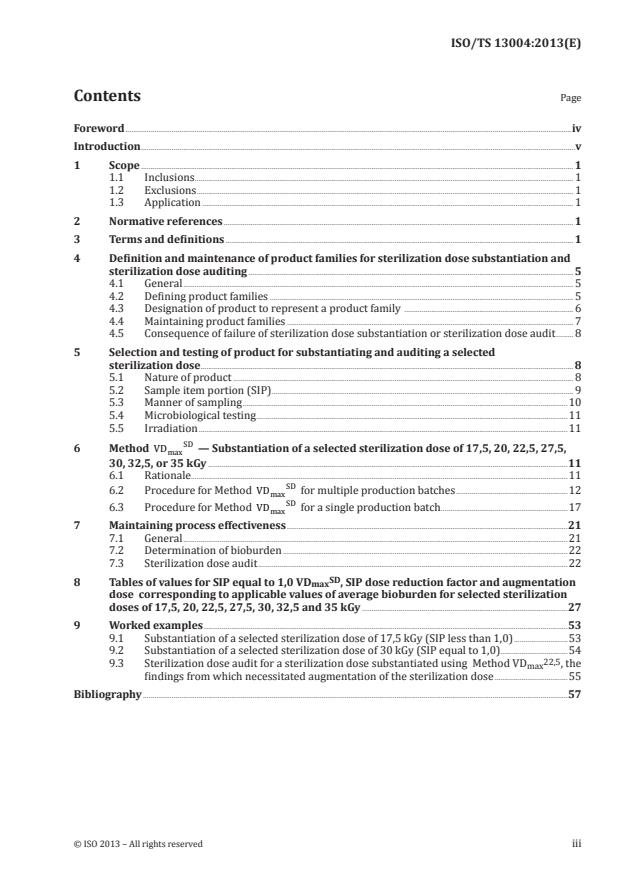
TECHNICAL ISO/TS
SPECIFICATION 13004
First edition
2013-05-01
Sterilization of health care products —
Radiation — Substantiation of selected
SD
sterilization dose: Method VD
max
Stérilisation des produits de santé — Irradiation — Justification de la
SD
dose de stérilisation choisie: méthode VD
max
Reference number
©
ISO 2013
© ISO 2013
All rights reserved. Unless otherwise specified, no part of this publication may be reproduced or utilized otherwise in any form
or by any means, electronic or mechanical, including photocopying, or posting on the internet or an intranet, without prior
written permission. Permission can be requested from either ISO at the address below or ISO’s member body in the country of
the requester.
ISO copyright office
Case postale 56 • CH-1211 Geneva 20
Tel. + 41 22 749 01 11
Fax + 41 22 749 09 47
E-mail copyright@iso.org
Web www.iso.org
Published in Switzerland
ii © ISO 2013 – All rights reserved
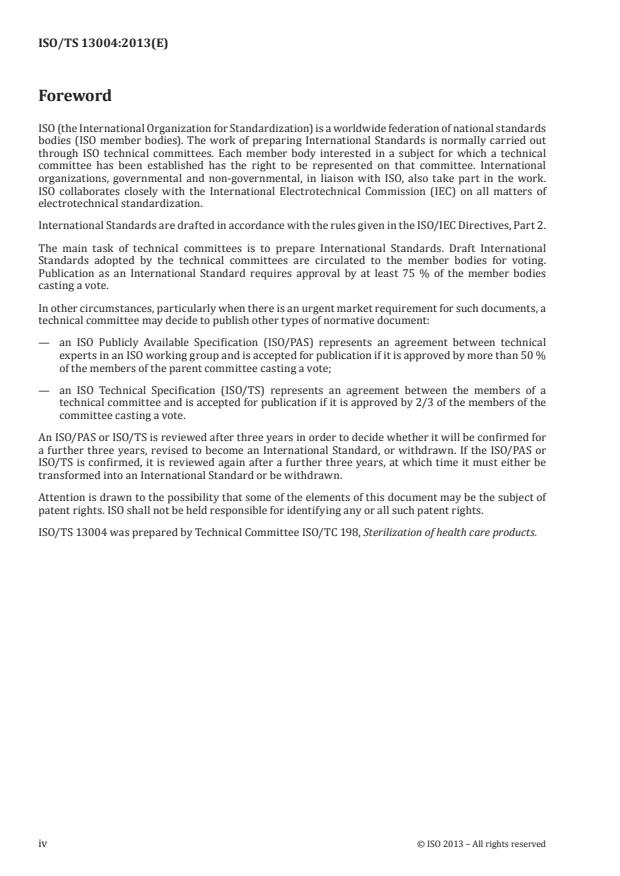
Contents Page
Foreword .iv
Introduction .v
1 Scope . 1
1.1 Inclusions . 1
1.2 Exclusions . 1
1.3 Application . 1
2 Normative references . 1
3 Terms and definitions . 1
4 Definition and maintenance of product families for sterilization dose substantiation and
sterilization dose auditing . 5
4.1 General . 5
4.2 Defining product families . 5
4.3 Designation of product to represent a product family . 6
4.4 Maintaining product families . 7
4.5 Consequence of failure of sterilization dose substantiation or sterilization dose audit . 8
5 Selection and testing of product for substantiating and auditing a selected
sterilization dose. 8
5.1 Nature of product . 8
5.2 Sample item portion (SIP) . 9
5.3 Manner of sampling .10
5.4 Microbiological testing .11
5.5 Irradiation .11
SD
6 Method VD — Substantiation of a selected sterilization dose of 17,5, 20, 22,5, 27,5,
max
30, 32,5, or 35 kGy .11
6.1 Rationale.11
SD
6.2 Procedure for Method VD for multiple production batches .12
max
SD
6.3 Procedure for Method VD for a single production batch .17
max
7 Maintaining process effectiveness .21
7.1 General .21
7.2 Determination of bioburden .22
7.3 Sterilization dose audit .22
SD
8 Tables of values for SIP equal to 1,0 VD , SIP dose reduction factor and augmentation
max
dose corresponding to applicable values of average bioburden for selected sterilization
doses of 17,5, 20, 22,5, 27,5, 30, 32,5 and 35 kGy .27
9 Worked examples .53
9.1 Substantiation of a selected sterilization dose of 17,5 kGy (SIP less than 1,0) .53
9.2 Substantiation of a selected sterilization dose of 30 kGy (SIP equal to 1,0) .54
22,5
9.3 Sterilization dose audit for a sterilization dose substantiated using Method VD , the
max
findings from which necessitated augmentation of the sterilization dose .55
Bibliography .57
Foreword
ISO (the International Organization for Standardization) is a worldwide federation of national standards
bodies (ISO member bodies). The work of preparing International Standards is normally carried out
through ISO technical committees. Each member body interested in a subject for which a technical
committee has been established has the right to be represented on that committee. International
organizations, governmental and non-governmental, in liaison with ISO, also take part in the work.
ISO collaborates closely with the International Electrotechnical Commission (IEC) on all matters of
electrotechnical standardization.
International Standards are drafted in accordance with the rules given in the ISO/IEC Directives, Part 2.
The main task of technical committees is to prepare International Standards. Draft International
Standards adopted by the technical committees are circulated to the member bodies for voting.
Publication as an International Standard requires approval by at least 75 % of the member bodies
casting a vote.
In other circumstances, particularly when there is an urgent market requirement for such documents, a
technical committee may decide to publish other types of normative document:
— an ISO Publicly Available Specification (ISO/PAS) represents an agreement between technical
experts in an ISO working group and is accepted for publication if it is approved by more than 50 %
of the members of the parent committee casting a vote;
— an ISO Technical Specification (ISO/TS) represents an agreement between the members of a
technical committee and is accepted for publication if it is approved by 2/3 of the members of the
committee casting a vote.
An ISO/PAS or ISO/TS is reviewed after three years in order to decide whether it will be confirmed for
a further three years, revised to become an International Standard, or withdrawn. If the ISO/PAS or
ISO/TS is confirmed, it is reviewed again after a further three years, at which time it must either be
transformed into an International Standard or be withdrawn.
Attention is drawn to the possibility that some of the elements of this document may be the subject of
patent rights. ISO shall not be held responsible for identifying any or all such patent rights.
ISO/TS 13004 was prepared by Technical Committee ISO/TC 198, Sterilization of health care products.
iv © ISO 2013 – All rights reserved
Introduction
This Technical Specification is intended to be used in conjunction with ISO 11137-1, Sterilization of health care
products – Radiation – Part 1: Requirements for development, validation and routine control of a sterilization
process for medical devices. One of the activities encompassed within process definition in ISO 11137-1 is
the option to select and substantiate a sterilization dose to be applied to health care products.
ISO 11137-2 includes Method VD for the substantiation of 25 kGy as a sterilization dose (termed
max
25 15
Method VD ) for product with an average bioburden less than or equal to 1 000 and Method VD
max max
for the substantiation of 15 kGy as a sterilization dose for product with an average bioburden less than
or equal to 1,5.
This Technical Specification extends the methods of selection and substantiation of a sterilization dose
specified in ISO 11137-2. It provides a methodology for the substantiation of selected sterilization doses
of 17,5, 20, 22,5, 27,5, 30, 32,5 and 35 kGy, each of which is valid only for a specified upper limit of
average bioburden.
NOTE Selected sterilization doses of 25 kGy and 15 kGy are not included in this Technical Specification. The
seven methods in this Technical Specification follow the same technical steps as the methods given in ISO 11137-2
for selection and substantiation of sterilization doses of 25 kGy and 15 kGy. However, the descriptive text in this
Technical Specification has been modified to better communicate the methods and hence the text occasionally
differs from that in ISO 11137-2.
The method described in this Technical Specification is for substantiation of a selected sterilization dose
−6 20
to achieve a sterility assurance level (SAL) of 10 or less at that dose, (e.g. Method VD for a selected
max
sterilization dose of 20 kGy). The application of the method is not limited by production batch size or
production frequency, and the number of product items irradiated in the verification dose experiment
remains constant. The method is founded on and embodies the following three principles:
— existence of a direct link between the outcome of the verification dose experiment and the attainment
−6
of an SAL of 10 at the selected sterilization dose;
— possession of a level of conservativeness at least equal to that of the standard distribution of
resistances (SDR);
— for a given bioburden, use of a maximal verification dose (VD ) corresponding to substantiation
max
of a selected sterilization dose.
[6]
This approach to sterilization dose substantiation was first outlined by Kowalski and Tallentire and,
[7]
from subsequent evaluations involving computational techniques (Kowalski, Aoshuang and Tallentire )
[8]
and field evaluations (Kowalski et al ), it was concluded that the method is soundly based. An overview
[9][10]
of the method and aspects of putting it into practice are provided in Kowalski and Tallentire.
Application of the Method VD approach to doses other than 25 kGy is discussed in Kowalski and
max
[11][12]
Tallentire.
SD
The method described here and designated Method VD procedurally comprises elements that
max
closely parallel those of dose setting Method 1 described in ISO 11137-2. One key area of difference is the
number of product items used in the verification dose experiment. In the computer evaluations referred
to above, changing the verification SAL value had little effect on the substantiation outcome and this
finding led to a sample size of 10 product items being chosen for subsequent field evaluations and,
ultimately, for inclusion in this document.
Manufacturers of health care products who intend to use this specification are reminded that the
requirements contained in ISO 11137 apply to the manufacture and control of production batches
destined for radiation sterilization. In particular, one requirement states that products have to be
manufactured in circumstances such that the bioburden is controlled. Compliance with the requirements
for controlling the quality of raw materials, the manufacturing environment, the health, hygiene and
attire of personnel and for establishing the basic properties of packaging material is essential.
TECHNICAL SPECIFICATION ISO/TS 13004:2013(E)
Sterilization of health care products — Radiation —
Substantiation of selected sterilization dose: Method
SD
VD
max
1 Scope
1.1 Inclusions
This Technical Specification describes a method for substantiating a selected sterilization dose of 17,5,
−6
20, 22,5, 27,5, 30, 32,5 or 35 kGy that achieves a sterility assurance level (SAL) of 10 or less for radiation
sterilization of health care products. This Technical Specification also specifies a method of sterilization
dose audit used to demonstrate the continued effectiveness of the substantiated sterilization dose.
NOTE Selection and substantiation of the sterilization dose is used to meet the requirements for establishing
the sterilization dose within process definition in ISO 11137-1.
1.2 Exclusions
This method is for the substantiation of a selected sterilization dose of 17,5, 20, 22,5, 27,5, 30, 32,5,
or 35 kGy only and is not used to substantiate other sterilization doses. The method is not used for
the substantiation of a selected sterilization dose if the average bioburden of the entire product item
exceeds the limit specified for the selected sterilization dose (see Table 3).
NOTE The methods for substantiation of selected sterilization doses of 25 kGy and 15 kGy are not included in
this Technical Specification; they are described in ISO 11137-2.
1.3 Application
If the decision is made to use this method of sterilization dose establishment, the method is to be followed
according to the requirements (shall) and guidance (should) stipulated herein.
2 Normative references
The following referenced documents are indispensable for the application of this document. For dated
references, only the edition cited applies. For undated references, the latest edition of the referenced
document (including any amendments) applies.
ISO 11137-1:2006, Sterilization of health care products — Radiation — Part 1: Requirements for development,
validation and routine control of a sterilization process for medical devices
ISO 11737-1, Sterilization of medical devices — Microbiological methods — Part 1: Determination of a
population of microorganisms on products
ISO 11737-2, Sterilization of medical devices — Microbiological methods — Part 2: Tests of sterility
performed in the definition, validation and maintenance of a sterilization process
3 Terms and definitions
For the purposes of this document, the following abbreviations, terms and definitions apply.
3.1
batch
defined quantity of product, intended or purported to be uniform in character and quality, that has been
produced during a defined cycle of manufacture
[SOURCE: ISO/TS 11139:2006, 2.1]
3.2
bioburden
population of viable microorganisms on or in product and/or sterile barrier system
[SOURCE: ISO/TS 11139:2006, 2.2]
3.3
correction
action to eliminate a detected nonconformity
Note 1 to entry: A correction can be made in conjunction with corrective action (3.4).
[SOURCE: ISO 9000:2005, 3.6.6, modified]
3.4
corrective action
action to eliminate the cause of a detected nonconformity or other undesirable situation
Note 1 to entry: There can be more than one cause for a nonconformity.
Note 2 to entry: Corrective action is taken to prevent recurrence whereas preventive action is taken to
prevent occurrence.
Note 3 to entry: There is a distinction between correction and corrective action.
[SOURCE: ISO 9000:2005, 3.6.5]
3.5
dose
absorbed dose
quantity of ionizing radiation energy imparted per unit mass of specified material
Note 1 to entry: The unit of absorbed dose is the gray (Gy), where 1 Gy is equivalent to the absorption of 1 J/kg.
Note 2 to entry: For the purposes of this document, the term dose is used to mean absorbed dose.
[SOURCE: ISO 11137-1:2006, 3.1, modified]
3.6
dose mapping
measurement of dose distribution and variability in material irradiated under defined conditions
[SOURCE: ISO 11137-1:2006, 3.10]
3.7
false positive
test result interpreted as growth arising from product, or portion thereof, tested when either growth
resulted from extraneous microbial contamination or turbidity occurred from interaction between the
product, or portion thereof, and the test medium
[SOURCE: ISO 11137-2:2012, 3.1.3]
2 © ISO 2013 – All rights reserved
3.8
health care product(s)
medical device(s), including in vitro diagnostic medical device(s), or medicinal product(s), including
biopharmaceutical(s)
[SOURCE: ISO/TS 11139:2006, 2.20]
3.9
medical device
instrument, apparatus, implement, machine, appliance, implant, in vitro reagent or calibrator, software,
material, or other related article intended by the manufacturer to be used, alone or in combination, for
human beings for one or more of the specific purpose(s) of:
— diagnosis, prevention, monitoring, treatment, or alleviation of disease;
— diagnosis, monitoring, treatment, alleviation of or compensation for an injury;
— investigation, replacement, modification, or support of the anatomy or of a physiological process;
— supporting or sustaining life;
— control of conception;
— disinfection of medical devices;
— providing information for medical purposes by means of in vitro examination of specimens derived
from the human body;
and which does not achieve its primary intended action in or on the human body by pharmacological,
immunological or metabolic means, but which may be assisted in its function by such means
Note 1 to entry: This definition from ISO 13485 has been developed by the Global Harmonization Task Force
(GHTF 2002)
[SOURCE: ISO 13485:2003, 3.7, modified]
3.10
Method VD
max
procedure for sterilization dose substantiation that uses the maximal verification dose for a given
−6
bioburden, consistent with the attainment of a SAL of 10 at a selected sterilization dose
SD
Note 1 to entry: The substantiation method is generally referred to as Method VD , where SD takes the value
max
of the selected sterilization dose.
3.11
microorganism
entity of microscopic size, encompassing bacteria, fungi, protozoa and viruses
Note 1 to entry: A specific standard might not require demonstration of the effectiveness of the sterilization
process in inactivating all types of microorganisms, identified in the definition above, for validation and/or
routine control of the sterilization process.
[SOURCE: ISO/TS 11139:2006, 2.26]
3.12
packaging system
combination of the sterile barrier system and protective packaging
[SOURCE: ISO/TS 11139:2006, 2.28]
3.13
positive test of sterility
test result for which there is detectable microbial growth from product, or portion thereof, subjected to
a test of sterility
[SOURCE: ISO 11137-2:2012, 3.1.8]
3.14
product
result of a process
Note 1 to entry: For the purposes of sterilization standards, product is tangible and can be raw material(s),
intermediate(s), sub-assembly(ies) or health care product(s)
[SOURCE: ISO 9000:2005, 3.4.2, modified]
3.15
sample item portion
SIP
defined portion of a health care product that is tested
[SOURCE: ISO 11137-2:2012, 3.1.9]
3.16
sterile barrier system
minimum package that prevents ingress of microorganisms and allows aseptic presentation of product
at the point of use
[SOURCE: ISO/TS 11139:2006, 2.44]
3.17
sterility
state of being free from viable microorganisms
Note 1 to entry: In practice, no such absolute statement regarding the absence of microorganisms can be proven
[see sterilization (3.19)].
[SOURCE: ISO/TS 11139:2006, 2.45]
3.18
sterility assurance level
SAL
probability of a single viable microorganism occurring on an item after sterilization
−6 −3
Note 1 to entry: The term SAL takes a quantitative value, generally 10 or 10 . When applying this quantitative
−6
value to assurance of sterility, an SAL of 10 has a lower value but provides a greater assurance of sterility than
−3
an SAL of 10 .
[SOURCE: ISO/TS 11139:2006, 2.46]
3.19
sterilization
validated process used to render product free from viable microorganisms
Note 1 to entry: In a sterilization process, the nature of microbial inactivation is exponential and thus the survival
of a microorganism on an individual item can be expressed in terms of probability. While this probability can be
reduced to a very low number it can never be reduced to zero [see sterility assurance level (3.18)].
[SOURCE: ISO/TS 11139:2006, 2.47]
4 © ISO 2013 – All rights reserved
3.20
sterilization dose
SD
dose selected to achieve the specified requirements for sterility
[SOURCE: ISO 11137-1:2006, 3.40, modified]
3.21
sterilization dose audit
exercise undertaken to confirm the appropriateness of an established sterilization dose
[SOURCE: ISO 11137-2:2012, 3.2.12]
3.22
test of sterility
technical operation performed as part of development, validation or requalification to determine the
presence or absence of viable microorganisms on product or portion thereof
[SOURCE: ISO/TS 11139:2006, 2.54]
3.23
verification dose
−2
dose predicted to give a predetermined SAL greater than or equal to 10 used in establishing the
sterilization dose
−1
Note 1 to entry: For the purpose of this Technical Specification, this predetermined SAL is 10 .
3.24
SD
VD
max
SD
maximal verification dose for a particular selected sterilization dose (SD) obtained in using Method VD
max
4 Definition and maintenance of product families for sterilization dose substan-
tiation and sterilization dose auditing
4.1 General
The establishment of a sterilization dose, for which sterilization dose selection and substantiation can
be undertaken, and the carrying out of sterilization dose audits are activities that are part of process
definition and maintaining process effectiveness (see ISO 11137-1). For these activities, product may
be grouped into families; definition of product families is based principally on the numbers and types
of microorganisms on or in product (the bioburden), the type being indicative of the microorganism’s
resistance to radiation (see ISO 11737-1). Variables such as density and product configuration within its
packaging system are not considered in the establishment of these product families because they are
not factors that influence bioburden.
In using product families for establishing the sterilization dose and for carrying out sterilization dose
audits, it is important to be aware of the reduction in the ability to detect an inadvertent change within
the manufacturing process that influences the effectiveness of sterilization. Furthermore, with the use
of a single product to represent the product family, changes that occur in other members of the product
family might not be detected. The effect of a reduction on ability to detect changes in other members
of the product family should be evaluated and a plan for maintaining product families developed and
implemented before proceeding.
4.2 Defining product families
4.2.1 The criteria for defining a product family shall be documented. Product shall be assessed against
these criteria and the similarities between potential product family members considered. Consideration
shall include all product-related variables that affect bioburden, including, but not limited to:
a) nature and sources of raw materials, including the effect, if any, of raw materials that might be
sourced from more than one location;
b) components;
c) product design and size;
d) manufacturing processes;
e) manufacturing equipment;
f) manufacturing environment;
g) manufacturing location.
The outcome of the assessment and considerations shall be recorded (see 4.1.2 of ISO 11137-1:2006).
4.2.2 Product shall only be included in a product family if it is demonstrated that the product-related
variables (see 4.2.1) are similar and under control.
4.2.3 To include product within a product family, it shall be demonstrated that bioburden comprises
similar numbers and types of microorganisms.
4.2.4 Inclusion of product from more than one manufacturing location in a product family shall be
specifically justified and recorded (see 4.1.2 of ISO 11137-1:2006). Consideration shall be given to the
effect on bioburden of:
a) geographic and/or climatic differences between locations;
b) any differences in the control of the manufacturing processes or environment;
c) sources of raw materials and processing adjuvants (e.g. water).
4.3 Designation of product to represent a product family
4.3.1 Product to represent a product family
4.3.1.1 The number and types of microorganisms on or in product shall be used as the basis for selecting
product to represent a product family.
4.3.1.2 A product family shall be represented by:
a) a master product (see 4.3.2), or
b) an equivalent product (see 4.3.3), or
c) a simulated product (see 4.3.4).
4.3.1.3 A formal, documented assessment shall be undertaken to decide which of the three potential
representative products in 4.3.1.2 is appropriate. In this assessment, consideration shall be given to
the following:
a) number of microorganisms comprising the bioburden;
b) types of microorganisms comprising the bioburden;
c) environment in which the microorganisms occur;
d) size of product;
6 © ISO 2013 – All rights reserved
e) number of components;
f) complexity of product;
g) degree of automation during manufacture;
h) manufacturing environment.
4.3.2 Master product
A member of a product family shall only be considered a master product if assessment (see 4.3.1.3)
indicates that the member presents a challenge to the sterilization process that is greater than that of
all other product family members. In some situations, there can be several products within the product
family, each of which could be considered as the master product. In such circumstances, any one of these
products may be selected as the master product to represent the family, either
a) at random, or
b) according to a documented procedure to include the different products each of which could be
considered as the master product.
4.3.3 Equivalent product
A group of product shall only be considered equivalent if assessment (see 4.3.1.3) indicates that group
members require the same sterilization dose. Selection of the equivalent product to represent the family
shall be either a) at random, or b) according to a documented procedure to include different members of
the product family. The manufacturing volume and availability of product should be considered in the
selection of the equivalent product to represent the product family.
4.3.4 Simulated product
A simulated product shall only represent a product family if it constitutes an equivalent or greater
challenge to the sterilization process than that provided by members of the product family. Simulated
product shall be packaged in a manner and with materials used for the actual product.
NOTE A simulated product is not intended for clinical use; it is fabricated solely for the establishment or
maintenance of the sterilization dose.
A simulated product may be:
a) one that is similar to the actual product in terms of materials and size, and subjected to similar
manufacturing processes; e.g. a piece of the material, used for implants, that goes through the entire
manufacturing process, or
b) a combination of components from product within the product family that would not typically
be combined for use; e.g. a tubing set containing multiple filters, clamps and stopcocks that are
components of other products within the product family.
4.4 Maintaining product families
4.4.1 Periodic review
Review shall be performed at a specified frequency to ensure that product families and product used to
represent each product family remain valid. Responsibility for reviews of product and/or processes that
might affect membership of product families shall be allocated to competent personnel. Such review
shall be performed at least annually. The outcome of the review shall be recorded in accordance with
4.1.2 of ISO 11137-1:2006.
4.4.2 Modification to product and/or manufacturing process
Modifications to product, such as raw materials (nature and source), components or product design
(including size), and/or modifications to the manufacturing process, such as equipment, environment or
location, shall be assessed through a formal, documented change control system. Such modifications can
alter the basis on which the product family was defined or the basis on which the selection of product
to represent the product family was made. Significant changes can require definition of a new product
family or the selection of a different representative product.
4.4.3 Records
Records of product families shall be retained (see 4.1.2 of ISO 11137-1:2006).
4.5 Consequence of failure of sterilization dose substantiation or sterilization dose audit
In the event of failure during substantiation of a selected sterilization dose or performance of the
sterilization dose audit for a product family, all members of that family shall be considered to be affected.
Subsequent actions shall apply to all members comprising the product family.
5 Selection and testing of product for substantiating and auditing a selected
sterilization dose
5.1 Nature of product
5.1.1 Product for sterilization can consist of:
a) an individual health care product in its packaging system;
b) a set of components presented in a packaging system, which are assembled at the point of use to
form the health care product, together with accessories required to use the assembled product;
c) a number of identical health care products in their packaging system;
d) a kit comprising a variety of procedure-related health care products.
Product items for sterilization dose substantiation and for sterilization dose auditing shall be taken in
accordance with Table 1.
8 © ISO 2013 – All rights reserved
Table 1 — Nature of product items for sterilization dose substantiation and for sterilization
dose auditing
Item for bioburden determination
Product type Rationale
and verification dose experiment
Individual health care product in its Each health care product is used
Individual health care product
packaging system independently in clinical practice.
Components are assembled as a
Set of components in a packaging Combination of all components of
product and used together in clini-
system the product
cal practice.
Each health care product is used
independently in clinical practice;
the SAL of an individual health
Number of identical health care Single health care product taken care product within the packag-
products in their packaging system from the packaging system ing system meets the selected SAL,
although the overall SAL associated
with the packaging system might be
higher.
Kit of procedure-related health care Each type of health care product Each health care product is used
a
products comprising the kit independently in clinical practice.
a
In dose establishment, the sterilization dose is chosen based on the health care product requiring the highest sterilization
dose.
5.1.2 If the product has a claim of sterility for part of the product, the sterilization dose may be
established on the basis of that part only.
EXAMPLE If the product has a label claim of sterility for the fluid path only, the sterilization dose may be
established based on bioburden determinations and outcomes of tests of sterility performed on the fluid path.
5.2 Sample item portion (SIP)
5.2.1 For product with an average bioburden greater than or equal to 1,0, whenever practicable, an
entire product (SIP equal to 1,0) should be used for testing in accordance with Table 1. When the use of an
entire product is not practicable, a selected portion of product (SIP) may be substituted. The SIP should
be as large a portion of the item as practicable and should be of a size that can be handled during testing.
5.2.2 For a product with an average bioburden less than or equal to 0,9, an entire product (SIP equal to
1,0) shall be used for testing in accordance with Table 1.
NOTE When testing products with low average bioburden, it is possible that an SIP will not always be the
portion of the product item possessing microorganisms. Therefore, the entire product (SIP = 1,0) is used for
products with an average bioburden less than or equal to 0,9.
5.2.3 If the bioburden is evenly distributed on and/or in the item, the SIP may be selected from any
portion of the item. If the bioburden is not evenly distributed, the SIP shall consist of either
a) portions of product selected at random that proportionally represent each of the materials from
which the product is made, or
b) the portion of the product that is considered to be the most severe challenge to the sterilization process.
The value of SIP can be calculated on the basis of length, mass, volume or surface area (see Table 2
for examples).
Table 2 — Examples for calculation of SIP
Basis for SIP Product
Tubing (consistent diameter)
Length
Rolls of bandage
Powders
Mass
Gowns
Volume Liquids
Surgical drapes
Surface area
Tubing (variable diameter)
5.2.4 The preparation and packaging of an SIP shall be carried out under conditions that minimize
alterations to bioburden. Environmentally-controlled conditions should be used for preparation of SIPs
and, whenever possible, packaging materials should be equivalent to those used for the finished product.
5.2.5 The adequacy of a selected SIP shall be demonstrated. The bioburden of the SIP shall be such that
either at least 17 of the 20 non-irradiated SIPs yield positive tests of sterility, or a bioburden of one or
more is found on at least 85 % of 20 or more SIPs. If neither of these criteria is met, an SIP that is different
than that examined originally and that meets one of the above criteria shall be used. If an entire product
is tested (SIP equal to 1,0), the criteria specified above do not apply.
5.2.6 The same portion of product item (SIP) should be used in the performance of tests of sterility
when carrying out the verification dose experiment as that used in the determination of bioburden when
obtaining the verification dose.
NOTE If the portion of product item (SIP) used in the performance of tests of sterility is different from that
used in the determination of bioburden, caution should be exercised when selecting the sterilization dose and
SD
when calculating the value of SIP VD . In carrying out these two activities, two separate determinations of
max
bioburden are required: one for the SIP used to obtain the bioburden for the entire product item employed in the
SD
selection of the sterilization dose and the other for the SIP used to obtain the value of SIP VD employed in
max
the performance of the verification dose experiment.
5.3 Manner of sampling
5.3.1 Product for sterilization dose substantiation and for sterilization dose auditing shall be
representative of that subjected to routine manufacturing procedures and conditions.
5.3.2 Each product item used in the determination of bioburden or in the performance of a test of
sterility should be taken, where applicable (see Table 1), from a separate packaging system.
5.3.3 The period of time between the taking of product items from production and the determination of
bioburden or the performance of the verification dose experiment should reflect the time period between
completion of the last manufacturing step and sterilization of product.
5.3.4 If prolonged storage of product items is necessary prior to the determination of bioburden and/or
in the performance of tests of sterility, product capable of supporting microbial growth shall be stored
under conditions that inhibit such growth.
5.3.5 Product items may be selected from product rejected during the manufacturing process provided
that they have been subjected to the same manufacturing procedures and conditions as the remainder of
production, including packaging.
10 © ISO 2013 – All rights reserved
5.4 Microbiological testing
5.4.1 Bioburden determinations and performance of tests of sterility shall be conducted in accordance
with ISO 11737-1 and ISO 11737-2, respectively.
NOTE Soybean Casein Digest Broth, with an incubation temperature of (30 ± 2) °C and an incubation period
of 14 days, is generally recommended when a single medium is used for the performance of tests of sterility.
If there is reason to suspect that this medium and temperature do not support the growth of microorganisms
[5] [4]
present, other appropriate media and incubation conditions should be used. See, e.g. Herring et al. ; Favero ;
[3]
NHB 5340.1A.
To reduce the possibility of false positives in carrying out tests of sterility, items may be disassembled
and repackaged prior to irradiation. Manipulations prior to irradiation shall not change the magnitude
of the bioburden or its response to radiation (i.e. manipulations that alter the chemical environment in
the vicinity of the microorganisms, typically oxygen tension).
5.4.2 Bioburden determinations shall be carried out on product that has undergone the packaging process.
NOTE Generally, it is sufficient to perform a bioburden determination on a product item after removal from
its packaging system and to omit the packaging system from the determination.
5.5 Irradiation
5.5.1 Irradiation of product in performing sterilization dose substantiation and sterilization dose
auditing shall be conducted in an irradiator that has undergone installation qualification and operational
qualification in accordance with ISO 11137-1.
5.5.2 Measurement of dose and the use of radiation sources shall be in accordance with ISO 11137-1.
5.5.3 For the performance of a verification dose experiment, sufficient performance qualification dose
mapping shall be carried out to identify the highest and the lowest doses delivered to product.
5.5.4 Whenever practicable, for the performance of a verification dose experiment, product should be
irradiated in its original form and in its packaging system.
5.5.5 Materials for repackaging product items for irradiation, if applicable (see 5.4.1), shall be capable
of withstanding the doses delivered and subsequent handling, thereby minimizing the likelihood of
contamination.
NOTE See ISO 11137-3 for guidance on dosimetric aspects of radiation sterilization.
SD
6 Method VD — Substantiation of a selected sterilization dose of 17,5, 20,
max
22,5, 27,5, 30, 32,5, or 35 kGy
6.1 Rationale
Operationally, the method of substantiation for a selected sterilization dose is similar to dose setting
Method 1 of ISO 11137-2; it too requires a determination of bioburden and the performance of a
verification dose experiment.
In carrying out substantiation, the method verifies that bioburden present on product prior to
sterilization is less resistant to radiation than a microbial population of maximal resistance consistent
−6
with the attainment of an SAL of 10 at the selected sterilization dose; verification is conducted
−1
through performance of a verification dose experiment at an SAL of 10 using 10 product items. The
−1
dose at an SAL of 10 for a population having this resistance (maximal verification dose, VD ) is
max
characteristic of the bioburden level, the sterilization dose and the associated maximal resistance. In
establishing the maximal resistance for a particular bioburden level and sterilization dose, due account
has been taken of the various resistance components of the Standard Distribution of Resistances (SDR),
the latter being the basis of Method 1. Components of the SDR of high resistance that have significant
−6
effect on the attainment of an SAL of 10 have been used to define the maximal resistances on which
this substantiation method is based. In this way, the level of conservativeness of the SDR, and thus of
[6] [7]
Method 1, is preserved. See Kowalski and Tallentire ; Kowalski, Aoshuang, and Tallentire ; Kowalski
[10]
and Tallentire.
In practice, a determination is made of the average bioburden. Based on this average value, a sterilization
dose is selected from a table listing the upper limits of average bioburden that apply to specified selected
sterilization doses. These upper limits are the numbers of microorganisms possessing a given maximal
−6
resistance commensurate with the attainment of a SAL of 10 at the selected sterilization dose. The
SD
VD dose corresponding to the selected sterilization dose and the average bioburden is read from
max
a second table; it is the dose at which the verification dose experiment is carried out. Ten product items,
SD
or portions thereof (if applicable, see 5.2), are exposed to the VD dose and each item is subjected
max
individually to a test of sterility. If there is no more than one positive test of sterility in the 10 tests, the
pre-selected sterilization dose is substantiated.
The VD methods giv
...
Questions, Comments and Discussion
Ask us and Technical Secretary will try to provide an answer. You can facilitate discussion about the standard in here.
Loading comments...