

ISO 2789:2022
(Main)Information and documentation — International library statistics
General Information
- Abstract
This document specifies rules for the library and information services community on the collection and reporting of statistics: — for the purposes of international reporting; — to ensure conformity between countries for those statistical measures that are frequently used by library managers, but do not qualify for international reporting; — to encourage good practice in the use of statistics for the management of library and information services.
- Status
- Published
- Publication Date
- 13-Sep-2022
- Technical Committee
- ISO/TC 46/SC 8 - Quality - Statistics and performance evaluation
- Drafting Committee
- ISO/TC 46/SC 8/WG 2 - International library statistics
- Current Stage
- 6060 - International Standard published
- Start Date
- 14-Sep-2022
- Due Date
- 13-Jan-2023
- Completion Date
- 14-Sep-2022
Buy Documents




ISO 2789:2022 - Information and documentation — International library statistics Released:14. 09. 2022

ISO 2789:2022 - Information et documentation — Statistiques internationales de bibliothèques/31/2024
Overview
ISO 2789:2022 - Information and documentation - International library statistics defines rules for the collection and reporting of library statistics to support international reporting, improve comparability between countries, and encourage good statistical practice in library and information services. The sixth edition (2022) provides standardized definitions, reporting periods, quality considerations and detailed guidance on what to count and how to present library metrics.
Key topics and technical requirements
ISO 2789:2022 covers a comprehensive set of technical topics and measurement requirements, including:
- Terms and definitions for libraries, services, collections, access/facilities, management, funding/expenditure and library staff to ensure consistent interpretation.
- Scope of library activities and changes in user behavior (inside and outside premises) relevant to statistics.
- Data quality and reporting rules: time periods, sampling, estimated data and presentation for stakeholders.
- Detailed data collection guidance across major metric groups:
- Services & use: user counts, lending, interlibrary loans, reference queries, copying, mediated electronic delivery, events, physical visits, user training.
- Digital services: website visits, use of digital resources, mobile services, social network interactions, institutional repositories and databases.
- Collections: printed materials, manuscripts, microforms, cartographic items, audiovisual, music, ebooks, multimedia and free internet resources.
- Access & facilities: opening hours, days open, user places, public access workstations, catalogue records and space.
- Management, funding & expenditure: operating/capital expenditure, income/funding, preservation, digitization.
- Staffing: total staff, volunteers and classification of staff roles.
- Guidance on presenting statistics for internal management, external reporting and international comparison.
Practical applications and users
ISO 2789:2022 is practical for organizations that need reliable library statistics, including:
- Library managers and administrators - for benchmarking, performance measurement and operational planning.
- National and regional library agencies - to harmonize statistics for national reporting and cross-country comparisons.
- Academic, public, special and national libraries - to standardize internal reporting and justify funding.
- Policy makers and funders - to assess impact, allocate resources and set strategic priorities.
- Researchers and statisticians - who analyze library trends, digital adoption and service usage.
Benefits include improved comparability, more consistent metrics for decision-making, and guidance for collecting quality data on both physical and digital library services.
Related standards
See other ISO publications and national statistical frameworks addressing information and documentation, library performance metrics and data quality for complementary guidance when implementing ISO 2789:2022.
Relations
- Effective Date
- 23-Apr-2020
Buy Documents
ISO 2789:2022 - Information and documentation — International library statistics Released:14. 09. 2022
ISO 2789:2022 - Information et documentation — Statistiques internationales de bibliothèques/31/2024
Frequently Asked Questions
ISO 2789:2022 is a standard published by the International Organization for Standardization (ISO). Its full title is "Information and documentation — International library statistics". This standard covers: This document specifies rules for the library and information services community on the collection and reporting of statistics: — for the purposes of international reporting; — to ensure conformity between countries for those statistical measures that are frequently used by library managers, but do not qualify for international reporting; — to encourage good practice in the use of statistics for the management of library and information services.
This document specifies rules for the library and information services community on the collection and reporting of statistics: — for the purposes of international reporting; — to ensure conformity between countries for those statistical measures that are frequently used by library managers, but do not qualify for international reporting; — to encourage good practice in the use of statistics for the management of library and information services.
ISO 2789:2022 is classified under the following ICS (International Classification for Standards) categories: 01.140.20 - Information sciences. The ICS classification helps identify the subject area and facilitates finding related standards.
ISO 2789:2022 has the following relationships with other standards: It is inter standard links to ISO 2789:2013. Understanding these relationships helps ensure you are using the most current and applicable version of the standard.
ISO 2789:2022 is available in PDF format for immediate download after purchase. The document can be added to your cart and obtained through the secure checkout process. Digital delivery ensures instant access to the complete standard document.
Standards Content (Sample)
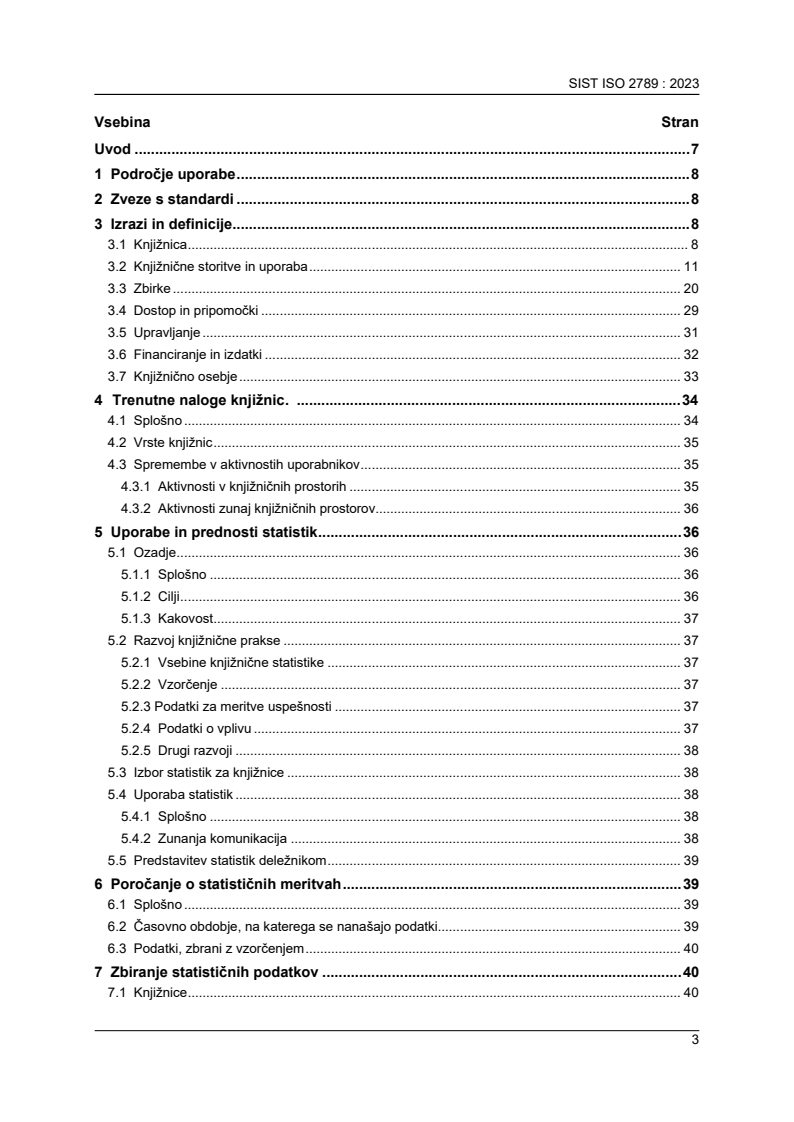
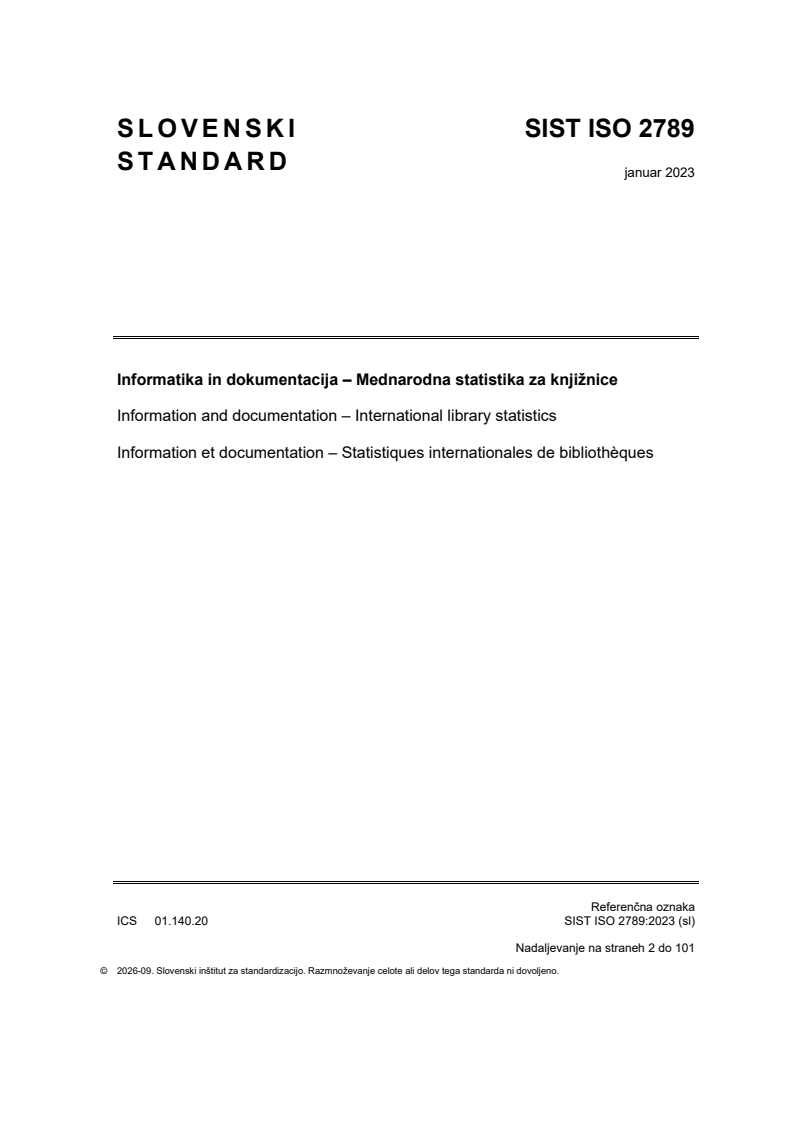
SLOVENSKI STANDARD
01-januar-2023
Nadomešča:
SIST ISO 2789:2013
Informatika in dokumentacija - Mednarodna statistika za knjižnice
Information and documentation -- International library statistics
Information et documentation -- Statistiques internationales de bibliothèques
Ta slovenski standard je istoveten z: ISO 2789:2022
ICS:
01.140.20 Informacijske vede Information sciences
2003-01.Slovenski inštitut za standardizacijo. Razmnoževanje celote ali delov tega standarda ni dovoljeno.
INTERNATIONAL ISO
STANDARD 2789
Sixth edition
2022-09
Information and documentation —
International library statistics
Information et documentation — Statistiques internationales de
bibliothèques
Reference number
© ISO 2022
All rights reserved. Unless otherwise specified, or required in the context of its implementation, no part of this publication may
be reproduced or utilized otherwise in any form or by any means, electronic or mechanical, including photocopying, or posting on
the internet or an intranet, without prior written permission. Permission can be requested from either ISO at the address below
or ISO’s member body in the country of the requester.
ISO copyright office
CP 401 • Ch. de Blandonnet 8
CH-1214 Vernier, Geneva
Phone: +41 22 749 01 11
Email: copyright@iso.org
Website: www.iso.org
Published in Switzerland
ii
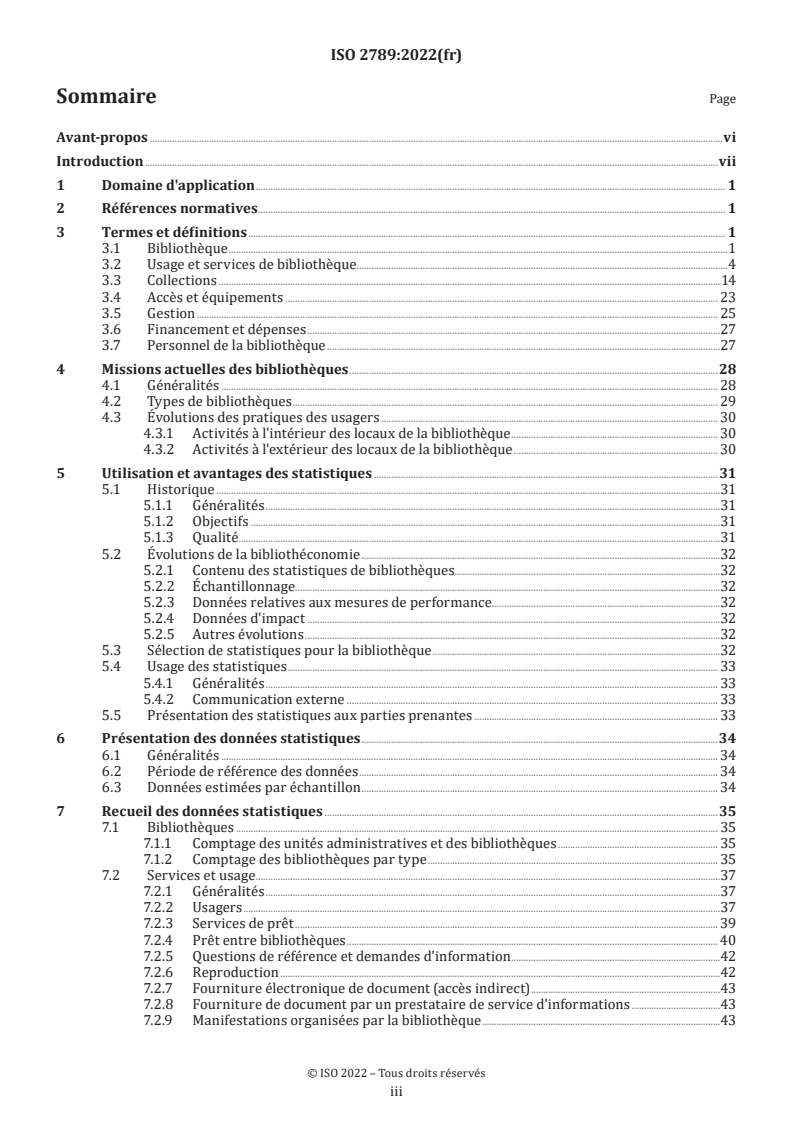
Contents Page
Foreword . vi
Introduction .vii
1 Scope . 1
2 Normative references . 1
3 Terms and definitions . 1
3.1 Library . 1
3.2 Library services and use . 4
3.3 Collections . 13
3.4 Access and facilities .22
3.5 Management . . . 24
3.6 Funding and expenditure . . 25
3.7 Library staff . 26
4 Current tasks of libraries .27
4.1 General . 27
4.2 Types of libraries .28
4.3 Changes in user activities .28
4.3.1 Activities inside the library premises .28
4.3.2 Activities outside the library premises .29
5 Uses and benefits of statistics . .29
5.1 Background .29
5.1.1 General .29
5.1.2 Objectives . 29
5.1.3 Quality . 30
5.2 Developments in library practice . 30
5.2.1 Contents of library statistics .30
5.2.2 Sampling .30
5.2.3 Data for performance measures .30
5.2.4 Impact data . 30
5.2.5 Other developments .30
5.3 Selection of statistics for the library . 30
5.4 Use of statistics . 31
5.4.1 General . 31
5.4.2 External communication . 31
5.5 Presenting statistics to stakeholders . 31
6 Reporting statistical data .32
6.1 General . 32
6.2 Time period to which data refer . 32
6.3 Data estimated by sample . 32
7 Collecting statistical data .32
7.1 Libraries . 32
7.1.1 Counting administrative units and libraries . 32
7.1.2 Counting types of libraries . 33
7.2 Services and use . 35
7.2.1 General . 35
7.2.2 Users . 35
7.2.3 Lending services . 36
7.2.4 Interlibrary lending . 37
7.2.5 Reference and informational questions.39
7.2.6 Copying .40
7.2.7 Electronic document delivery (mediated) .40
7.2.8 External document supply .40
7.2.9 Events organized by the library .40
iii
7.2.10 Physical visits . 41
7.2.11 User orientation and training . 41
7.2.12 Use of digital resources and services . 42
7.2.13 Number of website visits. 43
7.2.14 Services for mobile devices .44
7.2.15 Social network services .44
7.2.16 Services for target populations with special needs . 45
7.3 Collection . 47
7.3.1 General . 47
7.3.2 Books and serials (printed material) . . 47
7.3.3 Manuscripts .48
7.3.4 Microforms .48
7.3.5 Cartographic documents .48
7.3.6 Printed music documents . .49
7.3.7 Audiovisual documents .49
7.3.8 Graphic documents . . .50
7.3.9 Patents .50
7.3.10 Other library documents and items . 51
7.3.11 eBooks. 51
7.3.12 Other digital documents . 52
7.3.13 Databases . 52
7.3.14 Current serials received (at the end of the reporting period; all formats:
print, microform, electronic) . 53
7.3.15 Multimedia documents .54
7.3.16 Free Internet resources .54
7.3.17 Documents in institutional repositories .54
7.3.18 Data in institutional research data repositories .54
7.4 Access and facilities . 55
7.4.1 Opening hours . 55
7.4.2 Days open . 55
7.4.3 User places . 55
7.4.4 Public access workstations . 55
7.4.5 Catalogue records.56
7.4.6 Reprographic facilities .56
7.4.7 eBook readers .56
7.4.8 Other equipment available for public use .56
7.4.9 Space . . .56
7.5 Management . . . 57
7.5.1 Cooperation . 57
7.5.2 Library staff research publications .58
7.5.3 Publications about the library .58
7.5.4 Preservation/conservation .58
7.5.5 Digitization .58
7.6 Funding and expenditure (during the reporting period) . 59
7.6.1 Operating (ordinary) expenditure . 59
7.6.2 Capital expenditure . 61
7.6.3 Income and funding . 61
7.7 Library staff (at the end of the reporting period) . 61
7.7.1 General . 61
7.7.2 Total staff . 61
7.7.3 Volunteers. 62
7.7.4 Age groups of staff . 62
7.7.5 Gender . 62
7.7.6 Staff training . 62
7.7.7 Professional education .63
7.7.8 Staff allocation to service areas/working areas .63
7.7.9 Staff allocation to special services .64
7.7.10 Library staff in institutional committees .66
iv
Annex A (informative) Recommended categories for further statistical analysis .67
Annex B (informative) Grossing up .79
Annex C (informative) Methods and problems of measuring digital usage .82
Annex D (informative) Alphabetical index .86
Bibliography .92
v
Foreword
ISO (the International Organization for Standardization) is a worldwide federation of national standards
bodies (ISO member bodies). The work of preparing International Standards is normally carried out
through ISO technical committees. Each member body interested in a subject for which a technical
committee has been established has the right to be represented on that committee. International
organizations, governmental and non-governmental, in liaison with ISO, also take part in the work.
ISO collaborates closely with the International Electrotechnical Commission (IEC) on all matters of
electrotechnical standardization.
The procedures used to develop this document and those intended for its further maintenance are
described in the ISO/IEC Directives, Part 1. In particular, the different approval criteria needed for the
different types of ISO documents should be noted. This document was drafted in accordance with the
editorial rules of the ISO/IEC Directives, Part 2 (see www.iso.org/directives).
Attention is drawn to the possibility that some of the elements of this document may be the subject of
patent rights. ISO shall not be held responsible for identifying any or all such patent rights. Details of
any patent rights identified during the development of the document will be in the Introduction and/or
on the ISO list of patent declarations received (see www.iso.org/patents).
Any trade name used in this document is information given for the convenience of users and does not
constitute an endorsement.
For an explanation of the voluntary nature of standards, the meaning of ISO specific terms and
expressions related to conformity assessment, as well as information about ISO's adherence to
the World Trade Organization (WTO) principles in the Technical Barriers to Trade (TBT), see
www.iso.org/iso/foreword.html.
This document was prepared by Technical Committee ISO/TC 46, Information and documentation,
Subcommittee SC 8, Quality — Statistics and performance evaluation.
This sixth edition cancels and replaces the fifth edition (ISO 2789:2013), which has been technically
revised.
The main changes are as follows:
— problems in the practical application of ISO 2789:2013 have been addressed;
— new development in library services have been taken into account.
Any feedback or questions on this document should be directed to the user’s national standards body. A
complete listing of these bodies can be found at www.iso.org/members.html.
vi
Introduction
This document provides guidance to the library and information services community on the collection
and reporting of statistics.
Clauses 3 and 7 form the core of this document. Clause 3 provides definitions for most of the elements
which constitute a library service; these are for statistical purposes only. Clause 7 recommends how
each of these elements should be counted. Users need to consult both clauses for the complete picture.
This document includes definitions and counting procedures for all types of resources and services that
libraries offer to their users.
It is recognized that not all measures specified in this document can be collected by libraries of different
types and sizes. To give greater completeness, several additional measures (important for some sectors
only) are described in Annex A. The aim is to ensure that, where a particular statistic is collected, the
same definitions and methods are used.
Annex B is important for the compilation and publication of national statistics so that they can be truly
comparable between countries and over time.
As the use of digital library services has become a main issue for showing the role and impact of
libraries, Annex C has been added, giving an overview of methods for measuring digital usage.
The strong requirement to describe and publicize library activities can only be satisfied if data
collection in libraries follows the lines of this document. As far as possible, it is advisable that libraries
collect all data named in this document that concern their activities.
Developments in relation to this document will be monitored and additional statistical measures will
be incorporated as needed.
An alphabetical index is given in Annex D.
vii
INTERNATIONAL STANDARD ISO 2789:2022(E)
Information and documentation — International library
statistics
1 Scope
This document specifies rules for the library and information services community on the collection and
reporting of statistics:
— for the purposes of international reporting;
— to ensure conformity between countries for those statistical measures that are frequently used by
library managers, but do not qualify for international reporting;
— to encourage good practice in the use of statistics for the management of library and information
services.
2 Normative references
The following documents are referred to in the text in such a way that some or all of their content
constitutes requirements of this document. For dated references, only the edition cited applies. For
undated references, the latest edition of the referenced document (including any amendments) applies.
ISO 11799, Information and documentation — Document storage requirements for archive and library
materials
3 Terms and definitions
For the purposes of this document, the following terms and definitions apply.
ISO and IEC maintain terminology databases for use in standardization at the following addresses:
— ISO Online browsing platform: available at https:// www .iso .org/ obp
— IEC Electropedia: available at https:// www .electropedia .org/
3.1 Library
3.1.1
academic library
library whose primary function is to cover the information needs of learning and research
Note 1 to entry: This includes libraries of institutions of higher education and general research libraries.
3.1.2
administrative unit
any independent library, or group of libraries, under a single directorate or a single administration
Note 1 to entry: The term "independent" does not imply legal or financial independence but only that the library
is a recognizably separate unit, typically within a larger organization.
Note 2 to entry: The administrative unit can be a single library or a larger organization, typically containing a
central/main library, branch libraries and administrative functions. See the Example in 7.1.1.
3.1.3
branch library
part of a larger administrative unit (3.1.2) providing, in separate quarters, a service for a particular user
group (e.g. children, faculties) or for a locally defined clientele
Note 1 to entry: Institute, departmental and other affiliated libraries are included. Mobile libraries and external
service points are excluded.
3.1.4
central library
main library
part or parts of an administrative unit (3.1.2) where centralized functions of administration, collections,
and services are located
Note 1 to entry: An administrative unit comprising several branch libraries does not necessarily include a central
library.
3.1.5
external service point
point away from library premises at which a certain service is regularly offered to users
Note 1 to entry: This includes places within a locality at which library material is deposited for informal
circulation to a restricted group of users but without other library services, for example, old people’s homes,
community centres, collections for hospital patients.
Note 2 to entry: This includes service points that offer digital services, but no print collections.
Note 3 to entry: Mobile libraries and their stops are not counted as external service points.
Note 4 to entry: A simple computer connection to a place outside the library (e.g. in a students' residence hall) is
not counted as an external service point.
3.1.6
library
organization, or part of an organization, whose main aim is to facilitate the use of such information
resources, services and facilities as are required to meet the informational, research, educational,
cultural or recreational needs of its users
Note 1 to entry: The supply of the required information resources can be accomplished by building and
maintaining a collection and/or by organizing access to information resources.
Note 2 to entry: These are the basic requirements for a library and do not exclude any additional resources and
services incidental to its main purpose.
3.1.7
library of an institution of higher education
library whose primary function is to serve students, academic and professional staff in universities and
other institutions of education at the third (tertiary) level and above
Note 1 to entry: It can also serve the general public.
Note 2 to entry: This is a type of academic library.
3.1.8
mobile library
library, sometimes a division of a public library (3.1.10), using transport means, motorised or not, to
provide documents and services directly to users as an alternative to access on library premises
EXAMPLE Motor vehicles, carts, ships, bicycles, donkeys
3.1.9
national library
library that is responsible for acquiring and conserving copies of all relevant documents published in
the country in which the library is located
Note 1 to entry: A national library will also normally perform some or all of the following functions: produce
the national bibliography; hold and keep up to date a large and representative collection of foreign literature
including documents about the country; act as a national bibliographic information centre; compile union
catalogues; supervise the administration of other libraries and/or promote collaboration; coordinate a research
and development service; etc.
Note 2 to entry: The definition of "national library" allows for more than one national library in a country.
3.1.10
public library
general library that is open to the public and that serves the whole population of a local or regional
community and is usually financed, in whole or in part, from public funds
Note 1 to entry: A public library is defined as open to the public, even if its services are primarily intended for a
particular part of the population to be served, such as children, visually impaired persons, or hospital patients.
Its basic services are free of charge or available for a subsidized fee. This definition includes services provided
to schools by a public library organization and services provided to public libraries in a region by a regional
organization.
3.1.11
school library
library attached to all types of schools below the third (tertiary) level of education whose primary
function is to serve the pupils and teachers of such a school
Note 1 to entry: A school library can also serve the general public.
Note 2 to entry: This includes libraries and resource collections in all educational institutions below the third
level, which can be described as "Colleges", "Colleges of Further Education", "Vocational Institutes", etc.
3.1.12
special library
independent library covering one discipline or particular field of knowledge or a special regional
interest
Note 1 to entry: The term "special library" includes libraries primarily serving a specific category of users, or
primarily devoted to a specific form of document, and libraries sponsored by an organization to serve its own
work-related objectives.
Note 2 to entry: The statistics of special libraries should be collected and presented separately for those in the
areas given in 3.1.12.1 to 3.1.12.7 (differentiated according to funding institutions).
3.1.12.1
government library
library maintained to serve any government service, department or agency, or parliament, including
both international, national and local (regional) government organizations
3.1.12.2
health service library
medical library
library which serves health service professionals in hospitals or elsewhere, whether in the private or
public sector
Note 1 to entry: Pharmaceutical company libraries are included under 3.1.12.4.
Note 2 to entry: These libraries can also include materials for patients.
3.1.12.3
library of professional and learned institutions and associations
library maintained by professional or trade associations, learned societies, trade unions and other
similar bodies, whose primary objective is to provide services to the members and practitioners of a
specific trade or profession
3.1.12.4
industrial and commercial library
library in any industrial enterprise or business firm, maintained by the parent organization to serve
the information needs of its staff
Note 1 to entry: The term "industrial and commercial library" includes libraries maintained by information and
management consultants, manufacturing and service industries and libraries of commercial legal practices.
3.1.12.5
media library
library serving media and publishing firms and organizations, including newspapers, publishers,
broadcasting, film and television
3.1.12.6
regional library
major library serving a particular region whose primary function cannot be described as that of a
public, school or academic library (3.1.1) nor as part of a national library network
3.1.12.7
other special library
any library not included elsewhere
EXAMPLE Library within voluntary organizations, museums, religious institutions.
3.1.13
storage library
library whose primary function is to store less-used material from other administrative units (3.1.2)
Note 1 to entry: Storage libraries that are part of or administrated by another library (e.g. national or regional
library) are excluded.
Note 2 to entry: Libraries whose stock remains the possession of the storing libraries are excluded. The
collections and their use are counted with the proprietary libraries.
3.2 Library services and use
3.2.1
access
successful request of a library-provided online service
3.2.2
access
right, opportunity, means of finding, using or retrieving information, of using a service, or
entering a building
[SOURCE: ISO 15489-1:2016, 3.1, modified — “of using a service, or entering a building” have been
added.]
3.2.3
active borrower
registered user who has borrowed at least one item during the reporting period
Note 1 to entry: This count underrates the number of active users, but is still for many libraries the only
manageable measure.
3.2.4
active user
registered user who has visited or made use of library facilities or services during the reporting period
Note 1 to entry: This includes active borrowers.
Note 2 to entry: This can include the use of digital library services, if it is possible to identify digital use and
virtual visits of the individual user, or if data can be obtained by means of surveys.
Note 3 to entry: If a library identifies non-registered active users, e.g. by surveys, these are counted separately.
3.2.5
blog
weblog
web page that provides frequent continuing publication of web links and/or comments on a particular
topic or subject (broad or narrow in scope), often in the form of short entries arranged in reverse
chronological order, the most recently added piece of information appearing first
Note 1 to entry: The information can be written or collected by the site owner or contributed by users.
3.2.6
browser
application allowing a person to retrieve and read hypertext, to view the contents of hypertext nodes
(Web pages), to navigate from one Web page to another, and to interact with the content, such as
changing the visual appearance of the displayed content
[SOURCE: ISO/IEC/IEEE 23026: 2015, 4.5]
3.2.7
caching
process of storing data in a temporary storage area on a mobile device, computer or server, so that
future requests for that data are served up faster than is possible by accessing the data's primary
storage location
3.2.8
client
soft- or hardware that can request specific services from a server
3.2.9
device detection
process of capturing accurate real-time intelligence about the devices being used to access online
information
3.2.10
digital service
library service delivered digitally, whether from local servers or provided via networks
Note 1 to entry: Digital library services include the online catalogue, the library website, the digital collection,
electronic lending, electronic document delivery (mediated), digital reference service, digitally delivered user
training, services for mobile devices, services for interactive use (including services on social networks), and
Internet access offered via the library.
Note 2 to entry: This does not include booking physical services (e.g. rooms or library tours) digitally.
3.2.11
diversity
characteristics of differences and similarities between people
Note 1 to entry: Dimensions of diversity are demographic or other personal characteristics, often expressed
statistically, for example, age, disability, sex, sexual orientation, gender, race, colour, nationality, ethnic or
national origin, religion or belief.
[SOURCE: ISO 30415:2021, 3.7]
3.2.12
download
successful request of a content unit from a library-provided online service or other internet service
3.2.13
educational services
learning sessions and learning materials and programmes in all formats for children and adults for the
purpose of enhancing skills in library and information use
Note 1 to entry: This includes the provision of services for schools and the cooperation with other libraries in
preparing and offering educational services.
Note 2 to entry: Education of librarians is excluded.
[SOURCE: ISO 21248:2019, 3.22]
3.2.14
electronic document delivery (mediated)
electronic transmission of a document or part of a document from the library collection to a user,
mediated by library staff, not necessarily via another library
Note 1 to entry: Electronic transmission of documents to members of the population to be served is included. Fax
transmission is excluded.
Note 2 to entry: May be split up as to transmission with or without charge to the user.
Note 3 to entry: Unmediated downloading by users from the digital collection of the library is excluded.
Note 4 to entry: The forms of lending and delivery services defined in this document are shown in Table 1.
Table 1 — Forms of lending and delivery services
Supplier Library Document supplier
Recipient User Other library User (via library)
Original Loan ILL EDS
Print copy Loan ILL EDS
Time-limited: EDD EDS
Transmission
Loan
format
Electronic
No time limit:
EDD
ILL: Interlibrary lending.
EDD: Electronic document delivery (mediated).
EDS: External document supply.
3.2.15
equity
principle that people should be subject to policies, processes and practices that are fair, as far as
possible, and free from bias
[SOURCE: ISO 30415:2021, 3.10]
3.2.16
event
pre-arranged activity with cultural, educational, social, political, scholarly, or other intent
EXAMPLE Exhibitions, author visits, literary discussions, workshops.
Note 1 to entry: Only events arranged by the library on its own or in partnership with other institutions are
included, whether inside or outside the library premises. Events inside the library premises organized by
institutions outside the library without the library’s cooperation are excluded.
Note 2 to entry: User training lessons and library tours are excluded.
Note 3 to entry: Ongoing programs are included. Each session of a program is counted as one event.
Note 4 to entry: Virtual events are included.
3.2.17
exhibition
time-limited display of objects, organized or co-organized by the library
Note 1 to entry: Exhibitions can take place inside or outside the library premises.
3.2.18
external document supply
document or part of it, in print or electronic form, delivered from outside the library collection by non-
library suppliers (not through interlibrary lending) with the library being involved in the transaction
and/or the payment
Note 1 to entry: It is irrelevant whether a number of individual transactions are paid per view or a certain number
of transactions have been prepaid.
Note 2 to entry: The forms of lending and delivery services defined in this document are shown in Table 1.
3.2.19
external user
user of a library who does not belong to that library’s population to be served
3.2.20
geolocation
process or technique of identifying the geographical location of a person or device by means of digital
information processed via the internet
Note 1 to entry: Frequently Global Positioning System (GPS) or related technologies are used for fixing geographic
positions.
3.2.21
inclusion
practice in which all individuals are treated fairly and respectfully, are valued for their distinctive
skills, experiences, and perspectives and have equal access to resources and opportunities
3.2.22
indirect user
non-registered user who uses library services via a registered user
3.2.23
informational ques
...
INTERNATIONAL ISO
STANDARD 2789
Sixth edition
2022-09
Information and documentation —
International library statistics
Information et documentation — Statistiques internationales de
bibliothèques
Reference number
© ISO 2022
All rights reserved. Unless otherwise specified, or required in the context of its implementation, no part of this publication may
be reproduced or utilized otherwise in any form or by any means, electronic or mechanical, including photocopying, or posting on
the internet or an intranet, without prior written permission. Permission can be requested from either ISO at the address below
or ISO’s member body in the country of the requester.
ISO copyright office
CP 401 • Ch. de Blandonnet 8
CH-1214 Vernier, Geneva
Phone: +41 22 749 01 11
Email: copyright@iso.org
Website: www.iso.org
Published in Switzerland
ii
Contents Page
Foreword . vi
Introduction .vii
1 Scope . 1
2 Normative references . 1
3 Terms and definitions . 1
3.1 Library . 1
3.2 Library services and use . 4
3.3 Collections . 13
3.4 Access and facilities .22
3.5 Management . . . 24
3.6 Funding and expenditure . . 25
3.7 Library staff . 26
4 Current tasks of libraries .27
4.1 General . 27
4.2 Types of libraries .28
4.3 Changes in user activities .28
4.3.1 Activities inside the library premises .28
4.3.2 Activities outside the library premises .29
5 Uses and benefits of statistics . .29
5.1 Background .29
5.1.1 General .29
5.1.2 Objectives . 29
5.1.3 Quality . 30
5.2 Developments in library practice . 30
5.2.1 Contents of library statistics .30
5.2.2 Sampling .30
5.2.3 Data for performance measures .30
5.2.4 Impact data . 30
5.2.5 Other developments .30
5.3 Selection of statistics for the library . 30
5.4 Use of statistics . 31
5.4.1 General . 31
5.4.2 External communication . 31
5.5 Presenting statistics to stakeholders . 31
6 Reporting statistical data .32
6.1 General . 32
6.2 Time period to which data refer . 32
6.3 Data estimated by sample . 32
7 Collecting statistical data .32
7.1 Libraries . 32
7.1.1 Counting administrative units and libraries . 32
7.1.2 Counting types of libraries . 33
7.2 Services and use . 35
7.2.1 General . 35
7.2.2 Users . 35
7.2.3 Lending services . 36
7.2.4 Interlibrary lending . 37
7.2.5 Reference and informational questions.39
7.2.6 Copying .40
7.2.7 Electronic document delivery (mediated) .40
7.2.8 External document supply .40
7.2.9 Events organized by the library .40
iii
7.2.10 Physical visits . 41
7.2.11 User orientation and training . 41
7.2.12 Use of digital resources and services . 42
7.2.13 Number of website visits. 43
7.2.14 Services for mobile devices .44
7.2.15 Social network services .44
7.2.16 Services for target populations with special needs . 45
7.3 Collection . 47
7.3.1 General . 47
7.3.2 Books and serials (printed material) . . 47
7.3.3 Manuscripts .48
7.3.4 Microforms .48
7.3.5 Cartographic documents .48
7.3.6 Printed music documents . .49
7.3.7 Audiovisual documents .49
7.3.8 Graphic documents . . .50
7.3.9 Patents .50
7.3.10 Other library documents and items . 51
7.3.11 eBooks. 51
7.3.12 Other digital documents . 52
7.3.13 Databases . 52
7.3.14 Current serials received (at the end of the reporting period; all formats:
print, microform, electronic) . 53
7.3.15 Multimedia documents .54
7.3.16 Free Internet resources .54
7.3.17 Documents in institutional repositories .54
7.3.18 Data in institutional research data repositories .54
7.4 Access and facilities . 55
7.4.1 Opening hours . 55
7.4.2 Days open . 55
7.4.3 User places . 55
7.4.4 Public access workstations . 55
7.4.5 Catalogue records.56
7.4.6 Reprographic facilities .56
7.4.7 eBook readers .56
7.4.8 Other equipment available for public use .56
7.4.9 Space . . .56
7.5 Management . . . 57
7.5.1 Cooperation . 57
7.5.2 Library staff research publications .58
7.5.3 Publications about the library .58
7.5.4 Preservation/conservation .58
7.5.5 Digitization .58
7.6 Funding and expenditure (during the reporting period) . 59
7.6.1 Operating (ordinary) expenditure . 59
7.6.2 Capital expenditure . 61
7.6.3 Income and funding . 61
7.7 Library staff (at the end of the reporting period) . 61
7.7.1 General . 61
7.7.2 Total staff . 61
7.7.3 Volunteers. 62
7.7.4 Age groups of staff . 62
7.7.5 Gender . 62
7.7.6 Staff training . 62
7.7.7 Professional education .63
7.7.8 Staff allocation to service areas/working areas .63
7.7.9 Staff allocation to special services .64
7.7.10 Library staff in institutional committees .66
iv
Annex A (informative) Recommended categories for further statistical analysis .67
Annex B (informative) Grossing up .79
Annex C (informative) Methods and problems of measuring digital usage .82
Annex D (informative) Alphabetical index .86
Bibliography .92
v
Foreword
ISO (the International Organization for Standardization) is a worldwide federation of national standards
bodies (ISO member bodies). The work of preparing International Standards is normally carried out
through ISO technical committees. Each member body interested in a subject for which a technical
committee has been established has the right to be represented on that committee. International
organizations, governmental and non-governmental, in liaison with ISO, also take part in the work.
ISO collaborates closely with the International Electrotechnical Commission (IEC) on all matters of
electrotechnical standardization.
The procedures used to develop this document and those intended for its further maintenance are
described in the ISO/IEC Directives, Part 1. In particular, the different approval criteria needed for the
different types of ISO documents should be noted. This document was drafted in accordance with the
editorial rules of the ISO/IEC Directives, Part 2 (see www.iso.org/directives).
Attention is drawn to the possibility that some of the elements of this document may be the subject of
patent rights. ISO shall not be held responsible for identifying any or all such patent rights. Details of
any patent rights identified during the development of the document will be in the Introduction and/or
on the ISO list of patent declarations received (see www.iso.org/patents).
Any trade name used in this document is information given for the convenience of users and does not
constitute an endorsement.
For an explanation of the voluntary nature of standards, the meaning of ISO specific terms and
expressions related to conformity assessment, as well as information about ISO's adherence to
the World Trade Organization (WTO) principles in the Technical Barriers to Trade (TBT), see
www.iso.org/iso/foreword.html.
This document was prepared by Technical Committee ISO/TC 46, Information and documentation,
Subcommittee SC 8, Quality — Statistics and performance evaluation.
This sixth edition cancels and replaces the fifth edition (ISO 2789:2013), which has been technically
revised.
The main changes are as follows:
— problems in the practical application of ISO 2789:2013 have been addressed;
— new development in library services have been taken into account.
Any feedback or questions on this document should be directed to the user’s national standards body. A
complete listing of these bodies can be found at www.iso.org/members.html.
vi
Introduction
This document provides guidance to the library and information services community on the collection
and reporting of statistics.
Clauses 3 and 7 form the core of this document. Clause 3 provides definitions for most of the elements
which constitute a library service; these are for statistical purposes only. Clause 7 recommends how
each of these elements should be counted. Users need to consult both clauses for the complete picture.
This document includes definitions and counting procedures for all types of resources and services that
libraries offer to their users.
It is recognized that not all measures specified in this document can be collected by libraries of different
types and sizes. To give greater completeness, several additional measures (important for some sectors
only) are described in Annex A. The aim is to ensure that, where a particular statistic is collected, the
same definitions and methods are used.
Annex B is important for the compilation and publication of national statistics so that they can be truly
comparable between countries and over time.
As the use of digital library services has become a main issue for showing the role and impact of
libraries, Annex C has been added, giving an overview of methods for measuring digital usage.
The strong requirement to describe and publicize library activities can only be satisfied if data
collection in libraries follows the lines of this document. As far as possible, it is advisable that libraries
collect all data named in this document that concern their activities.
Developments in relation to this document will be monitored and additional statistical measures will
be incorporated as needed.
An alphabetical index is given in Annex D.
vii
INTERNATIONAL STANDARD ISO 2789:2022(E)
Information and documentation — International library
statistics
1 Scope
This document specifies rules for the library and information services community on the collection and
reporting of statistics:
— for the purposes of international reporting;
— to ensure conformity between countries for those statistical measures that are frequently used by
library managers, but do not qualify for international reporting;
— to encourage good practice in the use of statistics for the management of library and information
services.
2 Normative references
The following documents are referred to in the text in such a way that some or all of their content
constitutes requirements of this document. For dated references, only the edition cited applies. For
undated references, the latest edition of the referenced document (including any amendments) applies.
ISO 11799, Information and documentation — Document storage requirements for archive and library
materials
3 Terms and definitions
For the purposes of this document, the following terms and definitions apply.
ISO and IEC maintain terminology databases for use in standardization at the following addresses:
— ISO Online browsing platform: available at https:// www .iso .org/ obp
— IEC Electropedia: available at https:// www .electropedia .org/
3.1 Library
3.1.1
academic library
library whose primary function is to cover the information needs of learning and research
Note 1 to entry: This includes libraries of institutions of higher education and general research libraries.
3.1.2
administrative unit
any independent library, or group of libraries, under a single directorate or a single administration
Note 1 to entry: The term "independent" does not imply legal or financial independence but only that the library
is a recognizably separate unit, typically within a larger organization.
Note 2 to entry: The administrative unit can be a single library or a larger organization, typically containing a
central/main library, branch libraries and administrative functions. See the Example in 7.1.1.
3.1.3
branch library
part of a larger administrative unit (3.1.2) providing, in separate quarters, a service for a particular user
group (e.g. children, faculties) or for a locally defined clientele
Note 1 to entry: Institute, departmental and other affiliated libraries are included. Mobile libraries and external
service points are excluded.
3.1.4
central library
main library
part or parts of an administrative unit (3.1.2) where centralized functions of administration, collections,
and services are located
Note 1 to entry: An administrative unit comprising several branch libraries does not necessarily include a central
library.
3.1.5
external service point
point away from library premises at which a certain service is regularly offered to users
Note 1 to entry: This includes places within a locality at which library material is deposited for informal
circulation to a restricted group of users but without other library services, for example, old people’s homes,
community centres, collections for hospital patients.
Note 2 to entry: This includes service points that offer digital services, but no print collections.
Note 3 to entry: Mobile libraries and their stops are not counted as external service points.
Note 4 to entry: A simple computer connection to a place outside the library (e.g. in a students' residence hall) is
not counted as an external service point.
3.1.6
library
organization, or part of an organization, whose main aim is to facilitate the use of such information
resources, services and facilities as are required to meet the informational, research, educational,
cultural or recreational needs of its users
Note 1 to entry: The supply of the required information resources can be accomplished by building and
maintaining a collection and/or by organizing access to information resources.
Note 2 to entry: These are the basic requirements for a library and do not exclude any additional resources and
services incidental to its main purpose.
3.1.7
library of an institution of higher education
library whose primary function is to serve students, academic and professional staff in universities and
other institutions of education at the third (tertiary) level and above
Note 1 to entry: It can also serve the general public.
Note 2 to entry: This is a type of academic library.
3.1.8
mobile library
library, sometimes a division of a public library (3.1.10), using transport means, motorised or not, to
provide documents and services directly to users as an alternative to access on library premises
EXAMPLE Motor vehicles, carts, ships, bicycles, donkeys
3.1.9
national library
library that is responsible for acquiring and conserving copies of all relevant documents published in
the country in which the library is located
Note 1 to entry: A national library will also normally perform some or all of the following functions: produce
the national bibliography; hold and keep up to date a large and representative collection of foreign literature
including documents about the country; act as a national bibliographic information centre; compile union
catalogues; supervise the administration of other libraries and/or promote collaboration; coordinate a research
and development service; etc.
Note 2 to entry: The definition of "national library" allows for more than one national library in a country.
3.1.10
public library
general library that is open to the public and that serves the whole population of a local or regional
community and is usually financed, in whole or in part, from public funds
Note 1 to entry: A public library is defined as open to the public, even if its services are primarily intended for a
particular part of the population to be served, such as children, visually impaired persons, or hospital patients.
Its basic services are free of charge or available for a subsidized fee. This definition includes services provided
to schools by a public library organization and services provided to public libraries in a region by a regional
organization.
3.1.11
school library
library attached to all types of schools below the third (tertiary) level of education whose primary
function is to serve the pupils and teachers of such a school
Note 1 to entry: A school library can also serve the general public.
Note 2 to entry: This includes libraries and resource collections in all educational institutions below the third
level, which can be described as "Colleges", "Colleges of Further Education", "Vocational Institutes", etc.
3.1.12
special library
independent library covering one discipline or particular field of knowledge or a special regional
interest
Note 1 to entry: The term "special library" includes libraries primarily serving a specific category of users, or
primarily devoted to a specific form of document, and libraries sponsored by an organization to serve its own
work-related objectives.
Note 2 to entry: The statistics of special libraries should be collected and presented separately for those in the
areas given in 3.1.12.1 to 3.1.12.7 (differentiated according to funding institutions).
3.1.12.1
government library
library maintained to serve any government service, department or agency, or parliament, including
both international, national and local (regional) government organizations
3.1.12.2
health service library
medical library
library which serves health service professionals in hospitals or elsewhere, whether in the private or
public sector
Note 1 to entry: Pharmaceutical company libraries are included under 3.1.12.4.
Note 2 to entry: These libraries can also include materials for patients.
3.1.12.3
library of professional and learned institutions and associations
library maintained by professional or trade associations, learned societies, trade unions and other
similar bodies, whose primary objective is to provide services to the members and practitioners of a
specific trade or profession
3.1.12.4
industrial and commercial library
library in any industrial enterprise or business firm, maintained by the parent organization to serve
the information needs of its staff
Note 1 to entry: The term "industrial and commercial library" includes libraries maintained by information and
management consultants, manufacturing and service industries and libraries of commercial legal practices.
3.1.12.5
media library
library serving media and publishing firms and organizations, including newspapers, publishers,
broadcasting, film and television
3.1.12.6
regional library
major library serving a particular region whose primary function cannot be described as that of a
public, school or academic library (3.1.1) nor as part of a national library network
3.1.12.7
other special library
any library not included elsewhere
EXAMPLE Library within voluntary organizations, museums, religious institutions.
3.1.13
storage library
library whose primary function is to store less-used material from other administrative units (3.1.2)
Note 1 to entry: Storage libraries that are part of or administrated by another library (e.g. national or regional
library) are excluded.
Note 2 to entry: Libraries whose stock remains the possession of the storing libraries are excluded. The
collections and their use are counted with the proprietary libraries.
3.2 Library services and use
3.2.1
access
successful request of a library-provided online service
3.2.2
access
right, opportunity, means of finding, using or retrieving information, of using a service, or
entering a building
[SOURCE: ISO 15489-1:2016, 3.1, modified — “of using a service, or entering a building” have been
added.]
3.2.3
active borrower
registered user who has borrowed at least one item during the reporting period
Note 1 to entry: This count underrates the number of active users, but is still for many libraries the only
manageable measure.
3.2.4
active user
registered user who has visited or made use of library facilities or services during the reporting period
Note 1 to entry: This includes active borrowers.
Note 2 to entry: This can include the use of digital library services, if it is possible to identify digital use and
virtual visits of the individual user, or if data can be obtained by means of surveys.
Note 3 to entry: If a library identifies non-registered active users, e.g. by surveys, these are counted separately.
3.2.5
blog
weblog
web page that provides frequent continuing publication of web links and/or comments on a particular
topic or subject (broad or narrow in scope), often in the form of short entries arranged in reverse
chronological order, the most recently added piece of information appearing first
Note 1 to entry: The information can be written or collected by the site owner or contributed by users.
3.2.6
browser
application allowing a person to retrieve and read hypertext, to view the contents of hypertext nodes
(Web pages), to navigate from one Web page to another, and to interact with the content, such as
changing the visual appearance of the displayed content
[SOURCE: ISO/IEC/IEEE 23026: 2015, 4.5]
3.2.7
caching
process of storing data in a temporary storage area on a mobile device, computer or server, so that
future requests for that data are served up faster than is possible by accessing the data's primary
storage location
3.2.8
client
soft- or hardware that can request specific services from a server
3.2.9
device detection
process of capturing accurate real-time intelligence about the devices being used to access online
information
3.2.10
digital service
library service delivered digitally, whether from local servers or provided via networks
Note 1 to entry: Digital library services include the online catalogue, the library website, the digital collection,
electronic lending, electronic document delivery (mediated), digital reference service, digitally delivered user
training, services for mobile devices, services for interactive use (including services on social networks), and
Internet access offered via the library.
Note 2 to entry: This does not include booking physical services (e.g. rooms or library tours) digitally.
3.2.11
diversity
characteristics of differences and similarities between people
Note 1 to entry: Dimensions of diversity are demographic or other personal characteristics, often expressed
statistically, for example, age, disability, sex, sexual orientation, gender, race, colour, nationality, ethnic or
national origin, religion or belief.
[SOURCE: ISO 30415:2021, 3.7]
3.2.12
download
successful request of a content unit from a library-provided online service or other internet service
3.2.13
educational services
learning sessions and learning materials and programmes in all formats for children and adults for the
purpose of enhancing skills in library and information use
Note 1 to entry: This includes the provision of services for schools and the cooperation with other libraries in
preparing and offering educational services.
Note 2 to entry: Education of librarians is excluded.
[SOURCE: ISO 21248:2019, 3.22]
3.2.14
electronic document delivery (mediated)
electronic transmission of a document or part of a document from the library collection to a user,
mediated by library staff, not necessarily via another library
Note 1 to entry: Electronic transmission of documents to members of the population to be served is included. Fax
transmission is excluded.
Note 2 to entry: May be split up as to transmission with or without charge to the user.
Note 3 to entry: Unmediated downloading by users from the digital collection of the library is excluded.
Note 4 to entry: The forms of lending and delivery services defined in this document are shown in Table 1.
Table 1 — Forms of lending and delivery services
Supplier Library Document supplier
Recipient User Other library User (via library)
Original Loan ILL EDS
Print copy Loan ILL EDS
Time-limited: EDD EDS
Transmission
Loan
format
Electronic
No time limit:
EDD
ILL: Interlibrary lending.
EDD: Electronic document delivery (mediated).
EDS: External document supply.
3.2.15
equity
principle that people should be subject to policies, processes and practices that are fair, as far as
possible, and free from bias
[SOURCE: ISO 30415:2021, 3.10]
3.2.16
event
pre-arranged activity with cultural, educational, social, political, scholarly, or other intent
EXAMPLE Exhibitions, author visits, literary discussions, workshops.
Note 1 to entry: Only events arranged by the library on its own or in partnership with other institutions are
included, whether inside or outside the library premises. Events inside the library premises organized by
institutions outside the library without the library’s cooperation are excluded.
Note 2 to entry: User training lessons and library tours are excluded.
Note 3 to entry: Ongoing programs are included. Each session of a program is counted as one event.
Note 4 to entry: Virtual events are included.
3.2.17
exhibition
time-limited display of objects, organized or co-organized by the library
Note 1 to entry: Exhibitions can take place inside or outside the library premises.
3.2.18
external document supply
document or part of it, in print or electronic form, delivered from outside the library collection by non-
library suppliers (not through interlibrary lending) with the library being involved in the transaction
and/or the payment
Note 1 to entry: It is irrelevant whether a number of individual transactions are paid per view or a certain number
of transactions have been prepaid.
Note 2 to entry: The forms of lending and delivery services defined in this document are shown in Table 1.
3.2.19
external user
user of a library who does not belong to that library’s population to be served
3.2.20
geolocation
process or technique of identifying the geographical location of a person or device by means of digital
information processed via the internet
Note 1 to entry: Frequently Global Positioning System (GPS) or related technologies are used for fixing geographic
positions.
3.2.21
inclusion
practice in which all individuals are treated fairly and respectfully, are valued for their distinctive
skills, experiences, and perspectives and have equal access to resources and opportunities
3.2.22
indirect user
non-registered user who uses library services via a registered user
3.2.23
informational question
directional and/or administrative inquiry delivered to library staff
Note 1 to entry: This includes, for example, questions for locating staff or facilities, questions regarding opening
times and registering procedures and questions about handling equipment such as printers or computer
terminals.
Note 2 to entry: The question can be delivered personally or by means of telephone, regular mail, fax or electronic
media (via email, the library website or other networked communication mechanisms).
Note 3 to entry: For reference questions, see 3.2.43.
3.2.24
in-house use
use of documents on the premises having been taken by a user from open access stock
Note 1 to entry: In-house use includes browsing at the shelves in the sense of a short investigation of the contents,
but excludes looking at the side or spine titles only for selecting material.
3.2.25
interlibrary loan
transaction of
...
Norme
internationale
ISO 2789
Sixième édition
Information et documentation —
2022-09
Statistiques internationales de
bibliothèques
Information and documentation — International library
statistics
Numéro de référence
DOCUMENT PROTÉGÉ PAR COPYRIGHT
© ISO 2022
Tous droits réservés. Sauf prescription différente ou nécessité dans le contexte de sa mise en œuvre, aucune partie de cette
publication ne peut être reproduite ni utilisée sous quelque forme que ce soit et par aucun procédé, électronique ou mécanique,
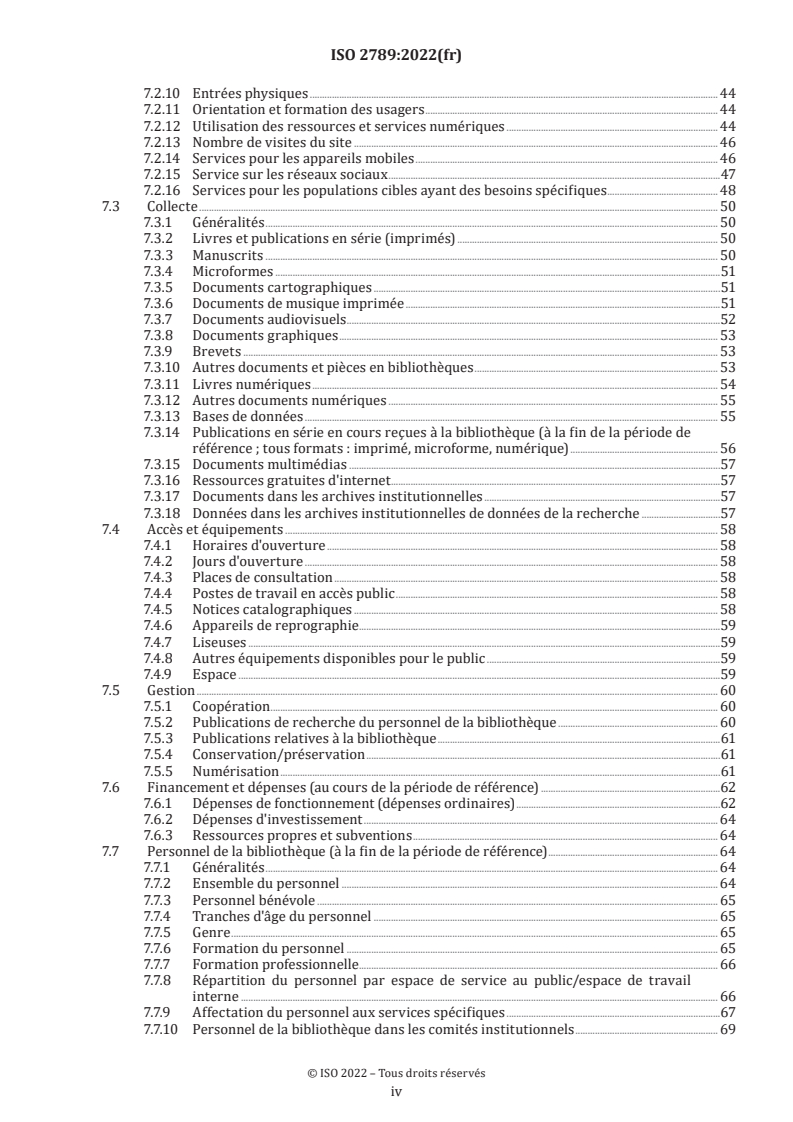
y compris la photocopie, ou la diffusion sur l’internet ou sur un intranet, sans autorisation écrite préalable. Une autorisation peut
être demandée à l’ISO à l’adresse ci-après ou au comité membre de l’ISO dans le pays du demandeur.
ISO copyright office
Case postale 401 • Ch. de Blandonnet 8
CH-1214 Vernier, Genève
Tél.: +41 22 749 01 11
E-mail: copyright@iso.org
Web: www.iso.org
Publié en Suisse
ii
Sommaire Page
Avant-propos .vi
Introduction .vii
1 Domaine d'application . 1
2 Références normatives . 1
3 Termes et définitions . 1
3.1 Bibliothèque .1
3.2 Usage et services de bibliothèque .4
3.3 Collections .14
3.4 Accès et équipements . 23
3.5 Gestion . 25
3.6 Financement et dépenses .27
3.7 Personnel de la bibliothèque .27
4 Missions actuelles des bibliothèques .28
4.1 Généralités . 28
4.2 Types de bibliothèques . 29
4.3 Évolutions des pratiques des usagers . 30
4.3.1 Activités à l'intérieur des locaux de la bibliothèque . 30
4.3.2 Activités à l'extérieur des locaux de la bibliothèque . 30
5 Utilisation et avantages des statistiques .31
5.1 Historique .31
5.1.1 Généralités .31
5.1.2 Objectifs .31
5.1.3 Qualité . .31
5.2 Évolutions de la bibliothéconomie .32
5.2.1 Contenu des statistiques de bibliothèques .32
5.2.2 Échantillonnage.32
5.2.3 Données relatives aux mesures de performance.32
5.2.4 Données d'impact .32
5.2.5 Autres évolutions .32
5.3 Sélection de statistiques pour la bibliothèque .32
5.4 Usage des statistiques . 33
5.4.1 Généralités . 33
5.4.2 Communication externe . 33
5.5 Présentation des statistiques aux parties prenantes . 33
6 Présentation des données statistiques .34
6.1 Généralités . 34
6.2 Période de référence des données . 34
6.3 Données estimées par échantillon . 34
7 Recueil des données statistiques .35
7.1 Bibliothèques . 35
7.1.1 Comptage des unités administratives et des bibliothèques . 35
7.1.2 Comptage des bibliothèques par type . 35
7.2 Services et usage .37
7.2.1 Généralités .37
7.2.2 Usagers .37
7.2.3 Services de prêt . 39
7.2.4 Prêt entre bibliothèques . 40
7.2.5 Questions de référence et demandes d'information .42
7.2.6 Reproduction .42
7.2.7 Fourniture électronique de document (accès indirect) .43
7.2.8 Fourniture de document par un prestataire de service d'informations .43
7.2.9 Manifestations organisées par la bibliothèque .43
iii
7.2.10 Entrées physiques . 44
7.2.11 Orientation et formation des usagers . 44
7.2.12 Utilisation des ressources et services numériques . 44
7.2.13 Nombre de visites du site . 46
7.2.14 Services pour les appareils mobiles . 46
7.2.15 Service sur les réseaux sociaux .47
7.2.16 Services pour les populations cibles ayant des besoins spécifiques . 48
7.3 Collecte . 50
7.3.1 Généralités . 50
7.3.2 Livres et publications en série (imprimés) . 50
7.3.3 Manuscrits . 50
7.3.4 Microformes .51
7.3.5 Documents cartographiques .51
7.3.6 Documents de musique imprimée .51
7.3.7 Documents audiovisuels .52
7.3.8 Documents graphiques . 53
7.3.9 Brevets . 53
7.3.10 Autres documents et pièces en bibliothèques . 53
7.3.11 Livres numériques . 54
7.3.12 Autres documents numériques . 55
7.3.13 Bases de données . 55
7.3.14 Publications en série en cours reçues à la bibliothèque (à la fin de la période de
référence ; tous formats : imprimé, microforme, numérique) . 56
7.3.15 Documents multimédias .57
7.3.16 Ressources gratuites d'internet .57
7.3.17 Documents dans les archives institutionnelles .57
7.3.18 Données dans les archives institutionnelles de données de la recherche .57
7.4 Accès et équipements . 58
7.4.1 Horaires d'ouverture . 58
7.4.2 Jours d'ouverture . 58
7.4.3 Places de consultation . 58
7.4.4 Postes de travail en accès public . 58
7.4.5 Notices catalographiques . 58
7.4.6 Appareils de reprographie . .59
7.4.7 Liseuses .59
7.4.8 Autres équipements disponibles pour le public .59
7.4.9 Espace .59
7.5 Gestion . 60
7.5.1 Coopération . 60
7.5.2 Publications de recherche du personnel de la bibliothèque . 60
7.5.3 Publications relatives à la bibliothèque .61
7.5.4 Conservation/préservation .61
7.5.5 Numérisation .61
7.6 Financement et dépenses (au cours de la période de référence) .62
7.6.1 Dépenses de fonctionnement (dépenses ordinaires) .62
7.6.2 Dépenses d'investissement . 64
7.6.3 Ressources propres et subventions . 64
7.7 Personnel de la bibliothèque (à la fin de la période de référence) . 64
7.7.1 Généralités . 64
7.7.2 Ensemble du personnel . 64
7.7.3 Personnel bénévole . 65
7.7.4 Tranches d'âge du personnel . 65
7.7.5 Genre . 65
7.7.6 Formation du personnel . 65
7.7.7 Formation professionnelle . . 66
7.7.8 Répartition du personnel par espace de service au public/espace de travail
interne . 66
7.7.9 Affectation du personnel aux services spécifiques .67
7.7.10 Personnel de la bibliothèque dans les comités institutionnels . 69
iv
Annexe A (informative) Catégories recommandées pour des analyses statistiques
complémentaires .70
Annexe B (informative) Extrapolation .83
Annexe C (informative) Méthodes et problèmes relatifs à la mesure des usages numériques .87
Annexe D (informative) Index alphabétique.91
Bibliographie .97
v
Avant-propos
L'ISO (Organisation internationale de normalisation) est une fédération mondiale d'organismes nationaux
de normalisation (comités membres de l'ISO). L'élaboration des Normes internationales est en général
confiée aux comités techniques de l'ISO. Chaque comité membre intéressé par une étude a le droit de faire
partie du comité technique créé à cet effet. Les organisations internationales, gouvernementales et non
gouvernementales, en liaison avec l'ISO participent également aux travaux. L'ISO collabore étroitement avec
la Commission électrotechnique internationale (IEC) en ce qui concerne la normalisation électrotechnique.
Les procédures utilisées pour élaborer le présent document et celles destinées à sa mise à jour sont
décrites dans les Directives ISO/IEC, Partie 1. Il convient, en particulier, de prendre note des différents
critères d'approbation requis pour les différents types de documents ISO. Le présent document
a été rédigé conformément aux règles de rédaction données dans les Directives ISO/IEC, Partie 2
(voir www.iso.org/directives).
L'attention est attirée sur le fait que certains des éléments du présent document peuvent faire l'objet de
droits de propriété intellectuelle ou de droits analogues. L'ISO ne saurait être tenue pour responsable
de ne pas avoir identifié de tels droits de propriété et averti de leur existence. Les détails concernant les
références aux droits de propriété intellectuelle ou autres droits analogues identifiés lors de l'élaboration du
document sont indiqués dans l'Introduction et/ou dans la liste des déclarations de brevets reçues par l'ISO
(voir www.iso.org/brevets).
Les appellations commerciales éventuellement mentionnées dans le présent document sont données pour
information, par souci de commodité, à l'intention des utilisateurs et ne sauraient constituer un engagement.
Pour une explication de la nature volontaire des normes, la signification des termes et expressions
spécifiques de l'ISO liés à l'évaluation de la conformité, ou pour toute information au sujet de l'adhésion de
l'ISO aux principes de l'Organisation mondiale du commerce (OMC) concernant les obstacles techniques au
commerce (OTC), voir www.iso.org/avant-propos.
Le présent document a été élaboré par le comité technique ISO/TC 46, Information et documentation,
sous-comité SC 8, Qualité — Statistiques et évaluation de la performance.
Cette sixième édition annule et remplace la cinquième édition (ISO 2789:2013), qui a fait l'objet d'une
révision technique.
Les principales modifications sont les suivantes :
— les problèmes concernant l'application pratique de l'ISO 2789:2013 ont été résolus ;
— les nouveaux développements du domaine des services de bibliothèque ont été pris en compte.
Il convient que l'utilisateur adresse tout retour d'information ou toute question concernant le présent
document à l'organisme national de normalisation de son pays. Une liste exhaustive desdits organismes se
trouve à l'adresse www.iso.org/fr/members.html.
vi
Introduction
Le présent document fournit des règles à la communauté des bibliothèques et des services d'information
pour la collecte et la présentation de statistiques.
Les Articles 3 et 7 forment le cœur du présent document. L'Article 3 fournit les définitions de la plupart des
éléments composant le service d'une bibliothèque, ces définitions ne s'appliquent que dans une perspective
statistique. L'Article 7 indique comment il convient de compter chacun des éléments définis. Il est nécessaire
que les usagers consultent les deux articles pour disposer d'une vue complète.
Le présent document comprend les définitions et les procédures de comptage pour tous les types de
ressources et de services que les bibliothèques proposent à leurs usagers.
Il va sans dire que l'ensemble des données définies dans le présent document ne peuvent être collectées par
des bibliothèques de types ou de tailles différents. À titre de complément, l'Annexe A décrit des données
supplémentaires (qui n'ont d'importance que dans certains cas uniquement). L'objectif visé est de garantir
que lorsque l'on collecte une donnée statistique particulière, on utilise toujours les mêmes définitions et les
mêmes méthodes.
L'Annexe B est importante pour recueillir et publier des statistiques nationales qui soient véritablement
comparables entre les pays et dans le temps.
Étant donné que l'utilisation des services numériques de bibliothèque constitue un enjeu important pour
démontrer le rôle et l'impact des bibliothèques, l'Annexe C a été ajoutée pour fournir un aperçu des méthodes
de mesure des usages numériques.
On ne peut satisfaire la forte demande de description et de diffusion de l'activité des bibliothèques que si
la collecte des données dans les bibliothèques suit les lignes du présent document. Autant que possible, il
est recommandé que les bibliothèques collectent toutes les données de leur activité citées dans le présent
document.
Les développements en rapport avec le présent document seront supervisés et de nouvelles mesures
statistiques seront incorporées en fonction des besoins.
Un index est donné à l'Annexe D.
vii
Norme internationale ISO 2789:2022(fr)
Information et documentation — Statistiques internationales
de bibliothèques
1 Domaine d'application
Le présent document fournit des règles à la communauté des bibliothèques et des services d'information
pour la collecte et la présentation de statistiques :
— en vue de l'établissement de synthèses sur le plan international ;
— pour assurer la conformité entre pays de mesures statistiques fréquemment utilisées par les gestionnaires
de bibliothèques sans pour autant servir à l'établissement de synthèses internationales ;
— pour encourager une bonne pratique des statistiques dans la gestion des bibliothèques et des services
d'information.
2 Références normatives
Les documents suivants sont cités dans le texte de sorte qu'ils constituent, pour tout ou partie de leur
contenu, des exigences du présent document. Pour les références datées, seule l'édition citée s'applique. Pour
les références non datées, la dernière édition du document de référence s'applique (y compris les éventuels
amendements).
ISO 11799, Information et documentation — Exigences pour le stockage des documents d’archives et de
bibliothèques
3 Termes et définitions
Pour les besoins du présent document, les termes et définitions suivants s'appliquent.
L'ISO et l'IEC tiennent à jour des bases de données terminologiques destinées à être utilisées en normalisation,
consultables aux adresses suivantes :
— ISO Online browsing platform : disponible à l'adresse https:// www .iso .org/ obp
— IEC Electropedia : disponible à l'adresse https:// www .electropedia .org/
3.1 Bibliothèque
3.1.1
bibliothèque universitaire et de recherche
bibliothèque dont la fonction principale est de répondre aux besoins documentaires pour la formation et la
recherche
Note 1 à l'article: Cela comprend les bibliothèques d'établissement d'enseignement supérieur et les bibliothèques de
recherche en général.
3.1.2
unité administrative
bibliothèque indépendante ou groupe de bibliothèques relevant d'une direction ou d'une administration unique
Note 1 à l'article: Le terme « indépendant » n'implique pas une indépendance juridique ou financière mais seulement le
fait que la bibliothèque est une unité identifiée comme distincte, par exemple au sein d'une organisation plus grande.
Note 2 à l'article: L'unité administrative peut être une bibliothèque unique ou une organisation plus importante
comprenant une bibliothèque centrale/principale, des bibliothèques annexes et des services administratifs. Voir
l'exemple en 7.1.1.
3.1.3
bibliothèque annexe
partie d'une unité administrative (3.1.2) plus grande, offrant dans un local distinct un service de bibliothèque
pour un groupe particulier d'usagers (par exemple une bibliothèque pour la jeunesse, une bibliothèque de
faculté) ou pour un public localement défini
Note 1 à l'article: Les bibliothèques d'instituts, de départements et les autres bibliothèques associées sont incluses. Les
bibliothèques mobiles et les points de desserte extérieurs sont exclus.
3.1.4
bibliothèque centrale
bibliothèque principale
la partie ou les parties d'une unité administrative (3.1.2) dans lesquelles sont centralisés les fonctions
administratives, les collections et les services
Note 1 à l'article: Une unité administrative comprenant plusieurs bibliothèques annexes ne comprend pas
nécessairement de bibliothèque centrale/principale.
3.1.5
point de desserte extérieur
point de desserte à l'extérieur des locaux de la bibliothèque où un service déterminé est régulièrement offert
aux usagers
Note 1 à l'article: Sont compris des lieux, dans un secteur géographique, dans lesquels des documents de la bibliothèque
sont déposés pour un usage informel au sein d'un groupe restreint d'usagers, mais sans autre service de bibliothèque,
par exemple des maisons de retraite, des maisons de quartier, des collections pour les patients des hôpitaux.
Note 2 à l'article: Cela comprend les points de desserte qui offrent des services numériques, sans collections imprimées.
Note 3 à l'article: Les points d'arrêt des bibliothèques mobiles ne sont pas comptés comme des points de desserte
extérieurs.
Note 4 à l'article: Une simple connexion informatique à la bibliothèque depuis un lieu extérieur (par exemple une
résidence universitaire) n'est pas comptée comme un point de desserte extérieur.
3.1.6
bibliothèque
organisation ou partie d'organisation, dont le but principal est de faciliter l'utilisation des ressources
documentaires, des services et des équipements adaptés aux besoins d'information, de recherche,
d'éducation, de culture et de loisirs de ses usagers
Note 1 à l'article: L'offre des ressources documentaires requises peut être assurée par le développement et la gestion
d'une collection et/ou par une organisation de l'accès aux ressources documentaires.
Note 2 à l'article: Ce sont les prérequis pour une bibliothèque qui n'excluent aucune ressource et aucun service
complémentaire.
3.1.7
bibliothèque d'établissement d'enseignement supérieur
bibliothèque ayant pour fonction principale de desservir les étudiants, le corps enseignant et le personnel
d'une université ou de tout autre établissement d'enseignement supérieur
Note 1 à l'article: Elle peut également desservir le grand public.
Note 2 à l'article: Il s'agit d'un type de bibliothèque universitaire et de recherche.
3.1.8
bibliothèque mobile/bibliobus
bibliothèque ou parfois service d'une bibliothèque publique (3.1.10), utilisant un véhicule spécialement
aménagé pour mettre directement à la disposition des usagers des documents et des services, comme
alternative à l'accès aux locaux de la bibliothèque
EXEMPLE Véhicules à moteur, chariots, bateaux, vélos, ânes.
3.1.9
bibliothèque nationale
bibliothèque responsable de l'acquisition et de la conservation d'exemplaires de tous les documents
importants édités dans le pays dans lequel est située la bibliothèque
Note 1 à l'article: En règle générale, une bibliothèque nationale assume tout ou partie des fonctions suivantes : établir la
Bibliographie nationale ; conserver et tenir à jour une collection étendue et représentative de la production étrangère
comprenant des documents concernant le pays ; tenir le rôle de centre national d'information bibliographique ; établir
des catalogues collectifs ; superviser l'administration d'autres bibliothèques et/ou promouvoir la coopération ;
coordonner un service de recherche et de développement ; etc.
Note 2 à l'article: La définition de « bibliothèque nationale » autorise plus d'une bibliothèque nationale dans un pays.
3.1.10
bibliothèque publique
bibliothèque générale qui est ouverte au public, qui dessert l'ensemble de la population d'une communauté
locale ou territoriale et qui est habituellement financée, en totalité ou en partie, par des fonds publics
Note 1 à l'article: Une bibliothèque publique est définie comme étant ouverte au public même si ses services sont
principalement destinés à une catégorie particulière de la population à desservir, telle que des enfants, des déficients
visuels ou des patients hospitalisés. Ses services de base sont gratuits ou disponibles moyennant un droit d'inscription.
Cette définition comprend les services offerts aux écoles par l'organisation d'une bibliothèque publique ainsi que les
services fournis aux bibliothèques publiques d'un territoire par un organisme territorial.
3.1.11
bibliothèque scolaire
bibliothèque dépendant d'établissements d'enseignement de tout type inférieur au niveau de l'enseignement
supérieur, dont la fonction principale est de desservir les élèves et enseignants de tels établissements
Note 1 à l'article: Une bibliothèque scolaire peut également desservir le grand public.
Note 2 à l'article: Cela comprend les bibliothèques et les collections de tout établissement d'enseignement de niveau
inférieur à celui de l'enseignement supérieur, pouvant être qualifié d'« Établissement d'enseignement secondaire », de
« Centre de formation continue », de « Lycée professionnel », etc.
3.1.12
bibliothèque spécialisée
bibliothèque indépendante couvrant une discipline ou un domaine particulier de la connaissance ou un
intérêt local spécifique
Note 1 à l'article: Ce terme comprend les bibliothèques desservant essentiellement une catégorie particulière
d'usagers ou concernant essentiellement une typologie particulière de documents et les bibliothèques parrainées par
un organisme pour répondre aux besoins propres aux activités de celui-ci.
Note 2 à l'article: Il convient que les statistiques concernant les bibliothèques spécialisées soient recueillies et
présentées séparément selon les domaines définis 3.1.12.1 à 3.1.12.7 (en fonction des types d'établissements qui les
financent).
3.1.12.1
bibliothèque d'administration
bibliothèque destinée à desservir tout service administratif, ministère ou administration dépendant du
gouvernement ou du parlement, y compris les organisations gouvernementales internationales, nationales
ou territoriales
3.1.12.2
bibliothèque de service de santé
bibliothèque médicale
bibliothèque desservant les professionnels des services de santé dans les hôpitaux ou ailleurs, que ce soit
dans le secteur privé ou public
Note 1 à l'article: Les bibliothèques des sociétés pharmaceutiques sont incluses parmi celles spécifiées en 3.1.12.4.
Note 2 à l'article: Ces bibliothèques peuvent également contenir des documents à l'intention des patients.
3.1.12.3
bibliothèque d'associations et d'organismes professionnels et savants
bibliothèque gérée par des associations professionnelles ou corporatives, des sociétés savantes, des
syndicats et d'autres structures similaires, dont la fonction principale est d'offrir des services aux membres
et praticiens d'une profession ou d'un métier particulier
3.1.12.4
bibliothèque du secteur industriel et commercial
bibliothèque de toute entreprise industrielle ou commerciale, gérée par l'organisme de tutelle pour répondre
aux besoins d'information de son personnel
Note 1 à l'article: Ce terme comprend les bibliothèques gérées par les consultants en information et en gestion, par les
industries des secteurs secondaires et tertiaires et les bibliothèques des professions juridiques libérales commerciales.
3.1.12.5
bibliothèque du secteur de la communication et des médias
bibliothèque des sociétés et organismes du secteur de la communication et de l'édition, comprenant la
presse, l'édition, la radio, le cinéma et la télévision
3.1.12.6
bibliothèque territoriale
bibliothèque d'importance majeure au service d'un territoire particulier à l'intérieur d'un pays dont la
fonction principale ne peut être décrite comme celle d'une bibliothèque publique, scolaire ou universitaire et
de recherche (3.1.1) ni comme partie d'un réseau national de bibliothèques
3.1.12.7
autre bibliothèque spécialisée
toute bibliothèque non comprise ailleurs
EXEMPLE Bibliothèque d'organismes bénévoles, de musées, d'institutions religieuses.
3.1.13
silo de stockage
bibliothèque qui a pour fonction principale de stocker les documents les moins utilisés provenant d'autres
unités administratives (3.1.2)
Note 1 à l'article: Les silos de stockage qui sont gérés par une autre bibliothèque ou en font partie (par exemple
bibliothèque nationale ou territoriale) sont exclus.
Note 2 à l'article: Les bibliothèques dont les fonds restent propriété des bibliothèques déposantes sont exclues. Dans ce
cas, les collections et leur utilisation sont rattachées à la bibliothèque propriétaire.
3.2 Usage et services de bibliothèque
3.2.1
accès
requête réussie sur un service en ligne fourni par la bibliothèque
3.2.2
accès
droit, modalités et moyens de recherche, d'exploitation ou de récupération de l'information,
d'utilisation d'un service ou d'entrée dans un bâtiment
[SOURCE: : ISO 15489-1:2016, 3.1, modifié — « d'utilisation d'un service ou d'entrée dans un bâtiment » a été
ajouté.]
3.2.3
emprunteur actif
usager inscrit ayant emprunté au moins un document au cours de la période de référence
Note 1 à l'article: Ce comptage sous-estime le nombre d'usagers actifs mais il reste la seule mesure gérable pour de
nombreuses bibliothèques.
3.2.4
usager actif
usager inscrit qui est entré à la bibliothèque ou a utilisé ses équipements ou ses services au cours de la
période de référence
Note 1 à l'article: Cela comprend les emprunteurs actifs.
Note 2 à l'article: Cela peut comprendre l'utilisation des services numériques de bibliothèque s'il est possible
d'identifier l'utilisation numérique et les visites virtuelles de chaque usager, ou si des données peuvent être obtenues
au moyen d'enquêtes.
Note 3 à l'article: Si une bibliothèque identifie des usagers actifs non inscrits, au cours d'enquêtes par exemple, ces
derniers sont comptés séparément.
3.2.5
blogue
weblog
page web utilisée pour la publication périodique et régulière de liens et/ou de commentaires rendant compte
d'un thème ou d'un sujet particulier (de portée vaste ou limitée), souvent constituée de courts articles classés
par ordre antéchronologique (les plus récents apparaissant en premier)
Note 1 à l'article: Les informations peuvent être rédigées ou recueillies par le propriétaire du site ou apportées par les
usagers.
3.2.6
navigateur
application permettant à une personne de récupérer et de lire de l'hypertexte, de voir des contenus de nœuds
hypertextes (pages web), de naviguer d'une page web à une autre et d'interagir avec le contenu, par exemple
en changeant l'apparence visuelle du contenu affiché
[SOURCE: : ISO/IEC/IEEE 23026:2015, 4.5]
3.2.7
mise en cache
processus de stockage des données dans un espace de stockage temporaire sur un appareil mobile, un
ordinateur ou un serveur de sorte que les requêtes ultérieures concernant ces données soient traitées plus
rapidement que si l'on accédait à l'emplacement de stockage principal des données
3.2.8
client
logiciel ou matériel informatique capable de demander des services spécifiques à un serveur
3.2.9
détection d'appareil
processus de capture de renseignements précis en temps réel sur les appareils utilisés pour accéder aux
informations en ligne
3.2.10
service numérique
service de bibliothèque fourni par voie numérique, par des serveurs locaux ou via les réseaux
Note 1 à l'article: Les services numériques de bibliothèque comprennent le catalogue en ligne, le site de la bibliothèque,
la collection numérique, le prêt numérique, la fourniture électronique de documents (par l'intermédiaire de la
bibliothèque), un service de référence numérique, la formation numérique des usagers, les services pour les appareils
mobiles, les services à usage interactif (y compris les services sur les réseaux sociaux), et l'accès à internet proposé
par la bibliothèque.
Note 2 à l'article: Cela ne comprend pas la réservation en ligne de services physiques (salles ou visites de la bibliothèque,
par exemple).
3.2.11
diversité
caractéristiques des différences et des similitudes entre les personnes
Note 1 à l'article: Les dimensions de la diversité comprennent les caractéristiques démographiques et autres
caractéristiques individuelles souvent exprimées sous forme de statistiques, par exemple l'âge, le handicap, le sexe,
l'orientation sexuelle, le genre, la race, la couleur, la nationalité, l'origine ethnique ou nationale, la religion ou les
croyances.
[SOURCE: : ISO 30415:2021, 3.7]
3.2.12
téléchargement
requête réussie d'une unité de contenu documentaire à partir d'un service en ligne fourni par la bibliothèque
ou de tout autre service d'internet
3.2.13
services éducatifs
sessions de formation, supports et programmes de formation dans tout format à destination des enfants
et des adultes ayant pour objectif de renforcer les compétences d'utilisation de la bibliothèque et des
informations
Note 1 à l'article: Cela inclut la fourniture de services à des écoles et la coopération avec d'autres bibliothèques en vue
de la préparation et de l'offre de services éducatifs.
Note 2 à l'article: La formation des bibliothécaires est exclue.
[SOURCE: : ISO 21248:2019, 3.22]
3.2.14
fourniture électronique de document (accès indirect)
transmission électro
...
SL OVEN SK I SIST ISO 2789
S T A NDA RD
januar 2023
Informatika in dokumentacija – Mednarodna statistika za knjižnice
Information and documentation – International library statistics
Information et documentation – Statistiques internationales de bibliothèques
Referenčna oznaka
ICS 01.140.20 SIST ISO 2789:2023 (sl)
Nadaljevanje na straneh 2 do 101
© 2026-09. Slovenski inštitut za standardizacijo. Razmnoževanje celote ali delov tega standarda ni dovoljeno.
SIST ISO 2789 : 2023
NACIONALNI UVOD
Standard SIST ISO 2789 (sl), Informatika in dokumentacija – Mednarodna statistika za knjižnice, 2023,
ima status slovenskega standarda in je istoveten z mednarodnim standardom ISO 2789 (en),
Information and documentation – International library statistics, šesta izdaja, 2022-09.
Ta standard nadomešča SIST ISO 2789:2013.
NACIONALNI PREDGOVOR
Mednarodni standard ISO 2789:2022 je pripravil pododbor tehničnega odbora Mednarodne organizacije
za standardizacijo ISO/TC 46/SC 8 Kakovost – Statistika in vrednotenje. Slovenski standard SIST ISO
2789:2023 je prevod mednarodnega standarda ISO 2789:2022. V primeru spora glede besedila
slovenskega prevoda je odločilen izvirni mednarodni standard v angleškem jeziku. Slovensko izdajo
standarda SIST ISO 2789:2023 je potrdil tehnični odbor SIST/TC IDT Informatika, dokumentacija, jezik
in terminologija.
Odločitev za privzem tega standarda je 16. novembra 2022 sprejel tehnični odbor SIST/TC IDT
Informatika, dokumentacija in splošna terminologija.
ZVEZE Z NACIONALNIMI STANDARDI
S privzemom tega evropskega standarda veljajo za omejeni namen referenčnih standardov vsi
standardi, navedeni v izvirniku, razen tistih, ki so že sprejeti v nacionalno standardizacijo:
SIST ISO 11799 Informatika in dokumentacija – Zahteve za shranjevanje dokumentov za
arhivsko in knjižnično gradivo
OSNOVA ZA IZDAJO STANDARDA
– privzem standarda ISO 2789:2022
PREDHODNA IZDAJA
– SIST ISO 2789:2013 (sl), Informatika in dokumentacija – Mednarodna statistika za knjižnice
OPOMBI
– Povsod, kjer se v besedilu standarda uporablja izraz "mednarodni standard", v SIST ISO
2789:2023 to pomeni "slovenski standard".
– Nacionalni uvod in nacionalni predgovor nista sestavni del standarda.
SIST ISO 2789 : 2023
Vsebina Stran
Uvod . 7
1 Področje uporabe . 8
2 Zveze s standardi . 8
3 Izrazi in definicije . 8
3.1 Knjižnica . 8
3.2 Knjižnične storitve in uporaba . 11
3.3 Zbirke . 20
3.4 Dostop in pripomočki . 29
3.5 Upravljanje . 31
3.6 Financiranje in izdatki . 32
3.7 Knjižnično osebje . 33
4 Trenutne naloge knjižnic . . 34
4.1 Splošno . 34
4.2 Vrste knjižnic . 35
4.3 Spremembe v aktivnostih uporabnikov . 35
4.3.1 Aktivnosti v knjižničnih prostorih . 35
4.3.2 Aktivnosti zunaj knjižničnih prostorov. 36
5 Uporabe in prednosti statistik . 36
5.1 Ozadje . 36
5.1.1 Splošno . 36
5.1.2 Cilji . 36
5.1.3 Kakovost . 37
5.2 Razvoj knjižnične prakse . 37
5.2.1 Vsebine knjižnične statistike . 37
5.2.2 Vzorčenje . 37
5.2.3 Podatki za meritve uspešnosti . 37
5.2.4 Podatki o vplivu . 37
5.2.5 Drugi razvoji . 38
5.3 Izbor statistik za knjižnice . 38
5.4 Uporaba statistik . 38
5.4.1 Splošno . 38
5.4.2 Zunanja komunikacija . 38
5.5 Predstavitev statistik deležnikom . 39
6 Poročanje o statističnih meritvah . 39
6.1 Splošno . 39
6.2 Časovno obdobje, na katerega se nanašajo podatki . 39
6.3 Podatki, zbrani z vzorčenjem . 40
7 Zbiranje statističnih podatkov . 40
7.1 Knjižnice . 40
SIST ISO 2789 : 2023
7.1.1 Štetje administrativnih enot in knjižnic . 40
7.1.2 Štetje vrst knjižnic. 40
7.2 Storitve in uporaba . 42
7.2.1 Splošno . 42
7.2.2 Uporabniki . 42
7.2.3 Storitve izposoje . 44
7.2.4 Medknjižnična izposoja . 45
7.2.5 Referenčna in informacijska vprašanja . 46
7.2.6 Kopiranje . 47
7.2.7 Elektronska dostava dokumentov (posredovana) . 47
7.2.8 Zunanja dobava dokumentov . 47
7.2.9 Dogodki, ki jih je organizirala knjižnica . 48
7.2.10 Fizični obiski . 48
7.2.11 Usmerjanje in usposabljanje uporabnikov . 49
7.2.12 Uporaba digitalnih virov in storitev . 49
7.2.13 Število obiskov spletnega mesta . 51
7.2.14 Storitve za mobilne naprave . 51
7.2.15 Storitve v družbenih omrežjih . 51
7.2.16 Storitve za ciljne populacije s posebnimi potrebami . 52
7.3 Knjižnična zbirka . 54
7.3.1 Splošno . 54
7.3.2 Monografske in serijske publikacije (tiskano gradivo) . 54
7.3.3 Rokopisi . 55
7.3.4 Mikrooblike . 55
7.3.5 Kartografski dokumenti . 55
7.3.6 Glasbeni tiski . 55
7.3.7 Avdiovizualni dokumenti . 56
7.3.8 Slikovni dokumenti . 57
7.3.9 Patenti . 57
7.3.10 Drugi knjižnični dokumenti in enote . 57
7.3.11 E-knjige . 58
7.3.12 Drugi digitalni dokumenti . 59
7.3.13 Podatkovne zbirke . 59
7.3.14 Tekoče naročene serijske publikacije (ob koncu poročevalskega obdobja; vse oblike,
vključno s tiskano obliko, mikroobliko, elektronsko obliko) . 60
7.3.15 Multimedijski dokumenti . 61
7.3.16 Internetni viri s prostim dostopom . 61
7.3.17 Dokumenti v institucionalnih repozitorijih . 61
7.3.18 Podatki v institucionalnih repozitorijih raziskovalnih podatkov . 61
7.4 Dostop in pripomočki . 61
7.4.1 Čas odprtosti . 61
SIST ISO 2789 : 2023
7.4.2 Dnevi odprtosti . 62
7.4.3 Uporabniška mesta . 62
7.4.4 Javno dostopne računalniške delovne postaje . 62
7.4.5 Kataložni zapisi . 62
7.4.6 Pripomočki za reproduciranje gradiva . 62
7.4.7 Bralniki e-knjig . 62
7.4.8 Druga oprema, ki je na voljo za javno uporabo . 63
7.4.9 Prostor . 63
7.5 Upravljanje . 64
7.5.1 Sodelovanje . 64
7.5.2 Raziskovalne objave knjižničnega osebja . 64
7.5.3 Objave o knjižnici . 64
7.5.4 Ohranjanje/konservatorstvo . 65
7.5.5 Digitalizacija . 65
7.6 Financiranje in izdatki (v poročevalskem obdobju) . 66
7.6.1 Izdatki delovanja (tekoči izdatki) . 66
7.6.2 Investicijski izdatki . 67
7.6.3 Prihodki in financiranje . 67
7.7 Knjižnično osebje (ob koncu poročevalskega obdobja). 68
7.7.1 Splošno . 68
7.7.2 Vse osebje . 68
7.7.3 Prostovoljci . 68
7.7.4 Starostne skupine osebja . 69
7.7.5 Spol . 69
7.7.6 Usposabljanje osebja . 69
7.7.7 Strokovno izobraževanje . 69
7.7.8 Razporeditev osebja po območjih za izvajanje storitev/delovnih območjih . 70
7.7.9 Razporeditev osebja po območjih izvajanja posebnih storitev . 70
7.7.10 Knjižnično osebje v institucionalnih odborih . 73
Dodatek A (informativni): Priporočene kategorije za nadaljnje statistične
analize . 74
Dodatek B (informativni): Preračun na celotno populacijo . 86
Dodatek C (informativni): Metode in težave merjenja digitalne uporabe . 89
Dodatek D (informativni): Abecedni seznam . 93
Literatura . 101
SIST ISO 2789 : 2023
Predgovor
ISO (Mednarodna organizacija za standardizacijo) je svetovna zveza nacionalnih organov za standarde
(članov ISO). Mednarodne standarde navadno pripravljajo tehnični odbori ISO. Vsak član, ki želi delovati
na določenem področju, za katero je bil ustanovljen tehnični odbor, ima pravico biti zastopan v tem
odboru. Pri delu sodelujejo tudi mednarodne vladne in nevladne organizacije, povezane z ISO. V vseh
zadevah, ki so povezane s standardizacijo na področju elektrotehnike, ISO tesno sodeluje z
Mednarodno elektrotehniško komisijo (IEC).
Postopki, uporabljeni pri pripravi tega dokumenta, in predvideni postopki za njegovo vzdrževanje so
opisani v 1. delu Direktiv ISO/IEC. Posebna pozornost naj se nameni različnim kriterijem odobritve,
potrebnim za različne vrste dokumentov ISO. Ta dokument je bil zasnovan v skladu z uredniškimi pravili
Direktiv ISO/IEC, 2. del (glej www.iso.org/directives).
Opozoriti je treba na možnost, da so nekateri elementi tega dokumenta lahko predmet patentnih pravic.
ISO ne prevzema odgovornosti za identifikacijo nekaterih ali vseh takih patentnih pravic. Podrobnosti o
morebitnih patentnih pravicah, ki so bile identificirane med pripravo tega dokumenta, bodo navedene v
uvodu in/ali na seznamu ISO s prejetimi patentnimi izjavami (glej www.iso.org/patents).
Trgovska imena, uporabljena v tem dokumentu, so informacije za uporabnike in ne pomenijo podpore
blagovni znamki.
Za razlago prostovoljne narave standardov, pomena specifičnih pojmov in izrazov ISO, povezanih z
ugotavljanjem skladnosti, ter informacij o tem, kako ISO spoštuje načela Svetovne trgovinske
organizacije (WTO) v tehničnih ovirah pri trgovanju (TBT), glej spletno mesto
www.iso.org/iso/foreword.html.
Ta dokument je pripravil tehnični odbor ISO/TC 46 Informatika in dokumentacija, pododbor SC 8
Kakovost – Statistika in vrednotenje uspešnosti.
Ta šesta izdaja razveljavlja in nadomešča peto izdajo (ISO 2789:2013), ki je bila strokovno revidirana.
Glavne spremembe so naslednje:
– odpravljene so bile težave glede praktične uporabe standarda ISO 2789:2013;
– upoštevane so bile novosti v razvoju knjižničnih storitev.
Uporabnik naj vse povratne informacije ali vprašanja o tem dokumentu posreduje nacionalnemu organu
za standarde v svoji državi. Celoten seznam teh organov je na voljo na naslovu
www.iso.org/members.html.
SIST ISO 2789 : 2023
Uvod
Ta dokument daje napotke za zbiranje in posredovanje statističnih podatkov, ki se nanašajo na
ponudnike knjižničnih in informacijskih storitev.
Točki 3 in 7 predstavljata jedro tega dokumenta. V točki 3 so opredeljene definicije za večino elementov,
ki sestavljajo knjižnične storitve; te definicije so namenjene izključno za potrebe statistike. Točka 7
vsebuje priporočila, kako naj se vsak od teh elementov šteje. Da bi si uporabniki lahko ustvarili celotno
sliko, morajo upoštevati obe točki.
Ta dokument vključuje definicije in postopke za štetje vseh vrst virov in storitev, ki jih knjižnice nudijo
svojim uporabnikom.
Razumljivo je, da knjižnice različnih vrst in velikosti ne morejo izvesti vseh meritev, določenih v tem
dokumentu. Za zagotovitev večje usklajenosti so v dodatku A opisane nekatere dodatne meritve
(pomembne le za nekatere sektorje). Namen je doseči rabo enakih definicij in metod pri posameznem
zbiranju statističnih podatkov.
Dodatek B ima pomembno vlogo pri zbiranju in objavljanju nacionalnih statistik, da jih je tako dejansko
mogoče primerjati med državami in v daljšem časovnem obdobju.
Ker na prikaz vloge in vpliva knjižnic pomembno vpliva uporaba storitev digitalnih knjižnic, je bil dodan
dodatek C, v katerem je pregled metod za merjenje digitalne uporabe.
Stroge zahteve za popisovanje in objavljanje aktivnosti knjižnic je mogoče izpolniti samo, če so pri
zbiranju podatkov v knjižnicah upoštevana določila tega dokumenta. Če je le mogoče, je priporočljivo,
da knjižnice zbirajo vse podatke, navedene v tem dokumentu, ki se nanašajo na njihove aktivnosti.
Razvoj na področju uporabe tega dokumenta bo spremljan in hkrati bodo v standard po potrebi vključene
morebitne dodatne statistične meritve.
Abecedni seznam je podan v dodatku D.
SIST ISO 2789 : 2023
Informatika in dokumentacija – Mednarodna statistika za knjižnice
1 Področje uporabe
Ta dokument določa pravila za ponudnike knjižničnih in informacijskih storitev, ki se navezujejo na
zbiranje in posredovanje statističnih podatkov:
‒ za namen mednarodnega poročanja,
‒ za zagotovitev skladnosti med državami za tiste statistične meritve, ki jih vodstvo knjižnic pogosto
izvaja, vendar niso ustrezne za mednarodno poročanje,
‒ za spodbujanje dobre prakse pri uporabi statistike za upravljanje knjižničnih in informacijskih
storitev.
2 Zveze s standardi
Naslednji dokumenti so navedeni v besedilu na način, da njihov del ali celotna vsebina predstavlja
zahteve tega dokumenta. Pri datiranih sklicevanjih se uporablja le navedena izdaja. Pri nedatiranih
sklicevanjih se uporablja zadnja izdaja publikacije (vključno z dopolnili).
ISO 11799 Informatika in dokumentacija – Zahteve za shranjevanje dokumentov za
arhivsko in knjižnično gradivo
3 Izrazi in definicije
V tem dokumentu so uporabljeni naslednji izrazi in definicije.
ISO in IEC hranita terminološke podatkovne zbirke za uporabo pri standardizaciji na naslednjih naslovih:
‒ platforma za brskanje po spletu ISO: na voljo na spletnem mestu https://www.iso.org/obp
‒ IEC Electropedia: na voljo na spletnem mestu http://www.electropedia.org/
3.1 Knjižnica
3.1.1
visokošolska knjižnica
knjižnica, katere primarna funkcija je pokrivati informacijske potrebe za izobraževalne in raziskovalne
namene
Opomba 1: Vključene so knjižnice visokošolskih izobraževalnih ustanov in splošne (univerzalne) knjižnice.
3.1.2
administrativna enota
vsaka samostojna knjižnica ali skupina knjižnic z enotnim vodstvom ali pod isto upravo
Opomba 1: Izraz "samostojna" se ne nanaša na pravno ali finančno neodvisnost, ampak zgolj na dejstvo, da je knjižnica
organizacijsko samostojna enota, navadno znotraj večje organizacije.
Opomba 2: Administrativna enota je lahko posamezna knjižnica ali večja organizacija, ki navadno združuje osrednjo/glavno
knjižnico, podružnične knjižnice in administracijo. Glej primer v točki 7.1.1.
3.1.3
podružnična knjižnica
del večje administrativne enote (3.1.2), ki na ločeni lokaciji izvaja storitve za posamezno skupino
uporabnikov (npr. za otroke, za profesorje) ali za lokalne uporabnike
Opomba 1: Vključene so knjižnice inštitutov, oddelčne in druge priključene knjižnice. Potujoče knjižnice in izposojevališča
niso vključeni.
SIST ISO 2789 : 2023
3.1.4
osrednja knjižnica
glavna knjižnica
del ali deli administrativne enote (3.1.2), kjer so glavne upravne funkcije, knjižnične zbirke in storitve
Opomba 1: Administrativna enota, ki obsega več podružničnih knjižnic, ne vključuje nujno tudi osrednje knjižnice.
3.1.5
izposojevališče
lokacija zunaj knjižničnih prostorov, na kateri se v rednih časovnih presledkih izvajajo določene storitve
za uporabnike
Opomba 1: Vključeni so prostori, v katerih je shranjeno knjižnično gradivo, namenjeno neformalni izposoji omejeni skupini
uporabnikov, vendar brez drugih knjižničnih storitev, na primer domovi za ostarele, centri lokalne skupnosti, zbirke
za paciente bolnišnic.
Opomba 2: Vključena so izposojevališča, ki nudijo digitalne storitve, ne pa tudi tiskanega gradiva.
Opomba 3: Potujoče knjižnice in njihova postajališča se ne štejejo za izposojevališče.
Opomba 4: Enostavne povezave računalnika do prostora zunaj knjižnice (na primer v študentskem domu) se ne štejejo za
izposojevališče.
3.1.6
knjižnica
organizacija ali del organizacije, katere osrednji namen je zagotavljati dostop do uporabe informacijskih
virov, storitev in pripomočkov, potrebnih za zadovoljevanje informacijskih, raziskovalnih, izobraževalnih,
kulturnih ali rekreacijskih potreb njenih uporabnikov
Opomba 1: Zagotavljanje zahtevanih informacijskih virov je mogoče doseči s sestavljanjem in vzdrževanjem zbirke in/ali z
organizacijo dostopa do informacijskih virov.
Opomba 2: To so osnovne zahteve za knjižnico in ne izključujejo morebitnih dodatnih virov in storitev, ki se pridružujejo
njenemu glavnemu namenu.
3.1.7
knjižnica visokošolske izobraževalne ustanove
knjižnica, katere primarna funkcija je namenjena študentom ter akademskemu in strokovnemu osebju
na univerzah ter drugih institucijah izobraževanja na tretji (terciarni) in višjih ravneh
Opomba 1: Knjižnica je lahko namenjena tudi splošni javnosti.
Opomba 2: To je vrsta visokošolske knjižnice.
3.1.8
potujoča knjižnica
knjižnica, včasih oddelek splošne knjižnice (3.1.10), ki neposredni dostop uporabnikov do knjižničnega
gradiva in storitev zagotavlja z uporabo prevoznih sredstev (motoriziranih ali nemotoriziranih) kot
alternativo dostopanja do knjižničnih prostorov
PRIMER: Motorna vozila, vozički, ladje, kolesa, osli.
3.1.9
nacionalna knjižnica
knjižnica, ki je odgovorna za pridobivanje in shranjevanje izvodov vsega pomembnega knjižničnega
gradiva v državi, v kateri je locirana
Opomba 1: Nacionalna knjižnica navadno izvaja eno ali vse naslednje funkcije: izdeluje nacionalno bibliografijo; hrani in
posodablja obširno in reprezentativno zbirko tuje literature, vključno z gradivom, ki se nanaša na državo; deluje
kot nacionalni bibliografski informacijski center; vzdržuje vzajemne kataloge; nadzoruje upravljanje drugih knjižnic
in/ali spodbuja sodelovanje med njimi; usmerja raziskovalne in razvojne storitve itd.
Opomba 2: Definicija "nacionalna knjižnica" dopušča več kot eno nacionalno knjižnico v eni državi.
SIST ISO 2789 : 2023
3.1.10
splošna knjižnica
splošna knjižnica, ki je javno dostopna in je namenjena celotni populaciji lokalne ali regionalne skupnosti
ter je navadno delno ali v celoti financirana iz javnih sredstev
Opomba 1: Splošna knjižnica je definirana kot javno dostopna, tudi če so njene storitve primarno namenjene določeni skupini
potencialnih uporabnikov, kot so otroci, slepi in slabovidni ali pacienti bolnišnice. Njene osnovne storitve so lahko
brezplačne ali dostopne s subvencionirano članarino. Ta definicija vključuje storitve, ki jih organizacija splošnih
knjižnic nudi šolam v regiji, ter storitve, ki jih regionalna organizacija nudi splošnim knjižnicam v regiji.
3.1.11
šolska knjižnica
knjižnica, ki deluje v vseh vrstah šol pod tretjo (terciarno) ravnjo izobraževanja, katere primarna funkcija
je nuditi storitve učencem in učiteljem na takšni šoli
Opomba 1: Šolska knjižnica lahko nudi storitve tudi splošni populaciji.
Opomba 2: Vključene so tudi knjižnice in zbirke virov v vseh izobraževalnih institucijah pod terciarno ravnjo, ki jih je mogoče
poimenovati z nazivi, kot so "višja šola", "višja šola za dopolnilno izobraževanje", "ljudska univerza" itd.
3.1.12
specialna knjižnica
samostojna knjižnica, ki pokriva eno disciplino ali določeno znanstveno področje oziroma specialni
regionalni interes
Opomba 1: Izraz "specialna knjižnica" vključuje knjižnice, ki so primarno namenjene specializirani skupini uporabnikov ali se
primarno posvečajo določeni obliki gradiva, ter knjižnice, ki jih sponzorirajo določene organizacije, da služijo
njihovim lastnim potrebam, povezanim z njihovim delovanjem.
Opomba 2: Statistični podatki o delu specialnih knjižnic naj se zbirajo in prikazujejo ločeno od tistih knjižnic, ki so navedene
v točkah od 3.1.12.1 do 3.1.12.7 (zaradi razlikovanja po viru financiranja ustanov).
3.1.12.1
vladna knjižnica
knjižnica, namenjena katerikoli vladni službi, oddelku, agenciji ali parlamentu, vključno z mednarodnimi,
nacionalnimi in lokalnimi vladnimi organizacijami
3.1.12.2
knjižnica s področja zdravstva
medicinska knjižnica
knjižnica, ki je namenjena strokovnemu medicinskemu osebju v bolnišnicah ali drugje, tako v javnem
sektorju kot v zasebnem
Opomba 1: Knjižnice farmacevtskih podjetij so vključene pod točko 3.1.12.4.
Opomba 2: Te knjižnice lahko vključujejo tudi gradiva za paciente.
3.1.12.3
knjižnica strokovnih in znanstvenih institucij in združenj
knjižnica, ki jo upravljajo strokovna ali profesionalna združenja, učne ustanove, sindikati ali podobne
organizacije, katere primarna naloga je zagotavljati storitve članom in sodelavcem določene specifične
panoge ali poklica
3.1.12.4
knjižnica s področja industrije in trgovine
knjižnica katerekoli industrijske ali poslovne družbe, ki služi informacijskim potrebam osebja,
zaposlenega v organizaciji, ki jo je ustanovila
Opomba 1: Izraz "knjižnica s področja industrije in trgovine" vključuje knjižnice, ki jih upravljajo informacijski in poslovni
svetovalci, knjižnice na področju proizvodne in storitvene industrije ter knjižnice s področja trgovine.
SIST ISO 2789 : 2023
3.1.12.5
mediateka
knjižnica, ki je namenjena medijskim in založniškim podjetjem in organizacijam, vključno s časopisnimi
hišami, založniki, radijskimi programi, filmom in televizijo
3.1.12.6
regionalna knjižnica
glavna knjižnica, ki služi določeni regiji, vendar njene primarne funkcije ni mogoče opisati niti kot
splošna, šolska ali visokošolska knjižnica (3.1.1) niti kot del nacionalne knjižnične mreže
3.1.12.7
druga specialna knjižnica
katerakoli knjižnica, ki ni vključena nikjer drugje
PRIMER: Knjižnice prostovoljnih organizacij, muzejev, religioznih institucij.
3.1.13
depozitna knjižnica
knjižnica, katere primarna funkcija je hraniti manj rabljeno gradivo iz drugih administrativnih enot (3.1.2)
Opomba 1: Depozitne knjižnice, ki so del ali pod upravo drugih knjižnic (na primer nacionalne ali regionalne knjižnice), niso
vključene.
Opomba 2: Knjižnice, katerih zbirka preide v last depozitne knjižnice, tu niso vključene. Zbirke in njihova uporaba se štejejo
k lastniški knjižnici.
3.2 Knjižnične storitve in uporaba
3.2.1
dostop
uspešna zahteva po spletni storitvi, ki jo zagotavlja knjižnica
3.2.2
dostop
pravica, priložnost, način iskanja, uporabe ali pridobivanja informacij, uporabe storitve ali
vstopa v stavbo
[VIR: ISO 15489-1:2016, 3.1, spremenjen – dodano: "uporabe storitve ali vstopa v stavbo"]
3.2.3
aktivni izposojevalec
registrirani uporabnik, ki si je v poročevalskem obdobju izposodil vsaj eno enoto gradiva
Opomba 1: Ta način štetja sicer zmanjšuje dejansko število aktivnih uporabnikov, vendar za številne knjižnice še vedno
predstavlja edino obvladljivo meritev.
3.2.4
aktivni uporabnik
registrirani uporabnik, ki je v poročevalskem obdobju obiskal knjižnico ali uporabil knjižnično opremo ali
storitve
Opomba 1: Aktivni izposojevalci so vključeni.
Opomba 2: Uporaba digitalnih storitev knjižnice je lahko vključena, če je mogoče identificirati digitalno rabo in virtualne obiske
posameznega uporabnika oziroma če je podatke mogoče pridobiti z anketami.
Opomba 3: Kadar knjižnica s pomočjo anket identificira neregistrirane aktivne uporabnike, naj se štejejo ločeno.
SIST ISO 2789 : 2023
3.2.5
blog
spletni dnevnik
spletna stran, ki zagotavlja pogosto neprekinjeno objavljanje na spletni povezavi in/ali komentiranje
določenih tem ali vsebin (na splošno ali na nekem področju), pogosto v obliki kratkih vpisov, razvrščenih
v obratnem časovnem zaporedju, pri čemer najnovejši del doda informacije k prvotni objavi
Opomba 1: Posamezno informacijo lahko napiše ali zbere lastnik spletne strani, lahko pa jo prispevajo uporabniki spletne
strani.
3.2.6
brskalnik
aplikacija, s katero lahko uporabnik prikaže in prebere hiperbesedilo, si ogleda vsebino hiperbesedilnih
vozlišč (spletnih strani), krmari z ene spletne strani na drugo in interaktivno uporablja vsebino, npr.
spreminja videz prikazane vsebine
[VIR: ISO/IEC/IEEE 23026:2015, 4.5]
3.2.7
predpomnjenje
postopek shranjevanja podatkov v začasno shrambo v mobilni napravi, računalniku ali strežniku, tako
da uporabnik ob prihodnjih zahtevah po teh istih podatkih dostopa hitreje kot z dostopom do primarne
lokacije za shranjevanje podatkov
3.2.8
odjemalec
programska ali strojna oprema, ki lahko od strežnika zahteva določene storitve
3.2.9
zaznavanje naprave
postopek sprotnega zajemanja natančnih podatkov o napravah, ki se uporabljajo za dostop do spletnih
informacij
3.2.10
digitalna storitev
storitev knjižnice, dostavljena na digitalni način iz lokalnih strežnikov ali zagotovljena prek omrežij
Opomba 1: Digitalne storitve knjižnice vključujejo online katalog, spletno mesto knjižnice, zbirko digitalnih virov, elektronsko
izposojo, elektronsko dostavo dokumentov (posredovano), digitalne referenčne storitve, usposabljanje
uporabnikov z uporabo digitalnih sredstev, storitve za mobilne naprave, storitve za interaktivno uporabo (vključno
s storitvami v družbenih omrežjih) ter internetni dostop, ki ga zagotavlja knjižnica.
Opomba 2: Digitalne rezervacije fizičnih storitev knjižnice (na primer sob ali vodenih ogledov knjižnice) niso vključene.
3.2.11
raznolikost
značilnosti razlik in podobnosti med ljudmi
Opomba 1: Raznolikosti so demografske ali druge osebne značilnosti, pogosto izražene statistično, na primer starost,
invalidnost, spol, spolna usmerjenost, družbeni spol, rasa, barva kože, narodnost, etnično ali nacionalno poreklo,
vera ali prepričanje.
[VIR: ISO 30415:2021, 3.7]
3.2.12
prenos
uspešno izpolnjena zahteva po vsebinski enoti iz spletne storitve, ki jo zagotavlja knjižnica, ali iz druge
internetne storitve
SIST ISO 2789 : 2023
3.2.13
izobraževalne storitve
učne ure, učna gradiva in programi v vseh oblikah za otroke in odrasle z namenom krepiti veščine
uporabe knjižnice in informacij
Opomba 1: To vključuje zagotavljanje storitev za šole in sodelovanje z drugimi knjižnicami pri pripravi in izvajanju
izobraževalnih storitev.
Opomba 2: Izobraževanje knjižničarjev je izključeno.
[VIR: ISO 21248:2019, 3.22]
3.2.14
elektronska dostava dokumentov (posredovana)
elektronsko posredovanje dokumenta ali dela dokumenta iz knjižnične zbirke uporabniku, ki ga izvede
knjižnično osebje; ni nujno, da poteka s posredovanjem druge knjižnice
Opomba 1: Elektronsko posredovanje dokumentov potencialnim uporabnikom je vključeno. Posredovanje po faksu je
izključeno.
Opomba 2: Storitev je lahko za uporabnika brezplačna ali plačljiva.
Opomba 3: Prenos podatkov iz zbirke digitalnih virov knjižnice, ki ga uporabnik izvede brez posredovanja knjižnice, je
izključen.
Opomba 4: Oblike izposoje in storitve dostave, definirane v tem dokumentu, so prikazane v preglednici 1.
Preglednica 1: Oblike izposoje in storitve dostave
Dobavitelj Knjižnica Dobavitelj dokumenta
Prejemnik Uporabnik Druga knjižnica Uporabnik (prek knjižnice)
Original Izposoja ILL EDS
Tiskana kopija Izposoja ILL EDS
Časovno EDD EDS
Format
omejeno:
posredovanja
Izposoja
Elektronsko
Časovno
neomejeno:
EDD
ILL: medknjižnična izposoja.
EDD: elektronska dostava dokumentov (posredovana).
EDS: zunanja dobava dokumentov.
3.2.15
pravičnost
načelo, da naj za ljudi veljajo politike, procesi in ravnanje, ki so, kolikor je le mogoče, pošteni in
nepristranski
[VIR: ISO 30415:2021, 3.10]
3.2.16
dogodek
predhodno dogovorjena aktivnost s kulturnim, izobraževalnim, socialnim, političnim, poučevalnim ali
kakim drugim namenom
PRIMER: Razstave, obiski avtorjev, literarne razprave in delavnice.
SIST ISO 2789 : 2023
Opomba 1: Vključeni so samo dogodki, ki jih knjižnica organizira sama ali v sodelovanju z drugimi institucijami v knjižničnih
prostorih ali zunaj njih. Dogodki, ki se odvijajo v knjižnici, vendar jih organizirajo zunanje institucije brez
sodelovanja knjižnice, so izključeni.
Opomba 2: Usposabljanja uporabnikov in vodeni ogledi knjižnice so izključeni.
Opomba 3: Tekoči programi knjižnice so vključeni. Vsaka izvedba programa se šteje za en dogodek.
Opomba 4: Virtualni dogodki so vključeni.
3.2.17
razstava
časovno omejen prikaz predmetov, ki ga organizira ali soorganizira knjižnica
Opomba 1: Razstave se lahko odvijajo v knjižnici ali zunaj nje.
3.2.18
zunanja dobava dokumenta
dokument ali del dokumenta, v tiskani ali elektronski obliki, dostavljen iz virov zunaj knjižnične zbirke
prek zunanjega dobavitelja, ki ni knjižnica (ne prek medknjižnične izposoje), pri čemer knjižnica
posreduje pri izvedbi in/ali plačilu
Opomba 1: Ni pomembno, ali je bila vsaka posamezna transakcija plačana po vpogledu ali pa je bilo za določeno število
transakcij plačano vnaprej.
Opomba 2: Oblike izposoje in storitve dostave, definirane v tem dokumentu, so prikazane v preglednici 1.
3.2.19
zunanji uporabnik
uporabnik knjižnice, ki ne sodi med potencialne uporabnike knjižnice
3.2.20
geolokacija
postopek ali tehnika prepoznavanja geografske lokacije osebe ali naprave s pomočjo digitalnih
informacij, obdelanih prek interneta
Opomba 1: Za določanje geografskih položajev se pogosto uporablja globalni sistem za določanje položaja (GPS) ali sorodne
tehnologije.
3.2.21
vključitev
praksa, v kateri so vsi posamezniki obravnavani pošteno in spoštljivo, cenjeni zaradi njihovih posebnih
veščin, izkušenj in perspektiv ter imajo enak dostop do virov in priložnosti
3.2.22
posredni uporabnik
neregistrirana oseba, ki uporablja storitve knjižnice prek registriranega uporabnika
3.2.23
informacijsko vprašanje
neposredna in/ali administrativna poizvedba, dostavljena knjižničnemu osebju
Opomba 1: Vključena so na primer vprašanja o lokaciji osebja in storitev, vprašanja o odpiralnih časih in vpisnih postopkih ter
vprašanja o ravnanju z opremo, kot so tiskalniki ali računalniški terminali.
Opomba 2: Vprašanje se lahko posreduje osebno ali prek telefona, običajne pošte, faksa ali elektronskih medijev (prek
elektronske pošte, spletnega mesta knjižnice ali prek omrežnih komunikacijskih mehanizmov).
Opomba 3: Za referenčna vprašanja glej točko 3.2.43.
SIST ISO 2789 : 2023
3.2.24
prezenčna uporaba, uporaba gradiva v knjižnici
uporaba dokumentov v prostorih knjižnice, ki so uporabniku na voljo v zbirki z odprtim dostopom
Opomba 1: Prezenčna uporaba vključuje pregledovanje gradiva na policah v smislu kratkega ogleda vsebine, izključeno pa
je izbiranje gradiva na podlagi pregledovanja hrbtnih naslovov.
3.2.25
medknjižnična izposoja
izposoja dokumenta v originalni fizični obliki ali dostava dokumenta ali dela dokumenta v kopirani obliki
iz ene knjižnice v drugo knjižnico, ki ni pod isto upravo
Opomba 1: Posredovan prenos dokumentov v elektronski obliki se šteje za elektronsko dostavo dokumentov (posredovano).
Opomba 2: Oblike izposoje in storitve dostave, definirane v tem dokumentu, so prikazane v preglednici 1.
3.2.26
internetni dostop
internetna povezava, ki jo vzpostavi uporabnik iz računalniške delovne postaje v lasti knjižnice ali iz
svojega računalnika v prostorih knjižnice prek omrežja knjižnice
Opomba 1: Internetni dostopi se lahko štejejo samo, kadar se uporabniki registrirajo ali pa se pri dostopu do interneta preveri
njihova istovetnost.
Opomba 2: Internetni dostop prek uporabnikovega lastnega računalnika (na primer prenosnika ali dlančnika), vzpostavljen
prek brezžične povezave knjižnice v prostorih knjižnice, naj se šteje in o njem poroča ločeno.
3.2.27
spletno mesto knjižnice
enotna domena na internetu, sestavljena iz vrste spletnih strani, ki jih objavlja knjižnica, da bi
zagotavljala dostop do knjižničnih storitev in virov
Opomba 1: Strani spletnega mesta so navadno med seboj povezane s hiperpovezavami.
Opomba 2: Izključeni so dokumenti, ki ustrezajo definiciji zbirke digitalnih virov ali internetnih virov s prostim dostopom, s
katerimi se je mogoče povezati prek spletnega mesta knjižnice.
Opomba 3: Izključene so spletne storitve v domeni knjižnice, katerih operativnost zagotavljajo druge organizacije.
3.2.28
všečkanje; všeček
pozitiven odziv na informacijo v družbenih medijih
3.2.29
izposoja
transakcija neposredne izposoje ali dostave enote v neelektronski obliki (na primer knjige), digitalnega
dokumenta na fizičnem nosilcu (na primer CD-ROM-u) ali naprave (na primer bralnika e-knjig) ali
posredovanje digitalnega dokumenta uporabniku za omejeno časovno obdobje (npr. e-knjige)
Opomba 1: Podaljšanja izposoje niso vključena, vendar se lahko štejejo ločeno.
Opomba 2: Izposoje vključujejo evidentirano izposojo znotraj knjižnice (prezenčna izposoja).
Opomba 3: Izposoje vključujejo kopije dokumentov, zagotovljene na kraju, kjer se nahaja originalni dokument (vključno s
faksom), in izpise elektronskih dokumentov, ki jih je za uporabnika naredilo osebje knjižnice.
Opomba 4: Izposoje dokumentov v fizični obliki oddaljenim uporabnikom so vključene.
Opomba 5: Elektronski prenos dokumentov s posredovanjem knjižnice se šteje za elektronsko dostavo dokumentov
(posredovano), kadar je njihova uporaba časovno neomejena. Vključena so posredovanja potencialnim
uporabnikom knjižnice.
SIST ISO 2789 : 2023
Opomba 6: Oblike izposoje in storitve dostave, definirane v tem dokumentu, so prikazane v preglednici 1.
3.2.30
dnevniška datoteka
datoteka z evidenco, ki jo o svojih aktivnostih samodejno ustvari strežnik
[VIR: ISO/TR 14873:2013, 2.28]
3.2.31
analiza dnevniške datoteke
ovrednotenje dnevniških datotek (3.2.30) računalniškega sistema v določenem
...