

ISO 21248:2019
(Main)Information and documentation — Quality assessment for national libraries
General Information
- Abstract
This document defines terms for the quality assessment of national libraries and specifies the following methods for the assessment: — performance measurement, and — impact assessment. The results of both methods are of special interest for comparison over time within the same library. Comparisons between libraries are possible if differences in the mandate, tasks and constituencies of the libraries are taken into account. Not all methods described in this document apply to all national libraries. Limitations of the applicability of individual methods are specified in the descriptions. This document is not intended to exclude the use of performance indicators or of methods for impact assessment not specified in it. This document does not cover web archiving, but refers to ISO/TR 14873 for statistics and quality issues for this new task of national libraries.
- Status
- Published
- Publication Date
- 03-Mar-2019
- Technical Committee
- ISO/TC 46/SC 8 - Quality - Statistics and performance evaluation
- Drafting Committee
- ISO/TC 46/SC 8 - Quality - Statistics and performance evaluation
- Current Stage
- 9093 - International Standard confirmed
- Start Date
- 02-Jul-2024
- Completion Date
- 29-Aug-2026
Buy Documents




ISO 21248:2019 - Information and documentation -- Quality assessment for national libraries

ISO 21248:2019 - Information and documentation — Quality assessment for national libraries/4/2019
Overview
ISO 21248:2019 (ISO 21248:2019) - Information and documentation - Quality assessment for national libraries - provides a structured framework for evaluating the quality, performance and impact of national libraries. The standard defines terminology, specifies performance measurement and impact assessment methods, and describes how results can be used for longitudinal comparison within a library and, with care, for comparisons between libraries with different mandates.
Key topics and technical requirements
- Definitions and terminology: a comprehensive set of terms for quality assessment in national libraries to ensure consistent measurement and reporting.
- Quality criteria: general and national-library‑specific criteria that apply to collections, services and organizational functions.
- Performance measurement:
- Guidance on selecting and using performance indicators.
- A descriptive framework for each indicator (name, background, objective, definition, method(s), interpretation, sources).
- Rules on selection, limitations and interpretation to support valid comparisons over time.
- Annex A provides a normative description of indicators.
- Impact assessment:
- Methods for demonstrating library impact on individuals, institutions and society (inferred, observed, solicited and combined evidence).
- Approaches for assessing economic value, including valuation of user benefits and economic impact analysis.
- Techniques for evaluating impact on specific target groups (researchers, educators, the public, publishers, government, business).
- Annex B offers example impact surveys; Annex C maps indicators to a balanced scorecard structure.
- Scope boundaries: the standard does not cover web archiving statistics and quality (it references ISO/TR 14873 for that topic).
- Practical constraints: not all methods apply to every national library; the standard specifies limitations and does not exclude other valid methods.
Practical applications
- Establishing a consistent performance-monitoring program tailored to a national library’s mission.
- Designing impact studies to demonstrate societal, educational or economic benefits to funders and stakeholders.
- Informing strategic planning, quality assurance and evidence-based reporting to government or civic bodies.
- Benchmarking internal trends over time and, where appropriate, comparing across institutions while accounting for mandate differences.
Who should use this standard
- National library directors and quality managers
- Institutional researchers and assessment teams
- Policy makers, funders and government auditors
- Library consultants and performance analysts
Related standards and references
- ISO 11620 (library performance indicators) and ISO 16439 (methods for impact assessment) influenced ISO 21248:2019.
- For web archiving statistics and quality, see ISO/TR 14873.
Keywords: ISO 21248, ISO 21248:2019, national libraries, quality assessment, performance indicators, impact assessment, library performance measurement, library evaluation.
Buy Documents
ISO 21248:2019 - Information and documentation -- Quality assessment for national libraries
ISO 21248:2019 - Information and documentation — Quality assessment for national libraries/4/2019
Frequently Asked Questions
ISO 21248:2019 is a standard published by the International Organization for Standardization (ISO). Its full title is "Information and documentation — Quality assessment for national libraries". This standard covers: This document defines terms for the quality assessment of national libraries and specifies the following methods for the assessment: — performance measurement, and — impact assessment. The results of both methods are of special interest for comparison over time within the same library. Comparisons between libraries are possible if differences in the mandate, tasks and constituencies of the libraries are taken into account. Not all methods described in this document apply to all national libraries. Limitations of the applicability of individual methods are specified in the descriptions. This document is not intended to exclude the use of performance indicators or of methods for impact assessment not specified in it. This document does not cover web archiving, but refers to ISO/TR 14873 for statistics and quality issues for this new task of national libraries.
This document defines terms for the quality assessment of national libraries and specifies the following methods for the assessment: — performance measurement, and — impact assessment. The results of both methods are of special interest for comparison over time within the same library. Comparisons between libraries are possible if differences in the mandate, tasks and constituencies of the libraries are taken into account. Not all methods described in this document apply to all national libraries. Limitations of the applicability of individual methods are specified in the descriptions. This document is not intended to exclude the use of performance indicators or of methods for impact assessment not specified in it. This document does not cover web archiving, but refers to ISO/TR 14873 for statistics and quality issues for this new task of national libraries.
ISO 21248:2019 is classified under the following ICS (International Classification for Standards) categories: 01.140.20 - Information sciences. The ICS classification helps identify the subject area and facilitates finding related standards.
ISO 21248:2019 is available in PDF format for immediate download after purchase. The document can be added to your cart and obtained through the secure checkout process. Digital delivery ensures instant access to the complete standard document.
Standards Content (Sample)
SLOVENSKI STANDARD
01-oktober-2019
Informatika in dokumentacija - Ocena kakovosti za nacionalne knjižnice
Information and documentation -- Quality assessment for national libraries
Information et documentation -- Evaluation de qualité pour les bibliothèques nationales
Ta slovenski standard je istoveten z: ISO 21248:2019
ICS:
01.140.20 Informacijske vede Information sciences
03.120.10 Vodenje in zagotavljanje Quality management and
kakovosti quality assurance
2003-01.Slovenski inštitut za standardizacijo. Razmnoževanje celote ali delov tega standarda ni dovoljeno.
INTERNATIONAL ISO
STANDARD 21248
First edition
2019-03
Information and documentation —
Quality assessment for national
libraries
Information et documentation — Evaluation de qualité pour les
bibliothèques nationales
Reference number
©
ISO 2019
© ISO 2019
All rights reserved. Unless otherwise specified, or required in the context of its implementation, no part of this publication may
be reproduced or utilized otherwise in any form or by any means, electronic or mechanical, including photocopying, or posting
on the internet or an intranet, without prior written permission. Permission can be requested from either ISO at the address
below or ISO’s member body in the country of the requester.
ISO copyright office
CP 401 • Ch. de Blandonnet 8
CH-1214 Vernier, Geneva
Phone: +41 22 749 01 11
Fax: +41 22 749 09 47
Email: copyright@iso.org
Website: www.iso.org
Published in Switzerland
ii © ISO 2019 – All rights reserved
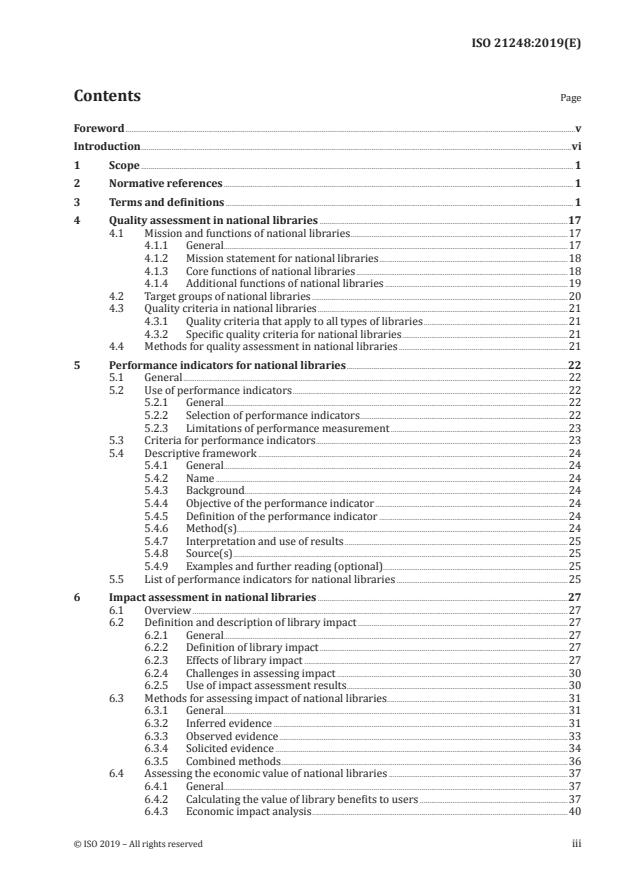
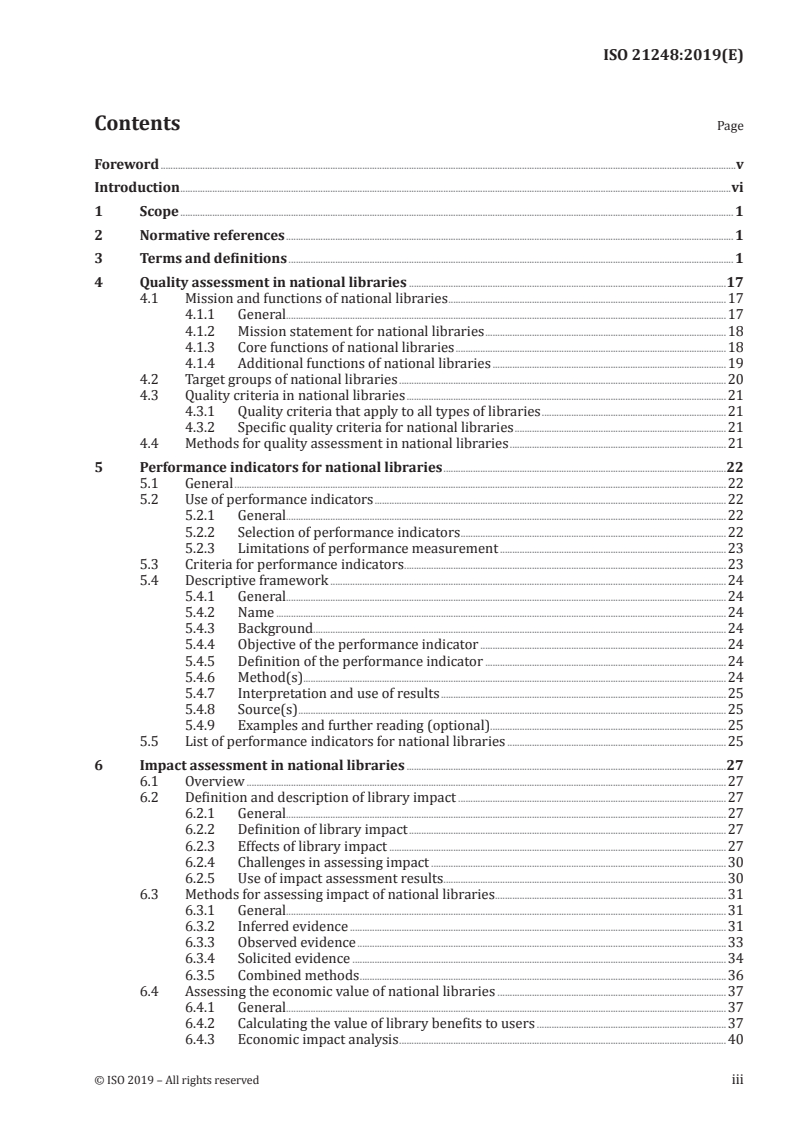
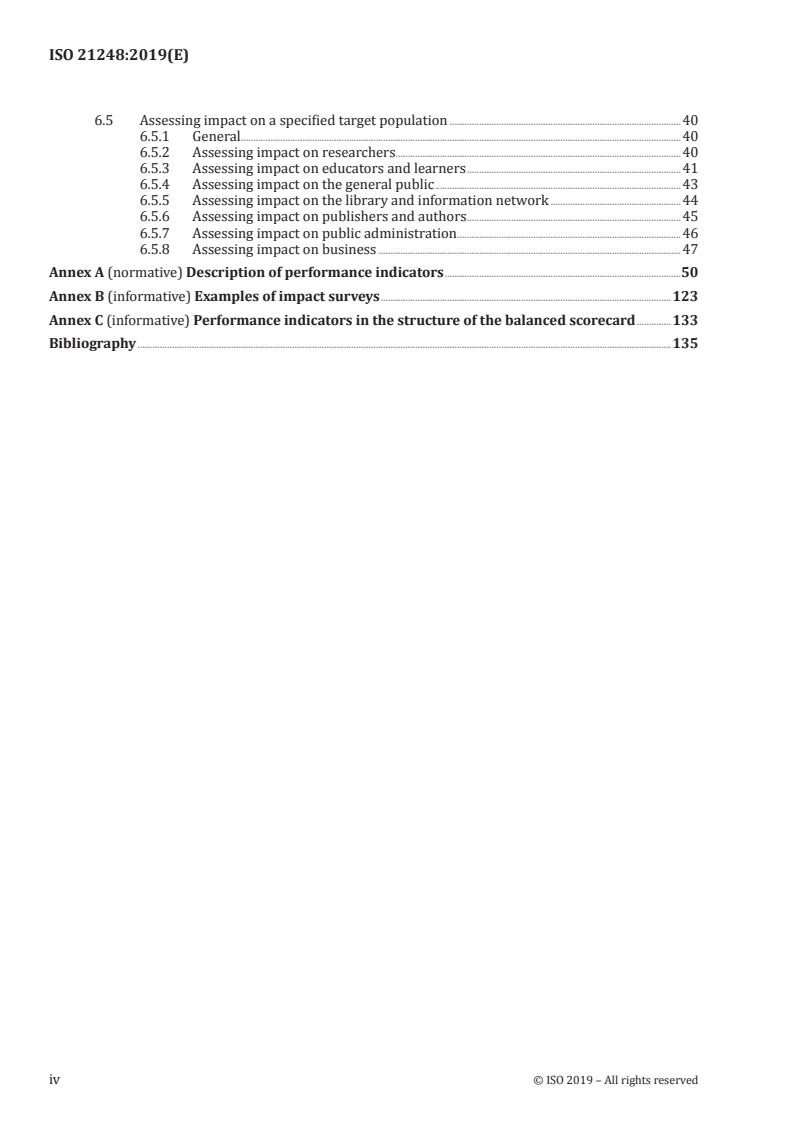
Contents Page
Foreword .v
Introduction .vi
1 Scope . 1
2 Normative references . 1
3 Terms and definitions . 1
4 Quality assessment in national libraries .17
4.1 Mission and functions of national libraries .17
4.1.1 General.17
4.1.2 Mission statement for national libraries .18
4.1.3 Core functions of national libraries .18
4.1.4 Additional functions of national libraries .19
4.2 Target groups of national libraries .20
4.3 Quality criteria in national libraries .21
4.3.1 Quality criteria that apply to all types of libraries .21
4.3.2 Specific quality criteria for national libraries .21
4.4 Methods for quality assessment in national libraries .21
5 Performance indicators for national libraries .22
5.1 General .22
5.2 Use of performance indicators .22
5.2.1 General.22
5.2.2 Selection of performance indicators .22
5.2.3 Limitations of performance measurement .23
5.3 Criteria for performance indicators .23
5.4 Descriptive framework .24
5.4.1 General.24
5.4.2 Name .24
5.4.3 Background.24
5.4.4 Objective of the performance indicator .24
5.4.5 Definition of the performance indicator .24
5.4.6 Method(s).24
5.4.7 Interpretation and use of results .25
5.4.8 Source(s) .25
5.4.9 Examples and further reading (optional).25
5.5 List of performance indicators for national libraries .25
6 Impact assessment in national libraries .27
6.1 Overview .27
6.2 Definition and description of library impact .27
6.2.1 General.27
6.2.2 Definition of library impact .27
6.2.3 Effects of library impact .27
6.2.4 Challenges in assessing impact .30
6.2.5 Use of impact assessment results . .30
6.3 Methods for assessing impact of national libraries .31
6.3.1 General.31
6.3.2 Inferred evidence .31
6.3.3 Observed evidence .33
6.3.4 Solicited evidence .34
6.3.5 Combined methods .36
6.4 Assessing the economic value of national libraries .37
6.4.1 General.37
6.4.2 Calculating the value of library benefits to users .37
6.4.3 Economic impact analysis .40
6.5 Assessing impact on a specified target population .40
6.5.1 General.40
6.5.2 Assessing impact on researchers .40
6.5.3 Assessing impact on educators and learners .41
6.5.4 Assessing impact on the general public .43
6.5.5 Assessing impact on the library and information network .44
6.5.6 Assessing impact on publishers and authors .45
6.5.7 Assessing impact on public administration .46
6.5.8 Assessing impact on business .47
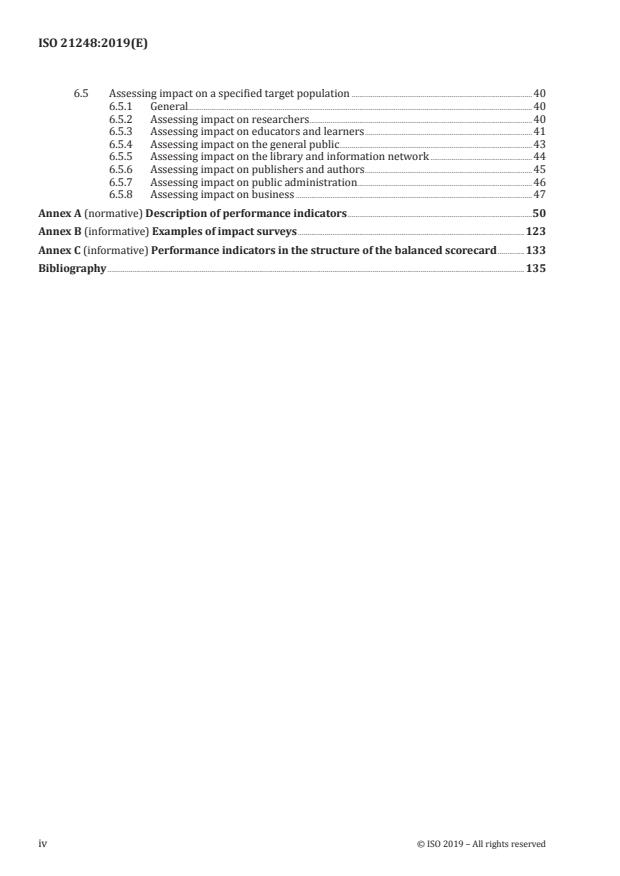
Annex A (normative) Description of performance indicators .50
Annex B (informative) Examples of impact surveys .123
Annex C (informative) Performance indicators in the structure of the balanced scorecard .133
Bibliography .135
iv © ISO 2019 – All rights reserved
Foreword
ISO (the International Organization for Standardization) is a worldwide federation of national standards
bodies (ISO member bodies). The work of preparing International Standards is normally carried out
through ISO technical committees. Each member body interested in a subject for which a technical
committee has been established has the right to be represented on that committee. International
organizations, governmental and non-governmental, in liaison with ISO, also take part in the work.
ISO collaborates closely with the International Electrotechnical Commission (IEC) on all matters of
electrotechnical standardization.
The procedures used to develop this document and those intended for its further maintenance are
described in the ISO/IEC Directives, Part 1. In particular, the different approval criteria needed for the
different types of ISO documents should be noted. This document was drafted in accordance with the
editorial rules of the ISO/IEC Directives, Part 2 (see www .iso .org/directives).
Attention is drawn to the possibility that some of the elements of this document may be the subject of
patent rights. ISO shall not be held responsible for identifying any or all such patent rights. Details of
any patent rights identified during the development of the document will be in the Introduction and/or
on the ISO list of patent declarations received (see www .iso .org/patents).
Any trade name used in this document is information given for the convenience of users and does not
constitute an endorsement.
For an explanation of the voluntary nature of standards, the meaning of ISO specific terms and
expressions related to conformity assessment, as well as information about ISO's adherence to the
World Trade Organization (WTO) principles in the Technical Barriers to Trade (TBT) see www .iso
.org/iso/foreword .html.
This document was prepared by Technical Committee ISO/TC 46, Information and documentation,
Subcommittee SC 8, Quality — Statistics and performance evaluation.
Any feedback or questions on this document should be directed to the user’s national standards body. A
complete listing of these bodies can be found at www .iso .org/members .html.
Introduction
This document is concerned with the evaluation of national libraries.
It provides guidance on the use of performance indicators regarding the quality of services in national
libraries and on methods for assessing the impact and value of national libraries.
Clause 5 resumes the work done in ISO/TR 28118:2009 where, for the first time, a specific evaluation
method was described for national libraries. This document establishes a set of performance indicators
that are adapted to the mission and functions of national libraries. Annex A specifies how the indicators
are intended to be calculated and used.
In Clause 6, this document describes methods for identifying and proving the impact of national
libraries on individuals, institutions and on society. The methods described in Clause 6 do not reflect all
possible methods or evaluation techniques, but are those seen to be most effective for assessing impact
of national libraries. Annex B gives examples of impact surveys, considering different user groups of
national libraries.
The texts in this document are partly based on ISO 11620 and ISO 16439.
vi © ISO 2019 – All rights reserved
INTERNATIONAL STANDARD ISO 21248:2019(E)
Information and documentation — Quality assessment for
national libraries
1 Scope
This document defines terms for the quality assessment of national libraries and specifies the following
methods for the assessment:
— performance measurement, and
— impact assessment.
The results of both methods are of special interest for comparison over time within the same library.
Comparisons between libraries are possible if differences in the mandate, tasks and constituencies of
the libraries are taken into account.
Not all methods described in this document apply to all national libraries. Limitations of the applicability
of individual methods are specified in the descriptions.
This document is not intended to exclude the use of performance indicators or of methods for impact
assessment not specified in it.
This document does not cover web archiving, but refers to ISO/TR 14873 for statistics and quality
issues for this new task of national libraries.
2 Normative references
There are no normative references in this document.
3 Terms and definitions
For the purposes of this document, the following terms and definitions apply.
ISO and IEC maintain terminological databases for use in standardization at the following addresses:
— ISO Online browsing platform: available at https: //www .iso .org/obp
— IEC Electropedia: available at http: //www .electropedia .org/
3.1
access
successful request of a library-provided online service
Note 1 to entry: An access is one cycle of user activities that typically starts when a user connects to a library-
provided online service and ends by a terminating activity that is either explicit (by leaving the database through
log-out or exit) or implicit (timeout due to user inactivity).
Note 2 to entry: Accesses to the library website (3.46) are counted as virtual visits (3.97).
Note 3 to entry: Requests of a general entrance or gateway page should be excluded.
Note 4 to entry: If possible, requests by search engines should be excluded.
[SOURCE: ISO 2789:2013, 2.2.1]
3.2
accessibility
ease of reaching and using a service or facility
[SOURCE: ISO 11620:2014, 2.2]
3.3
anecdotal evidence
evidence based on anecdotes or stories, obtained informally from personal observations and
experiences, not collected systematically nor empirically tested
[SOURCE: ISO 16439:2014, 3.5]
3.4
availability
degree to which content, documents, facilities or services are actually provided by the library at the
time required by users
[SOURCE: ISO 11620:2014, 2.6]
3.5
benefit
helpful or good effect, or something intended to help
[SOURCE: ISO 16439:2014, 3.7]
3.6
book
non-serial printed document in codex form
[SOURCE: ISO 2789:2013, 2.3.4]
3.7
capital expenditure
expenditure which results in the acquisition of, or addition to, fixed assets
Note 1 to entry: This includes expenditure on building sites, new buildings and extensions, furnishings and
equipment for new and expanded buildings, computer systems (hardware and software), etc. When applicable,
local and national sales/purchase taxes [e.g. value added tax (VAT)] are included.
[SOURCE: ISO 2789:2013, 2.6.1]
3.8
closed stacks
stacks that are not accessible to users
Note 1 to entry: Antonym: open stacks (3.63).
[SOURCE: ISO/TR 11219:2012, 2.19]
3.9
commercial publication
document in print or electronic format that is generally produced, distributed and sold for the purpose
of profit
Note 1 to entry: Excludes publications by non-profit organizations.
[SOURCE: ISO 2789:2013, 2.3.7, modified — Note 1 to entry has been added.]
2 © ISO 2019 – All rights reserved
3.10
conservation
preservation measures and actions applied to prevent, arrest or delay deterioration of a document or
other material object
[SOURCE: ISO 5127:2017, 3.12.1.01]
3.11
content unit
computer-processed uniquely identifiable textual or audio-visual piece of published work that may be
original or a digest of other published work
Note 1 to entry: This includes documents or parts of documents (e.g. articles, abstracts, content tables, images)
and descriptive records.
Note 2 to entry: Adapted from COUNTER code of practice, Release 3:2008.
Note 3 to entry: PDF, Postscript, HTML and other formats of the same content unit will be counted as separate items.
[SOURCE: ISO 2789:2013, 2.3.9]
3.12
contingent valuation
method for assessing the economic value of non-profit institutions and projects of public utility
depending on potential users’ responses to survey questions such as what they are willing to pay for a
benefit (3.5) or feature (willingness-to-pay), or what they would accept as financial compensation if a
certain benefit or feature was missing (willingness-to-accept)
Note 1 to entry: The method is used in environmental protection and health care, for example.
[SOURCE: ISO 16439:2014, 3.9]
3.13
cultural economics
branch of economics that studies the relation of culture to economic outcomes and explores cultural
phenomena as economic factors
[SOURCE: ISO 16439:2014, 3.12]
3.14
data mining
computational process that identifies patterns by analysing quantitative data (3.73) from different
perspectives and dimensions, categorizing it, and summarizing potential relationships and impacts
[SOURCE: ISO 16439:2014, 3.13]
3.15
digital document
information unit with a defined content, born digital or digitized, that has been created or digitized by
the library or acquired in digital form as part of the library collection (3.43)
Note 1 to entry: This includes eBooks, electronic patents, networked audio-visual documents and other digital
documents, e.g. reports, cartographic and music documents, preprints, etc. Databases and electronic serials are
excluded.
Note 2 to entry: A digital document can be structured into one or more files.
Note 3 to entry: A digital document consists of one or more content units (3.11). Before digitization (3.16), the
library must decide which content units should be searchable afterwards, e.g. articles in serials, or songs on
records.
[SOURCE: ISO 2789:2013, 2.3.13]
3.16
digitization
process of converting analogue materials into digital form
Note 1 to entry: Digitization for document supply from the library collection (3.43)to a user or institution is
excluded.
Note 2 to entry: Digitization for preservation purposes is included.
Note 3 to entry: Mass digitization is included.
Note 4 to entry: Purchase of electronic copies for replacing print copies is excluded.
[SOURCE: ISO 2789:2013, 2.3.15]
3.17
document
recorded information or material object which can be treated as a unit in a documentation process
Note 1 to entry: Documents can differ in form and characteristics.
[SOURCE: ISO 5127:2017, 3.1.1.38, modified — Note 1 to entry of ISO 2789:2013, 2.3.17 has been
included.]
3.18
document processing
everything done to a document after it is acquired by a library, before it is placed on the shelves, including
acquisition, descriptive cataloguing, subject indexing, if applicable binding, physical processing, and
shelving
Note 1 to entry: For electronic documents, the end of processing will either coincide with cataloguing when
the URL for a document on an external server has been added, or with the installation of the document on the
library’s server and the URL being added in the catalogue.
[SOURCE: ISO/TR 28118:2009, 2.13, modified — Note 1 to entry has been added.]
3.19
document retrieval
process of recovering specific documents from a storage (3.87) place
[SOURCE: ISO 5127:2017, 3.10.1.03, modified — The term “placement” has been excluded in the
definition.]
3.20
economic impact
effect of a policy, decision, institution, or event on the economy of a given area
Note 1 to entry: Economic impact is usually measured in terms of changes in economic growth (output or value
added) and associated changes in jobs (employment) and income (wages).
[SOURCE: ISO 16439:2014, 3.16, modified — The term “decision” has been added while “programme”
has been excluded in the definition.]
3.21
economic impact of libraries
positive influence of libraries on the local, regional or national economic life
4 © ISO 2019 – All rights reserved
3.22
educational services
learning sessions and learning materials and programmes in all formats for children and adults for the
purpose of enhancing skills in library and information use
Note 1 to entry: This includes the provision of services for schools and the cooperation with other libraries in
preparing and offering educational services.
Note 2 to entry: Education of librarians is excluded.
3.23
effectiveness
measure of the degree to which given objectives are achieved
Note 1 to entry: An activity is effective if it maximizes the results it was established to produce.
[SOURCE: ISO 11620:2014, 2.15]
3.24
efficiency
measure of the utilisation of resources to realize a given objective
Note 1 to entry: An activity is efficient if it minimizes the use of resources, or produces better performance with
the same resources.
[SOURCE: ISO 11620:2014, 2.16]
3.25
electronic collection
digital collection
all resources in electronic form in the library collection (3.43), whether born digital or digitized
Note 1 to entry: The electronic collection includes databases, electronic serials, and digital documents (3.15). Free
Internet resources (3.31) which have been catalogued by the library in its online catalogue (3.61) or a database are
excluded.
Note 2 to entry: The resources can be networked, installed on stand-alone workstations or stored on physical
carriers.
[SOURCE: ISO 2789:2013, 2.3.21, modified — The term “digital collection” has been added as an
accepted term.]
3.26
electronic document delivery
electronic transmission of a document or part of a document from the library collection
(3.43) to a user, mediated by library staff not necessarily via another library
Note 1 to entry: Electronic transmission of documents to members of the population to be served (3.67) is
included. Fax transmission is excluded.
Note 2 to entry: May be split up as to transmission with or without charge to the user.
Note 3 to entry: Unmediated downloading by users from the electronic collection (3.25) of the library is excluded.
[SOURCE: ISO 2789:2013, 2.2.7]
3.27
electronic service
library service delivered via electronic means whether from local servers or provided via networks
Note 1 to entry: Electronic library services include the online catalogue (3.61), the library website (3.46), the
electronic collection (3.25), electronic lending, electronic document delivery (mediated), electronic reference
service (3.77), user training (3.94) by electronic means, services for mobile devices (3.51), services for interactive
use (including services on social networks), and Internet access offered via the library.
Note 2 to entry: This does not include booking physical services (e.g. rooms or library tours) by electronic means.
[SOURCE: ISO 2789:2013, 2.2.8]
3.28
evaluation
process of estimating the effectiveness, efficiency, utility and relevance of a service or facility
[SOURCE: ISO 11620:2014, 3.19]
3.29
event
pre-arranged activity with cultural, educational, social, political, scholarly, or other intent
EXAMPLE Exhibitions, author visits, literary discussions, workshops, etc.
Note 1 to entry: Only events arranged by the library on its own or in partnership with other institutions are
included, whether inside or outside the library premises. Events inside the library premises organized by
institutions outside the library without the library’s cooperation are excluded.
Note 2 to entry: User training (3.94) lessons and library tours are excluded.
Note 3 to entry: Ongoing programmes are included. Each session of a programme is counted as one event.
Note 4 to entry: Virtual events are included.
[SOURCE: ISO 2789:2013, 2.2.9]
3.30
focus group interview
focus group discussion
group interview in the form of a moderated discussion among a small number of selected individuals on
topics introduced by the moderator
[SOURCE: ISO 16439:2014, 3.23]
3.31
free Internet resource
Internet resource with unrestricted (open) access for which no payment is required
[SOURCE: ISO 2789:2013, 2.3.23]
3.32
full-time equivalent
FTE
measurement equal to one staff person working a full-time work schedule for one year
Note 1 to entry: For example, if out of three persons employed as librarians, one works quarter-time, one works half-
time, and one works full-time, then the FTE of these three persons would be 0,25 + 0,5 + 1,0 = 1,75 librarians (FTE).
Note 2 to entry: Not all libraries may use the same number of hours per year to determine an FTE. Thus, any
comparative measures between libraries may need to consider any differences in hours.
[SOURCE: ISO 11620:2014, 2.23]
3.33
goal
desired state of affairs to be achieved by the implementation of agreed policies
[SOURCE: ISO 11620:2014, 2.24]
6 © ISO 2019 – All rights reserved
3.34
homepage
main or opening screen of a website to which all other pages for users are linked
[SOURCE: ISO 5127:2017, 3.3.3.26]
3.35
impact
difference or change in an individual or group resulting from the contact with library services
Note 1 to entry: The change can be tangible or intangible.
[SOURCE: ISO 16439:2014, 3.25]
3.36
income generated
income generated by library operations and from fees, charges, subscriptions and donations that is
available to the library for expenditure
[SOURCE: ISO/TR 28118:2009, 2.24]
3.37
indicator
expression (which may be numeric, symbolic or verbal) used to characterize activities (events, objects,
persons) both in quantitative and qualitative terms in order to assess the value of the activities
characterized, and the associated method
[SOURCE: ISO 11620:2014, 2.25]
3.38
information literacy
ability to recognize a need for information, to identify, retrieve, evaluate, and use information effectively
and to use information in an effective and responsible way
Note 1 to entry: Literacy in the sense of being able to read and write with a minimal level of proficiency is
fundamental for information literacy.
Note 2 to entry: This includes the skills for using information technology to access and retrieve information.
[SOURCE: ISO 16439:2014, 3.26, modified — The phrase “and to use information in an effective and
responsible way” has been added in the definition.]
3.39
informational question
directional and/or administrative inquiry delivered to library staff
Note 1 to entry: This includes questions for locating staff or facilities, questions regarding opening times and
registering procedures and questions about handling equipment such as printers or computer terminals.
Note 2 to entry: The question can be delivered personally or by means of telephone, regular mail, fax or electronic
media (via email, the library website (3.46) or other networked communication mechanisms).
Note 3 to entry: For reference questions, see 3.76.
[SOURCE: ISO 2789:2013, 2.2.13]
3.40
input
contribution of resources in support of a libraryEXAMPLE Examples of resources are funding, staff,
collections, space, equipment.
[SOURCE: ISO 16439:2014, 3.28, modified — Examples in the definition has been formatted separately
for clarity.]
3.41
interlibrary loan
loan of a document in its physical form or delivery of a document, or part of it, in copied form, from one
library to another which is not under the same administration
Note 1 to entry: Mediated transmission of electronic documents is counted as electronic document delivery (3.26).
[SOURCE: ISO 2789:2013, 2.2.16, modified — Note 2 to entry has been omitted.]
3.42
interview
oral questioning technique which results in a transfer of information from the interviewee to an
interviewer or researcher
Note 1 to entry: This technique obtains direct reactions to questions, in contrast to written questionnaires or
self-assessment (3.80) [self-recording (3.81)].
Note 2 to entry: Interviews can be subdivided according to the number of interviewees into one-to-one interviews
and group interviews.
Note 3 to entry: Interviews can be structured, semi-structured or unstructured.
Note 4 to entry: Where semi-structured or unstructured interviews are used with a group of respondents, these
are usually described as focus groups or group discussions.
[SOURCE: ISO 16439:2014, 3.30]
3.43
library collection
documents provided by a library for its users
Note 1 to entry: Comprises information resources held locally and remote resources for which access rights have
been acquired.
Note 2 to entry: Access rights can be acquired by the library itself, by a consortium and/or through external
funding.
Note 3 to entry: Acquisition is to be understood as deliberately selecting a document, securing access rights and
including it in the online catalogue (3.61) or other databases of the library. Interlibrary lending and document
delivery are excluded.
Note 4 to entry: Does not include links to Internet resources for which the library has not secured access rights
by legal agreements (e.g. legal deposit right), license or other contractual and/or cooperative agreement. Free
Internet resources (3.31) which have been catalogued by the library in its online catalogue or a database should
be counted separately.
[SOURCE: ISO 2789:2013, 2.3.28]
3.44
library employee
person who works for a library in return for payment
[SOURCE: ISO 2789:2013, 2.7.1]
3.45
library staff research publication
research publication by library staff in professional and academic subjects
Note 1 to entry: Includes publications in all formats, and presentations at conferences.
[SOURCE: ISO 2789:2013, 2.5.4]
8 © ISO 2019 – All rights reserved
3.46
library website
unique domain on the Internet consisting of a collection of web pages that is published by a library to
provide access to the library’s services and resources
Note 1 to entry: The pages of a website are usually interconnected by the use of hypertext links.
Note 2 to entry: Excludes documents that fit the definitions of electronic collection (3.25) and free Internet
resources (3.31) that may be linked from the library website.
Note 3 to entry: Excludes web services in the library’s domain that are operated on behalf of other organizations.
[SOURCE: ISO 2789:2013, 2.2.18]
3.47
loan
direct lending or delivery transaction of a returnable item in non-electronic form (e.g. book), of
an electronic document on a physical carrier (e.g. CD-ROM) or other device (e.g. eBook reader), or
transmission of an electronic document to one user for a limited time period (e.g. eBook)
Note 1 to entry: Renewals are excluded but could be counted separately.
Note 2 to entry: Loans include registered loans within the library (on-site loans).
Note 3 to entry: Loans include copied documents supplied in place of original documents (including fax) and
printouts of electronic documents made by library staff for the user.
Note 4 to entry: Loans of documents in physical form to distance users are included.
Note 5 to entry: Mediated electronic transmission of documents is counted as electronic document delivery (3.26)
if their use is permitted for unlimited time. This includes transmissions to members of the population to be
served (3.67).
[SOURCE: ISO 2789:2013, 2.2.19, modified — Note 6 to entry has been omitted.]
3.48
longitudinal study
two or more surveys (3.88) in which the same or a similar survey instrument is administered more than
once to the same population, after a suitable time period has elapsed, to measure changes in patterns of
usage, perceptions, attitudes, etc.
[SOURCE: ISO 16439:2014, 3.35]
3.49
mass conservation
conservation (3.10) measure of simultaneous treatment of a large number of documents by automated
conservation techniques
[SOURCE: ISO 5127:2017, 3.12.6.35]
3.50
mission
statement approved by the authorities formulating the organization's goals (3.33) and its choices in
services and products development
[SOURCE: ISO 11620:2014, 3.33]
3.51
mobile device
portable computing device, designed to be held and used in the hands, typically having a display screen
with touch, pen and/or keyboard input and Internet connection
EXAMPLE Mobile phone, eBook reader, tablet.
[SOURCE: ISO 2789:2013, 2.2.20, modified — A list of examples has been added.]
3.52
monetary value of libraries
value of library benefits calculated in monetary terms
3.53
national bibliography
bibliography in which documents published in a single country are recorded and described
Note 1 to entry: In some countries, the national bibliography also covers foreign publications relative to the
country and also the works by their nationals which are published abroad.
[SOURCE: ISO 9707:2008, 2.21]
3.54
national collection
collection of the national library (3.56) of the national imprint (3.55) and the national documentary
heritage in the form of manuscripts, archival materials, cartographic material, printed music
documents, pictures, photographs and audio-visual documents in conventional or electronic format
Note 1 to entry: Websites can be part of the national collection.
[SOURCE: ISO/TR 28118:2009, 2.36]
3.55
national imprint
all documents in all formats published in a country
Note 1 to entry: Includes commercial (3.9) and non-commercial publications (3.57).
[SOURCE: ISO/TR 28118:2009, 2.37]
3.56
national library
library that is responsible for acquiring and conserving copies of all relevant documents published in
the country in which the library is located
Note 1 to entry: A national library will also normally perform some or all of the following functions: produce the
national bibliography (3.53); hold and keep up to date a large and representative collection of foreign literature
including documents about the country; act as a national bibliographic information centre; compile union
catalogues; supervise the administration of other libraries and/or promote collaboration; coordinate a research
and development service; etc.
Note 2 to entry: The definition of "national library" allows for more than one national library in a country.
[SOURCE: ISO 2789:2013, 2.1.9]
3.57
non-commercial publication
document in all formats published by non-profit institutions such as communities, associations,
initiatives, etc., or by individuals, often not available through normal book trade channels
Note 1 to entry: Non-commercial publications can include reports, theses and dissertations, periodicals,
conference proceedings, etc.
[SOURCE: ISO 2789:2013, 2.3.37, modified — The phrase “or by individuals” has been added in the
definition.]
10 © ISO 2019 – All rights reserved
3.58
non-user
person belonging to a specific library’s population to be served (3.67) but not using that library’s physical
and/or electronic services (3.27)
Note 1 to entry: The definition includes former users of the library.
Note 2 to entry: For national libraries (3.56), every person not using the library can be regarded as a non-user.
[SOURCE: ISO 16439:2014, 3.39, modified — Note 2 to entry has been added.]
3.59
objective
specific target for an activity to be attained as a contribution to achieving the goal (3.33) of an
organization
[SOURCE: ISO 11620:2014, 2.34]
3.60
observation
method of data collection in which the situation of interest is watched and the relevant facts, actions
and behaviours are recorded
Note 1 to entry: This includes direct observation by researchers, observation by technical devices, e.g. via video
recording or log analysis, and self-observation by users.
Note 2 to entry: There can be rating scales that the researcher would use when observing the behaviour.
[SOURCE: ISO 16439:2014, 3.41, modified — a new Note 1 to entry has been added and the former Note
has been renumbered.]
3.61
online catalogue
database of bibliographical records describing the collection usually of one particular library or
library system
[SOURCE: ISO 2789:2013, 2.2.21]
3.62
open access
unrestricted access to information, documents or information services
Note 1 to entry: In a narrower sense, this means that information content is made freely available via the Internet.
[SOURCE: ISO 16439:2014, 3.42]
3.63
open stacks
stacks that are accessible to users
Note 1 to entry: Antonym: closed stacks (3.8).
[SOURCE: ISO 16439:2014, 2.58]
3.64
output
products of library processes EXAMPLE Number of titles catalogued, number of loans, number of
reference questions answered.
[SOURCE: ISO 16439:2014, 3.45, modified — examples of output have been formatted separately for
clarity.]
3.65
performance
effectiveness of the provision of services by the library and the efficiency of the allocation and use of
resources in providing services
[SOURCE: ISO 11620:2014, 2.38]
3.66
performance indicator
numerical, symbolic or verbal expression, derived from library statistics and data used to characterize
the performance of a library
[SOURCE: ISO 11620:2014, 2.39]
3.67
population to be served
number of individuals for whom the library is set up to provide its services and materials
Note 1 to entry: For public libraries, this will normally be the population of the legal service area (authority); for
libraries of an institution of higher education, this will normally be the total of academic and professional staff
plus students.
[SOURCE: ISO 11620:2014, 2.40]
3.68
preservation
measures taken, including financial and strategic decisions, to maintain and extend the integrity of
documents or collections
[SOURCE: ISO 5127:2017, 3.2.1.39, modified — Notes to entry have been omitted.]
3.69
process
set of interrelated or interacting activities which transforms inputs into outputs
EXAMPLE Cataloguing, lending, reference service.
[SOURCE: ISO 16439:2014, 3.50]
3.70
publication
document offered for general distribution or sale and usually produced in multiple copies
[SOURCE: ISO 5127:2017, 3.1.8.27]
3.71
qualitative data
data describing but not measuring the attributes or properties of an object, in particular the reasons
for human actions
Note 1 to entry: The attributes can be categorized into classes that may be assigned numeric values.
[SOURCE: ISO 16439:2014, 3.52]
3.72
quality
degree to which a set of inherent characteristics fulfils requirements
Note 1 to entry: The term "quality" can be used with adjectives such as poor, good or excellent.
Note 2 to entry: "Inherent", as opposed to "assigned", means existing in something, especially as a permanent
characteristic.
12 © ISO 2019 – All rights reserved
[SOURCE: ISO 9000:2005, 3.1.1]
3.73
quantitative data
data in numerical form expressing a certain quantity, amount or range, amenable to statistical
manip
...
INTERNATIONAL ISO
STANDARD 21248
First edition
2019-03
Information and documentation —
Quality assessment for national
libraries
Information et documentation — Evaluation de qualité pour les
bibliothèques nationales
Reference number
©
ISO 2019
© ISO 2019
All rights reserved. Unless otherwise specified, or required in the context of its implementation, no part of this publication may
be reproduced or utilized otherwise in any form or by any means, electronic or mechanical, including photocopying, or posting
on the internet or an intranet, without prior written permission. Permission can be requested from either ISO at the address
below or ISO’s member body in the country of the requester.
ISO copyright office
CP 401 • Ch. de Blandonnet 8
CH-1214 Vernier, Geneva
Phone: +41 22 749 01 11
Fax: +41 22 749 09 47
Email: copyright@iso.org
Website: www.iso.org
Published in Switzerland
ii © ISO 2019 – All rights reserved
Contents Page
Foreword .v
Introduction .vi
1 Scope . 1
2 Normative references . 1
3 Terms and definitions . 1
4 Quality assessment in national libraries .17
4.1 Mission and functions of national libraries .17
4.1.1 General.17
4.1.2 Mission statement for national libraries .18
4.1.3 Core functions of national libraries .18
4.1.4 Additional functions of national libraries .19
4.2 Target groups of national libraries .20
4.3 Quality criteria in national libraries .21
4.3.1 Quality criteria that apply to all types of libraries .21
4.3.2 Specific quality criteria for national libraries .21
4.4 Methods for quality assessment in national libraries .21
5 Performance indicators for national libraries .22
5.1 General .22
5.2 Use of performance indicators .22
5.2.1 General.22
5.2.2 Selection of performance indicators .22
5.2.3 Limitations of performance measurement .23
5.3 Criteria for performance indicators .23
5.4 Descriptive framework .24
5.4.1 General.24
5.4.2 Name .24
5.4.3 Background.24
5.4.4 Objective of the performance indicator .24
5.4.5 Definition of the performance indicator .24
5.4.6 Method(s).24
5.4.7 Interpretation and use of results .25
5.4.8 Source(s) .25
5.4.9 Examples and further reading (optional).25
5.5 List of performance indicators for national libraries .25
6 Impact assessment in national libraries .27
6.1 Overview .27
6.2 Definition and description of library impact .27
6.2.1 General.27
6.2.2 Definition of library impact .27
6.2.3 Effects of library impact .27
6.2.4 Challenges in assessing impact .30
6.2.5 Use of impact assessment results . .30
6.3 Methods for assessing impact of national libraries .31
6.3.1 General.31
6.3.2 Inferred evidence .31
6.3.3 Observed evidence .33
6.3.4 Solicited evidence .34
6.3.5 Combined methods .36
6.4 Assessing the economic value of national libraries .37
6.4.1 General.37
6.4.2 Calculating the value of library benefits to users .37
6.4.3 Economic impact analysis .40
6.5 Assessing impact on a specified target population .40
6.5.1 General.40
6.5.2 Assessing impact on researchers .40
6.5.3 Assessing impact on educators and learners .41
6.5.4 Assessing impact on the general public .43
6.5.5 Assessing impact on the library and information network .44
6.5.6 Assessing impact on publishers and authors .45
6.5.7 Assessing impact on public administration .46
6.5.8 Assessing impact on business .47
Annex A (normative) Description of performance indicators .50
Annex B (informative) Examples of impact surveys .123
Annex C (informative) Performance indicators in the structure of the balanced scorecard .133
Bibliography .135
iv © ISO 2019 – All rights reserved
Foreword
ISO (the International Organization for Standardization) is a worldwide federation of national standards
bodies (ISO member bodies). The work of preparing International Standards is normally carried out
through ISO technical committees. Each member body interested in a subject for which a technical
committee has been established has the right to be represented on that committee. International
organizations, governmental and non-governmental, in liaison with ISO, also take part in the work.
ISO collaborates closely with the International Electrotechnical Commission (IEC) on all matters of
electrotechnical standardization.
The procedures used to develop this document and those intended for its further maintenance are
described in the ISO/IEC Directives, Part 1. In particular, the different approval criteria needed for the
different types of ISO documents should be noted. This document was drafted in accordance with the
editorial rules of the ISO/IEC Directives, Part 2 (see www .iso .org/directives).
Attention is drawn to the possibility that some of the elements of this document may be the subject of
patent rights. ISO shall not be held responsible for identifying any or all such patent rights. Details of
any patent rights identified during the development of the document will be in the Introduction and/or
on the ISO list of patent declarations received (see www .iso .org/patents).
Any trade name used in this document is information given for the convenience of users and does not
constitute an endorsement.
For an explanation of the voluntary nature of standards, the meaning of ISO specific terms and
expressions related to conformity assessment, as well as information about ISO's adherence to the
World Trade Organization (WTO) principles in the Technical Barriers to Trade (TBT) see www .iso
.org/iso/foreword .html.
This document was prepared by Technical Committee ISO/TC 46, Information and documentation,
Subcommittee SC 8, Quality — Statistics and performance evaluation.
Any feedback or questions on this document should be directed to the user’s national standards body. A
complete listing of these bodies can be found at www .iso .org/members .html.
Introduction
This document is concerned with the evaluation of national libraries.
It provides guidance on the use of performance indicators regarding the quality of services in national
libraries and on methods for assessing the impact and value of national libraries.
Clause 5 resumes the work done in ISO/TR 28118:2009 where, for the first time, a specific evaluation
method was described for national libraries. This document establishes a set of performance indicators
that are adapted to the mission and functions of national libraries. Annex A specifies how the indicators
are intended to be calculated and used.
In Clause 6, this document describes methods for identifying and proving the impact of national
libraries on individuals, institutions and on society. The methods described in Clause 6 do not reflect all
possible methods or evaluation techniques, but are those seen to be most effective for assessing impact
of national libraries. Annex B gives examples of impact surveys, considering different user groups of
national libraries.
The texts in this document are partly based on ISO 11620 and ISO 16439.
vi © ISO 2019 – All rights reserved
INTERNATIONAL STANDARD ISO 21248:2019(E)
Information and documentation — Quality assessment for
national libraries
1 Scope
This document defines terms for the quality assessment of national libraries and specifies the following
methods for the assessment:
— performance measurement, and
— impact assessment.
The results of both methods are of special interest for comparison over time within the same library.
Comparisons between libraries are possible if differences in the mandate, tasks and constituencies of
the libraries are taken into account.
Not all methods described in this document apply to all national libraries. Limitations of the applicability
of individual methods are specified in the descriptions.
This document is not intended to exclude the use of performance indicators or of methods for impact
assessment not specified in it.
This document does not cover web archiving, but refers to ISO/TR 14873 for statistics and quality
issues for this new task of national libraries.
2 Normative references
There are no normative references in this document.
3 Terms and definitions
For the purposes of this document, the following terms and definitions apply.
ISO and IEC maintain terminological databases for use in standardization at the following addresses:
— ISO Online browsing platform: available at https: //www .iso .org/obp
— IEC Electropedia: available at http: //www .electropedia .org/
3.1
access
successful request of a library-provided online service
Note 1 to entry: An access is one cycle of user activities that typically starts when a user connects to a library-
provided online service and ends by a terminating activity that is either explicit (by leaving the database through
log-out or exit) or implicit (timeout due to user inactivity).
Note 2 to entry: Accesses to the library website (3.46) are counted as virtual visits (3.97).
Note 3 to entry: Requests of a general entrance or gateway page should be excluded.
Note 4 to entry: If possible, requests by search engines should be excluded.
[SOURCE: ISO 2789:2013, 2.2.1]
3.2
accessibility
ease of reaching and using a service or facility
[SOURCE: ISO 11620:2014, 2.2]
3.3
anecdotal evidence
evidence based on anecdotes or stories, obtained informally from personal observations and
experiences, not collected systematically nor empirically tested
[SOURCE: ISO 16439:2014, 3.5]
3.4
availability
degree to which content, documents, facilities or services are actually provided by the library at the
time required by users
[SOURCE: ISO 11620:2014, 2.6]
3.5
benefit
helpful or good effect, or something intended to help
[SOURCE: ISO 16439:2014, 3.7]
3.6
book
non-serial printed document in codex form
[SOURCE: ISO 2789:2013, 2.3.4]
3.7
capital expenditure
expenditure which results in the acquisition of, or addition to, fixed assets
Note 1 to entry: This includes expenditure on building sites, new buildings and extensions, furnishings and
equipment for new and expanded buildings, computer systems (hardware and software), etc. When applicable,
local and national sales/purchase taxes [e.g. value added tax (VAT)] are included.
[SOURCE: ISO 2789:2013, 2.6.1]
3.8
closed stacks
stacks that are not accessible to users
Note 1 to entry: Antonym: open stacks (3.63).
[SOURCE: ISO/TR 11219:2012, 2.19]
3.9
commercial publication
document in print or electronic format that is generally produced, distributed and sold for the purpose
of profit
Note 1 to entry: Excludes publications by non-profit organizations.
[SOURCE: ISO 2789:2013, 2.3.7, modified — Note 1 to entry has been added.]
2 © ISO 2019 – All rights reserved
3.10
conservation
preservation measures and actions applied to prevent, arrest or delay deterioration of a document or
other material object
[SOURCE: ISO 5127:2017, 3.12.1.01]
3.11
content unit
computer-processed uniquely identifiable textual or audio-visual piece of published work that may be
original or a digest of other published work
Note 1 to entry: This includes documents or parts of documents (e.g. articles, abstracts, content tables, images)
and descriptive records.
Note 2 to entry: Adapted from COUNTER code of practice, Release 3:2008.
Note 3 to entry: PDF, Postscript, HTML and other formats of the same content unit will be counted as separate items.
[SOURCE: ISO 2789:2013, 2.3.9]
3.12
contingent valuation
method for assessing the economic value of non-profit institutions and projects of public utility
depending on potential users’ responses to survey questions such as what they are willing to pay for a
benefit (3.5) or feature (willingness-to-pay), or what they would accept as financial compensation if a
certain benefit or feature was missing (willingness-to-accept)
Note 1 to entry: The method is used in environmental protection and health care, for example.
[SOURCE: ISO 16439:2014, 3.9]
3.13
cultural economics
branch of economics that studies the relation of culture to economic outcomes and explores cultural
phenomena as economic factors
[SOURCE: ISO 16439:2014, 3.12]
3.14
data mining
computational process that identifies patterns by analysing quantitative data (3.73) from different
perspectives and dimensions, categorizing it, and summarizing potential relationships and impacts
[SOURCE: ISO 16439:2014, 3.13]
3.15
digital document
information unit with a defined content, born digital or digitized, that has been created or digitized by
the library or acquired in digital form as part of the library collection (3.43)
Note 1 to entry: This includes eBooks, electronic patents, networked audio-visual documents and other digital
documents, e.g. reports, cartographic and music documents, preprints, etc. Databases and electronic serials are
excluded.
Note 2 to entry: A digital document can be structured into one or more files.
Note 3 to entry: A digital document consists of one or more content units (3.11). Before digitization (3.16), the
library must decide which content units should be searchable afterwards, e.g. articles in serials, or songs on
records.
[SOURCE: ISO 2789:2013, 2.3.13]
3.16
digitization
process of converting analogue materials into digital form
Note 1 to entry: Digitization for document supply from the library collection (3.43)to a user or institution is
excluded.
Note 2 to entry: Digitization for preservation purposes is included.
Note 3 to entry: Mass digitization is included.
Note 4 to entry: Purchase of electronic copies for replacing print copies is excluded.
[SOURCE: ISO 2789:2013, 2.3.15]
3.17
document
recorded information or material object which can be treated as a unit in a documentation process
Note 1 to entry: Documents can differ in form and characteristics.
[SOURCE: ISO 5127:2017, 3.1.1.38, modified — Note 1 to entry of ISO 2789:2013, 2.3.17 has been
included.]
3.18
document processing
everything done to a document after it is acquired by a library, before it is placed on the shelves, including
acquisition, descriptive cataloguing, subject indexing, if applicable binding, physical processing, and
shelving
Note 1 to entry: For electronic documents, the end of processing will either coincide with cataloguing when
the URL for a document on an external server has been added, or with the installation of the document on the
library’s server and the URL being added in the catalogue.
[SOURCE: ISO/TR 28118:2009, 2.13, modified — Note 1 to entry has been added.]
3.19
document retrieval
process of recovering specific documents from a storage (3.87) place
[SOURCE: ISO 5127:2017, 3.10.1.03, modified — The term “placement” has been excluded in the
definition.]
3.20
economic impact
effect of a policy, decision, institution, or event on the economy of a given area
Note 1 to entry: Economic impact is usually measured in terms of changes in economic growth (output or value
added) and associated changes in jobs (employment) and income (wages).
[SOURCE: ISO 16439:2014, 3.16, modified — The term “decision” has been added while “programme”
has been excluded in the definition.]
3.21
economic impact of libraries
positive influence of libraries on the local, regional or national economic life
4 © ISO 2019 – All rights reserved
3.22
educational services
learning sessions and learning materials and programmes in all formats for children and adults for the
purpose of enhancing skills in library and information use
Note 1 to entry: This includes the provision of services for schools and the cooperation with other libraries in
preparing and offering educational services.
Note 2 to entry: Education of librarians is excluded.
3.23
effectiveness
measure of the degree to which given objectives are achieved
Note 1 to entry: An activity is effective if it maximizes the results it was established to produce.
[SOURCE: ISO 11620:2014, 2.15]
3.24
efficiency
measure of the utilisation of resources to realize a given objective
Note 1 to entry: An activity is efficient if it minimizes the use of resources, or produces better performance with
the same resources.
[SOURCE: ISO 11620:2014, 2.16]
3.25
electronic collection
digital collection
all resources in electronic form in the library collection (3.43), whether born digital or digitized
Note 1 to entry: The electronic collection includes databases, electronic serials, and digital documents (3.15). Free
Internet resources (3.31) which have been catalogued by the library in its online catalogue (3.61) or a database are
excluded.
Note 2 to entry: The resources can be networked, installed on stand-alone workstations or stored on physical
carriers.
[SOURCE: ISO 2789:2013, 2.3.21, modified — The term “digital collection” has been added as an
accepted term.]
3.26
electronic document delivery
electronic transmission of a document or part of a document from the library collection
(3.43) to a user, mediated by library staff not necessarily via another library
Note 1 to entry: Electronic transmission of documents to members of the population to be served (3.67) is
included. Fax transmission is excluded.
Note 2 to entry: May be split up as to transmission with or without charge to the user.
Note 3 to entry: Unmediated downloading by users from the electronic collection (3.25) of the library is excluded.
[SOURCE: ISO 2789:2013, 2.2.7]
3.27
electronic service
library service delivered via electronic means whether from local servers or provided via networks
Note 1 to entry: Electronic library services include the online catalogue (3.61), the library website (3.46), the
electronic collection (3.25), electronic lending, electronic document delivery (mediated), electronic reference
service (3.77), user training (3.94) by electronic means, services for mobile devices (3.51), services for interactive
use (including services on social networks), and Internet access offered via the library.
Note 2 to entry: This does not include booking physical services (e.g. rooms or library tours) by electronic means.
[SOURCE: ISO 2789:2013, 2.2.8]
3.28
evaluation
process of estimating the effectiveness, efficiency, utility and relevance of a service or facility
[SOURCE: ISO 11620:2014, 3.19]
3.29
event
pre-arranged activity with cultural, educational, social, political, scholarly, or other intent
EXAMPLE Exhibitions, author visits, literary discussions, workshops, etc.
Note 1 to entry: Only events arranged by the library on its own or in partnership with other institutions are
included, whether inside or outside the library premises. Events inside the library premises organized by
institutions outside the library without the library’s cooperation are excluded.
Note 2 to entry: User training (3.94) lessons and library tours are excluded.
Note 3 to entry: Ongoing programmes are included. Each session of a programme is counted as one event.
Note 4 to entry: Virtual events are included.
[SOURCE: ISO 2789:2013, 2.2.9]
3.30
focus group interview
focus group discussion
group interview in the form of a moderated discussion among a small number of selected individuals on
topics introduced by the moderator
[SOURCE: ISO 16439:2014, 3.23]
3.31
free Internet resource
Internet resource with unrestricted (open) access for which no payment is required
[SOURCE: ISO 2789:2013, 2.3.23]
3.32
full-time equivalent
FTE
measurement equal to one staff person working a full-time work schedule for one year
Note 1 to entry: For example, if out of three persons employed as librarians, one works quarter-time, one works half-
time, and one works full-time, then the FTE of these three persons would be 0,25 + 0,5 + 1,0 = 1,75 librarians (FTE).
Note 2 to entry: Not all libraries may use the same number of hours per year to determine an FTE. Thus, any
comparative measures between libraries may need to consider any differences in hours.
[SOURCE: ISO 11620:2014, 2.23]
3.33
goal
desired state of affairs to be achieved by the implementation of agreed policies
[SOURCE: ISO 11620:2014, 2.24]
6 © ISO 2019 – All rights reserved
3.34
homepage
main or opening screen of a website to which all other pages for users are linked
[SOURCE: ISO 5127:2017, 3.3.3.26]
3.35
impact
difference or change in an individual or group resulting from the contact with library services
Note 1 to entry: The change can be tangible or intangible.
[SOURCE: ISO 16439:2014, 3.25]
3.36
income generated
income generated by library operations and from fees, charges, subscriptions and donations that is
available to the library for expenditure
[SOURCE: ISO/TR 28118:2009, 2.24]
3.37
indicator
expression (which may be numeric, symbolic or verbal) used to characterize activities (events, objects,
persons) both in quantitative and qualitative terms in order to assess the value of the activities
characterized, and the associated method
[SOURCE: ISO 11620:2014, 2.25]
3.38
information literacy
ability to recognize a need for information, to identify, retrieve, evaluate, and use information effectively
and to use information in an effective and responsible way
Note 1 to entry: Literacy in the sense of being able to read and write with a minimal level of proficiency is
fundamental for information literacy.
Note 2 to entry: This includes the skills for using information technology to access and retrieve information.
[SOURCE: ISO 16439:2014, 3.26, modified — The phrase “and to use information in an effective and
responsible way” has been added in the definition.]
3.39
informational question
directional and/or administrative inquiry delivered to library staff
Note 1 to entry: This includes questions for locating staff or facilities, questions regarding opening times and
registering procedures and questions about handling equipment such as printers or computer terminals.
Note 2 to entry: The question can be delivered personally or by means of telephone, regular mail, fax or electronic
media (via email, the library website (3.46) or other networked communication mechanisms).
Note 3 to entry: For reference questions, see 3.76.
[SOURCE: ISO 2789:2013, 2.2.13]
3.40
input
contribution of resources in support of a libraryEXAMPLE Examples of resources are funding, staff,
collections, space, equipment.
[SOURCE: ISO 16439:2014, 3.28, modified — Examples in the definition has been formatted separately
for clarity.]
3.41
interlibrary loan
loan of a document in its physical form or delivery of a document, or part of it, in copied form, from one
library to another which is not under the same administration
Note 1 to entry: Mediated transmission of electronic documents is counted as electronic document delivery (3.26).
[SOURCE: ISO 2789:2013, 2.2.16, modified — Note 2 to entry has been omitted.]
3.42
interview
oral questioning technique which results in a transfer of information from the interviewee to an
interviewer or researcher
Note 1 to entry: This technique obtains direct reactions to questions, in contrast to written questionnaires or
self-assessment (3.80) [self-recording (3.81)].
Note 2 to entry: Interviews can be subdivided according to the number of interviewees into one-to-one interviews
and group interviews.
Note 3 to entry: Interviews can be structured, semi-structured or unstructured.
Note 4 to entry: Where semi-structured or unstructured interviews are used with a group of respondents, these
are usually described as focus groups or group discussions.
[SOURCE: ISO 16439:2014, 3.30]
3.43
library collection
documents provided by a library for its users
Note 1 to entry: Comprises information resources held locally and remote resources for which access rights have
been acquired.
Note 2 to entry: Access rights can be acquired by the library itself, by a consortium and/or through external
funding.
Note 3 to entry: Acquisition is to be understood as deliberately selecting a document, securing access rights and
including it in the online catalogue (3.61) or other databases of the library. Interlibrary lending and document
delivery are excluded.
Note 4 to entry: Does not include links to Internet resources for which the library has not secured access rights
by legal agreements (e.g. legal deposit right), license or other contractual and/or cooperative agreement. Free
Internet resources (3.31) which have been catalogued by the library in its online catalogue or a database should
be counted separately.
[SOURCE: ISO 2789:2013, 2.3.28]
3.44
library employee
person who works for a library in return for payment
[SOURCE: ISO 2789:2013, 2.7.1]
3.45
library staff research publication
research publication by library staff in professional and academic subjects
Note 1 to entry: Includes publications in all formats, and presentations at conferences.
[SOURCE: ISO 2789:2013, 2.5.4]
8 © ISO 2019 – All rights reserved
3.46
library website
unique domain on the Internet consisting of a collection of web pages that is published by a library to
provide access to the library’s services and resources
Note 1 to entry: The pages of a website are usually interconnected by the use of hypertext links.
Note 2 to entry: Excludes documents that fit the definitions of electronic collection (3.25) and free Internet
resources (3.31) that may be linked from the library website.
Note 3 to entry: Excludes web services in the library’s domain that are operated on behalf of other organizations.
[SOURCE: ISO 2789:2013, 2.2.18]
3.47
loan
direct lending or delivery transaction of a returnable item in non-electronic form (e.g. book), of
an electronic document on a physical carrier (e.g. CD-ROM) or other device (e.g. eBook reader), or
transmission of an electronic document to one user for a limited time period (e.g. eBook)
Note 1 to entry: Renewals are excluded but could be counted separately.
Note 2 to entry: Loans include registered loans within the library (on-site loans).
Note 3 to entry: Loans include copied documents supplied in place of original documents (including fax) and
printouts of electronic documents made by library staff for the user.
Note 4 to entry: Loans of documents in physical form to distance users are included.
Note 5 to entry: Mediated electronic transmission of documents is counted as electronic document delivery (3.26)
if their use is permitted for unlimited time. This includes transmissions to members of the population to be
served (3.67).
[SOURCE: ISO 2789:2013, 2.2.19, modified — Note 6 to entry has been omitted.]
3.48
longitudinal study
two or more surveys (3.88) in which the same or a similar survey instrument is administered more than
once to the same population, after a suitable time period has elapsed, to measure changes in patterns of
usage, perceptions, attitudes, etc.
[SOURCE: ISO 16439:2014, 3.35]
3.49
mass conservation
conservation (3.10) measure of simultaneous treatment of a large number of documents by automated
conservation techniques
[SOURCE: ISO 5127:2017, 3.12.6.35]
3.50
mission
statement approved by the authorities formulating the organization's goals (3.33) and its choices in
services and products development
[SOURCE: ISO 11620:2014, 3.33]
3.51
mobile device
portable computing device, designed to be held and used in the hands, typically having a display screen
with touch, pen and/or keyboard input and Internet connection
EXAMPLE Mobile phone, eBook reader, tablet.
[SOURCE: ISO 2789:2013, 2.2.20, modified — A list of examples has been added.]
3.52
monetary value of libraries
value of library benefits calculated in monetary terms
3.53
national bibliography
bibliography in which documents published in a single country are recorded and described
Note 1 to entry: In some countries, the national bibliography also covers foreign publications relative to the
country and also the works by their nationals which are published abroad.
[SOURCE: ISO 9707:2008, 2.21]
3.54
national collection
collection of the national library (3.56) of the national imprint (3.55) and the national documentary
heritage in the form of manuscripts, archival materials, cartographic material, printed music
documents, pictures, photographs and audio-visual documents in conventional or electronic format
Note 1 to entry: Websites can be part of the national collection.
[SOURCE: ISO/TR 28118:2009, 2.36]
3.55
national imprint
all documents in all formats published in a country
Note 1 to entry: Includes commercial (3.9) and non-commercial publications (3.57).
[SOURCE: ISO/TR 28118:2009, 2.37]
3.56
national library
library that is responsible for acquiring and conserving copies of all relevant documents published in
the country in which the library is located
Note 1 to entry: A national library will also normally perform some or all of the following functions: produce the
national bibliography (3.53); hold and keep up to date a large and representative collection of foreign literature
including documents about the country; act as a national bibliographic information centre; compile union
catalogues; supervise the administration of other libraries and/or promote collaboration; coordinate a research
and development service; etc.
Note 2 to entry: The definition of "national library" allows for more than one national library in a country.
[SOURCE: ISO 2789:2013, 2.1.9]
3.57
non-commercial publication
document in all formats published by non-profit institutions such as communities, associations,
initiatives, etc., or by individuals, often not available through normal book trade channels
Note 1 to entry: Non-commercial publications can include reports, theses and dissertations, periodicals,
conference proceedings, etc.
[SOURCE: ISO 2789:2013, 2.3.37, modified — The phrase “or by individuals” has been added in the
definition.]
10 © ISO 2019 – All rights reserved
3.58
non-user
person belonging to a specific library’s population to be served (3.67) but not using that library’s physical
and/or electronic services (3.27)
Note 1 to entry: The definition includes former users of the library.
Note 2 to entry: For national libraries (3.56), every person not using the library can be regarded as a non-user.
[SOURCE: ISO 16439:2014, 3.39, modified — Note 2 to entry has been added.]
3.59
objective
specific target for an activity to be attained as a contribution to achieving the goal (3.33) of an
organization
[SOURCE: ISO 11620:2014, 2.34]
3.60
observation
method of data collection in which the situation of interest is watched and the relevant facts, actions
and behaviours are recorded
Note 1 to entry: This includes direct observation by researchers, observation by technical devices, e.g. via video
recording or log analysis, and self-observation by users.
Note 2 to entry: There can be rating scales that the researcher would use when observing the behaviour.
[SOURCE: ISO 16439:2014, 3.41, modified — a new Note 1 to entry has been added and the former Note
has been renumbered.]
3.61
online catalogue
database of bibliographical records describing the collection usually of one particular library or
library system
[SOURCE: ISO 2789:2013, 2.2.21]
3.62
open access
unrestricted access to information, documents or information services
Note 1 to entry: In a narrower sense, this means that information content is made freely available via the Internet.
[SOURCE: ISO 16439:2014, 3.42]
3.63
open stacks
stacks that are accessible to users
Note 1 to entry: Antonym: closed stacks (3.8).
[SOURCE: ISO 16439:2014, 2.58]
3.64
output
products of library processes EXAMPLE Number of titles catalogued, number of loans, number of
reference questions answered.
[SOURCE: ISO 16439:2014, 3.45, modified — examples of output have been formatted separately for
clarity.]
3.65
performance
effectiveness of the provision of services by the library and the efficiency of the allocation and use of
resources in providing services
[SOURCE: ISO 11620:2014, 2.38]
3.66
performance indicator
numerical, symbolic or verbal expression, derived from library statistics and data used to characterize
the performance of a library
[SOURCE: ISO 11620:2014, 2.39]
3.67
population to be served
number of individuals for whom the library is set up to provide its services and materials
Note 1 to entry: For public libraries, this will normally be the population of the legal service area (authority); for
libraries of an institution of higher education, this will normally be the total of academic and professional staff
plus students.
[SOURCE: ISO 11620:2014, 2.40]
3.68
preservation
measures taken, including financial and strategic decisions, to maintain and extend the integrity of
documents or collections
[SOURCE: ISO 5127:2017, 3.2.1.39, modified — Notes to entry have been omitted.]
3.69
process
set of interrelated or interacting activities which transforms inputs into outputs
EXAMPLE Cataloguing, lending, reference service.
[SOURCE: ISO 16439:2014, 3.50]
3.70
publication
document offered for general distribution or sale and usually produced in multiple copies
[SOURCE: ISO 5127:2017, 3.1.8.27]
3.71
qualitative data
data describing but not measuring the attributes or properties of an object, in particular the reasons
for human actions
Note 1 to entry: The attributes can be categorized into classes that may be assigned numeric values.
[SOURCE: ISO 16439:2014, 3.52]
3.72
quality
degree to which a set of inherent characteristics fulfils requirements
Note 1 to entry: The term "quality" can be used with adjectives such as poor, good or excellent.
Note 2 to entry: "Inherent", as opposed to "assigned", means existing in something, especially as a permanent
characteristic.
12 © ISO 2019 – All rights reserved
[SOURCE: ISO 9000:2005, 3.1.1]
3.73
quantitative data
data in numerical form expressing a certain quantity, amount or range, amenable to statistical
manipulation
Note 1 to entry: Quantitative data are usually expressed in measurement units, e.g. number of loans, percentage
of interviewees visiting the library.
[SOURCE: ISO 16439:2014, 3.54]
3.74
questionnaire
set of questions for a survey (3.88) or a structured or semi-structured interview
Note 1 to entry: The questions may be closed (answerable by checking one of several predetermined answers) or
open (requiring participants to answer in their own words).
Note 2 to entry: The questionnaire may be paper-based or in electronic form.
[SOURCE: ISO 16439:2014, 3.55, modified — Note 2 to entry has been added.]
3.75
rare material
incunabula, manuscripts (including fragments and rolls, autographs, music manuscripts), books
published before 1800 and newer books that are made precious by their limited issue, by their binding,
by dedications, and similar characteristics
Note 1 to entry: The definition excludes archives and records concerning private persons, institutions and
organizations (collections containing letters, notes, photos, and other material given by bequest to the library or
purchased as such by, or on behalf of,
...
INTERNATIONAL ISO
STANDARD 21248
First edition
2019-03
Information and documentation —
Quality assessment for national
libraries
Information et documentation — Evaluation de qualité pour les
bibliothèques nationales
Reference number
©
ISO 2019
© ISO 2019
All rights reserved. Unless otherwise specified, or required in the context of its implementation, no part of this publication may
be reproduced or utilized otherwise in any form or by any means, electronic or mechanical, including photocopying, or posting
on the internet or an intranet, without prior written permission. Permission can be requested from either ISO at the address
below or ISO’s member body in the country of the requester.
ISO copyright office
CP 401 • Ch. de Blandonnet 8
CH-1214 Vernier, Geneva
Phone: +41 22 749 01 11
Fax: +41 22 749 09 47
Email: copyright@iso.org
Website: www.iso.org
Published in Switzerland
ii © ISO 2019 – All rights reserved
Contents Page
Foreword .v
Introduction .vi
1 Scope . 1
2 Normative references . 1
3 Terms and definitions . 1
4 Quality assessment in national libraries .17
4.1 Mission and functions of national libraries .17
4.1.1 General.17
4.1.2 Mission statement for national libraries .18
4.1.3 Core functions of national libraries .18
4.1.4 Additional functions of national libraries .19
4.2 Target groups of national libraries .20
4.3 Quality criteria in national libraries .21
4.3.1 Quality criteria that apply to all types of libraries .21
4.3.2 Specific quality criteria for national libraries .21
4.4 Methods for quality assessment in national libraries .21
5 Performance indicators for national libraries .22
5.1 General .22
5.2 Use of performance indicators .22
5.2.1 General.22
5.2.2 Selection of performance indicators .22
5.2.3 Limitations of performance measurement .23
5.3 Criteria for performance indicators .23
5.4 Descriptive framework .24
5.4.1 General.24
5.4.2 Name .24
5.4.3 Background.24
5.4.4 Objective of the performance indicator .24
5.4.5 Definition of the performance indicator .24
5.4.6 Method(s).24
5.4.7 Interpretation and use of results .25
5.4.8 Source(s) .25
5.4.9 Examples and further reading (optional).25
5.5 List of performance indicators for national libraries .25
6 Impact assessment in national libraries .27
6.1 Overview .27
6.2 Definition and description of library impact .27
6.2.1 General.27
6.2.2 Definition of library impact .27
6.2.3 Effects of library impact .27
6.2.4 Challenges in assessing impact .30
6.2.5 Use of impact assessment results . .30
6.3 Methods for assessing impact of national libraries .31
6.3.1 General.31
6.3.2 Inferred evidence .31
6.3.3 Observed evidence .33
6.3.4 Solicited evidence .34
6.3.5 Combined methods .36
6.4 Assessing the economic value of national libraries .37
6.4.1 General.37
6.4.2 Calculating the value of library benefits to users .37
6.4.3 Economic impact analysis .40
6.5 Assessing impact on a specified target population .40
6.5.1 General.40
6.5.2 Assessing impact on researchers .40
6.5.3 Assessing impact on educators and learners .41
6.5.4 Assessing impact on the general public .43
6.5.5 Assessing impact on the library and information network .44
6.5.6 Assessing impact on publishers and authors .45
6.5.7 Assessing impact on public administration .46
6.5.8 Assessing impact on business .47
Annex A (normative) Description of performance indicators .50
Annex B (informative) Examples of impact surveys .123
Annex C (informative) Performance indicators in the structure of the balanced scorecard .133
Bibliography .135
iv © ISO 2019 – All rights reserved
Foreword
ISO (the International Organization for Standardization) is a worldwide federation of national standards
bodies (ISO member bodies). The work of preparing International Standards is normally carried out
through ISO technical committees. Each member body interested in a subject for which a technical
committee has been established has the right to be represented on that committee. International
organizations, governmental and non-governmental, in liaison with ISO, also take part in the work.
ISO collaborates closely with the International Electrotechnical Commission (IEC) on all matters of
electrotechnical standardization.
The procedures used to develop this document and those intended for its further maintenance are
described in the ISO/IEC Directives, Part 1. In particular, the different approval criteria needed for the
different types of ISO documents should be noted. This document was drafted in accordance with the
editorial rules of the ISO/IEC Directives, Part 2 (see www .iso .org/directives).
Attention is drawn to the possibility that some of the elements of this document may be the subject of
patent rights. ISO shall not be held responsible for identifying any or all such patent rights. Details of
any patent rights identified during the development of the document will be in the Introduction and/or
on the ISO list of patent declarations received (see www .iso .org/patents).
Any trade name used in this document is information given for the convenience of users and does not
constitute an endorsement.
For an explanation of the voluntary nature of standards, the meaning of ISO specific terms and
expressions related to conformity assessment, as well as information about ISO's adherence to the
World Trade Organization (WTO) principles in the Technical Barriers to Trade (TBT) see www .iso
.org/iso/foreword .html.
This document was prepared by Technical Committee ISO/TC 46, Information and documentation,
Subcommittee SC 8, Quality — Statistics and performance evaluation.
Any feedback or questions on this document should be directed to the user’s national standards body. A
complete listing of these bodies can be found at www .iso .org/members .html.
Introduction
This document is concerned with the evaluation of national libraries.
It provides guidance on the use of performance indicators regarding the quality of services in national
libraries and on methods for assessing the impact and value of national libraries.
Clause 5 resumes the work done in ISO/TR 28118:2009 where, for the first time, a specific evaluation
method was described for national libraries. This document establishes a set of performance indicators
that are adapted to the mission and functions of national libraries. Annex A specifies how the indicators
are intended to be calculated and used.
In Clause 6, this document describes methods for identifying and proving the impact of national
libraries on individuals, institutions and on society. The methods described in Clause 6 do not reflect all
possible methods or evaluation techniques, but are those seen to be most effective for assessing impact
of national libraries. Annex B gives examples of impact surveys, considering different user groups of
national libraries.
The texts in this document are partly based on ISO 11620 and ISO 16439.
vi © ISO 2019 – All rights reserved
INTERNATIONAL STANDARD ISO 21248:2019(E)
Information and documentation — Quality assessment for
national libraries
1 Scope
This document defines terms for the quality assessment of national libraries and specifies the following
methods for the assessment:
— performance measurement, and
— impact assessment.
The results of both methods are of special interest for comparison over time within the same library.
Comparisons between libraries are possible if differences in the mandate, tasks and constituencies of
the libraries are taken into account.
Not all methods described in this document apply to all national libraries. Limitations of the applicability
of individual methods are specified in the descriptions.
This document is not intended to exclude the use of performance indicators or of methods for impact
assessment not specified in it.
This document does not cover web archiving, but refers to ISO/TR 14873 for statistics and quality
issues for this new task of national libraries.
2 Normative references
There are no normative references in this document.
3 Terms and definitions
For the purposes of this document, the following terms and definitions apply.
ISO and IEC maintain terminological databases for use in standardization at the following addresses:
— ISO Online browsing platform: available at https: //www .iso .org/obp
— IEC Electropedia: available at http: //www .electropedia .org/
3.1
access
successful request of a library-provided online service
Note 1 to entry: An access is one cycle of user activities that typically starts when a user connects to a library-
provided online service and ends by a terminating activity that is either explicit (by leaving the database through
log-out or exit) or implicit (timeout due to user inactivity).
Note 2 to entry: Accesses to the library website (3.46) are counted as virtual visits (3.97).
Note 3 to entry: Requests of a general entrance or gateway page should be excluded.
Note 4 to entry: If possible, requests by search engines should be excluded.
[SOURCE: ISO 2789:2013, 2.2.1]
3.2
accessibility
ease of reaching and using a service or facility
[SOURCE: ISO 11620:2014, 2.2]
3.3
anecdotal evidence
evidence based on anecdotes or stories, obtained informally from personal observations and
experiences, not collected systematically nor empirically tested
[SOURCE: ISO 16439:2014, 3.5]
3.4
availability
degree to which content, documents, facilities or services are actually provided by the library at the
time required by users
[SOURCE: ISO 11620:2014, 2.6]
3.5
benefit
helpful or good effect, or something intended to help
[SOURCE: ISO 16439:2014, 3.7]
3.6
book
non-serial printed document in codex form
[SOURCE: ISO 2789:2013, 2.3.4]
3.7
capital expenditure
expenditure which results in the acquisition of, or addition to, fixed assets
Note 1 to entry: This includes expenditure on building sites, new buildings and extensions, furnishings and
equipment for new and expanded buildings, computer systems (hardware and software), etc. When applicable,
local and national sales/purchase taxes [e.g. value added tax (VAT)] are included.
[SOURCE: ISO 2789:2013, 2.6.1]
3.8
closed stacks
stacks that are not accessible to users
Note 1 to entry: Antonym: open stacks (3.63).
[SOURCE: ISO/TR 11219:2012, 2.19]
3.9
commercial publication
document in print or electronic format that is generally produced, distributed and sold for the purpose
of profit
Note 1 to entry: Excludes publications by non-profit organizations.
[SOURCE: ISO 2789:2013, 2.3.7, modified — Note 1 to entry has been added.]
2 © ISO 2019 – All rights reserved
3.10
conservation
preservation measures and actions applied to prevent, arrest or delay deterioration of a document or
other material object
[SOURCE: ISO 5127:2017, 3.12.1.01]
3.11
content unit
computer-processed uniquely identifiable textual or audio-visual piece of published work that may be
original or a digest of other published work
Note 1 to entry: This includes documents or parts of documents (e.g. articles, abstracts, content tables, images)
and descriptive records.
Note 2 to entry: Adapted from COUNTER code of practice, Release 3:2008.
Note 3 to entry: PDF, Postscript, HTML and other formats of the same content unit will be counted as separate items.
[SOURCE: ISO 2789:2013, 2.3.9]
3.12
contingent valuation
method for assessing the economic value of non-profit institutions and projects of public utility
depending on potential users’ responses to survey questions such as what they are willing to pay for a
benefit (3.5) or feature (willingness-to-pay), or what they would accept as financial compensation if a
certain benefit or feature was missing (willingness-to-accept)
Note 1 to entry: The method is used in environmental protection and health care, for example.
[SOURCE: ISO 16439:2014, 3.9]
3.13
cultural economics
branch of economics that studies the relation of culture to economic outcomes and explores cultural
phenomena as economic factors
[SOURCE: ISO 16439:2014, 3.12]
3.14
data mining
computational process that identifies patterns by analysing quantitative data (3.73) from different
perspectives and dimensions, categorizing it, and summarizing potential relationships and impacts
[SOURCE: ISO 16439:2014, 3.13]
3.15
digital document
information unit with a defined content, born digital or digitized, that has been created or digitized by
the library or acquired in digital form as part of the library collection (3.43)
Note 1 to entry: This includes eBooks, electronic patents, networked audio-visual documents and other digital
documents, e.g. reports, cartographic and music documents, preprints, etc. Databases and electronic serials are
excluded.
Note 2 to entry: A digital document can be structured into one or more files.
Note 3 to entry: A digital document consists of one or more content units (3.11). Before digitization (3.16), the
library must decide which content units should be searchable afterwards, e.g. articles in serials, or songs on
records.
[SOURCE: ISO 2789:2013, 2.3.13]
3.16
digitization
process of converting analogue materials into digital form
Note 1 to entry: Digitization for document supply from the library collection (3.43)to a user or institution is
excluded.
Note 2 to entry: Digitization for preservation purposes is included.
Note 3 to entry: Mass digitization is included.
Note 4 to entry: Purchase of electronic copies for replacing print copies is excluded.
[SOURCE: ISO 2789:2013, 2.3.15]
3.17
document
recorded information or material object which can be treated as a unit in a documentation process
Note 1 to entry: Documents can differ in form and characteristics.
[SOURCE: ISO 5127:2017, 3.1.1.38, modified — Note 1 to entry of ISO 2789:2013, 2.3.17 has been
included.]
3.18
document processing
everything done to a document after it is acquired by a library, before it is placed on the shelves, including
acquisition, descriptive cataloguing, subject indexing, if applicable binding, physical processing, and
shelving
Note 1 to entry: For electronic documents, the end of processing will either coincide with cataloguing when
the URL for a document on an external server has been added, or with the installation of the document on the
library’s server and the URL being added in the catalogue.
[SOURCE: ISO/TR 28118:2009, 2.13, modified — Note 1 to entry has been added.]
3.19
document retrieval
process of recovering specific documents from a storage (3.87) place
[SOURCE: ISO 5127:2017, 3.10.1.03, modified — The term “placement” has been excluded in the
definition.]
3.20
economic impact
effect of a policy, decision, institution, or event on the economy of a given area
Note 1 to entry: Economic impact is usually measured in terms of changes in economic growth (output or value
added) and associated changes in jobs (employment) and income (wages).
[SOURCE: ISO 16439:2014, 3.16, modified — The term “decision” has been added while “programme”
has been excluded in the definition.]
3.21
economic impact of libraries
positive influence of libraries on the local, regional or national economic life
4 © ISO 2019 – All rights reserved
3.22
educational services
learning sessions and learning materials and programmes in all formats for children and adults for the
purpose of enhancing skills in library and information use
Note 1 to entry: This includes the provision of services for schools and the cooperation with other libraries in
preparing and offering educational services.
Note 2 to entry: Education of librarians is excluded.
3.23
effectiveness
measure of the degree to which given objectives are achieved
Note 1 to entry: An activity is effective if it maximizes the results it was established to produce.
[SOURCE: ISO 11620:2014, 2.15]
3.24
efficiency
measure of the utilisation of resources to realize a given objective
Note 1 to entry: An activity is efficient if it minimizes the use of resources, or produces better performance with
the same resources.
[SOURCE: ISO 11620:2014, 2.16]
3.25
electronic collection
digital collection
all resources in electronic form in the library collection (3.43), whether born digital or digitized
Note 1 to entry: The electronic collection includes databases, electronic serials, and digital documents (3.15). Free
Internet resources (3.31) which have been catalogued by the library in its online catalogue (3.61) or a database are
excluded.
Note 2 to entry: The resources can be networked, installed on stand-alone workstations or stored on physical
carriers.
[SOURCE: ISO 2789:2013, 2.3.21, modified — The term “digital collection” has been added as an
accepted term.]
3.26
electronic document delivery
electronic transmission of a document or part of a document from the library collection
(3.43) to a user, mediated by library staff not necessarily via another library
Note 1 to entry: Electronic transmission of documents to members of the population to be served (3.67) is
included. Fax transmission is excluded.
Note 2 to entry: May be split up as to transmission with or without charge to the user.
Note 3 to entry: Unmediated downloading by users from the electronic collection (3.25) of the library is excluded.
[SOURCE: ISO 2789:2013, 2.2.7]
3.27
electronic service
library service delivered via electronic means whether from local servers or provided via networks
Note 1 to entry: Electronic library services include the online catalogue (3.61), the library website (3.46), the
electronic collection (3.25), electronic lending, electronic document delivery (mediated), electronic reference
service (3.77), user training (3.94) by electronic means, services for mobile devices (3.51), services for interactive
use (including services on social networks), and Internet access offered via the library.
Note 2 to entry: This does not include booking physical services (e.g. rooms or library tours) by electronic means.
[SOURCE: ISO 2789:2013, 2.2.8]
3.28
evaluation
process of estimating the effectiveness, efficiency, utility and relevance of a service or facility
[SOURCE: ISO 11620:2014, 3.19]
3.29
event
pre-arranged activity with cultural, educational, social, political, scholarly, or other intent
EXAMPLE Exhibitions, author visits, literary discussions, workshops, etc.
Note 1 to entry: Only events arranged by the library on its own or in partnership with other institutions are
included, whether inside or outside the library premises. Events inside the library premises organized by
institutions outside the library without the library’s cooperation are excluded.
Note 2 to entry: User training (3.94) lessons and library tours are excluded.
Note 3 to entry: Ongoing programmes are included. Each session of a programme is counted as one event.
Note 4 to entry: Virtual events are included.
[SOURCE: ISO 2789:2013, 2.2.9]
3.30
focus group interview
focus group discussion
group interview in the form of a moderated discussion among a small number of selected individuals on
topics introduced by the moderator
[SOURCE: ISO 16439:2014, 3.23]
3.31
free Internet resource
Internet resource with unrestricted (open) access for which no payment is required
[SOURCE: ISO 2789:2013, 2.3.23]
3.32
full-time equivalent
FTE
measurement equal to one staff person working a full-time work schedule for one year
Note 1 to entry: For example, if out of three persons employed as librarians, one works quarter-time, one works half-
time, and one works full-time, then the FTE of these three persons would be 0,25 + 0,5 + 1,0 = 1,75 librarians (FTE).
Note 2 to entry: Not all libraries may use the same number of hours per year to determine an FTE. Thus, any
comparative measures between libraries may need to consider any differences in hours.
[SOURCE: ISO 11620:2014, 2.23]
3.33
goal
desired state of affairs to be achieved by the implementation of agreed policies
[SOURCE: ISO 11620:2014, 2.24]
6 © ISO 2019 – All rights reserved
3.34
homepage
main or opening screen of a website to which all other pages for users are linked
[SOURCE: ISO 5127:2017, 3.3.3.26]
3.35
impact
difference or change in an individual or group resulting from the contact with library services
Note 1 to entry: The change can be tangible or intangible.
[SOURCE: ISO 16439:2014, 3.25]
3.36
income generated
income generated by library operations and from fees, charges, subscriptions and donations that is
available to the library for expenditure
[SOURCE: ISO/TR 28118:2009, 2.24]
3.37
indicator
expression (which may be numeric, symbolic or verbal) used to characterize activities (events, objects,
persons) both in quantitative and qualitative terms in order to assess the value of the activities
characterized, and the associated method
[SOURCE: ISO 11620:2014, 2.25]
3.38
information literacy
ability to recognize a need for information, to identify, retrieve, evaluate, and use information effectively
and to use information in an effective and responsible way
Note 1 to entry: Literacy in the sense of being able to read and write with a minimal level of proficiency is
fundamental for information literacy.
Note 2 to entry: This includes the skills for using information technology to access and retrieve information.
[SOURCE: ISO 16439:2014, 3.26, modified — The phrase “and to use information in an effective and
responsible way” has been added in the definition.]
3.39
informational question
directional and/or administrative inquiry delivered to library staff
Note 1 to entry: This includes questions for locating staff or facilities, questions regarding opening times and
registering procedures and questions about handling equipment such as printers or computer terminals.
Note 2 to entry: The question can be delivered personally or by means of telephone, regular mail, fax or electronic
media (via email, the library website (3.46) or other networked communication mechanisms).
Note 3 to entry: For reference questions, see 3.76.
[SOURCE: ISO 2789:2013, 2.2.13]
3.40
input
contribution of resources in support of a libraryEXAMPLE Examples of resources are funding, staff,
collections, space, equipment.
[SOURCE: ISO 16439:2014, 3.28, modified — Examples in the definition has been formatted separately
for clarity.]
3.41
interlibrary loan
loan of a document in its physical form or delivery of a document, or part of it, in copied form, from one
library to another which is not under the same administration
Note 1 to entry: Mediated transmission of electronic documents is counted as electronic document delivery (3.26).
[SOURCE: ISO 2789:2013, 2.2.16, modified — Note 2 to entry has been omitted.]
3.42
interview
oral questioning technique which results in a transfer of information from the interviewee to an
interviewer or researcher
Note 1 to entry: This technique obtains direct reactions to questions, in contrast to written questionnaires or
self-assessment (3.80) [self-recording (3.81)].
Note 2 to entry: Interviews can be subdivided according to the number of interviewees into one-to-one interviews
and group interviews.
Note 3 to entry: Interviews can be structured, semi-structured or unstructured.
Note 4 to entry: Where semi-structured or unstructured interviews are used with a group of respondents, these
are usually described as focus groups or group discussions.
[SOURCE: ISO 16439:2014, 3.30]
3.43
library collection
documents provided by a library for its users
Note 1 to entry: Comprises information resources held locally and remote resources for which access rights have
been acquired.
Note 2 to entry: Access rights can be acquired by the library itself, by a consortium and/or through external
funding.
Note 3 to entry: Acquisition is to be understood as deliberately selecting a document, securing access rights and
including it in the online catalogue (3.61) or other databases of the library. Interlibrary lending and document
delivery are excluded.
Note 4 to entry: Does not include links to Internet resources for which the library has not secured access rights
by legal agreements (e.g. legal deposit right), license or other contractual and/or cooperative agreement. Free
Internet resources (3.31) which have been catalogued by the library in its online catalogue or a database should
be counted separately.
[SOURCE: ISO 2789:2013, 2.3.28]
3.44
library employee
person who works for a library in return for payment
[SOURCE: ISO 2789:2013, 2.7.1]
3.45
library staff research publication
research publication by library staff in professional and academic subjects
Note 1 to entry: Includes publications in all formats, and presentations at conferences.
[SOURCE: ISO 2789:2013, 2.5.4]
8 © ISO 2019 – All rights reserved
3.46
library website
unique domain on the Internet consisting of a collection of web pages that is published by a library to
provide access to the library’s services and resources
Note 1 to entry: The pages of a website are usually interconnected by the use of hypertext links.
Note 2 to entry: Excludes documents that fit the definitions of electronic collection (3.25) and free Internet
resources (3.31) that may be linked from the library website.
Note 3 to entry: Excludes web services in the library’s domain that are operated on behalf of other organizations.
[SOURCE: ISO 2789:2013, 2.2.18]
3.47
loan
direct lending or delivery transaction of a returnable item in non-electronic form (e.g. book), of
an electronic document on a physical carrier (e.g. CD-ROM) or other device (e.g. eBook reader), or
transmission of an electronic document to one user for a limited time period (e.g. eBook)
Note 1 to entry: Renewals are excluded but could be counted separately.
Note 2 to entry: Loans include registered loans within the library (on-site loans).
Note 3 to entry: Loans include copied documents supplied in place of original documents (including fax) and
printouts of electronic documents made by library staff for the user.
Note 4 to entry: Loans of documents in physical form to distance users are included.
Note 5 to entry: Mediated electronic transmission of documents is counted as electronic document delivery (3.26)
if their use is permitted for unlimited time. This includes transmissions to members of the population to be
served (3.67).
[SOURCE: ISO 2789:2013, 2.2.19, modified — Note 6 to entry has been omitted.]
3.48
longitudinal study
two or more surveys (3.88) in which the same or a similar survey instrument is administered more than
once to the same population, after a suitable time period has elapsed, to measure changes in patterns of
usage, perceptions, attitudes, etc.
[SOURCE: ISO 16439:2014, 3.35]
3.49
mass conservation
conservation (3.10) measure of simultaneous treatment of a large number of documents by automated
conservation techniques
[SOURCE: ISO 5127:2017, 3.12.6.35]
3.50
mission
statement approved by the authorities formulating the organization's goals (3.33) and its choices in
services and products development
[SOURCE: ISO 11620:2014, 3.33]
3.51
mobile device
portable computing device, designed to be held and used in the hands, typically having a display screen
with touch, pen and/or keyboard input and Internet connection
EXAMPLE Mobile phone, eBook reader, tablet.
[SOURCE: ISO 2789:2013, 2.2.20, modified — A list of examples has been added.]
3.52
monetary value of libraries
value of library benefits calculated in monetary terms
3.53
national bibliography
bibliography in which documents published in a single country are recorded and described
Note 1 to entry: In some countries, the national bibliography also covers foreign publications relative to the
country and also the works by their nationals which are published abroad.
[SOURCE: ISO 9707:2008, 2.21]
3.54
national collection
collection of the national library (3.56) of the national imprint (3.55) and the national documentary
heritage in the form of manuscripts, archival materials, cartographic material, printed music
documents, pictures, photographs and audio-visual documents in conventional or electronic format
Note 1 to entry: Websites can be part of the national collection.
[SOURCE: ISO/TR 28118:2009, 2.36]
3.55
national imprint
all documents in all formats published in a country
Note 1 to entry: Includes commercial (3.9) and non-commercial publications (3.57).
[SOURCE: ISO/TR 28118:2009, 2.37]
3.56
national library
library that is responsible for acquiring and conserving copies of all relevant documents published in
the country in which the library is located
Note 1 to entry: A national library will also normally perform some or all of the following functions: produce the
national bibliography (3.53); hold and keep up to date a large and representative collection of foreign literature
including documents about the country; act as a national bibliographic information centre; compile union
catalogues; supervise the administration of other libraries and/or promote collaboration; coordinate a research
and development service; etc.
Note 2 to entry: The definition of "national library" allows for more than one national library in a country.
[SOURCE: ISO 2789:2013, 2.1.9]
3.57
non-commercial publication
document in all formats published by non-profit institutions such as communities, associations,
initiatives, etc., or by individuals, often not available through normal book trade channels
Note 1 to entry: Non-commercial publications can include reports, theses and dissertations, periodicals,
conference proceedings, etc.
[SOURCE: ISO 2789:2013, 2.3.37, modified — The phrase “or by individuals” has been added in the
definition.]
10 © ISO 2019 – All rights reserved
3.58
non-user
person belonging to a specific library’s population to be served (3.67) but not using that library’s physical
and/or electronic services (3.27)
Note 1 to entry: The definition includes former users of the library.
Note 2 to entry: For national libraries (3.56), every person not using the library can be regarded as a non-user.
[SOURCE: ISO 16439:2014, 3.39, modified — Note 2 to entry has been added.]
3.59
objective
specific target for an activity to be attained as a contribution to achieving the goal (3.33) of an
organization
[SOURCE: ISO 11620:2014, 2.34]
3.60
observation
method of data collection in which the situation of interest is watched and the relevant facts, actions
and behaviours are recorded
Note 1 to entry: This includes direct observation by researchers, observation by technical devices, e.g. via video
recording or log analysis, and self-observation by users.
Note 2 to entry: There can be rating scales that the researcher would use when observing the behaviour.
[SOURCE: ISO 16439:2014, 3.41, modified — a new Note 1 to entry has been added and the former Note
has been renumbered.]
3.61
online catalogue
database of bibliographical records describing the collection usually of one particular library or
library system
[SOURCE: ISO 2789:2013, 2.2.21]
3.62
open access
unrestricted access to information, documents or information services
Note 1 to entry: In a narrower sense, this means that information content is made freely available via the Internet.
[SOURCE: ISO 16439:2014, 3.42]
3.63
open stacks
stacks that are accessible to users
Note 1 to entry: Antonym: closed stacks (3.8).
[SOURCE: ISO 16439:2014, 2.58]
3.64
output
products of library processes EXAMPLE Number of titles catalogued, number of loans, number of
reference questions answered.
[SOURCE: ISO 16439:2014, 3.45, modified — examples of output have been formatted separately for
clarity.]
3.65
performance
effectiveness of the provision of services by the library and the efficiency of the allocation and use of
resources in providing services
[SOURCE: ISO 11620:2014, 2.38]
3.66
performance indicator
numerical, symbolic or verbal expression, derived from library statistics and data used to characterize
the performance of a library
[SOURCE: ISO 11620:2014, 2.39]
3.67
population to be served
number of individuals for whom the library is set up to provide its services and materials
Note 1 to entry: For public libraries, this will normally be the population of the legal service area (authority); for
libraries of an institution of higher education, this will normally be the total of academic and professional staff
plus students.
[SOURCE: ISO 11620:2014, 2.40]
3.68
preservation
measures taken, including financial and strategic decisions, to maintain and extend the integrity of
documents or collections
[SOURCE: ISO 5127:2017, 3.2.1.39, modified — Notes to entry have been omitted.]
3.69
process
set of interrelated or interacting activities which transforms inputs into outputs
EXAMPLE Cataloguing, lending, reference service.
[SOURCE: ISO 16439:2014, 3.50]
3.70
publication
document offered for general distribution or sale and usually produced in multiple copies
[SOURCE: ISO 5127:2017, 3.1.8.27]
3.71
qualitative data
data describing but not measuring the attributes or properties of an object, in particular the reasons
for human actions
Note 1 to entry: The attributes can be categorized into classes that may be assigned numeric values.
[SOURCE: ISO 16439:2014, 3.52]
3.72
quality
degree to which a set of inherent characteristics fulfils requirements
Note 1 to entry: The term "quality" can be used with adjectives such as poor, good or excellent.
Note 2 to entry: "Inherent", as opposed to "assigned", means existing in something, especially as a permanent
characteristic.
12 © ISO 2019 – All rights reserved
[SOURCE: ISO 9000:2005, 3.1.1]
3.73
quantitative data
data in numerical form expressing a certain quantity, amount or range, amenable to statistical
manipulation
Note 1 to entry: Quantitative data are usually expressed in measurement units, e.g. number of loans, percentage
of interviewees visiting the library.
[SOURCE: ISO 16439:2014, 3.54]
3.74
questionnaire
set of questions for a survey (3.88) or a structured or semi-structured interview
Note 1 to entry: The questions may be closed (answerable by checking one of several predetermined answers) or
open (requiring participants to answer in their own words).
Note 2 to entry: The questionnaire may be paper-based or in electronic form.
[SOURCE: ISO 16439:2014, 3.55, modified — Note 2 to entry has been added.]
3.75
rare material
incunabula, manuscripts (including fragments and rolls, autographs, music manuscripts), books
published before 1800 and newer books that are made precious by their limited issue, by their binding,
by dedications, and similar characteristics
Note 1 to entry: The definition excludes archives and records concerning private persons, institutions and
organizations (collections containing letters, notes, photos, and other material given by bequest to the library or
purchased as such by, or on behalf of,
...