


ISO 10328:2006
(Main)Prosthetics — Structural testing of lower-limb prostheses — Requirements and test methods
Prosthetics — Structural testing of lower-limb prostheses — Requirements and test methods
ISO 10328:2005 specifies procedures for static and cyclic strength tests on lower-limb prostheses where, with one exception, compound loadings are produced by the application of a single test force. The compound loads in the test sample relate to the peak values of the components of loading which normally occur at different instants during the stance phase of walking. The tests described in ISO 10328:2005 comprise: principal static and cyclic tests for all components; a separate static test in torsion for all components; separate static and cyclic tests on ankle-foot devices and foot units for all ankle-foot devices as single components including ankle units or ankle attachments and all foot units as single components; a separate static ultimate strength test in maximum knee flexion on knee joints and associated parts for all knee units or knee-shin-assemblies and adjacent components that normally provide the flexion stop on a complete prosthesis; separate static and cyclic tests on knee locks for all mechanisms which lock the knee joint in the extended position of the knee unit or knee-shin-assembly. The tests described in this ISO 10328:2005 apply to specific types of ankle-disarticulation prostheses, to transtibial (below-knee), knee-disarticulation and transfemoral (above-knee) prostheses and to the distal (lower) part of hip-disarticulation and hemi-pelvectomy prostheses.
Prothèses — Essais portant sur la structure des prothèses de membres inférieurs — Exigences et méthodes d'essai
L'ISO 10328:2006 spécifie des modes opératoires d'essais de résistance statiques et cycliques des prothèses de membres inférieurs dans le cadre desquels, à une exception près, des contraintes combinées sont produites par l'application d'une force d'essai unique. Les contraintes combinées dans l'échantillon d'essai correspondent aux valeurs maximales des composantes des forces qui interviennent normalement à différents moments au cours du cycle de marche. Les essais décrits dans l'ISO 10328:2006 comprennent les essais principaux statiques et cycliques s'appliquant à tous les composants, un essai statique en torsion s'appliquant à tous les composants, les essais statiques et cycliques réalisés sur les ensembles cheville-pied et sur les pieds s'appliquant à tous les ensembles cheville-pied en tant que composants, y compris les chevilles ou leurs fixations et à tous les pieds en tant que composants, un essai statique distinct de résistance à la rupture en flexion maximale du genou réalisé sur les articulations du genou et sur les éléments associés s'appliquant à tous les genoux ou les ensembles genou-tibia et aux composants adjacents assurant normalement l'arrêt de la flexion sur une prothèse complète, les essais statiques et cycliques réalisés sur les verrous de genou s'appliquant à tous les mécanismes qui verrouillent l'articulation du genou en position étendue du genou ou de l'ensemble genou-tibia. Les essais décrits dans l'ISO 10328:2006 s'appliquent à des types spécifiques de prothèses, à savoir, aux prothèses utilisées en cas de désarticulation de la cheville, aux prothèses transtibiales (pour amputation au niveau de la jambe, sous le niveau du genou), aux prothèses utilisées en cas de désarticulation du genou et aux prothèses transfémorales (au niveau de la cuisse, au-dessus du genou), aux prothèses utilisées en cas de désarticulation de la partie (inférieure) distale de la hanche et aux prothèses pour hémipelvectomie.
General Information
- Status
- Withdrawn
- Publication Date
- 13-Sep-2006
- Withdrawal Date
- 13-Sep-2006
- Technical Committee
- ISO/TC 168 - Prosthetics and orthotics
- Drafting Committee
- ISO/TC 168/WG 3 - Testing
- Current Stage
- 9599 - Withdrawal of International Standard
- Start Date
- 26-May-2016
- Completion Date
- 12-Feb-2026
Relations
- Effective Date
- 12-Feb-2026
- Effective Date
- 06-Jun-2022
- Consolidated By
ISO 10447:2015 - Resistance welding — Testing of welds — Peel and chisel testing of resistance spot and projection welds - Effective Date
- 06-Jun-2022
- Effective Date
- 25-Apr-2020
- Effective Date
- 21-Nov-2015
- Effective Date
- 15-Apr-2008
- Effective Date
- 15-Apr-2008
- Revises
ISO 10328-2:1996 - Prosthetics — Structural testing of lower-limb prostheses — Part 2: Test samples - Effective Date
- 15-Apr-2008
- Revises
ISO 10328-8:1996 - Prosthetics — Structural testing of lower-limb prostheses — Part 8: Test report - Effective Date
- 15-Apr-2008
- Effective Date
- 15-Apr-2008
- Effective Date
- 15-Apr-2008
- Effective Date
- 15-Apr-2008
- Effective Date
- 15-Apr-2008
ISO 10328:2006 - Prosthetics -- Structural testing of lower-limb prostheses -- Requirements and test methods
ISO 10328:2006 - Protheses -- Essais portant sur la structure des protheses de membres inférieurs -- Exigences et méthodes d'essai
Get Certified
Connect with accredited certification bodies for this standard

BSI Group
BSI (British Standards Institution) is the business standards company that helps organizations make excellence a habit.

TÜV Rheinland
TÜV Rheinland is a leading international provider of technical services.

TÜV SÜD
TÜV SÜD is a trusted partner of choice for safety, security and sustainability solutions.
Sponsored listings
Frequently Asked Questions
ISO 10328:2006 is a standard published by the International Organization for Standardization (ISO). Its full title is "Prosthetics — Structural testing of lower-limb prostheses — Requirements and test methods". This standard covers: ISO 10328:2005 specifies procedures for static and cyclic strength tests on lower-limb prostheses where, with one exception, compound loadings are produced by the application of a single test force. The compound loads in the test sample relate to the peak values of the components of loading which normally occur at different instants during the stance phase of walking. The tests described in ISO 10328:2005 comprise: principal static and cyclic tests for all components; a separate static test in torsion for all components; separate static and cyclic tests on ankle-foot devices and foot units for all ankle-foot devices as single components including ankle units or ankle attachments and all foot units as single components; a separate static ultimate strength test in maximum knee flexion on knee joints and associated parts for all knee units or knee-shin-assemblies and adjacent components that normally provide the flexion stop on a complete prosthesis; separate static and cyclic tests on knee locks for all mechanisms which lock the knee joint in the extended position of the knee unit or knee-shin-assembly. The tests described in this ISO 10328:2005 apply to specific types of ankle-disarticulation prostheses, to transtibial (below-knee), knee-disarticulation and transfemoral (above-knee) prostheses and to the distal (lower) part of hip-disarticulation and hemi-pelvectomy prostheses.
ISO 10328:2005 specifies procedures for static and cyclic strength tests on lower-limb prostheses where, with one exception, compound loadings are produced by the application of a single test force. The compound loads in the test sample relate to the peak values of the components of loading which normally occur at different instants during the stance phase of walking. The tests described in ISO 10328:2005 comprise: principal static and cyclic tests for all components; a separate static test in torsion for all components; separate static and cyclic tests on ankle-foot devices and foot units for all ankle-foot devices as single components including ankle units or ankle attachments and all foot units as single components; a separate static ultimate strength test in maximum knee flexion on knee joints and associated parts for all knee units or knee-shin-assemblies and adjacent components that normally provide the flexion stop on a complete prosthesis; separate static and cyclic tests on knee locks for all mechanisms which lock the knee joint in the extended position of the knee unit or knee-shin-assembly. The tests described in this ISO 10328:2005 apply to specific types of ankle-disarticulation prostheses, to transtibial (below-knee), knee-disarticulation and transfemoral (above-knee) prostheses and to the distal (lower) part of hip-disarticulation and hemi-pelvectomy prostheses.
ISO 10328:2006 is classified under the following ICS (International Classification for Standards) categories: 11.040.40 - Implants for surgery, prosthetics and orthotics. The ICS classification helps identify the subject area and facilitates finding related standards.
ISO 10328:2006 has the following relationships with other standards: It is inter standard links to EN ISO 10328:2006, ISO/IEC ISP 10611-5:1994, ISO 10447:2015, ISO 10328:2006/FDAmd 1, ISO 10328:2016, ISO 10328-4:1996, ISO 10328-6:1996, ISO 10328-2:1996, ISO 10328-8:1996, ISO 10328-3:1996, ISO 10328-1:1996, ISO 10328-7:1996, ISO 10328-5:1996. Understanding these relationships helps ensure you are using the most current and applicable version of the standard.
ISO 10328:2006 is available in PDF format for immediate download after purchase. The document can be added to your cart and obtained through the secure checkout process. Digital delivery ensures instant access to the complete standard document.
Standards Content (Sample)
INTERNATIONAL ISO
STANDARD 10328
First edition
2006-10-01
Prosthetics — Structural testing of lower-
limb prostheses — Requirements and
test methods
Prothèses — Essais portant sur la structure des prothèses de membres
inférieurs — Exigences et méthodes d'essai
Reference number
©
ISO 2006
PDF disclaimer
This PDF file may contain embedded typefaces. In accordance with Adobe's licensing policy, this file may be printed or viewed but
shall not be edited unless the typefaces which are embedded are licensed to and installed on the computer performing the editing. In
downloading this file, parties accept therein the responsibility of not infringing Adobe's licensing policy. The ISO Central Secretariat
accepts no liability in this area.
Adobe is a trademark of Adobe Systems Incorporated.
Details of the software products used to create this PDF file can be found in the General Info relative to the file; the PDF-creation
parameters were optimized for printing. Every care has been taken to ensure that the file is suitable for use by ISO member bodies. In
the unlikely event that a problem relating to it is found, please inform the Central Secretariat at the address given below.
© ISO 2006
All rights reserved. Unless otherwise specified, no part of this publication may be reproduced or utilized in any form or by any means,
electronic or mechanical, including photocopying and microfilm, without permission in writing from either ISO at the address below or
ISO's member body in the country of the requester.
ISO copyright office
Case postale 56 • CH-1211 Geneva 20
Tel. + 41 22 749 01 11
Fax + 41 22 749 09 47
E-mail copyright@iso.org
Web www.iso.org
Published in Switzerland
ii © ISO 2006 – All rights reserved
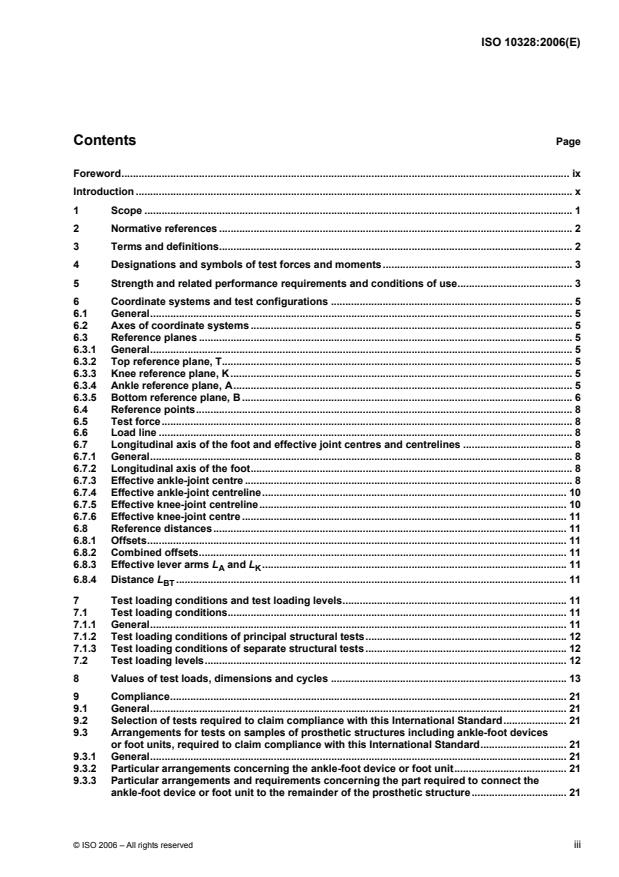
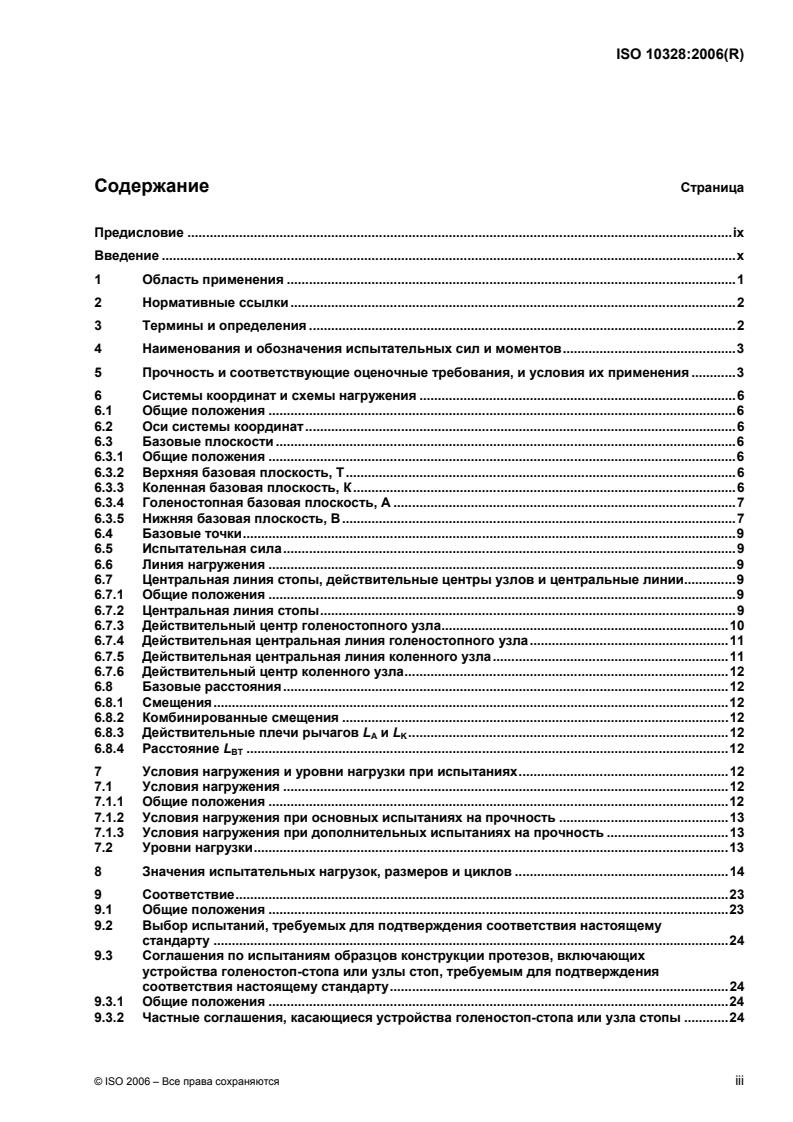
Contents Page
Foreword. ix
Introduction . x
1 Scope . 1
2 Normative references . 2
3 Terms and definitions. 2
4 Designations and symbols of test forces and moments. 3
5 Strength and related performance requirements and conditions of use. 3
6 Coordinate systems and test configurations . 5
6.1 General. 5
6.2 Axes of coordinate systems . 5
6.3 Reference planes . 5
6.3.1 General. 5
6.3.2 Top reference plane, T. 5
6.3.3 Knee reference plane, K. 5
6.3.4 Ankle reference plane, A. 5
6.3.5 Bottom reference plane, B . 6
6.4 Reference points. 8
6.5 Test force. 8
6.6 Load line . 8
6.7 Longitudinal axis of the foot and effective joint centres and centrelines . 8
6.7.1 General. 8
6.7.2 Longitudinal axis of the foot. 8
6.7.3 Effective ankle-joint centre . 8
6.7.4 Effective ankle-joint centreline. 10
6.7.5 Effective knee-joint centreline. 10
6.7.6 Effective knee-joint centre . 11
6.8 Reference distances. 11
6.8.1 Offsets. 11
6.8.2 Combined offsets. 11
6.8.3 Effective lever arms L and L . 11
A K
6.8.4 Distance L . 11
BT
7 Test loading conditions and test loading levels. 11
7.1 Test loading conditions. 11
7.1.1 General. 11
7.1.2 Test loading conditions of principal structural tests. 12
7.1.3 Test loading conditions of separate structural tests . 12
7.2 Test loading levels. 12
8 Values of test loads, dimensions and cycles . 13
9 Compliance. 21
9.1 General. 21
9.2 Selection of tests required to claim compliance with this International Standard. 21
9.3 Arrangements for tests on samples of prosthetic structures including ankle-foot devices
or foot units, required to claim compliance with this International Standard. 21
9.3.1 General. 21
9.3.2 Particular arrangements concerning the ankle-foot device or foot unit. 21
9.3.3 Particular arrangements and requirements concerning the part required to connect the
ankle-foot device or foot unit to the remainder of the prosthetic structure. 21
9.4 Number of tests and test samples required to claim compliance with this International
Standard. 22
9.5 Multiple use of test samples . 22
9.5.1 General . 22
9.5.2 Restriction. 23
9.6 Testing at particular test loading levels not specified in this International Standard. 23
10 Test samples. 25
10.1 Selection of test samples . 25
10.1.1 General . 25
10.1.2 Selection of ankle-foot devices and foot units of appropriate size of foot. 25
10.2 Types of test samples. 26
10.2.1 Complete structure . 26
10.2.2 Partial structure. 28
10.2.3 Any other structure. 28
10.3 Preparation of test samples. 28
10.4 Identification of test samples. 29
10.5 Alignment of test samples . 30
10.5.1 Test samples for principal tests and separate tests on knee locks . 30
10.5.2 Test samples for separate tests on ankle-foot devices and foot units . 30
10.5.3 Test samples for separate static ultimate strength tests in maximum knee flexion for knee
joints and associated parts. 31
10.5.4 Test samples for separate tests on knee locks . 31
10.6 Worst-case alignment position of test samples . 32
11 Responsibility for test preparation . 32
12 Test submission document. 33
12.1 General requirements . 33
12.2 Information required for test samples . 34
12.2.1 All test samples. 34
12.2.2 Test samples for tests on ankle-foot devices and foot units . 34
12.2.3 Test samples for static ultimate strength tests in maximum knee flexion for knee joints
and associated parts . 34
12.3 Information required for tests. 35
12.3.1 General . 35
12.3.2 For all tests . 35
12.3.3 For static tests in torsion and on ankle-foot devices and foot units. 35
12.3.4 For static ultimate strength tests . 35
12.3.5 For cyclic tests . 35
12.3.6 For tests in torsion. 35
12.3.7 For tests on ankle-foot devices and foot units . 36
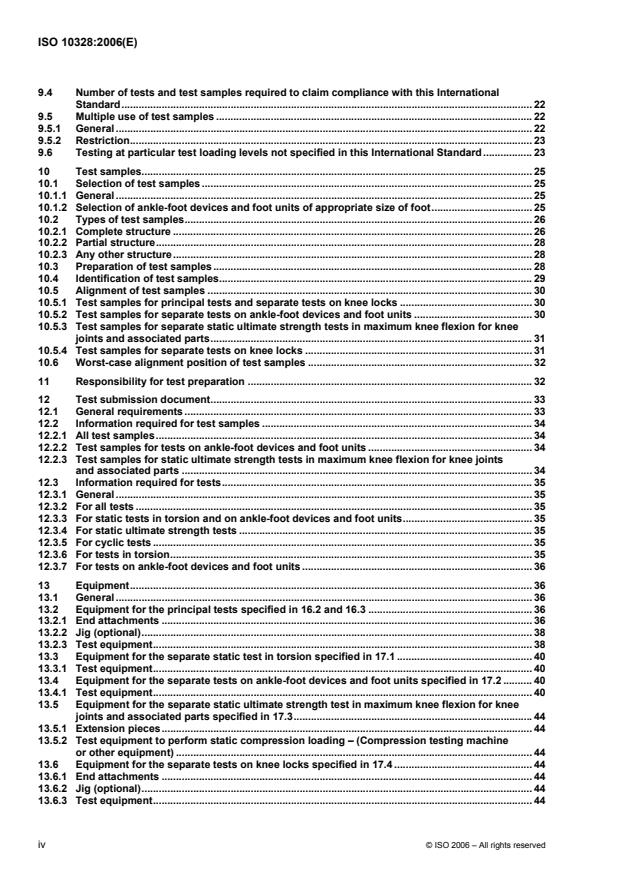
13 Equipment. 36
13.1 General . 36
13.2 Equipment for the principal tests specified in 16.2 and 16.3 . 36
13.2.1 End attachments . 36
13.2.2 Jig (optional). 38
13.2.3 Test equipment. 38
13.3 Equipment for the separate static test in torsion specified in 17.1 . 40
13.3.1 Test equipment. 40
13.4 Equipment for the separate tests on ankle-foot devices and foot units specified in 17.2 . 40
13.4.1 Test equipment. 40
13.5 Equipment for the separate static ultimate strength test in maximum knee flexion for knee
joints and associated parts specified in 17.3.44
13.5.1 Extension pieces. 44
13.5.2 Test equipment to perform static compression loading – (Compression testing machine
or other equipment) . 44
13.6 Equipment for the separate tests on knee locks specified in 17.4 . 44
13.6.1 End attachments . 44
13.6.2 Jig (optional). 44
13.6.3 Test equipment. 44
iv © ISO 2006 – All rights reserved
14 Accuracy. 45
14.1 General. 45
14.2 Accuracy of equipment . 45
14.3 Accuracy of procedure. 45
15 Test principles. 46
15.1 General. 46
15.2 Static test procedure . 46
15.3 Cyclic test procedure . 46
16 Test procedures – Principal structural tests . 46
16.1 Test loading requirements. 46
16.1.1 Preparation for test loading. 46
16.1.2 Application of test loading. 46
16.2 Principal static test procedure . 48
16.2.1 Principal static proof test. 48
16.2.2 Principal static ultimate strength test. 53
16.3 Principal cyclic test procedure. 57
16.3.1 General requirements. 57
16.3.2 Test method. 57
16.3.3 Performance requirements . 61
16.3.4 Compliance conditions . 61
17 Test procedures – Separate structural tests . 65
17.1 Separate static test in torsion . 65
17.1.1 General. 65
17.1.2 Purpose of test. 65
17.1.3 Test method. 65
17.1.4 Performance requirements . 67
17.1.5 Compliance conditions . 67
17.2 Separate tests on ankle-foot devices and foot units . 69
17.2.1 General. 69
17.2.2 Purpose of tests. 69
17.2.3 Separate static proof test for ankle-foot devices and foot units . 69
17.2.4 Separate static ultimate strength test for ankle-foot devices and foot units . 73
17.2.5 Separate cyclic test for ankle-foot devices and foot units. 78
17.3 Separate static ultimate strength test in maximum knee flexion for knee joints and
associated parts. 83
17.3.1 General. 83
17.3.2 Purpose of test. 83
17.3.3 Applicability of the test to specific test samples . 83
17.3.4 Test method. 84
17.3.5 Performance requirement . 84
17.3.6 Compliance conditions . 85
17.4 Separate tests on knee locks . 86
17.4.1 General. 86
17.4.2 Purpose of tests. 86
17.4.3 Separate static proof test for knee locks . 86
17.4.4 Separate static ultimate strength test for knee locks . 90
17.4.5 Separate cyclic test for knee locks. 92
18 Test laboratory/facility log . 101
18.1 General requirements. 101
18.2 Specific requirements . 101
19 Test report . 101
19.1 General requirements. 101
19.2 Specific requirements . 102
19.3 Options . 102
20 Classification and designation. 102
20.1 General. 102
20.2 Examples of classification and designation . 102
21 Labelling. 103
21.1 General . 103
21.2 Use of mark "*)" and warning symbol. 104
21.3 Examples of label layout . 104
21.4 Label placement . 104
Annex A (informative) Description of internal loads and their effects. 106
Annex B (informative) Reference data for the specification of test loading conditions and test
loading levels of principal cyclic tests . 110
Annex C (informative) Guidance on the application of an alternative static ultimate strength test . 114
Annex D (informative) Guidance on the application of an additional test loading level P6. 115
Annex E (informative) Summary of the records to be entered in the test laboratory/facility log. 118
Annex F (informative) Background information on the loading profiles generated by test
equipment according to 13.4.1.2 for separate cyclic tests for ankle-foot devices and foot
units according to 17.2.5.1. 133
Annex G (informative) Reference to the essential principles of safety and performance of medical
devices according to ISO/TR 16142 . 135
Bibliography . 136
Figure 1 — Coordinate systems for right and left-sided application. 6
Figure 2 — Coordinate systems according to Figure 1 with reference planes . 6
Figure 3 — Specific configuration with u = 0, showing coordinate systems with reference planes
B
(see Figures 1 and 2), reference lines, reference points and test force, F, for right and left-
sided application. 7
Figure 4 — Determination of longitudinal axis of foot (see 6.7.2), effective ankle-joint centre (see
6.7.3) and effective ankle-joint centreline (see 6.7.4) for test loading conditions I and II
and of combined bottom offset S (see 6.8.2) for test loading condition II [see 7.1.2 b)]. 9
B
Figure 5 — Position of effective knee-joint centreline for prosthetic knee units of different types . 10
Figure 6 — Application of a specific test configuration with u = 0 to a left-sided sample specified
B
in 10.2.1 . 27
Figure 7 — Position of foot in test equipment (see 10.5.2, 13.4 and 17.2). 30
Figure 8 — Test configuration for the separate static ultimate strength test in maximum knee
flexion on knee joints and associated parts (see 10.5.3.1, 13.5 and 17.3.4). 31
Figure 9 — Load cycle parameters for the principal cyclic test.39
Figure 10 — Load cycle parameters for the separate cyclic test for ankle-foot devices and foot
units. 43
Figure 11 — Illustration of test loading principle applied to a knee unit with attachments, aligned
to simulate a left-sided test sample (see 16.1.1). 47
Figure 12 — Method of calculating offsets at any height u = u (see 16.1.1). 48
x
Figure 13 — Flowchart for the principal static proof test, specified in 16.2.1.1 . 52
Figure 14 — Flowchart for the principal static ultimate strength test, specified in 16.2.2.1. 56
Figure 15 — Flowchart for the principal cyclic test, specified in 16.3.2 Continued on Figures 16 and
17 . 62
Figure 16 — Flowchart for the principal cyclic test, specified in 16.3.2 Continued from Figure 15
and continued on Figure 17 . 63
Figure 17 — Flowchart for the principal cyclic test, specified in 16.3.2 Continued from Figure 16. 64
vi © ISO 2006 – All rights reserved
Figure 18 — Flowchart for the separate static test in torsion, specified in 17.1.3. 68
Figure 19 — Flowchart for the separate static proof test for ankle-foot devices and foot units,
specified in 17.2.3.1 . 72
Figure 20 — Flowchart for the separate static ultimate strength test for ankle-foot devices
and foot units, specified in 17.2.4.1 . 77
Figure 21 — Flowchart for the separate cyclic test for ankle-foot devices and foot units, specified
in 17.2.5.1 Continued on Figure 22. 81
Figure 22 — Flowchart for the separate cyclic test for ankle-foot devices and foot units, specified
in 17.2.5.1 Continued from Figure 21. 82
Figure 23 — Flowchart for the separate static ultimate strength test in maximum knee flexion
for knee joints and associated parts, specified in 17.3.4 . 85
Figure 24 — Flowchart for the separate static proof test for knee locks, specified in 17.4.3.1. 89
Figure 25 — Flowchart for the separate static ultimate strength test for knee locks, specified in
17.4.4.1 . 92
Figure 26 — Flowchart for the separate cyclic test for knee locks, specified in 17.4.5.1 Continued
on Figures 27 and 28. 98
Figure 27 — Flowchart for the separate cyclic test for knee locks, specified in 17.4.5.1 Continued
from Figure 26 and continued on Figure 28 . 99
Figure 28 — Flowchart for the separate cyclic test for knee locks, specified in 17.4.5.1 Continued
from Figure 27. 100
Figure 29 — General concept for the label layout. 103
Figure 30 — Models for the label layout. 105
Figure A.1 — Test loading condition I [see 7.1.2 a)] . 108
Figure A.2 — Test loading condition II [see 7.1.2 b)] . 109
Table 1 — Designations and symbols of test forces and moments. 3
Table 2 — Categories of strength addressed in this International Standard, together with the
related performance requirements and test methods for their verification . 4
Table 3 — Test loads and relevant references. 14
Table 4 — Test forces of the proof test of end attachments for test loading levels P5, P4 and P3
(see 13.2.1.2). 15
Table 5 — Total length and segmental lengths of different types of test samples for principal
tests and separate tests on knee locks, for all test loading conditions and test loading
levels (see also 10.2, 10.3, 16.2, 16.3, 17.4 and Figure 2). 15
Table 6 — Values of offsets for all principal tests (see 16.2 and 16.3). 16
Table 7 — Values of combined offsets related to the values of offsets listed in Table 6 (see 10.1.2
and 13.2.1.2.3) . 16
Table 8 — Test forces of all principal tests and prescribed number of cycles of the cyclic test, for
test loading levels P5, P4 and P3 (see 16.2 and 16.3). 17
Table 9 — Twisting moments of the separate static test in torsion (see 17.1). 18
Table 10 — Angles of directions of loading of all separate tests on ankle-foot devices and foot
units, for test loading levels P5, P4 and P3 (see 17.2 and Figure 7) . 18
Table 11 — Test forces of all separate tests on ankle-foot devices and foot units and prescribed
number of cycles of the cyclic test, for test loading levels P5, P4 and P3 (see 17.2) . 19
Table 12 — Loading parameters of the separate static ultimate strength test in maximum knee
flexion for knee joints and associated parts (see 17.3 and Figure 8). 19
Table 13 — Offsets of all separate tests on knee locks, for test loading levels P5, P4 and P3 (see
17.4) . 20
Table 14 — Test forces of all separate tests on knee locks and prescribed number of cycles of
the cyclic test, for test loading levels P5, P4 and P3 (see 17.4). 20
Table 15 — Tests required to claim compliance with this International Standard for prosthetic
structures representing complete assemblies, partial assemblies or individual
components. 23
Table 16 — Number of tests and test samples required to claim compliance with this
International Standard . 24
Table 17 — Option for end attachments of specific design .37
Table A.1 — Positive internal forces and moments with descriptions of their effects. 107
Table B.1 — Values of ankle and knee moments related to test force F = F for different test
cr
loading conditions and test loading levels of principal cyclic tests . 111
Table B.2 — Calculated values of axial force and twisting moment related to test force F = F
cr
for different test loading conditions and test loading levels of principal cyclic tests. 111
Table B.3 — Values of ankle and knee moments related to test force F = F for different test
cmax
loading conditions and test loading levels of principal cyclic tests . 112
Table B.4 — Calculated values of axial force and twisting moment related to test force F = F
cmax
for different test loading conditions and test loading levels of principal cyclic tests. 112
Table D.1 — Test forces of the proof test of end attachments for test loading level P6
(see 13.2.1.2) . 116
Table D.2 — Test forces of all principal tests and prescribed number of cycles of the cyclic test,
for test loading level P6 (see 16.2 and 16.3) . 116
Table D.3 — Test forces of all separate tests on ankle-foot devices and foot units and prescribed
number of cycles of the cyclic test, for test loading level P6 (see 17.2) . 117
Table G.1 — Correspondence between this International Standard and the essential principles of
ISO/TR 16142 . 135
viii © ISO 2006 – All rights reserved
Foreword
ISO (the International Organization for Standardization) is a worldwide federation of national standards bodies
(ISO member bodies). The work of preparing International Standards is normally carried out through ISO
technical committees. Each member body interested in a subject for which a technical committee has been
established has the right to be represented on that committee. International organizations, governmental and
non-governmental, in liaison with ISO, also take part in the work. ISO collaborates closely with the
International Electrotechnical Commission (IEC) on all matters of electrotechnical standardization.
International Standards are drafted in accordance with the rules given in the ISO/IEC Directives, Part 2.
The main task of technical committees is to prepare International Standards. Draft International Standards
adopted by the technical committees are circulated to the member bodies for voting. Publication as an
International Standard requires approval by at least 75 % of the member bodies casting a vote.
Attention is drawn to the possibility that some of the elements of this document may be the subject of patent
rights. ISO shall not be held responsible for identifying any or all such patent rights.
ISO 10328 was prepared by Technical Committee ISO/TC 168, Prosthetics and orthotics.
This first edition cancels and replaces the eight parts of the first edition (ISO 10328-1:1996 to
ISO 10328-8:1996), which have been technically revised and combined into one single document.
Introduction
Throughout this International Standard, the term prosthesis means an externally applied device used to
replace wholly, or in part, an absent or deficient limb segment.
As a result of concern in the international community about the need to provide prostheses that are safe in
use, and also because of an awareness that test standards would assist the development of better prostheses,
a series of meetings was held under the aegis of the International Society for Prosthetics and Orthotics (ISPO).
The final one was held in Philadelphia, PA, USA in 1977 at which a preliminary consensus was reached on
methods of testing and the required load values. From 1979 onwards this work was continued by
ISO Technical Committee 168 leading to the development of ISO 10328:1996. The test procedures may not
be applicable to prostheses of mechanical characteristics different from those used in the consensus.
During use, a prosthesis is subjected to a series of load actions, each varying individually with time. The test
methods specified in this International Standard use static and cyclic strength tests which typically produce
compound loadings by the application of a single test force.
The static tests relate to the worst loads generated in any activity. The cyclic tests relate to normal walking
activities where loads occur regularly with each step. This International Standard specifies fatigue testing of
structural components. The tests specified do not provide sufficient data to predict actual service life.
The evaluation of lower-limb prostheses and their components requires controlled field trials in addition to the
laboratory tests specified in this International Standard.
The laboratory tests and field trials should be repeated when significant design changes are made to a load-
bearing part of a prosthesis.
Ideally, additional laboratory tests should be carried out to deal with function, wear and tear, new material
developments, environmental influences and user activities as part of the evaluation procedure. There are no
standards for such tests, so appropriate procedures will need to be determined.
In order to allow continuity of testing by checking the test methods for ankle-foot devices and foot units
specified in Clause 16 of ISO 22675:2006 against those specified in this International Standard, a transition
period will be established, during which both test methods are valid. For practical reasons, this transition
period will be adapted to the period of time after which the systematic review of this International Standard
and ISO 22675:2006 is indicated. The systematic review of both standards is expected to result, among other
outcomes, in the finding on whether the test methods specified in ISO 22675:2006 have demonstrated their
suitability.
x © ISO 2006 – All rights reserved
INTERNATIONAL STANDARD ISO 10328:2006(E)
Prosthetics — Structural testing of lower-limb prostheses —
Requirements and test methods
1 Scope
IMPORTANT — This International Standard is suitable for the assessment of the conformity of lower
limb prosthetic devices/structures with th
...
NORME ISO
INTERNATIONALE 10328
Première édition
2006-10-01
Prothèses — Essais portant sur la
structure des prothèses de membres
inférieurs — Exigences et méthodes
d'essai
Prosthetics — Structural testing of lower-limb prostheses —
Requirements and test methods
Numéro de référence
©
ISO 2006
PDF – Exonération de responsabilité
Le présent fichier PDF peut contenir des polices de caractères intégrées. Conformément aux conditions de licence d'Adobe, ce fichier
peut être imprimé ou visualisé, mais ne doit pas être modifié à moins que l'ordinateur employé à cet effet ne bénéficie d'une licence
autorisant l'utilisation de ces polices et que celles-ci y soient installées. Lors du téléchargement de ce fichier, les parties concernées
acceptent de fait la responsabilité de ne pas enfreindre les conditions de licence d'Adobe. Le Secrétariat central de l'ISO décline toute
responsabilité en la matière.
Adobe est une marque déposée d'Adobe Systems Incorporated.
Les détails relatifs aux produits logiciels utilisés pour la création du présent fichier PDF sont disponibles dans la rubrique General Info
du fichier; les paramètres de création PDF ont été optimisés pour l'impression. Toutes les mesures ont été prises pour garantir
l'exploitation de ce fichier par les comités membres de l'ISO. Dans le cas peu probable où surviendrait un problème d'utilisation,
veuillez en informer le Secrétariat central à l'adresse donnée ci-dessous.
© ISO 2006
Droits de reproduction réservés. Sauf prescription différente, aucune partie de cette publication ne peut être reproduite ni utilisée sous
quelque forme que ce soit et par aucun procédé, électronique ou mécanique, y compris la photocopie et les microfilms, sans l'accord écrit
de l'ISO à l'adresse ci-après ou du comité membre de l'ISO dans le pays du demandeur.
ISO copyright office
Case postale 56 • CH-1211 Geneva 20
Tel. + 41 22 749 01 11
Fax. + 41 22 749 09 47
E-mail copyright@iso.org
Web www.iso.org
Publié en Suisse
ii © ISO 2006 – Tous droits réservés
Sommaire Page
Avant-propos. ix
Introduction . x
1 Domaine d'application. 1
2 Références normatives . 2
3 Termes et définitions. 2
4 Désignations et symboles des forces d'essai et des moments. 2
5 Exigences concernant la résistance et les performances inhérentes et conditions
d'utilisation. 3
6 Repère orthonormé et configurations d'essai . 6
6.1 Généralités . 6
6.2 Axes des repères orthonormés. 6
6.3 Plans de référence. 6
6.3.1 Généralités . 6
6.3.2 Plan de référence supérieur, T . 6
6.3.3 Plan de référence du genou, K . 7
6.3.4 Plan de référence de la cheville, A. 7
6.3.5 Plan de référence inférieur, B. 7
6.4 Points de référence. 8
6.5 Force d'essai . 9
6.6 Droite de chargement. 9
6.7 Axe longitudinal du pied, centres et axes réels de l'articulation. 9
6.7.1 Généralités . 9
6.7.2 Axe longitudinal du pied . 9
6.7.3 Centre réel de l'articulation de la cheville . 9
6.7.4 Axe réel de l'articulation de la cheville. 10
6.7.5 Axe réel de l'articulation du genou . 11
6.7.6 Centre réel de l'articulation du genou . 11
6.8 Distances de référence. 12
6.8.1 Décalages . 12
6.8.2 Décalages combinés . 12
6.8.3 Bras de levier réels L et L . 12
A K
6.8.4 Distance L . 12
BT
7 Conditions de mise en contrainte d'essai et niveaux de contrainte d'essai . 12
7.1 Conditions de mise en contrainte d'essai.12
7.1.1 Généralités . 12
7.1.2 Conditions de mise en contrainte d'essai des essais principaux de structure . 12
7.1.3 Conditions de mise en contrainte des essais de structure. 13
7.2 Niveaux de contrainte d'essai . 13
8 Valeurs des contraintes d'essai, dimensions et cycles (forces et moments de torsion;
longueurs des segments, décalages et angles; nombre de cycles spécifié). 14
9 Conformité. 22
9.1 Généralités . 22
9.2 Sélection des essais requis en vue de la déclaration de conformité avec la présente
Norme internationale. 22
9.3 Dispositions relatives aux essais réalisés sur les échantillons de structures prothétiques
comprenant des ensembles cheville-pied ou des pieds requises en vue de la déclaration
de conformité avec la présente Norme internationale. 22
9.3.1 Généralités. 22
9.3.2 Dispositions particulières relatives à l'ensemble cheville-pied ou l'unité de pied . 22
9.3.3 Dispositions particulières et exigences relatives à la partie nécessaire à la liaison de
l'ensemble cheville-pied ou de l'unité de pied au reste de la structure prothétique . 23
9.4 Nombre d'essais et d'échantillons pour essai requis en vue de la déclaration de
conformité avec la présente Norme internationale . 23
9.5 Usage multiple des échantillons pour essai . 23
9.5.1 Généralités. 23
9.5.2 Restriction. 24
9.6 Essais réalisés à des niveaux de contrainte d'essai non spécifiés dans la présente Norme
internationale. 24
10 Échantillons pour essai. 27
10.1 Sélection des échantillons pour essai. 27
10.1.1 Généralités. 27
10.1.2 Sélection des ensembles cheville-pied et des pieds de dimensions de pied appropriées. 27
10.2 Types d'échantillon pour essai. 28
10.2.1 Structure complète . 28
10.2.2 Structure partielle . 30
10.2.3 Autres structures . 30
10.3 Préparation des échantillons pour essai. 30
10.4 Identification des échantillons pour essai . 32
10.5 Alignement des échantillons pour essai .32
10.5.1 Échantillons pour essai relatifs aux essais principaux et réalisés sur les verrous de
genou. 32
10.5.2 Échantillons pour essai relatifs aux essais réalisés sur les ensembles cheville-pied et les
pieds . 32
10.5.3 Échantillons pour essai relatifs aux essais statiques de résistance à la rupture en flexion
maximale du genou réalisés sur les articulations du genou et les éléments associés . 33
10.5.4 Échantillons pour essai relatifs aux essais réalisés sur les verrous de genou. 33
10.6 Position d'alignement la plus défavorable des échantillons pour essai. 33
11 Responsabilité relative à la préparation d'essai. 34
12 Bon de commande de l'essai. 35
12.1 Exigences générales. 35
12.2 Informations requises, relatives aux échantillons pour essai . 36
12.2.1 Tous les échantillons pour essai. 36
12.2.2 Échantillons pour essai relatifs aux tests réalisés sur les ensembles cheville-pied et les
pieds . 36
12.2.3 Échantillons pour essai relatifs aux essais statiques de résistance à la rupture en flexion
maximale du genou réalisés sur les articulations du genou et les éléments associés . 36
12.3 Informations requises, relatives aux essais.37
12.3.1 Généralités. 37
12.3.2 Pour tous les essais . 37
12.3.3 Pour les essais statiques en torsion et réalisés sur les ensembles cheville-pied et les
pieds . 37
12.3.4 Pour les essais statiques de résistance à la rupture . 37
12.3.5 Pour les essais en torsion. 38
12.3.6 Pour les essais portant sur les ensembles cheville-pied et les pieds . 38
13 Équipement. 38
13.1 Généralités. 38
13.2 Équipement relatif aux essais principaux spécifiés aux paragraphes 16.2 et 16.3 . 38
13.2.1 Pièces de liaison . 38
13.2.2 Dispositif de serrage (facultatif) . 41
13.2.3 Équipement d'essai. 41
13.3 Équipement relatif à l'essai statique distinct en torsion spécifié au paragraphe 17.1 . 43
13.3.1 Équipement d'essai. 43
13.4 Équipement relatif aux essais portant sur les ensembles cheville-pied ainsi que sur les
pieds spécifiés au paragraphe 17.2 . 43
13.4.1 Équipement d'essai. 43
iv © ISO 2006 – Tous droits réservés
13.5 Équipement relatif à l'essai statique distinct de résistance à la rupture en flexion
maximale du genou réalisé sur les articulations du genou et les éléments associés
spécifié au paragraphe 17.3. 46
13.5.1 Prolongateurs. 46
13.5.2 Équipement d'essai . 47
13.6 Équipement relatif aux essais réalisés sur les verrous de genou spécifiés au paragraphe
17.4 . 47
13.6.1 Pièces de liaison. 47
13.6.2 Dispositif de serrage (facultatif). 47
13.6.3 Équipement d'essai . 47
14 Exactitude. 48
14.1 Généralités . 48
14.2 Exactitude de l'équipement . 48
14.3 Exactitude du mode opératoire . 48
15 Principes d'essai. 49
15.1 Généralités . 49
15.2 Mode opératoire d'essai statique. 49
15.3 Mode opératoire d'essai cyclique . 49
16 Modes opératoires d'essai – Essais principaux de structure . 49
16.1 Exigences de mise en contrainte d'essai.49
16.1.1 Préparation de mise en contrainte d'essai.49
16.1.2 Application de mise en contrainte d'essai .49
16.2 Principal mode opératoire statique. 51
16.2.1 Principal essai statique sous contrainte. 51
16.2.2 Principal essai statique de résistance à la rupture. 56
16.3 Mode opératoire principal d'essai cyclique . 60
16.3.1 Exigences générales . 60
16.3.2 Méthode d'essai . 60
16.3.3 Exigences de performances . 64
16.3.4 Conditions de conformité . 65
17 Modes opératoires d'essai – Essais de structure . 69
17.1 Essai statique en torsion distinct . 69
17.1.1 Généralités . 69
17.1.2 Finalité de l'essai . 69
17.1.3 Méthode d'essai . 69
17.1.4 Exigences de performances . 71
17.1.5 Conditions de conformité . 71
17.2 Essais des ensembles cheville-pied et des pieds. 73
17.2.1 Généralités . 73
17.2.2 Finalité des essais . 73
17.2.3 Essai statique de charge des ensembles cheville-pied et des pieds. 73
17.2.4 Essai statique de résistance à la rupture des ensembles cheville-pied et pieds . 77
17.2.5 Essai cyclique distinct des ensembles cheville-pied et des pieds . 82
17.3 Essai statique de résistance à la rupture en flexion maximale du genou pour les
articulations de genou et éléments associés . 87
17.3.1 Généralités . 87
17.3.2 Finalité de l'essai . 87
17.3.3 Applicabilité de l'essai à des échantillons pour essai spécifiques. 87
17.3.4 Méthode d'essai . 88
17.3.5 Exigences de performances . 89
17.3.6 Conditions de conformité . 89
17.4 Essais séparés sur les verrous de genou. 90
17.4.1 Généralités . 90
17.4.2 Finalité des essais . 91
17.4.3 Essai statique de charge des verrous de genou . 91
17.4.4 Essai statique de résistance à la rupture des verrous de genou . 96
17.4.5 Essai cyclique des verrous de genou. 98
18 Journal du laboratoire/l'organisme d'essai. 108
18.1 Exigences générales. 108
18.2 Exigences spécifiques. 108
19 Rapport d'essai . 108
19.1 Exigences générales. 108
19.2 Exigences spécifiques. 109
19.3 Options. 109
20 Classification et désignation . 109
20.1 Généralités. 109
20.2 Exemples de classification et de désignation. 110
21 Étiquetage. 110
21.1 Généralités. 110
21.2 Utilisation du signe « *) » et symbole d'avertissement. 111
21.3 Mise en forme de l'étiquette. 111
21.4 Emplacement de l'étiquette. 112
Annexe A (informative) Description of internal loads and their effects. 113
Annexe B (informative) Reference data for the specification of test loading conditions and test
loading levels of principal cyclic tests . 117
Annexe C (informative) Guidance on the application of an alternative static ultimate strength test . 120
Annexe D (informative) Guidance on the application of an additional test loading level P6 . 121
Annexe E (informative) Summary of the records to be entered in the test laboratory/facility log. 124
Annexe F (informative) Background information on the loading profiles generated by test
equipment according to 13.4.1.2 for separate cyclic tests for ankle-foot devices and foot
units according to 17.2.5.1. 139
Annexe G (informative) Reference to the essential principles of safety and performance of
medical devices according to ISO/TR 16142. 141
Bibliographie . 142
Figure 1 — Systèmes de coordonnées pour une application du côté droit et du côté gauche . 7
Figure 2 — Systèmes de coordonnées représentés dans la figure 1 avec les plans de référence. 7
Figure 3 — Configuration spécifique avec u = 0, représentant les systèmes de coordonnées
B
avec les plans de référence (voir les figures 1 et 2), axes de référence, points de
référence et la force d'essai F pour une application du côté droit et du côté gauche . 8
Figure 4 — Détermination de l'axe longitudinal du pied (voir en 6.7.2), du centre réel de
l'articulation de la cheville (voir en 6.7.3) et de l'axe réel de l'articulation de la cheville
(voir en 6.7.4) dans les conditions de mise en contrainte d'essai I et II et du décalage
inférieur combiné S (voir en 6.8.2) dans la condition de mise en contrainte d'essai II [voir
B
en 7.1.2 b)]. 10
Figure 5 — Emplacement de l'axe réel de l'articulation du genou pour différents types d'unités
prothétiques de genou . 11
Figure 6 — Configuration d'essai spécifique à un échantillon pour essai du côté gauche tel que
spécifié en 10.2.1, avec u = 0. 29
B
Figure 7 — Position du pied dans l'équipement d'essai – (voir en 10.5.2, 13.4 et 17.2) . 32
Figure 8 — Configuration d'essai relative à l'essai statique distinct de résistance à la rupture en
flexion maximale du genou réalisé sur les articulations du genou et les éléments
associés – (voir en 10.5.3.1, 13.5 et 17.3.4) . 33
Figure 9 — Paramètres du cycle de contrainte relatifs à l'essai cyclique principal . 42
Figure 10 — Paramètres du cycle de contrainte relatifs à l'essai cyclique distinct réalisés sur les
ensembles cheville-pied et les pieds . 46
vi © ISO 2006 – Tous droits réservés
Figure 11 — Illustration du principe de mise en contrainte d'essai appliqué à un genou muni
d'éléments de jonction, aligné pour la simulation d'échantillon pour essai du côté gauche
(voir en 16.1.1). 50
Figure 12 — Méthode de calcul des décalages à n'importe quelle hauteur u = u (voir en 16.1.1). 51
x
Figure 13 — Logigramme d'essai statique de charge principal, spécifié en 16.2.1.1. 55
Figure 14 — Organigramme du principal essai statique de résistance à la rupture, spécifié en
16.2.2.1 . 59
Figure 15 — Organigramme du principal essai cyclique, spécifié au paragraphe 16.3.2 –
Suite aux figures 16 et 17. 66
Figure 16 — Organigramme du principal essai cyclique, spécifié au paragraphe 16.3.2 – Suite de
la figure 15 - Suite à la figure 17. 67
Figure 17 — Organigramme du principal essai cyclique, spécifié au paragraphe 16.3.2 – Suite de
la figure 16 . 68
Figure 18 — Organigramme de l'essai statique distinct en torsion, spécifié en 17.1.3 . 72
Figure 19 — Logigramme de l'essai de rupture statique pour les ensembles cheville-pied et pied,
spécifié en 17.2.3.1 . 76
Figure 20 — Flowchart for the separate static ultimate strength test for ankle-foot devices
and foot units, specified in 17.2.4.1 . 81
Figure 21 — Logigramme de l'essai cyclique distinct des mécanismes de cheville-pied et de
pieds, spécifiés en 17.2.5.1 – suite à la figure 22 . 85
Figure 22 — Logigramme de l'essai cyclique distinct des mécanismes de cheville-pied et de
pieds, spécifiés en 17.2.5.1 – suite de la figure 21 . 86
Figure 23 — Logigramme de l'essai de résistance à la rupture statique en flexion de genou
maximale concernant les articulations de genoux et éléments associés, spécifié en 17.3.4 . 90
Figure 24 — Logigramme de l'essai statique de résistance à la charge des verrous de genoux,
spécifié en 17.4.3.1 . 95
Figure 25 — Organigramme pour l'essai statique de résistance à la rupture pour le verrou de
genou, spécifié en 17.4.4.1 . 98
Figure 26 — Flowchart for the separate cyclic test for knee locks, specified in 17.4.5.1 –
Continued on Figures 27 and 28 . 105
Figure 27 — Flowchart for the separate cyclic test for knee locks, specified in 17.4.5.1 –
Continued from Figure 26 and continued on Figure 28. 106
Figure 28 — Flowchart for the separate cyclic test for knee locks, specified in 17.4.5.1 –
Continued from Figure 27 . 107
Figure 29 — Concept général de mise en forme de l'étiquette . 111
Figure 30 — Modèles de mise en forme de l'étiquette. 112
Figure A.1 — Test loading condition I [see 7.1.2 a)] . 115
Figure A.2 — Test loading condition II [see 7.1.2 b)] . 116
Tableau 1 — Désignations et symboles des forces d'essai et des moments . 3
Tableau 2 — Catégories de résistance définies dans la présente Norme, exigences de
performances inhérentes et méthodes d'essai en vue de leur vérification. 5
Tableau 3 — Contraintes d'essai et références en cause. 15
Tableau 4 — Forces d'essai de l'essai sous contrainte des pièces de liaison aux niveaux de
contrainte d'essai P5, P4 et P3 – (voir en 13.2.1.2). 16
Tableau 5 — Longueur totale et longueurs des segments des différents types d'échantillons pour
essai destinés aux essais principaux et des verrous de genou dans toutes les conditions
de mise en contrainte d'essai et à tous les niveaux de contrainte d'essai – (voir également
10.2, 10.3, 16.2, 16.3, 17.4 et la figure 2). 16
Tableau 6 — Valeurs des décalages de tous les essais principaux – (voir en 16.2 et 16.3) . 17
Tableau 7 — Valeurs des décalages combinés relatives aux valeurs des décalages énumérées
dans le tableau 7 – (voir en 10.1.2 et 13.2.1.2.3). 17
Tableau 8 — Forces d'essai de tous les essais principaux et nombre requis de cycles de l'essai
cyclique aux niveaux de contrainte d'essai P5, P4 et P3 – (voir en 16.2 et 16.3) . 18
Tableau 9 — Moments de torsion de l'essai statique en torsion – (voir en 17.1). 19
Tableau 10 — Angles des directions de mise en contrainte de tous les essais réalisés sur les
ensembles cheville-pied et les pieds aux niveaux de contrainte d'essai P5, P4 et P3 – (voir
en 17.2 et la figure 7). 19
Tableau 11 — Forces d'essai de tous les essais réalisés sur les ensembles cheville-pied et les
pieds et nombre requis de cycles de l'essai cyclique aux niveaux de contrainte d'essai P5,
P4 et P3 – (voir en 17.2) . 20
Tableau 12 — Paramètres de contrainte de l'essai statique de résistance à la rupture en flexion
maximale du genou des articulations du genou et des éléments associés – (voir en 17.3
et à la figure 8). 20
Tableau 13 — Décalages de tous les essais des verrous de genou aux niveaux de contrainte
d'essai P5, P4 et P3 – (voir en 17.4) . 21
Tableau 14 — Forces d'essai de tous les essais des verrous de genou et nombre requis de
cycles de l'essai cyclique aux niveaux de contrainte d'essai P5, P4 et P3 – (voir en 17.4) . 21
Tableau 15 — Essais requis en vue de déclarer les structures prothétiques correspondant à des
ensembles complets, des ensembles partiels ou des différents composants conformes à
la présente Norme internationale . 25
Tableau 16 — Nombre d'essais et d'échantillons pour essai requis en vue de la déclaration de
conformité avec la présente Norme internationale . 26
Tableau 17 — Option relative aux pièces de liaison de conception spéficique . 39
Table A.1 — Positive internal forces and moments with descriptions of their effects. 114
Table B.1 — Values of ankle and knee moments related to test force F = F for different test
cr
loading conditions and test loading levels of principal cyclic tests . 118
Table B.2 — Calculated values of axial force and twisting moment related to test force F = F for
cr
different test loading conditions and test loading levels of principal cyclic tests . 118
Table B.3 — Values of ankle and knee moments related to test force F = F for different test
cmax
loading conditions and test loading levels of principal cyclic tests . 118
Table B.4 — C Calculated values of axial force and twisting moment related to test force F = F
cmax
for different test loading conditions and test loading levels of principal cyclic tests. 119
Table D.1 — Test forces of the proof test of end attachments for test loading level P6 – (see
13.2.1.2) . 122
Table D.2 — Test forces of all principal tests and prescribed number of cycles of the cyclic test,
for test loading level P6 – (see 16.2 and 16.3) . 122
Table D.3 — Test forces of all separate tests on ankle-foot devices and foot units and prescribed
number of cycles of the cyclic test, for test loading level P6 – (see 17.2) . 123
Table G.1 — C Correspondence between this International Standard and the essential principles
of ISO/TR 16142. 141
viii © ISO 2006 – Tous droits réservés
Avant-propos
L'ISO (Organisation internationale de normalisation) est une fédération mondiale d'organismes nationaux de
normalisation (comités membres de l'ISO). L'élaboration des Normes internationales est en général confiée
aux comités techniques de l'ISO. Chaque comité membre intéressé par une étude a le droit de faire partie du
comité technique créé à cet effet. Les organisations internationales, gouvernementales et non
gouvernementales, en liaison avec l'ISO participent également aux travaux. L'ISO collabore étroitement avec
la Commission électrotechnique internationale (CEI) en ce qui concerne la normalisation électrotechnique.
Les Normes internationales sont rédigées conformément aux règles données dans les Directives ISO/CEI,
Partie 2.
La tâche principale des comités techniques est d'élaborer les Normes internationales. Les projets de Normes
internationales adoptés par les comités techniques sont soumis aux comités membres pour vote. Leur
publication comme Normes internationales requiert l'approbation de 75 % au moins des comités membres
votants.
L'attention est appelée sur le fait que certains des éléments du présent document peuvent faire l'objet de
droits de propriété intellectuelle ou de droits analogues. L'ISO ne saurait être tenue pour responsable de ne
pas avoir identifié de tels droits de propriété et averti de leur existence.
L'ISO 10328 a été élaborée par le comité technique ISO/TC 168, Prothèses et orthèses.
Cette première édition annule et remplace les huit parties de la première édition (ISO 10328-1:1996
à ISO 10328-8:1996) qui ont fait l'objet d'une révision technique et sont compilées dans un même document.
Introduction
Dans toutes les parties de cette Norme internationale, le terme prothèse désigne un appareil externe servant
à remplacer totalement ou partiellement un segment de membre absent ou déficient.
Étant donné que la communauté internationale est préoccupée par la nécessité de fournir des prothèses
présentant un degré de sécurité élevé et que l'on a pris conscience que des normes d'essai contribueraient à
la mise au point de prothèses de meilleure qualité, une série de réunions a été organisée sous l'égide de la
“International Society for Prosthetics and Orthotics” (ISPO). Lors de la dernière réunion qui s'est tenue à
Philadelphie, PA, Etats-Unis, en 1977, on est parvenu à un consensus préliminaire sur les méthodes d'essai
et les valeurs de charge exigées. Depuis 1979, ces travaux ont été poursuivis par le Comité Technique 168
de l'ISO et ils ont abouti à l'élaboration de l'ISO 10328:1996. Les modes opératoires d'essai peuvent ne pas
être applicables aux prothèses ayant des caractéristiques mécaniques différentes de celles définies dans le
cadre du consensus.
En cours d'utilisation, une prothèse est soumise aux actions d'une série de contraintes qui varient chacune
individuellement dans le temps. Les méthodes d'essai spécifiées dans la présente Norme internationale sont
fondées sur des essais de résistance statiques et cycliques dans le cadre desquels des contraintes
combinées sont produites par l'application d'une force d'essai unique.
Les essais statiques concernent les contraintes les plus sévè
...
МЕЖДУНАРОДНЫЙ ISO
СТАНДАРТ 10328
Первое издание
2006-10-01
Протезы. Испытания конструкции
протезов нижних конечностей.
Требования и методы испытания
Prosthetics — Structural testing of lower limb prostheses —
Requirements and test methods
Ссылочный номер
Все права сохраняются. Если не указано иное, никакую часть настоящей публикации нельзя копировать или использовать в
какой-либо форме или каким-либо электронным или механическим способом, включая фотокопии и микрофильмы, без
предварительного письменного согласия ISO, которое должно быть получено после запроса о разрешении, направленного по
адресу, приведенному ниже, или в комитет-член ISO в стране запрашивающей стороны.
ISO copyright office
Case postale 56 • CH-1211 Geneva 20
Tel. + 41 22 749 01 11
Fax + 41 22 749 09 47
E-mail copyright@iso.org
Web www.iso.org
ii © ISO 2006 – Все права сохраняются
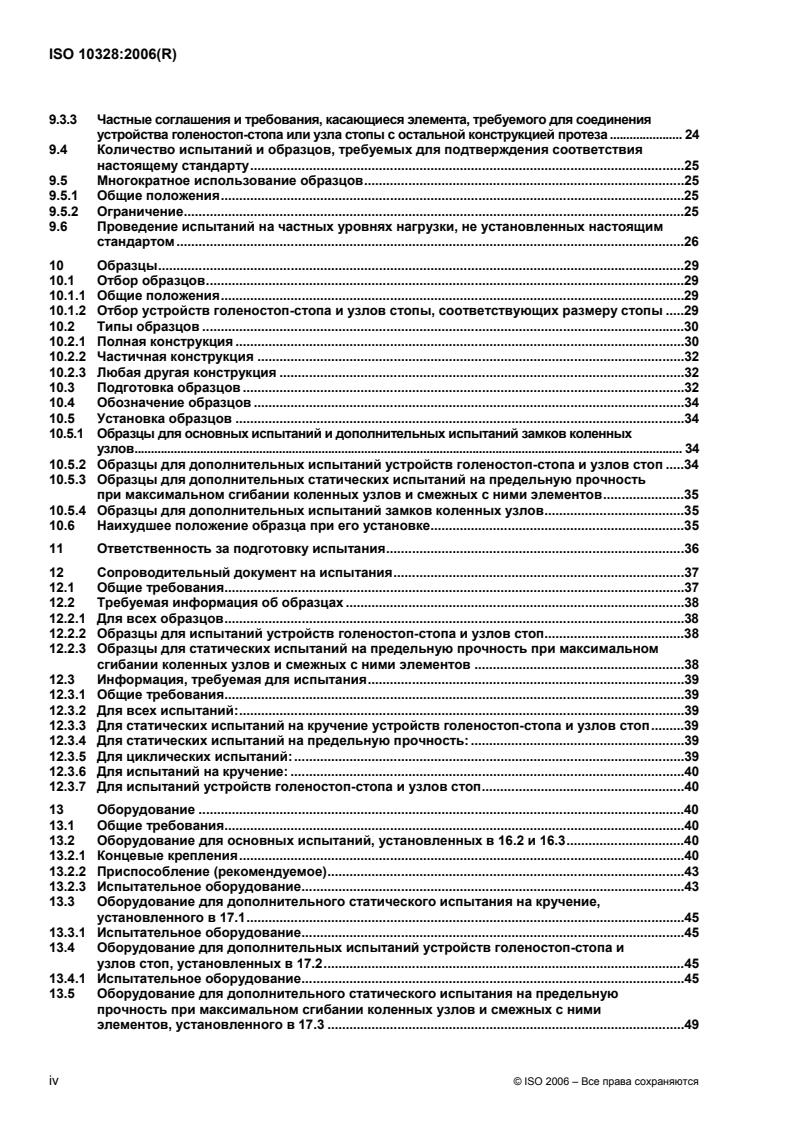
Содержание Страница
Предисловие . ix
Введение . x
1 Область применения . 1
2 Нормативные ссылки . 2
3 Термины и определения . 2
4 Наименования и обозначения испытательных сил и моментов . 3
5 Прочность и соответствующие оценочные требования, и условия их применения . 3
6 Системы координат и схемы нагружения . 6
6.1 Общие положения . 6
6.2 Оси системы координат . 6
6.3 Базовые плоскости . 6
6.3.1 Общие положения . 6
6.3.2 Верхняя базовая плоскость, Т . 6
6.3.3 Коленная базовая плоскость, К . 6
6.3.4 Голеностопная базовая плоскость, А . 7
6.3.5 Нижняя базовая плоскость, В . 7
6.4 Базовые точки . 9
6.5 Испытательная сила . 9
6.6 Линия нагружения . 9
6.7 Центральная линия стопы, действительные центры узлов и центральные линии . 9
6.7.1 Общие положения . 9
6.7.2 Центральная линия стопы . 9
6.7.3 Действительный центр голеностопного узла . 10
6.7.4 Действительная центральная линия голеностопного узла . 11
6.7.5 Действительная центральная линия коленного узла . 11
6.7.6 Действительный центр коленного узла . 12
6.8 Базовые расстояния . 12
6.8.1 Смещения . 12
6.8.2 Комбинированные смещения . 12
6.8.3 Действительные плечи рычагов L и L . 12
A K
6.8.4 Расстояние L . 12
BT
7 Условия нагружения и уровни нагрузки при испытаниях . 12
7.1 Условия нагружения . 12
7.1.1 Общие положения . 12
7.1.2 Условия нагружения при основных испытаниях на прочность . 13
7.1.3 Условия нагружения при дополнительных испытаниях на прочность . 13
7.2 Уровни нагрузки . 13
8 Значения испытательных нагрузок, размеров и циклов . 14
9 Соответствие . 23
9.1 Общие положения . 23
9.2 Выбор испытаний, требуемых для подтверждения соответствия настоящему
стандарту . 24
9.3 Соглашения по испытаниям образцов конструкции протезов, включающих
устройства голеностоп-стопа или узлы стоп, требуемым для подтверждения
соответствия настоящему стандарту . 24
9.3.1 Общие положения . 24
9.3.2 Частные соглашения, касающиеся устройства голеностоп-стопа или узла стопы . 24
9.3.3 Частные соглашения и требования, касающиеся элемента, требуемого для соединения
устройства голеностоп-стопа или узла стопы с остальной конструкцией протеза . 24
9.4 Количество испытаний и образцов, требуемых для подтверждения соответствия
настоящему стандарту .25
9.5 Многократное использование образцов .25
9.5.1 Общие положения .25
9.5.2 Ограничение .25
9.6 Проведение испытаний на частных уровнях нагрузки, не установленных настоящим
стандартом .26
10 Образцы .29
10.1 Отбор образцов .29
10.1.1 Общие положения .29
10.1.2 Отбор устройств голеностоп-стопа и узлов стопы, соответствующих размеру стопы .29
10.2 Типы образцов .30
10.2.1 Полная конструкция .30
10.2.2 Частичная конструкция .32
10.2.3 Любая другая конструкция .32
10.3 Подготовка образцов .32
10.4 Обозначение образцов .34
10.5 Установка образцов .34
10.5.1 Образцы для основных испытаний и дополнительных испытаний замков коленных
узлов . 34
10.5.2 Образцы для дополнительных испытаний устройств голеностоп-стопа и узлов стоп .34
10.5.3 Образцы для дополнительных статических испытаний на предельную прочность
при максимальном сгибании коленных узлов и смежных с ними элементов .35
10.5.4 Образцы для дополнительных испытаний замков коленных узлов .35
10.6 Наихудшее положение образца при его установке .35
11 Ответственность за подготовку испытания .36
12 Сопроводительный документ на испытания .37
12.1 Общие требования .37
12.2 Требуемая информация об образцах .38
12.2.1 Для всех образцов .38
12.2.2 Образцы для испытаний устройств голеностоп-стопа и узлов стоп.38
12.2.3 Образцы для статических испытаний на предельную прочность при максимальном
сгибании коленных узлов и смежных с ними элементов .38
12.3 Информация, требуемая для испытания .39
12.3.1 Общие требования .39
12.3.2 Для всех испытаний: .39
12.3.3 Для статических испытаний на кручение устройств голеностоп-стопа и узлов стоп .39
12.3.4 Для статических испытаний на предельную прочность: .39
12.3.5 Для циклических испытаний: .39
12.3.6 Для испытаний на кручение: .40
12.3.7 Для испытаний устройств голеностоп-стопа и узлов стоп .40
13 Оборудование .40
13.1 Общие требования .40
13.2 Оборудование для основных испытаний, установленных в 16.2 и 16.3 .40
13.2.1 Концевые крепления .40
13.2.2 Приспособление (рекомендуемое) .43
13.2.3 Испытательное оборудование .43
13.3 Оборудование для дополнительного статического испытания на кручение,
установленного в 17.1 .45
13.3.1 Испытательное оборудование .45
13.4 Оборудование для дополнительных испытаний устройств голеностоп-стопа и
узлов стоп, установленных в 17.2 .45
13.4.1 Испытательное оборудование .45
13.5 Оборудование для дополнительного статического испытания на предельную
прочность при максимальном сгибании коленных узлов и смежных с ними
элементов, установленного в 17.3 .49
iv © ISO 2006 – Все права сохраняются
13.5.1 Удлинители . 49
13.5.2 Испытательное оборудование для статического нагружения на сжатие (машина для
испытания на сжатие или другое оборудование . 49
13.6 Оборудование для дополнительных испытаний замков коленных узлов,
установленных в 17.4 . 49
13.6.1 Концевые крепления . 49
13.6.2 Приспособление (рекомендуемое) . 49
13.6.3 Испытательное оборудование . 49
14 Точность . 50
14.1 Общие положения . 50
14.2 Точность оборудования . 50
14.3 Погрешность измерения . 50
15 Концепция испытаний . 51
15.1 Основные положения . 51
15.2 Статические испытания . 51
15.3 Циклические испытания . 51
16 Основные испытания на прочность . 51
16.1 Требования к нагружению . 51
16.1.1 Подготовка к нагружению . 51
16.1.2 Применение нагружения . 52
16.2 Основные статические испытания . 53
16.2.1 Основное статическое проверочное испытание . 53
16.2.2 Основное статическое испытание на предельную прочность . 59
16.3 Основное циклическое испытание . 63
16.3.1 Общие требования . 63
16.3.2 Метод испытания . 63
16.3.3 Оценочные требования . 67
16.3.4 Условия соответствия . 68
17 Дополнительные испытания на прочность . 72
17.1 Дополнительное статическое испытание на кручение . 72
17.1.1 Общие положения . 72
17.1.2 Цель испытания . 72
17.1.3 Метод испытания . 72
17.1.4 Оценочные требования . 74
17.1.5 Условия соответствия . 74
17.2 Дополнительные испытания устройств голеностоп-стопа и узлов стоп . 76
17.2.1 Общие положения . 76
17.2.2 Цель испытания . 76
17.2.3 Дополнительное статическое проверочное испытание устройств голеностоп-стопа
и узлов стоп . 76
17.2.4 Дополнительное статическое испытание на предельную прочность устройств
голеностоп-стопа и узлов стоп . 80
17.2.5 Дополнительное циклическое испытание устройств голеностоп-стопа и узлов стоп . 85
17.3 Дополнительное статическое испытание на предельную прочность при
максимальном сгибании коленных узлов и смежных с ними элементов . 90
17.3.1 Общие положения . 90
17.3.2 Цель испытания . 90
17.3.3 Применимость испытания к конкретным образцам . 90
17.3.4 Метод испытания . 91
17.3.5 Оценочное требование . 92
17.3.6 Условия соответствия . 92
17.4 Дополнительные испытания замков коленных узлов . 93
17.4.1 Общие положения . 93
17.4.2 Цель испытаний . 94
17.4.3 Дополнительное статическое проверочное испытание замков коленных узлов . 94
17.4.4 Дополнительное статическое испытание на предельную прочность замков
коленных узлов . 99
17.4.5 Дополнительное циклическое испытание замков коленных узлов . 101
18 Журнал испытательной лаборатории/центра . 111
18.1 Общие требования . 111
18.2 Специальные требования . 111
19 Протокол испытания . 111
19.1 Общие требования . 111
19.2 Специальные требования . 112
19.3 Дополнительные требования . 112
20 Классификация и обозначение . 112
20.1 Общие положения . 112
20.2 Примеры классификации и обозначения . 113
21 Маркировка . 113
21.1 Общие положения . 113
∗
21.2 Применение знака « )» и предупреждающего знака . 114
21.3 Образцы этикеток . 114
21.4 Размещение этикетки . 115
Приложение А (информативное) Описание внутренних нагрузок и их воздействия . 116
Приложение В (информативное) Исходные данные для определения условий нагружения и
уровней нагрузки при основных циклических испытаниях . 120
Приложение С (информативное) Указания по применению альтернативного статического
испытания на предельную прочность . 124
Приложение D (информативное) Указания по применению дополнительного уровня
нагрузки Р6 . 126
Приложение Е (информативное) Данные, подлежащие включению в журнал испытательной
лаборатории/центра . 129
Приложение F (информативное) Исходная информация о профилях нагружения,
создаваемых испытательным оборудованием, соответствующим 13.4.1.2, при
дополнительных циклических испытаниях устройств голеностоп-стопа и узлов
стоп, соответствующих 17.2.5.1 . 146
Приложение G (информативное) Ссылка на основные принципы безопасности и
характеристики медицинских изделий, соответствующие ISO/TR 16142 . 148
Библиография . 149
Рисунок 1 — Системы координат для право- и левостороннего применения протеза .7
Рисунок 2 — Системы координат, соответствующие Рисунку 1, с базовыми плоскостями .7
Рисунок 3 — Специальная схема нагружения при u = 0 в системе координат с базовыми
B
плоскостями (см. Рисунки 1 и 2), базовыми линиями, базовыми точками и
испытательной силой F, для право- и левостороннего применения протеза .8
Рисунок 4 — Определение центральной линии стопы (см. 6.7.2), действительного центра
голеностопного узла (см. 6.7.3), действительной центральной линии голеностопного
узла (см. 6.7.4) при условиях нагружения I и II и суммарного нижнего смещения S
B
(см. 6.8.2) при условии нагружения II [см. 7.1.2 b)]. .10
Рисунок 5 — Расположение действительной центральной линии коленных узлов протезов
различных типов .11
Рисунок 6 — Специальная схема нагружения при u =0 для левостороннего образца,
B
установленного по 10.2.1 .31
Рисунок 7 — Положение стопы в испытательном оборудовании (см. 10.5.2, 13.4 и 17.2) .34
Рисунок 8 — Схема нагружения для дополнительного статического испытания на
предельную прочность при максимальном сгибании коленных узлов и смежных с
ними элементов (см. 10.5.3.1, 13.5 и 17.3.4) .35
Рисунок 9 — Параметры нагружения при основном циклическом испытании .44
vi © ISO 2006 – Все права сохраняются
Рисунок 10 — Параметры нагружения при дополнительном циклическом испытании
устройств голеностоп-стопа и узлов стоп . 48
Рисунок 11 – Иллюстрация нагружения при основном испытании коленного узла с
креплениями для левостороннего образца (см. 16.1.1.) . 52
Рисунок 12 — Обозначение смещений на высоте u = uи формулы для их вычисления (см. 16.1.1). 53
x
Рисунок 13 — Блок схема основного статического проверочного испытания,
установленного в 16.2.1.1 . 58
Рисунок 14 — Блок схема основного статического испытания на предельную прочность,
установленного в 16.2.2.1 . 62
Рисунок 15 — Блок-схема основного циклического испытания, установленного в 16.3.2. . 69
Рисунок 16 — Блок-схема основного циклического испытания, установленного в 16.3.2. . 70
Рисунок 17 — Блок-схема основного циклического испытания, . 71
установленного в 16.3.2. Окончание Рисунка 15 . 71
Рисунок 18 — Блок-схема дополнительного статического испытания . 75
на кручение, установленного в 17.1.3 . 75
Рисунок 19 — Блок-схема дополнительного статического проверочного испытания
устройств голеностоп-стопа и узлов стоп, установленного в 17.2.3.1 . 79
Рисунок 20 — Блок-схема дополнительного статического испытания на предельную
прочность устройств голеностоп-стопа и узлов стоп, установленного в 17.2.4.1 . 84
Рисунок 21 — Блок-схема дополнительного циклического испытания устройств
голеностоп-стопа и узлов стоп, установленного в 17.2.5.1. . 88
Рисунок 22 — Блок-схема дополнительного циклического испытания устройств
голеностоп-стопа и узлов стоп, установленного в 17.2.5.1. . 89
Рисунок 23 — Блок-схема дополнительного статического испытания на . 93
предельную прочность при максимальном сгибании коленных узлов и смежных с ними
элементов, установленного в 17.3.4 . 93
Рисунок 24 — Блок схема дополнительного статического проверочного испытания замков
коленных узлов, установленного в 17.4.3.1 . 98
Рисунок 25 — Блок-схема дополнительного статического испытания на предельную
прочность замков коленных узлов, установленного в 17.4.4.1 . 101
Рисунок 26 — Блок-схема дополнительного циклического испытания замков коленных
узлов, установленного в 17.4.5.1. Продолжение на Рисунках 27 и 28 . 108
Рисунок 27 — Блок-схема дополнительного циклического испытания замков коленных
узлов, установленного в 17.4.5.1. Продолжение Рисунка 26, окончание на Рисунке 28 . 109
Рисунок 28 — Блок-схема дополнительного циклического испытания замков коленных
узлов, установленного в17.4.5. Окончание Рисунка 26 . 110
Рисунок 29 — Схема этикетки . 114
Рисунок 30 — Образцы этикеток . 115
Рисунок А.1 – Условие нагружения I [см.7.1.2 а)] . 118
Рисунок А.2 – Условие нагружения II [см. 7.1.2 b)] . 119
Таблица 1 — Наименование и обозначения испытательных сил и моментов . 3
Таблица 2 — Виды прочности, оценочные требования и виды испытаний для их проверки . 5
Таблица 3 — Испытательные нагрузки и соответствующие ссылки . 15
Таблица 4 — Значения испытательных сил при проверочном испытании концевых
креплений для уровней нагрузки Р5, Р4 и Р3 (см. 13.2.1.2) . 16
Таблица 5 — Значения общей длины и длин сегментов образцов различных типов при основных
испытаниях и дополнительных испытаниях замков коленных узлов для всех условий
нагружения и уровней нагрузки (см. также 10.2, 10.3, 16.2, 16.3, 17.4 и Рисунок 2) . 17
Таблица 6 — Значения смещений при основных испытаниях (см. 16.2 и 16.3) .18
Таблица 7 — Значения комбинированных смещений, связанных со значениями смещений,
указанными в Таблице 6 (см. 10.1.2 и 13.2.1.2.3) .19
Таблица 8 – Значения испытательных сил при основных испытаниях и назначенное число
циклов при циклическом испытании для уровней нагрузки Р5, Р4 и Р3 (см. 16.2 и 6.3) .20
Таблица 9 – Значения крутящих моментов при дополнительном статическом испытании на
кручение (см. 17.1) .20
Таблица 10 — Направление нагружения при всех дополнительных испытаниях устройств
голеностоп-стопа и узлов стоп для уровней нагрузки Р5, Р4 и Р3 (см. 17.2 и Рисунок ) .21
Таблица 11 — Значение испытательных сил при всех дополнительных испытаниях
устройств голеностоп-стопа и узлов стоп и назначенное число циклов при
циклическом испытании для уровней нагрузки Р5, Р4 и Р3 (см. 17.2) .21
Таблица 12 – Параметры нагружения при дополнительном статическом испытании на
предельную прочность при максимальном сгибании коленных узлов и смежных с
ними элементов (см. 17.3 и Рисунок 8) .22
Таблица 13 – Значения смещений при всех дополнительных испытаниях замков коленных
узлов для уровней нагрузки Р5, Р4 и Р3 (см. 17.4) .22
Таблица 14 – Значения испытательных сил при всех дополнительных испытаниях замков
коленных узлов и назначенное число циклов при циклических испытаниях (см. 17.4) .23
Таблица 15 — Испытания, требуемые для подтверждения соответствия настоящему
стандарту конструкций протезов, представляющих собой полные конструкции,
частичные конструкции или отдельные элементы .27
Таблица 16 — Количество испытаний и образцов, требуемых для подтверждения
соответствия настоящему стандарту .28
Таблица 17 — Рекомендация для специальных концевых креплений .41
Таблица А.1 — Положительные внутренние силы и моменты с описанием их воздействия . 117
Таблица В.1 — Значения моментов в голеностопном и в коленном узлах, соответствующие
испытательной силе F = F , для различных условий нагружения и уровней нагрузки
cr
при основных циклических испытаниях . 121
Таблица В.2 — Расчетные значения осевой силы и крутящего момента, соответствующие
испытательной силе F = F для различных условий нагружения и уровней нагрузки
cr
при основных циклических испытаниях . 121
Таблица В.3 — Значения моментов в голеностопном и коленном узлах, соответствующие
испытательной силе F = F , для различных условий нагружения и уровней
сmax
нагрузки при основных циклических испытаниях . 122
Таблица В.4 — Расчетные значения осевой силы и крутящего момента, соответствующие
испытательной силе F = F для различных условий нагружения и уровней
cmax
нагрузки при основных циклических испытаниях . 122
Таблица D.1 — Значения испытательных сил при проверочном испытании концевых
креплений для уровня нагрузки Р6 (см. 13.2.1.2) . 127
Таблица D.2—Значения испытательных сил при всех основных испытаниях и назначенное
число циклов при циклическом испытании для уровня нагрузки Р6 (см. 16.2 и 16.3) . 127
Таблица D.3 — Значения испытательных сил при всех дополнительных испытаниях
устройств голеностоп-стопа и узлов стоп и назначенное число циклов при
циклическом испытании для уровня нагрузки Р6 (см. 17.2) . 128
Таблица G.1 — Соответствие настоящего стандарта основным принципам ISO/TR 16142 . 148
viii © ISO 2006 – Все права сохраняются
Предисловие
Международная организация по стандартизации (ISO) является всемирной федерацией национальных
организаций по стандартизации (комитетов-членов ISO). Разработка международных стандартов
обычно осуществляется техническими комитетами ISO. Каждый комитет-член, заинтересованный в
деятельности, для которой был создан технический комитет, имеет право быть представленным в этом
комитете. Международные правительственные и неправительственные организации, имеющие связи с
ISO, также принимают участие в этой работе. ISO работает в тесном сотрудничестве с Международной
электротехнической комиссией (IEC) по всем вопросам стандартизации в области электротехники.
Проекты международных стандартов разрабатываются в соответствии с правилами, приведенными в
Директивах ISO/IEC, Часть 2.
Основная задача технических комитетов заключается в разработке международных стандартов.
Проекты международных стандартов, принятые техническими комитетами, рассылаются комитетам-
членам на голосование. Их опубликование в качестве международных стандартов требует одобрения
не менее 75 % комитетов-членов, принимающих участие в голосовании.
Следует иметь в виду, что, возможно, некоторые элементы настоящего документа могут быть
объектом патентных прав. ISO не несет ответственности за определение некоторых или всех таких
патентных прав.
ISO 10328 разработан Техническим комитетом TC 168 ISO, Протезирование и ортезирование.
Настоящее первое издание отменяет и заменяет восемь частей первого издания (ISO 10328-1:1996 -
ISO 10328-8:1996), которые были технически пересмотрены и объединены в единый документ.
Введение
В настоящем стандарте термин «протез» означает устройство, примененное снаружи и
предназначенное для замещения полностью или частично отсутствующей или неполноценного
сегмента конечности.
Исходя из озабоченности международного сообщества необходимостью обеспечения безопасности
при эксплуатации протезов, а также из понимания того, что стандарты на испытания помогут
разработке усовершенствованных протезов, была проведена серия заседаний под эгидой
Международного общества протезирования и ортезирования (ISPO). Окончательное заседание было
проведено в Филадельфии, США, в 1977 году. На нём было достигнуто предварительное соглашение о
методах испытаний и требуемых значениях нагрузок. С 1979 года эта работа продолжалась
Техническим комитетом ISO 168, проводившим разработку ISO 10328:1996. Испытания не могут быть
применены к протезам, механические характеристики которых отличны от характеристик, указанных в
соглашении.
При эксплуатации протезы подвергаются ряду воздействий нагрузок, каждая из которых изменяется
индивидуально во времени. Методы испытания, установленные в этом стандарте, используют для
статических и динамических испытаний на прочность, при которых сложные нагружения воспроизводят
приложением единственной испытательной силы.
Статические испытания соответствуют наибольшим нагрузкам, возникающим при какой-либо
деятельности. Циклические испытания соответствуют нормальной ходьбе, при которой нагрузки
регулярно возникают при каждом шаге. Настоящий стандарт устанавливает проверку элементов
конструкции на прочность. Указанные испытания не обеспечивают получения достаточных данных,
позволяющих прогнозировать действительный срок службы протезов.
Оценка протезов нижних конечностей и их элементов требует проведения контролируемых полевых
испытаний в дополнение к стендовым испытаниям, установленным в настоящем стандарте.
При внесении существенных изменений в конструкцию части протеза, несущей нагрузку, стендовые и
полевые испытания следует повторять.
В идеале, дополнительные стендовые испытания следует проводить на функционирование,
износостойкость, при разработке новых материалов, на влияние окружающей среды и с участием
пользователя, как части процедуры оценки. Стандарты для таких испытаний отсутствуют, поэтому
необходимо определить соответствующие процедуры.
Для того чтобы предоставить возможность проверки методов испытания устройств голеностоп-стопа
и узлов стоп, установленных в Разделе 16 ISO 22675:2006, методами, установленными настоящим
стандартом, должен быть установлен переходный период, в течение которого необходимо оценить
оба метода испытания. По практическим соображениям этот переходный период должен
соответствовать времени, по истечении которого проводится периодический пересмотр настоящего
стандарта и ISO 22675:2006. При периодической проверке обоих стандартов предполагается
установить пригодность методов испытания, установленных в ISO 22675:2006.
x © ISO 2006 – Все права сохраняются
МЕЖДУНАРОДНЫЙ СТАНДАРТ ISO 10328:2006(R)
Протезы. Испытания конструкции протезов нижних
конечностей. Требования и методы испытания
1 Область применения
ВАЖНОЕ — Настоящий стандарт пригоден для оценки соответствия протезных
устройств/конструкций протезов нижних конечностей требованиям прочности, установленным
в 4.4 ISO 22523:2006 (см. ПРИМЕЧАНИЕ 1). Устройства голеностоп-стопа и узлы стоп пригодны
для продажи, если соответствие требованиям прочности, установленным в 4.4 ЕN 12523:1999,
подтверждено соответствующими испытаниями по ISO 10328:1996, нет необходимости
повторно испытывать по ISO 22675:2006.
ПРЕДУПРЕЖДЕНИЕ — Настоящий стандарт не пригоден для использования в качестве
руководства при назначении конкретного протезного устройства/конструкции нижней
конечности индивидуального изготовления!
Настоящий стандарт устанавливает статические и циклические испытания на прочность протезов
нижних конечностей (см. ПРИМЕЧАНИЕ 2), при которых сложные нагружения воспроизводят
приложением единственной испытательной силы. Сложные нагрузки на испытываемый образец
соответствуют пиковым значениям нагрузок, которые обычно возникают в различные моменты фазы
опоры при ходьбе.
Испытания, приведенные в настоящем стандарте, включают
— основные статические и циклические испытания всех элементов;
— дополнительное статическое испытание на кручение всех элементов;
— дополнительные статические и циклические испытания устройств голеностоп-стопа и узлов стоп
всех устройств голеностоп-стопа, как одиночных элементов, включающих узлы голени или их
крепления, и всех узлов стоп, как одиночных элементов;
— дополнительное статическое испытание на предельную прочность при максимальном сгибании
коленных узлов и смежных с ними элементов или сборок колено-голень и смежных элементов,
которые стопорят дальнейшее сгибание на полном протезе;
— дополнительные статические и циклические испытания замков ко
...
Questions, Comments and Discussion
Ask us and Technical Secretary will try to provide an answer. You can facilitate discussion about the standard in here.
Loading comments...