

ISO 22675:2024
(Main)Prosthetics — Testing of ankle-foot devices and foot units — Requirements and test methods
General Information
- Abstract
This document primarily specifies a cyclic test procedure for ankle-foot devices and foot units of external lower limb prostheses, these differ in the potential to realistically simulate those loading conditions of the complete stance phase of walking from heel strike to toe-off which is relevant to the verification of performance requirements such as strength, durability and service life. This potential is of particular importance for the assessment of the performance of a variety of recent designs of ankle-foot devices and foot units with specific characteristics that will only develop under realistic conditions of loading. In addition, this document specifies a static test procedure for prosthetic ankle-foot devices and foot units, consisting of a static proof test and a static ultimate strength test, distinguished, besides other features (see NOTE), by the potential to generate heel and forefoot forces at lines of action conforming to those occurring at the instants of maximum heel and forefoot loading during the cyclic test. These loading conditions are characterized by a loading profile determined by the resultant vector of the vertical and horizontal (A-P) ground reaction forces and by a locomotion profile determined by the tibia angle. The test loading conditions specified in this document are characterized by standardized formats of these loading and locomotion profiles, applied by the cyclic and static test procedures to each sample of ankle-foot device or foot unit submitted for test. This document specifies Test Ranges (R) by specifying locomotion profiles for the cyclic test in relation to the intended use. According to the concept of the tests of this document, each sample of ankle-foot device or foot unit submitted for test is, nevertheless, free to develop its individual performance under load. This document is suitable for the assessment and testing of prosthetic ankle-foot devices and foot units with the strength requirements specified in 4.4 of ISO 22523:2006 (see NOTE). Prosthetic ankle-foot devices and foot units on the market, which have demonstrated their compliance with the strength requirements specified in 4.4 of ISO 22523:2006 through submission to the relevant tests of ISO 10328:2016, need not be retested to this document. NOTE The lines of action of the heel and forefoot forces generated by the static test procedure for Test Range 4 (R4) specified in this document approach those determining the sagittal plane loading of the test loading conditions I and II for the principal structural tests referring to ISO 10328:2016, without changing the values of the angles of the heel and forefoot platform(s) for the structural tests on ankle-foot devices and foot units specified in ISO 10328:2016.
- Status
- Published
- Publication Date
- 04-Dec-2024
- Technical Committee
- ISO/TC 168 - Prosthetics and orthotics
- Drafting Committee
- ISO/TC 168/WG 3 - Testing
- Current Stage
- 6060 - International Standard published
- Start Date
- 05-Dec-2024
- Due Date
- 02-Oct-2022
- Completion Date
- 05-Dec-2024
Buy Documents
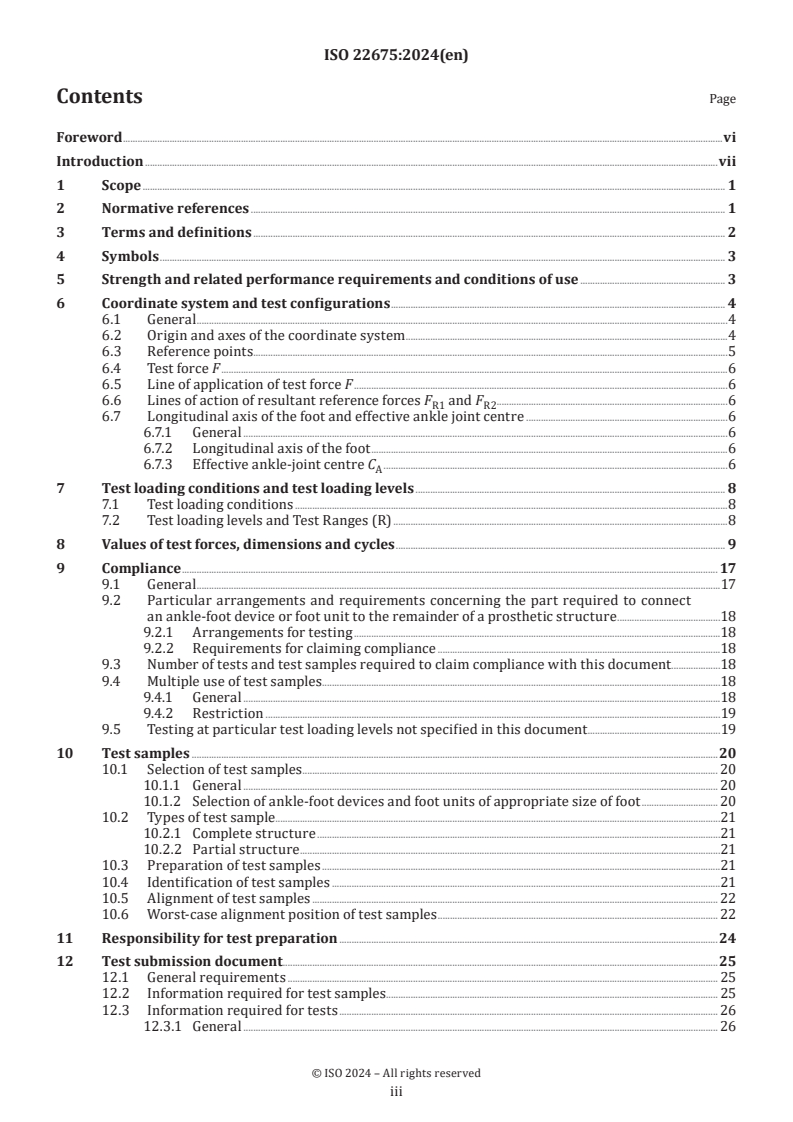
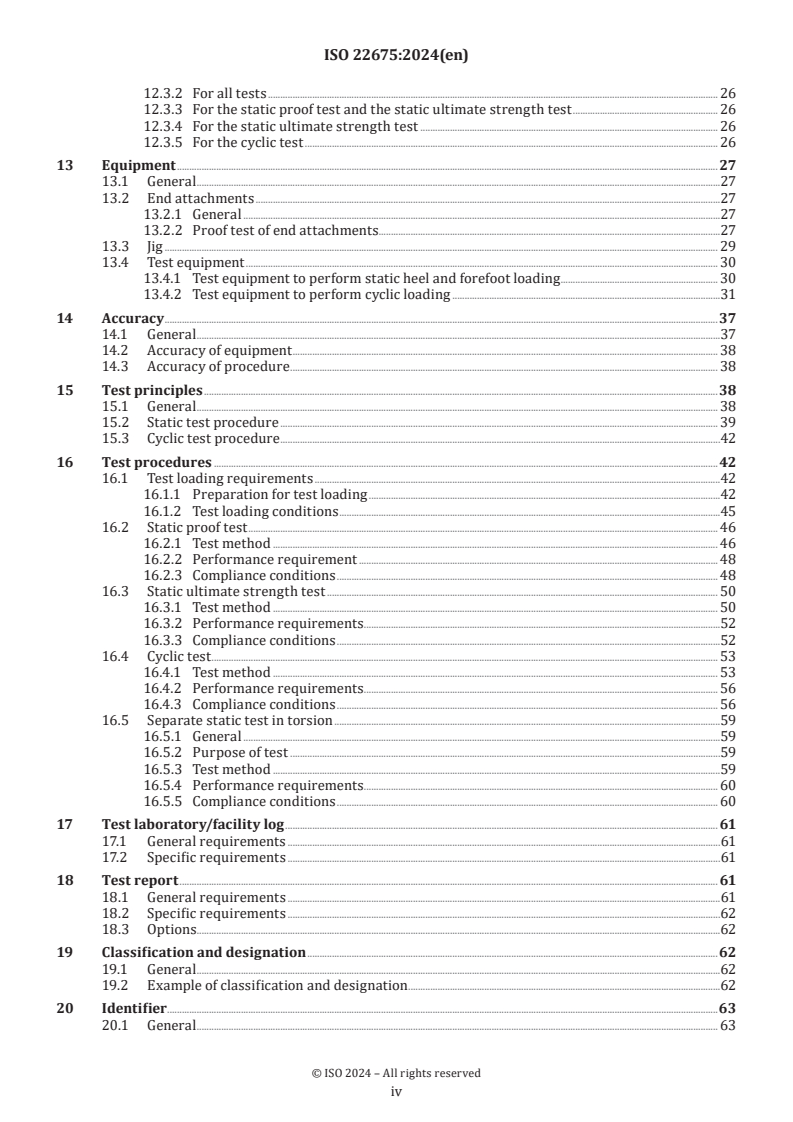
ISO 22675:2024 - Prosthetics — Testing of ankle-foot devices and foot units — Requirements and test methods Released:12/5/2024
ISO 22675:2024 - Protheses — Essais d'articulations cheville-pied et unités de pied — Exigences et méthodes d'essai Released:12/5/2024
Overview
ISO 22675:2024 - Prosthetics - Testing of ankle-foot devices and foot units - Requirements and test methods defines standardized mechanical test procedures to assess the strength, durability and service life of ankle‑foot prosthetic devices and foot units. The standard focuses on realistic simulation of the complete stance phase of walking (heel strike to toe-off) using both cyclic and static test methods. Test loading profiles are determined by the resultant ground reaction force vector and the tibia angle, and are applied in standardized formats to each submitted sample.
Key topics and technical requirements
- Cyclic test procedure: A repeatable, time-varying loading regime that simulates heel-to-toe loading during walking to evaluate durability and endurance under realistic conditions.
- Static tests: Includes the static proof test and the static ultimate strength test, which generate heel and forefoot forces with lines of action matching peak loading instants in the cyclic test.
- Test Ranges (R): Locomotion profiles and specified test ranges tied to intended use (e.g., activity level or user mass) to ensure representative loading.
- Coordinate system & test configuration: Defined origins, axes, reference points, and lines of action for reproducible loading and alignment.
- Sample preparation and alignment: Procedures for selecting, preparing and aligning complete or partial structures, including worst‑case alignment positions.
- Equipment, accuracy and jigs: Requirements for end attachments, test rigs, cyclic and static actuators, and measurement accuracy.
- Compliance and documentation: Test submission documents, number of samples, compliance criteria and laboratory logs.
- Torsion test option: Separate static torsion assessment for relevant devices.
Practical applications
- Verifying mechanical performance of new ankle‑foot devices and foot units during design validation and pre‑market testing.
- Supporting product claims for durability, service life and structural strength.
- Guiding selection of materials and geometries to meet intended activity levels.
- Enabling reproducible lab testing for quality control and comparative evaluations.
Who should use this standard
- Prosthetic device manufacturers and R&D teams validating ankle‑foot products.
- Independent test laboratories performing mechanical characterization and certification testing.
- Regulatory bodies and conformity assessors reviewing mechanical safety and performance.
- Clinical engineers and prosthetists interpreting test evidence for device selection and risk assessment.
Related standards
- ISO 22523:2006 (strength requirements for prosthetic components) - ISO 22675 is suitable for devices meeting the strength class in section 4.4 of ISO 22523.
- ISO 10328:2016 (structural testing of lower‑limb prostheses) - devices previously tested to ISO 10328 may not require retesting to ISO 22675 for the same strength requirements.
Keywords: ISO 22675:2024, prosthetics testing, ankle-foot devices, foot units, cyclic testing, static proof test, static ultimate strength, durability testing, prosthetic standards.
Relations
- Effective Date
- 12-Feb-2026
- Consolidates
ISO 21111-2:2020 - Road vehicles — In-vehicle Ethernet — Part 2: Common physical entity requirements - Effective Date
- 06-Jun-2022
- Effective Date
- 23-Apr-2020
Buy Documents
ISO 22675:2024 - Prosthetics — Testing of ankle-foot devices and foot units — Requirements and test methods Released:12/5/2024
ISO 22675:2024 - Protheses — Essais d'articulations cheville-pied et unités de pied — Exigences et méthodes d'essai Released:12/5/2024
Get Certified
Connect with accredited certification bodies for this standard

BSI Group
BSI (British Standards Institution) is the business standards company that helps organizations make excellence a habit.

TÜV Rheinland
TÜV Rheinland is a leading international provider of technical services.

TÜV SÜD
TÜV SÜD is a trusted partner of choice for safety, security and sustainability solutions.
Sponsored listings
Frequently Asked Questions
ISO 22675:2024 is a standard published by the International Organization for Standardization (ISO). Its full title is "Prosthetics — Testing of ankle-foot devices and foot units — Requirements and test methods". This standard covers: This document primarily specifies a cyclic test procedure for ankle-foot devices and foot units of external lower limb prostheses, these differ in the potential to realistically simulate those loading conditions of the complete stance phase of walking from heel strike to toe-off which is relevant to the verification of performance requirements such as strength, durability and service life. This potential is of particular importance for the assessment of the performance of a variety of recent designs of ankle-foot devices and foot units with specific characteristics that will only develop under realistic conditions of loading. In addition, this document specifies a static test procedure for prosthetic ankle-foot devices and foot units, consisting of a static proof test and a static ultimate strength test, distinguished, besides other features (see NOTE), by the potential to generate heel and forefoot forces at lines of action conforming to those occurring at the instants of maximum heel and forefoot loading during the cyclic test. These loading conditions are characterized by a loading profile determined by the resultant vector of the vertical and horizontal (A-P) ground reaction forces and by a locomotion profile determined by the tibia angle. The test loading conditions specified in this document are characterized by standardized formats of these loading and locomotion profiles, applied by the cyclic and static test procedures to each sample of ankle-foot device or foot unit submitted for test. This document specifies Test Ranges (R) by specifying locomotion profiles for the cyclic test in relation to the intended use. According to the concept of the tests of this document, each sample of ankle-foot device or foot unit submitted for test is, nevertheless, free to develop its individual performance under load. This document is suitable for the assessment and testing of prosthetic ankle-foot devices and foot units with the strength requirements specified in 4.4 of ISO 22523:2006 (see NOTE). Prosthetic ankle-foot devices and foot units on the market, which have demonstrated their compliance with the strength requirements specified in 4.4 of ISO 22523:2006 through submission to the relevant tests of ISO 10328:2016, need not be retested to this document. NOTE The lines of action of the heel and forefoot forces generated by the static test procedure for Test Range 4 (R4) specified in this document approach those determining the sagittal plane loading of the test loading conditions I and II for the principal structural tests referring to ISO 10328:2016, without changing the values of the angles of the heel and forefoot platform(s) for the structural tests on ankle-foot devices and foot units specified in ISO 10328:2016.
This document primarily specifies a cyclic test procedure for ankle-foot devices and foot units of external lower limb prostheses, these differ in the potential to realistically simulate those loading conditions of the complete stance phase of walking from heel strike to toe-off which is relevant to the verification of performance requirements such as strength, durability and service life. This potential is of particular importance for the assessment of the performance of a variety of recent designs of ankle-foot devices and foot units with specific characteristics that will only develop under realistic conditions of loading. In addition, this document specifies a static test procedure for prosthetic ankle-foot devices and foot units, consisting of a static proof test and a static ultimate strength test, distinguished, besides other features (see NOTE), by the potential to generate heel and forefoot forces at lines of action conforming to those occurring at the instants of maximum heel and forefoot loading during the cyclic test. These loading conditions are characterized by a loading profile determined by the resultant vector of the vertical and horizontal (A-P) ground reaction forces and by a locomotion profile determined by the tibia angle. The test loading conditions specified in this document are characterized by standardized formats of these loading and locomotion profiles, applied by the cyclic and static test procedures to each sample of ankle-foot device or foot unit submitted for test. This document specifies Test Ranges (R) by specifying locomotion profiles for the cyclic test in relation to the intended use. According to the concept of the tests of this document, each sample of ankle-foot device or foot unit submitted for test is, nevertheless, free to develop its individual performance under load. This document is suitable for the assessment and testing of prosthetic ankle-foot devices and foot units with the strength requirements specified in 4.4 of ISO 22523:2006 (see NOTE). Prosthetic ankle-foot devices and foot units on the market, which have demonstrated their compliance with the strength requirements specified in 4.4 of ISO 22523:2006 through submission to the relevant tests of ISO 10328:2016, need not be retested to this document. NOTE The lines of action of the heel and forefoot forces generated by the static test procedure for Test Range 4 (R4) specified in this document approach those determining the sagittal plane loading of the test loading conditions I and II for the principal structural tests referring to ISO 10328:2016, without changing the values of the angles of the heel and forefoot platform(s) for the structural tests on ankle-foot devices and foot units specified in ISO 10328:2016.
ISO 22675:2024 is classified under the following ICS (International Classification for Standards) categories: 11.040.40 - Implants for surgery, prosthetics and orthotics. The ICS classification helps identify the subject area and facilitates finding related standards.
ISO 22675:2024 has the following relationships with other standards: It is inter standard links to EN ISO 22675:2025, ISO 21111-2:2020, ISO 22675:2016. Understanding these relationships helps ensure you are using the most current and applicable version of the standard.
ISO 22675:2024 is available in PDF format for immediate download after purchase. The document can be added to your cart and obtained through the secure checkout process. Digital delivery ensures instant access to the complete standard document.
Standards Content (Sample)
International
Standard
ISO 22675
Third edition
Prosthetics — Testing of ankle-
2024-12
foot devices and foot units —
Requirements and test methods
Prothèses — Essais d'articulations cheville-pied et unités de pied
— Exigences et méthodes d'essai
Reference number
© ISO 2024
All rights reserved. Unless otherwise specified, or required in the context of its implementation, no part of this publication may
be reproduced or utilized otherwise in any form or by any means, electronic or mechanical, including photocopying, or posting on
the internet or an intranet, without prior written permission. Permission can be requested from either ISO at the address below
or ISO’s member body in the country of the requester.
ISO copyright office
CP 401 • Ch. de Blandonnet 8
CH-1214 Vernier, Geneva
Phone: +41 22 749 01 11
Email: copyright@iso.org
Website: www.iso.org
Published in Switzerland
ii
Contents Page
Foreword .vi
Introduction .vii
1 Scope . 1
2 Normative references . 1
3 Terms and definitions . 2
4 Symbols . 3
5 Strength and related performance requirements and conditions of use . 3
6 Coordinate system and test configurations . 4
6.1 General .4
6.2 Origin and axes of the coordinate system .4
6.3 Reference points.5
6.4 Test force F .6
6.5 Line of application of test force F .6
6.6 Lines of action of resultant reference forces F and F .6
R1 R2
6.7 Longitudinal axis of the foot and effective ankle joint centre .6
6.7.1 General .6
6.7.2 Longitudinal axis of the foot .6
6.7.3 Effective ankle-joint centre C .6
A
7 Test loading conditions and test loading levels . 8
7.1 Test loading conditions .8
7.2 Test loading levels and Test Ranges (R) .8
8 Values of test forces, dimensions and cycles . 9
9 Compliance . 17
9.1 General .17
9.2 Particular arrangements and requirements concerning the part required to connect
an ankle-foot device or foot unit to the remainder of a prosthetic structure .18
9.2.1 Arrangements for testing .18
9.2.2 Requirements for claiming compliance .18
9.3 Number of tests and test samples required to claim compliance with this document .18
9.4 Multiple use of test samples . .18
9.4.1 General .18
9.4.2 Restriction .19
9.5 Testing at particular test loading levels not specified in this document .19
10 Test samples .20
10.1 Selection of test samples . 20
10.1.1 General . 20
10.1.2 Selection of ankle-foot devices and foot units of appropriate size of foot . 20
10.2 Types of test sample . .21
10.2.1 Complete structure .21
10.2.2 Partial structure .21
10.3 Preparation of test samples .21
10.4 Identification of test samples .21
10.5 Alignment of test samples . 22
10.6 Worst-case alignment position of test samples . 22
11 Responsibility for test preparation .24
12 Test submission document . .25
12.1 General requirements . 25
12.2 Information required for test samples . 25
12.3 Information required for tests . 26
12.3.1 General . 26
iii
12.3.2 For all tests . 26
12.3.3 For the static proof test and the static ultimate strength test . 26
12.3.4 For the static ultimate strength test . 26
12.3.5 For the cyclic test . 26
13 Equipment .27
13.1 General .27
13.2 End attachments .27
13.2.1 General .27
13.2.2 Proof test of end attachments.27
13.3 Jig . 29
13.4 Test equipment . 30
13.4.1 Test equipment to perform static heel and forefoot loading . 30
13.4.2 Test equipment to perform cyclic loading .31
14 Accuracy .37
14.1 General .37
14.2 Accuracy of equipment . 38
14.3 Accuracy of procedure . 38
15 Test principles .38
15.1 General . 38
15.2 Static test procedure . 39
15.3 Cyclic test procedure .42
16 Test procedures .42
16.1 Test loading requirements .42
16.1.1 Preparation for test loading .42
16.1.2 Test loading conditions .45
16.2 Static proof test . 46
16.2.1 Test method . 46
16.2.2 Performance requirement . 48
16.2.3 Compliance conditions . 48
16.3 Static ultimate strength test . 50
16.3.1 Test method . 50
16.3.2 Performance requirements .52
16.3.3 Compliance conditions .52
16.4 Cyclic test . 53
16.4.1 Test method . 53
16.4.2 Performance requirements . . 56
16.4.3 Compliance conditions . 56
16.5 Separate static test in torsion .59
16.5.1 General .59
16.5.2 Purpose of test .59
16.5.3 Test method .59
16.5.4 Performance requirements . . 60
16.5.5 Compliance conditions . 60
17 Test laboratory/facility log . 61
17.1 General requirements .61
17.2 Specific requirements .61
18 Test report . 61
18.1 General requirements .61
18.2 Specific requirements .62
18.3 Options.62
19 Classification and designation .62
19.1 General .62
19.2 Example of classification and designation .62
20 Identifier . .63
20.1 General . 63
iv
20.2 Identifier layout . 63
20.3 Identifier placement . 63
Annex A (informative) Reference data for the specification of the test loading conditions and
test loading levels of this document .64
Annex B (informative) Guidance on the application of an alternative static ultimate strength
test .73
Annex C (informative) Summary of the records entered in the test laboratory/facility log . 74
Annex D (informative) Information on ISO/TR 22676 .79
Annex E (informative) Background data (reduced) of the six-minute walk test for adults .90
Bibliography .91
v
Foreword
ISO (the International Organization for Standardization) is a worldwide federation of national standards
bodies (ISO member bodies). The work of preparing International Standards is normally carried out through
ISO technical committees. Each member body interested in a subject for which a technical committee
has been established has the right to be represented on that committee. International organizations,
governmental and non-governmental, in liaison with ISO, also take part in the work. ISO collaborates closely
with the International Electrotechnical Commission (IEC) on all matters of electrotechnical standardization.
The procedures used to develop this document and those intended for its further maintenance are described
in the ISO/IEC Directives, Part 1. In particular, the different approval criteria needed for the different types
of ISO document should be noted. This document was drafted in accordance with the editorial rules of the
ISO/IEC Directives, Part 2 (see www.iso.org/directives).
ISO draws attention to the possibility that the implementation of this document may involve the use of (a)
patent(s). ISO takes no position concerning the evidence, validity or applicability of any claimed patent
rights in respect thereof. As of the date of publication of this document, ISO had not received notice of (a)
patent(s) which may be required to implement this document. However, implementers are cautioned that
this may not represent the latest information, which may be obtained from the patent database available at
www.iso.org/patents. ISO shall not be held responsible for identifying any or all such patent rights.
Any trade name used in this document is information given for the convenience of users and does not
constitute an endorsement.
For an explanation of the voluntary nature of standards, the meaning of ISO specific terms and expressions
related to conformity assessment, as well as information about ISO's adherence to the World Trade
Organization (WTO) principles in the Technical Barriers to Trade (TBT), see www.iso.org/iso/foreword.html.
This document was prepared by Technical Committee ISO/TC 168, Prosthetics and orthotics, in collaboration
with the European Committee for Standardization (CEN) Technical Committee CEN/TC 293, Assistive
products and accessibility, in accordance with the Agreement on technical cooperation between ISO and CEN
(Vienna Agreement).
This third edition cancels and replaces the second edition (ISO 22675:2016), which has been technically
revised.
The main changes are as follows:
— test Ranges (R) have been introduced;
— test loading levels P7 and P8 have been introduced in Table 5, 8, 9, 10, 11 and A.1 and the clauses pointing
at these tables have been updated;
— Former Annex C has been deleted and integrated in main text;
— Subclause 15.2 has been updated;
— Subclause 16.5 has been added.
Any feedback or questions on this document should be directed to the user’s national standards body. A
complete listing of these bodies can be found at www.iso.org/members.html.
vi
Introduction
This document offers alternatives to the structural tests on ankle-foot devices and foot units specified in
ISO 10328:2016, 17.2, which still suffer from several “weaknesses”, such as:
a) the inconsistency of the lines of application of the heel and forefoot test forces with those of the test
forces of test loading conditions I and II for the principal structural tests specified in 16.2 (static tests)
and 16.3 (cyclic test) of ISO 10328:2016;
b) the unrealistic course and magnitude of loading in the phase between the instants of maximum heel and
forefoot loading during the cyclic test;
c) the effect of periodical “stepping in a hollow” during the cyclic test, resulting from simultaneous heel
and forefoot loading at different angles.
In this relation, it is important to note that the complexity of the test equipment required for the testing of
ankle-foot devices and foot units specified in this document is low, comparable to that of the test equipment
required for the corresponding separate structural tests specified in ISO 10328:2016. Apparently, basic
components of both types of test equipment are similar and can be re-used in a modified design.
Finally, the potential of the general concept applied to the test procedures specified in this document allows
other applications directed to the assessment of specific performance characteristics of ankle-foot devices
and foot units that can be of relevance in the future.
NOTE Further guidance on the specification of the test loading conditions and test loading levels and on the
design of appropriate test equipment is given in ISO/TR 22676.
vii
International Standard ISO 22675:2024(en)
Prosthetics — Testing of ankle-foot devices and foot units —
Requirements and test methods
WARNING — This document is not suitable to serve as a guide for the selection of a specific ankle-
foot device or foot unit in the prescription of an individual lower limb prosthesis! Any disregard of
this warning can result in a safety risk for amputees.
1 Scope
This document primarily specifies a cyclic test procedure for ankle-foot devices and foot units of external
lower limb prostheses, these differ in the potential to realistically simulate those loading conditions of
the complete stance phase of walking from heel strike to toe-off which is relevant to the verification of
performance requirements such as strength, durability and service life.
This potential is of particular importance for the assessment of the performance of a variety of recent
designs of ankle-foot devices and foot units with specific characteristics that will only develop under
realistic conditions of loading.
In addition, this document specifies a static test procedure for prosthetic ankle-foot devices and foot units,
consisting of a static proof test and a static ultimate strength test, distinguished, besides other features (see
NOTE), by the potential to generate heel and forefoot forces at lines of action conforming to those occurring
at the instants of maximum heel and forefoot loading during the cyclic test.
These loading conditions are characterized by a loading profile determined by the resultant vector of the
vertical and horizontal (A-P) ground reaction forces and by a locomotion profile determined by the tibia angle.
The test loading conditions specified in this document are characterized by standardized formats of these
loading and locomotion profiles, applied by the cyclic and static test procedures to each sample of ankle-foot
device or foot unit submitted for test.
This document specifies Test Ranges (R) by specifying locomotion profiles for the cyclic test in relation to
the intended use. According to the concept of the tests of this document, each sample of ankle-foot device or
foot unit submitted for test is, nevertheless, free to develop its individual performance under load.
This document is suitable for the assessment and testing of prosthetic ankle-foot devices and foot units with
the strength requirements specified in 4.4 of ISO 22523:2006 (see NOTE). Prosthetic ankle-foot devices
and foot units on the market, which have demonstrated their compliance with the strength requirements
specified in 4.4 of ISO 22523:2006 through submission to the relevant tests of ISO 10328:2016, need not be
retested to this document.
NOTE The lines of action of the heel and forefoot forces generated by the static test procedure for Test Range 4
(R4) specified in this document approach those determining the sagittal plane loading of the test loading conditions I
and II for the principal structural tests referring to ISO 10328:2016, without changing the values of the angles of the
heel and forefoot platform(s) for the structural tests on ankle-foot devices and foot units specified in ISO 10328:2016.
2 Normative references
The following documents are referred to in the text in such a way that some or all of their content constitutes
requirements of this document. For dated references, only the edition cited applies. For undated references,
the latest edition of the referenced document (including any amendments) applies.
ISO 7000, Graphical symbols for use on equipment — Registered symbols
ISO 8549-1, Prosthetics and orthotics — Vocabulary — Part 1: General terms for external limb prostheses and
external orthoses
ISO 10328:2016, Prosthetics — Structural testing of lower-limb prostheses — Requirements and test methods
ISO 22523:2006, External limb prostheses and external orthoses — Requirements and test methods
IEC 60417, Graphical symbols for use on equipment
3 Terms and definitions
For the purposes of this document, the terms and definitions given in ISO 8549-1 and the following apply.
ISO and IEC maintain terminology databases for use in standardization at the following addresses:
— ISO Online browsing platform: available at https:// www .iso .org/ obp
— IEC Electropedia: available at https:// www .electropedia .org/
3.1
proof strength
static load representing an occasional severe event, which can be sustained by the ankle-foot device or foot
unit and still allow it to function as intended
3.2
ultimate strength
static load representing a gross single event, which can be sustained by the ankle-foot device or foot unit but
which could render it thereafter unusable
3.3
fatigue strength
cyclic load that can be sustained by the ankle-foot device or foot unit for a given number of cycles
3.4
batch
set of test samples of an ankle-foot device or foot unit submitted together to a test laboratory/facility to
undertake tests to demonstrate conformity with requirements
3.5
shock absorption capacity
capacity of a specimen to absorb energy by deflection without a proportional increase of force
3.6
test force
force applied to a sample under test
Note 1 to entry: Test equipment, build to test to previous versions of this document (using compression force with a
positive sign) do not need to be reprogrammed.
3.7
accuracy of equipment
accuracy to which the test equipment and any jig and measuring device measures linear and angular
dimensions, test forces and the frequency of cyclic tests
3.8
accuracy of procedure
tolerances with which linear and angular dimensions are set and finally adjusted, test forces and tilting
angles are applied and the frequency of cyclic tests is controlled
4 Symbols
F, F , F Test forces
1 2
F Settling test force
set
F Stabilizing test force
stab
F Proof test force of end attachments
pa
F , F Static proof test force on heel/forefoot
1sp 2sp
F , F Static ultimate test force on heel/forefoot
1su 2su
F (t); F (β) Pulsating test force
c c
st nd
F , F 1 and 2 maximum value of pulsating test force
1cmax 2cmax
F Intermediate minimum value of pulsating test force
cmin
F , F Final static test force on heel/forefoot
1fin 2fin
5 Strength and related performance requirements and conditions of use
5.1 A prosthetic ankle-foot device or foot unit shall have the strength to sustain the loads occurring during
use by amputees in the manner intended by the manufacturer for that device according to their written
instructions on its intended use in accordance with ISO 22523:2006, 4.4.1. Based on the written instructions,
the manufacturer assigns a Test Range (R) that is appropriate to test the strength for the intended use.
The manufacturer/supplier is responsible for the instructions for use and the related assignment. National
or international classification schemes are independent to the instructions and the related assignment.
For the assessment of the strength to sustain loads occurring during use, this document provides means
of determining different categories of strength. These are listed in Table 1, together with the related
performance requirements and the test methods for their verification.
5.2 In order to demonstrate the strength to sustain the loads occurring during use by amputees of a
specific ankle-foot device or foot unit, the following safety concept shall apply:
The device shall
a) conform with the requirements in 9.1 and 9.2 and for a specific test loading level, with the
requirements in 7.2,
b) be used in accordance with the body mass limit specified by the manufacturer in consideration of the
intended use of that device, and
NOTE The statement of the body mass limit not to be exceeded by amputees is part of the conditions of use to
be specified, with justification, by the manufacturer in their written instructions on the intended use of a specific
ankle-foot device or foot unit, taking account of all other factors affecting the loads expected to be exerted on that
ankle-foot device or foot unit by amputees (see Clause A.1).
c) be used solely for the intended use as described in the IFU.
The conditions in a), b) and c), are regarded in both the classification and designation of ankle-foot devices
and foot units according to Clause 19 and their indicators according to Clause 20.
Table 1 — Categories of strength addressed in this document, together with the related
performance requirements and test methods for their verification
a
Category of strength Related performance requirement Test method for verification
Structure shall sustain static loading by the Static proof test (see 16.2.1),
Proof strength proof test forces F and F at the prescribed successively applying heel and
1sp 2sp
values for the prescribed time (see 16.2.2). forefoot loading.
Structure shall sustain static loading by the Static ultimate strength test (see
Ultimate strength ultimate test forces F and F at the 16.3.1), separately applying heel and
1su 2su
prescribed values (see 16.3.2). forefoot loading.
Structure shall sustain successively (see 16.4.2)
1) cyclic loading by the pulsating test force
Cyclic test procedure (see 16.4.1),
F (t) or F (β) at the prescribed profile for
c c
repeatedly applying a loading profile
the prescribed number of cycles and
Fatigue strength
simulating the stance phase of walking,
followed by final static heel and fore-
2) final static loading by the final test forces
foot loading.
F and F at the prescribed values for
1fin 2fin
the prescribed time.
a
The performance requirements related to a specific category of strength are specified in full in an individual subclause
following the subclause in which the test method for their verification is specified.
6 Coordinate system and test configurations
6.1 General
The test configurations of this document are defined in a manner similar to that applied in ISO 10328:2016.
Each test configuration shall be defined in a two-dimensional, rectangular coordinate system (see Figure 1).
Each test configuration specifies reference parameters both for the position of the line of application of the
test force and for the alignment of test samples within the coordinate system.
6.2 Origin and axes of the coordinate system
The origin and the axes of the coordinate system are specified in a) to d) in relation to a prosthesis which is
standing on the ground in an upright position. In Figure 1 the ground is represented by the bottom plane B.
NOTE 1 ISO 9787 defines coordinate systems for robots. ISO 8855 defines the same coordinate system for vehicles
in a right-hand system: Upward (u), thumb: z; Forward (f), pointer finger: x; Outward (o) (to the left), middle finger: y.
If a test sample is not in the vertical position, the axes of the coordinate system shall be rotated to correspond.
a) The origin 0 of the coordinate system is located in the bottom plane B.
b) The u-axis extends from the origin 0 perpendicular to the bottom plane B and passes through the
effective ankle-joint centre C , specified in 6.7.3 (see Figure 1). Its positive direction is upwards (in the
A
proximal direction).
NOTE 2 The location of the effective ankle-joint centre C (see Figure 1) is defined in 6.7.3.4. Connectors or
A
ankle-joint units, connecting the ankle-foot unit to proximal elements, can be located in positions different to C .
A
NOTE 3 The u-axis also passes through the effective knee-joint centre C (see Figure 1). This can be relevant
K
to the setting-up of test samples of specific designs of ankle-foot devices or foot units which extend towards
the knee unit of a lower limb prosthesis and which, therefore, also require the knowledge of the position of the
effective knee joint centre.
c) The f-axis extends from the origin 0 perpendicular to the u-axis (see Figure 1). Its positive direction is
forward towards the toe (in the anterior direction).
d) The o-axis extends from the origin 0 perpendicular to both, the u-axis and to the f-axis (see Figure 1). Its
positive direction points medial for right sided foot.
Key
B bottom plane (see 6.2)
0 origin of coordinate system [see 6.2 a)]
u (upward) axis of coordinate system [see 6.2 b)]
f (forward) axis of coordinate system [see 6.2 c)]
C effective ankle-joint centre [see 6.2 b) and 6.7.3]
A
C effective knee-joint centre [see NOTE of 6.2 b)]
K
P top load application point (see 6.3)
T
P , P knee load reference points (see 6.3)
K1 K2
P , P ankle load reference points (see 6.3)
A1 A2
P , P bottom load application points (see 6.3)
B1 B2
1 line of application of test force F (see 6.5)
2 line of action of resultant reference force F (heel loading) (see 6.6)
R1
3 line of action of resultant reference force F (forefoot loading) (see 6.6)
R2
Figure 1 — Coordinate system with reference parameters
6.3 Reference points
The reference points determine the position of the line of application of the test force F (see 6.5) and the
lines of action of the resultant reference forces F (heel loading) and F (forefoot loading) (see 6.6 and
R1 R2
Figure A.1) within the f-u-plane of the coordinate system (see 6.2 and Figure 1). The coordinates of the
reference points are as follows:
— top load application point (see NOTE 1), P ( f , u );
T T T
— knee load reference point, P ( f , u );
K K K
— ankle load reference point (see NOTE 2), P ( f , u );
A A A
— bottom load application point, P ( f , 0).
B B
The only reference point to be defined and specified for the application of the test principles outlined in
15.1 is the top load application point P , at which the test force F (see 6.4) is applied to the test sample (see
T
Figure 1).
The reference points at knee, ankle and bottom level are required to specify the lines of action of the
resultant reference forces F and F .
R1 R2
In the subsequent clauses of this document, the f-coordinates are also referred to as "offsets".
NOTE 1 If appropriate, the dependence of the position of the top load application point P ( f , u ) on the foot length
T T T
L is indicated by the additional suffix 'L' in the form P ( f , u ) (see 10.5, 16.1.1, A.2.2.3, A.2.4.1, D.3.4.2, Figures 4
T, L T, L T, L
and 5 and Table 7). If appropriate, general suffix 'L' can be replaced by specific values (see Figures A.2 and D.4).
NOTE 2 If the ankle load reference point P ( f , u ) describes the position of specific lines of action as illustrated
A A A
in Figure 1 for heel loading by resultant reference force F and forefoot loading by resultant reference force F , this
R1 R2
can be indicated by the additional suffixes '1' for heel loading and '2' for forefoot loading in the form P ( f , u )
A1 A1 A1
or P ( f , u ), if appropriate (see A.2.2). The additional suffixes '1' and '2' are also used to identify the f -offsets
A2 A2 A2 B
addressed in 13.2.2.2.1 and listed in Table 4.
6.4 Test force F
The test force F is a single load applied to the top load application point P specified in 6.3 along its line of
T
application specified in 6.5.
NOTE During testing, a force component, F , perpendicular to the line of application of the test force F develops as
H
shown in Figure A.1 on the test machine.
6.5 Line of application of test force F
The line of application of the test force F passes through the top load application point P parallel to the
T
u-axis (see Figures 1, 5 and A.1).
6.6 Lines of action of resultant reference forces F and F
R1 R2
The lines of action of the resultant reference forc
...
Norme
internationale
ISO 22675
Troisième édition
Prothèses — Essais d'articulations
2024-12
cheville-pied et unités de pied —
Exigences et méthodes d'essai
Prosthetics — Testing of ankle-foot devices and foot units —
Requirements and test methods
Numéro de référence
DOCUMENT PROTÉGÉ PAR COPYRIGHT
© ISO 2024
Tous droits réservés. Sauf prescription différente ou nécessité dans le contexte de sa mise en œuvre, aucune partie de cette
publication ne peut être reproduite ni utilisée sous quelque forme que ce soit et par aucun procédé, électronique ou mécanique,
y compris la photocopie, ou la diffusion sur l’internet ou sur un intranet, sans autorisation écrite préalable. Une autorisation peut
être demandée à l’ISO à l’adresse ci-après ou au comité membre de l’ISO dans le pays du demandeur.
ISO copyright office
Case postale 401 • Ch. de Blandonnet 8
CH-1214 Vernier, Genève
Tél.: +41 22 749 01 11
E-mail: copyright@iso.org
Web: www.iso.org
Publié en Suisse
ii
Sommaire Page
Avant-propos .vi
Introduction .vii
1 Domaine d'application . 1
2 Références normatives . 2
3 Termes et définitions . 2
4 Symboles . 3
5 Résistance et exigences de performances afférentes, conditions d'utilisation . 3
6 Système de coordonnées et configurations d'essai . 4
6.1 Généralités .4
6.2 Origine et axes du système de coordonnées .4
6.3 Points de référence .6
6.4 Force d'essai F .7
6.5 Ligne d'application de la force d'essai F .7
6.6 Lignes de charges des résultantes des forces de référence F et F .7
R1 R2
6.7 Axe longitudinal du pied, centre réel de l'articulation de la cheville .7
6.7.1 Généralités .7
6.7.2 Axe longitudinal du pied .8
6.7.3 Centre réel de l'articulation de la cheville C .8
A
7 Conditions de mise en charge d'essai et niveaux de charge d'essai . 9
7.1 Conditions de mise en charge d'essai .9
7.2 Niveaux de charge d'essai et plages d'essai (R) .10
8 Valeurs des forces d'essai, des dimensions et des cycles .11
9 Conformité .20
9.1 Généralités . 20
9.2 Dispositifs et exigences particuliers relatifs à la partie nécessaire pour relier un
ensemble cheville-pied ou une unité de pied au reste d'une structure prothétique .21
9.2.1 Dispositifs d'essai .21
9.2.2 Exigences pour déclaration de conformité .21
9.3 Nombre d'essais et d'échantillons d'essai requis pour une déclaration de conformité au
présent document .21
9.4 Usage multiple des échantillons d'essai . 22
9.4.1 Généralités . 22
9.4.2 Restriction . 22
9.5 Essais réalisés à des niveaux de charge d'essai spécifiques non spécifiés dans le présent
document . 22
10 Échantillons d'essai.23
10.1 Choix des échantillons d'essai . 23
10.1.1 Généralités . 23
10.1.2 Choix des ensembles cheville-pied et des unités de pied ayant une dimension de
pied appropriée . 23
10.2 Types d'échantillons d'essai .24
10.2.1 Structure complète . .24
10.2.2 Structure partielle .24
10.3 Préparation des échantillons d'essai .24
10.4 Identification des échantillons d'essai . 25
10.5 Alignement des échantillons d'essai . 25
10.6 Position d'alignement la plus défavorable des échantillons d'essai . 25
11 Responsabilités pour la préparation de l'essai .27
12 Bon de commande de l'essai .28
12.1 Exigences générales . 28
iii
12.2 Informations requises relatives aux échantillons d'essai . 28
12.3 Informations requises relatives aux essais . 29
12.3.1 Généralités . 29
12.3.2 Pour tous les essais . 29
12.3.3 Pour l'essai statique de charge et l'essai statique de résistance à la rupture . 29
12.3.4 Pour l'essai statique de résistance à la rupture . 29
12.3.5 Pour l'essai cyclique . 30
13 Équipement .30
13.1 Généralités . 30
13.2 Pièces de liaison . 30
13.2.1 Généralités . 30
13.2.2 Essai de charge des pièces de liaison . 30
13.3 Dispositif de serrage . 33
13.4 Équipement d'essai . 33
13.4.1 Équipement d'essai utilisé afin de réaliser la mise en charge statique du talon et
de l'avant-pied . 33
13.4.2 Équipement d'essai utilisé afin de réaliser la mise en charge cyclique . 34
14 Exactitude . 41
14.1 Généralités .41
14.2 Exactitude de l'équipement .42
14.3 Exactitude du mode opératoire .42
15 Principes d'essai .43
15.1 Généralités .43
15.2 Mode opératoire de l'essai statique .43
15.3 Mode opératoire de l'essai cyclique .47
16 Modes opératoires d'essai . .47
16.1 Exigences de mise en charge d'essai .47
16.1.1 Préparation de la mise en charge d'essai.47
16.1.2 Conditions de mise en charge d'essai . 50
16.2 Essai statique de charge .51
16.2.1 Méthode d'essai .51
16.2.2 Exigence de performance . 53
16.2.3 Conditions de conformité . 53
16.3 Essai statique de résistance à la rupture . 54
16.3.1 Méthode d'essai . 54
16.3.2 Exigences de performance .57
16.3.3 Conditions de conformité .57
16.4 Essai cyclique . 58
16.4.1 Méthode d'essai . 58
16.4.2 Exigences de performance .61
16.4.3 Conditions de conformité .61
16.5 Essai statique séparé en torsion . 64
16.5.1 Généralités . 64
16.5.2 Objet de l'essai . 64
16.5.3 Méthode d'essai . 64
16.5.4 Exigences de performance . 66
16.5.5 Conditions de conformité . 66
17 Journal de laboratoire/d'organisme d'essai .66
17.1 Exigences générales . 66
17.2 Exigences spécifiques . 66
18 Rapport d'essai . 67
18.1 Exigences générales .67
18.2 Exigences spécifiques .67
18.3 Options.67
19 Classification et désignation .68
iv
19.1 Généralités . 68
19.2 Exemple de classification et de désignation . 68
20 Identifiant .68
20.1 Généralités . 68
20.2 Mise en forme de l'identifiant . 69
20.3 Placement de l'identifiant . 69
Annexe A (informative) Données de référence pour la spécification des conditions de mise en
charge d'essai et des niveaux de charge d'essai du présent document .70
Annexe B (informative) Recommandations relatives à l'application d'un essai statique
alternatif de résistance à la rupture .80
Annexe C (informative) Résumé des relevés à entrer dans le journal de laboratoire/d'organisme
d'essai .81
Annexe D (informative) Informations sur l'ISO/TR 22676 .87
Annexe E (informative) Données de base (réduites) de l'essai de marche de six minutes pour
les adultes .99
Bibliographie .100
v
Avant-propos
L'ISO (Organisation internationale de normalisation) est une fédération mondiale d'organismes nationaux
de normalisation (comités membres de l'ISO). L'élaboration des Normes internationales est en général
confiée aux comités techniques de l'ISO. Chaque comité membre intéressé par une étude a le droit de faire
partie du comité technique créé à cet effet. Les organisations internationales, gouvernementales et non
gouvernementales, en liaison avec l'ISO participent également aux travaux. L'ISO collabore étroitement avec
la Commission électrotechnique internationale (IEC) en ce qui concerne la normalisation électrotechnique.
Les procédures utilisées pour élaborer le présent document et celles destinées à sa mise à jour sont
décrites dans les Directives ISO/IEC, Partie 1. Il convient, en particulier, de prendre note des différents
critères d'approbation requis pour les différents types de documents ISO. Le présent document
a été rédigé conformément aux règles de rédaction données dans les Directives ISO/IEC, Partie 2
(voir www.iso.org/directives).
L'ISO attire l'attention sur le fait que la mise en application du présent document peut entraîner l'utilisation
d'un ou de plusieurs brevets. L'ISO ne prend pas position quant à la preuve, à la validité et à l'applicabilité
de tout droit de propriété revendiqué à cet égard. À la date de publication du présent document, l'ISO
n'avait pas reçu notification qu'un ou plusieurs brevets pouvaient être nécessaires à sa mise en application.
Toutefois, il y a lieu d'avertir les responsables de la mise en application du présent document que des
informations plus récentes sont susceptibles de figurer dans la base de données de brevets, disponible à
l'adresse www.iso.org/brevets. L'ISO ne saurait être tenue pour responsable de ne pas avoir identifié tout ou
partie de tels droits de brevet.
Les appellations commerciales éventuellement mentionnées dans le présent document sont données pour
information, par souci de commodité, à l'intention des utilisateurs et ne sauraient constituer un engagement.
Pour une explication de la nature volontaire des normes, la signification des termes et expressions
spécifiques de l'ISO liés à l'évaluation de la conformité, ou pour toute information au sujet de l'adhésion de
l'ISO aux principes de l'Organisation mondiale du commerce (OMC) concernant les obstacles techniques au
commerce (OTC), voir www.iso.org/avant-propos.
Le présent document a été élaboré par le comité technique ISO/TC 168, Prothèses et orthèses, en collaboration
avec le comité technique CEN/TC 293, Aides techniques pour personnes handicapée, conformément à l'Accord
de coopération technique entre l'ISO et le CEN (Accord de Vienne).
Cette troisième édition annule et remplace la deuxième édition (ISO 22675:2016), qui a fait l'objet d'une
révision technique.
Les principales modifications sont les suivantes:
— des plages d'essai (R) ont été introduites;
— les niveaux de charge d'essai P7 et P8 ont été rajoutés dans les Tableaux 5, 8, 9, 10, 11 et A.1, et les articles
renvoyant vers ces tableaux ont été mis à jour;
— l'ancienne Annexe C a été supprimée et intégrée dans le texte principal;
— le paragraphe 15.2 a été mis à jour;
— le paragraphe 16.5 a été ajouté.
Il convient que l'utilisateur adresse tout retour d'information ou toute question concernant le présent
document à l'organisme national de normalisation de son pays. Une liste exhaustive desdits organismes se
trouve à l'adresse www.iso.org/fr/members.html.
vi
Introduction
Le présent document suggère des solutions alternatives aux essais de structure portant sur les ensembles
cheville-pied et les unités de pied spécifiés dans l'ISO 10328:2016, 17.2, qui présentent encore plusieurs
«points faibles», tels que:
a) une incohérence des lignes d'application des forces d'essai du talon et de l'avant-pied par rapport aux
forces d'essai des conditions de mise en charge d'essai I et II, pour les essais principaux de structure
spécifiés en 16.2 (essais statiques) et en 16.3 (essai cyclique) de l'ISO 10328:2016;
b) une incohérence de la course et de l'amplitude de l'effort lors de la phase comprise entre les instants où
les efforts appliqués au talon et à l'avant-pied lors de l'essai cyclique sont maximaux;
c) l'effet d'un «pas dans un creux» périodique lors de l'essai cyclique, résultant d'une mise en charge
simultanée du talon et de l'avant-pied sous des angles différents.
Dans ce contexte, il est important de noter que l'équipement d'essai, requis pour l'évaluation des ensembles
cheville-pied et des unités de pied, spécifié dans le présent document, est peu complexe, c'est-à-dire qu'il
est comparable à l'équipement d'essai requis pour les essais de structure séparés correspondants spécifiés
dans l'ISO 10328:2016. Les composants de base des deux types d'équipements d'essai sont apparemment
similaires et peuvent être réutilisés dans un autre modèle.
Enfin, le concept général, appliqué aux modes opératoires d'essai spécifiés dans le présent document,
permet d'autres applications destinées à l'évaluation de caractéristiques de performances spécifiques aux
ensembles cheville-pied et aux unités de pied qui peuvent s'avérer pertinentes ultérieurement.
NOTE D'autres recommandations relatives à la spécification des conditions de mise en charge d'essai et des
niveaux de charge d'essai ainsi qu'à la conception de l'équipement d'essai adéquat sont disponibles dans l'ISO/TR 22676.
vii
Norme internationale ISO 22675:2024(fr)
Prothèses — Essais d'articulations cheville-pied et unités de
pied — Exigences et méthodes d'essai
AVERTISSEMENT — Le présent document n'a pas pour objectif de proposer des critères permettant
de choisir un ensemble cheville-pied ou une unité de pied spécifique lors de la prescription d'une
prothèse de membre inférieur! La non-prise en compte de cet avertissement peut entraîner des
risques pour la sécurité des personnes amputées.
1 Domaine d'application
Le présent document spécifie essentiellement un mode opératoire d'essais cycliques portant sur les
ensembles cheville-pied et les unités de pied des prothèses externes pour membres inférieurs, lesquels
diffèrent par la possibilité de modéliser, de manière réaliste, les conditions de mise en charge pendant la
phase complète d'appui lors de la marche (depuis l'attaque au talon jusqu'au décollement des orteils), qui
est pertinente pour la vérification des exigences de performances telles que la résistance, la durabilité et la
durée de vie de l'appareil.
Cela est particulièrement important dans le cadre de l'évaluation des performances de divers ensembles
cheville-pied et unités de pied de conception récente et qui présentent des caractéristiques visibles
uniquement dans des conditions de mise en charge réalistes.
En outre, le présent document spécifie un mode opératoire d'essai statique portant sur les ensembles
cheville-pied et unités de pied prothétiques, qui comprend un essai statique de charge et un essai statique de
résistance à la rupture. L'essai se distingue, entre autres (voir NOTE), par la possibilité de générer, au niveau
des lignes de charges, des forces au talon et à l'avant-pied comparables à celles développées aux instants où
les efforts appliqués au talon et à l'avant-pied lors de l'essai cyclique sont maximaux.
Ces conditions de mise en charge se caractérisent par un profil de chargement déterminé par le vecteur qui
résulte des forces de réaction du sol verticales et horizontales (A-P), et par un profil de locomotion déterminé
par l'angle du tibia.
Les conditions de mise en charge d'essai spécifiées dans le présent document se caractérisent par les
formats type de ces profils de chargement et de locomotion, utilisés de manière systématique dans les
modes opératoires d'essais cyclique et statique auxquels est soumis chaque échantillon d'ensemble cheville-
pied ou d'unité de pied.
Le présent document définit les plages d'essai (R) en spécifiant les profils de locomotion pour l'essai cyclique,
en accord avec l'usage prévu. Néanmoins, le concept des essais du présent document permet que chaque
échantillon d'ensemble cheville-pied ou d'unité de pied soumis à l'essai développe ses propres performances
lorsqu'il est mis en charge.
Le présent document permet d'évaluer et de soumettre à l'essai des unités de pied et des ensembles cheville-
pied prothétiques conformément aux exigences de résistance spécifiées en 4.4 de l'ISO 22523:2006 (voir
NOTE). Les unités de pied et les ensembles cheville-pied prothétiques commercialisés, conformes aux
exigences concernant la résistance spécifiées en 4.4 de l'ISO 22523:2006 après soumission aux essais
appropriés de l'ISO 10328:2016, sont réputés conformes au présent document.
NOTE Les lignes de charges des forces au talon et à l'avant-pied générées par le mode opératoire d'essai statique
pour la plage d'essai 4 (R4) spécifié dans le présent document, sont comparables aux efforts dans le plan sagittal
respectivement définis dans les conditions de mise en charge d'essai I et II des essais principaux de structure de
l'ISO 10328:2016, sans changer les valeurs des angles de la ou des plates-formes du talon et de l'avant-pied pour les
essais de structure portant sur les ensembles cheville-pied et les unités de pied spécifiés dans l'ISO 10328:2016.
2 Références normatives
Les documents suivants sont cités dans le texte de sorte qu'ils constituent, pour tout ou partie de leur
contenu, des exigences du présent document. Pour les références datées, seule l'édition citée s'applique. Pour
les références non datées, la dernière édition du document de référence s'applique (y compris les éventuels
amendements).
ISO 7000, Symboles graphiques utilisables sur le matériel — Symboles enregistrés
ISO 8549-1, Prothèses et orthèses — Vocabulaire — Partie 1: Termes généraux pour prothèses de membre et
orthèses externes
ISO 10328:2016, Prothèses — Essais portant sur la structure des prothèses de membres inférieurs — Exigences
et méthodes d'essai
ISO 22523:2006, Prothèses de membre externes et orthèses externes — Exigences et méthodes d'essai
IEC 60417, Symboles graphiques utilisables sur le matériel
3 Termes et définitions
Pour les besoins du présent document, les termes et les définitions de l'ISO 8549-1 ainsi que les suivants
s'appliquent.
L'ISO et l'IEC tiennent à jour des bases de données terminologiques destinées à être utilisées en normalisation,
consultables aux adresses suivantes:
— ISO Online browsing platform: disponible à l'adresse https:// www .iso .org/ obp
— IEC Electropedia: disponible à l'adresse https:// www .electropedia .org/
3.1
résistance à la charge
effort statique survenu lors d'un incident grave occasionnel, pouvant être supporté par l'ensemble cheville-
pied ou l'unité de pied tout en permettant son utilisation normale
3.2
résistance à la rupture
effort statique survenu lors d'un seul incident grave, pouvant être supporté par l'ensemble cheville-pied ou
l'unité de pied, mais qui peut la rendre inutilisable
3.3
résistance à la fatigue
effort cyclique pouvant être supporté par l'ensemble cheville-pied ou l'unité de pied pendant un nombre de
cycles déterminé
3.4
lot
ensemble des échantillons d'essai d'un ensemble cheville-pied ou d'une unité de pied envoyés à un
laboratoire/organisme d'essai chargé de réaliser les essais de conformité à des exigences
3.5
capacité d'absorption des chocs
capacité d'une éprouvette à absorber de l'énergie par déflexion sans augmentation proportionnelle de la force
3.6
force d'essai
force appliquée à un échantillon soumis à l'essai
Note 1 à l'article: Les équipements d'essai, conçus pour des essais conformes aux versions précédentes du présent
document (à l'aide d'une force de compression avec un signe positif), n'ont pas besoin d'être reprogrammés.
3.7
exactitude de l'équipement
exactitude à laquelle l'équipement d'essai et tout dispositif de serrage et de mesure mesurent les dimensions
linéaires et angulaires, les forces d'essai et la fréquence des essais cycliques
3.8
exactitude du mode opératoire
tolérances avec lesquelles les dimensions linéaires et angulaires sont réglées et finalement ajustées, les
forces d'essai et les angles d'inclinaison sont appliqués et la fréquence des essais cycliques est contrôlée
4 Symboles
F, F , F Forces d'essai
1 2
F Force d'essai de mise en place
set
F Force d'essai de stabilisation
stab
F Force d'essai de charge appliquée sur les pièces de liaison
pa
F , F Force d'essai statique de charge appliquée au talon/à l'avant-pied
1sp 2sp
F , F Force d'essai statique de résistance à la rupture appliquée au talon/à l'avant-pied
1su 2su
F (t); F (β) Force d'essai cyclique
c c
re e
F , F 1 et 2 valeurs maximales de force d'essai cyclique
1cmax 2cmax
F Valeur minimale intermédiaire de force d'essai cyclique
cmin
F , F Force d'essai statique finale appliquée au talon/à l'avant-pied
1fin 2fin
5 Résistance et exigences de performances afférentes, conditions d'utilisation
5.1 Un ensemble cheville-pied ou une unité de pied prothétique doit avoir une résistance suffisante pour
pouvoir supporter les efforts liés à son utilisation par une personne amputée dans des conditions normales
prévues par le fabricant et décrites dans son mode d'emploi conformément à l'ISO 22523:2006, 4.4.1. En
fonction des instructions écrites, le fabricant attribue une plage d'essai (R) appropriée pour soumettre
à l'essai la résistance pour l'usage prévu. Le fabricant/fournisseur est responsable des instructions
d'utilisation et de l'affectation correspondante. Les systèmes de classification nationaux ou internationaux
ne dépendent pas des instructions et de l'affectation correspondante. Dans le cadre de l'évaluation de la
résistance suffisante pour pouvoir supporter les efforts liés à son utilisation, le présent document constitue
un outil permettant de déterminer les différentes catégories de résistance. Ces catégories sont énumérées
dans le Tableau 1, ainsi que les exigences de performances afférentes et les méthodes d'essai permettant de
les contrôler.
5.2 Pour démontrer la résistance suffisante pour pouvoir supporter les efforts liés à son utilisation par
une personne amputée d'un ensemble cheville-pied ou d'une unité de pied spécifique, les dispositions de
sécurité suivantes doivent s'appliquer:
L'appareil doit
a) être conforme aux exigences de 9.1 et 9.2 et, pour un niveau de charge d'essai spécifique, aux
exigences de 7.2;
b) être utilisé dans les limites de masse corporelle spécifiées par le fabricant pour l'usage prévu de
l'appareil; et
NOTE L'indication de la limite de masse corporelle ne devant pas être dépassée par les personnes amputées
figure dans les conditions d'utilisation spécifiées, justification à l'appui, par le fabricant dans le mode d'emploi
d'un ensemble cheville-pied ou d'une unité de pied spécifique et tient compte de tous les autres facteurs agissant
sur les efforts qui vont être exercés sur cet ensemble cheville-pied ou cette unité de pied (voir A.1).
c) être utilisé uniquement pour l'usage prévu tel que décrit dans les instructions d'utilisation.
Les conditions décrites en a), b) et c) sont respectées à la fois dans la classification et la désignation
des ensembles cheville-pied et des unités de pied conformément à l'Article 19 et dans leur indicateur
conformément à l'Article 20.
Tableau 1 — Catégories de résistance définies dans le présent document, exigences de performances
afférentes et méthodes d'essai en vue de leur contrôle
a
Catégorie de résistance Exigence de performance afférente Méthode d'essai pour leur contrôle
La structure doit supporter une mise en charge
Essai statique de charge (voir 16.2.1),
statique dans le cas de forces d'essai de charge
Résistance à la charge avec mises en charge successives du
F et F pour des valeurs et des durées spé-
1sp 2sp
talon et de l'avant-pied.
cifiées (voir 16.2.2).
La structure doit supporter une mise en charge Essai statique de résistance à la rup-
Résistance à la rupture statique dans le cas de forces d'essai limite F ture (voir 16.3.1), avec mise en charge
1su
et F pour des valeurs spécifiées (voir 16.3.2). séparée du talon et de l'avant-pied.
2su
La structure doit supporter successivement
(voir 16.4.2):
Mode opératoire d'essai cyclique
1) une mise en charge cyclique dans le cas de
(voir 16.4.1), appliquant de manière ré-
la force d'essai cyclique F (t) ou F (β) pour
c c
pétée un profil de chargement simulant
le profil spécifié et des nombres de cycles
Résistance à la fatigue
la phase d'appui de la marche, suivie
spécifiés; et
d'une mise en charge statique finale du
talon et de l'avant-pied.
2) une mise en charge statique finale dans
le cas de forces d'essai finales F et F
1fin 2fin
pour des valeurs et des durées spécifiées.
a
Les exigences concernant les performances relatives à une catégorie de résistance spécifique sont spécifiées intégralement
dans un paragraphe distinct à la suite du paragraphe dans lequel la méthode d'essai servant à leur contrôle est spécifiée.
6 Système de coordonnées et configurations d'essai
6.1 Généralités
Les configurations d'essai du présent document sont définies de la même manière que celles qui s'appliquent
dans l'ISO 10328:2016.
Chaque configuration d'essai doit être définie dans un système de coordonnées bidimensionnel (voir
Figure 1).
Chaque configuration d'essai spécifie des paramètres de référence pour la position de la droite d'application
de la force d'essai et pour l'alignement des échantillons d'essai par rapport au système de coordonnées.
6.2 Origine et axes du système de coordonnées
L'origine et les axes du système de coordonnées sont spécifiés de a) à d) pour une prothèse positionnée à la
verticale sur le sol. Sur la Figure 1, le sol est représenté par le plan inférieur B.
NOTE 1 L'ISO 9787 définit les systèmes de coordonnées pour les robots. L'ISO 8855 définit le même système de
coordonnées pour les véhicules dans un système de coordonnées direct (à droite): vers le haut (u), pouce: z; vers l'avant
(f), index: x; vers l'extérieur (o) (vers la gauche), majeur: y.
Si l'échantillon d'essai n'est pas en position verticale, il faut appliquer une rotation aux axes du système pour
qu'ils correspondent à la position considérée.
a) L'origine 0 du système de coordonnées est située sur le plan inférieur B.
b) L'axe u est une droite qui part de l'origine 0 de façon perpendiculaire au plan inférieur B et qui passe par
le centre réel de l'articulation de la cheville C , spécifié en 6.7.3 (voir Figure 1). Sa direction positive est
A
vers le haut (dans la direction proximale).
NOTE 2 L'emplacement du centre réel de l'articulation de la cheville C (voir Figure 1) est défini en 6.7.3.4.
A
Les pièces de jonction ou les unités d'articulation de la cheville, qui relient l'unité cheville-pied aux éléments
proximaux, peuvent être situés dans des positions différentes du C .
A
NOTE 3 L'axe u passe également par le centre réel de l'articulation du genou C (voir Figure 1). Cela peut s'avérer
K
pertinent pour le réglage des échantillons d'essai d'ensembles cheville-pied ou d'unités de pied à conception
spécifique, qui se prolongent vers l'unité de genou d'une prothèse de membre inférieur et qui, par conséquent,
nécessitent également la connaissance de la position du centre réel de l'articulation du genou.
c) L'axe f est une droite qui part de l'origine 0, de façon perpendiculaire à l'axe u (voir Figure 1). Sa direction
positive est vers l'avant, vers les orteils (direction avant).
d) L'axe o est une droite qui part de l'origine 0, de façon perpendiculaire à la fois à l'axe u et l'axe f (voir
Figure 1). Sa direction positive pointe en direction médiale pour un pied droit.
Légende
B plan inférieur (voir 6.2)
0 origine du système de coordonnées [voir 6.2 a)]
u axe (vers le haut) du système de coordonnées [voir 6.2 b)]
f axe (vers l'avant) du système de coordonnées [voir 6.2
...