

ISO 29782:2022
(Main)Prostheses and orthoses — Factors to be considered when specifying a prosthesis for a person who has had a lower limb amputation
General Information
- Abstract
This document lists factors to be considered when specifying a prosthesis for a person who has had a lower limb amputation.
- Status
- Published
- Publication Date
- 18-Dec-2022
- Technical Committee
- ISO/TC 168 - Prosthetics and orthotics
- Drafting Committee
- ISO/TC 168/WG 1 - Nomenclature and classification
- Current Stage
- 6060 - International Standard published
- Start Date
- 19-Dec-2022
- Due Date
- 05-Dec-2022
- Completion Date
- 19-Dec-2022
Overview
ISO 29782:2022 provides a structured list of factors to be considered when specifying a prosthesis for a person who has had a lower limb amputation. The document supports clinicians, prosthetists and multidisciplinary prosthetic teams in making informed, patient-centred decisions about component selection and prosthetic design. It emphasizes assessment of the stump, general physical and clinical condition, functional capacity, environmental exposure, and social and economic context.
Key Topics
The standard organizes considerations into practical categories. Key topics include:
- Stump characteristics: length, shape, soft tissues, skin condition, circulation, pain and proximal joint status. These influence socket design and component compatibility.
- General physical characteristics: body mass, height, age, upper-limb or trunk limitations, and the condition of the contralateral limb.
- General clinical conditions: significant cardiovascular, respiratory, neurological, sensory, nutritional or cognitive issues that affect prosthetic prescription.
- Functional capabilities: balance, coordination and endurance that determine appropriate component performance and safety margins.
- Motivation and perceived needs: the individual’s goals and expectations which shape the choice between functional, cosmetic or activity-specific solutions.
- Anticipated activity: mobility levels (from non-ambulant to running), vocational, sporting/recreational and social/cultural activities (e.g., kneeling, squatting, barefoot walking, varying heel heights).
- Environmental conditions: exposure to contaminants, water immersion, sunlight, extreme temperatures and humidity-factors that affect durability and maintenance needs.
- Locally available supply and maintenance: availability of replacement parts, repair services and local expertise.
- Social and economic circumstances: living environment, family support and financial constraints that impact feasibility and ongoing use.
Applications
ISO 29782:2022 is practical for:
- Clinicians and prosthetists conducting comprehensive prosthetic assessments and prescriptions.
- Multidisciplinary teams seeking a common framework for patient-centred decision-making.
- Service planners evaluating supply, maintenance and funding implications for prosthetic programs.
Benefits include improved alignment of prosthetic components with user needs, enhanced mobility outcomes, better durability and realistic maintenance planning.
Related Standards
- ISO 8548-2 - Method of describing lower limb amputation stumps (referenced in ISO 29782:2022).
- ISO 8548-5 - Description of the clinical condition of the person who has had an amputation (referenced in ISO 29782:2022).
These related standards provide terminology and descriptive methods that complement the factor-based approach in ISO 29782:2022, supporting consistent documentation and communication across prosthetic services.
Relations
- Effective Date
- 23-Apr-2020
Get Certified
Connect with accredited certification bodies for this standard

BSI Group
BSI (British Standards Institution) is the business standards company that helps organizations make excellence a habit.

TÜV Rheinland
TÜV Rheinland is a leading international provider of technical services.

TÜV SÜD
TÜV SÜD is a trusted partner of choice for safety, security and sustainability solutions.
Sponsored listings
Frequently Asked Questions
ISO 29782:2022 is a standard published by the International Organization for Standardization (ISO). Its full title is "Prostheses and orthoses — Factors to be considered when specifying a prosthesis for a person who has had a lower limb amputation". This standard covers: This document lists factors to be considered when specifying a prosthesis for a person who has had a lower limb amputation.
This document lists factors to be considered when specifying a prosthesis for a person who has had a lower limb amputation.
ISO 29782:2022 is classified under the following ICS (International Classification for Standards) categories: 11.040.40 - Implants for surgery, prosthetics and orthotics. The ICS classification helps identify the subject area and facilitates finding related standards.
ISO 29782:2022 has the following relationships with other standards: It is inter standard links to ISO 29782:2008. Understanding these relationships helps ensure you are using the most current and applicable version of the standard.
ISO 29782:2022 is available in PDF format for immediate download after purchase. The document can be added to your cart and obtained through the secure checkout process. Digital delivery ensures instant access to the complete standard document.
Standards Content (Sample)
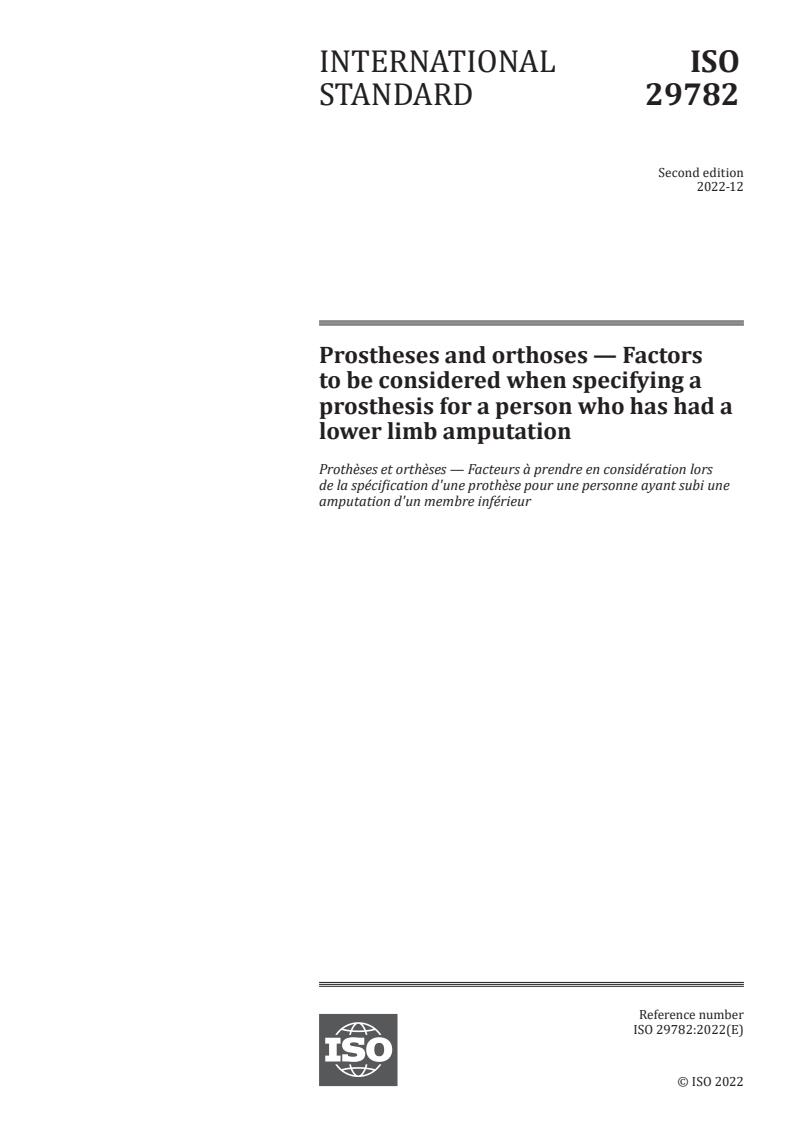
INTERNATIONAL ISO
STANDARD 29782
Second edition
2022-12
Prostheses and orthoses — Factors
to be considered when specifying a
prosthesis for a person who has had a
lower limb amputation
Prothèses et orthèses — Facteurs à prendre en considération lors
de la spécification d'une prothèse pour une personne ayant subi une
amputation d'un membre inférieur
Reference number
© ISO 2022
All rights reserved. Unless otherwise specified, or required in the context of its implementation, no part of this publication may
be reproduced or utilized otherwise in any form or by any means, electronic or mechanical, including photocopying, or posting on
the internet or an intranet, without prior written permission. Permission can be requested from either ISO at the address below
or ISO’s member body in the country of the requester.
ISO copyright office
CP 401 • Ch. de Blandonnet 8
CH-1214 Vernier, Geneva
Phone: +41 22 749 01 11
Email: copyright@iso.org
Website: www.iso.org
Published in Switzerland
ii
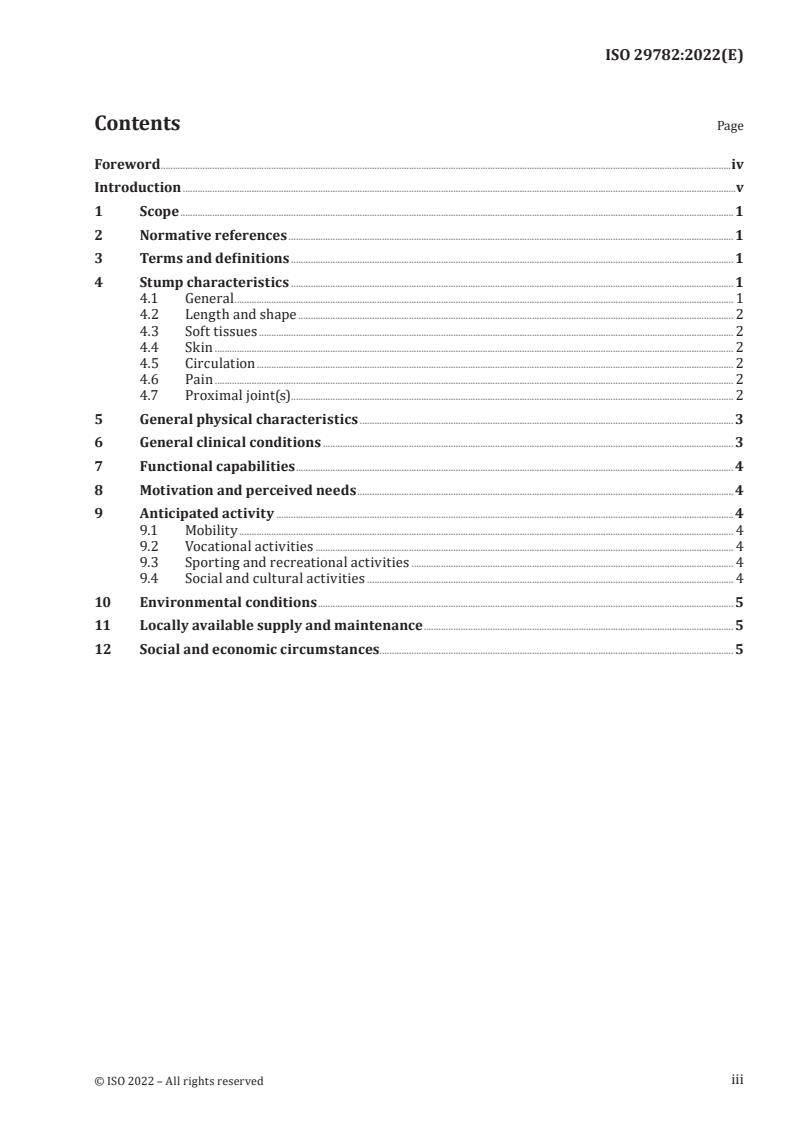
Contents Page
Foreword .iv
Introduction .v
1 Scope . 1
2 Normative references . 1
3 Terms and definitions . 1
4 Stump characteristics . 1
4.1 General . 1
4.2 Length and shape . 2
4.3 Soft tissues . 2
4.4 Skin . 2
4.5 Circulation . 2
4.6 Pain . 2
4.7 Proximal joint(s) . . 2
5 General physical characteristics . 3
6 General clinical conditions . 3
7 Functional capabilities . 4
8 Motivation and perceived needs .4
9 Anticipated activity .4
9.1 Mobility . 4
9.2 Vocational activities . 4
9.3 Sporting and recreational activities . 4
9.4 Social and cultural activities . 4
10 Environmental conditions . 5
11 Locally available supply and maintenance . 5
12 Social and economic circumstances. 5
iii
Foreword
ISO (the International Organization for Standardization) is a worldwide federation of national standards
bodies (ISO member bodies). The work of preparing International Standards is normally carried out
through ISO technical committees. Each member body interested in a subject for which a technical
committee has been established has the right to be represented on that committee. International
organizations, governmental and non-governmental, in liaison with ISO, also take part in the work.
ISO collaborates closely with the International Electrotechnical Commission (IEC) on all matters of
electrotechnical standardization.
The procedures used to develop this document and those intended for its further maintenance are
described in the ISO/IEC Directives, Part 1. In particular, the different approval criteria needed for the
different types of ISO documents should be noted. This document was drafted in accordance with the
editorial rules of the ISO/IEC Directives, Part 2 (see www.iso.org/directives).
Attention is drawn to the possibility that some of the elements of this document may be the subject of
patent rights. ISO shall not be held responsible for identifying any or all such patent rights. Details of
any patent rights identified during the development of the document will be in the Introduction and/or
on the ISO list of patent declarations received (see www.iso.org/patents).
Any trade name used in this document is information given for the convenience of users and does not
constitute an endorsement.
For an explanation of the voluntary nature of standards, the meaning of ISO specific terms and
expressions related to conformity assessment, as well as information about ISO's adherence to
the World
...