

ISO/IEC TS 24192-1:2021
(Main)Cards and security devices for personal identification — Communication between contactless readers and fare media used in public transport — Part 1: Implementation requirements for ISO/IEC 14443 (all parts)
General Information
- Abstract
This document defines the technical requirements to be met by contactless public transport (PT) devices in order to be able to interface together using the ISO/IEC 14443 (all parts) contactless communications protocol. This document applies to PT devices: — PT readers which are contactless fare management system terminals acting as a PCD contactless reader based on ISO/IEC 14443 (all parts); — PT objects which are contactless fare media acting as a PICC contactless object based on ISO/IEC 14443 (all parts). This document addresses interoperability of consumer-market NFC mobile devices, compliant to NFC Forum specifications, with above mentioned PT devices, aligns with ISO/IEC 14443 (all parts) and does not seek to limit compliance for PT readers with EMV Contactless Interface Specification.
- Status
- Published
- Publication Date
- 04-May-2021
- Technical Committee
- ISO/IEC JTC 1/SC 17 - Cards and security devices for personal identification
- Drafting Committee
- ISO/IEC JTC 1/SC 17/WG 8 - Integrated circuit cards without contacts
- Current Stage
- 9092 - International Standard to be revised
- Start Date
- 22-Dec-2024
- Completion Date
- 29-Aug-2026
Buy Documents
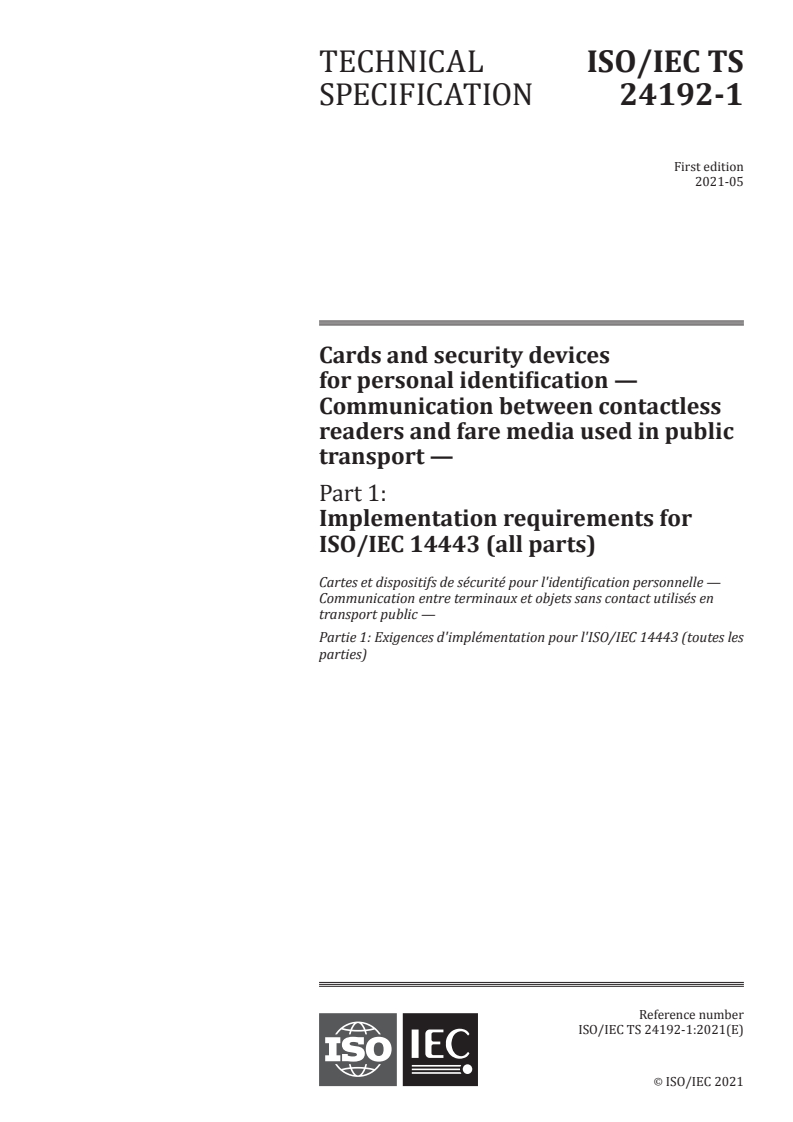

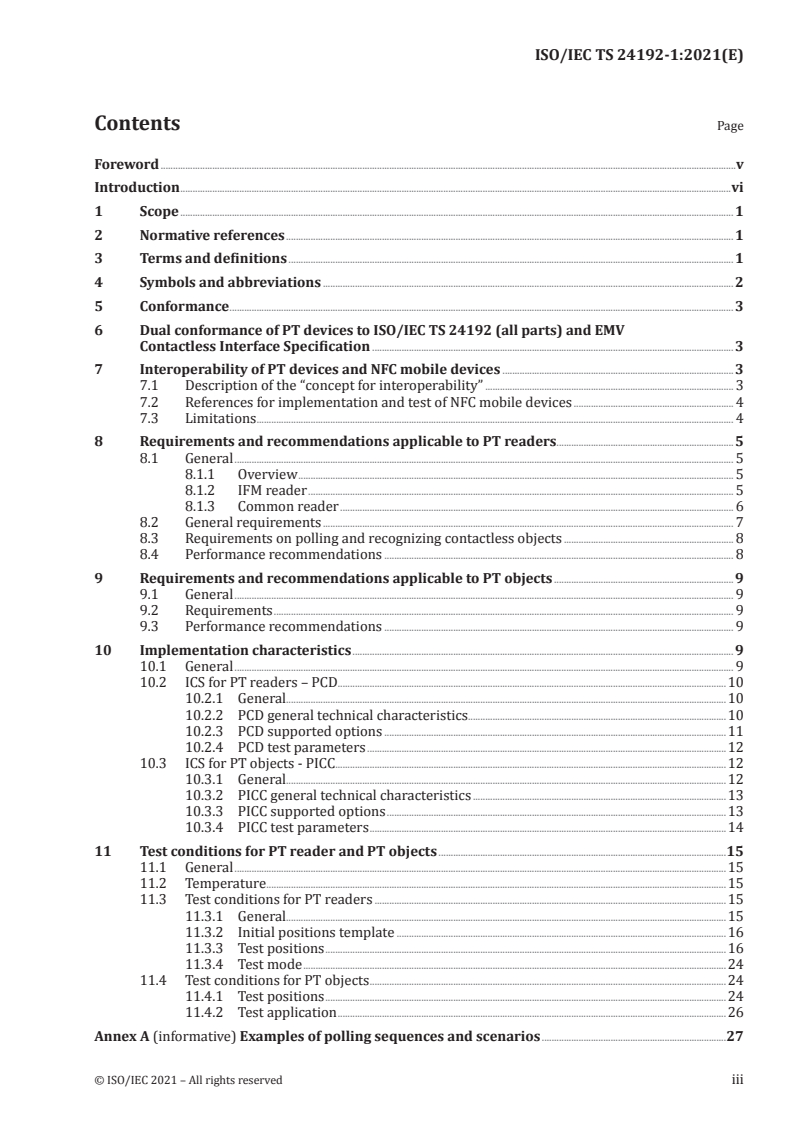

ISO/IEC TS 24192-1:2021 - Cards and security devices for personal identification — Communication between contactless readers and fare media used in public transport — Part 1: Implementation requirements for ISO/IEC 14443 (all parts) Released:5/5/2021
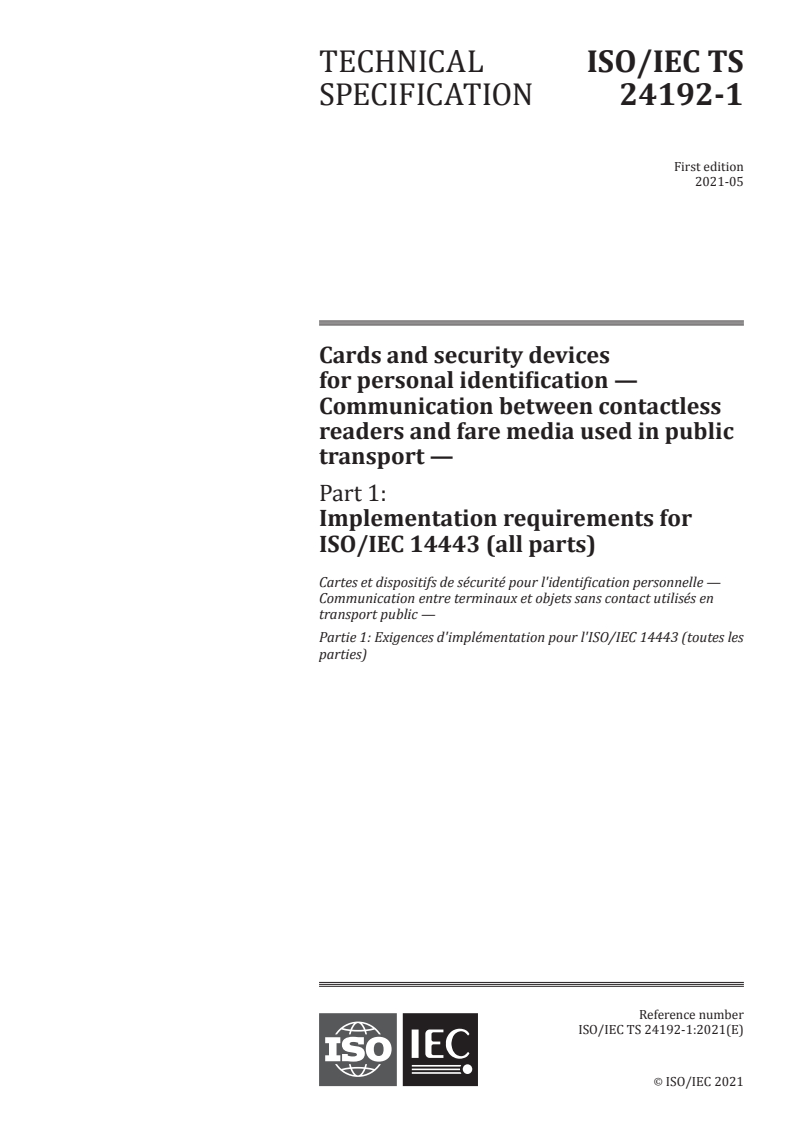

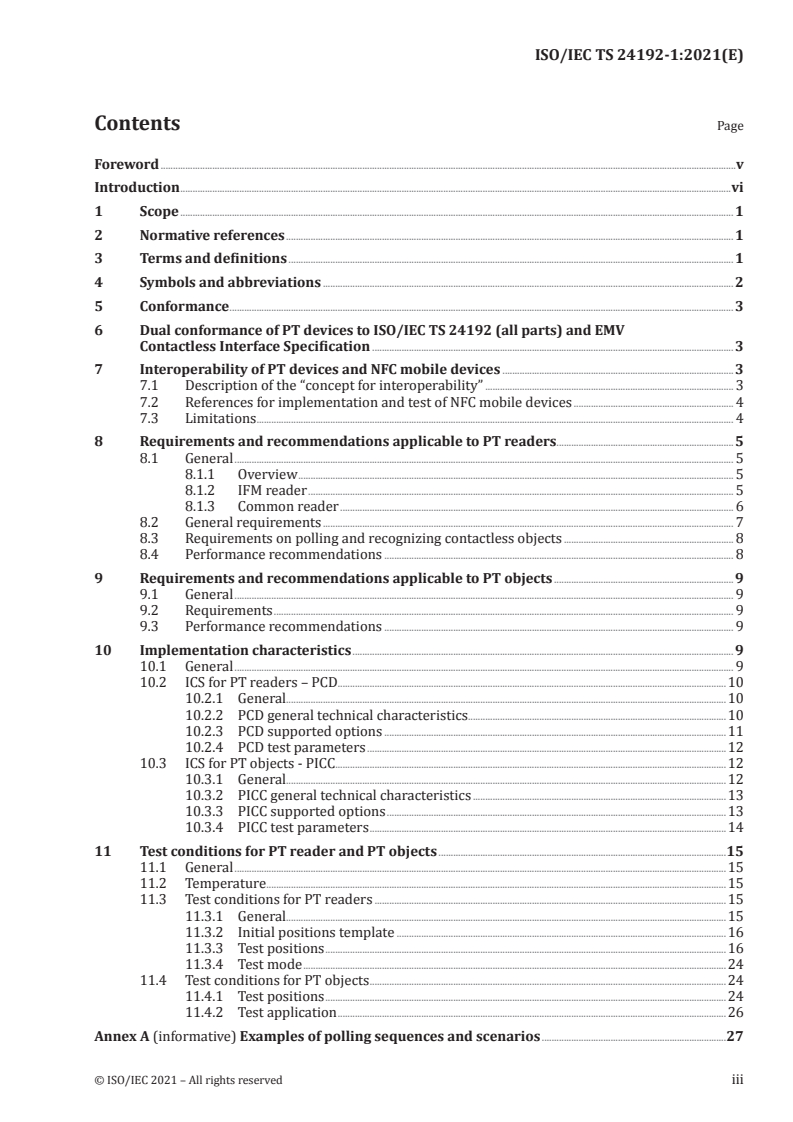

ISO/IEC TS 24192-1:2021 - Cards and security devices for personal identification — Communication between contactless readers and fare media used in public transport — Part 1: Implementation requirements for ISO/IEC 14443 (all parts)/5/2021
Overview
ISO/IEC TS 24192-1:2021 - Part 1 of the ISO/IEC TS 24192 series - specifies implementation requirements for using ISO/IEC 14443 (all parts) in public transport (PT) environments. The technical specification defines how contactless PT devices (PCD/PT readers and PICC/PT objects) shall behave to ensure reliable, interoperable communication between fare management terminals and multiple form factors of fare media (smartcards, e‑tickets, NFC mobile devices, USB keys, tablets, etc.). It complements ISO/IEC 14443 and ISO/IEC 10373-6 with transport‑specific guidance rather than duplicating base standards.
Key topics and technical requirements
- Scope and applicability: Requirements apply to PT readers (PCD) and PT objects (PICC) based on ISO/IEC 14443 and address interoperability with consumer NFC mobile devices (NFC Forum compliant).
- Conformance and ICS: Conformance is claimed against the requirements in Clauses 8–9 per an applicant’s Implementation Conformance Statement (ICS) and tested under Clause 11 conditions using the test plans in ISO/IEC TS 24192-2.
- Dual conformance considerations: Designed to allow PT devices to comply with both ISO/IEC TS 24192 and the EMV Contactless Interface Specification where relevant.
- Reader and object requirements: General and specific functional requirements, polling/recognition behaviors, supported options, and performance recommendations for PCDs and PICCs.
- Implementation characteristics and test parameters: Detailed ICS entries, PCD/PICC technical characteristics, supported options and test parameters (Clauses 10–11).
- Test conditions and methods: Environmental and positional test conditions, test modes, and test applications; informative annexes include polling examples and a loopback interface for reader testing.
- Interoperability with NFC devices: Conceptual and reference material for NFC mobile device interaction; NFC device conformance remains under NFC Forum specifications.
Applications and who should use it
ISO/IEC TS 24192-1 is practical for:
- Public transport authorities and operators specifying fare terminal behavior
- Terminal and reader manufacturers implementing PCD functionality
- Card and secure element vendors producing PICC fare media
- System integrators and solution architects ensuring multi‑vendor interoperability
- Test laboratories and certification bodies executing ISO/IEC TS 24192-2 test plans
- Mobile wallet and NFC platform teams ensuring compatibility with PT systems
Use cases include contactless ticketing rollouts, multi‑modal fare interoperability, mobile‑ticket acceptance, and certification of PT hardware/software.
Related standards
- ISO/IEC 14443 (all parts) - contactless proximity cards
- ISO/IEC TS 24192-2 - Test plan for ISO/IEC 14443 (PT)
- ISO/IEC 10373-6 - Test methods for contactless proximity objects
- ISO/IEC 15693-2, ISO/IEC 18092 (NFCIP‑1)
- NFC Forum specifications (for mobile device conformance)
- EMV Contactless Interface Specification (dual‑conformance considerations)
Keywords: ISO/IEC TS 24192-1:2021, ISO/IEC 14443, contactless, public transport, PT devices, NFC mobile device, fare media, interoperability, PCD, PICC, conformance, testing.
Buy Documents
ISO/IEC TS 24192-1:2021 - Cards and security devices for personal identification — Communication between contactless readers and fare media used in public transport — Part 1: Implementation requirements for ISO/IEC 14443 (all parts) Released:5/5/2021
ISO/IEC TS 24192-1:2021 - Cards and security devices for personal identification — Communication between contactless readers and fare media used in public transport — Part 1: Implementation requirements for ISO/IEC 14443 (all parts)/5/2021
Get Certified
Connect with accredited certification bodies for this standard

BSI Group
BSI (British Standards Institution) is the business standards company that helps organizations make excellence a habit.

Great Wall Tianjin Quality Assurance Center
Established 1993, first batch to receive national accreditation with IAF recognition.
Hong Kong Quality Assurance Agency (HKQAA)
Hong Kong's leading certification body.
Sponsored listings
Frequently Asked Questions
ISO/IEC TS 24192-1:2021 is a technical specification published by the International Organization for Standardization (ISO). Its full title is "Cards and security devices for personal identification — Communication between contactless readers and fare media used in public transport — Part 1: Implementation requirements for ISO/IEC 14443 (all parts)". This standard covers: This document defines the technical requirements to be met by contactless public transport (PT) devices in order to be able to interface together using the ISO/IEC 14443 (all parts) contactless communications protocol. This document applies to PT devices: — PT readers which are contactless fare management system terminals acting as a PCD contactless reader based on ISO/IEC 14443 (all parts); — PT objects which are contactless fare media acting as a PICC contactless object based on ISO/IEC 14443 (all parts). This document addresses interoperability of consumer-market NFC mobile devices, compliant to NFC Forum specifications, with above mentioned PT devices, aligns with ISO/IEC 14443 (all parts) and does not seek to limit compliance for PT readers with EMV Contactless Interface Specification.
This document defines the technical requirements to be met by contactless public transport (PT) devices in order to be able to interface together using the ISO/IEC 14443 (all parts) contactless communications protocol. This document applies to PT devices: — PT readers which are contactless fare management system terminals acting as a PCD contactless reader based on ISO/IEC 14443 (all parts); — PT objects which are contactless fare media acting as a PICC contactless object based on ISO/IEC 14443 (all parts). This document addresses interoperability of consumer-market NFC mobile devices, compliant to NFC Forum specifications, with above mentioned PT devices, aligns with ISO/IEC 14443 (all parts) and does not seek to limit compliance for PT readers with EMV Contactless Interface Specification.
ISO/IEC TS 24192-1:2021 is classified under the following ICS (International Classification for Standards) categories: 03.220.20 - Road transport; 35.240.15 - Identification cards. Chip cards. Biometrics; 35.240.60 - IT applications in transport. The ICS classification helps identify the subject area and facilitates finding related standards.
ISO/IEC TS 24192-1:2021 is available in PDF format for immediate download after purchase. The document can be added to your cart and obtained through the secure checkout process. Digital delivery ensures instant access to the complete standard document.
Standards Content (Sample)
TECHNICAL ISO/IEC TS
SPECIFICATION 24192-1
First edition
2021-05
Cards and security devices
for personal identification —
Communication between contactless
readers and fare media used in public
transport —
Part 1:
Implementation requirements for
ISO/IEC 14443 (all parts)
Cartes et dispositifs de sécurité pour l'identification personnelle —
Communication entre terminaux et objets sans contact utilisés en
transport public —
Partie 1: Exigences d'implémentation pour l'ISO/IEC 14443 (toutes les
parties)
Reference number
©
ISO/IEC 2021
© ISO/IEC 2021
All rights reserved. Unless otherwise specified, or required in the context of its implementation, no part of this publication may
be reproduced or utilized otherwise in any form or by any means, electronic or mechanical, including photocopying, or posting
on the internet or an intranet, without prior written permission. Permission can be requested from either ISO at the address
below or ISO’s member body in the country of the requester.
ISO copyright office
CP 401 • Ch. de Blandonnet 8
CH-1214 Vernier, Geneva
Phone: +41 22 749 01 11
Email: copyright@iso.org
Website: www.iso.org
Published in Switzerland
ii © ISO/IEC 2021 – All rights reserved
Contents Page
Foreword .v
Introduction .vi
1 Scope . 1
2 Normative references . 1
3 Terms and definitions . 1
4 Symbols and abbreviations . 2
5 Conformance . 3
6 Dual conformance of PT devices to ISO/IEC TS 24192 (all parts) and EMV
Contactless Interface Specification . 3
7 Interoperability of PT devices and NFC mobile devices . 3
7.1 Description of the “concept for interoperability” . 3
7.2 References for implementation and test of NFC mobile devices . 4
7.3 Limitations . 4
8 Requirements and recommendations applicable to PT readers . 5
8.1 General . 5
8.1.1 Overview . 5
8.1.2 IFM reader . 5
8.1.3 Common reader . 6
8.2 General requirements . 7
8.3 Requirements on polling and recognizing contactless objects . 8
8.4 Performance recommendations . 8
9 Requirements and recommendations applicable to PT objects . 9
9.1 General . 9
9.2 Requirements . 9
9.3 Performance recommendations . 9
10 Implementation characteristics . 9
10.1 General . 9
10.2 ICS for PT readers – PCD . .10
10.2.1 General.10
10.2.2 PCD general technical characteristics.10
10.2.3 PCD supported options .11
10.2.4 PCD test parameters .12
10.3 ICS for PT objects - PICC .12
10.3.1 General.12
10.3.2 PICC general technical characteristics .13
10.3.3 PICC supported options .13
10.3.4 PICC test parameters .14
11 Test conditions for PT reader and PT objects .15
11.1 General .15
11.2 Temperature .15
11.3 Test conditions for PT readers .15
11.3.1 General.15
11.3.2 Initial positions template .16
11.3.3 Test positions .16
11.3.4 Test mode .24
11.4 Test conditions for PT objects .24
11.4.1 Test positions .24
11.4.2 Test application .26
Annex A (informative) Examples of polling sequences and scenarios .27
© ISO/IEC 2021 – All rights reserved iii
Annex B (informative) Loopback interface for PT reader testing .29
Bibliography .30
iv © ISO/IEC 2021 – All rights reserved
Foreword
ISO (the International Organization for Standardization) is a worldwide federation of national standards
bodies (ISO member bodies). The work of preparing International Standards is normally carried out
through ISO technical committees. Each member body interested in a subject for which a technical
committee has been established has the right to be represented on that committee. International
organizations, governmental and non-governmental, in liaison with ISO, also take part in the work.
The procedures used to develop this document and those intended for its further maintenance are
described in the ISO/IEC Directives, Part 1. In particular, the different approval criteria needed for the
different types of ISO documents should be noted. This document was drafted in accordance with the
editorial rules of the ISO/IEC Directives, Part 2 (see www .iso .org/ directives or www .iec .ch/ members
_experts/ refdocs).
Attention is drawn to the possibility that some of the elements of this document may be the subject of
patent rights. ISO shall not be held responsible for identifying any or all such patent rights. Details of
any patent rights identified during the development of the document will be in the Introduction and/
or on the ISO list of patent declarations received (see www .iso .org/ patents) or the IEC list of patent
declarations received (see http:// patents .iec .ch).
Any trade name used in this document is information given for the convenience of users and does not
constitute an endorsement.
For an explanation of the voluntary nature of standards, the meaning of ISO specific terms and
expressions related to conformity assessment, as well as information about ISO's adherence to the
World Trade Organization (WTO) principles in the Technical Barriers to Trade (TBT) see www .iso .org/
iso/ foreword .html. In the IEC, see www .iec .ch/ understanding -standards.
This document was prepared by Technical Committee ISO/IEC JTC 1, Information technology, Information
technology, Subcommittee SC 17, Cards and security devices for personal identification.
A list of all parts in the ISO/IEC TS 24192 series can be found on the ISO and IEC website.
Any feedback or questions on this document should be directed to the user’s national standards body. A
complete listing of these bodies can be found at www .iso .org/ members .html and www .iec .ch/ national
-committees.
© ISO/IEC 2021 – All rights reserved v
Introduction
This document defines the requirements related to the use of ISO/IEC 14443 (all parts) to ensure
interoperability between fare management system terminals and multiple-form-factor contactless fare
media (smartcards, e-tickets, mobile phones, USB keys, tablets, etc.).
These implementation requirements are not designed to repeat or duplicate the referenced
specifications, essentially ISO/IEC 14443 (all parts) and ISO/IEC 10373-6, but to complement those
specifications with public transport specific considerations.
vi © ISO/IEC 2021 – All rights reserved
TECHNICAL SPECIFICATION ISO/IEC TS 24192-1:2021(E)
Cards and security devices for personal identification —
Communication between contactless readers and fare
media used in public transport —
Part 1:
Implementation requirements for ISO/IEC 14443 (all
parts)
1 Scope
This document defines the technical requirements to be met by contactless public transport (PT)
devices in order to be able to interface together using the ISO/IEC 14443 (all parts) contactless
communications protocol.
This document applies to PT devices:
— PT readers which are contactless fare management system terminals acting as a PCD contactless
reader based on ISO/IEC 14443 (all parts);
— PT objects which are contactless fare media acting as a PICC contactless object based on
ISO/IEC 14443 (all parts).
This document addresses interoperability of consumer-market NFC mobile devices, compliant to NFC
Forum specifications, with above mentioned PT devices, aligns with ISO/IEC 14443 (all parts) and does
not seek to limit compliance for PT readers with EMV Contactless Interface Specification.
2 Normative references
The following documents are referred to in the text in such a way that some or all of their content
constitutes requirements of this document. For dated references, only the edition cited applies. For
undated references, the latest edition of the referenced document (including any amendments) applies.
ISO/IEC/TS 24192-2, Cards and security devices for personal identification — Communication between
contactless readers and fare media used in public transport — Part 2: Test plan for ISO/IEC 14443 (all parts)
ISO/IEC 10373-6, Cards and security devices for personal identification — Test methods — Part 6:
Contactless proximity objects
ISO/IEC 14443 (all parts), Cards and security devices for personal identification — Contactless proximity
objects
ISO/IEC 15693-2, Cards and security devices for personal identification — Contactless vicinity objects —
Part 2: Air interface and initialization
ISO/IEC 18092, Information technology — Telecommunications and information exchange between
systems — Near Field Communication — Interface and Protocol (NFCIP-1)
3 Terms and definitions
For the purposes of this document, the terms and definitions given in ISO/IEC 14443-1, ISO/IEC 14443-2,
ISO/IEC 14443-3, ISO/IEC 14443-4, ISO/IEC 10373-6 and the following apply.
© ISO/IEC 2021 – All rights reserved 1
ISO and IEC maintain terminological databases for use in standardization at the following addresses:
— ISO Online browsing platform: available at https:// www .iso .org/ obp
— IEC Electropedia: available at http:// www .electropedia .org/
3.1
common reader
PT reader (3.8) used in interoperable fare management system terminals with reduced performance
requirements
Note 1 to entry: See 8.1.
3.2
IFM reader
PT reader (3.8) used in interoperable fare management system terminals
Note 1 to entry: See 8.1.
3.3
NFC mobile device
mobile device capable of near field communication that is offered in the consumer market and is used
by PT customers as a contactless object or a contactless reader
3.4
NFC mobile device in card emulation mode
mobile device used as a PT object (3.7)
3.5
NFC mobile device in reader/writer mode
mobile device used as a PT reader (3.8)
3.6
PT device
PT reader (3.8) or PT object (3.7)
3.7
PT object
PICC specifically designed for the use in PT systems
Note 1 to entry: PICC is defined in ISO/IEC 14443 (all parts).
3.8
PT reader
PCD specifically designed for the use in PT systems
Note 1 to entry: PCD is defined in ISO/IEC 14443 (all parts).
4 Symbols and abbreviations
For the purposes of this document, the abbreviations given in ISO/IEC 14443-1, ISO/IEC 14443-2,
ISO/IEC 14443-3, ISO/IEC 14443-4, ISO/IEC 10373-6 and the following apply.
ICS implementation conformance statements
NFC near field communication
PT public transport
t maximum reference PICC time-to-detection
detect
2 © ISO/IEC 2021 – All rights reserved
5 Conformance
To claim conformance to this document, the following requirements shall be met:
— for a PT reader, all the requirements listed in Clause 8 that are applicable according to the applicant's
ICS, under the test conditions stipulated in Clause 11 and following the PCD test plan defined in
ISO/IEC TS 24192-2;
— for a PT object, all the requirements listed in Clause 9 that are applicable according to the applicant's
ICS, under the test conditions stipulated in Clause 11 and following the PICC test plan defined in
ISO/IEC TS 24192-2.
Conformance of NFC mobile devices is tested according to NFC Forum specifications and is out of scope
of this document.
The description of the certification or qualification processes to be carried out for demonstrating the
conformance of PT devices to this document is out of scope of this document.
6 Dual conformance of PT devices to ISO/IEC TS 24192 (all parts) and EMV
Contactless Interface Specification
[1]
It is acknowledged that next to this document there is also EMV Contactless Interface Specification
relevant for many PT devices; therefore this document is developed such that PT devices can comply
[1]
with the requirements of both EMV Contactless Interface Specification and this document.
7 Interoperability of PT devices and NFC mobile devices
7.1 Description of the “concept for interoperability”
The contactless interface for NFC mobile devices follows the implementation and test specifications of
[3] [4]
the NFC Forum as specified by the NFC Forum and referenced in GSMA TS.26 and TS.27 .
The ISO/IEC 14443 (all parts) contactless interface of PT devices is designed and tested according to
the rules defined in this document.
The concept for interoperability is established to synchronise the specifications for the contactless
interface of NFC mobile devices and those for the contactless interface of PT devices in order to:
— facilitate interoperability between NFC mobile devices and PT devices;
— avoid unnecessary test and certification effort.
[5] [6]
The NFC Forum conducted a comparison of NFC Analog Specification and NFC Digital Specification
with ISO/IEC 14443 (all parts) and ISO/IEC 10373-6. Procedures that support correlation between
results from tests according to NFC Forum specifications and those according to ISO/IEC 10373-6 have
been defined.
The correlation is used to translate test results from the NFC Forum’s terminology into ISO/IEC 10373-6’s
method for describing the relevant parameters. This is the foundation for the following characteristics
of the concept for interoperability:
a) Development of PT devices and NFC mobile devices
Despite the fact that different methods for describing the relevant parameters are used, this
document and the relevant implementation specifications from the NFC Forum can be synchronised.
By synchronising the implementations’ specifications, interoperability is integrated into the design
processes of NFC mobile devices and PT devices and makes it a common feature for both types of
devices.
© ISO/IEC 2021 – All rights reserved 3
b) Test and certification of PT devices and NFC mobile devices
Based on the concept for interoperability it is possible to judge if an NFC mobile device that went
through NFC Forum testing is interoperable with a PT device that complies with the requirements
for ISO/IEC 14443 (all parts) set out in this document. Therefore, it is sufficient evidence of
interoperability to test and certify ISO/IEC 14443 (all parts) conformant PT devices according to
ISO/IEC TS 24192-2 and to test and certify NFC mobile devices according to NFC Forum’s test and
certification procedures.
The detailed methodology used to demonstrate the concept of interoperability between NFC Forum
compliant devices and ISO/IEC 14443 (all parts) compliant devices is described in Reference [8].
Table 1 summarizes how contactless communication can be ensured either via conformity testing
between PT readers and PT objects or via interoperability testing between PT devices and NFC mobile
devices.
Table 1 — Conformity and interoperability matrix for NFC Forum specifications
Contactless objects
NFC mobile devices in
PT objects card emulation mode
Specified and tested accord- Specified and tested
ing to ISO/IEC TS 24192 according to NFC Forum
specifications
PT readers
(IFM readers and common readers)
Conformity based on ISO/
Interoperability
IEC TS 24192 (all parts)
Specified and tested according to ISO/
IEC TS 24192 (all parts)
Contactless
readers
NFC mobile devices in
Conformity based on
reader/writer mode
Interoperability NFC Forum specifica-
Specified and tested according to
tions
NFC Forum specifications
7.2 References for implementation and test of NFC mobile devices
The applicable NFC Forum specifications for designing and testing the contactless communication of
NFC mobile devices are listed in the Bibliography (References [2] to [7]).
Conformance of NFC mobile devices to these specifications is a prerequisite to ensure interoperability
of NFC mobile devices with PT devices as presented in Table 1.
7.3 Limitations
Only parameters, parameter settings or modes of operations that are relevant for PT use cases have
been regarded and aligned with for both NFC mobile and PT devices. These use cases are described in
[2]
the STA document "Documentation of Use Cases for NFC Mobile Devices in Public Transport" .
The following parameters, settings or modes are currently not covered by the harmonization of
specifications according to the concept for interoperability described in 7.1:
a) communication bit rates higher than f /128 (~106 kbit/s);
c
b) peer-to-peer mode according to NFC Forum specifications;
c) ISO/IEC 18092 mode of communication;
d) ISO/IEC 15693-2 mode of communication.
4 © ISO/IEC 2021 – All rights reserved
8 Requirements and recommendations applicable to PT readers
8.1 General
8.1.1 Overview
8.2 and 8.3 define requirements; and 8.4 defines recommendations for PT readers.
The requirements and recommendations on PT readers are identified by a numbering format that reads
[Rdrnn] where nn is the number of the requirement or recommendation.
There are two categories of PT readers:
— IFM reader;
— common reader.
All implementation requirements and tests that are necessary to achieve interoperability between PT
readers and PT objects are mandatory for both PT reader categories.
8.1.2 IFM reader
The first category, the “IFM reader”, covers use cases where performances (i.e. operating distance,
transaction time, etc.) are key. As shown in Figure 1 and Figure 2, the IFM reader shall offer an operating
range that covers the full scope of range A and range B defined in 11.3.3.2 and 11.3.3.4 respectively. All
the test positions are defined in Table 3 and Table 4.
Position A1 of range A and Position B1 of range B may be at a different position on the IFM reader, see
11.3.3.
Figure 1 — Range A test positions for IFM reader
© ISO/IEC 2021 – All rights reserved 5
Figure 2 — Range B test positions for IFM reader
8.1.3 Common reader
The second category, the “common reader", is defined for scenarios that impose requirements on the
contactless interface such as minimization of cost or maximization of battery life of the PT reader.
These requirements have been derived from use cases from the following parts of the PT operator’s
system implementation which are described in the STA document “Documentation of Use Cases for NFC
[2]
Mobile Devices in Public Transport” :
a) sales infrastructure;
b) customer’s home infrastructure;
c) mobile inspection terminals.
Some requirements given in this document are adapted for common readers.
As shown in Figure 3, the common reader shall offer an operating range that covers a limited subset of
range A defined in 11.3.3.2. All the test positions are defined in Table 3.
6 © ISO/IEC 2021 – All rights reserved
Figure 3 — Range A test positions for common reader
8.2 General requirements
[Rdr1] The PT reader shall meet the requirements for PCD defined in the ISO/IEC 14443 (all parts) and
pass associated ISO/IEC 10373-6 test methods.
NOTE 1 The PT reader is tested against Reference PICC 1, Reference PICC 2 and Reference PICC 3 only,
corresponding to the mandatory PICC classes “Class 1”, “Class 2” and “Class 3”. No test is required with Reference
PICC 4, Reference PICC 5 and Reference PICC 6 corresponding to the optional PICC classes “Class 4”, “Class 5” and
“Class 6”.
NOTE 2 There are no particular restrictions to PT readers for accepting contactless objects using any value
for Application data field (Type B).
[1]
NOTE 3 EMV Contactless Interface Specification imposes that the extended ATQB option not be supported.
ISO/IEC 14443-3 considers that the support of this feature is optional.
[Rdr2] For IFM readers:
— In all range A test positions (see Figure 1), the IFM reader shall comply with all the [Rdr1]
requirements when tested with Reference PICC 1, Reference PICC 2 and Reference PICC 3.
— In all range B test positions (see Figure 2) when tested with Reference PICC 3, the IFM reader shall:
— comply with all the [Rdr1] requirements;
— provide a field strength of at least 2 A/m (rms).
[Rdr3] For common readers:
— In Position A1, Position A1,1, Position A1,2, Position A1,3, Position A1,4 and Position A2 (see
Figure 3), the common reader shall comply with all the [Rdr1] requirements when with Reference
PICC 1, Reference PICC 2 and Reference PICC 3.
— There are no requirements applicable to range B.
© ISO/IEC 2021 – All rights reserved 7
NOTE 4 These minimum operating distance ranges are added as complementary requirements to
ISO/IEC 14443-2. Operating distance ranges A and B are defined in 11.3.
NOTE 5 The minimum field strength requirement in range B is set to anticipate future acceptance of objects of
optional classes “Class 4”, “Class 5” and “Class 6”.
[Rdr4] The PT reader shall use an AFI of '00' in at least one REQB/WUPB command in its polling
sequence.
8.3 Requirements on polling and recognizing contactless objects
This subclause defines the requirements on the polling sequence of contactless objects.
[1]
NOTE 1 EMV Contactless Interface Specification defines specific polling requirements which can impact the
transaction time.
[Rdr5] The time-to-detection of a Reference PICC requiring minimum SFGT (no SFGI or SFGI = 0) by the
PT reader shall be less than t = 250 ms. This remains a valid requirement regardless of the moment
detect
when the Reference PICC is placed within range A or B of the PT reader. The Reference PICC time-to-
detection is defined between the moment when the Reference PICC is placed into the field and the send-
out of the first I-block sent by the PT reader. The Reference PICC time-to-detection shall be the average
value measured on 10 consecutive measurements and shall be provided by the testing laboratory as
part of the result report.
NOTE 2 Some PT networks can require a maximum applicative transaction time that imposes a time-to-
detection much shorter than t .
detect
PT readers may also poll for objects non-compliant with ISO/IEC 14443 (all parts).
When inserting operating field resets in the polling sequence, the PT reader should take care that a
contactless object using a random identifier responds with a different identifier and therefore should
not consider such an object as two different objects.
When getting no response from a contactless object despite error detection and recovery defined in
ISO/IEC 14443-4, PT readers not using any operating field reset in their polling sequence should use an
operating field reset to put the silent contactless object in IDLE state, allowing it to receive and answer
request commands without the need to manually remove it from the field.
[Rdr6] The PT reader shall resume its polling sequence after the removal of any disturbance caused by
an ISO/IEC 14443-2 or ISO/IEC 15693-2 or ISO/IEC 18092 object.
NOTE 3 Disturbance is defined as an unexpected ISO/IEC 14443-2 or ISO/IEC 15693-2 or ISO/IEC 18092
modulated or unmodulated field.
[Rdr7] The PT reader may give priority to applications using a non-ISO/IEC 14443-4 protocol
initiated by ISO/IEC 14443-3 polling commands (REQA/WUPA and/or REQB/WUPB), but shall
look for applications using the ISO/IEC 14443-4 protocol when no suitable application using such a
non-ISO/IEC 14443-4 protocol is found.
NOTE 4 This requirement is intended to ensure that the PT reader does not lock onto a non-ISO/IEC 14443-4
protocol when processing contactless objects supporting one or several other non-ISO/IEC 14443-4
protocols initiated by ISO/IEC 14443-3 polling commands (REQA/WUPA and/or REQB/WUPB), in addition to
ISO/IEC 14443-4 protocol.
Annex A gives examples of polling sequences and scenarios for PT readers.
8.4 Performance recommendations
The following recommendation is providing performance indications.
8 © ISO/IEC 2021 – All rights reserved
[Rdr8] The frame size supported by the PT reader in receiver mode should be at least 256 bytes.
Consequently, the PT reader should indicate an FSDI (Type A) or a Maximum Frame Size Code in ATTRIB
(Type B) greater than or equal to 8.
NOTE The aim of this recommendation is to avoid forcing the contactless object to segment its long answers
into small frames, which would slow the transaction.
9 Requirements and recommendations applicable to PT objects
9.1 General
9.2 defines requirements; and 9.3 defines recommendations for PT objects.
The requirements and recommendations on PT objects are identified by a numbering format that reads
[Objnn] where nn is the number of the requirement or recommendation.
9.2 Requirements
[Obj1] The PT object shall meet the requirements for PICC defined in ISO/IEC 14443 (all parts) and
pass associated ISO/IEC 10373-6 test methods.
[1]
NOTE 1 PT objects also conforming to the EMV Contactless Interface Specification requirements limit the
bit rate capabilities indication to f /128 (~106 kbit/s) in both directions.
c
[Obj2] If the PT object claims compliancy to one of the PICC classes “Class 1”, “Class 2” or “Class 3”, it
shall meet the corresponding requirements for PICCs of “Class 1”, “Class 2” or “Class 3” as defined in
ISO/IEC 14443 (all parts) and ISO/IEC 10373-6.
NOTE 2 If the PT object does not claim to meet the requirements of one particular PICC class, the definitions
for PICCs which do not claim to meet the requirements of one particular PICC class in ISO/IEC 14443 (all parts)
and ISO/IEC 10373-6 apply.
9.3 Performance recommendations
The following recommendation is providing performance indications.
[Obj3] The frame
...
TECHNICAL ISO/IEC TS
SPECIFICATION 24192-1
First edition
2021-05
Cards and security devices
for personal identification —
Communication between contactless
readers and fare media used in public
transport —
Part 1:
Implementation requirements for
ISO/IEC 14443 (all parts)
Cartes et dispositifs de sécurité pour l'identification personnelle —
Communication entre terminaux et objets sans contact utilisés en
transport public —
Partie 1: Exigences d'implémentation pour l'ISO/IEC 14443 (toutes les
parties)
Reference number
©
ISO/IEC 2021
© ISO/IEC 2021
All rights reserved. Unless otherwise specified, or required in the context of its implementation, no part of this publication may
be reproduced or utilized otherwise in any form or by any means, electronic or mechanical, including photocopying, or posting
on the internet or an intranet, without prior written permission. Permission can be requested from either ISO at the address
below or ISO’s member body in the country of the requester.
ISO copyright office
CP 401 • Ch. de Blandonnet 8
CH-1214 Vernier, Geneva
Phone: +41 22 749 01 11
Email: copyright@iso.org
Website: www.iso.org
Published in Switzerland
ii © ISO/IEC 2021 – All rights reserved
Contents Page
Foreword .v
Introduction .vi
1 Scope . 1
2 Normative references . 1
3 Terms and definitions . 1
4 Symbols and abbreviations . 2
5 Conformance . 3
6 Dual conformance of PT devices to ISO/IEC TS 24192 (all parts) and EMV
Contactless Interface Specification . 3
7 Interoperability of PT devices and NFC mobile devices . 3
7.1 Description of the “concept for interoperability” . 3
7.2 References for implementation and test of NFC mobile devices . 4
7.3 Limitations . 4
8 Requirements and recommendations applicable to PT readers . 5
8.1 General . 5
8.1.1 Overview . 5
8.1.2 IFM reader . 5
8.1.3 Common reader . 6
8.2 General requirements . 7
8.3 Requirements on polling and recognizing contactless objects . 8
8.4 Performance recommendations . 8
9 Requirements and recommendations applicable to PT objects . 9
9.1 General . 9
9.2 Requirements . 9
9.3 Performance recommendations . 9
10 Implementation characteristics . 9
10.1 General . 9
10.2 ICS for PT readers – PCD . .10
10.2.1 General.10
10.2.2 PCD general technical characteristics.10
10.2.3 PCD supported options .11
10.2.4 PCD test parameters .12
10.3 ICS for PT objects - PICC .12
10.3.1 General.12
10.3.2 PICC general technical characteristics .13
10.3.3 PICC supported options .13
10.3.4 PICC test parameters .14
11 Test conditions for PT reader and PT objects .15
11.1 General .15
11.2 Temperature .15
11.3 Test conditions for PT readers .15
11.3.1 General.15
11.3.2 Initial positions template .16
11.3.3 Test positions .16
11.3.4 Test mode .24
11.4 Test conditions for PT objects .24
11.4.1 Test positions .24
11.4.2 Test application .26
Annex A (informative) Examples of polling sequences and scenarios .27
© ISO/IEC 2021 – All rights reserved iii
Annex B (informative) Loopback interface for PT reader testing .29
Bibliography .30
iv © ISO/IEC 2021 – All rights reserved
Foreword
ISO (the International Organization for Standardization) is a worldwide federation of national standards
bodies (ISO member bodies). The work of preparing International Standards is normally carried out
through ISO technical committees. Each member body interested in a subject for which a technical
committee has been established has the right to be represented on that committee. International
organizations, governmental and non-governmental, in liaison with ISO, also take part in the work.
The procedures used to develop this document and those intended for its further maintenance are
described in the ISO/IEC Directives, Part 1. In particular, the different approval criteria needed for the
different types of ISO documents should be noted. This document was drafted in accordance with the
editorial rules of the ISO/IEC Directives, Part 2 (see www .iso .org/ directives or www .iec .ch/ members
_experts/ refdocs).
Attention is drawn to the possibility that some of the elements of this document may be the subject of
patent rights. ISO shall not be held responsible for identifying any or all such patent rights. Details of
any patent rights identified during the development of the document will be in the Introduction and/
or on the ISO list of patent declarations received (see www .iso .org/ patents) or the IEC list of patent
declarations received (see http:// patents .iec .ch).
Any trade name used in this document is information given for the convenience of users and does not
constitute an endorsement.
For an explanation of the voluntary nature of standards, the meaning of ISO specific terms and
expressions related to conformity assessment, as well as information about ISO's adherence to the
World Trade Organization (WTO) principles in the Technical Barriers to Trade (TBT) see www .iso .org/
iso/ foreword .html. In the IEC, see www .iec .ch/ understanding -standards.
This document was prepared by Technical Committee ISO/IEC JTC 1, Information technology, Information
technology, Subcommittee SC 17, Cards and security devices for personal identification.
A list of all parts in the ISO/IEC TS 24192 series can be found on the ISO and IEC website.
Any feedback or questions on this document should be directed to the user’s national standards body. A
complete listing of these bodies can be found at www .iso .org/ members .html and www .iec .ch/ national
-committees.
© ISO/IEC 2021 – All rights reserved v
Introduction
This document defines the requirements related to the use of ISO/IEC 14443 (all parts) to ensure
interoperability between fare management system terminals and multiple-form-factor contactless fare
media (smartcards, e-tickets, mobile phones, USB keys, tablets, etc.).
These implementation requirements are not designed to repeat or duplicate the referenced
specifications, essentially ISO/IEC 14443 (all parts) and ISO/IEC 10373-6, but to complement those
specifications with public transport specific considerations.
vi © ISO/IEC 2021 – All rights reserved
TECHNICAL SPECIFICATION ISO/IEC TS 24192-1:2021(E)
Cards and security devices for personal identification —
Communication between contactless readers and fare
media used in public transport —
Part 1:
Implementation requirements for ISO/IEC 14443 (all
parts)
1 Scope
This document defines the technical requirements to be met by contactless public transport (PT)
devices in order to be able to interface together using the ISO/IEC 14443 (all parts) contactless
communications protocol.
This document applies to PT devices:
— PT readers which are contactless fare management system terminals acting as a PCD contactless
reader based on ISO/IEC 14443 (all parts);
— PT objects which are contactless fare media acting as a PICC contactless object based on
ISO/IEC 14443 (all parts).
This document addresses interoperability of consumer-market NFC mobile devices, compliant to NFC
Forum specifications, with above mentioned PT devices, aligns with ISO/IEC 14443 (all parts) and does
not seek to limit compliance for PT readers with EMV Contactless Interface Specification.
2 Normative references
The following documents are referred to in the text in such a way that some or all of their content
constitutes requirements of this document. For dated references, only the edition cited applies. For
undated references, the latest edition of the referenced document (including any amendments) applies.
ISO/IEC/TS 24192-2, Cards and security devices for personal identification — Communication between
contactless readers and fare media used in public transport — Part 2: Test plan for ISO/IEC 14443 (all parts)
ISO/IEC 10373-6, Cards and security devices for personal identification — Test methods — Part 6:
Contactless proximity objects
ISO/IEC 14443 (all parts), Cards and security devices for personal identification — Contactless proximity
objects
ISO/IEC 15693-2, Cards and security devices for personal identification — Contactless vicinity objects —
Part 2: Air interface and initialization
ISO/IEC 18092, Information technology — Telecommunications and information exchange between
systems — Near Field Communication — Interface and Protocol (NFCIP-1)
3 Terms and definitions
For the purposes of this document, the terms and definitions given in ISO/IEC 14443-1, ISO/IEC 14443-2,
ISO/IEC 14443-3, ISO/IEC 14443-4, ISO/IEC 10373-6 and the following apply.
© ISO/IEC 2021 – All rights reserved 1
ISO and IEC maintain terminological databases for use in standardization at the following addresses:
— ISO Online browsing platform: available at https:// www .iso .org/ obp
— IEC Electropedia: available at http:// www .electropedia .org/
3.1
common reader
PT reader (3.8) used in interoperable fare management system terminals with reduced performance
requirements
Note 1 to entry: See 8.1.
3.2
IFM reader
PT reader (3.8) used in interoperable fare management system terminals
Note 1 to entry: See 8.1.
3.3
NFC mobile device
mobile device capable of near field communication that is offered in the consumer market and is used
by PT customers as a contactless object or a contactless reader
3.4
NFC mobile device in card emulation mode
mobile device used as a PT object (3.7)
3.5
NFC mobile device in reader/writer mode
mobile device used as a PT reader (3.8)
3.6
PT device
PT reader (3.8) or PT object (3.7)
3.7
PT object
PICC specifically designed for the use in PT systems
Note 1 to entry: PICC is defined in ISO/IEC 14443 (all parts).
3.8
PT reader
PCD specifically designed for the use in PT systems
Note 1 to entry: PCD is defined in ISO/IEC 14443 (all parts).
4 Symbols and abbreviations
For the purposes of this document, the abbreviations given in ISO/IEC 14443-1, ISO/IEC 14443-2,
ISO/IEC 14443-3, ISO/IEC 14443-4, ISO/IEC 10373-6 and the following apply.
ICS implementation conformance statements
NFC near field communication
PT public transport
t maximum reference PICC time-to-detection
detect
2 © ISO/IEC 2021 – All rights reserved
5 Conformance
To claim conformance to this document, the following requirements shall be met:
— for a PT reader, all the requirements listed in Clause 8 that are applicable according to the applicant's
ICS, under the test conditions stipulated in Clause 11 and following the PCD test plan defined in
ISO/IEC TS 24192-2;
— for a PT object, all the requirements listed in Clause 9 that are applicable according to the applicant's
ICS, under the test conditions stipulated in Clause 11 and following the PICC test plan defined in
ISO/IEC TS 24192-2.
Conformance of NFC mobile devices is tested according to NFC Forum specifications and is out of scope
of this document.
The description of the certification or qualification processes to be carried out for demonstrating the
conformance of PT devices to this document is out of scope of this document.
6 Dual conformance of PT devices to ISO/IEC TS 24192 (all parts) and EMV
Contactless Interface Specification
[1]
It is acknowledged that next to this document there is also EMV Contactless Interface Specification
relevant for many PT devices; therefore this document is developed such that PT devices can comply
[1]
with the requirements of both EMV Contactless Interface Specification and this document.
7 Interoperability of PT devices and NFC mobile devices
7.1 Description of the “concept for interoperability”
The contactless interface for NFC mobile devices follows the implementation and test specifications of
[3] [4]
the NFC Forum as specified by the NFC Forum and referenced in GSMA TS.26 and TS.27 .
The ISO/IEC 14443 (all parts) contactless interface of PT devices is designed and tested according to
the rules defined in this document.
The concept for interoperability is established to synchronise the specifications for the contactless
interface of NFC mobile devices and those for the contactless interface of PT devices in order to:
— facilitate interoperability between NFC mobile devices and PT devices;
— avoid unnecessary test and certification effort.
[5] [6]
The NFC Forum conducted a comparison of NFC Analog Specification and NFC Digital Specification
with ISO/IEC 14443 (all parts) and ISO/IEC 10373-6. Procedures that support correlation between
results from tests according to NFC Forum specifications and those according to ISO/IEC 10373-6 have
been defined.
The correlation is used to translate test results from the NFC Forum’s terminology into ISO/IEC 10373-6’s
method for describing the relevant parameters. This is the foundation for the following characteristics
of the concept for interoperability:
a) Development of PT devices and NFC mobile devices
Despite the fact that different methods for describing the relevant parameters are used, this
document and the relevant implementation specifications from the NFC Forum can be synchronised.
By synchronising the implementations’ specifications, interoperability is integrated into the design
processes of NFC mobile devices and PT devices and makes it a common feature for both types of
devices.
© ISO/IEC 2021 – All rights reserved 3
b) Test and certification of PT devices and NFC mobile devices
Based on the concept for interoperability it is possible to judge if an NFC mobile device that went
through NFC Forum testing is interoperable with a PT device that complies with the requirements
for ISO/IEC 14443 (all parts) set out in this document. Therefore, it is sufficient evidence of
interoperability to test and certify ISO/IEC 14443 (all parts) conformant PT devices according to
ISO/IEC TS 24192-2 and to test and certify NFC mobile devices according to NFC Forum’s test and
certification procedures.
The detailed methodology used to demonstrate the concept of interoperability between NFC Forum
compliant devices and ISO/IEC 14443 (all parts) compliant devices is described in Reference [8].
Table 1 summarizes how contactless communication can be ensured either via conformity testing
between PT readers and PT objects or via interoperability testing between PT devices and NFC mobile
devices.
Table 1 — Conformity and interoperability matrix for NFC Forum specifications
Contactless objects
NFC mobile devices in
PT objects card emulation mode
Specified and tested accord- Specified and tested
ing to ISO/IEC TS 24192 according to NFC Forum
specifications
PT readers
(IFM readers and common readers)
Conformity based on ISO/
Interoperability
IEC TS 24192 (all parts)
Specified and tested according to ISO/
IEC TS 24192 (all parts)
Contactless
readers
NFC mobile devices in
Conformity based on
reader/writer mode
Interoperability NFC Forum specifica-
Specified and tested according to
tions
NFC Forum specifications
7.2 References for implementation and test of NFC mobile devices
The applicable NFC Forum specifications for designing and testing the contactless communication of
NFC mobile devices are listed in the Bibliography (References [2] to [7]).
Conformance of NFC mobile devices to these specifications is a prerequisite to ensure interoperability
of NFC mobile devices with PT devices as presented in Table 1.
7.3 Limitations
Only parameters, parameter settings or modes of operations that are relevant for PT use cases have
been regarded and aligned with for both NFC mobile and PT devices. These use cases are described in
[2]
the STA document "Documentation of Use Cases for NFC Mobile Devices in Public Transport" .
The following parameters, settings or modes are currently not covered by the harmonization of
specifications according to the concept for interoperability described in 7.1:
a) communication bit rates higher than f /128 (~106 kbit/s);
c
b) peer-to-peer mode according to NFC Forum specifications;
c) ISO/IEC 18092 mode of communication;
d) ISO/IEC 15693-2 mode of communication.
4 © ISO/IEC 2021 – All rights reserved
8 Requirements and recommendations applicable to PT readers
8.1 General
8.1.1 Overview
8.2 and 8.3 define requirements; and 8.4 defines recommendations for PT readers.
The requirements and recommendations on PT readers are identified by a numbering format that reads
[Rdrnn] where nn is the number of the requirement or recommendation.
There are two categories of PT readers:
— IFM reader;
— common reader.
All implementation requirements and tests that are necessary to achieve interoperability between PT
readers and PT objects are mandatory for both PT reader categories.
8.1.2 IFM reader
The first category, the “IFM reader”, covers use cases where performances (i.e. operating distance,
transaction time, etc.) are key. As shown in Figure 1 and Figure 2, the IFM reader shall offer an operating
range that covers the full scope of range A and range B defined in 11.3.3.2 and 11.3.3.4 respectively. All
the test positions are defined in Table 3 and Table 4.
Position A1 of range A and Position B1 of range B may be at a different position on the IFM reader, see
11.3.3.
Figure 1 — Range A test positions for IFM reader
© ISO/IEC 2021 – All rights reserved 5
Figure 2 — Range B test positions for IFM reader
8.1.3 Common reader
The second category, the “common reader", is defined for scenarios that impose requirements on the
contactless interface such as minimization of cost or maximization of battery life of the PT reader.
These requirements have been derived from use cases from the following parts of the PT operator’s
system implementation which are described in the STA document “Documentation of Use Cases for NFC
[2]
Mobile Devices in Public Transport” :
a) sales infrastructure;
b) customer’s home infrastructure;
c) mobile inspection terminals.
Some requirements given in this document are adapted for common readers.
As shown in Figure 3, the common reader shall offer an operating range that covers a limited subset of
range A defined in 11.3.3.2. All the test positions are defined in Table 3.
6 © ISO/IEC 2021 – All rights reserved
Figure 3 — Range A test positions for common reader
8.2 General requirements
[Rdr1] The PT reader shall meet the requirements for PCD defined in the ISO/IEC 14443 (all parts) and
pass associated ISO/IEC 10373-6 test methods.
NOTE 1 The PT reader is tested against Reference PICC 1, Reference PICC 2 and Reference PICC 3 only,
corresponding to the mandatory PICC classes “Class 1”, “Class 2” and “Class 3”. No test is required with Reference
PICC 4, Reference PICC 5 and Reference PICC 6 corresponding to the optional PICC classes “Class 4”, “Class 5” and
“Class 6”.
NOTE 2 There are no particular restrictions to PT readers for accepting contactless objects using any value
for Application data field (Type B).
[1]
NOTE 3 EMV Contactless Interface Specification imposes that the extended ATQB option not be supported.
ISO/IEC 14443-3 considers that the support of this feature is optional.
[Rdr2] For IFM readers:
— In all range A test positions (see Figure 1), the IFM reader shall comply with all the [Rdr1]
requirements when tested with Reference PICC 1, Reference PICC 2 and Reference PICC 3.
— In all range B test positions (see Figure 2) when tested with Reference PICC 3, the IFM reader shall:
— comply with all the [Rdr1] requirements;
— provide a field strength of at least 2 A/m (rms).
[Rdr3] For common readers:
— In Position A1, Position A1,1, Position A1,2, Position A1,3, Position A1,4 and Position A2 (see
Figure 3), the common reader shall comply with all the [Rdr1] requirements when with Reference
PICC 1, Reference PICC 2 and Reference PICC 3.
— There are no requirements applicable to range B.
© ISO/IEC 2021 – All rights reserved 7
NOTE 4 These minimum operating distance ranges are added as complementary requirements to
ISO/IEC 14443-2. Operating distance ranges A and B are defined in 11.3.
NOTE 5 The minimum field strength requirement in range B is set to anticipate future acceptance of objects of
optional classes “Class 4”, “Class 5” and “Class 6”.
[Rdr4] The PT reader shall use an AFI of '00' in at least one REQB/WUPB command in its polling
sequence.
8.3 Requirements on polling and recognizing contactless objects
This subclause defines the requirements on the polling sequence of contactless objects.
[1]
NOTE 1 EMV Contactless Interface Specification defines specific polling requirements which can impact the
transaction time.
[Rdr5] The time-to-detection of a Reference PICC requiring minimum SFGT (no SFGI or SFGI = 0) by the
PT reader shall be less than t = 250 ms. This remains a valid requirement regardless of the moment
detect
when the Reference PICC is placed within range A or B of the PT reader. The Reference PICC time-to-
detection is defined between the moment when the Reference PICC is placed into the field and the send-
out of the first I-block sent by the PT reader. The Reference PICC time-to-detection shall be the average
value measured on 10 consecutive measurements and shall be provided by the testing laboratory as
part of the result report.
NOTE 2 Some PT networks can require a maximum applicative transaction time that imposes a time-to-
detection much shorter than t .
detect
PT readers may also poll for objects non-compliant with ISO/IEC 14443 (all parts).
When inserting operating field resets in the polling sequence, the PT reader should take care that a
contactless object using a random identifier responds with a different identifier and therefore should
not consider such an object as two different objects.
When getting no response from a contactless object despite error detection and recovery defined in
ISO/IEC 14443-4, PT readers not using any operating field reset in their polling sequence should use an
operating field reset to put the silent contactless object in IDLE state, allowing it to receive and answer
request commands without the need to manually remove it from the field.
[Rdr6] The PT reader shall resume its polling sequence after the removal of any disturbance caused by
an ISO/IEC 14443-2 or ISO/IEC 15693-2 or ISO/IEC 18092 object.
NOTE 3 Disturbance is defined as an unexpected ISO/IEC 14443-2 or ISO/IEC 15693-2 or ISO/IEC 18092
modulated or unmodulated field.
[Rdr7] The PT reader may give priority to applications using a non-ISO/IEC 14443-4 protocol
initiated by ISO/IEC 14443-3 polling commands (REQA/WUPA and/or REQB/WUPB), but shall
look for applications using the ISO/IEC 14443-4 protocol when no suitable application using such a
non-ISO/IEC 14443-4 protocol is found.
NOTE 4 This requirement is intended to ensure that the PT reader does not lock onto a non-ISO/IEC 14443-4
protocol when processing contactless objects supporting one or several other non-ISO/IEC 14443-4
protocols initiated by ISO/IEC 14443-3 polling commands (REQA/WUPA and/or REQB/WUPB), in addition to
ISO/IEC 14443-4 protocol.
Annex A gives examples of polling sequences and scenarios for PT readers.
8.4 Performance recommendations
The following recommendation is providing performance indications.
8 © ISO/IEC 2021 – All rights reserved
[Rdr8] The frame size supported by the PT reader in receiver mode should be at least 256 bytes.
Consequently, the PT reader should indicate an FSDI (Type A) or a Maximum Frame Size Code in ATTRIB
(Type B) greater than or equal to 8.
NOTE The aim of this recommendation is to avoid forcing the contactless object to segment its long answers
into small frames, which would slow the transaction.
9 Requirements and recommendations applicable to PT objects
9.1 General
9.2 defines requirements; and 9.3 defines recommendations for PT objects.
The requirements and recommendations on PT objects are identified by a numbering format that reads
[Objnn] where nn is the number of the requirement or recommendation.
9.2 Requirements
[Obj1] The PT object shall meet the requirements for PICC defined in ISO/IEC 14443 (all parts) and
pass associated ISO/IEC 10373-6 test methods.
[1]
NOTE 1 PT objects also conforming to the EMV Contactless Interface Specification requirements limit the
bit rate capabilities indication to f /128 (~106 kbit/s) in both directions.
c
[Obj2] If the PT object claims compliancy to one of the PICC classes “Class 1”, “Class 2” or “Class 3”, it
shall meet the corresponding requirements for PICCs of “Class 1”, “Class 2” or “Class 3” as defined in
ISO/IEC 14443 (all parts) and ISO/IEC 10373-6.
NOTE 2 If the PT object does not claim to meet the requirements of one particular PICC class, the definitions
for PICCs which do not claim to meet the requirements of one particular PICC class in ISO/IEC 14443 (all parts)
and ISO/IEC 10373-6 apply.
9.3 Performance recommendations
The following recommendation is providing performance indications.
[Obj3] The frame
...