


ISO/DTR 25734
(Main)Tourism and related services — Staff training of tourist information services — Case studies
Tourism and related services — Staff training of tourist information services — Case studies
Tourisme et services connexes — Formation du personnel des services d'information touristique — Études de cas
General Information
- Status
- Not Published
- Technical Committee
- ISO/TC 228 - Tourism and related services
- Current Stage
- 5020 - FDIS ballot initiated: 2 months. Proof sent to secretariat
- Start Date
- 30-Jan-2026
- Completion Date
- 30-Jan-2026
Overview
ISO/DTR 25734 is an International Organization for Standardization (ISO) technical report focusing on staff training within tourist information services. It provides comprehensive case studies and practical insights based on real-world implementations to enhance the quality and effectiveness of training programs for tourism service staff. This document addresses various aspects critical to staff development in tourism information services, emphasizing challenges, solutions, and outcomes across multiple training domains.
The report is essential for organizations aiming to improve their tourist information services through structured, evidence-based staff training approaches. This ensures a professional standard in delivering accurate, customer-focused tourism guidance.
Key Topics
The standard explores a broad range of topics concerning staff training in tourist information services, including but not limited to:
- Training Needs Analysis: Identification and evaluation of skills and knowledge gaps crucial for developing effective training programs.
- Target Audience Profiling: Understanding the various groups within tourist information services that require specific training methods.
- Curriculum Design: Best practices for developing comprehensive training curricula tailored to the tourism industry’s unique demands.
- Training Implementation & Monitoring: Techniques for executing training programs effectively and continuously monitoring their delivery.
- Assessment & Improvement: Strategies for evaluating training success and identifying areas requiring enhancement.
- Resource Assurance: Ensuring the availability of sufficient and qualified resources to support training activities.
- Continuous Improvement: Promoting an ongoing cycle of review and refinement to maintain high-quality training standards.
Each section includes common challenges faced during implementation, practical initiatives, solutions, and the resulting impact for continuous learning and better service delivery.
Applications
ISO/DTR 25734 is highly applicable in various tourism-related settings, such as:
- Tourist Information Centers: Enhancing the skills of frontline consultants who provide critical information to travelers.
- Local and Regional Tourism Boards: Promoting consistent, effective staff training programs to boost tourism support services.
- Hospitality and Travel Agencies: Aligning their informational services with best training practices to improve customer satisfaction.
- Training Providers: Designing customized tourism service training modules based on well-documented case study insights.
- Policy Makers: Developing strategies and policies that support workforce competency development within the tourism sector.
Applying this standard allows organizations to adopt a structured methodology for staff training that aligns with international best practices, improving service quality and operational efficiency.
Related Standards
For comprehensive development and management of tourism-related services, ISO/DTR 25734 can be used alongside other ISO standards and technical reports, including:
- ISO 17618: Guidelines for tourism service quality.
- ISO 21401: Sustainability management systems for accommodation establishments.
- ISO 9001: Quality management systems, useful for embedding continual improvement processes.
- ISO 22483: Hospitality services - Tourist accommodation guidelines.
Integrating ISO/DTR 25734 with these standards helps organizations maintain high service quality while addressing staff preparedness and training within the tourism industry.
By following the detailed insights and case study analyses provided in ISO/DTR 25734, tourism organizations can strategically enhance their staff training initiatives, leading to improved tourist information services and elevated customer experiences worldwide.

ISO/DTR 25734 - Tourism and related services — Staff training of tourist information services — Case studies Released:16. 01. 2026
REDLINE ISO/DTR 25734 - Tourism and related services — Staff training of tourist information services — Case studies Released:16. 01. 2026
Get Certified
Connect with accredited certification bodies for this standard

BSI Group
BSI (British Standards Institution) is the business standards company that helps organizations make excellence a habit.

Bureau Veritas
Bureau Veritas is a world leader in laboratory testing, inspection and certification services.

DNV
DNV is an independent assurance and risk management provider.
Sponsored listings
Frequently Asked Questions
ISO/DTR 25734 is a draft published by the International Organization for Standardization (ISO). Its full title is "Tourism and related services — Staff training of tourist information services — Case studies". This standard covers: Tourism and related services — Staff training of tourist information services — Case studies
Tourism and related services — Staff training of tourist information services — Case studies
ISO/DTR 25734 is classified under the following ICS (International Classification for Standards) categories: 03.100.30 - Management of human resources; 03.200.01 - Leisure and tourism in general. The ICS classification helps identify the subject area and facilitates finding related standards.
ISO/DTR 25734 is available in PDF format for immediate download after purchase. The document can be added to your cart and obtained through the secure checkout process. Digital delivery ensures instant access to the complete standard document.
Standards Content (Sample)
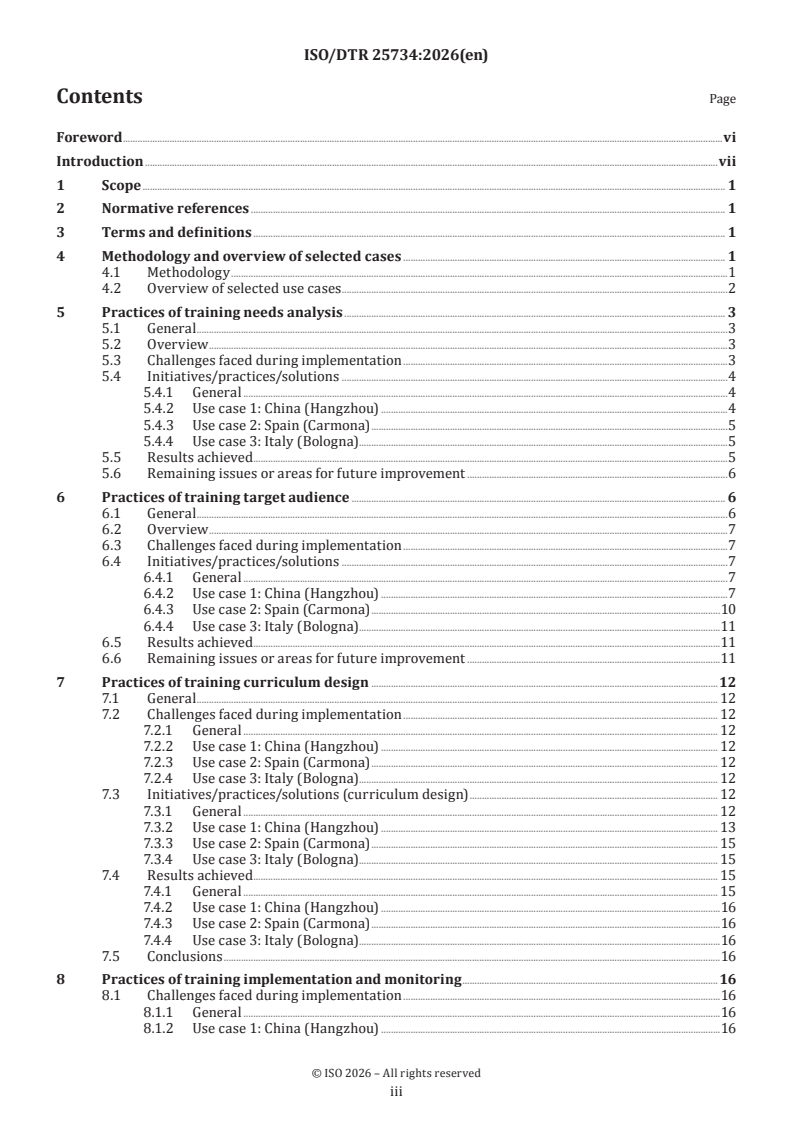
FINAL DRAFT
Technical
Report
ISO/TC 228
Tourism and related services —
Secretariat: UNE
Staff training of tourist information
Voting begins on:
services — Case studies
2026-01-30
Voting terminates on:
2026-03-27
RECIPIENTS OF THIS DRAFT ARE INVITED TO SUBMIT,
WITH THEIR COMMENTS, NOTIFICATION OF ANY
RELEVANT PATENT RIGHTS OF WHICH THEY ARE AWARE
AND TO PROVIDE SUPPOR TING DOCUMENTATION.
IN ADDITION TO THEIR EVALUATION AS
BEING ACCEPTABLE FOR INDUSTRIAL, TECHNO
LOGICAL, COMMERCIAL AND USER PURPOSES, DRAFT
INTERNATIONAL STANDARDS MAY ON OCCASION HAVE
TO BE CONSIDERED IN THE LIGHT OF THEIR POTENTIAL
TO BECOME STAN DARDS TO WHICH REFERENCE MAY BE
MADE IN NATIONAL REGULATIONS.
Reference number
FINAL DRAFT
Technical
Report
ISO/TC 228
Tourism and related services —
Secretariat: UNE
Staff training of tourist information
Voting begins on:
services — Case studies
Voting terminates on:
RECIPIENTS OF THIS DRAFT ARE INVITED TO SUBMIT,
WITH THEIR COMMENTS, NOTIFICATION OF ANY
RELEVANT PATENT RIGHTS OF WHICH THEY ARE AWARE
AND TO PROVIDE SUPPOR TING DOCUMENTATION.
© ISO 2026
IN ADDITION TO THEIR EVALUATION AS
All rights reserved. Unless otherwise specified, or required in the context of its implementation, no part of this publication may
BEING ACCEPTABLE FOR INDUSTRIAL, TECHNO
LOGICAL, COMMERCIAL AND USER PURPOSES, DRAFT
be reproduced or utilized otherwise in any form or by any means, electronic or mechanical, including photocopying, or posting on
INTERNATIONAL STANDARDS MAY ON OCCASION HAVE
the internet or an intranet, without prior written permission. Permission can be requested from either ISO at the address below
TO BE CONSIDERED IN THE LIGHT OF THEIR POTENTIAL
or ISO’s member body in the country of the requester.
TO BECOME STAN DARDS TO WHICH REFERENCE MAY BE
MADE IN NATIONAL REGULATIONS.
ISO copyright office
CP 401 • Ch. de Blandonnet 8
CH-1214 Vernier, Geneva
Phone: +41 22 749 01 11
Email: copyright@iso.org
Website: www.iso.org
Published in Switzerland Reference number
ii
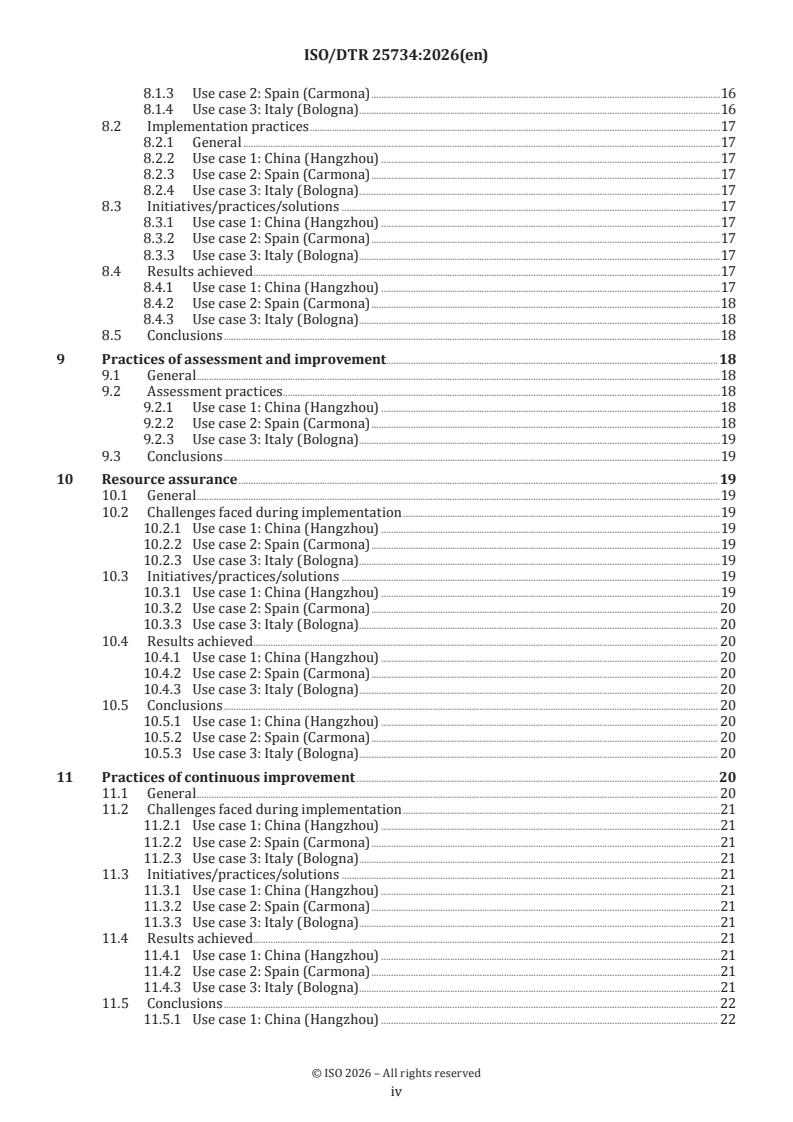
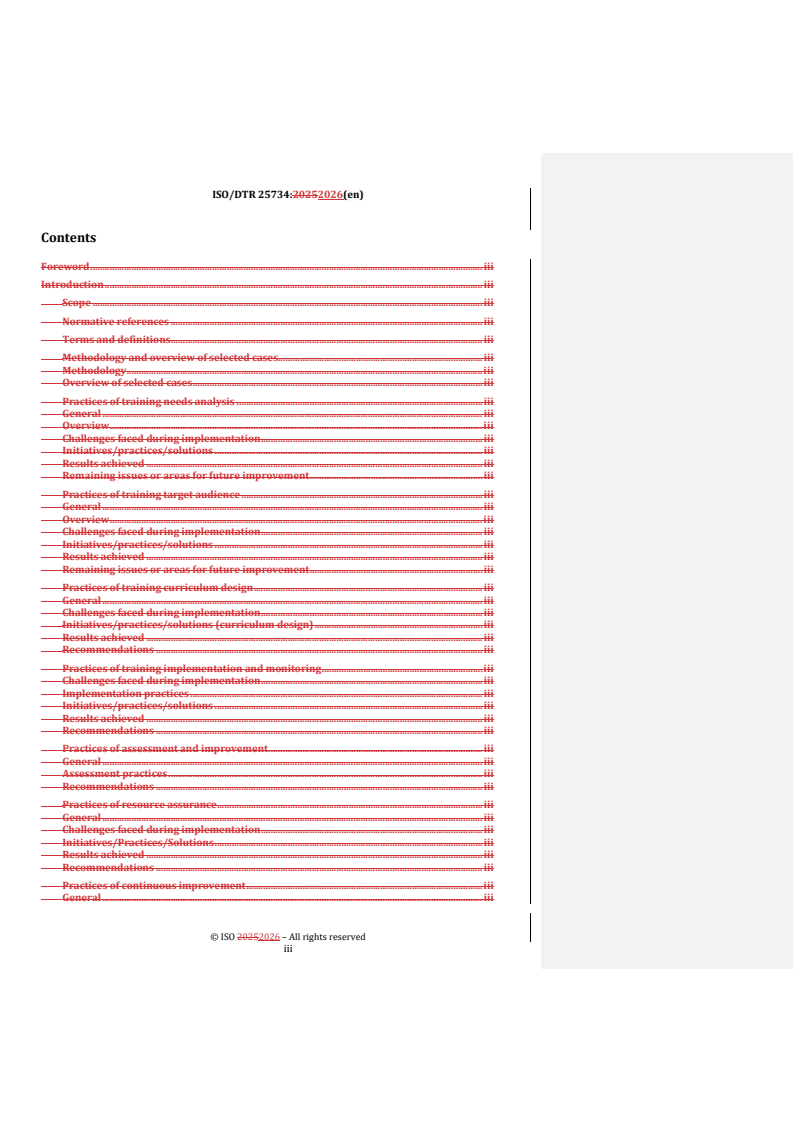
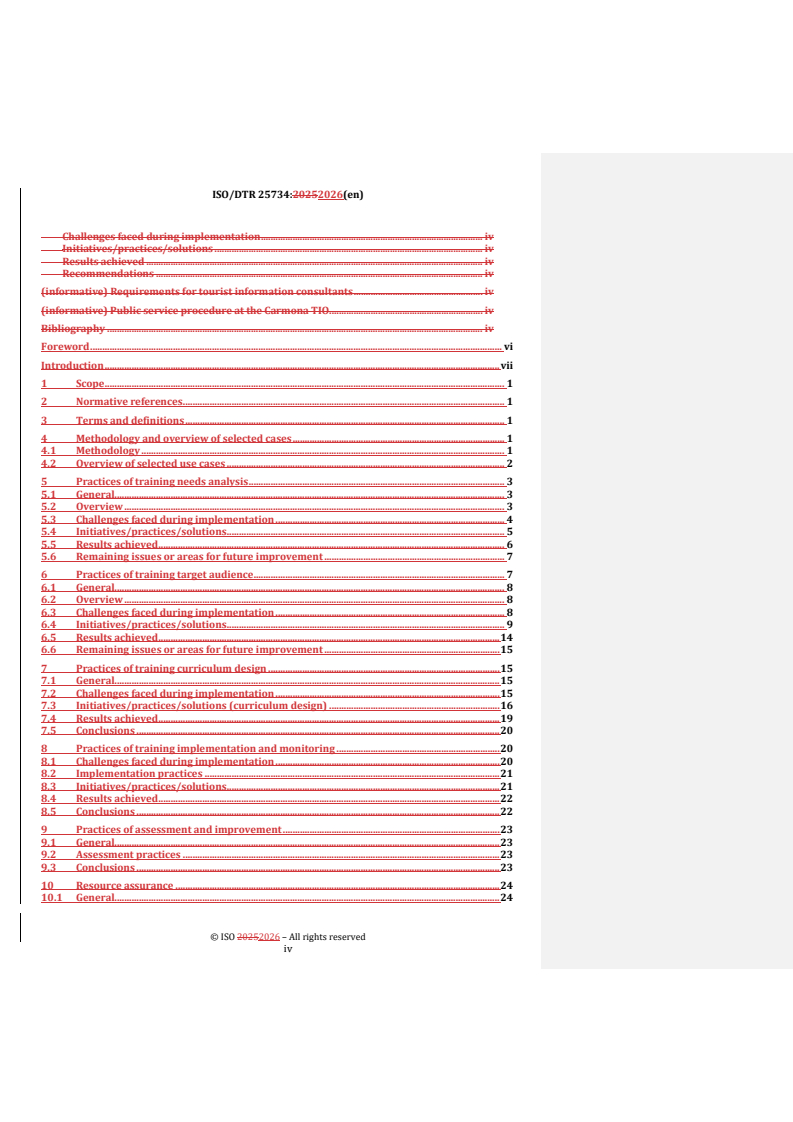
Contents Page
Foreword .vi
Introduction .vii
1 Scope . 1
2 Normative references . 1
3 Terms and definitions . 1
4 Methodology and overview of selected cases . 1
4.1 Methodology .1
4.2 Overview of selected use cases .2
5 Practices of training needs analysis . 3
5.1 General .3
5.2 Overview .3
5.3 Challenges faced during implementation .3
5.4 Initiatives/practices/solutions .4
5.4.1 General .4
5.4.2 Use case 1: China (Hangzhou) .4
5.4.3 Use case 2: Spain (Carmona) .5
5.4.4 Use case 3: Italy (Bologna) .5
5.5 Results achieved .5
5.6 Remaining issues or areas for future improvement .6
6 Practices of training target audience . 6
6.1 General .6
6.2 Overview .7
6.3 Challenges faced during implementation .7
6.4 Initiatives/practices/solutions .7
6.4.1 General .7
6.4.2 Use case 1: China (Hangzhou) .7
6.4.3 Use case 2: Spain (Carmona) .10
6.4.4 Use case 3: Italy (Bologna) .11
6.5 Results achieved .11
6.6 Remaining issues or areas for future improvement .11
7 Practices of training curriculum design .12
7.1 General . 12
7.2 Challenges faced during implementation . 12
7.2.1 General . 12
7.2.2 Use case 1: China (Hangzhou) . 12
7.2.3 Use case 2: Spain (Carmona) . 12
7.2.4 Use case 3: Italy (Bologna) . 12
7.3 Initiatives/practices/solutions (curriculum design) . 12
7.3.1 General . 12
7.3.2 Use case 1: China (Hangzhou) . 13
7.3.3 Use case 2: Spain (Carmona) . 15
7.3.4 Use case 3: Italy (Bologna) . 15
7.4 Results achieved . . 15
7.4.1 General . 15
7.4.2 Use case 1: China (Hangzhou) .16
7.4.3 Use case 2: Spain (Carmona) .16
7.4.4 Use case 3: Italy (Bologna) .16
7.5 Conclusions .16
8 Practices of training implementation and monitoring .16
8.1 Challenges faced during implementation .16
8.1.1 General .16
8.1.2 Use case 1: China (Hangzhou) .16
iii
8.1.3 Use case 2: Spain (Carmona) .16
8.1.4 Use case 3: Italy (Bologna) .16
8.2 Implementation practices .17
8.2.1 General .17
8.2.2 Use case 1: China (Hangzhou) .17
8.2.3 Use case 2: Spain (Carmona) .17
8.2.4 Use case 3: Italy (Bologna) .17
8.3 Initiatives/practices/solutions .17
8.3.1 Use case 1: China (Hangzhou) .17
8.3.2 Use case 2: Spain (Carmona) .17
8.3.3 Use case 3: Italy (Bologna) .17
8.4 Results achieved . .17
8.4.1 Use case 1: China (Hangzhou) .17
8.4.2 Use case 2: Spain (Carmona) .18
8.4.3 Use case 3: Italy (Bologna) .18
8.5 Conclusions .18
9 Practices of assessment and improvement.18
9.1 General .18
9.2 Assessment practices.18
9.2.1 Use case 1: China (Hangzhou) .18
9.2.2 Use case 2: Spain (Carmona) .18
9.2.3 Use case 3: Italy (Bologna) . .19
9.3 Conclusions .19
10 Resource assurance . 19
10.1 General .19
10.2 Challenges faced during implementation .19
10.2.1 Use case 1: China (Hangzhou) .19
10.2.2 Use case 2: Spain (Carmona) .19
10.2.3 Use case 3: Italy (Bologna) .19
10.3 Initiatives/practices/solutions .19
10.3.1 Use case 1: China (Hangzhou) .19
10.3.2 Use case 2: Spain (Carmona) . 20
10.3.3 Use case 3: Italy (Bologna) . 20
10.4 Results achieved . 20
10.4.1 Use case 1: China (Hangzhou) . 20
10.4.2 Use case 2: Spain (Carmona) . 20
10.4.3 Use case 3: Italy (Bologna) . 20
10.5 Conclusions . 20
10.5.1 Use case 1: China (Hangzhou) . 20
10.5.2 Use case 2: Spain (Carmona) . 20
10.5.3 Use case 3: Italy (Bologna) . 20
11 Practices of continuous improvement .20
11.1 General . 20
11.2 Challenges faced during implementation .21
11.2.1 Use case 1: China (Hangzhou) .21
11.2.2 Use case 2: Spain (Carmona) .21
11.2.3 Use case 3: Italy (Bologna) .21
11.3 Initiatives/practices/solutions .21
11.3.1 Use case 1: China (Hangzhou) .21
11.3.2 Use case 2: Spain (Carmona) .21
11.3.3 Use case 3: Italy (Bologna) .21
11.4 Results achieved . .21
11.4.1 Use case 1: China (Hangzhou) .21
11.4.2 Use case 2: Spain (Carmona) .21
11.4.3 Use case 3: Italy (Bologna) .21
11.5 Conclusions . 22
11.5.1 Use case 1: China (Hangzhou) . 22
iv
11.5.2 Use case 2: Spain (Carmona) . 22
11.5.3 Italy (Bologna) . 22
Annex A (informative) Requirements for tourist information consultants .23
Annex B (informative) Public service procedure at the Carmona TIO (use case 2) .32
Bibliography .37
v
Foreword
ISO (the International Organization for Standardization) is a worldwide federation of national standards
bodies (ISO member bodies). The work of preparing International Standards is normally carried out through
ISO technical committees. Each member body interested in a subject for which a technical committee
has been established has the right to be represented on that committee. International organizations,
governmental and non-governmental, in liaison with ISO, also take part in the work. ISO collaborates closely
with the International Electrotechnical Commission (IEC) on all matters of electrotechnical standardization.
The procedures used to develop this document and those intended for its further maintenance are described
in the ISO/IEC Directives, Part 1. In particular, the different approval criteria needed for the different types
of ISO document should be noted. This document was drafted in accordance with the editorial rules of the
ISO/IEC Directives, Part 2 (see www.iso.org/directives).
ISO draws attention to the possibility that the implementation of this document may involve the use of (a)
patent(s). ISO takes no position concerning the evidence, validity or applicability of any claimed patent
rights in respect thereof. As of the date of publication of this document, ISO had not received notice of (a)
patent(s) which may be required to implement this document. However, implementers are cautioned that
this may not represent the latest information, which may be obtained from the patent database available at
www.iso.org/patents. ISO shall not be held responsible for identifying any or all such patent rights.
Any trade name used in this document is information given for the convenience of users and does not
constitute an endorsement.
For an explanation of the voluntary nature of standards, the meaning of ISO specific terms and expressions
related to conformity assessment, as well as information about ISO's adherence to the World Trade
Organization (WTO) principles in the Technical Barriers to Trade (TBT), see www.iso.org/iso/foreword.html.
This document was prepared by Technical Committee ISO/TC 228, Tourism and related services.
Any feedback or questions on this document should be directed to the user’s national standards body. A
complete listing of these bodies can be found at www.iso.org/members.html.
vi
Introduction
Due to the rapidly expanding trend for online and onsite tourism information services (TIS), an increasing
number of Tourist Information Offices (TIOs) have begun raising their requirements for staff regarding the
application of multimedia tools, data statistics, complex tourism-related information and guidance, and even
more globally in terms of language ability. In order to implement and maintain good quality TIS, a number of
requirements and recommendations for staff training can be met by TIS management organizations, as laid
[1]
out in ISO 14785:2024 , Clause 7.
The purpose of this document is to support TIS management organizations in understanding how to apply
[1]
the requirements and recommendations of ISO 14785:2024 , Clause 7, through the use of case studies,
which provide situational understanding and practical illustrations for the relevant requirements and
recommendations. Case studies for staff training can help TIS management organizations to identify, clarify
and achieve relevant requirements and recommendations by sharing practical and effective solutions
and experiences. By understanding and referring to the use cases in this document, TIS management
organizations can learn about applicable practices and strategies, and apply them under similar
circumstances to promote or improve the quality of their TIS.
vii
FINAL DRAFT Technical Report ISO/DTR 25734:2026(en)
Tourism and related services — Staff training of tourist
information services — Case studies
1 Scope
This document provides real use cases, situational understanding and practical solutions applicable to the
[1]
provisions concerning staff and training in ISO 14785:2024 .
This document can be used as a reference or inspiration for tourism information services (TIS) management
organizations analysing and improving their TIS staff training and pursuing quality TIS through the
[1]
application of ISO 14785:2024 .
2 Normative references
The following documents are referred to in the text in such a way that some or all of their content constitutes
requirements of this document. For dated references, only the edition cited applies. For undated references,
the latest edition of the referenced document (including any amendments) applies.
ISO 14785, Tourism and related services —Tourist information services — Requirements and recommendations
3 Terms and definitions
For the purposes of this document, the terms and definitions given in ISO 14785 apply.
ISO and IEC maintain terminology databases for use in standardization at the following addresses:
— ISO Online browsing platform: available at https:// www .iso .org/ obp
— IEC Electropedia: available at https:// www .electropedia .org/
4 Methodology and overview of selected cases
4.1 Methodology
This document contains use cases taken from various countries with detailed descriptions of practices, for
use in the creation of quality staff training for TIS.
[1]
The relationships between elements from ISO 14785:2024 and the practices outlined in the use cases in
this document are identified in Table 1.
Table 1 — Relationship between elements from ISO 14785 and use cases and practices
Element ISO 14785 Case 1 Case 2 Case 3
Training needs 7.2 a) 1-1 2-1 3-1
analysis
Training target 7.1, concerning different job positions at the 1-2 2-2 3-2
audience TIS
Training curriculum 7.2 c) and 7.2 from 1) to g) 1-3 2-3 3-3
design
TTabablele 1 1 ((ccoonnttiinnueuedd))
Element ISO 14785 Case 1 Case 2 Case 3
Training implementa- 7.2 1-4 2-4 3-4
tion and monitoring
Assessment and 1-5 2-5 3-5
improvement
Resource assurance 1-6 2-6 3-6
Continuous improve- 1-7 2-7 3-7
ment of training
4.2 Overview of selected use cases
An overview of the selected use cases is shown in Table 2.
Table 2 — Overview of use cases
No. Country Overview
Use case 1 China Use case 1 represents Hangzhou’s largest Tourist Information Office (TIO) and is
one of the 20 key social welfare initiatives launched by the Hangzhou Municipal
Government to advance the city’s tourism internationalization. Since its inception
in 2004, the TIO has served over 1,5 million domestic and international tourists,
distributed more than 2 million travel brochures, and established a comprehensive
network of tourism consultation outlets. These outlets are strategically located in
major transportation hubs, popular scenic spots, and central commercial districts,
operating under the unified Hangzhou Tourism Service Hotline “96123.” Comple-
mented by the e-commerce platform www .96123 .com as its digital extension, the
TIO has developed a multifunctional and integrated tourism consultation, promotion
and service network, adhering to the principle of convenience and public benefit.
Currently, the TIO operates 6 sub-TIOs in Hangzhou’s districts, offering tourists
and residents comprehensive assistance with dining, accommodation, transporta-
tion, attractions, entertainment and shopping, as well as access to Hangzhou travel
guides. In 2021, the TIO embarked on a digital transformation of its consultation
points. Leveraging the online system developed by the Municipal Bureau of Culture
and Tourism, integrated with the Urban Brain Cultural and Tourism System, the TIO
combines offline spatial interaction with expanded scenario applications. Through
the “Hangzhou Digital Tourism” mini-programme, users can now scan a single QR
code or access a unified interface to obtain information, services, and public products.
This digitization has enhanced the intelligence and efficiency of tourism consultation
services, significantly improving tourists' satisfaction.
Use case 2 Spain Use case 2 represents a Tourist Information Office (TIO) established in April 1995 at
the "Casa de los Talabarteros" in Plaza de San Fernando (Carmona, Spain). On World
Tourism Day (September 27, 1996), it relocated to its current location, the Alcázar de
la Puerta de Sevilla, a monumental gateway that has served as Carmona’s entrance
for over 3 000 years.
This municipally-owned building falls under the jurisdiction of Carmona City Coun-
cil’s Tourism Delegation and is managed by the public company SODECAR, S.A. (as
approved on September 14, 1994). As part of the Municipal Tourist Reception Center,
the TIO benefits from its strategic placement adjacent to one of the city’s most icon-
ic landmarks. This prime location within Carmona’s most valuable heritage site
significantly enhances the office’s visibility and reinforces the destination’s image.
The TIO’s mission is to provide professional, high-quality tourist services while
promoting Carmona’s rich history and cultural heritage, with particular emphasis
on its artistic, religious, landscape-related and ethnographic values preserved
through generations.
Use case 3 Italy Use case 3 represents the experience of Appennino Slow, a network of TIS operat-
ing in the Apennine area of Bologna, Italy. This model is rooted in close coopera-
tion with the Metropolitan City of Bologna and represents an integrated, sustaina-
ble and progressive approach to the professional training of tourism personnel.
5 Practices of training needs analysis
5.1 General
[1]
ISO 14785:2024 , 7.2, requires training to be offered periodically, according to the needs. This practice
describes an ecological model of training needs analysis (TNA) encapsulated in four aspects: challenges,
initiatives/practices/solutions, results, remaining issues or areas.
TNA serves as the foundation for effective TIO personnel training in Hangzhou (use case 1). The process
aligns with strategic human resource development, integrating organizational goals with employee
development.
In Carmona (use case 2), comprehensive initial training for new staff is essential to ensure high-quality
tourist services and maximize team efficiency.
5.2 Overview
Training programmes for TIO staff are designed to ensure the consistent development of professional
competencies required to deliver high-quality information and consultation services to domestic and
international tourists. The programmes aim to align with international best practices, national tourism
development goals, and the evolving needs of travellers in the digital age.
In Hangzhou (use case 1), TIO personnel training involves a three-tiered approach:
— organizational analysis (assessing Hangzhou’s tourism strategy),
— task analysis (evaluating job-specific requirements),
— individual analysis (identifying employee competencies and gaps).
This ensures that training supports Hangzhou’s vision of becoming a world-class tourism destination.
In Carmona (use case 2), the training programme focuses on:
a) organizational familiarization: understanding the organizational structure, corporate philosophy and
ongoing projects;
b) role competencies: mastering job functions, responsibilities and service protocols;
c) operational skills: developing service techniques, sales methodologies and demand data recording;
d) safety fundamentals: learning basic safety measures and procedures.
Additionally, the programme emphasizes destination knowledge enhancement, ensuring staff are well-
versed in Carmona’s primary tourism offerings.
5.3 Challenges faced during implementation
A range of challenges that vary across countries and regions can arise in the implementation of training
programmes for TIO staff. These challenges often stem from the dynamic nature of the tourism sector, diverse
stakeholder expectations, legal and cultural considerations, and limitations of traditional TNA methods.
The following examples (see Table 3) illustrate common obstacles encountered during implementation,
highlighting the need for adaptive, context-sensitive training strategies.
Table 3 — Examples of challenges faced during implementation
Country (region) Challenges faced during implementation
China (Hangzhou) — Misalignment between organizational, task-related and individual needs, often
resulting in overlapping or conflicting demands. Additionally, traditional TNA
methods (e.g. surveys and interviews) struggle to capture the dynamic needs of
a rapidly evolving tourism sector, particularly with seasonal fluctuations and
emerging tourist expectations.
— Diverse needs reconciliation: balancing organizational goals, specific job
requirements, and individual competencies is complex, as these levels often have
conflicting priorities.
— Dynamic industry changes: The rapidly evolving tourism industry, driven by
shifting tourist expectations and technological advancements, requires frequent
updates to the TNA.
Spain (Carmona) — Differences in the prior knowledge levels of staff.
— Dynamic nature of the activity.
— Need for multilingual support.
Italy (Bologna) — Lag in digital skills.
— Inadequate preparation for emergency cases.
— Weak narrative or storytelling around the territory.
5.4 Initiatives/practices/solutions
5.4.1 General
To address the diverse challenges encountered during the implementation of training programmes in TIOs,
various countries and regions have adopted innovative and context-specific approaches. These initiatives
aim to enhance the relevance, flexibility and effectiveness of training through strategic alignment,
competency-based frameworks, stakeholder engagement and the integration of digital tools. The examples
in this subclause illustrate practical solutions that have been successfully applied to ensure that training
remains responsive to evolving sector demands and local priorities.
5.4.2 Use case 1: China (Hangzhou)
Hangzhou employs a strategic TNA approach, detailed below, integrating modern techniques like competency-
based models and performance consulting. For instance, the TIO conducts in-depth organizational analysis
to align training with Hangzhou’s tourism strategy, such as promoting cultural heritage and sustainable
tourism. Task analysis focuses on front-line skills (e.g. tourist guidance and emergency handling), while
individual analysis uses employee feedback to tailor training. Advanced tools, such as psychological profiling
and detailed questionnaires, enhance the depth of needs assessment.
— Three-tiered approach: the TIO employs a structured TNA at three levels:
— organizational analysis: aligns training with strategic objectives, such as promoting Hangzhou’s
cultural heritage;
— task analysis: identifies role-specific skills, like tourist guidance or information dissemination;
— individual analysis: assesses employee competencies through performance reviews and feedback.
— Strategic orientation: training is designed to support long-term organizational goals and employee
growth, incorporating advanced methods like competency-based models and performance consulting.
— Employee-driven needs analysis: the employee-driven needs assessment programme builds complete
cycle from diagnosis to decision-making. Its structured workflow systematically converts front-line staff
feedback into actionable training plans, boosting both programme acceptance and learner engagement.
Ultimately, this drives standardized service delivery and strengthens the destination’s competitive edge
through competency-aligned skill development (see Table 4).
Table 4 — Employee-driven needs assessment
Steps Content Specific practices
1 Assess the status quo How are we doing?
2 Future expectations What does success look like?
3 Gather information Who? What? How?
4 Organize and analyse Expectations, descriptions of the status quo, definitional issues.
5 Results published Content aspect, publication object, publication tool, publication
skill.
6 Make decisions Are training courses held? Designate a person in charge and set the
work schedule.
5.4.3 Use case 2: Spain (Carmona)
Carmona has implemented the following measures to enhance training and tourist services.
— Structured training materials: the content is divided into a basic welcome manual with supplementary
annexes to facilitate assimilation and is updated periodically.
— Multilingual support: training materials are translated into English for foreign staff, while public-
facing resources include printed materials in five languages and audio guides in four languages for key
attractions.
— Practical learning: staff participate in guided tours of the destination, conducted in Spanish and English.
5.4.4 Use case 3: Italy (Bologna)
Bologna (Appennino Slow) has implemented the following measures to enhance training and tourist
services.
— Periodic feedback collection from internal staff.
— Ongoing collaboration with local destination management organisation (DMO).
— Triangulation of identified training needs from staff surveys, customer relationship management (CRM)
data and tourist trends.
5.5 Results achieved
The implementation of targeted training programmes in TIO has led to measurable improvements in service
quality, staff performance and organizational alignment. Across different national contexts, these initiatives
have contributed to enhanced visitor satisfaction, strengthened cultural competency, improved internal
coordination, and increased adaptability to evolving industry demands. The following examples (see
Table 5) illustrate the positive outcomes observed in various regions, demonstrating the value of structured
and context-responsive training approaches.
Table 5 — Results achieved
Country (region) Remaining issues or areas for future improvement
China (Hangzhou) — Designing of targeted training programmes that address specific gaps, such as
improving the cultural knowledge and service skill of staff. This has strengthened
alignment between training outcomes and the city’s tourism goals, boosting visitor
satisfaction and operational efficiency.
Spain (Carmona) — Improved knowledge of the organizational structure, philosophy, and main projects
of the organization, as well as job functions and responsibilities.
— Enhanced service skills and skills in terms of sales techniques, demand data
registration and basic safety measures.
— Better integration of staff into the work team.
Italy (Bologna) — Foundational level storytelling and marketing of the local destination.
— Greater digital literacy and emergency preparedness.
— Greater staff involvement in training.
5.6 Remaining issues or areas for future improvement
While significant progress has been made in enhancing training programmes for TIO staff, several challenges
and areas for further development remain. These include the need for more responsive and data-driven
TNA methods, broader integration of digital tools, and greater inclusivity in training content and delivery.
Addressing these issues will be essential in ensuring that training remains relevant, equitable and aligned
with the evolving demands of the tourism sector. The following examples (see Table 6) highlight current
gaps and future directions identified in various regions.
Table 6 — Remaining issues or areas for future improvement
Country (region) Remaining issues or areas for future improvement
China (Hangzhou) — The accuracy of TNA remains
...
Style Definition: List Continue 2: Indent: Left: 0.71 cm,
Hanging: 0.71 cm, Bulleted + Level: 1 + Aligned at:
1.35 cm + Indent at: 1.98 cm
ISO/TC 228
Secretariat: UNE
Date: 2025-11-242026-01-16
Tourism and related services — Staff training of tourist information
services — Case studies
All rights reserved. Unless otherwise specified, or required in the context of its implementation, no part of this publication
may be reproduced or utilized otherwise in any form or by any means, electronic or mechanical, including photocopying,
or posting on the internet or an intranet, without prior written permission. Permission can be requested from either ISO
at the address below or ISO’s member body in the country of the requester.
ISO copyright office
CP 401 • Ch. de Blandonnet 8
CH-1214 Vernier, Geneva
Phone: + 41 22 749 01 11
Formatted: French (France)
E-mail: copyright@iso.org
Website: www.iso.org
Published in Switzerland
ii
Contents
Foreword . iii
Introduction . iii
Scope . iii
Normative references . iii
Terms and definitions . iii
Methodology and overview of selected cases. iii
Methodology . iii
Overview of selected cases . iii
Practices of training needs analysis . iii
General . iii
Overview . iii
Challenges faced during implementation . iii
Initiatives/practices/solutions . iii
Results achieved . iii
Remaining issues or areas for future improvement . iii
Practices of training target audience . iii
General . iii
Overview . iii
Challenges faced during implementation . iii
Initiatives/practices/solutions . iii
Results achieved . iii
Remaining issues or areas for future improvement . iii
Practices of training curriculum design . iii
General . iii
Challenges faced during implementation . iii
Initiatives/practices/solutions (curriculum design) . iii
Results achieved . iii
Recommendations . iii
Practices of training implementation and monitoring . iii
Challenges faced during implementation . iii
Implementation practices . iii
Initiatives/practices/solutions . iii
Results achieved . iii
Recommendations . iii
Practices of assessment and improvement . iii
General . iii
Assessment practices . iii
Recommendations . iii
Practices of resource assurance . iii
General . iii
Challenges faced during implementation . iii
Initiatives/Practices/Solutions . iii
Results achieved . iii
Recommendations . iii
Practices of continuous improvement . iii
General . iii
iii
Challenges faced during implementation . iv
Initiatives/practices/solutions . iv
Results achieved . iv
Recommendations . iv
(informative) Requirements for tourist information consultants . iv
(informative) Public service procedure at the Carmona TIO . iv
Bibliography . iv
Foreword . vi
Introduction . vii
1 Scope . 1
2 Normative references . 1
3 Terms and definitions . 1
4 Methodology and overview of selected cases . 1
4.1 Methodology . 1
4.2 Overview of selected use cases . 2
5 Practices of training needs analysis . 3
5.1 General. 3
5.2 Overview . 3
5.3 Challenges faced during implementation . 4
5.4 Initiatives/practices/solutions . 5
5.5 Results achieved . 6
5.6 Remaining issues or areas for future improvement . 7
6 Practices of training target audience . 7
6.1 General. 8
6.2 Overview . 8
6.3 Challenges faced during implementation . 8
6.4 Initiatives/practices/solutions . 9
6.5 Results achieved . 14
6.6 Remaining issues or areas for future improvement . 15
7 Practices of training curriculum design . 15
7.1 General. 15
7.2 Challenges faced during implementation . 15
7.3 Initiatives/practices/solutions (curriculum design) . 16
7.4 Results achieved . 19
7.5 Conclusions . 20
8 Practices of training implementation and monitoring . 20
8.1 Challenges faced during implementation . 20
8.2 Implementation practices . 21
8.3 Initiatives/practices/solutions . 21
8.4 Results achieved . 22
8.5 Conclusions . 22
9 Practices of assessment and improvement . 23
9.1 General. 23
9.2 Assessment practices . 23
9.3 Conclusions . 23
10 Resource assurance . 24
10.1 General. 24
iv
10.2 Challenges faced during implementation . 24
10.3 Initiatives/practices/solutions . 24
10.4 Results achieved . 25
10.5 Conclusions . 25
11 Practices of continuous improvement . 25
11.1 General. 26
11.2 Challenges faced during implementation . 26
11.3 Initiatives/practices/solutions . 26
11.4 Results achieved . 27
11.5 Conclusions . 27
Annex A (informative) Requirements for tourist information consultants . 28
Annex B (informative) Public service procedure at the Carmona TIO (use case 2) . 38
Bibliography . 44
v
Foreword
ISO (the International Organization for Standardization) is a worldwide federation of national standards
bodies (ISO member bodies). The work of preparing International Standards is normally carried out through
ISO technical committees. Each member body interested in a subject for which a technical committee has been
established has the right to be represented on that committee. International organizations, governmental and
non-governmental, in liaison with ISO, also take part in the work. ISO collaborates closely with the
International Electrotechnical Commission (IEC) on all matters of electrotechnical standardization.
The procedures used to develop this document and those intended for its further maintenance are described
in the ISO/IEC Directives, Part 1Part 1. In particular, the different approval criteria needed for the different
types of ISO document should be noted. This document was drafted in accordance with the editorial rules of
the ISO/IEC Directives, Part 2IEC Directives, Part 2 (see www.iso.org/directives).
ISO draws attention to the possibility that the implementation of this document may involve the use of (a)
patent(s). ISO takes no position concerning the evidence, validity or applicability of any claimed patent rights
in respect thereof. As of the date of publication of this document, ISO [had/had not] received notice of (a)
patent(s) which may be required to implement this document. However, implementers are cautioned that this
may not represent the latest information, which may be obtained from the patent database available at
www.iso.org/patents. ISO shall not be held responsible for identifying any or all such patent rights.
Any trade name used in this document is information given for the convenience of users and does not
constitute an endorsement.
For an explanation of the voluntary nature of standards, the meaning of ISO specific terms and expressions
related to conformity assessment, as well as information about ISO's adherence to the World Trade
Organization (WTO) principles in the Technical Barriers to Trade (TBT), see www.iso.org/iso/foreword.html.
This document was prepared by Technical Committee ISO/TC 228, Tourism and related services.
Formatted: Font: Not Italic
Any feedback or questions on this document should be directed to the user’s national standards body. A
complete listing of these bodies can be found at www.iso.org/members.html.
vi
Introduction
With aDue to the rapidly expanding trend offor online and onsite tourism information services (TIS), more
and more an increasing number of Tourist Information Offices( (TIOs)) have increased the begun raising
their requirements for staff inregarding the application of multimedia tools, data statistics, complex tourism -
related information and guidance, and even more globally in terms of language ability at the global level. In
order to implement and maintain good quality TIS, there are somea number of requirements and
recommendations for staff training tocan be met by TIS management organizations, providedas laid out in ISO
[1]
14785ISO 14785 , Clause 7.
As a methodology, The purpose of this document is to support TIS management organizations in
[1]
understanding how to apply the requirements and recommendations of ISO 14785 , Clause 7, through the
use of case studies of, which provide situational understanding and practical illustrations for the relevant
requirements and recommendations. Case studies for staff training can help TIS management organizations
to identify, clarify and achieve therelevant requirements and recommendations related to the goal of quality
TIS in ISO 14785 by providingsharing practical and effective solutions and effective experiences. By
understanding and referring to the use cases in this document, TIS management organizations can find out
thelearn about applicable practices and strategies, and apply them under similar circumstances to promote
and/or improve the quality of their TIS.
The purpose of this document is to support TIS management organizations to understand how to apply Clause
7 of ISO 14785 through case studies, by providing situational understanding and practical illustrations for the
relevant requirements and recommendations.
vii
Tourism and related services — Staff training of tourist information
services — Case studies
1 Scope
This document provides real use cases, situational understanding and practical solutions applicable to apply
[1]
the provisions concerning staff and training contents ofin ISO 14785ISO 14785 .
This document can be used as a reference and/or inspiration for tourism information services (TIS)
management organizations analysing and improving their TIS staff training and pursuing quality TIS by
[1]
applying through the application of ISO 14785ISO 14785 .
2 Normative references
There are no normative references in this document.
The following documents are referred to in the text in such a way that some or all of their content constitutes
requirements of this document. For dated references, only the edition cited applies. For undated references,
the latest edition of the referenced document (including any amendments) applies.
ISO 14785, Tourism and related services —Tourist information services — Requirements and recommendations
3 Terms and definitions
The Terms and definitions clause is a mandatory element of the text.
For rules on the drafting of the Terms and definitions, refer to the ISO/IEC Directives, Part 2:2018, Clause 16.
To insert a new terminological entry, go to the Structure tab and click on Insert Term entry.
For the purposes of this document, the following terms and definitions / terms and definitions given in ISO
14785ISO 14785 apply.
ISO and IEC maintain terminologicalterminology databases for use in standardization at the following
addresses:
— IEC Electropedia: available at http://www.electropedia.org/
— — ISO Online browsing platform: available at
Formatted: Body Text
http://www.iso.org/obphttps://www.iso.org/obp
— IEC Electropedia: available at https://www.electropedia.org/
4 Methodology and overview of selected cases
Formatted: Default Paragraph Font
4.1 Methodology
Formatted: Default Paragraph Font
This document contains use cases taken from various countries with detailed descriptions of practices gleaned
from countries, for use in the possible creation of quality staff training offor TIS.
The practices of these highly acclaimed cases were collected and determined their relevance to staff and
training related elements of ISO 14785, Clause 7.
[1]
The linkagesrelationships between elements from ISO 14785 and the related elements from ISO 14785 and
practices outlined in the practices ofuse cases in this document are identified in Table 1 .
Table 1 — Relationship between related elements, from ISO 14785 and use cases and practices and
ISO 14785
Element ISO 14785 Case 1 Case 2 Case 3
Formatted: Centered
Training needs 7.2 a)) 1-1 2-1 3-1
Formatted: Centered
analysis
Training target 7.1, concerning different job positions at the 1-2 2-2 3-2
Formatted: Centered
audience TIS.
Training curriculum 1-3 2-3 3-3
7.2 c)) and 7.2 from 1)) to g))
Formatted: Centered
design
Training 7.2 Training shall be offered periodically, 1-4 2-4 3-4
Formatted: Centered
implementation and according to the needs.This training shall be
monitoring documented within a plan.
Familiarization tours for TI0 staff, visiting
Assessment and 1-5 2-5 3-5
Formatted: Centered
tourist and service provider sites, visiting
improvement
other tourist information offices and
Resource assurance 1-6 2-6 3-6
mentoring can be helpful.
Formatted: Centered
Training activities shall be recorded and their
Continuous 1-7 2-7 3-7
Formatted: Centered
effectiveness shall be assessed.7.2
improvement of
training
4.2 Overview of selected use cases
Formatted: Default Paragraph Font
Formatted: Default Paragraph Font
An overview of the selected use cases is shown in Table 2 .
Table 2 — Overview of use cases
No. Country Overview
Formatted: Centered
CaseUse case China CaseUse case 1 represents Hangzhou’s largest Tourist Information Office (TIO)
1 and is one of the 20 key social welfare initiatives launched by the Hangzhou
Municipal Government to advance the city’s tourism internationalization. Since its
inception in 2004, the TIO has served over 1.,5 million domestic and international
tourists, distributed more than 2 million travel brochures, and established a
comprehensive network of tourism consultation outlets. These outlets are
strategically located in major transportation hubs, popular scenic spots, and
central commercial districts, operating under the unified Hangzhou Tourism
Service Hotline “96123.” Complemented by the e-commerce platform
www.96123.com as its digital extension, the TIO has developed a multifunctional
and integrated tourism consultation, promotion, and service network, adhering to
the principle of convenience and public benefit.
Currently, the TIO operates 6 sub-TIOs in Hangzhou’s districts, offering tourists
and residents comprehensive assistance with dining, accommodation,
transportation, attractions, entertainment, and shopping, as well as access to
Hangzhou travel guides. In 2021, the TIO embarked on a digital transformation of
its consultation points. Leveraging the online system developed by the Municipal
Bureau of Culture and Tourism—, integrated with the Urban Brain Cultural and
Tourism System—, the TIO combines offline spatial interaction with expanded
scenario applications. Through the “Hangzhou Digital Tourism” mini-
programprogramme, users can now scan a single QR code or access a unified
No. Country Overview
Formatted: Centered
interface to obtain information, services, and public products. This digitization
has enhanced the intelligence and efficiency of tourism consultation services,
significantly improving tourists' satisfaction.
CaseUse case Spain CaseUse case 2 isrepresents a Tourist Information Office (TIO) established in
2 April 1995 at the ‘"Casa de los Talabarteros’Talabarteros" in Plaza de San
Fernando (HarmonicaCarmona, Spain). On World Tourism Day (September 27,
1996), it relocated to its current location -, the Alcázar de la Puerta de Sevilla, a
monumental gateway that has served as Carmona’s entrance for over 3, 000
years.
This municipally-owned building falls under the jurisdiction of Carmona City
Council’s Tourism Delegation and is managed by the public company SODECAR,
S.A. (as approved on September 14, 1994). As part of the Municipal Tourist
Reception Center, the TIO benefits from its strategic placement adjacent to one of
the city’s most iconic landmarks. This prime location within Carmona’s most
valuable heritage site significantly enhances the office’s visibility and reinforces
the destination’s image.
The TIO’s mission is to provide professional, high-quality tourist services while
promoting Carmona’s rich history and cultural heritage, with particular emphasis
on its artistic, religious, landscape,-related and ethnographic values preserved
through generations.
CaseUse case Italy TheUse case study selected presents3 represents the experience of Appennino
3 Slow, a network of TIS operating in the Apennine area of Bologna, Italy. This
model is rooted in close cooperation with the Metropolitan City of Bologna and
represents an integrated, sustainable, and progressive approach to the
professional training of tourism personnel.
5 Practices of training needs analysis
Formatted: Default Paragraph Font
5.1 General
Formatted: Default Paragraph Font
[1]
ISO 14785ISO 14785 ,, 7.2 specifies that the, requires training shallto be offered periodically, according to
the needs. This practice describes an ecological model of training needs analysis (TNA) encapsulated in four
aspects: challenges, initiatives/practices/solutions, results, remaining issues or areas.
Training needs analysis (TNA) serves as the foundation for effective TIO personnel training in Hangzhou. (use
case 1). The process aligns with strategic human resource development, integrating organizational goals with
employee development.
In Carmona, (use case 2), comprehensive initial training for new staff is essential to ensure high-quality tourist
services and maximize team efficiency.
5.2 Overview
Formatted: Default Paragraph Font
The training programTraining programmes for TIO staff isare designed to ensure the consistent development
of professional competencies required to deliver high-quality information and consultation services to
domestic and international tourists. The program aimsprogrammes aim to align with international best
practices, national tourism development goals, and the evolving needs of travellers in the digital age.
In Hangzhou, (use case 1), TIO personnel training involves a three-tiered approach:
— organizational analysis (assessing Hangzhou’s tourism strategy), and
— task analysis (evaluating job-specific requirements),
— individual analysis (identifying employee competencies and gaps).
This ensures that training supports Hangzhou’s vision of becoming a world-class tourism destination.
In Carmona, (use case 2), the training programprogramme focuses on:
a) organizational familiarization: understanding the organizational structure, corporate philosophy, and
Formatted: Numbered + Level: 1 + Numbering Style: a,
ongoing projects;
b, c, … + Start at: 1 + Alignment: Left + Aligned at: 0
cm + Indent at: 0 cm
b) role competencies: mastering job functions, responsibilities, and service protocols;
c) operational skills: developing service techniques, sales methodologies, and demand data recording;
d) safety fundamentals: learning basic safety measures and procedures.
Additionally, the programprogramme emphasizes destination knowledge enhancement, ensuring staff are
well-versed in Carmona’s primary tourism offerings.
5.3 Challenges faced during implementation
Formatted: Default Paragraph Font
The implementation of training programs for TIO staff faces aA range of challenges that vary across countries
and regions can arise in the implementation of training programmes for TIO staff. These challenges often stem
from the dynamic nature of the tourism sector, diverse stakeholder expectations, legal and cultural
considerations, and limitations of traditional training needs assessment (TNA) methods. The following
examples (see Table 3) illustrate common obstacles encountered during implementation, highlighting the
need for adaptive, context-sensitive training strategies.
Table 3 — Examples of challenges faced during implementation
Country (Regionregion) Challenges faced during implementation
Formatted: Centered
— A key challenge is the misalignmentMisalignment between organizational, task,-
China( (Hangzhou)) Formatted: List Continue 1 (-), Bulleted + Level: 1 +
related and individual needs, often resulting in overlapping or conflicting demands.
Aligned at: 0 cm + Indent at: 0 cm
Additionally, traditional TNA methods (e.g. surveys and interviews) struggle to
Formatted: Left
capture the dynamic needs of a rapidly evolving tourism sector, particularly with
seasonal fluctuations and emerging tourist expectations.
— Diverse needs reconciliation: Balancingbalancing organizational goals, specific job
requirements, and individual competencies is complex, as these levels often have
conflicting priorities.
— Dynamic industry changes: The rapidly evolving tourism industry, driven by
shifting tourist expectations and technological advancements, requires frequent
updates to the TNA.
— Differences in the prior knowledge levels of staff; .
Spain( (Carmona))
Formatted: Left
— Dynamic nature of the activity; .
— Need for multilingual support.
Formatted: List Continue 1 (-), Bulleted + Level: 1 +
Aligned at: 0 cm + Indent at: 0 cm
— The challenges faced during implementation include a lagLag in digital skills,
Italy
inadequate.
(Bologna)
Formatted: Left
Country (Regionregion) Challenges faced during implementation
Formatted: Centered
— Inadequate preparation for emergency cases, and weak.
— Weak narrative or storytelling around the territory.
Formatted: List Continue 1 (-), Bulleted + Level: 1 +
Aligned at: 0 cm + Indent at: 0 cm
5.4 Initiatives/practices/solutions
Formatted: Default Paragraph Font
5.4.1 General
To address the diverse challenges encountered during the implementation of training programsprogrammes
in TIOTIOs, various countries and regions have adopted innovative and context-specific approaches. These
initiatives aim to enhance the relevance, flexibility, and effectiveness of training through strategic alignment,
competency-based frameworks, stakeholder engagement, and the integration of digital tools. The following
examples in this subclause illustrate practical solutions that have been successfully applied to ensure that
training remains responsive to evolving sector demands and local priorities.
5.4.2 Use case 1: China (Hangzhou)
Formatted: Default Paragraph Font
Hangzhou employs a strategic TNA approach, detailed below, integrating modern techniques like competency
-based models and performance consulting. For instance, the TIO conducts in-depth organizational analysis
to align training with Hangzhou’s tourism strategy, such as promoting cultural heritage and sustainable
tourism. Task analysis focuses on front-line skills (e.g. tourist guidance and emergency handling), while
individual analysis uses employee feedback to tailor training. Advanced tools, such as psychological profiling
and detailed questionnaires, enhance the depth of needs assessment.
— Three-Tieredtiered approach: Thethe TIO employs a structured TNA at three levels:
Formatted: List Continue 1
— Organizational Analysis: Alignsorganizational analysis: aligns training with strategic objectives, such
as promoting Hangzhou’s cultural heritage.;
— Task Analysis: Identifiestask analysis: identifies role-specific skills, like tourist guidance or
information dissemination.;
— Individual Analysis: Assessesindividual analysis: assesses employee competencies through
performance reviews and feedback.
— Strategic orientation: Trainingtraining is designed to support long-term organizational goals and
employee growth, incorporating advanced methods like competency-based models and performance
consulting.
— Employee-driven needs analysis: Thethe employee-driven needs assessment programprogramme builds
complete cycle from diagnosis to decision-making. Its structured workflow systematically converts front-
line staff feedback into actionable training plans, boosting both programprogramme acceptance and
learner engagement. Ultimately, this drives standardized service delivery and strengthens the
destination’s competitive edge through competency-aligned skill development (see Table 4 ).).
Table 4 — Employee-driven needs assessment
Steps Content Specific practices
Formatted: Centered
1 Assess the status quo How are we doing?
2 Future expectations What does success look like?
3 Gather information Who? What? How?
Steps Content Specific practices
Formatted: Centered
4 Organize and analyse Expectations, descriptions of the status quo, definitional issues.
5 Results published Content aspect, publication object, publication tool, publication
skill.
6 Make decisions Are training courses held? Designate a person in charge and set the
work schedule.
5.4.3 Use case 2: Spain (Carmona)
Formatted: Default Paragraph Font
Carmona has implemented the following measures to enhance training and tourist services:.
— Structured training materials: Thethe content is divided into a basic welcome manual with supplementary
annexes for easierto facilitate assimilation and is updated periodically.
— Multilingual support: Trainingtraining materials are translated into English for foreign staff, while public-
facing resources include printed materials in five languages and audio guides in four languages for key
attractions.
— Practical learning: Staffstaff participate in guided tours of the destination, conducted in both Spanish and
English.
5.4.4 Use case 3: Italy (Bologna)
Formatted: Default Paragraph Font
Bologna (Appennino Slow) has implemented the following measures to enhance training and tourist services:.
— Periodic feedback collection from internal staff;.
— Ongoing collaboration with local destination management organisation (DMO;).
— Triangulation of identified training needs from staff surveys, customer relationship management (CRM)
data and tourist trends.
5.5 Results achieved
Formatted: Default Paragraph Font
The implementation of targeted training programsprogrammes in TIO has led to measurable improvements
in service quality, staff performance, and organizational alignment. Across different national contexts, these
initiatives have contributed to enhanced visitor satisfaction, strengthened cultural competency, improved
internal coordination, and increased adaptability to evolving industry demands. The following examples (see
Table 5) illustrate the positive outcomes observed in various regions, demonstrating the value of structured
and context-responsive training approaches.
Table 5
— Results achieved
Formatted: Table title
Country (Regionregion) Remaining issues or areas for future improvement
Formatted: Centered
— The strategic TNA has enabled Hangzhou’s TIO to designDesigning of targeted
China( (Hangzhou)) Formatted: List Continue 1 (-), Bulleted + Level: 1 +
training programsprogrammes that address specific gaps, such as improving
Aligned at: 0 cm + Indent at: 0 cm
staff’sthe cultural knowledge and service skillsskill of staff. This has strengthened
Formatted: Left
alignment between training outcomes and the city’s tourism goals, boosting visitor
satisfaction and operational efficiency.
Country (Regionregion) Remaining issues or areas for future improvement
Formatted: Centered
— Improved knowledge of the organizational structure, philosophy, and main projects
Spain( (Carmona)) Formatted: Bulleted + Level: 1 + Aligned at: 0 cm +
of the organization, as well as job functions and responsibilities.
Indent at: 0 cm
Formatted: Left
— Enhanced service skills, and skills in terms of sales techniques, demand data
registration, and basic safety measures.
— Better integration of staff into the work team.
— Foundational level storytelling and marketing of the local destination;.
Italy Formatted: Bulleted + Level: 1 + Aligned at: 0 cm +
Indent at: 0 cm
(Bologna)
— Greater digital literacy and emergency preparedness;.
Formatted: Left
— Greater staff involvement in training;.
5.6 Remaining issues or areas for future improvement
Formatted: Default Paragraph Font
While significant progress has been made in enhancing training programsprogrammes for TIO staff, several
challenges and areas for further development remain. These include the need for more responsive and data-
driven training needs assessment (TNA)TNA methods, broader integration of digital tools, and greater
inclusivity in training content and delivery. Addressing these issues will be essential to ensurein ensuring that
training remains relevant, equitable, and aligned with the evolving demands of the tourism sector. The
following examples (see Table 6 )) highlight current gaps and future directions identified in various regions.
Table 6
— Remaining issues or areas for future improvement
Formatted: Table title
Country (Regionregion) Remaining issues or areas for future improvement
Formatted: Centered
— The accuracy of TNA remains limited by outdated survey tools and insufficient real-
China( (Hangzhou)) Formatted: Bulleted + Level: 1 + Aligned at: 0 cm +
time data on tourist demands. Future improvements could include adopting digital
Indent at: 0 cm
analytics (e.g. tourist feedback via apps) and refining competency models to reflect
Formatted: Left
emerging trends like digital tourism.
— Real-Time Data Integration: IncorporatingReal-time data integration: incorporating
live tourist feedback and industry trends could enhance the responsiveness of the
TNA.
— Inclusivity: Ensuringensuring the analysis fully captures the needs of all personnel,
including support staff, remains a challenge.
— Integration of new technology-based tools in the training process, such as tutorial
Formatted: Bulleted + Level: 1 + Aligned at: 0 cm +
Spain( (Carmona))
videos and e-learning platforms.
Indent at: 0 cm
Formatted: Left
— Expansion of language options in training materials.
— More needNeed for more data-driven personalization;.
Italy Formatted: Bulleted + Level: 1 + Aligned at: 0 cm +
Indent at: 0 cm
(Bologna)
— MoreNeed for more integration of accessibility content.
Formatted: Left
6 Practices of training target audience
Formatted: Default Paragraph Font
6.1 General
Formatted: Default Paragraph Font
[1]
ISO 14785ISO 14785 , 7.2 specifies that the, requires training shallto be offered periodically. This practice
describes an ecological model of training target audience encapsulated in four aspects: challenges,
initiatives/practices/solutions, results, remaining issues or areas.
6.2 Overview
Formatted: Default Paragraph Font
The target audience for TIO training in Hangzhou includes front-line staff (including full-time staff, university
interns, volunteers, seconded personnel from partner organizations, and temporary hires, etc.), mid-level
supervisors, and senior managers, each with distinct roles in tourism service delivery. Front-line staff handle
direct tourist interactions, supervisors manage operations, and senior leaders shape strategic direction,
necessitating differentiated training focuses.
The regular team of Carmona TIO consists of 1 municipal tourism deleg
...
Questions, Comments and Discussion
Ask us and Technical Secretary will try to provide an answer. You can facilitate discussion about the standard in here.
Loading comments...