

ISO/TS 6417:2025
(Main)Microfluidic pumps — Symbols and performance communication
General Information
- Abstract
This document provides symbols and defines standard datasheets for some of the most often used microfluidic pumps, such as the peristaltic pump, pressure pump, syringe pump and diaphragm/membrane pump.
- Status
- Published
- Publication Date
- 05-Jun-2025
- Technical Committee
- ISO/TC 48 - Laboratory equipment
- Drafting Committee
- ISO/TC 48 - Laboratory equipment
- Current Stage
- 6060 - International Standard published
- Start Date
- 06-Jun-2025
- Due Date
- 11-Mar-2024
- Completion Date
- 06-Jun-2025
Overview
ISO/TS 6417:2025 - Microfluidic pumps: Symbols and performance communication defines a common language for describing microfluidic pumps. The Technical Specification provides standardized graphical symbols and a template for standard datasheets covering widely used microfluidic pump types (peristaltic, pressure, syringe and diaphragm/membrane pumps). The aim is to enable consistent comparison of pump performance and clearer communication between manufacturers, integrators and end users.
Key topics and requirements
The specification organizes pump information into a consistent datasheet structure and defines required content areas. Key technical topics include:
Naming and schematic/symbol
- Use of manufacturer model plus an explicit pump type (e.g., “Brand A, Model B, Peristaltic pump”).
- Provision of a standardized pump symbol (referencing ISO/IEC graphical symbol collections).
Technology characteristics
- Actuation type (electrical, pneumatic, mechanical) with operating ranges.
- Requirement of consumables (tubing, syringes, membranes) with expected lifetime and material data.
- Wetted materials and relevant compatibility/biocompatibility information.
- Reversible flow capability and tolerances.
- Closed‑loop capability (control signals and feedback sensor information).
- Operational lifetime expectations and reusability.
General working conditions
- Maximum pressure, self‑priming, incubator compatibility, self‑heating, sound level, certifications and back‑pressure behavior.
Electrical, mechanical and flow characteristics
- Power supply and EMC data; internal volume, dimensions, weight, connectors; flow rate range, stability (standard deviation), response time, open state fluidic resistance.
Symbols referencing
- Graphical symbols built from ISO 7000, IEC/ISO 80416 series and ISO 14617 collections.
Applications and who uses it
ISO/TS 6417:2025 is useful for:
- Pump manufacturers – to publish consistent datasheets and symbols for product catalogs.
- Microfluidic system integrators and OEMs – to compare pump options and ensure compatibility when designing lab‑on‑a‑chip, analytical or diagnostic systems.
- Laboratory equipment designers and procurement teams – to evaluate performance against standardized criteria (flow rates, pressure, materials).
- Regulatory and quality engineers – to verify documentation completeness and interoperability in medical, biotech and research settings.
Standardized pump symbols and datasheets improve purchasing decisions, system interoperability and technical communication across the microfluidics ecosystem.
Related standards
- ISO 10991 (Microfluidics - Vocabulary)
- ISO 7000, IEC/ISO 80416 series (graphical symbol principles)
- ISO 14617-2 (graphical symbols for diagrams)
Get Certified
Connect with accredited certification bodies for this standard

ECOCERT
Organic and sustainability certification.

Eurofins Food Testing Global
Global leader in food, environment, and pharmaceutical product testing.

Intertek Bangladesh
Intertek certification and testing services in Bangladesh.
Sponsored listings
Frequently Asked Questions
ISO/TS 6417:2025 is a technical specification published by the International Organization for Standardization (ISO). Its full title is "Microfluidic pumps — Symbols and performance communication". This standard covers: This document provides symbols and defines standard datasheets for some of the most often used microfluidic pumps, such as the peristaltic pump, pressure pump, syringe pump and diaphragm/membrane pump.
This document provides symbols and defines standard datasheets for some of the most often used microfluidic pumps, such as the peristaltic pump, pressure pump, syringe pump and diaphragm/membrane pump.
ISO/TS 6417:2025 is classified under the following ICS (International Classification for Standards) categories: 01.080.20 - Graphical symbols for use on specific equipment; 71.040.20 - Laboratory ware and related apparatus. The ICS classification helps identify the subject area and facilitates finding related standards.
ISO/TS 6417:2025 is available in PDF format for immediate download after purchase. The document can be added to your cart and obtained through the secure checkout process. Digital delivery ensures instant access to the complete standard document.
Standards Content (Sample)
Technical
Specification
ISO/TS 6417
First edition
Microfluidic pumps — Symbols and
2025-06
performance communication
Reference number
© ISO 2025
All rights reserved. Unless otherwise specified, or required in the context of its implementation, no part of this publication may
be reproduced or utilized otherwise in any form or by any means, electronic or mechanical, including photocopying, or posting on
the internet or an intranet, without prior written permission. Permission can be requested from either ISO at the address below
or ISO’s member body in the country of the requester.
ISO copyright office
CP 401 • Ch. de Blandonnet 8
CH-1214 Vernier, Geneva
Phone: +41 22 749 01 11
Email: copyright@iso.org
Website: www.iso.org
Published in Switzerland
ii
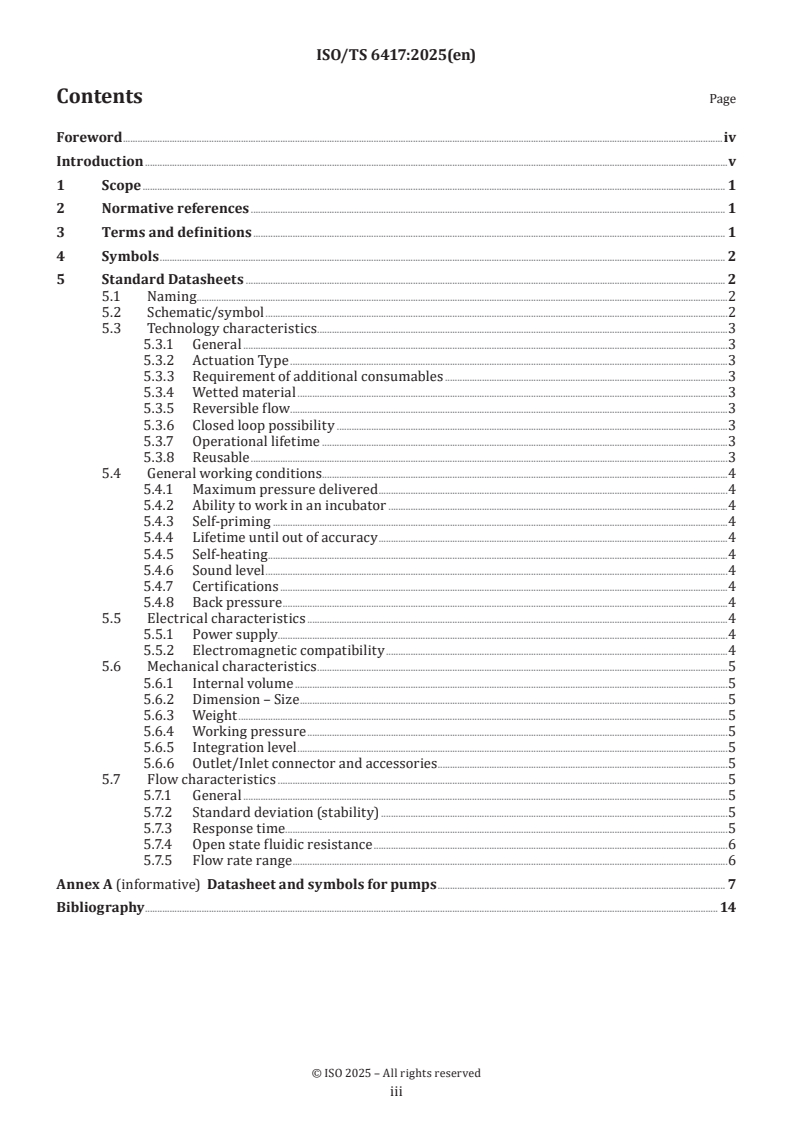
Contents Page
Foreword .iv
Introduction .v
1 Scope . 1
2 Normative references . 1
3 Terms and definitions . 1
4 Symbols . 2
5 Standard Datasheets . 2
5.1 Naming .2
5.2 Schematic/symbol .2
5.3 Technology characteristics .3
5.3.1 General .3
5.3.2 Actuation Type .3
5.3.3 Requirement of additional consumables .3
5.3.4 Wetted material .3
5.3.5 Reversible flow.3
5.3.6 Closed loop possibility .3
5.3.7 Operational lifetime .3
5.3.8 Reusable .3
5.4 General working conditions .4
5.4.1 Maximum pressure delivered .4
5.4.2 Ability to work in an incubator .4
5.4.3 Self-priming .4
5.4.4 Lifetime until out of accuracy .4
5.4.5 Self-heating .4
5.4.6 Sound level .4
5.4.7 Certifications .4
5.4.8 Back pressure .4
5.5 Electrical characteristics .4
5.5.1 Power supply . .4
5.5.2 Electromagnetic compatibility .4
5.6 Mechanical characteristics .5
5.6.1 Internal volume .5
5.6.2 Dimension – Size .5
5.6.3 Weight .5
5.6.4 Working pressure .5
5.6.5 Integration level .5
5.6.6 Outlet/Inlet connector and accessories .5
5.7 Flow characteristics .5
5.7.1 General .5
5.7.2 Standard deviation (stability) .5
5.7.3 Response time . . .5
5.7.4 Open state fluidic resistance .6
5.7.5 Flow rate range .6
Annex A (informative) Datasheet and symbols for pumps . 7
Bibliography . 14
iii
Foreword
ISO (the International Organization for Standardization) is a worldwide federation of national standards
bodies (ISO member bodies). The work of preparing International Standards is normally carried out through
ISO technical committees. Each member body interested in a subject for which a technical committee
has been established has the right to be represented on that committee. International organizations,
governmental and non-governmental, in liaison with ISO, also take part in the work. ISO collaborates closely
with the International Electrotechnical Commission (IEC) on all matters of electrotechnical standardization.
The procedures used to develop this document and those intended for its further maintenance are described
in the ISO/IEC Directives, Part 1. In particular, the different approval criteria needed for the different types
of ISO document should be noted. This document was drafted in accordance with the editorial rules of the
ISO/IEC Directives, Part 2 (see www.iso.org/directives).
ISO draws attention to the possibility that the implementation of this document may involve the use of (a)
patent(s). ISO takes no position concerning the evidence, validity or applicability of any claimed patent
rights in respect thereof. As of the date of publication of this document, ISO had not received notice of (a)
patent(s) which may be required to implement this document. However, implementers are cautioned that
this may not represent the latest information, which may be obtained from the patent database available at
www.iso.org/patents. ISO shall not be held responsible for identifying any or all such patent rights.
Any trade name used in this document is information given for the convenience of users and does not
constitute an endorsement.
For an explanation of the voluntary nature of standards, the meaning of ISO specific terms and expressions
related to conformity assessment, as well as information about ISO's adherence to the World Trade
Organization (WTO) principles in the Technical Barriers to Trade (TBT), see www.iso.org/iso/foreword.html.
This document was prepared by Technical Committee ISO/TC 48, Laboratory equipment.
Any feedback or questions on this document should be directed to the user’s national standards body. A
complete listing of these bodies can be found at www.iso.org/members.html.
iv
Introduction
Several microfluidic pumps are available on the market. The relevant technical information from the
datasheet will enable end-users to compare the performance of the microfluidic pumps and to choose the
best-fitted pump for their application. Without a standardized datasheet, the comparison of the performance
of different microfluidic pumps is often not possible due to the lack of similar information or divergent
definitions of similar performance characteristics.
The following groups of characteristics are defined, described and explained with examples where it is
appropriate:
— naming;
— schematic/symbol;
— technology characteristics;
— general working conditions;
— electronical characteristics;
— mechanical characteristics;
— flow characteristics.
v
Technical Specification ISO/TS 6417:2025(en)
Microfluidic pumps — Symbols and performance
communication
1 Scope
This document provides symbols and defines standard datasheets for some of the most often used microfluidic
pumps, such as the peristaltic pump, pressure pump, syringe pump and diaphragm/membrane pump.
2 Normative references
The following documents are referred to in the text in such a way that some or all of their content constitutes
requirements of this document. For dated references, only the edition cited applies. For undated references,
the latest edition of the referenced document (including any amendments) applies.
ISO 10991, Microfluidics — Vocabulary
3 Terms and definitions
For the purposes of this document, the terms and definitions given in ISO 10991 and the following apply.
ISO and IEC maintain terminology databases for use in standardization at the following addresses:
— ISO Online browsing platform: available at https:// www .iso .org/ obp
— IEC Electropedia: available at https:// www .electropedia .org/
3.1
peristaltic pump
volumetric pump in which the flow of the liquid is achieved by the cyclic deformation (expansion and
contraction) of a flexible body
[SOURCE: ISO 5681:2020, 3.2.5.5 modified — “the continuous progression of a deformation in a flexible
tube” replaced by “the cyclic deformation (expansion and contraction) of a flexible body”.]
3.2
pressure pump
volumetric pump in which the flow is achieved by the pressurization of a gas to drive a liquid into a system
[SOURCE: ISO 5681:2020, 3.2.5.1 modified — “means of the positive displacement of the liquid” replaced by
“pressurization of a gas to drive a liquid into a system”.]
3.3
syringe pump
volumetric pump in which the flow of the liquid is achieved by means of one or more single action syringe(s)
or similar container(s)
[SOURCE: IEC 60601-2-24:2012, 201.3.220, modified — “infusion” replaced by “volumetric”; “intended for
controlled infusion of liquids into the patient” replaced by “in which the flow of the liquid is achieved”; “(e.g.
where the cartridge/bag is emptied by positive pressure applied to the cartridge/bag) in which delivery
rate is indicated in volume per unit of time or units related to drug dosage” was deleted.]
3.4
diaphragm pump
membrane pump
volumetric pump in which the flow of the liquid is achieved by the deformation of a diaphragm
[SOURCE: ISO 5681:2020, 3.2.5.3, modified — "membrane pump" has been added as a preferred term.]
4 Symbols
The symbols presented in Table 1 use basic elements on graphical symbols according to ISO 7000,
1)
IEC 80416-1, ISO 80416-2 and IEC 80416-3.
Table 1 — Graphic symbols for different types of microfluidic pumps
PERISTALTIC PUMP
(ISO 14617-2-X4401)
PRESSURE PUMP
(ISO 14617-2-X2426)
SYRINGE PUMP
(ISO 14617-2-X4402)
DIAPHRAGM/MEMBRANE PUMP
(ISO 14617-2-X4403)
5 Standard Datasheets
5.1 Naming
Along with the dedicated model reference, which is manufacturer-specific, an explicit term can be in the
device's name based on the main working principle of the pump.
EXAMPLE Brand A, Model B, Peristaltic pump.
5.2 Schematic/symbol
...