

ISO/TS 17429:2017
(Main)Intelligent transport systems — Cooperative ITS — ITS station facilities for the transfer of information between ITS stations
General Information
- Abstract
ISO/TS 17429:2017 specifies generic mechanisms enabling the exchange of information between ITS stations for applications related to Intelligent Transport Systems. It complies with the ITS station reference architecture (ISO 21217) and defines the following ITS station facilities layer functionalities: - Communication Profile Handler (CPH); - Content Subscription Handler (CSH); - Facilities Services Handler (FSH). These functionalities are used by ITS-S application processes (ITS-S-AP) to communicate with other ITS-S application processes and share information. These functionalities describe - how lower-layer communication services assigned to a given data flow are applied to the service data units at the various layers in the communication protocol stack (CPH, see 6.2.3), - how content from data dictionaries can be published and subscribed to by ITS-S application processes (CSH, see 6.2.5), - how well-known ITS station facilities layer and management services can be applied to application process data units (FSH, see 6.2.4), relieving (ITS-S) application processes from having to implement these services on their own, - how service access points (SAP) primitives specified in ISO 24102‑3 are used, - service primitives for the exchange of information between ITS-S application processes and the ITS station facilities layer (FA-SAP), and - a set of communication requirements and objectives (profiles) using the methods defined in ISO/TS 17423 to select the level of performance (best effort or real-time, etc.), confidence and security (authentication, encryption, etc.) for information exchange between ITS stations, such as data provision, event notification, roadside configuration, map update.
- Status
- Published
- Publication Date
- 28-Mar-2017
- Technical Committee
- ISO/TC 204 - Intelligent transport systems
- Drafting Committee
- ISO/TC 204/WG 18 - Cooperative systems
- Current Stage
- 9060 - Close of review
- Start Date
- 03-Sep-2026
- Completion Date
- 02-Sep-2026

Overview
ISO/TS 17429:2017 specifies ITS station facilities to enable standardized information exchange between Intelligent Transport Systems (ITS) stations for Cooperative ITS (C-ITS). Aligned with the ITS station reference architecture (ISO 21217), the technical specification defines a facilities layer that provides reusable, technology‑agnostic mechanisms so ITS applications can share data reliably, securely and with selectable performance levels.
Key topics and requirements
- Core facilities layer functions:
- Communication Profile Handler (CPH) - selects and applies communication profiles to data flows, manages flow parameters, path/address resolution and reporting.
- Facilities Services Handler (FSH) - provides well‑known facilities and management services that applications can reuse instead of implementing themselves; defines ITS‑FPDU format.
- Content Subscription Handler (CSH) - supports publish/subscribe of data objects based on data dictionaries and routes content to interested ITS‑S application processes.
- Service access and primitives:
- FA‑SAP primitives for application ↔ facilities interaction (e.g., TransmitFlowData, ReceiveFlowData, PublishContent, SubscribeContent, CancelContent, ReceiveContent).
- NF‑SAP primitives for facilities ↔ lower layers (e.g., ReceiveNTSDU, TransmitNTSDU).
- Profiles and requirements:
- Defines communication requirements/objectives (profiles) using ISO/TS 17423 methods to choose performance (best‑effort, real‑time), confidence and security levels (authentication, encryption) for exchanges such as data provision, event notification, roadside configuration and map updates.
- Conformance and initialization: startup/initialization, flow registration, statistics reporting and management operations are specified to ensure interoperable behavior.
Practical applications and users
- Who uses it:
- ITS system architects and software developers building C‑ITS applications for vehicles, roadside units and central traffic management systems.
- Vendors of ITS station middleware and communications stacks who need standardized facilities layer implementations.
- Traffic authorities and integrators deploying interoperable roadside infrastructure, event reporting and map update services.
- Practical benefits:
- Enables reuse of facilities services across applications, reducing implementation cost.
- Standardizes publish/subscribe and flow handling so heterogeneous ITS stations can share sensor data, CAM/TPEG/DATEX II messages, event notifications and configuration commands.
- Supports selectable performance and security profiles suitable for real‑time safety or best‑effort efficiency use cases.
Related standards
- ISO 21217 (ITS station reference architecture)
- ISO/TS 17423 (profile selection methods)
- ISO 24102‑3 (service access point primitives)
- ISO/TS 17419, ETSI data dictionaries, DATEX II, TPEG, SAE J2735 (message/data object context)
Keywords: ISO/TS 17429:2017, Intelligent Transport Systems, C-ITS, ITS station facilities, Communication Profile Handler, Content Subscription Handler, Facilities Services Handler, ITS data exchange, ITS profiles, publish/subscribe.
Relations
- Effective Date
- 25-Aug-2026
- Effective Date
- 25-Aug-2026
- Effective Date
- 25-Aug-2026
- Effective Date
- 12-Feb-2026
Get Certified
Connect with accredited certification bodies for this standard

BSI Group
BSI (British Standards Institution) is the business standards company that helps organizations make excellence a habit.

Great Wall Tianjin Quality Assurance Center
Established 1993, first batch to receive national accreditation with IAF recognition.
Hong Kong Quality Assurance Agency (HKQAA)
Hong Kong's leading certification body.
Sponsored listings
Frequently Asked Questions
ISO/TS 17429:2017 is a technical specification published by the International Organization for Standardization (ISO). Its full title is "Intelligent transport systems — Cooperative ITS — ITS station facilities for the transfer of information between ITS stations". This standard covers: ISO/TS 17429:2017 specifies generic mechanisms enabling the exchange of information between ITS stations for applications related to Intelligent Transport Systems. It complies with the ITS station reference architecture (ISO 21217) and defines the following ITS station facilities layer functionalities: - Communication Profile Handler (CPH); - Content Subscription Handler (CSH); - Facilities Services Handler (FSH). These functionalities are used by ITS-S application processes (ITS-S-AP) to communicate with other ITS-S application processes and share information. These functionalities describe - how lower-layer communication services assigned to a given data flow are applied to the service data units at the various layers in the communication protocol stack (CPH, see 6.2.3), - how content from data dictionaries can be published and subscribed to by ITS-S application processes (CSH, see 6.2.5), - how well-known ITS station facilities layer and management services can be applied to application process data units (FSH, see 6.2.4), relieving (ITS-S) application processes from having to implement these services on their own, - how service access points (SAP) primitives specified in ISO 24102‑3 are used, - service primitives for the exchange of information between ITS-S application processes and the ITS station facilities layer (FA-SAP), and - a set of communication requirements and objectives (profiles) using the methods defined in ISO/TS 17423 to select the level of performance (best effort or real-time, etc.), confidence and security (authentication, encryption, etc.) for information exchange between ITS stations, such as data provision, event notification, roadside configuration, map update.
ISO/TS 17429:2017 specifies generic mechanisms enabling the exchange of information between ITS stations for applications related to Intelligent Transport Systems. It complies with the ITS station reference architecture (ISO 21217) and defines the following ITS station facilities layer functionalities: - Communication Profile Handler (CPH); - Content Subscription Handler (CSH); - Facilities Services Handler (FSH). These functionalities are used by ITS-S application processes (ITS-S-AP) to communicate with other ITS-S application processes and share information. These functionalities describe - how lower-layer communication services assigned to a given data flow are applied to the service data units at the various layers in the communication protocol stack (CPH, see 6.2.3), - how content from data dictionaries can be published and subscribed to by ITS-S application processes (CSH, see 6.2.5), - how well-known ITS station facilities layer and management services can be applied to application process data units (FSH, see 6.2.4), relieving (ITS-S) application processes from having to implement these services on their own, - how service access points (SAP) primitives specified in ISO 24102‑3 are used, - service primitives for the exchange of information between ITS-S application processes and the ITS station facilities layer (FA-SAP), and - a set of communication requirements and objectives (profiles) using the methods defined in ISO/TS 17423 to select the level of performance (best effort or real-time, etc.), confidence and security (authentication, encryption, etc.) for information exchange between ITS stations, such as data provision, event notification, roadside configuration, map update.
ISO/TS 17429:2017 is classified under the following ICS (International Classification for Standards) categories: 03.220.01 - Transport in general; 35.240.60 - IT applications in transport. The ICS classification helps identify the subject area and facilitates finding related standards.
ISO/TS 17429:2017 has the following relationships with other standards: It is inter standard links to CEN ISO/TS 17426:2016, CEN ISO/TS 21184:2021, CEN ISO/TS 21176:2020, CEN ISO/TS 17429:2017. Understanding these relationships helps ensure you are using the most current and applicable version of the standard.
ISO/TS 17429:2017 is available in PDF format for immediate download after purchase. The document can be added to your cart and obtained through the secure checkout process. Digital delivery ensures instant access to the complete standard document.
Standards Content (Sample)
TECHNICAL ISO/TS
SPECIFICATION 17429
First edition
2017-03
Intelligent transport systems —
Cooperative ITS — ITS station facilities
for the transfer of information
between ITS stations
Systèmes intelligents de transport — ITS coopératifs —
Fonctionnalités des stations ITS pour le transfert d’information entre
stations ITS
Reference number
©
ISO 2017
© ISO 2017, Published in Switzerland
All rights reserved. Unless otherwise specified, no part of this publication may be reproduced or utilized otherwise in any form
or by any means, electronic or mechanical, including photocopying, or posting on the internet or an intranet, without prior
written permission. Permission can be requested from either ISO at the address below or ISO’s member body in the country of
the requester.
ISO copyright office
Ch. de Blandonnet 8 • CP 401
CH-1214 Vernier, Geneva, Switzerland
Tel. +41 22 749 01 11
Fax +41 22 749 09 47
copyright@iso.org
www.iso.org
ii © ISO 2017 – All rights reserved
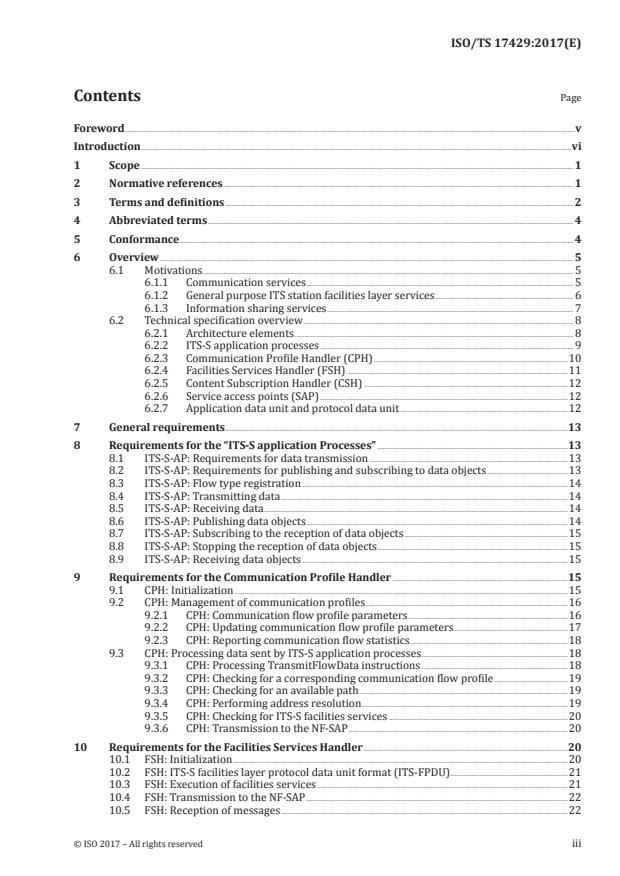
Contents Page
Foreword .v
Introduction .vi
1 Scope . 1
2 Normative references . 1
3 Terms and definitions . 2
4 Abbreviated terms . 4
5 Conformance . 4
6 Overview . 5
6.1 Motivations . 5
6.1.1 Communication services . 5
6.1.2 General purpose ITS station facilities layer services . 6
6.1.3 Information sharing services . 7
6.2 Technical specification overview . 8
6.2.1 Architecture elements . 8
6.2.2 ITS-S application processes . 9
6.2.3 Communication Profile Handler (CPH) .10
6.2.4 Facilities Services Handler (FSH) .11
6.2.5 Content Subscription Handler (CSH) .12
6.2.6 Service access points (SAP) .12
6.2.7 Application data unit and protocol data unit .12
7 General requirements .13
8 Requirements for the “ITS-S application Processes” .13
8.1 ITS-S-AP: Requirements for data transmission .13
8.2 ITS-S-AP: Requirements for publishing and subscribing to data objects .13
8.3 ITS-S-AP: Flow type registration .14
8.4 ITS-S-AP: Transmitting data .14
8.5 ITS-S-AP: Receiving data .14
8.6 ITS-S-AP: Publishing data objects .14
8.7 ITS-S-AP: Subscribing to the reception of data objects .15
8.8 ITS-S-AP: Stopping the reception of data objects .15
8.9 ITS-S-AP: Receiving data objects .15
9 Requirements for the Communication Profile Handler .15
9.1 CPH: Initialization .15
9.2 CPH: Management of communication profiles .16
9.2.1 CPH: Communication flow profile parameters .16
9.2.2 CPH: Updating communication flow profile parameters .17
9.2.3 CPH: Reporting communication flow statistics .18
9.3 CPH: Processing data sent by ITS-S application processes .18
9.3.1 CPH: Processing TransmitFlowData instructions .18
9.3.2 CPH: Checking for a corresponding communication flow profile .19
9.3.3 CPH: Checking for an available path .19
9.3.4 CPH: Performing address resolution .19
9.3.5 CPH: Checking for ITS-S facilities services .20
9.3.6 CPH: Transmission to the NF-SAP .20
10 Requirements for the Facilities Services Handler .20
10.1 FSH: Initialization .20
10.2 FSH: ITS-S facilities layer protocol data unit format (ITS-FPDU) .21
10.3 FSH: Execution of facilities services .21
10.4 FSH: Transmission to the NF-SAP .22
10.5 FSH: Reception of messages .22
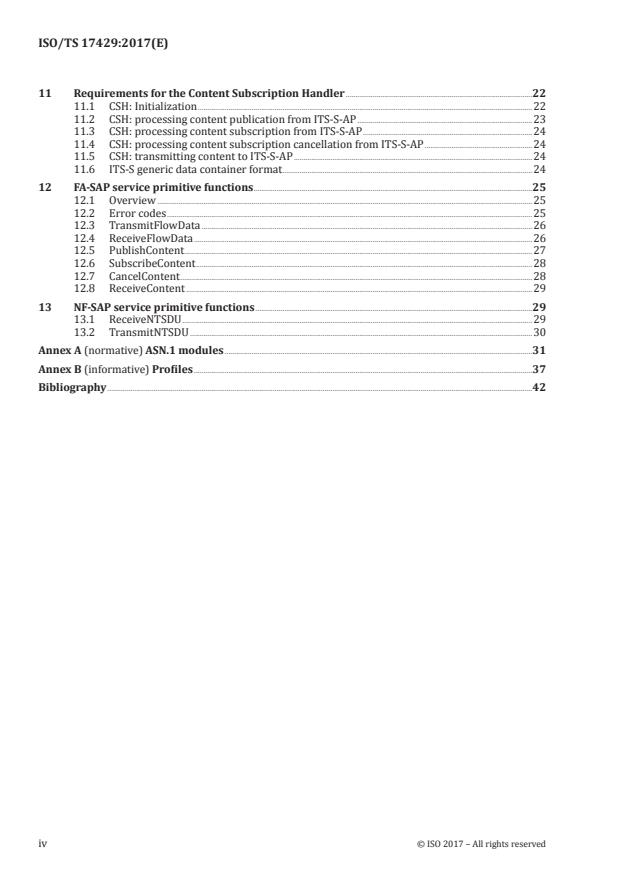
11 Requirements for the Content Subscription Handler .22
11.1 CSH: Initialization .22
11.2 CSH: processing content publication from ITS-S-AP .23
11.3 CSH: processing content subscription from ITS-S-AP .24
11.4 CSH: processing content subscription cancellation from ITS-S-AP .24
11.5 CSH: transmitting content to ITS-S-AP .24
11.6 ITS-S generic data container format .24
12 FA-SAP service primitive functions .25
12.1 Overview .25
12.2 Error codes .25
12.3 TransmitFlowData .26
12.4 ReceiveFlowData .26
12.5 PublishContent .27
12.6 SubscribeContent .28
12.7 CancelContent .28
12.8 ReceiveContent .29
13 NF-SAP service primitive functions .29
13.1 ReceiveNTSDU .29
13.2 TransmitNTSDU .30
Annex A (normative) ASN.1 modules .31
Annex B (informative) Profiles .37
Bibliography .42
iv © ISO 2017 – All rights reserved
Foreword
ISO (the International Organization for Standardization) is a worldwide federation of national standards
bodies (ISO member bodies). The work of preparing International Standards is normally carried out
through ISO technical committees. Each member body interested in a subject for which a technical
committee has been established has the right to be represented on that committee. International
organizations, governmental and non-governmental, in liaison with ISO, also take part in the work.
ISO collaborates closely with the International Electrotechnical Commission (IEC) on all matters of
electrotechnical standardization.
The procedures used to develop this document and those intended for its further maintenance are
described in the ISO/IEC Directives, Part 1. In particular the different approval criteria needed for the
different types of ISO documents should be noted. This document was drafted in accordance with the
editorial rules of the ISO/IEC Directives, Part 2 (see www .iso .org/ directives).
Attention is drawn to the possibility that some of the elements of this document may be the subject of
patent rights. ISO shall not be held responsible for identifying any or all such patent rights. Details of
any patent rights identified during the development of the document will be in the Introduction and/or
on the ISO list of patent declarations received (see www .iso .org/ patents).
Any trade name used in this document is information given for the convenience of users and does not
constitute an endorsement.
For an explanation on the meaning of ISO specific terms and expressions related to conformity assessment,
as well as information about ISO’s adherence to the World Trade Organization (WTO) principles in the
Technical Barriers to Trade (TBT) see the following URL: www . i so .org/ iso/ foreword .html.
The committee responsible for this document is ISO/TC 204, Intelligent transport systems.
Introduction
ITS station units compliant with the ITS station reference architecture specified in ISO 21217 may
engage in Cooperative ITS (C-ITS) activities involving data exchanges between ITS stations in a variety
of roles. Such data exchanges include, but are not limited to:
— data collected by the roadside infrastructure and transmitted to traffic control centers, possibly
after aggregation,
— roadside equipment configured from the control centers to process a given set of data or issue
messages to vehicles,
— roadside events reported to control centers, and
— broadcast transmission of vehicle status and event messages (e.g. CAM) to nearby ITS stations.
An example of an ITS station unit engaged in a C-ITS activity is a roadside ITS station unit collecting
traffic-related information generated by road sensors and/or by vehicle ITS station units. The collected
data can often serve other purposes than the originally intended one. For example, the cooperative
awareness message (CAM) from the ETSI C-ITS message set generated for traffic-safety applications
can be collected by roadside ITS station units for exploitation by traffic efficiency applications in traffic
control centers (e.g. central ITS stations). The same information is thus used to improve road safety, as
well as traffic efficiency and also to reduce greenhouse gas emissions.
The exploitation of such exchanges for purposes not initially intended is made possible once this
exchange of information is performed in a standardized way through an ITS station facilities layer
that is able to recognize messages from specific message sets (e.g. DATEX II, TPEG, C-ITS message sets)
with data according to data object specifications from data dictionaries (e.g. the common ETSI data
dictionary) and to forward them to applications which have an interest therein and have subscribed to
the delivery of such message(s) and data. A Communication Profile Handler (CPH), a Facilities Services
Handler (FSH) and a Content Subscription Handler (CSH) are defined in this Technical Specification to
serve this purpose.
Outside of this Technical Specification, the commonly used term “message set” is used to indicate a
collection of “messages” used in the exchange of information between peer ITS station units (see
ISO/TS 17419). These messages are composed of structures sometime referred to as “data frames”
and/or “data objects” which are in turn composed of objects called “data elements” (see SAE J2735).
Herein, a slightly different lexicon is adopted. The term “data dictionary” is used to indicate a
collection of “messages”, including “data object” from which the messages are composed. Thus, herein,
“data objects” are synonymous with “data frames” and “data elements”. However, in this Technical
Specification, the terms are used with the precise meaning to distinguish messages and data objects
from which messages are constructed.
The functionalities specified in this Technical Specification include a Communication Profile
Handler (CPH), a Facilities Services Handler (FSH), and a Content Subscription Handler (CSH). These
functionalities are intended to enable, and be invoked by, technology-agnostic ITS applications and to
facilitate the deployment of C-ITS applications that share information. In particular, these functionalities
allow an application to
— specify a set of facilities layer services to be applied to its data units (ADUs),
— allow ITS station management to select the optimum communication profile (as a function of time)
for any or all of its data flows, and
— publish information to and subscribe to information from a central repository (the CSH) in a
standardized way that enables sharing of information between applications (the definition of C-ITS).
These functionalities provide a toolkit facilitating the specification of standards and the development
of ITS applications [e.g. In-Vehicle Signage (ISO/TS 17425), Contextual Speed (ISO/TS 17426), Point of
vi © ISO 2017 – All rights reserved
Interest, Probe Data, IVI, LDM synchronization, remote ITS station configuration, and ITS applications
for freight, logistics, public transportation, etc.] complying with the set of Cooperative ITS standards.
TECHNICAL SPECIFICATION ISO/TS 17429:2017(E)
Intelligent transport systems — Cooperative ITS — ITS
station facilities for the transfer of information between
ITS stations
1 Scope
This Technical Specification specifies generic mechanisms enabling the exchange of information
between ITS stations for applications related to Intelligent Transport Systems. It complies with the
ITS station reference architecture (ISO 21217) and defines the following ITS station facilities layer
functionalities:
— Communication Profile Handler (CPH);
— Content Subscription Handler (CSH);
— Facilities Services Handler (FSH).
These functionalities are used by ITS-S application processes (ITS-S-AP) to communicate with other
ITS-S application processes and share information. These functionalities describe
— how lower-layer communication services assigned to a given data flow are applied to the service
data units at the various layers in the communication protocol stack (CPH, see 6.2.3),
— how content from data dictionaries can be published and subscribed to by ITS-S application
processes (CSH, see 6.2.5),
— how well-known ITS station facilities layer and management services can be applied to application
process data units (FSH, see 6.2.4), relieving (ITS-S) application processes from having to implement
these services on their own,
— how service access points (SAP) primitives specified in ISO 24102-3 are used,
— service primitives for the exchange of information between ITS-S application processes and the ITS
station facilities layer (FA-SAP), and
— a set of communication requirements and objectives (profiles) using the methods defined in
ISO/TS 17423 to select the level of performance (best effort or real-time, etc.), confidence and
security (authentication, encryption, etc.) for information exchange between ITS stations, such as
data provision, event notification, roadside configuration, map update.
2 Normative references
The following documents are referred to in the text in such a way that some or all of their content
constitutes requirements of this document. For dated references, only the edition cited applies. For
undated references, the latest edition of the referenced document (including any amendments) applies.
ISO/TS 17419, Intelligent transport systems — Cooperative systems — Classification and management of
ITS applications in a global context
ISO/TS 17423, Intelligent transport systems — Cooperative systems — ITS application requirements and
objectives for selection of communication profiles
ISO 21217, Intelligent transport systems — Communications access for land mobiles (CALM) — Architecture
ISO 24102-3, Intelligent transport systems — Communications access for land mobiles (CALM) — ITS
station management — Part 3: Service access points
ISO 24102-6, Intelligent transport systems — Communications access for land mobiles (CALM) — ITS
station management Part 6: Path and flow management
3 Terms and definitions
For the purposes of this document, the following terms and definitions apply.
3.1
ITS-S application
ITS-S application process residing in the ITS-S application entity
[SOURCE: ISO 21217:2014, 3.18]
3.2
ITS-S application process
ITS-S-AP
element in an ITS station that performs information processing for a particular application, and uses
ITS-S services to transmit and receive information
Note 1 to entry: Examples of ITS-S application processes are contextual speed (ISO/TS 17426) and In-Vehicle
Signage (ISO/TS 17425).
[SOURCE: ISO 21217:2014, 3.19]
3.3
ITS-S capability
ITS-S capabilities
uniquely addressable protocol functionality
Note 1 to entry: Examples of ITS-S capabilities are Content Subscription Handler (CSH), Facilities Service Handler
(FSH), Communication Profile Handler (CPH).
[SOURCE: ISO 24102-6:2015, 3.6]
3.4
ITS-S facilities layer protocol data unit
ITS-FPDU
protocol data unit assembled by the Facilities Services Handler in the ITS-S facilities layer consisting of
nested protocol data units exchanged between peer facilities layer services in ITS-S
3.5
ITS-S communication profile
parameterized ITS-S communication protocol stack
[SOURCE: ISO/TS 17423:2014, 3.7]
3.6
ITS-S data container
sequence of type-length-value (TLV) encoded data objects
3.7
ITS-S data header
header of the “ITS-S generic data container format” uniquely identifying the data contained in the ITS-S
data containers by means of data dictionary identifiers unique in the ITS domain and the number of
data objects from the data dictionary in the container
2 © ISO 2017 – All rights reserved
3.8
ITS-S flow
identifiable sequence of packets of a given ITS-S flow type transmitted between a source node and a
destination node
[SOURCE: ISO 24102-6:2015, 3.6]
3.9
ITS-S flow identifier
ITS-S-FlowID
identifier, being unique within the ITS station, that identifies an ITS-S flow
[SOURCE: ISO 24102-6:2015, 3.6]
3.10
ITS-S flow type
set of characteristics describing a data flow
[SOURCE: ISO 24102-6:2015, 3.6]
3.11
ITS-S flow type identifier
ITS-S-FlowTypeID
identifier, being unique within the ITS station that identifies an ITS-S flow type
[SOURCE: ISO 24102-6:2015, 3.6]
3.12
ITS-S generic data container format
format of an ADU exchanged between an “ITS-S application process” and a Content Subscription Handler
(CSH) or between two peer CSHs containing an “ITS-S data header” and followed by a number of “ITS-S
data containers”
3.13
ITS-S facilities header
header used to form an “ITS-S facilities layer protocol data unit”
3.14
ITS-S facilities service
ITS-S capability of the ITS-S facilities layer providing a service that may be applied to ADUs at the
request of the source ITS-S-AP
Note 1 to entry: Examples of ITS-S facilities services are “time stamping”, “geo-stamping”.
3.15
ITS-S managed service entity
ITS-S MSE
uniquely addressable entity in an ITS-S layer comprised of a set of related ITS-S capabilities
Note 1 to entry: Examples of ITS-S managed service entities are: a communication module in the ITS-S access
technologies layer (M5, cellular, etc.), a protocol suite in the ITS-S networking & transport layer (IPv6, FNTP,
GeoNetworking, 6LoWPAN, etc.), and MSEGenFac, the entity comprising the generic ITS-S facilities services
specified in this Technical Specification (CPH, CSH, the FSH and possibly more).
[SOURCE: ISO 24102-6:2015, 3.14]
3.16
registered ITS-S flow
ITS-S flow that has been allocated an ITS-S-FlowID
4 Abbreviated terms
ADU application data unit
BSMD bounded secured managed domain (see ISO/TS 17419)
BSME bounded secured managed entity (see ISO 21217)
C-ITS cooperative ITS
CPH Communication Profile Handler
CSH Content Subscription Handler
FSH Facilities Services Handler
ITS intelligent transport systems (see ISO/TS 17419)
ITS-FlowTypeID ITS flow type identifier (see ISO/TS 17423)
ITS-FPDU ITS station facilities layer protocol data unit (see ISO 21217)
ITS-FSDU ITS station facilities layer service data unit (see ISO 21217)
ITS-PN ITS port number (see ISO/TS 17419)
ITS-S ITS station (see ISO 21217)
ITS-S-AP ITS-S application process (see ISO 24102-6)
ITS-S MSE ITS-S managed service entity
ITS-SCP ITS station communication profile (see ISO/TS 17423)
ITS-S-FlowID ITS station flow identifier (see ISO 24102-6)
LDM local dynamic map
MSEGenFac generic facilities ITS-S MSE
MSEGenFacID generic facilities ITS-S MSE identifier
SME station management entity
5 Conformance
Details on conformity of equipment with this Technical Specification and on conformance tests are
1)
specified in the multipart ISO 20594 :
— ISO 20594-1;
— ISO 20594-2;
— ISO 20594-3.
1) Under development.
4 © ISO 2017 – All rights reserved
6 Overview
6.1 Motivations
6.1.1 Communication services
Abstracting applications from the communications services used to exchange information between peer
entities is a useful basic architectural principle of intelligent transport systems (ITS) embodied in the ITS
station and communication architecture presented in ISO 21217. Applications and the communications
services they use are linked together using the concepts of paths and flows and communication profiles
described in ISO 21217 with related path and flow management procedures specified in ISO 24102-6.
The ITS station management entity (SME) uses communication requirements and objectives provided
by the ITS station application processes (ITS-S-AP) as specified in ISO/TS 17423 together with the
“ITS-S capabilities” of each layer, dynamic information provided by each layer (computed internally or
collected from neighbour ITS stations) and sets of decision rules (regulations and policies) to select the
most suitable ITS-S communication protocol stack, also referred to as ITS-S communication profiles
(ITS-SCP), for each source of a potential flow as illustrated in Figure 1.
A set of communication requirements is referred to as a flow type (ITS-FlowType) in ISO 24102-6. There
are well-known registered Flow Types as specified in ISO/TS 17419. A flow identifier (ITS-S-FlowID)
which is unique within the ITS station is provided to the requesting ITS station application process and
the decision rules are communicated by the ITS station management entity to the relevant ITS station
layers in the ITS station. The procedures for the management of paths and flows are out of scope of this
Technical Specification and are defined in ISO 24102-6.
The flow identifier is used by the Communication Profile Handler (CPH) (see 6.2.3) to determine the
actions to be applied to each application data unit (ADU) (see Figure 6), presented by an ITS station
application process for transmission using lower layer communication services. From this flow
identifier pointing to the ITS-S communication profile selected by the ITS station management entity, the
Communication Profile Handler determines, amongst other things, how to perform address resolution,
whether security actions have to be performed (by the ITS station security entity), and how to prepare
the service data units (ITS-SDUs) for processing by the next lower layer. As shown in Figure 4, at the
facilities layer, the CPH passes the ADU to the facilities service handler (FSH) for applying well-known
facilities layer services to the ADU, if requested by the ITS station application process, to form an ITS-
FSDU for transmission to the ITS station networking and transport layer.
The mechanisms presented in this Technical Specification and in ISO 24102-6 allow dynamic selection
of the best protocol stack at any given time and location according to the current resources (available
access technologies, available communication capabilities of the destination, etc.). For example, an ITS
station implementing such capabilities could transmit data using an IP communication stack in one
situation and a non-IP communication stack in another situation (network protocol agnostic). Similarly,
[8]
data could be transmitted using a long-range communication technology (e.g. 3G ) in one situation
[9]
and a short-range communication technology (e.g. 802.11 ) in another situation, transparently to the
application (access technology agnostic). This eases deployment as applications can function properly
in different deployment scenarios and in situations where different communication technologies
are available. Such applications would also easily cope with the deployment of new communication
technologies.
Figure 1 — ITS-S communication profile selection process (ISO/TS 17423)
Figure 2 — ITS station facilities layer functionalities
6.1.2 General purpose ITS station facilities layer services
ITS stations generally host a number of applications that instantiate various ITS-related services. These
applications, in turn, make use of ITS-S services to perform their functions. A number of these ITS-S
services reside in OSI layers 5 through 7 (session, presentation, and application layers respectively) and
are invoked by many applications. Examples of actions that are commonly performed include:
— determination of a network address of the destination(s) identified by e.g. a name (group name), a
URL or a geographic location;
— determination of a communication protocol stack to be used to reach the destination(s);
— addition of a time-stamp to the payload at the source;
— addition of a geo-stamp to the payload at the source;
— addition of non-repudiation material to the payload at the source and assessing the correctness of
the payload at the destination;
6 © ISO 2017 – All rights reserved
— addition of authentication material (a certificate) to the payload at the source and authentication of
the source at the destination;
— encryption of the payload at the source and decryption at the destination;
— compression of the payload at the source and decompression at the destination.
Once generic services that perform these and similar common actions are standardized and instantiated
in the ITS-S facilities layer, they are available to all applications. The availability of such services
can simplify, the development of applications thereby decreasing development costs and application
complexity. Furthermore, it allows applications to make use of upgrades to such services seamlessly.
The Facilities Services Handler (FSH) described in 6.2.4 and specified in Clause 10 provides a mechanism
for applying generic services (ITS-S facilities services) to payloads (ADUs) transmitted by applications
(ITS-S APs) upon their request. Performing any of these generic services requires the definition of an ITS-S
facilities layer header carrying the information necessary to perform the reverse action associated with
each service at the destination of the data (encryption/decryption, compression/decompression, etc.).
The number of ITS-S facilities services supported by the Facilities Services Handler is extensible by
means of a generic services registry. New services can be installed in the ITS-S facilities layer at any
time, without requiring modifications to this Technical Specification. The registration mechanism
supports global, regional, or local services, as well as well-known and proprietary services.
In order for successful exchange of ADUs between peer ITS-S-APs to occur, the services applied on
transmission generally must be available at the receiver so the reverse actions can be performed.
Mechanisms for ensuring service availability at both transmitting ITS-S-APs and peer receiving ITS-S-
APs are outside the scope of this Technical Specification. Such mechanisms can include application level
negotiation, inclusion of appropriate information in service advertisements, and system configuration
requirements on ITS-Ss with service push and update functionality.
6.1.3 Information sharing services
Messages exchanged between ITS stations contain information that is often useful to a number of
applications, not only the peer application receiving the message, and not only ITS applications. For
instance, the speed of vehicles contained in messages collected by the roadside infrastructure could be
used by an application to assess traffic congestion and at the same time be used by another application
to estimate pollution levels. While the information being processed is the same, the services are quite
different.
Different applications would indeed compute new information based on the aggregation of different
pieces of data. This can be done to the condition the type of data can easily be identified and can easily
be divided into atomic pieces.
Messages sent by vehicles, the roadside infrastructure and control centers generally contain data
formatted differently according to the purpose of the messages, the organization in charge of defining
the format, and the region where they are used. For instance the cooperative awareness message (CAM)
[15]
specified in ETSI 102 637-2 and the decentralized environmental notification message (DENM)
[16]
specified in ETSI 102 637-3 have been defined by ETSI; ISO and CEN have defined messages for In-
[1] [2]
Vehicle Signage (ISO/TS 17425) , Contextual Speed (ISO/TS 17426) , and signal phase and timing
[5] [18]
(SPAT) (ISO/TS 19091) . DATEX II, TPEG, SAE J2735 are other messages sets that are heavily used.
Several of the defined messages contain similar basic pieces of information (e.g. vehicle speed or type,
time, geographic position, road identification) and each message or set of messages contains a variety
of these basic pieces of information. This results in redundancies and inefficiencies unless the data
contained in these messages is presented according to a harmonized reference model.
This Technical Specification provides specifications for a generic means for the sharing of information
from well-known message sets. These include:
— Specification of a generic data container (message) format (ITS-S generic data container format)
made of a header (ITS-S data header) containing an identifier of the data dictionary and a number
indicating the quantity of data objects (ITS-S data container) from this data dictionary. This ITS-S
facilities layer header is processed by the Facilities Services Handler (FSH) specified in Clause 10.
— Definition of a functionality allowing applications to publish data objects to and to subscribe to the
reception of a specific data object from a given data dictionary. This functionality is provided by the
Content Subscription Handler (CSH) specified in Clause 11.
The mechanisms defined in this Technical Specification allow information developed for specific
services and purposes to be shared among applications that can make beneficial use of such information.
The messages can contain data objects from well-known and publicly available data dictionaries or
restricted proprietary data dictionaries to the condition data dictionaries are registered and identified
by a globally unique data dictionary identifier.
These mechanisms allow the harmonization of the transmission and handling of messages defined
for various use cases and fulfilling regional requirements, while preserving specific interests of all
stakeholders. The number of means to use and combine data objects contained in messages is limitless
and opens the door to innovative applications.
6.2 Technical specification overview
6.2.1 Architecture elements
This Technical Specification defines new functionalities of the ITS-S facilities layer of the ITS station
reference architecture specified in ISO 21217, and the interaction of the ITS-S facilities layer with other
layers and entities of the ITS station reference architecture.
— Clause 8 specifies additional requirements for ITS-S application processes (ITS-S-AP) in order to
use the ITS-S facilities layer capabilities specified in this Technical Specification.
— Clause 9 specifies the Communication Profile Handler (CPH) capability within the ITS-S facilities
layer. This capability simplifies the exchange of information between ITS station units or within an
ITS station unit, i.e. between distinct nodes (ITS-SCUs) of the same ITS station unit.
— Clause 10 specifies the Facilities Services Handler (FSH) capability within the ITS-S facilities layer.
This capability appends an ITS-S facilities layer header to the application data unit (ADU), whenever
“ITS-S facilities services” are requested by the transmitting ITS-S-AP and require treatment of the
ADU at both the sender and the recipient(s) of the packet containing the ADU.
— Clause 11 specifies the Content Subscription Handler (CSH) capability of the ITS-S facilities layer.
This capability is used to deliver content formatted according to the “ITS-S generic data container
format” to all ITS-S application processes which have subscribed to the reception of data objects
from a data dictionary.
— Clauses 12 and 13 specify the service access points (SAP) by means of which the ITS-S facilities
layer interacts with ITS-S application processes (ITS-S-APs) and with the ITS-S networking and
transport layer.
— Annex A provides ASN.1 definitions.
— Annex B provides an examples of communication profiles for which services specified in this
Technical Specification are necessary.
ITS station architecture elements considered in this Technical Specification are illustrated in Figure 3.
8 © ISO 2017 – All rights reserved
Figure 3 — ITS station architecture elements considered in this Technical Specification
6.2.2 ITS-S application processes
As indicated in ISO/TS 17423, an ITS-S application process (ITS-S-AP) may reside in the ITS-S
application entity (above the communication stack), the ITS-S management entity or any of the ITS-S
layers. Examples of ITS-S-APs include the following.
[1]
— ITS-S-APs located in the ITS-S application entity: e.g. Contextual Speed (ISO/TS 17425) , In-Vehicle
[2],
Signage (ISO/TS 17426) Point of Interest, Electric Vehicle Charging Spot.
— ITS-S-APs located in the ITS-S management entity: e.g. remote ITS station management
[12] [13]
(ISO 24102-2) , the ITS station internal management communication (ISO 24102-4) , the
[14]
Fast Service Advertisement Protocol (ISO 24102-5) , or the ITS-S security entity (e.g. certificate
collection).
[4] [15] [16]
— ITS-S-APs located in the ITS-S facilities layer: e.g. LDM, and possibly CAM, , DENM once ITS-
FSDUs are presented to the ITS-S facilities layer in a manner complying with ISO/TS 17423 and
ISO/TS 17419.
In order to use ITS-S facilities layer functionalities to communicate with peer ITS-S-APs, an ITS-S-
AP shall first register its communication requirements to the ITS-S management entity (SME) using
the procedures specified in ISO/TS 17423. This first-step registration must be performed for each
“communication source” identified by an InterfaceNo (see ISO/TS 17423:2014, 5.1) and its ITS-S
flow type. As a result of a successful communication requirements registration, the requesting ITS-
S-AP obtains an ITS-S flow type identifier (FlowTypeID) from the ITS-S management entity for each
registered communication source. This informs the ITS-S-AP that the ITS station has the necessary
ITS-S capabilities to support ITS-S flows with characteristics of such ITS-S flow types.
Before transmitting, anITS-S-AP shall register its ITS-S flows corresponding to the registered ITS-S
flow types and the communication sources using the methods specified in ISO 24102-6. This second
step registration shall be performed for each destination to which ADUs are to be sent. As a result of
each successful ITS-S flow registration, the requesting ITS-S-AP obtains an ITS-S flow identifier (ITS-S-
FlowID) from the ITS-S management entity. The ITS-AP can now start transmitting ADUs.
ITS-S-APs transmit their ADUs (ITS-FSDUs) and the corresponding ITS-S flow identifier (ITS-S-FlowID)
to the underlying ITS station layer for further processing (see Figure 6). The ITS-S flow identifier points
to the information necessary for each layer to properly form its PDUs for transmission to its peer(s).
This information is contained in the specific communication profile (ITS-SCP) selected by the ITS-S
management entity.
ADUs may be transmitted down to the ITS-S networking and transport layer either directly without
further processing by the ITS-S facilities layer or after invoking a set of requested services of the ITS-S
facilities layer. In either case, the ITS-FSDU (the ADU after processing) or the ADU itself is transmitted
to the ITS-
...