

ISO 7059:2023
(Main)Caprolactam for industrial use — Determination of absorbance at a wavelength of 290 nm
General Information
- Abstract
This document specifies a spectrometric method for the determination of the absorbance at a wavelength of 290 nm of caprolactam for industrial use.
- Status
- Published
- Publication Date
- 16-Jul-2023
- Technical Committee
- ISO/TC 61/SC 5 - Physical-chemical properties
- Drafting Committee
- ISO/TC 61/SC 5 - Physical-chemical properties
- Current Stage
- 6060 - International Standard published
- Start Date
- 17-Jul-2023
- Due Date
- 22-Sep-2024
- Completion Date
- 17-Jul-2023
Overview
ISO 7059:2023 - "Caprolactam for industrial use - Determination of absorbance at a wavelength of 290 nm" specifies a spectrometric method for measuring the ultraviolet absorbance of caprolactam solutions. The standard defines sample preparation, instrument requirements and calculation procedures to determine the absorbance at 290 nm for caprolactam intended for industrial use. It replaces the 1982 edition and modernizes measurement options and instrument requirements.
Key Topics and Requirements
- Scope: Determination of absorbance at 290 nm for caprolactam for industrial use using UV spectrometry.
- Sample preparation: Weigh (50.0 ± 0.1) g of caprolactam and dissolve in (50.0 ± 0.1) mL of distilled (or equivalent) water to obtain a 50% solution; bring solution to room temperature before measurement.
- Apparatus:
- UV spectrometer capable of measurements at 290 nm.
- Two quartz cells, optical path length 1 cm (preferred), or
- One quartz flow‑through cell (1 cm) with a pump system.
- Measurement procedure:
- Zero the spectrometer with water.
- For two-cell method: measure test solution vs water and correct for any difference between the two cells by measuring both filled with water.
- For flow‑through method: zero with water, measure sample, then rinse and verify rinsing effectiveness (recommended rinsing volume ~20–30× cell + tubing volume).
- Calculations: Report absorbance normalized to optical path length; include cell-correction term when using two cells.
- Precision requirement: Parallel measurements should not differ by more than 0.001 × l (where l is path length in cm).
- Reagents: Only distilled water or equivalent purity recommended.
- Test report content: sample identification, method reference, results and expression, instrument make/type, optical path length, rinsing volume, any deviations or unusual observations, and date.
Applications
- Quality control and acceptance testing of industrial caprolactam batches.
- Routine laboratory analysis to monitor UV‑absorbing impurities and product consistency.
- Process control in caprolactam production and polymer feedstock verification for nylon manufacture.
- Documentation for suppliers, purchasers, and regulatory or conformity assessment activities.
Who should use this standard
- QC/analytical chemists in chemical and polymer industries
- Laboratory managers and testing service providers
- Manufacturers and purchasers of caprolactam
- Regulatory and conformity assessment bodies involved with industrial chemicals
Related standards
- ISO 7059:1982 (previous edition) - superseded by this document.
- Other ISO standards on plastics and physico‑chemical testing (see ISO/TC 61 publications) for broader analytical and material requirements.
Keywords: ISO 7059:2023, caprolactam, absorbance 290 nm, UV spectrometer, quartz cell, flow‑through cell, industrial caprolactam, spectrometric method, quality control.
Relations
- Effective Date
- 06-Jun-2022
Get Certified
Connect with accredited certification bodies for this standard

ECOCERT
Organic and sustainability certification.

Eurofins Food Testing Global
Global leader in food, environment, and pharmaceutical product testing.

Intertek Bangladesh
Intertek certification and testing services in Bangladesh.
Sponsored listings
Frequently Asked Questions
ISO 7059:2023 is a standard published by the International Organization for Standardization (ISO). Its full title is "Caprolactam for industrial use — Determination of absorbance at a wavelength of 290 nm". This standard covers: This document specifies a spectrometric method for the determination of the absorbance at a wavelength of 290 nm of caprolactam for industrial use.
This document specifies a spectrometric method for the determination of the absorbance at a wavelength of 290 nm of caprolactam for industrial use.
ISO 7059:2023 is classified under the following ICS (International Classification for Standards) categories: 71.080.30 - Organic nitrogen compounds. The ICS classification helps identify the subject area and facilitates finding related standards.
ISO 7059:2023 has the following relationships with other standards: It is inter standard links to ISO 7059:1982. Understanding these relationships helps ensure you are using the most current and applicable version of the standard.
ISO 7059:2023 is available in PDF format for immediate download after purchase. The document can be added to your cart and obtained through the secure checkout process. Digital delivery ensures instant access to the complete standard document.
Standards Content (Sample)
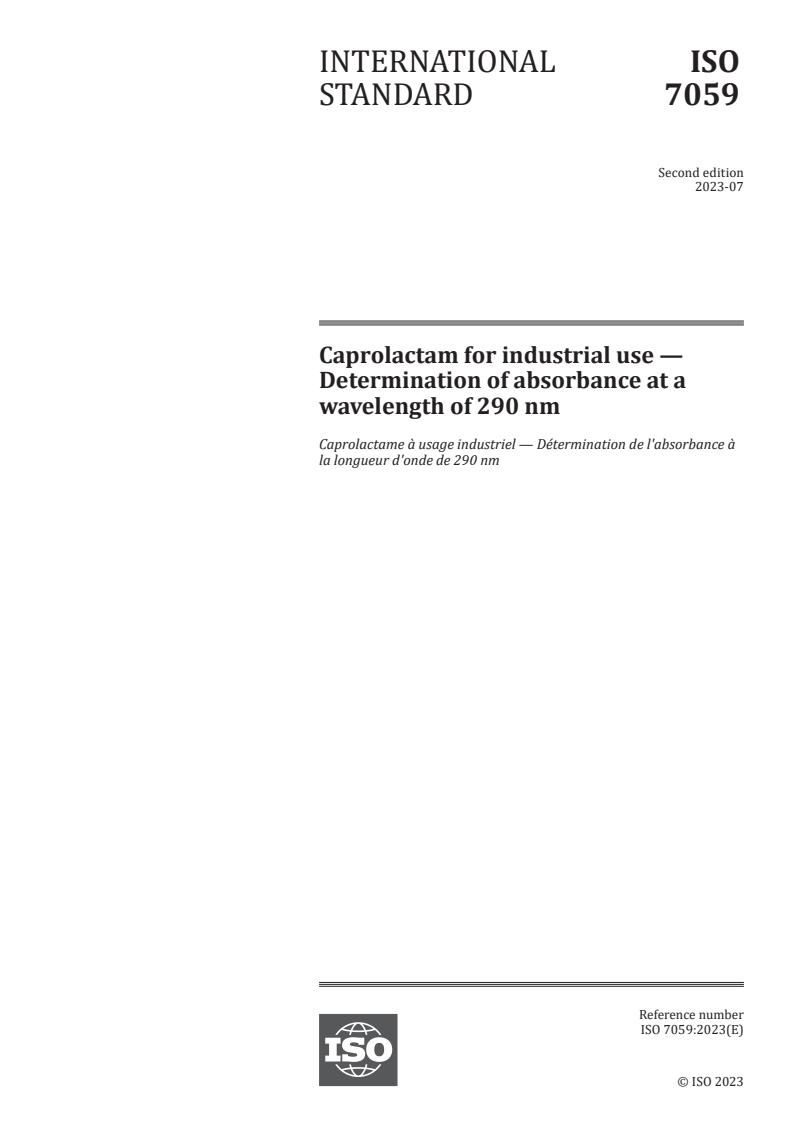
INTERNATIONAL ISO
STANDARD 7059
Second edition
2023-07
Caprolactam for industrial use —
Determination of absorbance at a
wavelength of 290 nm
Caprolactame à usage industriel — Détermination de l'absorbance à
la longueur d'onde de 290 nm
Reference number
© ISO 2023
All rights reserved. Unless otherwise specified, or required in the context of its implementation, no part of this publication may
be reproduced or utilized otherwise in any form or by any means, electronic or mechanical, including photocopying, or posting on
the internet or an intranet, without prior written permission. Permission can be requested from either ISO at the address below
or ISO’s member body in the country of the requester.
ISO copyright office
CP 401 • Ch. de Blandonnet 8
CH-1214 Vernier, Geneva
Phone: +41 22 749 01 11
Email: copyright@iso.org
Website: www.iso.org
Published in Switzerland
ii
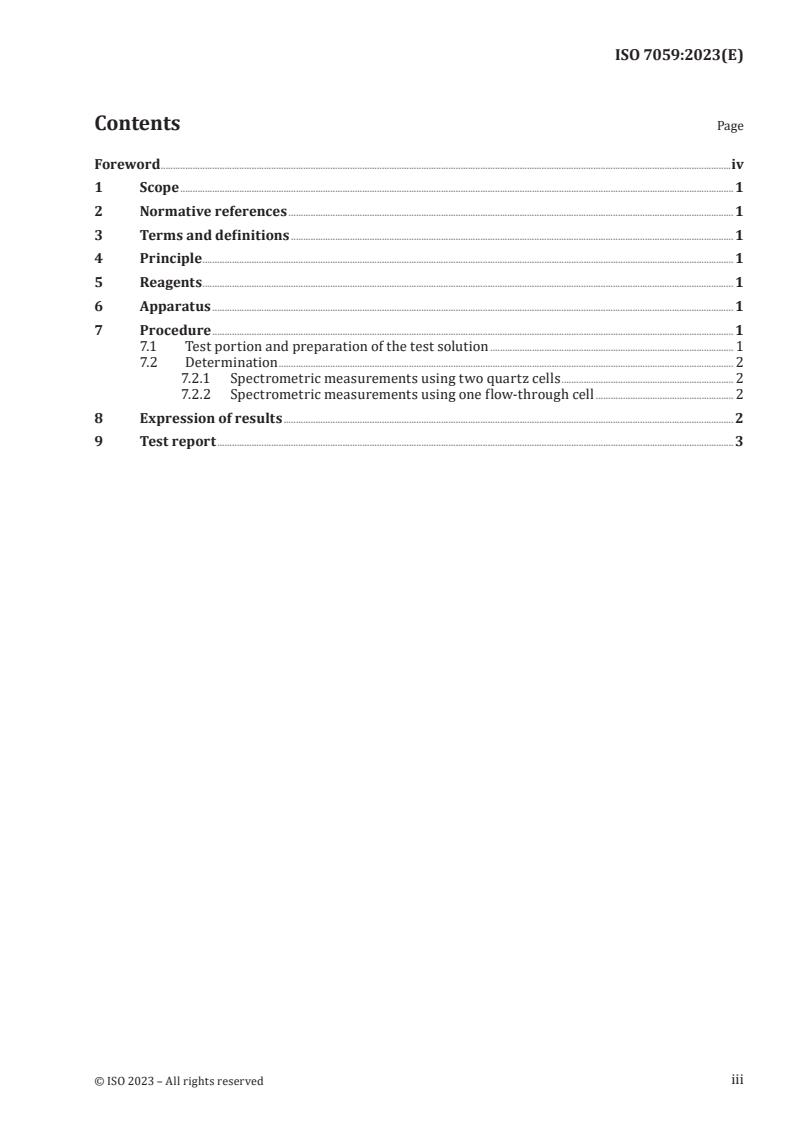
Contents Page
Foreword .iv
1 Scope . 1
2 Normative references . 1
3 Terms and definitions . 1
4 Principle . 1
5 Reagents . 1
6 Apparatus . 1
7 Procedure .1
7.1 Test portion and preparation of the test solution . 1
7.2 Determination . 2
7.2.1 Spectrometric measurements using two quartz cells . 2
7.2.2 Spectrometric measurements using one flow-through cell . 2
8 Expression of results . 2
9 Test report . 3
iii
Foreword
ISO (the International Organization for Standardization) is a worldwide federation of national standards
bodies (ISO member bodies). The work of preparing International Standards is normally carried out
through ISO technical committees. Each member body interested in a subject for which a technical
committee has been established has the right to be represented on that committee. International
organizations, governmental and non-governmental, in liaison with ISO, also take part in the work.
ISO collaborates closely with the International Electrotechnical Commission (IEC) on all matters of
electrotechnical standardization.
The procedures used to develop this document and those intended for its further maintenance are
described in the ISO/IEC Directives, Part 1. In particular, the different approval criteria needed for the
different types of ISO document should be noted. This document was drafted in accordance with the
editorial rules of the ISO/IEC Directives, Part 2 (see www.iso.org/directives).
ISO draws attention to the possibility that the implementation of this document may involve the use
of (a) patent(s). ISO takes no position concerning the evidence, validity or applicability of any claimed
patent rights in respect thereof. As of the date of publication of this document, ISO had not received
notice of (a) patent(s) which may be required to implement this document. However, implementers are
cautioned that this may not represent the latest information, which may be obtained from the patent
database available at www.iso.org/patents. ISO shall not be held responsible for identifying any or all
such patent rights.
Any trade name used in this document is information given for the convenience of users and does not
constitute an endorsement.
For an explanation of
...