

ISO 21013-4:2012/Amd 1:2019
(Amendment)Cryogenic vessels — Pilot operated pressure relief devices — Part 4: Pressure-relief accessories for cryogenic service — Amendment 1
General Information
- Abstract
- Status
- Published
- Publication Date
- 05-May-2019
- Technical Committee
- ISO/TC 220 - Cryogenic vessels
- Drafting Committee
- ISO/TC 220/WG 3 - Supporting standards
- Current Stage
- 6060 - International Standard published
- Start Date
- 06-May-2019
- Due Date
- 11-Dec-2019
- Completion Date
- 11-Dec-2019


Overview
ISO 21013-4:2012/Amd 1:2019 is an amendment to the international standard covering pilot-operated pressure relief devices specifically designed for cryogenic vessels. This standard is part 4 of the ISO 21013 series and focuses on pressure-relief accessories tailored for cryogenic service. Managed by ISO Technical Committee ISO/TC 220, the standard ensures safety and reliability in managing excessive pressure in cryogenic vessels through defined safety devices and materials criteria.
The 2019 amendment introduces important updates, including revised references to other relevant standards such as ISO 4126-4:2013 for pilot operated safety valves. It also updates material specifications and production testing requirements to enhance the performance and safety of pressure-relief accessories used in extremely low temperature environments.
Key Topics
- Pilot-operated pressure relief devices: Devices that automatically relieve excess pressure in cryogenic vessels, activated by pilot valves to provide enhanced safety and control.
- Pressure-relief accessories: Essential components designed to work in tandem with relief valves, adapted for cryogenic conditions to prevent catastrophic vessel failure.
- Material specifications: Metals used must contain less than 65% copper when used with acetylene mixtures to ensure chemical compatibility and safety.
- Production testing requirements: Testing and certification processes aligned with ISO 4126-4:2013, ensuring products meet international safety and quality standards.
- Updated references: The amendment replaces outdated references to older ISO and EN standards, ensuring alignment with the latest international regulatory framework.
Applications
ISO 21013-4:2012/Amd 1:2019 is critical for industries and sectors where cryogenic vessels are used to store and handle liquefied gases at extremely low temperatures, including:
- LNG and other liquefied gas storage: Ensuring reliable pressure relief in storage tanks for liquefied natural gas and similar products.
- Chemical and petrochemical plants: Maintaining safety in cryogenic processes involving acetylene, nitrogen, oxygen, and other gases.
- Medical and research facilities: Safeguarding pressure vessels used for storing and transporting liquid gases in laboratories and hospitals.
- Cryogenic transportation: Pressure relief devices compliant with this standard help protect cryogenic containers during shipping.
This amendment enables manufacturers, engineers, and safety professionals to employ advanced pressure-relief devices that are certified for cryogenic service, enhancing operational safety and regulatory compliance.
Related Standards
- ISO 21013 series: The broader series addressing cryogenic vessels and related safety devices.
- ISO 4126-4:2013: Safety devices for protection against excessive pressure – Part 4 focusing on pilot operated safety valves, referenced for production testing.
- EN 12516 series: European standards on industrial valves that are harmonized in this amendment without edition dates.
- ISO/IEC Directives: Editorial framework governing the preparation and maintenance of ISO standards.
By adhering to ISO 21013-4:2012/Amd 1:2019, stakeholders ensure that cryogenic pressure relief accessories meet stringent international safety, performance, and quality criteria, providing reliable protection in demanding low temperature applications.
Keywords: ISO 21013-4 amendment, cryogenic vessels, pilot operated pressure relief devices, pressure relief accessories, cryogenic service standards, ISO 4126-4:2013, cryogenic safety valves, metal material specifications, acetylene mixtures, production testing, liquefied gas storage safety.
Relations
- Effective Date
- 06-Jun-2022
- Effective Date
- 09-May-2020
Get Certified
Connect with accredited certification bodies for this standard

Institut za varilstvo d.o.o. (Welding Institute)
Slovenia's leading welding institute since 1952. ISO 3834, EN 1090, pressure equipment certification, NDT personnel, welder qualification. Only IIW Au
Sponsored listings
Frequently Asked Questions
ISO 21013-4:2012/Amd 1:2019 is a standard published by the International Organization for Standardization (ISO). Its full title is "Cryogenic vessels — Pilot operated pressure relief devices — Part 4: Pressure-relief accessories for cryogenic service — Amendment 1". This standard covers: Cryogenic vessels — Pilot operated pressure relief devices — Part 4: Pressure-relief accessories for cryogenic service — Amendment 1
Cryogenic vessels — Pilot operated pressure relief devices — Part 4: Pressure-relief accessories for cryogenic service — Amendment 1
ISO 21013-4:2012/Amd 1:2019 is classified under the following ICS (International Classification for Standards) categories: 23.020.40 - Cryogenic vessels. The ICS classification helps identify the subject area and facilitates finding related standards.
ISO 21013-4:2012/Amd 1:2019 has the following relationships with other standards: It is inter standard links to ISO/TR 4450:2020, ISO 21013-4:2012. Understanding these relationships helps ensure you are using the most current and applicable version of the standard.
ISO 21013-4:2012/Amd 1:2019 is available in PDF format for immediate download after purchase. The document can be added to your cart and obtained through the secure checkout process. Digital delivery ensures instant access to the complete standard document.
Standards Content (Sample)
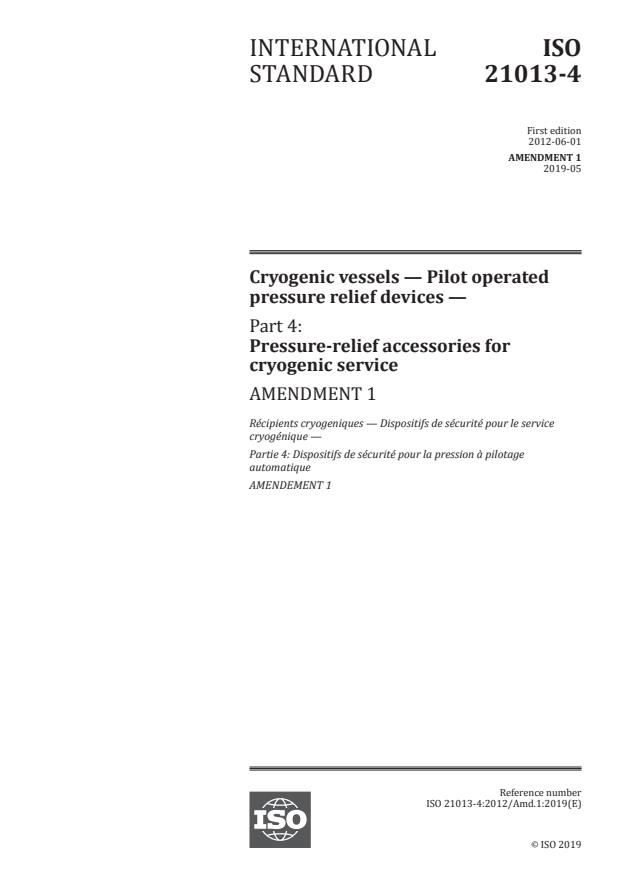
INTERNATIONAL ISO
STANDARD 21013-4
First edition
2012-06-01
AMENDMENT 1
2019-05
Cryogenic vessels — Pilot operated
pressure relief devices —
Part 4:
Pressure-relief accessories for
cryogenic service
AMENDMENT 1
Récipients cryogeniques — Dispositifs de sécurité pour le service
cryogénique —
Partie 4: Dispositifs de sécurité pour la pression à pilotage
automatique
AMENDEMENT 1
Reference number
ISO 21013-4:2012/Amd.1:2019(E)
©
ISO 2019
ISO 21013-4:2012/Amd.1:2019(E)
© ISO 2019
All rights reserved. Unless otherwise specified, or required in the context of its implementation, no part of this publication may
be reproduced or utilized otherwise in any form or by any means, electronic or mechanical, including photocopying, or posting
on the internet or an intranet, without prior written permission. Permission can be requested from either ISO at the address
below or ISO’s member body in the country of the requester.
ISO copyright office
CP 401 • Ch. de Blandonnet 8
CH-1214 Vernier, Geneva
Phone: +41 22 749 01 11
Fax: +41 22 749 09 47
Email: copyright@iso.org
Website: www.iso.org
Published in Switzerland
ii © ISO 2019 – All rights reserved
ISO 21013-4:2012/Amd.1:2019(E)
Foreword
ISO (the International Organization for Standardization) is a worldwide federation of national standards
bodies (ISO member bodies). The work of preparing International Standards is normally carried out
through ISO technical committees. Each member body interested in a subject for which a technical
committee has been established has the right to be represented on that committee. International
organizations, governmental and non-governmental, in liaison with ISO, also take part in the work.
ISO collaborates closely with the International Electrotechnical Commission (IEC) on all matters of
electrotechnical standardization.
The procedures used to develop this document and those intended for its further maintenance are
described in the ISO/IEC Directives, Part 1. In particular, the different approval criteria needed for the
different types of ISO documents should be noted. This document was drafted in accordance with the
editorial rules of the ISO/IEC Directives, Par
...