


ISO 4789:2023
(Main)Guidelines for wastewater treatment and reuse in thermal power plants
Guidelines for wastewater treatment and reuse in thermal power plants
This document specifies guidelines for wastewater treatment and reuse in thermal power plants, including the types and characteristics of wastewater and the technologies of wastewater treatment and reuse. In this document, thermal power plant drainage systems are divided into fuel supply, chemical water treatment, boiler and auxiliary, recirculating cooling, flue gas processing, gasification scrubber and ash handling. Wastewater from these systems is classified in accordance with its system sources. In addition, technical guidelines for wastewater treatment and reuse are provided according to the water requirements of systems in the thermal power plant. This document is formulated to provide feasible technical guidance for the treatment and reuse of wastewater in thermal power plants. It is applicable to coal-fired, oil-fired, gas-fired (including gas turbine), biomass-fired, waste incineration and integrated gasification combined cycle (IGCC) thermal power plants.
Lignes directrices pour le traitement et la réutilisation des eaux usées dans les centrales électriques thermiques
General Information
- Status
- Published
- Publication Date
- 08-Jun-2023
- Technical Committee
- ISO/TC 282/SC 4 - Industrial water reuse
- Drafting Committee
- ISO/TC 282/SC 4 - Industrial water reuse
- Current Stage
- 6060 - International Standard published
- Start Date
- 09-Jun-2023
- Due Date
- 20-Apr-2023
- Completion Date
- 09-Jun-2023
Overview
ISO 4789:2023 - Guidelines for wastewater treatment and reuse in thermal power plants provides technical guidance for classifying, treating and reusing wastewater produced across thermal power plant systems. Applicable to coal‑fired, oil‑fired, gas‑fired (including gas turbines), biomass‑fired, waste‑incineration and IGCC plants, the standard addresses wastewater sources, characteristics, treatment technologies and reuse targets to support water savings and environmental protection.
Key topics and technical requirements
- System-based wastewater classification - divides plant drainage into fuel supply, chemical water treatment, boiler & auxiliary, recirculating cooling, flue gas processing, gasification scrubber and ash handling; wastewater is classified by its system source.
- Wastewater characteristics - describes typical contaminant profiles (e.g., high TSS/COD/turbidity for coal yard runoff; oily wastewater forms; high salinity in RO concentrate; leachate with high COD/ammonia/heavy metals).
- Treatment technology guidance - recommendations for appropriate processes for different streams, including membrane processes (RO, NF, UF), biological and physico‑chemical treatments, and advanced options for TDS reduction and concentrate management.
- Reuse water quality requirements - sets out considerations for matching treated water quality to reuse targets within the plant (e.g., boiler feed, cooling make‑up, ash handling), emphasizing separate treatment where reuse targets differ.
- Design and planning principles - stresses water balance optimization across the whole plant, economic and site considerations, and staged technical/economic review to determine feasible reuse pathways.
- Specific stream guidance - technical approaches for coal wastewater, oily waste, RO concentrate, membrane wash and resin regeneration effluents, boiler blowdown and chemical cleaning waste, FGD/WESP blowdown, gasification scrubber effluent and ash handling water.
Practical applications and users
ISO 4789:2023 is intended for:
- Plant engineers and process designers planning wastewater treatment and reuse schemes.
- Environmental and water‑management teams seeking to reduce freshwater withdrawal and meet discharge limits.
- Consultants and technology vendors designing tailored treatment trains (membranes, biological systems, concentrate management).
- Regulators and sustainability officers evaluating water reuse, zero liquid discharge potential and compliance strategies.
Typical applications include designing boiler blowdown reuse, recycling cooling system blowdown, managing RO concentrate, treating FGD and WESP effluents, and planning whole‑plant water balances to maximize reclaimed water quantities.
Related standards
- ISO 20670 - Water reuse - Vocabulary (normative reference used in ISO 4789).
- Other ISO guidance from ISO/TC 282 (Water reuse) and sector‑specific standards for industrial water management.
Keywords: ISO 4789:2023, wastewater treatment, water reuse, thermal power plants, boiler blowdown, FGD wastewater, RO concentrate, industrial water reuse, IGCC, coal‑fired power plant, zero liquid discharge.
Get Certified
Connect with accredited certification bodies for this standard

NSF International
Global independent organization facilitating standards development and certification.

CIS Institut d.o.o.
Personal Protective Equipment (PPE) certification body. Notified Body NB-2890 for EU Regulation 2016/425 PPE.

Kiwa BDA Testing
Building and construction product certification.
Sponsored listings
Frequently Asked Questions
ISO 4789:2023 is a standard published by the International Organization for Standardization (ISO). Its full title is "Guidelines for wastewater treatment and reuse in thermal power plants". This standard covers: This document specifies guidelines for wastewater treatment and reuse in thermal power plants, including the types and characteristics of wastewater and the technologies of wastewater treatment and reuse. In this document, thermal power plant drainage systems are divided into fuel supply, chemical water treatment, boiler and auxiliary, recirculating cooling, flue gas processing, gasification scrubber and ash handling. Wastewater from these systems is classified in accordance with its system sources. In addition, technical guidelines for wastewater treatment and reuse are provided according to the water requirements of systems in the thermal power plant. This document is formulated to provide feasible technical guidance for the treatment and reuse of wastewater in thermal power plants. It is applicable to coal-fired, oil-fired, gas-fired (including gas turbine), biomass-fired, waste incineration and integrated gasification combined cycle (IGCC) thermal power plants.
This document specifies guidelines for wastewater treatment and reuse in thermal power plants, including the types and characteristics of wastewater and the technologies of wastewater treatment and reuse. In this document, thermal power plant drainage systems are divided into fuel supply, chemical water treatment, boiler and auxiliary, recirculating cooling, flue gas processing, gasification scrubber and ash handling. Wastewater from these systems is classified in accordance with its system sources. In addition, technical guidelines for wastewater treatment and reuse are provided according to the water requirements of systems in the thermal power plant. This document is formulated to provide feasible technical guidance for the treatment and reuse of wastewater in thermal power plants. It is applicable to coal-fired, oil-fired, gas-fired (including gas turbine), biomass-fired, waste incineration and integrated gasification combined cycle (IGCC) thermal power plants.
ISO 4789:2023 is classified under the following ICS (International Classification for Standards) categories: 13.030.20 - Liquid wastes. Sludge; 13.030.50 - Recycling; 13.060.25 - Water for industrial use. The ICS classification helps identify the subject area and facilitates finding related standards.
ISO 4789:2023 is available in PDF format for immediate download after purchase. The document can be added to your cart and obtained through the secure checkout process. Digital delivery ensures instant access to the complete standard document.
Standards Content (Sample)
INTERNATIONAL ISO
STANDARD 4789
First edition
2023-06
Guidelines for wastewater treatment
and reuse in thermal power plants
Lignes directrices pour le traitement et la réutilisation des eaux usées
dans les centrales électriques thermiques
Reference number
© ISO 2023
All rights reserved. Unless otherwise specified, or required in the context of its implementation, no part of this publication may
be reproduced or utilized otherwise in any form or by any means, electronic or mechanical, including photocopying, or posting on
the internet or an intranet, without prior written permission. Permission can be requested from either ISO at the address below
or ISO’s member body in the country of the requester.
ISO copyright office
CP 401 • Ch. de Blandonnet 8
CH-1214 Vernier, Geneva
Phone: +41 22 749 01 11
Email: copyright@iso.org
Website: www.iso.org
Published in Switzerland
ii
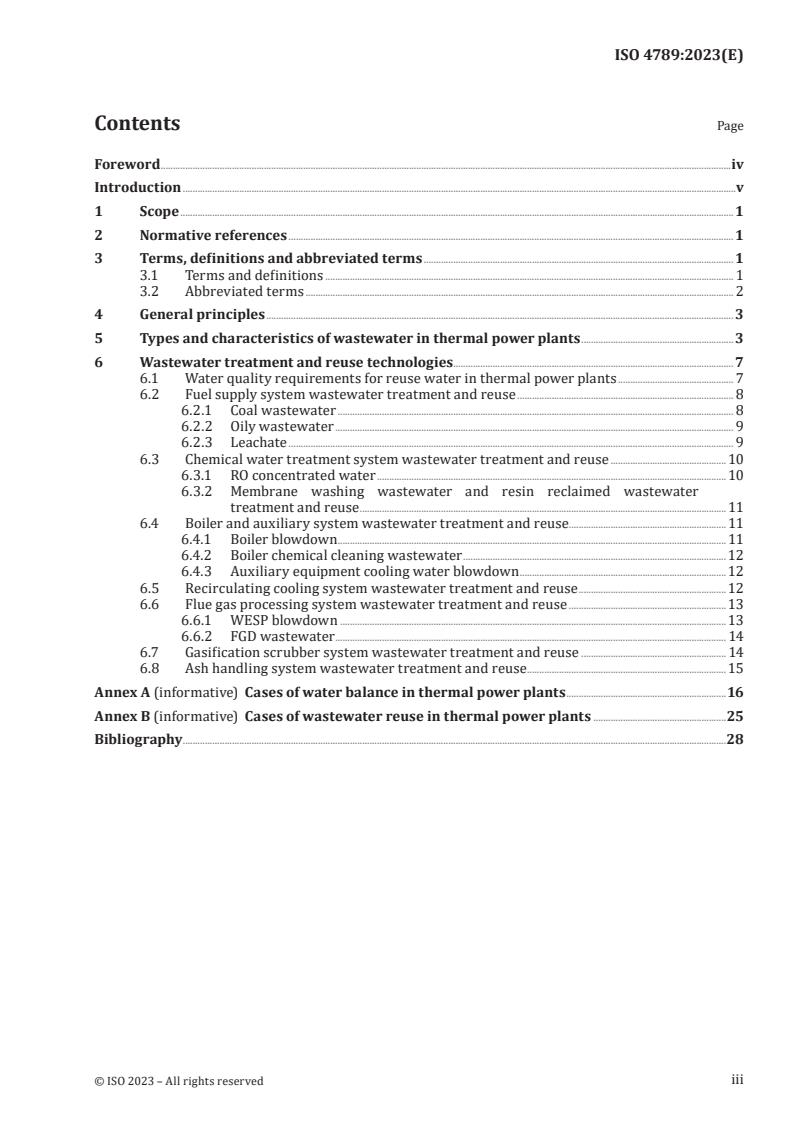
Contents Page
Foreword .iv
Introduction .v
1 Scope . 1
2 Normative references . 1
3 Terms, definitions and abbreviated terms . 1
3.1 Terms and definitions . 1
3.2 Abbreviated terms . 2
4 General principles . 3
5 Types and characteristics of wastewater in thermal power plants .3
6 Wastewater treatment and reuse technologies . 7
6.1 Water quality requirements for reuse water in thermal power plants . 7
6.2 Fuel supply system wastewater treatment and reuse . 8
6.2.1 Coal wastewater . 8
6.2.2 Oily wastewater . 9
6.2.3 Leachate . 9
6.3 Chemical water treatment system wastewater treatment and reuse . 10
6.3.1 RO concentrated water . 10
6.3.2 Membrane washing wastewater and resin reclaimed wastewater
treatment and reuse . 11
6.4 Boiler and auxiliary system wastewater treatment and reuse . 11
6.4.1 Boiler blowdown . . . 11
6.4.2 Boiler chemical cleaning wastewater .12
6.4.3 Auxiliary equipment cooling water blowdown .12
6.5 Recirculating cooling system wastewater treatment and reuse .12
6.6 Flue gas processing system wastewater treatment and reuse .13
6.6.1 WESP blowdown .13
6.6.2 FGD wastewater . 14
6.7 Gasification scrubber system wastewater treatment and reuse . 14
6.8 Ash handling system wastewater treatment and reuse . 15
Annex A (informative) Cases of water balance in thermal power plants .16
Annex B (informative) Cases of wastewater reuse in thermal power plants .25
Bibliography .28
iii
Foreword
ISO (the International Organization for Standardization) is a worldwide federation of national standards
bodies (ISO member bodies). The work of preparing International Standards is normally carried out
through ISO technical committees. Each member body interested in a subject for which a technical
committee has been established has the right to be represented on that committee. International
organizations, governmental and non-governmental, in liaison with ISO, also take part in the work.
ISO collaborates closely with the International Electrotechnical Commission (IEC) on all matters of
electrotechnical standardization.
The procedures used to develop this document and those intended for its further maintenance are
described in the ISO/IEC Directives, Part 1. In particular, the different approval criteria needed for the
different types of ISO document should be noted. This document was drafted in accordance with the
editorial rules of the ISO/IEC Directives, Part 2 (see www.iso.org/directives).
ISO draws attention to the possibility that the implementation of this document may involve the use
of (a) patent(s). ISO takes no position concerning the evidence, validity or applicability of any claimed
patent rights in respect thereof. As of the date of publication of this document, ISO had not received
notice of (a) patent(s) which may be required to implement this document. However, implementers are
cautioned that this may not represent the latest information, which may be obtained from the patent
database available at www.iso.org/patents. ISO shall not be held responsible for identifying any or all
such patent rights.
Any trade name used in this document is information given for the convenience of users and does not
constitute an endorsement.
For an explanation of the voluntary nature of standards, the meaning of ISO specific terms and
expressions related to conformity assessment, as well as information about ISO's adherence to
the World Trade Organization (WTO) principles in the Technical Barriers to Trade (TBT), see
www.iso.org/iso/foreword.html.
This document was prepared by Technical Committee ISO/TC 282, Water reuse, Subcommittee SC 4,
Industrial water reuse.
Any feedback or questions on this document should be directed to the user’s national standards body. A
complete listing of these bodies can be found at www.iso.org/members.html.
iv
Introduction
Global water scarcity is becoming increasingly pronounced as a result of the massive demand for water
caused by population growth, public life and industrial growth. Due to the increasing cost of water and
sewage disposal, wastewater reuse in thermal power plants is being initiated. The number of wastewater
recycling projects in thermal power plants is increasing and water treatment and reuse technologies
are being developed. Studies have shown that electric power plants account for approximately half the
[1]
global industrial water withdrawal , which means the problem of water shortage will be aggravated
with the expansion of thermal power plants.
Although the generation of electricity from renewable sources (e.g. wind, hydro and solar photovoltaic)
with almost zero water consumption is growing, the proportion of world gross electricity generated
[2]
by combustible fuels still accounted for 64,1 % in 2020 . In addition, the wastewater from thermal
power plants (power plants that generate electricity from combustible fuels) is diverse, with a high
[3]
volume and complex pollutant components , and its discharge poses a threat to the ecology of water
environments. Therefore, the reuse of wastewater from thermal power plants has dual benefits of
water saving and environmental protection.
The increasing efforts to control water scarcity and water pollution in some countries have made
industrial wastewater reuse a valuable means of augmenting the existing water supply and reducing
wastewater discharge to the environment. In terms of wastewater treatment and reuse in thermal
[4] [5] [6] [7]
power plants, the United States , China , Japan and International Energy Agency (IEA) have all
introduced relevant policies to encourage wastewater reuse or even zero discharge in thermal power
plants.
However, the reclaimed water quantity of wastewater in thermal power plants is not high, and the
different characteristics of wastewater generated from different systems are ignored. Therefore, it
is necessary to strengthen the classification and characteristic analysis of wastewater, adopt more
reasonable and efficient treatment and reuse technologies in thermal power plants to optimize the
reclaimed water quantity of wastewater, to realize zero liquid discharge of wastewater and to improve
the benefits of water saving and environmental protection and ultimately achieve the sustainable
development goals (see www.un.org/sustainabledevelopment).
v
INTERNATIONAL STANDARD ISO 4789:2023(E)
Guidelines for wastewater treatment and reuse in thermal
power plants
1 Scope
This document specifies guidelines for wastewater treatment and reuse in thermal power plants,
including the types and characteristics of wastewater and the technologies of wastewater treatment
and reuse.
In this document, thermal power plant drainage systems are divided into fuel supply, chemical water
treatment, boiler and auxiliary, recirculating cooling, flue gas processing, gasification scrubber and
ash handling. Wastewater from these systems is classified in accordance with its system sources. In
addition, technical guidelines for wastewater treatment and reuse are provided according to the water
requirements of systems in the thermal power plant. This document is formulated to provide feasible
technical guidance for the treatment and reuse of wastewater in thermal power plants.
It is applicable to coal-fired, oil-fired, gas-fired (including gas turbine), biomass-fired, waste incineration
and integrated gasification combined cycle (IGCC) thermal power plants.
2 Normative references
The following documents are referred to in the text in such a way that some or all of their content
constitutes requirements of this document. For dated references, only the edition cited applies. For
undated references, the latest edition of the referenced document (including any amendments) applies.
ISO 20670, Water reuse — Vocabulary
3 Terms, definitions and abbreviated terms
For the purposes of this document, the terms and definitions given in ISO 20670 and the following apply.
ISO and IEC maintain terminology databases for use in standardization at the following addresses:
— ISO Online browsing platform: available at https:// www .iso .org/ obp
— IEC Electropedia: available at https:// www .electropedia .org/
3.1 Terms and definitions
3.1.1
advanced treatment for TDS
advanced treatment for total dissolved solids
process of further reducing the salt content in wastewater by using advanced treatment technology
after pretreatment to achieve certain reuse water targets
3.1.2
ash handling system
system that includes all the equipment, pipelines and monitoring devices for collecting bottom ash and
fly ash from combustion or gasification of fuel in boilers and transferring it out of the power plant
3.1.3
boiler and auxiliary system
system that includes primary production equipment for the combustion or gasification of fuel and other
auxiliary machinery
3.1.4
chemical water treatment system
system that treats the raw water to achieve water quality requirements for the different water
applications in the power plant
Note 1 to entry: A chemical water treatment system includes the raw water pretreatment, boiler replenishment
water treatment, condensate polishing treatment and wastewater treatment
3.1.5
flue gas processing system
system that purifies boiler flue gas and reduces pollutants such as sulfur dioxide, nitrogen oxides,
particulate matter and organic gas in flue gas
3.1.6
fuel supply system
system that collects, stores, pre-treats and transports combustible fuels for power generation
3.1.7
gasification scrubber system
system that purifies gaseous fuel after gasification of solid or liquid fuel
3.1.8
recirculating cooling system
system that circularly uses a cooling medium (e.g. water, air) to transfer heat
Note 1 to entry: A recirculating cooling system consists of heat exchange equipment, cooling equipment,
treatment facilities, pumps, pipelines and other related facilities.
3.1.9
reclaimed water quantity
amount of water that is directly cascade-utilized or reused after proper treatment in the production
process of the thermal power plant
3.1.10
thermal power plant
power plant that converts heat, such as that released by the combustion of carbonaceous fuels, into
electricity
Note 1 to entry: Carbonaceous fuels include coal and coal products, oil and oil products, natural gas, biofuels
from biomass, industrial waste and municipal waste.
[SOURCE: ISO 27919-1:2018, 3.1.42, modified — Definition revised and note to entry added.]
3.2 Abbreviated terms
A/O anoxic/oxic
BOD biochemical oxygen demand after 5 days
COD chemical oxygen demand
EDTA ethylene diamine tetraacetic acid
FGD flue gas desulfurization
IGCC integrated gasification combined cycle
MBR membrane bioreactor
MVR mechanical vapor recompression
NF nanofiltration
NTU nephelometric turbidity unit
PAHs polycyclic aromatic hydrocarbons
RO reverse osmosis
TDS total dissolved solids
TP total phosphorus
TSS total suspended solids
UASB upflow anaerobic sludge blanket
UF ultrafiltration
WESP wet electrostatic precipitator
4 General principles
The following principles should be followed for the treatment and reuse of wastewater in thermal
power plants.
a) The wastewater should be treated and reused separately if its water quality and reuse target are
different.
b) If wastewater has similar water quality and the same reuse target, similar treatment processes can
be adopted.
c) Wastewater that meets the water quality requirements of the reuse target can be directly utilized
in the target system.
d) The process flow of wastewater treatment and reuse in thermal power plants should be determined
taking requirements of the effluent water quantity and quality, influent water quality of reuse
targets, site conditions, environmental protection and other factors into account during the
technical and economic review.
e) The entire plant water balance should be optimized before designing a water reuse plan. The water
withdrawal, consumption and drainage of each system should be considered through a water
balance. The water quality requirements of each system should also be considered (see Annex A).
5 Types and characteristics of wastewater in thermal power plants
Wastewater in thermal power plants can be classified based on the following systems: fuel supply,
chemical water treatment, boiler and auxiliary, recirculating cooling, flue gas processing, gasification
[8]
scrubber and ash handling. The types of wastewater in each system are shown in Table 1.
Table 1 — Types of wastewater in thermal power plants
System source Type Involved power plants
a
Coal wastewater Coal-fired power plants, IGCC
b
Oily wastewater All power plants
Fuel supply
Biomass-fired power plants, waste incineration
c
Leachate
power plants
d
RO concentrated water
Chemical water treat-
e
Membrane washing wastewater All power plants
ment
f
Resin reclaimed wastewater
a
Coal wastewater has high TSS, COD, chroma and turbidity. The TSS concentration can be between 200 mg/l and
5,000 mg/l. Coal wastewater includes the leakage caused by the spraying and dustproofing in the coal yard, the washing
waste water caused by the washing of the coal transporting trestle, the rain water in the coal yard and the effluent water
after dust removal in the coal conveying system.
b [9]
Oily wastewater includes oil slick, disperse oil, emulsified oil and dissolved oil . It can come from the oil storage
facilities, the leakage of the oil system in the main plant during the operation of the steam engine and the power generation
turning machine bearings, and the oily wastewater generated during the operation, cleaning or overhaul of the equipment.
c [10]
Leachate has high COD, BOD , ammonia nitrogen, TSS and heavy metals, with a pH of 5~7 . It comes from the
biochemical degradation during the stacking process of biomass or waste. Its quantity and quality are different due to the
types of waste generated from various sites, fuel composition and climatic conditions at the power plants.
d
RO-concentrated water is of high salinity, and its quality is related to the quality of raw water. It is concentrated
wastewater generated during the operation of the RO membrane filtration system in the chemical water treatment system
[11]
of the power plants .
e
Membrane washing wastewater is acidic or alkaline and has a high salinity. It comes from the physical and chemical
cleaning of membrane components in chemical water treatment system. Its quantity and quality are related to the quality
of raw water and the concentration of chemical cleaning agent.
f
Resin reclaimed wastewater is the acid or alkali wastewater from the regeneration of ion-exchange resin in the
chemical water treatment system. It is of high TDS and TSS. Its quantity and quality are related to resin regeneration time
and acid and base dosage.
g
Boiler blowdown can be divided into boiler continuous blowdown and boiler regular blowdown. The boiler continuous
3−−2 2−
+ 2+ 3+
blowdown contains only a small amount of Na , PO ,CO ,SiO , Fe , Fe and other salts. The iron content in the boiler
4 3 3
[12]
regular blowdown is high and contains ammonia nitrogen, TSS and COD .
h
Boiler chemical cleaning wastewater has high TDS, COD and TSS. Major pollutants are dependent on the type of acid
cleaning agent, such as hydrochloric acid, citric acid, complex acid and EDTA, used in the process of boiler chemical cleaning.
i
Auxiliary equipment cooling water blowdown contains a small amount of TDS and the water quality is high. It comes
from the cooling water system of auxiliary equipment of the power plant.
j
Cooling tower blowdown has high salinity, which has the largest flow rate in thermal power plants. Its quantity and
quality are related to the concentration ratio. The common pollutants include TSS, colloid, organic matter, inorganic salts,
microorganisms and algae. These pollutants come mainly from supplemental water and chemicals added to the water cycle,
as well as pollutants that grow in the system.
k
WESP blowdown can be split into WESP continuous blowdown and WESP regular blowdown since the cleaning types
of WESP include continuous-flow water cleaning and spray cleaning. The WESP blowdown is acidic wastewater, including
TSS, TDS and heavy metal. Its quantity is related to the cleaning type of WESP.
l
FGD wastewater is acidic, with a pH value between 4 and 6, containing a large number of TSS (e.g. gypsum particles,
SiO , CaF ) and a certain amount of COD. TSS is about 10,000 mg/l or more, TDS ranges between 30,000 mg/l to 65,000 mg/l.
2 2
-
The hardness is relatively high. The anions in wastewater are mainly Cl and sulfate radical ions, and there are many kinds
of heavy metal cation, such as mercury, lead, zinc, nickel and arsenic.
m
Tar-containing wastewater is the organic wastewater with tar as the main pollutant produced by wet gas purification
equipment. Tar can be considered a mixture of several acidic, alkaline and neutral compounds. The acidic components
include acids and phenols, the basic components include nitrogen-containing compounds and the neutral components
[12]
include PAHs . In addition, the wastewater also contains ammonia nitrogen, chloride and other inorganic substances.
n
The quality of ash handling wastewater is determined by the chemical composition of ash. Since the fuel source is not
fixed, the water quality of ash handling wastewater is also unstable. In general, ash wastewater is of high pH and TDS.
The pH value is generally greater than 9 and sometimes more than 10,5. It contains heavy metal elements and fluoride
dissolved from ash residue. The TSS of ash handling wastewater in the slurry concentration pool is higher.
TTaabbllee 11 ((ccoonnttiinnueuedd))
System source Type Involved power plants
g
Boiler blowdown
Boiler chemical cleaning waste-
h
Boiler and auxiliary water All power plants
Auxiliary equipment cooling
i
water blowdown
j
Recirculating cooling Cooling tower blowdown All power plants
k
WESP blowdown Coal-fired power plants
Coal-fired power plants, oil-fired power plants,
Flue gas processing
l
FGD wastewater biomass-fired power plants, waste incineration
power plants
a
Coal wastewater has high TSS, COD, chroma and turbidity. The TSS concentration can be between 200 mg/l and
5,000 mg/l. Coal wastewater includes the leakage caused by the spraying and dustproofing in the coal yard, the washing
waste water caused by the washing of the coal transporting trestle, the rain water in the coal yard and the effluent water
after dust removal in the coal conveying system.
b [9]
Oily wastewater includes oil slick, disperse oil, emulsified oil and dissolved oil . It can come from the oil storage
facilities, the leakage of the oil system in the main plant during the operation of the steam engine and the power generation
turning machine bearings, and the oily wastewater generated during the operation, cleaning or overhaul of the equipment.
c [10]
Leachate has high COD, BOD , ammonia nitrogen, TSS and heavy metals, with a pH of 5~7 . It comes from the
biochemical degradation during the stacking process of biomass or waste. Its quantity and quality are different due to the
types of waste generated from various sites, fuel composition and climatic conditions at the power plants.
d
RO-concentrated water is of high salinity, and its quality is related to the quality of raw water. It is concentrated
wastewater generated during the operation of the RO membrane filtration system in the chemical water treatment system
[11]
of the power plants .
e
Membrane washing wastewater is acidic or alkaline and has a high salinity. It comes from the physical and chemical
cleaning of membrane components in chemical water treatment system. Its quantity and quality are related to the quality
of raw water and the concentration of chemical cleaning agent.
f
Resin reclaimed wastewater is the acid or alkali wastewater from the regeneration of ion-exchange resin in the
chemical water treatment system. It is of high TDS and TSS. Its quantity and quality are related to resin regeneration time
and acid and base dosage.
g
Boiler blowdown can be divided into boiler continuous blowdown and boiler regular blowdown. The boiler continuous
3−−2 2−
+ 2+ 3+
blowdown contains only a small amount of Na , PO ,CO ,SiO , Fe , Fe and other salts. The iron content in the boiler
4 3 3
[12]
regular blowdown is high and contains ammonia nitrogen, TSS and COD .
h
Boiler chemical cleaning wastewater has high TDS, COD and TSS. Major pollutants are dependent on the type of acid
cleaning agent, such as hydrochloric acid, citric acid, complex acid and EDTA, used in the process of boiler chemical cleaning.
i
Auxiliary equipment cooling water blowdown contains a small amount of TDS and the water quality is high. It comes
from the cooling water system of auxiliary equipment of the power plant.
j
Cooling tower blowdown has high salinity, which has the largest flow rate in thermal power plants. Its quantity and
quality are related to the concentration ratio. The common pollutants include TSS, colloid, organic matter, inorganic salts,
microorganisms and algae. These pollutants come mainly from supplemental water and chemicals added to the water cycle,
as well as pollutants that grow in the system.
k
WESP blowdown can be split into WESP continuous blowdown and WESP regular blowdown since the cleaning types
of WESP include continuous-flow water cleaning and spray cleaning. The WESP blowdown is acidic wastewater, including
TSS, TDS and heavy metal. Its quantity is related to the cleaning type of WESP.
l
FGD wastewater is acidic, with a pH value between 4 and 6, containing a large number of TSS (e.g. gypsum particles,
SiO , CaF ) and a certain amount of COD. TSS is about 10,000 mg/l or more, TDS ranges between 30,000 mg/l to 65,000 mg/l.
2 2
-
The hardness is relatively high. The anions in wastewater are mainly Cl and sulfate radical ions, and there are many kinds
of heavy metal cation, such as mercury, lead, zinc, nickel and arsenic.
m
Tar-containing wastewater is the organic wastewater with tar as the main pollutant produced by wet gas purification
equipment. Tar can be considered a mixture of several acidic, alkaline and neutral compounds. The acidic components
include acids and phenols, the basic components include nitrogen-containing compounds and the neutral components
[12]
include PAHs . In addition, the wastewater also contains ammonia nitrogen, chloride and other inorganic substances.
n
The quality of ash handling wastewater is determined by the chemical composition of ash. Since the fuel source is not
fixed, the water quality of ash handling wastewater is also unstable. In general, ash wastewater is of high pH and TDS.
The pH value is generally greater than 9 and sometimes more than 10,5. It contains heavy metal elements and fluoride
dissolved from ash residue. The TSS of ash handling wastewater in the slurry concentration pool is higher.
TTaabbllee 11 ((ccoonnttiinnueuedd))
System source Type Involved power plants
m
Gasification scrubber Tar-containing wastewater Biomass gasification power plants, IGCC
Coal-fired power plants, biomass-fired power
n
Ash handling Ash handling wastewater
plants, waste incineration power plants
a
Coal wastewater has high TSS, COD, chroma and turbidity. The TSS concentration can be between 200 mg/l and
5,000 mg/l. Coal wastewater includes the leakage caused by the spraying and dustproofing in the coal yard, the washing
waste water caused by the washing of the coal transporting trestle, the rain water in the coal yard and the effluent water
after dust removal in the coal conveying system.
b [9]
Oily wastewater includes oil slick, disperse oil, emulsified oil and dissolved oil . It can come from the oil storage
facilities, the leakage of the oil system in the main plant during the operation of the steam engine and the power generation
turning machine bearings, and the oily wastewater generated during the operation, cleaning or overhaul of the equipment.
c [10]
Leachate has high COD, BOD , ammonia nitrogen, TSS and heavy metals, with a pH of 5~7 . It comes from the
biochemical degradation during the stacking process of biomass or waste. Its quantity and quality are different due to the
types of waste generated from various sites, fuel composition and climatic conditions at the power plants.
d
RO-concentrated water is of high salinity, and its quality is related to the quality of raw water. It is concentrated
wastewater generated during the operation of the RO membrane filtration system in the chemical water treatment system
[11]
of the power plants .
e
Membrane washing wastewater is acidic or alkaline and has a high salinity. It comes from the physical and chemical
cleaning of membrane components in chemical water treatment system. Its quantity and quality are related to the quality
of raw water and the concentration of chemical cleaning agent.
f
Resin reclaimed wastewater is the acid or alkali wastewater from the regeneration of ion-exchange resin in the
chemical water treatment system. It is of high TDS and TSS. Its quantity and quality are related to resin regeneration time
and acid and base dosage.
g
Boiler blowdown can be divided into boiler continuous blowdown and boiler regular blowdown. The boiler continuous
3−−2 2−
+ 2+ 3+
blowdown contains only a small amount of Na , PO ,CO ,SiO , Fe , Fe and other salts. The iron content in the boiler
4 3 3
[12]
regular blowdown is high and contains ammonia nitrogen, TSS and COD .
h
Boiler chemical cleaning wastewater has high TDS, COD and TSS. Major pollutants are dependent on the type of acid
cleaning agent, such as hydrochloric acid, citric acid, complex acid and EDTA, used in the process of boiler chemical cleaning.
i
Auxiliary equipment cooling water blowdown contains a small amount of TDS and the water quality is high. It comes
from the cooling water system of auxiliary equipment of the power plant.
j
Cooling tower blowdown has high salinity, which has the largest flow rate in thermal power plants. Its quantity and
quality are related to the concentration ratio. The common pollutants include TSS, colloid, organic matter, inorganic salts,
microorganisms and algae. These pollutants come mainly from supplemental water and chemicals added to the water cycle,
as well as pollutants that grow in the system.
k
WESP blowdown can be split into WESP continuous blowdown and WESP regular blowdown since the cleaning types
of WESP include continuous-flow water cleaning and spray cleaning. The WESP blowdown is acidic wastewater, including
TSS, TDS and heavy metal. Its quantity is related to the cleaning type of WESP.
l
FGD wastewater is acidic, with a pH value between 4 and 6, containing a large number of TSS (e.g. gypsum particles,
SiO , CaF ) and a certain amount of COD. TSS is about 10,000 mg/l or more, TDS ranges between 30,000 mg/l to 65,000 mg/l.
2 2
-
The hardness is relatively high. The anions in wastewater are mainly Cl and sulfate radical ions, and there are many kinds
of heavy metal cation, such as mercury, lead, zinc, nickel and arsenic.
m
Tar-containing wastewater is the organic wastewater with tar as the main pollutant produced by wet gas purification
equipment. Tar can be considered a mixture of several acidic, alkaline and neutral compounds. The acidic components
include acids and phenols, the basic components include nitrogen-containing compounds and the neutral components
[12]
include PAHs . In addition, the wastewater also contains ammonia nitrogen, chloride and other inorganic substances.
n
The quality of ash handling wastewater is determined by the chemical composition of ash. Since the fuel source is not
fixed, the water quality of ash handling wastewater is also unstable. In general, ash wastewater is of high pH and TDS.
The pH value is generally greater than 9 and sometimes more than 10,5. It contains heavy metal elements and fluoride
dissolved from ash residue. The TSS of ash handling wastewater in the slurry concentration pool is higher.
6 Wastewater treatment and reuse technologies
6.1 Water quality requirements for reuse water in thermal power plants
To ensure the proper operation of each system, it is recommended that the reuse water quality after
treatment meet the requirements of influent water for the given target. The required water quality
parameters of various types of industrial reuse water are given in Table 2.
Table 2 — Required water quality parameters of reuse water
Chem-
Ash
ical
han-
Recirculat-
Gasifi-
Fuel supply sys- water Boiler and aux- Flue gas pro-
ing cooling dling
cation
tem treat- iliary system cessing system
sys-
system
scrubber
ment
Parame-
tem-
No. sys-
system
ter
tem-Pro-
Ash
Boiler WESP
cess
Wash- Dust-sup-
han-
Influent make- Cooling Cooling clean- Process
water
ing pressing
dling
water up water water ing water
water water water
a
water water
pH 6,5 to 8,8 to 7,0 to 6,0 to 6,5 to
1 6,5 to 9,0 C 6,5 to 8,5 6,5 to 9,5 C
(25 °C) 9,0 9,3 9,5 8,0 9,0
TSS
2 ≤ 30 ≤ 30 C C C ≤ 30 ≤ 150 ≤ 50 O ≤ 30
(mg/l)
Turbidity
3 O O O C C ≤ 5 C O O O
(NTU)
4 Chroma ≤ 30 ≤ 30 C C C ≤ 30 C C C ≤ 30
BOD
5 ≤ 30 ≤ 30 C C C ≤ 10 C C C ≤ 30
(mg/l)
COD
6 O O O O C ≤ 60 O O O O
(mg/l)
Fe
7 ≤ 0,3 ≤ 0,3 O O C ≤ 0,3 C C C ≤ 0,3
(mg/l)
Mn
8 ≤ 0,1 ≤ 0,1 O C C ≤ 0,1 C C C ≤ 0,1
(mg/l)
-
Cl
9 ≤ 250 ≤ 250 C O C C ≤ 200 ≤ 1,000 C ≤ 250
(mg/l)
SiO
10 O O O ≤ 0,02 C ≤ 50 O O O O
(mg/l)
Total
hardness
11 ≤ 450 ≤ 450 C ≤ 0,002 C ≤ 450 ≤ 200 ≤ 250 C ≤ 450
(mg/l)
Total al-
kalinity
12 ≤ 350 ≤ 350 C C C ≤ 350 C C C ≤ 350
(mg/l)
NOTE The values in this table refer to References [14] to [21].
a
The water quality of boiler make-up water in the boiler and auxiliary system should meet the following additional
targets: TOC (total organic carbon) ≤ 0,4 mg/l, conductivity (25 °C) ≤ 0,4 μS/cm.
Key
C: The indicator is controlled; the value or range of the indicator is conditional.
O: The indicator is optional.
TTaabbllee 22 ((ccoonnttiinnueuedd))
Chem-
Ash
ical
Recirculat- han-
Gasifi-
Fuel supply sys- water Boiler and aux- Flue gas pro-
ing cooling dling
cation
tem treat- iliary system cessing system
sys-
system
scrubber
ment
Parame-
tem-
No. sys-
system
ter
tem-Pro-
Ash
Boiler WESP
cess
Wash- Dust-sup-
han-
Influent make- Cooling Cooling clean- Process
water
ing pressing dling
water up water water ing water
water water
water
a
water water
Sulfate
13 ≤ 250 ≤ 250 C C C ≤ 600 ≤ 200 ≤ 400 C ≤ 250
(mg/l)
NH -N
14 O O O C C ≤ 10 ≤ 10 ≤ 10 O O
(mg/l)
TP
15 O O O C C ≤ 1 ≤ 5 ≤ 5 O O
(mg/l)
TDS
16 ≤ 1,000 ≤ 1,000 C ≤ 0,1 C ≤ 1,000 C C C ≤ 1,000
(mg/l)
Petrole-
um
17 C O O C C ≤ 5 0 0 C O
(mg/l)
NOTE The values in this table refer to References [14] to [21].
a
The water quality of boiler make-up water in the boiler and auxiliary system should meet the following additional
targets: TOC (total organic carbon) ≤ 0,4 mg/l, conductivity (25 °C) ≤ 0,4 μS/cm.
Key
C: The indicator is controlled; the value or range of the indicator is conditional.
O: The indicator is optional.
6.2 Fuel supply system wastewater treatment and reuse
6.2.1 Coal wastewater
According to the effluent water quality of coal wastewater and the influent water quality requirements
for the reuse targets, pre-precipitation, coagulating sedimentation, filtration, etc. or a combination of
processes can be adopted to treat the coal wastewater. Options for treatment and reuse processes are
shown in Figure 1.
The effluent after pre-precipitation, coagulating sedimentation and filtration treatment can be reused
in the coal supply system (washing water for coal conveying facilities, dust-suppressing water for
spraying in dry coal yard).
a
The pre-precipitation of coal wastewater is used to separate large particles of solids from waste-
water. Sedimentation by gravity can be used.
b
The coagulating sedimentation of coal wastewater is used to remove TSS in wastewater. Chemical
flocculation, electronic flocculation, etc. can be used.
c
The filtration of coal wastewater is used to separate sludge formed by coagulating sedimentation
from wastewater. Mechanical filtration, membrane filtration, etc. can be used.
d
If there is oil in the coal wastewater, an air float treatment unit can be added after coagulating
sedimentation to remove the oil in the wastewater.
Figure 1 — Process flow of coal wastewater treatment and reuse
6.2.2 Oily wastewater
The separation treatment system should be set up for oily wastewater. According to the effluent
water quality of oily wastewater and the influent water quality requirements for the reuse targets, oil
separation, air floating, deep de-oiling, etc. or a combination of processes can be adopted to treat the
oily wastewater. Options for treatment and reuse processes are shown in Figure 2.
The effluent after oil separation and air flotation treatment can be reused in the oil supply system
(washing water for oil storage and oil conveying facilities). The effluent after oil separation and air
flotation treatment also can be reused in the coal supply system (washing water for coal conveying
facilities, dust-suppressing water for spraying in dry coal yard). The effluent after oil separation, air
flotation and deep de-oiling treatment can be reused in the recirculating cooling system (recirculating
cooling water).
a
Oil droplets with larger particle size and suspended oil droplets in wastewater can be removed
using oil separation processes such as advection oil traps, inclined plate oil traps or corrugated
inclined plate oil traps.
b
Dispersed oil droplets with smaller particle size and solid particles in oily wastewater can be
removed using air flotation.
c
Deep de-oiling of oily wastewater is used to remove dissolved oil droplets from the wastewater
using processes such as flocculation precipitation, biological treatment and membrane filtration.
Figure 2 — Process flow of oily wastewater treatment and reuse
6.2.3 Leachate
A separate collection and treatment system should be set up for leachate. According to the effluent
water quality of leachate and the influent water quality requirements for the reuse targets, biological
treatment, membrane filtration, etc. or a combination of processes can be adopted to treat leachate.
Options for treatment and reuse processes are shown in Figure 3. More information about leachate
[22]
treatment and reuse can be found in ISO 24297 .
The effluent after biological treatment and membrane filtration treatment can be reused in the ash
handling system (ash handling water, ash field spray water), flue gas processing system (process water)
and recirculating cooling system (recirculating cooling water).
The concentrated water after biological treatment and membrane filtration treatment can be sprayed
back to the boiler. The concentrated water is regularly sprayed into the boiler in a certain ratio according
to the amount and calorific value of the waste, avoiding the generation of excessive crystalline salts by
controlling the proportion of concentrated water injected back.
a
The biological treatment of leachate is used to remove organic matter in wastewater, such as COD,
BOD or oil. Anaerobic activated sludge process, A/O, etc. can be used.
b
The membrane filtration of leachate is used to remove pollutants such as heavy metal ions and
small molecules from wastewater. UF, NF, RO, etc. can be used.
Figure 3 — Process flow of leachate treatment and reuse
6.3 Chemical water treatment system wastewater treatment and reuse
6.3.1 RO concentrated water
According to the effluent water quality of RO concentrated water and the influent water quality
requirements for the reuse targets, the membrane filtration processes can be adopted to treat RO
concentrated water. Options for treatment and reuse processes are shown in Figure 4.
RO concentrated water can be directly utilized in the ash handling system (ash handling water, ash
field spray water) and/or the flue gas processing system (process water). The concentrated water
after membrane filtration treatment can be reused in the ash handling system (ash handling water, ash
field spray water) and/or the flue gas processing system (process water). The concentration of TDS in
the concentrated water needs to be considered to avoid adverse effects on ash reuse and equipment
operation. The effluent after membrane filtration treatment can be reused in the recirculating cooling
system (recirculating cooling water).
a
The membrane filtration of RO concentrated water is used to remove salts in wastewater. NF, RO,
etc. can be used.
b
If the hardness of RO concentrated water is high, a softening treatment unit can be added before
membrane filtration to remove hardness. The softening process includes the application of soften-
ing agents and ion exchange.
Figure 4 — Process flow of RO concentrated water treatment and reuse
6.3.2 Membrane washing wastewater and resin reclaimed wastewater treatment and reuse
Membrane washing wastewater and resin reclaimed wastewater are similar and have the same reuse
targets. According to the effluent water quality of membrane washing wastewater and resin reclaimed
wastewater and the influent water quality requirements for the reuse targets, neutralization,
coagulating sedimentation, filtration, etc. or a combination of processes can be adopted to treat
membrane washing wastewater and resin reclaimed wastewater. Options for treatment and reuse
processes are shown in Figure 5.
Membrane washing wastewater and resin reclaimed wastewater can be utilized to the ash handling
system (ash handling water, ash field spray water) and/or the flue gas processing system (process
water) after neutralization. The concentrated water after neutralization, coagulating sedimentation
and filtration treatment can be reused in the ash handling system (ash handling water, ash field
spray water) and/or the flue gas processing system (process water). The effluent after neutralization,
coagulating sedimentation and filtration treatment can be reused in the recirculating cooling system
(recirculating cooling water) if the quantity of TDS is relatively little.
a
The neutralization of membrane washing wastewater and resin reclaimed wastewater is used to
adjust the pH to neutral by adding acid (or alkali) for subsequent treatment.
b
The coagulating sedim
...
Questions, Comments and Discussion
Ask us and Technical Secretary will try to provide an answer. You can facilitate discussion about the standard in here.
Loading comments...