


ISO/FDIS 29821
(Main)Condition monitoring and diagnostics of machine systems — Ultrasound — General requirements, guidelines, procedures and validation
Condition monitoring and diagnostics of machine systems — Ultrasound — General requirements, guidelines, procedures and validation
ISO 29821:2018 - gives guidelines for establishing severity assessment criteria for anomalies identified by airborne (AB) and structure-borne (SB) ultrasound, - specifies methods and requirements for carrying out ultrasonic examination of machines, including safety recommendations and sources of error, and - provides information relative to data interpretation, assessment criteria and reporting.
Surveillance des conditions et diagnostic d'état des machines — Ultrasons — Exigences générales, lignes directrices, procédures et validation
General Information
- Status
- Not Published
- Technical Committee
- ISO/TC 108/SC 5 - Condition monitoring and diagnostics of machine systems
- Drafting Committee
- ISO/TC 108/SC 5/WG 15 - Ultrasound
- Current Stage
- 5020 - FDIS ballot initiated: 2 months. Proof sent to secretariat
- Start Date
- 29-Jan-2026
- Completion Date
- 29-Jan-2026
Relations
- Effective Date
- 04-Nov-2023
Overview
ISO/FDIS 29821:2026, issued by the International Organization for Standardization (ISO), sets forth comprehensive guidelines for the use of ultrasound technology in the condition monitoring and diagnostics of machine systems. This standard focuses specifically on both airborne (AB) and structure-borne (SB) ultrasound methods, providing general requirements, procedures, and validation processes to ensure reliable anomaly detection in mechanical and electrical machinery.
By establishing well-defined severity assessment criteria, methods for ultrasonic inspection, and data interpretation protocols, ISO 29821 aims to enhance the accuracy and effectiveness of preventative maintenance programs that leverage ultrasonic testing. The standard also addresses safety recommendations and highlights common sources of error to improve diagnostic confidence.
Key Topics
Principles of Airborne and Structure-Borne Ultrasound
Understanding how ultrasound waves propagate through air or machine structures is fundamental. Ultrasound frequencies above 20 kHz, which are inaudible to humans, are detected externally to locate faults such as leaks, friction, impacts, or electrical discharges.Ultrasound Equipment and Sensor Selection
The standard covers guidelines for choosing appropriate airborne microphones and structure-borne contact modules, including considerations for sensor type, instrument characteristics, and recent advancements like MEMS sensors.Data Collection and Interpretation
It provides methods for both qualitative (comparative) and quantitative (baseline) ultrasonic data collection. Proper training and consistent procedures are emphasized to ensure accuracy and repeatability in measurements.Assessment Criteria and Error Management
ISO 29821 details how to establish severity levels for anomalies detected via ultrasound and discusses common error sources such as background noise, sonic reflections, and sensor mounting issues.Validation and Monitoring Practices
The standard includes protocols for sensitivity validation and recommendations on monitoring intervals to optimize maintenance schedules. It also compares ultrasound with alternative condition monitoring techniques.Reporting and Documentation
Guidance on generating comprehensive ultrasound inspection reports ensures that findings are clearly communicated and actionable.
Applications
ISO 29821 facilitates effective ultrasonic testing across a broad range of machine systems, including but not limited to:
Mechanical Systems
- Heat exchangers, boilers, condensers
- Valves, steam traps, pumps, gears, gearboxes
- Fans, compressors, conveyors, turbines
- Bearings (both high-speed and low-speed), lubrication systems
Electrical Systems
- Motors, switchgear, transformers, insulators
- Junction boxes, circuit breakers
- Detection of arcing, corona discharges, and potential safety hazards
Ultrasound serves as an essential non-invasive tool to detect early-stage mechanical wear, leaks, improper lubrication, electrical faults, and other anomalies that traditional vibration or thermographic analysis might miss. Moreover, it can act as a safety check prior to procedures like infrared thermography on electrical cabinets.
Related Standards
ISO/FDIS 29821 is aligned and references several related ISO standards to ensure comprehensive coverage of machine condition monitoring:
- ISO 13372 - Vocabulary for condition monitoring and diagnostics
- ISO 13379-1 - Data interpretation and diagnostic techniques
- ISO 13381-1 - Prognostics and general guidelines for condition monitoring
- ISO 17359 - General guidelines for condition monitoring and diagnostics
- ISO 18436-8 - Qualification and assessment of personnel specifically for ultrasound
- ISO 22096 - Use of acoustic emission in condition monitoring (related technology)
These standards collectively provide a robust framework that standardizes terminology, methodologies, and training requirements fundamental to effective ultrasonic condition monitoring.
Keywords: ISO 29821 ultrasound, condition monitoring standard, machine diagnostics, airborne ultrasound, structure-borne ultrasound, ultrasonic inspection, severity assessment criteria, ultrasonic data interpretation, ultrasonic equipment, machine fault detection, preventive maintenance, vibration analysis alternative, ISO standards machinery

ISO/FDIS 29821 - Condition monitoring and diagnostics of machine systems — Ultrasound — General requirements, guidelines, procedures and validation Released:15. 01. 2026
REDLINE ISO/FDIS 29821 - Condition monitoring and diagnostics of machine systems — Ultrasound — General requirements, guidelines, procedures and validation Released:15. 01. 2026
Get Certified
Connect with accredited certification bodies for this standard

BSMI (Bureau of Standards, Metrology and Inspection)
Taiwan's standards and inspection authority.
Sponsored listings
Frequently Asked Questions
ISO/FDIS 29821 is a draft published by the International Organization for Standardization (ISO). Its full title is "Condition monitoring and diagnostics of machine systems — Ultrasound — General requirements, guidelines, procedures and validation". This standard covers: ISO 29821:2018 - gives guidelines for establishing severity assessment criteria for anomalies identified by airborne (AB) and structure-borne (SB) ultrasound, - specifies methods and requirements for carrying out ultrasonic examination of machines, including safety recommendations and sources of error, and - provides information relative to data interpretation, assessment criteria and reporting.
ISO 29821:2018 - gives guidelines for establishing severity assessment criteria for anomalies identified by airborne (AB) and structure-borne (SB) ultrasound, - specifies methods and requirements for carrying out ultrasonic examination of machines, including safety recommendations and sources of error, and - provides information relative to data interpretation, assessment criteria and reporting.
ISO/FDIS 29821 is classified under the following ICS (International Classification for Standards) categories: 17.160 - Vibrations, shock and vibration measurements. The ICS classification helps identify the subject area and facilitates finding related standards.
ISO/FDIS 29821 has the following relationships with other standards: It is inter standard links to ISO 29821:2018. Understanding these relationships helps ensure you are using the most current and applicable version of the standard.
ISO/FDIS 29821 is available in PDF format for immediate download after purchase. The document can be added to your cart and obtained through the secure checkout process. Digital delivery ensures instant access to the complete standard document.
Standards Content (Sample)
FINAL DRAFT
International
Standard
ISO/TC 108/SC 5
Condition monitoring and
Secretariat: SA
diagnostics of machine
Voting begins on:
systems — Ultrasound — General
2026-01-29
requirements, guidelines,
Voting terminates on:
procedures and validation
2026-03-26
Surveillance des conditions et diagnostic d'état des machines —
Ultrasons — Exigences générales, lignes directrices, procédures et
validation
RECIPIENTS OF THIS DRAFT ARE INVITED TO SUBMIT,
WITH THEIR COMMENTS, NOTIFICATION OF ANY
RELEVANT PATENT RIGHTS OF WHICH THEY ARE AWARE
AND TO PROVIDE SUPPOR TING DOCUMENTATION.
IN ADDITION TO THEIR EVALUATION AS
BEING ACCEPTABLE FOR INDUSTRIAL, TECHNO
LOGICAL, COMMERCIAL AND USER PURPOSES, DRAFT
INTERNATIONAL STANDARDS MAY ON OCCASION HAVE
TO BE CONSIDERED IN THE LIGHT OF THEIR POTENTIAL
TO BECOME STAN DARDS TO WHICH REFERENCE MAY BE
MADE IN NATIONAL REGULATIONS.
Reference number
FINAL DRAFT
International
Standard
ISO/TC 108/SC 5
Condition monitoring and
Secretariat: SA
diagnostics of machine
Voting begins on:
systems — Ultrasound — General
requirements, guidelines,
Voting terminates on:
procedures and validation
Surveillance des conditions et diagnostic d'état des machines —
Ultrasons — Exigences générales, lignes directrices, procédures et
validation
RECIPIENTS OF THIS DRAFT ARE INVITED TO SUBMIT,
WITH THEIR COMMENTS, NOTIFICATION OF ANY
RELEVANT PATENT RIGHTS OF WHICH THEY ARE AWARE
AND TO PROVIDE SUPPOR TING DOCUMENTATION.
© ISO 2026
IN ADDITION TO THEIR EVALUATION AS
All rights reserved. Unless otherwise specified, or required in the context of its implementation, no part of this publication may
BEING ACCEPTABLE FOR INDUSTRIAL, TECHNO
LOGICAL, COMMERCIAL AND USER PURPOSES, DRAFT
be reproduced or utilized otherwise in any form or by any means, electronic or mechanical, including photocopying, or posting on
INTERNATIONAL STANDARDS MAY ON OCCASION HAVE
the internet or an intranet, without prior written permission. Permission can be requested from either ISO at the address below
TO BE CONSIDERED IN THE LIGHT OF THEIR POTENTIAL
or ISO’s member body in the country of the requester.
TO BECOME STAN DARDS TO WHICH REFERENCE MAY BE
MADE IN NATIONAL REGULATIONS.
ISO copyright office
CP 401 • Ch. de Blandonnet 8
CH-1214 Vernier, Geneva
Phone: +41 22 749 01 11
Email: copyright@iso.org
Website: www.iso.org
Published in Switzerland Reference number
ii
Contents Page
Foreword .iv
Introduction .v
1 Scope . 1
2 Normative references . 1
3 Terms and definitions . 1
4 Principle of the airborne and structure-borne method . 2
4.1 General .2
4.2 Application of airborne and structure-borne ultrasound within condition monitoring
programmes . . .2
4.3 Correlation with other technologies .3
5 Ultrasound equipment . 4
5.1 General .4
5.2 Types of sensor .6
5.3 Airborne sensor choice.7
5.4 Structure-borne sensor choice .7
5.5 Instrument characteristics . .7
5.5.1 General .7
5.5.2 Frequency response .7
6 Data collection guidelines . 8
6.1 General .8
6.2 Comparative ultrasound .8
6.3 Baseline method — Quantitative ultrasound .9
7 Training requirements . 9
8 Assessment criteria . 9
8.1 General .9
8.2 Error sources, accuracy and repeatability .11
9 Interpretation guidelines .11
10 Diagnosing ultrasonic problems .12
10.1 Principles of diagnostics using ultrasound . 12
10.2 Generation of ultrasound . 12
10.2.1 Surface friction . 12
10.2.2 Fluid flow . 12
10.2.3 Ionization . 12
10.2.4 Impacting . 12
11 Sensitivity validation guidelines .12
12 Monitoring interval.13
13 Alternative CM techniques .13
14 Reporting .13
Annex A (informative) Example of a compressed air leak survey . 14
Annex B (informative) Typical examples of ultrasound test reports . 17
Annex C (informative) Example of a generic sensitivity validation procedure — Ultrasonic tone
generator method .20
Bibliography .22
iii
Foreword
ISO (the International Organization for Standardization) is a worldwide federation of national standards
bodies (ISO member bodies). The work of preparing International Standards is normally carried out through
ISO technical committees. Each member body interested in a subject for which a technical committee
has been established has the right to be represented on that committee. International organizations,
governmental and non-governmental, in liaison with ISO, also take part in the work. ISO collaborates closely
with the International Electrotechnical Commission (IEC) on all matters of electrotechnical standardization.
The procedures used to develop this document and those intended for its further maintenance are described
in the ISO/IEC Directives, Part 1. In particular, the different approval criteria needed for the different types
of ISO document should be noted. This document was drafted in accordance with the editorial rules of the
ISO/IEC Directives, Part 2 (see www.iso.org/directives).
ISO draws attention to the possibility that the implementation of this document may involve the use of (a)
patent(s). ISO takes no position concerning the evidence, validity or applicability of any claimed patent
rights in respect thereof. As of the date of publication of this document, ISO had not received notice of (a)
patent(s) which may be required to implement this document. However, implementers are cautioned that
this may not represent the latest information, which may be obtained from the patent database available at
www.iso.org/patents. ISO shall not be held responsible for identifying any or all such patent rights.
Any trade name used in this document is information given for the convenience of users and does not
constitute an endorsement.
For an explanation of the voluntary nature of standards, the meaning of ISO specific terms and expressions
related to conformity assessment, as well as information about ISO's adherence to the World Trade
Organization (WTO) principles in the Technical Barriers to Trade (TBT), see www.iso.org/iso/foreword.html.
This document was prepared by Technical Committee ISO/TC 108, Mechanical vibration, shock and condition
monitoring, Subcommittee SC 5, Condition monitoring and diagnostics of machine systems.
This second edition of ISO 29821 cancels and replaces the first edition (ISO 29821:2018) which has been
technically revised.
The main changes are as follows:
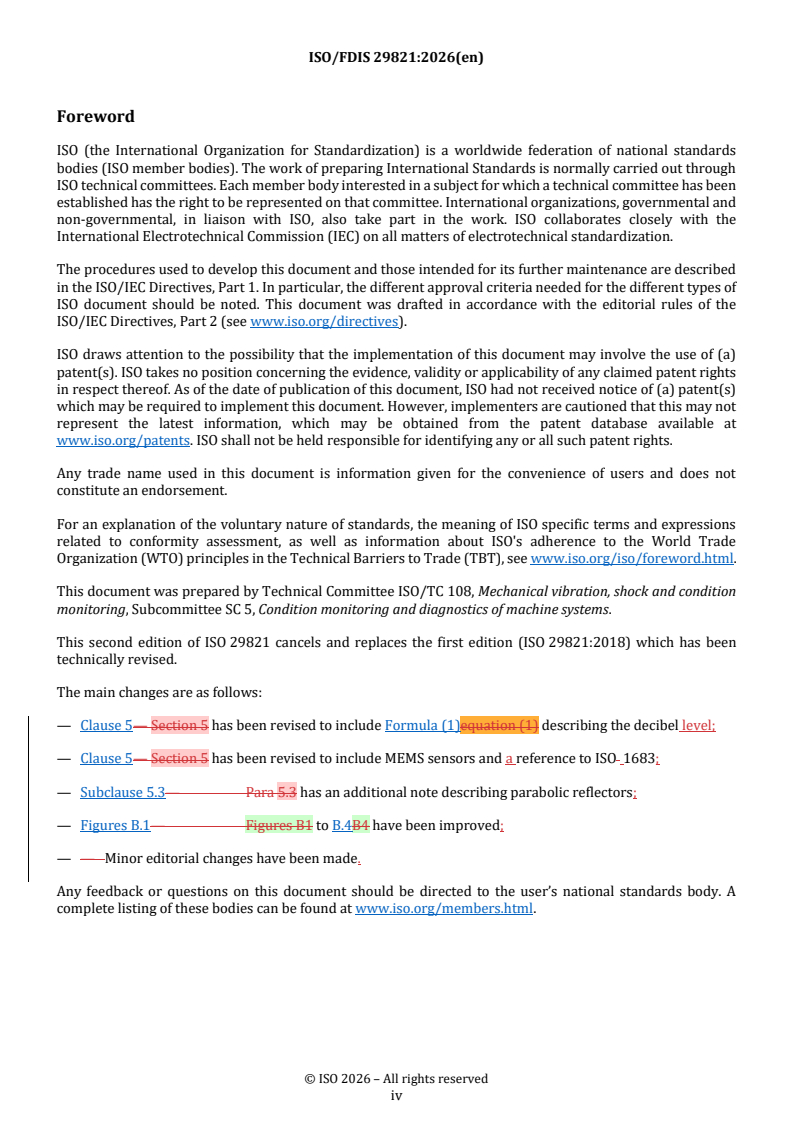
— Clause 5 has been revised to include Formula (1) describing the decibel level;
— Clause 5 has been revised to include MEMS sensors and a reference to ISO 1683;
— Subclause 5.3 has an additional note describing parabolic reflectors;
— Figures B.1 to B.4 have been improved;
— Minor editorial changes have been made.
Any feedback or questions on this document should be directed to the user’s national standards body. A
complete listing of these bodies can be found at www.iso.org/members.html.
iv
Introduction
This document provides specific guidance on the interpretation of ultrasonic readings and wave files or
frequency and time domain printouts (sometimes called sound characteristics) as part of a programme for
condition monitoring (CM) and diagnostics of machines.
Airborne (AB) and structure-borne (SB) ultrasound can be used to detect abnormal performance or
machine anomalies. The anomalies are detected as high frequency acoustic events caused by turbulent flow,
ionization events, impacts and friction which are caused by incorrect machinery operation, leaks, improper
lubrication, worn components, and/or electrical discharges.
Airborne and structure-borne ultrasound is based on measuring the high frequency sound that is generated
by either turbulent flow, friction, impacts or ionization created from the anomalies. Personnel carrying
out ultrasonic inspections or measurements therefore require an understanding of ultrasound and how it
propagates through the atmosphere and through structures as a prerequisite to the creation of an airborne
and/or structure-borne ultrasound programme.
Ultrasonic energy is present with the operation of all machines. It can be in the form of friction, turbulent
flow, impacts and/or ionization as a property of the process, or produced by the process itself. As a result,
ultrasonic emissions are created and these are a useful parameter for monitoring the condition of machines
and for detecting machine anomalies.
v
FINAL DRAFT International Standard ISO/FDIS 29821:2026(en)
Condition monitoring and diagnostics of machine systems —
Ultrasound — General requirements, guidelines, procedures
and validation
1 Scope
This document
— gives guidelines for establishing severity assessment criteria for anomalies identified by airborne (AB)
and structure-borne (SB) ultrasound,
— specifies methods and requirements for carrying out ultrasonic inspection, testing, measurement and
monitoring of machines, including safety recommendations and sources of error, and
— provides information relative to data interpretation, assessment criteria and reporting.
2 Normative references
The following documents are referred to in the text in such a way that some or all of their content constitutes
requirements of this document. For dated references, only the edition cited applies. For undated references,
the latest edition of the referenced document (including any amendments) applies.
ISO 13372, Condition monitoring and diagnostics of machines — Vocabulary
ISO 13379-1, Condition monitoring and diagnostics of machine systems — Data interpretation and diagnostics
techniques — Part 1: General guidelines
ISO 13381-1, Condition monitoring and diagnostics of machine systems — Prognostics — Part 1: General
guidelines and requirements
ISO 17359, Condition monitoring and diagnostics of machines — General guidelines
ISO 18436-8, Condition monitoring and diagnostics of machines — Requirements for qualification and
assessment of personnel — Part 8: Ultrasound
3 Terms and definitions
For the purposes of this document, the terms and definitions given in ISO 13372 and the following apply.
ISO and IEC maintain terminology databases for use in standardization at the following addresses:
— IEC Electropedia: available at https:// www .electropedia .org/
— ISO Online browsing platform: available at https:// www .iso .org/ obp
3.1
airborne and structure-borne ultrasound
non-destructive test method detecting airborne and structure-borne ultrasound above 20 kHz created from
or through a medium
3.2
background noise
unwanted noise present in a signal which cannot be attributed to a specific cause
Note 1 to entry: This ultrasonic noise can emanate from the area surrounding the measurement position, which can
cause false indications.
3.3
scanning
moving a receiving transducer or an array of transducers around a suspected source of ultrasound to verify
its location
3.4
sonic reflection
airborne ultrasound reflected off a solid surface possibly indicating a false reading
3.5
contact module
waveguide in the form of a rod attached to an ultrasonic transducer conducting ultrasound through physical
contact with the structure or machine
4 Principle of the airborne and structure-borne method
4.1 General
Airborne and structure-borne ultrasound is a physical wave that occurs within the test subject (material or
machinery component) or in the atmosphere and is detected externally either close to or at a distance from
the test subject and is based on the detection of high-frequency sounds.
Most ultrasonic instruments used to monitor equipment detect frequencies above 20 kHz which is above
the range of human hearing (20 Hz to 20 kHz). The differences in the way low-frequency and high-frequency
sounds travel help to explain why this technology can be effective for condition monitoring since
— low-frequency sounds maintain a high intensity of sound volume and travel further than high-frequency
sounds, and
— high-frequency sounds are more directional. As high-frequency sound waves propagate from the point of
generation, their intensity level decreases rapidly with distance depending on the elasticity and density
of the medium traversed which helps to identify the origin of a sound source.
Airborne ultrasound is propagated through an atmosphere (air or gas) and detected with an ultrasonic
microphone while structure-borne ultrasound is generated within and propagated through the structure
and is usually detected with a contact module, although other sensors may be used. These contact modules
do not require any coupling agent, as the detection frequencies are low enough that, unlike traditional pulse-
echo ultrasound, small air gaps between the contact probe and the structure under test do not significantly
attenuate the received signal. If permanently mounted sensors are used, careful mounting techniques
should be utilized to avoid signal attenuation or resonances, or both. The structure can be a machine or any
component of a machine or a system.
4.2 Application of airborne and structure-borne ultrasound within condition monitoring
programmes
Ultrasound is a non-invasive measurement technique which can identify a range of faults in many
applications.
Table 1 shows typical examples of ultrasound applications to machine condition monitoring.
4.3 Correlation with other technologies
Airborne and structure-borne ultrasonic is often used in a condition-monitoring programme to detect
failure modes that have been previously identified by another technology. There are instances where
airborne or structure-borne ultrasound is the first indicator of a failure mode, such as in the detection
of faulty slow-speed bearings and/or insufficient lubrication in rolling element bearings. Airborne or
structure-borne ultrasound can also be used to identify a potential safety hazard to a practitioner using an
alternate technology, for example, in the inspection of enclosed electrical systems. Airborne and structure-
borne ultrasound can be used to determine if an arc flash hazard is present before opening the cabinet for
an infrared thermographic inspection.
Acoustic emission is the phenomenon of radiation of acoustic (elastic) waves in solids that occurs when a
material undergoes irreversible changes in its internal structure. Acoustic emission is traditionally utilized
to monitor items that are under stress to detect the formation and location of cracks including structures,
pressure vessels and pipelines. Many of the acoustic emission applications are similar to the structure-borne
ones described in this document.
NOTE For information on the use of acoustic emission for condition monitoring refer to ISO 22096.
Table 1 — Ultrasonic application examples
Pressure or vacuum leak
a a
Machine description Mechanical Electrical
a
detection
Heat exchangers AB — —
Boilers AB — —
Condensers AB — —
Control air systems AB — —
Valves SB — —
Steam traps SB — —
Motors — SB SB
Pumps AB SB SB
Gears/gear boxes — SB —
Fans — SB —
Compressors AB SB SB
Conveyors — SB and AB SB
Switchgear — AB and SB AB and SB
Transformers — SB AB/SB
Insulators — — AB
Junction boxes — — SB
Circuit breaker — — SB
Turbines AB SB —
Generators (utility) AB SB AB/SB
Lubrication — SB —
High-speed bearings — SB and AB —
Low-speed bearings — SB and AB —
a
AB: airborne; SB: structure-borne.
5 Ultrasound equipment
5.1 General
Airborne and structure-borne ultrasonic instruments are typically hand-held, portable and battery operated
for ease of use in the field. Online, non-portable systems are also utilized mainly for condition monitoring
where an anomaly may occur and needs to be addressed at the inception rather than when a route-based
inspection is scheduled. Most online applications target a narrow range of applications where amplitude is
the primary parameter that is monitored and false indications are less likely to occur.
It is recommended that the system consist of an instrument, ultrasonic transducer and headphones. It is
also recommended that the demodulated output signal can be made audible using headphones to enable
discrimination between competing sources. This allows the practitioner to recognize and prevent the
acquisition of poor-quality data.
The system shall provide for the detection of acoustic energy that is either airborne or structure-borne in
the range above 20 kHz and shall translate (demodulate or heterodyne) this energy into an audible signal
that can be seen on a signal strength indicator and heard through headphones. The signal strength is usually
displayed in decibels and commonly referred to as decibel value. The demodulated or heterodyned signal is
representative of the amplitude and frequency characteristics of the original ultrasonic signal.
The ultrasonic physical pressure wave or pressure variation which is received and measured by the ultrasonic
instrument is demodulated and converted to a corresponding decibel level, L , given by Formula (1):
p
L = 20 log r (1)
p 10 a
where
L is the sound pressure level (dB);
p
r is the relative voltage amplitude ratio, referenced to the threshold level of the instrument.
a
Instrument sensitivity may vary between different manufacturers. Each manufacturer establishes its own
threshold level (0 dB) If a condition monitoring application requires a comparison or trending of signal
strength readings over time, care should be taken to use instruments that have the same sensitivity so that
comparable data can be obtained. When making comparisons between instrument readings, the dB readings
shall be of the same type.
NOTE Guidance on preferred reference quantities for acoustic levels is given in ISO 1683.
The main housing contains ultrasonic transducers that receive the ultrasound signal and convert it to an
amplified electrical signal. Next, this signal is fed into the main instrument where it is amplified again,
then demodulated or heterodyned. The demodulation or heterodyne principle is used to convert the non-
audible ultrasonic frequencies down to the audible level suitable for humans to hear and for interfacing with
recording and analysing devices. In the demodulation or heterodyne process, the audio signal is a direct
translation of the original signal and this demodulated signal is used for further analysis (see Figure 1).
The demodulated or heterodyned signal allows the practitioner to identify a relevant sound source and to
determine the event or condition producing the ultrasound (e.g. air leaks in the same area as an electrical
discharge can cause confusion to an unskilled operator). The demodulated signal can also be used to
determine the location of the irrelevant ultrasound that could lead to a false reading.
Therefore, the headphone output signal is not a divided signal where the audio frequency is multiplied by a
number and ends up with the ultrasonic frequency. In the demodulation (heterodyne) process, the incoming
ultrasonic signal is mixed with an internal oscillator signal and the difference is amplified and then sent to
the headphone output and the meter circuit. An analogy would be a piano key being struck once a second
(1 Hz); the resultant sound would contain the resonant frequency of the string that the piano key is linked to,
modulated by the 1 Hz of the key being struck. If the piano string signal (carrier frequency) were removed,
what would be left is the 1 Hz signal (modulation frequency) of the key being depressed.
The ultrasonic sensors only detect high-frequency noise caused by friction or turbulent flow and do not
respond to low-frequency acceleration, displacement or audible sounds. In the case of bearings, ultrasound
is created by the motion of the rotating elements. As a bearing deteriorates, imperfections form on the
rotating surfaces and when a rotating element interacts with the imperfection, it produces an acoustic event
or symptom. The actual fault frequencies of the affected bearing modulate the high-frequency components
of the generated ultrasonic noise or signal. The signal after the demodulation or heterodyning would only
leave the original modulation.
For example, in a bearing, if the fault frequency is 48 Hz, the instrument detects the ultrasonic component
that is modulated by the 48 Hz fault frequency. When that signal is demodulated or heterodyned, the audio
signal at the headphones does not contain the ultrasonic signal, but contains the 48 Hz fault frequency signal.
In high-speed bearings, when analysing the demodulated or heterodyned ultrasound signal with a spectral
(FFT) analyser, and comparing it to the signal from an accelerometer, the signals would be qualitatively
similar. With low-speed bearings typically below 10 r/min, comparison of ultrasonic to vibration signals
depends on the acceleration sensor type. For example:
— Standard piezo-electric vibration accelerometers have low signal output at low excitation frequency.
(typically <5,0 Hz).
— Micro-electromechanical systems (MEMS) accelerometers typically have good output response down to
0 Hz.
— Ultrasonic sensors can provide useful measurements from large bearings (e.g. >15 m diameter) on
machines operating at speeds <1 r/min, with the sensor output then evaluated by spectral analysis
(FFT).
In addition to mechanical condition analysis, signal analysis of the heterodyned signals received from
electrical discharges can help identify the severity of the condition and can also help distinguish the
difference between loose components such as transformer windings and electrical discharges.
Key
1 transducer pre-amp
2 variable gain amplifier
3 demodulation circuit
4 mixer
5 oscillator
6 low-pass filter
7 audio amplifier
8 phone output
9 line output
10 RMS-to-DC converter
11 digital I/O
12 sensitivity/frequency adjustment knob
13 store button
14 CPU and digital controls
15 gain control
16 frequency control
17 converter input
18 display
Figure 1 — Block diagram example of an ultrasonic detector
5.2 Types of sensor
Airborne ultrasound is propagated through an atmosphere (air or gas) and detected with an ultrasonic
sensor, while structure-borne ultrasound is generated within and propagated through a structure and is
usually detected with a contact module, although other sensors may be used. Examples of which sensor
should be chosen can be found in Table 1.
5.3 Airborne sensor choice
An ultrasonic instrument with fixed sensors might have limitations with respect to field of detection and
might not be suitable for all applications. For ultrasonic instruments with interchangeable sensors, there is
normally a choice of two types of sensor configuration: wide-angle and parabolic.
NOTE A parabolic reflector microphone is a device that uses a parabolic dish to collect and focus sound waves
from a specific direction onto the microphone sensor.
For machine condition monitoring, wide-angle airborne sensors are particularly useful for gaining an overall
assessment of the machine condition utilizing the maximum machine area for comparison of ultrasonic
signatures. This allows the comparison of multiple components in a single machine. This module type is also
useful in confined-space areas where the access area can be very small.
Parabolic sensors are useful for remote detection such as elevated conveyors, equipment, vessels and
outdoor substations, where access may be limited and the machine, system, or component of either, may
be at a great distance. The narrow field of reception is helpful especially for pinpointing leaks in overhead
piping or in determining which phase in a high-voltage electrical tower has an electrical discharge.
5.4 Structure-borne sensor choice
Structure-borne sensors are used to non-invasively detect internal abnormal performance or machine
anomalies. There is normally a choice of hand-held contact, magnetically coupled or permanently installed
(threaded) sensors.
The contact sensor (stethoscope) is most commonly used when a machine, system or component needs to
be quickly scanned to determine where an anomaly or fault condition is located. It is also effectively used to
get into tight spaces to gain access to a good monitoring point. For measurement points that are just out of
reach, extension contact rods can be u
...
ISO TC 108/SC 5
Date: 2025-12-13
ISO/TC 108/SC 5
Secretariat: SA
Date: 2026-xx
Condition monitoring and diagnostics of machinesmachine
systems — Ultrasound — General requirements, guidelines,
procedures and validation
Surveillance des conditions et diagnostic d'état des machines — Ultrasons — Exigences générales, lignes
directrices, procédures et validation
FDIS stage
All rights reserved. Unless otherwise specified, or required in the context of its implementation, no part of this publication
may be reproduced or utilized otherwise in any form or by any means, electronic or mechanical, including photocopying,
or posting on the internet or an intranet, without prior written permission. Permission can be requested from either ISO
at the address below or ISO'sISO’s member body in the country of the requester.
ISO copyright office
CP 401 • Ch. de Blandonnet 8
CH-1214 Vernier, Geneva
Phone: + 41 22 749 01 11
Email:
E-mail: copyright@iso.org
Website: www.iso.org
Published in Switzerland.
ii
Contents Page
Foreword . iv
Introduction . v
1 Scope . 1
2 Normative references . 1
3 Terms and definitions . 1
4 Principle of the airborne and structure-borne method . 2
4.1 General. 2
4.2 Application of airborne and structure-borne ultrasound within condition monitoring
programmes. 2
4.3 Correlation with other technologies . 3
5 Ultrasound equipment . 4
5.1 General. 4
5.2 Types of sensor . 6
5.3 Airborne sensor choice . 7
5.4 Structure-borne sensor choice . 7
5.5 Instrument characteristics . 7
6 Data collection guidelines. 8
6.1 General. 8
6.2 Comparative ultrasound . 8
6.3 Baseline method — Quantitative ultrasound . 9
7 Training requirements . 9
8 Assessment criteria . 9
8.1 General. 9
8.2 Error sources, accuracy and repeatability . 11
9 Interpretation guidelines . 11
10 Diagnosing ultrasonic problems . 12
10.1 Principles of diagnostics using ultrasound . 12
10.2 Generation of ultrasound . 12
11 Sensitivity validation guidelines . 13
12 Monitoring interval . 13
13 Alternative CM techniques . 13
14 Reporting . 13
Annex A (informative) Example of a compressed air leak survey . 15
Annex B (informative) Typical examples of ultrasound test reports . 19
Annex C (informative) Example of a generic sensitivity validation procedure — Ultrasonic tone
generator method . 23
Bibliography . 25
iii
Foreword
ISO (the International Organization for Standardization) is a worldwide federation of national standards
bodies (ISO member bodies). The work of preparing International Standards is normally carried out through
ISO technical committees. Each member body interested in a subject for which a technical committee has been
established has the right to be represented on that committee. International organizations, governmental and
non-governmental, in liaison with ISO, also take part in the work. ISO collaborates closely with the
International Electrotechnical Commission (IEC) on all matters of electrotechnical standardization.
The procedures used to develop this document and those intended for its further maintenance are described
in the ISO/IEC Directives, Part 1. In particular, the different approval criteria needed for the different types of
ISO document should be noted. This document was drafted in accordance with the editorial rules of the
ISO/IEC Directives, Part 2 (see www.iso.org/directives).
ISO draws attention to the possibility that the implementation of this document may involve the use of (a)
patent(s). ISO takes no position concerning the evidence, validity or applicability of any claimed patent rights
in respect thereof. As of the date of publication of this document, ISO had not received notice of (a) patent(s)
which may be required to implement this document. However, implementers are cautioned that this may not
represent the latest information, which may be obtained from the patent database available at
www.iso.org/patents. ISO shall not be held responsible for identifying any or all such patent rights.
Any trade name used in this document is information given for the convenience of users and does not
constitute an endorsement.
For an explanation of the voluntary nature of standards, the meaning of ISO specific terms and expressions
related to conformity assessment, as well as information about ISO's adherence to the World Trade
Organization (WTO) principles in the Technical Barriers to Trade (TBT), see www.iso.org/iso/foreword.html.
This document was prepared by Technical Committee ISO/TC 108, Mechanical vibration, shock and condition
monitoring, Subcommittee SC 5, Condition monitoring and diagnostics of machine systems.
This second edition of ISO 29821 cancels and replaces the first edition (ISO 29821:2018) which has been
technically revised.
The main changes are as follows:
— Clause 5— Section 5 has been revised to include Formula (1)equation (1) describing the decibel level;
— Clause 5— Section 5 has been revised to include MEMS sensors and a reference to ISO 1683;
— Subclause 5.3— Para 5.3 has an additional note describing parabolic reflectors;
— Figures B.1— Figures B1 to B.4B4 have been improved;
— — Minor editorial changes have been made.
Any feedback or questions on this document should be directed to the user’s national standards body. A
complete listing of these bodies can be found at www.iso.org/members.html.
iv
Introduction
This document provides specific guidance on the interpretation of ultrasonic readings and wave files or
frequency and time domain printouts (sometimes called sound characteristics) as part of a programme for
condition monitoring (CM) and diagnostics of machines.
Airborne (AB) and structure-borne (SB) ultrasound can be used to detect abnormal performance or machine
anomalies. The anomalies are detected as high frequency acoustic events caused by turbulent flow, ionization
events, impacts and friction which are caused by incorrect machinery operation, leaks, improper lubrication,
worn components, and/or electrical discharges.
Airborne and structure-borne ultrasound is based on measuring the high frequency sound that is generated
by either turbulent flow, friction, impacts or ionization created from the anomalies. Personnel carrying out
ultrasonic inspections or measurements therefore require an understanding of ultrasound and how it
propagates through the atmosphere and through structures as a prerequisite to the creation of an airborne
and/or structure-borne ultrasound programme.
Ultrasonic energy is present with the operation of all machines. It can be in the form of friction, turbulent flow,
impacts and/or ionization as a property of the process, or produced by the process itself. As a result, ultrasonic
emissions are created and these are a useful parameter for monitoring the condition of machines and for
detecting machine anomalies.
v
Condition monitoring and diagnostics of machinesmachine systems —
Ultrasound — General requirements, guidelines, procedures and
validation
1 Scope
This document
— — gives guidelines for establishing severity assessment criteria for anomalies identified by airborne (AB)
and structure-borne (SB) ultrasound,
— — specifies methods and requirements for carrying out ultrasonic inspection, testing, measurement and
monitoring of machines, including safety recommendations and sources of error, and
— — provides information relative to data interpretation, assessment criteria and reporting.
2 Normative references
The following documents are referred to in the text in such a way that some or all of their content constitutes
requirements of this document. For dated references, only the edition cited applies. For undated references,
the latest edition of the referenced document (including any amendments) applies.
ISO 13372, Condition monitoring and diagnostics of machines — Vocabulary
ISO 13379--1, Condition monitoring and diagnostics of machine systems — Data interpretation and diagnostics
techniques — Part 1: General guidelines
ISO 13381--1, Condition monitoring and diagnostics of machine systems — Prognostics — Part 1: General
guidelines and requirements
ISO 17359, Condition monitoring and diagnostics of machines — General guidelines
ISO 18436--8, Condition monitoring and diagnostics of machines — Requirements for qualification and
assessment of personnel — Part 8: Ultrasound
3 Terms and definitions
For the purposes of this document, the terms and definitions given in ISO 13372 and the following apply.
ISO and IEC maintain terminologicalterminology databases for use in standardization at the following
addresses:
— — IEC Electropedia: available at https://www.electropedia.org/
— — ISO Online browsing platform: available at https://www.iso.org/obp
3.1 3.1
airborne and structure-borne ultrasound
non-destructive test method detecting airborne and structure-borne ultrasound above 20 kHz created from
or through a medium
3.2 3.2
background noise
unwanted noise present in a signal which cannot be attributed to a specific cause
Note 1 to entry: This ultrasonic noise can emanate from the area surrounding the measurement position, which can
cause false indications.
3.3 3.3
scanning
moving a receiving transducer or an array of transducers around a suspected source of ultrasound to verify
its location
3.4 3.4
sonic reflection
airborne ultrasound reflected off a solid surface possibly indicating a false reading
3.5 3.5
contact module
waveguide in the form of a rod attached to an ultrasonic transducer conducting ultrasound through physical
contact with the structure or machine
4 Principle of the airborne and structure-borne method
4.1 General
Airborne and structure-borne ultrasound is a physical wave that occurs within the test subject (material or
machinery component) or in the atmosphere and is detected externally either close to or at a distance from
the test subject and is based on the detection of high-frequency sounds.
Most ultrasonic instruments employedused to monitor equipment detect frequencies above 20 kHz which is
above the range of human hearing (20 Hz to 20 kHz). The differences in the way low-frequency and high-
frequency sounds travel help to explain why this technology can be effective for condition monitoring since:
— — low-frequency sounds maintain a high intensity of sound volume and travel further than high-
frequency sounds, and
— — high-frequency sounds are more directional. As high-frequency sound waves propagate from the point
of generation, their intensity level decreases rapidly with distance depending on the elasticity and density
of the medium traversed which helps to identify the origin of a sound source.
Airborne ultrasound is propagated through an atmosphere (air or gas) and detected with an ultrasonic
microphone while structure-borne ultrasound is generated within and propagated through the structure and
is usually detected with a contact module, although other sensors may be used. These contact modules do not
require any coupling agent, as the detection frequencies are low enough that, unlike traditional pulse-echo
ultrasound, small air gaps between the contact probe and the structure under test do not significantly
attenuate the received signal. If permanently mounted sensors are used, careful mounting techniques should
be utilized to avoid signal attenuation or resonances, or both. The structure can be a machine or any
component of a machine or a system.
4.2 Application of airborne and structure-borne ultrasound within condition monitoring
programmes
Ultrasound is a non-invasive measurement technique which can identify a range of faults in many applications.
Table 1Table 1 shows typical examples of ultrasound applications to machine condition monitoring.
4.3 Correlation with other technologies
Airborne and structure-borne ultrasonic is often used in a condition-monitoring programme to detect failure
modes that have been previously identified by another technology. There are instances where airborne or
structure-borne ultrasound is the first indicator of a failure mode, such as in the detection of faulty slow-speed
bearings and/or insufficient lubrication in rolling element bearings. Airborne or structure-borne ultrasound
can also be used to identify a potential safety hazard to a practitioner using an alternate technology, for
example, in the inspection of enclosed electrical systems. Airborne and structure-borne ultrasound can be
used to determine if an arc flash hazard is present before opening the cabinet for an infrared thermographic
inspection.
Acoustic emission is the phenomenon of radiation of acoustic (elastic) waves in solids that occurs when a
material undergoes irreversible changes in its internal structure. Acoustic emission is traditionally utilized to
monitor items that are under stress to detect the formation and location of cracks including structures,
pressure vessels and pipelines. Many of the acoustic emission applications are similar to the structure-borne
ones described in this document.
NOTE For information on the use of acoustic emission for condition monitoring refer to ISO 22096.
Table 1 — Ultrasonic application examples
Pressure or vacuum leak
a a
Machine description Mechanical Electrical
a
detection
Heat exchangers AB — —
Boilers AB — —
Condensers AB — —
Control air systems AB — —
Valves SB — —
Steam traps SB — —
Motors — SB SB
Pumps AB SB SB
Gears/gear boxes — SB —
Fans — SB —
Compressors AB SB SB
Conveyors — SB and AB SB
Switchgear — AB and SB AB and SB
Transformers — SB AB/SB
Insulators — — AB
Junction boxes — — SB
Circuit breaker — — SB
Turbines AB SB —
Generators (utility) AB SB AB/SB
Lubrication — SB —
High-speed bearings — SB and AB —
Low-speed bearings — SB and AB —
Pressure or vacuum leak
a a
Machine description Mechanical Electrical
a
detection
a AB: airborne; SB: structure-borne.
5 Ultrasound equipment
5.1 General
Airborne and structure-borne ultrasonic instruments are typically hand-held, portable and battery operated
for ease of use in the field. Online, non-portable systems are also utilized mainly for condition monitoring
where an anomaly may occur and needs to be addressed at the inception rather than when a route-based
inspection is scheduled. Most online applications target a narrow range of applications where amplitude is the
primary parameter that is monitored and false indications are less likely to occur.
It is recommended that the system consist of an instrument, ultrasonic transducer and headphones. It is also
recommended that the demodulated output signal can be made audible using headphones to enable
discrimination between competing sources. This allows the practitioner to recognize and prevent the
acquisition of poor-quality data.
The system shall provide for the detection of acoustic energy that is either airborne or structure-borne in the
range above 20 kHz and shall translate (demodulate or heterodyne) this energy into an audible signal that can
be seen on a signal strength indicator and heard through headphones. The signal strength is usually displayed
in decibels and commonly referred to as decibel value. The demodulated or heterodyned signal is
representative of the amplitude and frequency characteristics of the original ultrasonic signal.
The ultrasonic physical pressure wave or pressure variation which is received and measured by the ultrasonic
instrument is demodulated and converted to a corresponding decibel level, L , given by Formula (1)::
p
L = 20 log r log r (1)
p 10 a 10 a
where
Lp, is the sound pressure level (dB));
ra is the relative voltage amplitude ratio, referenced to the threshold level of the instrument.
Instrument sensitivity may vary between different manufacturers. Each manufacturer establishes its own
threshold level (0 dB) If a condition monitoring application requires a comparison or trending of signal
strength readings over time, care should be taken to use instruments that have the same sensitivity so that
comparable data can be obtained. When making comparisons between instrument readings, the dB readings
shall be of the same type.
NOTE: Guidance on preferred reference quantities for acoustic levels is given in ISO 1683.
The main housing contains ultrasonic transducers that receive the ultrasound signal and convert it to an
amplified electrical signal. Next, this signal is fed into the main instrument where it is amplified again, then
demodulated or heterodyned. The demodulation or heterodyne principle is used to convert the non-audible
ultrasonic frequencies down to the audible level suitable for humans to hear and for interfacing with recording
and analysing devices. In the demodulation or heterodyne process, the audio signal is a direct translation of
the original signal and this demodulated signal is used for further analysis (see Figure 1Figure 1).).
The demodulated or heterodyned signal allows the practitioner to identify a relevant sound source and to
determine the event or condition producing the ultrasound (e.g. air leaks in the same area as an electrical
discharge can cause confusion to an unskilled operator). The demodulated signal can also be used to
determine the location of the irrelevant ultrasound that could lead to a false reading.
Therefore, the headphone output signal is not a divided signal where the audio frequency is multiplied by a
number and ends up with the ultrasonic frequency. In the demodulation (heterodyne) process, the incoming
ultrasonic signal is mixed with an internal oscillator signal and the difference is amplified and then sent to the
headphone output and the meter circuit. An analogy would be a piano key being struck once a second (1 Hz);
the resultant sound would contain the resonant frequency of the string that the piano key is linked to,
modulated by the 1 Hz of the key being struck. If the piano string signal (carrier frequency) were removed,
what would be left is the 1 Hz signal (modulation frequency) of the key being depressed.
The ultrasonic sensors only detect high-frequency noise caused by friction or turbulent flow and do not
respond to low-frequency acceleration, displacement or audible sounds. In the case of bearings, ultrasound is
created by the motion of the rotating elements. As a bearing deteriorates, imperfections form on the rotating
surfaces and when a rotating element interacts with the imperfection, it produces an acoustic event or
symptom. The actual fault frequencies of the affected bearing modulate the high-frequency components of the
generated ultrasonic noise or signal. The signal after the demodulation or heterodyning would only leave the
original modulation.
For example, in a bearing, if the fault frequency is 48 Hz, the instrument detects the ultrasonic component that
is modulated by the 48 Hz fault frequency. When that signal is demodulated or heterodyned, the audio signal
at the headphones does not contain the ultrasonic signal, but contains the 48 Hz fault frequency signal.
In high-speed bearings, when analysing the demodulated or heterodyned ultrasound signal with a spectral
(FFT) analyser, and comparing it to the signal from an accelerometer, the signals would be qualitatively
similar. With low-speed bearings typically below 10 r/min, comparison of ultrasonic to vibration signals
depends on the acceleration sensor type. For example:
— — Standard piezo-electric vibration accelerometers have low signal output at low excitation frequency.
(typically <5,0 Hz).
— — Micro-electromechanical systems (MEMS) accelerometers typically have good output response down
to 0 Hz.
— — Ultrasonic sensors can provide useful measurements from large bearings (e.g. >15 m diameter) on
machines operating at speeds < 1 r/min, with the sensor output then evaluated by spectral analysis (FFT).
In addition to mechanical condition analysis, signal analysis of the heterodyned signals received from
electrical discharges can help identify the severity of the condition and can also help distinguish the difference
between loose components such as transformer windings and electrical discharges.
29821_ed2fig1.EPS
Key
1 transducer pre-amp
2 variable gain amplifier
3 demodulation circuit
4 mixer
5 oscillator
6 low-pass filter
7 audio amplifier
8 phone output
9 line output
10 RMS-to-DC converter
11 digital I/O
12 sensitivity/frequency adjustment knob
13 store button
14 CPU and digital controls
15 gain control
16 frequency control
17 converter input
18 display
Figure 1 — Block diagram example of an ultrasonic detector
5.2 Types of sensor
Airborne ultrasound is propagated through an atmosphere (air or gas) and detected with an ultrasonic sensor,
while structure-borne ultrasound is generated within and propagated through a structure and is usually
detected with a contact module, although other sensors may be used. A guide forExamples of which sensor
should be chosen can be found in Table 1Table 1.
5.3 Airborne sensor choice
An ultrasonic instrument with fixed sensors might have limitations with respect to field of detection and might
not be suitable for all applications. For ultrasonic instruments with interchangeable sensors, there is normally
a choice of two types of sensor configuration: wide-angle and parabolic.
NOTE A parabolic reflector microphone is a device that uses a parabolic dish to collect and focus sound waves from
a specific direction onto the microphone sensor.
For machine condition monitoring, wide-angle airborne sensors are particularly useful for gaining an overall
assessment of the machine condition utilizing the maximum machine area for comparison of ultrasonic
signatures. This allows the comparison of multiple components in a single machine. This module type is also
useful in confined-space areas where the access area can be very small.
Parabolic sensors are useful for remote detection such as elevated conveyors, equipment, vessels and outdoor
substations, where access may be limited and the machine, system, or component of either, may be at a great
distance. The narrow field of reception is helpful especially for pinpointing leaks in overhead piping or in
determining which phase in a high-voltage electrical tower has an electrical discharge.
5.4 Structure-borne sensor choice
Structure-borne sensors are used to non-invasively detect internal abnormal performance or machine
anomalies. There is normally a choice of hand-held contact, magnetically coupled or permanently installed
(threaded) sensors.
The contact sensor (stethoscope) is most commonly used when a machine, system or component needs to be
quickly scanned to determine where an anomaly or fault condition is located. It is also effectively used to get
into tight spaces to gain access to a good monitoring point. For measurement points that are just out of reach,
extension contact rods can be used. For measurement points that are in difficult to reach or in unsafe areas,
permanent remote contact sensors can be used.
Magnetically coupled contact sensors remove the measurement variation associated with hand-held contact
sensors. They are useful where a long sampling time is required or where there are multiple practitioners
taking readings on the same sampling point. For example: when measuring an electrical transformer, a slight
movement of a contact sensor may sound like partial discharge, which could cause a false indication of an
anomaly.
5.5 Instrument characteristics
5.5.1 General
When selecting an ultrasonic instrument, the sensitivity, frequency response and ability to record the
heterodyned (demodulated) ultrasonic signal output shall be carefully considered with respect to the
application. Some manufacturers recommend that applications require monitoring at different frequencies for
the best results. Other applications require a recording of the heterodyned (demodulated) sound signature
for further analysis and reporting.
5.5.2 Frequency response
When using an airborne or structure-borne ultrasonic instrument with heterodyned (demodulated)
frequency tuning capability, the practitioner should be aware of typical frequencies applicable to specific
applications. These monitoring frequencies are primarily due to the propagation of the ultrasonic wave
through different media, but can also be influenced by the resonance of the ultrasonic sensor. Examples of
typical monitoring frequencies and applications are shown in Table 2Table 2.
Table 2 — Typical monitoring frequencies
Acquisition Application Frequency
method
kHz
Airborne Leaks, electrical 40
Bearings, mechanical 30
Structure-borne Valves, steam traps 25
Electrical – sealed leaks – underground 20
6 Data collection guidelines
6.1 General
Several techniques are recognized and in use throughout the industry to collect data. With the most recent
advances, ultrasonic detectors have become much more sophisticated and have evolved from subjective
listening devices with hand-written data to systems that can store test data, record sound samples, analyse
the data through data management software and process the recorded sound samples with signal analysis
software. These instruments provide the capability to identify changes in the condition of monitored
equipment and to determine any further action to be taken.
Where ultrasound techniques are used as part of a condition-monitoring program, the program shall be
implemented in accordance with ISO 17359. Diagnosis and prognosis shall be carried out in accordance with
ISO 13379--1 and ISO 13381--1, respectively.
6.2 Comparative
...
Questions, Comments and Discussion
Ask us and Technical Secretary will try to provide an answer. You can facilitate discussion about the standard in here.
Loading comments...