


ISO/TR 25326
(Main)Use cases for green logistics activities
Use cases for green logistics activities
Cas d'usage pour les activités logistiques vertes
General Information
- Status
- Not Published
- Technical Committee
- TC 344 - ISO/TC 344
- Drafting Committee
- TC 344 - ISO/TC 344
- Current Stage
- 6000 - International Standard under publication
- Start Date
- 11-Dec-2025
- Completion Date
- 12-Feb-2026
Overview
ISO TR 25326:2025 - "Use cases for green logistics activities" is an ISO Technical Report (ISO/TC 344) that compiles practical case studies and guidance to support the green transformation of logistics. Presented as a draft technical report, it is not an ISO International Standard but a curated resource of real-world use cases contributed by 28 enterprises across 15 countries. The document focuses on operational scenarios across the logistics value chain and aligns green logistics activities with principles such as resource intensive utilization, low‑carbon emissions, resource recycling, environmental protection, and occupational health.
Key topics
- Scope and purpose: Case-based guidance to help organizations understand and implement green logistics activities across multiple scenarios.
- Methodology: Selection criteria and mapping of cases to green logistics elements and Sustainable Development Goals (SDGs). The report documents how cases were gathered and categorized.
- Terms and definitions: Standardized definitions for core logistics concepts (transport, storing, loading/unloading, handling, package, distribution processing, distribution, information processing).
- Scenario-based practice: Detailed use-case collections organized by business scenarios:
- Transport
- Storing (warehousing)
- Loading and unloading
- Handling
- Package (packaging design and use)
- Distribution processing (picking, sorting, labeling, light processing)
- Distribution (last-mile, consolidation, routing)
- Information processing (data collection, analytics, information sharing)
- Mapping to SDGs: Cases are cross-referenced to relevant SDGs and linked to ISO/UNDP PAS 53002:2024 where applicable.
- Non‑normative guidance: As a TR, it provides illustrative practices rather than prescriptive requirements; there are no normative references.
Practical applications and users
Who benefits:
- Logistics and supply chain managers seeking sustainable logistics and low‑carbon logistics solutions
- Sustainability officers and corporate ESG teams implementing green supply chain measures
- Warehouse and transport operators looking for case-driven improvements in energy use, waste reduction, packaging, and occupational health
- Policy makers, consultants, and standardization bodies using practical examples to shape local/regional guidance
- Software and technology providers developing tools for logistics information processing, route optimization, and emissions monitoring
How to use it:
- Benchmark green logistics practices and adapt relevant case studies to local operations
- Inform corporate green logistics strategies and training materials
- Support business case development for investments in low‑carbon transport, recycling systems, and smarter packaging
- Align logistics initiatives with SDGs and sustainability reporting
Related standards
- ISO/UNDP PAS 53002:2024 (SDG mapping guidance referenced in the report)
- Produced by ISO/TC 344 (Innovative Logistics)
Keywords: ISO TR 25326, green logistics, sustainable logistics, low‑carbon logistics, logistics use cases, green supply chain, transport, warehousing, packaging, distribution processing, information processing.


Get Certified
Connect with accredited certification bodies for this standard

BSI Group
BSI (British Standards Institution) is the business standards company that helps organizations make excellence a habit.

Bureau Veritas
Bureau Veritas is a world leader in laboratory testing, inspection and certification services.

DNV
DNV is an independent assurance and risk management provider.
Sponsored listings
Frequently Asked Questions
ISO/TR 25326 is a draft published by the International Organization for Standardization (ISO). Its full title is "Use cases for green logistics activities". This standard covers: Use cases for green logistics activities
Use cases for green logistics activities
ISO/TR 25326 is classified under the following ICS (International Classification for Standards) categories: 03.100.10 - Purchasing. Procurement. Logistics; 13.020.01 - Environment and environmental protection in general. The ICS classification helps identify the subject area and facilitates finding related standards.
ISO/TR 25326 is available in PDF format for immediate download after purchase. The document can be added to your cart and obtained through the secure checkout process. Digital delivery ensures instant access to the complete standard document.
Standards Content (Sample)
FINAL DRAFT
Technical
Report
ISO/DTR 25326
ISO/TC 344
Use cases for green logistics
Secretariat: SAC
activities
Voting begins on:
2025-10-15
Voting terminates on:
2025-12-10
RECIPIENTS OF THIS DRAFT ARE INVITED TO SUBMIT,
WITH THEIR COMMENTS, NOTIFICATION OF ANY
RELEVANT PATENT RIGHTS OF WHICH THEY ARE AWARE
AND TO PROVIDE SUPPOR TING DOCUMENTATION.
IN ADDITION TO THEIR EVALUATION AS
BEING ACCEPTABLE FOR INDUSTRIAL, TECHNO
LOGICAL, COMMERCIAL AND USER PURPOSES, DRAFT
INTERNATIONAL STANDARDS MAY ON OCCASION HAVE
TO BE CONSIDERED IN THE LIGHT OF THEIR POTENTIAL
TO BECOME STAN DARDS TO WHICH REFERENCE MAY BE
MADE IN NATIONAL REGULATIONS.
Reference number
ISO/DTR 25326:2025(en) © ISO 2025
FINAL DRAFT
ISO/DTR 25326:2025(en)
Technical
Report
ISO/DTR 25326
ISO/TC 344
Use cases for green logistics
Secretariat: SAC
activities
Voting begins on:
Voting terminates on:
RECIPIENTS OF THIS DRAFT ARE INVITED TO SUBMIT,
WITH THEIR COMMENTS, NOTIFICATION OF ANY
RELEVANT PATENT RIGHTS OF WHICH THEY ARE AWARE
AND TO PROVIDE SUPPOR TING DOCUMENTATION.
© ISO 2025
IN ADDITION TO THEIR EVALUATION AS
All rights reserved. Unless otherwise specified, or required in the context of its implementation, no part of this publication may
BEING ACCEPTABLE FOR INDUSTRIAL, TECHNO
LOGICAL, COMMERCIAL AND USER PURPOSES, DRAFT
be reproduced or utilized otherwise in any form or by any means, electronic or mechanical, including photocopying, or posting on
INTERNATIONAL STANDARDS MAY ON OCCASION HAVE
the internet or an intranet, without prior written permission. Permission can be requested from either ISO at the address below
TO BE CONSIDERED IN THE LIGHT OF THEIR POTENTIAL
or ISO’s member body in the country of the requester.
TO BECOME STAN DARDS TO WHICH REFERENCE MAY BE
MADE IN NATIONAL REGULATIONS.
ISO copyright office
CP 401 • Ch. de Blandonnet 8
CH-1214 Vernier, Geneva
Phone: +41 22 749 01 11
Email: copyright@iso.org
Website: www.iso.org
Published in Switzerland Reference number
ISO/DTR 25326:2025(en) © ISO 2025
ii
ISO/DTR 25326:2025(en)
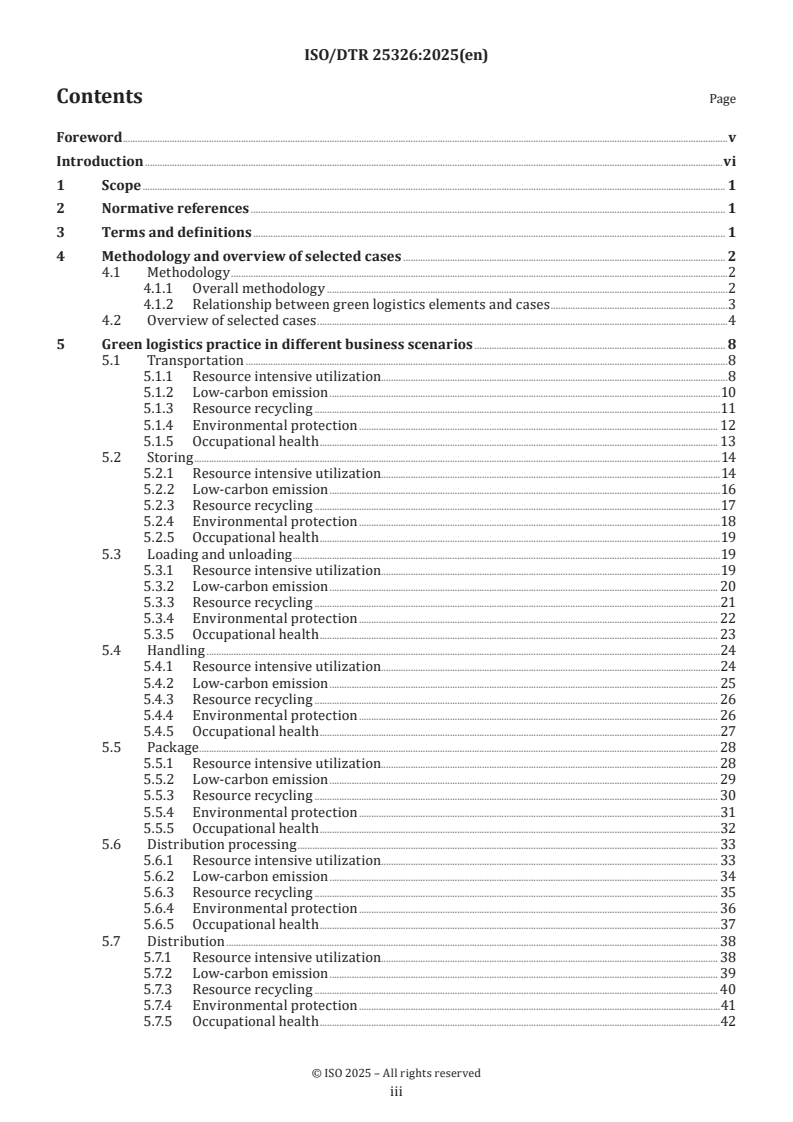
Contents Page
Foreword .v
Introduction .vi
1 Scope . 1
2 Normative references . 1
3 Terms and definitions . 1
4 Methodology and overview of selected cases . 2
4.1 Methodology .2
4.1.1 Overall methodology .2
4.1.2 Relationship between green logistics elements and cases .3
4.2 Overview of selected cases .4
5 Green logistics practice in different business scenarios . 8
5.1 Transportation .8
5.1.1 Resource intensive utilization . . .8
5.1.2 Low-carbon emission .10
5.1.3 Resource recycling .11
5.1.4 Environmental protection . 12
5.1.5 Occupational health . 13
5.2 Storing .14
5.2.1 Resource intensive utilization . .14
5.2.2 Low-carbon emission .16
5.2.3 Resource recycling .17
5.2.4 Environmental protection .18
5.2.5 Occupational health .19
5.3 Loading and unloading .19
5.3.1 Resource intensive utilization . .19
5.3.2 Low-carbon emission . 20
5.3.3 Resource recycling .21
5.3.4 Environmental protection . 22
5.3.5 Occupational health . 23
5.4 Handling .24
5.4.1 Resource intensive utilization . .24
5.4.2 Low-carbon emission . 25
5.4.3 Resource recycling . 26
5.4.4 Environmental protection . 26
5.4.5 Occupational health .27
5.5 Package . 28
5.5.1 Resource intensive utilization . . 28
5.5.2 Low-carbon emission . 29
5.5.3 Resource recycling . 30
5.5.4 Environmental protection .31
5.5.5 Occupational health .32
5.6 Distribution processing . 33
5.6.1 Resource intensive utilization . . 33
5.6.2 Low-carbon emission . 34
5.6.3 Resource recycling . 35
5.6.4 Environmental protection . 36
5.6.5 Occupational health .37
5.7 Distribution . 38
5.7.1 Resource intensive utilization . . 38
5.7.2 Low-carbon emission . 39
5.7.3 Resource recycling . 40
5.7.4 Environmental protection .41
5.7.5 Occupational health .42
iii
ISO/DTR 25326:2025(en)
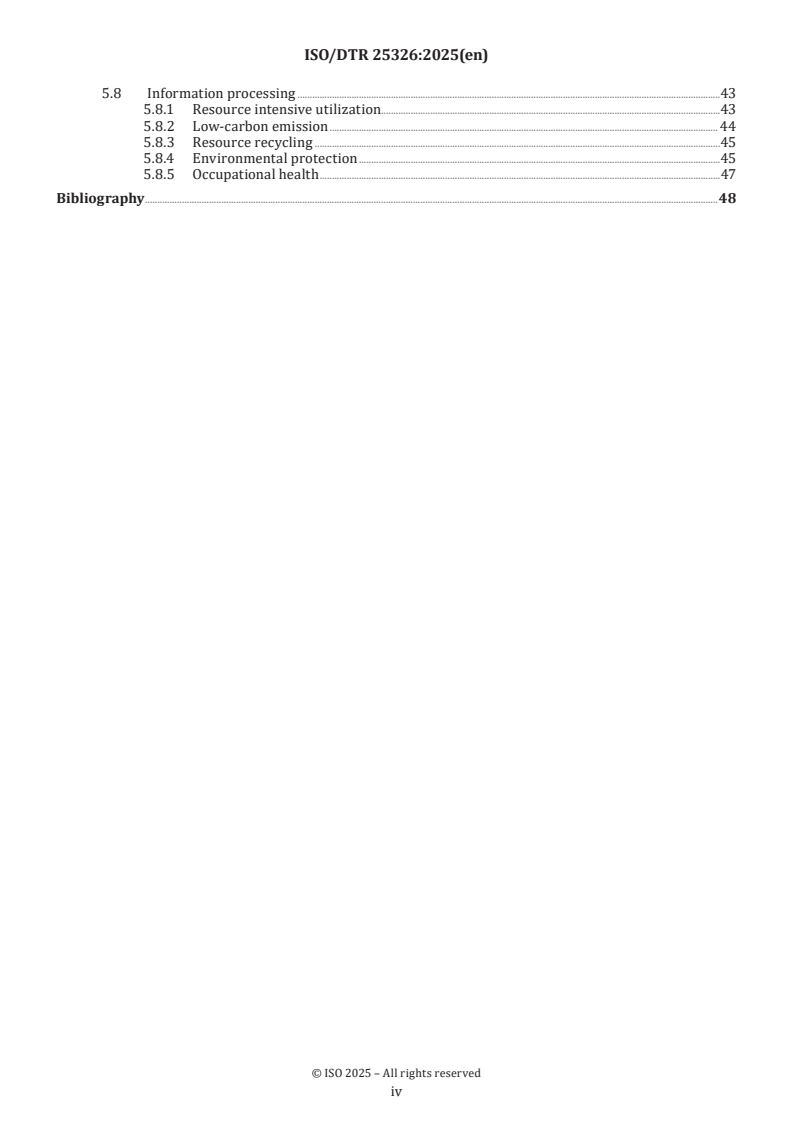
5.8 Information processing .43
5.8.1 Resource intensive utilization . .43
5.8.2 Low-carbon emission . 44
5.8.3 Resource recycling .45
5.8.4 Environmental protection .45
5.8.5 Occupational health .47
Bibliography .48
iv
ISO/DTR 25326:2025(en)
Foreword
ISO (the International Organization for Standardization) is a worldwide federation of national standards
bodies (ISO member bodies). The work of preparing International Standards is normally carried out through
ISO technical committees. Each member body interested in a subject for which a technical committee
has been established has the right to be represented on that committee. International organizations,
governmental and non-governmental, in liaison with ISO, also take part in the work. ISO collaborates closely
with the International Electrotechnical Commission (IEC) on all matters of electrotechnical standardization.
The procedures used to develop this document and those intended for its further maintenance are described
in the ISO/IEC Directives, Part 1. In particular, the different approval criteria needed for the different types
of ISO document should be noted. This document was drafted in accordance with the editorial rules of the
ISO/IEC Directives, Part 2 (see www.iso.org/directives).
ISO draws attention to the possibility that the implementation of this document may involve the use of (a)
patent(s). ISO takes no position concerning the evidence, validity or applicability of any claimed patent
rights in respect thereof. As of the date of publication of this document, ISO had not received notice of (a)
patent(s) which may be required to implement this document. However, implementers are cautioned that
this may not represent the latest information, which may be obtained from the patent database available at
www.iso.org/patents. ISO shall not be held responsible for identifying any or all such patent rights.
Any trade name used in this document is information given for the convenience of users and does not
constitute an endorsement.
For an explanation of the voluntary nature of standards, the meaning of ISO specific terms and expressions
related to conformity assessment, as well as information about ISO's adherence to the World Trade
Organization (WTO) principles in the Technical Barriers to Trade (TBT), see www.iso.org/iso/foreword.html.
This document was prepared by Technical Committee ISO/TC 344, Innovative logistics.
Any feedback or questions on this document should be directed to the user’s national standards body. A
complete listing of these bodies can be found at www.iso.org/members.html.
v
ISO/DTR 25326:2025(en)
Introduction
As an important carrier of service production and life, logistics integrates a number of rapidly developing
fields such as transportation freight, construction warehousing and information services, and has
become an important pillar of the global economy. However, logistics activities are also accompanied by
significant energy consumption, greenhouse gas emissions, exhaust pollution, and the use and disposal of
packaging plastics, which have a significant impact on the environment. In the context of global sustainable
development and combating climate change, governments and market players have put forward carbon
peak and carbon neutral targets to promote the green development of enterprises and their upstream and
downstream supply chains.
This document focuses on the green transformation of generalized logistics and provides application cases
in green logistics, including transport, storage and other scenarios. These cases show guided by principles
of resource intensive utilization, low-carbon emissions, resource recycling, environmental protection and
occupational health.
The goal of this document is to help organizations better understand green logistics activities, thereby
driving the overall logistics industry towards sustainable development and contributing to the broader
environmental protection and social responsibility goals.
vi
FINAL DRAFT Technical Report ISO/DTR 25326:2025(en)
Use cases for green logistics activities
1 Scope
This document presents case studies and insights into the practical application of green logistics. The cases
are delineated across various operational scenarios, including transport, storing, loading and unloading,
handling, package, distribution processing, distribution and information processing.
The objective of this document is to facilitate organizations in comprehending green logistics activities.
2 Normative references
There are no normative references in this document.
3 Terms and definitions
For the purposes of this document, the following terms and definitions apply.
ISO and IEC maintain terminology databases for use in standardization at the following addresses:
— ISO Online browsing platform: available at https:// www .iso .org/ obp
— IEC Electropedia: available at https:// www .electropedia .org/
3.1
green logistics
advanced technologies and management methods employed by organizations to effectively plan and
implement processes, such as transportation, storage, loading and unloading, handling, packaging,
distribution processing, distribution, and information management, guided by principles of resource
intensive utilization, low-carbon emissions, resource recycling, environmental protection and occupational
health, which aims to achieve a balance between economic development, social benefits, and environmental
protection
Note 1 to entry: The principle of resource intensive utilization advocates that in logistics activities, resources should
be utilized efficiently and rationally through measures such as integration and reduction.
Note 2 to entry: The principle of low-carbon emissions advocates reducing the intensity of greenhouse gas emissions
through cost-effective measures such as carbon reduction at the source, during the process, and carbon sequestration
at the terminal. These efforts are based on comprehensive monitoring of energy consumption and greenhouse gas
emissions under various circumstances to ensure that economically feasible methods are adopted to reduce emissions.
Note 3 to entry: The principle of resource recycling advocates the return and reuse of raw materials, semi-finished
products, finished products, waste and other resources from the usage stage through the design and use of recyclable
logistics container equipment, as well as the optimization of logistics operation processes, so as to restore their value
or dispose of them reasonably.
Note 4 to entry: The principle of environmental protection advocates efforts to reduce solid, liquid, gas and noise
pollution, thereby minimizing the environmental impact of logistics activities.
Note 5 to entry: The occupational health principle advocates safeguarding the physical and mental health of workers
participating in green logistics activities. It involves minimizing harmful factors, preventing occupational diseases
and workplace accidents, and improving the working environment and practices through intelligent and green
technologies, with the goal of achieving sustainable occupational health management.
ISO/DTR 25326:2025(en)
3.2
transport
act of carrying resources to move goods over a long distance by vehicles, facilities, equipment, and manpower
3.3
storing, verb
to store, protect and manage goods
3.4
loading and unloading
act of putting in or taking out goods by manual or mechanical manner, between transport means or between
transport means and storage sites (warehouses)
3.5
handling
process of moving goods by manual or mechanical means at the same location
3.6
package
containers, materials and auxiliary materials adopted according to certain technical approaches in order to
protect products, facilitate storage and transport and promote sales during circulation
Note 1 to entry: It also refers to the operation activities such as applying certain technical approaches in the process of
using containers, materials and auxiliary materials in order to achieve the above purposes.
3.7
distribution processing
act of carrying on products in the process of circulation according to the needs of customers
Note 1 to entry: Simple processing activities include packaging, cutting, metering, sorting, and picking, marking,
labelling, grouping allocation and assembly, etc.
3.8
distribution
act of sorting, picking, consolidating, packing, assembling and delivering goods to their designated locations
on time in line with customer requirements
3.9
information processing
collecting, analysing, storing, and disseminating data and information related to logistics activities
4 Methodology and overview of selected cases
4.1 Methodology
4.1.1 Overall methodology
This document presents a curated collection of green logistics case studies contributed by 28 enterprises
across 15 nations.
The selection of these cases is based on various logistics business scenarios and the principles followed by
green logistics.
— Covering some or all aspects of logistics business scenarios. Logistics business scenarios include
transport, storing, loading and unloading, handling, package, distribution processing, distribution, and
information processing.
— Guided by principles of resource intensive utilization, low-carbon emissions, resource recycling,
environmental protection and occupational health.
ISO/DTR 25326:2025(en)
4.1.2 Relationship between green logistics elements and cases
As a result of this document, the links between the elements of green logistics activities and the use cases in
this document are identified in Table 1.
The rightmost column of Table 1 shows the correspondence between the content of the application cases
and the relevant elements of the SDGs. For more information on the SDGs, refer to ISO/UNDP PAS 53002.
The SDGs in Table 1 are also applicable to other tables in this document.
Table 1 — The relationship between green logistics related elements and cases
Application cases in
Business scenario Characteristics of green
Application cases in this document
of logistics logistics
SDGs
Resource intensive utilization Case 1, Case2, Case3, case4 7, 9, 12
Low-carbon emission Case 5, Case6, Case7, Case 8 7,9,13
Transport Resource recycling Case 9, Case10 7,12,15
Environmental protection Case 11, Case12 6,8,9,11
Occupational health Case 13, Case14 3,8,6,11
Resource intensive utilization Case 15, Case16, Case17, Case 18 9,12
Low-carbon emission Case 19, Case 20 7,9,13
Storing Resource recycling Case 21, Case22 9,11,12
Environmental protection Case 23, Case24` 3,8,9,11
Occupational health Case25 3,9
Resource intensive utilization Case 26, Case27 9,12
Low-carbon emission Case28, Case29, Case30 7,9,12
loading and unload-
Resource recycling Case 31 9,12
ing
Environmental protection Case32, Case33 6,11,12
Occupational health Case34, Case35 3,8,11
Resource intensive utilization Case36, Case37 9,12
Low-carbon emission Case 38 7,12
Handling Resource recycling Case 39 8,12
Environmental protection Case 40 3,9,12
Occupational health Case 41 3
Resource intensive utilization Case42, Case43, Case44 8,12
Low-carbon emission Case45, Case46, Case47 7,8,12
Package Resource recycling Case48 8,12
Environmental protection Case49, Case50, Case51 8,12
Occupational health Case52, Case53 3
Resource intensive utilization Case54, Case55 12
Low-carbon emission Case56, Case57 7,12
Distribution pro-
Resource recycling Case58, Case59 7,8,12
cessing
Environmental protection Case60, Case61 6,12
Occupational health Case62, Case63 3,8
Resource intensive utilization Case64, Case65 12
Low-carbon emission Case66, Case67 7,12
delivery Resource recycling Case68, Case69 12
Environmental protection Case70, Case71 7,12,15
Occupational health Case72 3,8
ISO/DTR 25326:2025(en)
TTabablele 1 1 ((ccoonnttiinnueuedd))
Application cases in
Business scenario Characteristics of green
Application cases in this document
of logistics logistics
SDGs
Resource intensive utilization Case73, Case74, Case75 12
Low-carbon emission Case76, Case77 7,8
information pro-
Resource recycling Case78 11,12
cessing
Environmental protection Case79, Case80, Case81, Case82 9
Occupational health Case83 3
4.2 Overview of selected cases
An overview of selected cases is shown in Table 2.
Table 2 — Overview of cases
No. Countries Overview
This paper introduces the effective cargo stowage strategy of Enterprise
Case 1 China 1, which can improve the transportation efficiency by logical arrange-
ment according to the volume and weight of goods
This paper introduces how Enterprise 2 can reduce transportation cost,
Case 2 Denmark
improve safety and timeliness through sea LCL service
Enterprise 3 has introduced 'One Container Service' intermodal
transport, which facilitates the transition of transportation methods
without the need for any manipulation of the goods themselves, offering
Case 3 China a comprehensive door-to-door service across the entire supply chain.
The technology for transporting rolled steel plates cargo with plat-
form-based containers has the effect of environmental protection, ener-
gy-saving and low-carbon
This paper introduces the platform scheduling system based on big data
case 4 Denmark analysis in Enterprise 2 to optimize route and resource allocation and
realize efficient transportation management
Enterprise 4 and Enterprise 5 are introduced to use electric trucks to re-
Case 5 United States, Saudi Arabia duce carbon emissions, while incentivizing logistics providers to follow
suit to expand the impact of green logistics
Based on microgrid and energy management technology, Enterprise 6
is introduced to optimize the operation management and charging in-
Case 6 France
frastructure of electric trucks, reduce energy consumption and improve
operational efficiency
Introduced Enterprise 2's attempt to reduce emissions by using hydro-
Case 7 Denmark genated vegetable oil (HVO) and MGO mixed fuel by diversifying energy
sources
Enterprise 7 developed a GHG emission visualization tool based on ISO
Case 8 Japan 14083 to help customers accurately calculate emissions and improve
emissions transparency
Introduced the cooperation between Enterprise 2 and green dismantling
Case 9 Denmark field to ensure environmentally friendly and safe dismantling of trans-
port machinery and reduce environmental impact
Enterprise 8 has deployed repurposed battery energy storage solutions,
Case 10 Germany paired with sophisticated energy management, to significantly cut car-
bon emissions
Introduced the real-time monitoring of vehicle driving status of En-
Case 11 America terprise 9 through vehicle management platform, optimizing driving
routes, reducing fuel consumption and exhaust emissions
ISO/DTR 25326:2025(en)
TTabablele 2 2 ((ccoonnttiinnueuedd))
No. Countries Overview
Introduced the predictive analysis technology introduced by Enterprise
Case 12 Denmark 2 to collect and analyze real-time data of Marine engine and realize pre-
ventive maintenance
Enterprise 10 adopts ISO 14001 environmental management standard to
Case 13 Finland systematically promote environmental management and ensure safe and
sustainable transportation environment
Introduced Enterprise 9 with the introduction of transport vehicles
Case 14 China equipped with automatic or assisted driving technology to reduce the
frequency of traffic accidents and protect the safety of drivers
Introduced how Enterprise 11 can improve operation efficiency by intro-
Case 15 Japan ducing automated warehouse system, combining robot technology and
automated guided vehicle (AGV)
Introduced how Enterprises 12 optimize warehouse layout according to
Case 16 Korea cargo attributes and operation plans, ensure efficient use of space, and
use algorithms to optimize logistics routes to improve efficiency
Introduced how Enterprise 9 interconnects warehouses across the coun-
Case 17 China try into a shared network, updates inventory information in real time,
and optimizes inventory distribution and distribution distance
Introduced the implementation of a digital warehouse management
system by Enterprise 13, enhancing order tracking and management
Case 18 Switzerland
capabilities, optimizing resource allocation, and enabling more flexible
and precise inventory control
Introduced the construction of energy-efficient warehousing facilities by
Case 19 Denmark, Switzerland
Enterprise 2 and Enterprise 14, aiming to reduce operational costs
Introduced Enterprise 1 to implement low-carbon transformation such
Case 20 China as rooftop photovoltaic power generation and LED solar street lights to
reduce energy consumption
Enterprise 15 has established recycling centres dedicated to the refur-
Case 21 South Korea
bishment and processing of returned products
Enterprise 9 established a perfect product reverse warehousing network
Case 22 China
to realize the return of goods to the nearest outlets
Introduced Enterprise 16's development of intelligent tracking devic-
Case 23 Norway es for parcels, ensuring real-time updates of location information and
status data
Introduced Enterprise 12 to install AI sensors on forklifts to reduce
Case 24 South Korea
accidents
Enterprise 17 has implemented intelligent warehousing equipment to
Case 25 France
alleviate the work burden on employees
Enterprise 2 is introduced to optimize the loading and unloading
Case 26 Denmark scheme, reduce transit and repeat operation, and improve loading and
unloading efficiency
Enterprise 1 adopts digital loading and unloading scheduling system to
Case 27 China
improve the overall operation fluency
Enterprise 8 adopts electric forklift, equipped with high-capacity batter-
Case 28 Germany
ies, achieving zero emissions and low noise
The introduction of Enterprise 8 deployment of intelligent scheduling
Case 29 Germany system, optimize the operation efficiency of forklift trucks and automa-
tion equipment, reduce energy consumption
Introduced Enterprise 18 Harnessing solar power to reduce dependence
Case 30 Singapore
on traditional energy sources
Introduced the wide application of recyclable environmental protection
Case 31 China materials such as circular packing boxes in the loading and unloading
links to extend the service life of Enterprise 9
ISO/DTR 25326:2025(en)
TTabablele 2 2 ((ccoonnttiinnueuedd))
No. Countries Overview
The introduction of Enterprise 9 in the logistics loading and unloading
Case 32 China links to fully introduce electric forklifts and automatic stackers, reduce
noise
This paper introduces how Enterprise 12 improve the inspection mecha-
Case 33 South Korea nism of loading and unloading equipment to ensure the normal opera-
tion of equipment
The article introduces the requirement of Enterprise 19 to install
Case 34 China tailboard on trucks to realize automatic lifting and lifting and improve
loading and unloading efficiency and safety
Enterprise 20 introduced to promote safety awareness and environmen-
Case 35 France
tal awareness among employees through regular meetings and training
Introduced the Enterprise 9 use automated handling equipment to im-
Case 36 China
prove handling efficiency and accuracy
Enterprise 19 optimization handling scheme is introduced to improve
Case 37 China
the logistics processing efficiency and operation efficiency
Introduced Enterprise 13 to adopt low-carbon emission handling equip-
Case 38 Switzerland
ment to reduce carbon emissions
Introduced Enterprise 9 use reusable handling containers to reduce
Case 39 China
resource consumption
Enterprise 9 adopts light handling equipment to reduce environmental
Case 40 China
burden and maintenance frequency
The establishment of work health and safety management system in
Case 41 France, Switzerland Enterprise 20 and Enterprise 13 to protect the health of employees is
introduced
Introduced Enterprise 8 reduce the use of packaging materials by opti-
Case 42 Germany
mizing packaging design
Introduced Enterprise 15 and Enterprise 21 reduce unnecessary space
Case 43 South Korea, India and material use and reduce plastic consumption through improved
packaging
Introduced Enterprise 22 choose to use strong but light-weight materials
Case 44 Italy
for packaging, improve safety and reduce overall weight
Introduced Enterprise 8 introduce energy-saving sealing machine and
Case 45 Germany
baler to reduce energy consumption
Introduced Enterprise 3 to work with partners to promote green pack-
Case 46 China aging, optimize the choice of packaging materials, use recyclable and
environmentally friendly materials, and reduce environmental impact
Introduced Enterprise 9 and Enterprise 10 reduce package materials
Case 47 China, Finland consumption by application of foldable insulated turnover boxes and
reusable packaging boxes
Introduced Enterprise 14 and Enterprise 23 using recyclable packaging
Case 48 Germany, Switzerland materials such as cardboard and aluminium to reduce environmental
impact
Introduced the research and development of biodegradable packaging
Case 49 Denmark, Switzerland materials in Enterprise 2 and Enterprise14 to gradually reduce the use of
disposable non-degradable plastics
Introduced Enterprise 9 encourage the use of original packaging and
Case 50 China constantly upgrade environmentally friendly packaging materials to
ensure safety and harmless
Introduced Enterprise 19 on fragile products, liquids, powders and other
Case 51 China goods to take additional reinforcement and leak-proof treatment meas-
ures to improve stability and safety
Introduced Enterprise 13 to provide packaging workers with profession-
Case 52 Switzerland
al personal protective equipment to ensure safety
ISO/DTR 25326:2025(en)
TTabablele 2 2 ((ccoonnttiinnueuedd))
No. Countries Overview
Introduced Enterprise 10 packaging workstation ergonomic optimiza-
Case 53 Finland
tion, reduce the burden of employees
Introduced Enterprise 3 use the online platform to centrally purchase
Case 54 China raw materials, optimize production and inventory management, reduce
costs and improve efficiency
Introduced Enterprise 24 to adopt the cross-warehouse distribution
Case 55 United States
mode to improve the efficiency of goods circulation
Introduced Enterprise 9 based on packaging algorithm to improve pack-
Case 56 China
aging efficiency and reduce carbon emissions
Enterprise 11 has successfully transformed biogas into electricity,
hydrogen energy, and potable water through a highly efficient and pollu-
Case 57 Japan
tion-free process, thereby achieving the objective of zero air pollutants
across the entire operation
Introduces Enterprise 11 to build a closed-loop battery ecology, expand
Case 58 Japan the recycling network, and promote the collection and storage of batter-
ies to be more efficient
Introduced Enterprise 3 use automatic identification technology to trace
the whole process of returned products, establish resource recycling
Case 59 China
system to record energy consumption, emissions and treatment meth-
ods, optimize resource utilization
Enterprise 11 improved the efficiency of water resource utilization by
Case 60 Japan filtering processed wastewater through membrane bioreactor technolo-
gy and reverse osmosis system
Introduced Enterprise 3 use digital platform to carry out environmental
Case 61 China monitoring, improve resource management and environmental protec-
tion efficiency
Introduced Enterprise 14 conducts regular occupational health assess-
Case 62 Switzerland
ments to help employees identify and manage potential risks at work
Introduced Enterprise 25 offers a diverse range of health benefits to its
Case 63 United States
staff, promoting a harmonious balance between work and personal life
The introduction of Enterprise 5 provides customized distribution
Case 64 Saudi Arabia schemes to meet different logistics needs and enhance market competi-
tiveness
Introduced how Enterprise 20 has integrated an advanced digital plat-
Case 65 France
form to optimize delivery routes and reduce transportation costs
Introduced Enterprise 26 to develop sustainable high-tech barges and
Case 66 France 'river warehouses' to deliver packages efficiently in a low-carbon emis-
sion manner
Introduced the cooperation between Enterprise 20 and new energy vehi-
cle enterprises, using tools such as carbon emission reduction simulator
Case 67 France and autonomous driving simulator to optimize low-carbon emission
distribution scheme and promote sustainable development of logistics
industry
Enterprise 9 is introduced to build a resource recycling distribution
Case 68 China centre, conduct quality inspection and sorting of returned goods, and
reduce transportation distance and carbon emissions
Enterprise 27 works with partners to build a systematic resource recy-
Case 69 Sweden
cling process for easy return and resale of goods
Enterprise 9 is introduced to optimize the delivery path through an
Case 70 China intelligent scheduling system while monitoring the status of parcels and
creating a safe delivery environment
Enterprise 10 uses fossil free and renewable energy sources to power
Case 71 Finland
electric vehicles and lower emissions
ISO/DTR 25326:2025(en)
TTabablele 2 2 ((ccoonnttiinnueuedd))
No. Countries Overview
Introduced the safety strengthening activities carried out by the Enter-
Case 72 Japan prise 28 every year to reduce the risk of industrial accidents and protect
the health and safety of employees
Enterprise 8 adopts the Internet of Things technology to achieve re-
Case 73 Germany al-time data acquisition, reducing the workload and error rate of manual
data entry
Enterprise 24 use blockchain technology to improve transparency and
Case 74 United States
security in the product supply chain
Introduced the central unified management and control platform de-
Case 75 Singapore veloped by Enterprise 18 for multi-data centres to achieve intelligent
management
The introduction of Enterprise 1 through the electronic voucher system
and the enterprise's warehouse management system seamless connec-
Case 76 China
tion, to achieve the rapid transfer of information and automatic update,
improve the efficiency of parcel handling
The introduction of Enterprise 18 by establishing real-time monitoring
Case 77 Singapore system, optimize equipment adjustment strategy, improve equipment
efficiency
Enterprise 8 set up recycling stations in global logistics centres to en-
Case 78 Germany
sure efficient and systematic recycling of waste equipment
Introduced how Enterprise 8 optimized the placement of user privacy
Case 79 Germany pop-ups through big data analysis during data compliance processes,
ensuring privacy security and trustworthiness
Introduced the efficient cooling system of logistics data centre of Enter-
Case 80 China
prise 9, which effectively reduces energy consumption
Introduced how to manage dust, moisture, and cleaning in Enterprise 9
Case 81 China
data centres to ensure the stable operation of data centre devices.
Introduced how Enterprise 18 integrated AI technology into its data
Case 82 Singapore
centre to ensure equipment security.
Enterprise 8 introduced AR smart wearable devices to reduce informa-
Case 83 Germany
tion processing errors and improve work experience.
5 Green logistics practice in different business scenarios
5.1 Transportation
5.1.1 Resource intensive utilization
5.1.1.1 Cases
Case 1: Cargo stowage optimization
Enterprise 1 employs an effective cargo stowage strategy. This approach takes into account the volume and
weight of goods being transported. The principle is to arrange goods in a logical order within the carriage
where heavy and compact items are placed at the bottom while lighter and larger items are positioned on
top. By implementing this efficient cargo stowage method, Enterprise 1 can optimize each truck's load,
reduce empty space, and ultimately enhance transportation efficiency.
Case 2: Consolidated transportation services
Enterprise 2 offers less-than-container load (LCL) shipping solutions, consolidating small shipments from
multiple clients into a single container to optimize transportation costs. This LCL service not only reduces
maritime shipping expenses but also enhances safety, reliability and delivery efficiency.
ISO/DTR 25326:2025(en)
Case 3: 'One container service' intermodal transport
Enterprise 3 has launched the 'One Container Service' intermodal transport, a streamlined logistics model
where goods are packed into a container and transported using two or more integrated transportation
modes. Throughout the journey, the container remains sealed, and the goods are not handled or reloaded
during transitions between transportation modes, ensuring a seamless door-to-door delivery experience.
This intermodal approach significantly reduces transit time, minimizes energy consumption, and enhances
overall logistics efficiency and customer satisfaction. In addition, the technology for transporting rolled
steel plates cargo with platform-based containers does not need grass products as support, which solves
the environmental problems caused by the original straw as the support body of coil steel. The technology
for transporting rolled steel plates cargo with platform-based containers can be adopted as 'One Container
Service' intermodal transport, which can realize energy saving and low-carbon.
Case 4: Optimization of transportation dispatch
Enterprise 2 has deployed an advanced transportation management system utilizing a big data analytics-
driven platform for dispatch operations. This system employs intelligent algorithms to optimize routing,
allocate resources efficiently, and enhance overall transportation performance. Key functionalities include
real-time tracking of cargo location, monitoring of traffic conditions, and assessment of vessel/aircraft
status, as well as the dynamic adjustment of transportation schedules and routes in response to operational
demands. By leveraging this platform, Enterprise 2 ensures compliance with indu
...
ISO TR 25326:2025(E)
ISO/TC344
DTRDate: 2025-07-25
ISO TR 25326:2025(E)
ISO /TC 344/WG 1
Secretariat: SAC
Date:
Use cases for green logistics activities
WD stage
Warning for WDs and CDs
This document is not an ISO International Standard. It is distributed for review and comment. It is
subject to change without notice and may not be referred to as an International Standard.
Recipients of this draft are invited to submit, with their comments, notification of any relevant patent
rights of which they are aware and to provide supporting documentation.
© ISO/WD TR #### – All rights reserved
ISO #####-#:####(X)
2 © ISO #### – All rights reserved
ISO TR 25326:2025(E)
All rights reserved. Unless otherwise specified, or required in the context of its
implementation, no part of this publication may be reproduced or utilized otherwise in any
form or by any means, electronic or mechanical, including photocopying, or posting on the
internet or an intranet, without prior written permission. Permission can be requested from
either ISO at the address below or ISO’s member body in the country of the requester.
ISO copyright office
CP 401 • Ch. de Blandonnet 8
CH-1214 Vernier, Geneva
Phone: + 41 22 749 01 11
EmailE-mail: copyright@iso.org
Website: www.iso.orgwww.iso.org
Published in Switzerland
© ISO/WD TR #### – All rights reserved 1
ISO/DTR 25326:(en)
ii
ISO/DTR 25326:(en)
Contents
Foreword . v
Introduction . vii
1 Scope . 1
2 Normative references . 1
3 Terms and definitions . 1
4 Methodology and overview of selected cases . 3
5 Green logistics practice in different business scenarios . 10
Bibliography . 55
Foreword . Ⅳ
Introduce . V
1 Scope .1
2 Normative references .1
3 Terms and definitions .1
4 Methodology and overview of selected cases .3
4.1 Methodology .3
4.2 Overview of selected cases .4
5 Green logistics practice in different business scenarios . 10
5.1 Transport . 10
5.2 Storing . 17
5.3 Loading and unloading . 23
5.4 Handling . 28
5.5 Package . 32
5.6 Distribution processing . 39
5.7 Distribution. 44
5.8 Information processing . 49
iii
iii
ISO/DTR 25326:(en)
iv
ISO/DTR 25326:(en)
Foreword
ISO( (the International Organization for Standardization) is a worldwide consortiumfederation of national
standards bodies (ISO member bodies). The work of developing international standardspreparing
International Standards is usuallynormally carried out through ISO technical committees. Each member
groupbody interested in thea subject of thefor which a technical committee has been established has the right
to be represented on thethat committee. International organizations that maintain contact with ISO, both,
governmental and non-governmental, are in liaison with ISO, also involvedtake part in thisthe work. ISO
workscollaborates closely with the International Electrotechnical Commission (IEC) on all electricianmatters
of electrotechnical standardization issues.
Part 1 of the ISO/IEC Directive describes the procedures used to develop and further maintain this document.
In particular, attention should be paid to the different approval criteria required for different types of ISO
documents. This document has been drafted in accordance with the editorial rules in Part 2 of the ISO/IEC
Directive (see www.iso.org/directives).
It is important to note that certain elements of this document may be the subject of a patent right. ISO is not
responsible for identifying any or all such patent rights. Details of any patent rights identified during the
development of the document will be found in the introduction and/or list of ISO Patent declarations received
(see www.iso.org/patents).
The procedures used to develop this document and those intended for its further maintenance are described
in the ISO/IEC Directives, Part 1. In particular, the different approval criteria needed for the different types of
ISO document should be noted. This document was drafted in accordance with the editorial rules of the
ISO/IEC Directives, Part 2 (see www.iso.org/directives).
ISO draws attention to the possibility that the implementation of this document may involve the use of (a)
patent(s). ISO takes no position concerning the evidence, validity or applicability of any claimed patent rights
in respect thereof. As of the date of publication of this document, ISO had not received notice of (a) patent(s)
which may be required to implement this document. However, implementers are cautioned that this may not
represent the latest information, which may be obtained from the patent database available at
www.iso.org/patents. ISO shall not be held responsible for identifying any or all such patent rights.
Any trade namesname used in this document are provided asis information given for the convenience of the
userusers and dodoes not constitute an endorsement.
Explain about For an explanation of the voluntary standard, ISO nature of standards, the meaning of ISO
specific terms and expressions related to conformity assessment and the expression of meaning, as well as the
relevant ISO information about ISO's adherence to comply with the world trade organizationthe World Trade
Organization (WTO) the principle of technical barriersprinciples in the Technical Barriers to tradeTrade (TBT)
information, please refer to the www.iso.org/iso/foreword.html), see www.iso.org/iso/foreword.html.
This document was prepared by Technical Committee ISO/TC 344, Innovative Logisticslogistics.
Any feedback or questions on this document should be directed to the user'suser’s national standards body. A
complete list of these bodies can be found at www.iso.org/members.htmlA complete listing of these bodies
can be found at www.iso.org/members.html.
v
v
ISO/DTR 25326:(en)
Introduce
vi
ISO/DTR 25326:(en)
Introduction
As an important carrier of service production and life, logistics integrates a number of rapidly developing
fields such as transportation freight, construction warehousing and information services, and has become an
important pillar of the global economy. However, logistics activities are also accompanied by significant
energy consumption, greenhouse gas emissions, exhaust pollution, and the use and disposal of packaging
plastics, which have a significant impact on the environment. In the context of global sustainable development
and combating climate change, governments and market players have put forward carbon peak and carbon
neutral targets to promote the green development of enterprises and their upstream and downstream supply
chains.
Green logistics is to advanced technologies and management methods employed by organizations to
effectively plan and implement processes, such as transportation, storage, loading and unloading, handling,
packaging, distribution processing, distribution, and information management,guided by principles of
resource intensive utilization, low-carbon emissions, resource recycling, environmental protection and
occupational health, which aims to achieve a balance between economic development, social benefits, and
environmental protection.
This document focuses on the green transformation of generalized logistics and provides application cases in
green logistics, including transport, storage and other scenarios. These cases show guided by principles of
resource intensive utilization, low-carbon emissions, resource recycling, environmental protection and
occupational health.
The goal of this document is to help organizations better understand green logistics activities, thereby driving
the overall logistics industry towards sustainable development and contributing to the broader environmental
protection and social responsibility goals.
vii
vii
ISO/DTR 25326:(en)
Use cases for green logistics activities
1 1 Scope
This document presents case studies and insights into the practical application of green logistics. The cases
are delineated across various operational scenarios, including transport, storing, loading and unloading,
handling, package, distribution processing, distribution, and information processing.
The objective of this document is to facilitate organizations in comprehending green logistics activities.
2 2 Normative references
There are no normative references in this document.
13 3 Terms and definitions
For the purposes of this document, the
The following terms and definitions apply to this document.
.
3.1 ISO and IEC maintain terminology databases for use in standardization at the following addresses:
— ISO Online browsing platform: available at https://www.iso.org/obp
— IEC Electropedia: available at https://www.electropedia.org/
3.1
green logistics
advanced technologies and management methods employed by organizations to effectively plan and
implement processes, such as transportation, storage, loading and unloading, handling, packaging,
distribution processing, distribution, and information management, guided by principles of resource intensive
utilization, low-carbon emissions, resource recycling, environmental protection and occupational health,
which aims to achieve a balance between economic development, social benefits, and environmental
protection
Note 1 to entry: The principle of resource intensive utilization advocates that in logistics activities, resources should be
utilized efficiently and rationally through measures such as integration and reduction.
Note 2 to entry: The principle of low-carbon emissions advocates reducing the intensity of greenhouse gas emissions
through cost-effective measures such as carbon reduction at the source, during the process, and carbon sequestration at
the terminal. These efforts are based on comprehensive monitoring of energy consumption and greenhouse gas
emissions under various circumstances to ensure that economically feasible methods are adopted to reduce emissions.
Note 3 to entry: The principle of resource recycling advocates the return and reuse of raw materials, semi-finished
products, finished products, waste and other resources from the usage stage through the design and use of recyclable
logistics container equipment, as well as the optimization of logistics operation processes, so as to restore their value or
dispose of them reasonably.
ISO/DTR 25326:(en)
Note 4 to entry: The principle of environmental protection advocates efforts to reduce solid, liquid, gas and noise
pollution, thereby minimizing the environmental impact of logistics activities.
Note 5 to entry: The occupational health principle advocates safeguarding the physical and mental health of workers
participating in green logistics activities. It involves minimizing harmful factors, preventing occupational diseases and
workplace accidents, and improving the working environment and practices through intelligent and green technologies,
with the goal of achieving sustainable occupational health management.
3.2 3.2
transport
act of carrying resources to move goods over a long distance by vehicles, facilities, equipment, and manpower
3.3 3.3
storing, verb
to store, protect and manage goods
3.4 3.4
loading and unloading
act of putting in or taking out goods by manual or mechanical manner, between transport means or between
transport means and storage sites (warehouses)
3.5 3.5
handling
process of moving goods by manual or mechanical means at the same location
3.6 3.6
package
containers, materials and auxiliary materials adopted according to certain technical approaches in order to
protect products, facilitate storage and transport and promote sales during circulation
Note 1 to entry: It also refers to the operation activities such as applying certain technical approaches in the process of
using containers, materials and auxiliary materials in order to achieve the above purposes.
3.7 3.7
distribution processing
act of carring outcarrying on products in the process of circulation according to the needs of customers
Note 1 to entry: Simple processing activities include packaging, cutting, metering, sorting, and picking, marking,
labelinglabelling, grouping allocation and assembly, etc.
3.8 3.8
distribution
act of sorting, picking, consolidating, packing, assembling, and delivering goods to their designated locations
on time in line with customer requirements
3.9 3.9
information processing
collecting, analyzinganalysing, storing, and disseminating data and information related to logistics activities
ISO/DTR 25326:(en)
4 4 Methodology and overview of selected cases
4.1 4.1 Methodology
4.1.1 4.1.1 Overall methodology
This document presents a curated collection of green logistics case studies contributed by 28 enterprises
across 15 nations.
The selection of these cases is based on various logistics business scenarios and the principles followed by
green logistics.
— —Covering some or all aspects of logistics business scenarios. Logistics business scenarios include
transport, storing, loading and unloading, handling, package, distribution processing, distribution, and
information processing.
— —Guided by principles of resource intensive utilization, low-carbon emissions, resource recycling,
environmental protection and occupational health.
4.1.2 4.1.2 The relationshipRelationship between green logistics elements and cases
As a result of this technical reportdocument, the links between the elements of green logistics activities and
the use cases in this document are identified in Table 1.Table 1.
The rightmost column of Table 1Table 1 shows the correspondence between the content of the application
cases and the relevant elements of the SDGs. For more information on the SDGs, refer to ISO/UNDP PAS
53002:2024.
The SDGs in Table 1Table 1 are also applicable to other tables in this document.
Table 1— — The relationship between green logistics related elements and cases
Application cases
Business scenario Characteristics of green Application cases in this
in
of logistics logistics document
SDGs
Resource intensive utilization Case 1, Case2, Case3, case4 7, 9, 12
Low-carbon emission Case 5, Case6, Case7, Case 8 7,9,13
Transport Resource recycling Case 9, Case10 7,12,15
Environmental protection Case 11, Case12 6,8,9,11
Occupational health Case 13, Case14 3,8,6,11
Resource intensive utilization Case 15, Case16, Case17, Case 18 9,12
Low-carbon emission Case 19, Case 20 7,9,13
Storing
Resource recycling Case 21, Case22 9,11,12
Environmental protection Case 23, Case24` 3,8,9,11
ISO/DTR 25326:(en)
Application cases
Business scenario Characteristics of green Application cases in this
in
of logistics logistics document
SDGs
Occupational health Case25 3,9
Resource intensive utilization Case 26, Case27 9,12
Low-carbon emission Case28, Case29, Case30 7,9,12
loading and
Resource recycling Case 31 9,12
unloading
Environmental protection Case32, Case33 6,11,12
Occupational health Case34, Case35 3,8,11
Resource intensive utilization Case36, Case37 9,12
Low-carbon emission Case 38 7,12
Handling Resource recycling Case 39 8,12
Environmental protection Case 40 3,9,12
Occupational health Case 41 3
Resource intensive utilization Case42, Case43, Case44 8,12
Low-carbon emission Case45, Case46, Case47 7,8,12
Package Resource recycling Case48 8,12
Environmental protection Case49, Case50, Case51 8,12
Occupational health Case52, Case53 3
Resource intensive utilization Case54, Case55 12
Low-carbon emission Case56, Case57 7,12
Distribution
Resource recycling Case58, Case59 7,8,12
processing
Environmental protection Case60, Case61 6,12
Occupational health Case62, Case63 3,8
Resource intensive utilization Case64, Case65 12
Low-carbon emission Case66, Case67 7,12
delivery Resource recycling Case68, Case69 12
Environmental protection Case70, Case71 7,12,15
Occupational health Case72 3,8
Resource intensive utilization Case73, Case74, Case75 12
Low-carbon emission Case76, Case77 7,8
information
Resource recycling Case78 11,12
processing
Environmental protection Case79, Case80, Case81, Case82 9
Occupational health Case83 3
4.2 4.2 Overview of selected cases
An overview of selected cases is shown in Table 2.Table 2.
ISO/DTR 25326:(en)
Table 2— — Overview of cases
No. Countries Overview
This paper introduces the effective cargo stowage strategy of Enterprise
Case 1 China 1, which can improve the transportation efficiency by logical
arrangement according to the volume and weight of goods
This paper introduces how Enterprise 2 can reduce transportation cost,
Case 2 Denmark
improve safety and timeliness through sea LCL service
Enterprise 3 has introduced 'One Container Service' intermodal
transport, which facilitates the transition of transportation methods
without the need for any manipulation of the goods themselves, offering
Case 3 China a comprehensive door-to-door service across the entire supply chain.
The technology for transporting rolled steel plates cargo with platform -
based containers has the effect of environmental protection, energy-
saving and low-carbon
This paper introduces the platform scheduling system based on big data
case 4 Denmark analysis in Enterprise 2 to optimize route and resource allocation and
realize efficient transportation management
Enterprise 4 and Enterprise 5 are introduced to use electric trucks to
Case 5 United States, Saudi Arabia reduce carbon emissions, while incentivizing logistics providers to
follow suit to expand the impact of green logistics
Based on microgrid and energy management technology, Enterprise 6 is
introduced to optimize the operation management and charging
Case 6 France
infrastructure of electric trucks, reduce energy consumption and
improve operational efficiency
Introduced Enterprise 2's attempt to reduce emissions by using
Case 7 Denmark hydrogenated vegetable oil (HVO) and MGO mixed fuel by diversifying
energy sources
Enterprise 7 developed a GHG emission visualization tool based on ISO
Case 8 Japan 14083:2023 to help customers accurately calculate emissions and
improve emissions transparency
Introduced the cooperation between Enterprise 2 and green dismantling
Case 9 Denmark field to ensure environmentally friendly and safe dismantling of
transport machinery and reduce environmental impact
Enterprise 8 has deployed repurposed battery energy storage solutions,
Case 10 Germany paired with sophisticated energy management, to significantly cut
carbon emissions
Introduced the real-time monitoring of vehicle driving status of
Case 11 America Enterprise 9 through vehicle management platform, optimizing driving
routes, reducing fuel consumption and exhaust emissions
Introduced the predictive analysis technology introduced by Enterprise
Case 12 Denmark 2 to collect and analyze real-time data of Marine engine and realize
preventive maintenance
ISO/DTR 25326:(en)
No. Countries Overview
Enterprise 10 adopts ISO 14001 environmental management standard
Case 13 Finland to systematically promote environmental management and ensure safe
and sustainable transportation environment
Introduced Enterprise 9 with the introduction of transport vehicles
Case 14 China equipped with automatic or assisted driving technology to reduce the
frequency of traffic accidents and protect the safety of drivers
Introduced how Enterprise 11 can improve operation efficiency by
Case 15 Japan introducing automated warehouse system, combining robot technology
and automated guided vehicle (AGV)
Introduced how Enterprises 12 optimize warehouse layout according to
Case 16 Korea cargo attributes and operation plans, ensure efficient use of space, and
use algorithms to optimize logistics routes to improve efficiency
Introduced how Enterprise 9 interconnects warehouses across the
Case 17 China country into a shared network, updates inventory information in real
time, and optimizes inventory distribution and distribution distance
Introduced the implementation of a digital warehouse management
system by Enterprise 13, enhancing order tracking and management
Case 18 Switzerland
capabilities, optimizing resource allocation, and enabling more flexible
and precise inventory control
Introduced the construction of energy-efficient warehousing facilities by
Case 19 Denmark, Switzerland
Enterprise 2 and Enterprise 14, aiming to reduce operational costs
Introduced Enterprise 1 to implement low-carbon transformation such
Case 20 China as rooftop photovoltaic power generation and LED solar street lights to
reduce energy consumption
Enterprise 15 has established recycling centerscentres dedicated to the
Case 21 South Korea
refurbishment and processing of returned products
Enterprise 9 established a perfect product reverse warehousing
Case 22 China
network to realize the return of goods to the nearest outlets
Introduced Enterprise 16's development of intelligent tracking devices
Case 23 Norway for parcels, ensuring real-time updates of location information and
status data
Introduced Enterprise 12 to install AI sensors on forklifts to reduce
Case 24 South Korea
accidents
Enterprise 17 has implemented intelligent warehousing equipment to
Case 25 France
alleviate the work burden on employees
Enterprise 2 is introduced to optimize the loading and unloading
Case 26 Denmark scheme, reduce transit and repeat operation, and improve loading and
unloading efficiency
Enterprise 1 adopts digital loading and unloading scheduling system to
Case 27 China
improve the overall operation fluency
Enterprise 8 adopts electric forklift, equipped with high-capacity
Case 28 Germany
batteries, achieving zero emissions and low noise
The introduction of Enterprise 8 deployment of intelligent scheduling
Case 29 Germany system, optimize the operation efficiency of forklift trucks and
automation equipment, reduce energy consumption
Introduced Enterprise 18 Harnessing solar power to reduce dependence
Case 30 Singapore
on traditional energy sources
ISO/DTR 25326:(en)
No. Countries Overview
Introduced the wide application of recyclable environmental protection
Case 31 China materials such as circular packing boxes in the loading and unloading
links to extend the service life of Enterprise 9
The introduction of Enterprise 9 in the logistics loading and unloading
Case 32 China links to fully introduce electric forklifts and automatic stackers, reduce
noise
This paper introduces how Enterprise 12 improve the inspection
Case 33 South Korea mechanism of loading and unloading equipment to ensure the normal
operation of equipment
The article introduces the requirement of Enterprise 19 to install
Case 34 China tailboard on trucks to realize automatic lifting and lifting and improve
loading and unloading efficiency and safety
Enterprise 20 introduced to promote safety awareness and
Case 35 France environmental awareness among employees through regular meetings
and training
Introduced the Enterprise 9 use automated handling equipment to
Case 36 China
improve handling efficiency and accuracy
Enterprise 19 optimization handling scheme is introduced to improve
Case 37 China
the logistics processing efficiency and operation efficiency
Introduced Enterprise 13 to adopt low-carbon emission handling
Case 38 Switzerland
equipment to reduce carbon emissions
Introduced Enterprise 9 use reusable handling containers to reduce
Case 39 China
resource consumption
Enterprise 9 adopts light handling equipment to reduce environmental
Case 40 China
burden and maintenance frequency
The establishment of work health and safety management system in
Case 41 France, Switzerland Enterprise 20 and Enterprise 13 to protect the health of employees is
introduced
Introduced Enterprise 8 reduce the use of packaging materials by
Case 42 Germany
optimizing packaging design
Introduced Enterprise 15 and Enterprise 21 reduce unnecessary space
Case 43 South Korea, India and material use and reduce plastic consumption through improved
packaging
Introduced Enterprise 22 choose to use strong but light -weight
Case 44 Italy
materials for packaging, improve safety and reduce overall weight
Introduced Enterprise 8 introduce energy-saving sealing machine and
Case 45 Germany
baler to reduce energy consumption
Introduced Enterprise 3 to work with partners to promote green
packaging, optimize the choice of packaging materials, use recyclable
Case 46 China
and environmentally friendly materials, and reduce environmental
impact
ISO/DTR 25326:(en)
No. Countries Overview
Introduced Enterprise 9 and Enterprise 10 reduce package materials
Case 47 China, Finland consumption by application of foldable insulated turnover boxes and
reusable packaging boxes
Introduced Enterprise 14 and Enterprise 23 using recyclable packaging
Case 48 Germany, Switzerland materials such as cardboard and aluminumaluminium to reduce
environmental impact
Introduced the research and development of biodegradable packaging
Case 49 Denmark, Switzerland materials in Enterprise 2 and Enterprise14 to gradually reduce the use
of disposable non-degradable plastics
Introduced Enterprise 9 encourage the use of original packaging and
Case 50 China constantly upgrade environmentally friendly packaging materials to
ensure safety and harmless
Introduced Enterprise 19 on fragile products, liquids, powders and
Case 51 China other goods to take additional reinforcement and leak-proof treatment
measures to improve stability and safety
Introduced Enterprise 13 to provide packaging workers with
Case 52 Switzerland
professional personal protective equipment to ensure safety
Introduced Enterprise 10 packaging workstation ergonomic
Case 53 Finland
optimization, reduce the burden of employees
Introduced Enterprise 3 use the online platform to centrally purchase
Case 54 China raw materials, optimize production and inventory management, reduce
costs and improve efficiency
Introduced Enterprise 24 to adopt the cross-warehouse distribution
Case 55 United States
mode to improve the efficiency of goods circulation
Introduced Enterprise 9 based on packaging algorithm to improve
Case 56 China
packaging efficiency and reduce carbon emissions
Enterprise 11 has successfully transformed biogas into electricity,
hydrogen energy, and potable water through a highly efficient and
Case 57 Japan
pollution-free process, thereby achieving the objective of zero air
pollutants across the entire operation
Introduces Enterprise 11 to build a closed-loop battery ecology, expand
Case 58 Japan the recycling network, and promote the collection and storage of
batteries to be more efficient
Introduced Enterprise 3 use automatic identification technology to trace
the whole process of returned products, establish resource recycling
Case 59 China
system to record energy consumption, emissions and treatment
methods, optimize resource utilization
Enterprise 11 improved the efficiency of water resource utilization by
Case 60 Japan filtering processed wastewater through membrane bioreactor
technology and reverse osmosis system
Introduced Enterprise 3 use digital platform to carry out environmental
Case 61 China monitoring, improve resource management and environmental
protection efficiency
Introduced Enterprise 14 conducts regular occupational health
Case 62 Switzerland assessments to help employees identify and manage potential risks at
work
Introduced Enterprise 25 offers a diverse range of health benefits to its
Case 63 United States
staff, promoting a harmonious balance between work and personal life
ISO/DTR 25326:(en)
No. Countries Overview
The introduction of Enterprise 5 provides customized distribution
Case 64 Saudi Arabia schemes to meet different logistics needs and enhance market
competitiveness
Introduced how Enterprise 20 has integrated an advanced digital
Case 65 France
platform to optimize delivery routes and reduce transportation costs
Introduced Enterprise 26 to develop sustainable high-tech barges and
Case 66 France 'river warehouses' to deliver packages efficiently in a low-carbon
emission manner
Introduced the cooperation between Enterprise 20 and new energy
vehicle enterprises, using tools such as carbon emission reduction
Case 67 France simulator and autonomous driving simulator to optimize low-carbon
emission distribution scheme and promote sustainable development of
logistics industry
Enterprise 9 is introduced to build a resource recycling distribution
Case 68 China centercentre, conduct quality inspection and sorting of returned goods,
and reduce transportation distance and carbon emissions
Enterprise 27 works with partners to build a systematic resource
Case 69 Sweden
recycling process for easy return and resale of goods
Enterprise 9 is introduced to optimize the delivery path through an
Case 70 China intelligent scheduling system while monitoring the status of parcels and
creating a safe delivery environment
Enterprise 10 uses fossil free and renewable energy sources to power
Case 71 Finland
electric vehicles and lower emissions
Introduced the safety strengthening activities carried out by the
Case 72 Japan Enterprise 28 every year to reduce the risk of industrial accidents and
protect the health and safety of employees
Enterprise 8 adopts the Internet of Things technology to achieve real-
Case 73 Germany time data acquisition, reducing the workload and error rate of manual
data entry
Enterprise 24 use blockchain technology to improve transparency and
Case 74 United States
security in the product supply chain
Introduced the central unified management and control platform
Case 75 Singapore developed by Enterprise 18 for multi-data centerscentres to achieve
intelligent management
The introduction of Enterprise 1 through the electronic voucher system
and the enterprise's warehouse management system seamless
Case 76 China
connection, to achieve the rapid transfer of information and automatic
update, improve the efficiency of parcel handling
The introduction of Enterprise 18 by establishing real-time monitoring
Case 77 Singapore system, optimize equipment adjustment strategy, improve equipment
efficiency
Enterprise 8 set up recycling stations in global logistics centerscentres to
Case 78 Germany
ensure efficient and systematic recycling of waste equipment
ISO/DTR 25326:(en)
No. Countries Overview
Introduced how Enterprise 8 optimized the placement of user privacy
Case 79 Germany pop-ups through big data analysis during data compliance processes,
ensuring privacy security and trustworthiness
Introduced the efficient cooling system of logistics data centercentre of
Case 80 China
Enterprise 9, which effectively reduces energy consumption
Introduced how to manage dust, moisture, and cleaning in Enterprise 9
Case 81 China data centerscentres to ensure the stable operation of data centercentre
devices.
Introduced how Enterprise 18 integrated AI technology into its data
Case 82 Singapore
centercentre to ensure equipment security.
Enterprise 8 introduced AR smart wearable devices to reduce
Case 83 Germany
information processing errors and improve work experience.
5 5 Green logistics practice in different business scenarios
5.1 5.1 Transportation
5.1.1 5.1.1 Resource intensive utilization
5.1.1.1 5.1.1.1 Cases
Case 1: Cargo stowage optimization
Enterprise 1 employs an effective cargo stowage strategy. This approach takes into account the volume and
weight of goods being transported. The principle is to arrange goods in a logical order within the carriage
where heavy and compact items are placed at the bottom while lighter and larger items are positioned on top.
By implementing this efficient cargo stowage method, Enterprise 1 can optimize each truck's load, reduce
empty space, and ultimately enhance transportation efficiency.
Case 2: Consolidated transportation services
Enterprise 2 offers less-than-container load (LCL) shipping solutions, consolidating small shipments from
multiple clients into a single container to optimize transportation costs. This LCL service not only reduces
maritime shipping expenses but also enhances safety, reliability, and delivery efficiency.
Case 3: 'One container service' intermodal transport
Enterprise 3 has launched the 'One Container Service' intermodal transport, a streamlined logistics model
where goods are packed into a container and transported using two or more integrated transportation modes.
Throughout the journey, the container remains sealed, and the goods are not handled or reloaded during
transitions between transportation modes, ensuring a seamless door-to-door delivery experience. This
intermodal approach significantly reduces transit time, minimizes energy consumption, and enhances overall
logistics efficiency and customer satisfaction. In addition, the technology for transporting rolled steel plates
cargo with platform-based containers does not need grass products as support, which solves the
environmental problems caused by the original straw as the support body of coil steel. The technology for
transporting rolled steel plates cargo with platform-based containers can be adopted as 'One Container
Service' intermodal transport, which can realize energy saving and low-carbon.
Case 4: Optimization of transportation dispatch
Enterprise 2 has deployed an advanced transportation management system utilizing a big data analytics-
driven platform for dispatch operations. This system employs intelligent algorithms to optimize routing,
ISO/DTR 25326:(en)
allocate resources efficiently, and enhance overall transportation performance. Key functionalities include
real-time tracking of cargo location, monitoring of traffic conditions, and assessment of vessel/aircraft status,
as well as the dynamic adjustment of transportation schedules and routes in response to operational demands.
By leveraging this platform, Enterprise 2 ensures compliance with industry standards, delivering expedited,
reliable, and environmentally compliant logistics services.
5.1.1.2 5.1.1.2 The experience given by the cases
5.1.1.2.1 5.1.1.2.1 Objectives
The objectives of the cases are shown in Table 3.Table 3.
Table 3—The objectives — Objectives of the cases
Case No. Objectives Corresponding SDGs Dimensions involved
Maximizing load capacity and space within
1 12 Economy
a limited vehicle space
Taking into account the timeliness and
2 7, 12 Economy
cost of cargo transportation
'One container service' intermodal
3 7, 12 Economy, environment
transport
Improved transportation scheduling
4 9, 12 Economy
efficiency
5.1.1.2.2 5.1.1.2.2 Key Elementselements
CargoThe key elements include cargo stowing, unloading transport, integrated transport, warehouse delivery,
intermodal transport, real-time monitoring based on transport system, route optimization, scheduling and
early warning.
5.1.1.2.3 5.1.1.2.3 Standardization Suggestionssuggestions
1) (1) Carry out vehicle (ship, machine) cargo matching, and implement cargo loading and route
optimization based on the status of the goods.
2) (2) The implementation of swinging transport, consolidation, warehouse distribution, line and back
convection optimization, intermodal transport 'one Bill service', 'One container service', 'scattered change
set', cloud warehouse and other models.
3) (3) The use of intelligent logistics platform to achieve the planning and management of two-way transport
load rate, heavy load rate, turnover rate, to achieve the optimization of transport routes, vehicle
scheduling, cargo distribution, etc.
4) (4) Adopt big data-driven transportation equipment potential defect identification and early warning
technology, etc., to give early warning to the state of transportation, and timely adjust the transportation
route or redeploy the appropriate means of transportation when there is an abnormal situation.
ISO/DTR 25326:(en)
5) (5) The indicators of concern include, but are not limited to, the utilization rate of the load (volume) of
the carrier, the proportion of the container unit transportation, the full load rate, the heavy load rate, and
the early warning response time of the transportation state.
5.1.2 5.1.2 Low-carbon emission
5.1.2.1 5.1.2.1 Cases
Case 5: Using clean energy equipment
Enterprise 4 first began to adopt LNG trucks, pure electric heavy trucks, and hydrogen fuel cell heavy trucks
as low-carbon emission alternatives to conventional fuel vehicles;. Secondly, Enterprise 4 has expanded the
reach of green logistics through incentives to encourage its logistics suppliers to also use new energy trucks.
Enterprise 4 aims to promote 100 per cent renewable electricity in its global operating markets and reduce
carbon dioxide emissions by 25 per cent by 2025.
Enterprise 5 launches its first fleet of electric trucks to gradually replace conventional fuel trucks and reduce
carbon emissions. They are workingwork with electric vehicle manufacturers and chargingcharge
infrastructure providers to ensure the efficient operation of electric trucks, and have planned a network of
charging stations to support long-distance transportation. The initiative has significantly reduced carbon
emissions during transportation and driven a sustainable transformation of the kingdom's logistics industry.
Case 6: Adoption of low-carbon emission transport technologies
Enterprise 6 Optimizes the overall operation management and charging infrastructure of electric trucks based
on microgrid and energy management technologies. Using these technologies, Enterprise 6 is able to allocate
energy more intelligently, rationally plan charging times and locations, and reduce unnecessary energy
consumption. These measures improve the operational efficiency of electric trucks, making Enterprise 6 the
primary carrier to achieve 1 million zero-emission miles.
Case 7: Using diverse energy sources for power
Enterprise 2 Adopt diversified energy sources as power by trying to use hydrogenated vegetable oil (HVO)
fuel. By using a blend of 15 % HVO and 85 % MGO, you can reduce your carbon footprint by 13.,5 %. Enterprise
2 aims to have at least 25 % of its seaborne cargo transported on green fuels by 2030.
Case 8: Establishing a monitoring system for greenhouse gas emissions from transport links
Enterprise 7 has developed a Greenhouse gas (GHG) emission visualization tool based on ISO 14083:2023,
which is designed to enable corporate customers to more realistically calculate the GHG emissions generated
by Enterprise 7 during transportation that fall within Scope 3. The visualization tool focuses on GHG emissions
generated during transportation by road, rail, air, sea, water, etc., as well as indirect GHG emissions generated
by enterprises in the supply chain.
5.1.2.2 5.1.2.2 The experience given by the cases
5.1.2.2.1 5.1.2.2.1 Objectives
The objectives of the cases are shown in Table 4.Table 4.
Table 4—The objectives — Objectives of the cases
Case No. Objectives Corresponding SDGs Dimensions involved
Reducing the carbon emissions of
5 7, 9 Environment
transportation equipment
ISO/DTR 25326:(en)
Case No. Objectives Corresponding SDGs Dimensions involved
Enhance the charging infrastructure and
Environment,
operational efficiency of electric heavy-
6 9
duty truck fleets to mitigate existing
climate action
challenges
Achieve diversification of energy sources
7 7, 13 Environment
for transportation
Achieve accurate calculation and tracking
8 of greenhouse gas emissions during 13 Climate action
transportation
5.1.2.2.2 5.1.2.2.2 Key Elementselements
CleanThe key elements include clean fuel, engine energy saving, low-carbon transportation technology,
diversified energy sources, charging and replacing technology, carbon emission monitoring.
5.1.2.2.3 5.1.2.2.3 Standardization Suggestionssuggestions
1) (1) Prioritize the deployment of clean energy-powered transport equipment and accelerate the adoption
of new ene
...
Questions, Comments and Discussion
Ask us and Technical Secretary will try to provide an answer. You can facilitate discussion about the standard in here.
Loading comments...