

ISO 17273:2024
(Main)Waste management and reduction from aquaculture facilities in natural water bodies — Principles and guidelines
General Information
- Abstract
This document specifies a system for waste management and reduction of solid waste in aquaculture. It includes management plans, methods, principles and guidelines. This document is relevant for aquaculture in marine and fresh water bodies. This document does not apply to land-based aquaculture and does not comprise biological waste.
- Status
- Published
- Publication Date
- 12-Mar-2024
- Technical Committee
- ISO/TC 234 - Fisheries and aquaculture
- Drafting Committee
- ISO/TC 234 - Fisheries and aquaculture
- Current Stage
- 6060 - International Standard published
- Start Date
- 13-Mar-2024
- Due Date
- 01-Jul-2024
- Completion Date
- 13-Mar-2024
Overview
ISO 17273:2024 - Waste management and reduction from aquaculture facilities in natural water bodies - provides principles and guidelines for managing solid waste generated by aquaculture in marine and fresh water environments. The standard specifies a system for waste management including waste plans, methods, classification, storage, monitoring and prioritization using the waste hierarchy and circular-economy principles. It explicitly does not apply to land‑based aquaculture or to biological waste.
Key topics and technical requirements
- Scope and definitions: Clear terms for waste, litter, plastics (including biodegradable and microplastics), main components, extra equipment and other equipment.
- Principles: General guidance to avoid littering and pollution, prioritize waste prevention and resource recovery, and adapt measures to local waste systems.
- Waste plan: Requirements to develop, document and implement a waste management plan covering classification, handling, storage and offloading.
- Classification & hazardous waste: Guidance on categorizing solid waste, and managing hazardous items appropriately.
- Operations & maintenance waste: Handling wastes from cleaning/flushing, maintenance of vessels and aquaculture equipment, and managing lost or discarded gear.
- Storage & discharge: Rules for planned storage and controls to avoid discharge into aquatic environments.
- Monitoring & documentation: Ongoing monitoring, geolocation of lost items, recordkeeping and risk assessment to support continuous improvement.
- Circular economy actions: Prioritize reuse, recycling and recovery; avoid actions that reduce waste quality; and integrate local waste‑receiver arrangements.
Practical applications
- Reduce litter and plastic pollution (including macro- and microplastics) from farms, cages, barges and service vessels.
- Minimize environmental impacts on fish, invertebrates, birds and marine mammals by preventing gear loss and uncontrolled discharges.
- Improve resource efficiency through reuse and recycling of equipment and materials.
- Support compliance and stakeholder communication via documented waste plans, monitoring records and risk assessments.
- Facilitate operational decisions during maintenance, equipment replacement and emergency response to minimize waste release.
Who should use this standard
- Aquaculture operators and farm managers working in natural water bodies
- Environmental and compliance officers
- Regulators and permitting authorities
- Consultants, auditors and certification bodies
- Equipment manufacturers and service providers in the aquaculture supply chain
- NGOs and community stakeholders focused on marine pollution reduction
Related standards and references
- ISO 5020:2022 (terminology referenced in the document)
- MARPOL (Appendix V) principles referenced for litter definitions
- Guidance from ISO/TC 234 (Fisheries and aquaculture)
Keywords: ISO 17273:2024, aquaculture waste management, marine aquaculture, waste reduction, circular economy, waste plan, plastic pollution, microplastic, waste hierarchy.
Get Certified
Connect with accredited certification bodies for this standard

BSI Group
BSI (British Standards Institution) is the business standards company that helps organizations make excellence a habit.

Bureau Veritas
Bureau Veritas is a world leader in laboratory testing, inspection and certification services.

DNV
DNV is an independent assurance and risk management provider.
Sponsored listings
Frequently Asked Questions
ISO 17273:2024 is a standard published by the International Organization for Standardization (ISO). Its full title is "Waste management and reduction from aquaculture facilities in natural water bodies — Principles and guidelines". This standard covers: This document specifies a system for waste management and reduction of solid waste in aquaculture. It includes management plans, methods, principles and guidelines. This document is relevant for aquaculture in marine and fresh water bodies. This document does not apply to land-based aquaculture and does not comprise biological waste.
This document specifies a system for waste management and reduction of solid waste in aquaculture. It includes management plans, methods, principles and guidelines. This document is relevant for aquaculture in marine and fresh water bodies. This document does not apply to land-based aquaculture and does not comprise biological waste.
ISO 17273:2024 is classified under the following ICS (International Classification for Standards) categories: 13.020.40 - Pollution, pollution control and conservation; 13.030.99 - Other standards related to wastes; 13.060.01 - Water quality in general. The ICS classification helps identify the subject area and facilitates finding related standards.
ISO 17273:2024 is available in PDF format for immediate download after purchase. The document can be added to your cart and obtained through the secure checkout process. Digital delivery ensures instant access to the complete standard document.
Standards Content (Sample)
International
Standard
ISO 17273
First edition
Waste management and reduction
2024-03
from aquaculture facilities in
natural water bodies — Principles
and guidelines
Gestion et réduction des déchets des installations aquacoles dans
les plans d'eau naturels — Principes et lignes directrices
Reference number
© ISO 2024
All rights reserved. Unless otherwise specified, or required in the context of its implementation, no part of this publication may
be reproduced or utilized otherwise in any form or by any means, electronic or mechanical, including photocopying, or posting on
the internet or an intranet, without prior written permission. Permission can be requested from either ISO at the address below
or ISO’s member body in the country of the requester.
ISO copyright office
CP 401 • Ch. de Blandonnet 8
CH-1214 Vernier, Geneva
Phone: +41 22 749 01 11
Email: copyright@iso.org
Website: www.iso.org
Published in Switzerland
ii
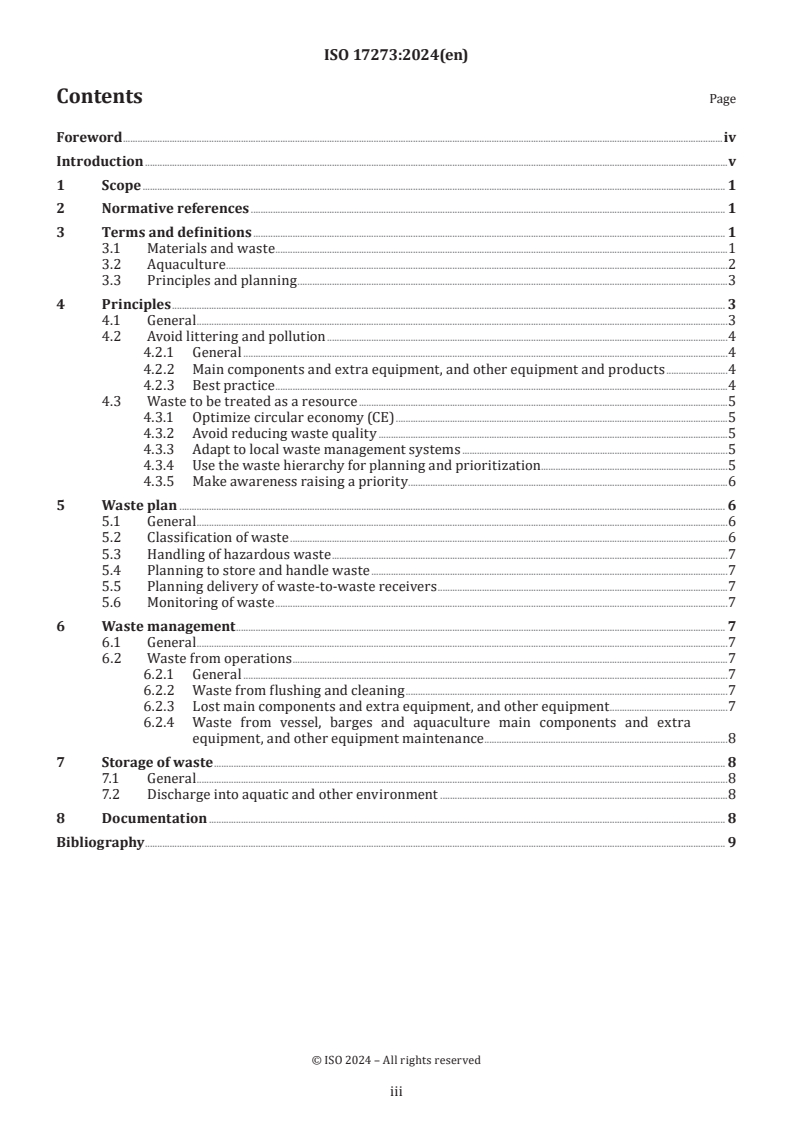
Contents Page
Foreword .iv
Introduction .v
1 Scope . 1
2 Normative references . 1
3 Terms and definitions . 1
3.1 Materials and waste .1
3.2 Aquaculture .2
3.3 Principles and planning .3
4 Principles . 3
4.1 General .3
4.2 Avoid littering and pollution .4
4.2.1 General .4
4.2.2 Main components and extra equipment, and other equipment and products .4
4.2.3 Best practice .4
4.3 Waste to be treated as a resource .5
4.3.1 Optimize circular economy (CE) .5
4.3.2 Avoid reducing waste quality .5
4.3.3 Adapt to local waste management systems .5
4.3.4 Use the waste hierarchy for planning and prioritization.5
4.3.5 Make awareness raising a priority .6
5 Waste plan . 6
5.1 General .6
5.2 Classification of waste .6
5.3 Handling of hazardous waste .7
5.4 Planning to store and handle waste .7
5.5 Planning delivery of waste-to-waste receivers .7
5.6 Monitoring of waste .7
6 Waste management . 7
6.1 General .7
6.2 Waste from operations .7
6.2.1 General .7
6.2.2 Waste from flushing and cleaning .7
6.2.3 Lost main components and extra equipment, and other equipment .7
6.2.4 Waste from vessel, barges and aquaculture main components and extra
equipment, and other equipment maintenance .8
7 Storage of waste . 8
7.1 General .8
7.2 Discharge into aquatic and other environment .8
8 Documentation . 8
Bibliography . 9
iii
Foreword
ISO (the International Organization for Standardization) is a worldwide federation of national standards
bodies (ISO member bodies). The work of preparing International Standards is normally carried out through
ISO technical committees. Each member body interested in a subject for which a technical committee
has been established has the right to be represented on that committee. International organizations,
governmental and non-governmental, in liaison with ISO, also take part in the work. ISO collaborates closely
with the International Electrotechnical Commission (IEC) on all matters of electrotechnical standardization.
The procedures used to develop this document and those intended for its further maintenance are described
in the ISO/IEC Directives, Part 1. In particular, the different approval criteria needed for the different types
of ISO document should be noted. This document was drafted in accordance with the editorial rules of the
ISO/IEC Directives, Part 2 (see www.iso.org/directives).
ISO draws attention to the possibility that the implementation of this document may involve the use of (a)
patent(s). ISO takes no position concerning the evidence, validity or applicability of any claimed patent
rights in respect thereof. As of the date of publication of this document, ISO had not received notice of (a)
patent(s) which may be required to implement this document. However, implementers are cautioned that
this may not represent the latest information, which may be obtained from the patent database available at
www.iso.org/patents. ISO shall not be held responsible for identifying any or all such patent rights.
Any trade name used in this document is information given for the convenience of users and does not
constitute an endorsement.
For an explanation of the voluntary nature of standards, the meaning of ISO specific terms and expressions
related to conformity assessment, as well as information about ISO's adherence to the World Trade
Organization (WTO) principles in the Technical Barriers to Trade (TBT), see www.iso.org/iso/foreword.html.
This document was prepared by Technical Committee ISO/TC 234, Fisheries and aquaculture.
Any feedback or questions on this document should be directed to the user’s national standards body. A
complete listing of these bodies can be found at www.iso.org/members.html.
iv
Introduction
A productive, healthy, and clean aquatic environment is vital for aquaculture. It is therefore essential to avoid
littering and other types of pollution to reduce the environmental footprint of marine sectors. Despite of
this, marine and fresh waters are recipients for litter and other pollutants, intentionally or unintentionally.
Waste and litter occurring in marine and fresh waters are to a large extent transported over large distances,
often following the ocean currents. Problems due to marine pollution therefore need to be solved at an
international level as well as at a national one. Reduced release of waste into the marine and fresh water
bodies will also make a significant contribution to improved resource management, increased sustainable
food-production and improved circular economy.
Waste management in aquaculture could contribute to:
— Reduction of litter and other pollutants from aquaculture.
— Reduced macro and micro plastic levels in marine and fresh waters, and on the seabed.
— Reduction of litter in the littoral zone and nearby terrestrial areas, as well as on recreation areas.
— Reduced environmental impact from the seafood industry, e.g. on fish species, invertebrates, reptiles,
birds and mammals.
— Increased contribution to circular economy, e.g. reuse and recycling of equipment from aquaculture.
— Healthy aquatic ecosystems.
v
International Standard ISO 17273:2024(en)
Waste management and reduction from aquaculture facilities
in natural water bodies — Principles and guidelines
1 Scope
This document specifies a system for waste management and reduction of solid waste in aquaculture. It
includes management plans, methods, principles and guidelines. This document is relevant for aquaculture
in marine and fresh water bodies.
This document does not apply to land-based aquaculture and does not comprise biological waste.
2 Normative references
There are no normative references in this document.
3 Terms and definitions
For the purposes of this document, the following terms and definitions apply.
ISO and IEC maintain terminology databases for use in standardization at the following addresses:
— ISO Online browsing platform: available at https:// www .iso .org/ obp
— IEC Electropedia: available at https:// www .electropedia .org/
3.1 Materials and waste
3.1.1
waste
substance or object which are disposed of, are intended to be disposed of or are required to be disposed of
by the provisions of national law
Note 1 to entry: In this document, “waste” does not include biological waste.
[SOURCE: ISO 5020:2022, 3.1.1]
3.1.2
litter
solid material, object or fragment which has been deliberately discarded or unintentionally lost
Note 1 to entry: According to the International Convention for the Prevention of Pollution from Ships, MARPOL 73/78
(Appendix V "Rules for the Prevention of Pollution by Garbage from Ships"), litter means all types of food, household
and operational waste, all types of plastics, cargo residues, ash from incinerators, cooking oil, fishing gear and
carcasses of animals that are formed during the normal operation of the vessel
...