

ISO/TS 4869-5:2006
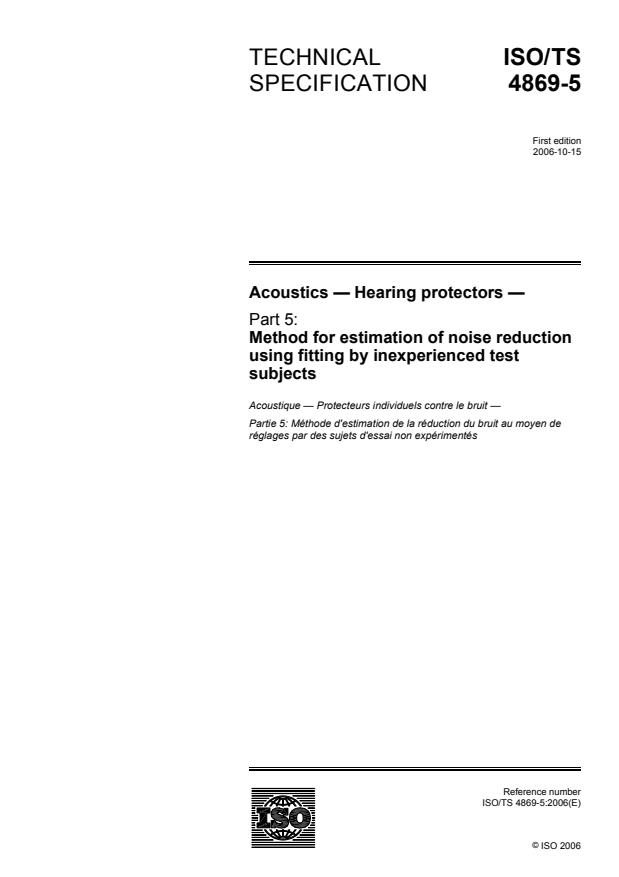
(Main)Acoustics — Hearing protectors — Part 5: Method for estimation of noise reduction using fitting by inexperienced test subjects
General Information
- Abstract
ISO/TS 4869-5:2006 specifies a method for measuring noise reduction of passive hearing protectors at the threshold of hearing. The method is designed to provide estimates of the noise reduction obtained by typical groups of users in real-world occupational settings, who may lack the training and motivation to wear hearing protectors in an optimum manner. The principle of the test method is to measure the difference in hearing threshold with and without wearing a hearing protector. This difference between the thresholds constitutes the noise reduction. The measurement is done twice on a given number of test subjects. This test method yields data that are collected at low sound pressure levels (close to the threshold of hearing), but which are also representative of the noise reduction values of hearing protectors at higher sound pressure levels. ISO/TS 4869-5:2006 is inapplicable for level-dependent hearing protectors for sound pressure levels above the point at which their level-dependent characteristics become effective.
- Status
- Published
- Publication Date
- 11-Oct-2006
- Technical Committee
- ISO/TC 43/SC 1 - Noise
- Current Stage
- 9020 - International Standard under periodical review
- Start Date
- 15-Jul-2026
- Completion Date
- 15-Jul-2026
Overview
ISO/TS 4869-5:2006 - "Acoustics - Hearing protectors - Part 5" specifies a laboratory method for estimating the noise reduction of passive hearing protectors by measuring hearing thresholds with fitting by inexperienced test subjects. The core principle is simple: measure the open-ear threshold (no protector) and the occluded-ear threshold (with protector); the difference is the individual noise reduction. Measurements are made twice per subject at sound pressure levels close to the threshold of hearing; results are intended to represent the performance typical users achieve in real-world occupational settings.
Key Topics and Requirements
- Purpose: Provide realistic estimates of hearing protector performance when worn by untrained or unmotivated users (ear-plugs, ear-muffs).
- Measurement principle: Threshold-based test - difference between occluded and open-ear thresholds.
- Repeatability: Each measurement is performed twice on each subject to reduce variability.
- Representative levels: Tests are done at low sound pressure levels (near threshold) but are considered representative for higher levels; not applicable to level-dependent protectors above their effective activation point.
- Test site and environment: Requirements for test room acoustics (reverberation time), background noise control and general validity conditions.
- Test equipment: Audiometric and acoustic equipment conforming to referenced IEC standards (e.g., IEC 60645-1, IEC 61672-1, IEC 61260).
- Test subjects: Criteria for subject acceptance/dismissal (age, hearing thresholds, anatomical considerations, prior experience), number of subjects required, otoscopic inspection, limits on spectacles/jewellery, and maximum tests per subject.
- Product handling: Rules for product samples including custom-moulded earplugs, instructions to subjects, and variable headband or band-force considerations.
- Data processing: Calculation of individual and group noise reduction values and assessment of measurement uncertainty (informative Annex A).
- Reporting: Standardized reporting of results and associated uncertainty.
Applications and Users
Who uses ISO/TS 4869-5:
- Manufacturers evaluating real-world performance of ear-plugs and ear-muffs.
- Test laboratories performing independent attenuation assessments.
- Occupational hygienists and safety officers selecting and specifying hearing protection for workplaces.
- Regulators and procurement teams needing representative attenuation data for policy, labeling, and purchasing decisions.
Practical uses:
- Estimating the noise reduction achievable by typical, inexperienced users.
- Comparing product designs under realistic fitting conditions.
- Informing training and fit-check programs by highlighting real-world attenuation gaps.
Related Standards
- ISO/TS 4869 series (Parts 1–6): Part 1 (subjective attenuation), Part 2 (effective A-weighted levels), Part 3 (insertion loss), Part 4 (level-dependent), Part 6 (active NR - under development).
- Normative references cited: IEC 60263, IEC 60645-1, IEC 61260, IEC 61672-1, and the GUM guide for uncertainty.
Relations
- Effective Date
- 06-Jun-2022
Get Certified
Connect with accredited certification bodies for this standard

CIS Institut d.o.o.
Personal Protective Equipment (PPE) certification body. Notified Body NB-2890 for EU Regulation 2016/425 PPE.

Kiwa BDA Testing
Building and construction product certification.
Kmetijski inštitut Slovenije
Agricultural Institute of Slovenia. Soil testing, plant health, agricultural product analysis.
Sponsored listings
Frequently Asked Questions
ISO/TS 4869-5:2006 is a technical specification published by the International Organization for Standardization (ISO). Its full title is "Acoustics — Hearing protectors — Part 5: Method for estimation of noise reduction using fitting by inexperienced test subjects". This standard covers: ISO/TS 4869-5:2006 specifies a method for measuring noise reduction of passive hearing protectors at the threshold of hearing. The method is designed to provide estimates of the noise reduction obtained by typical groups of users in real-world occupational settings, who may lack the training and motivation to wear hearing protectors in an optimum manner. The principle of the test method is to measure the difference in hearing threshold with and without wearing a hearing protector. This difference between the thresholds constitutes the noise reduction. The measurement is done twice on a given number of test subjects. This test method yields data that are collected at low sound pressure levels (close to the threshold of hearing), but which are also representative of the noise reduction values of hearing protectors at higher sound pressure levels. ISO/TS 4869-5:2006 is inapplicable for level-dependent hearing protectors for sound pressure levels above the point at which their level-dependent characteristics become effective.
ISO/TS 4869-5:2006 specifies a method for measuring noise reduction of passive hearing protectors at the threshold of hearing. The method is designed to provide estimates of the noise reduction obtained by typical groups of users in real-world occupational settings, who may lack the training and motivation to wear hearing protectors in an optimum manner. The principle of the test method is to measure the difference in hearing threshold with and without wearing a hearing protector. This difference between the thresholds constitutes the noise reduction. The measurement is done twice on a given number of test subjects. This test method yields data that are collected at low sound pressure levels (close to the threshold of hearing), but which are also representative of the noise reduction values of hearing protectors at higher sound pressure levels. ISO/TS 4869-5:2006 is inapplicable for level-dependent hearing protectors for sound pressure levels above the point at which their level-dependent characteristics become effective.
ISO/TS 4869-5:2006 is classified under the following ICS (International Classification for Standards) categories: 13.340.20 - Head protective equipment. The ICS classification helps identify the subject area and facilitates finding related standards.
ISO/TS 4869-5:2006 has the following relationships with other standards: It is inter standard links to ISO 4064-1:1977. Understanding these relationships helps ensure you are using the most current and applicable version of the standard.
ISO/TS 4869-5:2006 is available in PDF format for immediate download after purchase. The document can be added to your cart and obtained through the secure checkout process. Digital delivery ensures instant access to the complete standard document.
Standards Content (Sample)
TECHNICAL ISO/TS
SPECIFICATION 4869-5
First edition
2006-10-15
Acoustics — Hearing protectors —
Part 5:
Method for estimation of noise reduction
using fitting by inexperienced test
subjects
Acoustique — Protecteurs individuels contre le bruit —
Partie 5: Méthode d'estimation de la réduction du bruit au moyen de
réglages par des sujets d'essai non expérimentés
Reference number
©
ISO 2006
PDF disclaimer
This PDF file may contain embedded typefaces. In accordance with Adobe's licensing policy, this file may be printed or viewed but
shall not be edited unless the typefaces which are embedded are licensed to and installed on the computer performing the editing. In
downloading this file, parties accept therein the responsibility of not infringing Adobe's licensing policy. The ISO Central Secretariat
accepts no liability in this area.
Adobe is a trademark of Adobe Systems Incorporated.
Details of the software products used to create this PDF file can be found in the General Info relative to the file; the PDF-creation
parameters were optimized for printing. Every care has been taken to ensure that the file is suitable for use by ISO member bodies. In
the unlikely event that a problem relating to it is found, please inform the Central Secretariat at the address given below.
© ISO 2006
All rights reserved. Unless otherwise specified, no part of this publication may be reproduced or utilized in any form or by any means,
electronic or mechanical, including photocopying and microfilm, without permission in writing from either ISO at the address below or
ISO's member body in the country of the requester.
ISO copyright office
Case postale 56 • CH-1211 Geneva 20
Tel. + 41 22 749 01 11
Fax + 41 22 749 09 47
E-mail copyright@iso.org
Web www.iso.org
Published in Switzerland
ii © ISO 2006 – All rights reserved
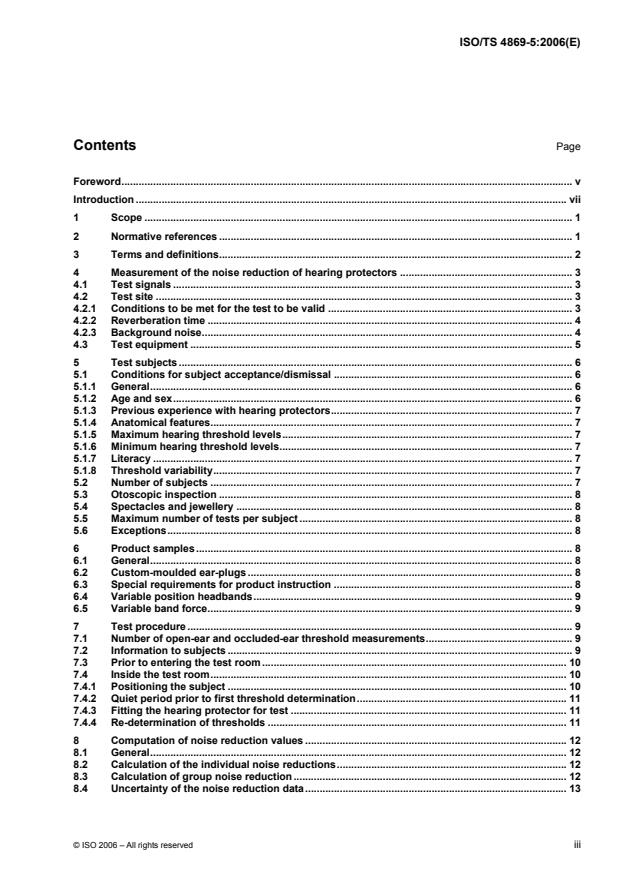
Contents Page
Foreword. v
Introduction . vii
1 Scope . 1
2 Normative references . 1
3 Terms and definitions. 2
4 Measurement of the noise reduction of hearing protectors . 3
4.1 Test signals . 3
4.2 Test site . 3
4.2.1 Conditions to be met for the test to be valid . 3
4.2.2 Reverberation time . 4
4.2.3 Background noise. 4
4.3 Test equipment . 5
5 Test subjects . 6
5.1 Conditions for subject acceptance/dismissal . 6
5.1.1 General. 6
5.1.2 Age and sex. 6
5.1.3 Previous experience with hearing protectors. 7
5.1.4 Anatomical features. 7
5.1.5 Maximum hearing threshold levels. 7
5.1.6 Minimum hearing threshold levels. 7
5.1.7 Literacy . 7
5.1.8 Threshold variability. 7
5.2 Number of subjects . 7
5.3 Otoscopic inspection . 8
5.4 Spectacles and jewellery . 8
5.5 Maximum number of tests per subject. 8
5.6 Exceptions. 8
6 Product samples. 8
6.1 General. 8
6.2 Custom-moulded ear-plugs . 8
6.3 Special requirements for product instruction . 8
6.4 Variable position headbands. 9
6.5 Variable band force. 9
7 Test procedure . 9
7.1 Number of open-ear and occluded-ear threshold measurements. 9
7.2 Information to subjects . 9
7.3 Prior to entering the test room . 10
7.4 Inside the test room. 10
7.4.1 Positioning the subject . 10
7.4.2 Quiet period prior to first threshold determination. 11
7.4.3 Fitting the hearing protector for test . 11
7.4.4 Re-determination of thresholds . 11
8 Computation of noise reduction values .12
8.1 General. 12
8.2 Calculation of the individual noise reductions. 12
8.3 Calculation of group noise reduction. 12
8.4 Uncertainty of the noise reduction data. 13
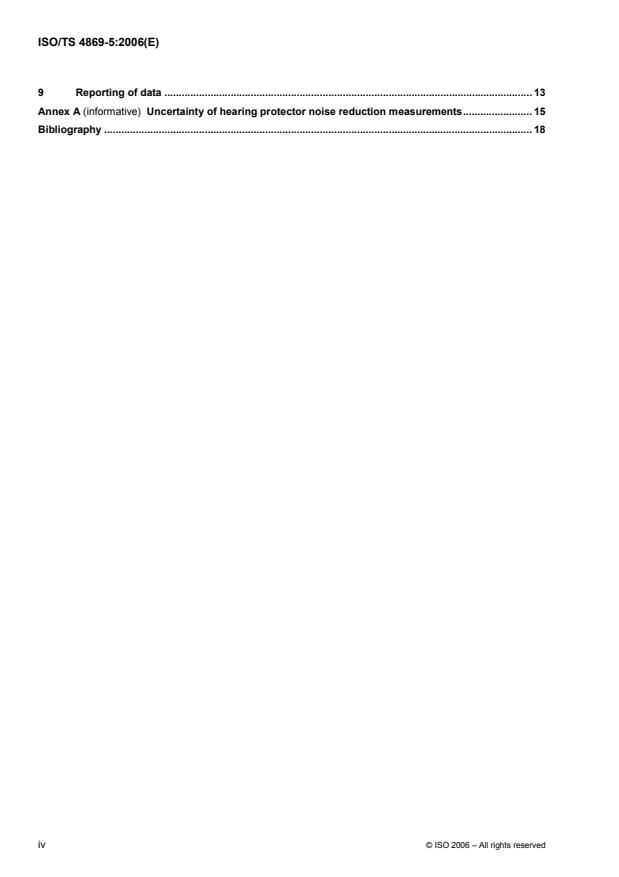
9 Reporting of data . 13
Annex A (informative) Uncertainty of hearing protector noise reduction measurements. 15
Bibliography . 18
iv © ISO 2006 – All rights reserved
Foreword
ISO (the International Organization for Standardization) is a worldwide federation of national standards bodies
(ISO member bodies). The work of preparing International Standards is normally carried out through ISO
technical committees. Each member body interested in a subject for which a technical committee has been
established has the right to be represented on that committee. International organizations, governmental and
non-governmental, in liaison with ISO, also take part in the work. ISO collaborates closely with the
International Electrotechnical Commission (IEC) on all matters of electrotechnical standardization.
International Standards are drafted in accordance with the rules given in the ISO/IEC Directives, Part 2.
The main task of technical committees is to prepare International Standards. Draft International Standards
adopted by the technical committees are circulated to the member bodies for voting. Publication as an
International Standard requires approval by at least 75 % of the member bodies casting a vote.
In other circumstances, particularly when there is an urgent market requirement for such documents, a
technical committee may decide to publish other types of normative document:
⎯ an ISO Publicly Available Specification (ISO/PAS) represents an agreement between technical experts in
an ISO working group and is accepted for publication if it is approved by more than 50 % of the members
of the parent committee casting a vote;
⎯ an ISO Technical Specification (ISO/TS) represents an agreement between the members of a technical
committee and is accepted for publication if it is approved by 2/3 of the members of the committee casting
a vote.
An ISO/PAS or ISO/TS is reviewed after three years in order to decide whether it will be confirmed for a
further three years, revised to become an International Standard, or withdrawn. If the ISO/PAS or ISO/TS is
confirmed, it is reviewed again after a further three years, at which time it must either be transformed into an
International Standard or be withdrawn.
Attention is drawn to the possibility that some of the elements of this document may be the subject of patent
rights. ISO shall not be held responsible for identifying any or all such patent rights.
ISO/TS 4869-5 was prepared by Technical Committee ISO/TC 43, Acoustics, Subcommittee SC 1, Noise.
ISO/TS 4869 consists of the following parts, under the general title Acoustics — Hearing protectors:
⎯ Part 1: Subjective method for the measurement of sound attenuation
⎯ Part 2: Estimation of effective A-weighted sound pressure levels when hearing protectors are worn
1)
⎯ Part 3 : Measurement of insertion loss of ear-muff type protectors using an acoustic test fixture
⎯ Part 4: Measurement of effective sound pressure levels for level-dependent sound-restoration ear-muffs
(ISO/TR)
⎯ Part 5: Method for estimation of noise reduction using fitting by inexperienced test subjects (ISO/TS)
1) To be published.
The following part is under development:
2)
⎯ Part 6: Active noise reduction of hearing protectors
Annex A of this part of ISO 4869 is for information only.
2) Presently a preliminary work item.
vi © ISO 2006 – All rights reserved
Introduction
Hearing protectors are used to reduce the noise to which the ear is exposed. Hearing protectors are generally
divided into ear-muffs and ear-plugs with a great variety of products within both categories. The measurement
conditions given in this Technical Specification – making use of inexperienced hearing protector users – is
believed to provide results that are representative for the noise reduction obtained by groups of typical users
in real-world occupational settings.
The method described in ISO 4869-1 yields the sound attenuation of the hearing protector under test. The
result of the measurement is a pure physical characteristic of the hearing protector.
The method described in this Technical Specification yields the performance of the system as a whole, i.e.
hearing protector, test subjects, fitting and instruction.
TECHNICAL SPECIFICATION ISO/TS 4869-5:2006(E)
Acoustics — Hearing protectors —
Part 5:
Method for estimation of noise reduction using fitting
by inexperienced test subjects
1 Scope
This Technical Specification specifies a method for measuring noise reduction of passive hearing protectors at
the threshold of hearing. The method is designed to provide estimates of the noise reduction obtained by
typical groups of users in real-world occupational settings, who may lack the training and motivation to wear
hearing protectors in an optimum manner.
The principle of the test method is to measure the difference in hearing threshold with and without wearing a
hearing protector. This difference between the thresholds constitutes the noise reduction. The measurement is
done twice on a given number of test subjects.
NOTE 1 The principle of measuring the influence of a hearing protector on the hearing threshold is used in ISO 4869-1
and in this Technical Specification. The method described in ISO 4869-1 yields the sound attenuation of the hearing
protector under test. The result of the measurement is a pure physical characteristic of the hearing protector. The method
described in this Technical Specification yields the performance of the system as a whole, i.e. the influence of hearing
protector, test subjects, fitting and instruction.
This test method yields data that are collected at low sound pressure levels (close to the threshold of hearing),
but which are also representative of the noise reduction values of hearing protectors at higher sound pressure
levels. This Technical Specification is inapplicable for level-dependent hearing protectors for sound pressure
levels above the point at which their level-dependent characteristics become effective.
NOTE 2 At frequencies below 500 Hz, real-ear noise reduction data measured according to this Technical Specification
may be spuriously high by a few decibels, with the error increasing as the frequency decreases. The error results from
masking of the occluded-ear threshold by physiological noise during testing.
2 Normative references
The following referenced documents are indispensable for the application of this document. For dated
references, only the edition cited applies. For undated references, the latest edition of the referenced
document (including any amendments) applies.
IEC 60263, Scales and sizes for plotting frequency characteristics and polar diagrams
IEC 60645-1, Electroacoustics — Audiological equipment — Part 1: Pure-tone audiometers
IEC 61260:1995, Electroacoustics — Octave-band and fractional-octave-band filters
lEC 61672-1, Electroacoustics — Sound level meters — Part 1: Specifications
Guide to the expression of uncertainty in measurement (GUM), BIPM/IEC/IFCC/ISO/IUPAC/IUPAP/OIML,
3)
ISBN 92-67-10188-9, 1993
3) Corrected and reprinted in 1995.
3 Terms and definitions
For the purpose of this document, the following terms and definitions apply.
3.1
hearing protector
device worn by a person to reduce unwanted effects of sound
NOTE Hearing protectors can include electronic devices for communication or devices designed to play an active
role in the reduction of the noise level between the hearing protector and the eardrum.
3.2
ear-muff
hearing protector consisting of an ear-cup to be pressed against each pinna or of a circumaural ear-cup to be
pressed against the head around the pinna
NOTE The ear-cups can be pressed against the head with a special headband or neck-band or by means of a device
attached to a safety helmet or other equipment.
3.3
ear-plug
hearing protector that either is inserted into the external ear canal or covers the ear canal entrance
NOTE Some ear-plugs are held in place by a lightweight band. They are sometimes called canal caps, semi-aural
inserts, or banded ear-plugs.
3.4
helmet
device which covers a substantial part of the head
3.5
hearing level
〈of a pure tone〉 at a specified frequency, for a specified type of earphone and for a specified manner of
application, the sound pressure level of this pure tone produced by the earphone in a specified acoustic
coupler or artificial ear minus the appropriate reference equivalent threshold sound pressure level
NOTE Values of reference equivalent threshold sound pressure levels are specified in ISO 389-1.
3.6
hearing threshold level
〈of a given ear〉 at a specified frequency and for a specified type of earphone, the threshold of hearing
expressed as hearing level
NOTE For appropriate measurement procedures see, for example, ISO 6189 and ISO 8253-1.
3.7
threshold of hearing
lowest sound pressure level at which, under specified conditions, a person gives a predetermined percentage
of correct detection responses on repeated trials
NOTE For the purpose of this Technical Specification, the threshold of hearing is measured with and without
the hearing protector. For appropriate test conditions, see ISO 8253-2.
3.8
occluded-ear threshold of hearing
threshold of hearing when a hearing protector is worn
3.9
open-ear threshold of hearing
threshold of hearing when no hearing protector is worn
2 © ISO 2006 – All rights reserved
3.10
individual noise reduction
for a given test signal and a selected test subject, the difference between the occluded-ear threshold of
hearing and the open-ear threshold of hearing, i.e. the threshold with and without the hearing protector
NOTE The individual noise reduction is expressed in decibels.
3.11
group noise reduction
for a given test signal, the mean of the individual noise reductions for a group of test subjects
3.12
pink noise
noise in which sound power spectral density is inversely proportional to frequency
3.13
reference point
fixed point within the test chamber; the test subject is positioned so that the mid-point of a line connecting the
subjects’ ear canal openings coincides with the reference point
NOTE All objective measurements of the sound field characteristics are referenced to the reference point.
3.14
reverberation time
time required for the sound pressure level to decrease by 60 dB after the sound source has stopped
NOTE See ISO 354.
4 Measurement of the noise reduction of hearing protectors
4.1 Test signals
The test signals shall consist of a signal from pink noise filtered through one-third-octave bands with centre
frequencies in accordance with IEC 61260. At a minimum, the following centre frequencies shall be tested:
125 Hz, 250 Hz, 500 Hz, 1 000 Hz, 2 000 Hz, 4 000 Hz and 8 000 Hz
4.2 Test site
4.2.1 Conditions to be met for the test to be valid
a) With the test subject and the subject's chair absent, the sound pressure level measured with
an omnidirectional microphone at positions 15 cm from the reference point on the front back, right-left and
up-down axes shall deviate by no more than ± 2,5 dB from the sound pressure level at the reference point
for any of the test signals. Further, the difference between the extreme right-left positions shall not exceed
3 dB. The orientation of the microphone shall be kept the same at each position.
b) At frequencies of 500 Hz and above, the sound pressure level at the reference point shall be within 5 dB
for the two directions of measurement that give maximum and minimum readings of the incident sound
energy when measured with a directional microphone with a front-to-random sensitivity index of 5 dB. For
other directional microphones, the relationship between the front-to-random sensitivity index and the
allowable field variation is given in Table 1.
Table 1 — Allowable field variation for different microphones
Front-to-random sensitivity index Allowable field variation
dB dB
W 5 5
4,5 4,5
4 4
< 4 Measurement not suitable
NOTE 1 The test should be carried out in a sufficient number of directions, which depend on the type of
microphone and the characteristics of the loudspeaker arrangement and include at least the two directions
where maximum and minimum sound pressure levels may be expected.
NOTE 2 More than one loudspeaker is necessary to produce the desired sound field. The loudspeakers
may require to be fed with non-coherent electrical signals to reduce the effects of standing waves.
4.2.2 Reverberation time
The reverberation time in the test space (without subject) shall not exceed 1,6 s for each of the test bands.
4.2.3 Background noise
The background noise at the test site in the test room shall not exceed the values given in Table 2 with the
test subject absent. The level of the background noise shall be determined by measuring the sound pressure
level.
NOTE Background noise includes the ambient noise present in the room and the noise of the test equipment in the
absence of the test signal.
4 © ISO 2006 – All rights reserved
Table 2 — Maximum permissible background sound pressure level
Centre frequency One-third-octave-band
sound pressure level
Hz
(ref. 20 µPa)
dB
50 38
63 32
80 27
100 22
125 17
160 14
200 12
250 10
315 8
400 6
500 5
630 5
800 4
1 000 4
1 250 4
1 600 5
2 000 5
2 500 3
3 150 1
4 000 −1
5 000 1
6 300 6
8 000 12
10 000 14
With the background noise levels given in Table 2, it is possible to measure hearing threshold levels down to
0 dB. If test subjects' hearing threshold levels are better than 0 dB, the permissible background noise levels
shall be lowered accordingly.
NOTE The values in Table 2 are from ISO 8253-2.
4.3 Test equipment
The test equipment shall be able to produce all test signals without distortion at the test subject's position.
For the test signals mentioned in 4.1, the frequency range shall be from 110 Hz (approximately, the lower
limiting frequency of the 125 Hz one-third octave) to 9 000 Hz (approximately, the upper limiting frequency of
the 8 000 Hz one-third-octave band).
The equipment, including the loudspeaker system, shall be able to produce the minimum and maximum test
signal sound pressure levels given in Table 3 at the test subject’s position.
Table 3 — Minimum and maximum sound pressure levels for test signals
Minimum and maximum test signal
sound pressure levels
Centre frequency
(ref. 20 µPa)
Hz
dB
125 10 to 70
250 0 to 70
500 −5 to 80
1 000 −10 to 80
W 2 000
−15 to 90
The equipment, including the loudspeaker system, shall secure the reproduction of the test signals without
any audible crackle and rattle at each test band and each level as given in Table 3. At centre frequencies from
one octave above the test band up to 16 kHz, and from one octave below the test band down to 63 Hz, all
one-third-octave-band sound pressure levels shall remain at least 40 dB below the sound pressure level in
the test band under all test conditions. The band levels shall be measured using filters complying with
IEC 61260. The test band sound pressure levels shall be measured as average values (L in IEC 61672-1)
eq
and the remaining band levels using time weighting F of IEC 61672-1.
NOTE The lower limits of the levels in Table 3 are set to allow open ear testing of subjects with better than average
hearing.
Attenuator steps shall be 2,5 dB or smaller.
The error in the difference between the indications at any two positions of the attenuator with the complete
test equipment including the loudspeaker shall not exceed 2 dB over the total range of the attenuator and 1 dB
over any 80 dB range. Where possible, this test shall be performed acoustically. At low sound pressure levels,
it is also permissible to check the test equipment by electrical measurement of the signal voltage at the
terminals of the loudspeaker(s).
If it is not possible to achieve the desired accuracy in the attenuation system, the test equipment shall be
calibrated and the corrections thus obtained shall be applied to the measurements.
The electrical signals applied to the loudspeakers shall comply with IEC 60645-1.
5 Test subjects
5.1 Conditions for subject acceptance/dismissal
5.1.1 General
No subject selection criteria shall exist besides those specified in this clause. It is not permitted to optimize a
test panel based upon experience gained from subject participation in prior tests.
5.1.2 Age and sex
Subjects shall be at least 18 years of age.
Unless the hearing protector under test is designed to fit only males or only females, the balance of male to
female subjects shall be 50/50 ± 10 %.
6 © ISO 2006 – All rights reserved
5.1.3 Previous experience with hearing protectors
Subjects shall not have had significant previous experience with hearing protectors. Potential subjects shall be
questioned as follows:
a) Have you ever received one-to-one personal instruction in fitting of hearing protectors?
b) Within the past two years, have you attended a lecture on, or watched videotaped or computer-based
instruction about how to fit hearing protectors?
c) Within the past two years, have you participated in an experiment designed to measure hearing protector
noise reduction?
d) Within the past two years, on how many days have you worn any kind of hearing protector to protect
yourself from noise, and for how many days have you worn ear-plugs while sleeping or swimming?
Potential subjects shall be rejected if they answer “yes” to questions (a), (b) or (c) or if in response to (d) they
indicate use of any kind of ear-plugs for more than ten days or use of ear-muffs for more than two months.
5.1.4 Anatomical features
Subjects shall be selected without regard to sizes and shapes of heads, pinnae and ear ca
...