

ISO 3873:2025
(Main)Industrial protective helmets
General Information
- Abstract
This document specifies physical and performance requirements, test methods and marking requirements for industrial protective helmets. This document describes the requirements for two helmet types. Type I — intended to protect the upper part of wearer’s head against impacts that may occur in an industrial setting, such as a falling object. Type II — intended to protect the head against impacts that may occur in an industrial setting, such as a falling object or a fall. NOTE The Type II helmet is intended to offer protection from falls from standing or a low height, e.g. standing height elevated by up to one metre. The Type II helmet is not intended to offer protection to the head in all falls and is unlikely to prevent serious head injury or death in uncontrolled falls from one level to another or from a position elevated on a ladder or scaffolding. The selection of a Type II helmet should be considered as one part of an overall safe system of work in the context of working at heights and managing the risks of falls from greater than two metres.
- Status
- Published
- Publication Date
- 24-Feb-2025
- Technical Committee
- ISO/TC 94 - Personal safety -- Personal protective equipment
- Drafting Committee
- ISO/TC 94 - Personal safety -- Personal protective equipment
- Current Stage
- 6060 - International Standard published
- Start Date
- 25-Feb-2025
- Due Date
- 16-Feb-2025
- Completion Date
- 25-Feb-2025

Overview - ISO 3873:2025 (Industrial protective helmets)
ISO 3873:2025 is the International Standard specifying physical and performance requirements, test methods and marking requirements for industrial protective helmets. The second edition updates and replaces ISO 3873:1977 and introduces two helmet types:
- Type I - protects the upper part of the head from impacts typical in industrial settings (e.g., falling objects).
- Type II - provides broader protection (front, side and rear) against impacts such as falling objects or short falls (note: Type II is intended for falls from standing or low height, up to about 1 m, and is not designed to prevent serious injury from uncontrolled or long-distance falls).
This standard is published by ISO/TC 94 (Personal safety - Personal protective equipment) and outlines mandatory and optional tests, conditioning procedures, marking and user instructions for safety helmets.
Key topics and technical requirements
ISO 3873:2025 covers the following technical areas:
- Materials and general construction requirements for helmet shells, liners and attachments.
- Performance tests, including:
- Impact energy attenuation (new for Type II) - verifies the helmet’s capacity to reduce transmitted impact forces.
- Striker drop test and headform drop test for impact performance.
- Resistance to penetration - evaluates protection against sharp falling objects.
- Resistance to ignition - replaces previous flame-resistance provisions.
- Dynamic strength of the retention system and dynamic stability (Type II).
- Buckle release, and optional tests such as low-temperature, artificial ageing and electrical performance.
- Test requirements and conditioning - sample selection, environmental conditioning (cold, heat, wet, ageing) and test schedule.
- Marking and instructions for use - mandatory helmet markings and user guidance for safe selection and maintenance.
Practical applications and who uses this standard
ISO 3873:2025 is used by:
- Helmet manufacturers and designers to develop and certify industrial protective helmets.
- Test laboratories and certification bodies to perform standardized testing and conformity assessment.
- Procurement officers and safety managers to specify compliant helmets for workplaces (construction, manufacturing, utilities, mining).
- Regulators and occupational health professionals to reference accepted performance criteria for PPE. Practical benefits include improved product safety, consistent testing protocols, and clearer guidance on helmet selection-especially the limitations of Type II helmets in fall scenarios. Selection of helmets for work at height should be part of a comprehensive fall-risk system, particularly when working above 2 m.
Related standards and context
ISO 3873:2025 is aligned with ISO/TC 94 work on personal protective equipment and reflects collaboration with electrotechnical committees where relevant (electrical performance testing). Users should also consider complementary national and regional PPE standards and fall-protection regulations when specifying helmets.
Keywords: ISO 3873:2025, industrial protective helmets, safety helmets, PPE standard, Type I helmet, Type II helmet, impact energy attenuation, retention system, penetration resistance, striker drop test.
Relations
- Effective Date
- 06-Jun-2022
Get Certified
Connect with accredited certification bodies for this standard

CIS Institut d.o.o.
Personal Protective Equipment (PPE) certification body. Notified Body NB-2890 for EU Regulation 2016/425 PPE.

Kiwa BDA Testing
Building and construction product certification.
Kmetijski inštitut Slovenije
Agricultural Institute of Slovenia. Soil testing, plant health, agricultural product analysis.
Sponsored listings
Frequently Asked Questions
ISO 3873:2025 is a standard published by the International Organization for Standardization (ISO). Its full title is "Industrial protective helmets". This standard covers: This document specifies physical and performance requirements, test methods and marking requirements for industrial protective helmets. This document describes the requirements for two helmet types. Type I — intended to protect the upper part of wearer’s head against impacts that may occur in an industrial setting, such as a falling object. Type II — intended to protect the head against impacts that may occur in an industrial setting, such as a falling object or a fall. NOTE The Type II helmet is intended to offer protection from falls from standing or a low height, e.g. standing height elevated by up to one metre. The Type II helmet is not intended to offer protection to the head in all falls and is unlikely to prevent serious head injury or death in uncontrolled falls from one level to another or from a position elevated on a ladder or scaffolding. The selection of a Type II helmet should be considered as one part of an overall safe system of work in the context of working at heights and managing the risks of falls from greater than two metres.
This document specifies physical and performance requirements, test methods and marking requirements for industrial protective helmets. This document describes the requirements for two helmet types. Type I — intended to protect the upper part of wearer’s head against impacts that may occur in an industrial setting, such as a falling object. Type II — intended to protect the head against impacts that may occur in an industrial setting, such as a falling object or a fall. NOTE The Type II helmet is intended to offer protection from falls from standing or a low height, e.g. standing height elevated by up to one metre. The Type II helmet is not intended to offer protection to the head in all falls and is unlikely to prevent serious head injury or death in uncontrolled falls from one level to another or from a position elevated on a ladder or scaffolding. The selection of a Type II helmet should be considered as one part of an overall safe system of work in the context of working at heights and managing the risks of falls from greater than two metres.
ISO 3873:2025 is classified under the following ICS (International Classification for Standards) categories: 13.340.20 - Head protective equipment. The ICS classification helps identify the subject area and facilitates finding related standards.
ISO 3873:2025 has the following relationships with other standards: It is inter standard links to ISO 3873:1977. Understanding these relationships helps ensure you are using the most current and applicable version of the standard.
ISO 3873:2025 is available in PDF format for immediate download after purchase. The document can be added to your cart and obtained through the secure checkout process. Digital delivery ensures instant access to the complete standard document.
Standards Content (Sample)
International
Standard
ISO 3873
Second edition
Industrial protective helmets
2025-02
Casques de protection pour l'industrie
Reference number
© ISO 2025
All rights reserved. Unless otherwise specified, or required in the context of its implementation, no part of this publication may
be reproduced or utilized otherwise in any form or by any means, electronic or mechanical, including photocopying, or posting on
the internet or an intranet, without prior written permission. Permission can be requested from either ISO at the address below
or ISO’s member body in the country of the requester.
ISO copyright office
CP 401 • Ch. de Blandonnet 8
CH-1214 Vernier, Geneva
Phone: +41 22 749 01 11
Email: copyright@iso.org
Website: www.iso.org
Published in Switzerland
ii
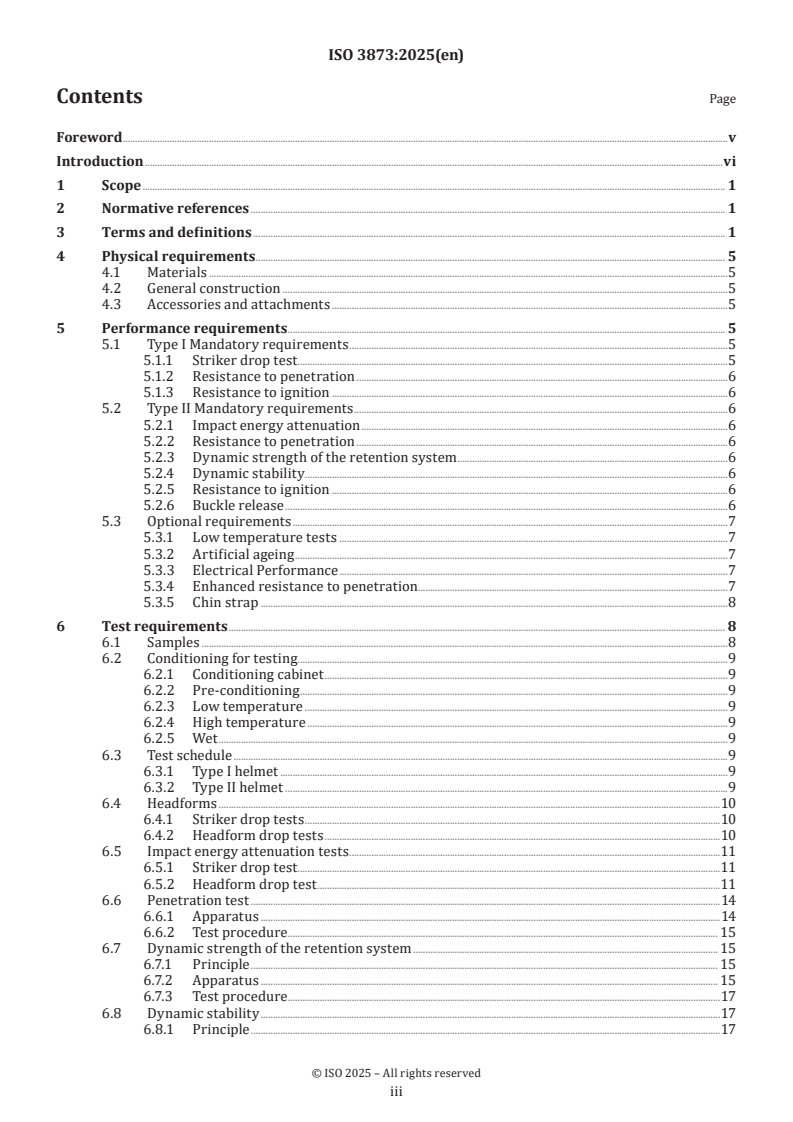
Contents Page
Foreword .v
Introduction .vi
1 Scope . 1
2 Normative references . 1
3 Terms and definitions . 1
4 Physical requirements . 5
4.1 Materials .5
4.2 General construction .5
4.3 Accessories and attachments .5
5 Performance requirements . . 5
5.1 Type I Mandatory requirements .5
5.1.1 Striker drop test.5
5.1.2 Resistance to penetration .6
5.1.3 Resistance to ignition .6
5.2 Type II Mandatory requirements .6
5.2.1 Impact energy attenuation .6
5.2.2 Resistance to penetration .6
5.2.3 Dynamic strength of the retention system .6
5.2.4 Dynamic stability . . .6
5.2.5 Resistance to ignition .6
5.2.6 Buckle release .6
5.3 Optional requirements .7
5.3.1 Low temperature tests .7
5.3.2 Artificial ageing .7
5.3.3 Electrical Performance .7
5.3.4 Enhanced resistance to penetration .7
5.3.5 Chin strap .8
6 Test requirements . 8
6.1 Samples .8
6.2 Conditioning for testing.9
6.2.1 Conditioning cabinet .9
6.2.2 Pre-conditioning .9
6.2.3 Low temperature .9
6.2.4 High temperature .9
6.2.5 Wet .9
6.3 Test schedule .9
6.3.1 Type I helmet .9
6.3.2 Type II helmet .9
6.4 Headforms .10
6.4.1 Striker drop tests .10
6.4.2 Headform drop tests .10
6.5 Impact energy attenuation tests .11
6.5.1 Striker drop test.11
6.5.2 Headform drop test .11
6.6 Penetration test .14
6.6.1 Apparatus .14
6.6.2 Test procedure. 15
6.7 Dynamic strength of the retention system . 15
6.7.1 Principle . 15
6.7.2 Apparatus . 15
6.7.3 Test procedure.17
6.8 Dynamic stability .17
6.8.1 Principle .17
iii
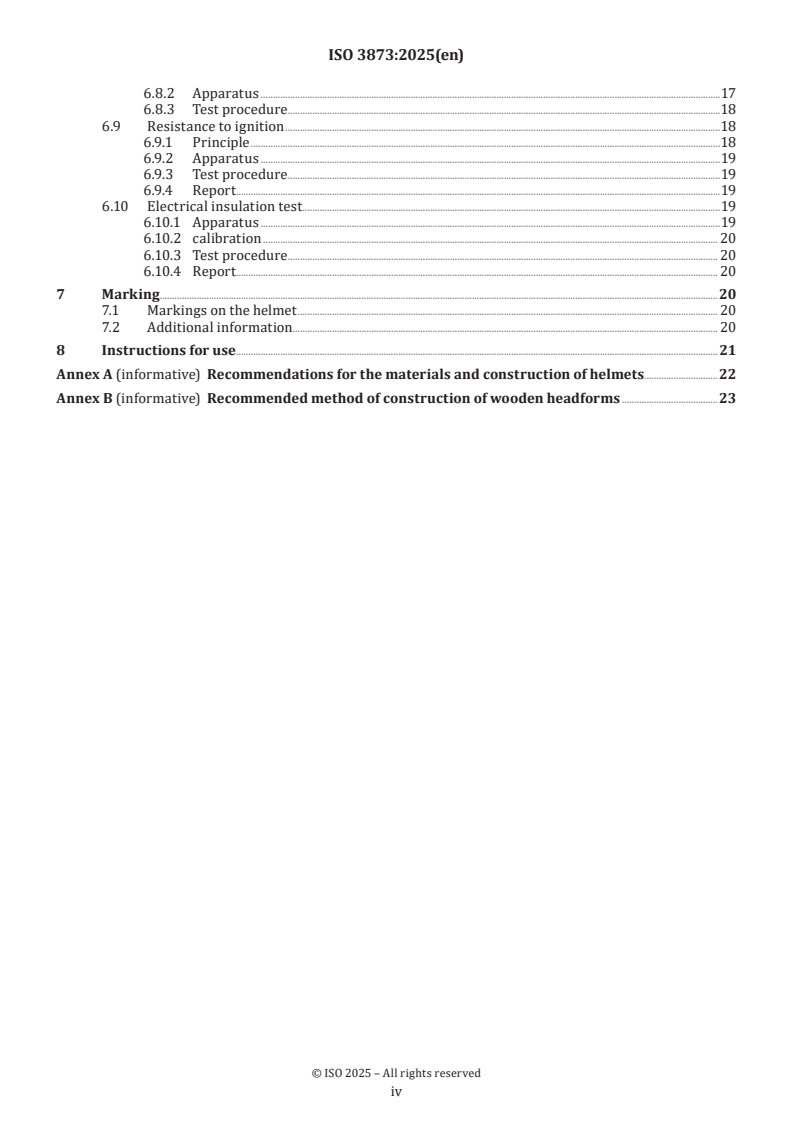
6.8.2 Apparatus .17
6.8.3 Test procedure.18
6.9 Resistance to ignition .18
6.9.1 Principle .18
6.9.2 Apparatus .19
6.9.3 Test procedure.19
6.9.4 Report.19
6.10 Electrical insulation test .19
6.10.1 Apparatus .19
6.10.2 calibration . 20
6.10.3 Test procedure. 20
6.10.4 Report. 20
7 Marking . .20
7.1 Markings on the helmet . 20
7.2 Additional information. 20
8 Instructions for use . .21
Annex A (informative) Recommendations for the materials and construction of helmets.22
Annex B (informative) Recommended method of construction of wooden headforms .23
iv
Foreword
ISO (the International Organization for Standardization) is a worldwide federation of national standards
bodies (ISO member bodies). The work of preparing International Standards is normally carried out through
ISO technical committees. Each member body interested in a subject for which a technical committee
has been established has the right to be represented on that committee. International organizations,
governmental and non-governmental, in liaison with ISO, also take part in the work. ISO collaborates closely
with the International Electrotechnical Commission (IEC) on all matters of electrotechnical standardization.
The procedures used to develop this document and those intended for its further maintenance are described
in the ISO/IEC Directives, Part 1. In particular, the different approval criteria needed for the different types
of ISO document should be noted. This document was drafted in accordance with the editorial rules of the
ISO/IEC Directives, Part 2 (see www.iso.org/directives).
ISO draws attention to the possibility that the implementation of this document may involve the use of (a)
patent(s). ISO takes no position concerning the evidence, validity or applicability of any claimed patent
rights in respect thereof. As of the date of publication of this document, ISO had received notice of (a)
patent(s) which may be required to implement this document. However, implementers are cautioned that
this may not represent the latest information, which may be obtained from the patent database available at
www.iso.org/patents. ISO shall not be held responsible for identifying any or all such patent rights.
Any trade name used in this document is information given for the convenience of users and does not
constitute an endorsement.
For an explanation of the voluntary nature of standards, the meaning of ISO specific terms and expressions
related to conformity assessment, as well as information about ISO's adherence to the World Trade
Organization (WTO) principles in the Technical Barriers to Trade (TBT), see www.iso.org/iso/foreword.html.
This document was prepared by Technical Committee ISO/TC 94, Personal safety — Personal protective
equipment
This second edition cancels and replaces the first edition (ISO 3873:1977), which has been technically
revised.
The main changes are as follows:
— Introduction of a Type II helmet that is intended to protect the front, side and rear of the wearer’s head.
Reflecting this change is the introduction of impact energy attenuation requirements, dynamic strength
of the retention system and dynamic stability tests.
— Elimination of mandatory harness dimensions and clearances for Type I helmets. A Type I helmet could
be constructed using a conventional harness system, but it could also be constructed using an impact
energy attenuation liner.
— Introduction of resistance to ignition tests to replace the flame resistance requirements.
Future considerations:
— Impacts to the head that result in head angular motion (referred to as angled, tangential or oblique
impacts) are one of the causes of brain injury. The revisions to the standard have not addressed directly
the performance of systems intended to manage head angular motion. The introduction of a Type II
helmet will offer some improvements in managing head angular motion with regards to the first edition
of ISO 3873 because of the additional impact energy attenuation tests. At the time that second edition
of ISO 3873 was developed, no test method was available that could be readily incorporated into this
standard. In the future, when a suitable oblique impact test method and risk analysis are available, the
ambition of this committee is to revise this document and include requirements for such a test.
Any feedback or questions on this document should be directed to the user’s national standards body. A
complete listing of these bodies can be found at www.iso.org/members.html.
v
Introduction
The International Organization for Standardization (ISO) draws attention to the fact that it is claimed that
compliance with this document may involve the use of a patent.
ISO takes no position concerning the evidence, validity and scope of this patent right.
The holder of this patent right has assured ISO that he/she is willing to negotiate licences under reasonable
and non-discriminatory terms and conditions with applicants throughout the world. In this respect, the
statement of the holder of this patent right is registered with ISO. Information may be obtained from the
patent database available at www.iso.org/patents.
Attention is drawn to the possibility that some of the elements of this document may be the subject of patent
rights other than those in the patent database. ISO shall not be held responsible for identifying any or all
such patent rights.
vi
International Standard ISO 3873:2025(en)
Industrial protective helmets
1 Scope
This document specifies physical and performance requirements, test methods and marking requirements
for industrial protective helmets. This document describes the requirements for two helmet types.
Type I — intended to protect the upper part of wearer’s head against impacts that may occur in an industrial
setting, such as a falling object.
Type II — intended to protect the head against impacts that may occur in an industrial setting, such as a
falling object or a fall.
NOTE The Type II helmet is intended to offer protection from falls from standing or a low height, e.g. standing
height elevated by up to one metre. The Type II helmet is not intended to offer protection to the head in all falls and
is unlikely to prevent serious head injury or death in uncontrolled falls from one level to another or from a position
elevated on a ladder or scaffolding. The selection of a Type II helmet should be considered as one part of an overall safe
system of work in the context of working at heights and managing the risks of falls from greater than two metres.
2 Normative references
The following documents are referred to in the text in such a way that some or all of their content constitutes
requirements of this document. For dated references, only the edition cited applies. For undated references,
the latest edition of the referenced document (including any amendments) applies.
EN 960, Headforms for use in the testing of protective helmets
J211/1, SAE Instrumentation for Impact Test Part 1 - Electronic Instrumentation
EN 13087-1, Protective helmets - Test methods - Part 1: Conditions and conditioning
3 Terms and definitions
For the purposes of this document, the following terms and definitions apply.
ISO and IEC maintain terminology databases for use in standardization at the following addresses:
— ISO Online browsing platform: available at https:// www .iso .org/ obp
— IEC Electropedia: available at https:// www .electropedia .org/
3.1
protective helmet
helmet intended to protect at a minimum the upper part of the wearer's head against an impact
3.2
shell
hard, smoothly finished material that provides the general external form of the helmet
3.2.1
crown
the area on the upper, outer surface of a headform, centred on the mid coronal plane (see EN 960)
3.3
peak
horizontal extension of the shell (3.2) above the eyes
3.4
brim
rim surrounding the shell (3.2)
3.5
chin strap
strap that is intended to pass under the wearer’s chin with two points of attachment to the helmet used with
Type I helmets
Note 1 to entry: A chin strap is an accessory.
3.6
helmet accessories
any optional parts for special purposes such as chin strap, neck protector, drawlace and attachment devices
for lamp and cable
3.7
helmet attachment
accessory which is not an integral part of the helmet and secured to helmet
3.8
helmet positioning index
HPI
vertical distance, measured in the vertical longitudinal plane, between the reference plane of the reference
headform and the lowest point of the helmet in the forehead region
Note 1 to entry: HPI is provided by the helmet supplier and indicates the intended position of the helmet when worn.
3.9
liner
protective component of the helmet, positioned between shell (3.2) and head, that primarily provides impact
energy attenuation
3.10
planes
3.10.1
basic plane
Frankfurt plane
plane intersecting the inferior borders of the orbits and external auditory meatuses
3.10.2
mid-sagittal plane
median plane
plane equivalent to the vertical longitudinal plane
3.10.3
mid-coronal plane
frontal plane
plane equivalent to the vertical transverse plane
Note 1 to entry: See Figure 1.
Key
1 horizontal plane (also known as transverse plane)
2 mid-sagittal plane
3 basic plane
4 mid-coronal plane
Figure 1 — Orientation planes
3.11
impact energy attenuation
ability of the helmet to manage the kinetic energy during an impact
3.12
harness
assembly comprising a cradle, headband, comfort padding and nape strap which maintains the helmet in
position on the head and provides impact energy attenuation (3.11)
Note 1 to entry: A harness assembly has been the method used on occupational protective helmets meeting
ISO 3873:1977 to maintain the helmet in position on the head and provide impact energy attenuation.
3.13
retention system
assembly that maintains the position of the helmet on the head during use; consisting of components for
adjustment and improved comfort; a chin strap is not a retention system
Note 1 to entry: A retention system may consist of webbing, webbing adjustment components used to lengthen and
shorten webbing pieces and a buckle
3.14
test line
line denoting the extent of protection of a helmet
Note 1 to entry: Defined by the dimensions presented in Table 1 corresponding to Figure 2.
Note 2 to entry: The extent of coverage may exceed the test line. Helmets may have components below the test line
which may be contacted during testing. Such contact does not invalidate the test.
Key
1 central and vertical axis
2 test line
3 basic plane
Figure 2 — Extent of protection and test line for helmets
Table 1 — Test line dimensions for headforms
Headform size Dimensions( see Figure 2)
Code letter (EN 960 size) mm
a b c d e f g
A (495) 23 65 88 59 34,5 26,5 113,5
E (535) 29,5 65 94,5 64 39 33 121,5
J (575) 36 65 101 66 41 36 130
M (605) 41 65 106 67 41,5 37 136
O (625) 43,5 65 108,5 68 42 38 140
4 Physical requirements
4.1 Materials
Recommendations for general consideration of materials are given in Annex A.
4.2 General construction
Recommendations for general consideration of construction of helmets are given in Annex A.
A Type I helmet shall typically be constructed from a shell and liner; shell, liner and harness; or, shell and
harness.
NOTE If a helmet is constructed from a shell and liner, it requires a system for retaining the helmet on the wearer’s
head. The headband and nape strap in a harness typically offer an adjustable system for retaining the helmet on the
wearer’s head.
A Type II helmet shall be constructed from a shell, liner, harness and retention system; or, shell, liner and
retention system. The retention system shall have at least three points of permanent attachment to the shell.
NOTE One point of attachment can be shared, e.g. at the rear of the helmet.
4.3 Accessories and attachments
An helmet accessory, an helmet attachment or a combination of accessories and attachments shall not
decrease the protective performance of the helmet.
NOTE The test lab should consider testing the helmet with the accessory or attachment on the helmet as per
manufacturer’s instructions against relevant performance requirements in Clause 5.
5 Performance requirements
5.1 Type I Mandatory requirements
5.1.1 Striker drop test
When tested by the method given in 6.5.1 at low and high temperatures and in wet conditions, the force
transmitted to the headform shall not exceed 5,0 kN. The striker shall be allowed to fall on the centre of the
crown of the helmet shell with an impact energy of 49 J attained by the striker impacting at
00, 5
44,/3ms ms/ measured over the last 40 mm of fall. 4,43 m/s equates to a nominal striker drop height
of 1 000 mm.
5.1.2 Resistance to penetration
When the helmet is tested by the method given in 6.6, the point of the striker shall not contact the surface of
the headform.
5.1.3 Resistance to ignition
When tested in accordance with 6.9, no part of the helmet shell shall ignite upon application of the heated
rod nor continue to glow after removal of the heated rod.
5.2 Type II Mandatory requirements
5.2.1 Impact energy attenuation
5.2.1.1 Crown impacts
When tested at the prescribed crown impact location by the method given in 6.5.1 at low and high
temperatures and in wet conditions, the force transmitted to the headform shall not exceed 10,0 kN. The
striker shall be allowed to fall on the centre of the crown of the helmet shell with an impact energy of 98 J
00, 6
attained by the striker impacting at 62,/6± ms measured over the last 40 mm of fall. 6,26 m/s equates
to a nominal striker drop height of 2 000 mm.
5.2.1.2 All other impact locations
When tested at any of the other three prescribed and one non-prescribed impact locations by the headform
drop test method given in 6.5.2 at low and high temperatures and in wet conditions, the peak resultant
linear headform acceleration shall not exceed 200 g. In the headform drop test, the helmeted headform shall
00, 5
contact the centre of the anvil with a velocity of 50,/5± ms , measured over the last 40 mm of fall. The
impact velocity equates to a nominal drop height of 1 300 mm. The test laboratory shall select the site
considered most likely to achieve the worst result for the impact at the non-prescribed impact location.
5.2.2 Resistance to penetration
When the helmet is tested by the method given in 6.6 the point of the striker shall not contact the surface of
the headform.
5.2.3 Dynamic strength of the retention system
When tested by the method given in 6.7 using a drop height of 150 mm, the dynamic displacement of the
retention system shall not exceed 30 mm.
5.2.4 Dynamic stability
When tested by the method given in 6.8 with a drop mass of 10 kg and drop height of 100 mm, the helmet
shall not rotate forward or rearward by more than 45° to the horizontal. The helmet shall be tested rear-to-
front and front-to-rear.
5.2.5 Resistance to ignition
When tested in accordance with 6.9, no part of the helmet shell shall ignite upon application of the heated
rod nor continue to glow after removal of the heated rod.
5.2.6 Buckle release
It shall be possible for the wearer to remove the helmet by releasing the retaining strap or buckle, using one hand.
5.3 Optional requirements
5.3.1 Low temperature tests
With the conditioning temperature lowered to -30 °C, Type I helmets tested for impact energy attenuation in
accordance with 6.5 and for resistance to penetration in accordance with 6.6 shall meet the requirements of
5.1.1 and 5.1.2 respectively.
With the conditioning temperature lowered to -30 °C, Type II helmets tested for impact energy attenuation
in accordance with 6.5 and for resistance to penetration in accordance with 6.6 shall meet the requirements
of 5.2.1 and 5.2.2 respectively.
Helmets claimed to meet these requirements shall state this fact on the label attached to the helmet, in
accordance with Clause 7.
5.3.2 Artificial ageing
The helmet shall be conditioned according to EN 13087-1.
After conditioning to EN 13087-1, Type I helmets tested for impact energy attenuation in accordance with
6.5 and for resistanc
...