

ISO 11999-5:2024
(Main)PPE for firefighters — Test methods and requirements for PPE used by firefighters who are at risk of exposure to high levels of heat and/or flame while fighting fires occurring in structures — Part 5: Helmets
General Information
- Abstract
This document specifies the minimum design and performance requirements for helmets as part of personal protective equipment (PPE) to be used by firefighters, primarily but not solely to protect against impact and exposure to flame and high thermal loads.
- Status
- Published
- Publication Date
- 01-Aug-2024
- Technical Committee
- ISO/TC 94/SC 14 - Firefighters' personal equipment
- Drafting Committee
- ISO/TC 94/SC 14 - Firefighters' personal equipment
- Current Stage
- 6060 - International Standard published
- Start Date
- 02-Aug-2024
- Due Date
- 15-Aug-2025
- Completion Date
- 02-Aug-2024
Buy Documents

ISO 11999-5:2024 - PPE for firefighters — Test methods and requirements for PPE used by firefighters who are at risk of exposure to high levels of heat and/or flame while fighting fires occurring in structures — Part 5: Helmets Released:2. 08. 2024
Overview
ISO 11999-5:2024 sets out the minimum design and performance standards for helmets used by firefighters as part of their personal protective equipment (PPE). Focused on structural fire scenarios, this standard aims to ensure that firefighter helmets provide robust protection against impacts, exposure to flames, and elevated thermal loads typical of building fires. By defining essential requirements for helmet construction, performance, and testing methods, ISO 11999-5:2024 supports the health and safety of firefighting professionals who face hazardous conditions.
Key Topics
- Scope of Protection: The standard covers helmets intended to protect against mechanical impacts, heat, and flame exposure encountered during firefighting in structures.
- Component Requirements: It specifies essential helmet features, including shell, energy absorption system, retention system (chinstrap), neck protector and/or ear covers, shikoro, and face shield or goggles.
- Design Criteria: Guidelines include fit adjustability (lateral and vertical), minimization of protrusions or sharp edges, reinforced shell construction, and protected coverage area based on defined planes on the headform.
- Material Safety: All materials in contact with the user must be non-irritant and safe for prolonged skin exposure, conforming with ISO 13688.
- Tests and Performance: Helmets must undergo rigorous tests for mechanical (force impact, penetration, lateral crushing), thermal (flame resistance, radiant and convective heat), and other hazards (electrical insulation, molten metal splash, chemical resistance, optical properties, and fogging/scratch resistance of oculars).
- Helmet Marking: Helmets must have clear markings, particularly if mass exceeds 1,500 g, and conform to conspicuity and retro-reflectivity requirements for safety and visibility.
- Pre-conditioning Procedures: Prior to testing, helmets are subjected to thermal shock, water soak, and temperature extremes to simulate real-world use and aging.
Applications
- Firefighter Safety: Ensures helmets provide essential protection against structural fire hazards, such as falling debris, flames, high heat, and electrical or chemical exposures.
- Procurement Standards: Provides clear criteria for fire departments and safety managers to evaluate and specify helmets that meet international best practices.
- Manufacturer Guidance: Clarifies minimum construction and testing benchmarks for helmet makers aiming for certification and market access.
- Training and Compliance: Assists organizations in training staff on the proper use and maintenance of compliant helmets, including cleaning and replacement of parts.
Related Standards
- ISO 11999-3: Specifies requirements for firefighting clothing.
- ISO 11999-9: Covers firehoods for firefighters.
- ISO 13688: General requirements for protective clothing.
- ISO 17492, ISO 17493, ISO 9151: Methods for evaluating heat and flame resistance in protective materials.
- EN 13087 Series: Helmet-specific test methods for shock absorption, retention, and heat resistance.
- NFPA 1971: North American standard for structural firefighter protective ensembles.
- ISO 3146, ISO 6942, ISO 9185: Specialized standards for plastic behaviors, radiant heat, and molten metal splash.
- EN 960: Standardized headforms for helmet testing.
Practical Value
Adherence to ISO 11999-5:2024 helps organizations safeguard personnel by ensuring helmets deliver reliable protection under challenging firefighting conditions. Selecting helmets certified to this standard supports compliance with occupational health and safety regulations, reduces the risk of injury, and contributes to overall rescue effectiveness and operational continuity.
Keywords: ISO 11999-5:2024, firefighter PPE, helmet standards, flame resistance, heat protection, structural fire helmet, personal protective equipment, firefighter safety, helmet testing, international standards for PPE.
Relations
- Effective Date
- 06-Jun-2022
Buy Documents
ISO 11999-5:2024 - PPE for firefighters — Test methods and requirements for PPE used by firefighters who are at risk of exposure to high levels of heat and/or flame while fighting fires occurring in structures — Part 5: Helmets Released:2. 08. 2024
Get Certified
Connect with accredited certification bodies for this standard

CIS Institut d.o.o.
Personal Protective Equipment (PPE) certification body. Notified Body NB-2890 for EU Regulation 2016/425 PPE.

Kiwa BDA Testing
Building and construction product certification.
Kmetijski inštitut Slovenije
Agricultural Institute of Slovenia. Soil testing, plant health, agricultural product analysis.
Sponsored listings
Frequently Asked Questions
ISO 11999-5:2024 is a standard published by the International Organization for Standardization (ISO). Its full title is "PPE for firefighters — Test methods and requirements for PPE used by firefighters who are at risk of exposure to high levels of heat and/or flame while fighting fires occurring in structures — Part 5: Helmets". This standard covers: This document specifies the minimum design and performance requirements for helmets as part of personal protective equipment (PPE) to be used by firefighters, primarily but not solely to protect against impact and exposure to flame and high thermal loads.
This document specifies the minimum design and performance requirements for helmets as part of personal protective equipment (PPE) to be used by firefighters, primarily but not solely to protect against impact and exposure to flame and high thermal loads.
ISO 11999-5:2024 is classified under the following ICS (International Classification for Standards) categories: 13.340.20 - Head protective equipment. The ICS classification helps identify the subject area and facilitates finding related standards.
ISO 11999-5:2024 has the following relationships with other standards: It is inter standard links to ISO 11999-5:2015. Understanding these relationships helps ensure you are using the most current and applicable version of the standard.
ISO 11999-5:2024 is available in PDF format for immediate download after purchase. The document can be added to your cart and obtained through the secure checkout process. Digital delivery ensures instant access to the complete standard document.
Standards Content (Sample)
International
Standard
ISO 11999-5
Second edition
PPE for firefighters — Test methods
2024-08
and requirements for PPE used
by firefighters who are at risk of
exposure to high levels of heat
and/or flame while fighting fires
occurring in structures —
Part 5:
Helmets
Équipement de protection individuelle pour pompiers —
Méthodes d'essai et exigences pour les équipements de protection
individuelle utilisés par les pompiers qui risquent d'être exposés
à des niveaux élevés de chaleur et/ou de flamme lorsqu'ils
combattent des incendies dans des structures —
Partie 5: Casques
Reference number
© ISO 2024
All rights reserved. Unless otherwise specified, or required in the context of its implementation, no part of this publication may
be reproduced or utilized otherwise in any form or by any means, electronic or mechanical, including photocopying, or posting on
the internet or an intranet, without prior written permission. Permission can be requested from either ISO at the address below
or ISO’s member body in the country of the requester.
ISO copyright office
CP 401 • Ch. de Blandonnet 8
CH-1214 Vernier, Geneva
Phone: +41 22 749 01 11
Email: copyright@iso.org
Website: www.iso.org
Published in Switzerland
ii
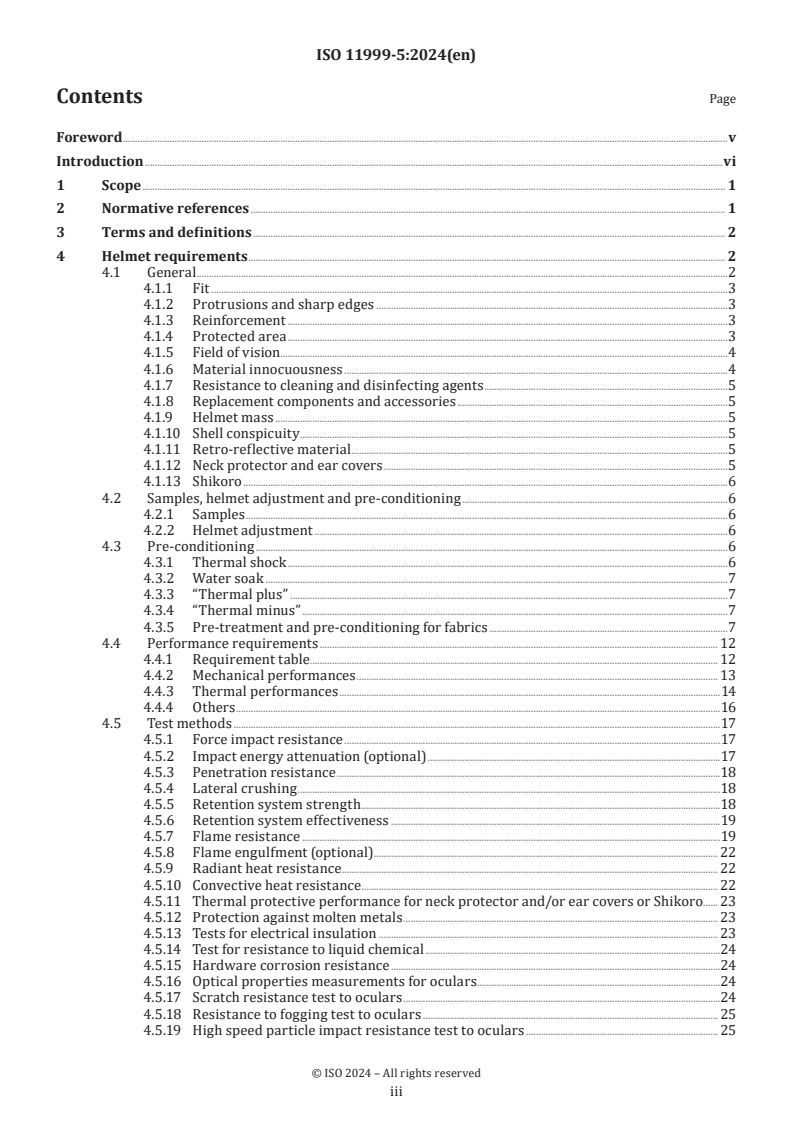
Contents Page
Foreword .v
Introduction .vi
1 Scope . 1
2 Normative references . 1
3 Terms and definitions . 2
4 Helmet requirements . 2
4.1 General .2
4.1.1 Fit .3
4.1.2 Protrusions and sharp edges .3
4.1.3 Reinforcement .3
4.1.4 Protected area .3
4.1.5 Field of vision.4
4.1.6 Material innocuousness .4
4.1.7 Resistance to cleaning and disinfecting agents .5
4.1.8 Replacement components and accessories .5
4.1.9 Helmet mass .5
4.1.10 Shell conspicuity .5
4.1.11 Retro-reflective material .5
4.1.12 Neck protector and ear covers .5
4.1.13 Shikoro .6
4.2 Samples, helmet adjustment and pre-conditioning .6
4.2.1 Samples .6
4.2.2 Helmet adjustment .6
4.3 Pre-conditioning .6
4.3.1 Thermal shock .6
4.3.2 Water soak .7
4.3.3 “Thermal plus” .7
4.3.4 “Thermal minus” .7
4.3.5 Pre-treatment and pre-conditioning for fabrics .7
4.4 Performance requirements . 12
4.4.1 Requirement table . 12
4.4.2 Mechanical performances . 13
4.4.3 Thermal performances .14
4.4.4 Others .16
4.5 Test methods .17
4.5.1 Force impact resistance .17
4.5.2 Impact energy attenuation (optional) .17
4.5.3 Penetration resistance .18
4.5.4 Lateral crushing .18
4.5.5 Retention system strength .18
4.5.6 Retention system effectiveness .19
4.5.7 Flame resistance .19
4.5.8 Flame engulfment (optional) . 22
4.5.9 Radiant heat resistance . 22
4.5.10 Convective heat resistance . 22
4.5.11 Thermal protective performance for neck protector and/or ear covers or Shikoro . 23
4.5.12 Protection against molten metals . 23
4.5.13 Tests for electrical insulation . 23
4.5.14 Test for resistance to liquid chemical .24
4.5.15 Hardware corrosion resistance .24
4.5.16 Optical properties measurements for oculars . .24
4.5.17 Scratch resistance test to oculars .24
4.5.18 Resistance to fogging test to oculars . 25
4.5.19 High speed particle impact resistance test to oculars . 25
iii
5 Marking . .25
iv
Foreword
ISO (the International Organization for Standardization) is a worldwide federation of national standards
bodies (ISO member bodies). The work of preparing International Standards is normally carried out through
ISO technical committees. Each member body interested in a subject for which a technical committee
has been established has the right to be represented on that committee. International organizations,
governmental and non-governmental, in liaison with ISO, also take part in the work. ISO collaborates closely
with the International Electrotechnical Commission (IEC) on all matters of electrotechnical standardization.
The procedures used to develop this document and those intended for its further maintenance are described
in the ISO/IEC Directives, Part 1. In particular, the different approval criteria needed for the different types
of ISO document should be noted. This document was drafted in accordance with the editorial rules of the
ISO/IEC Directives, Part 2 (see www.iso.org/directives).
ISO draws attention to the possibility that the implementation of this document may involve the use of (a)
patent(s). ISO takes no position concerning the evidence, validity or applicability of any claimed patent
rights in respect thereof. As of the date of publication of this document, ISO had not received notice of (a)
patent(s) which may be required to implement this document. However, implementers are cautioned that
this may not represent the latest information, which may be obtained from the patent database available at
www.iso.org/patents. ISO shall not be held responsible for identifying any or all such patent rights.
Any trade name used in this document is information given for the convenience of users and does not
constitute an endorsement.
For an explanation of the voluntary nature of standards, the meaning of ISO specific terms and expressions
related to conformity assessment, as well as information about ISO's adherence to the World Trade
Organization (WTO) principles in the Technical Barriers to Trade (TBT), see www.iso.org/iso/foreword.html.
This document was prepared by Technical Committee ISO/TC 94, Personal safety — Protective clothing and
equipment, Subcommittee SC 14, Fire-fighters’ personal equipment.
This second edition cancels and replaces the first edition (ISO 11999-5:2015), which has been technically
revised.
The main changes are as follows:
— the content has been revised with a focus on single performance requirements.
A list of all parts in the ISO 11999 series can be found on the ISO website.
Any feedback or questions on this document should be directed to the user’s national standards body. A
complete listing of these bodies can be found at www.iso.org/members.html.
v
Introduction
Figures are reproduced from AS/NZS 4067:2012 and AS/NZS 2512.1:2009, with permission from Standards
Australia. ISO has no responsibility and context in which are extracts are reproduced, nor is ISO in anyway
responsible for the other content or accuracy therein.
vi
International Standard ISO 11999-5:2024(en)
PPE for firefighters — Test methods and requirements for
PPE used by firefighters who are at risk of exposure to high
levels of heat and/or flame while fighting fires occurring in
structures —
Part 5:
Helmets
1 Scope
This document specifies the minimum design and performance requirements for helmets as part of personal
protective equipment (PPE) to be used by firefighters, primarily but not solely to protect against impact and
exposure to flame and high thermal loads.
2 Normative references
The following documents are referred to in the text in such a way that some or all of their content constitutes
requirements of this document. For dated references, only the edition cited applies. For undated references,
the latest edition of the referenced document (including any amendments) applies.
ISO 3146, Plastics — Determination of melting behaviour (melting temperature or melting range) of semi-
crystalline polymers by capillary tube and polarizing-microscope methods
ISO 6330:2021, Textiles — Domestic washing and drying procedures for textile testing
ISO 6942:2022, Protective clothing — Protection against heat and fire — Method of test: Evaluation of materials
and material assemblies when exposed to a source of radiant heat
ISO 9151, Protective clothing against heat and flame — Determination of heat transmission on exposure to flame
ISO 9185:2007, Protective clothing — Assessment of resistance of materials to molten metal splash
ISO 11612:2015, Protective clothing — Clothing to protect against heat and flame — Minimum performance
requirements
ISO 11999-3, PPE for firefighters — Test methods and requirements for PPE used by firefighters who are at risk
of exposure to high levels of heat and/or flame while fighting fires occurring in structures — Part 3: Clothing
ISO 11999-9, PPE for firefighters — Test methods and requirements for PPE used by firefighters who are at risk
of exposure to high levels of heat and/or flame while fighting fires occurring in structures — Part 9: Firehoods
ISO 13688:2013 + ISO 13688:2013/Amd.1:2021, Protective clothing — General requirements
ISO 15025, Protective clothing — Protection against flame — Method of test for limited flame spread
ISO 17492, Clothing for protection against heat and flame — Determination of heat transmission on exposure to
both flame and radiant heat
ISO 17493, Clothing and equipment for protection against heat — Test method for convective heat resistance
using a hot air circulating oven
ISO/TR 19591, Personal protective equipment for firefighters — Standard terms and definitions
EN 136:1998, Respiratory protective devices - Full face masks
EN 137:2006, Respiratory protective devices. Self-contained open-circuit compressed air breathing apparatus
with full facemask. Requirements, testing, marking
EN 167:2001, Personal eye protection — Optical test methods
EN 168:2001, Personal eye protection — Non-optical test methods
EN 172:1994 + A1: 2000, Personal eye protection — Sunglare filters for industrial use
EN 960, Headforms for use in the testing of protective helmets
EN 13087-1:2012, Protective helmets — Test methods — Part 1: Conditions and conditioning
EN 13087-2:2012, Protective helmets — Test methods — Part 2: Shock absorption
EN 13087-4, Protective helmets — Test methods — Part 4: Retention system effectiveness
EN 13087-5:2012, Protective helmets — Test methods — Part 5: Retention system strength
EN 13087-6, Protective helmets — Test methods — Part 6: Field of vision
EN 13087-8:2000, Protective helmets — Test methods — Part 8: Electrical properties
EN 13087-10, Protective helmet — Test methods — Part 10: Resistance to radiant heat
NFPA 1971:2018, Standard on Protective Ensembles for Structural Fire Fighting and Proximity Fire Fighting
CIE 54.2, Retroreflection – Definition and measurement
3 Terms and definitions
For the purposes of this document, the terms and definitions given in ISO/TR 19591 and the following apply.
ISO and IEC maintain terminology databases for use in standardization at the following addresses:
— ISO Online browsing platform: available at https:// www .iso .org/ obp
— IEC Electropedia: available at https:// www .electropedia .org/
4 Helmet requirements
4.1 General
Helmets shall consist of at least the following assembled components:
a) Shell (at the minimum area above the A-A’ line as per Figure 1).
b) Energy absorbing system.
c) Retention system. The retention system shall include a chinstrap having a minimum width of 19 mm,
quick release buckle, and size adjustment mechanism.
d) Neck protector and/or ear covers, or Shikoro.
e) Face shield or goggles or both —
— where a face shield is selected, the face shield shall be attached to and tested with the helmet;
— where goggles are selected, the goggles shall be permitted to be removed from the helmet before it is
tested. This only applies to those which are removable. Where they are attached to the helmet, they
shall be tested with the helmet.
f) Retro-reflective material.
4.1.1 Fit
The fit of the helmet shall be adjustable laterally and/or vertically to improve the wearing comfort and the
helmet efficiency. This adjustment shall be easily done by the wearer without the use of tools. It should
be possible for the wearer to remove the helmet by loosening the chinstraps, using one hand wearing a
structural firefighting glove.
When this adjustment covers several sizes of head circumference, the relevant instructions shall be given in
the information supplied by the manufacturer.
4.1.2 Protrusions and sharp edges
There shall be no sharp edges, roughness, or projection on any part of the helmet. Projections intruding
more than 5 mm from the shell interior surface and above the test line, shall not be acceptable unless
covered by protective padding or impact liner. Projections above the test line shall be impacted directly over
the position of the said projection in accordance with 4.4.2.1, and the testing laboratory shall assess that the
projection did not make contact with the head form.
Rigid internal projections below the test line and above the reference plane shall not be able to touch the
head of the wearer when the helmet is normally affixed to the head.
The profile at the front of the helmet shall not prevent the wearing of spectacles or goggles as specified by
the helmet manufacturer.
4.1.3 Reinforcement
The shell construction shall be uniformly reinforced. This does not exclude a gradual increase of the shell’s
thickness or of the grooves or fixation devices of the harness or of the accessories, but it does exclude every
other localized reinforcement.
4.1.4 Protected area
When adjusted on the head form as in 4.2.2, the helmet shall at the minimum cover the entire area 12,7 mm
above the reference plane (see line A -A’ in Figure 1).
Dimensions in millimetres
Key
1 reference plane
2 basic plane
3 central vertical axis
Figure 1 — Protected area (Image taken from AS/NZS 2512.1:2009)
4.1.5 Field of vision
When the helmet is tested in accordance with EN 13087-6, with any attached face shield or goggle in both
the stowed and deployed positions, the wearer’s field of vision shall correspond to the following angles:
a) A dihedral angle of at least 105° measured horizontally between L and K on each side of the sagittal plane
which passes through the point L (see Figure 2). Remove the neck protector or Shikoro, if necessary.
b) An upper dihedral angle greater than 7° above the reference plane and which is defined by the straight
line passing through L1, L2 (see Figure 2).
c) A lower dihedral angle greater than 45° under the basic plane and which is defined by the straight line
passing through K1 K2 situated on the surface of the head form as 31 mm on each side of the point K (see
Figure 2).
d) With face shield or goggles in the stowed position, the helmet shall provide peripheral vision clearance
of at least 94° to each side.
NOTE “Stowed position” means to be placed in “out of use” position when it is not providing the designed
protection.
4.1.6 Material innocuousness
Materials used in helmets that may come into contact with the wearer’s skin shall not be known to be likely
to cause irritation or any other adverse effect to health. They shall meet the requirements as detailed in
ISO 13688:2013, 4.2.
4.1.7 Resistance to cleaning and disinfecting agents
All helmet materials shall be unimpaired after cleaning and disinfection by the agents and procedures
specified in the information provided by the manufacturer. Such agents shall not be known to be likely to
cause irritation or any other adverse effect to the health of the wearer.
4.1.8 Replacement components and accessories
The fitting and/or replacement of any interchangeable parts or accessories shall not impair the function
and/or safety of the helmet. All accessories and their respective replacement procedures shall be given in
the information supplied by the manufacturer. No openings shall penetrate the helmet shell other than those
provided by the manufacturer for mounting energy absorbing systems, retention systems or accessories.
Face shields shall not be considered as accessories and along with neck protectors shall be considered as
fixed components of the helmet assembly.
4.1.9 Helmet mass
If helmet mass, excluding non-permanently fitted accessory parts, exceed 1 500 g it shall be marked on the
helmet visible to users.
4.1.10 Shell conspicuity
The helmet shell shall have retro-reflective markings in accordance with 4.1.11 adhered to the shell exterior.
A minimum of 26 cm of the markings shall be visible when the helmet is viewed from any angle at the
reference plane (see Key 2 on Figure 1). A material which combines both fluorescent and retro-reflective
properties may be used. Care should be exercised when selecting marking materials to ensure they will not
degrade the helmet shell.
4.1.11 Retro-reflective material
The material shall have a coefficient of luminous intensity per square meter (CIL/m ) of not less than
−1 −2
100 cd·lux ·m when measured in accordance with CIE 54.2 with an observation angle of 0,2° and entrance
angle of −4°.
4.1.12 Neck protector and ear covers
Neck protector and/or ear covers shall cover the wearer’s neck and ears and shall provide at least the
following area of coverage as described below.
The helmet with neck protector and ear cover shall be donned in the proper wearing position as specified
by the manufacturer on an EN 960 head form 575 according to its helmet positioning index. The helmet
positioning index shall be the vertical distance, as specified by the manufacturer, from the lowest point of
the brow at the lateral midpoint of the helmet to the basic plane of the EN 960 head form 575 with the helmet
firmly positioned on the head form. See Figure 4.
In this position, the neck coverage shall be measured downward from the reference plane to the lower edge
of the neck coverage:
a) 95 mm measured 50 mm forward of the coronal plane;
b) 120 mm measured 25 mm forward of the coronal plane;
c) 130 mm measured at the coronal plane;
d) 130 mm measured at the midsagittal plane at the rear of the head form.
4.1.13 Shikoro
Where Shikoro is fitted, it shall be made of fire resistant fabric that surrounds the entire wearer’s head,
neck part below the helmet brim level except eye portion covered by the face shield. Its purpose is to prevent
direct flame contact to wearer’s head, face, or neck and also to reduce heat stress. The helmet fitted with
Shikoro shall continue to meet the relevant requirements of 4.4.3.1 to 4.4.3.5.
4.2 Samples, helmet adjustment and pre-conditioning
Helmet samples shall be submitted for testing in the condition in which they are offered for sale, including
any means of attachment for energy absorbing systems, retention systems, neck protector and ear covers or
Shikoro, as well as face shield or goggles as specified in the test methods.
4.2.1 Samples
Unless otherwise specified in the test methods, the number of specimens needed for pre-conditioning and
testing shall be in accordance with Table 2.
4.2.2 Helmet adjustment
The helmet shall be adjusted in accordance with the Head Positioning Index (HPI) provided by the
manufacturer before testing is performed. Following alignment with the selected head form, the helmet is
firmly seated on the head form with the aid of a (5,0 ± 0,5) kg ballast mass. If the wearing adjustment covers
several sizes of head form, then the size of head form representing the most unfavourable case shall be used.
Helmets shall be tested on head forms that conform to EN 960 and to sizes as appropriate to the test
performed.
4.3 Pre-conditioning
Unless otherwise specified in the specific test methods, all specimens (complete with any attached
accessories, which shall be in the stowed position, where appropriate) shall be pre-conditioned for a
minimum of 24 h by exposure to a temperature of (20 ± 2) °C and a relative humidity of (65 ± 15) % prior to
testing.
Testing shall be carried out within 5 min of removing the samples from pre-conditioning.
Where specified in the test methods, helmets shall be conditioned in accordance with the conditioning
sequence defined in Table 2 and testing shall be carried out within 5 min of removing from the conditioning
chamber.
4.3.1 Thermal shock
Expose the helmet successively to the following conditions:
a) 1 h at the temperature of: (choose a condition mark accordingly) –10 °C ± 2 °C; −20 °C ± 2 °C; −30 °C ± 2 °C
or −40 °C ± 2 °C,
b) 1 h at a temperature of 60 °C ± 2 °C;
c) 15 min totally immersed in fresh tap water at a temperature of 10 °C ± 2 °C;
d) 1 h at a temperature of 60 °C ± 2 °C;
e) 20 h to 24 h at standard temperature 20 °C ± 2 °C and standard relative humidity 65 % ± 5 %.
The time interval between sequences a) to b), b) to c) and c) to d) shall be within 5 s. During sequences d)
and e), the helmet shall be in a position that allows it to drain.
4.3.2 Water soak
The helmet shall be conditioned according to EN 13087-1:2012, 4.6, with tap water temperature not greater
than 27 °C, for between 4 h and 24 h.
4.3.3 “Thermal plus”
The helmet shall be conditioned according to EN 13087-1:2012, 4.4 at the temperature of 50 °C ± 2 °C for
between 4 h and 24 h.
4.3.4 “Thermal minus”
The helmet shall be conditioned according to EN 13087-1:2012, 4.5 at the temperature chosen in 4.3.1 a) for
between 4 h and 24 h.
4.3.5 Pre-treatment and pre-conditioning for fabrics
The neck protector and/or ear cover or Shikoro shall be laundered in line with the manufacturer’s
instructions on the basic standardized processes for five cleaning cycles. If the cleaning method is not
specified, the specimens shall be subjected to five cleaning cycles in accordance with the procedure defined
in Table 1.
Table 1 — Laundering procedure
Wash procedure Dry procedure
ISO 6330, 6N (front load, normal, 60 °C, 1 g/L ECE deter- ISO 6330:2021, Annex F, (machine Type A1)
gent in soft water) exhaust temperature normal
Following pre-treatment, specimens shall be pre-conditioned in accordance with 4.3.
Key
CTV central transverse vertical plane
LVM longitudinal vertical median plane
F front
B back
a
Reference plane.
b
Basic plane.
Figure 2 — Section of head form, longitudinal, vertical, medial, reference and basic planes (Image
taken from of AS/NZS 4067)
Key
A mid-sagittal plane
B reference plane
C basic plane
D coronal plane
E central vertical axis
1 crown
2 front
3 rear
4 left or right
Figure 3 — Impact points for force impact
Dimensions in millimetres
Key
A central and vertical axis
B front vertical transverse plane
C front test area
D front test line (85 mm above basic plane)
E top test area
F rear vertical transverse plane
G two side test area (left and right)
H rear test area
I rear test line (60 mm above test line)
J reference plane
K basic plane
Figure 4 — Impact sites for impact energy attenuation (Image taken from AS/NZ 4067)
Table 2 — Pre-conditioning and testing sequence
Sequence 0 1 2 3 4 5
Helmet Pre-con- Ther- Ther- Ther- Water Specific test
specimen dition- mal mal mal soak
number ing shock plus minus
4.3.2
4.3.3 4.3.4
4.3.1
1 X 4.1.4 Protected area
1 X 4.1.5 Field of vision
1 X X
2 X X 4.5.1 Force impact resistance
3 X X
4 X X
5 X X 4.5.2 Impact energy attenuation (optional)
6 X X
7 X X
4.5.3 Penetration
8 X X
2 X 4.5.4 Lateral crushing
3 X 4.5.5 Retention system strength
7 X 4.5.6 Retention system effectiveness
4.5.7.2 Flame resistance tests on helmets, Method 1
9 X X
4.5.7.2 Flame resistance tests on helmets, Method 2
X 4.5.7.3 Flame resistance on face shield/goggles
4.5.7.4 Flame resistance on neck protector and/or ear
X
cover of Shikoro and chin strap material
13 X 4.5.8 Flame engulfment (optional)
(optional)
10 X 4.5.9.1 (method A) Radiant heat resistance: Helmet
X 4.5.9.2 (method B) Radiant heat resistance: Face
shield/goggle
Fabric X 4.5.9.3 Radiant heat transfer: Neck protector and ear
assembly cover/Shikoro
11 X 4.5.10 Convective heat: Helmet
X 4.5.10 Convective heat: Neck protector and ear cover/
Shikoro, thread
X 4.5.10 Convective heat: Face shield/goggles
Fabric X 4.5.11 TPP: neck protector and ear cover or Shikoro
assembly HTI: Shikoro only
14 X 4.5.12 Protection against molten metal
3 X 4.5.13.1 Electrical: Conductive head form
(On helmet and face shield)
6 X 4.5.13.2 Electrical: Wet helmet insulation
3 X 4.5.13.3 Electrical: Surface insulation
4.5.14 Contact with liquid chemicals
12 X
(On helmet and face shield/goggles)
X 4.5.15 Hardware corrosion resistance
X 4.5.16 Optical properties: Face shield/goggles
X 4.5.17 Resistance to scratch: Face shield/goggle
X 4.5.18 Resistance to fogging: Face shield/goggles
X 4.5.19 High speed particle impact: Face shield
4.4 Performance requirements
4.4.1 Requirement table
No helmet sample that has been subjected to testing shall be offered for sale.
Helmets shall be tested according to the performance requirements in accordance with Table 3, as
appropriate with manufacturer’s accessories in place as appropriate. The required state of deployment of
these accessories during testing are described in 4.4.2 to 4.4.4.
Table 3 — Overview of helmet performance requirements
Performance property Applies to Clause
Mechanical
Resistance to force impact Helmet 4.4.2.1
Impact energy attenuation (optional) Helmet 4.4.2.2
Resistance to penetration Helmet 4.4.2.3
Lateral crushing Helmet 4.4.2.4
Retention system strength Retention system 4.4.2.5
Retention system effectiveness Retention system 4.4.2.6
Thermal
Flame resistance Helmet
Neck protector and/or ear cover or Shikoro
4.4.3.1
Chin strap
Face shield/goggles
Flame engulfment (optional) Helmet and accessories 4.4.3.2
Radiant heat resistance Helmet
Face shield/goggles 4.4.3.3
Neck protector and/or ear cover or Shikoro
Convective heat resistance Helmet
Face shield/goggles
Neck protector and/or ear cover or Shikoro 4.4.3.4
Thread
Label (for traditional style helmet)
Thermal protective performance Neck protector and/or ear cover or Shikoro 4.4.3.5
Molten metal Helmet
4.4.3.6
Neck protector and/or ear cover or Shikoro
Others
Electrical, conductive headform Helmet
4.4.4.1.1
Face shield
Electrical, wet helmet insulation Helmet 4.4.4.1.2
Electrical, surface insulation Helmet 4.4.4.1.3
Contact with liquid chemical Helmet
4.4.4.2
Face shield
Corrosion resistance Hardware 4.4.4.3
Optical properties Face shield/goggles 4.4.4.4
Resistance to scratch Face shield/goggles 4.4.4.5
Resistance to fogging Face shield/goggles 4.4.4.6
High speed particle impact Face shield/goggles 4.4.4.7
4.4.2 Mechanical performances
4.4.2.1 Force impact resistance
The helmet shall be tested according to 4.5.1, with face shield/goggles attached (excluding neck protector
and/or ear cover or Shikoro), and the force transmitted to the head form shall not exceed 15 kN with an
impact energy of (123 ± 1) J on the crown and (25 ± 1) J on the off-crowns.
4.4.2.2 Impact energy attenuation (optional)
The helmet, with face shield/goggles in the deployed position (excluding neck protector and ear cover/
Shikoro), shall be tested according to 4.5.2, and shall not exceed the maximum acceleration as specified
follows:
— top: 1 471,5 m/s (150g);
— front: 2 943,0 m/s (300g);
— sides: 2 943,0 m/s (300g);
— back: 2 943,0 m/s (300g).
Any acceleration above 1 962 m/s (200g) shall not exceed a duration of 3 ms, and an acceleration above
1 471,5 m/s (150g) shall not exceed a duration of 6 ms.
4.4.2.3 Penetration resistance
The helmet shall be tested according to 4.5.3 with the face shield/goggles in deployed position (excluding
neck protector and ear cover/Shikoro), and shall have no contact between the striker and the test block.
4.4.2.4 Lateral crushing
The helmet shall be tested according to 4.5.4 with the maximum transverse and longitudinal deformations
not exceeding 40 mm, and the residual deformations not exceeding 15 mm.
4.4.2.5 Retention system strength
The helmet shall be tested according to 4.5.5:
a) the maximum elongation of the whole system shall not exceed 20 mm for a load of 250 N;
b) the minimum width of the chin strap shall not be less than 15 mm for a load of 250 N;
c) the release point of the retention system shall be between 500 N and 1 000 N.
NOTE Users are reminded of the following possible consequences when making a decision with regards to c):
— Option to not adopt – there is a risk of strangulation due to the wearer being hung by the chinstrap if the chinstrap
does not release below 1 000 N.
— Option to adopt – there is a risk of losing head protection by having the helmet retention system break prematurely
(i.e. below 500 N) due to deterioration of retention system over time.
4.4.2.6 Retention system effectiveness
Tested according to 4.5.6, the helmets shall not come off the head form.
4.4.3 Thermal performances
4.4.3.1 Flame resistance
The helmet, together with face shield/goggles, neck protector and/or ear cover or Shikoro and chin strap
material shall be tested according to the respective subclauses of 4.5.7 and shall meet the following
requirements.
a) Helmet material, including edging shall not show any visible after flame or glow 5 s after removal from
the test f lame.
b) Face shield/goggles shall not show any visible flame or glow 5 s after removal from the test flame.
c) No part of the helmet and face shield/goggles around test point shall show separation, melting or
dripping.
d) Individual materials in the fabric assembly of neck protector and/or ear cover or Shikoro and chin strap
webbing shall demonstrate the following performances:
Table 4 — Limited flame spread performance following Surface ignition
Properties Requirements
Flame spread No specimen shall permit any part of the lowest boundary of any flame to reach the upper or
either vertical edge.
Flaming debris No specimen shall give flaming or molten debris.
Hole formation No specimen shall give hole formation of 5 mm or greater in any direction, except for an inner
layer that is used for specific protection other than flame or heat protection.
Afterglow Afterglow time shall be ≤2 s.
A glowing inside the charred area is defined in ISO 15025 as afterglow without combustion and
for the purpose of this clause is not regarded as afterglow.
After flame After flame time shall be ≤2 s.
Table 5 — Limited flame spread performance following Bottom-edge ignition
Properties Requirements
Flame spread No specimen shall permit any part of the lowest boundary of any flame to reach the upper or
either vertical edge.
Flaming debris No specimen shall give flaming or molten debris.
After flame After flame time shall be ≤2 s.
Afterglow Afterglow time shall be ≤2 s.
A glowing inside the charred area is defined in ISO 15025 as afterglow without combustion and
for the purpose of this clause is not regarded as afterglow.
Char length Char length shall be <100 mm in accordance with ISO 15025:2016, Annex C.
4.4.3.2 Flame engulfment (optional)
When tested in accordance with 4.5.8, the helmet together with face shield/goggles, neck protector and/or
ear cover or Shikoro, shall not show any visible afterflame or glow 5 s after removal from the test flame.
4.4.3.3 Radiant heat resistance
The helmet, with face shield/goggle attached in the stowed position, shall be tested in accordance with
4.5.9.1 (method A) for helmet, 4.5.9.2 (method B) for face shield/goggles and 4.5.9.3 for neck protector and/
or ear cover or Shikoro, and shall meet the following requirements.
a) No part of the helmet, face shield/goggles shall ignite or melt to such a degree as to cause softening or
dripping of material such that there is contact of the material with the head form.
b) The temperature measured at the surface of the artificial head shall not rise more than 20 °C above the
standard laboratory temperature of 20 °C ± 3 °C.
c) Neck protector and/or ear cover or Shikoro shall achieve the radiant heat transfer performances in
Table 6 and results rounded to the nearest whole second (s).
Table 6 — Radiant heat transfer
Heat transfer index Performance (s)
RHTI ≥11
RHTI – RHTI ≥4
24 12
4.4.3.4 Convective heat resistance
When tested according to 4.5.10, helmets with neck protector and ear cover/Shikoro, and face shield/goggles
attached in the deployed position shall meet the following requirements.
a) no part of the helmet assembly that is not in contact with the head form before the test shall come into
contact with the head form as a result of the test. Evaluate by visual inspection.
b) there shall be no ignition, separation, melting or dripping of any part of the helmet assembly, including
threads.
c) any moveable elements of the helmet, (e.g. chin strap closure and release device(s) or face shield
mechanism) shall remain functional.
d) there shall be no ignition, melting or loss of legibility of any part of the product labels.
e) no part of the face shield/goggles component that was not below the brim line prior to the test shall be
below the brim line after the test.
f) there shall be no dripping of the face shield/goggle component.
g) no part of the neck protector and ear cover and Shikoro shall ignite, melt or shrink more than 5 % (10 %
for Shikoro) in two perpendicular directions.
4.4.3.5 Thermal protective performance (TPP)
When tested according to 4.5.11, neck protector and/or ear cover assembly or Shikoro shall have an average
TPP of at least 20.
Shikoro only shall be tested in accordance with ISO 9151, after 4.3.5 pre-treatment with the performance of
HTI ≥ 10 s and HTI – HTI ≥ 3 s.
24 24 12
4.4.3.6 Protection against molten metals
When tested according to 4.5.12, helmets, neck protector and/or ear covers or Shikoro:
a) shall not be penetrated by the molten metal;
b) shall not show any deformation greater than 10 mm when measured at right angles to the base plane of
the helmet;
c) shall not burn with the emission of a flame after a period of 5 s has elapsed after the pouring of the
molten metal has ceased;
d) neck protector and ear cover/Shikoro shall meet the requirements of ISO 11612:2015, 7.5 Performance
level E2.
4.4.4 Others
4.4.4.1 Electrical resistance
4.4.4.1.1 Conductive headform test
The helmet assembly shall be tested according to 4.5.13.1 and shall show no visible evidence of breakdown
and the leakage current shall not exceed 3,0 mA.
4.4.4.1.2 Wet helmet insulation test
When tested according to 4.5.13.2, the helmet assembly shall show no visible evidence of breakdown and the
leakage current shall not exceed 3,0 mA.
4.4.4.1.3 Surface in
...